periodical issue
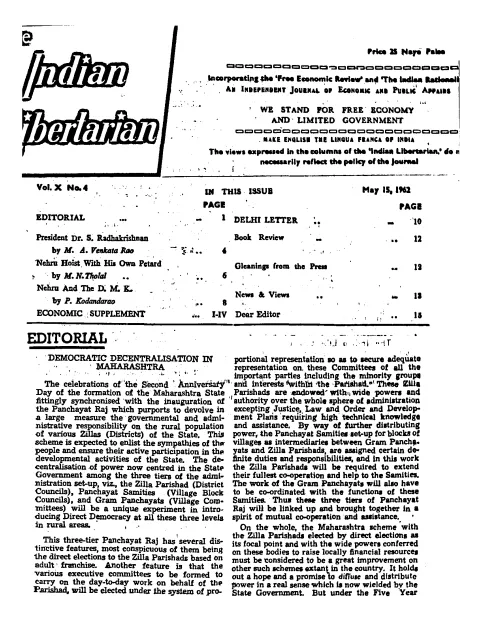
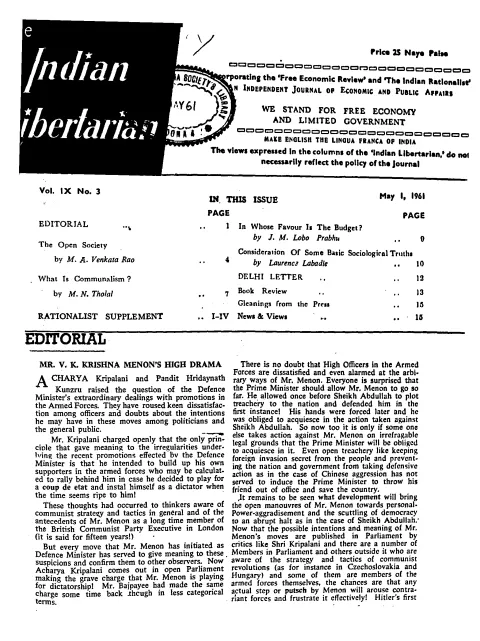
The Indian Libertarian
An Independent Journal of Economic and Public Affairs (Incorporating the 'Free Economic Review' and 'The Indian Rationalist')
By MA Venkata Rao, M. N. Tholal, J. M. Lobo Prabhu
Edited and Published by D. M. Kulkarni, B.A., LL.B. for the Libertarian Publishers (Private) Ltd., Arya Bhuvan, Sandhurst Road, Bombay 4. · Bombay · 1961
20 pages
The Indian Libertarian
Summary
The May 1, 1961 issue (Vol. IX No. 3) of The Indian Libertarian, the Bombay fortnightly edited by D. M. Kulkarni for the Libertarian Publishers and flying the slogans ‘We stand for free economy and limited government’ and ‘Make English the lingua franca of India’, turns on two questions, the conduct of the Defence Minister and the Congress proposal to ban communal parties before the general elections. The unsigned editorial opens with ‘Mr. V. K. Krishna Menon’s High Drama’, reporting the charges brought by Acharya Kripalani and Pandit Hridaynath Kunzru over irregular Army promotions and Kripalani’s claim that Mr. Menon is building a following in the armed forces against the day he plays for a coup, and goes on to a Czech account of the communist seizure of power in 1948, to the Russian pilots allowed to fly over the Indian border areas, and to the Congress committee’s proposal to outlaw communal parties, which the editorial answers by holding that the real offence is extra-territorial loyalty and that the Communist Party of India is the one party nobody proposes to ban. M. A. Venkata Rao’s ‘The Open Society’ takes up Bergson and Popper and asks how far India’s schools, trades and new linguistic States meet the test of an open society. M. N. Tholal’s ‘What Is Communalism ?’ defends Madan Mohan Malaviya against the charge, recalls Maulana Mohammad Ali and the writer’s own years on the Hindustan Times, and reports the Muslim argument that Gandhi’s campaign against untouchability was itself communal. J. M. Lobo Prabhu’s ‘In Whose Favour Is The Budget ?’ argues that the Finance Minister’s pre-election budget taxes the common man while appearing to spare him, and Laurence Labadie’s ‘Consideration Of Some Basic Sociological Truths’ traces the evils of Statism to the master and slave relation and ends in a defence of anarchism. The four-page Rationalist Supplement carries S. Ramanathan’s ‘A New Atom Bomb’ on Freud and religion, Narsingh Narain’s ‘Humanism In India’ setting out the new Humanist Union’s common-sense humanism, and H. Cutner’s ‘The Struggle For Family Planning’ on Malthus, Bradlaugh and Marie Stopes. A Delhi Letter on the Prime Minister’s use of the word ‘nuisance’ for Acharya Kripalani, S. Ramanathan’s review of S. S. Arakeri’s prize essay on the caste system, and the Gleanings from the Press and News & Views columns close the issue.
Key points
-
The editorial holds that Mr. V. K. Krishna Menon’s dealings with Army promotions, raised in Parliament by Acharya Kripalani and Pandit Hridaynath Kunzru, are of a piece with his fifteen years on the executive of the British Communist Party, and that the Prime Minister will act against him only if someone else forces his hand, as happened with Sheikh Abdullah.
-
The editorial urges Indian politicians to study the chapter published by Herbert Morrison and the British Parliamentary Association from a Czech participant’s account of the 1948 coup, and Rakosi’s pamphlet on the taking of Hungary, as manuals of how a trusting democracy is captured from within.
-
On the Congress proposal to ban communal parties the editorial argues that the offence worth punishing is extra-territorial loyalty rather than communal preference, that slogans of Pakistan Zindabad shouted in Indian streets should be prosecuted as acts and not as opinions, and that the Communist Party of India, the most dangerous case of all, is the one nobody proposes to ban.
-
M. A. Venkata Rao’s ‘The Open Society’ argues, following Bergson and Popper, that a society is closed wherever birth, orthodoxy or official doctrine settles a man’s place, and tests India by its school ladders, its spreading State monopolies, the bar on outsiders acquiring property in Kashmir and the drive to expel Bengalis from Assam.
-
M. N. Tholal’s ‘What Is Communalism ?’ contends that insisting on justice for one’s own community is not communalism, defends Madan Mohan Malaviya by quoting Jawaharlal Nehru’s own tribute in the Autobiography, and observes that a legal ban of the kind now proposed would have outlawed Malaviya’s Nationalist Party of 1926.
-
J. M. Lobo Prabhu’s ‘In Whose Favour Is The Budget ?’ holds that the Finance Minister’s new duties on tea, coffee, kerosene, matches, cloth and diesel fall on the whole population, that the duty on newsprint is a tax on information, and that the Third Plan must be turned from public to private and from capital intensive to labour intensive schemes if the 45 idle millions are to be employed.
-
Laurence Labadie’s ‘Consideration Of Some Basic Sociological Truths’ argues that the professions which live off society’s evils acquire an interest in their continuance, that the doctrine of the culpability of man arms Church and State alike, and that anarchism is the only social philosophy left unscathed by the atomic bomb.
-
The Rationalist Supplement carries S. Ramanathan on Weston LaBarre’s Freudian reading of religion as a neurotic defence, Narsingh Narain’s statement of the newly registered Humanist Union’s ‘Common-sense Humanism’, and H. Cutner’s history of the birth control struggle from Malthus and Knowlton through the Bradlaugh and Besant trial to Marie Stopes.
-
The Delhi Letter reports that a special committee of the Congress Parliamentary Party voted five to two to ban communal parties but only after the next General Election, and objects that the Prime Minister asked Opposition members to disclose their sources of information and called Acharya Kripalani a nuisance to the House.
-
S. Ramanathan’s review of S. S. Arakeri’s prize essay holds with Ambedkar and against Gandhi that untouchability is only an extended form of caste, and that the whole graded pyramid must be smashed before untouchability can be abolished.
Essays
Editorial
The unsigned editorial opens with ‘Mr. V. K. Krishna Menon’s High Drama’, prompted by the questions Acharya Kripalani and Pandit Hridaynath Kunzru put in Parliament about the Defence Minister’s extraordinary dealings with promotions in the armed forces. It reports Kripalani’s open charge that the only principle giving meaning to the irregularities is that Mr. Menon intended to build up his own supporters against the day he might play for a coup d’etat, notes that Mr. Bajpayee had said as much earlier in less categorical terms, and sets the charge beside Mr. Menon’s long membership of the British Communist Party executive in London. It then turns to communist tactics in Czechoslovakia, to the Russian pilots flying over the Indian border areas, to the Congress proposal to ban communal parties and to the question of extra-territorial loyalty.
- Argues that the Prime Minister will move against Mr. Menon only if someone else acts on irrefragable legal grounds, as his hands were forced over Sheikh Abdullah
- Commends to Indian politicians the chapter published by Herbert Morrison and the British Parliamentary Association from a Czech participant’s account of the 1948 coup, and Rakosi’s pamphlet on Hungary, as instruction in how coalition governments with communist defence and police ministers end
- Reports that Mr. C. Rajagopalachari, who had until then endorsed the Prime Minister’s foreign policy, has condemned the admission of Russian military pilots to instruct the Indian air force, and calls the Prime Minister’s plea that precautions have been taken no longer innocence but plain treachery
- Holds that the Law Minister has refused to oblige the party caucus by finding a ban on communal parties constitutional, and that the Congress interest in the question is the neutralising of communal bloc votes before the elections
- Answers that the operative charge against the Muslim League is loyalty to Pakistan rather than communal preference, that the Communist Party of India has given ample evidence of extra-territorial loyalty and is not thought of for banning, and that a military pact with Pakistan would free Indian forces to answer the Chinese attack
- Carries alongside the editorial the fable ‘The Fat Dog And The Wild Wolf’ from William A. Paton’s ‘Shirt Sleeve Economics’ and a column of quotations headed ‘British Socialists On Nationalisation’ from Gaitskell, Crosland, Pakenham, Bellenger, Mrs. Eirene White and Mr. Beswick
The Open Society
By M. A. Venkata Rao
M. A. Venkata Rao’s ‘The Open Society’ argues that democracy requires as its matrix and psychological climate what may be called the open society, and takes its two expositors to be Henri Bergson in ‘The Two Sources of Morality and Religion’ and Dr. Popper in ‘The Open Society and its Enemies’. Venkata Rao follows Bergson’s account of morality and religion as defence reactions grown out of tribal struggle, and Popper’s test that a society is closed wherever it excludes a man for an accident such as the colour of his skin, orthodoxy of opinion or birth. He ranks medieval Catholicism, modern communism, Nazism and the caste order together as closed systems, and then turns the criterion on India.
- Cites Bertrand Russell nearly mobbed in England during the first world war, and later obliged to give up a New York teaching post over his views on free love, as instances of the closed standard of judgment at work in national societies
- Reads Napoleon’s maxim that every soldier’s knapsack contained a Marshal’s baton as the expanding horizon that inspired a generation of Frenchmen, and Britain’s imperial century as an open society at least for her own nationals
- Treats the Commonwealth, which has just shed South Africa over apartheid, as the logical development of that opening
- Asks whether India’s school system reaches the whole school-age population to fourteen, whether evening schools and scholarships carry able scholars further, and whether private persons may still start industrial and trade centres of their own
- Objects that Indians from other parts of India may not acquire property or start enterprises in Kashmir, that more lines of trade are passing into State monopoly, and that the drive in Assam to send back Bengalis settled for a hundred years is the closed mind of chauvinistic nationalism appearing before Assam has a nationalism of its own
AIR: Free Pasture For Salazar Agents
The boxed item ‘AIR: Free Pasture For Salazar Agents’, printed as ‘AIR, FREE PASTURE FOR SALAZAR AGENTS’ and reprinted from the Marathi Sunday journal ‘Alamgeer’ and set at the foot of the page carrying ‘The Open Society’, alleges that the Portuguese propaganda section of All India Radio has been a preserve for Salazar’s sympathisers. It reports the departure by air for Brazil of the Goan doctor Gaitonde and his Portuguese wife Edilla Gaitonde, who had resigned from AIR shortly before, and asks why a professed liberation leader should leave Indian soil just as fresh efforts over Goa are being prepared.
- Alleges that Mrs. Edilla Gaitonde repeatedly refused to relay anti-Salazar material and altered scripts, and that her Indian seniors were snubbed by Dr. Keskar for complaining
- Records her reported remark that it was better to serve under the Salazar regime than to work under AIR
- Recalls the earlier case of Tello Mascarenhas, chief of the Portuguese section of AIR, who left the Government of India’s service in 1958 and is now Public Prosecutor in Portugal
What Is Communalism ?
By M. N. Tholal
M. N. Tholal’s ‘What Is Communalism ?’ opens by asking whether a man who insists on justice for his own community, or who would teach its women the use of the revolver against goondas, can be called communal, and answers that he cannot. The man in question is Madan Mohan Malaviya, and Tholal recalls putting Malaviya’s case to Motilal Nehru, who dismissed it as a drop in the ocean, and coming on reflection to think the drop would become the ocean if unchecked. He sets against Malaviya the utterances of Maulana Mohammad Ali, who told a public meeting that the meanest Muslim was better than Mahatma Gandhi, and who chose the Prime Minister as General Secretary of the Congress.
- Quotes Ghalib’s couplet on the limit to punishment for a sinner rather than an unbeliever to show the dimensions of the problem, and traces the rift between Gandhi and the Ali Brothers to their demand that Hindu and Muslim disputes in the Frontier Province be settled by the Shariat
- Quotes Nehru’s Autobiography on the Nationalist Party of Malaviya and Lala Lajpat Rai and on Malaviya as the Nestor of Indian politics, and observes that under the ban some Congress leaders now contemplate such a party would have to be banned
- Recounts the writer’s own time acting as Editor of the Hindustan Times during the 1926 elections, when Lala Lajpat Rai complained to Malaviya about his impartiality and Malaviya took little notice
- Reports the Muslim argument that Gandhi’s movement against untouchability was itself communal, since it closed a hunting ground for conversion, and suggests Gandhi took up untouchability when politics had to be eschewed to stay out of prison
- Reads the Jana Sangh victory in the Delhi by-election as the shock behind the talk of banning organisations, and the shunting of Sampurnanand and the pressure over the U.P. Congress presidency as the same pursuit of power by hook or crook
A New Atom Bomb
By S. Ramanathan
S. Ramanathan’s ‘A New Atom Bomb’, which opens the four-page Rationalist Supplement, takes up Weston LaBarre’s article on neurotic defence mechanisms in supernatural religion from the November and December 1960 American Humanist. Ramanathan argues that the psychological atom bomb LaBarre calls for is not a new discovery but the revaluation of Freud, and that psycho-analysis is a therapy of societies as well as of individuals. As the child’s helplessness before its father breeds the complexes of later life, so religion belongs to the childhood of the race, when thunder, storm and drought made gods necessary; science having conquered those terrors, God now looks as silly a hypothesis as Santa Claus.
- Answers the argument that God is necessary for the common man with LaBarre’s reply that nothing but the truth is good enough for us, and that any genuine truth is good enough for every man
- Defines culture, in the last analysis, as the hotch-potch of discarded cosmology, Oedipus complex, superstition, folklore and infantilism by which societies defend themselves against science
- Rejects the attempt to make Freud respectable by integrating psycho-analysis with religion, quoting LaBarre on the inevitable war between the authoritarian character and the scientist
- Traces the modern effort to make religion look like science to Annie Besant, once a collaborator of Charles Bradlaugh and later the High Priestess of Theosophy, whose slogan that all religions lead to the same God he calls absurd
- Finds the same facile unification in Gandhi, with what he judges the tragic result of partition, and in Vice-President Radhakrishnan
Humanism In India
By Narsingh Narain
Narsingh Narain’s ‘Humanism In India’ publishes, with an explanatory note, the basic principles laid down in the Memorandum of Association of the Humanist Union, registered under the Indian Societies Registration Act in the previous year. Narain surveys the labels dissenters from traditional religion have used, from Freethought and Secularism to Rationalism and Humanism, notes the growing use of Humanism as the general term since the International Humanist and Ethical Union was formed in 1952, and proposes that the Indian Union call its own viewpoint ‘Common-sense Humanism’ on the ground that humanism is not meant for an intellectual elite.
- Declines to make naturalistic or any other metaphysics essential to humanism, holding that metaphysical theories matter only in their bearing on practical aims
- Locates the basis of morality in the instinctive sentiment of love and friendship rather than in reason, and defines its essence as the extension of sympathy beyond the family to all mankind
- Denies that rejection of God is the first necessity for rational living, and objects only to the further beliefs usually attached to it, that God’s will is revealed in a book or a prophet and that morality is tied to reward and punishment in another life
- Argues that even if psychical research established survival there would be no evidence of what to do about it, so that the question makes no difference to a humanist’s practical ideals
- Quotes Corliss Lamont, A. R. Wadia and Albert Schweitzer on mysticism, holds that its ethical content is too slight and its sense of oneness misdirected by world-negating religion, and closes with John Dewey on the acts by which men express the ties that bind them
The Struggle For Family Planning
By H. Cutner
H. Cutner’s ‘The Struggle For Family Planning’, reprinted from the Freethinker and running across pages III and IV of the Rationalist Supplement, argues that the pressure of population on subsistence was not unknown before Malthus, citing Norman Himes’s ‘Medical History of Contraception’ and the knowledge of Soranos of Ephesus. Cutner notes that Malthus, being a clergyman, had one remedy only in late marriage, which split his followers at once between the advocates of artificial contraception and those of abstinence, and that many soon saw one need not be a Malthusian to believe in birth control.
- Names Francis Place, John Stuart Mill and Richard Carlile among the early advocates, and Knowlton’s ‘Fruits of Philosophy’, Robert Dale Owen’s ‘Moral Physiology’ and George Drysdale’s ‘Elements of Social Science’ as the books that had to be sold under the counter
- Recounts Charles Bradlaugh’s ordering of a hundred thousand copies of ‘Fruits of Philosophy’ in 1877 to force a prosecution, and holds that the authorities wanted both to stamp out birth control for the poor and to convict him of an offence that would keep him out of Parliament
- Reports that Bradlaugh and Mrs. Besant got off, but that the seventy-year-old Edward Truelove was retried and given four months and a fifty pound fine for selling ‘Moral Physiology’
- Credits Marie Stopes, Norman Haire and Margaret Sanger with winning the right to give contraceptive information, and names Roman Catholic influence as the remaining obstacle
- Ends with the National Secular Society’s intention to protest by petition and picket against the British Transport Commission’s ban on Family Planning Association posters
In Whose Favour Is The Budget ?
By J. M. Lobo Prabhu
J. M. Lobo Prabhu’s ‘In Whose Favour Is The Budget ?’ opens with the remark that the habit of self-deception dies hard, and that the Finance Minister, having persuaded himself that prohibition of liquor is a success, has proceeded to prohibit through his budget something to everybody and everything to the legitimate development of the economy. Lobo Prabhu concedes that duties on betel, liquor, tobacco, rayon, radios, glassware and paints may pass as duties on luxuries, but insists that tea, coffee, kerosene, matches and cloth are common necessities on which the whole population will pay more than the duty, since in a sellers’ market the rounding off always favours the seller.
- Argues that the duty on diesel raises the cost of transport, that customs duties on machinery and excise on steel, aluminium and electrical instruments reduce industrial development directly, and that the duty on newsprint is a tax on information and knowledge
- Holds that the Minister has not spared industry and trade but favoured them, since increased duties on capital goods keep out the new enterprises that would compete and reduce prices
- Objects that public borrowing raises interest rates for private enterprise, citing Professor Dumont’s report of 19 to 75 per cent on secured and 800 per cent on unsecured loans for agriculturists in West Bengal
- Sets the 1954 to 1955 harvest of 66.96 million tons and a price index of 86.6 against the 1960 estimate of 72 millions with imports of 5 millions and an index of 127, and concludes that either the production figures are wrong or government control and fiscal policy have kept the grain from the people
- Contends that the increased Plan expenditure can only lift the economy if it employs the 45 idle millions, which requires the Third Plan to be changed from public to private enterprise and from capital intensive to labour intensive schemes
Consideration Of Some Basic Sociological Truths
By Laurence Labadie
Laurence Labadie’s ‘Consideration Of Some Basic Sociological Truths’ holds that the central evil of all known civilisations is the misuse of the principle of property, meaning the exclusive control of persons, things or actions, and that organised predatory power grew out of ancient conditions of absolute scarcity. Labadie argues that once established the master and slave relation becomes a way of life in all so-called nations, because it is easier to follow precedent than to think, and that the differences between governments are mostly semantic. Inherent in nationalism, he writes, is the clash of economic and military forces, and inherent in what is called capitalism is imperialistic expansion driven by interest-bearing money and unlimited private holdings of land.
- Argues that politicians, preachers, physicians, lawyers, professors and social workers acquire an entrenched interest in the very evils that give them their incomes, so that a self-aggravating system loses its self-alleviating features
- Holds that communism makes every individual the slave of a hypothetical collectivity, and that the same recourse is almost as prevalent in so-called free enterprise economies as in overtly collectivist ones
- Contends that doing for a man what he could do for himself retards his education and condemns him to immaturity, and reads the American welfare apparatus since the Roosevelt regime as evidence of social disintegration
- Traces the theory of the culpability of man to religious doctrine, and holds that it has licensed indoctrination, torture and murder by governments and churches alike
- Concludes that the atomic bomb has consigned some ninety per cent of sociological theory to the garbage heap and left anarchism the one social philosophy vindicated, while professional reformers label new manacles as freedoms
Delhi Letter: Nuisance And Mr. Nehru
The Delhi Letter, headed ‘Nuisance And Mr. Nehru’ and filed from our correspondent, reports that a special committee of the Congress Parliamentary Party has by five votes to two endorsed a legal ban on the participation of communal parties in elections, and recommended that it be enforced only after the next General Election. The letter finds the reasons for deferment as unconvincing as the proposal itself, since little time is needed to legislate or even to amend the Constitution, and since deferring the measure will look more like stifling an opposition it cannot counter, not less. It reads the delay as an admission that the Congress expects a reduced return next time and is unsure of the election after that.
- Attributes the decision to Mr. Nehru through Mr. Jain, the same Jain whose inquiry into Assam reported what his chief wanted and who is being pressed for the presidentship of the U.P. Congress
- Objects that the committee’s proposed high-powered and impartial advisory body would be nominated by a Congress Government, and that the Congress put the cart before the horse in framing a secular constitution for a religious people and then doing nothing to make the people secular
- Reports Mr. Nehru’s offer, in the Lok Sabha debate on the Defence Ministry grants, to give members the actual information if they would name their sources, and calls the request undemocratic since journalists have gone to prison rather than disclose theirs
- Records the exchange in which Acharya Kripalani said he could not go to a busy Prime Minister and make a nuisance of himself, and Mr. Nehru replied that it was better to be a nuisance to him than to the House
- Closes with King Mahendra of Nepal’s New Year complaint about outsiders who dream of making his country a playground of their whims, and urges Indian editors and leaders to suppress their ideological enthusiasm over Nepal
Book Review: Origin Of The Caste-System And Its Role In Bringing Foreign Rule In India
By S. Ramanathan
S. Ramanathan reviews ‘Origin Of The Caste-System And Its Role In Bringing Foreign Rule In India’ by S. S. Arakeri, published by the Libertarian Social Institute at Arya Bhuvan, Sandhurst Road (West), Bombay 4, price 40 nP. The book is the prize essay in a competition for young men run by the Institute, and Ramanathan treats it as indicative of how the younger generation in India is thinking about caste. He notes that it is filled with quotations from Ambedkar, M. N. Roy, G. S. Ghurye and Frank Moraes, and that on the origin and features of caste and the way to end it the author sides with Ambedkar and rejects Gandhi.
- Reports Arakeri’s argument that caste prepared the way for foreign rule and led at last to partition, and his opinion that Muslim and British rule were boons under which Sudras and Untouchables regained their humanity
- Quotes the book on conversions to Islam and Christianity as escapes from the clutches of caste, and on British rule immobilising the caste councils by transferring their power to the courts
- Records the claim that British rule created the sentiment of patriotism where altruistic feeling had begun and ended with service of the caste
- Sets out Ramanathan’s own objection that Gandhi to the end defended caste as Varnashrama Dharma and called its evils superficial, missing that Indian society is a graded pyramid with the Brahmin at the apex and the Untouchable at the base
- Quotes Ambedkar on the impossibility of abolishing untouchability while retaining caste, and welcomes a younger generation ready to discard Gandhi’s teaching on the question
Gleanings from the Press
The ‘Gleanings from the Press’ column reprints under the heading ‘What A Prime Minister! What A Regime!’ a piece by Saka in ‘Swarajya’, which recalls a conversation with Lord Attlee eleven years earlier in which Attlee explained that the right of the majority party to rule was only part of democracy, and that the honour paid to minority dissent as a source of constructive wisdom was the distinguishing mark of the British parliamentary system. The writer holds that Mr. Nehru has yet to learn the A.B.C. of such a system after fourteen years in office.
- Charges that the Prime Minister hid the Chinese incursions from public knowledge, that twelve thousand square miles have been lost without military action to recover them, and that troops are meanwhile sent to the Congo
- Calls it the crowning outrage on commonsense that India should take tutelage in border defence from the greatest friend and ally of the aggressor it must defend itself against
- Concludes that a British Prime Minister would have found no majority could save him after a fraction of such failures, and that this one instead disparages the judgment and capacity of his critics
News & Views
The ‘News & Views’ column closes the issue with short items, opening under ‘Facing Both Ways’ with Mr. Nehru’s statement that minority communalism is bad but can be understood while majority communalism is unpardonable, to which the journal replies that the Congress winks at and tolerates minority communalism.
- Reprints from the ‘Times of India’ a report from Vijayawada that Mr. Mikhail Suslov, chief of the Soviet observer group at the Indian communist congress, prevailed on the Indian communists to relegate the Sino-Indian border issue to the background, and asks how Indian the CPI is
- Quotes the ‘Washington Post’ editorial ‘Tainted Contribution’ on Mr. Krishna Menon’s call for the American delegation to the United Nations to disavow press criticism of Mr. Rajeshwar Dayal, and on the impression that Indian support for the United Nations presence in the Congo depends on an Indian holding the post
- Carries Edmund A. Opitz in the ‘Freeman’ on the cruel dilemma of two fears, that war will break out and destroy what is left of a free society, and that peace will bring the vaunted material prosperity crushing down
- Reports under ‘How Clean Are The Congress Rulers?’ that only 12 of a list of 250 Congress legislators have submitted the annual statements of assets and incomes ordered by the High Command, the Andhra Chief Minister Mr. D. Sanjeeviah being the first to do so
- Runs alongside the columns the picture strip ‘Visit To America’ by Tom Jones, and closes the issue with the Libertarian Publishers’ list of books for your shelf and the Duncan Road Flour Mills advertisement
Rewritten on 27 July 2026 from the page scans of Vol. IX No. 3. Awaiting editorial review.
Metadata and summary are AI-extracted from the source PDF and reviewed for editorial accuracy. The original work is available via the Read PDF tab above (where present); paragraph-level citation inside the PDF is deferred to a future engagement.