
book · collected works
ANTIDOTE
ESSAYS AGAINST THE SOCIALIST INDIAN STATE
Macmillan India Limited · New Delhi · 2000
193 pages
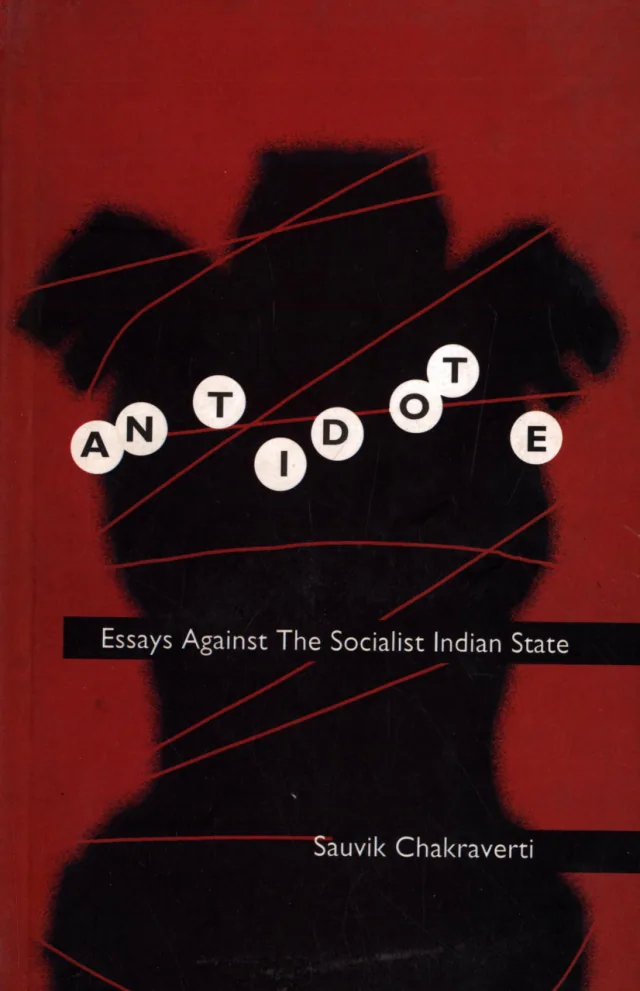
ANTIDOTE
Summary
Antidote (Macmillan India, 2000) is a single-author collection of ten essays by Sauvik Chakraverti, dedicated to the memory of B. R. Shenoy as the only official Indian economist to record a note of dissent against Nehru’s socialist planning. Its preface states the thesis plainly: Indian socialism is better called statism, because it places the state above society, and the Indian state is a predator and a kleptocracy. Freedom, Chakraverti says, rests on three pillars (the political freedom of democracy, the economic freedom of the market, and liberal education), and India has only the first. The essays are written in a deliberately journalistic register for housewives, copywriters, managers, students and journalists, in the author’s words ‘essays, not theses’. Each chapter carries a pop-culture epigraph and an exclamatory title with an ‘or How…’ subtitle.
The first five essays build the economic and political case. ‘Population’ offers a prosperity equation (a person with knowledge, plus trade, towns, transport and communications, plus freedom and security) and argues that people cause prosperity rather than poverty, that cities are the engines of wealth, and that India’s rural bias has produced ‘primacy’, with one big city overgrowing while the surrounding small towns starve for roads; evidence includes Gujarat’s 1981-91 urban data, the Delhi MRTS and the Delhi-Dehra Dun road. ‘State’ uses public choice theory, Mancur Olson’s stationary-bandit model and Deepak Lal to argue that the Indian state undersupplies real public goods (roads, policing, courts) while spending on private goods and ‘rural development’, and that petty officials prey on hawkers. ‘Development’ attacks the vicious-circle theory and development economics, adopts Olson’s view that national boundaries explain poverty, puts trade before manufacture, and rebuts the ‘khadi fallacy’ about machines and unemployment (with Hazlitt, Gandhi and Tagore). ‘Imperialism’ uses B. R. Tomlinson and P. J. Marshall to argue that laissez-faire British rule was more open, and more industrializing, than the standard nationalist account allows, and that the East India Company resembles today’s state monopolies. ‘Borders’ argues for peace through trade (Bastiat, Galbraith), free immigration and a ‘Tiebout effect’ between states, criticizes the 1998 nuclear tests and the Kargil conflict, and proposes self-policing and reformed policing.
The last five essays move to morality, social policy, money, administration and the environment. ‘Morality’ claims that morality precedes religion, grows out of the market and the sexual union, and is corroded by the welfare state and ‘middle class morality’; ‘Prohibitions’ argues for legalizing cannabis (citing the 1893 Indian Hemp Drugs Commission and AIIMS), for sensible alcohol taxation and Gandhi’s idea of a ‘public sphere’ of pubs, and for banning nothing. ‘Money’ presents the case for free banking and competitive private currencies, against central banking, Keynesianism, state-owned banks and the IMF, drawing on Hayek, Dowd, Schuler and Parth Shah. ‘Government’ sets out a hollowed-out, minimalist state run through New Public Management, contracting out and retraining the IAS in classical political economy, and ends with a rebuttal of Amartya Sen on safety nets, health and education. ‘Environment’ treats the market as an ecosystem, argues that property rights prevent tragedies of the commons, follows Julian Simon against sustainable-development planning, and critiques consumerism through Bauer’s idea of ‘needlessness’.
Across the whole work the method is polemical and illustrative: wide borrowing from Austrian, public choice and free-banking literature, personal anecdote, humour and Indian examples (Delhi, Bihar, Kargil, hawkers, khadi), rather than original empirical research. Several positions (legal prostitution and cannabis, free immigration, abolishing central banks, a ‘hollowed out’ state) are stated as the author’s own view and are radical by mainstream standards. A few internal inconsistencies are visible, for example the 1999 World Freedom Index rank for India is given as 120 in the preface and first essay and as 118 in ‘Development’. The book closes with an index (printed p. 179 onward).
Notable passages
"Indian socialism is better called statism: it places state above society."
"Freedom rests on three pillars: the political freedom of democracy; the economic freedom of the market; and liberal education—that which teaches the value of freedom."
"This essay seeks to establish the fact that population causes prosperity. This can be proved in four words: Urban Areas Are Rich."
"the state does not create wealth: it only taxes and spends."
"In 1991, while there were 350 urban centres in all in Gujarat, two-thirds of the entire urban population was concentrated in 21 cities."
Metadata and summary are AI-extracted from the source PDF and reviewed for editorial accuracy. The original work is available via the Read PDF tab above (where present); paragraph-level citation inside the PDF is deferred to a future engagement.