periodical issue
Freedom First
published for the Democratic Research Service by Adam Adil at 127 Mahatma Gandhi Road, Bombay 1; printed at Inland Printers, 55 Gamdevi Road, Bombay 7 · Bombay · 1963
12 pages
Freedom First
Summary
This is the August 1963 issue (No. 135) of Freedom First, the Bombay-based classical-liberal periodical published by the Democratic Research Service. The issue opens with M. R. Masani surveying the fractured state of India’s opposition parties and arguing for tactical unity among them against Congress, followed by Pheroze J. Shroff’s diagnosis of corruption as a product of licence-permit-raj regimentation and inflationary finance, and A. G. Mulgaonkar’s constitutional analysis of the largely ceremonial powers of the Indian President. M. A. Venkata Rao contributes a philosophical essay reinterpreting the Bhagavad Gita as scriptural grounding for a modern, equality-affirming “reformation” in Indian social thought. The second half of the issue turns to foreign affairs and the Cold War: an unsigned editorial (“S. M.”) criticizes the government’s defensive posturing over the Indo-US-UK joint air exercises; defector Aleksandr Kaznacheev’s essay (excerpted from his book, also reviewed in this issue) argues that Sino-Soviet rivalry stems from each regime’s structural dependence on external threat as a tool of internal control; and V. B. Karnik reviews Kaznacheev’s memoir Inside a Soviet Embassy in detail. A short unsigned review of the multi-author volume China Invades India (edited by Karnik) follows, and the issue closes with the regular “With Many Voices” page of topical quotations and a subscription coupon.
Key points
-
M. R. Masani’s “The Evolution Of An Opposition” traces India’s weak opposition to Congress absorbing independent political currents after independence, and endorses ad hoc “unity in action” among opposition parties rather than formal merger, citing wins at Dohad, Amroha, Farrukhabad and Rajkot.
-
Pheroze J. Shroff’s “Corruption: Causes And Cure” blames endemic corruption on the licence-permit regime’s discretionary power and on inflationary finance debasing public morals, calling for dismantling controls alongside asset disclosure and vigilance committees.
-
A. G. Mulgaonkar’s “Powers Of The President” rebuts K. M. Munshi’s claim that the President can override the Council of Ministers, working through Articles 52-78 and Walter Bagehot’s formula for constitutional monarchy to conclude the President’s real influence is limited to being informed, consulted, and to warn.
-
M. A. Venkata Rao’s “Today’s Reformation In India” reinterprets the Bhagavad Gita’s teaching of equal divinity across all beings and its ethic of public-spirited action as scriptural grounding for a modern reformation supporting democracy and equality of opportunity.
-
An unsigned editorial, “Guilt Complex At Work,” criticises the government’s evasive, defensive public statement on the joint Indo-US-UK air exercises, arguing appeasement of non-alignment purists undercuts India’s ability to build real defence capacity against China.
-
Soviet defector Aleksandr Kaznacheev’s “Why Sino-Soviet Conflict?” argues the Sino-Soviet split is structural rather than ideological, since both regimes depend on an external enemy to justify dictatorship at home, and compares Mao’s China to Hitler’s Germany.
-
V. B. Karnik reviews Kaznacheev’s memoir “Inside a Soviet Embassy,” detailing how the Rangoon embassy functioned as a subversion operation, including a fabricated bribery story planted against Morarji Desai.
-
A review of “China Invades India,” edited by Karnik, singles out contributor B. K. Desai’s charge that Nehru was prepared to concede Tibet to China even before his 1949 Peking visit.
-
The issue closes with “With Many Voices,” including Macmillan’s remark on the Profumo scandal (“two tarts”) and Sukarno’s comment on not wanting to be told he is wrong.
Essays
s failure to heed Gandhi
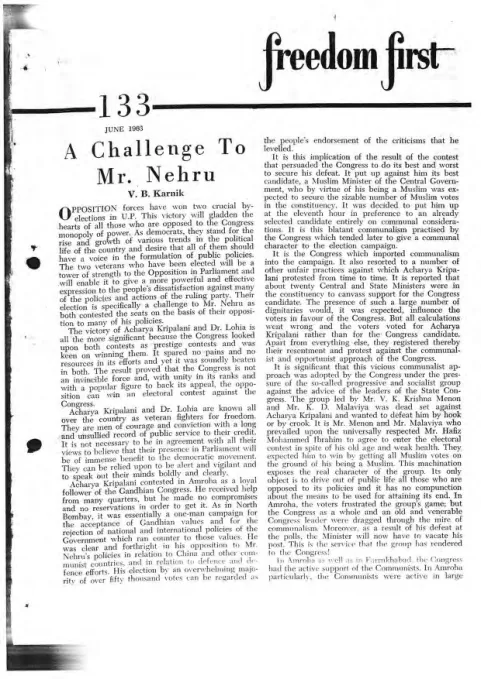
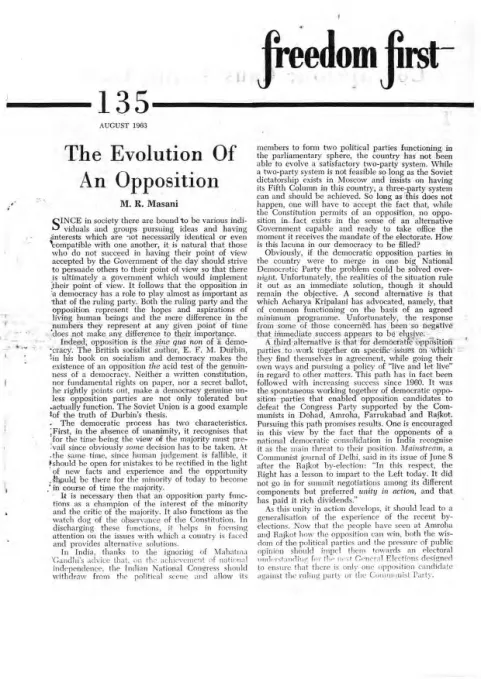
M. R. Masani traces the absence of a credible opposition to Congress in Indian democracy back to the Congress’s failure to heed Gandhi’s advice to withdraw from active politics after independence. He rejects a single merged opposition party as unrealistic and is lukewarm about Acharya Kripalani’s proposal for common-programme cooperation, instead endorsing the emerging practice of ad hoc electoral cooperation among opposition parties — “unity in action” without formal merger — citing the opposition’s wins over Congress-backed, Communist-supported candidates at Dohad, Amroha, Farrukabad, and Rajkot as evidence the approach is working and should be extended to the next general election.
- Opposition is presented as the sine qua non of democracy, citing E. F. M. Durbin’s thesis that a genuine opposition, not just formal constitutional trappings, is the real test of a democracy.
- Blames the lack of a two-party or coherent multi-party system partly on Congress absorbing what should have been independent political currents after independence.
- Rules out Soviet-style single-party dominance disguised as opposition (citing the Soviet Fifth Column framing) and a full merger of opposition parties as unrealistic near-term options.
- Endorses ad hoc, issue-by-issue electoral cooperation among opposition parties (“live and let live”) over formal alliance, citing recent by-election wins.
- Quotes the Communist journal Mainstream conceding that this pragmatic unity-in-action approach has been more effective for the Right than ideological summit negotiations.
The Evolution Of An Opposition
By M. R. Masani
Pheroze J. Shroff argues that corruption has become endemic in India because the licence-permit regime — the Industries (Development and Regulation) Act, Essential Commodities Act, Foreign Exchange Regulation Act, and similar legislation — has invested officials with enormous discretionary power that a class of contact-men and intermediaries routinely exploit for bribes. He links this directly to inflationary government finance, arguing a debased currency corrodes public morals and pushes both officials and citizens toward corrupt practice, and calls for dismantling ideologically driven controls rather than layering on more anti-corruption machinery, alongside specific reforms: asset declarations for ministers and officials, vigilance committees, a stronger Commissions of Inquiry Act, and loss of political rights for those convicted of corruption.
- Corruption is described as endemic and normalized rather than shameful in contemporary Indian public life.
- Root cause is identified as the ‘totalitarian-type economy’ — licensing and permit legislation that gives officials broad discretionary power exploited by a ‘parasitical and corrupt tribe’ of contact-men.
- Inflationary government finance is blamed for debasing both the currency and public morals, pushing officials to demand illegal gratification to protect real incomes.
- Recommends eliminating discretionary economic controls at the root, rather than adding more enforcement machinery which itself risks becoming corrupt.
- Proposes concrete institutional reforms: mandatory asset disclosure by ministers/officials, citizen vigilance committees, strengthened use of the Commissions of Inquiry Act 1952, and disqualification of politicians convicted of corruption.
Corruption: Causes And Cure
By Pheroze J. Shroff
A. G. Mulgaonkar examines the constitutional scope of the Indian President’s powers, responding to K. M. Munshi’s contention that the President can, on certain occasions, override the advice of the Council of Ministers. Working through Articles 52, 53, 74, 76, and 78, Mulgaonkar concludes the President is a formal, constitutional head who must act on ministerial advice, comparable to Dr. Rajendra Prasad’s own description of the office as modeled on the British constitutional monarchy. He draws on Walter Bagehot’s classic formulation of the British Crown’s residual rights — to be informed, to be consulted, and to warn — and historical instances of monarchical influence (Queen Victoria, Edward VII, George V vis-a-vis Asquith and the 1910 peers crisis, and the Baldwin-versus-Curzon succession) to argue that an Indian President could similarly wield real, if narrow, influence without any license to overrule the Council of Ministers on substantive decisions.
- Challenges K. M. Munshi’s newspaper argument that the Constitution empowers the President to override the Council of Ministers in certain circumstances.
- Walks through Articles 53(1), 74(1), 76 and 78 to show the President’s executive power must be exercised on the advice of, and in the name of, the Council of Ministers.
- Cites Dr. Rajendra Prasad’s own characterization of the Indian presidency as modeled on the British constitutional monarch.
- Invokes Walter Bagehot’s formula for the powers of the British Crown — the right to be informed, consulted, and to warn — as the realistic ceiling on presidential influence.
- Uses historical British precedents (Victoria and Gladstone, George V and Asquith over the 1910 peers crisis, Baldwin’s selection over Curzon) to illustrate how much real influence a constitutional head can exert without formal power to overrule ministers.
- Argues the Attorney-General’s advisory role does not create an independent channel for the President to countermand his ministers, and that constitutional disputes between the two should go to the Supreme Court under Article 143.
Powers Of The President
By A. G. Mulgaonkar
M. A. Venkata Rao argues that what some call a Renaissance in modern India — from Raja Ram Mohan Roy through Gandhi — is better understood as a ‘reformation’: a many-sided rethinking of Hindu culture’s core ideas and institutions in light of democratic values, running parallel to the Reformation in Europe. He illustrates this by reinterpreting verses of the Bhagavad Gita to argue that the scripture itself, properly read, already affirms the equal divinity present in all beings regardless of caste or fortune, that its ethic of karma (action) is public-spirited and world-affirming rather than merely ritualistic, and that the new reformation channels this scriptural humanism into support for democracy, equality of opportunity, and a modern social conscience.
- Frames the modern Indian reform tradition (Ram Mohan Roy, Dayananda Saraswati, Tilak, Aurobindo, Gandhi and others) as a ‘reformation’ rather than a ‘renaissance’, paralleling Luther and Calvin in Europe.
- Cites Gita verses (e.g., XIII-28, VI-30) to argue the scripture teaches the equal presence of the divine across brahman, cow, elephant, dog, and outcaste alike, undercutting untouchability.
- Reinterprets the Gita’s doctrine of karma/action as public-spirited service (lokasangraha) rather than ritual observance, aligning it with a modern democratic ethic of duty.
- Frames this reworked scriptural humanism as underwriting equality of opportunity, democracy as ‘a way of life’, and the rule of law over privilege.
- Positions the essay’s ‘new reformation’ as a leaven running through art, literature, music, painting, social work, and politics — what the author collectively calls democracy.
Today’s Reformation In India
By MA Venkata Rao
An unsigned editorial (‘S. M.’) criticizes the Indian government’s public statement on the forthcoming joint Indo-US-UK air exercises as evasive and defensive, arguing it dwells more on reassuring domestic critics of India’s non-alignment than on explaining the substantively straightforward training arrangement. The piece contends the government is bending over backwards to appease vocal non-alignment purists even as India’s sovereignty is being actively violated by China, and closes by arguing that appeasing ‘ignorant or dishonest’ critics on defence cooperation weakens India’s ability to build the military capacity and national resolve needed to meet the continuing Chinese threat.
- Criticizes the government’s official statement on the Indo-US-UK joint air exercises for evasively over-emphasizing non-alignment and sovereignty rather than plainly stating the training’s purpose.
- Frames the exercises as a straightforward technical necessity: training the Indian Air Force, which lacks supersonic aircraft experience, in radar equipment operation under India’s own command.
- Argues the government’s anxious rhetoric about sovereignty is misplaced given the real, ongoing violation of Indian sovereignty by China.
- Warns that appeasing vocal non-alignment critics produces hesitations that undercut India’s ability to build up its actual defence resources and national morale against the Chinese threat.
- Calls Chinese border propaganda (relayed via powerful Tibet-based radio stations in local Indian languages) a serious and under-countered element of the broader security challenge.
Guilt Complex At Work
By S. M.
In this extract from his book Inside a Soviet Embassy (reviewed elsewhere in this issue), Soviet defector Aleksandr Kaznacheev argues that the growing Sino-Soviet split is not primarily ideological or tactical but structural: both the Soviet and Chinese Communist regimes depend on an external enemy to justify continued dictatorship at home, and as each grows more aggressive to sustain that justification, their interests become irreconcilably opposed. He compares Maoist China’s combination of a large, ambitious, resource-constrained population with nationalist grievance to Hitler’s Germany in the 1930s, and predicts the Sino-Soviet alliance will hold only as an uneasy facade until one side concludes the other, rather than the West, is now the primary threat.
- Rejects the common Western framing of the Sino-Soviet split as a matter of ideological or developmental ‘backwardness’ on China’s part.
- Argues both Communist regimes’ internal stability depends on manufacturing or exploiting an external threat, making their mutual rivalry for that role a deeper structural driver of conflict.
- Draws an extended comparison between Mao’s China and Hitler’s Germany: a large, industrious, nationalistic population in a resource-constrained territory surrounded by weaker neighbours.
- Contrasts Soviet stability (no comparable population-pressure or expansionist necessity) with China’s genuine need for both political and territorial expansion.
- Predicts continued surface unity between the two Communist powers while they privately prepare for eventual open conflict, given irreconcilable ambitions for supremacy over the Communist bloc and the wider world.
Why Sino-Soviet Conflict?
By Aleksandr Kaznacheev
V. B. Karnik reviews Aleksandr Kaznacheev’s memoir Inside a Soviet Embassy, describing how Kaznacheev, trained by the Soviet regime for diplomatic work and posted to Rangoon as a Political Intelligence officer, grew disillusioned and defected to the United States. Karnik details Kaznacheev’s account of Soviet embassies functioning not as normal diplomatic missions but as subversive intelligence operations aimed at penetrating and manipulating a host country’s political parties, trade unions, and youth groups, including a documented case of a fabricated bribery story planted against Morarji Desai in a Burmese newspaper, and the shift after Stalin’s death toward a ‘friendly neutrality’ policy that still covertly undermined host governments while officially professing non-interference.
- Introduces Kaznacheev’s biography: Russian-trained diplomat posted to the Soviet embassy in Rangoon, recruited into Political Intelligence work, later defected and sought asylum in the United States.
- Details the embassy’s core function as ‘penetration and subversion of local regimes’ targeting political parties, trade unions, and youth groups rather than conventional diplomacy.
- Recounts a specific fabricated story planted in the Burmese journal Botataung Daily accusing Morarji Desai of taking a bribe to subvert Indian neutrality, later picked up internationally by Tass.
- Describes the post-Stalin shift to a declared policy of ‘friendly neutrality’ that nonetheless retained covert subversion and intelligence penetration of host countries.
- Notes Kaznacheev described embassy staff life as being like captives ‘in camera’, living under mutual surveillance even among colleagues.
A Look Into A Russian Embassy
By V. B. Karnik
No summary was extracted for this article. Listed for completeness.
Review: China Invades India (edited by V. B. Karnik)
By Raman Desai
A short unsigned review of China Invades India, a multi-author volume edited by V. B. Karnik (Allied Publishers, 309 pages), describes it as a unified continuous narrative across four essayists’ contributions rather than a loose miscellany, tracing Chinese history through to the recent invasion of India. The review singles out contributor B. K. Desai’s treatment of India’s handling of Tibet as especially critical, arguing Nehru was prepared to concede Tibet to China even before his 1949 Peking visit, and closes by praising the volume’s argument for future vigilance against ideological illusions and stronger military alliances and preparedness.
- Describes China Invades India (ed. V. B. Karnik) as a single continuous historical-analytical narrative spanning four essayists rather than a disconnected anthology.
- Credits contributors by name and tone: Karnik (polished), Kini (jerky but authoritative), B. K. Desai (scathing and entertaining), Mrs. Indu Patel (starts rhetorical, ends with prognosis for economic streamlining and defence preparedness).
- Highlights B. K. Desai’s account of India’s Tibet policy as the volume’s sharpest critique, alleging Nehru had effectively resolved to hand over Tibet to China even before his 1949 Peking trip.
- Faults Britain, France (‘Dunkirk’), and Germany (‘Buchenwald’) collectively alongside India for complacency toward totalitarian threats, framing the fault as shared across democracies.
- Concludes the volume argues for continued vigilance against ideological illusions and stronger military alliances and preparedness in the years ahead.
With Many Voices
The regular back-page feature ‘With Many Voices’ compiles topical quotations from public figures published in the preceding weeks, on themes of Cold War rhetoric, Sino-Soviet dynamics, British and Indian political scandal, and non-alignment, drawn from sources including Khrushchev, Kennedy, Macmillan, Nehru, Sukarno, and Indian and British commentators such as A. D. Gorwala, Taya Zinkin, and Max Lerner. The page closes with the magazine’s masthead, printing and subscription details.
- Compiles short dated quotations (late June-July 1963) from a range of Indian, British, American, and Soviet public figures on Cold War and domestic political themes.
- Includes Khrushchev on non-interference and on Marxism, Kennedy on Berlin and Western alliance solidarity, Macmillan on the Profumo scandal (‘two tarts’), and Nehru dismissing mere talkativeness as a mark of a thinker.
- Features Indian commentator A. D. Gorwala questioning Soviet ‘peaceful coexistence’ rhetoric and probing what genuine non-interference would require.
- Records Sukarno’s remark on not wanting to be told he is wrong, positioned alongside other quotations on political vanity and evasion.
- Closes with the Freedom First subscription form and imprint: edited by Raman Desai, printed at Inland Printers, Bombay, published for the Democratic Research Service by Adam Adil, 127 Mahatma Gandhi Road, Bombay 1.
Generated by the v1.5 extraction pipeline. Awaiting editorial review.
Metadata and summary are AI-extracted from the source PDF and reviewed for editorial accuracy. The original work is available via the Read PDF tab above (where present); paragraph-level citation inside the PDF is deferred to a future engagement.