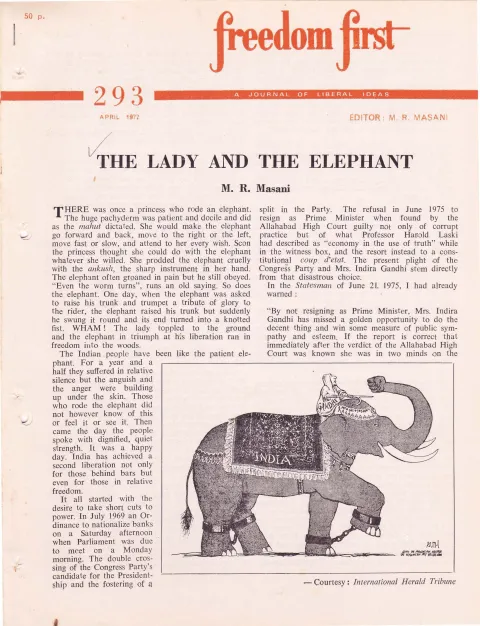
periodical issue
Freedom First
A Journal of Liberal Ideas
By S. V. Raju
Published for Democratic Research Service by J. R. Patel, Associate Editor, Freedom First at 127, M. Gandhi Road, Bombay 400 023 (Phone: 273914) and printed by him at Mohan Mudranalaya, Acme Estate, Sewri (East), Bombay 400 015 · Bombay · 1977
16 pages
Freedom First
Summary
Freedom First No. 294 (May 1977) is a monthly issue of the Bombay-based journal of liberal ideas, edited by M. R. Masani, appearing weeks after the Janata Party’s electoral victory ended the Emergency. The issue opens with a report on Masani’s public address proposing concrete safeguards against a repeat of the 1975 ‘constitutional coup d’etat’ — a commission of inquiry and a non-partisan watchdog Committee of a Hundred — and worries that public impatience could again tempt India toward a ‘strong man.’ Other contributors range across a translated Russian dissident’s account of samizdat publishing, a critique of the government’s retreat on family planning, an appreciative essay on C. Rajagopalachari, a defence of Milton Friedman’s Chile visit reprinted from a Wall Street Journal letter, a compilation of world news items (on Soviet living standards, dissidents, and Idi Amin’s Uganda), a film review of Satyajit Ray’s ‘Jana Aranya’, two book reviews, and a closing page of quoted aphorisms plus the subscription form and imprint. The issue’s argumentative centre, in the rendered pages, is anti-authoritarianism: distrust of concentrated state power, whether exercised through India’s suspended constitution, Soviet censorship, or the abuses of Amin’s regime, paired with a liberal insistence on individual liberty, free institutions, and free enterprise.
Key points
-
A front-page report, “No Second Derailment”, summarises M. R. Masani’s address to the Indian Liberal Group proposing a commission of inquiry into the 1975 “constitutional coup d’etat” and a non-partisan “Committee of a Hundred” civil-liberties watchdog, a proposal Jayaprakash Narayan publicly welcomed.
-
Julius Telesin’s essay explains samizdat, the Soviet Union’s unofficial uncensored self-publishing practice, distinguishing it from tamizdat and detailing the risks typists and readers face despite its technical non-illegality.
-
M. Murlidhar criticises the government’s retreat on family planning as capitulation to “mass hysteria”, invoking A. V. Dicey’s distinction between legislative and public opinion to argue population policy should override popular sentiment as the Hindu Code Bill once did.
-
K. Vedamurthy’s essay on the renewed relevance of C. Rajagopalachari likens him to Ralph Waldo Emerson, crediting him with founding the Swatantra Party against “parrot culture” and unquestioning political obedience.
-
Arnold C. Harberger, in a reprinted Wall Street Journal letter, defends Milton Friedman’s 1976 Nobel Prize against criticism of his 1975 Chile visit, stating both economists had no consulting relationship with the Pinochet government and that Friedman refused two honorary degrees to avoid any appearance of endorsement.
-
Geeta Doctor’s film review finds Satyajit Ray’s Jana Aranya a weaker retread of Pratidwandi and Mahanagar, criticising its slow pacing and repeated visual motifs.
-
A. G. Noorani reviews B. B. Misra’s The Indian Political Parties, praising its archival Intelligence Bureau sourcing and its account of Nehru’s admission to Asaf Ali that the 1939 Congress ministries’ resignation had been an error.
-
A World News digest covers Solzhenitsyn’s fund aiding Soviet political prisoners, comparative Soviet-Western worker living standards, and defected MIG pilot Viktor Belenko’s astonishment at U.S. military life.
Essays
No Second Derailment: Editor Suggests Concrete Steps
This unsigned front-page report (‘No Second Derailment: Editor Suggests Concrete Steps’) summarises a talk by M. R. Masani at a public meeting of the Indian Liberal Group on 1 April, with Soli Sorabjee also speaking and S. P. Aiyar in the chair. Masani proposed that the Union Government set up a commission to investigate how the 26 June 1975 ‘constitutional coup d’etat’ was engineered, so as to recommend safeguards against a repeat, explicitly disclaiming any ‘witchhunt’ against individuals. His second proposal was an Indian Liberal Group-organised Committee of a Hundred, non-partisan watchdogs drawn from law, journalism, trade unions and education, to sound the alarm on threats to civil liberty — a response to Prime Minister Morarji Desai’s invitation to citizens to stay vigilant (a proposal JP Narayan had publicly welcomed). The piece closes on a cautionary note: despite the electorate’s maturity in voting out Mrs Gandhi, the underlying conditions that produced authoritarian temptation — too much politics, too little citizenship, weak voluntary associations — remain, and public memory is short.
- Masani proposed a government commission of inquiry into the ‘modus operandi’ behind the 26 June 1975 constitutional coup, framed explicitly as not a witchhunt against individuals.
- Masani’s second proposal was an Indian Liberal Group ‘Committee of a Hundred’ to act as a non-partisan watchdog for civil liberties.
- Jayaprakash Narayan publicly welcomed the Committee of a Hundred proposal at a 2 April press conference.
- Masani warned that the ease with which absolute power was seized in 1975 showed weakened public faith in parliamentary institutions, and that public memory of authoritarian abuse is short.
- The report frames the election result as showing the poor ‘want freedom as much as they want bread’, endorsing JP’s reading that a vote against Mrs Gandhi was more anti-Emergency than pro-Janata.
- Masani highlighted Jayaprakash Narayan’s stress on ‘Jana Shakti’ (people’s power) over ‘Raj Shakti’ (state power) as vital, citing India’s weak infrastructure of voluntary grassroots associations since 1950.
What Is “Samizdat”?
By Julius Telesin
Julius Telesin, a Russian writer recently resettled in the West, explains samizdat — the Soviet practice of unofficial, uncensored self-publishing — in this abridged reprint from Encounter. He traces the word’s origin to a 1950s Moscow poet’s ironic coinage on the model of official Soviet publishing-house names, and distinguishes samizdat (works produced and circulated wholly outside censorship) from tamizdat (foreign editions of the same works). He catalogues thirteen genres of samizdat, from novels and poetry to trial transcripts, prisoner biographies, and lists of official censorship cuts. The essay’s second half, printed on later pages, walks through the practical mechanics of samizdat production and distribution in granular, first-person detail: negotiating typed copies with friends and paid typists, the economics of tissue paper versus ordinary paper, the risks of denunciation and KGB searches, and why despite the risk none of this literature is technically ‘illegal’ under Soviet law, since the USSR maintains no published blacklist and pays lip service to Article 19 of the Universal Declaration of Human Rights. Telesin closes by noting samizdat’s real but bounded readership — confined largely to ‘the thinking part of society’ willing to accept the risk of reading uncensored material.
- Samizdat originated as an ironic coinage in 1950s Moscow, punning on official Soviet publishing-house names like Politizdat and Voyenizdat.
- Telesin distinguishes samizdat (self-published, uncensored work) from tamizdat (foreign-published reprints of similar material) and lists 13 genres, including novels, memoirs, court transcripts, and lists of official censorship cuts.
- The practical logistics of samizdat — typewriters, carbon paper, tissue paper for bulk copying, negotiating with typists — are described in first-person, granular detail as a semi-underground cottage industry.
- Telesin argues samizdat is not technically illegal in the USSR: there is no published blacklist of banned works, and the state officially endorses the UN’s Universal Declaration of Human Rights including Article 19 on freedom of expression.
- Despite the absence of formal illegality, samizdat readers and typists face real risks of KGB searches, shadowing, and prosecution under vague ‘anti-Soviet’ statutes.
- Samizdat’s readership is self-selecting: confined to those willing to accept risk in pursuit of information the official press withholds, not a mass phenomenon.
Dichotomy of Family Planning
By M. Murlidhar
M. Murlidhar criticises the government’s retreat on family planning as a capitulation to ‘mass hysteria’ whipped up by opposition parties and religious leaders, arguing that population control was an issue requiring ‘a war-like zeal to carry out’ at independence but instead faced cowardly leadership and reactionary opinion from every religious denomination. Invoking A. V. Dicey’s account of the tension between ‘legislative opinion’ and ‘public opinion’ in 19th-century Britain, Murlidhar argues that on some issues of national importance — as with defence, or the Hindu Code Bill in India — legislative opinion must override a hostile public, and that family planning should likewise be pursued according to legislative judgment rather than deferring to majority sentiment.
- Murlidhar attributes the government’s retreat on family planning to ‘mass hysteria’ generated by opposition parties and blessed by religious leaders across denominations, including the Puri Shankracharya and the Pope.
- He invokes A. V. Dicey’s framework distinguishing ‘legislative opinion’ from ‘public opinion’, arguing some issues (defence, wartime secrets) require legislative opinion to override hostile public opinion.
- The Hindu Code Bill is cited as a precedent where legislative opinion successfully overrode majority Hindu opposition, changing personal law.
- Murlidhar argues the coercive excesses of the Emergency-era family planning drive were real but were not the true ‘excess’ — rather, insufficient earlier action against ‘a dangerous disease’ was the deeper failure.
- He calls for legislative opinion to reassert itself on family planning going forward, framing the issue as a dichotomy between speedy social progress and deference to popular opinion.
The Relevance of Rajaji
By K. Vedamurthy
K. Vedamurthy’s essay argues for the renewed relevance of C. Rajagopalachari (Rajaji) to India’s post-Emergency moment, portraying him as a strenuous advocate of independent thinking, individual liberty, and civil criticism of authority, likened to Ralph Waldo Emerson. Drawing on Rajaji’s own writings in Swarajya across the 1950s-60s, Vedamurthy assembles his warnings against ‘parrot culture’ and unquestioning political obedience, his insistence that criticism and counterreply are essential to democratic health, and his critique of both left- and right-authoritarianism. The essay closes with Rajaji’s own 1963 reflection on whether India has ‘forgotten the Mahatma,’ concluding that Gandhi’s teaching of nonviolence remains imperfectly absorbed but not forgotten.
- Vedamurthy likens Rajaji to Ralph Waldo Emerson as a ‘strenuous advocate of liberty and independence’ opposed to ‘parrot culture’ — unreflective political conformity.
- Rajaji is credited with founding the Swatantra Party out of concern that citizens’ fundamental rights were being whittled away, following decades of moral and political decay he traced through the preceding decade.
- The essay presents Rajaji as a rationalist in religion and a ‘true Vedantin’, seeing no conflict between science’s pursuit of material truth and religion’s pursuit of non-material truth.
- Rajaji’s famous retort to critics who called him merely oppositional — defining his affirmative commitments (soap over filth, working over loafing, peasant proprietorship over collectivism) — is presented as capturing his political philosophy.
- The essay closes on Rajaji’s 1963 answer to whether India has forgotten Gandhi: not fully absorbed, but ‘convinced that brute force and compulsion cannot accomplish anything.’
s 1976 Nobel Prize in Economics arising from Friedman
This reprinted Wall Street Journal letter by Arnold C. Harberger, chairman of the University of Chicago economics department, rebuts criticism of Milton Friedman’s 1976 Nobel Prize in Economics arising from Friedman’s brief 1975 visit to Chile. Harberger, who accompanied Friedman throughout the six-day visit, states both economists went at Harberger’s urging under the auspices of a private Chilean foundation to give academic lectures, had no consulting relationship with the Pinochet government, and publicly and repeatedly condemned the regime’s repression. He notes Friedman turned down two honorary degrees from Chilean universities to avoid any appearance of political endorsement, and stresses that the University of Chicago’s institutional connection to Chile predates and is independent of the current government, running through an AID-financed exchange program with the Catholic University of Chile from 1956 to 1964.
- Harberger states he and Friedman visited Chile under a private foundation’s auspices, not as government consultants, and had no official connection to the Pinochet government.
- Friedman refused two honorary degrees from Chilean universities specifically to avoid the appearance of political approval of the regime.
- Friedman delivered a lecture titled ‘The Fragility of Freedom’ at two Chilean universities characterizing the government as denying and curtailing freedom.
- The University of Chicago’s institutional Chile connection dates to a 1956-64 AID-financed exchange with the Catholic University of Chile, predating the current government and unconnected to Friedman.
- Harberger affirms both economists ‘profoundly oppose authoritarian regimes, whether from the right or the left’ while maintaining sympathy for former Chilean students who took positions in the current government.
Prof. Milton Friedman and Chile
By Arnold C. Harberger (letter to Stig Ramel, reprinted from the Wall Street Journal)
This ‘World News’ section compiles reprinted news items from Western papers (The Daily Telegraph, International Herald Tribune, The Guardian, The Times) on Soviet and authoritarian-regime affairs: Alexander Solzhenitsyn’s clandestine fund aiding Soviet political prisoners and their families; a statistical comparison showing Soviet workers must labour far longer than British or American workers to afford basic goods; declining Soviet economic growth rates; a Ugandan pilot’s defection and asylum bid after falling out of favour with Idi Amin; the collapse of British and Canadian human-rights initiatives on Uganda at the UN due to Communist and Third World bloc resistance; defected Soviet MIG pilot Viktor Belenko’s astonished reactions to the informality and abundance of U.S. military life; and a South Korean opposition leader’s surprising defence of President Park’s rule against charges of dictatorship while lobbying against U.S. troop withdrawal.
- Alexander Solzhenitsyn financed a $360,000 fund (administered by Alexander Ginzburg) that assisted over a thousand Soviet political prisoners and their families between 1974 and 1976.
- A comparative study by British economist Keith Bush found Soviet workers labour two to twelve times longer than British or American workers to afford equivalent staple goods.
- The Soviet Union’s 1976 economic growth rate was among its lowest in at least 25 years.
- Ugandan pilot Charles Balidawa, once publicly honoured by Idi Amin, sought asylum in Britain after his life was threatened by Amin’s State Research Bureau.
- British and Canadian resolutions for an independent international inquiry into human rights abuses under Idi Amin’s regime collapsed at the UN Commission on Human Rights, opposed by Communist states and most Third World delegations.
- Defected Soviet MIG-25 pilot Viktor Belenko expressed astonishment at the informality, food abundance, and lack of harsh discipline in the U.S. military compared to his experience in the Soviet Air Force, including reports of frequent suicides among Soviet enlisted men.
- South Korean opposition leader Lee Chul Seung defended President Park against charges of dictatorship and lobbied Washington to delay U.S. troop withdrawal, citing the North Korean threat.
”Jana Aranya”: Directed by Satyajit Ray (Film review)
By Geeta Doctor
Geeta Doctor reviews Satyajit Ray’s film ‘Jana Aranya’, judging it a weaker retread of Ray’s earlier films ‘Pratidwandi’ and ‘Mahanagar’, recycling similar themes of youthful idealism crushed by urban corruption and the job-hunting ‘system’. She traces the plot — a bright graduate forced into shady middleman business who is eventually asked to procure a woman for a client to clinch a deal, and who discovers the woman is his best friend’s sister — while criticizing the film’s deliberate slow pacing and heavy-handed use of visual motifs (cigarette lighting, silent stares) to signal the protagonist’s moral crises. She contrasts commercial and art-film conventions ironically, arguing that despite Ray’s continued technical mastery, the film has degenerated into ‘a fussy mass of details and mannerisms’ rather than genuinely probing beneath the surface of Indian urban life.
- Doctor argues ‘Jana Aranya’ recycles the themes of Ray’s earlier ‘Pratidwandi’ (with more poetry) and ‘Mahanagar’ (with more narrative strength), without matching either.
- The plot follows a graduate who fails to find conventional work, becomes a business ‘middleman’, and is ultimately asked to procure a woman for a client — discovering she is his best friend’s sister.
- Doctor criticizes Ray’s deliberate, slow pacing and repeated use of visual tics (matchlight, cigarette-lighting, extended stares) as substitutes for narrative economy.
- She satirizes the conventions dividing commercial films (moustached villains, entertainment-first aims) from art films (social relevance as an unquestionable virtue).
- Despite her criticism, Doctor concedes ‘a Satyajit Ray film can never be entirely bad’ and that many viewers found the film excellent, but concludes Ray is reproducing his own trademarks rather than taking creative risks.
The Indian Political Parties: An Historical Analysis of Political Behaviour upto 1947 (Review of B. B. Misra)
By A. G. Noorani
A. G. Noorani reviews B. B. Misra’s ‘The Indian Political Parties: An Historical Analysis of Political Behaviour upto 1947’ (Oxford University Press, Rs. 100), calling it an outstanding, well-sourced work drawing on archival Directorate of Intelligence Bureau records. Noorani highlights Misra’s account of the British Raj as impersonal but imperialist rule, quotes Misra’s analysis of the bureaucratic despotism of the post-1857 period, and details fine archival nuggets: N. M. Joshi’s forwarding of the Communist Party’s 1942 Memorandum of Policy to the Home Member, and Nehru’s private admission to Asaf Ali that the 1939 Congress ministries’ resignation had been an ‘error.’ Noorani praises Misra’s analysis of why India has so many political parties — rooted in the interaction between traditional caste-based groupings and newly emerging ideological social groups — and his critique of Congress’s 1937 failure to form coalitions, though he regrets Misra’s thinner treatment of 1946-47.
- Misra’s book draws on archival Directorate of Intelligence Bureau records, including intercepted correspondence between Indian leaders.
- Misra frames British Raj rule as impersonal, contrasting the Viceroy’s constrained council-based authority with ‘Grand Mughal’ assumptions.
- Noorani highlights Nehru’s private admission to Asaf Ali that the 1939 Congress ministries’ resignation had been ‘an error.’
- The Communist Party’s 1942 Memorandum of Policy, drafted by P. C. Joshi and Adhikari and forwarded by N. M. Joshi to the Home Member, pledged ‘burning and ardent’ cooperation in the war effort in exchange for the release of Communist detenus.
- Misra explains India’s proliferation of political parties as resulting from an interaction between traditional caste-bound status groups and newly emerging ideologically united social groups.
- Noorani regrets that Misra gives thinner treatment to the events of 1946-47 than to earlier decades.
Are You Killing Yourself, Mr. Executive? (Review of Dr. R. H. Dastur)
By S. V. Raju
S. V. Raju reviews Dr. R. H. Dastur’s ‘Are You Killing Yourself, Mr. Executive?’ (All India Management Association, New Delhi, 1976; Rs. 35), a health guide aimed at busy Indian executives covering occupational stress, ulcers, blood pressure, and other ‘executive’ ailments. Raju finds the book genuinely useful for its introduction, appendices, and first five chapters, praises its ‘Food for Health’ chart, but faults Dastur for straying into unrelated commentary on industrialisation and the state sector, given that most heavy industry employees are salaried government workers rather than overworked private executives.
- The book targets Indian executives suffering stress-related ailments: ulcers, blood pressure, heart trouble, slipped discs.
- A cited 1998 Executives survey found 50% of Indian executives suffer emotional stress and anxiety versus 40% overweight, contrasted with the American pattern of higher heart attack/stroke rates.
- Raju recommends the introduction, two appendices, and first five chapters for general readership, while suggesting the rest be consulted only for one’s specific ailment, ‘like books on astrology.’
- Raju’s chief criticism is that Dastur’s discussion of industrialisation and heavy industry (mostly state-sector, salaried employment) sits oddly within a book about executive stress.
Essay 8
No summary was extracted for this article. Listed for completeness.
Essay 9
No summary was extracted for this article. Listed for completeness.
Essay 10
The closing page, ‘With Many Voices’, compiles brief quoted aphorisms and remarks from world newspapers and magazines (International Herald Tribune, The Economist, The Observer, Time, Democratic World) on figures including Jimmy Carter, Indira Gandhi, Morarji Desai, Leonid Brezhnev, and Jawaharlal Nehru, framed by an epigraph from Tennyson. The page also carries the Freedom First subscription form (annual subscription Rs. 5.00, C/o Democratic Research Service, Bombay) and the publication’s colophon, naming J. R. Patel as Associate Editor and publisher.
- The page collects short quoted remarks from international papers on contemporary political figures, framed by a Tennyson epigraph on the world’s inevitable movement toward change.
- Prime Minister Morarji Desai is quoted three times from Time (April 4), including on his ideals (Gandhi and Lincoln, versus Nehru’s Machiavelli) and on government being something people fear more than any other agency.
- The subscription form lists Freedom First’s address as C/o Democratic Research Service, Maneckji Wadia Bldg., Bombay 400023, with an annual subscription of Rs. 5.00.
- The colophon records the periodical as ‘Published for Democratic Research Service by J. R. Patel, Associate Editor, Freedom First’ and printed at Mohan Mudranalaya, Bombay.
Generated by the v1.5 extraction pipeline. Awaiting editorial review.
Metadata and summary are AI-extracted from the source PDF and reviewed for editorial accuracy. The original work is available via the Read PDF tab above (where present); paragraph-level citation inside the PDF is deferred to a future engagement.