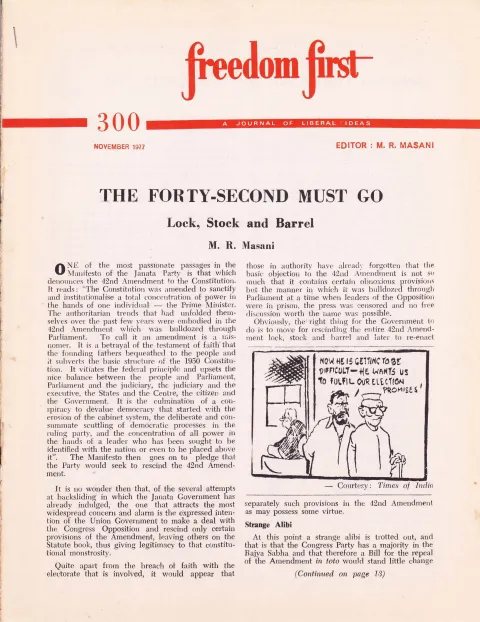
periodical issue
Freedom First
A Journal of Liberal Ideas
By S. V. Raju
Published for Democratic Research Service by J. R. Patel, Associate Editor, Freedom First at 127, M. Gandhi Rd., Bombay 400 023 (Phone: 273914) and printed by him at States' People Press, Ghoga Street, Fort, Bombay-400 001. · Bombay · 1977
16 pages
Freedom First
Summary
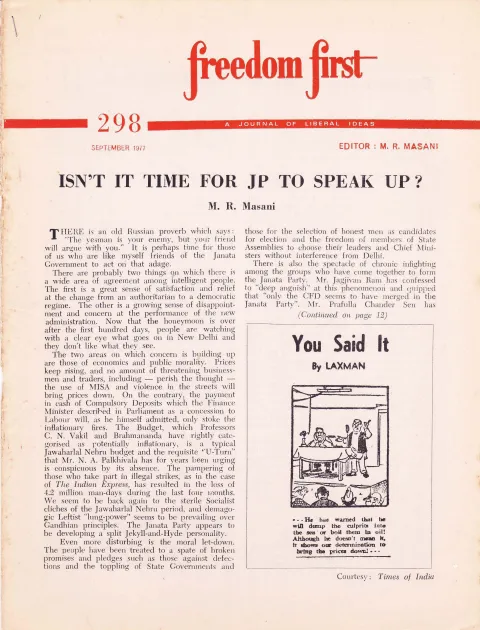
This is the September 1977 issue (No. 298) of Freedom First, edited by M. R. Masani, published a few months after the end of the Emergency and the Janata Party’s assumption of power. The issue’s centre of gravity is a critical stock-taking of the new Janata government: Masani’s lead editorial questions why Jayaprakash Narayan has not spoken up about the government’s drift back toward statist economics and factional infighting, and an unsigned piece urges immediate repeal of MISA and the 42nd Amendment. Alongside this runs a substantial two-part treatment of custodial torture and preventive detention by S. A. A. Pinto, a comparative review of three rushed Emergency-retrospective books by S. P. Aiyar, a lighter personal essay on Parsi-Irani community history by Jal Irani, a ‘World News’ digest of Cold War and human-rights items (Ethiopia, the USSR, Africa, Soviet dissidents), a report on the ‘Committee of a Hundred’ watchdog group’s intervention in Maharashtra medical-college admissions, two book reviews, and the regular ‘With Many Voices’ page of quotations. The issue’s argumentative center is classical-liberal impatience with the Janata government for not moving fast enough to dismantle Emergency-era machinery and statist economic policy.
Key points
-
M. R. Masani’s lead editorial, “Isn’t It Time For JP To Speak Up?”, catalogues the Janata government’s economic drift, chronic coalition infighting, and broken promises, invokes Lincoln’s line on the cowardice of silence, and appeals directly to Jayaprakash Narayan to break his silence.
-
S. A. A. Pinto opens a two-part essay on torture and preventive detention, arguing custodial abuse is an ancient, universal practice unreliable as an investigative tool, extending well beyond political and Naxalite victims, and noting no magistrate or minister has ever conducted a surprise inspection of police custody.
-
S. P. Aiyar reviews three rushed Emergency retrospectives, finding Kuldip Nayar’s The Judgement vivid but poorly sourced, praising V. K. Narasimhan’s Democracy Redeemed as the most substantively reflective, and faulting all for neglecting the RSS’s and Citizens for Democracy’s roles.
-
Jal Irani contributes a comic personal essay on the shared Persian origins and diverging fortunes of the Parsi and Irani communities in India.
-
An unsigned report describes the newly formed “Committee of a Hundred” watchdog group’s first intervention, a memorandum on the admissions crisis caused by merging two parallel streams in Maharashtra’s medical colleges.
-
D. M. Kalapesi and S. V. Raju review, respectively, Vadilal Lallubhai Mehta’s book on Gandhian trusteeship as an economic model, and a biography of Coimbatore textile magnate G. Kuppuswamy Naidu.
-
A World News digest reports roughly 30,000 Ethiopians killed or imprisoned under the Dergue junta and Hebrew University’s award of an honorary degree to Milton Friedman amid speculation about his advising Israel’s new Likud government.
Essays
Isn’t It Time For JP To Speak Up?
By M. R. Masani
M. R. Masani’s lead editorial argues that friends of the Janata Government should now speak candidly about its shortcomings rather than remain yes-men. He catalogues economic drift (inflationary budget, compulsory deposits, a ‘Jawaharlal Nehru budget’ with no U-turn from statism), chronic infighting within the coalition, and a ‘moral let-down’ over broken promises on defections and state government interference. Continued on pages 12-13, the piece surveys eroding Janata vote shares in recent state assembly elections, lists six categorical policy imperatives (repeal of the 42nd Amendment and MISA, autonomous broadcasting, electoral reform, population control, decentralisation of power), invokes Lincoln’s line on the cowardice of silence to urge the middle classes to organise and speak out, and closes with a direct public appeal to Jayaprakash Narayan to break his silence and offer the country moral guidance.
- Masani argues the Janata government’s honeymoon is over and its economic and moral performance is disappointing.
- He criticizes the Budget (endorsed as inflationary by Professors C. N. Vakil and Brahmananda) as a continuation of the ‘Jawaharlal Nehru’ statist style.
- He notes chronic infighting among Janata constituent groups, quoting Jagjivan Ram’s ‘deep anguish’.
- He cites falling Janata vote shares across multiple states (e.g., Uttar Pradesh 68.02% to 48.36%) between the March and June 1977 elections as evidence of eroding support.
- He calls for repeal of MISA and the 42nd Amendment, autonomous broadcasting corporations, and electoral reform without delay.
- He lists six categorical imperatives for the Janata Party to act on, including devolution of power from Delhi to the states and population control without coercion.
- He invokes Abraham Lincoln’s line that ‘to sin by silence makes cowards of men’ to argue the middle classes must organise and speak out rather than stay silent as they did during the Emergency.
- The piece ends with a personal appeal to Jayaprakash Narayan to speak up and guide public opinion on whether the Janata Party is honouring its election promises.
1975 And All That
By S. P. Aiyar
The unsigned ‘Between You & Me and The Lamp Post’ column covers a run of topical items: the Indian Express strike and Ramnath Goenka’s court battle against the government over compulsory deposit obligations (paralleled with the Grunwick dispute in Britain); the Sheikh Abdullah’s electoral victory in Kashmir and its bearing on Kashmir’s and Nagaland’s special status, including a Gandhi quotation on Naga self-determination; a note on the fall of Sirimavo Bandaranaike in Sri Lanka and J. R. Jayawardene’s return to power; B. K. Nehru’s warnings on the true meaning of unemployment and doles; and the Janata government’s decision to scrap post-Independence honours and titles as contrary to Article 18 of the Constitution.
- Contrasts Ramnath Goenka’s Indian Express strike dispute with the Grunwick dispute in Britain, arguing both governments capitulated to organized labour over the rule of law.
- Frames Sheikh Abdullah’s Kashmir election win as proof that Kashmir and Nagaland occupy a genuinely special constitutional position, quoting Gandhi’s 1947 assurance to Naga delegates.
- Welcomes J. R. Jayawardene’s return to power in Sri Lanka as part of a regional shift away from pro-Soviet non-alignment.
- Cites B. K. Nehru’s argument that a dole is not real employment and that genuine employment requires production exceeding consumption.
- Praises the Janata government’s move to scrap post-Independence honours as consistent with Article 18 of the Constitution, recalling a 1947-48 Constituent Assembly debate in which Nehru insisted awards of merit (as opposed to titles) should continue.
Torture And Preventive Detention-I: Origins And Consequences
By S. A. A. Pinto
S. P. Aiyar reviews three hastily-written retrospectives on the Emergency published in its immediate aftermath: Kuldip Nayar’s The Judgement, D. R. Mankekar and Kamla Mankekar’s The Decline and Fall of Indira Gandhi, and (in less detail) Promilla Kalhan’s Black Wednesday, alongside praise for V. K. Narasimhan’s Democracy Redeemed. Aiyar finds Nayar’s book journalistically vivid on Sanjay Gandhi’s circle and the machinery of censorship but shallow, poorly cited, and marred by careless proofreading and undue reliance on secondary material (including uncredited borrowing from U. R. Anantha Murthy’s introduction to Snehalata Reddy’s Prison Diary). The Mankekars’ book is judged stronger on press harassment and student resistance but weak on the RSS’s role and the Citizens for Democracy’s contribution, and Kalhan’s book is dismissed as a ‘curious non-book.’ Aiyar singles out Narasimhan’s Democracy Redeemed as the most substantively reflective of the crop, praising its faith in Indian democratic values and its author’s personally courageous editorial record during the Emergency.
- Aiyar frames the glut of rushed Emergency books (following Matthew Arnold’s line that ‘journalism is literature in a hurry’) as commercially successful but intellectually thin.
- He criticizes Kuldip Nayar’s The Judgement for lack of citations, undistinguished style, factual carelessness (e.g., an arrest warrant issued for a dead man), and uncredited reproduction of others’ material.
- He credits Nayar’s first chapter, on Siddhartha Shankar Ray’s role in proposing the internal Emergency and Sanjay Gandhi’s circle supplying censorship models from the Philippines, as the book’s most useful part.
- He compares the Mankekars’ Decline and Fall favourably on press harassment and student resistance but faults both major books for ignoring the RSS’s and Citizens for Democracy’s roles.
- He singles out V. K. Narasimhan’s Democracy Redeemed for its reflective, non-sensationalist quality and Narasimhan’s own courageous editorship of the Indian Express during the Emergency.
- He concludes both flagship books lack a framework or interpretation of when the ‘Decline’ actually began, unlike Narasimhan’s more analytical treatment.
Historical Hysteria
By Jal Irani
S. A. A. Pinto opens a two-part essay on torture and preventive detention by arguing that public outrage should not be confined to political and Naxalite victims of Emergency-era abuse, since the practice of torture is ancient, universal, and routinely used by police, officers, administrators, and politicians alike. He argues torture is unreliable as an investigative tool because victims, tortured beyond their pain tolerance, will confess to anything or falsely implicate others regardless of guilt, and contends the same national tendency toward coercive shortcuts shows up elsewhere in Indian policy (cow-slaughter legislation, prohibition, forced imposition of Hindi). He closes the installment by noting that, since Independence, there has been no recorded instance of a magistrate, judge, or minister of any ruling party conducting surprise inspections to check on complaints of torture in police custody.
- Pinto argues focusing outrage only on political/Naxalite torture victims deflects attention from the systemic, ancient, and universal practice of torture.
- He contends torture is inherently unreliable for extracting truth since confessions reflect the victim’s pain tolerance rather than facts.
- He argues acceptance of torture as ‘routine and necessary’ extends beyond police to officers, administrators, politicians and the general public.
- He draws a parallel between the resort to torture and other coercive Indian policy shortcuts: cow-slaughter bans, prohibition, and compulsory imposition of Hindi.
- He states that since Independence no magistrate, judge, minister, or politician in power has ever conducted a surprise inspection to investigate torture complaints against persons in police custody.
Committee Of A Hundred Acts
Jal Irani contributes a light, comic personal essay on the history and culture of the Parsi and Irani communities in India, tracing their shared Persian origins, their divergent economic paths (Parsis into trade and knighthoods, Iranis into tea shops), and the eventual intermarriage and blending of the two communities. Written in a self-deprecating, humorous register, the piece plays with etymology and family history (including the author’s own name) to poke fun at both communities’ foibles and shared identity markers.
- Irani traces the shared Persian origin of Parsis and Iranis, noting Parsis arrived earlier via the ‘boat race’ from the Persian Gulf to Sanjan.
- He describes economic differentiation: Parsis dominated the liquor business and received British knighthoods; Iranis ran tea shops and later pursued education and their own knighthoods.
- He plays on the anglicization of traditional Iranian names within Parsi families (e.g., Sohrab to Soli, Zal to Jal) as part of the essay’s comic personal narrative.
- He closes by noting that Parsis and Iranis increasingly intermarried, eroding the earlier cultural divide, with a joking reference to the ‘famous Bawaji nose’ as their common trait.
Reviews: Equality Through Trusteeship (review of Vadilal Lallubhai Mehta’s book)
By D. M. Kalapesi
The unsigned ‘World News’ section compiles short reprinted items from international wire services and newspapers covering: a report of 30,000 killed or imprisoned by Ethiopia’s Marxist Dergue junta; an editorial on the OAU’s Libreville summit and hypocrisy around human rights in Africa; Hebrew University’s award of an honorary degree to Milton Friedman amid speculation he might advise Israel’s new Likud government; a British sex-discrimination tribunal case decided by Lord Denning; UNITA’s routing of Angolan government forces; Soviet dissident physicist Benjamin Fain’s account of KGB pressure tactics tied to Jimmy Carter’s human-rights stance; and a Kremlin decree ordering Soviet bureaucracy to improve consumer goods and services.
- Reports that roughly 30,000 Ethiopians have been killed or imprisoned under the Dergue military junta, per a Sunday Telegraph source.
- An editorial from The Times argues African governments’ outrage at Western human-rights standards is hypocritical given practices like Idi Amin’s regime and RSS-style abuses within Africa.
- Notes Hebrew University in Jerusalem is awarding Milton Friedman an honorary degree amid reports he could become an adviser to Menahem Begin’s new Likud government, which Friedman denies intending to do permanently.
- Describes Lord Denning’s ruling in the first appellate case under Britain’s Sex Discrimination Act, upholding a factory’s five-minute early release for women.
- Recounts Soviet physicist Benjamin Fain’s account of KGB harassment tied to his emigration application, and his view that President Carter’s firm stance has forced decisions on dissident treatment to the highest political level.
- Reports a Kremlin decree ordering improvements to consumer goods and services, quoting Pravda’s criticism of rude service and shoddy products.
Reviews: An Enterpreneur Par Excellance (review of ‘The Life of a Textile Pioneer’ by Nilkan Perumal)
By S. V. Raju
An unsigned report describes the formation and first activity of the ‘Committee of a Hundred,’ an informal, non-partisan watchdog group of prominent public figures organized to comment on issues of public importance. Its inaugural intervention concerns the admissions crisis in Maharashtra’s medical colleges caused by the merger of two parallel student streams; the piece lists the Committee’s diverse membership and details a memorandum sent to state and central health authorities proposing steps to mitigate harm to medical education standards from the sudden addition of 700 extra seats.
- The Committee of a Hundred was formed as an informal, non-partisan watchdog for civil liberties and free society values, welcomed publicly by Jayaprakash Narayan at an April 1977 press conference.
- Its membership spans social workers, educationists, writers, editors, trade unionists, business executives, lawyers, retired defence and civil servants; Cyrus Guzder serves as Organizing Secretary.
- Its first action addressed a crisis in Maharashtra medical college admissions caused by merging two parallel streams of Inter-Science and Std. XII students.
- The Committee’s medical-group memorandum, sent to state and central health ministries and the Medical Council of India, calls for publicly defined admission plans, full compliance with Medical Council conditions, expanded teaching and hospital capacity, and filling of existing staff vacancies.
- The memorandum was signed by Dr. Shantilal J. Mehta, Dr. N. H. Wadia, Dr. B. Colabawalla, Dr. Mrs. Piroja Irani, Dr. K. G. Nair and Dr. S. K. Pandya.
World News (compilation of wire/press excerpts: Ethiopia, OAU summit, Friedman in Israel, Sex Discrimination Act ruling, Angola/UNITA, Soviet dissidents, Soviet consumer goods decree)
This is the volume’s regular Reviews section, containing two separate notices. D. M. Kalapesi reviews Vadilal Lallubhai Mehta’s Equality through Trusteeship, judging the book’s ambition to justify Gandhian trusteeship as an economic model for full employment overreached and under-argued, with weak treatment of social costs and equity that the reviewer discusses at length. S. V. Raju reviews the late Nilkan Perumal’s short biography The Life of a Textile Pioneer, an admiring account of Coimbatore textile magnate G. Kuppuswamy Naidu (1884-1942), republished by the Kuppuswamy Naidu Charity Trust on its silver jubilee, praising Naidu’s rise from agriculturist to textile magnate and philanthropist.
- Kalapesi finds Mehta’s Trusteeship model economically simplistic, faulting its arbitrary ‘ceiling’ of four lakhs for a family of four as the threshold of superfluous wealth.
- Kalapesi extensively discusses the concept of ‘social costs’ as internalized, unpaid debts owed by entrepreneurs to society, and argues Mehta’s book under-develops this idea.
- Kalapesi credits the book for stimulating serious thought on Trusteeship/Stewardship as alternatives to statist planning, despite calling it a ‘rushed job.’
- Raju’s review praises The Life of a Textile Pioneer as an elegant account of G. Kuppuswamy Naidu’s rise from a small ginning operation using bullock power in 1905 to building the Laxmi group of textile mills in Coimbatore.
- Raju notes Naidu’s philanthropy (a school and hospital in Coimbatore) and that his son G. K. Sandaram has carried on the family business tradition.
With Many Voices (quotations column)
The closing ‘With Many Voices’ page is an unsigned compilation of quotations drawn from international press sources (Time, The Economist, International Herald Tribune, and others) commenting wryly on Cold War, Middle East, and Indian political affairs of mid-1977, framed by an epigraph from Tennyson. The page is followed by the Freedom First subscription form and the issue’s printer’s colophon, confirming this as the final page of the complete 16-page issue.
- The page opens with a Tennyson epigraph on ‘the deep… moans round with many voices’ before the quotation compilation.
- Quotations touch on Jayaprakash Narayan being called India’s most disappointed leader, Brezhnev’s human rights record, Begin’s and Yadin’s remarks on Israeli security, and satirical Cold War jokes about Soviet and Chinese propaganda.
- The page closes the issue with the Freedom First subscription form (Rs. 5.00 annual subscription, C/o Democratic Research Service, Bombay) and the printer’s colophon, confirming completeness of the rendered pages as the full issue.
Generated by the v1.5 extraction pipeline. Awaiting editorial review.
Metadata and summary are AI-extracted from the source PDF and reviewed for editorial accuracy. The original work is available via the Read PDF tab above (where present); paragraph-level citation inside the PDF is deferred to a future engagement.