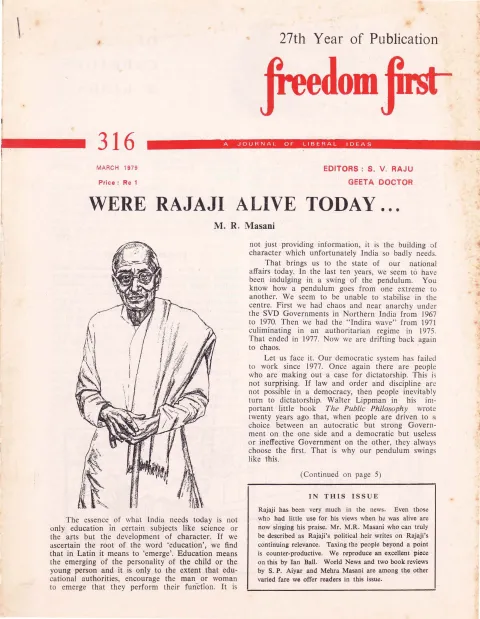
periodical issue
Freedom First
A Journal of Liberal Ideas
By M. R. Pai
Published for the Democratic Research Service by J. R. Patel, Associate Editor, Freedom First at 127, M. Gandhi Rd., Bombay 400 023 (Phone: 273914) and printed by him at States' People Press, Ghoga Street, Fort, Bombay-400 001. · Bombay · 1978
16 pages
Freedom First
Summary
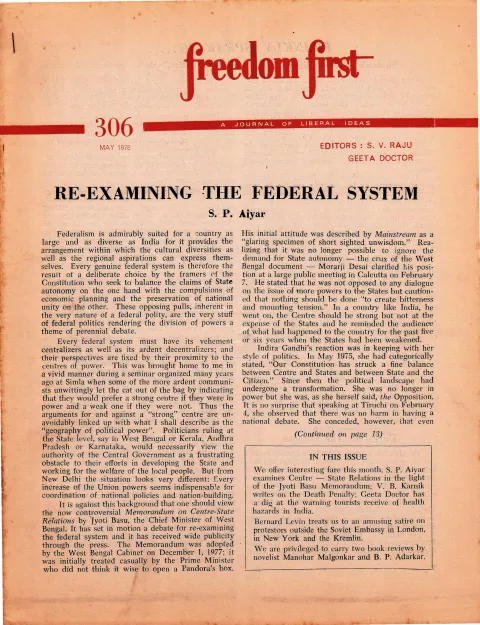
Freedom First No. 306 (May 1978) is a monthly issue of the Bombay-based liberal journal edited by S. V. Raju and Geeta Doctor. The lead essay by S. P. Aiyar re-examines Centre-State relations in light of the CPI(M)-led West Bengal government’s Memorandum on Centre-State Relations authored by Chief Minister Jyoti Basu, tracing the historical over-centralization of Indian federalism under Congress rule and the Planning Commission, and concluding that the Memorandum’s radical decentralist proposals overstate the case even though some devolution is warranted. Beyond this centrepiece the issue carries the regular unsigned ‘Frankly Speaking’ notes on the repeal of MISA and student indiscipline on campuses; short editorial notes on VIP privilege, Acharya Kripalani’s retirement, jaundice in Bombay, and Bhutto’s fate in a Pakistani condemned cell; an unsigned report on the newly constituted Minorities Commission under M. R. Masani; Geeta Doctor’s satirical column on an alarmist government health-advisory for tourists; V. B. Karnik’s argument for abolishing the death penalty citing the Amnesty International Stockholm declaration; S. A. A. Pinto’s critique of the new Drug Policy and the Hathi Committee’s nationalisation proposals; a tribute to the late economist B. R. Shenoy by M. R. Pai; two book reviews (Manohar Malgonkar on Aiyar and Raju’s own book on the Emergency, and B. P. Adarkar on Michael Harrington’s The Twilight of Capitalism); a reprinted Bernard Levin satire on Western protestors outside the Soviet Embassy in London; a ‘World News’ digest of foreign-press excerpts; and the ‘With Many Voices’ page of press quotations closing the issue.
Key points
-
S. P. Aiyar’s “Re-Examining the Federal System” responds to Jyoti Basu’s Memorandum on Centre-State Relations, tracing decades of federal centralisation via the Planning Commission and judging its radical decentralist proposals, including abolishing the All-India Services and giving states 75% of central revenue, sound in diagnosis but overstated in remedy.
-
The “Frankly Speaking” column welcomes Home Minister Charan Singh’s announcement that MISA will be repealed outright rather than replaced, and catalogues a wave of March 1978 student violence in Kanpur, Bangalore, and Delhi, contrasting weak police response with West Bengal Chief Minister Jyoti Basu’s firmer stance.
-
A tribute to the late economist B. R. Shenoy by M. R. Pai recalls him as “an economist’s economist” ostracized by the profession for his free-market views, believing the poor would never see improvement “unless statism was given up”.
-
V. B. Karnik argues for abolishing the death penalty, citing Amnesty International’s December 1977 Stockholm declaration and Arthur Koestler’s account of the mental torture of prisoners awaiting execution.
-
S. A. A. Pinto’s “Opiate for the Masses” criticises India’s new Drug Policy for forcing foreign pharmaceutical formulators to dilute equity to 40%, arguing the punitive approach will discourage rather than attract the foreign investment needed for bulk-drug manufacturing.
-
Manohar Malgonkar reviews S. P. Aiyar and S. V. Raju’s own book When the Wind Blows, India’s Ballot-Box Revolution, praising its account of the Emergency-era resistance movement and its record of the April 1976 Supreme Court ruling abrogating Habeas Corpus rights.
-
B. P. Adarkar’s review of Michael Harrington’s The Twilight of Capitalism rebuts its neo-Marxist analysis, arguing that joint-stock ownership, social insurance, and progressive taxation have made 19th-century Marxist capitalism obsolete.
-
Bernard Levin’s satirical column mocks British left-wing figures marching against Soviet involvement in the Ethiopian-Somali war for their selective outrage, closing with an ironic anecdote about “kindly KGB men” handing out soup at a Kremlin vigil.
Essays
Re-Examining the Federal System
By S. P. Aiyar
S. P. Aiyar’s lead essay examines the renewed debate over Centre-State relations triggered by Jyoti Basu’s Memorandum on Centre-State Relations, adopted by the West Bengal Cabinet on 1 December 1977. Aiyar argues that federalism suits India’s size and diversity but that every federal system generates both centralizers and decentralizers whose positions track their proximity to power; he illustrates this with an anecdote about communists at a Simla seminar who admitted preferring a strong centre when in power. He surveys the political reactions to the Basu Memorandum, including Morarji Desai’s cautious response and Indira Gandhi’s shifting position now that she is in opposition, and situates the debate against decades of federal centralization driven by the Planning Commission (which Karl Loewenstein described as the ‘D.D.T. of federalism’) and Congress’s statist policies. The continuation traces how central funding through bodies like the University Grants Commission eroded State initiative in higher education, and how central control over industry and internal security further weakened State autonomy. Aiyar walks through the Memorandum’s specific radical proposals — including abolition of the All-India Services, allocation of 75% of central revenue to the States, deletion of Articles 356, 357 and 249, and replacing ‘Union’ with ‘Federation’ in constitutional language — before concluding that while the Memorandum correctly diagnoses over-centralization, it overshoots into a proposal that risks administrative paralysis and that a middle path of integrating opposing views, not swinging to either extreme, is the wiser course.
- Federalism in India creates structurally opposed camps of centralizers and decentralizers whose views track their proximity to power, not fixed principle.
- Jyoti Basu’s Memorandum on Centre-State Relations, adopted by the West Bengal Cabinet in December 1977, is the immediate occasion for the essay.
- Morarji Desai and Indira Gandhi both responded cautiously, with Desai warning against creating ‘bitterness and mounting tension’ between Centre and States.
- Aiyar traces decades of federal centralization via the Planning Commission and central funding schemes (e.g. University Grants Commission) that eroded State initiative even in areas nominally within State jurisdiction.
- The Memorandum proposes sweeping changes: replacing ‘Union’ with ‘Federation’, abolishing All-India Services like the IAS and IPS, allocating 75% of central revenue to States, and deleting Articles 249, 356 and 357.
- Aiyar judges the Memorandum’s core diagnosis sound but its remedy overstated, risking administrative paralysis if adopted wholesale.
- He calls for integration of opposing views on Centre-State relations rather than adherence to either centralizing or decentralizing extremes.
Frankly Speaking… (Shabash Charan Singh / Unrest in the Campus)
By SVR
The unsigned ‘Frankly Speaking’ column opens by praising Home Minister Charan Singh’s announcement that the Janata Government would repeal MISA (the Maintenance of Internal Security Act) rather than replace it with an equivalent preventive-detention amendment to the Criminal Procedure Code, noting the irony that the announcement was welcomed even by Congress members who had backed preventive detention while in power. A second section, ‘Unrest in the Campus’, catalogues a spate of student violence in March 1978 — attacks on university officials in Kanpur, Bangalore, and Delhi — and criticizes the weak response of district authorities and police, contrasting this with West Bengal Chief Minister Jyoti Basu’s firm public warning that police would be used to curb student hooliganism.
- Home Minister Charan Singh announced on 23 March that the Janata Government would repeal MISA rather than replace it with equivalent preventive-detention powers, a move welcomed across party lines.
- The column frames this as evidence that ‘the true test of the health of a democracy is the government’s responsiveness to public opinion’ (Charan Singh’s own words).
- A wave of student violence in March 1978 in Kanpur, Bangalore, and Delhi is catalogued, including assaults on a Vice-Chancellor and a Director of Collegiate Education.
- Police and district authorities are criticized for inaction in the face of student hooliganism.
- Jyoti Basu’s warning that his government would use police to maintain order on West Bengal campuses is cited approvingly as an example of government firmness.
On Our Junior VIPs / Never Say Die / Jaundiced Cure
By SVR
A set of short unsigned notes columns. ‘On Our Junior VIPs’ (signed SVR) satirizes nepotism and the special privileges enjoyed by the children of India’s political and business elite, contrasting an Edinburgh Council’s refusal to grant Prince Charles a civic honour with India’s more indulgent treatment of ‘junior VIPs.’ ‘Never Say Die’ is a warm tribute to Acharya J. B. Kripalani on his retirement from public life at 90, recounting anecdotes about his relationship with his wife Sucheta Kripalani and his long political career from the Champaran satyagraha onward. ‘Jaundiced Cure’ mocks Bombay municipal authorities’ ineffectual response to a jaundice outbreak, comparing their inaction unfavourably to (mockingly cited) ‘ancient Hindoo’ folk remedies.
- ‘On Our Junior VIPs’ criticizes nepotism enjoyed by children of India’s powerful, contrasting it with Edinburgh’s refusal to grant Prince Charles a civic Freeman honour.
- The note references warnings by ‘the great Sardar’ (Sardar Patel, implied) to officials against favouring his own son.
- ‘Never Say Die’ profiles Acharya J. B. Kripalani’s retirement at 90, describing him as combining features of ‘Cassius,’ ‘Moses’ and ‘Scrooge.’
- Kripalani’s relationship with his wife Sucheta Kripalani, a Congress stalwart, is illustrated through an anecdote about his complaints of exhaustion during 1952 campaigning against the Congress.
- ‘Jaundiced Cure’ criticizes Bombay municipal authorities for failing to curb a spreading jaundice outbreak or publish statistics on it.
Bhutto’s Fate / Prof. B. R. Shenoy (obituary)
By GD
Two short unsigned/initialled pieces. ‘Bhutto’s fate’ (signed GD) reflects on Zulfikar Ali Bhutto awaiting trial in a Pakistani condemned cell, arguing that despite his contribution to freeing Mujibur Rahman and his overall statesmanship, Bhutto’s anti-India rhetoric and his complicity in the Bangladesh tragedy leave India little reason to mourn his fate, while noting that his trial under a Martial Law administration casts doubt on its impartiality. A tribute to the late economist Prof. B. R. Shenoy (signed M. R. Pai) praises him as ‘an economist’s economist’ who was ostracized by the profession and the Indian Government for his free-market views but remained an uncompromising believer in market economy and a beloved teacher.
- The Bhutto piece argues India has little reason to weep for Bhutto’s fate given his role in the Bangladesh tragedy and his anti-India rhetoric at the UN Security Council.
- It nonetheless casts doubt on the impartiality of Bhutto’s trial, held under the auspices of a Martial Law administration.
- The Shenoy tribute (by M. R. Pai) describes B. R. Shenoy, who died 20 February 1978, as intellectually isolated for his free-market views yet technically respected.
- Shenoy is described as believing the poor would never see improvement ‘unless statism was given up.’
- Shenoy is remembered as a devoted, meticulous teacher who updated his lecture notes throughout his career.
Minorities Commission: Not an Arm of the Government
An unsigned report summarizing a statement by M. R. Masani, Chairman of the newly formed Minorities Commission, at a press conference in New Delhi on 23 March. Masani asserted that the Commission, though established by executive order and reporting to the President and Parliament, should function as an independent, quasi-judicial body akin to an ombudsman rather than as an arm of the executive, and stated that the Union Government had assured early steps to guarantee its independence through a constitutional amendment.
- M. R. Masani, Chairman of the Minorities Commission, held a press conference in New Delhi on 23 March 1978.
- Masani stressed the Commission should not be seen as an arm of the executive despite being established by executive order.
- He described its function as quasi-judicial, akin to an ombudsman, reviewing safeguards against discrimination and recommending legal and administrative measures.
- He said the Union Government had assured early steps to guarantee the Commission’s independence via a constitutional amendment.
- The Commission framed its mission as dealing with minority rights within the larger context of civil rights for all.
Virus India
By Geeta Doctor
Geeta Doctor’s satirical column ‘Virus India’ mocks an official ‘Health and Medical Report’ distributed to foreign visitors that catalogues India’s diseases — malaria, dysentery, jaundice — in lurid, alarmist detail, comparing its rhetorical effect to a horror-movie tourist guide. She skewers its claims about India’s high road-fatality rate, its warnings against 54 differently-named formulations of a dangerous anti-dysentery drug, and its graphic descriptions of contamination from ‘night soil’ and unsanitary swimming pools. The continuation adds an anecdote about two businessmen attacked by a bear while riding an elephant in a Mysore game sanctuary, wryly suggesting the report should add a warning to ‘jump off if attacked by a bear.’
- The column satirizes an official Health and Medical Report given to foreign visitors, which frames India’s disease burden in alarmist, horror-guide language.
- It notes India has 1.5 million registered vehicles yet the highest per-vehicle fatality rate in the world — ‘fifteen times better than the USA or Britain,’ ironically phrased.
- The report warns against a banned/dangerous anti-dysentery drug sold under 54 different trade names, offering no safe alternative.
- Vivid warnings about ‘night soil’ contamination of produce and swimming-pool hygiene are mocked as needlessly lurid.
- A closing anecdote recounts two businessmen thrown from an elephant after a bear attack during a Mysore sanctuary ride, used to mock the report’s failure to warn about wildlife.
Abolish Death Penalty
By V. B. Karnik
V. B. Karnik argues for the abolition of the death penalty in India, citing the December 1977 Stockholm conference of Amnesty International, which declared capital punishment ‘the ultimate cruel, inhuman and degrading punishment’ and called for its worldwide abolition. Karnik reviews the abolitionist-retentionist debate, rejects deterrence as an empirically supported justification, and argues that the irrevocability and prolonged mental torture of the death sentence make it uniquely cruel, citing Arthur Koestler’s writing on death-row waiting periods. He suggests that while the Stockholm declaration’s scope (covering all killing, not just state-imposed death penalty) is too broad to be practical, India should at least move toward abolishing the death penalty imposed by law.
- Amnesty International’s December 1977 Stockholm conference, attended by delegates from over 200 countries, declared the death penalty ‘the ultimate cruel, inhuman and degrading punishment.’
- In India the declaration was endorsed by leaders including Jayaprakash Narayan and Acharya J. B. Kripalani.
- Karnik argues no evidence shows the death penalty deters murder, since executions are carried out in secret with no public exemplary effect.
- He cites Arthur Koestler’s account of the prolonged mental torture endured by prisoners awaiting execution as an argument against the penalty’s supposed ‘quickness.’
- He argues the Stockholm declaration’s call to abolish all killing (including war and guerrilla violence) is too broad to be practicable, and recommends India focus on abolishing the state’s own death penalty first.
Opiate for the Masses
By S. A. A. Pinto
S. A. A. Pinto critiques India’s new Drug Policy, which forces foreign pharmaceutical companies engaged solely in formulations to reduce foreign equity to 40% and sell the remainder to government and Indian investors. He argues this punitive approach to foreign investment is economically self-defeating, since companies confined to formulations manufacturing will simply be sold off at depressed value, discouraging further foreign investment rather than encouraging transfer of bulk-drug technology. He then narrates the political history of the Hathi Committee’s report, criticizing Minister C. Subramaniam’s Petroleum & Chemicals ministry colleague Mr. Bahuguna for proposing back-door nationalisation of nine drug-formulation companies, and concludes that the policy amounts to an ‘opiate for the masses’ — a slogan that sounds pro-poor but will not actually make medicines more affordable while it will chase away foreign investment.
- The new Drug Policy compels foreign companies solely in ‘formulations’ to reduce foreign equity to 40%, distributing the balance to government (40%) and Indian investors (20%).
- Pinto argues bulk-drug prices, frozen for one year under a sliding-scale price-control regime, are set at a 14% or 12% post-tax return on capital depending on category.
- He argues punitive equity-dilution rules are self-defeating: firms confined to formulations will be sold at scrap value, discouraging the very foreign capital needed to develop bulk-drug manufacturing.
- The Hathi Committee-derived cabinet sub-committee, with Mr. Bahuguna relying on a majority recommendation, initially proposed nationalising nine formulation-only drug companies.
- Pinto concludes the policy is ‘the opiate for the masses’ — a phrase evoking Bahuguna’s own Marxist rhetoric — likely to fail the poor while damaging India’s investment climate.
Freedom - Lost and Regained (review of ‘When the Wind Blows, India’s Ballot-Box Revolution’)
By Manohar Malgonkar
Novelist Manohar Malgonkar reviews When the Wind Blows, India’s Ballot-Box Revolution by S. P. Aiyar and S. V. Raju (Himalaya Publishing House, pp. 482, Rs. 55), a 470-page account of the Emergency. Malgonkar praises the book as better-written, better-edited and more even-tempered than other Emergency books, noting its extensive 75-page treatment of the resistance movement led by figures such as Durga Bhagwat, Mrinal Gore, M. C. Chagla, V. M. Tarkunde, and A. D. Gorwala, and its documentation of protests by Indians abroad, including U.S. Senator Eugene McCarthy’s denunciation of Indira Gandhi’s suppression of civil rights. He singles out the book’s account of the April 1976 Supreme Court ruling that citizens’ Habeas Corpus rights stood abrogated during the Emergency as the darkest hour recalled in the book.
- The review covers When the Wind Blows, India’s Ballot-Box Revolution by S. P. Aiyar and S. V. Raju, published by Himalaya Publishing House (pp. 482, Rs. 55).
- Malgonkar praises the book as more carefully edited, proof-read, and even-tempered than other Emergency-era books, which he likens to ‘dishes prepared by short-order cooks.’
- The book devotes 75 pages to the resistance movement, naming Durga Bhagwat, Mrinal Gore, M. C. Chagla, V. M. Tarkunde, and A. D. Gorwala among others.
- It documents protests by Indians living abroad and quotes U.S. Senator Eugene McCarthy’s condemnation of Indira Gandhi’s action as ‘an act of desperation.’
- Malgonkar recalls the April 1976 Supreme Court ruling abrogating citizens’ Habeas Corpus rights during the Emergency as its darkest hour.
An Oracle in the Ruins? (review of ‘The Twilight of Capitalism’ by Michael Harrington)
By B. P. Adarkar
B. P. Adarkar reviews The Twilight of Capitalism by Michael Harrington (MacMillan Press, pp. 446, £8.95), delivering a sharply critical assessment of the book’s neo-Marxist analysis of contemporary America. Adarkar accuses Harrington of self-praising obscurity, mocking his claim to have rescued ‘the new Marx’ while dismissing Harrington’s critiques of Keynesian GNP and the welfare state as failing to refute the concept even as they gesture at its limitations. In the continuation, Adarkar delivers his own counter-thesis: that Marx’s 19th-century capitalism is ‘dead long as the Dodo,’ that modern welfare states, extensive social insurance, and progressive taxation have made Marx’s prescriptions obsolete, and that in some respects ‘it is Labour that exploits Capital’ today rather than the reverse — concluding that Communist powers would better serve mankind by abandoning interference in the Third and Fourth Worlds than by clinging to outdated doctrine.
- The review covers The Twilight of Capitalism by Michael Harrington (MacMillan Press Ltd., London, pp. 446, £8.95).
- Adarkar criticizes Harrington’s prose as ‘obscure language bordering on pure abracadabra’ despite jacket-copy praise from J. K. Galbraith calling him a ‘lucid writer.’
- Harrington is described as dismissing Keynes as merely a ‘principled anti-revolutionary’ and criticizing GNP as failing to capture social costs like pollution and distributional effects, citing Pigou and Gunnar Myrdal approvingly.
- Adarkar’s own rebuttal argues 19th-century Marxist capitalism is obsolete: joint-stock companies let ‘everyone be a capitalist,’ social insurance covers the population ‘from the cradle to the grave,’ and progressive taxation redistributes wealth — none of which existed when Marx and Engels wrote.
- Adarkar claims that in modern economies ‘it is Labour that exploits Capital,’ inverting the classical Marxist relationship.
- He concludes Communist powers would better serve humanity by ceasing to impose their system on the Third/Fourth World rather than by claiming Marxist relevance.
And the Kindly KGB Handed Out Soup
By Bernard Levin
Bernard Levin’s satirical column (reprinted from The Times, London) mocks a march by prominent British left-wing figures — including Tariq Ali, Vanessa Redgrave, Michael Foot, and Judith Hart — protesting Soviet military involvement in the Ethiopian-Somali conflict, highlighting the marchers’ hypocrisy given their past silence or support regarding Soviet actions elsewhere and their history of anti-Vietnam War organizing. Levin catalogues the proliferation of nearly identical protest committees all operating from the same address, then closes with an anecdote about the Soviet Committee for an End to Soviet Involvement in Africa’s all-night vigil outside the Kremlin, where ‘kindly KGB men’ joked, laughed, and handed out soup, and where Brezhnev himself allegedly mingled with protestors — the piece ending with an editorial note revealing a technical error inverted the entire article’s meaning by omitting the word ‘not.’
- The column describes a march on the Soviet Embassy in London organized by Tariq Ali, Vanessa Redgrave, and Paul Foot, protesting Soviet military involvement in the Ethiopian-Somali war.
- A delegation including Peer Hain, John Arden, Judith Hart MP, and Richard Gott met the Soviet Ambassador, who received them ‘with grave courtesy.’
- Levin satirizes the proliferation of nearly identical protest groups (e.g. ‘Doctors Against Soviet Imperialism,’ ‘Teachers Against Soviet Imperialism’) that appear to share the same address, implying they are not as independent as they claim.
- The piece closes with an anecdote about a vigil outside the Kremlin walls, where KGB men allegedly distributed hot soup and Brezhnev himself supposedly mingled with protestors, defending their right to free speech.
- An appended editorial note reveals that owing to ‘technical errors,’ the word ‘not’ was omitted throughout the article, inverting its intended (satirical/critical) meaning — a device signalling the entire final anecdote is fabricated irony.
World News
The unsigned ‘World News’ digest reprints excerpts from the international press. The lead item, from the International Herald Tribune, profiles Zbigniew Brzezinski, President Carter’s national security adviser, describing him as combining hawkish views on nuclear war casualties with an intellectually engaged, non-dogmatic openness to Marxism’s analytical value. Further short items, drawn from The Observer and The Guardian, cover the changing position of women in Saudi Arabia amid gradual social reform, a Saudi princess’s tragic execution, and Syria’s tilt toward a freer economy and closer economic ties with the West despite formal ties with Moscow.
- The lead item profiles Zbigniew Brzezinski, quoting him on the acceptable scale of nuclear war casualties (‘only about 10 per cent of humanity would be killed’) and on Marxism’s analytical value.
- Brzezinski describes Marxism as offering ‘a series of categories’ for analyzing historical transformation while criticizing its ‘institutionalization’ and ‘dogmatization.’
- A report on Saudi Arabia describes gradual social change for women even as strict traditional restrictions (e.g. barred from driving, separate amusement park days) persist.
- A short item notes the ‘tragic double execution of a Saudi princess and her husband’ embarrassed the Saudi leadership.
- A Guardian dispatch from Damascus describes Syria’s ‘slow but unmistakable evolution away from dependence on the Soviet Union’ toward closer economic ties with the West, quoted via Planning Minister Georges Horaine.
With Many Voices
The closing ‘With Many Voices’ page, prefaced by a Tennyson epigraph, compiles brief press quotations from world leaders and commentators on contemporary affairs — including remarks by Margaret Thatcher, Anwar el-Sadat on Nasser, Zulfikar Ali Bhutto on Pakistan’s provinces, George Fernandes on multinationals, Ram Manohar Lohia on socialism, and B. R. Ambedkar on Indian democracy — sourced from The Economist, the Guardian, the International Herald Tribune, and Indian newspapers between February and March 1978. The page closes with the journal’s subscription coupon and imprint details identifying Freedom First as published for the Democratic Research Service by J. R. Patel and printed at States’ People Press, Bombay.
- The page opens with an epigraph from Tennyson: ‘The deep / Moans round with many voices. Come, my friends, / ‘Tis not too late to seek a newer world.’
- Quotations are drawn chiefly from The Economist (five separate February-March 1978 issues) alongside The Guardian, International Herald Tribune, Statesman, Times of India, and Sunday Standard.
- Zulfikar Ali Bhutto is quoted describing Sindh as ‘my body,’ Punjab as ‘my soul,’ Baluchistan as ‘my pride’ and NWFP as ‘my courage.’
- B. R. Ambedkar is quoted (from a March 1978 reprint) stating ‘Democracy is only top-dressing in Indian soil, which is essentially undemocratic.’
- Ram Manohar Lohia is quoted on always having dreaded socialism ‘because it meant the takeover by the government of all big industries.’
- The masthead confirms the issue is published for the Democratic Research Service by J. R. Patel, Associate Editor, at 127 M. Gandhi Road, Bombay 400 023, printed at States’ People Press, Ghoga Street, Fort, Bombay-400 001.
Generated by the v1.5 extraction pipeline. Awaiting editorial review.
Metadata and summary are AI-extracted from the source PDF and reviewed for editorial accuracy. The original work is available via the Read PDF tab above (where present); paragraph-level citation inside the PDF is deferred to a future engagement.