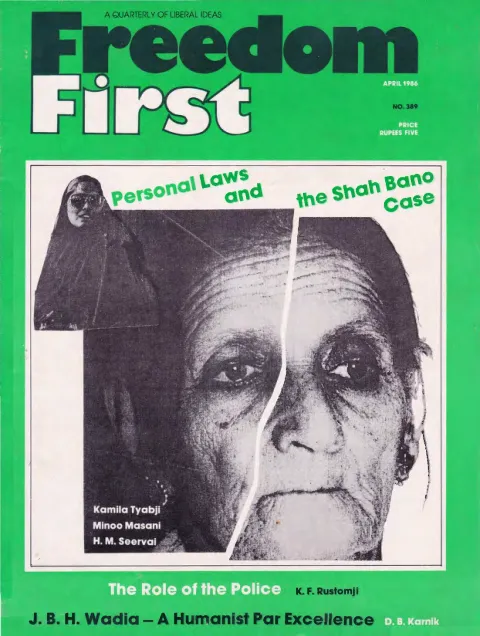
periodical issue
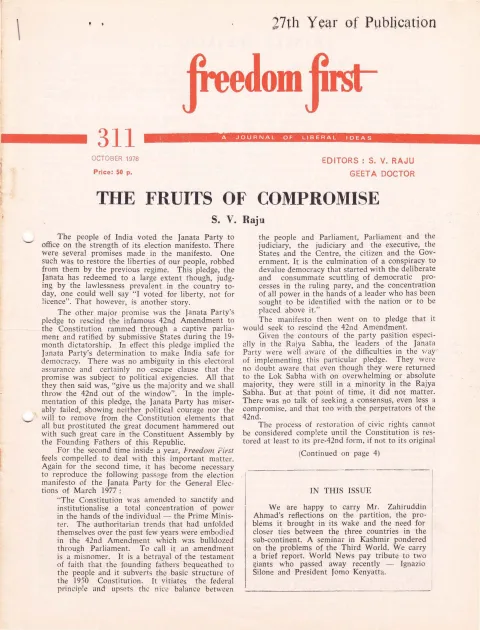
Freedom First
A Journal of Liberal Ideas
Edited by S. V. Raju
Published for the Democratic Research Service by J. R. Patel, Associate Editor, Freedom First at 127, M. Gandhi Rd., Bombay 400 023 and printed by him at States' People Press, Ghoga Street, Fort, Bombay-400 001. · Bombay · 1978
16 pages
Freedom First
Summary
Freedom First issue 311 (October 1978) opens with editor S. V. Raju’s “The Fruits of Compromise,” a sharp attack on the Janata Party government for watering down its election pledge to fully repeal the Emergency-era 42nd Amendment, settling instead for a truncated 45th Amendment Bill after the Rajya Sabha, with Mrs. Gandhi’s bloc voting it down. The issue’s editorial columns (“Frankly Speaking”) take up Kerala’s Gulf-remittance boom, the Law Ministry’s defence of removing the right to property from the Fundamental Rights chapter (rebutted using N. A. Palkhivala’s own words), and a satirical dispatch on the Rajneesh ashram in Poona. Zahiruddin Ahmad, writing from Australia on the thirtieth anniversary of independence, offers a personal and historical meditation on Partition, arguing it was a mistake that has hurt Muslims of the subcontinent more than Hindus, and tracing how British policy and communal politics produced 1947. A report summarises a Srinagar seminar on Third World development problems (technology transfer, MNCs, agricultural productivity). P. G. Mavalankar, M.P., reflecting on the Shah Commission’s findings on the Emergency, presses Parliament to act on its recommendations. World News carries obituaries of Ignazio Silone and Jomo Kenyatta and a note on the Dalai Lama and Tibet. A book review assesses Charan Singh’s “India’s Economic Policy: A Gandhian Blueprint,” and a film review pans the Kannada art film “Ghatashradda.” Maj. Gen. E. D’Souza argues India lacks a war memorial worthy of its servicemen’s sacrifices. The issue closes with the “With Many Voices” quotations column and subscription information.
Key points
-
S. V. Raju’s “The Fruits of Compromise” attacks the Janata government for pursuing only a watered-down 45th Amendment rather than fully repealing the 42nd Amendment as promised, a measure the Rajya Sabha then rejected outright.
-
Zahiruddin Ahmad, a Bengali Muslim who migrated to Pakistan in 1951 and later resigned from its Civil Service, reflects on Partition’s thirtieth anniversary, arguing it was a mistake driven by British policy and Gandhi’s “blunders” that ultimately hurt subcontinental Muslims more than Hindus by fragmenting their community.
-
P. G. Mavalankar’s Lok Sabha-based piece presses Parliament to act on the Shah Commission’s findings, condemning the burning of Commission report copies in several states, including his own Gujarat, as smacking of fascism.
-
A report on a Srinagar seminar on Third World development, attended by J. R. D. Tata, B. K. Nehru, and M. R. Masani among others, addresses agricultural productivity, technology transfer, and the role of multinational corporations.
-
Sonal Shah reviews Charan Singh’s India’s Economic Policy: A Gandhian Blueprint, summarising his argument that Nehru’s capital-intensive industrial strategy misallocated resources away from agriculture and produced persistent poverty.
-
World News carries obituaries of Ignazio Silone, the Italian Communist-turned-anti-Stalinist novelist, and Kenya’s Jomo Kenyatta, alongside a note on the Dalai Lama’s tentative consultations about reconciliation with Chinese-ruled Tibet.
-
Geeta Doctor reviews the Kannada film Ghatashradda, calling it unremittingly bleak, and separately reports on the Bhagwan Shree Rajneesh ashram in Poona, framing its provocations as exposing conventional society’s “cant and hypocrisy”.
-
Maj. Gen. E. D’Souza argues India lacks a war memorial worthy of its servicemen’s sacrifices across the conflicts fought since 1947, criticising the existing small samadhi at India Gate as architecturally insignificant.
Essays
The Fruits of Compromise
By S. V. Raju
S. V. Raju’s lead editorial accuses the Janata Party of failing to honour its manifesto pledge to rescind the 42nd Amendment in full. Instead of standing firm, the government sought a watered-down 45th Amendment, which Mrs. Gandhi’s bloc (with CPI allies) nonetheless voted down in the Rajya Sabha, leaving even that weaker measure dead. Raju recounts M. R. Masani’s parliamentary challenge asking whether a government needing assured majorities in both houses before legislating is functioning democracy, and criticizes reports that the Law Ministry wants the truncated bill accepted anyway. He calls for a fresh Amendment Bill to repeal the 42nd Amendment in toto.
- Janata Party’s manifesto promised full repeal of the 42nd Amendment but the government pursued only a partial 45th Amendment Bill.
- The Rajya Sabha, dominated by Mrs. Gandhi’s supporters and CPI allies, rejected even the diluted 45th Amendment.
- M. R. Masani’s November 1977 Freedom First article questioned whether a government must secure opposition consensus before legislating.
- Clauses voted down included restoring primacy of fundamental rights over directive principles and provisions for a referendum on constitutional amendments affecting basic features.
- The author urges the government to let the current bill lapse and introduce a fresh bill to repeal the 42nd Amendment entirely.
Thirty Years Ago-Thirty Years Later
By Zahiruddin Ahmad
Two short unsigned-by-byline columns under the “Frankly Speaking” masthead, both credited GD (Geeta Doctor) and SVR (S. V. Raju) respectively. The first, “Kerala’s Mini Boom,” describes the social transformation wrought in Kerala by Gulf remittances, citing an Economic and Political Weekly study showing most household savings go into land, buildings, and consumer durables rather than productive investment, and warns of a coming crisis as Gulf jobs dry up. The second, “‘Uninformed’ Indeed!,” rebuts Law Ministry spokesmen who dismissed critics of removing the right to property from the Fundamental Rights chapter as ‘uninformed,’ countering with a lengthy quotation from N. A. Palkhivala on why the right to property underpins other fundamental rights.
- Gulf remittances have driven a consumption boom in Kerala, funding home construction, appliances, and imported goods.
- An EPW study found over 90% of household savings went into land, buildings, and durables rather than productive investment.
- The number of passport applications from Ernakulam has dropped sharply, signalling the boom may be tapering.
- The column warns the government has given no thought to reintegrating returning Gulf workers when the boom ends.
- N. A. Palkhivala, India’s Ambassador to the USA, is quoted arguing that removing constitutional property rights would hollow out press freedom, trade union rights, and freedom of residence.
Learning the Right Lessons
By P. G. Mavalankar M.P.
No summary was extracted for this article. Listed for completeness.
Book Review: India’s Economic Policy. A Gandhian Blueprint by Charan Singh
By Sonal Shah
No summary was extracted for this article. Listed for completeness.
Film Review: “Ghatashradda” — Unrelieved Gloom
By Geeta Doctor
Geeta Doctor’s “Rajneesh at Poona” is a wry, observational report on the Bhagwan Shree Rajneesh ashram, describing the orange-clad followers flooding Poona’s streets, public disapproval including a rumoured rape, and a visit inside the ashram: the meditation hall’s ‘Kundalini’ dancing, the ashramites’ unselfconscious dress and behaviour, and the boutiques selling Rajneesh-branded goods. She closes by comparing Rajneesh’s provocations favourably to the ‘cant and hypocrisy’ of conventional society, predicting Poona will never be the same.
- Poona’s traditional Hindu-orthodox self-image is described as under strain from the visible presence of Rajneesh’s orange-robed followers.
- The ashram’s ‘Kundalini’ dancing and meditation practices are described in detail as compelling but bewildering to an outside observer.
- Followers are described as unselfconscious about nudity, dress, and physical intimacy in ways that scandalize local sentiment.
- The author frames Rajneesh as exposing the ‘cant and hypocrisy’ of conventional social norms rather than as simply immoral.
A Truly National War Memorial
By Maj. Gen. E. D’Souza PVSM (Retd.)
Zahiruddin Ahmad, a Bengali Muslim who left for Pakistan in 1951 and resigned from its Civil Service in 1957, reflects on the thirtieth anniversary of Indian independence. He recounts surviving the 1946 Calcutta killings, argues that Muslims of India constitute castes within Hindu society rather than a separate nation, and rejects Jinnah’s two-nation theory as a false black-and-white picture of a society full of grey. He blames British policy (the 1909 separate electorates) and Gandhi’s repeated ‘blunders’ (ending non-cooperation in 1922, the 1931 Gandhi-Irwin Pact) for enabling Partition, which he calls a mistake that hurt subcontinental Muslims more than Hindus by fragmenting a once-larger community across India, Pakistan, and Bangladesh. He contrasts India’s continued protection of its ~60 million Muslims with Pakistan’s expulsion or killing of Sikhs and Hindus from Lahore, and closes by asking whether India and Pakistan (and Bangladesh) can cooperate economically even if reunification is impossible.
- The author frames Indian Muslims as castes within a heterogeneous Indian society rather than a separate nation, rejecting Jinnah’s two-nation theory.
- He describes surviving the August 1946 Calcutta killings, saved by a Hindu friend and sheltered by a Muslim pharmacist who protected Hindu refugees.
- He argues British policy — especially the 1909 separate electorates — was a deliberate ‘divide and rule’ strategy alongside deep-rooted communal politics.
- He criticizes Gandhi three times: ending non-cooperation in 1922, signing the Gandhi-Irwin Pact in 1931, and thereby squandering opportunities against British rule.
- He states that had India not been partitioned, its ~200 million Muslims would still be a minority but one ‘no one can ignore,’ and that Partition weakened Muslim political effectiveness by dividing the community across three states.
- He contrasts India’s continued accommodation of Muslims with Pakistan’s expulsion or killing of nearly all Sikhs and Hindus from Lahore by 1947-48.
- He closes wondering whether India, Pakistan, and Bangladesh could cooperate economically — monetary policy, trade, customs, water resources — given the changed post-1971 landscape.
Problems of the Third World
An unsigned report on a seminar on ‘Problems of the Third World’ held in Srinagar, Kashmir, from 6-9 September, attended by twenty-four participants from Germany, the UK, Italy, Switzerland, Sweden, Malaysia, Singapore, Togo, Sri Lanka, and India. Opened by L. K. Jha, Governor of Jammu and Kashmir, the seminar addressed developing countries’ obligations to build efficient administration and raise productivity, with particular attention to agricultural productivity, technology transfer debates, and the role of multinational corporations, concluding with recommendations for greater public awareness and government support for economic cooperation with LDCs.
- Twenty-four participants from ten countries attended the Srinagar seminar, including J. R. D. Tata, G. Malagodi, B. K. Nehru, M. R. Masani, and David Wrimark MP.
- The seminar stressed that developing countries must rely primarily on their own resources and build honest, efficient administration.
- Agricultural productivity was identified as decisive for LDCs’ export capacity, balance of payments, and participation in the world economy.
- Debate on technology transfer covered whether developing countries’ non-protection of patents harms their own long-term interests.
- The seminar recognized both the controversy around and the ultimately welcomed role of multinational corporations, while affirming states’ rights to regulate them.
- Recommendations included greater public awareness of Third World problems and increased publicity for economic cooperation between LDCs and developed countries.
Essay 6
P. G. Mavalankar, M.P., in a piece based on a Lok Sabha speech of 3 August 1978, asks whether India has learned the right lessons from the Emergency, invoking the Shah Commission’s findings on preventive detention converted into punitive detention, press censorship, and the concentration of power. He recalls telling Mrs. Gandhi in Parliament in July 1975 that declaring the Emergency was an act of a weak and cowardly Prime Minister, quotes the Shah Commission on the need to root out extra-constitutional centres of power, and condemns the burning of Shah Commission report copies in several states including his own Gujarat, comparing it to book-burning under Hitler.
- Mavalankar frames a series of stark choices facing India post-Emergency: democracy vs authoritarianism, rule of law vs arbitrary action, independent judiciary vs subverted judiciary.
- He quotes the Shah Commission’s finding that Mrs. Gandhi’s decision to promulgate the Emergency reflected ‘a political decision… by an interested Prime Minister in a desperate endeavour to save herself.’
- He quotes the Shah Commission’s call for government to ensure ‘extra-constitutional centres of power’ are not allowed to grow and are ‘snuffed out ruthlessly.’
- He notes that copies of the Shah Commission report were burnt in several cities, including in his home state of Gujarat, and condemns this as smacking of fascist tendency.
- He calls on the government and Parliament to act courageously on the Shah Commission’s findings before time runs out.
Problems of the Third World: Report of a Seminar
The ‘World News’ section reprints three pieces from foreign press. An obituary from The Guardian (24 August 1978) profiles Italian novelist Ignazio Silone, tracing his path from founding member of the Italian Communist Party and friend of Lenin and Trotsky to anti-Stalinist writer of ‘Fontamara’ and ‘The God That Failed.’ A Swiss Press Review piece (28 August 1978) eulogizes the late President Jomo Kenyatta of Kenya as a pioneer of African freedom who forgave his former British jailers and built a stable multiracial, mixed-economy state. A further Swiss Press Review piece (31 July 1978) discusses the Dalai Lama’s tentative consultations, encouraged by Indian pressure, about a possible reconciliation with and return to a Chinese-ruled Tibet.
- Ignazio Silone, aged 78, is profiled as a founder of the Italian Communist Party who broke with Stalinism in 1930 and became an independent anti-Fascist writer.
- Silone refused to vote for a Comintern censure motion against Trotsky’s Chinese policy in 1927, an episode he said opened his eyes to Communist methods.
- Jomo Kenyatta is eulogized as a pioneer who avoided the common mistake of one-sided justice, building a Kenya where Africans, Asians and Europeans coexist under a mixed economy.
- The Dalai Lama is reported to be consulting followers in India about a possible reconciliation with and return to Chinese-ruled Tibet, with Indian diplomatic pressure playing a role.
- The piece notes the Dalai Lama’s initial rejection of Chinese overtures on the grounds of the continued presence of 300,000 Chinese soldiers in Tibet.
Frankly Speaking… (Kerala’s Mini Boom / “Uninformed” Indeed! / Rajneesh at Poona)
By GD / SVR
Sonal Shah reviews Charan Singh’s ‘India’s Economic Policy: A Gandhian Blueprint’ (Vikas Publishing House, 122 pages, Rs. 30). The review summarizes Charan Singh’s Gandhian-inspired thesis that India’s post-independence planners wrongly chose a capital-intensive, centralized industrial strategy over a labour-intensive, decentralized agricultural one, blaming Nehru for ‘aping’ the USSR model. The book argues this misallocation between agriculture and industry has produced persistent poverty and unemployment, and calls for a reversal of policy toward agricultural investment. Shah notes the review appears just as the Janata Party itself was riven by tension between Charan Singh and Morarji Desai, but predicts Charan Singh’s ideas will outlast his own political position.
- The book argues India chose a capital-intensive, mechanised, centralized industrial strategy in 1947 instead of a labour-intensive, decentralized agricultural one inspired by Gandhi.
- Charan Singh blames Nehru for a faulty policy of ‘misallocation of financial outlay between industry and agriculture’ resulting in 42 crores of people below the poverty line 36 years after independence, per the book’s claims.
- The review quotes the book’s argument that heavy industry has created ‘a dual economy with small enclaves of prosperity in a hinterland of poverty, unemployment and stagnation.’
- Charan Singh proposes a ‘complete reversal’ of policy: increased agricultural output per acre and reduced number of workers per acre.
- The reviewer notes the political irony that this book appears amid the public rift between Charan Singh and Morarji Desai within the Janata Party.
World News (Ignazio Silone / President Jomo Kenyatta / Lighter Chinese Hand in Tibet)
Geeta Doctor reviews the Kannada film ‘Ghatashradda’ (The Ritual of Excommunication), winner of the year’s President’s gold medal, calling it ‘the most disappointing, dreary, dismal experience that one can hope to see.’ She summarizes the plot — a Brahmin’s widowed daughter, made pregnant by a low-caste schoolteacher, is tormented, forced toward a botched abortion and suicide attempt, and finally ritually excommunicated — and argues the film fails despite (or because of) its unrelieved bleakness, contrasting it unfavourably with ‘Zorba the Greek’ for offering no affirmation of life. She closes by invoking Charlie Chaplin’s disdain for ‘tricky effects’ in cinema to criticize the film’s overused stereotyped art-house visual symbolism.
- The film ‘Ghatashradda,’ winner of the President’s gold medal, is criticized as unremittingly dismal without any redeeming character or moment of affirmation.
- The reviewer objects to art films being praised as ‘realistic’ simply for depicting grim subject matter, arguing this is as much a falsification as escapist entertainment films.
- The plot involves a pregnant widow’s daughter tormented by students, subjected to a coerced abortion, and ultimately ritually excommunicated by her own father.
- The reviewer compares the film unfavourably to ‘Zorba the Greek,’ which despite similar tragedy ends with an affirmation of life; ‘Ghatashradda’ offers only defeat and resignation.
- The review closes by quoting Charlie Chaplin’s autobiography condemning directors’ overuse of ‘tricky effects’ and symbolic camera work.
We can’t laugh at ourselves
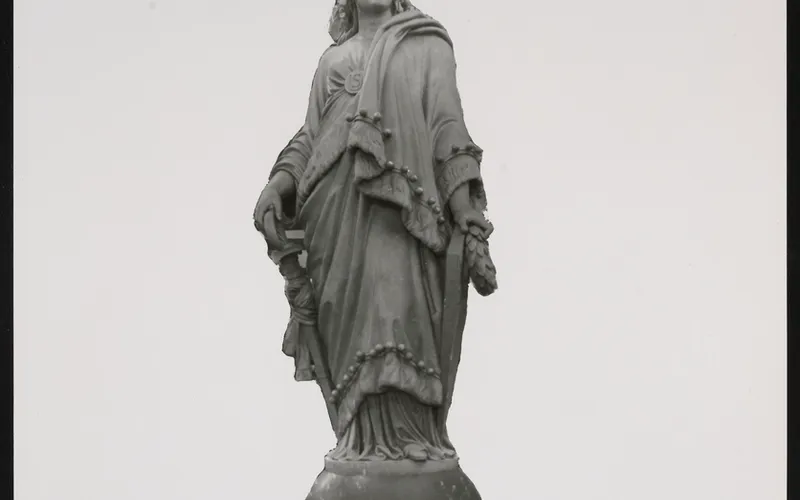
Maj. Gen. E. D’Souza (Retd.) argues India lacks a war memorial worthy of its servicemen, tracing the many conflicts India’s forces have fought since 1947 (Kashmir, Hyderabad, Goa, the 1962 China war, 1965 and 1971 wars, Nagaland and Mizoram counter-insurgency). He describes the existing National War Memorial — a small samadhi with reversed rifle and steel helmet under India Gate, hastily conceived in 1972 — as architecturally insignificant and physically overshadowed by the Imperial monument surrounding it, rarely visited by dignitaries or the public. He calls for a proper, competition-designed National War Memorial that projects the secular character of the armed forces and the theme of peace bought through sacrifice.
- The article catalogues India’s continuous military engagements since 1947, from Kashmir and Hyderabad through the 1962, 1965, and 1971 wars to ongoing counter-insurgency in Nagaland and Mizoram.
- The existing National War Memorial, a small samadhi under India Gate conceived in 1972, is criticized as architecturally meaningless and physically dwarfed by the surrounding Imperial monument.
- The author notes no foreign dignitary has ever been asked to lay a wreath at the memorial in over two years in Delhi, unlike the customary visit to tombs of Unknown Soldiers elsewhere.
- British-era war memorials across Indian cantonments and cities (e.g., Pune, unveiled by the Prince of Wales in 1921) are cited as contrasting examples of proper commemoration.
- The author calls for a new, competition-designed National War Memorial reflecting the secular, apolitical nature of the armed forces and the theme of peace bought by sacrifice.
With Many Voices
A short, unsigned filler item on page 15 titled ‘We can’t laugh at ourselves,’ reprinted from Times of India (7 September), reporting that censors cut the word ‘Marathi’ from a comedy film’s dialogue where a character mocks Marathi speakers, with actor Amol Palekar citing the episode as evidence Indians cannot laugh at themselves. This is followed on page 16 by ‘With Many Voices,’ a column of quotations on current affairs drawn from the Indian and international press (Romesh Thapar on the succession of political dynasties from Motilal Nehru onward, Margaret Thatcher on fear as no basis for foreign policy, Ashok Mitra on Centre-State fiscal balance, and others), and the issue’s subscription form and imprint.
- A censorship anecdote reports the word ‘Marathi’ being cut from a comedy film’s dialogue mocking Marathi-speakers, cited by actor Amol Palekar as evidence Indians cannot laugh at themselves.
- The ‘With Many Voices’ column collects short quotations from Indian and international press commentary published in August 1978.
- Romesh Thapar’s quoted item wryly traces a chain of political dynasties: Motilal Nehru to Nehru to Indira to Sanjay, and Morarjibhai to Kanti, and so on.
- Margaret Thatcher is quoted from the Sunday Statesman stating fear is no basis for foreign policy.
- The issue closes with Freedom First’s subscription form (Rs. 10 annual) and its publication imprint naming J. R. Patel as publisher for the Democratic Research Service.
Generated by the v1.5 extraction pipeline. Awaiting editorial review.
Metadata and summary are AI-extracted from the source PDF and reviewed for editorial accuracy. The original work is available via the Read PDF tab above (where present); paragraph-level citation inside the PDF is deferred to a future engagement.