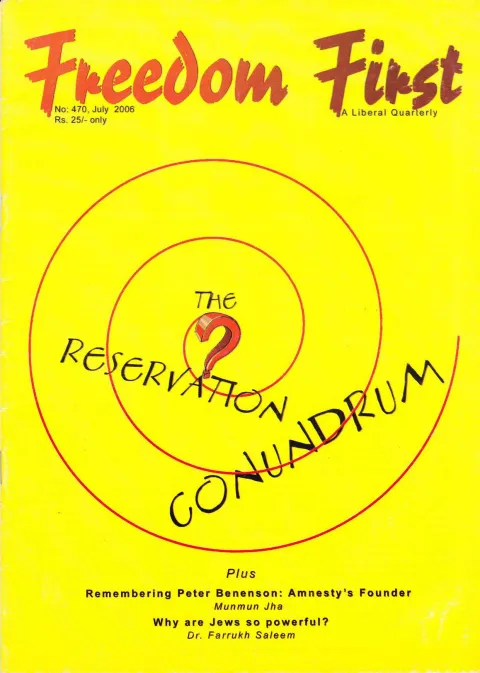
periodical issue
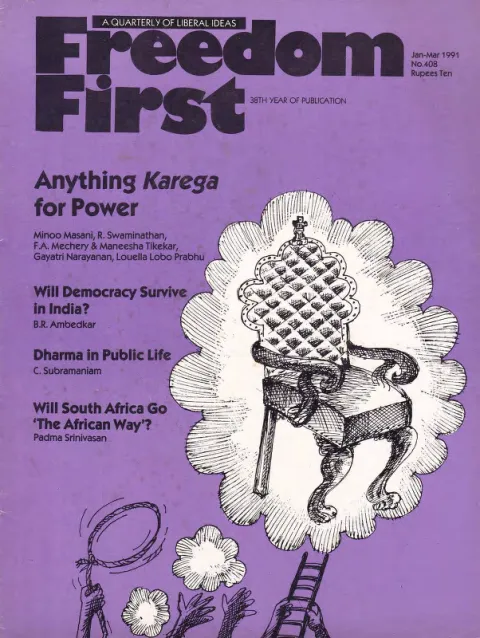
Freedom First
A Quarterly of Liberal Ideas
By Minoo Masani, B. R. Ambedkar, S. V. Raju
Published by J.R. Patel for the Democratic Research Service and printed by him at Parsiana Publications Pvt. Ltd, 300 Perin Nariman Street, Bombay 400 001 · Bombay · 1991
52 pages
Freedom First
Summary
Freedom First No. 408 (January-March 1991), the quarterly’s 38th year of publication, leads with a themed symposium, “Anything Karega for Power,” on the moral collapse of Indian political life amid the rapid churn of prime ministers (Rajiv Gandhi to V.P. Singh to Chandra Shekhar) and the fallout of the Mandal Commission’s OBC reservation recommendation and the Ayodhya dispute. Minoo Masani, R. Swaminathan, F.A. Mechery and Maneesha Tikekar, Gayatri Narayanan, and Louella Lobo Prabhu contribute essays examining, respectively, the fitness of India’s revolving-door prime ministers, the constitutional legitimacy of the Chandra Shekhar government installed with Congress(I) support, the Mandal Report’s aftermath and its overlooked non-reservation recommendations, and the Ayodhya temple-mosque dispute as an avoidable communal confrontation. In the Centenary Year of Dr. B.R. Ambedkar, the issue reprints an extract of his 25 November 1949 Constituent Assembly speech, “Will Democracy Survive in India?”, warning against hero-worship (bhakti) in politics and urging that political democracy be completed by social and economic democracy. Additional contents (per the table of contents, largely beyond the rendered pages) include C. Subramaniam on “Dharma in Public Life,” G.N. Sarma revisiting Raja Rao’s Kanthapura fifty years on, Padma Srinivasan on South Africa, S.V. Raju on a Tibet festival, Satish Oberoi on Indian sports, a debate on the credibility of civil libertarians, and book reviews.
Key points
-
Minoo Masani’s “Do We Deserve our Prime Ministers?” indicts Rajiv Gandhi, V.P. Singh and Chandra Shekhar as each unfit, proposing a caretaker government of eminent non-political citizens like Justice H.R. Khanna pending fresh elections.
-
R. Swaminathan’s “Prime Minister — Anyone?” argues India’s leaders “don’t know why they want power,” detailing the Congress(I)‘s calculated decision to prop up Chandra Shekhar’s minority government.
-
F.A. Mechery and Maneesha Tikekar’s “The Legitimacy of ‘Arithmetical Democracy’” argue Chandra Shekhar’s government has a legal case on arithmetic but lacks the legitimacy of a popular mandate, tracing defections that exploited gaps in the anti-defection law.
-
Gayatri Narayanan’s “The Mandal Report — Some Reservations” argues public debate wrongly reduced the seven-volume Mandal Report to a single reservations clause, ignoring its educational-concession, land-reform, and Backward Classes Development Corporation recommendations.
-
Louella Lobo Prabhu’s “The Ayodhya Non-Issue — An Avoidable Confrontation” lays out both the Muslim legal case and the Hindu psychological case on the Ram Janmabhoomi-Babri Masjid dispute, suggesting L.K. Advani’s Rath Yatra was a calculated response to V.P. Singh’s caste-based mobilisation.
-
A reprinted extract of B.R. Ambedkar’s 25 November 1949 Constituent Assembly speech, “Will Democracy Survive in India?”, warns against bhakti (hero-worship) in politics and insists political democracy is unsustainable without underlying social and economic democracy.
-
An unsigned assessment of the Mandal Commission’s fallout, including student self-immolations, presents both the pro- and anti-reservation cases and concludes the country has reached “a point of divide.”
Essays
Do We Deserve our Prime Ministers?
By Minoo Masani
Minoo Masani’s opening editorial-style essay indicts the entire political class for the country’s decline, arguing that Rajiv Gandhi, V.P. Singh, and now Chandra Shekhar have each shown themselves unfit, and that the President’s installation of Chandra Shekhar as a stopgap premier reflects a desperate search for “anyone” willing to hold office rather than a mandate-driven choice. Masani is unsparing about V.P. Singh in particular, blaming his Mandal Commission gambit and his indifference to police brutality against protesting students for deepening social division, and argues a caretaker government of non-partisan eminent citizens (naming Justice H.R. Khanna and Justice B. Lentin as examples) should have been installed instead pending fresh elections.
- Masani calls V.P. Singh’s tenure as Prime Minister “something of a misery” and a “humiliation,” faulting his embrace of Mandal-style reservations and his indifference to police violence against anti-Mandal student protesters.
- He argues Chandra Shekhar’s installation, brokered via Congress(I) support after a Janata Dal(S) split, lacks a real popular mandate.
- Masani criticizes the government’s replacement of state Governors and the treatment of Punjab’s Anandpur Sahib Resolution as evidence that Delhi still does not respect India’s federal structure.
- He proposes that a caretaker government of non-political, distinguished citizens (naming Justice H.R. Khanna and Justice B. Lentin) should have governed pending fresh elections.
- The essay closes gesturing toward upcoming pieces examining whether Indians, as a people, have lapsed into political fatalism.
Prime Minister — Anyone?
By R. Swaminathan
R. Swaminathan’s essay argues that India’s chief political malady is leaders who seek the prime ministership without a coherent sense of why, offering only platitudes about poverty eradication rather than workable policy. He walks through the arithmetic of Chandra Shekhar’s dependence on Congress(I) support, compares the situation to Britain’s Thatcher-to-Major transition, and closes arguing for administrative decentralization and, eventually, a more consultative “government by discussion” in which MPs demand a genuine say in policy rather than mere patronage.
- Swaminathan argues political leaders “don’t know why they want power,” offering only “tiresome glibness of platitudes” about uplift and social justice.
- He details the Congress(I)‘s calculated decision to prop up Chandra Shekhar’s minority government rather than force fresh elections, seeing it as a tactic to buy time and avoid immediate accountability.
- He compares Chandra Shekhar’s position to Britain’s Conservative succession from Thatcher to Major, and notes the BJP’s advantage in being untested by a governing record.
- Swaminathan quotes historian G.M. Trevelyan on Tudor-era English rural prosperity to argue against treating rural and urban India’s interests as opposed.
- He closes by predicting future Indian politics will move toward a more consultative ‘government by discussion’ as MPs increasingly demand real input into policy.
The Legitimacy of ‘Arithmetical Democracy’
By F.A. Mechery and Maneesha Tikekar
F.A. Mechery and Maneesha Tikekar examine the constitutional propriety of Chandra Shekhar’s government, which they argue has a defensible legal case on arithmetic and procedural grounds (having split from the Janata Dal and secured Congress(I) backing) but lacks deeper political legitimacy since it never sought or won a popular mandate. The essay traces the sequence of defections after V.P. Singh’s fall, the Speaker’s uneven application of the anti-defection law, and Congress(I)‘s calculated interest in keeping Chandra Shekhar’s minority government afloat as a low-risk, low-accountability arrangement while it waits out the political cycle.
- The authors argue that while Chandra Shekhar’s government has a ‘legal case on the basis of arithmetic and procedure,’ it lacks the legitimacy that comes from a popular mandate.
- They detail how the Congress(I) calculated that propping up a piece-meal, dependent government kept it in the limelight while narrowing V.P. Singh’s power base.
- The essay describes how a trickle of defections from the Janata Dal (including Chandrashekhar, Maneka Gandhi, and Harmohan Dhawan) exploited gaps in the anti-defection law by allowing a slow accumulation past the one-third threshold.
- It cites jurist N.A. Palkhivala’s criticism of the anti-defection law for making legislators ‘soulless and conscienceless entities.’
- The authors conclude the government’s ‘freedom from accountability’ could paradoxically let it act boldly on issues like Punjab, Kashmir, and Ayodhya-Babri Masjid, since it has little further to lose.
The Mandal Report — Some Reservations
By Gayatri Narayanan
Gayatri Narayanan’s essay revisits the Mandal Commission’s 27% OBC reservation recommendation, arguing that public debate wrongly reduced a seven-volume, ten-year-old report to a single reservations clause, ignoring its broader recommendations on educational concessions, land reform, and dedicated Backward Classes Development Corporations. She surveys the Commission’s own findings on OBC educational disadvantage and argues that V.P. Singh’s government over-emphasized reservations to the exclusion of more structural, less politically charged reforms the report also proposed.
- Narayanan argues the Mandal Report was ‘much more than prescribing quotas,’ and that its educational, land-reform, and financing recommendations went largely unnoticed.
- She quotes the Commission’s own observation that reservations would let only 52% of OBCs (constitutionally a general figure) ‘go forward,’ underscoring that quotas alone cannot fix backwardness.
- The essay reviews the Commission’s proposed ‘educational concessions’ for OBC students (fee exemptions, books, hostels, stipends) as insufficient without structural changes to an ‘elitist’ education system inherited from British rule.
- She highlights the Commission’s land legislation recommendations and its proposal for Backward Classes Development Corporations at the Central and state levels.
- Narayanan concludes that V.P. Singh’s decision to implement Mandal fits a pattern of governments chasing short-term political gain from ‘radical’ policy moves rather than pursuing the report’s fuller structural agenda.
The Mandal Commission — An Assessment
This unsigned contributed essay, “The Mandal Commission — An Assessment,” reflects on the violent fallout of the Mandal reservations dispute, including student self-immolations, and argues that political parties on all sides abandoned their responsibility to calm the situation. It lays out both pro- and anti-reservation arguments in some detail — concerns about merit and competence versus arguments that upper castes have long monopolized education, the professions, and the bureaucracy — and concludes that Indian society and politics have reached an ideological ‘point of divide’ on Mandal that will likely see only temporary resolutions.
- The essay condemns the emotional and physical violence surrounding the Mandal agitation, including self-immolations, as a ‘permanent scar’ on the country, and faults political leaders and media for partisan coverage.
- It presents the anti-reservation case (concerns about merit, competence, and a ‘quantum of injustice’ in any such scheme) alongside the pro-reservation case (upper-caste dominance of education, professions, and the civil service).
- The essay discusses U.S.-style affirmative action as a comparator, noting the U.S. is ‘compelled to resort to some form of reservations’ despite being an advanced economy.
- It anticipates that the reservations dispute will trigger further caste-based political mobilization, including agrarian castes newly demanding backward status (citing the Vanniyar agitation in Tamil Nadu), and predicts increased upper-caste migration abroad.
- The essay closes concluding the country has reached ‘a point of divide’ on Mandal, with valid arguments on both sides underplayed by their opponents, and that any resolution will be temporary.
The Mandal Commission — An Assessment / The Mandal Report — Some Reservations
In a boxed sidebar within the Mandal coverage, economist Daniel Seligman’s Fortune column ‘Affirmative Action, Indian Style’ is reproduced, applying economist Thomas Sowell’s five generalizations about affirmative action (drawn from his book Preferential Policies: An International Perspective) to India’s Mandal-driven reservations regime — covering the tendency of ‘temporary’ preferences to persist, benefits accruing to the already-advantaged within preferred groups, group polarization and violence, fraudulent caste-certificate claims, and a broader absence of evidence on whether such policies actually reduce inequality.
- The sidebar reproduces Daniel Seligman’s Fortune (March 12, 1990) column applying Thomas Sowell’s five ‘laws’ of affirmative action to the Indian case.
- Law 1: affirmative action framed as temporary invariably becomes permanent, as has ‘plainly happened in India.’
- Law 4 is illustrated by a Washington Post story describing a brisk trade in fraudulent lower-caste certificates in Pauna, India.
- Law 3 is linked to India’s caste-based violence, private caste armies, and student self-immolations following expanded preferences.
- The column closes noting no evidence has crossed Seligman’s desk showing affirmative action programs, in India or the U.S., actually succeed in reducing inequality.
The Ayodhya Non-Issue — An Avoidable Confrontation
By Louella Lobo Prabhu
Louella Lobo Prabhu’s essay frames the Ayodhya Ram Janmabhoomi-Babri Masjid dispute as an ‘avoidable confrontation’ and, in her view, a ‘non-issue’ turned into a communal tinderbox by political actors. She lays out both the Muslim legal case (possession, the impossibility of endlessly relitigating historical title, the mosque’s protected status as a century-old structure) and the Hindu psychological/cultural case (Ram’s centrality to Hindu tradition regardless of literal historicity), and argues that L.K. Advani’s Rath Yatra exploited resurgent Hindu sentiment in a low-key but calculated response to V.P. Singh’s Mandal-driven caste politics.
- Lobo Prabhu argues that unlike the ‘Left’ parties (whose Marxist atheism simplifies their dealings with religious minorities), other parties have struggled to find a principled position on Ayodhya.
- She presents the ‘Muslim case’: possession is nine-tenths of the law, and reopening title on a centuries-old religious site invites endless historical relitigation (comparing it to the Elgin Marbles dispute).
- She presents the ‘Hindu case’: Ram is integral to the Hindu psyche regardless of religious-mythological status, and the psyche was not disturbed by the Babri Masjid’s presence until politics revived the dispute.
- The essay credits Chandra Shekhar with a good record on human rights and civil liberties (unlike V.P. Singh), noting he was imprisoned during the Emergency.
- Lobo Prabhu suggests L.K. Advani’s Rathyatra was a calculated, if ‘odious,’ attempt to counter V.P. Singh’s caste-based mobilization through resurgent Hindu chauvinism, and closes urging both majority and minority communities to step back from the ‘brink of the precipice.‘
Will Democracy Survive in India?
By B.R. Ambedkar
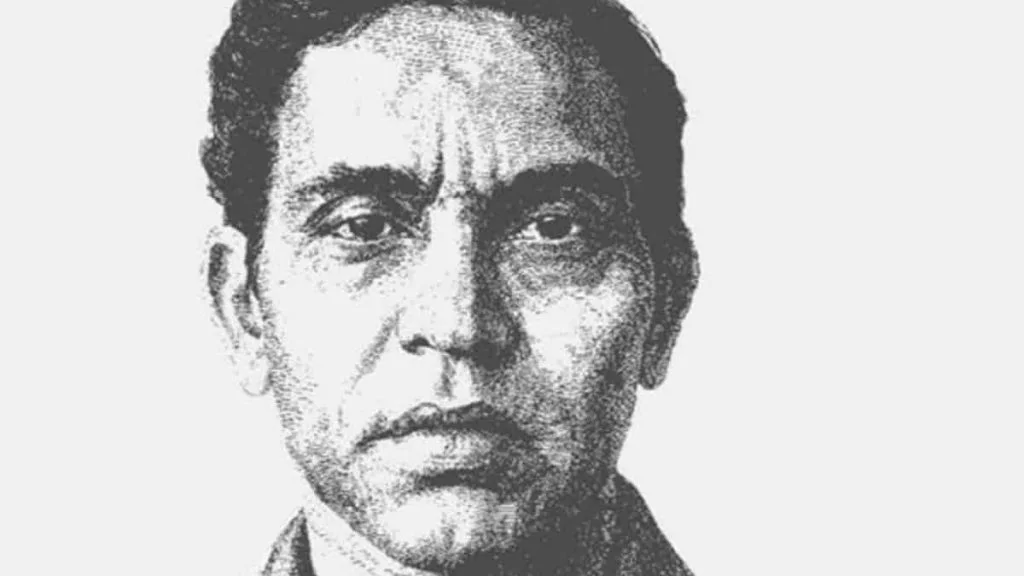
In Ambedkar’s Centenary Year, Freedom First reprints an extract from his 25 November 1949 address to the Constituent Assembly, ‘Will Democracy Survive in India?’ Ambedkar voices anxiety over whether independent India will retain both its independence and its new democratic constitution, recalling historical betrayals (Sind’s fall to Mohammed-bin-Kasim, Jaichand’s invitation to Mohammed Ghori, the Sikh rulers’ passivity in 1857) as cautionary precedent for internal treachery undermining self-rule. He argues India must hold fast to constitutional methods over ‘the Grammar of Anarchy,’ warns against the political dangers of bhakti/hero-worship, and insists that political democracy is unsustainable without underlying social and economic democracy rooted in liberty, equality, and fraternity.
- Ambedkar frames his central anxiety as whether India, having once lost its independence through the treachery of some of its own people, might lose it again after 26 January 1950.
- He recounts historical episodes of internal betrayal — the invasion of Sind, Jaichand’s invitation to Mohammed Ghori, and Sikh rulers’ passivity in 1857 — as evidence that India’s past loss of freedom came from within, not merely from external conquest.
- He argues newly-won democracy in India could give way to dictatorship if constitutional methods are abandoned in favor of civil disobedience, satyagraha, or revolution once constitutional avenues are open.
- Ambedkar warns explicitly against bhakti (hero-worship) in politics, quoting John Stuart Mill’s caution against laying liberties ‘at the feet of even a great man,’ and calling bhakti in politics ‘a sure road to degradation and to eventual dictatorship.’
- He defines ‘real democracy’ as requiring liberty, equality, and fraternity together as an indivisible trinity, and argues that persistent social and economic inequality alongside political equality constitutes a dangerous ‘life of contradictions’ that could eventually ‘blow up the structure of political democracy.’
Generated by the v1.5 extraction pipeline. Awaiting editorial review.
Kanthapura — Fifty Years Later
By B. R. Ambedkar
No summary was extracted for this article. Listed for completeness.
Metadata and summary are AI-extracted from the source PDF and reviewed for editorial accuracy. The original work is available via the Read PDF tab above (where present); paragraph-level citation inside the PDF is deferred to a future engagement.