periodical issue
Freedom First
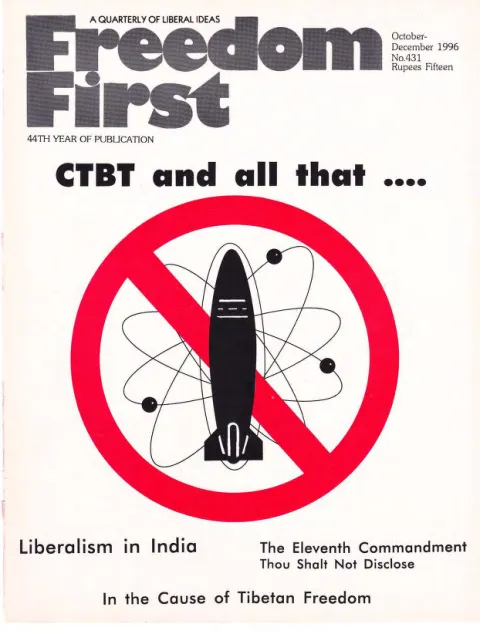
CTBT and all that ....
By Sharad Joshi
Published by J. R. Patel for the Indian Committee for Cultural Freedom and printed by him at Kaiser-E-Hind Private Ltd., 300, Perin Nariman Street, Mumbai 400 001. · Mumbai · 1996
52 pages
Freedom First
Summary
This is issue No. 431 (October-December 1996) of Freedom First, the Bombay-based quarterly of liberal ideas founded by Minoo Masani in 1952, edited at this point by S. V. Raju with R. Srinivasan as Associate Editor. In the rendered pages the issue opens with its regular “With Many Voices” and “Of Cabbages and Kings” columns, then runs its cover package “CTBT and all that…”, three essays debating India’s refusal to sign the Comprehensive Test Ban Treaty. This is followed by Sharad Joshi’s essay “Liberalism in India - Awaiting a Hitler?”, which argues that ancient Vedantic thought anticipated liberal individualism but that the tradition was suppressed under successive rulers and left contemporary India vulnerable to authoritarian populism. The chunk closes with a report, “In the Cause of Tibetan Freedom,” on the Second International Conference of Tibet Support Groups in Bonn and the Friedrich Naumann Foundation’s decision to continue the conference despite Chinese pressure (which led Beijing to shut down the Foundation’s China offices), and the start of a serialized “Tibet: The Facts” backgrounder.
Key points
-
The cover package “CTBT and all that…” debates India’s refusal to sign the Comprehensive Test Ban Treaty: Rajesh M. Basrur argues the treaty’s collapse reflected the nuclear powers’ own lack of genuine commitment to disarmament rather than Indian obstruction, faulting the Entry Into Force clause for making India, Pakistan and Israel scapegoats.
-
E. D’Souza (Maj. Gen., Retd.) defends India’s refusal to sign, arguing the CTBT is not truly comprehensive since it exempts laboratory and sub-critical testing while letting the five declared powers keep upgrading arsenals, and praises Ambassador Arundhati Ghose’s firmness at Geneva.
-
S. S. Bankeshwar calls nuclear disarmament efforts an exercise in futility since weapons technology cannot be disinvented, and argues India faces only three choices, fatalism, a foreign nuclear umbrella, or self-reliant deterrence, endorsing the third.
-
Sharad Joshi’s “Liberalism in India - Awaiting a Hitler?” argues that Vedantic thought anticipated liberal individualism but that seven centuries of conquest and colonial rule, followed by Nehruvian statism, suppressed this inheritance, warning that economic disillusionment could produce an Indian Hitler exploiting communal and caste grievances.
-
A report on the Second International Conference of Tibet Support Groups in Bonn covers the Dalai Lama’s keynote framing the Tibet struggle as pro-justice rather than anti-Chinese, and China’s retaliatory shutdown of the Friedrich Naumann Foundation’s China offices after the Foundation proceeded with the conference.
-
The regular “Of Cabbages and Kings” column mourns Swatantra Party colleague N. C. Zamindar, reports on a decade-old broadcasting-licence writ petition tied to Minoo Masani’s Emergency-era censorship fight, and comments on executions of Indian workers in Saudi Arabia and the CIA’s Cold War “Operation Jakarta” in Indonesia.
Essays
Many Voices
The magazine’s recurring miscellany column of quoted press clippings and editorial one-liners on Indian and world affairs, framed by a Tennyson epigraph. In the rendered pages it compiles quips from Indian columnists and public figures on political corruption, coalition politics, the Bombay High Court, and prime-ministerial ambition, illustrated by an R. K. Laxman-style cartoon about a judge asking for an injunction against Gandhi-tribute speeches.
- Compiles quoted remarks from Indian newspapers (Indian Express, Times of India, The Hindu, The Pioneer, India Today) and other outlets from May-September 1996
- Recurring theme: cynicism about politicians’ pursuit of power and coalition-era democracy
- Includes commentary on corruption among bureaucrats and godmen (Chandraswami’s arrest)
- One entry references the 1971 Bangladesh war dead being forgotten in national memory
Of Cabbages & Kings
The editor’s regular personal column of obituary notes and current-affairs commentary. This installment mourns the death of Swatantra Party colleague N. C. Zamindar, reports on a long-delayed broadcasting-license writ petition connected to Freedom First founder M. R. Masani’s fight against Indira Gandhi-era censorship, and comments on the execution of Indian workers in Saudi Arabia, the CIA’s Cold War-era ‘Operation Jakarta’ in Indonesia, and Dr. Indumati Parikh’s honor from the Centre for the Study of Social Change.
- Obituary for N. C. Zamindar, Swatantra Party colleague, Hindi novelist, and Agra University gold medalist, who died in Indore aged 73
- Reports a 1996 letter from Solicitor D. H. Nanavati about the 1987 writ petition M. R. Masani and P. C. Chatterjee filed for permission to run an independent broadcasting station, filed amid Emergency-era censorship disputes
- Comments on the beheading of Indian and other foreign nationals in Saudi Arabia for murder and robbery, and Amnesty International’s concern over Saudi executions
- Recounts the CIA’s ‘Operation Jakarta’ covert support for anti-communist forces after Indonesia’s 1965 massacre, drawing a parallel to the toppling of Allende in Chile
- Congratulates Dr. Indumati Parikh, Radical Humanist and founder of Streehitakarini, on winning the Dr. Jankidas Bajaj Award
Between Ourselves …
Editorial note explaining the issue’s contents: why the magazine had avoided covering the CTBT until now, framing it as this issue’s cover story following reader requests, and introducing profiles of C. Rajagopalachari, Annie Besant, and the husband-wife musician team M. S. Subbulakshmi and T. Sadasivam, plus a tribute to the Friedrich Naumann Foundation’s stand on Tibet.
- Explains the editorial decision to finally cover the CTBT as the cover story after reader requests
- Frames Sharad Joshi’s essay on liberalism as marking his succession to Minoo Masani’s leadership of the Indian liberal movement
- Previews profiles on C. Rajagopalachari, Annie Besant, and the Subbulakshmi-Sadasivam musical partnership
- Praises the Friedrich Naumann Foundation for holding a Tibet conference in Germany despite Chinese pressure
CTBT and all that … / The Future of Arms Control
By Rajesh M. Basrur
Rajesh M. Basrur’s essay argues that the 1996 collapse of the CTBT negotiations at Geneva reflected the P5 nuclear powers’ own lack of genuine commitment to arms control, not merely India’s objections. He contends the treaty’s Entry Into Force (EIF) clause, which effectively required India, Pakistan, and Israel to sign as a precondition, was a diplomatic blunder that let India be cast as the spoiler, while the non-proliferation value of the CTBT was marginal given existing NPT coverage. He faults US domestic politics, especially Republican opposition associated with Colin Powell, for undermining a serious arms-control push.
- Attributes the CTBT’s collapse to India’s objection to the EIF clause requiring signature by India, Pakistan, and Israel as threshold states
- Argues the treaty’s non-proliferation value was peripheral since the NPT already covers most of that ground
- Notes the P5 (US, Russia, Britain, France, China) all continued modernizing arsenals rather than committing to real disarmament
- Blames the Clinton administration’s deference to the Pentagon and figures like Colin Powell for the CTBT’s weak arms-control ambition
- Frames India’s 1996 stance as consistent with Nehru’s 1954 call for a nuclear test moratorium
India’s Objections
By E. D’Souza
E. D’Souza (Maj. Gen., Retd.) defends India’s refusal to sign the CTBT, arguing the treaty is not truly comprehensive since it exempts several kinds of testing and lets the five declared nuclear powers keep upgrading arsenals while denying the option to others. He surveys expert and political opinion (K. Subramanyam, Jasjit Singh, Lt. Gen. S. K. Sinha, Dr. Usha Mehta) on whether India should conduct one more test before signing, and defends India’s ambassador Arundhati Ghose for holding firm against pressure at Geneva. As a Hiroshima veteran (present shortly after the bombing as part of Commonwealth occupation forces), he grounds his anti-nuclear-weapons advocacy in personal experience while still endorsing India keeping its options open.
- Argues the CTBT is not truly ‘comprehensive’ since it doesn’t cover lab, computer-simulated, or sub-critical tests
- Traces India’s consistent objection to nuclear disarmament treaties back to Nehru’s 1954 moratorium call
- Surveys the debate over whether India should conduct a second nuclear test (after Pokhran 1974) before signing any test-ban treaty, citing A. Venkateswaran and Lt. Gen. S. K. Sinha in favor and the author’s own skepticism
- Notes Dr. Usha Mehta, a Gandhian, surprisingly supported a second test, while the author invokes Gandhi’s opposition to nuclear weapons based on his own visit to Hiroshima’s hospital
- Praises Ambassador Arundhati Ghose’s performance at the Geneva CTBT talks against pressure from the nuclear ‘haves’
- Cites Field Marshal Sam Manekshaw’s view that the nuclear five have no moral right to arrogate nuclear monopoly to themselves
An Exercise in Futility
By S. S. Bankeshwar
S. S. Bankeshwar argues bluntly that nuclear non-proliferation efforts and the CTBT are an exercise in futility, since existing nuclear powers (especially the US) will never truly give up their weapons and ‘might is right’ governs international relations. He contends India has only three choices - fatalism, seeking a foreign nuclear umbrella, or building its own bombs - and argues forcefully for self-reliant nuclear deterrence, rejecting reliance on external protection as immoral cowardice.
- Calls nuclear disarmament talks futile because destroyed weapons technology ‘cannot be disinvented’
- Notes the US has conducted 1,149 nuclear tests, Russia 1,100, France 209, Britain 45, China 43, versus India’s single Pokhran test
- Argues seeking nuclear protection from allies is no less immoral than developing nuclear weapons domestically
- States India faces only three alternatives: fatalism, seeking a nuclear umbrella, or self-reliant nuclear armament, and endorses the third
- Frames nuclear self-reliance as a lesson from India’s wars with Pakistan about the unreliability of foreign guarantees
Liberalism in India - Awaiting a Hitler?
By Sharad Joshi
Sharad Joshi, founder of the Shetkari Sanghatana and Swatantra Bharat Party (successor to Minoo Masani as leader of the Indian liberal movement per the editor’s note), argues that ancient Indian society, particularly the Vedanta tradition, anticipated core liberal tenets - individual autonomy, skepticism of authority, and epistemic humility - but that this liberal inheritance was suppressed for seven centuries first by Muslim conquest and then British colonial administration, and finally captured by statist Congress-era socialism after independence. He surveys the failure of the Nehruvian licence-permit model, argues that liberal politics faces almost no organized constituency in India today because liberal-minded individuals are hard to organize, and warns that the resulting economic and political disillusionment creates fertile ground for an Indian Hitler figure to emerge and exploit communal and caste grievances, positioning the Swatantra Party and its successors as history’s underdeveloped liberal alternative.
- Argues ancient India, especially the Vedanta school, anticipated liberal tenets: individual uniqueness, rejection of absolutism, skepticism of authority
- Traces Indian liberal lineage to Dadabhai Naoroji, Gokhale, Raja Rammohan Roy, Narmad, Phule, Agarkar, and links them to J. S. Mill and Adam Smith
- Argues Muslim invasions from the 13th century and British colonial rule together produced seven centuries of ‘liberal eclipse’ despite the British instituting rule of law
- Identifies three post-independence political currents - socio-religious reformist movements, Hindu-nation movements (Tilak-style), and oppressed-community movements led by Ambedkar, Periyar, and Ramaswami Naicker - as all ultimately statist
- Credits Gandhi with an anarchist, minimal-government vision but says Nehruvian socialism captured the state instead, producing the licence-permit-quota Raj
- Warns that economic stagnation and disillusionment with all governments create conditions like Weimar Germany, ripe for a ‘comic-book Hitler’ figure exploiting communal and caste hatred
- Surveys the electoral failure of the Swatantra Party (founded by Rajaji, swept away in 1971) and the fledgling Swatantra Bharat Party (founded 1994, negligible seats)
- Concludes liberals have almost no organizational base because liberal individuals are inherently resistant to being organized under any single authority
In the Cause of Tibetan Freedom
A news report on the Second International Conference of Tibet Support Groups held at the Wasserwerk in Bonn, Germany, jointly organised by the Tibetan Government in Exile and the Friedrich Naumann Foundation. It covers the Dalai Lama’s keynote address distinguishing the Tibetan freedom struggle from anti-Chinese sentiment, the Chinese government’s retaliatory shutdown of the Friedrich Naumann Foundation’s China offices and cancellation of ministerial visits, and the German Parliament’s unanimous resolution condemning Chinese pressure and supporting the conference.
- The Dalai Lama told delegates the Tibet struggle should be seen as pro-justice rather than anti-Chinese, and criticized international bodies for letting economic gains override human rights concerns
- China pressured the German government to cancel funding and banned the Friedrich Naumann Foundation’s China activities in retaliation for the Foundation proceeding with the conference
- More than 250 delegates from 56 countries attended; a joint plan of action was adopted for Tibet Support Groups worldwide
- The German Bundestag (FDP resolution, later a cross-party resolution including CDU/CSU, SPD, FDP, and the Greens) condemned Chinese pressure and called for stronger German government action on Tibetan human rights
- Bilateral Sino-German trade tensions (DM 27 billion trade, major projects like Volkswagen and BASF investments) are noted as the backdrop straining Germany’s Tibet policy
- The report ends mid-way into a serialized factual backgrounder, ‘Tibet: The Facts - I,’ covering Tibet’s history, geography, and the 1959 flight of the Dalai Lama into exile
The Eleventh Commandment -Thou Shalt not Disclose
By N. B. Grant
No summary was extracted for this article. Listed for completeness.
C. Rajagopalachari - The Man & his Vision
By G. Narayanaswamy
No summary was extracted for this article. Listed for completeness.
Generated by the v1.5 extraction pipeline. Awaiting editorial review.
Metadata and summary are AI-extracted from the source PDF and reviewed for editorial accuracy. The original work is available via the Read PDF tab above (where present); paragraph-level citation inside the PDF is deferred to a future engagement.