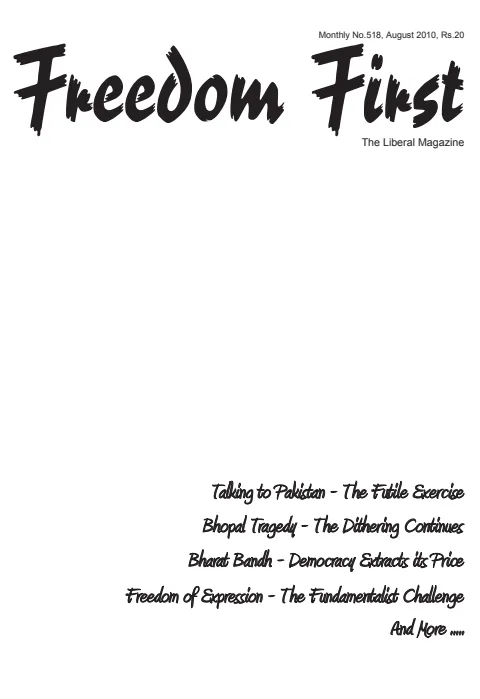
periodical issue
Freedom First
The Liberal Magazine
By P Kodanda Rao, Sharad Bailur
Publishers: Indian Committee for Cultural Freedom (ICCF), 3rd Floor, Army & Navy Building, 148, Mahatma Gandhi Road, Mumbai 400 001. · Mumbai · 2010
36 pages
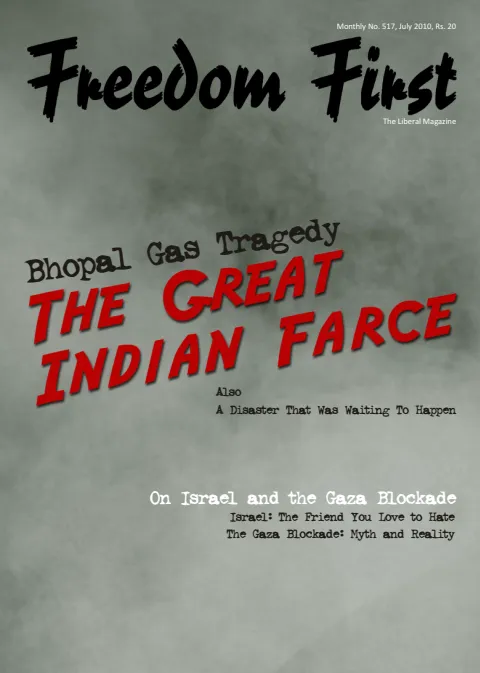
Freedom First
Summary
The rendered pages are from the July 2010 issue of Freedom First, a liberal magazine whose visible contents combine memorial writing, editorial comment, reader letters, political criticism, international affairs commentary, archival reprints, and advertisements. The issue foregrounds the Bhopal gas tragedy after the delayed 2010 verdict, with several pieces arguing that political blame-shifting, media spectacle, weak accountability, and neglected compensation have displaced serious concern for victims. A second cluster defends Israel’s position during the Gaza blockade controversy, treating Hamas, Turkey, and regional power politics as central to the episode.
Key points
-
Keshav Rau argues India’s reaction to the delayed 2010 Bhopal verdict follows a familiar pattern of outrage, media theatre, and calls for reform followed by inaction, questioning whether arresting Warren Anderson would materially aid victims still lacking relief and site cleanup.
-
K. Subramanian’s technical account describes the Bhopal disaster as preventable, tracing Union Carbide’s market miscalculation, cost-cutting on safety systems, and ignored engineering warnings stretching back years before the leak.
-
Firoze Hirjikaka and Nitin Raut both defend Israel over the Gaza flotilla raid, with Hirjikaka arguing Israel is strategically secure but politically inept at managing international opinion and Raut casting the Mavi Marmara voyage as a Turkish political move rather than a humanitarian mission.
-
H. R. Bapu Satyanarayana argues Maoist attacks including the Howrah-Mumbai train incident expose the UPA government’s lack of a coherent security policy, wrestling with the dilemma that force may harm tribal civilians while inaction leaves the state looking helpless.
-
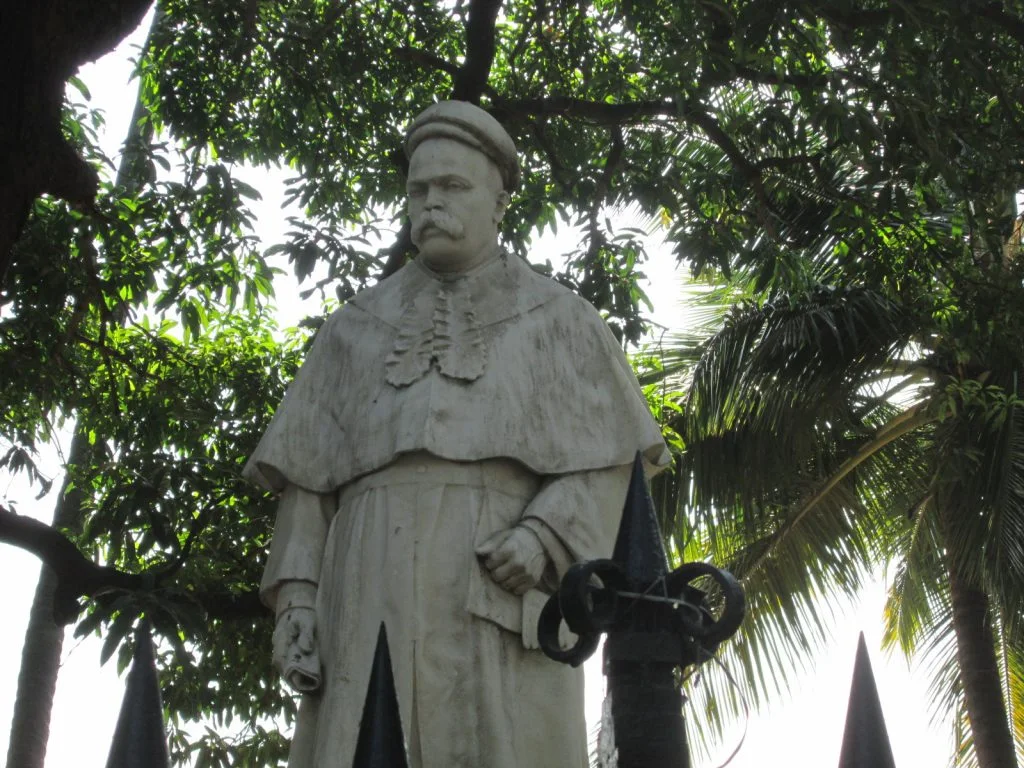
Aroon Tikekar’s memorial profile of G. P. Pradhan presents him as a Gandhian teacher-politician whose ethical, secular liberalism drew on Ranade, Gokhale, Tilak, Phule, and Ambedkar.
-
Ashok Karnik’s “Point Counter Point” is skeptical of caste enumeration in the 2011 census as deepening concessions politics, and questions confusion over Home Minister Chidambaram’s ‘limited mandate’ against Naxalism.
-
Sadanand B. Kumta cites a Hong Kong-based survey ranking India last among twelve Asian bureaucracies, arguing public servants have become masters rather than servants and defending RTI transparency against proposed exclusions.
-
An archival reprint of P. Kodanda Rao’s 1953 essay argues language has no nationality and should be judged by communicational utility, rejecting the idea that English is inherently foreign to Indians.
Essays
Essay 0
Aroon Tikekar’s memorial profile presents G. P. Pradhan as a teacher-politician shaped by Gandhian ethics, democratic nationalism, secularism, and a temperate liberalism. The piece emphasizes his classroom gifts, public-speaking clarity, imprisonments in 1942 and during the Emergency, sympathy for opponents, faith in younger people, and intellectual lineage from Ranade, Gokhale, Tilak, Agarkar, Phule, Gandhi, Sane Guruji, and Ambedkar.
- Pradhan is described as a rare leader who left active politics yet continued to inspire younger citizens.
- His liberalism is framed as ethical, democratic, secular, and humanist rather than doctrinaire.
- The essay stresses his ability to understand opponents sympathetically.
- The closing continuation places him in a Marathi reformist and nationalist tradition.
Between Ourselves
The editor’s note defines the Bhopal aftermath as a “farce” in which ruling politicians show more concern for blame management than for the people killed, maimed, or still living with contamination. It also frames Israel as a democratic state unfairly equated with rogue regimes, notes the constraints created by China and North Korea, and asks readers to support the magazine financially.
- The note condemns post-verdict political blame games around Bhopal.
- It argues that a genuinely concerned government would have acted long before the judgment.
- It previews the issue’s pro-Israel treatment of the Gaza blockade controversy.
- It appeals for donations and advertising to keep Freedom First publishing.
From Our Readers
The reader letters visible here praise Freedom First, denounce the Bhopal settlement and Warren Anderson’s departure, dispute claims about racism against Indian students in Australia, and criticize Tamil Nadu’s proposed land allotment to MLAs. The page gives the magazine a civic-forum texture: donations, polemical reader responses, newspaper excerpts, and a small survey are all used to press liberal concerns about accountability, corruption, and public opinion.
- Several letters send donations and affirm the magazine’s liberal role.
- The Bhopal letter blames corporate actors and Indian governments alike.
- One letter argues a cited Australian case was fraud rather than racism.
- A Chennai NGO survey reports overwhelming opposition to special land allotments for MLAs.
Dealing with Industrial Disasters and Human Tragedies: The Great Indian Farce
By Keshav Rau
Keshav Rau’s article argues that India’s reaction to Bhopal follows a familiar pattern: outrage, media theatre, calls for new rules, and then a return to normal until the next disaster. He criticizes the delayed judgment, revisits Nani Palkhivala’s claim about Indian courts and the Bhopal litigation, questions the fixation on Warren Anderson’s arrest, and argues that criminal liability and adequate compensation were confused while victims still lacked relief, rehabilitation, and site cleanup.
- The article treats Bhopal as part of a national habit of reactive, symbolic governance.
- It argues that the media and legal experts avoided hard questions when they mattered.
- Rau questions whether arresting or extraditing Warren Anderson would materially aid victims.
- The essay compares Bhopal with Thalidomide and BP’s Gulf of Mexico spill to separate compensation from criminal spectacle.
- It concludes that India shows little concern for human life or welfare.
A Tragedy that was Waiting to Happen
By K. Subramanian
The Bhopal technical report, summarized from K. Subramanian’s paper, explains the disaster as the result of decisions and warnings stretching back years before the leak. It describes Union Carbide’s market miscalculation, pressure to preserve foreign-equity status, excessive MIC storage, cost-cutting in safety systems, ignored engineering cautions, and warnings from journalists and visiting teams before the plant became a dormant danger.
- The piece frames Bhopal as preventable rather than accidental.
- It links unsafe storage and project design to corporate and regulatory pressure.
- It says market failure and cost-cutting weakened safety systems.
- It notes that warnings about lapses and rectification went unheeded.
On Israel and the Gaza Blockade: Israel - The Friend You Love to Hate
By Firoze Hirjikaka
Firoze Hirjikaka argues that Israel is strategically secure but politically inept at managing international opinion. The essay treats the Gaza flotilla raid as a public-relations disaster, criticizes humanitarian sympathies that ignore Hamas and regional power calculations, and concludes that Israel will continue to absorb criticism while acting in its own security interests.
- The essay says Israel’s military assertiveness often makes it appear as a bully.
- It argues that Arab solidarity against Israel is weaker than public rhetoric suggests.
- Egypt, Hamas, Fatah, Iran, Jordan, Turkey, and the United States are all presented as strategic actors.
- The conclusion says being seen as a bully may sometimes help Israel’s interests.
The Gaza Blockade: Myth and Reality
By Nitin Raut
Nitin G. Raut defends the Gaza blockade as a lawful and necessary response to Hamas’s refusal to recognize Israel, armed attacks, and alleged arms smuggling. He casts the Mavi Marmara voyage as a Turkish political move rather than a purely humanitarian mission, argues that international law recognizes maritime blockades in armed conflict, and ends by saying Turkey missed a chance to help resolve the Palestinian Arab state question.
- The article treats Hamas’s 2005 electoral victory and later conduct as the reason for blockade.
- It argues that Turkey used the aid ship to seek leadership in the Arab-Muslim world.
- Raut says humanitarian supplies were allowed through supervised channels.
- The piece cites the Supreme Court of Israel and international law to defend Israeli policy.
- An appended Economist excerpt describes Hamas rule in Gaza as coercive.
Point Counter Point
By Ashok Karnik
Ashok Karnik’s column juxtaposes two-sided commentary on the UPA’s faltering young ministers, caste enumeration in the 2011 census, and the Centre’s uncertain mandate against Naxalism. The column is skeptical of intellectual arrogance in politics, warns that renewed caste emphasis may divide citizens further, and questions whether anti-Naxalite responsibility lies with the Centre, states, or a coherent joint strategy.
- Karnik contrasts early optimism about young UPA ministers with later reversals.
- He argues that caste census proposals risk deepening concessions politics.
- He prefers targeting economic backwardness rather than caste identity.
- The Naxalism section notes confusion over Chidambaram’s ‘limited mandate’.
Taking on the Maoists
By H. R. Bapu Satyanarayana
H. R. Bapu Satyanarayana’s article argues that Maoist attacks have exposed the UPA government’s lack of a coherent security policy. It criticizes inadequate training and precautions, alleges political division around P. Chidambaram’s approach, says human-rights criticism has emboldened Maoists, and then wrestles with the hard dilemma that force may harm tribal civilians while inaction leaves the state looking helpless.
- The article begins from recent deadly attacks, including the Howrah-Mumbai train incident.
- It argues that security forces repeat basic mistakes and lack jungle-fighting preparation.
- The Maoist issue is treated as both a security problem and a tribal-development failure.
- Satyanarayana says the buck ultimately stops with Prime Minister Manmohan Singh.
- A boxed excerpt gives figures for Naxal strength and spread.
Freedom First: This Month in July 1953
The archival July 1953 page reprints P. Kodanda Rao’s liberal argument that language has no nationality and should be judged by communicational utility, not patriotic ownership. It also excerpts Bertram D. Wolfe’s memories of Yusuf Meherally and a short clipping about A. K. Gopalan’s comments on Georgi Malenkov’s moustache after Stalin.
- Kodanda Rao rejects the idea that English is inherently foreign to Indians.
- He argues that no one is born with a language and that languages are acquired cultural tools.
- The page links language policy to communication rather than historicity or identity.
- The Meherally excerpt is personal and commemorative rather than policy-focused.
Indian Bureaucracy
By Sadanand B. Kumta
Sadanand B. Kumta’s article describes Indian bureaucracy as a self-perpetuating administrative burden despite democratic vibrancy and economic optimism. Using a Hong Kong-based survey that rates India last among twelve Asian bureaucracies, the essay criticizes slow, painful civil-service processes, resistance to reform, threats to the spirit of RTI, and post-retirement privileges for senior officials.
- The piece names bureaucracy as an ‘administrative migraine’.
- It cites PERC’s ranking of India last among twelve Asian bureaucracies.
- Kumta argues that public servants have become masters rather than servants.
- The article defends RTI transparency against proposed exclusions of file notings.
Cornucopia
By Firoze Hirjikaka
The visible Cornucopia pieces by Firoze Hirjikaka first attack ‘crocodile tears’ over Bhopal, arguing that political parties and media houses prefer convenient villains to hard questions about compensation, trusts, settlements, and victims still suffering after twenty-five years. The following item turns lighter but still institutional: it mocks computer systems that cannot process apostrophes, particles, and culturally varied names.
- The Bhopal column says victims have been forgotten amid blame-shifting.
- It criticizes Congress, BJP, Times Now, and media barons for spectacle and selectivity.
- It asks why the settlement fell from $3.5 billion to $450 million and where the money went.
- The name-glitch column satirizes programming assumptions about personal names.
Generated by the v1.5 extraction pipeline. Awaiting editorial review.
Metadata and summary are AI-extracted from the source PDF and reviewed for editorial accuracy. The original work is available via the Read PDF tab above (where present); paragraph-level citation inside the PDF is deferred to a future engagement.