
periodical issue
Freedom First
The Liberal Magazine
By C. Rajagopalachari, Sunil S. Bhandare, Ajit Karnik, R. M. Mohan Rao
PUBLISHERS: Indian Committee for Cultural Freedom (ICCF) 3rd floor, Army & Navy Building, 148, Mahatma Gandhi Road, Mumbai 400001. PUBLISHED BY J. R. Patel for the ICCF and printed by him at Union Press, 13, Homji Street, Fort, Mumbai 400001. · Mumbai · 2014
36 pages
Freedom First
Summary
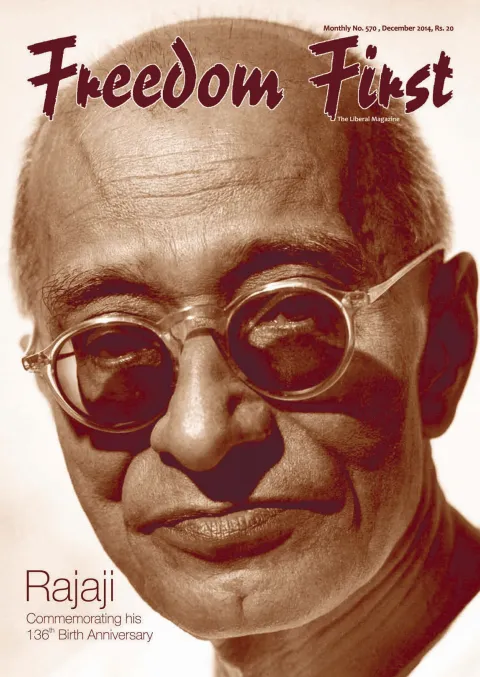
This is No. 570 (December 2014) of Freedom First, the Bombay-based liberal monthly founded by Minoo Masani and edited by S. V. Raju, published by the Indian Committee for Cultural Freedom. The issue is built around a double occasion: the 136th birth anniversary of C. Rajagopalachari (Rajaji), commemorated on the cover and in an inside-cover compilation of his epigrams plus a reprinted 1963 Swarajya essay in which Rajaji frankly assesses Jawaharlal Nehru as Prime Minister, and the ongoing revival of interest in Sardar Vallabhbhai Patel, whom T. H. Chowdary’s essay argues was systematically written out of Nehru-Congress memory. Around this historical core, the issue is dominated by contemporary political commentary on the first six months of the Narendra Modi government: reports on the October 2014 Haryana and Maharashtra assembly elections (won by the BJP, the latter without a majority), a ‘Point Counter Point’ feature debating the Maharashtra outcome, the Ottawa terror attack and the black-money controversy, two opinion pieces on Modi himself (one admiring, one critical of his concentration of power), a piece on organised opposition to Modi’s US visit, an analysis of India’s China policy, and a study of federalism and governance under the new government. Rounding out the issue are an obituary of journalist M. V. Kamath, an academic paper on agricultural indebtedness, two book reviews (on Nepal’s democratic transition and on Indian intelligence management), a three-part ‘Educating Adults’ feature debating the legalisation of prostitution in India, a short piece on school infrastructure versus teaching quality, and a page of archival 1958 press commentary on the Nehru government reprinted as ‘Many Voices from the Past’. The overall political tenor is classical-liberal and anti-Congress-dynasty, sympathetic to the BJP’s 2014 mandate while airing internal debate about Modi’s personalisation of power.
Essays
The Wit and Wisdom of Rajaji
By C. Rajagopalachari
An inside-cover compilation of aphorisms and remarks by C. Rajagopalachari (Rajaji) spanning 1965 to 1972, marking his 136th birth anniversary. The selections range from his explanation for founding the Swatantra Party at age 80, through barbed commentary on Congress hypocrisy, Indira Gandhi’s breach of promises to princely rulers, and reflections on power, dogma, and political prudence.
- Rajaji explains that he founded the Swatantra Party in 1959, at age 80, because of ‘the spreading abuses, the cants, the hypocrisies’ he saw in Indian public life.
- He credits the Hindi word ‘Swatantra’ as the best available term for the individual freedom he sought in economic life, citing Montesquieu and Abraham Lincoln on the ambiguity of the word ‘freedom’.
- He attacks the Indira Gandhi government’s abolition of the privy purses to former rulers as a broken pledge, contrasting it with Congress’s own claim that ‘we break pledges without compunction’.
- He argues democratic governments should sense public opinion in advance rather than waiting for violent agitation before acting.
- The page closes with wry asides on unconscious political humour (quoting Bhutto and Morarji Desai) and on Lord Acton’s dictum about power and corruption.
Between Ourselves
The editor’s note reports on a successful symposium on ‘Gokhale’s Legacy’ (marking the centenary of Gopal Krishna Gokhale’s death), previews an extensive February 2015 issue devoted to Gokhale, notes space constraints that squeezed out some submitted material even as coverage of Narendra Modi dominates the issue, comments on the revival of interest in Sardar Patel (blamed on decades of deliberate Congress neglect), and marks Rajaji’s 136th birthday, explaining the cover feature and quote selections.
- A symposium on ‘Gokhale’s Legacy’ was held, with an inaugural address by Dr. Aroon Tikekar and a speech by Sunil Gokhale; the February 2015 issue will be dedicated to Gokhale’s 100th death anniversary.
- The editor invites reader contributions on Gokhale’s life and work for the February issue.
- Modi ‘continues to dominate’ the issue’s page count, including a piece by subscriber Dr. Sardul Minhas on opposition to Modi’s US visit.
- The editor attributes the erasure of Sardar Patel’s memory from public commemoration to deliberate Indira Congress policy, not oversight.
- December 10 marks Rajaji’s 136th birthday, explaining the cover and the Rajaji-quote features in this issue.
Obituary: M. V. Kamath (R.I.P.)
By P. M. Kamath
P. M. Kamath’s obituary tribute to journalist Madhav Vithal (M. V.) Kamath (1921-2014), who died on 9 October 2014 aged 93. Drawing on a decades-long personal and professional relationship dating to the late 1950s, the author highlights two traits: Kamath’s habit of keeping strong political opinions private until the appropriate moment (illustrated by his shifting sympathies toward Indira Gandhi’s Emergency versus the Janata government depending on his posting), and his consistent, ideologically-rooted anti-Americanism despite decades spent in Washington as a journalist. The piece also notes Kamath’s role as editor of the Illustrated Weekly of India, his BJP-era appointment as Chairman of Prasar Bharati, his authorship of a Modi biography, and his declining a governorship on health grounds.
- M. V. Kamath died on 9 October 2014 at age 93; at the time he was Honorary Director of the Media Studies Department at Manipal University.
- The author recounts meeting Kamath in Bombay in the late 1950s and later working alongside him in Washington, DC in 1976-77 during the National Emergency.
- Kamath appeared to support Indira Gandhi and the Emergency while in Bombay circles, but seemed closer to the Janata Party line after returning as editor of the Illustrated Weekly of India — a shift the author attributes to Kamath’s own explanation that he was ‘not privy to domestic developments’ while posted abroad.
- The NDA government made Kamath Chairman of Prasar Bharati; he had earlier published a biography of Narendra Modi as Gujarat Chief Minister and was reportedly offered, but declined, a governorship.
- The author identifies Kamath’s anti-Americanism as deep-seated and possibly shaped by his exposure to John Foster Dulles-era Cold War thinking, despite Kamath’s own long American postings.
From Our Readers
A letters page carrying five reader contributions: Dr. T. H. Chowdary argues that Andhra Pradesh Day should be observed on 1 October rather than 2 June to honour the Potti Sriramulu-led formation of the original Andhra state; Arvind Banavalikar corrects an error in his own earlier article confusing ASEAN and ‘tiger’ nations, and separately recounts a case of Indian officials denying a military field hospital in Tajikistan ‘foreign posting’ allowances; Brig. Suresh C. Sharma responds to a prior FF piece by arguing scientists should not be compelled into rigid teaching hours, since research and teaching aptitudes differ; and the page closes with a Rajaji ‘Dear Reader’ excerpt musing on what a resurrected Gandhi would say to Congressmen invoking his name.
- T. H. Chowdary argues Andhra Pradesh Day (2 June) is a ‘sad day’ marking disintegration and proposes 1 October, honouring Potti Sriramulu’s sacrifice for the original 1953 Andhra state.
- Arvind Banavalikar issues a correction to a previous FF article that had conflated ASEAN member states with the Asian ‘tiger’ economies.
- A reader account describes bureaucratic obstruction of allowances for army medical personnel posted to Tajikistan/Afghanistan to treat Northern Alliance soldiers.
- Brig. Suresh C. Sharma argues against a government policy mandating 12 hours of teaching for all CSIR scientists, since research and teaching are distinct aptitudes.
- A closing Rajaji excerpt imagines Gandhi disowning the Congressmen who invoke his name, echoing Marx’s ‘I am not a Marxist.’
”I Touch a Sensitive Spot”
By C. Rajagopalachari
An extensive excerpt from a July 1963 Swarajya article by Rajaji, framed by an editorial introduction noting the contrasting post-independence fates of Nehru, Patel and Rajaji himself. Rajaji offers a candid, affectionate but critical assessment of Jawaharlal Nehru’s fitness as an administrator, arguing that Nehru’s gift is oratory and public education rather than the hard, sometimes ruthless work of implementation, and that Nehru’s fatal weakness is the absence of a strong deputy — a Vallabhbhai Patel figure — willing to speak frankly to him and execute policy without fear of losing favour.
- The editor frames the piece by noting Nehru, Patel, and Rajaji were all ‘giants’ among Gandhi’s lieutenants, and that Patel and Rajaji have both been sidelined in official memory relative to the Nehru-Gandhi dynasty.
- Rajaji criticises Nehru’s claim that his continuance as PM is necessary for the country’s progress, comparing it to similar claims by Ayub Khan and Sukarno.
- He argues Nehru is a gifted ‘romantic schoolmaster’ educator of the public but lacks the administrator’s courage to force compliance and correct errors.
- Rajaji’s central point (‘the sensitive spot’) is that Nehru needs a strong, frank Deputy Premier or Chief Secretary — a Vallabhbhai Patel figure — since Nehru himself cannot supply that toughness.
- The excerpt closes suggesting such an arrangement, even if imperfect, would benefit both Nehru and the nation by surfacing policy errors faster.
The Assembly Elections – Haryana: A Decisive Victory for the BJP
By B. N. Mehrish
B. N. Mehrish reports on the October 2014 Haryana Assembly election, a decisive BJP victory (47 seats, up from 4 in 2009). The piece opens with ground reportage from posh Gurgaon condominiums where voter apathy was notable despite improved district-wide turnout, describes the pilot use of the Voter Verifiable Paper Audit Trail (VVPAT) system in several constituencies, and closes by noting a record 13 women MLAs in the new Assembly.
- Gurgaon district turnout was 69%, below the state average of 76%, with posh condominium residents citing candidate apathy and lack of local development work.
- The Election Commission piloted VVPAT (Voter Verifiable Paper Audit Trail) in 19 constituencies including Gurgaon, Rohatak, Karnal, Sonepat, Panipat and Thanesar.
- The new Haryana Assembly has 13 women MLAs, the highest since the state’s first assembly polls in 1965; AIDWA fielded seven debut women candidates.
- The BJP won 47 seats (up from 4 in 2009), the Congress fell to 15 (from 40), and the INLD to 19 (from 31).
The Assembly Elections – Maharashtra: Have the BJP and the Shiv Sena Missed the Mandate?
By Nitin G. Raut
Nitin G. Raut analyses the October 2014 Maharashtra Assembly election, in which the BJP emerged the largest single party (122 of 288 seats) but fell short of a majority following the collapse of its 25-year alliance with the Shiv Sena. The essay traces the historical roots of Maharashtra’s political complexity — Congress patronage networks, the Maratha-dominated cooperative movement, and the parallel but electorally limited rise of Hindu nationalist organisations founded in the state (RSS, Hindu Mahasabha) — before arguing the BJP-Shiv Sena split was a ‘short-sighted’ move that could hand NCP leader Sharad Pawar renewed leverage and jeopardise the anti-corruption mandate both parties were elected on.
- The BJP won 122 seats (up from 46 in 2009) and the Shiv Sena 63 (up from 44), but their pre-poll alliance broke up before the election.
- The author frames Maharashtra as both the birthplace of the Congress-aligned cooperative movement under Y. B. Chavan and of Hindu nationalist organisation, noting the RSS was founded in Nagpur in 1925 and Hindu Mahasabha co-founder V. D. Savarkar was based in Maharashtra.
- Despite this ideological lineage, Hindu nationalist parties only gained electoral traction in Maharashtra after the 1989 BJP-Shiv Sena alliance.
- The author warns that NCP leader Sharad Pawar’s declared ‘unconditional’ support to the BJP raises the risk of a Congress-style co-optation reminiscent of Indira Gandhi’s manoeuvring against Charan Singh, and that BJP-Sena infighting could hand the initiative back to the ousted Congress-NCP.
- Maharashtra’s underlying problems cited include a Rs. 3 lakh crore debt burden, poor law and order, farmer suicides, and deteriorating urban infrastructure in Mumbai.
Point Counter Point
By Ashok Karnik
Ashok Karnik’s recurring ‘Point Counter Point’ feature presents paired opposing viewpoints on three topical issues: the uncertain political aftermath of the Maharashtra election (a BJP minority government propped up by NCP support versus a fractured former Shiv Sena alliance); the October 2014 attack on the Canadian Parliament in Ottawa as a symptom of ISIS-inspired ‘lone wolf’ terrorism; and the ‘hype’ around recovering Indians’ black money stashed abroad, weighing the practical and treaty-based obstacles to recovery against public expectations fanned by campaign promises.
- On Maharashtra, the ‘Point’ view stresses the tragedy of a fractured anti-Congress alliance producing an unstable outcome despite big individual gains for BJP and Shiv Sena; the ‘Counter Point’ argues the Sena badly miscalculated by not immediately backing the BJP, while the NCP’s ‘unconditional’ support let the BJP sideline the Sena.
- On the Ottawa attack, one side frames it as evidence of a dangerous new pattern of individually radicalised, ISIS-inspired ‘lone wolf’ violence; the counter-view stresses India’s relative advantage from lacking a gun culture even as it remains a prime target for Pakistan-based and ISIS-aligned terrorism.
- On black money, one side criticises the government (and predecessor UPA) for offering no credible mechanism to actually repatriate illicit funds beyond exposing names; the other argues bilateral tax-information treaties legally bar public disclosure and that recoverable amounts (estimated at $30bn of a possible $200bn) will likely disappoint inflated public expectations.
- The feature closes each section with a satirical unrelated notice (a Norwegian cocktail-lounge sign, a Budapest zoo sign) as light editorial punctuation.
Foreign Relations in the 21st Century – Containment and Co-operation: Continuity and Change in India’s China Policy
By B. Ramesh Babu
B. Ramesh Babu surveys India-China relations in the second half of 2014, describing a foreign policy of simultaneous ‘containment and cooperation’ under Prime Minister Modi. He reviews the BRICS Summit and Modi-Xi meetings, Modi’s outreach to Japan’s Shinzo Abe, President Xi Jinping’s state visit to India (marred by a Chinese military incursion in the Chumar sector of Ladakh during the visit itself), the scaled-back scope of Chinese investment pledges compared to pre-visit hype, Modi’s high-profile US trip and its implications for US-India-Japan trilateral cooperation, and continuing border-management talks (WMCC) that have made only incremental progress. The essay concludes that India’s approach — deterring Chinese aggression while cooperating on shared global interests — is likely to persist indefinitely given no near-term prospect of resolving the underlying border dispute.
- Xi’s September 2014 state visit to India began symbolically at Ahmedabad on Modi’s birthday but was overshadowed by a Chinese military incursion into the Chumar sector of Ladakh; Modi publicly linked further bilateral progress to border tranquility.
- China’s actual investment pledge during the visit ($20bn over five years, two industrial parks) fell well short of pre-visit hints of $100bn and matching Japan’s $35.5bn Japanese pledge to India.
- Modi and Abe upgraded the India-Japan relationship to a ‘special’ strategic partnership and discussed a possible US-Japan-India trilateral upgrade, alongside a four-nation Malabar naval exercise that China explicitly criticised.
- The Working Mechanism for Consultation and Coordination on India-China Border Affairs (WMCC) met in October 2014 but produced only incremental commitments on hotlines and communication, with no progress on Line of Actual Control clarification.
- The author frames the relationship as a permanent ‘tight rope walk’ between deterrence and cooperation, warning that any escalation to actual border conflict would tip the balance decisively toward containment.
Modi Triumphant
By Firoze Hirjikaka
Firoze Hirjikaka offers an admiring but pointed assessment of Narendra Modi’s political dominance six months into his premiership, comparing his hold on public affection favourably to the more distant authority of Nehru and Indira Gandhi. The essay credits Modi’s ability to appear as ‘one of them’ to ordinary Indians and his skilful positioning as indispensable to the BJP, illustrated by the party’s poor by-election showing when he stayed out of campaigning. It then turns critical, noting the BJP’s Maharashtra win depended heavily on defectors and post-poll allies, and warns that Modi’s concentration of personal power and marginalisation of colleagues (Amit Shah excepted) risks turning India into a de facto one-party democracy without a credible national opposition to check him.
- The author contrasts Modi’s ‘one of them’ populist appeal with the respected-but-distant authority of Nehru and the benevolent-father image of Indira Gandhi.
- Modi’s deliberate absence from September-October 2014 by-election campaigning, which the BJP lost badly, is read as a calculated demonstration that the party cannot win without him.
- The author is skeptical of Modi’s pre-election promise to repatriate enough black money to give every Indian Rs. 15 lakh, calling the sum mathematically implausible.
- 35 of the BJP’s 122 Maharashtra seats went to defectors from Congress, NCP and Shiv Sena, plus 12 independents/smaller-party members, undercutting the purity of the anti-corruption mandate.
- The author criticises the BJP’s Maharashtra swearing-in spectacle (timed to coincide with, and eclipse, Indira Gandhi’s death anniversary and the newly resurrected Sardar Patel Jayanti) as symbolically aimed at ‘driving the final nail into the Nehru-Gandhi coffin.’
- The piece closes warning that concentrating power in one individual, with no credible opposition, is ‘a mixed blessing’ whose ultimate effect on Indian democracy ‘only time will tell.‘
Modi’s Detractors in America
By Sardul Singh Minhas
Sardul Singh Minhas, writing from California, recounts the nine-year backstory of organised American opposition to Narendra Modi, culminating in a New York federal court summons issued to Modi just before his September 2014 US visit over a lawsuit alleging human-rights abuses in the 2002 Gujarat riots. The essay traces the anti-Modi coalition’s origins to a 2005 campaign (led by evangelical Christian activist John Prabhudoss and secular organiser Raju Rajagopal) that successfully pressured the US State Department into denying Modi a visa using the International Religious Freedom Act, and to attorney Gurpatwant Singh Pannun’s more recent, publicity-driven lawsuits and protests. The author concludes that the coalition, originally powered by right-wing evangelical support, has since faded into political ‘antediluvian’ irrelevance and that the 2012 Indian Supreme Court-monitored SIT report exonerating Modi has undercut the legal basis of the original visa denial, contrasting the roughly 30,000-strong enthusiastic Indian-American crowd at Modi’s Madison Square Garden reception with the ‘couple of hundred protestors’ outside.
- A New York federal court summons was issued to Modi just before his September 2014 US visit, in a suit alleging failure to prevent over 1,000 Muslim deaths in the 2002 Gujarat riots (silent on the 300+ Hindu deaths in the same riots).
- Attorney Gurpatwant Singh Pannun, who filed the Modi suit, had previously filed a similar human-rights suit against Sonia Gandhi over the 1984 anti-Sikh riots, later dismissed.
- Organised opposition to Modi’s US entry began in 2005 around a planned address to the Asian American Hotel Owners Association, led by a 41-group Coalition Against Genocide; pressure led TV host Chris Matthews to withdraw from the event.
- Key coalition leaders were John Prabhudoss (Washington-based evangelical Christian activist) and Raju Rajagopal (Berkeley-based, seeking a broader secular coalition), using the International Religious Freedom Act of 1998 to get Modi’s visa denied in March 2005.
- The author argues the visa denial’s basis was undermined when India’s Supreme Court-monitored Special Investigation Team exonerated Modi in 2012, finding he ‘took all possible steps to control the riots.’
- Modi’s 2014 Madison Square Garden reception drew roughly 30,000 enthusiastic Indian-American attendees versus a few hundred protestors outside the White House and elsewhere.
Rediscovering The Sardar
By T. H. Chowdary
T. H. Chowdary argues that Sardar Vallabhbhai Patel was systematically marginalised by the Nehru-Gandhi dynasty despite being the decisive figure in integrating princely India, suppressing communist insurgency, and building institutions like INTUC. The essay recounts how Patel three times withdrew his presidential/prime-ministerial candidacy at Gandhi’s urging in favour of Nehru, how Nehru sidelined both Patel and Subhash Chandra Bose, how Patel alone (not Nehru or Mountbatten) negotiated the princely states’ accession, his forceful handling of Junagadh and (via Police Action) Hyderabad against Nehru’s more conciliatory instinct, and his suppression of the 1949-51 Communist insurgency. The author frames Modi’s 2014 mandate as inaugurating a ‘Second Republic’ correcting the ‘Nehruvian’ first republic, including for the first time official government involvement in celebrating Patel’s Jayanti, and calls for similarly honouring other neglected freedom-movement leaders.
- Patel withdrew his 1945 Congress presidential candidacy — despite unanimous PCC support — in favour of Nehru on Gandhi’s advice, having also done so in 1928 and been sidelined again in 1959 when Indira Gandhi became Congress President.
- Gandhi’s patronage similarly built up Nehru at the expense of both Patel and Subhash Chandra Bose, who left Congress to found the Forward Bloc after Nehru opposed his continuing as Congress President.
- Patel, not Mountbatten, negotiated the accession of over 600 princely states to India, including forcing Junagadh’s accession reversal and, after Nehru barred him from handling Jammu & Kashmir (leaving it to Mountbatten-influenced Nehru), decisively resolving Hyderabad’s status via a four-day Police Action in September 1948 that created what is now Telangana.
- Patel suppressed the 1949-51 Comintern-directed Communist insurgency using the Preventive Detention Act, a campaign completed by his successor Govind Ballabh Pant; Patel also founded INTUC to counter the communist-controlled AITUC.
- The author frames the BJP’s 2014 Lok Sabha majority as a ‘Second Republic’ correcting a Nehru-dominated ‘first republic’ that named over 400 institutions after the Nehru dynasty, and calls for honouring other neglected leaders including Tanguturi Prakasam Pantulu, Purushottam Das Tandon, J. B. Kripalani, Bose, Gokhale, Tilak, Lala Lajpat Rai and Bipin Chandra Pal.
Federalism, Governance and Growth
By Sunil Bhandare
Sunil S. Bhandare, adapting remarks given as Chair of a Gokhale’s Legacy symposium session, examines the relationship between federalism, governance and economic growth in India under the new NDA government. He argues good governance is a precondition for sustainable high growth, situates India’s ‘quasi-federal’ constitutional structure as an act of necessity given the country’s scale and diversity, and reviews the BJP manifesto’s promises on cooperative federalism (reviving the National Development Council and Inter-State Council, Regional Councils of States) and governance reform (e-governance, tax simplification, Panchayati Raj empowerment), concluding that Modi’s ‘disruptive’ leadership style could catalyse a new phase of stronger federalism, better governance and higher growth if sustained over the coming two to three years.
- The author posits a ‘symbiotic’ relationship among federalism, governance and growth, citing India’s two post-reform high-growth phases (1993-97 at ~7.5% and 2003-08 at ~9%) as partly reflecting good fiscal governance.
- India’s constitution is characterised by experts as ‘quasi-federal,’ envisaging strong states under a stronger centre, an arrangement the author calls a ‘TINA’ (There Is No Alternative) necessity given the country’s scale and diversity.
- Despite the 73rd Constitutional Amendment being nearly two decades old, decentralization of economic power to local governments remains seriously deficient.
- The BJP manifesto promises reviving moribund bodies like the National Development Council and Inter-State Council, creating Regional Councils of States, and a five-point governance agenda including e-governance, tax simplification, and Panchayati Raj empowerment.
- The author frames the 1991 economic reforms as having already broken the ‘Hindu growth rate’ shackle and expresses hope that ‘disruptive’ political leadership can similarly transform federalism and governance.
The Political Economy of Black Money in India
By Ajit Karnik
Ajit Karnik, in a piece excerpted from his blog, argues that the political controversy over disclosing the names of Indians with illegal foreign bank accounts obscures a more important issue: that far more black money is generated and held within India than is stashed abroad. He is broadly sympathetic to the government’s position that bilateral double-taxation treaties legally constrain public disclosure of names, criticises both major parties for making unrealistic election-expenditure disclosures, and argues that lasting progress against black money requires reforming the discretionary regulatory powers (in real estate, finance, bullion, mining and equity trading) that create the underlying incentive structure, rather than the ‘cops and robbers’ game of chasing foreign account holders.
- The author distinguishes the political fight over the Supreme Court-ordered disclosure of 600+ foreign account holder names from the ‘crucial’ issue of the dynamics of black money generation within India.
- He estimates political parties spent Rs. 30,500 crore in the 2014 general election, several times the legally permitted maximum, and neither the BJP nor Congress had submitted expense details to the Election Commission by October 2014.
- Real estate is identified as a major source of black money, accounting for an estimated 10% of India’s GDP with 30% of property transactions reportedly involving black money.
- The government’s White Paper on Black Money is cited as identifying real estate, finance, bullion/jewellery, mining and equity trading as sectors still susceptible to black money generation due to persistent bureaucratic discretion.
- The author argues the core problem is the ‘nexus’ between private beneficiaries of discretionary favours and those (including the polity generally) who dispense them, and is skeptical that this nexus will be broken absent electoral finance reform such as public funding of elections.
The Rural Perspective – Agriculture and Rural Indebtedness - IV
By R. M. Mohan Rao
The fourth installment of R. M. Mohan Rao’s series on agriculture and rural indebtedness examines institutional credit flow to agriculture, arguing that claims of disproportionately poor loan recovery and high non-performing assets in the farm sector are not well founded once natural risk factors are accounted for. The piece also covers risk and crop insurance, the declining viability of small landholdings, the limits of contract farming as a solution, and rising costs and stagnant profitability in agriculture, citing detailed cost-of-cultivation data showing labour cost shares rising and real farm business income growth decelerating sharply since the 1980s.
- The share of private-channel rural credit fell from 92.7% in 1951 to 30.6% by 1991 as institutional credit expanded, though this positive trend may have reversed with weakening cooperative credit structures and financial sector reforms.
- Agricultural loan NPAs (12% of outstanding advances during 2001-2003 droughts) are argued to reflect adverse natural conditions (droughts, cyclones, irregular electricity) rather than wilful default, and are lower in absolute terms (Rs.7,635 crore) than non-priority sector NPAs (Rs.28,764 crore).
- Sub-marginal and marginal landholdings have grown as a share of ownership holdings (sub-marginal from 35.24% in 1971-72 to 40.11% by 1991-92), while average farm size has fallen from 2.30 to 1.41 hectares (1970-71 to 1995-96).
- Contract farming is judged an ‘impractical proposition at present’ given unequal bargaining power and the absence of farmer organisations to enforce contract discipline.
- Real (CPIAL-deflated) Farm Business Income growth per hectare decelerated sharply from 3.21% per annum in the 1980s to 1.02% per annum in the 1990s, even as hired labour costs grew faster than farm output value.
Book Reviews
Dr. G. R. S. Rao reviews Lok Raj Baral’s ‘Nation State in the Wilderness: Managing State, Democracy and Geopolitics’ (Sage Publications, 2012), praising Baral’s multi-faceted perspective (academic, diplomat, politician) on Nepal’s turbulent democratisation. The review characterises the book’s central theme as the greater difficulty of achieving durable ‘democratic social transformation’ compared with merely attaining ‘political freedom,’ and highlights Baral’s treatment of Nepal’s constitution-making struggles in comparison with India’s more consensual constitutional history.
- The book is framed as analysing why attaining ‘political freedom’ through revolution is easier than achieving lasting democratic social transformation, a two-level process of institutionalising democracy and ‘democratizing the people.’
- The reviewer credits Baral’s varied background (academic, diplomat, politician) for a richly-sourced, non-comparative narrative focused specifically on Nepal rather than a generic cross-country study.
- Nepal’s first Prime Minister, Prachanda, is quoted as framing the core challenge: ‘Nepal may have attained its political freedom, but we have to face the World Bank moulds of growth and development.’
- The reviewer contrasts Nepal’s ongoing constitutional struggle with India’s history of ‘consensual democracy,’ noting India’s constitution has been amended over 120 times.
Educating Adults – The Legality of ‘Tolerated Prostitution’ (Remembering Meliscent Shephard as we Debate)
By Jyoti Marwah
Brig. Suresh C. Sharma (Retd.) reviews Vappala Balachandran’s ‘National Security and Intelligence Management: A New Paradigm’ (Indus Source Books, 2014), a collection drawn from the author’s career across Maharashtra Police and 19 years in foreign intelligence. The review surveys the book’s arguments about the lack of an apex intelligence-coordination body (contributing to lapses from Kargil to the Indira and Rajiv Gandhi assassinations), the Intelligence Bureau’s colonial-era fixation on domestic political surveillance over external threats, turf wars between agencies, opacity around inquiry reports, and case studies including nuclear-treaty diplomacy, the Sadat-Israel peace process, and gaps in coastal and air security exposed by the 2008 Mumbai attacks.
- The author, Vappala Balachandran, served 17 years in the Maharashtra Police and 19 years in foreign intelligence; the book compiles his articles and lectures.
- The absence of an apex body to arbitrate conflicting intelligence is blamed for lapses including the Kargil crisis, the assassinations of Indira Gandhi and Rajiv Gandhi, and the 1986 Rajghat attack on political leaders.
- The National Security Council, formed in 1998, met only once during the Kargil crisis and a month after the incursion was confirmed; the Intelligence Bureau is described as having inherited a British tradition of watching domestic opposition rather than external threats.
- The review recounts how intervention by Dr. Sethna (at the author’s urging) and R. N. Kao corrected a Ministry of External Affairs misstep on the Nuclear Proliferation Treaty, and how the Space Department reversed an MEA commitment barring defence use of an Indian communications satellite.
- Coastal security is highlighted as neglected despite prior warnings, contributing to the 2008 Mumbai attacks; the review also notes the book’s coverage of the Sadat-Israel Camp David peace process and Vajpayee’s Lahore visit.
Educating Adults – Legalizing Prostitution: The Way Forward
By Elizabeth Rosen
Dr. Jyoti Marwah, in the first of three ‘Educating Adults’ pieces on legalising prostitution, revisits the work of Meliscent Shephard, a British reformer sent to India in 1928 by the Association for Moral and Social Hygiene to campaign against colonial-era ‘tolerated brothels.’ The essay traces Shephard’s two-decade campaign, her endorsement by Gandhi, the Indian feminists she inspired, and the eventual legislative legacy running from the 1956 Suppression of Immoral Traffic Act (SITA) to the 1986 Immoral Trafficking Act (ITPA), framing today’s debate over legalising sex work as a live question about whether India would be ‘treading on dangerous grounds’ by reversing what reformers like Shephard fought against.
- Meliscent Shephard came to India in 1928 at the request of C. F. Andrews to represent the Association for Moral and Social Hygiene (AMSH), campaigning against government-‘tolerated brothels’ until her return to England in 1947.
- Mahatma Gandhi met Shephard in 1933 and told her she need not apologise for being a foreigner serving India’s ‘fallen sisters.’
- Shephard inspired Indian feminists including Shakuntala Lal, Malti Chatpal, Veena Duggal and Urmila Devi Masooda, and left AMSH branches in 128 districts across 18 states.
- Her work culminated in India’s first anti-trafficking law, the 1956 Suppression of Immoral Traffic Act (SITA), later renamed the Immoral Trafficking Act (ITPA) in 1986.
- The author notes today’s legalisation debate centres on claims it could regulate the industry, reduce trafficking, and improve working conditions and health outcomes, but questions whether this risks reversing Shephard-era reforms.
Educating Adults – Sending Sheetal from a Red Light Area to a U.S. Drum School
Elizabeth Rosen argues, in the second ‘Educating Adults’ piece, for legalising prostitution in India as the practical way out of a system in which police collude with pimps and traffickers to trap women and children, including through kidnapping of widows and orphans, in exploitative conditions. She contends legalisation — as a voluntary, registered trade — would sever the police-trafficker nexus, bring sex workers under the ambit of social security and healthcare, remove the stigma affecting their children, and cites other countries’ experience as evidence of largely positive effects.
- The author argues current law enforcement gaps allow police to collude with brothel ‘ringleaders,’ including profiting personally from trafficked women and minors.
- Coercion into the trade often targets widows and orphans through kidnapping, with women ‘caged for life’ under threat, and children born into the trade absorbing its stigma from birth.
- The author proposes legalisation combined with Aadhaar-linked financial inclusion as a mechanism to give sex workers registered identity, government benefits without intermediary leakage, and a path out of the cycle for their children.
- She claims legalisation in other countries has ‘served to lift the veil of secrecy’ and eliminated the police-pimp nexus by bringing participants under registration and state oversight.
- The essay concludes prostitution should be legitimised in India to end ‘the vicious cycle of violence, greed, lust and neglect by the many catalysts in the process.‘
Educating Adults – Facilities Alone do not make for Good Education (A Personal Experience)
By Suresh C. Sharma
A short, unsigned online campaign notice, endorsed by Freedom First, publicising a crowdfunding appeal to send Sheetal — a 19-year-old woman raised in a Mumbai red-light area who was helped out of the sex trade by the NGO Kranti and discovered a passion for drumming — to study and pursue drumming in the United States.
- Sheetal, 19, grew up in a Mumbai red-light area and was extricated from an expected life in the sex trade with support from the NGO Kranti.
- Through Kranti’s support she studied, underwent therapy, and discovered a passion for playing drums.
- The campaign (hosted on milaap.org) sought small donations (as little as Rs.100) to fund her tuition, travel and stay in the US.
- Freedom First explicitly ‘commends’ the campaign as a positive counter-example to the systemic issues discussed in the accompanying prostitution-legalisation essays.
Essay 21
Suresh C. Sharma offers a brief personal reflection contrasting a TV report on a poorly-resourced Uttarakhand school with his own memories of a small-town school built of thatched work with no drinking water or toilets, whose academic and sporting results nonetheless outperformed better-equipped rivals. He argues committed teachers and motivated students, not physical infrastructure, are the essential inputs for good education, citing Maharashtra data showing only 5% of candidates qualifying in the teacher eligibility test and 25% teacher absenteeism as evidence that facilities alone cannot fix Indian education.
- The author’s childhood school, built of thatched work with no drinking water or toilet, nonetheless had the best academic and sporting results among three local schools due to strong character-building and teacher-student commitment.
- After the original building burned down, students studied in a tin-roofed replacement further away without any decline in results, some students walking or running up to five km daily.
- The author states that in Maharashtra only 5% of candidates could qualify in the Teacher Eligibility Test and 25% of teachers are absent from duty on any given day.
- The conclusion is that ‘committed teachers and keen students’ are the essential inputs for good education, with infrastructure merely welcome, not sufficient.
Essay 22
‘Many Voices - From The Past’ is a compiled page of press commentary from 1958, republished without new authorial framing, showing contemporary journalists and politicians (in outlets including The Times of India, Swarajya, Current, and Statesman) debating the moral climate and personal conduct of Jawaharlal Nehru’s government, V. K. Krishna Menon, and the Congress Party — including Nehru’s own self-critical remarks about India’s ‘split personality’ and declining public standards.
- A. M. Rosenthal of The New York Times (1958) is quoted contrasting India’s corrupt officials and businessmen with a governmental ‘moral climate’ he judges not itself corrupt.
- Multiple 1958 commentators (Raja Hutheesing, H. V. Kamath, B. G. Verghese) criticise Nehru’s own responsibility for declining public morality despite his public laments about it.
- C. Rajagopalachari is quoted from Swarajya comparing the Congress organisation to ‘a mutt which attracts and supports people who have no calling of their own.’
- Several commentators (D. F. Karaka, ‘Jupiter’, Vighneshwara) target V. K. Krishna Menon for indignation-seeking behaviour and unsuitability for high office.
- Nehru is quoted admitting, in Time magazine (1958), that ‘Hunger is more important even than freedom, except in odd individuals.’
Generated by the v1.5 extraction pipeline. Awaiting editorial review.
Metadata and summary are AI-extracted from the source PDF and reviewed for editorial accuracy. The original work is available via the Read PDF tab above (where present); paragraph-level citation inside the PDF is deferred to a future engagement.