
periodical issue
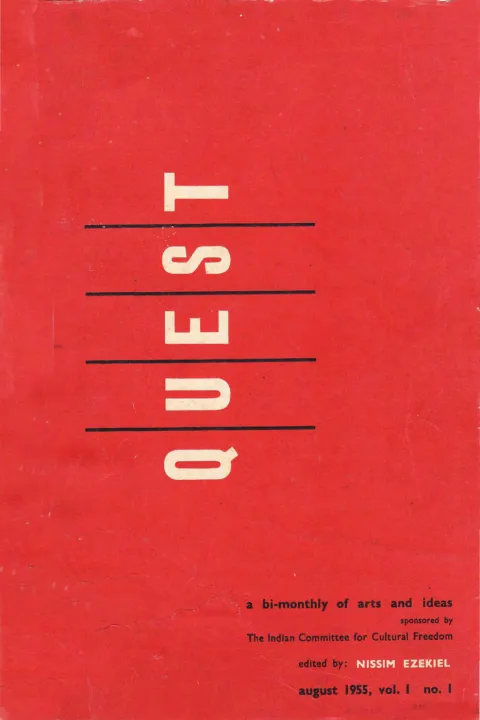
Quest
a bi-monthly of arts and ideas
By M. G. Bailur, Narendra Mitra, S. Ookerjee, D. G. Nadkarni, Ignazio Silone, Comolata Dutt, Jean Bouret, M. Krishnan, T. R. Ramiah, Molly Daniels, Dom Moraes, P. K. Saha, Arun Kolhatkar
QUEST is sponsored by the Indian Committee for Cultural Freedom (Army and Navy Building, 148, Mahatma Gandhi Road, Bombay 1). Edited, printed and published by Nissim Ezekiel for the Indian Committee for Cultural Freedom, Army and Navy Building, 148, Mahatma Gandhi Road, Bombay 1, at the Karnatak Press, Fort Chambers, 109, Parsi Bazar Street, Fort, Bombay 1. · Bombay · 1955
72 pages
QUEST
Summary
This inaugural issue of QUEST (August 1955, Vol. I No. 1), a Bombay bi-monthly of arts and ideas sponsored by the Indian Committee for Cultural Freedom and edited by Nissim Ezekiel, sets out its stall as a journal of ‘discussion and exposition’ rather than propaganda, explicitly linking its literary ambitions to the wider international Congress for Cultural Freedom network (Encounter, Preuves, Forum, etc.). The nine articles range from a polemical critique of Vinoba Bhave’s Bhoodan/Sarvodaya movement and Nehru-era planning (M. G. Bailur), through an indictment of Indian university culture (S. Ookerjee), a dissenting review of the Japanese film Gate of Hell (D. G. Nadkarni), a self-portrait interview with ex-Communist novelist Ignazio Silone, essays on Indian classical music (Comolata Dutt) and the painter Laxman Pai in Paris (Jean Bouret), a close reading of a third-century Tamil Sangam poem (M. Krishnan), and an alarmed report on Dravidian separatist and anti-Brahmin politics in Tamil Nad (T. R. Ramiah). These sit alongside a translated Bengali short story by Narendra Mitra (‘Sap’, tr. Lila Ray), five poems (including early work by Dom Moraes and Arun Kolhatkar), four book reviews, and — unlisted on the contents page — a four-page portfolio of photography (Richard Lannoy) and reproduced art (paintings by Laxman Pai, ink drawings by M. F. Husain).
Taken together the issue’s argumentative center is a liberal, anti-totalitarian scepticism of mass ideological projects — whether Gandhian/Sarvodaya moral economics, Nehruvian planning, Communism, or Dravidian racial-caste politics — paired with an insistence, stated in the editorial, that criticism and ‘discussion and exposition’ are the proper instruments of a free culture. Several pieces explicitly cross-reference this framing: Bailur’s essay measures Bhoodan against ‘facts, verifiable results,’ Ramiah invokes QUEST’s own editorial claim to be ‘first Indian, then Asian and finally International,’ and Silone’s interview stages a public break with Communist orthodoxy in the idiom of individual conscience.
Essays
Bhoodan and Sarvodaya
By M. G. BAILUR
M. G. Bailur’s opening article is a sustained polemical critique of Vinoba Bhave’s Bhoodan (land-gift) and the broader Sarvodaya movement, alongside a parallel critique of Nehru’s and Rajendra Prasad’s rival versions of ‘basic education.’ Bailur argues that Sarvodaya’s claim to aim at ‘the welfare of all’ is empty tautology, that Bhoodan’s moral-exhortation method cannot be judged efficacious because its successes are cherry-picked and its failures invisible, and that its own logic --- surrender of land, then service, then total renunciation --- terminates in ‘universal pauperisation’ rather than any coherent social good. He is equally sharp about the movement’s economics of self-sufficiency, arguing that deliberate ‘catastrophic decline’ in production dressed up as thrift is not idealism but impoverishment, and closes by turning the same rationalist scepticism on Rajendra Prasad’s claim that ‘the Eastern conception of happiness’ rests on introspection rather than material welfare or scientific method.
- Bhoodan’s claimed efficacy cannot be verified: successes are unfalsifiable (‘a fictitious efficacy may be claimed for the method’) and failures are hidden inside aggregate acreage totals.
- Bailur traces Bhoodan’s own logic to an admitted end-point of total renunciation and ‘universal pauperisation’, quoting Vinoba Bhave’s stated three-step programme (Bhoodan, then Sampattidan, then surrender of everything).
- Village self-sufficiency is criticised as economically incoherent: it requires ‘a catastrophic decline in the general level of the country’s production of goods’ while offering only a bare subsistence ‘living wage’.
- The essay contrasts Nehru’s technocratic, science-based vision of national progress with Gandhi’s/Prasad’s basic-education ideal, arguing the two are incompatible (‘is it not clear that one of them is mistaken?’).
- Rajendra Prasad’s rejection of science as a source of ‘material enrichment’ is challenged as unrealistic for ‘the half-starved masses’ and inconsistent with his own praise of introspection.
- The essay’s method is explicitly empiricist: ‘facts, verifiable results, are the only criterion; not faith, not hypotheses about God and human nature.‘
Sap
By NARENDRA MITRA
Narendra Mitra’s story, translated from Bengali by Lila Ray, follows Motalef, a skilled date-palm tapper in rural Bengal, through two marriages of convenience. He marries the widow Maju Khatun for her skill at boiling sap into sugar while he saves the bride-price for Fulbanu, the younger woman he actually desires; once he has the money he discards Maju Khatun with a fabricated accusation of infidelity and brings Fulbanu home. But Fulbanu cannot match Maju Khatun’s craft at sugar-boiling, his sugar’s quality and reputation collapse, and his passion curdles into resentment and violence, while Maju Khatun — remarried to the boatman Nadir — finds she cannot forget him. The story closes on an ambiguous, unresolved note as Motalef, humiliated by his own declining trade, is caught between the two women and unable to voice what he actually feels to either.
- Motalef marries Maju Khatun, Rajek Mridha’s widow, explicitly for her skill boiling palm sap into sugar during the winter tapping season, while continuing to court the younger Fulbanu.
- Fulbanu extracts a pledge of ‘honour’ rather than money from Motalef, and he divorces Maju Khatun on a fabricated charge of misconduct with her brother-in-law once he can afford Fulbanu’s bride-price.
- Fulbanu proves unable to match Maju Khatun’s skill; the sugar burns and sells poorly, and Motalef’s public reputation as the best tapper in the village erodes along with his temper.
- Maju Khatun remarries the boatman Nadir but remains tormented by jealousy on hearing of Motalef’s domestic happiness with Fulbanu, and later forbids Nadir from doing business with him.
- The narrative closes with Motalef bringing sap to Nadir’s house in a gesture that reads as an oblique, unspoken message to Maju Khatun, met by her furious but visibly wounded reaction.
- A translator’s note at the end thanks Ajit Mukherjee for assistance with the translation.
All Play and No Work
By S. OOKERJEE
S. Ookerjee’s essay is a scathing description of Indian university student life circa 1955, arguing that Indian campuses have institutionalised indiscipline, disengagement from study, and reliance on ‘guide’ cram-books in place of genuine texts. He blames overcrowding, weak teacher-student contact, an examination system that rewards stereotyped ‘model answers’, and a culture that alternately demands more ‘bookish’ graduates and then despises bookishness. His remedy is a drastic overhaul: shrink enrolment to those capable of real study, raise examination standards, and let universities single-mindedly pursue disinterested inquiry rather than chase numbers or vocational fashion.
- Indian university ‘traditions’ described include skipping class, disrupting lectures with ‘paper arrows’, and depending entirely on commercial exam ‘guides’ rather than primary texts.
- Ookerjee cites a personal anecdote of a debate with one speaker for a motion against four opposed, and of inter-class debate trophies going unheld for two years from poor response.
- He argues the root cause is not the legacy of the Civil Disobedience movement but sheer overcrowding, which degrades teacher engagement, and a repetitive, guide-driven examination culture that rewards memorised ‘model answers’.
- Malpractice examples include professors selling coaching on likely exam questions and a radio smuggled into an exam hall to receive outside answers.
- The essay insists theoretical/academic knowledge is not opposed to practical value, and that a university’s primary duty is to ‘foster and assist the Spirit of Inquiry and Research… independent of any motives extraneous to the desire for knowledge.’
- Proposed reforms (shrinking enrolment, raising standards, overhauling exams) are predicted to be fiercely resisted by ‘writers of guides’, ‘lazy professors’, ‘corrupt examiners’ and unmotivated students alike.
”Gate of Hell”
By D. G. NADKARNI
D. G. Nadkarni offers a dissenting review of the Japanese colour film Gate of Hell, judging it against Kurosawa’s Rashomon and Tora-no-o. He grants the film’s visual mastery — ‘a testament of colours’ — especially in its opening depiction of a palace revolt, but argues the simple love-triangle plot (a soldier’s obsession with a married woman, ending in her engineered death and his repentance) has ‘no point to drive home’ and collapses into conventional melodrama once the action is confined indoors. He contrasts this unfavourably with Rashomon’s psychological complexity and Tora-no-o’s spare, tense economy, and questions whether the film’s celebrated use of colour is intrinsically remarkable or merely flattered by its exotic subject matter.
- Nadkarni situates Gate of Hell alongside Rashomon and Tora-no-o as period pieces of medieval Japan, crediting the Daiei studio’s training at Eastman/Warner labs for its colour craftsmanship.
- He praises the opening palace-revolt sequence but argues the film ‘loses sight of’ its historical background once it narrows to the Kesa-Moritoh-Wataru triangle.
- The plot is summarised as simplistic: Moritoh’s obsession with Kesa leads her to sacrifice herself in her husband’s place, after which Moritoh becomes a monk.
- Nadkarni contrasts Gate of Hell’s ‘wax figures’ unfavourably with Rashomon’s competing testimonies and Tora-no-o’s ‘cat-and-mouse’ tension, judging the acclaimed colour palette partly a function of exotic subject matter rather than pure technique.
- He notes Gate of Hell is considered in Japan ‘one of Kinugasa’s worst films’, citing this as evidence unpopularity need not indicate poor craftsmanship.
Self-Portrait
By IGNAZIO SILONE
Framed by an editor’s biographical introduction, this is a question-and-answer ‘self-portrait’ of Ignazio Silone, the Italian ex-Communist novelist of Fontamara and Bread and Wine. Silone answers rapid-fire questions about his tastes, values, and politics: he writes ‘to communicate with others’, names Cervantes, Tolstoy and Verga as favourite novelists, professes no confidence in progress as inevitable, and states that freedom in the age of monopolies requires ‘a certain number of socialist measures’ even while insisting Soviet Russia has ‘no socialism, but its opposite — State capitalism; no freedom, but its opposite.’ He describes his continuing confidence in the men who ‘accept suffering and transform it into truth and moral courage’ emerging from the Soviet labour camps.
- Silone states his motive for writing is ‘to communicate with others’ and describes his ideal reader as ‘restless spirits’ who think for themselves.
- He denies that criticism has ever influenced his writing and denies that man’s progress is inevitable, but affirms ‘I think man can be free.’
- Asked about the Soviet Union, he answers that ‘there is no socialism, but its opposite — State capitalism; no freedom, but its opposite,’ while still holding that some socialist measures are necessary for freedom to survive ‘in the age of monopolies.’
- He names Don Luigi Orione, Antonio Gramsci, Leon Trotsky and Leonhard Ragaz among the people who mattered most to him personally.
- On the possibility of world war, he answers grimly that a third world war ‘would prepare the way for the fourth.’
- A prefatory editorial note summarises Silone’s biography: exile under Fascism, his youthful membership of the Communist Party, and his eventual break, dramatised through the character Pietro Spina in Bread and Wine.
The Future of Indian Music
By COMOLATA DUTT
Comolata Dutt, Supervisor of Western Music at All India Radio Delhi, argues that Indian music has stayed needlessly insular by clinging to regional notations instead of adopting a universal system, and proposes that its future lies in developing harmony and orchestration — especially counterpoint — without abandoning the raga system. She surveys parallels between Indian ragas and the scales used by Western composers like Debussy and Scriabine, argues Indian ballet/dance-drama needs newly composed orchestral music rather than recycled classical pieces, and warns that uncontrolled foreign borrowing in film music is producing ‘hybrid music of the worst possible taste’ for want of proper training in harmony and counterpoint in Indian music schools.
- Dutt argues Indian music’s regional notations should be replaced by the universal Western notation to allow international appreciation and exchange.
- She traces parallels between the fixed ‘fifths’ background of the tamboura and Western harmonic structure, arguing Indian music already has a form of harmony even without chordal blocks.
- She distinguishes ‘block harmony’ from ‘counterpoint’ and argues contrapuntal writing suits Indian melodic (raga-based) sensibility better than chordal harmony, describing her own experiments combining ragas contrapuntally.
- European composers Debussy and Scriabine are cited as having independently arrived at scales identical to South Indian ragas (Rishabhapriya and Vachaspattya respectively).
- She calls for formal university-level training in composition, harmony and counterpoint (citing Europe’s nine-year courses) to develop new Indian orchestral and ballet music rather than continued ad hoc borrowing from film music.
- Uncontrolled importation of ‘jazz rhythms and South American melodies’ into Indian film music is criticised as producing ‘hybrid music of the worst possible taste.‘
An Indian in Paris
By JEAN BOURET
French critic Jean Bouret’s letter recalls three young Bombay-trained painters — Padamsee, Raza and Laxman Pai — arriving in his Paris office around 1951 with portfolios of ‘legendary subject-matter.’ Losing track of the other two, he focuses on Laxman Pai’s subsequent development in Paris: a shift from densely coloured, sacred-themed imagery toward sparer ‘plastic notations’ that leave large uncoloured spaces, absorbing French Impressionist ideas of intermittent light while still alluding to twelfth-century Sanskrit poetry. Bouret reads this trajectory through André Malraux’s theory that an artist is not a mere reflection of social/racial background but an individual sensing ‘imponderable elements’ shaped by time and personal maturity, situating Pai within the abstract/constructivist wing of modern art.
- Bouret recalls Padamsee, Raza and Laxman Pai, all trained at Bombay’s J. J. School of Art, visiting his office at the Paris weekly Arts around 1951 with portfolios combining classical Indian and contemporary Western material.
- He states he has since lost track of Padamsee and Raza but that Laxman Pai has ‘persevered in his will to conquer the Paris art-world’, recently exhibiting on the Right Bank.
- Pai’s stylistic evolution is described as a move from covering ‘every inch’ of the canvas with colour and detail toward leaving ‘great spaces without any colour’, which Bouret reads as new sensitivity to French conceptions of intermittent light.
- Pai is said to remain faithful to twelfth-century Sanskrit poetic themes while also technically converging, in places, with Van Gogh — devices Bouret notes ‘Van Gogh had indeed borrowed from some of Laxman Pai’s own ancestors.’
- Bouret frames Pai’s development through André Malraux’s view that an artist senses ‘imponderable elements’ shaped by time and personal maturity rather than merely reflecting social/racial background, aligning Pai with the ‘abstract and constructivist wing of modern art.‘
The Long North Wind
By M. KRISHNAN
Naturalist and writer M. Krishnan offers a close reading of Nedu-nal-vaadai (‘the long, good north wind’), a 188-line 3rd-century Tamil Sangam poem by Nakkeerar. He praises its freedom from later Tamil poetry’s ‘conceits and formal niceties,’ noting its assonance and pithiness anticipate qualities modern English readers value, and situates it precisely via its reference to the historical Pandiya king Nedunjezhian’s victory at Talaiyaalanganam. Krishnan walks through the poem’s structure — cold-season scenes of herdsmen and animals, an evening cityscape, a lonely queen awaiting her king at midnight, and the king’s own battlefield rounds — closing on its final wish to the war-goddess Durga for victory, which he notes is structurally interposed mid-poem rather than saved for the end.
- Krishnan selects Nedu-nal-vaadai partly for its brevity (188 lines) and freedom from ‘formal flourishes and conventions’ common to later, more elaborate Sangam-period verse.
- He dates the poem confidently to the 3rd century A.D. via its reference to the Pandiya king Nedunjezhian’s historical victory at Talaiyaalanganam against two kings and five allies.
- He recounts the legend of Nakkeerar rebuking the god Siva (disguised as a mortal poet) for a factual error in a verse, and being scorched by Siva’s third eye yet refusing to retract his correction.
- The poem’s structure is traced scene by scene: chilled herdsmen and animals, an evening city street patrolled by foreign mercenaries, women timing nightfall by jasmine buds, and a lonely queen awaiting her king’s return from battle.
- Krishnan highlights the poem’s ‘masterful abruptness’ in shifting from the queen’s midnight longing to the king’s battlefield rounds, and its closing wish to the goddess Durga for ‘swift victory… to relieve the pangs of separation’ of the queen.
Fever in the South
By T. R. RAMIAH
T. R. Ramiah surveys the Dravida Kazhagam (D.K.) and Dravida Munnetra Kazhagam (D.M.K.), describing their goal of an independent, casteless ‘Dravida Nadu’ built on a race theory that casts Brahmins as Aryan colonisers of a Dravidian South. He details the movement’s mixture of linguistic pride, anti-Brahmin resentment grounded in real historical domination, vaguely Marxist/Maoist class rhetoric, and programmatic atheism (illustrated by an anti-religious pamphlet debating the chastity of Sita and Kunti, and a booklet on Rasputin). Ramiah calls Nehru’s dismissal of the movement as ‘childish nonsense’ correct in substance but dangerously complacent, comparing the D.M.K.’s appeal to ‘obscure but powerful feelings’ with Nazism’s appeal in Germany, and closes by warning that the movement, left unaddressed, will ‘spread like poison’ even though it currently lacks electoral strength.
- The D.M.K. broke from the D.K. (led by E. V. Ramaswami Naicker, ‘Periyar’) under C. N. Annadurai, both sharing the goal of an independent, casteless ‘Dravida Nadu’.
- Their ideology fuses a race theory (Dravidians vs. ‘Aryan’ Brahmins), Tamil linguistic pride against ‘Hindi imperialism’, vaguely Marxist/Maoist class rhetoric, and militant atheism aimed at religion as a tool of Brahmin control.
- Ramiah cites a D.M.K. pamphlet debate on the chastity of Sita and Kunti, and a booklet on Rasputin, as evidence the movement’s ‘rationalism’ is really an outlet for anti-religious and anti-Brahmin animus.
- He compares the D.M.K.’s appeal to ‘obscure but powerful feelings’ to the appeal of Nazism in Germany, despite seeing no personal resemblance between Annadurai and Hitler.
- Brahmin reactions are sorted into three unproductive types: complacent dismissal, militant indignation, and paralysed, guilty bewilderment — illustrated by a Madras professor who told Ramiah ‘Freedom from bias… is really impossible’ and quoted Srinivasa Sastry’s advice to ‘leave it alone.’
- Ramiah agrees Nehru was right to call the movement ‘childish nonsense’ but insists ignoring it is dangerous, predicting it will ‘spread like poison through the entire society’ if left unaddressed, even though it currently lacks electoral strength.
To …
By MOLLY DANIELS
A short lyric of romantic betrayal in which the speaker recalls a vow of fidelity ‘unto death’ now hollowed out: when strangers pass with the beloved’s grey eyes or walk where she once walked, the speaker feels ‘possessed’, and resents that other men have used the words of love she once made uniquely his.
- The poem is structured around a broken promise of eternal fidelity, triggered by chance resemblances (grey eyes, a cobbled square) that recall the absent beloved.
- It closes on the image of other men’s declarations of love as devalued repetitions of what the speaker once believed were her words alone.
Cainsmorning
By DOM MORAES
A dramatic-monologue poem in the voice of Cain after killing Abel, wandering through a modern, luminous, cold cityscape of ‘Cadillacs and Rheinwine.’ Cain rationalises the killing as necessary ‘for my bettering’ even as he is haunted by a nascent sense of guilt and mortality, ending with his prayer melting away unanswered in ‘the cold, the grey, the faceless rain.’
- The biblical Cain-and-Abel story is transposed onto a modern urban setting (shopwindows, Cadillacs) to dramatise self-justifying violence.
- Cain’s self-justification (‘Being for my bettering, let my brother die’) is undercut by the poem’s closing image of an unanswered prayer dissolving in the rain.
The Apples
By P. K. SAHA
A short imagist poem comparing ripening apples to billiard balls, tracking their colour from green to blood-red under the sun and then to darkness at dusk, ending on a fleeting memory of a coolie-woman’s hands at plucking time.
- The poem uses a repeated ‘billiard ball’ image to track the apples’ colour change from green to red across a single day.
- It closes by attaching a human labour memory (a coolie-woman’s hands at harvest) to the natural image.
The Blind
By ARUN KOLHATKAR
A compact poem in the voice of a blind man who ‘reads’ the world through touch, framing his condition as a scripture read in braille and his five remaining senses as an oracle governed by a ‘blind god’s wayward hand.’
- The poem figures blindness as a form of reading (‘Riddle of the world is brailled / Reader am I’) rather than simple deprivation.
- It closes on a theological inversion, casting the speaker as ‘predicate’ to a ‘subject god’ whose own foresight is itself blind.
The Renunciation of the Dog
By ARUN KOLHATKAR
A cryptic, surreal short poem describing dogs barking at waves the night before a journey, and a black dog that ‘yawned and leapt’ out of the travellers’ own selves and later died mysteriously ‘between God and our heads,’ leaving the travellers ‘naked and shame faced.’
- The poem stages an unexplained, dream-like incident (a black dog emerging from ‘nowhere of ourselves’) as a kind of collective psychological or spiritual event.
- It ends unresolved, addressed as a question (‘Tell me why’) rather than an explained narrative.
Sex, Literature and Censorship
By LAEEQ FUTEHALLY
Laeeq Futehally reviews a Heinemann collection of D. H. Lawrence’s essays on sex, literature and censorship, occasioned by the recent obscenity prosecution of publisher Seeker & Warburg. She summarises Lawrence’s argument that English ‘hush-hush’ about sex dates to fear of venereal disease in Tudor/Stuart times, that genuine openness (not pornography) is the antidote, and that Lawrence himself would ‘censor genuine pornography rigorously’ because it ‘insults’ sex rather than because sex itself is shameful. Futehally extends the argument to India, arguing Indian society was historically more balanced about sex than Britain but risks losing that balance to a new ‘vigilance’ of ‘censor-morons’, while endorsing a ban on one genuinely new form of ‘evil trash’: horror comics mixing pornography with sadism aimed at even illiterate readers.
- The review opens from the prosecution of Seeker & Warburg for obscenity, noting that Zola, Havelock Ellis, Boccaccio and Lawrence’s own The Rainbow have all previously been banned on similar grounds.
- Futehally summarises Lawrence’s historical claim that fear of venereal disease in Tudor/Stuart England caused the ‘great hush-hush’ around sex, replacing earlier Chaucerian openness.
- She distinguishes Lawrence’s targets: he opposes ‘“hush-hush”’ repression of natural sexuality but says he would himself ‘censor genuine pornography rigorously’ since it ‘insults’ sex and ‘the human spirit.’
- India is described as historically freer of British-style sexual taboo, but Futehally warns new ‘censor-morons’ could import self-consciousness where none previously existed.
- She singles out horror comics — ‘pornography mixed with sadism and crime… so that even the illiterate may read them’ — as trash that should be banned, endorsing the Indian government’s import ban on them.
- The review closes by imagining Lawrence would have supported banning horror comics ‘everywhere’, reusing his own line about censoring genuine pornography.
The Illusion of the Epoch
By YOGENDRA CHOPRA
Yogendra Chopra reviews H. B. Acton’s The Illusion of the Epoch: Marxism-Leninism as a Philosophical Creed, praising Acton’s analytic rigour in exposing the ‘fatal ambiguities’ underlying Marxist philosophy — particularly its attempt to combine positivism with Hegelian metaphysics, and the slipperiness of the Materialist Conception of History. The review credits Acton with showing that Marxism’s quasi-philosophical apparatus does not withstand analytic scrutiny even where his broader attempt to liken Marxism to Anglo-American positivism goes too far, concluding the book is ‘a major contribution to the study of Marxism’ despite this overreach.
- Acton’s book is described as applying the analytic techniques associated with G. E. Moore to sociological/political doctrines, aiming mainly at refutation rather than new theses.
- Chopra highlights Acton’s finding that Marxism’s defect is less vagueness than ‘ambiguousness’, especially in trying to fuse positivism with ‘Hegilianism’ [sic].
- The review notes Acton’s partial sympathy for Lenin’s philosophical defence of ‘common sense’ realism against phenomenalism, comparing it to G. E. Moore’s proof of an external world.
- Acton’s treatment of the Materialist Conception of History is called the book’s strongest section, agreeing with Martin Buber that it only makes sense as a technological theory of history.
- Chopra criticises Acton for lumping Marxism together with contemporary positivism too closely, calling this ‘not a thesis that can be defended in a few pages’, while still endorsing the book’s overall value.
Echoes
By SADHAN KUMAR GHOSH
Sadhan Kumar Ghosh reviews Compton Mackenzie’s essay collection Echoes, situating Mackenzie in the nostalgic personal-essay tradition of Max Beerbohm (contrasted with Stephen Spender’s puzzlement, in a remembered conversation, over whether anyone still writes essays). Ghosh highlights Mackenzie’s memories of Ellen Terry, Henry James and Cunninghame-Graham alongside more intimate sensory recollections of old London, and singles out the essay ‘A Passage to India’ — covering the Lawrence School centenary at Sanawar attended by Lord Mountbatten — for its claim that India’s apparent contrasts reveal an ‘intrinsic unity’, and for Mackenzie’s closing tribute to what the West stands to gain from India.
- Ghosh frames Mackenzie as belonging to the personal-essay tradition of Max Beerbohm, recalling a conversation in which Stephen Spender wondered aloud whether anyone still writes essays ‘after the death of Robert Lynd.’
- Mackenzie’s memories mix encounters with the eminent (Ellen Terry, Henry James, Cunninghame-Graham) with sensory nostalgia for lost London sights and smells (marguerites, gas-lit theatres, lavender-sellers).
- The essay ‘A Passage to India’ recalls the Lawrence School, Sanawar centenary attended by Lord Mountbatten, and Mackenzie’s claim that India’s contrasts reveal an underlying ‘intrinsic unity’ — called ‘a rather unusual statement from an old-guard Englishman.’
- Mackenzie is quoted thanking India for what it taught him ‘about the potentiality of man’ and predicting Westerners will increasingly gain ‘spiritual enrichment’ from India.
- Ghosh closes by praising Mackenzie’s trustworthy memory and ‘endless search for experience’ as what makes him ‘a remarkable person.‘
Everyday Life in Ancient India
By ARATI MUKERJI
Arati Mukerji reviews Padmini Sengupta’s Everyday Life in Ancient India, praising its ability to make prehistoric and early-historic Indians (‘as ancient as B.C. 10,000’) feel human rather than abstract via ‘compact vivid sentences.’ The review summarises the book’s account of the Indus Valley ‘city civilisation’ at Mohenjodaro and Harappa (developed script, copper/bronze tools, gold ornaments, planned drainage) and its violent end likely at Aryan hands, followed by the Vedic, epic and Mauryan periods, closing on Sengupta’s thesis that India’s ancient cultural unity allowed diverse elements to ‘grow and develop and flourish’ rather than remain static.
- Mukerji praises Sengupta for making distant prehistory (‘as ancient as B.C. 10,000’) readable for a general audience rather than ‘the research scholar.’
- The review recounts the book’s picture of the Indus Valley civilisation (Mohenjodaro, Harappa) by 2500 B.C.: a pictographic script, copper/bronze tools, gold ornaments, clay toys, planned cities with scientific drainage.
- It notes the book attributes that civilisation’s ‘sudden and violent end’ probably to Aryan invasion, followed by the Vedic, epic, Buddhist and Mauryan periods.
- Mukerji highlights Sengupta’s closing thesis that India’s ancient ‘cultural unity’ (the origin of the term ‘Bharatvarsa’) allowed diverse regional elements to develop rather than remain static.
Essay 19
A four-page art and photography portfolio sits between ‘Sap’ and ‘All Play and No Work’ with no entry on the printed contents page. It opens with an uncaptioned-photographer image titled ‘India-Past and Present’, showing tailors working beneath ancient sculpture in the Pudumandapam of Madurai’s great shrine; followed by a photograph ‘Band Shop in Old Delhi’ credited to Richard Lannoy; two paintings by Laxman Pai (‘Tricot’ and ‘My Mother’), cross-referenced to the Jean Bouret profile later in the issue; and two ink line drawings by M. F. Husain (‘Priest, Rome’ and ‘Tribal Girl, Hyderabad’).
- This four-page insert (pp.23-26) is not listed on the printed contents page and was located only by rendering the intervening pages directly.
- Page 23 carries a full-page photograph captioned ‘India-Past and Present’, showing tailors’ stalls set up beneath ancient sculpture in the Pudumandapam of Madurai’s temple.
- Page 24 carries a photograph titled ‘Band Shop in Old Delhi’, credited ‘by Richard Lannoy.’
- Page 25 reproduces two Laxman Pai paintings, ‘Tricot’ and ‘My Mother’, explicitly cross-referenced (‘see p. 45’) to Jean Bouret’s profile of Pai later in the issue.
- Page 26 carries two ink line drawings by M. F. Husain, captioned ‘Priest, Rome’ and ‘Tribal Girl, Hyderabad.’
Generated by the v1.5 extraction pipeline. Awaiting editorial review.
Metadata and summary are AI-extracted from the source PDF and reviewed for editorial accuracy. The original work is available via the Read PDF tab above (where present); paragraph-level citation inside the PDF is deferred to a future engagement.
People in this work
- M. G. Bailurauthor
- Narendra Mitraauthor
- S. Ookerjeeauthor
- D. G. Nadkarniauthor
- Ignazio Siloneauthor
- Comolata Duttauthor
- Jean Bouretauthor
- M. Krishnanauthor
- T. R. Ramiahauthor
- Molly Danielsauthor
- Dom Moraesauthor
- P. K. Sahaauthor
- Arun Kolhatkarauthor
- Nissim Ezekiel
- Lila Ray
- Laeeq Futehally
- Yogendra Chopra
- Sadhan Kumar Ghosh
- Arati Mukerji
- M. F. Husain
- Laxman Pai
- Richard Lannoy
- Jawaharlal Nehru
- Mahatma Gandhi
- Karl Marx
- Mao Zedong