
periodical issue
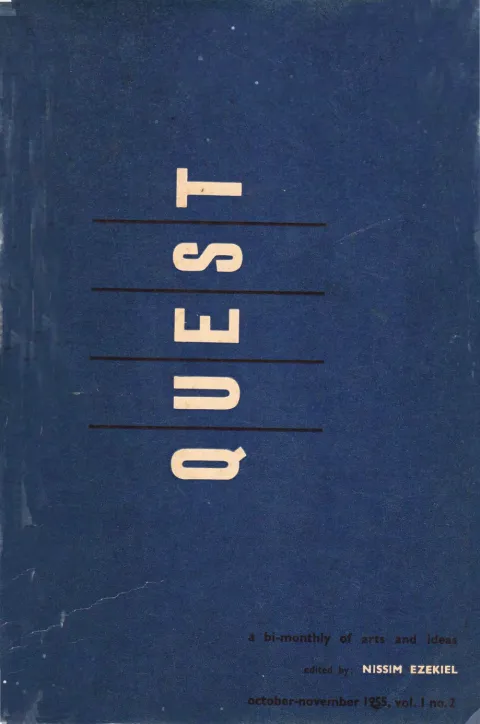
Quest
a bi-monthly of arts and ideas
By V. Vijayatunga, Prabhakar Padhye, G. D. Parikh, Sadhan Kumar Ghosh, Swami Agehananda Bharati, Rene Tavernier, A. Subbiah, S. Nedumaran, Buddhadeva Bose, Asoke Vijay Raha, R. Ramaswamy, Laeeq Futehally, Anish Ghatak
Edited, printed and published by Nissim Ezekiel for the Indian Committee for Cultural Freedom, Army and Navy Building, 148, Mahatma Gandhi Road, Bombay 1, at the Kanada Press, Podar Chambers, 109, Parsi Bazar Street, Fort, Bombay 1. · Bombay · 1955
76 pages
Quest
Summary
Quest Vol. I No. 2 (October-November 1955), the second issue of Nissim Ezekiel’s Bombay ‘bi-monthly of arts and ideas’ sponsored by the Indian Committee for Cultural Freedom, opens with a two-part lead essay in which Prabhakar Padhye and G. D. Parikh diagnose the post-independence Asian intellectual’s alienation and vulnerability to communism, and argue for a decentralised, culturally-rooted alternative to both Soviet-style planning and cold-war alignment. The rest of the issue ranges across a Pondicherry ashram diary (J. Vijayatunga), a polemic against India’s consolidating post-independence elite (Sadhan Kumar Ghosh), a comparative essay on Indian versus Western philosophical method by the Austrian-born monk Swami Agehananda, a Paris cultural-political dispatch (Rene Tavernier), a heated exchange on Tamil Brahmin/non-Brahmin politics between A. Subbiah and D.M.K. correspondent S. Nedumaran (continuing a controversy from the first issue), two poems, and a substantial back section of theatre, dance, film and book reviews. An unsigned-but-signed editorial by Ezekiel, not listed on the contents page, defends the first issue against hostile press notices. Read together, the issue stages the magazine’s founding argument — that a non-communist, non-doctrinaire cultural liberalism, sceptical of both nationalist revivalism and Soviet models, is the position from which Asian and Indian intellectual life should proceed — while giving substantial, uncensored space to positions (the D.M.K.’s, the Brahmin-critical case) that cut against its own editorial instincts.
Essays
The Intellectual in Modern Asia
By Prabhakar Padhye
Padhye diagnoses a psychological and spiritual crisis among Western-educated Asian intellectuals after independence. Their colonial-era education instilled a philosophy of mastery over Nature foreign to Asian traditions of harmony with Nature, leaving them ideally suited to the negative task of expelling colonial rulers but ill-equipped for the different, constructive work of reconstruction. He traces their frequent attraction to communism to this alienation rather than to doctrine: communism flatters the intellectual’s sense of superiority while promising ‘integration’ with the masses and a role in a grand historical process, but Padhye insists this Soviet-style integration is really pure conformity, incompatible with genuine intellectual life, and that centralised high-power industrialisation is unsuited to Asia because its man-to-resource ratio is the opposite of Russia’s.
- Colonial-era Western education equipped Asian intellectuals to fight for independence but left them ‘spiritually ill-equipped’ for the different, decentralised tasks of post-independence reconstruction.
- Asian and Western philosophies differ fundamentally in their orientation to Nature (harmony vs. mastery), shaping their differing capacity to absorb Western political and economic models.
- The Asian intellectual’s alienation and status anxiety, not doctrine, is what draws him to communism, which flatters his sense of superiority while promising integration with the masses.
- Soviet-style centralised industrialisation is unsuited to Asia because the man-to-resource ratio there is the opposite of Russia’s.
- True freedom requires decentralising power to the village/factory level — citing Aneurin Bevan on enfranchising people ‘not only at the ballot box but also in the fields and factories’ — rather than the ‘mechanical integration’ of a Soviet-style plan.
The Intellectual in Modern Asia (ditto marks in TOC; second of ‘two statements’ under the shared title, per the article’s own subtitle ‘two statements’)
By G. D. Parikh
Parikh’s companion statement argues that Asia’s integration into the ‘free world’ must not be conflated with cold-war alignment; freedom must be experienced through Asia’s own free institutions, not imposed. Surveying the psychological aftermath of independence — insecurity, defensiveness, oversensitivity to real or imagined slights — he argues the West’s cold-war framing misunderstands Asian aspirations, which extend beyond preserving independence to economic, social and spiritual welfare, quoting F. S. C. Northrop on the need for ‘informed realism of philosophical and cultural understanding’ rather than power-political realism. He then argues Asian nationalism failed to develop a secular, rational character, instead cultivating an authoritarian, backward-looking mentality that leaves it compatible with both fascism and communism, and — endorsing Northrop’s call to combine the West’s ‘theoretic’ and the East’s ‘aesthetic’ components of civilisation while doubting that otherworldly Asian religions can supply the ethic needed for social reconstruction — cites the ‘phenomenon of Gandhian communism’ in India as a cautionary instance. He concludes that Asia’s freedom depends on a twentieth-century intellectual and institutional ‘Renaissance’ from the village level up, not on nationalism, state-led industrialisation, or religious revival.
- Integration with the ‘free world’ must be Asia’s own free choice, not an artifact of cold-war alignment; a ‘Cause cannot be imposed.’
- Asian nationalism, lacking a secular-rational character, tends toward authoritarian and revivalist attitudes compatible with both fascism and communism.
- Quotes F. S. C. Northrop at length on combining the West’s ‘theoretic’ component with the East’s ‘aesthetic’ one, while doubting Eastern religions can supply the ethic of social reconstruction Asia needs.
- Cites ‘Gandhian communism’ in India as a warning about the fragility of religiously-inspired movements like Bhoodan when pressed into service against communism’s appeal.
- State-sponsored industrialisation, given weak administrative capacity and low literacy across most of Asia, risks entrenching authoritarianism rather than freedom.
Pondicherry Journal
By J. Vijayatunga
A diary-form ‘Pondicherry Journal’ recording the author’s life at the Sri Aurobindo Ashram over several months, mixing wry domestic anecdote (bus journeys, a mynah’s nest, a curt refusal to lend a pen) with a sustained, self-lacerating meditation on Asian mimicry of the West. Watching dockworkers unload a cargo steamer, Vijayatunga turns the diary into a polemic against Asian claims to civilisational superiority, arguing that material backwardness and psychological dependence on the West — visible in everything from clothing to table manners — make such claims hollow, and singles out English-speaking, foreign-educated Indians who ‘boast that we are superior’ while owing every comfort to Western civilisation. The entry is written throughout in the period’s casually derogatory language about mixed-race people and labourers, which the text preserves verbatim as part of the historical record rather than as editorial endorsement.
- Diary form spanning several months at the Sri Aurobindo Ashram, Pondicherry, mixing personal anecdote with cultural criticism.
- Sharp self-criticism of Asian claims to spiritual/civilisational superiority as compensation for material and psychological dependence on the West.
- An extended, uncomfortable meditation on dockworkers (‘coolies’) unloading a cargo steamer, contrasted with India’s ambassadors and Western-educated leaders.
- Contains dated, disparaging period language about a person of mixed race and about labourers, transcribed verbatim as historical record.
- Ends on a personal note distinguishing a comfortable domestic ‘Place’ from genuine contentment found in ‘People.‘
The Cold Class War
By Sadhan Kumar Ghosh
Ghosh argues that India’s post-independence ‘ruling classes’ — the Congress leadership, industrialists, financiers and high bureaucrats — are consolidating into a closed elite, the ‘Westernised Intellectual,’ whose children pass through a handful of elite schools and colleges before going abroad, while opportunity for the majority narrows. He reads state promotion of family planning, the lowering of English-medium teaching standards, and proposals to abolish the Intermediate examination as disguised strategies of exclusion, comparable to the medieval Church restricting Bible literacy to priests, and — citing Jayaprakash Narayan on the rise of new post-independence elite groups and Harold Laski on Britain’s Barlow Report — contrasts India’s widening inequality with Britain’s postwar Welfare State (the Beveridge Report, the NHS, the Arts Council). He dismisses the Avadi Resolution’s ‘Socialistic Pattern of Society’ and the Kalelkar Commission’s backward-classes findings as diversions that leave the real, much larger ‘backward’ population — effectively all of India minus the elite — unaddressed, and closes warning of a ‘new age of slavery’ as unemployment, birth-control propaganda and rationalisation deepen social frustration.
- Argues India’s Congress-led elite is consciously narrowing opportunity to preserve its own privilege, tightening control as resentment grows (citing Hilferding’s pattern).
- Reads state-promoted family planning as an evasion of the real issue of distribution rather than production, quoting the writer George Floris on a ‘cold class war.’
- Frames the lowering of English-teaching standards and the proposed abolition of the Intermediate examination as a deliberate ‘educational counter-revolution.’
- Contrasts India’s growing inequality unfavourably with Britain’s Welfare State (Beveridge Report, NHS, Arts Council-funded repertory theatre).
- Dismisses the Avadi Resolution and the Kalelkar Commission on backward classes as diversions that understate the true scale (200 million-plus) of India’s underprivileged.
Philosophy East and West
By Swami Agehananda
Swami Agehananda argues that Western scholars’ mistranslation of ‘philosophy’ as darshana-shastra (traced to Max Muller) produced enduring confusion: darshana is properly theology/mysticism, and Indian thought — with the sole historical exception of Nagarjuna’s shunya-vada school — has always been axiomatic, scripture-bound metaphysics rather than critical philosophy in the Western sense. He contrasts the ‘enthusiastic’ cast of Indian thought (relying on scripture, tradition or mystical vision) with the West’s ‘critical’ temper, noting the West itself had a long ‘enthusiastic,’ dogmatic dark-ages phase, and argues — against a common claim — that Indian thought, including Mahayana Buddhism, has always been radically individualistic: salvation can only be sought and won by individuals, never by an abstraction like ‘mankind.’ He warns that if India ever ‘gets enamoured with collectivism,’ it will suffer the crises the collectivist West has had, and closes contrasting India’s excess of ‘inspiration’ (citing Vivekananda) against its deficit of ‘information.’
- The mistranslation of ‘philosophy’ as darshana-shastra, traced to Max Muller, is the root of mutual incomprehension between Indian pundits and Western-trained critical philosophers.
- Indian thought is axiomatic/theological throughout its history, with the sole exception of Nagarjuna’s Madhyamika school; the recent Navya-Nyaya school is the closest analogue to Western critical analysis.
- Distinguishes Western ‘critical’ thought from Indian (and older Western) ‘enthusiastic’ thought — thought that relies on external, traditional or mystical authority rather than independent analysis.
- Argues Indian religious/philosophical tradition, including Buddhism, is radically individualistic: there is no coherent notion of salvation for ‘mankind,’ only for individuals.
- Names the ‘modern Charvaka,’ M. N. Roy, as one of the very few Indian thinkers who accepted no scriptural text as a source of philosophical authority.
Letter from France
By Rene Tavernier
A political and cultural dispatch from Paris in mid-1955. Politically, Tavernier reads the post-Geneva-Conference ‘easing’ of Cold War tension as Soviet tactical appeasement rather than genuine rapprochement, arguing only a federated Europe with a pooled atomic policy could meet it from strength; he profiles General de Gaulle’s principled but increasingly nationalist retirement-era politics and surveys France’s fraying colonial settlements (cautious optimism on the Tunisian agreements, Algeria and Morocco described as open wounds). Culturally, he reviews the Picasso retrospective at the Museum of Decorative Arts as the season’s high point, contrasts it with the Soviet-approved painter Fougeron’s fall from favour and the rise of Bernard Buffet, and surveys three major books of the year — Aron’s The Opium of the Intellectuals, Merleau-Ponty’s The Adventures of the Dialectic, and Luthy’s essay on France — as evidence of French intellectuals’ disenchantment with Communist mythology, alongside new fiction, poetry and Sartre’s poorly received play Nekrassov.
- Interprets the 1955 Geneva ‘detente’ as Soviet tactical appeasement, answerable only by a federated European atomic policy.
- Profiles de Gaulle’s prestige-in-retirement, noting his hardening nationalism and opposition to European federation.
- Surveys France’s colonial crises: cautious optimism on Tunisia, but Algeria and Morocco described as unresolved.
- Reviews Aron’s The Opium of the Intellectuals and Merleau-Ponty’s break with Sartre (The Adventures of the Dialectic) as landmark anti-Communist intellectual statements.
- Praises the Picasso retrospective at length as the cultural high point of the Paris season, and reviews Sartre’s Nekrassov unfavourably.
Cultural Conflicts in Tamil Nad
By A. Subbiah
A. Subbiah replies to T. R. Ramiah’s earlier Quest article ‘Fever in the South’ on the D.K./D.M.K. movements, arguing Ramiah understated the depth and antiquity of Tamil Brahmin/non-Brahmin conflict by treating it as merely recent ‘political and economic domination.’ Marshalling philological authorities (Bishop Caldwell, Prof. Murray Fowler) and Brahmin historians themselves (S. Krishnaswami Aiyangar, T. R. Sesha Iyengar), Subbiah argues the conflict is centuries old, rooted in Brahmin linguistic Sanskritism, a self-identification as Aryan migrants distinct from ‘Sudra’ Dravidians, control of Sanskrit learning to maintain caste hierarchy, and the long suppression of Tamil as a liturgical language even in Tamil temples. Contrasting Tamil ethical literature (the Kural, praised by Albert Schweitzer) with the Sanskritic Dharma Shastras, and criticising Ramiah for excusing Brahmin dominance, he calls on the Brahmin community to voluntarily renounce claims of superiority and identify with Tamil aspirations, warning that unresolved Tamil Nad conflicts threaten the wider unity of India.
- Argues Brahmin-non-Brahmin conflict in Tamil Nad long predates British rule and is not merely ‘political and economic domination’ as Ramiah claimed.
- Traces Brahmin cultural dominance to control of Sanskrit learning and a doctrine of Aryan/Sudra racial distinction that Subbiah says Brahmin historians themselves (Krishnaswami Aiyangar, Sesha Iyengar) have documented or propagated.
- Documents historic suppression of Tamil as a temple/liturgical language in favour of Sanskrit.
- Cites Albert Schweitzer’s praise of the Tamil ethical classic the Kural as evidence of an indigenous, non-Brahminical ethical tradition.
- Calls on Brahmins to renounce claims of caste superiority and align with Tamil aspirations as the only durable resolution, while defending the D.M.K. against charges of pure race theory.
A Letter
By S. Nedumaran
A rebuttal letter from S. Nedumaran, Assistant Editor of the D.M.K. weekly Murasoli, to T. R. Ramiah’s earlier Quest article ‘Fever in the South.’ Nedumaran disputes Ramiah’s claim that the D.M.K. lacks real membership, citing a Madras government witness’s court testimony (membership over a lakh, over a thousand branches) and a Blitz magazine report of 250,000 members. He denies the D.M.K. holds a ‘pure Dravidian race’ theory, distinguishing it from the Dravida Kazhagam and clarifying that ‘Dravida’ groups Andhras, Malayalis, Kannadigas and Tamils, and insists the movement targets ‘Brahminism’ as a social structure, not Brahmins as individuals. He criticises Ramiah for uncritically endorsing Nehru’s dismissal of the movement as ‘childish nonsense’ and closes urging Quest to give a ‘correct picture’ of the Dravidian movement.
- Rebuts Ramiah’s claim that the D.M.K. lacks real strength, citing court testimony and a Blitz report of roughly 250,000 members.
- Distinguishes the D.M.K.’s position from the Dravida Kazhagam’s ‘pure Dravidian race’ theory.
- Insists the movement targets ‘Brahminism’ as a social structure, not Brahmins as individuals.
- Criticises Ramiah for endorsing Nehru’s ‘childish nonsense’ characterisation of the movement without argument.
- Asks Quest’s editor to give a more accurate account of the Dravidian movement going forward.
The Dreamer to the Dancer
By Buddhadeva Bose
A short lyric poem, ‘adapted from the author’s Bengali,’ addressed to a dancer/river figure in which the poet-speaker (the ‘dreamer’) claims creative mastery over his elusive, elemental subject even as he acknowledges the dancer/river’s own autonomous, cosmic scale — ‘interminable horizons,’ ‘changeful moons,’ Death ‘leashed at its end.’
- A translated/adapted lyric (from Bengali) using the dancer and the river interchangeably as images for a wild, elemental muse.
- The poet figures his own creative labour as ‘hewing and racking’ ore into shape, claiming the subject as material for his art.
- Ends on themes of dream, mortality and the unconscious (‘the dark, forlorn, cavernous bed of my mind’).
Man of the Hills
By Asoke Vijay Raha
A short lyric personifying Haflong mountain in the Naga Hills as a mythic giant whose ‘flute’ is heard at night, its music briefly interrupted by a passing train, set in a landscape of jungle, moonlight and the Melang river, closing by naming the music explicitly as the ‘Naga’ flute.
- Personifies Haflong mountain as a mythic giant (‘offspring of a mighty giant’) with a spear, jungle-wrapped, the sun as a jewelled ear-ring.
- Uses a passing train’s whistle as an intrusion of modernity into an otherwise timeless natural/tribal soundscape.
- Explicitly ties the mountain’s night-music to the Naga people of the region in its closing line.
Sense and Sentiment
By D. C.
A review of Mina Gurjari, a Gujarati stage production by the Nat Mandal of Ahmedabad that has toured successfully across India. D.C. questions the play’s claim to be a new dramatic form, arguing Indian theatre generally fails to find forms adequate to its themes, unlike Greek tragedy, which the reviewer treats as a structural model. Although the story — a Gujarati ‘Joan of Arc’ who repels a Mughal chieftain’s advances but is spurned by her own people on her return — has tragic potential, the production reduces it to sentimental ‘country-fair natak,’ burying its universal theme under regional folk colour and, the reviewer notes ironically, ends up indicting the Gujarati community rather than the Mughal antagonist, who behaves nobly.
- Argues Indian theatre lacks an adequate dramatic form, unlike Greek tragedy, held up as a structural model.
- Summarises the Mina Gurjari plot: a village-maiden heroine who repels a Mughal chieftain, saves her people, but is disowned by them on suspicion of dishonour.
- Criticises the production for burying the story’s tragic, universal core under folkloric ‘local colour’ and slapstick.
- Notes the irony that the production ends up indicting the Gujarati community rather than the Mughal chieftain, who is shown behaving nobly.
- Diagnoses ‘sentimentalism’ as a besetting weakness of Indian artistic expression generally.
New Themes and Old Ways
By R. Ramaswamy
A critical survey of three young Kathak dancers seen in Bombay — Brij Mohan, Gopi Krishen and Roshan Kumari — used to argue for reform of the Kathak repertoire. Ramaswamy judges Brij Mohan technically superior, especially in abhinaya, but finds the other two more delightful to watch, and argues Kathak’s reliance on a handful of stock mythological vignettes has become exhausted through repetition, unlike its footwork and spins, which lose little from repetition. He proposes dancers retire the most overused themes for a decade in favour of the wider Puranic/epic repertoire, and closes admiring the untranslated onomatopoeic Braj Bhasha verses used in performance.
- Compares three leading young Kathak dancers, rating Brij Mohan’s technique highest but finding the other two more engaging performers.
- Argues Kathak’s abhinaya (expressive/mimetic) repertoire has become stale through repetition of a small stock of mythological vignettes.
- By contrast, judges Kathak’s footwork and whirls to retain excitement even under heavy repetition.
- Proposes a decade-long moratorium on the most overused themes in favour of the wider Puranas, Mahabharata and Ramayana.
- Closes by quoting and admiring the onomatopoeic Braj Bhasha verse accompaniment used in Kathak recitation.
Russian Salesmanship?
By Laeeq Futehally
A review of a Soviet-made documentary of Nehru’s visit to Russia. Futehally finds the film technically amateurish and creatively unimaginative — essentially two hours of watching Nehru’s car and face — arguing the Soviets missed an opportunity to showcase Indian audiences their own culture and technology. She singles out rare unguarded glimpses of ordinary Russian streets, buildings and people as the film’s real interest, drawing tentative conclusions about uninspired Soviet architecture and the comparatively unadorned appearance of Russian women.
- Judges the Nehru-in-Russia documentary technically amateurish, largely repetitive shots of Nehru’s car and face.
- Argues the Soviets squandered a chance to showcase their own culture and technology to Indian viewers.
- Finds the incidental background glimpses of Russian streets and buildings the film’s most interesting content.
- Assesses Soviet architecture, based on these glimpses, as uninspired (‘designed by engineers rather than architects’).
- Speculates about why Russian women appear comparatively unadorned/‘drab’ on screen.
Film and Civilisation
By Anish Ghatak
Ghatak argues cinema is a genuine art form, unique for its international reach and collaborative combination of the other arts, but that Indian filmmakers have debased the medium with violence, sex and vulgar wealth display, citing commercial pressure as their excuse. He rejects this excuse by pointing to small countries (Sweden, Czechoslovakia, Belgium, Holland) whose commercial films are nonetheless serious national art, and argues the real obstacle in India is a lack of artistic sensibility among the small group controlling production resources.
- Argues cinema qualifies as art because, like music or painting, it satisfies a ‘compulsive human experience’ demanding expression, while being uniquely collaborative and international.
- Criticises the contemporary Indian film industry for pandering to ‘lower levels of quick emotional satisfaction’ via violence, sex and vulgar wealth display.
- Rejects the commercial-necessity excuse by citing Sweden, Czechoslovakia, Belgium and Holland as countries whose commercial films are also serious national art.
- Locates the real obstacle in the lack of artistic sensibility among India’s small class of film financiers and producers.
- Calls on producers to raise, not merely follow, public taste.
Old Friends and New Music by N. Nabokov
By Victor Paranjoti
A warm review of Nicolas Nabokov’s autobiography Old Friends and New Music, framed by Paranjoti’s complaint that Indians lump all non-Indian concert music together as ‘European,’ a prejudice that has cut India off from most of it. He praises the book’s portraits of Stravinsky, Prokofiev and Shostakovich, its account of Nijinsky’s decline, Nabokov’s stint as a US Army ‘cultural officer’ negotiating musical life in occupied Berlin with Soviet counterparts, and its recurring figure of Diaghilev.
- Frames the review around Indian audiences’ prejudice against ‘European’ (non-Indian ‘international’) concert music.
- Praises Nabokov’s pen-portraits of Stravinsky, Prokofiev and especially a ‘restrained, objective but strangely moving’ chapter on Shostakovich.
- Highlights an account of the author’s encounter with the insane, declining Nijinsky.
- Notes Nabokov’s work as a US Army ‘cultural officer’ negotiating with Soviet authorities over musical life in occupied Berlin.
- Recommends the book even to readers uninterested in music, citing its wit and warmth.
Flaubert’s Dictionary of Accepted Ideas
By Foy Nissen
A review of Jacques Barzun’s translation of Flaubert’s satirical Dictionnaire des Idees Recues. Nissen frames the ‘accepted idea’ as a form of social conformity (‘lust for order through convention’) that Flaubert dissected as a symptom of human transformation under machine capitalism, and admires how Barzun’s translation preserves the deadpan, cumulative comic structure of Flaubert’s entries, crediting Barzun’s introduction for bringing out the work’s continuing relevance.
- Frames Flaubert’s dictionary as a diagnosis of ‘lust for order through convention’ among the ‘middling sensual man.’
- Notes Flaubert’s stated motive (‘to dissect is to revenge’) alongside his interest in ideological conformity under capitalism.
- Illustrates the dictionary’s cumulative, self-reinforcing structure with several quoted entries.
- Praises Barzun’s translation for preserving Flaubert’s understated satirical technique.
- Suggests some entries strike Indian readers as more than merely period-specific or French in relevance.
No Flies in China by G. S. Gale
By Zafar Futehally
A review of Manchester Guardian correspondent G. S. Gale’s account of a three-week 1954 visit to China with a British Labour Party delegation. Futehally highlights Gale’s frustrated attempts to get straight answers from Chinese officials — a lengthy official monologue citing production statistics, and an evasive explanation of the phased nationalisation of private industry via ‘state capitalism’ — and Gale’s harsher findings at a coal mine and a re-education jail for ‘counter-revolutionaries.’ He records an exchange in which officials insist the press is ‘quite free’ while conceding they cannot criticise government policy itself, and notes that only Aneurin Bevan among the delegation defended parliamentary democracy against the Chinese hosts.
- Gale’s brief (three-week) 1954 China visit is presented, by his own admission, as an impressionistic ‘cartoon’ rather than a complete picture.
- Quotes official statistics claiming steep production gains since 1949 versus Kuomintang-era output.
- Details the phased nationalisation of private industry described by a Chinese official (‘state capitalism’ as an intermediate stage).
- Recounts a jail visit for political ‘re-education’ of alleged ‘counter-revolutionaries,’ including workers accused of machine slackening.
- Highlights a circular exchange in which officials claim press freedom while ruling out criticism of Party policy itself; only Bevan defended parliamentary democracy outright.
- Notes Nehru’s own more measured verdict after his China visit — that China had achieved much, but India should advance by its own, different methods.
Not Honour More by Joyce Cary
By Krishnanath
A review of the concluding volume of Joyce Cary’s second trilogy, centred on the radical evangelical politician Chester Nimmo — modelled loosely on figures like Bevan, Lloyd George, Roosevelt and Billy Graham — narrated here by Nimmo’s rival/cousin Jim Latter. Krishnanath judges the trilogy technically superior to Cary’s first, praising Nimmo as a fully achieved ‘demagogue, artist in words’ whose sincerity and self-serving manipulation are inseparable, and reads the trilogy not as an indictment of democracy but as a study of ‘the political imagination’ and its capacity for both creative and destructive force, while noting weaknesses of garrulousness and repetitive characterisation in the final volume.
- Reviews the third and final volume of Cary’s trilogy about the politician Chester Nimmo, narrated here by his rival Jim Latter.
- Compares Nimmo, as a manipulative demagogic ‘artist in politics,’ to Gulley Jimson, the artist-protagonist of Cary’s The Horse’s Mouth.
- Argues the trilogy is not an indictment of democracy but a study of the political imagination’s ecstasy and destructiveness.
- Notes technical improvement over Cary’s earlier trilogy but criticises garrulousness and repetitive character-types in this final volume.
- Praises Cary’s feel for family ‘solidarity…complicated cruelty’ and the social-historical texture of the novels.
Dilemmas by Gilbert Ryle
By P. C. Chatterji
A review of Gilbert Ryle’s Tarner Lectures, Dilemmas, in which Ryle sets aside the lectures’ usual brief (relations between the sciences) to examine philosophical ‘dilemmas’ — apparently irreconcilable pairs of answers — as symptoms of linguistic confusion rather than genuine metaphysical puzzles. Chatterji summarises Ryle’s treatment of the fatalist and Zeno paradoxes (illustrated via a cake-cutting analogy) as his strongest chapters, situates Ryle among the ‘Neo-Wittgensteinians’ who treat philosophical problems as pseudo-problems generated by verbal muddle, and closes questioning whether Ryle’s method can ever get readers ‘all the way out’ of a dilemma rather than merely half-way.
- Frames Dilemmas as a departure from Ryle’s usual technical register, aimed at a general philosophical audience.
- Summarises Ryle’s treatment of the fatalist and Zeno paradoxes (with a cake-cutting analogy for infinite divisibility) as his strongest material.
- Notes Ryle diagnoses philosophical ‘dilemmas’ as products of linguistic confusion rather than real metaphysical conflicts, aligning him with the ‘Neo-Wittgensteinians.’
- Contrasts Ryle’s approach with Hegel’s dialectical resolution via the Absolute Idea.
- Questions whether diagnosing a conceptual muddle is sufficient, or only ‘half way out’ of the underlying philosophical task.
Essay 20
Not listed on the printed contents page: the issue’s unsigned-but-signed opening editorial by editor Nissim Ezekiel reviews the critical reception of Quest’s first issue, quoting and rebutting hostile notices — the communist New Age’s charge that Quest represents ‘the birth of a new baby in the American Lobby,’ and complaints from the Sunday Standard and the Free Press Journal’s ‘Taurus’ columnist about the journal’s political motivations and its acceptance of ‘big business’ advertising — while noting largely favourable notices from The Times of India, The Indian P.E.N. and others, and closing with satisfaction that the journal’s visual design attracted as much comment as its contents.
- Not on the printed contents page; a signed editorial by editor Nissim Ezekiel opening the issue.
- Responds point-by-point to hostile reviews, especially the communist New Age’s ‘American Lobby’ characterisation.
- Defends Quest’s explicit ‘political motivations’ against the charge of ‘masquerading under a cultural garb.’
- Notes that most reviews (Times of India, Indian P.E.N., Thought, Mysindia, Nav Bharat, Eastern Economist, Loksatta) were favourable.
- Rebuts the charge that advertising revenue from ‘big business’ compromises the journal’s independence.
Generated by the v1.5 extraction pipeline. Awaiting editorial review.
Metadata and summary are AI-extracted from the source PDF and reviewed for editorial accuracy. The original work is available via the Read PDF tab above (where present); paragraph-level citation inside the PDF is deferred to a future engagement.
People in this work
- V. Vijayatungaauthor
- Prabhakar Padhyeauthor
- G. D. Parikhauthor
- Sadhan Kumar Ghoshauthor
- Swami Agehananda Bharatiauthor
- Rene Tavernierauthor
- A. Subbiahauthor
- S. Nedumaranauthor
- Buddhadeva Boseauthor
- Asoke Vijay Rahaauthor
- R. Ramaswamyauthor
- Laeeq Futehallyauthor
- Anish Ghatakauthor
- Victor Paranjoti
- Foy Nissen
- Zafar Futehally
- Krishnanath
- P. C. Chatterji
- Nissim Ezekiel
- Mahatma Gandhi
- M. N. Roy
- Jayaprakash Narayan
- Jawaharlal Nehru
- C. D. Deshmukh