
periodical issue
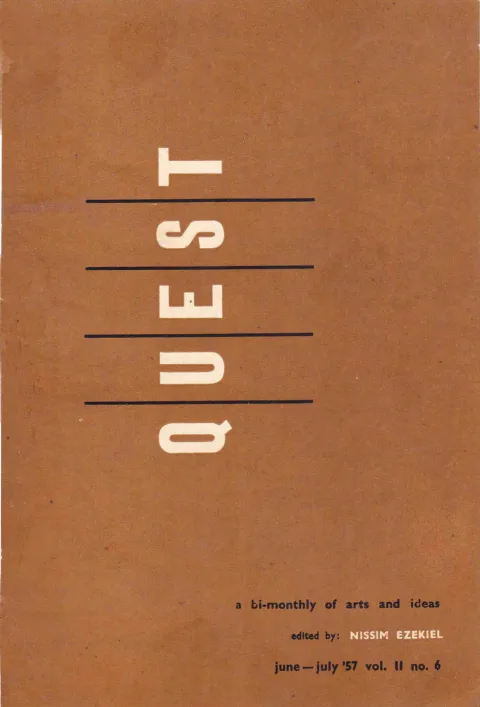
Quest
a bi-monthly of arts and ideas
By Nirad C. Chaudhuri, Swami Agehananda Bharati, D. D. Karve, Ithuriel, John Clement, Ranjani Rao, Monika Varma, Vyankatesh Madgulkar, Mahadeoshastri Joshi, R. B. Joshi, D. G. Nadkarni, Charles Higham, Laeeq Futehally, Prabhakar Padhye, Mangesh Padki
QUEST is published once every two months in August, October, December, February, April and June, at Army & Navy Building, 148, Mahatma Gandhi Road, Bombay 1. Edited, printed and published by NISSIM EZEKIEL for the Indian Committee for Cultural Freedom, Army and Navy Building, 148, Mahatma Gandhi Road, Bombay 1. At the Karnatak Press, Podar Chambers, 109, Parsi Bazar Street, Fort, Bombay 1. · Bombay · 1957
80 pages
Quest
Summary
This June-July 1957 issue of Quest (Vol. II, No. 6), the Bombay bi-monthly of arts and ideas sponsored by the Indian Committee for Cultural Freedom and edited by Nissim Ezekiel, is organised around a single editorial concern — the proper limits of State patronage of art, literature and opinion in Nehru-era India — which its unsigned lead editorial states explicitly and which two of its feature articles (Nirad C. Chaudhuri’s ‘India’s Kulturkampf’ and D. D. Karve’s piece on academic freedom) are framed as directly answering. Around that spine the issue carries a report on the second general elections by ‘Ithuriel’, reportage on Japan by Swami Agehananda, two pieces of translated Marathi short fiction, three poems, reports from two writers’ conferences (Allahabad and the Marathi Sahitya Sammelan), a photo-essay on the Khajuraho temples and another on polling day tinted with photographs from the Films Division, notes on Australian culture and on a children’s-art exhibition, eight book reviews, and two correspondence letters. Taken together the issue reflects the Congress for Cultural Freedom milieu’s characteristic double concern in this period: intellectual and artistic freedom from state control at home, and an anti-Communist framing of world affairs abroad (most visible in the review of Tibor Mende’s Conversations with Mr. Nehru).
Essays
India’s Kulturkampf
By Nirad C. Chaudhuri
Nirad C. Chaudhuri’s lead essay argues that New Delhi’s claim to a post-independence cultural renaissance is largely spurious. He distinguishes a deep-seated but regional traditional Hindu culture from a thin, English-medium, pan-Indian culture manufactured to hold the country together politically; only the latter is available for the Central Government to patronise, which makes its patronage inherently artificial and increasingly answerable to foreign (Western) taste rather than to any living Indian standard. He predicts a slow-burning ‘Kulturkampf’ between this state-sponsored, Westernised culture and the passive but ultimately more durable force of traditional regional Hinduism, and closes by regretting that those who still hold a liberal, humanistic culture lack the courage to resist the drift into ‘an orthodox oligarchy.’
- New Delhi’s cultural claim rests on a handful of imported events (exhibitions, akademi functions) rather than any native cultural vitality.
- Chaudhuri distinguishes deep regional ‘anthropological’ Hindu culture from a shallow, English-medium pan-Indian culture that only the Centre can patronise.
- Central patronage is politically motivated and, lacking any real all-India culture to judge itself by, defers increasingly to foreign/Western taste.
- He predicts a latent ‘Kulturkampf’ between Westernised centralising culture and regional traditionalism, which he expects traditionalism to eventually win by attrition.
- Traditional Hinduism’s own freedoms are not hospitable to originality or creativity, so its victory will not necessarily restore liberal cultural life.
The Changing Face of Japan
By Swami Agehananda
Swami Agehananda offers impressionistic reportage on Japan’s cultural mood in the mid-1950s: the near-mystical finality of the apology-word ‘sumimasen’; the Buddhist substratum beneath Japanese behaviour, traced back through Chinese transmission to an Indian origin most Japanese Indologists insist is un-Indian in practice; the geisha as a nearly extinct institution of refined art rather than the prostitute of Western caricature; the incongruous coexistence, without felt contradiction, of Monteverdi and rock ‘n’ roll in a Ginza coffee-house; and the fashionable pull of existentialism and, less seriously, communism among college students. The piece ends on an anecdote about a Japanese naval officer’s proverb on the ideal cross-cultural marriage of American house, Chinese cook and Japanese wife.
- ‘Sumimasen’ functions as an absolute conversational full-stop in Japanese social life, unlike any Western apology-word.
- Japanese Buddhism is Chinese in transmission though its founders trace it to an Indian origin barely recognised by Japanese Buddhists themselves.
- The geisha survives as serious art only around Kansai (Kobe/Osaka/Kyoto) and has no real link to Yoshiwara-style prostitution.
- Western classical and popular music genres are consumed side by side in Japan without the sense of contradiction a Westerner would feel.
- Existentialism is fashionable in Japanese academies; flirtation with ‘the Big Left’ is common among students but not deeply held.
Academic Freedom and Self-Government in the Indian Universities
By D. D. Karve
D. D. Karve, Principal of Fergusson College, Poona, argues for university self-government against Government and lay interference, while insisting this cannot mean total academic autonomy without conditions: the profession itself, he says, has failed to raise admission standards because the ‘non-academic side’ resists it, and low secondary-school marks are treated as sufficient for university entry across Indian universities. He wants Syndicates and Executive Councils freed from outside political control but paired with adequate government financing, so that colleges are not forced to over-admit for revenue and teachers are paid enough to attract talent — freedom from interference, in his argument, has to be earned by financial independence, not simply asserted.
- Karve supports academic self-government but blames the academic profession itself, not only Government, for low admission standards.
- Every student completing the minimum secondary mark is currently deemed fit for university admission across India.
- University governance sits with Syndicates/Executive Councils that mix academic and lay/public representation.
- He conditions freedom from outside interference on adequate government financial support, so colleges are not driven to over-admit for fees.
- Adequate teacher salaries are presented as a precondition for attracting talent into university teaching.
The Elections and After
By Ithuriel
Writing under the pseudonym ‘Ithuriel’, a QUEST political commentator surveys India’s second general elections. Congress was ‘reprieved, not returned to power’ in his framing: it lost badly in Kerala (where Communists took office, and even cited John Stuart Mill in defence of releasing prisoners), suffered reverses in Maharashtra, Gujarat, Orissa and the Bhakra-Nangal project area, and was damaged by its own mishandling of the bilingual-Bombay-state question. The essay is sceptical of all the alternatives — the Praja Socialists are leaderless, Jayaprakash Narayan’s turn away from party politics is well-meaning but impractical, and the Communists’ gains, while real, should be neither panicked over nor appeased. Its deeper argument is that democratic freedoms exist on paper but are exercised less than under British rule, and that this passivity, not any single party’s fortunes, is India’s real second-election warning.
- Congress was ‘reprieved’ rather than strengthened; its worst reverses came in Kerala, Maharashtra, Gujarat, Orissa and the Bhakra-Nangal area.
- Kerala’s Communist ministry cited John Stuart Mill in justifying the release of prisoners — a fact the author finds strikingly ironic.
- The mishandling of the bilingual Bombay State question alienated both Maharashtrians and Gujaratis and cost Congress dearly.
- Jayaprakash Narayan’s proposed withdrawal from party politics is judged well-intentioned but naive about how political change actually happens.
- The essay’s real warning is that Indians exercise their constitutional freedoms less vigilantly now than under British rule.
Otranto Blue
By John Clement
A short satirical poem in which an advertising copywriter invents a fanciful car-paint colour, ‘Otranto Blue’, calculated to flatter customers’ half-informed nostalgia for evocative Mediterranean place-names; the speaker notes wryly that reading the (car) instruction booklet has genuinely conjured Otranto’s colours in his own mind, despite — or because of — the cynicism of the marketing exercise that put the name there.
- The poem stages an advertising pitch-meeting inventing a nostalgic, meaningless colour name for a car.
- It satirises consumer marketing’s manufacture of borrowed, half-known exoticism.
- The final turn concedes the manufactured name still succeeds in evoking real imagery in the speaker’s mind.
The Vagabond
By Ranjani Rao
A brief lyric portrait of a street child seen sitting cross-legged on a pavement, contrasting the speaker’s sorrowful, distanced sympathy with the child’s own ‘fierce ease’ and self-possession; the poem closes admitting the speaker cannot share or fully understand the peace the child seems to possess.
- The poem observes a homeless or street child with a mixture of pity and admiration.
- It contrasts adult sentimental sorrow with the child’s own apparent contentment.
- The final lines admit the speaker’s inability to access the child’s inner peace.
Scent of Light
By Monika Verma
A short devotional-toned lyric using sunlight and perfume as a repeated figure for spiritual clarity: flowers, birds and dust are all said to ‘carry the scent of light,’ and the poem closes urging that people mired in ‘grovelling darkness’ of private thought might likewise let their words carry that same light.
- The poem builds a refrain (‘carry the scent of light’) across stanzas moving from flowers to birds to human beings.
- It frames spiritual or moral clarity as a kind of perfume detectable in those who possess it.
- The final stanza turns the image into an ethical appeal for honest, luminous speech.
The Other Woman
By V. Madgulkar
A chapter from Vyankatesh Madgulkar’s novel Bangarwadi (translated from the Marathi by S. D. Deshmukh), continuing a story previously excerpted in QUEST’s Marathi Literature Special Issue. The village schoolteacher-narrator is visited by Sheku’s wife, who tearfully confesses that her husband has taken up with a much younger girl, Anja, and wants to marry her because his wife has borne him no child; the narrator can offer only sympathy, not a solution. In a following scene Anja herself is seduced away by an itinerant shepherd during a chance encounter in the fields, abandoning Sheku entirely — after which Sheku’s estranged wife returns to the narrator, delighted, with the news that her wayward husband has come back to her.
- Sheku’s childless wife confides in the narrator that her husband wants to marry a much younger woman, Anja, in hope of an heir.
- The narrator is sympathetic but powerless to intervene in what he recognises as a private, socially delicate matter.
- Anja is later drawn away from Sheku by a visiting shepherd who camps near Sheku’s field, and leaves with him.
- The story closes with Sheku’s original wife returning to the narrator overjoyed that her husband has come back to her.
The Fugitive
By M. Joshi
Mahadeoshastri Joshi’s story (translated from the Marathi by M. D. Hatkanangalekar) opens on a sudden monsoon storm during which a drenched, frightened teenage girl takes shelter with the narrator’s family and begs to be hidden. Two men soon arrive looking for a girl matching her description; it emerges the girl is fleeing a forced marriage arrangement made by relatives who stood to profit from giving her away. The narrator and his wife shelter and feed her despite the risk and awkwardness of the situation, and the narrator is caught between the moral claim of protecting the girl and the practical threat of having to repay the money her relative would have gained from marrying her off.
- A violent monsoon storm drives a frightened, soaked teenage girl to the narrator’s house asking to be hidden.
- Two men from a neighbouring village arrive searching for a girl matching her exact description.
- It emerges she is fleeing a marriage her family arranged chiefly for the money it would bring them.
- The narrator’s household shelters and feeds her despite social awkwardness and financial risk to himself.
- The narrator is torn between moral obligation to the girl and the practical consequence of assuming her family’s forfeited bride-money.
The Writers’ Seminar and Conference at Allahabad
By R. B. Joshi
R. B. Joshi reports on the Writers’ Seminar and Conference convened by the Allahabad literary body Parimal in May 1957, framed explicitly as a response to the same state-patronage anxieties raised in the issue’s editorial: nominally autonomous government akademis are in practice Government-controlled in membership and prize committees, and this constrains writers’ freedom, especially those in Government service or All India Radio. Around sixty invited writers from across India (Bengali, Gujarati, Assamese, Kannada, Marathi, Hindi and Urdu literary figures among them) debated the writer’s relationship to State patronage, planning, publishing and welfare across four commissions, deliberately without passing any binding resolution, and reached a broad consensus that akademis should be reconstituted on a democratic basis independent of Government control, that the State should not publish contemporary creative work or textbooks, and that the writer’s vocation is properly an end in itself rather than an instrument of state or revolutionary purpose.
- The conference was organised by Parimal, a small group of young Allahabad writers, around a detailed questionnaire on writers and the State.
- About sixty writers from across India’s language communities attended discussions confined to invited members, keeping debate serious and focused.
- Four commissions covered the writer and State patronage, planning, publishing, and welfare, deliberately without passing formal resolutions.
- Consensus: akademis and prize committees should be reconstituted as genuinely independent of Government nomination and control.
- Consensus: the State should not publish contemporary creative work or textbooks, though it may fund classics, translations and scholarship.
- The majority view held creative writing to be an end in itself, not an instrument of social or political revolution.
The Marathi Sahitya Sammelan
By D. G. Nadkarni
D. G. Nadkarni’s wry report on the Marathi Sahitya Sammelan (literary conference), held that year in Aurangabad amid the politically charged backdrop of the Samyukta Maharashtra (united-Maharashtra) linguistic-state agitation, records how literary business was overtaken by political passion: Prof. Anant Kanekar’s presidential address on language and cultural identity drew both boos (for those urging a temperate line on the bilingual state) and cheers; a sharp public exchange between Kakasaheb Gadgil and historian Datto Waman Potdar was a highlight; and the Sammelan’s more purely literary business — an aesthetics symposium and a poets’ gathering — is described as comparatively tame and ‘foggy’. Nadkarni concludes the event was more a ‘jamboree’ shaped by election results than a serious literary occasion.
- The 1957 Sammelan moved to Aurangabad, in the newly-integrated Marathwada region, for the first time.
- Debate over the Samyukta Maharashtra (united-Maharashtra) linguistic state dominated the proceedings over literary matters.
- A public argument between Kakasaheb Gadgil and historian Datto Waman Potdar was among the conference’s most memorable moments.
- An aesthetics symposium and a poets’ gathering (Kavi Sammelan) are judged largely unsuccessful, apart from a strong performance by the poet Amar Shekh.
- Nadkarni frames the whole event as shaped more by election-year political emotion than by literary seriousness.
Letter from Australia
By Charles Higham
Charles Higham surveys Sydney’s cultural scene: the screening of Bresson’s Journal d’un cure de campagne and other classic films threatened by the destruction of irreplaceable prints, and the slow emergence of a National Film Archive; the controversial, dramatic design for the Sydney Opera House by Danish architect Jorn Utzon, whose funding and construction remain uncertain; and the growing achievement of the Elizabethan Theatre Trust under Hugh Hunt, including the premiere of Ray Lawler’s The Summer of the Seventeenth Doll, which Higham reads alongside Sidney Nolan’s painting and Patrick White’s fiction as evidence that Australian culture is coming into its own, provided the country now commits to preserving and funding it properly.
- Rare Australian and international film prints are being lost to fire, decay and neglect for want of a proper national archive.
- The proposed Sydney Opera House, designed by Jorn Utzon, is applauded as daring but its funding and construction remain in doubt.
- The Elizabethan Theatre Trust under Hugh Hunt is credited with building a serious national acting company from almost nothing.
- Ray Lawler’s The Summer of the Seventeenth Doll is presented as evidence of a maturing native Australian drama.
- Higham frames all of this as a fragile, hopeful moment in which Australia must choose to invest in its own cultural infrastructure.
A Visit to Khajuraho
By L. F.
Writing under the initials ‘L. F.’, the author describes a visit to the tenth-century Khajuraho temples, now a booming pilgrimage-cum-tourist site maintained by the Maharajas of Chatarpur. The essay dwells at length on the temples’ famously explicit erotic sculpture, arguing that reproduction in photographs (rather than the temple wall itself, where scale and distance soften the effect) risks a ‘pornographic lewdness’ the stone originals do not carry, and that the sculptor’s repeated erotic motifs are best read as a display of pure technical and artistic mastery rather than as religious instruction or moral allegory. The essay also notes the comparatively inferior, less ‘ubiquitous’ Jain temple group nearby and closes disapprovingly on a badly modernised restoration job using whitewash and bathroom tiles.
- Khajuraho has become a major pilgrimage/tourist draw, with government plans for an upgraded rest-house to meet demand.
- The temples’ explicit erotic sculpture is read as a display of the sculptor’s technical mastery, not primarily religious instruction.
- The author argues photographs of the sculptures feel more ‘pornographic’ than the stone originals seen at true scale and distance.
- The nearby Jain temple group is judged technically inferior, with less vitality than the main Shaivite temples.
- The essay ends criticising a modern whitewash-and-tile restoration of a damaged statue as an aesthetic disaster.
Children’s Art
By K. G. P.
‘K. G. P.’ reviews Shankar’s Weekly’s annual Children’s Art Exhibition, shown for the first time in Bombay. The essay traces a developmental arc in the children’s paintings on display — from small children’s confident, symmetrical human figures to older children’s more socially observant scenes of weddings, festivals and street life — and compares national styles impressionistically (Irish entries noted for visual rhythm in ordinary subjects, Soviet entries for an ‘ineffectual realism’ inherited from adult painters, Egyptian/Indonesian/Turkish entries for documentary vividness). It closes wondering, without much optimism, whether these children will keep their unselfconscious creative freshness once adult social pressures set in.
- The exhibition, organised annually by Shankar’s Weekly, appeared in Bombay for the first time this year.
- Younger children’s paintings favour bold, symmetrical human figures; older children’s work grows more socially observant.
- National styles are compared impressionistically: Irish entries for visual rhythm, Soviet entries for an inherited ‘ineffectual realism’, others for documentary vividness.
- An American child artist’s black-and-white abstraction-leaning drawings are singled out as unusually advanced.
- The essay closes doubting whether the children will retain their creative freshness once adult social conformity sets in.
Conversations with Mr. Nehru by Tibor Mende
By Prabhakar Padhye
Prabhakar Padhye reviews Tibor Mende’s Conversations with Mr. Nehru, praising Mende’s journalistic acuity over Norman Cousins’s earlier Nehru dialogues but sharply criticising Nehru’s own thinking as revealed in the book. Padhye’s central complaint is that Nehru claims the Communist and Socialist ideals ‘do not differ very much’ while also condemning communist methods, a contradiction Padhye traces to Nehru’s unresolved debt to Gandhian ends-means doctrine; he presses Nehru on why India continues ‘fraternising’ culturally with regimes whose coercive methods Nehru himself disavows, and faults Nehru’s foreign-policy arguments about America and colonialism as resting on selective, sometimes factually shaky claims. He credits Mende as an accomplished, sympathetic interviewer but regrets there is little real cross-questioning in the book.
- Padhye judges Mende’s book superior to Norman Cousins’s earlier Nehru interviews because of Mende’s greater regional knowledge.
- Nehru’s claim that Communist and Socialist ideals ‘do not differ very much’ is read as an unresolved ideological contradiction.
- Padhye ties this contradiction to Nehru’s application of Gandhian ends-means reasoning to questions it cannot really settle.
- He criticises Nehru’s continued cultural ‘fraternising’ with regimes whose coercive methods Nehru himself says he dislikes.
- He faults Nehru’s arguments about American aid motives and ‘new colonialism’ as selectively stated and under-examined.
- Mende himself is praised as skilled and sympathetic but criticised for not cross-questioning Nehru more searchingly.
Religious Freedom by J. R. Chandran and M. M. Thomas
By S. Natarajan
S. Natarajan reviews Religious Freedom, a symposium edited by J. R. Chandran and M. M. Thomas, noting that five of its eight contributors argue chiefly for a right to religious conversion, fearing that restricting conversion would let ‘Hindu dominance’ fill the space vacated by secularism. Natarajan finds P. M. Sapru’s constitutional-law analysis of religious freedom the most useful but faults it for missing that the Indian Constitution actually makes the secular state an ethical one, subordinating religious claims to public order, morality and health. His own argument distinguishes secularism (protecting the individual against social/religious tyranny) from mere religious neutrality, and criticises the symposium’s contributors, apart from P. Chenchiah, for never examining what ‘conversion’ itself substantively means, especially where it is pursued for material gain in a welfare state.
- Five of the symposium’s eight essays argue mainly for an unrestricted right to religious conversion.
- Natarajan credits P. M. Sapru’s legal analysis but argues Sapru misses that the Constitution’s secularism is itself an ethical, not neutral, stance.
- He distinguishes true secularism (protecting the individual from religious/social tyranny) from mere religious neutrality.
- Only P. Chenchiah, among the contributors, seriously examines what religious conversion itself means.
- Natarajan criticises conversion pursued for material gain as incompatible with a welfare state’s ideals.
Development for Free Asia by Maurice Zinkin
By D. K.
‘D. K.’ reviews Maurice Zinkin’s Development for Free Asia as an unusually readable, jargon-free account of Asian economic development, praising its wide-ranging social and historical observations (especially a concise four-page treatment of land reform) and its author’s evident affection for the region after nearly twenty years living in India, while noting the book is weaker on purely technical economic questions such as profits and hoarding, where its customary clarity slides into over-simplification.
- The reviewer praises Zinkin’s avoidance of the jargon-heavy ‘models and propensities’ typical of development economics writing.
- The book’s social and historical observations, including a compact treatment of land reform, are singled out as its strongest sections.
- Zinkin’s long residence in India (nearly twenty years) is credited for the book’s particular attentiveness to Indian conditions.
- The chapters on profits, hoarding and development criteria are judged the book’s weakest, prone to over-simplification.
Indian Village by S. C. Dube
By V. K. Bawa
V. K. Bawa reviews S. C. Dube’s Indian Village, a study of Shamirpet village in Telangana near Hyderabad, treating it as a genuine departure in the literature on Indian rural life. The review’s surviving portion focuses on Dube’s account of continuity and change: despite the spread of Communist politics and secular materialism into village life, Dube finds no fundamental change in the villager’s underlying worldview, which still orients itself toward ‘peaceful adjustment and adaptation to the laws that control the universe’ — a claim Bawa says Dube does not fully reconcile with the very evidence of change he presents.
- Dube’s Indian Village studies Shamirpet, a village in Telangana near Hyderabad, and is presented as breaking new ground in village studies.
- Dube argues the villager’s underlying spiritual/cosmological worldview persists despite growing secularism and Communist politics.
- Bawa notes a tension Dube does not resolve between claims of persisting tradition and the book’s own evidence of change.
- The review invites readers to draw their own conclusions by the book’s final chapter.
The Meaning of the Dead Sea Scrolls by A. Powell Davies
By M. K. Haldar
M. K. Haldar reviews A. Powell Davies’s The Meaning of the Dead Sea Scrolls, summarising how the 1947 Qumran discoveries revealed that many core Christian ideas and terms (including ‘Christ’ itself, originally a generic title, ‘the Anointed’) predate Jesus and derive from the Essenic sect of Judaism. Haldar reports Davies’s argument that Jesus likely knew of, and possibly lived among, the Essenes, and that Christianity is best understood as one branch of Judaism’s Messianic development rather than a wholly unique revelation — a conclusion Haldar says the clergy have resisted more from dogmatic reflex than honest engagement with the evidence, prompting his own closing question about whether dogma is in fact essential to religion at all.
- The 1947 Qumran discoveries are traced from their accidental find by Bedouin shepherds to their eventual scholarly recognition.
- Davies argues ‘Christ’ was originally a generic Essenic/Messianic title, not a name unique to Jesus.
- Jesus is argued to have likely known of, or even lived among, the Essenes.
- Christianity is presented as a development within Judaism’s Messianic tradition rather than a wholly separate revelation.
- Haldar closes by questioning whether dogma is truly essential to religious faith, given the clergy’s defensive reaction to the Scrolls.
The Outsider by Colin Wilson
By A. B. Shah
A. B. Shah reviews Colin Wilson’s The Outsider with respectful but firm dissent from its acclaim. He credits Wilson’s rare psychological insight into the alienated ‘Outsider’ figure (as exemplified by Van Gogh, T. E. Lawrence, Nijinsky, and treated through Kierkegaard, Nietzsche, Dostoevsky and religious mystics) but argues Wilson never grounds the Outsider’s problem in its social and historical context, and notes that none of Wilson’s Outsiders is a woman or a scientist — figures Shah says the Outsider instinctively treats as threats precisely because their creativity is socially and emotionally integrated rather than alienated.
- Shah credits Wilson with genuine psychological insight into the figure of the alienated ‘Outsider’.
- Wilson’s Outsiders include Van Gogh, T. E. Lawrence and Nijinsky in life, and Kierkegaard, Nietzsche, Dostoevsky and religious mystics in thought.
- Shah’s central criticism is that Wilson never situates the Outsider’s problem within its social and historical context.
- He notes that none of Wilson’s chosen Outsiders is a woman or a natural/social scientist, which he reads as revealing about Wilson’s argument.
- Wilson’s proposed religious ‘solution’ to the Outsider’s problem is compared unfavourably to euthanasia as a cure for cancer.
Confessions of Felix Krull, Confidence Man by Thomas Mann
By R. C.
‘R. C.’ reviews Thomas Mann’s Confessions of Felix Krull, Confidence Man, admitting disappointment despite Mann’s evident narrative gifts. The reviewer rejects the claim (attributed to Professor Erich Heller) that the novel is the great comic novel German literature has long lacked, arguing its scope is too narrow, its supporting characters mere sketches, and its comic register too melancholy to sustain the label; nonetheless the review closes crediting Mann’s prose, even below his best, with genuine power to unsettle complacency and open new avenues of reflection.
- The reviewer disputes Erich Heller’s claim that Felix Krull is the great comic novel German literature had lacked.
- Krull himself is judged a convincing, vital creation, but the surrounding characters are seen as thin, transient sketches.
- The novel’s episodic three-part structure (childhood, hotel service, Portuguese adventures) is described as insufficiently unified.
- Mann’s characteristic melancholy is said to undercut any genuinely comic register.
- Despite these criticisms, the review closes crediting Mann’s prose with real power to disturb the reader’s complacency.
Baby Doll by Tennessee Williams
By Lola Chatterji
Lola Chatterji reviews Tennessee Williams’s Baby Doll, the published script (with its two source one-act plays) of the Elia Kazan film, describing the plot’s melodramatic love triangle between an ageing cotton-gin owner, his young unconsummated wife, and a rival businessman who seduces her after exposing her husband’s arson. Chatterji finds the source plays thin, the film’s characters lacking real dignity, and the whole treated as an ironic, distinctly American parable of the ‘survival of the fittest’ dressed up in Southern local colour, worth studying chiefly as a case study in adapting minor stage material into an effective full-length script.
- Baby Doll is the published film script plus its two source one-act plays, offered as a case study in dramatic adaptation.
- The plot centres on an ageing cotton-gin owner, his young unconsummated wife, and the rival who seduces her after exposing his arson.
- Chatterji judges the underlying one-act plays ‘rather trivial’ compared to the finished film script.
- The characters are found to lack dignity, which she says pushes the film toward abstraction rather than sympathy.
- She reads the story as an ironic American parable of the ‘survival of the fittest’ set against Southern local colour.
The Asian Writers’ Conference
By Prabhakar Padhye
Prabhakar Padhye writes to correct a QUEST report on the Asian Writers’ Conference by V. Anant, insisting that he and S. H. Vatsyayan were in fact deeply concerned with fundamental issues (agenda-setting and Asian representation) rather than merely ‘regional and linguistic representation’ as the report implied, and rejecting the reporter’s characterisation of their role as keeping the conference ‘politically neutral’ as itself a communist-inflected misreading of what ‘fundamentals’ means.
- Padhye disputes V. Anant’s earlier QUEST report that he and S. H. Vatsyayan were preoccupied only with regional/linguistic representation.
- He says he raised fundamental agenda and Asian-representation issues, including inviting writers like Lin Yutang and Chien Mu, which were turned down.
- He objects to being characterised as having sought to keep the conference ‘politically neutral’, calling this a communist-style misunderstanding of the term ‘fundamentals’.
QUEST Marathi Lit. Issue
By Mangesh Padki
Mangesh Padki, a contributor to QUEST’s earlier Marathi Literature Special Issue, writes to say the editor’s closing remark (that the special issue represented a period ‘actually closing’) implies QUEST should follow up with a further special issue capturing the more experimental, emotionally unsettled writing of the younger generation now emerging.
- Padki responds to an editorial comment that the Marathi Literature Special Issue captured a closing literary period.
- He argues QUEST should commission a further special issue on the newer, more experimental Marathi writing now emerging.
Essay 25
An unsigned editorial (not listed on the printed contents page) argues that State patronage of art and literature in India, however well-intentioned, compromises artists’ integrity because government bodies inevitably impose an ideological frame and reward political safety over merit. It criticises the composition of prize committees (dominated by officials and, it says pointedly, their wives), the political vetting of All India Radio employees (illustrated by a Bombay USIS seminar that AIR staff were barred from attending as delegates), and prohibition and film censorship as further instances of the State remaking cultural and moral life in its own image. It closes framing this issue’s articles on academic freedom and the elections as direct responses to the danger of a slide from parliamentary democracy into what it calls an ‘orthodox oligarchy’.
- The editorial argues that any direct State patronage of art creates an unavoidable feeling of ideological obligation in the artist.
- Prize and award committees are criticised for being dominated by government officials (and, the editorial says, their wives) rather than independent authorities.
- All India Radio employees are described as politically vetted and barred from attending independent seminars as delegates.
- Prohibition and film censorship are cited as further examples of the State reshaping India’s moral and cultural life.
- The editorial explicitly frames two of the issue’s own articles as direct responses to this problem of state cultural control.
Essay 26
An unsigned boxed notice (not on the printed contents page) reports the result of QUEST’s Short Story Competition for Indian Writers, run for the Congress for Cultural Freedom, Paris: of nearly ninety entries, the judging panel (Nirad C. Chaudhuri, Sudhin Datta and Nissim Ezekiel; R. K. Narayan was invited but unable to attend) found no single winner and instead split the roughly Rs. 1,350 prize 3:2 between S. J. Joshi’s ‘The Devil’ (translated from Marathi by Mangesh Padki) and M. S. Kalyanasundaram’s ‘The Message’ (translated by the author from Tamil), with both stories and biographical notes promised for the next issue.
- QUEST’s Short Story Competition, run for the Congress for Cultural Freedom, Paris, drew nearly ninety entries.
- The judging panel of Chaudhuri, Datta and Ezekiel found no single story merited the full prize.
- The roughly Rs. 1,350 prize was split 3:2 between S. J. Joshi’s ‘The Devil’ and M. S. Kalyanasundaram’s ‘The Message’.
- R. K. Narayan had been invited to judge but could not attend, being abroad.
Essay 27
A three-page, uncaptioned-folio photo essay (absent from the printed contents page) titled ‘The Temple Sculpture of Khajuraho’, presenting large black-and-white photographs of the temples’ figural friezes and erotic carvings under short editorial captions (‘The erotic … tempered by an aesthetic faith’; ‘Friezes celebrating the human ways of gods and goddesses’). The plates are inserted immediately after ‘Children’s Art’ and before the Allahabad conference report, and their insertion without pagination is the point in the issue where the printed-folio offset shifts from -2 to -6.
- The plates are a standalone photo essay on the Khajuraho temple sculptures, distinct from the earlier prose article ‘A Visit to Khajuraho’.
- No photographer or source credit is printed for these images, unlike the election photo-essay that follows them.
- The captions frame the temples’ erotic carving as tempered by ‘an aesthetic faith’ rather than treated salaciously.
- These three unnumbered pages are the structural cause of the issue’s printed-folio offset changing partway through.
Essay 28
A one-page, uncaptioned-folio photo essay (absent from the printed contents page) titled ‘India Goes to the Polls’, crediting its images to the Films Division and explicitly cross-referencing Ithuriel’s election article (‘Ithuriel reviews the elections on page 43 of this issue’). It shows a tribal woman from Ranchi voting and Rajasthani men travelling by camel to a desert polling tent, visually illustrating the scale and reach of the second general elections discussed in the prose article.
- The plate explicitly cross-references ‘The Elections and After’ by Ithuriel, functioning as its visual companion.
- Photographs are credited to the government’s Films Division rather than to a named photographer.
- Images depict a tribal woman from Ranchi voting and Rajasthani voters travelling by camel to a desert polling tent.
- Like the Khajuraho plates, this page carries no printed folio and falls within the unnumbered four-page block that shifts the issue’s offset.
Essay 29
A ‘contributors to this issue’ page (absent from the printed contents page) gives short biographical notes for six of the issue’s contributors: Nirad C. Chaudhuri (advisory editor and author of The Autobiography of an Unknown Indian), D. D. Karve (Principal, Fergusson College, Poona), Vyankatesh Madgulkar (All India Radio, Poona; his novel Bangarwadi being translated into Japanese), ‘Ithuriel’ (identified only as ‘the pseudonym of a famous journalist’), Mahadeoshastri Joshi (Marathi short-story writer researching ancient Indian culture in Poona), and M. D. Hatkanangalekar (Lecturer in English, Willingdon College, Sangli). The great majority of the issue’s other bylined contributors receive no note here.
- Only six of the issue’s roughly two dozen bylined contributors receive a printed biographical note.
- The note confirms ‘Ithuriel’ is a pseudonym without naming the journalist behind it.
- Madgulkar’s novel Bangarwadi is noted as being translated into Japanese, corroborating his standing as a significant Marathi novelist.
- Two contributors (Karve, Hatkanangalekar) are identified by academic post rather than by literary reputation.
Generated by the v1.5 extraction pipeline. Awaiting editorial review.
Metadata and summary are AI-extracted from the source PDF and reviewed for editorial accuracy. The original work is available via the Read PDF tab above (where present); paragraph-level citation inside the PDF is deferred to a future engagement.
People in this work
- Nirad C. Chaudhuriauthor
- Swami Agehananda Bharatiauthor
- D. D. Karveauthor
- Ithurielauthor
- John Clementauthor
- Ranjani Raoauthor
- Monika Varmaauthor
- Vyankatesh Madgulkarauthor
- Mahadeoshastri Joshiauthor
- R. B. Joshiauthor
- D. G. Nadkarniauthor
- Charles Highamauthor
- Laeeq Futehallyauthor
- Prabhakar Padhyeauthor
- Mangesh Padkiauthor
- Sudhin Datta
- S. D. Deshmukh
- M. D. Hatkanangalekar
- S. Natarajan
- V. K. Bawa
- M. K. Haldar
- A. B. Shah
- Lola Chatterji
- Sheela Singh
- John Stuart Mill
- Jayaprakash Narayan
- Jawaharlal Nehru
- Mahatma Gandhi