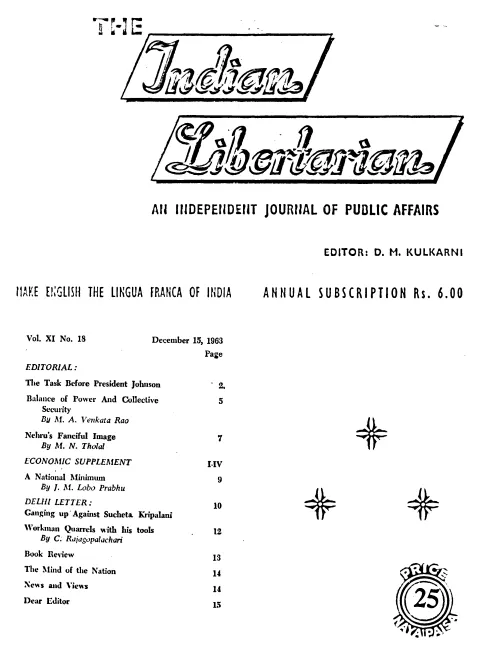
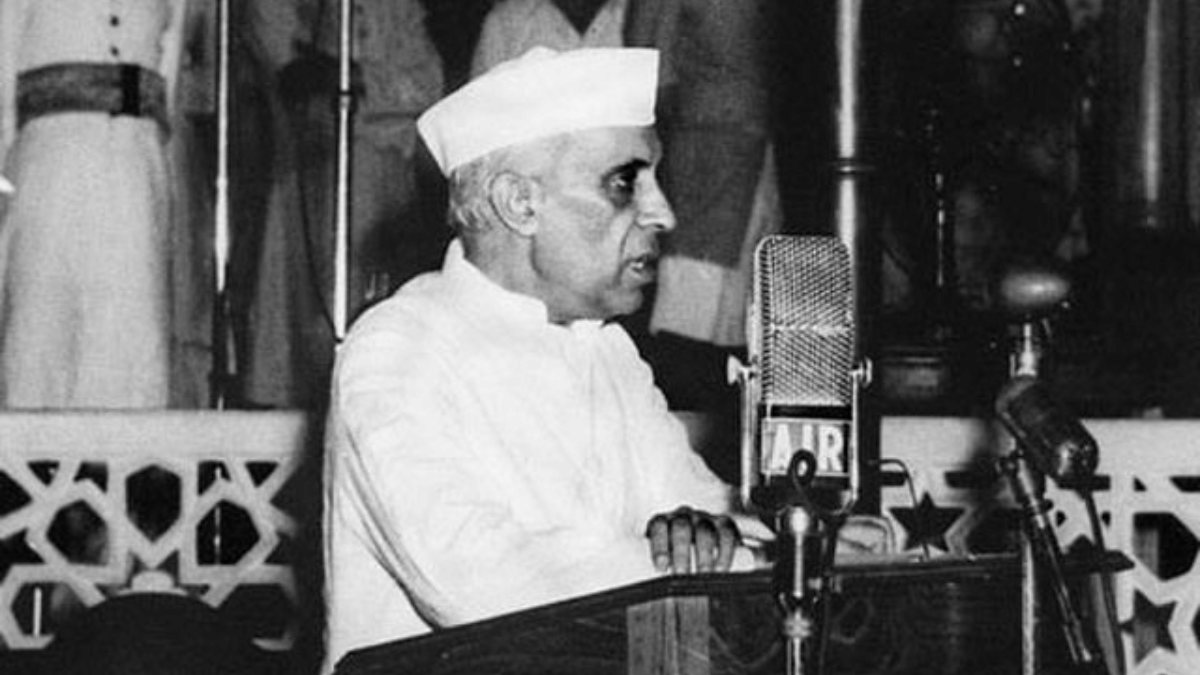
periodical issue
The Indian Libertarian
An Independent Journal of Public Affairs
By MA Venkata Rao, M. N. Tholal, G N Lawande, J. M. Lobo Prabhu
The Libertarian Publishers (Private) Ltd., First floor, Arya Bhuvan, Sandhurst Road West, Bombay 4 · Bombay · 1963
20 pages
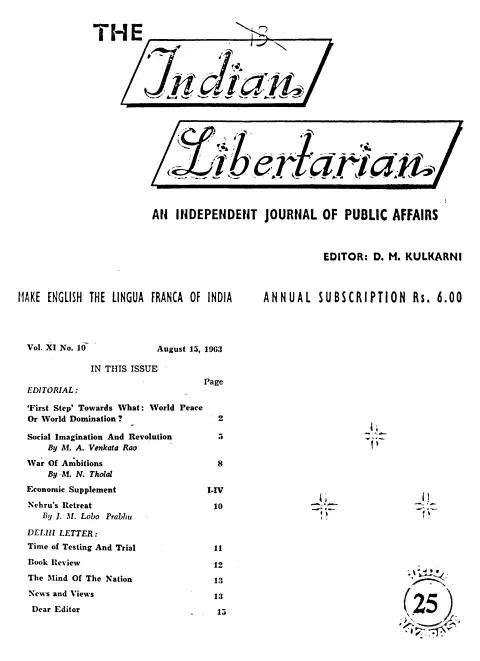
The Indian Libertarian
Summary
The August 15, 1963 issue (Vol. XI No. 10) of The Indian Libertarian, edited by D. M. Kulkarni and published from Bombay by Libertarian Publishers Pvt. Ltd., gathers an editorial, four signed essays, an Economic Supplement, a Delhi Letter, a book review, news round-ups and a reader letter. The argumentative centre is twofold: a sceptical reading of Cold War realignments in the wake of the Partial Nuclear Test-Ban Treaty, and a domestic critique of Nehruvian planning, Congress factionalism and rising prices. M. A. Venkata Rao argues that liberal humanism must reclaim social imagination from Marxist Utopias; M. N. Tholal dissects the U.P. Congress succession war; J. M. Lobo Prabhu reads the Kamaraj-Plan cabinet reshuffle as Nehru’s retreat; Prof. G. N. Lawande devotes the supplement to inflation and the common man, with a companion piece by Edna Shaker on U.S. paternalism over American Indians; a review of R. M. MacIver’s Conflict of Loyalties and a reader letter on holding politicians to account round out the issue.
Key points
-
The unsigned lead editorial reads the Moscow Partial Nuclear Test-Ban Treaty as consolidating Soviet-Anglo-American detente rather than advancing genuine disarmament, since it leaves underground and Chinese nuclear testing untouched.
-
M. A. Venkata Rao’s ‘Social Imagination and Revolution’ argues the Indian intelligentsia has surrendered its imagination to Marxist categories, reconstructing an alternative humanist lineage running through the Enlightenment and the French and American revolutions.
-
M. N. Tholal’s ‘War of Ambitions’ anatomises the fall of Uttar Pradesh Chief Minister C. B. Gupta and the manoeuvring of figures such as Kamlapati Tripathi as evidence the Kamaraj Plan reshuffled Congress players without reforming the party.
-
Prof. G. N. Lawande’s Economic Supplement traces the steady climb of consumer prices since the Second Plan to deficit financing, exchange controls and public-sector expansion rather than to crop failure.
-
Lawande argues wage and dearness-allowance adjustments merely ratify inflation rather than curing it, in a supplement paired with Edna Shaker’s piece on U.S. Bureau of Indian Affairs paternalism over reservation Indians.
-
J. M. Lobo Prabhu’s ‘Nehru’s Retreat’ reads the Kamaraj Plan cabinet reshuffle as a retreat forced on Nehru by the China defeat, the rupee crisis and Planning Commission failures.
-
The issue also carries a Delhi Letter, a book review of R. M. MacIver’s Conflict of Loyalties, and a reader letter on holding politicians accountable.
Essays
EDITORIAL: ‘First Step’ Towards What: World Peace Or World Domination?
The unsigned lead editorial reads the Moscow Partial Nuclear Test-Ban Treaty not as a step toward world peace but as a step toward Soviet-Anglo-American detente that may consolidate, rather than dismantle, the architecture of world domination. It argues that the treaty leaves the underground and Chinese nuclear options open, sidelines the non-aligned, and rewards Khrushchev’s coexistence line while exposing Mao’s harder posture. The editorial then turns to India, arguing that Nehru’s ‘non-aligned’ diplomacy has lost its purchase: with China hostile, Pakistan emboldened, and the Soviet line shifting, India is left without leverage, and the Planning Commission’s failures have eroded credibility at home.
- The Test-Ban Treaty is framed as a great-power condominium, not disarmament.
- Underground tests and the Chinese programme remain outside the treaty’s reach.
- Non-alignment has lost utility now that Moscow and Washington are seeking accommodation.
- Indian foreign policy is criticised for failing to anticipate the Sino-Soviet split’s consequences.
- Domestic credibility of the Nehru government is tied to Planning Commission failures.
Social Imagination And Revolution
By MA Venkata Rao
M. A. Venkata Rao argues that the Indian intelligentsia has surrendered its social imagination to Marxist categories and Utopian socialism, mistaking these for the only scientific road to progress. He reconstructs an alternative humanist lineage running through the eighteenth-century revolutions, the great religious traditions and post-war European thought, and presses for a ‘social imagination’ rooted in the dignity of the person rather than in class war. The essay closes with a plea to fellow-travellers to recognise that real revolution is the deepening of liberty and conscience, not the capture of the state, and warns that Nehruvian planning has reproduced the disabilities of doctrinaire collectivism.
- Marxist ‘science’ has captured the imagination of the Indian intelligentsia and crowded out liberal alternatives.
- A humanist conception of society draws from religion, the Enlightenment and the American and French revolutions.
- Genuine revolution is the expansion of liberty and personality, not collectivisation.
- Planning under Nehru reproduces, rather than escapes, the pathologies of state socialism.
- Fellow-travellers must be disabused of the equation of socialism with progress.
War Of Ambitions
By M. N. Tholal
M. N. Tholal anatomises the war of ambitions inside the Uttar Pradesh Congress, taking the fall of Chief Minister C. B. Gupta and the manoeuvring around his successor as a case study in the Congress system’s drift from politics to court intrigue. He reads the rise and fall of factional figures like Kamlapati Tripathi, Pandit Mohan Lal Gautam, Banarsi Das and others as evidence that the Kamaraj Plan has not cleansed the party but only re-shuffled the players. The essay treats U.P. as a microcosm of an exhausted ruling party whose ambitions have outgrown its programme.
- U.P. Congress politics has become a war of personal ambitions, not a contest of programmes.
- C. B. Gupta’s exit illustrates the limits of the Kamaraj Plan as a reform device.
- Faction leaders inside the State Congress are mapped as a court, not a cabinet.
- The article treats U.P. as a microcosm of Congress decay in 1963.
Economic Supplement
By G N Lawande
Prof. G. N. Lawande’s Economic Supplement reads the steady climb of consumer prices since the Second Plan as the inevitable cost of deficit financing, exchange controls and an over-extended public sector. He shows how monetary expansion, rather than crop failure, drives the price line for the common man, and warns that wage and dearness-allowance fixes only ratify the inflation they pretend to cushion. The supplement is paired with Edna Shaker’s piece ‘American Indians Under Control’, which uses U.S. Bureau of Indian Affairs paternalism over reservation Indians as a cautionary tale about what happens when governments substitute administrative tutelage for property rights and freedom of contract.
- Rising prices are tracked to deficit financing, not to harvest shortfalls.
- Exchange controls and public-sector expansion are diagnosed as structural sources of inflation.
- Wage and dearness-allowance adjustments are treated as ratifications, not remedies, of inflation.
- The Edna Shaker companion piece reads the U.S. Bureau of Indian Affairs as a parable about administrative tutelage.
- Both pieces argue that price stability and dignity depend on enforceable property rights.
Nehru’s Retreat
By J. M. Lobo Prabhu
J. M. Lobo Prabhu reads the Kamaraj-Plan cabinet reshuffle as Nehru’s retreat under the cumulative weight of the China defeat, the rupee crisis and Planning Commission failures. He argues that the new line-up – with Lal Bahadur Shastri, Gulzarilal Nanda and Indira Gandhi promoted while veterans depart – is less a renewal than a closing of ranks. The exit of Morarji Desai and the elevation of state-level loyalists are read as the Congress high command’s choice of survival over reform.
- The reshuffle is read as a defensive consolidation, not a programmatic renewal.
- Promotions of Shastri, Nanda and Indira Gandhi mark a generational pivot inside Congress.
- Morarji Desai’s exit removes the most prominent intra-party critic of fiscal indiscipline.
- The Kamaraj Plan is judged as a device for managing the centre, not for reforming state governments.
DELHI LETTER: Time of Testing And Trial
By (From Our Correspondent)
The Delhi Letter reports the capital’s mood after the cabinet reshuffle and on the eve of the Indo-American air exercise. The unsigned correspondent argues that the new arrangements have not stilled the unease about strategic drift, that Galbraith’s mediating role is being read as a sign of American patience wearing thin, and that the proposed MiG-21 deal with Moscow has been read in Washington as a hedge rather than a choice.
- Delhi is described as in a ‘time of testing and trial’ rather than of policy renewal.
- Galbraith’s diplomacy is read as a barometer of U.S. patience.
- The MiG-21 deal is treated as a strategic hedge that strains U.S.-India relations.
- The reshuffle has not displaced foreign-policy anxieties.
Book Review
The Book Review of R. M. MacIver’s Conflict of Loyalties (and the companion volume Religion and Civilisation) presents MacIver’s case that pluralist societies require citizens to hold multiple, sometimes incompatible, allegiances – to family, faith, class, nation and humanity – and that the liberal state is the institutional answer to that condition. The reviewer summarises MacIver’s distinction between loyalty to persons and loyalty to ideas, and treats the book as a useful corrective to the absolutist temptations of mid-century ideology.
- Pluralism, in MacIver’s account, is a fact of moral life before it is a political programme.
- The liberal state is recast as a framework for managing competing allegiances.
- Religion and ideology are placed on a continuum of loyalty rather than treated as opposites.
- The review reads the book as ammunition against mid-century absolutisms.
The Mind Of The Nation
‘The Mind of the Nation’ (anchored by the piece ‘Why Peking Smirks at the Proposed Indo-American Air Exercises?’) argues that Chinese propaganda has been quick to weaponise the planned Indo-American air exercises as proof that non-alignment is dead, and that India’s response has been clumsy. The column reads the episode as evidence that Indian opinion has not yet found a vocabulary for an explicitly Western-leaning posture, and is therefore vulnerable to both Chinese and Soviet framings.
- Peking has framed the air exercises as the burial of non-alignment.
- Indian official communication is judged as defensive rather than principled.
- The column argues that a clearer pro-Western posture would be less, not more, costly.
- Soviet diplomacy is reading the same exercises through its own propaganda lens.
News and Views
The News and Views section runs short items on U.S.-Soviet ideological incompatibility, mixed aid and Soviet pacts, South Korean operations, prisoners-of-war from China-Burma-Thailand, the West African Open Pledge debate, the ‘You Bow Over Nothing’ commentary on Y. Narasimhan of Express News Service, the Chinese destruction culture debate, the Communist Party as ‘source’ of Dange’s statement, and the question whether Indian nationalisation amounts to a Communist Party victory. The cumulative effect is a brief on the Communist world’s manoeuvres and on Indian fellow-travellers’ embarrassments.
- The section reads U.S.-Soviet ideological talk as fundamentally irreconcilable in 1963.
- Dange’s statement on the Sino-Indian border is traced back to its likely Communist source.
- Nationalisation of banks is discussed as a possible CPI gain dressed as policy.
- Short notices on China, Burma, Thailand and West Africa frame India’s foreign-policy environment.
Dear Editor
S. R. Narayana Iyer’s reader letter, ‘Exposing the Politicians’, argues that citizens cannot trust politicians to police themselves and proposes a programme of disclosure: total tax paid by each representative under the Emergency, contributions to Defence Funds by state, names of children and close relatives of politicians studying in English-medium schools while speaking publicly for vernacular education, and similar items. The letter frames disclosure as a ‘forceful corrective’ to the conduct of public life.
- Citizens are urged to organise locally to publish factual indictments of representatives.
- Three concrete disclosure demands are spelled out (taxes paid, Defence Fund contributions, schooling of relatives).
- Politicians are treated as agents who must be exposed by their principals, not reformed from within.
Generated by the v1.5 extraction pipeline. Awaiting editorial review.
Metadata and summary are AI-extracted from the source PDF and reviewed for editorial accuracy. The original work is available via the Read PDF tab above (where present); paragraph-level citation inside the PDF is deferred to a future engagement.