
periodical issue
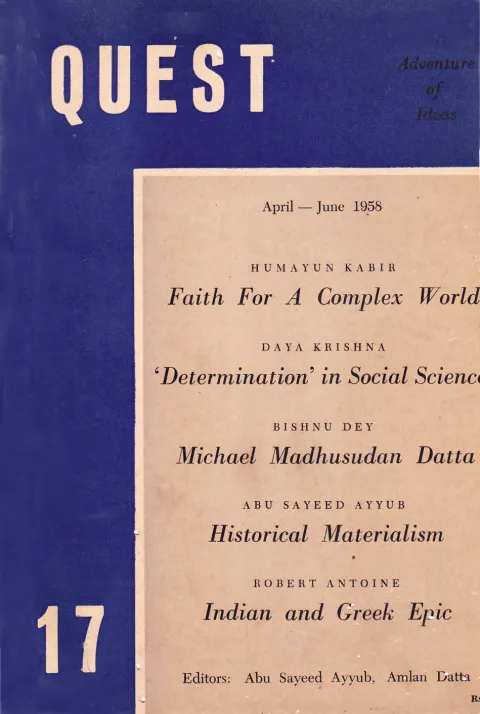
Quest
A Quarterly of Inquiry, Criticism, and Ideas
By Bishnu Dey, Daya Krishna, R. de Loyola Furtado, Abu Sayeed Ayyub, Robert Antoine, K. Raghavendra Rao, Humayun Kabir, Lila Ray, Shyamsvarup Jalota, Iqbal Ahmad, Martin S. Dworkin, Emily Polk, Prof. Amlan Datta, Ramaswamy R. Iyer, P. C. Chatterji
QUEST is published quarterly, at Army & Navy Building, 148, Mahatma Gandhi Road, Bombay 1 ... Printed and published by Miss Sheela Singh for the Indian Committee for Cultural Freedom ... at the Kanada Press, Poddar Chambers, 109, Parsi Bazar Street, Fort, Bombay 1. · Bombay · 1958
102 pages
Quest
Summary
Quest No. 17 (April-June 1958) is the transition issue in which the magazine converts from Nissim Ezekiel’s bimonthly ‘of arts and ideas’ into a quarterly ‘of inquiry, criticism, and constructive thought’ under new editors Abu Sayeed Ayyub and Amlan Datta, with an advisory board of Nirad C. Chaudhuri, Sudin Datta and Laxmanshastri Joshi. The unsigned editorial sets out the new charter: cultural questions treated on their own terms, politics only ‘by implication’, and an explicit commitment to cultural freedom as the sponsoring Indian Committee for Cultural Freedom’s central concern. The issue that follows is heavily literary and philosophical rather than economic: a critical reassessment of the 19th-century Bengali poet Michael Madhusudan Datta; a technical philosophy-of-science paper on the limits of sociological determinism; Ayyub’s own long critique of Marxist historical materialism; a comparative study of the Indian and Greek epics; Humayun Kabir’s essay on faith in the modern world; a paper on psychometric personality assessment; a practical essay on the failure of English-teaching methods in Indian universities; an American film critic’s essay on the state of film criticism; four poems; an unsigned geopolitical essay on race, Islam, Christianity and communism in Africa and Asia; four book reviews (poetry anthologies, a reportage book on Maoist China, a T. S. Eliot criticism collection, and Richard Hoggart’s The Uses of Literacy); two letters to the editor continuing earlier controversies; and a Contributors page with biographical notes. No fine-art plate, photograph, or illustration credited to an artist was found anywhere in the issue’s own editorial content — its only images are commercial advertisements (aviation, textiles, soap, cycles, throat lozenges) and one advertisement (Voltas air-conditioners) built around a mother-and-child photograph; this appears to be a genuine absence of the kind of uncredited art plate seen in sibling issues.
Essays
Editorial
The unsigned Editorial announces that, from this issue, Quest changes ‘from “a bimonthly of arts and ideas” to “a quarterly journal of inquiry, criticism and constructive thought”’. It commits the journal to treating politics only ‘by implication’ except on the one question where politics and culture meet directly for its sponsors: cultural freedom. The editors position Quest as an open forum intolerant only of ‘anti-reason’, invoke M. N. Roy’s warning about India’s ‘medievalist-authoritarian trend’ and Michael Polanyi’s argument that liberalism carried to its nihilistic extreme collapses into totalitarianism, and close by distinguishing the cultural struggle for freedom of thought from the separate (and, they say, no less real) struggle against physical and economic want.
- Announces the shift from Ezekiel’s bimonthly ‘of arts and ideas’ to a quarterly ‘of inquiry, criticism and constructive thought’ under new editorial personnel.
- Restates and refines Quest’s founding formula that its politics is dealt with only ‘by implication’, except regarding cultural freedom itself.
- Declares the journal an ‘open forum’ opposed only to ‘anti-reason’, not to any particular substantive view.
- Invokes M. N. Roy on India’s authoritarian cultural heritage and Michael Polanyi on the self-destructive extreme of Western liberalism as bracketing warnings.
- Distinguishes cultural/political unfreedom from the separate problem of physical and economic want, while insisting the former is the journal’s specific remit.
A Note on Michael Madhusudan Datta
By Bishnu Dey
Bishnu Dey’s essay reassesses Michael Madhusudan Datta (1824-73), the ‘Anglo-Indian’ Bengali poet who wrote plays and poetry in English before returning, decisively, to Bengali. Dey reads Madhusudan’s biography as a case study in the ‘split’ running through the whole Indo-Anglian generation: a man who mastered eight languages and lived by an imported European analogy, yet whose poetic power turned out to have its ‘submarine hold’ in Bengali all along. Extensive quotation from Madhusudan’s own letters (to Rajnarain Bose and others) is used to show his mystified sense of Bengali coming to him unbidden despite a self-confessedly weak vocabulary. The second half of the essay compares Madhusudan to Milton, Virgil and Dante via T. S. Eliot’s essays on Virgil, arguing that Eliot’s Eurocentric humanism cannot account for a poet who, in Dey’s Marxian framing, anticipates ‘the greatest prose epic of modern life, Das Kapital’. The essay closes by reading Madhusudan’s tragedy as symbolic of the false premises of Anglo-India, urging readers to ‘focus the history of our life right’ and complete India’s own cultural renaissance.
- Frames Michael Madhusudan Datta’s biography (Hindu College, conversion to Christianity, English writing, eventual return to Bengali) as a case study of the ‘split’ in the Indo-Anglian generation.
- Quotes Madhusudan’s letters to Rajnarain Bose describing Bengali words coming to him unbidden despite his admittedly thin vocabulary.
- Credits Vidyasagar, alone among Madhusudan’s generation, with having faced Europe without ‘violence to his inner being’.
- Uses T. S. Eliot’s lectures on Virgil to argue that European Christian-classical humanism excludes most of mankind, contrasting it with Marx’s Das Kapital as ‘the greatest prose epic of modern life’.
- Concludes that Madhusudan’s personal tragedy is symbolic of the false premises of Anglo-Indian history.
‘Determination’ in Social Sciences
By Daya Krishna
Daya Krishna’s paper argues against the loose sociological habit of saying that art, science, law and philosophy are ‘determined’ by economic or social conditions. Surveying Marxist, Hegelian (‘Geist’-based) and MacIver-style ‘dynamic assessment’ theories, he contends each supra-sociological field — physics, art, philosophy — possesses a relative autonomy that only shades, at the limit, into the autonomy of the individual thinker, who is ‘permitted’ rather than ‘determined’ by the frameworks he inherits. He proposes replacing the word ‘determination’ with ‘permitting’ wherever a wider realm is said to condition a narrower, embedded one, and closes by insisting there is no defensible half-way house between this position and full physical reductionism.
- Rejects the sociological claim that art, science and philosophy are simply ‘determined’ by economic/social conditions, preferring ‘relative autonomy’.
- Uses Kant’s philosophy (irreducible to Prussia’s politico-economic conditions) as a test case against social-determinist explanation.
- Surveys Hegelian Geist-based and MacIver’s ‘dynamic assessment’ alternatives to causal-social determinism.
- Locates the ‘ultimate locus of autonomy’ in the precarious, mortal individual — ‘permitted’ rather than ‘determined’ by his presupposed frameworks.
- Proposes replacing ‘determination’ with ‘permitting’ as the correct relation between an embedding and an embedded realm of phenomena.
Summer Day
By R. de Loyola Furtado
A short lyric poem, printed at the foot of the page immediately after Daya Krishna’s article, built around images of thirst, fire and a phoenix-like ‘firebird’ crying for release from the abyss into ‘the burning day’.
- A brief lyric using fire, thirst and phoenix imagery.
- Closes on an image of a caged bird waiting to fly free from slumber.
Historical Materialism
By Abu Sayeed Ayyub
Abu Sayeed Ayyub’s essay is a sustained critique of Marxist historical materialism, which he calls ‘much more than’ a theory of history — the thread running through nearly all of Marx and Engels’s thought. He rejects the common Marxist move (which he traces to a Hegelian legacy, quoting Stalin’s Dialectical and Historical Materialism at length) of deriving historical materialism as a mere corollary of dialectical materialism. Working through Engels’s letters, Mao’s ‘On Contradiction’, and critics from Sidney Hook to Karl Popper, Ayyub argues that cultural production (art, religion, philosophy, even physical science) has a genuine, if variable, autonomy from the economic base, an autonomy that should increase as societies become less materially constrained. A closing unsigned editorial note explains that this essay and Daya Krishna’s precede it as an unplanned but complementary ‘symposium’ on the same underlying question of determination.
- Argues historical materialism is the organizing thread of the entire Marxist system, more fundamental in practice than dialectical materialism.
- Traces the derivation of historical materialism from dialectical materialism to a Hegelian legacy, illustrated via a long quotation from Stalin’s Dialectical and Historical Materialism.
- Surveys Engels’s later letters (e.g. to Bloch) as evidence Engels himself resisted crude economic determinism.
- Uses Mao Tse-tung’s ‘On Contradiction’ as a contemporary instance of Marxist theorizing about causal primacy.
- Concludes that cultural production’s dependence on economic conditions should loosen as a society’s emancipated middle class grows, and that the degree of that loosening measures a society’s ‘civilisation’.
- An appended editorial note frames this essay and Daya Krishna’s as a de facto two-part symposium on the same problem, printed together though written independently.
Indian and Greek Epic
By Robert Antoine
Robert Antoine, a Jesuit Sanskritist, compares the Greek epics (Iliad, Odyssey) with the Mahabharata and Ramayana. Part I catalogues structural similarities of ‘heroic society’: aristocratic war fought over personal honour rather than nation, feats of strength winning brides, and heroes facing death with a mixture of fatalism and personal responsibility. Part II argues the two traditions diverge temperamentally: the Greek epic is ‘extrovert’ and ‘pure present’, its gods humanised and its heroes fully human even under divine influence; the Indian epic is ‘introvert’, its heroes progressively divinised until ‘the Indian gods are so prominent that they blur the human outlines of the heroes’. He locates the difference partly in composition — the Mahabharata’s vast digressive apparatus (the Santi-parva and Anusasana-parva alone comprising 22,000 verses of law, cosmogony and yoga) versus the Iliad’s tight focus on Achilles’s wrath — and partly in each culture’s differing relationship to death, the individual, and ultimate liberation.
- Warns against both ‘cultural syncretism’ (over-stressing similarity) and ‘cultural chauvinism’ (over-stressing difference) as biases in comparative epic study.
- Shows structural parallels: wars fought over personal/marital honour (Helen, Draupadi, Sita), feats of strength winning brides (Rama’s bow, Arjuna’s bow, Ulysses’s bow), and a shared ‘Middle Ages’ emergence of epic between two urban civilizations.
- Characterises the Greek Epic temperament as ‘extrovert’ — humanised gods, heroes who remain fully human, life as a gift to be enjoyed before death’s ‘great retirement’.
- Characterises the Indian Epic temperament as ‘introvert’ — gods so prominent they ‘blur the human outlines of the heroes’, life read as bondage from which one seeks liberation.
- Contrasts the Mahabharata’s vast digressive, para-by-para structure (quantified in verse counts) with the Iliad and Odyssey’s comparatively focused narrative economy.
Consolation in Words
By K. Raghavendra Rao
A short poem dedicated ‘For the Sekhars’ on solitude, mortality and the ‘unremembering’ of ordinary life against the vastness of night and the city of stars, closing on an image of humanity as ‘the lucky orphans of the dark’.
- Explores solitude and mortality through images of stars, night and the passage of time.
- Ends by defining humanity as a ‘mood’ of unconcerned nature — leaves, waters and blind birds.
Faith for a Complex World
By Humayun Kabir
Humayun Kabir argues that the modern age is uniquely, objectively critical: scientific and communications advances have unified the world while producing terrible weapons and a global weakening of traditional faith, since exposure to competing belief systems corrodes inherited certainties. The resulting spiritual discomfort is worsened by a widening gap between rising expectations and actual achievement. Since a revival of old, revelation-based faith is no longer intellectually credible, Kabir calls for a new faith grounded in rationality, toleration of divergent views, and ‘imaginative identification’ with other human beings through compassion — arguing that intellectual acceptance of human unity is not enough on its own to prevent parochial loyalties from winning out in moments of crisis.
- The modern age is ‘objectively’ more critical than earlier ones because science has unified the world’s fate while multiplying its destructive capacity.
- Improved communication has weakened inherited religious/social faith by exposing every belief system to comparison with rival ones.
- A widening gap between rising individual expectations and actual social/economic achievement compounds spiritual discomfort.
- Faith can no longer rest on revelation or mystery; it must be rational, universal, and grounded in the dignity of the individual.
- Argues rationality and toleration are necessary but insufficient — only ‘imaginative identification’ through compassion can override parochial or national loyalty in a crisis.
Desert Indemnity
By Lila Ray
A short poem of desert imagery — dunes, palms, a copper sun, a moon rising over ‘the arid waste of earth’ — ending on stars burgeoning like grain in ‘the fertile fields of heaven’.
- Desert landscape imagery (dunes, palms, heat) building to a nightfall scene.
- Closes by contrasting the earth’s aridity with a ‘fertile’ sky of stars.
Personality Assessment
By Shyamsvarup Jalota
Shyamsvarup Jalota surveys techniques for the scientific assessment of personality, from bodily-type theories and endocrine explanations through questionnaire-based trait psychology (notably Raymond Cattell’s 16 Personality Factor Test) to projective techniques like ink-blot interpretation. He reports his own Banaras University group’s project to prepare a Hindi version of the 16PF test (undertaken with Cattell’s encouragement) and gives comparative data suggesting Indian and American college students score similarly on most of Cattell’s sixteen factors, with a few notable divergences. He closes by cataloguing the practical problem of biased self-report answers (illustrated by a police-recruit survey where respondents implausibly claimed to prefer art galleries over card games) and the ‘lie-score’ techniques devised to detect them.
- Surveys the history of personality-assessment technique: bodily-type and endocrine theories, then statistically-derived trait questionnaires.
- Describes Raymond B. Cattell’s factor-analytic ‘16 Personality Factor Test’ as the most rigorous contemporary instrument.
- Reports the author’s own Banaras University project, undertaken at Cattell’s suggestion, to prepare a Hindi version of the 16PF test.
- Gives comparative data: Banaras college students differ from American norms on only 3-4 of Cattell’s 16 factors.
- Discusses projective techniques (ink-blots, ambiguous pictures) and the practical problem of socially-desirable, biased questionnaire answers.
The Problem of Teaching English
By Iqbal Ahmad
Iqbal Ahmad, an English lecturer at Allahabad, argues that Indian universities are teaching English badly: undergraduates arrive having read almost nothing in English and are nonetheless set Shakespeare and Wordsworth, acquiring only ‘distaste and dislike’. He describes his own failed experiment of assigning slow, careful reading of simple modern novels (Wells, Pearl Buck, Maugham, Forster) in tutorials, and concludes the real fix must start much earlier, with oral-aural instruction for young children, which India’s poverty makes currently impractical. His concrete proposal is that the central government pay eminent English authors handsomely — ‘a lakh of rupees per book’ — to write culturally-attuned English textbooks for Indian schoolchildren, arguing this would be a sound investment repaid within a year through nationwide adoption.
- Argues English remains indispensable for at least the next 50 years and is not merely a colonial ‘hangover’.
- Diagnoses the core teaching problem: students with almost no prior English reading are set canonical literature (Shakespeare, Wordsworth, Shelley) they cannot digest.
- Describes an unsuccessful personal experiment assigning slow, deliberate reading of simple 20th-century novels in tutorial classes.
- Argues the ideal fix — oral-aural instruction from early childhood — is currently impractical in a poor country lacking trained teachers and equipment.
- Proposes paying eminent English authors a lakh of rupees per book to write new, India-attuned school textbooks, calling it a sound government investment.
The Critical Conditions of the Movies
By Martin S. Dworkin
American film critic Martin S. Dworkin argues that serious film criticism matters precisely because most films are mediocre by economic necessity, and that great films depend on an industry that also produces routine ‘programmer’ pictures. He rejects the industry excuse that ‘message’ films cannot make money, arguing instead that all films are ‘message’ films whether or not they intend to be, since every film either treats its audience as a manipulable mass or as free individuals to be persuaded. Reporting producer Stanley Kramer’s own frank post-mortems on his commercially unsuccessful ‘message’ pictures, and a Variety trade survey showing critics move the box office only for small ‘art house’ films, Dworkin concludes that the real stakes of film criticism are not ticket sales but whether mass-media freedom is genuine choice or merely ‘the freedom of addicts, choosing among brands of opium’.
- Argues ‘first-rate’ films depend structurally on the industry’s mass production of mediocre ones, quoting Gilbert Seldes on the need for ‘the background of the second rate’.
- Rejects the industry claim that ‘message’ films inherently fail commercially; argues all films are message films, differing only in how honestly they say so.
- Uses producer Stanley Kramer’s own account of his films’ commercial failures (Member of the Wedding, Cyrano de Bergerac, Death of a Salesman) as a case study in artistic risk.
- Cites a 1954 Variety trade survey finding film critics move ticket sales only for small ‘art house’ audiences, not the mass market.
- Concludes that ‘giving the public what it wants’ in the mass-media marketplace is not democratic freedom but its illusion — ‘the freedom of addicts’.
Three Poems
By Emily Polk
Three poems drawn from Emily Polk’s collection ‘The Invisible Queen’, exploring ‘that quality in women’ through images of withered tunes, uninvited days, and history as sand blown across an open hand — wars, mystics, children and ‘all the people in all lands quarrelling’ — ending with nothing left in the speaker’s hand but ‘a dust of salt and sea dew’.
- Three linked lyric poems taken from the author’s forthcoming collection The Invisible Queen.
- The third poem allegorises human history as sand blown from the speaker’s palm — wars, mysticism, and ordinary people’s quarrels alike scattering and vanishing.
A World Divided
By A.D.
Writing under the initials ‘A.D.’, the author argues that a dangerous new global alignment is forming beneath the surface of Cold War rhetoric: a fusion of racial antagonism (white/coloured), the old contest between Christianity and Islam (with Islam making faster inroads across Africa), and the newer struggle between communism and Western democracy. Communism, having failed to spread in the industrially developed West, has redirected its ambitions toward Asia and Africa, where it can pose as champion of anti-colonial and racial grievance regardless of its own ideals’ merits. The essay documents a systematic racial asymmetry in how Asians and Africans judge otherwise comparable atrocities (more outrage at Suez than at the more lethal Hungarian intervention), warns that South African apartheid is manufacturing exactly the atmosphere of hatred that will make future racial coexistence harder, and closes by arguing that no single religion can any longer serve as mankind’s unifying creed — only a shared consciousness of common human roots and destiny can avert a racially polarised catastrophe.
- Argues three historic conflicts — white/coloured racial antagonism, Christianity/Islam, and communism/democracy — are converging into one dangerous alignment.
- Notes Islam is winning more converts than Christianity across newly independent Africa and among South African blacks.
- Argues communism, defeated in the industrial West after both World Wars, has redirected its strategy toward Asia and Africa by exploiting anti-colonial and racial grievance.
- Documents an asymmetry in Asian/African moral outrage — greater over Suez than over the more lethal Soviet intervention in Hungary — attributing it to unconscious racial identification.
- Warns that South African apartheid guarantees a future atmosphere of hatred regardless of when or how it eventually collapses.
- Concludes no single existing religion can unify mankind; only a shared sense of common human roots and destiny, joined to industrial cooperation between developed and developing nations, can avert catastrophe.
The New Poets of England & America
By Jyotirmoy Datta
Jyotirmoy Datta reviews two anthologies of new English-language poetry (Hall/Pack/Simpson’s The New Poets of England & America, introduced by Robert Frost, and Rolfe Humphries’s New Poems by American Poets) under the title ‘The Stone and the Dove’. He praises the anthologies’ technical dexterity but argues the dominant ‘new’ style — clear, ironic, tightly controlled, epitomised by Donald Davie’s suspicion of ‘high feelings’ — forecloses genuine poetic surprise: ‘when there is such complete control, it is impossible for anything to happen in the poem.’ Surveying poets from Merwin to Donald Hall, he concludes the young poet’s dilemma is that eight decades of successive ‘modern’ styles (from Mallarme to Eliot) have made mere novelty-seeking a trap, and that only patience, not a forced tabula rasa or revolutionary rupture, can produce a genuinely new style.
- Reviews two American/British ‘new poetry’ anthologies together as one essay titled ‘The Stone and the Dove’.
- Argues the dominant contemporary style prizes clarity and self-control over risk, quoting Donald Davie’s and Michael Hamburger’s ironic distrust of ‘high feelings’.
- Contrasts two structural methods in the reviewed poems: syllogistic inevitability (Charles G. Bell’s ‘Termites’) versus cumulative particulars building to a sceptical conclusion (Merwin’s ‘When I Came From Colchis’).
- Situates the anxiety of being labelled merely ‘new’ or ‘younger’ poets within a century-long sequence of successive modern styles (Mallarme to Eliot).
- Concludes real stylistic change cannot be forced by revolution or a deliberate ‘clean slate’, only found through patience.
New Poems by American Poets
By Jyotirmoy Datta
The second half of the same joint review (see toc_index 15) turns to the danger of the ‘new’ style calcifying into pastiche, and closes on Richard Eberhart’s poem ‘A Stone’ as a rare exception — a poem that earns, rather than forces, its transformation of ordinary material (‘in due time, the stone turned itself into a dove’) — which supplies the review’s title.
- Warns that eight decades of ‘modern’ poetic styles risk collapsing into pastiche if pursued merely for novelty’s sake.
- Singles out Richard Eberhart’s poem ‘A Stone’ as the collection’s best example of earned rather than forced poetic transformation.
- The review’s own title, ‘The Stone and the Dove’, is drawn directly from this closing example.
The Blue Ants
By Ashok Desai
Ashok Desai reviews Robert Guillain’s ‘The Blue Ants’, a Le Monde correspondent’s account of China under Mao based on visits in 1937, 1946, 1949 and 1955. Guillain sums up his findings in two propositions: communism has made China’s air ‘unbearable for anyone who intends to remain a man and not become a robot’, while also achieving genuine material progress (peace, a stable currency, industrialisation). Desai highlights Guillain’s image of six hundred million Chinese in identical blue boiler-suits as a symbol of enforced conformity, and quotes a stock dialogue in which every Chinese answer to an ordinary question routes through official slogans. He closes ambivalently, judging Maoist ‘spartan dedication’ preferable to Chiang’s misrule, but questioning whether Chinese communism’s total suppression of independent thought is really necessary to its material achievements, or simply reflects that ‘in Chinese botany Marx has precedence over Linneaus’.
- Reviews Robert Guillain’s The Blue Ants, based on the French correspondent’s visits to China in 1937, 1946, 1949 and 1955.
- Reports Guillain’s two-part verdict: real material achievement alongside air ‘unbearable for anyone who intends to remain a man and not become a robot’.
- Highlights the ‘blue ant’ image — six hundred million Chinese in identical boiler suits — as symbolic of enforced ideological conformity.
- Quotes a stock dialogue showing how ordinary conversation is channelled through official political slogans.
- Questions whether total suppression of independent thought is actually necessary for China’s material progress, or merely an ideological excess.
On Poets and Poetry
By Lola Chatterji
Lola Chatterji reviews T. S. Eliot’s ‘On Poets and Poetry’, a collection of sixteen critical papers published as Eliot approached seventy. She traces Eliot’s (and Pound’s) early polemical break with critics like Arnold and Symons toward a more text-focused criticism, then argues Eliot’s mature prose, though more assured, has lost some of the bite and rigour of his youthful essays — ‘I prefer the earlier essays despite their pungency and prejudice.’ She examines Eliot’s recurring question of why poetic drama is so hard to write after Shakespeare, his concept of a ‘common style’ close to everyday speech, and his refinement of the ‘impersonality’ doctrine (poetry as escape from emotion) in the essay on Yeats. She closes by connecting Eliot’s remark that a man in middle age must choose to stop writing, repeat himself, or find a new way of working, to the early death of Dylan Thomas, whom she reads as a poet unable to make that adaptation.
- Reviews Eliot’s On Poets and Poetry (16 papers) as a milestone nearing Eliot’s seventieth year.
- Traces Eliot and Pound’s early joint rebellion against critics like Arnold, Symons and Saintsbury toward text-focused criticism.
- Argues Eliot’s early essays, for all their prejudice, are more rigorous and stimulating than his later, more ‘self-satisfied’ prose.
- Discusses Eliot’s long-standing question of why poetic drama struggles after Shakespeare, and his idea of a ‘common style’ near everyday speech.
- Reads Eliot’s remark about a writer’s three middle-age choices (stop, repeat, or adapt) as an implicit diagnosis of Dylan Thomas’s fatal inability to adapt.
The Use of Literacy
By Ramakanta Rath
Ramakanta Rath reviews Richard Hoggart’s ‘The Use of Literacy’ [The Uses of Literacy], praising it as a welcome corrective to complacent assumptions that parliamentary democracy and trade unions have made working-class conditions a settled question. He dwells especially on Hoggart’s account of the ‘scholarship boy’ — someone lifted out of his working-class background by education who belongs fully to neither his origin nor his destination class — and worries that automation may eventually erode class distinctions not through justice but through economic near-anarchy. He closes more hopefully, endorsing Hoggart’s portrait of enduring working-class values (home, family, pre-industrial tradition) as a possible basis for synthesising working- and middle-class life, concluding ‘there is little logic in despair’.
- Frames Hoggart’s book as a corrective to political and social complacency about the ‘solved’ condition of the working class.
- Highlights Hoggart’s account of the ‘scholarship boy’, uprooted from his class of origin without full acceptance into the class he rises to.
- Speculates that automation could eventually dissolve class distinctions through economic near-anarchy rather than through justice.
- Praises Hoggart’s descriptive account of durable working-class values — home, family, pre-industrial tradition, mild cynicism — as a possible basis for cross-class synthesis.
- Closes on a note of qualified hope: ‘there is little logic in despair’.
Essay 20
By Ramaswamy R. Iyer
An untitled letter to the editor from Ramaswamy R. Iyer, responding at length to three correspondents (‘Andal’, Mr Subramanyam, and Mr Doraiswamy) who had objected to an earlier Quest article of his on the state of Tamil literature. Iyer defends his claims about the novelist Kalki (arguing he claimed ‘stature’, not literary excellence), clarifies he was criticising rather than praising the writer ‘Devan’, and reaffirms his critical view of ‘S.V.V.’s’ later work. He rejects the charge of holding an ‘Indo-Anglian’ bias, insists ‘major’ need not mean ‘most read’, and closes by restating his central complaint: contemporary Tamil literature suffers from a large mass of mediocre, widely-read writing alongside a small number of genuinely serious writers who remain little-read.
- Responds to three critics (‘Andal’, Subramanyam, Doraiswamy) of the author’s earlier Quest article on Tamil literature.
- Clarifies that his claim for the novelist Kalki was one of historical ‘stature’ as a man of letters, not of literary excellence.
- Denies holding an ‘Indo-Anglian’ critical bias or believing that popularity equals literary seriousness.
- Restates his core diagnosis: Tamil literature currently combines a large mass of poor, popular writing with a small number of serious, under-read writers.
Essay 21
By P. C. Chatterji
An untitled letter to the editor from P. C. Chatterji, rebutting a review by ‘Prof. Ookerjee’ of his book ‘An Introduction to Philosophical Analysis’ (in an earlier Quest issue, cited as No. 3, Vol. iii). Chatterji defends his brief treatment of Descartes, Spinoza, Leibniz, Kant and Russell as deliberately focused (‘the discipline of strict relevance’) rather than superficial, disputes the reviewer’s reading of his arguments on Berkeley, Russell and Bradley point by point, and closes by citing supporting authorities (Joachim, Blanshard, Ewing) for his interpretation.
- Rebuts Prof. Ookerjee’s review (in an earlier Quest issue) of the author’s book on philosophical analysis.
- Defends brief, selective treatment of major philosophers as a matter of relevance rather than superficiality.
- Addresses specific disputed points concerning Leibniz, Berkeley, Russell’s theory of the object as logical construction, and Bradley’s theory of relations.
- Cites Joachim, Blanshard and Ewing as supporting authorities for his interpretation.
Contributors
A one-page directory of biographical notes on this issue’s contributors (excluding the two correspondence writers and the masthead editors/advisory board), giving each person’s institutional affiliation and, where relevant, publications — e.g. Humayun Kabir as ‘at present Minister of Culture and Scientific Research in the Government of India’; Bishnu Dey as ‘one of the major poets of Bengal after Tagore’; Martin S. Dworkin as ‘a wellknown New York film-critic’.
- Provides short institutional/biographical notes for the sixteen non-editorial, non-correspondence contributors to this issue.
- Several contributors are identified by present academic post (e.g. Daya Krishna at Saugor, Shyamsvarup Jalota at Banaras, Robert Antoine at Jadavpur/St Xavier’s).
- Notably identifies Humayun Kabir’s contemporaneous government post as Minister of Culture and Scientific Research.
- The reviewer bylined ‘K. Raghavendra Rao’ on the poem’s own printed signature appears here without the initial, as ‘Raghavendra Rao’.
Generated by the v1.5 extraction pipeline. Awaiting editorial review.
Metadata and summary are AI-extracted from the source PDF and reviewed for editorial accuracy. The original work is available via the Read PDF tab above (where present); paragraph-level citation inside the PDF is deferred to a future engagement.
People in this work
- Bishnu Deyauthor
- Daya Krishnaauthor
- R. de Loyola Furtadoauthor
- Abu Sayeed Ayyubauthor
- Robert Antoineauthor
- K. Raghavendra Raoauthor
- Humayun Kabirauthor
- Lila Rayauthor
- Shyamsvarup Jalotaauthor
- Iqbal Ahmadauthor
- Martin S. Dworkinauthor
- Emily Polkauthor
- Prof. Amlan Dattaauthor
- Ramaswamy R. Iyerauthor
- P. C. Chatterjiauthor
- Ashok Desai
- Lola Chatterji
- Ramakanta Rath
- Nirad C. Chaudhuri
- Sudin Datta
- Laxmanshastri Joshi
- Sheela Singh
- M. N. Roy
- Ishwar Chandra Vidyasagar
- Rabindranath Tagore
- Immanuel Kant
- Mahatma Gandhi
- Karl Marx
- Mao Zedong