
periodical issue
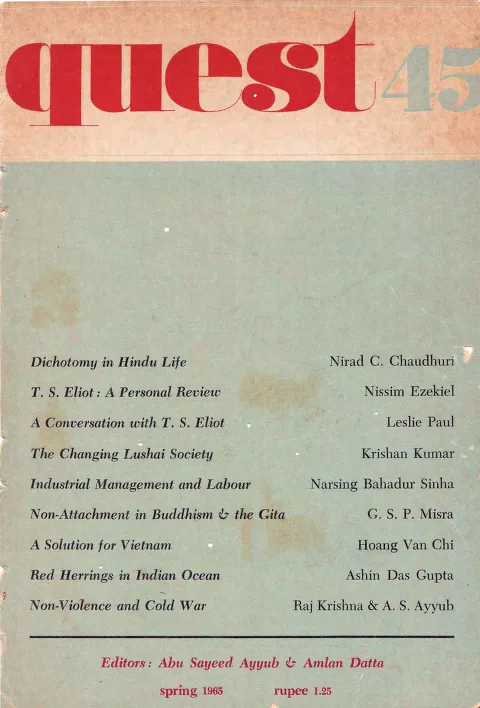
Quest
A Quarterly of Inquiry, Criticism and Ideas
By Nirad C. Chaudhuri, Nissim Ezekiel, Leslie Paul, Narsing Bahadur Sinha, Krishan Kumar, G. S. P. Misra, Om Prakash Sharma, Hoang van Chi, Ashin Das Gupta, Punya Sloka Ray, Raj Krishna, Abu Sayeed Ayyub, Cedomir Minderovic, Joan Mas's, Mary Ann Dasgupta, Amaresh Datta, A. Madhavan, Abraham Ivan Eraly, Shashi Kant, Meenakshi Mukherjee, Jill Hugh-Jones
Printed and published by MISS SHEELA SINGH for the Indian Committee for Cultural Freedom, Army and Navy Building, 148 Mahatma Gandhi Rd., Bombay 1. at Inland Printers, Victoria Mills Buildings, 55 Gamdevi Road, Bombay 7. · Bombay · 1965
126 pages
QUEST
Summary
Quest No. 45 (April/June 1965; ‘spring 1965’ on the cover) is the Bombay quarterly of the Indian Committee for Cultural Freedom, edited by Abu Sayeed Ayyub and Amlan Datta with Nirad C. Chaudhuri and Laxmanshastri Joshi as advisory editors, and it reads as a number organised around two shocks: the death of T. S. Eliot in January 1965 and the deepening American war in Vietnam. Seven articles, three current-affairs pieces, a two-letter discussion, five poems, a short story, eight book reviews and two letters fill 124 printed pages. The argumentative centre is a sustained liberal anti-monism: Nirad C. Chaudhuri argues that Hindu India is disabled by paired opposite traits and cannot tolerate public dissent; Hoang Van Chi argues that American policy in Vietnam has mistaken industrial development for the cause of democracy and has therefore bought ‘strong men’ instead of building a democratic movement; Ashin Das Gupta argues that Soekarno’s confrontation with Malaysia is a fake crisis and that the real question is whether a plural society can hold; Punya Sloka Ray argues for the deliberate ‘mutual isolation’ of India and Pakistan; and the long Raj Krishna-Ayyub exchange tests whether moral values can be reduced to a common numeraire at all, with the economist saying yes and the co-editor saying no. Two literary sequences frame this: Nissim Ezekiel’s personal reckoning with Eliot’s decline and Leslie Paul’s previously unpublished 1958 BBC interview in which Eliot defends a class society and predicts that a purely materialistic civilisation ends in boredom.
Essays
Dichotomy in Hindu Life
By Nirad C. Chaudhuri
Nirad C. Chaudhuri argues that Hindu life is structured by permanently paired opposite traits, and that this dichotomy — not any doctrine or interest — is what shapes India’s external relations. He announces nine such pairs (solidarity/disunity, megalomania/self-abasement, xenophobia/xenolatry, authoritarianism/anarchic individualism, violence/non-violence, militarism/pacifism, possessiveness/indifference, courage/cowardice, stupidity/cleverness) and treats the first three at length. Hindu solidarity, he says, is separative rather than unitive: it unites Hindus only against non-Hindus, so it contributes nothing to internal nationalism while making public dissent from a national position unthinkable. Against this he sets British counter-examples — the Pro-Boers, Burke and Sheridan, John Bright — and observes that many high-placed Hindus privately disapproved of the occupation of Goa but none protested publicly. He then argues that the political unity of India is a British legacy to which the new regime has added nothing, and that provincial sentiment is the real emerging national passion.
The second and third pairs are handled as a psychological history. Aryan self-confidence, he says, curdled into a defensive megalomania under Muslim and then British rule, sustained by an illusion of greatness; the nineteenth-century interlude of rational self-criticism is over and self-abasement has reverted to a degraded form, which he illustrates with the shopkeeper’s refrain ‘Desi aisai hota’. Xenophobia and xenolatry are presented as the outward projection of the same pair: he quotes Alberuni and Abbé Dubois on Hindu contempt for foreigners, reports the abuse his own appreciative book on England drew in 1959, and then attacks the post-independence ‘degrading xenolatry’ of a ruling class that will not entrust a project to an Indian if a foreigner can be had. The piece closes by calling itself ‘only a sampling’, offered as a working hypothesis. The article’s own printed head is longer than either the cover or the contents-page title: ‘Dichotomy in Hindu Life and Its Impact on India’s External Relations’.
- Nine paired opposite traits are announced as the mechanism of Hindu life; only the first three (solidarity/disunity, megalomania/self-abasement, xenophobia/xenolatry) are treated in this article.
- Hindu solidarity is argued to be separative, not unitive: it mobilises only against non-Hindus and therefore contributes nothing to internal nationalism.
- The suppression of public dissent is the central political claim — a Hindu’s behaviour is said to be controlled ‘not only at the stage of action, but even at that of thought and feeling’.
- India’s political unity is credited to British imperialism, with provincial sentiment named the true emerging national passion.
- Post-independence ‘xenolatry’ is attacked as morally degrading and economically ruinous, with the National Physical Laboratory and imported foreign economists as the worked examples.
- The essay carries an unsigned italic head-note defending the use of the word ‘Hindu’ rather than ‘Indian’, initialled ‘-N.C.C.‘
T. S. Eliot: A Personal Review
By Nissim Ezekiel
Writing months after Eliot’s death, Nissim Ezekiel predicts a partial restoration of an influence that had declined badly over the previous decade, and then draws a firm line between the earlier and the later Eliot: the early criticism is seminal, the early poetry revolutionary, the early plays pioneering, while the later writing could be imagined as that of an intelligent disciple. He images the poetry from 1917 to 1943 as a Himalayan range with The Waste Land as its Everest and the Quartets as a high plateau, and argues that the temptation to treat that mountainscape as the whole sovereign territory of poetry was what made Eliot, in Blackmur’s phrase, a literary dictator. When the dictatorship of the poetry stopped working after the Second World War, he says, the critical assessments went on being effective.
Ezekiel is candid about what he cannot take. He finds much in the 1920 poems and The Waste Land tiresome, is unpersuaded by Leavis’s ‘rich disorganisation’, thinks the St Augustine and Buddha allusions ‘pathetically inadequate’, and yet calls The Waste Land a great poem because of the unity of personality expressed in it. He rejects Eliot’s self-description as classicist, royalist and Anglo-Catholic as an adequate summary, finds the social dogmas constricting where the literary tradition is liberating, but insists the programme for the poet — to hold the mind of one’s culture as more important than one’s own — exalts. The second half is a reading of the Four Quartets as chamber music, tracing the mystic moment through Burnt Norton, East Coker and Little Gidding. He closes on the drama: Murder in the Cathedral and The Family Reunion are both good plays and good poetry, while the three later plays are flabby and, in The Elder Statesman, a parody of themselves.
- A dated periodisation: everything up to 1943 is the real Eliot; the post-war criticism, poetry and plays are a decline.
- Eliot’s critical authority is argued to have outlived the authority of his verse — the ‘literary dictator’ whose readings of Milton, Dante and the Metaphysicals stuck.
- Ezekiel records personal resistance to The Waste Land’s technique while still calling it great, locating its unity in personality rather than in method.
- Eliot’s social and religious dogmas are separated from his conception of literary tradition, the first called constricting and the second liberating.
- The Four Quartets are read as chamber music organised around the timeless mystic moment, with the poems’ abstract and concrete registers deliberately alternated.
- The three later plays are judged inferior as drama and in language, with The Cocktail Party’s only exciting poetry said to be a quotation, not Eliot’s.
A Conversation with T. S. Eliot
By Leslie Paul
This is the transcript of a discussion Leslie Paul arranged with T. S. Eliot for the BBC European Service in 1958 and which, for reasons now obscure to both men, was never published; the first part of the conversation was lost because the technicians forgot to switch on the tape. Paul opens on politics, asking whether Eliot still holds that the choice is between a new Christian culture and a pagan one. Eliot withdraws the word ‘pagan’: Nazism and Communism were attempts to bypass Christian culture rather than genuine paganisms, and neither can survive, because their religious fervour depends on always presenting the image of an enemy and an earthly god. From there the talk turns to what Paul calls a ‘cultureless culture’ on the model of Orwell’s ‘foodless food’ — the mass entertainment culture that Eliot agrees is visible in the absence of values in plays and novels, and which he predicts will end, if explosives do not intervene, simply in boredom.
The long central exchange is on class. Eliot distinguishes the Christian elite of The Idea of a Christian Society, drawn from all cultural strata, from the class structure considered in Notes towards the Definition of Culture, and offers a paradox: contemplating a stratified society moves one emotionally towards classlessness, and contemplating an actual classless society moves one back. He defends arguing the case for a class society because equalitarianism is the accepted idea, holds that a healthy classless society will tend to form classes and a healthy class society to facilitate transition between them, and locates the evil of each in privilege without responsibility and in responsibility atomised until everyone is equally irresponsible. Paul then raises the writer’s position — the divorce of poet from people, the cost of publishing verse — and Eliot answers partly as a publisher. He explains the sandwiching of his plays and poems, says the inspiration for Burnt Norton was lines cut from Murder in the Cathedral, describes hammering out a metric as far as possible from the iambic pentameter, and hopes he may have helped future dramatists return to blank verse ‘as a fresh instrument’. The piece ends with the lost manuscript of The Waste Land: bought by John Quinn, absent from the sale of his collection, and — Eliot says, in two minds — perhaps better lost.
- Eliot retracts ‘pagan culture’ as the likely alternative to Christian society and substitutes the pseudo-religions of Nazism and Communism, which he argues cannot last without an enemy to keep them hot.
- The mass-entertainment ‘cultureless culture’ is diagnosed as a process of spiritual drying-up whose terminus is boredom.
- The defence of a class society is put as a paradox of emotional oscillation rather than a doctrine, with flexibility between classes as the test of health.
- Eliot speaks as a publisher on the economics of poetry: costs rise while the buying elite stays roughly constant however the population grows.
- He reveals that Burnt Norton grew from lines cut out of Murder in the Cathedral as irrelevant to the action.
- He says he is glad, for his own reputation and The Waste Land’s, that Ezra Pound’s blue-pencilled manuscript has disappeared — while also wanting it found as evidence of Pound’s ‘maieutic abilities’.
Industrial Labour and Management in India
By Narsing Bahadur Sinha
Narsing Bahadur Sinha, a lawyer who spent fifteen years as a general manager in Delhi industry, argues in three parts that India does not yet have an industrial working class at all, that it has no independent managerial cadre, and that its industrial-relations law protects neither. Part I holds that the men in town factories remain agricultural labour in character — retaining village roots, language and festivals, reverting to the land on the least pretext, acquiring narrow skills by chance rather than training, indebted, and dependent on ‘self-interested and poorly equipped labour union leaders’. His remedy is a system of permanent industrial labour colonies, classified by the workforce of the employing unit, financed by pooled contributions from government, industrialists and workers, with rental ceasing once half the building cost is paid off and occupancy rights then settling on the workers’ children. The colonies are to carry schools with a technical bias, night schools and literacy centres, dispensaries and maternity wards, cooperatives, recreation halls and museums of working models of small machines.
Part II argues that managers in the private sector are chosen for kinship or reliability rather than merit, that this blocks able young men and starves industry of talent, and that a government-maintained zonal register of qualified managers — from which industrialists would be obliged to choose, while keeping a wide final choice — would fix it. Part III turns to the law and is the sharpest section: the Chinese attack produced only a temporary industrial truce; workmen who complain are turned out and charge-sheeted afterwards by legally equipped staff; industrial tribunals are staffed by retired men with legal knowledge but no experience of industry, a point Sinha says he put to Prof. Richardson, an I.L.O. expert, who agreed and advised the government accordingly without result. He ends with a list of specific amendments to the Industrial Disputes Act — deleting the sub-clause that excludes managers earning over Rs. 500 a month from the definition of ‘workman’, tightening the lay-off and retrenchment definitions, and making works committees compulsory in every unit.
- The central claim is definitional: India’s town factory workforce is agricultural labour that has not been absorbed in agriculture, not an industrial class.
- The proposed remedy is permanent industrial labour colonies with tripartite financing and inheritable occupancy rights, plus technical schooling from childhood.
- Private-sector managerial appointment by kinship and ‘confidential recommendation’ is argued to damage industry as much as it damages the excluded.
- Managers earning over Rs. 500 a month fall outside the Industrial Disputes Act’s ‘workman’ and get neither provident fund, state insurance, gratuity nor pension — the article’s most concrete legal grievance.
- Lay-off under S.2(kkk) and retrenchment under S.2(oo) are said to be routinely manipulated through manufactured shortages of raw material and accumulations of stock.
- Named specific amendments are proposed, including deleting the proviso that withholds even half wages for lay-off beyond 45 days in a year.
The Changing Lushai Society
By Krishan Kumar
Krishan Kumar sets out to measure social change in the Mizo Hills by taking three cross-sections of Lushai society — before British administration, at the end of British rule, and at the time of writing — and comparing them. The pre-administration cameo is of a society whose unit was the village rather than the clan, focused on the Zawlbuk or bachelors’ hall as a training ground for warriors and a school of discipline and social obligation; governed by ‘tlawmngaihna’, an untranslatable duty of hospitality and unselfishness; self-sufficient in food and cloth; without prostitution, with almost no crime, with a sharp class division between chief and commoner that was nevertheless checked by the villagers’ power to migrate away from a despot, and with poverty as we know it practically unknown.
The rest is a catalogue of consequences, most of them unintended. Cheap administration required that the chiefs be preserved, so the British removed the right of migration and thereby turned the chiefs into genuine despots divorced from the people; pacification ended war and with it the chiefs’ reason for existing; the Assam Rifles brought disease and a loss of vigour along with order; bridle paths stimulated local trade; mission schools, opened against the administration’s own policy, produced the country’s third-highest literacy rate and with it a class of educated youths who would not work in the jhums, an exodus to the plains that became ‘the eyes and ears of the hills’, and the decay of the Zawlbuk system. The shift from barter to coin is treated as the single most disruptive change: it tied local prices to outside markets, produced money-lending at exorbitant rates, undercut the reciprocity of ‘tlawmngaihna’ because money does not perish, and — through inflation — destroyed the deterrent value of fixed fines and the compensatory meaning of bride price. Christianity is credited with the message of equality and blamed for loosening village bonds, creating a surplus of women by forbidding easy divorce, and driving drinking into private with ‘the wholesale practice of deceit’. After independence the dams burst one by one: the chiefs went abruptly, leaving a leadership vacuum; high schools multiplied from one in 1945 to over forty; a 36% population rise in 1951-61 shortened the jhumming cycle to as little as three years and put starvation in view. Kumar’s verdict is that transition was inevitable but is arriving as a series of explosions, and that Lushai society is sacrificing its co-operative ethic at the altar of economic advancement.
- The method is explicitly comparative — three ‘cameos’ of the same society at three arbitrary points of time, used to separate effects of British rule from effects of independence.
- The paradox of indirect rule is the article’s strongest claim: preserving the chiefs cheaply required removing the villagers’ right to migrate, which turned a checked authority into despotism.
- Mission education, pursued against administrative policy, produced both very high literacy and a class of educated youths unwilling to work the jhums.
- The move from barter to a money economy is treated as the deepest disruption, dissolving ‘tlawmngaihna’ because money, unlike rice, does not perish.
- Inflation is shown destroying two institutions at once: fixed fines as deterrents against rape and illegitimacy, and bride price as compensation to the father.
- A 36% population increase in the 1951-61 decade plus a jhumming cycle down to three years is presented as a chronic food deficit in the making.
Non-Attachment in Buddhist Texts and the Gita
By G. S. P. Misra
G. S. P. Misra sets out to show, by parallels of phraseology rather than of doctrine alone, that the Gita’s teaching of non-attachment borrows from the ascetic religions of sixth-century B.C. India, and in particular from early Buddhism. He begins from Aldous Huxley’s remark in Ends and Means that ‘non-attached’ is the best word for the ideal man of the free philosophers, mystics and founders of religion, and argues that the Gita’s achievement was to hold both pravrtti (active life) and nivrtti (complete renunciation) in abeyance — a Brahminical device for assimilating the ascetic ideal and so securing the predominance of Brahminical religion. In the process, he says, it could not help borrowing ideas and principles which then received enunciation in almost the same words.
The argument then proceeds by paired citation. Egoism is identified as the fulcrum of all attachment; the Gita’s remedy is subjective purification plus God-realization, a theistic route that Misra compares with the Christian gospel of attachment to God and calls, paradoxically, the preaching of niskama karma by way of sakama karma. Buddhism, having no supreme God, reaches the same doctrine by rational analysis of universal suffering, including parinamadukkhata, the suffering caused by the changeable nature of things, which equates even pleasure with pain; some sects, he notes from the Kathavatthu, denied that any feeling of pleasure exists at all. He then sets Gita verses against passages from the Sutta-nipata, the Samyutta Nikaya and the Theragatha on equanimity, on the monk as a lotus unwetted by the water, on the man who has left both good and evil, on the mind as an ape leaving one branch for another, and finally on the tortoise withdrawing its limbs into its shell — a simile he shows recurring almost word for word in Gita II.58. The conclusion is careful: the practical and dynamic doctrinizing of non-attachment was first furnished in the Gita, but the contribution of the ascetic religions to the theory cannot be denied.
- The thesis is one of borrowed phraseology, not merely parallel doctrine — the Gita is said to reproduce Buddhist formulations almost verbatim.
- The Gita is read as a Brahminical assimilation device: suspending both pravrtti and nivrtti to secure the predominance of Brahminical religion.
- Buddhist non-attachment is derived from the analysis of universal suffering and is therefore said to be free of any theistic influence.
- A three-way comparison is drawn in passing with Christianity, whose devotion to God Misra reads as niskama karma pursued by way of sakama karma.
- The tortoise simile (Samyutta IV and Gita II.58) is offered as the decisive textual parallel.
- All original texts are quoted from Pali Text Society translations, as a closing note states.
The Decline of the Prophet
By Om Prakash Sharma
Om Prakash Sharma’s short note, printed under the head ‘A Brief Note on the Decline of the Prophet’, marks Arnold Toynbee’s eighty-fifth birthday by observing that it is a matter of wonder his critics have allowed him to live that long. The argument is that history has let the great historian down: his theory of ageing cultures and civilisations has, Sharma says, a respectably neurotic German pedigree running from Hegel through Nietzsche and Marx to Spengler, all of them believers in predetermined phases marked by catastrophic convulsions; and when Spengler’s promised decline of the West failed to arrive after the First World War, Toynbee retreated hastily from a linear to a cyclical view. A Study of History is reported as rifled by experts for ‘logical incoherence and empirical invalidity’, labelled by H. R. Trevor-Roper ‘untrue, illogical, and dogmatic’, and yet — the note’s central irony — simultaneously more popular than ever, which prompts the question whether one must renounce the academic Eden to gain the whole world.
The second half restates the quarrel as one about fundamentals: what is history and what is the historian’s role. Sharma grants that facts without interpretation are ‘merely a blind datum of experience’, quotes Edward Carr’s fishmonger’s slab from the Trevelyan lectures, and concedes that any interpretation is somebody’s eye-view. But Toynbee’s taste, he says, is omnivorous and reckless: a bridge over the deep past and deep future from which he takes frequent leaps in the dark, taking his bearings not from the living present but from the Graeco-Roman world of two thousand years ago. Against J. B. Bury’s 1909 emphasis on chance in social evolution, Toynbee’s religious temperament posits the meaning of history outside history itself, which Sharma finds hard to distinguish from the ancient Greek’s Vast Impersonal Forces. He ends by filing Toynbee’s ‘meta-history’ alongside Adam Smith’s hidden hand, Berdyaev’s super-historical force and Hegel’s Zeitgeist, and letting A. J. P. Taylor have the last word.
- The note is an obituary-in-advance of Toynbee’s reputation rather than of Toynbee, whose eighty-fifth birthday is the occasion.
- Toynbee’s determinism is given a genealogy — Hegel, Nietzsche, Marx, Spengler — and his shift from a linear to a cyclical view is read as a retreat after Spengler’s failed prediction.
- The collapse of Toynbee’s academic standing and the rise of his popular standing are presented as possibly causally connected.
- Sharma sides against Ranke’s ‘crude corpus of ascertained facts’ while still refusing Toynbee’s leaps beyond the evidence.
- The concluding move is taxonomic: Toynbee’s ‘meta-history’ is filed with Adam Smith’s hidden hand, Berdyaev’s super-historical force and Hegel’s Zeitgeist as a deus ex machina.
- A. J. P. Taylor’s washing-up gibe is given the last word, deflating decline-of-civilisation talk into a complaint about domestic service.
A Solution for Vietnam
By Hoang Van Chi
Hoang Van Chi, a Viet Minh veteran who escaped North Vietnam in 1955, argues that American policy in South Vietnam rests on a chain of category errors. His premise is that guerrilla war is not the kind of war Western strategists know: military strength is a function of political capability, and political strength in turn a function of ideology and just cause. The Viet Cong, weak in 1958, grew strong because the Saigon government and the ‘nationalist’ camp could offer no adequate alternative. He then reconstructs a longer history: traditional Vietnamese society was a pyramid of ten levels cemented by Buddhism and Confucianism, with non-hereditary nobility and administrative posts open to brilliant scholars; the French conquest overturned it, jailing patriotic mandarins and installing unpatriotic ones, whose descendants became the high officials and senior officers of the Diem administration — anti-Communist mainly from fear of losing privilege, and therefore equally afraid of non-Communist opposition.
The article’s core is a numbered indictment of six Western mistakes: mistaking industrial development for the cause of democracy and so inventing the ‘strong man’, which he calls the most damaging theory for liberal American prestige since 1945; limiting knowledge of the Vietnamese to English-speaking city elites and so missing rural injustice; rejecting the Communist solution without offering another; over-estimating Catholic resistance in a primarily Buddhist country; equating stability with progress when nine years of stability under Diem were precisely when the Viet Cong grew; and treating Buddhist and student demonstrations as dangerous instability. To the objection that Buddhists and students may be infiltrated, he answers that genuine popular movements are harder to infiltrate than a few ambitious politicians or officers are to buy, and cites the Kuomintang officers who joined Mao. His prescription is that Washington should favour, or at least not hinder, a non-Communist democratic movement grounded in Buddhist tolerance and student demands for democracy — but he judges his own hope faint, because the South Vietnamese army has undergone a complete ‘kuomintang-isation’ of which the coup of 20 December 1964 is the latest proof.
- The governing formula is a chain of dependencies: military strength depends on political capability, which depends on ideology and just cause.
- The ‘strong man’ theory is traced to mistaking industrial development (the effect) for democracy (the cause), and named the most damaging theory for American prestige since 1945.
- Anti-Communism among Saigon’s officials is explained as fear of losing privilege, which makes them equally hostile to democratic opposition.
- Nine years of stability under Diem are turned against the stability argument: that was precisely when the Viet Cong acquired their power.
- Buddhism and the student movement are offered as the indigenous antidotes to class struggle and to Communist claims of a just cause.
- A counterfactual pair of historians’ verdicts — one generous, one about ‘contractors’ paid a billion dollars a year — is used to dramatise the gap between stated and actual policy.
Red Herrings in Indian Ocean
By Ashin Das Gupta
Ashin Das Gupta argues that Soekarno’s confrontation with Malaysia is a manufactured crisis: the real danger to Malaysia comes from China, not Indonesia, and Indonesia has no earthly reason to be desperate about a neighbour that can do her no harm. He begins by dismantling the national categories. Malay, Indonesian and Filipino are racially more or less one proto-Malay population of about sixty million spread from the Malayan peninsula through Formosa and the Philippines into Polynesia, while Indonesia and Malaysia together hold well over a hundred million, so the archipelago is an ‘open world’ in which precise definitions are more than usually foolish. But he refuses Soekarno’s inference that Malaysia is therefore artificial: nations there are emerging from historical experience rather than demography, since ‘imperial boundaries proved to be national frontiers’ — otherwise most modern African nations would not make sense.
The substance is a history of Chinese settlement and of Malay nationalism. Taking the peninsula with Singapore, 45% of the population is Chinese against 43% Malay, a situation Das Gupta says is unique in the world; almost all Malaysia’s problems trace to that one fact, and the fear is of Malaya becoming an Overseas Territory of Communist China. He distinguishes three waves of Chinese arrival — the ‘Queen’s Chinese’ merchant princes, the nineteenth-century entrepreneurs, and the twentieth-century working class radicalised after the depression — and shows Sun Yat Sen’s Tung Meng Hui, its Singapore branch of 1906 and its Overseas Department capturing Chinese vernacular schooling so completely that textbooks made no mention of Malaya. Malay nationalism, by contrast, he dates only to the Japanese occupation, which drove the Chinese into Communist resistance and set Malay against Chinese; UMNO was founded in 1946 against the Malayan Union, the Communist Emergency broke Chinese political power and thereby made independence possible, and Tunku Abdul Rahman’s Alliance combined UMNO with the Malay Chinese Association and the Malay Indian Congress. The essay ends by refusing the puppet thesis: British investors do want Malaysia, but foreign bases and an inability to defend oneself against a stronger neighbour would make puppets of a great many governments, and Lee Kuan Yew’s People’s Action Party is the genuinely encouraging development. What Malaysia needs is time; the arguments about Indonesia and the British are ‘so many red herrings’.
- The thesis is that Soekarno’s threat is a fake — it can neither win militarily nor split Malay nationalism — while China is the real danger.
- Racial and linguistic categories in the archipelago are shown to be too diffuse to ground nations; historical and imperial boundaries are credited instead.
- The 45% Chinese to 43% Malay head-count for the peninsula plus Singapore is called a situation unique in the world and the root of Malaysia’s problems.
- Chinese settlement is divided into three politically distinct waves, with the radicalisation of the working class dated to the depression of the thirties.
- Malay nationalism is dated only to the Japanese occupation, with UMNO founded in 1946 as a right-wing, princely-privilege party later transformed by Tunku Abdul Rahman.
- Plural society and multi-national formation are advanced as the direction of travel, with Macapagal’s Maphilindo named as where the future lies.
India, Pakistan & the Indian Muslims
By Punya Sloka Ray
Punya Sloka Ray opens from a maxim of European diplomacy — that every alliance involves a horse and a rider — to argue that co-operation between peoples always means accepting an inequality, and that Muslims and Hindus have never managed an alliance of the tolerable kind achieved by Britain and the United States. Had there been no partition and had Gandhi’s and Azad’s counsels prevailed, he suggests, India’s Muslims might have occupied a position analogous to that of the South in Indian politics today. Partition being irreversible, he confines this article to the India-Pakistan relation and defers the relation between Indian Muslims and Indian Hindus.
His analysis is that Pakistan has the clearer grip on the fact that the subcontinent is a single geopolitical space, and will therefore hate India as long as it cannot love her, but will never be indifferent; the anecdote of General Iskandar Mirza throwing his glass against the wall and crying ‘Dilli chalo!’ on learning of partition carries the point. Unable to be junior partner, Pakistan has pursued a pax pakistanica — a reformulation of pax islamica — helped by the diehard Tories, then by the USA, and now by Communist China; its strategy, Ray says, is to engineer a moral collapse of the Indian state with Chinese assistance. The flaw is that China will not prefer a pax pakistanica to a pax sinica or even to chaos. Since neither pax pakistanica nor pax indica is on the horizon, the remaining solution is mutual isolation, achievable by giving Pakistan access to Kashmir, by independence for East Pakistan, by complete exchange of populations, or most importantly by establishing an external paramount power — a role he sees the USA drifting into with a measure of Soviet co-operation, denying Communist China access to the subcontinent. The cost, he concludes, will be borne by India’s Muslims, whose ties of family, religion and language across the border will weaken until Indian and Pakistani Muslims are no more akin than Turks and Arabs; and since that is inevitable, the question becomes whether it can be accepted consciously and ‘planfully’ so as to rationalize, moralize and humanize it. The article closes by naming the problem of India’s cultural unity as, in the main, the problem of finding a cultural identity for the nationalist Indian Muslim.
- All co-operation between governments or peoples is said to require the acceptance of an inequality — the horse-and-rider aphorism.
- Pakistan is credited with a clearer grasp of the subcontinent as a single geopolitical space, and therefore with permanent non-indifference to India.
- Three pieces of ‘extraordinary providence’ are identified: the diehard Tories, the USA as buyer, and Communist China as active friend.
- The strategy attributed to Pakistan is engineering a moral collapse of the Indian state; its flaw is assuming a disinterested China.
- Mutual isolation is proposed as the only available solution, with four named mechanisms, of which an external paramount power is called by far the most important.
- Indian Muslims are identified as the party who will bear the cost, and their cultural identity as the real content of the ‘cultural unity of India’ question.
Non-Violence and Cold War
By Raj Krishna and A. S. Ayyub
The first half of the DISCUSSION is Raj Krishna’s letter to co-editor Ayyub, continuing an argument begun with his article ‘Non-Violence, War and Peace’ in the monsoon 1964 Quest. He insists that non-violence as the one prime value is very much alive in India and has kept policy-makers ‘in a state of guilt, confusion and indecision in the teeth of great danger’, so that the neglect of India’s defences was partly an intellectual muddle about the operational implications of the theory. He denies that he thinks value pluralism a modern discovery — quoting himself to the effect that ‘Moral monism is unindian’ — and names as monists the panacea-mongers for whom non-violence, or celibacy, or nature cure, or Ramanama, is all.
The philosophical core is a defence of quantification in moral choice. He rejects the popular neo-Gandhian separation of good ends from good means: the same weighted value-set and the same knowledge of consequences that make one will an end must make one will the most efficient means, so that a surgeon’s painful operation, or efficient police firing to end a riot, cannot be called bad means to a good end unless ‘bad’ just means ‘inefficient’. Answering Ayyub’s charge that values cannot be added and subtracted, he argues as an economist that any ordering of alternatives implies a numeraire, that the numeraire is not itself a value but ‘the value-ness of all particular values’, and that only a pluralist needs one. He denies that non-violence is more basic than other values, since under abnormal conditions — millions reduced to will-less soldiers by a leader identified with aggressive violence — even killing may have to be organised; and he collapses Ayyub’s distinction between justifying violence by the evil it prevents and the good it promotes, since every value has a correlate disvalue. Finally he legitimises the defensive cold war: where one side does not genuinely believe in coexistence but tries to convert, subvert, conquer or dominate, a defensive cold war forced on the threatened nation ‘may be an inescapable dharma’. The letter is signed from the Institute of Economic Growth, Delhi, and dated 26 November 1964.
- The charge is that moral monism about non-violence produced real strategic damage — ‘the criminal neglect of India’s defences’.
- Ends and means must be evaluated by identical criteria; the neo-Gandhian separation of the two is rejected as valuational double-think.
- A numeraire is argued to be a logical necessity of choice, and specifically a pluralist’s necessity, not a monist’s.
- Non-violence is denied basic status: labelling favourite values ‘basic’ does not resolve value-conflict.
- Justifying violence by evil prevented rather than good promoted is called a verbal, hair-splitting distinction.
- A defensive cold war forced on a nation by another’s aggressive cold war is defended as an inescapable dharma.
Non-Violence and Cold War
By Raj Krishna and A. S. Ayyub
Co-editor Abu Sayeed Ayyub’s reply, printed under the same DISCUSSION head, first disputes the factual premise. Has non-violence really been a major consideration for policy-makers since Gandhi’s death? Even under Gandhi the Congress high command accepted non-violence as policy rather than faith; under Nehru the magic word was non-alignment; and nobody was inhibited by ahimsa when the army was ordered into Hyderabad or Goa. The minister most responsible for military unpreparedness, he adds drily, is the last man to whom one would attribute any weakness for ahimsa. Intellectual muddle about the Communist mind, about Chinese intentions, about the relative threats from Pakistan and China — yes; but not about the operational implications of non-violence.
The substantive reply denies that a set of authentic, universal and general value-concepts can be identified at all. Truth, beauty and moral goodness are examined and found optative rather than universally obligatory: Dante, da Vinci, Goethe and Tagore cultivated knowledge while Keats, Yeats and Lawrence hated science, and Beethoven, Mirabai, Gauguin and Faiyaz Khan were ‘comparative ignoramuses’ — does it matter? Even moral heroism is optative; a poor swimmer is not obliged to drown attempting a rescue, though he will rightly be honoured if he tries. The one genuinely universal obligation Ayyub accepts is Kant’s second maxim, to treat everyone as an end and never as a means only; the value of the person is the only authentic and universal value, non-violence being not a value but a negative must-not imposed by it, and violence permissible only for the prevention or redress of violence. He then turns the numeraire against Raj Krishna: economic goods might be quantised, but there is no discoverable scale on which philosophy can be adjudicated greater or less than music, and a purely personal numeraire is not worth carrying about. Democracy, he observes, is in fact a value for only a section of mankind, which does not license forcing it on monarchists or communists any more than forcing poetry on cricket fans — though it fully licenses self-defence. On cold war the differences turn out to be superficial: Ayyub had meant by cold war psychology the anger, hatred and prejudice that paint the other side pitch black, quotes Raymond Aron on ideological coexistence and mutual tolerance, and concedes that if cold war does not mean a war in the soul he can have no objection but a semantic one.
- The factual rebuttal: non-alignment, not non-violence, was the operative frame of Indian policy, and Hyderabad and Goa show no ahimsa inhibition.
- Universal value-concepts are rejected: truth, beauty and moral goodness are shown to be optative, pursued by some great figures and neglected by others.
- Kant’s second maxim is accepted as the one formulation of universal obligation; the value of the person, not non-violence, is the basic value.
- Non-violence is reclassified as a negative obligation imposed by a value rather than a value in itself, permitting violence only to prevent or redress violence.
- The numeraire is granted for economic goods and denied for higher values — no scale can adjudicate philosophy against music.
- Democracy is conceded to be a value for only a section of mankind, a concession paired with an unqualified right of self-defence against those who would impose their preferences by force.
A Sick Faun’s Afternoon
By Cedomir Minderovic
‘A Sick Faun’s Afternoon’, by the Belgrade poet and library director Cedomir Minderovic and translated by T. Ladan, is a long free-verse monologue of erasure. Two lovers hold hands in an imaginary sweetshop ‘of margarine nothingness’ while Debussy plays, barely heard, behind a wall; at a tall table a prefect and a pastor sit over huge yellowish watery cream-pies, cutting their nails, and the door beside them is deadened and never opened. The three silly rosy palms of a lucky island blow towards Guzzler Bay under black umbrellas over the quick-sand and quick-ashes of lost and future civilisations.
The poem proceeds by insistent repetition — the nails, the cream-pies, the knob ‘out of which glitter the starry dust of hope’, the good-byes — and by a slow substitution of a dumpy black sputtering fountain for the music, until Debussy cannot be heard at all and the lips, hands and afternoon are all things ‘that never more will be’. Against the yellow nails, eyes and skulls grinning ‘in the gilded orgasm upon the pathetic gun-carriage of history’, the speaker sets a repeated wish for a glimmering evening, a red monsoon sky, a naive childish sail of departure. In the closing movement the door does open — ‘Who did open it / Who’ — everything disappears, and what is left is a monsoon sky, the hypnotizing sound of waves, gaudy parasols and two people tired and alone on a warm beach beside an ‘Indian Ocean whatever ocean’, without words.
- A single unpunctuated free-verse movement built on repetition of a handful of objects: nails, cream-pies, umbrellas, a door knob, a black fountain.
- Debussy’s receding music is the poem’s measure of loss, driven ‘behind some seventh wall’ by the nails and finally inaudible.
- Institutional authority appears once, as a prefect and a pastor cutting their nails at a tall table beside a door no one opens.
- History appears as a ‘pathetic gun-carriage’ bearing grinning skulls, the poem’s only overtly political image.
- The ending relocates the lovers to a beach beside the Indian Ocean ‘whatever ocean’ — a gesture towards the journal’s readers in the translated text.
- The translation credit ‘(Translated by T. Ladan)’ appears only at the foot of the poem; the contents page records no translator.
Fragment: Autobiographical
By Joan Mas
Joan Mas’s ‘Fragment: Autobiographical’ is a prose-poem in three numbered parts plus a postscript, spoken partly in the third person about a woman watching a child through a window and partly in the first person in a letter she is writing in her imagination. Part I sets the poem’s governing contrast of architecture: the child lives in a cornerless house of pale gold glass, round as a ball, through which everything is observed and reflected perfectly, while the watching woman’s house is of so complicated a design, of so many corners and corridors and cupboards and shelves to put things on — rambling, twisted, dim, and a place in which she grows afraid. Only children do not fear, the poem begins; adults, to whom everything has happened and yet nothing, have lost the power to be unafraid.
Part II is the imagined letter to someone never known and known always, a lover addressed as eternal as the stars and asked to ‘Be hands. And voice. And ideas. And laughter’ — someone who has lit the strange blue house of the speaker’s self with delicate candles and planted trees that will flower when he comes. Part III breaks the reverie: the child calls ‘mummy’, and over the round rim of the child’s head, like a moon, the woman aches with sadness while the restless leaves against her windows ‘gabble and gabble … And are like fools, mocking’. The POSTSCRIPT closes the sequence in a register of consummated burial, the warm dark earth opening its arms and drawing the speaker close, so that she can sleep through time as a woman sleeps who after being loved lies relaxed and at peace, her body joined to her lover’s ‘like a flower to a bough’.
- Structured in three numbered parts plus a POSTSCRIPT, alternating third-person narration with a first-person imagined letter.
- The controlling figure is architectural — the child’s cornerless glass ball against the adult’s cornered, cupboarded, corridored house.
- Fearlessness is assigned exclusively to children; the speaker dates her own fear to being thirty.
- The addressee of the letter is explicitly someone never met, which makes the love it declares wholly imagined.
- The child’s interruption in Part III converts the reverie into an ache, framed by the mocking gabble of leaves.
- The postscript resolves the sequence into an image of burial that is also an image of post-coital rest.
SONG
By Mary Ann Dasgupta
‘SONG’ is the first of the two poems the contents page groups as ‘Two Poems’ by Mary Ann Dasgupta. It takes its epigraph from the Elizabethan lyric ‘Come again, Sweet Love that once was mine…’ and then answers it with a short, typographically aggressive accusation. Capital letters are embedded inside lower-case words so that each term is made to display the smaller word hiding in it: ‘huMANity’, ‘deGENERATION’, ‘UNmending’, ‘unMINDful’, ‘MANliness’, ‘MISSopportunity’. The effect is to make humanity read as a degeneration of manliness and opportunity read as a missed one.
The poem’s single sentence runs from ‘Your huMANity (generally speaking) is a deGENERATION of shameless broken images’ to a closing image of MISSopportunity waiting and waiting, ‘an aging virgin gazing at the world’s children / who signify the thousandth coming / of loneliness’. The Eliotic ‘shameless broken images’ and the parodic annunciation of a thousandth coming place it firmly in the post-Waste Land idiom that dominates this issue.
- An eight-word Elizabethan epigraph, ‘Come again, Sweet Love that once was mine…’, is set against a modernist refusal.
- The device is typographic: embedded capitals expose MAN, GENERATION, MIND and MISS inside longer words.
- ‘shameless broken images’ picks up Eliot’s heap of broken images, aligning the poem with the issue’s Eliot preoccupation.
- Missed opportunity is personified as an aging virgin, making the poem’s subject sterility rather than lost love.
- The ‘thousandth coming of loneliness’ parodies annunciation and second coming at once.
FIRST ANNIVERSARY
By Mary Ann Dasgupta
‘FIRST ANNIVERSARY’ is the second poem under the contents line ‘Two Poems’, printed immediately below ‘SONG’ on the same page and sharing its signature. It is six lines long and turns on a single deflation. It opens with the received formula that God is Love, adds at once that love is scarce, and then concedes the devotional conclusion — that the speaker sees her god in the person addressed — only to withdraw all warmth from it.
The concession is qualified in parenthesis as having come ‘after long and painful scrutiny’, which converts a declaration of love into the result of an audit; and the last line refuses the god so found: ‘But I don’t like the looks of him.’ Placed under the title ‘First Anniversary’, the joke is bitter rather than light — a marriage poem in which the theological identification of God with love survives and the affection does not.
- Six lines built on a syllogism whose conclusion is accepted and then disliked.
- ‘God is Love’ is quoted as received doctrine and immediately undercut by ‘and love is scarce’.
- The parenthesis ‘(after long and painful scrutiny)’ converts a declaration into a verdict.
- The title supplies the occasion — a first wedding anniversary — which the poem then sours.
- Printed on the same page as ‘SONG’ and covered by the single joint signature MARY ANN DASGUPTA.
The Waiting
By Amaresh Datta
Amaresh Datta’s ‘The Waiting’ is a single thirty-line poem on a man whose whole life has been deferred. Its opening and closing lines frame it as a vigil for ‘the laughter of the sun’, qualified at the end into ‘the rhododendron laughter of the sun’. Between them the poem moves through what the subject desired — the fire of spring, the image of the soaring bird, to swoon or die like the careless wind of March in the sailing arms of love, to make stars of songs for his familiar domestic sky — and what he got: he gave his soul with the body’s borrowed charm to the glamour of the earth, but could not save the vesture of flesh from the hands of time.
The second half diagnoses the deferral. Long days of languid calm, ‘Idle and honied with sedative hopes’, have formed the wheel of his fate; he now waits not for spring but for a storm to swing his nest, for a violent assurance, for ‘the loud noise of light’ that would let him see beyond the bounds and the tautologic tale of life. Tamed, tubbed and pruned to the fashionable elegance of taste, he sighs for an unknown anguish of the soul that turns earth into foliage and makes verdure with sapphires of the eye. The wonder touches the edge of despair, and in the cool valley of silence he is still waiting. The indentation alternates between flush-left and indented blocks, marking the alternation between what he waits for and what he once wanted.
- Framed by a repeated line — waiting ‘For the laughter of the sun’ at the start and for its ‘rhododendron laughter’ at the close.
- The poem’s grammar of tenses does the work: he has been waiting, he had wished, he gave, he waits now.
- Comfort is the antagonist: ‘sedative hopes’ and being ‘Tamed and tubbed and pruned / To the fashionable elegance of taste’.
- What is wanted is violence rather than peace — a storm, a violent assurance, ‘the loud noise of light’.
- The alternating flush-left and indented blocks separate the present vigil from the remembered desire.
The Dream I Fathered
By A. Madhavan
A. Madhavan’s ‘The Dream I Fathered’ is a twelve-line poem in loose rhyme that stages the loss of a dream as a missing-person investigation. The dream has disowned the speaker and vanished ‘out of bounds of Memory Town’; he reports it to ‘the secret squad’, telling them it stayed awhile with him before flying into a hidden pocket of the sky. The bureaucratic machinery then defeats him twice over: asked for a picture he has none, and asked to describe the missing dream he cannot, having ‘fathered him in blindness like the sun’.
The last quatrain turns the investigation on the complainant. At dusk the squad bring back a rag found by the draw-bridge; the speaker identifies it — ‘It is his,’ I cried, ‘He wore this shirt. O is he dead?’ — and is answered by the Chief of the Police with the accusation ‘You killed him.’ The poem is printed not in the POETRY section but on printed page 60, filling the space below the numbered notes to Hoang Van Chi’s Vietnam article; the contents page records that page number correctly while listing the poem last among the poems.
- A lost dream is processed through the apparatus of a police missing-person case: a secret squad, a description, a photograph, a found garment, a Chief of Police.
- The speaker’s inability to describe what he has lost is made a consequence of having created it ‘in blindness like the sun’.
- The closing accusation reverses the poem’s premise: the dream did not abandon him, he killed it.
- ‘Memory Town’ and the draw-bridge give the poem a deliberately fabular, walled-city geography.
- Its physical placement on printed p.60, twenty folios before the POETRY section head, is a typesetting expedient, not a contents-page error.
Night of the Dark Trees
By Abraham Eraly
Abraham Eraly’s ‘Night of the Dark Trees’ is a first-person story about a man who cannot believe in his own happiness. Varma, a college lecturer in European philosophy, sits in the garden with his wife Sitha and their daughter Urmila and feels a great fear descend with wide black wings; between himself and his wife he keeps seeing the shadow of Itty, barring their parallel lives from converging. The story then goes back three years to a moonlit beach where Itty — tall, indistinct as an old photograph, with a deep bass voice that lent gravity to whatever banality he spoke — accosted him and, over coffee, announced that he was considering marriage and was ‘in a hell of a muddle’ between a proposal from a well-connected family, a former fiancée, and Sitha.
The centre of the story is the contrast between Varma’s two loves and Itty’s account of his conquest. Varma’s first love, Karthu, a poor girl taken into his mother’s house as help, was got rid of by his mother when she became pregnant; his love for Sitha, refined and rarefied, he destroyed himself by warning her, after a music recital, that he had been badly hurt before. Itty’s account is of deliberately breaking a proud woman: he was patronised, then flattered by her father’s praise of his writing on the older man’s secret paintings, and then, he says, ‘I knew that I had her in my power’. Varma, with ‘no tremor’ in his voice and a perverse streak that goes back to refusing to cry when caned, vehemently urges Itty to marry Sitha, thereby damning himself — and Itty, unable to decide, marries the other girl, Ramani, instead. Sitha resumes correspondence with Varma and they marry. The story ends with the exorcism: Itty visits with a fat wife and two noisy sons, corpulent and jabbering about playing golf with the Director; Sitha catches Varma’s eye brimming with laughter; the incubus falls off ‘like a dead leaf from the tree’, and the crater bitterness left in him is smoothed.
- The narrator’s condition is stated at once — happiness itself is what triggers his fear of unhappiness.
- Itty functions as a shadow rather than a rival: the threat is a claim he once made, not anything Sitha has done.
- Two class-marked love stories are set side by side: Karthu, disposed of by the narrator’s mother, and Sitha, lost by the narrator’s own warning.
- Itty’s narration of the courtship is the story’s moral centre — a project of breaking a proud woman, undone by his own indecision.
- The exorcism comes not through confrontation but through comedy, when the feared rival turns out to be a corpulent bore talking about golf.
- The story is headed by an epigraph from Nietzsche’s Thus Spake Zarathustra that supplies the title.
Great Sanskrit Plays
By David McCutchion
David McCutchion reviews P. Lal’s Great Sanskrit Plays in Modern Translation alongside H. W. Wells’s Six Sanskrit Plays in English Translation, treating the pair as an instructive comparison and confining himself, he says, to the language of translation. Four plays recur in both volumes. Of the traditional versions in the Asia collection he is severe: the language is that of exalted sentiment inherited from Augustan heroic drama and nineteenth-century ‘poetic’ diction, its syntax distorted by Sanskrit compression, its attempts at colloquialism reaching no further than ‘Son of a whore!’; Sri Aurobindo’s Vikramorvasie he calls completely unenergised, coining odd expressions like ‘sole-sitting’ and ‘grove avoidable of women’ before dropping into cliché.
Lal, by contrast, has set out to do for Sanskrit drama what Dudley Fitts did for Aristophanes, and McCutchion grants him many successes, quoting parallel passages to show how Lal slashes circumlocution and prefers the natural to the pompous. But he questions whether the procedure suits the material at all. On Lal’s own account the purpose of this drama was the production of rasa through balanced sentiments — ‘the imitation or representation of conditions and situations’ rather than of an action — so that by speeding up the action and cutting the poetic elaboration Lal ‘goes against the whole spirit of Sanskrit drama’. He shows the end of Act V of The Little Clay Cart losing its storm-cloud effusion, Rama’s nostalgia and the recapitulation at the end of Shakuntala disappearing, and the kiss in Act III of Shakuntala cut altogether. The gravest problem is the claim to a ‘neutral’ tone: modernisms turn into anachronisms (‘culture vulture’, ‘off-limits’), the tone shifts disconcertingly into bathos, and Rama and Sita are made ‘completely bourgeois’, the tender husband of a domestic comedy and a typical housewife. The verdict is double-edged: neither volume is entirely satisfactory, and the reservations indicate the impossibility of the task rather than the failure of either approach.
- The review is deliberately narrowed to translation language rather than Sanskrit scholarship, which McCutchion says would need a rarer reviewer.
- Traditional translation is diagnosed as the Augustan language of exalted sentiment plus a syntax distorted by Sanskrit compression.
- Sri Aurobindo’s Vikramorvasie is singled out as ‘a completely unenergised language’, remote from both Sanskrit and English.
- Lal’s modernisation is judged to work against the poetics of rasa, which dwells on situations rather than advancing an action.
- The claim to a ‘neutral’ tone acceptable to American, English and Indian readers is rejected as impossible in principle and jarring in practice.
- Rama and Sita made ‘completely bourgeois’ in the opening scene is offered as the decisive illustration of lost distance.
Six Sanskrit Plays
By ”
The contents page gives Six Sanskrit Plays a line of its own, with ditto marks for page and reviewer, but the book is treated inside McCutchion’s single combined notice of the two anthologies. H. W. Wells’s Asia Publishing House collection supplies the review’s negative pole: six ‘traditional’ translations from various hands, four of them overlapping with Lal’s volume, plus Sri Aurobindo’s Vikramorvasie and Nagananda. McCutchion quotes from its first scene to exhibit the failings of the genre — ‘Who is this insolent fellow, this lack-courtesy, made arrogant by fickle fortune’ — and sets its Revilo Pendleton Oliver version of a passage from The Toy Cart against Lal’s to show the difference in pace: where Lal has ‘Don’t give me the come-hither, my girl. I have no money’, Oliver has ‘To whom, O slender-waisted girl whose lips bear the marks of the bites that are given in amorous ecstasy, do you, with alluring glances, speak such charming speech?’
The volume is not, however, dismissed. It is charged with archaism, latinism, rhetorical posture and an awkward syntax that follows Sanskrit compression too closely, and with one absurdity — Oliver turning a Buddhist monk into a Friar — which McCutchion notes is no worse than Lal’s anachronisms. But when the two books are weighed against each other at the end, the Asia versions are credited with being more complete precisely where they are less readable, preserving the poetic elaboration that Lal cuts. The judgement is that the two volumes represent alternative approaches to a task that is impossible either way.
- Listed separately on the contents page with ditto marks, but reviewed inside a single combined notice with Great Sanskrit Plays.
- Four of its six plays overlap with Lal’s volume, which is what makes the comparison instructive.
- Its language is diagnosed as archaism, latinism and rhetorical posture over a syntax distorted by Sanskrit compression.
- Oliver’s rendering of a Toy Cart passage is quoted at length against Lal’s to show what ‘traditional’ translation does to pace.
- Turning a Buddhist monk into a Friar is its cited absurdity, explicitly balanced against Lal’s modern anachronisms.
- Its compensating virtue is completeness: it keeps the poetic elaboration that Lal’s readability requires him to cut.
Doctrine and Argument in Indian Philosophy
By J. N. Chubb
J. N. Chubb’s review of Ninian Smart’s Doctrine and Argument in Indian Philosophy, printed under the head ‘A Penetrating Interpretation’, opens with a general claim about why philosophy needs periodic restatement: thought moves on and raises new problems, and no philosophical system is ever complete, since the maturation of a point of view is not merely the coherent formulation of key concepts but ‘a penetration and deepening of insight, a process of soul-seeking and soul-finding’. Criticism, he argues, can operate at two levels — keeping pace with the texts, or going beyond and transforming them without contradicting them, as Plato said his own writings ‘beautified and rejuvenated’ Socrates. A critical account of Indian philosophy in the second sense has yet to be written, and readers hoping for it here will be disappointed; but Smart’s book has penetrativeness without marked profundity, and its exposition and interpretation are thorough and accurate, comparing favourably with Hiriyanna’s Outlines and doing something new in assembling arguments from different schools on a few major topics.
The substantive quarrel is with Smart’s chapter on religious factors in Indian metaphysics. That logic follows spiritual experience in Indian philosophy Chubb calls true but commonplace, adding that the experience meant should be anubhava or saksatkar — the same as moksa — and not religious practice. Smart’s more original thesis, that Indian contemplative experience is pluralistic and that only injected devotionalism turns it into a doctrine of the Absolute, Chubb finds ‘as much lacking in truth as it is full of originality’, and answers with three points: that the first condition of spiritual life is the turn from bahir-mukha to antar-mukha, that the Self realized by the jnanin is not the individual self, and that Smart himself notes how undifferentiated experience in Nirvana abandons the notion of individual souls. He accuses Smart of repeating ‘the myth’ that the Upanisads import yogic elements alien to early revelation, a myth he attributes to missing the esoteric meaning of the Rg Veda, and holds that no one writing with Smart’s sympathy could be excused for ignoring Sri Aurobindo’s adhyatmic interpretation of the Vedas. He questions the term ‘polarity’ for types of spiritual experience, preferring a difference of stress between meditative and devotional realization that interact to produce the Isa Upanisad and the Bhagavad Gita, and ends by calling the description of Buddhist thought as agnosticism a gross error.
- Two levels of philosophical criticism are distinguished, and Smart is placed at the lower one: penetrativeness without marked profundity.
- The book’s real achievement is judged to be comparative — assembling arguments from different schools on single topics, which had not been done.
- The distinction insisted on is between anubhava or saksatkar (identified with moksa) and religious experience and practice.
- Smart’s thesis that contemplative experience is pluralistic and only devotionalism yields the Absolute is rejected with three counter-arguments.
- Chubb faults the omission of Sri Aurobindo’s adhyatmic reading of the Vedas and calls the Upanisadic-importation thesis a myth resting on missing the Rg Veda’s esoteric meaning.
- The closing correction is that Buddhism is not agnosticism: agnosticism fills a gap in a mental construction of Reality, while the Buddhist attitude breaks up all such constructions.
An Area of Darkness
By Jill Hugh-Jones
Jill Hugh-Jones’s review of V. S. Naipaul’s An Area of Darkness, headed ‘Seeing the Obvious’, is a hostile notice of a writer she says she greatly admires. She grants the book all the distinction one would expect and the praise it has had for depth and beauty, and then calls it curiously disappointing, even rather dreadful. Her charge is of a holier-than-thou attitude she had imagined long discredited, and specifically of adopting the favourite practice of nineteenth-century evangelists — telling the Indians what — so that one just fails to hear the murmur ‘benighted heathen’. Naipaul’s declared sense that India threatened and endangered his individuality she finds hard to credit as more than a refusal of surrender; the chapter on his grandfather’s U.P. village shows something willed about its sparseness of response, a falling over backwards to be disagreeably ‘English’ rather than be suspected of love, and the tired withdrawal behind acknowledged ‘sweetness’ is what she would call negation.
The second half is more interesting than a simple rebuke, because she concedes the ground and then relocates it. Naipaul’s ferocity, she argues, springs from pity that has no outlet, and reacts in a typically Western way with aggressive practicality and furious irony; his pre-conviction of Western superiority is one we all share, based on great initial discomfort as much as on reason, and it wears off in about a year unless one is super-rich — hence Mother India, Beverley Nichols, and now Naipaul. She agrees that hardly a dozen of the well-off Bombay people she knew cared enough to do anything serious, but faults him for despising the manner of Indian acceptance without noticing that imperturbability is laid on them as a virtue. Where he rebukes Indians for lacking bourgeois business virtues she asks him to look at the rewards of those virtues in the West, and points out that no picture of India could be as forbidding as English society in Mr Stone & The Knights Companion. She quotes his South Indians squelching curds and rice in the dining-car, honours it as truly witty and charming, and then notes that it is written not from sympathy but from an instinctive distaste. Her closing objection is a dimension missing: Naipaul writes of India as city, temple, mosque, railway station and hotel, as it largely is for a tourist, and never of the country the English walked in, rode in, smelt, and tracked the birds and flowers and folksongs of.
- The charge is not inaccuracy but posture — a nineteenth-century evangelist’s habit of telling Indians what, with ‘benighted heathen’ just audible underneath.
- Naipaul’s ‘negation’ is turned back on him: the tired withdrawal from India’s sweetness, not his findings on Hinduism, is what deserves the word.
- His ferocity is explained as pity with no outlet, reacting in a Western way with aggressive practicality and furious irony.
- The pre-conviction of Western superiority is universalised and then dated — it wears off in about a year unless one is super-rich.
- Mr Stone & The Knights Companion is used against him: his own picture of English society is more forbidding than anything in his India.
- The missing dimension is the countryside — Naipaul’s India is urban and institutional, the tourist’s India.
Private Conscience, Public Morality
By Aamir Ali
Aamir Ali reviews Brian Inglis’s Private Conscience, Public Morality under the head ‘New Fashions in Vice’, taking 1963 — Christine Keeler and Profumo, Ward and Rachman, and least publicised but most shattering of all the corruption of the Sheffield police — as the convenient landmark after which the British could no longer say such things happen only in foreign places. Inglis’s survey documents an increase in vice and crime, but Ali identifies the marked change in attitudes as the important finding: it is no longer possible to sum up the ordinary person’s position as being ‘against sin’, because he would first ask what sin is and perhaps not wait for an answer. Since most individual consciences are untouched by fiddling, petty infringement and sexual licence, Inglis infers that conventional values must be inappropriate to present institutions.
The review’s interest, Ali says plainly, is not in Britain but in how much applies to India — in fact more than applies. Fiddling, whether of expense accounts or tax returns, is noted as something new in conventional English, and he adds that it ‘seems a rather small word for the scale on which we operate’, with the wry caution that reading Inglis will bring Indians the consolation of comparison. Where Inglis reports doping and bribery in professionalised sport as symptoms of an attitude bred by the affluent society, Ali comments that it looks no different from the attitude bred by the poor society. He is sceptical of Inglis’s central diagnostic device, the ‘umclass’ — the public-school-plus-Oxbridge upper-middle class whose training is now an actual handicap — finding the description a caricature for an outsider. What he takes as the kernel of the book is the thesis that prevailing moral standards are not formed by a general will but by the nature of the institutions that exercise power and the people who run them; and that where those institutions and people appear remote and self-seeking, the community will inevitably become irresponsible. India, he suggests, may be worse off than others because a closely knit caste-conscious society develops one standard for insiders and another for everyone outside the group — and the government is always on the outside.
- 1963 is taken as Britain’s landmark year, with the Sheffield police corruption named the most shattering and least publicised element.
- The change in attitudes, not the rise in crime, is identified as the book’s significant finding.
- ‘Fiddling’ is flagged as a word new to conventional English, and immediately judged too small a word for Indian practice.
- The affluent society’s attitude to malpractice is said to look no different from the poor society’s.
- Inglis’s ‘umclass’ diagnosis is treated with scepticism as reading like a caricature to an outsider.
- The kernel taken from the book is institutional: remote and self-seeking institutions produce an irresponsible community — applied directly to caste and to the Indian government’s position ‘on the outside’.
Peking and Moscow
By A. B. Shah
A. B. Shah reviews Klaus Mehnert’s Peking and Moscow under the head ‘Divided Comrades’, crediting the author with an unusual combination of qualifications — five years in Russia as a journalist, five years teaching in China, fluency in both languages, close observation without involvement, and the scholar’s critical apparatus for handling evidence certain to mislead the amateur. The book’s four parts are Peoples, Revolutionaries, Neighbours, and Partners and Rivals. Shah gives most attention to the first, whose thesis is that Russia is essentially a Western country with a ‘guilt culture’ while China has a ‘shame culture’; granting the danger of generalising about large human groups, he concedes that Mehnert has emphasised a vital element in the Sino-Soviet rift, and he endorses the corollary that Mehnert draws about the Chinese tradition predisposing the masses to accept a communist regime more readily than the Russian does.
Shah then extends Mehnert’s point about ‘Asiatic’ Russia into a correction of his own. Unlike ‘West’, he argues, ‘Asia’ is not a uniform concept standing for something common to nations from the Turks to the Indonesians, so Chinese communism must be understood essentially as Chinese, not Asian, and as communism — a failure to bear which in mind, he writes, ‘has sometimes resulted in a grievous misunderstanding of its nature on the part of Western commentators and Indian statesmen’. On the substance of the dispute he accepts that it is both ideological and power-political, with ideology functioning since Lenin’s death mainly as an instrument of power. Mehnert’s conclusion that the further development of the Chinese revolution will continue to affect Peking-Moscow relations was written before Khrushchev’s dethronement, and Shah judges that it survives with slight modification now that the personal factor has gone; wisdom for the West would lie in the continuous manifestation of its own strength, the policy Kennedy adopted and validated, and it is a pity that ‘Indians who consider themselves experts on China have failed to draw the necessary moral for India’. He closes by objecting to the blurb’s ‘cheap publicity’ and preferring Hugh Seton-Watson’s sober assessment in Encounter.
- Mehnert’s guilt-culture/shame-culture distinction between Russia and China is accepted as a vital element in the Sino-Soviet rift despite the risks of such generalisation.
- Shah’s own correction is that ‘Asia’ is not a uniform concept, so Chinese communism must be read as Chinese and as communism, not as Asian.
- Indian statesmen as well as Western commentators are named as having misunderstood Chinese communism on this account.
- Ideology is said to have functioned since Lenin’s death chiefly as an instrument of power, without ceasing to be genuinely at issue.
- The prescription for the West is continuous manifestation of strength rather than appeasement of either communist power — Kennedy’s policy, validated.
- The review ends by rejecting the publisher’s blurb in favour of Hugh Seton-Watson’s assessment in Encounter.
Requiem for Empire
By S. Natarajan
S. Natarajan reviews Maurice and Taya Zinkin’s Requiem for Empire under the head ‘Still British?’, beginning with a compliment to the team — Maurice with an extraordinary ability to simplify things, Taya with an inquisitive mind and an insatiable interest in persons — and to the attractiveness of the view they develop, which he likens to the position of those political students who regard Britain and the U.S.A. as branches of one culture. The Zinkins’ case, he reports, is that an identity of thinking between British and Indians is clearly visible despite pre- and post-Independence tensions, that Indian political institutions carry many distinctively British traits, and that neither Briton nor Indian is as comfortable with the rest of the world as each is with the other; he quotes their claim that the two modes of looking at power, running politics, harnessing intellectuals and containing conflict ‘are not nearly so like most other people’s’.
His objection is internal. Despite this optimism the book argues that Britain will link up with Western Europe and India look increasingly to the U.S.A., with the effect of increasing the practical, concrete, anti-extreme influence associated with Britain. But if the differences the Zinkins postulate between Britons and Indians on the one hand and the rest of the world on the other are valid at all, Natarajan argues, they should be influential enough to make those new ties of common interest and proximity uncomfortable and even oppressive — so the two halves of the argument do not sit together. He allows that expressing confidence in a line of development may help bring it about, and then delivers a short double verdict: the Zinkins have let their enthusiasm run away with them, and their other trouble is a failure to take note of the rest of the world. The review twice refers to the book under a different title, ‘Britain and Indian’ (sic), than the one in its own book-details line.
- The Zinkins’ thesis is an Anglo-Indian affinity of political method rather than of interest or sentiment.
- Natarajan’s objection is that the book’s own prediction — Britain to Europe, India to America — should chafe against the affinity it postulates.
- He concedes that confidently predicting a development may help produce it, without accepting the prediction.
- The two closing faults are enthusiasm and a failure to take note of the rest of the world.
- The review calls the book ‘Britain and Indian’ twice, against the ‘Requiem for Empire’ of its own heading — preserved as printed.
Modern African Stories
By Nita Pillai
Nita Pillai reviews Modern African Stories under the head ‘Exotica’, opening on the temper that produced it: the re-discovery of Africa is the grand adventure of the decade, demands are made on our sympathies from every discipline, and in such a climate books on and by rather than for Africa proliferate. As an illustration of how African writers in different parts of the continent use English, she allows the book a modest value; to claim distinction for it beyond that purely sociological kind, as the preface does, is quite another matter, since pidgin English or the delineation of tribal attitudes cannot redeem writing that is otherwise sentimental or an experience that is trite. ‘Interest in the unfamiliar is a weak crutch to lean upon.’
The review then turns the comparison home, and this is its real subject. The same problem faces Indians who choose to write in English: the days of delight in daffodils are gone, but the odour of jasmine and betelnut persists, and a lot of Indian writing in English tends towards documentation of heavily-stressed Indian experience whose surface splendours prove sufficient, particularly as the market for approval is abroad. A nationalism ‘so delicately balanced on inferiority’ demands that the richness of one’s own world be recognised, and appreciation is expected from non-indigenous quarters — so the panoply of the East becomes journalistic grist. Working through the anthology she finds arch humour making chiefs into patriarchs and English officials into villain-fools, a rose-coloured backward-looking perspective in Kwabena Annan and James Ngugi, method displacing substance in Christina Aidoo, and derivative comedy (‘up-dated Damon Runyonese-junior league’) in Casey Motsisi. The exceptions she names are the two Nigerian stories by Nkem Nwankwo and the poet Gabriel Okara, where pidgin explores new possibilities of humour and becomes a comment on mentality; Chinua Achebe’s ‘Death of a Boy’, an extract from Things Fall Apart, which she offers as an object lesson in how to utilise Africanness; Abioseh Nicol’s ‘The Judge’s Son’, where the loneliness of the boy rather than the locale dominates; and, coincidentally all South Africans, Alex La Guma, James Matthews and Ezekiel Mphahlele. Against Achebe’s own account of the African novelist as a teacher helping his society regain belief in itself, she asks whether that is not a confining role, since self-consciousness tends to creep in, and concludes that the book is a salutary warning.
- The anthology is granted a sociological value as a sample of African uses of English and denied any distinction beyond that.
- The review’s substantive argument is a transfer: the Africanness problem is also the Indian-writing-in-English problem.
- A nationalism ‘delicately balanced on inferiority’ and a market for approval abroad are named as the causes of over-stressed local colour.
- Specific stories are faulted for caricature, rose-coloured retrospect and technique displacing substance; specific others are praised.
- Achebe’s extract from Things Fall Apart is offered as the object lesson in using Africanness without trading on it.
- Achebe’s own view of the novelist as teacher is questioned, on the ground that self-consciousness is the cardinal flaw rather than any concept of education.
Historical Construction
By Shashi Kant
The first letter in the CORRESPONDENCE section answers Mr. K. C. Lalwani’s comments on the writer’s earlier piece ‘Approach to history’, and makes three corrections: that European is no race and cannot be equated with Semitic, Dravidian or Aryan; that historical construction and methodology are two distinct things, since the same methodology can yield different constructions; and that inhibited traditionalism gets in the way of correlating archaeological with literary evidence analytically and synchronistically.
The substance is a short comparative sketch of three Indian theories of cosmic evolution and historical growth, offered as having shaped Indian vision of historical construction. The Brahmanic puranic tradition is descending and dismal, running Satya (or Krita), Treta, Dwapara and Kali-yuga, each worse than the last in the performance of dharma as codified by Manu. The Jain tradition holds the universe without beginning or end and explains it by the interplay of two cycles each of six periods, the ascending Utsarpini beginning in gross misery and ending in all happiness and the descending Avasarpini the reverse. The Buddhist tradition does not bother about cosmic evolution and takes much the same view of historical growth as Christianity or Islam, with the founder as the principal historical landmark. From this the writer argues that faith and tradition are so mixed up in India that detachment is very difficult, that ‘the emphasis on stagnation is mythical and unrealistic’ with its seed in puranic traditionalism, and that the task is to construct the history of India and the Indians rather than of merely Dravidian or Aryan society. He closes with two notes on the journal itself: praise for Prof. M. P. Rege’s ‘Some reflections on the Indian philosophical tradition’ with a complaint that it ignores the Jain and materialist philosophies, and a request that co-editor Ayyub conclude his reflections on ‘Jawaharlal Nehru on Religion’. The letter is dated Lucknow, 19 January 1965, and signed ‘Shasi Kant’ — the contents page gives the name as ‘Shashi Kant’.
- Three corrections are put to K. C. Lalwani, the sharpest being that methodology and historical construction are distinct, since one methodology can yield different constructions.
- Three Indian cosmologies are compared as shapers of historical vision: puranic descent, Jain double cycles, and a Buddhist indifference to cosmic evolution.
- ‘The emphasis on stagnation is mythical and unrealistic’ is the letter’s polemical conclusion, traced to puranic traditionalism.
- The programme proposed is a history of India and the Indians rather than of Dravidian or Aryan society separately.
- Two comments on Quest itself close the letter — on M. P. Rege’s neglect of Jain and materialist philosophy, and on Ayyub’s unfinished series on Nehru and religion.
- The signature is ‘Shasi Kant’; the contents page prints ‘Shashi Kant’.
Review of The Princess
By Meenakshi Mukherji and Jill Hugh-Jones
The second CORRESPONDENCE letter is Meenakshi Mukherjee’s protest against Jill Hugh-Jones’s review, in Quest 44, of Manohar Malgaonkar’s The Princes. She concedes at once that the novel may not be first-rate literature and is certainly not the author’s best, but argues that the review is not first-rate reviewing either: a reviewer’s disapproval must be objectively stated, and ‘naive apologies’ of the kind Hugh-Jones offered — about a tender post-colonial conscience and having little right to complain of the result of flooding a country with one’s second-rate and vulgar culture — are uncalled for. A whole paragraph on the patronising attitude of British reviewers towards Indian novels serves no relevant purpose: ‘She is reviewing an Indian novel for an Indian journal, not writing an essay on Indo-British relations, literary or otherwise.’
Her second charge is of impressionism. In a magazine of Quest’s quality one expects more from a reviewer than ‘I liked the breakfast scene,’ ‘I like his tiger shoots,’ and ‘I do believe in them (the Bils)’, and one keeps wondering why the Maharaja is ‘almost first rate’ and the forlorn Maharani ‘remarakably poignant’. She then defends the novel on the point the reviewer thought its saddest failure — that the narrator Abhayraj is a feeble young man — arguing that his weakness is the whole strength of the book, since there is a tragic inevitability in his turning out, for all his democratic liberalism, an image of his feudal father, only weaker. Nowhere, she says, does the reviewer substantiate her claim that the book is a very good popular novel but not literature, and for all her exhortation to readers to loudly enunciate the difference, all she succeeds in doing is being loud. The letter closes with a challenge to Hugh-Jones’s credentials for writing the review beyond having lived in India and reviewed books for several papers in Bombay.
- The complaint is about method, not verdict: the letter concedes the novel is not first-rate literature.
- Post-colonial self-reproach and generalisations about British reviewers are called irrelevant in an Indian journal reviewing an Indian novel.
- Impressionistic notation — liking the breakfast scene and the tiger shoots — is held below the standard Quest’s readers expect.
- The narrator’s feebleness is defended as the book’s strength, with democratic liberalism collapsing into a weaker version of the feudal father.
- The reviewer’s credentials are challenged directly in the closing sentence, which provokes the reply printed beside it.
- Signed ‘Meenakshi Mukherjee’; the contents page prints ‘Meenakshi Mukherji’ and titles the exchange ‘Review of The Princess’ for a novel called The Princes.
Review of The Princess
By Meenakshi Mukherji and Jill Hugh-Jones
Printed immediately beside Mukherjee’s letter under the heading ‘Jill Hugh-Jones writes:’, this is the reviewer’s reply, opening with regret at having disappointed her correspondent and doubt that such heavy artillery is merited, and then answering six complaints in six numbered paragraphs. She says she thinks of the quality of the book under review rather than of the magazine; that all reviewers would prefer more references to the text if evil editors did not limit their space, and that being more polysyllabic would not have let her say more about the breakfast scene or the tiger-shoot, which ‘were fun’; and that reviewing an Indian novel for an Indian journal should not exclude all consideration of outside opinion, since ‘Such Swadeshi criticism would be quite alien to QUEST and remarkably hard to provide, I should imagine.’
On the novel she reverses the charge: Mukherjee strangely over-estimates the book in reading tragic inevitability into it, and strangely misreads her remark as an ‘apology’; her fault was found not with the hero for not being Homeric but with the author for making him out a far finer fellow than elementary good sense will allow. She adds that she tried, and failed, to relate this to a general proposition that there exist in India, as elsewhere, fine responses whose only outlet is a debased language — and that she does not mean the decline of English in schools and universities. The reply ends on the credentials challenge with self-deprecation: she is an Oxford M.A. who has reviewed for the Spectator and the Economist among others, and ‘except to say that I did not level a pistol at the editor’s heart, I have no other excuse for myself.’
- A point-by-point reply in six numbered paragraphs, printed on the same spread as the complaint.
- The ‘Swadeshi criticism’ retort is the reply’s central argument: excluding outside opinion would be alien to Quest.
- She distinguishes her actual objection — the author flattering his narrator — from the objection attributed to her, that the hero is not Homeric.
- A larger proposition is admitted to have failed in the review: fine responses in India whose only outlet is a debased language.
- The credentials challenge is answered by concession and joke rather than defence.
- Editors are blamed in passing for the brevity that produced the impressionism complained of.
Essay 31
An unlisted editors’ notice, boxed in double rules and occupying the lower half of printed page 54 below the end of Om Prakash Sharma’s Toynbee note, in which the editors of Quest apologise for a copyright lapse in the previous number. They regret that Prof. Richard Pipes’s letter to Shri Prabhakar Padhye, commenting on Padhye’s article ‘The Marxian Image of Man’ in Quest 44, was published in that issue without Pipes’s formal permission having been obtained, and attribute the lapse to a misunderstanding between Padhye and themselves. The notice is signed ‘-EDITORS’.
It appears nowhere on the contents page and is the only editorial statement in the issue. It is worth recording as an artefact of the run: Quest 44 had printed the Pipes letter, this number withdraws the authority for having done so, and the same Quest 44 is the object of the other unattended piece of housekeeping in this issue — Meenakshi Mukherjee’s complaint in the CORRESPONDENCE section about Jill Hugh-Jones’s review in that number.
- An unlisted, boxed editors’ apology filling the blank lower half of printed p.54.
- The lapse acknowledged is publishing a private letter from Prof. Richard Pipes without his formal permission.
- The letter in question commented on Prabhakar Padhye’s ‘The Marxian Image of Man’ in Quest 44.
- Responsibility is placed on a misunderstanding between Padhye and the editors rather than on either alone.
- Signed ‘-EDITORS’ and recorded on no contents line.
Essay 32
An unlisted ‘OUR REVIEWERS’ block filling the lower half of printed page 111 below the end of Nita Pillai’s review, giving one-sentence biographies of the seven reviewers whose notices appear in the BOOK-REVIEWS section. It is the counterpart to the OUR CONTRIBUTORS page three folios later, and Quest keeps the two separate.
The notes are terse and almost wholly institutional: David McCutchion teaches comparative languages at Jadavpur University, J. N. Chubb is a Professor of Philosophy at Elphinstone College, Aamir Ali works for the International Institute of Labour Studies in Geneva, S. Natarajan is a journalist now with the Council for Economic Education in Bombay, Nita Pillai teaches English at Wilson College, and Jill Hugh-Jones has reviewed for the Spectator and Economist and lives in London — the only statement of residence in the block. The entry that matters most to a reader of this issue is A. B. Shah’s, which discloses that he is general Secretary of the Indian Committee for Cultural Freedom; the statutory FORM IV eight folios later records the same Committee as the owner of Quest, so the block reveals, without remarking on it, that one of the reviewers is an officer of the journal’s proprietor.
- Seven one-sentence reviewer biographies, unlisted on the contents page, printed below the last review on p.111.
- Quest keeps reviewers and contributors in two separate blocks, three folios apart.
- The notes are institutional rather than biographical; five of the seven give only an employer.
- Jill Hugh-Jones’s ‘She lives in London’ is the block’s sole statement of residence.
- A. B. Shah’s note discloses his office in the Indian Committee for Cultural Freedom, which FORM IV on p.119 names as the owner of Quest.
- None of the seven reviewers is also listed on the OUR CONTRIBUTORS page, so no one carries two printed biographies in this issue.
Essay 33
The unlisted ‘OUR CONTRIBUTORS’ page on printed page 114 carries fourteen paragraphs of biography covering fifteen of the issue’s bylined writers, and is the archive’s principal source of biographical fact for this number. Nirad C. Chaudhuri is introduced as the widely known author of Autobiography of an Unknown Indian and A Passage to England with a first volume of De Rerum Indicarum Natura forthcoming from Chatto and Windus; Nissim Ezekiel as professor of English literature at Mithibai College and Associate Editor of Imprint and Art Critic of The Times of India; Narsing Bahadur Sinha as a lawyer who had been a general manager for nearly fifteen years and before that Officer Commanding of a Labour battalion in the Second World War; G. S. P. Misra as a researcher on Buddhism at the University of Rajasthan; Krishan Kumar as a short-story writer; Om Prakash Sharma as a lecturer at Govt. College, Ajmer; Hoang Van Chi as a Viet Minh veteran who escaped North Vietnam in 1955; Ashin Das Gupta as professor of History at Presidency College; Cedomir Minderovic as Director of the National Library in Belgrade; Joan Mas as a poet published in Australian quarterlies; Mary Ann Dasgupta as an American doing her M.A. in Calcutta; Amaresh Datta as Reader in English at Gauhati University; and Abraham Eraly as a teacher of History at Madras Christian College.
Two features are worth recording. One paragraph covers two people at once — ‘RAJ KRISHNA and PUNYA SLOKA RAY were introduced in recent issues of Quest’ — and is the only note in the issue that supplies no fact beyond a cross-reference to earlier numbers. And the page omits two writers who carry bylines in this very issue: Leslie Paul, whose Eliot interview runs from p.23, and A. Madhavan, whose poem is printed on p.60. The translator T. Ladan, the two correspondents and the whole masthead are likewise unrepresented.
- Fourteen paragraphs covering fifteen bylined writers, unlisted on the contents page.
- Two contributors with bylines in this issue are missing from the page: Leslie Paul and A. Madhavan.
- One group note covers Raj Krishna and Punya Sloka Ray together and supplies no fact except a cross-reference to recent issues.
- Two contributors are evidenced as non-Indian: Hoang Van Chi (escaped from North Vietnam in 1955) and Mary Ann Dasgupta (‘hails from the United States’).
- Cedomir Minderovic’s note gives institutional offices in Belgrade and Serbian and Yugoslav writers’ bodies, but no statement of origin.
- No person in the issue carries two printed biographies, and no biography is printed for anyone without a byline.
Essay 34
The unlisted statutory ‘STATEMENT ABOUT OWNERSHIP AND OTHER PARTICULARS ABOUT NEWSPAPER “QUEST”’, printed as FORM IV (See Rule 8) in a boxed panel on the lower half of printed page 119 beneath a weights-and-measures advertisement. It is the most authoritative single source in the issue for the journal’s publishing facts, and it disagrees with nothing else in the number.
It records the place of publication as Bombay and the periodicity as Quarterly — confirming the cadence claimed by the contents-page self-description. Printer and Publisher are both Miss Sheela Singh, nationality Indian, at 148, Mahatma Gandhi Road, Bombay 1, which is also the address the contents page gives for the Business Manager. The Editor’s Name is given as Abu Sayeed Ayyub & Amlan Datta, nationality ‘Indians’, at 5, Pearl Road, Calcutta 17, the same editorial address printed at the foot of the contents page — so the journal is edited from Calcutta and published from Bombay. Item 6 names the owner: the Indian Committee for Cultural Freedom, 148, Mahatma Gandhi Road, Bombay. Sheela Singh declares the particulars true and signs as Publisher, dated 1-4-‘65.
- Statutory FORM IV under Rule 8, unlisted on the contents page, boxed on printed p.119.
- Confirms the cadence independently of the masthead: ‘Periodicity of its publication — Quarterly’.
- Names the Indian Committee for Cultural Freedom as the owner of the newspaper — the only place in the issue where ownership is stated.
- Gives the nationality of the printer-publisher as Indian and of the two editors as ‘Indians’ — the issue’s only explicit nationality statements.
- Records the split between a Calcutta editorial address and a Bombay publishing address, matching the two addresses at the foot of the contents page.
- Dated 1-4-‘65 and signed by Sheela Singh as Publisher, fixing the issue’s production date at the start of April 1965.
Generated by the v1.5 extraction pipeline. Awaiting editorial review.
Metadata and summary are AI-extracted from the source PDF and reviewed for editorial accuracy. The original work is available via the Read PDF tab above (where present); paragraph-level citation inside the PDF is deferred to a future engagement.
People in this work
- Nirad C. Chaudhuriauthor
- Nissim Ezekielauthor
- Leslie Paulauthor
- Narsing Bahadur Sinhaauthor
- Krishan Kumarauthor
- G. S. P. Misraauthor
- Om Prakash Sharmaauthor
- Hoang van Chiauthor
- Ashin Das Guptaauthor
- Punya Sloka Rayauthor
- Raj Krishnaauthor
- Abu Sayeed Ayyubauthor
- Cedomir Minderovicauthor
- Joan Mas'sauthor
- Mary Ann Dasguptaauthor
- Amaresh Dattaauthor
- A. Madhavanauthor
- Abraham Ivan Eralyauthor
- Shashi Kantauthor
- Meenakshi Mukherjeeauthor
- Jill Hugh-Jonesauthor
- Prof. Amlan Datta
- Laxmanshastri Joshi
- Laeeq Futehally
- Sheela Singh
- T. Ladan
- David McCutchion
- J. N. Chubb
- Aamir Ali
- A. B. Shah
- S. Natarajan
- Nita Pillai
- Jawaharlal Nehru
- Aldous Huxley
- Adam Smith
- Mahatma Gandhi
- Rabindranath Tagore
- Nikita Khrushchev