
periodical issue
Quest
A Quarterly of Inquiry, Criticism and Ideas
By Minoo Masani, A. B. Shah, Nirad C. Chaudhuri, Ranjit Chaudhuri, Hiren J. Pandya, Annada Sankar Ray, Sisir Kumar Ghose, Dayal Saran Verma, Theodore Draper, V. H. Deshpande, Subhash Mukhopadhyay's, Gauri Deshpande, Usha Rani, Ka Naa Subramanyam, Kastur Chand Lalwani
Printed and published by MISS SHEELA SINGH for the Indian Committee for Cultural Freedom, Army and Navy Building, 148 Mahatma Gandhi Rd., Bombay 1. at Inland Printers, Victoria Mills Buildings, 55 Gamdevi Road, Bombay 7. · Bombay · 1965
126 pages
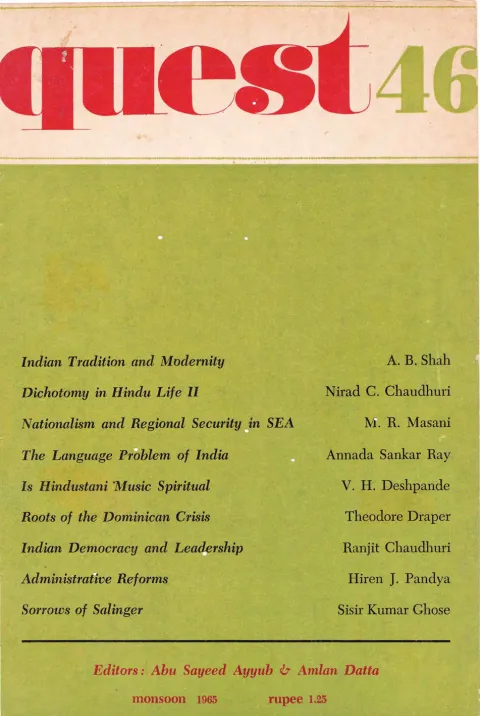
QUEST
Summary
Quest No. 46 (July/September 1965; ‘monsoon 1965’ on the cover) is the Bombay quarterly of the Indian Committee for Cultural Freedom under Abu Sayeed Ayyub and Amlan Datta, and its argumentative centre is a sustained, often abrasive inquiry into whether Indian society can carry a modern politics. A. B. Shah, the sponsoring committee’s own Executive Secretary, opens with a paper written for a Seoul seminar arguing that ‘modernity’ and ‘modernization’ are not the same thing and that the dominant Hindu tradition is, in its Manu-codified form, ‘so much deadwood today’. Nirad C. Chaudhuri, an advisory editor of the journal, follows with Part II of his anatomy of the ‘opposed traits of the Hindu character’, a piece of unrestrained cultural polemic that the issue’s single letter, from K. C. Lalwani, then attacks at the back of the same number. Three further articles read the same pathology through institutions: Ranjit Chaudhuri on the displacement of intellectuals by a ‘plebeian’ Congress leadership, Hiren J. Pandya on the political executive’s connivance in the public’s contempt for the civil services, and Annada Sankar Ray (in translation from Bengali) on the language settlement, arguing that the Constitution has quietly produced ‘a Hindi State’. Sisir Kumar Ghose reads Salinger as a failed Zen novelist, Dayal Saran Verma reconstructs Nietzsche’s idea of progress as a moral aristocracy, and V. H. Deshpande, in the ARTS section, sets out to demolish the visiting Western musicologists’ compliment that Hindustani music is ‘spiritual’.
The CURRENT AFFAIRS section carries the issue’s explicit liberal-Cold-War politics: M. R. Masani, general secretary of the Swatantra Party, delivers what is plainly a spoken address indicting Asian nationalism, non-alignment and autarkic planning, and Theodore Draper contributes nineteen printed pages — the longest item by far — reconstructing the April 1965 U.S. intervention in the Dominican Republic as a decision made against Juan Bosch rather than against Communism. Around these sit poems by Subhash Mukhopadhyay, Gauri Deshpande and Usha Rani (the last two appearing as page-fillers at pp.19 and 39), a self-translated Tamil story by Ka Naa Subramanyam, and seven book reviews under Nissim Ezekiel’s desk covering Edith Sitwell’s posthumous autobiography, two Nehru volumes, Gaudino’s study of the Indian university, an Asian-Australian anthology, a Shakespeare number of Indian Literature, and a Harvard study of Henry James. Two unlisted apparatus blocks, ‘OUR REVIEWERS’ (p.113) and ‘OUR CONTRIBUTORS’ (p.116), complete the editorial matter; there is no shorter-reviews column in this number and no editorial plate anywhere in the issue.
Essays
Tradition and Modernity in India
By A. B. Shah
Shah’s paper, submitted to a seminar on ‘Problems of Modernization in Asia’ at Korea University in June-July 1965, asks whether the Indian tradition is reconcilable with modernity, and answers by first separating two terms that Indian policy discourse conflates. ‘Modernization’ is a matter of civilization - literacy, urbanization, mobility, per capita income, an economy past the take-off stage. ‘Modernity’ is a type of culture, defined by rationality, plurality of opinion and of decision-making centres, secular ethics and respect for the private world of the individual. Industrialization, he argues, follows from modernity but does not produce it: Germany and Japan before the Second World War industrialized without weakening an authoritarian inherited culture, and Russia, Egypt, Ghana and Burma show modernization arriving with dictatorship.
Against that distinction he indicts the dominant Hindu tradition - world-negating, built on maya, karma and transmigration, with no concept of the rights of man and a tolerance ‘rooted in indifference rather than in a recognition of the other man’s right to be different’. He is careful to say which tradition he means: the framework codified by Manu, which he calls deadwood, not the protestant and life-affirming strands (Charvak, the Rig Veda) that he wants harnessed to make the transition less traumatic. His sharpest charge is against Indian intellectuals, who accept modernity only in their professional work while keeping ‘two opposing sets of habit patterns in two water-tight compartments’, and against the universities, national laboratories, Akademis and National Book Trust, whose failure he says is greater after Independence than under British rule and is not a question of money but of values, attitudes and the distribution of power.
- Distinguishes ‘modernity’ (a culture of rationality, plurality and secular ethics) from ‘modernization’ (literacy, urbanization, income), and argues the second does not generate the first.
- Dates Indian modernity to the appearance of the periodical press in Bengal and Western India ‘nearly a hundred and fifty years ago’, so the confrontation is not new and need not be as bitter as in the West.
- Locates the heart of modernity in the universities, and calls their post-Independence failure greater than their failure under British rule.
- Separates the Manu-codified Hindu tradition (which he says must go) from an ‘area of indifference’ (music, dance, painting, dress, handicrafts, festivals) that modernity can leave alone or even complement.
- Argues the West had advantages India lacks - four hundred years, colonial resources, and a Christian ethic available for harnessing - but also handicaps India is spared.
Dichotomy in Hindu Life II
By Nirad C. Chaudhuri
Continuing a series begun in Quest 45, Chaudhuri takes two more ‘dichotomies’ of what he calls the Hindu character - courage against cowardice, stupidity against intelligence - and treats the recessive term in each pair. On physical courage he concedes a great deal: it exists to a high degree, but is emotional rather than reasoned, needs a high boiling point, bears no relation to bodily strength, and is very unevenly distributed by ‘caste, breed, social status’. He reports that his own first military study, written in 1930-31 to rebut the British ‘martial races’ theory, converted him to it. Moral courage he says hardly exists at all: the Hindus have ‘an abject fear of power’, and the failure is worst precisely among those from whom leadership is expected - politicians, administrators, teachers, religious leaders and intellectuals - and has worsened rather than improved with independence, because under Swaraj the Swa, the Ego, has become infinitely more important.
The second half turns on intelligence, which he distinguishes from cleverness and from intellectual ability: the practical faculty of appraising a situation and meeting a crisis. Here he says the modern Hindus are more deficient than any human group in the world, and offers a catalogue of national misjudgments - the forty-year denial that a Hindu-Muslim question existed, the refusal of Irwin’s Dominion Status offer and of the Cripps and Cabinet Mission proposals, the universal expectation of a German victory in both wars, the mishandling of the border question with China. What the intelligence does work hard at, he argues, is the maintenance of the myths that make those failures bearable; its function is to supply ‘a cushion of insulation from all hard realities’. The closing image is of the Hindu intelligence as a retained advocate: the defence counsel for the Hindu way of life.
- Concedes high physical courage but calls it emotional, unevenly distributed by caste and group, and unrelated to bodily strength; reports his own conversion to the British ‘martial races’ theory while trying to refute it.
- Argues moral courage is effectively absent and is scarcest at the top of the social and official hierarchy, and that independence made this worse rather than better.
- Distinguishes ‘courage of life’ as endurance - fatalistic in private life, apocalyptic in public - and reads it as the reason Hindus neither fight resolutely nor compromise realistically.
- Separates cleverness from intelligence and offers a list of national misjudgments from 1929 to the NEFA reverses as evidence of a systemic failure of appraisal.
- Concludes that the Hindu intelligence is not a free agent but an instrument pre-set to defend a way of life, producing ‘semi-consciousness and a good conscience’.
- The piece is a sweeping and deliberately offensive ethnic generalisation, written in the author’s own voice rather than reported for criticism; it also prints a Hindi expletive as an elided triad.
Indian Democracy and Crisis of Leadership
By Ranjit Chaudhuri
Under an epigraph from C. Wright Mills, Ranjit Chaudhuri asks whether democracy necessarily brings the dominance of mediocrity, and traces in India what he calls the displacement of educated and talented men from party leadership by a ‘plebeian’ leadership drawn from the lower rungs of society. He gives six causes. Independence created an enormous demand for administrative and technical personnel, which absorbed the educated middle class and left the field of politics vacant for those with no qualification for the services - producing politicians who, in Max Weber’s terms, live ‘off’ politics rather than ‘for’ it. Universal adult franchise turned caste and community into the currency of local political competition, especially in southern India. Elite formation has gone wrong because competence and integrity, which Edward Shils makes the basis of political legitimacy, cannot be tested where corruption is the price of entry to the party hierarchy. Congress dominance has removed real competition. Illiteracy sustains parochial sentiment. And what Mannheim calls the ‘proletarianization of the intelligentsia’ has left the educated middle class economically dependent and politically subservient.
His conclusion is more careful than his diagnosis. The plebeian character of leadership is a crisis, but the intensity of the crisis depends on the dynamism of the system rather than on the character of the leaders. He points to the Congress having to recruit ‘a man like Asoka Mehta’ to supply intellectual content in the post-Nehru period, and to Nanda’s anti-corruption venture being ‘throttled to death by high level conspiracy inside the Congress’, and argues that what is finally at stake is social ethics - a self-imposed, unwritten code sanctioned by human rationality rather than imposed by an articulate clique.
- Argues Indian democracy has produced a ‘plebeian’ leadership by absorbing the educated class into administration and leaving politics to those with no other vocation.
- Applies Weber’s distinction between living ‘for’ and living ‘off’ politics and says Indian politicians predominantly live off it.
- Uses Shils on elite legitimacy to argue that corruption has become the entry price to party hierarchy, so talent cannot enter at all.
- Identifies one-party Congress dominance, quoting Rajni Kothari’s ‘The Congress is more than a party, it constitutes an entire party system’, as the structural reason competition fails.
- Ends not on leadership but on social ethics, quoting M. N. Roy that good institutions cannot succeed where men have to suffer for being good.
Administrative Reforms: An Attitude Analysis
By Hiren J. Pandya
Pandya writes into the moment of Home Minister Nanda’s anti-corruption drive and the one-man Vigilance Commission set up on a modified version of the Santhanam Committee’s recommendation, and his argument is that the drive is aimed at the wrong target with the wrong attitude. He first explains why the public despises the public services: democracy in an underdeveloped country raises expectations it cannot meet, promises are made ‘with trumpets but without much seriousness at the time of the General Elections’, and the citizen now meets a large ‘Welfare’ bureaucracy at far more points, with more levels of decision-making and more centres of discretionary power, which means both more delay and more scope for corruption. He judges the resulting public attitude ‘not justifiable, but quite understandable’.
He then turns on the political executive. The leaders who had reviled the services before Independence left the machinery almost untouched and even entrenched its members’ rights - a decision he attributes not to sympathy but to Sardar Patel’s threat to resign and to the absence of any plan to reshape the administration. Since then they have at best connived at public antagonism and at worst accentuated it: he cites Jammu and Kashmir, where some hundred public servants were forced into premature retirement on suspicion alone, with ‘no regular inquiry … no charges framed nor cases filed’. His central objection to the Vigilance Commission is its jurisdiction: it covers only Government employees, leaving those in political authority outside, which tells the services that ‘the target of this drive is not corruption or other weakness, but the services themselves’.
- Traces public contempt for the civil services to the gap between welfare-state expectations and capacity, and to the multiplication of discretionary contact points.
- Judges the public’s attitude unjustifiable but understandable, and blames the political executive for not correcting it.
- Reads the post-Independence decision to leave the administrative machinery intact as a product of Sardar Patel’s insistence, not of goodwill towards the services.
- Cites the Jammu and Kashmir premature retirements on suspicion alone as rash action in which ‘all principles of justice and fairplay were thrown overboard’.
- Attacks the Vigilance Commission for confining its jurisdiction to Government employees and exempting political authority, and warns the drive has ‘greater potentialities for harm than good’.
Racing Backwards
By Annada Sankar Ray
Ray’s essay, translated from Bengali by Lila Ray and modified by the author, reconstructs the language question as the story of a defeat - Gandhi’s. He tracks Gandhi’s shifting formula from the 1925 Sitapur Sammelan address through the 1935 definition of Hindustani as a language written in either Devanagari or Urdu script, the founding of the Hindustani Prachar Sabha, and the twin Devanagari and Urdu editions of Harijan Sevak, to the moment after Partition when Gandhi stopped both the Hindi and the Urdu editions rather than publish in one script only. The Hindi Sahitya Sammelan overruled him, Rajendra Prasad’s casting vote in the Constituent Assembly settled Devanagari Hindi as the Union’s official language, and a highly Sanskritized Hindi became, in Ray’s account, the vehicle of revivalism and of the Arya Samaj and the R.S.S.
From there he argues the general case. Where one language among many is made official, its native speakers become ‘members of the ruling class’ and everyone else second-class citizens - the Belgian, Swiss and Alsace-Lorraine examples are his evidence, and he notes that German is spoken by over 70 per cent of the Swiss without any claim to superior right. He wants English naturalised as an Indian language, retained permanently for competitive examinations and defined by function rather than geography, with Hindi as first official language ‘not the only one’ and Bengali, Tamil and Telugu given equal status; there is, he insists, ‘no such thing as a “regional language” because all our languages are national languages’. He takes the Tamil self-immolations seriously as a protest of principle, naming Sivalingam and comparing the movement to the Protestant Reformation, and he is unsparing about his own community: Bengalis’ suicide ‘will take place slowly, by degrees, not as dramatically’.
- Reads the language settlement as Gandhi’s major defeat, tracking his Hindustani formula from 1925 to his suppression of both scripts of Harijan Sevak after Partition.
- Argues that a single official language makes its native speakers a ruling class and everyone else second-class citizens, and calls the Constitution’s settlement ‘a Hindi State’.
- Wants English naturalised as an Indian language and retained permanently for competitive examinations, with frontiers ‘defined according to function, not geography’.
- Rejects the category of ‘regional language’ outright: all Indian languages are national languages.
- Takes the Tamil self-immolations as a protest of principle comparable to the Reformation, while predicting a slower Bengali decline.
Sorrows of Salinger
By Sisir Kumar Ghose
Ghose begins from a question put to him in America - is Salinger well known in India? - and turns it into a sceptical assessment of the Salinger phenomenon and of what, if anything, Salinger has achieved. He is alive to the industry (‘The “Salinger myth” is an active industry, at least on many campuses’) and to the hostile case, quoting critics on the ‘cunning and somewhat shoddy use of Zen’ and on ‘childhood lost’ resolving into ‘a half-mystical half-sentimental resignation’. His own reading places Salinger in the oldest tradition, that of the Quest, ‘but in a disinherited age’, and finds his characters - Holden Caulfield, Seymour Glass, Franny and Zooey - members of an ‘Ancient and Honourable Brotherhood of Seekers and the Maladjusted’ in which the dreamer survives but the dream dies.
He reads The Catcher in the Rye as ‘the teenager epic’ and Holden as divided between the heroic and the happy dream, the catcher in the rye and the deaf-mute in the cabin, with the division unhealed at the end. The Glass stories he treats as a family saga of attempted sainthood whose model, Seymour, has already killed himself before we meet him; Zooey preaches detachment while sitting in judgment, so the image of the Fat Lady ‘fails to be a genuine symbol’ and ‘the parable is underweight, as Time said’. The essay’s verdict is that the Zen experience the fiction speaks of has not yet become a felt quality in the action: the controlling idea does not yet control, and Salinger has still to write his Zen novel. Ghose measures the ideal against Indian terms - Brahmi-sthiti, Nishkama Karma, sarva-bhavena - and closes on an unattributed eight-line poem.
- Places Salinger in the tradition of the Quest ‘but in a disinherited age’, and reads his protagonists as seekers whose dreams die while they survive.
- Treats The Catcher in the Rye as a teenager epic built on an unhealed division between the catcher in the rye and the deaf-mute in the cabin.
- Finds Zooey’s preaching of detachment contradicted by his judging, so the Fat Lady ‘fails to be a genuine symbol’.
- Measures Salinger’s ideal against Indian formulations of non-attached action and finds an imbalance between theory and action.
- Concludes that Salinger has yet to write his Zen novel - and that if he did, ‘It would have to write itself.‘
Nietzsche’s Idea of Social Progress
By Dayal Saran Verma
Verma sets out to recover Nietzsche the social philosopher from Nietzsche the poet-atheist, starting from ‘God is dead; let us create new gods’ and insisting that the injunction to remain true to the earth rules out any new god placed beyond man’s creating will. He argues that Nietzsche’s rejection of the nineteenth century’s faith in inevitable progress was vindicated by the First World War, which exposed the absence of any correlation between man’s growing control over nature and his moral development, and that what the age lacked was control by the moral will - the ‘will’ Nietzsche was searching for.
The substance of the essay is an insistence that the will to power be read psychologically rather than metaphysically: as an account of a fact about valuation rather than a metaphysics, which is what makes Nietzsche’s irrationalism and existentialism intelligible. On that reading there can be no law of progress, because all knowledge is a ‘world-arrangement’ effectuated by the creative elements of human will, and progress consists not in the expansion of science and technology but in increasing the ‘quantum’ of will to power by rearing higher individuals. Verma is careful to interpret the higher man in terms of richness of personality - the capacity to harness antagonistic qualities - rather than self-assertion, and to refute the reading of Nietzsche as a supporter of state regimentation, quoting the Zarathustra passage on the state as ‘the coldest of all cold monsters’. The conclusion is that Nietzsche conceives a progressive society as a moral aristocracy, and that the will to power is ‘an urge for the higher life’. Verma notes in passing that many later theories of personality development were anticipated by Nietzsche.
- Reads Nietzsche’s new gods as necessarily earthly, so that no transcendental or inevitable principle can be admitted.
- Insists the will to power is a psychological, not a metaphysical, concept - the move that makes Nietzsche’s irrationalism and existentialism coherent.
- Denies any law of progress: knowledge is a ‘world-arrangement’ effectuated by will, so progress cannot be given an objective criterion.
- Interprets the higher man as richness of personality, the capacity to harness antagonistic forces, rather than self-assertion or self-aggrandisement.
- Refutes the reading of Nietzsche as an advocate of state regimentation, quoting Zarathustra on the state as the coldest of cold monsters and ‘The better the state is organised, the duller will humanity be’.
Nationalism and Regional Security in South & South-East Asia
By M. R. Masani
Masani opens from a remark by the Indian Foreign Minister, Swaran Singh, that Asian unity was being damaged by new ambitions and conflicts, and answers by touring the region: inter-Arab rivalries and the Yemen, the Arab states versus Israel, Pakhtoonistan, Kashmir, Chinese troops on the Himalayan heights (which he attributes squarely to ‘the betrayal of Tibet by the Indian Government in 1950 and again in 1960’), the Naga ceasefire, Burma turning into ‘a Cuba of the East’, Laos two-thirds eaten up by ‘neutralisation’, Vietnam as a vacuum, Cambodia seeing threats only from Washington, and Indonesian aggression against Malaysia backed by both Peking and Moscow. His diagnosis is that the cause of this failure to combine against the threat from the north is nationalism ‘of a rather superficial and foolish kind’, arriving too late in history - he quotes E. M. Forster on India as ‘Last comer to the drab 19th Century sisterhood’.
He then enumerates the forms this nationalism takes: neo-colonialism as ‘a reflection of a subjective feeling of inferiority’, non-alignment as ‘a moral evasion’, ‘my country, right or wrong’, and economic nationalism, which he says makes Soviet-type autarkic planning inevitable and starves agriculture in favour of steel. He quotes a Pakistani presidential adviser on the developing countries importing ‘all the traditional diseases of Europe’, and defends the proposition that genuine anti-imperialism must include opposition to the imperialism of one’s own country. His prescriptions are a policy of interdependence, equity capital rather than government-to-government loans (because equity comes in at its own risk), aid tied to infrastructure rather than manufacture, and above all frank intellectual aid: he complains bitterly that visiting Western experts ‘give a fine certificate to our governments’, eroding the position of Liberals and democrats at home. He distinguishes legitimate Swedish or Swiss state neutrality, which he does not attack, from the intellectual neutralism he says Asian leaders have been preaching.
- Surveys the region from the Yemen to Singapore to show natural allies quarrelling instead of combining against the threat from the north.
- Names superficial nationalism as the cause, and argues the nation state arrived in Asia and Africa ‘too late in history … like a baby born after its time’.
- Calls non-alignment ‘a moral evasion’ and a theory of equidistance that inevitably takes the side of tyranny, while explicitly exempting Swedish and Swiss state neutrality.
- Attacks economic nationalism and autarkic planning for diverting capital from agriculture to steel, and welcomes the U.S. Congress’s refusal of another steel plant.
- Argues for equity capital over government loans and for frank ‘intellectual or ideological aid’, complaining that visiting Western experts certify irresponsible governments and erode domestic liberals.
The Roots of the Dominican Crisis
By Theodore Draper
Draper’s nineteen-page reconstruction argues that the April 1965 crisis is not a separate event but a continuation of the 1963 coup, and that in both cases the Communist issue was a cover. He begins from the gap between American words and deeds - Johnson calling the pro-Bosch rising ‘a popular democratic revolution committed to democracy and social justice’ while U.S. forces patrolled Santo Domingo alongside the junta - and then supplies the history the official story omits. Bosch inherited the Trujillo armed forces intact and deliberately left them alone, knowing a purge meant civil war; he was in office seven months and knew of plots from his tenth day. On Communism, Draper shows that the charge preceded Bosch’s presidency, that his party had disbanded its own youth section to stop MPD infiltration, that the Communists had attacked him for decades, and that the only name ever produced to support the ‘infiltration’ charge was Sacha Volman, a well-known anti-Communist whose New York institute was chaired by Norman Thomas.
He then tracks the manufacture of the 1965 case. On 29 April Johnson had reports of ‘at least two and perhaps seven or eight’ Communists among the rebels; by 30 April the CIA had supplied a figure of 55 or 58; after 5 May not a single one of the names was mentioned again in dispatches from Santo Domingo, and Newsweek reported that the embassy ‘failed to convince the 156 foreign correspondents … that “the 58” were a menace’. He notes that U.S. intelligence traced the beginning of Communist growth in the Dominican Republic to the period after Bosch’s 1963 overthrow - ‘a devastating commentary on the legend that Bosch was overthrown to prevent a Communist takeover’. His conclusion is that policy fashioned intelligence rather than the reverse, that the decision of 25-28 April was made against Bosch rather than against Communism, and that backing Wessin y Wessin was like the Allies backing Goering to save Germany from Communism.
- Argues the 1965 intervention continues the 1963 coup, with the same actors and the same pretext - ‘Nothing has changed, not even the names.’
- Shows Bosch deliberately left the inherited Trujillo armed forces intact rather than risk civil war, and reads this as strength of character rather than weakness.
- Demonstrates that the Communist charge preceded Bosch’s presidency and that the Communists had themselves vilified him for decades; the only name offered to support ‘infiltration’ was a known anti-Communist.
- Tracks the official Communist count from ‘two and perhaps seven or eight’ on 29 April to 55 or 58 on 30 April, after which the names were never mentioned again.
- Documents U.S. correspondents’ disenchantment with embassy briefings, including an alleged machine-gunning that ‘not a single reporter … has found concrete evidence of’.
- Concludes that ‘policy fashioned intelligence - or at least the kind of intelligence made public.‘
Is Hindustani Music Spiritual?
By V. H. Deshpande
Deshpande’s talk, given to the G. M. Vidyalaya’s All Indian Music Teachers Conference at Jaipur in October 1964, takes up the compliment paid by Western musicologists at the February 1964 East and West Music Conference in New Delhi - that Indian classical music, unlike its Western counterpart, is essentially spiritual - and sets out to refuse it. He quotes Koellreutter, Junious, Meyer, Menuhin, Ashton, Stukenschmidt and Lutz, enters careful reservations that they may have meant something narrower by ‘spiritual’ than divine knowledge or self-realization, and then names what alarms him: none of the visitors except one spoke of the artistic values of the music at all, and Indians are already too fond of calling themselves spiritual in contrast to a materialistic West.
His argument turns on development. All music grew under religious protection, but the test of an art’s maturity is how far it has cast off those crutches; if ‘spiritual’ means ‘religious’, the description is not a compliment but a confession of infancy. He traces the succession from dhrupad, dominated by devotional literary content, to the khyal evolved by Sadarang at Mohamedshah’s court, ‘which has obviously no religious or spiritual colouring’. He then divides the gharanas into an artistic group - Gwalior, Agra, Rampur, Jaipur, Patiala, Bhendibazar - united by structural beauty, melodic design and above all ‘a sharp sense of “drama”’, and a single possible spiritual case, the Kirana house, which he narrows further to its founder Abdul Karim Khansaheb alone, excluding even his disciples. He credits Abdul Karim’s tonal trance while judging that his form ‘suffered and became lop-sided’, lacking ‘the essential rigour of the rhythmic frame’. Against the visiting scholar who said dramatic tension is alien to Indian music he sets the concept of sama, the accented first beat at which each cycle’s tension resolves. A Postscript suggests the Westerners may have generalised from the alaap-heavy instrumental performances of Ravi Shankar and Ali Akbar.
- Refuses the visiting musicologists’ compliment that Hindustani music is spiritual, allowing exactly one exception.
- Argues that if ‘spiritual’ means ‘religious’, the description records an art still in ‘a crawling infantile stage’ rather than a virtue.
- Divides the gharanas into an artistic group defined by structural design and ‘a sharp sense of drama’ and a single spiritual case, narrowed from the Kirana house to Abdul Karim Khansaheb personally.
- Answers the claim that dramatic tension is alien to Indian music with the concept of sama, the point of resolution of each rhythmic cycle.
- Distinguishes meditativeness from spirituality: anything spiritual ‘has to be employed spiritually’, as with Haridas Swami, Meerabai or Thyagaraja.
- Discloses his own twelve years under Abdul Karim’s ‘magic spell’ and warns he may be sublimating non-artistic deviations into a spiritual colour.
Spring
By Subhash Mukhopadhyay
A poem in free verse, translated from Bengali by Ashim Chowdhury, that sets a refrain of insistent seasonal renewal against images of urban and political damage. A sapless tree on the pavement, its roots dug into stone, ‘through its split sides / laughs into fresh green leaves’; between two statements of the refrain come the days that ‘put black blinkers on light’, that placed men in the lap of death and picked them up again, and that carried off a mimic-boy who played the cuckoo for a penny or two. The poem’s last movement turns to an unmarried woman at the rails who reads the yellow sky as a wedding invitation printed in red ink, is alighted on by ‘a shameless butterfly’, and bangs her door shut - while the gnarled tree stands on, ‘tittering in the dark’. An editorial footnote on printed p.93, not credited to anyone, explains that Bengali Hindu wedding invitations are printed in red on yellow paper and that Prajapati means both the presiding deity of marriage and a butterfly.
- Built on a two-line refrain, ‘Flowers or no, / it is spring today’, set against images of damage and loss.
- The central image is a sapless pavement tree that laughs into leaf through its split sides.
- A middle section curses the days that blinkered the light and took a street performer away.
- The close turns on an unmarried woman who reads the sky as a wedding invitation and shuts her door on a butterfly.
- An unsigned footnote supplies the Prajapati wordplay that the English cannot carry - the same word means Brahma as lord of marriage and a butterfly.
Poems in Winter
By Gauri Deshpande
Three numbered poems printed continuously under one head, all in a register of exhausted retrospection. In I, a speaker in ‘the autumn of my life’ finds the rusted heart no longer knows how to suffer, and asks repeatedly whether she should remember - the crazed cracked vessel, the shredded picture, the mocking tawny eyes, the spring when the Mimosa ‘Blew and blew and blew’ - before concluding that the earth’s ‘tiresome gyrations’ have sawed little piles of sawdust from her life, cutting away at the branch of memory until only a face and perhaps a smile remain. II addresses an absent person in paradox: ‘When the vast barrenness of your presence confronts me / I feel your absence fruitful’, and inventories what was projected onto them - smokey blue eyes and golden hair wished upon a child ‘That is born with her father’s face’, a laugh with sharp dog teeth, some long dark hand, some turn of phrase - only to refuse the word symbol: ‘No. For there you are, close enough to kiss / With only this vast / Barrenness of your presence between.’ III is a seven-line domestic scene: the speaker walks home late, her shadow tossed between lampposts, and is asked why she looks ‘like that’ - ‘What “that” was I never knew. / Not, I am sure, what I would have looked like / Had I met you.’ No printed biography accompanies the poems.
- A three-part sequence printed under one head and one byline, with no separate titles and no separate page numbers.
- I turns on whether to remember, and on memory as a branch being sawed away.
- II is built on a single sustained paradox - a barren presence against a fruitful absence.
- III reduces the whole sequence to a domestic exchange about a look the speaker cannot name.
- The unnamed addressee is never met in the poems; the encounter stays hypothetical to the last line.
The Unspoken Word
By Usha Rani
A ten-line poem, translated from Panjabi by Satya Dev Jaggi, printed as a filler in the lower half of printed p.19 beneath the tail of A. B. Shah’s footnotes. It is built entirely of questions. Who can speak the word the speaker would have spoken, had her eyes not failed to speak ‘In the silence of unuttered love’? Who will stand the chill of life’s unmeaning fire? The closing wish is to know what was once not seen and to feel, behind ‘slow time’s uncertain wing’, a sigh that owns all mankind and all its unredeeming grief - so that a private failure of utterance opens onto a general one.
- Ten lines, entirely interrogative or optative; no statement is made in the poem’s own voice.
- The governing failure is a failure of speech - eyes that ‘failed to speak / In the silence of unuttered love’.
- The close widens from a personal grief to ‘A sigh that owns all mankind’.
- Printed as page-filler under another author’s footnotes, and listed out of sequence on the contents page.
- The translator, Satya Dev Jaggi, is credited on the page but not on the contents page.
Love’s Voice Waiting
By Usha Rani
An eleven-line poem, again translated from Panjabi by Satya Dev Jaggi, printed as a filler in the lower half of printed p.39 beneath the close of Hiren J. Pandya’s article. Where ‘The Unspoken Word’ asked questions, this one refuses: the speaker, having lost her world and her pride, will not listen, and consigns the addressee to muteness and non-existence - ‘Do not exist for me.’ What follows is a birth announcement made out of loss. The ‘unborn bliss’ she will bear forth turns the ‘flower-born agonies’ into ‘the itches for a new desire’, and the new world she promises is ‘A new, a pregnant world, one giving place / To all the universes’. The last image is of speech deferred: ‘I shall speak as the chaff / Through the unripe grain - It is love’s voice / Waiting for the harsh wind to stop.’
- Opens by refusing to listen and by cancelling the addressee’s existence, the reverse of the companion poem’s questions.
- Reworks loss into gestation: an ‘unborn bliss’ and ‘A new, a pregnant world, one giving place / To all the universes’.
- Ends on deferred rather than failed speech - love’s voice waiting for the harsh wind to stop.
- Printed as page-filler under another author’s article and listed out of sequence on the contents page.
The Man Born to be King
By Ka Naa Subramanyam
A story translated from Tamil by the author, framed as a conversation between a history graduate and his grandmother Sundha, who has just been told by the astrologer Valluvan that she will live to a hundred and two. Asked whether it is good to believe, she answers ‘Sometimes it is good to believe; sometimes it is bad to believe’ and then tells a tale to settle the point. A poor Tanjore Brahmin boy, Govinda Iyan, quick to learn and adept at palmistry, sets out on a months-long padayatra for the court of the Vijayanagar Raya, earning his way by reading soldiers’ palms and telling them only what would please them. Resting by a tank, he reads the hand of a cowherd boy of ten or eleven, jerks to attention, calls for the left hand, and takes the boy with him. The cowherd becomes Sevvappa Nayaka, founder of the Nayak dynasty that ruled Tanjore for two centuries; Govinda Iyan returns as his minister, outlives him, serves his son and grandson, and has a tank and a bazaar named after him.
The story’s point is in the frame rather than the tale. Sundha’s conclusion is that a competent fortune-teller is worth believing and the local Valluvan is not. The grandson, nettled by her insistence that he is ignorant of local history, says historians will call it a grandmother’s story, and she replies that historians think they know everything and would have done better to listen to their grandmothers. The last paragraph is his capitulation, delivered with an irony that cuts both ways: ‘my grandmother, though wise in her generation, is a poor ignorant unlettered person while I am a graduate in history of the University.’
- A frame narrative in which a grandmother’s tale is set against a university history graduate’s scepticism.
- The inset tale explains the founding of the Tanjore Nayak dynasty by a cowherd whose palm was read by a wandering Brahmin.
- Govinda Iyan’s palmistry succeeds partly by flattery - ‘part of the art of prognostication consists in pleasing the subject’.
- The grandmother’s verdict discriminates between fortune-tellers rather than endorsing or rejecting the practice.
- The closing sentence leaves the irony unresolved: the graduate’s credentials are asserted just as his authority has been undercut.
Taken Care of
By Neville Braybrooke
Braybrooke reviews Edith Sitwell’s autobiography, published four months after her death, by turning three adjectives she used of Christopher Smart - ‘sainted’, ‘illuminated’ and ‘mad’ - back onto her own work. He concedes absurdities (‘Ghosts tall as the wind of silence on the wall’) but finds many more rewards, and reads her lifelong need for fantasy and her insistence on her own genius as compensations for a cold reception into the world: she was, on her own account, unpopular with her parents from the moment of her birth. The review is unusually attentive to the physical cruelty of her childhood - a steel harness that semi-paralysed the muscles of her back and legs for life, and upholstered pads clamped to each side of her nose that made normal breathing an effort - and to the charity with which she wrote about her parents in her last months.
He is clear about what the book is not: ‘for those in search of scandal or gossipy tit-bits, Taken Care Of will be unrewarding’, since her main concern is the practice of her art, and the family history is recorded in much more detail by her brother Osbert. He notes her pioneering of jazz poetry and her being the first poet of importance to write about the atomic bomb, quotes her retort to critics of ‘a wan grassy sea’ and ‘a swan-bosomed tree’, and traces her warmest phrases to servants and retainers rather than to her parents’ drawing-room. The review closes on the book’s final pages, a visit to Skid Row in Los Angeles, where she reapplies the vocabulary of her thirty-year-old Gold Coast Customs and where, in Ashantee in the 1830s as in Los Angeles in the 1960s, the poor man ‘continued to represent for her the Starved Man upon the Cross’.
- Applies Sitwell’s own words for Christopher Smart - sainted, illuminated, mad - to her posthumous autobiography.
- Reads her boasts of genius as compensation for parental rejection rather than as vanity.
- Records the remedial apparatus of her childhood - a steel harness and nose pads - as torture, and her later charity about it.
- Warns readers after scandal that the book’s real subject is the practice of her art.
- Ends on the continuity between the Ashantee slums of Gold Coast Customs and Skid Row in the 1960s.
The Emerging World
By Mahesh Desai
Desai reviews the Jawaharlal Nehru Memorial Volume as ‘in many ways a sad book to review’ - intended as a tribute on Nehru’s seventy-fifth year, issued instead after his death - and finds the contents unequal to their occasion. His two structural complaints are the narrow range of geography from which contributions were invited and the undefined context in which each was written; his blunt judgment is that many contributors ‘show themselves banal in thought and style’ by contrast with the man they commemorate.
He sorts the contributions by temper rather than nationality. The Asian contributors, he observes, produce spiritual and educational abstractions: Suzuki on Zen language, Tan Yun-Shan on India-China contacts, Rajagopalachari explaining Hinduism in three pages with ‘the bland statement that “All Hindus today understand, believe in and follow the Hindu religion faithfully”’, Sampurnanand on secularism deteriorating into anti-religionism, Vinoba Bhave on harmony with Nature and Zakir Hussain on education as anticipation of the future. ‘It is conceivable’, he notes drily, ‘that the process of emergence in Asia and Africa might have occasioned more mundane thoughts from a Nigerian or an Indonesian.’ The Western contributors he finds earthier - Attlee, Escott Reid, Willy Brandt, Mendes-France and Myrdal - though he adds that ‘such desperate appeal to the altruism of the West is seldom sweet music to Asian ears’. Best of all he likes the contemplatives: Lord Adrian’s ‘We must teach the new generation to advance beyond us’, Richard Gregg on the futility of prediction, and Sir Eric Ashby’s reminder that fear is no new thing and that ‘It is only the sophisticated who suffer from a sense of doom’. Nehru, he concludes, belonged to that ‘emerging but unarrogant world of science and humanism’, and the compassionate visionary ‘comes out beautifully in the single photograph in this book’.
- Reads the volume’s history against itself - planned as a 75th-year tribute, published as a memorial.
- Blames the narrow geography of invitation and the undefined brief for contributions that lack a unity of theme.
- Contrasts Asian contributors’ spiritual abstractions with Western contributors’ ‘inquiries of an earthier kind’.
- Quotes Rajagopalachari’s three-page account of Hinduism as an example of the volume’s blandness.
- Prefers the contemplatives - Adrian, Gregg, Ashby - and locates Nehru in their ‘emerging but unarrogant world of science and humanism’.
Nehru: Sunlight and Shadow
By A. G. Noorani
Noorani reviews Frank Moraes’s fresh appraisal of Nehru - by the author of an earlier Nehru biography - as a book with ‘a scrupulous regard for facts’ whose conclusions nonetheless stop short of the study the subject deserves. He accepts Moraes’s central contention against the Hamlet reading: Nehru’s mind was made up a decade before independence and his views ‘remained virtually static’ for twenty-five years afterwards. On the relationship with Krishna Menon he prefers Moraes’s sketch of Nehru’s character to Moraes’s stated explanation - ‘He despised sycophants though he was susceptible to clever flattery’ - and on Communism he reads Nehru’s famous distinction between the Communist ideal and the Communist technique as ‘confused thinking’ that explains why the 1953 overture to the Praja Socialists was never repeated.
The review’s substance is a list of what Moraes left out or got wrong. He wants the Praja Socialist episode discussed more fully; he identifies the omission of Indo-Pak relations’ impact on foreign policy as the book’s major gap, dating the formative years to 1952-54 and noting that ‘in all the seventeen years not once did Mr. Nehru take a determined initiative for Indo-Pak harmony’; and he rejects Moraes’s periodisation - ‘Nehru’s golden years as Prime Minister were the first ten years after Independence’ - on the ground that the later failures originated in earlier mistakes. He accepts Kashmir as the greatest of the mistakes, quotes Moraes at length on it as ‘a running sore’, and grants the achievements - Indian unity, democracy, secularism, planned economy, the principle of non-alignment - while listing the policies that undercut them. His verdict on the man is severe and generous at once: ‘Nehru was not a great intellect, but he was a man of noble impulse, civilized and humane’, and ‘A great man chose wilfully to remain greater than his achievements.’
- Accepts Moraes’s case against the Hamlet reading: Nehru’s views were fixed by 1936 and stayed static for twenty-five years.
- Reads Nehru’s distinction between the Communist ideal and the Communist technique as confused thinking with political consequences.
- Names the omission of Indo-Pak relations from the account of foreign policy as the book’s chief gap.
- Rejects the ‘golden first ten years’ periodisation, arguing later failures originated in earlier mistakes.
- Concedes the achievements - unity, democracy, secularism, planned economy, non-alignment - while listing the policies that weakened each.
The Indian University
By Suma Chitnis
Chitnis welcomes Robert L. Gaudino’s study as well timed for the Education Commission and pitched at exactly the reader who most needs it: the educated ‘common man’ who knows enough to be alarmed and not enough to see a solution. Its virtue, she argues, is that it is uncluttered with figures, tables and technical details, and that its author sympathises with the system’s handicaps without any of ‘the attitude of compromise or eagerness to condone that hamper constructive criticism’. Most of what he says is familiar - it is about universities where most readers have spent years - but the analysis compels a serious evaluation of an academic way of life ‘which is accepted uncritically out of apathy and sheer habit’.
She follows Gaudino’s two-part method: first the setting - a society that esteems age, respects status, nourishes hierarchy and remains caste-bound, with limited resources against bulging demands and a temperament ‘not prone to radical thought, though capable of spasmodic radical action’ - and then the structures (Senate, Syndicate, Academic Council, hostels, youth organizations) and the people (Chancellor, Vice-Chancellor, Registrar, Principal, Head of Department, teacher, student), each followed through routine and special function. The result, she reports, is that ‘the university does not emerge as an intellectual community at all’: the stated goal of study and research is reiterated on solemn occasions and then smothered by the demand to turn out more graduates, while lesser goals dissipate energy. Her own note of hope is institutional and slightly barbed - the University Grants Commission ‘stands out as a fairy godmother’ for having the courage to reject boldly the assertion that ‘higher education is a right for all’, and in the absence of any attempt to control ideas or condition points of view ‘there is great hope’. Her one criticism is that Gaudino never explicitly answers his own questions about India’s goals for higher education, and she declines to attribute the silence to politeness.
- Praises the book for reaching the educated general reader rather than the specialist, and for avoiding the forbidding apparatus of official reports.
- Follows Gaudino’s method from the social setting - hierarchy, status, caste, scarce resources - to structures and then to persons.
- Reports the central finding: the Indian university does not emerge as an intellectual community, its stated purpose smothered by graduate throughput.
- Finds hope in the UGC’s willingness to reject ‘higher education is a right for all’ and in the absence of any attempt to control ideas.
- Faults the author for never explicitly answering his own questions about India’s goals for higher education.
Hemisphere: Asian-Australian View-points and Ideas
By Sibnarayan Ray
Ray frames his review of this anthology from the Australian Commonwealth Office of Education’s magazine Hemisphere with a geopolitical argument of his own: Australia is ethnically, socially and culturally an extension of Europe whose future is tied to South and South-East Asia, and the situation admits two outcomes - Australia as ‘an energising influence in tradition-bound Asia’ without the old features of West-East relations, or Australia isolated and ‘caught unprepared in the vortex of South East Asian political instability’. He records the mutual ignorance on both sides: Australian schools and universities pay scant attention to Asian languages and civilizations, while Asian countries hold ‘a distorted and rather unflattering image of Australia’ made up of curious animals, vast empty spaces, ‘prosperous but semi-civilized wheat-and-wool growers’, segregated aborigines and a discriminatory immigration policy - a stereotype he reports in order to criticise it.
He sorts the forty-two essays - slightly over half Australian, the rest from eight Asian countries - into four groups: the case for greater cultural understanding, the problem of translation, informative surveys of Asian cultures, and critical examinations of Australian society. He rates the fourth group the most thoughtful, and that judgment produces his central criticism. Australians writing about themselves can be frank and critical; those writing about Asia, whether Asian or Australian, must refrain from even legitimate criticism because they are writing for an Australian readership that knows little about Asia. The result is that ‘there is little real dialogue, despite all the good intentions of the editor and the contributors’, and, most tellingly, ‘in this volume no Asian has written on Australia although that may possibly have been the most promising starting point’. He singles out H. F. Simon’s case for Asian languages in Australian schools as the most persuasive essay and notes that J. D. B. Miller’s proposals are ‘somewhat spoiled by its patronizing overtones’.
- Opens with Ray’s own thesis about Australia’s ambiguous position between a European inheritance and an Asian geography.
- Documents mutual ignorance, reporting the Asian stereotype of Australia in order to criticise it.
- Sorts forty-two essays into four groups and rates the self-critical Australian essays the most thoughtful.
- Identifies the structural asymmetry: frankness is available to Australians writing about themselves and not to anyone writing about Asia for Australian readers.
- Notes that no Asian in the volume writes about Australia - ‘possibly … the most promising starting point’.
Indian Literature: Vol. VII, No. 1 - Shakespeare Number
By D. McCutchion
McCutchion reviews the Sahitya Akademi’s Shakespeare number of Indian Literature - one essay on Shakespeare’s influence in each of the fourteen national languages, two for Bengali, plus a covering essay by Srinivasa Iyengar - and finds that nearly all tell the same story: early enthusiasm followed by a decline of interest. His pleasure is in the detail of the early reception. Shakespeare was taken on the stage as melodrama rather than tragedy, and travestied: Romeo and Juliet could ‘rise from the dead and live happily ever after’ in Kannada, King Lear became ‘a comedy with the usual farcical interludes and amorous songs’ in Hindi, and the Urdu Hamlet was ‘prone to break into a popular song which is meticulously set to tune and often repeated on popular demand’. In the colleges hostile forces operated too: Mrs Grundy once banned Romeo and Juliet in Sindhi for ‘the over-boldness of its love-scenes and dialogues’.
He is most interested in the Indianisation - Shylock as ‘a blood-sucking Shamu Shah’ in Punjabi and ‘Hariram, the Marwari usurer’ in Sindhi; Hamlet compared with Mahatma Gandhi and Othello read as a ‘tragedy of caste’; Coriolanus renamed Tara in Assam because the adapter emphasised Volumnia over her son; Ophelia held up by Hari Narayan Apte as an image of the young Indian woman suffering a father’s tyranny - and in the social reach that came with it, Shakespeare taken from the academics and brought to ‘semiliterate young men from the slums, the market place, and the petty labourers’. He notes that the discovery of Shakespeare coincided with the rediscovery of Sanskrit drama and that both inspired the revival of the Indian stage, before both were displaced by the realistic social problem play. Occasionally, he observes, contributors reach opposite conclusions - Das Gupta contrasting Sanskrit dream worlds with Shakespearean ‘stern realities’, Moorthy Rao insisting the tragic sense will not startle readers of Valmiki, Vyasa, Kalidasa and Bhavabhuti. His closing verdict is double: Shakespeare has returned to the academics, and translations steadily improve.
- Finds a single narrative across fourteen languages: early enthusiasm followed by declining interest.
- Collects the travesties of the early stage - a Romeo and Juliet with a happy ending, a comic King Lear, a singing Urdu Hamlet.
- Treats the Indianisation of names and settings as the number’s most fascinating material.
- Notes that Shakespeare reached slum youths and petty labourers, and was ‘a liberating force, a “symbol” … of an exciting new world’.
- Observes that contributors sometimes reach opposite conclusions about the relation of Shakespearean and Sanskrit tragedy.
- Ends on a double movement: Shakespeare back in the academy, and translations improving.
Technique in the Tales of Henry James
By Foy Nissen
Nissen reviews Krishna Baldev Vaid’s Harvard study of the short fiction of Henry James, and his account is chiefly a defence of its method. He opens with J. W. Beach’s observation that American scholarship tends to classify James as a realist although his aim was ‘to tell the special truth about highly selected types under circumstances carefully arranged’, and it is to that careful arrangement, he says, that Vaid attends - by close analysis of the internal evidence of the Tales themselves. Textual criticism is usually applied to verse, where compression and precision make it natural; Nissen argues that a textual approach is nonetheless vindicated for James’s prose by the one constant underlying his fiction, his conscious preoccupation with formal method. He quotes Graham Hough to a BBC audience - ‘it is always the formal problem that occupies most of his (James’) attention’ - and credits Vaid with knowing the Notebooks well while recognising their limits as a boundary for academic speculation.
He praises Vaid for wisely ignoring ‘the moral preoccupations that have bedevilled Jamesian criticism’ and for an approach governed by an identification with Ezra Pound’s honest critic answering the question ‘what the deuce shall I read?’. Through twenty-two tales - carefully distinguished as tales, anecdotes, nouvelles and parables - Vaid brings the reader to James’s personae, his first-person narrators (‘sometimes “conscient”, sometimes “semi-conscient”, and never fully “inconscient”’) and his omniscient-author narrators, and that distinction supplies the book’s formal division. Nissen singles out the discussion of The Turn of the Screw and the reliability of its governess as having ‘done much to apply a cold compress to much of the critical delirium’ around the tale, and describes James’s refinement of the omniscient narrator as a shift of focus from external to internal reality, foreclosing incident in favour of ‘perceptions inwardly attained’. His closing compliment is a backhanded one: Vaid ‘will have succeeded amply if the only reaction of his reader is to put him down to read James instead.’
- Defends the application of textual criticism to prose fiction on the ground of James’s own constant preoccupation with formal method.
- Praises Vaid for setting aside the moral and psychological preoccupations that have dominated Jamesian criticism.
- Summarises the book’s formal division between first-person and omniscient-author narrators across twenty-two tales.
- Singles out the treatment of The Turn of the Screw as a corrective to ‘critical delirium’ about the governess.
- Reads James’s late shift ‘from external to internal reality’ as a gain rather than a merely technical achievement.
Dichotomy in Hindu Life
By K. C. Lalwani
The issue’s single letter, and the only item under CORRESPONDENCE, attacks the premise of Nirad C. Chaudhuri’s work in the Statesman of 24 April and its continuation in Quest 45 - the phrase ‘the Hindu way of life’. Lalwani says he looked in vain for an explanation of it, and holds that there is no such thing as a set and uniform way of life called Hindu, so that attacking it is ‘like aiming a shot at an adversary who does not exist’. He grants that Chaudhuri’s contradictory characteristics, if admitted, would apply to the whole population rather than to a part of it, and rejects the definitional note preceding the article: whatever the word meant at the time of the Macedonian conquest, by the time it gained currency under Mughal rule it signified not a uniform ethnic group but peoples diverse in race, language, manners, usages, food habits and modes of worship, living in a land called Hindustan. Even Babar’s assessment, he notes, was directed against all infidels rather than against any particular ethnic group.
His counter-thesis is that Indian disunity is a historical rather than an evolutionary product. He lists the ethnic groups that entered and were ‘Hinduised’ from prehistory to the Kushans, argues that if the Aryan caste system supplied the vertical division of Hindu society then ethnic consciousness supplied a horizontal one, and observes that the ethnic division has taken a fresh lease of life from self-determination, producing the demand for linguistic states and a federal constitution. Against Chaudhuri’s claim that Hindu solidarity was roused only when the Hindu nations were collectively threatened by non-Hindus, he sets Aryan disunity before the Kushans, Rajput disunity before the Turko-Afghans, Maratha disunity at Panipat and Indian disunity in 1857. He borrows Toynbee for a general law - ‘the Englishmen built an empire when they were stupid but lost it when they became intelligent’ - and concludes that the facade of unity under the Raj disappeared the moment its utility was questioned. No editorial reply is printed.
- Attacks the existence of the object of Chaudhuri’s critique: there is no set and uniform ‘Hindu way of life’ to attack.
- Rejects Chaudhuri’s ethnic definition of ‘Hindu’ on historical grounds, tracing the word’s widening under Mughal rule.
- Proposes a vertical caste division crossed by a horizontal ethnic division, the latter revived by self-determination and linguistic states.
- Counters Chaudhuri’s claim about Hindu solidarity under external threat with four historical counter-examples.
- Attributes disunity to historical circumstance, a preference for small states, and a sometimes false sense of superiority rather than to evolution.
- The journal prints a frontal attack on the work of its own advisory editor - whose sequel appears in the same issue - without comment or reply.
Essay 24
An unlisted apparatus block, headed ‘OUR REVIEWERS’ in spaced capitals, printed at the foot of printed p.113 immediately after Foy Nissen’s signature and before the CORRESPONDENCE section. It carries one short third-person biographical note for each of the issue’s seven reviewers, in the order in which their reviews appear. The notes are terse and largely occupational: Braybrooke is ‘British author and journalist, has just published a symposium on Teilhard de Chardin’; Mahesh Desai ‘works for the P.S.P. in Jharia, Bihar’; Noorani ‘is a Bombay lawyer and journalist’; Suma Chitnis ‘has been a University teacher and now works for the Demographic Research Institute, Bombay’; Sibnarayan Ray is ‘one of the editors of the Radical Humanist, is at present on a teaching assignment at Melbourne University’; McCutchion ‘lectures in comparative literature at Jadavpur University, Calcutta’; and Foy Nissen ‘works for the British Council in Bombay’. Together with the separate ‘OUR CONTRIBUTORS’ block at printed p.116, this is the only apparatus the issue supplies about its own writers, and it is the source of the one item of nationality evidence in the whole number.
- Seven notes, one per reviewer, in review order; not listed on the contents page.
- Only Braybrooke’s note gives any nationality evidence in the whole issue: ‘British author and journalist’.
- Placement discloses a network: the Reviews Editor’s desk has drawn on the Radical Humanist circle, whose editor Sibnarayan Ray reviews here and to which A. B. Shah is a contributing editor.
- Mahesh Desai’s P.S.P. affiliation is disclosed immediately below a review in which he treats Praja Socialist material sympathetically elsewhere in the issue’s Nehru coverage.
- The block is printed in a smaller measure than the reviews, across the full width of the page rather than in columns.
Essay 25
An unlisted apparatus block, headed ‘OUR CONTRIBUTORS’ in spaced italic capitals between two rules, occupying printed p.116 between the correspondence and the back-matter advertisements. It carries twelve third-person biographical notes, one for each bylined article, poem and story author, in contents-page order - and notably not for Gauri Deshpande, Usha Rani, K. C. Lalwani or any of the three named translators, all of whom are bylined in the issue and have no note. Several of the notes carry information the issue does not disclose anywhere else, including the fact that this number’s lead article is by the Executive Secretary of the sponsoring committee, and that M. R. Masani, author of the Current Affairs piece on nationalism, is general secretary of the Swatantra Party and its deputy leader in the Lok Sabha. Nirad C. Chaudhuri’s note doubles as an advertisement for his forthcoming book, The Continent of Circe, which he also cites in a footnote to his own article on printed p.23. None of the notes gives nationality evidence; the Draper note records only university affiliations.
- Twelve notes in contents order, covering every article, poem and story author except Gauri Deshpande and Usha Rani.
- Bylined translators (Satya Dev Jaggi, Lila Ray, Ashim Chowdhury) and the correspondent K. C. Lalwani get no note at all.
- Discloses that the lead article’s author is ‘the Executive Secretary of the Indian Committee of the Congress for Cultural Freedom’ - the body that publishes Quest.
- Discloses M. R. Masani’s Swatantra Party office, information absent from his article page.
- Chaudhuri’s note advertises his forthcoming Chatto & Windus book, which he also cites in a footnote to his own article in this issue.
- Prints the organisation’s name in a second form (‘Indian Committee of the Congress for Cultural Freedom’) differing from the colophon’s ‘Indian Committee for Cultural Freedom’.
Generated by the v1.5 extraction pipeline. Awaiting editorial review.
Metadata and summary are AI-extracted from the source PDF and reviewed for editorial accuracy. The original work is available via the Read PDF tab above (where present); paragraph-level citation inside the PDF is deferred to a future engagement.
People in this work
- Minoo Masaniauthor
- A. B. Shahauthor
- Nirad C. Chaudhuriauthor
- Ranjit Chaudhuriauthor
- Hiren J. Pandyaauthor
- Annada Sankar Rayauthor
- Sisir Kumar Ghoseauthor
- Dayal Saran Vermaauthor
- Theodore Draperauthor
- V. H. Deshpandeauthor
- Subhash Mukhopadhyay'sauthor
- Gauri Deshpandeauthor
- Usha Raniauthor
- Ka Naa Subramanyamauthor
- Kastur Chand Lalwaniauthor
- Lila Ray
- Ashim Chowdhury
- Satya Dev Jaggi
- Neville Braybrooke
- Mahesh Desai
- A. G. Noorani
- Suma Chitnis
- Sibnarayan Ray
- David McCutchion
- Foy Nissen
- Abu Sayeed Ayyub
- Prof. Amlan Datta
- Laxmanshastri Joshi
- Nissim Ezekiel
- Laeeq Futehally
- Sheela Singh
- Mahatma Gandhi
- Rabindranath Tagore
- Jawaharlal Nehru
- Gopal Krishna Gokhale
- M. N. Roy
- Vallabhbhai Patel
- Rajendra Prasad
- Aldous Huxley
- Jayaprakash Narayan
- C. Rajagopalachari
- Vinoba Bhave
- Willy Brandt
- Karl Marx