
periodical issue
Quest
a bi-monthly of arts and ideas
By Edward Shils, K. Guru Dutt, Samaren Roy, A. B. Shah, Aamir Ali, Prema Anand, Asoke Vijay Raha, Srinivas Rayaprol, Balraj Komal, K. D. Katrak, D. V. Kumar, Rene Tavernier, A. M. Abraham, Sailesh Kumar Roy, Arati Mukerji, T. R. Ramiah
Edited, printed and published by NISSIM EZEKIEL for the Indian Committee for Cultural Freedom, Army and Navy Building, 148, Mahatma Gandhi Road, Bombay 1, at the Ananda Press, Fodor Chambers, 109, Parsi Bazar Street, Fort, Bombay 1. · Bombay · 1955
70 pages
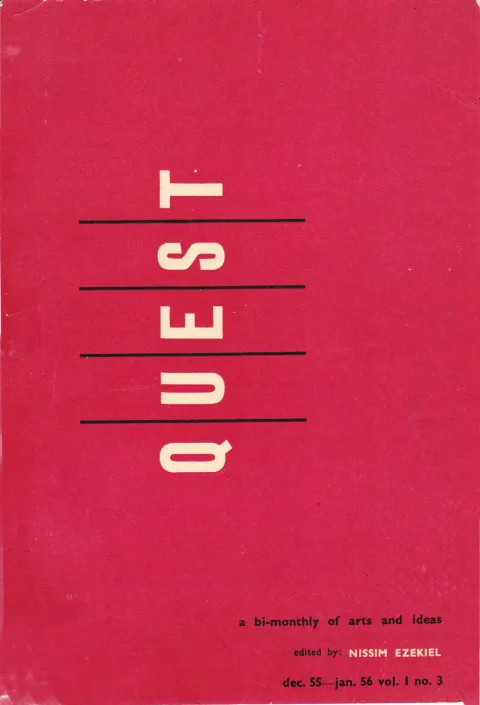
QUEST
Summary
Quest No. 3 (Dec. 1955-Jan. 1956), edited by Nissim Ezekiel for the Indian Committee for Cultural Freedom, opens with an unsigned editorial attacking the manufactured enthusiasm of Delhi’s welcome to Bulganin and Khrushchev and calling for ‘disinterested political effort’ from Indian intellectuals. Edward Shils then reports at length on the Congress for Cultural Freedom’s Milan conference on ‘The Future of Freedom’, where Asian and African delegates’ demands for aid exposed the limits of a debate framed only in East-West terms. K. Guru Dutt rebuts Nirad C. Chaudhuri’s claim that India is a ‘cultural vacuum’; Samaren Roy traces the nineteenth-century Bengali reform movement from Rammohun Roy through Vidyasagar to its exhaustion in Bankim Chandra’s revivalism; and A. B. Shah, in the issue’s most combative piece, argues that religion — including Gandhian and Vinobite revivalism — is structurally akin to the totalitarianisms it is often invoked against, and that Indian intellectuals must shed a ‘colonial mind’ before they can build a genuine democratic culture. Five poems, a travel essay on a Spanish bullfight, an essay questioning state guidance of Indian dress, four pieces of theatre/film/literary correspondence from Paris, Edinburgh, Calcutta and Bombay, five book reviews, a letter-column exchange on Tamil Nadu politics, and two unlisted art plates (Edinburgh Festival production photographs; a Jehangir Sabavala still life and a Francis Newton Souza etching) round out the issue. Read across the whole 70 pages, the volume’s centre of gravity is the Congress for Cultural Freedom’s anti-totalitarian, rationalist liberalism, applied restlessly to religion, nationalism, cinema, dress and Cold War diplomacy alike.
Essays
Encounter at Milan
By EDWARD SHILS
Edward Shils reports on the Congress for Cultural Freedom’s September 1955 Milan conference on ‘The Future of Freedom’, convened to move European intellectuals past a stale Left-Right ideological quarrel. The Organizing Committee (Aron, Polanyi and others) had hoped to dissolve doctrinal disputes into ‘matter-of-fact technical issues’, and commissioned papers by Gaitskell, Sidney Hook, Crosland, Aron, Devons, Galbraith and others on the non-economic conditions of democracy. But the conference’s real drama, Shils argues, came from an unplanned direction: Asian and African delegates (Max Beloff, Abdul Aziz, and above all the Indian civil servant A. D. Gorwala) forced European and American participants to confront the underdeveloped world’s distrust, resentment and demand for aid, especially during a heated session on Soviet versus Western economic growth. A blunt intervention by Secretary-General Nicolas Nabokov, accusing Western delegates of offering Asia and Africa ‘only words, unsympathetic or censorious’, split the room but ultimately produced what Shils calls a ‘genuine approximation’ of mutual understanding across the former colonial divide — summed up in Michael Polanyi’s closing confession that the conference had overturned his assumption that Europe’s problems were the world’s decisive problems.
- The Milan conference aimed to bring socialists and free-marketers together to resolve Cold War ideological conflict into practical, technical questions rather than doctrinal ones.
- Despite fifty commissioned papers on the non-economic conditions of democracy, these provoked little discussion at the conference itself.
- The real conflict emerged over economic aid and development: Asian and African delegates argued the West owed obligations to poorer nations, which Max Beloff and others rejected as ‘moral blackmail’.
- A. D. Gorwala of Bombay is singled out as playing a ‘decisive role’, mediating between resentful non-Western delegates and defensive Western intellectuals.
- Secretary-General Nicolas Nabokov’s floor intervention, accusing the West of offering only words, caused controversy but had a clarifying, ‘salutary effect’ on the conference’s mood.
- Shils frames the conference’s real achievement as an unplanned one: European, American, Asian and African intellectuals began, for the first time, to treat each other as equal partners rather than teacher and pupil.
Is India a Cultural Vacuum
By K. GURU DUTT
K. Guru Dutt rebuts Nirad C. Chaudhuri’s magazine article arguing that India is undergoing a ‘cultural vacuum’ — caught between a dead nineteenth-century liberal renaissance, a debased cinema, an infiltrating Communism, and a retrogressive Hindu revival. Guru Dutt concedes the poor state of Indian cinema is a real problem but treats it as a worldwide, not specifically Indian, phenomenon, and defends Indian filmmakers’ reliance on mythological material by invoking the epics’ genuine hold on the popular imagination. He argues Chaudhuri contradicts himself on Communism (admitting Soviet ‘progress’ is really ‘Americanization’ while still fearing cultural infiltration) and on Hinduism (fearing both its supposed enfeeblement and its supposed resurgence). Guru Dutt’s strongest counter-move is to install Gandhism, not Brahmoism, as the century’s dominant and genuinely ‘broad based’ cultural force, and he closes by declaring Chaudhuri’s thesis unsupported: there is ‘no evidence of any cultural vacuum in the country.’
- Chaudhuri’s original article claimed a nineteenth-century ‘Indian Renaissance’ (litterae humaniores, monotheism, liberalism) died with Tagore, leaving a vacuum filled only by cinema and Communist influence.
- Guru Dutt agrees Indian cinema’s quality is poor but argues this is a world problem (citing Rene Clair’s dim view of cinema generally), not evidence of a uniquely Indian void.
- He defends mythological film subjects by appeal to Nehru’s own view that understanding India requires appreciating the epics’ hold on the popular mind.
- He finds Chaudhuri’s fear of Communist cultural infiltration overstated and internally inconsistent, since Chaudhuri himself treats Soviet advance as mere ‘Americanization’.
- Guru Dutt argues it is Gandhism, not the older Brahmo/Renaissance movements, that is the genuinely ‘broad based’ cultural force of the period, faulting Chaudhuri for omitting Gandhi’s name entirely.
- He concludes Chaudhuri’s charge of a Hindu ‘resurgence’ is unsupported, and the essay ends confident that no cultural vacuum exists in India.
Nineteenth Century Bengal
By SAMAREN ROY
Samaren Roy narrates the rise and eventual exhaustion of nineteenth-century Bengali social reform as a story of ‘awareness’ of unjust restriction breaking through inherited ‘socially patterned defect’. He credits Raja Rammohun Roy as the pivotal figure — exposing suttee, caste and the degradation of women, founding the Brahmo Samaj, and enduring the ‘wrath of the entire Hindu society’ for it — and traces the movement through Derozio’s ‘philosophical rebels’ at Hindu College, the legal abolition of suttee (1829) and the legalisation of widow remarriage (1856, achieved despite 50,000 signatures against it, and later blamed by orthodox opinion for provoking the 1857 uprising). Roy then charts the reaction: orthodox dharma sabhas, the persecution of reformers, and finally Bankim Chandra Chattopadhyay’s public turn from Mill-influenced rationalism to a Gita-based ethic of social duty, which Roy reads as the moment the revivalist swing became complete. The essay closes on a contemporary note: the same ‘inhibited social awareness’ that let the nineteenth-century movement lose its vigour still confronts India, and ‘the resurrection of Indian manhood’ depends on breaking from a tradition of world-negation and resignation.
- Roy’s framing device is that social backwardness is fundamentally a lack of ‘awareness’ of the restrictions and injustices a society lives under, which can become internalised as virtue.
- Rammohun Roy is presented as the first Indian to revolt against authoritarian social order specifically to liberate the social individual (unlike the Charvakists or Buddha, whose revolts were ascetic/monastic, not social).
- Concrete reform milestones cited: abolition of suttee by Bentinck’s decree in 1829, and Vidyasagar’s campaign making widow remarriage legal in 1856 despite mass orthodox petitioning against it.
- A ‘philosophical rebels’ group (the Academic Association, led by Derozio) drew on French Enlightenment and Encyclopaedist inspiration and was persecuted for ‘atheistic anti-religious’ ideas.
- Orthodox reaction organised around figures like Radha Kanta Deb and Bhabani Charan Banerjee, and Roy claims the 1857 mutiny was blamed in Calcutta on the widow-remarriage law.
- Bankim Chandra Chattopadhyay’s shift from Mill-influenced rationalism to Gita-based duty (via Banga Darsana, 1872) marks, for Roy, the completion of the swing back to orthodox Hinduism.
- Roy closes by drawing a direct line from this nineteenth-century failure of nerve to a persistent ‘inhibited social awareness’ in contemporary India.
Religion and Indian Democracy
By A. B. SHAH
Responding to a debate between Prabhakar Padhye and G. D. Parikh in an earlier Quest issue, A. B. Shah argues that reviving Gandhism or Buddhism (as in the Bhoodan land-gift movement) is not a viable answer to Communist totalitarianism, because religion is itself structurally a totalitarian form of thought: like Hegelian or Marxist metaphysics, it derives ethics from a single cosmological principle and thereby licenses total control of the individual by whatever institution — State, Church, or Party — claims to interpret that principle. Quoting Vinoba Bhave’s defence of caste as ‘natural’ duty and Gandhi’s own mystical definition of religion, Shah argues both are incompatible with a rational, secular, freedom-centred democratic ethic, and that ‘well-fed cows in a wild pasture are not free’ — economic security is not the same as freedom. He traces the failure of Indian intellectuals to develop this rational outlook to a ‘colonial mind’: lacking a real struggle against a decayed native order, India’s Westernised intelligentsia became either sycophantic toward British rule or, after independence, opportunistically pro-planning and newly nostalgic for ‘Indian tradition’ — vices Shah sums up as hypocrisy, an inability to meet the world on equal terms, and compensatory intellectual chauvinism.
- Shah rejects the idea (attributed to Padhye) that revitalised Gandhism or Buddhism can effectively combat Communism, on the ground that religion is structurally akin to the totalitarian philosophies it opposes.
- His argument: totalitarian philosophies (Hegelian, Marxist) and religion both derive ethics from a single metaphysical/cosmological principle, which licenses an external authority to control the individual completely.
- Vinoba Bhave is quoted defending the four-caste system as natural and preordained duty (‘Dharma’); Gandhi is quoted defining religion in explicitly mystical terms.
- Shah argues material/institutional freedom (economic equality, parliamentary government) is necessary but not sufficient for real freedom, which requires escape from ‘the shackles of the superhuman’ as well.
- He distinguishes Buddhism/Jainism’s achievement as cultural reformation rather than social revolution, noting Brahminism’s historical ‘come-back’ after Buddha’s death.
- Shah blames the failure of Indian intellectuals on a ‘colonial mind’: a bourgeoisie/intelligentsia that arose under ‘quasi-liberal foreign rule’ rather than in struggle against a decayed native order, producing hypocrisy, inability to meet the West on ‘level terms’, and compensatory intellectual chauvinism.
- He singles out the post-Independence conversion of former liberals into ‘full-blown fellow-travellers’ as a case study of this intellectual failure.
I see a Bull Fight
By AAMIR ALI
Aamir Ali recounts attending a Madrid bullfight (bought from black-market touts after the official booking office sold out), narrating the corrida’s formal structure — the bull’s entrance, the picador’s lancing, the banderilleros’ spears, and the matador’s final muleta work and kill — with close attention to crowd behaviour, including a fellow spectator who covers his eyes while peeping through his fingers, and one intoxicated onlooker who leaps into the ring mid-fight. Ali is candid that he found the spectacle ‘rather too gruesome’ for his own taste and would have left had he not been hemmed in by the crowd, but he resists a simple condemnation, allowing that bullfighting is both ‘a barbaric spectacle’ and, to its devotees, ‘a mystic and exalted cult’, and closing on the trade’s real danger by recalling the recent death of the matador Manolete.
- Ali describes the full ritual sequence of a corrida: the bull’s disorienting entrance, the picador’s horse-mounted lancing, the banderilleros’ spear-planting, and the matador’s cape-work and kill.
- He personally found the spectacle too gruesome for his taste and would have left the first fight if not hemmed in by the crowd.
- He records an incident where an overexcited spectator leapt into the ring to play the bull himself before being led away to applause from the crowd.
- The essay balances condemnation (‘barbaric spectacle’) against sympathy for its appeal as ritual, colour, skill and daring, noting a matador’s fame and income rival that of film stars.
- It closes by noting the real physical danger of the profession, citing the recent death of the celebrated matador Manolete.
Dress and Decency
By PREMA ANAND
Prema Anand argues against a 1955 Government of India recommendation prescribing achkan-and-sherwani for male civil servants and plain, borderless saris or salwar kameez in ‘sober colours’ for female ones, on both principled and practical grounds. Principally, she objects that it is inappropriate for a democratic government to dictate dress at all — other democracies leave such matters to social convention — and that regulating hemlines and blouse lengths hardly befits governmental dignity. Practically, she argues traditional Indian dress (the sari, the achkan, the dhoti) was suited to a slower, more sedentary, feudal way of life and is now poorly adapted to buses, offices, and active occupations like nursing, engineering or piloting; she cites Japan’s compromise (Western dress for work, traditional dress for formal occasions) as a plausible model, and closes by calling for a ‘functional and inventive approach to dress’ guided by ‘sanity, and not sentiment’.
- The essay’s occasion is a 1955 Union Government recommendation prescribing achkan/sherwani and specific sari/salwar-kameez conventions (including minimum blouse length) for government servants.
- Anand’s principled objection: it is inappropriate for a democratic government to prescribe dress at all, a task better left to social convention and peer criticism, as in other democracies.
- Her practical objection: dress suited to a feudal, sedentary society (the sari, the dhoti, the achkan) is impractical for modern occupations and daily commuting — ‘What is more ludicrous than an air-hostess in a sari?’
- She contrasts India’s approach unfavourably with Japan’s, which retained traditional dress for formal/social occasions while adopting Western dress for work.
- The essay closes calling for dress reform guided by climate, activity and ‘sanity, and not sentiment’ rather than nostalgia for a feudal or imperial past.
Two Poems
By ASOKE VIJAY RAHA
Two poems translated from Asoke Vijay Raha’s Bengali by Lila Ray. ‘The Serpent Maiden’ addresses a snake-charmer girl in incantatory, image-dense couplets (‘Two great eyes outlined in black - / A long sleek black body’), fusing eroticism and menace as serpents figure both her ornament and her inner nature. ‘A Winter Night’ is a quieter nocturne personifying a sleeping village — ‘The old-woman village, wrapped in a quilt, / Sleeps soundly in the straw smoke’ — and closing on the image of ‘the one-eyed moon, holding a broken lantern’ turning toward the village of Adampur.
- Both poems are translated from the Bengali by Lila Ray.
- ‘The Serpent Maiden’ is addressed to a snake-charmer girl, repeatedly figuring her body, jewellery and inner nature through serpent imagery.
- ‘A Winter Night’ personifies a sleeping village as an old woman wrapped in a quilt, with animals (jackals, a vulture) as the only wakeful presences.
- Both poems favour dense, incantatory imagery over narrative or argument, typical of the issue’s poetry selections.
Old Rain
By SRINIVAS RAYAPROL
Srinivas Rayaprol’s ‘Old Rain’ is a long dramatic-monologue poem addressed to a younger generation, resisting being ‘fitted’ into the same pattern of ageing and diminishment the speaker was once fitted into. Imagining himself at forty, the speaker rehearses the platitudes he’ll be tempted to offer a young woman (‘You my dear are far too young to know / Wait till you are as old as me’) before rejecting that mode of ageing altogether in favour of a tree-like model of growth that does not shed but ‘contains’ its accumulated life.
- The poem is structured as an imagined future monologue, the speaker projecting himself to age forty confronting a younger generation.
- It stages and then rejects the cliche of an older generation patronising a younger one about the inevitability of disillusionment.
- The closing image proposes an alternative, tree-like model of ageing that accumulates and ‘contains’ experience rather than shedding it bitterly.
The Flood
By BALRAJ KOMAL
Balraj Komal’s ‘The Flood’ (translated from the Urdu, translator not credited) is a short free-verse poem figuring modern urban life as an undifferentiated ‘flood of din and noise on the road’, with the speaker one indistinguishable unit among ‘caravans of painful dreams’ rushing toward an unspecified ‘goal’, driven by a Time that ‘whets this flood’.
- The poem uses flood imagery to figure the noise and momentum of modern urban life.
- The speaker identifies himself as one undifferentiated unit within the crowd (‘I am one of them, and so are you’).
- Time itself is personified as the storm driving the flood onward.
Bird
By K. D. KATRAK
K. D. Katrak’s ‘Bird’ is a short, tightly-controlled poem of praise for a falcon’s stillness and violence, admiring in the bird an ‘unvicious savagery’ — an integrated, unapologetic ferocity the poem suggests ‘men / Have lost with the gift of wings.’
- The poem describes a falcon or hawk waiting motionless before flight, emphasising its patience and controlled violence.
- It closes with an explicit comparison unfavourable to humanity, which has gained flight (technology/civilisation) but lost the bird’s ‘unvicious savagery’ — an integrity of instinct.
Landscape
By D. V. KUMAR
D. V. Kumar’s ‘Landscape’ is a short lyric arguing, in effect, that nature imagery (‘river and land on the face of the moon’) has already ‘all been told’, yet still finds fresh life whenever it recurs in the poet’s own hands and words — a small meditation on cliche and renewal in poetic language.
- The poem opens by conceding that its own natural imagery (jasmine, dust, river, land, moon) has already been exhaustively used in poetry.
- It nonetheless insists that the same images regain life ‘in the hands I hold, / and the words in which I trade’ — a claim about renewal within poetic convention rather than escape from it.
Notes from Paris
By RENE TAVERNIER
Rene Tavernier’s Paris letter surveys the current French cultural scene with some impatience: he dismisses Ionesco and Beckett’s ‘avant garde’ theatre as merely repeating thirty-year-old Dada/Surrealist devices ‘with far more talent’ the first time round, and is equally unimpressed by Alexandre Astruc’s film Bad Company and by Jean Cocteau’s election to the French Academy, which he reads as confirming Cocteau was always more fashion-designer than genuine innovator. On books, he notes a wave of young women novelists following Francoise Sagan’s Bonjour Tristesse (finding Louise de Vilmorin’s work the most substantial of that vein), praises the vitality of new French-language writers from Morocco, Egypt and Algeria (Driss Chraibi, Albert Cossery, Mohammed Dib, Mouloud Mammeri) as evidence of French literature’s ongoing life, and closes admiring Michel Leiris’s confessional autobiography and, especially, the veteran cosmopolitan writer Valery Larbaud’s newly published Journal.
- Tavernier dismisses Ionesco and Beckett’s ‘young theatre’ as recycling thirty-year-old Dada/Surrealist techniques, done better the first time by Tristan Tzara, Breton and Desnos.
- He is critical of Alexandre Astruc’s film Bad Company and of Jean Cocteau’s induction into the French Academy, reading the latter as proof Cocteau was fundamentally a stylist rather than an innovator.
- He surveys a wave of young French women novelists writing in the wake of Francoise Sagan’s success, rating Louise de Vilmorin’s work as the most artful of the group.
- He highlights French-language writers from Morocco, Egypt and Algeria (Chraibi, Cossery, Dib, Mammeri) as the ‘permanent vitality’ of French literature.
- The column closes with admiring notice of Michel Leiris’s confessional autobiography and Valery Larbaud’s posthumously-flavoured Journal.
The Edinburgh Festival
By A. M. ABRAHAM
A. M. Abraham reports from the 1955 Edinburgh Festival, opening by dispelling the notion that a ‘puritanical’ Edinburgh cannot host a proper festival, and noting its scale (over eighty thousand visitors from some fifty countries). He focuses on two attractions: the Azuma Kabuki dancers from Japan, whose ‘Dance of the Lion’ and ‘Dance of the Spider’ he found alien at first but increasingly absorbing, comparing their facial and hand expressiveness to Kathakali; and Thornton Wilder’s new play A Life in the Sun (based on Euripides’ Alcestis), commissioned specially for the Old Vic-style ‘apron stage’ that had impressed Wilder at the 1954 Festival’s Macbeth. Abraham situates the production within a broader contemporary debate over open/apron staging, which anti-realist directors favour as liberating drama from naturalistic detail, though he declines to predict whether this signals a lasting revival or a passing fashion.
- Abraham opens by correcting the stereotype of a ‘dour’ Edinburgh unsuited to festivity, citing genuine Scottish hospitality and the Festival’s scale (80,000+ visitors, fifty countries).
- The Azuma Kabuki dancers’ ‘Dance of the Lion’ and ‘Dance of the Spider’ are singled out, with their visual/facial expressiveness compared to Indian Kathakali.
- Thornton Wilder’s A Life in the Sun, based on Euripides’ Alcestis, was written specifically for the Old Vic’s apron/thrust stage after Wilder saw its 1954 Macbeth production.
- The essay situates the apron-stage experiment within a wider contemporary debate among producers about whether open staging represents a genuine dramatic revival or a passing fashion.
Calcutta Letter
By SAILESH KUMAR ROY
Sailesh Kumar Roy’s Calcutta letter surveys post-Tagore Bengali culture as a period of unresolved transition: talent and enterprise are plentiful in poetry and journalism but, he argues, drama, music, painting, fiction and cinema have made little real advance. He runs through a roster of post-Tagore poets (Jibananda Das, Sudhindranath Dutt, Premendra Mitra, Buddhadev Bose, Amiya Chakravarthy, Samar Sen, Sanjoy Bhattacharya) and little magazines (Sabuj Patra, Kallol) that shaped the era, laments the absence of a strong new tradition of Bengali classical music since Tagore, and closes on a genuinely optimistic note about Bengali cinema: Satyajit Ray’s Pather Panchali (financed by the West Bengal government, influenced by De Sica and Renoir) is singled out as creating ‘almost a new norm for the Indian cinema’ and a possible ‘precursor of a renaissance’.
- Roy’s overall assessment is that Bengali culture since Tagore shows plenty of enterprise but little tangible achievement outside poetry and journalism.
- He surveys a generation of post-Tagore Bengali poets and the ‘little review’ journals (Sabuj Patra, Kallol) that carried their work.
- He notes Bengal has no strong classical-music tradition of its own, though individual Bengali musicians are eminent, and mourns that Bengali music has achieved little distinctive since Tagore’s own experiments.
- Bengali theatre is described as commercially alive (the only professional Indian theatre still functioning is in Calcutta) but creatively thin, still leaning on Tagore, Shakespeare, Shaw and Ibsen.
- The essay closes with real enthusiasm for Satyajit Ray’s Pather Panchali, financed by the West Bengal Government and influenced by De Sica’s neo-realism and Jean Renoir, calling it a possible precursor to a renaissance in Indian cinema.
The Penetrating Eye
By ARATI MUKERJI
Arati Mukerji reports on Marie Seton’s Bombay film seminar (the first of several conducted for the Ministry of Education), which used extracts from Chaplin, Pabst, Eisenstein and others to teach ‘film appreciation’ as a discipline. Seton is presented as making the case for cinema as art on a par with literature or music, illustrated with extracts from Chaplin’s The Refugee, Pabst’s Kameradschaft, the Japanese Children of Hiroshima, and an extended treatment of Eisenstein (Battleship Potemkin’s Odessa Steps, October, The General Line, Ivan the Terrible), plus Seton’s own compilation film Time in the Sun, drawn from Eisenstein’s unfinished, Upton Sinclair-financed Mexican project Que Viva Mexico. The piece closes with Seton’s blunt verdict on Indian cinema — that producers favour ‘artificial extravaganzas’ over the country’s own scenery, folklore and history — and her hope, delivered via a message reproduced in a footnote citing Bertrand Russell’s own use of film for pacifist advocacy, that Indian film societies will receive government support.
- Marie Seton’s seven-lecture seminar in Bombay, under the Ministry of Education, aimed to teach ‘film appreciation’ as a discipline distinct from simple viewing.
- Extracts shown included Chaplin’s The Refugee, Pabst’s Kameradschaft, the Japanese Children of Hiroshima, and multiple Eisenstein films (Battleship Potemkin, October, The General Line, Ivan the Terrible).
- Seton’s own film Time in the Sun, built from Eisenstein’s unfinished, Upton Sinclair-financed Que Viva Mexico, had reportedly just been purchased by the Indian government along with Storm over Asia and Brief Encounter.
- Seton also lectured on the international film-society movement (strong in Britain, France and Italy, weaker in America) as a model for India.
- Her closing assessment of Indian cinema, relayed by Mukerji, is that producers favour artificial extravaganzas over India’s own scenery, folklore and history — with Pather Panchali cited as a possible exception.
Shri 420 and Jhanak Jhanak …
By D. G. NADKARNI
D. G. Nadkarni reviews two ‘Indian prestige productions’ meant for export, Shri 420 and Jhanak Jhanak Payal Baaje, and finds both wanting despite real talent on display. He reads Raj Kapoor’s Shri 420 as a pastiche of Chaplin, Rene Clair and De Sica cliches wrapped around a moralising crime plot, praising Nargis’s performance and Radhu Karmakar’s cinematography but faulting the film’s derivativeness and its Mack Sennett-style police. V. Shantaram’s Jhanak Jhanak Payal Baaje fares worse in his account: an incoherent, geographically and chronologically inconsistent mythological dance spectacle that Nadkarni compares unfavourably (though not dismissively) to Uday Shankar’s Kalpana, despite praising dancers Gopi Krishna and Sandhya and noting the film’s claim to be the first Technicolour production made entirely by Indian hands. The review closes with a broader complaint that Indian directors compromise on ‘purity of content’ and ‘fidelity of technique’ in ways Japanese filmmakers, by contrast, do not.
- Nadkarni finds Shri 420 (Raj Kapoor) a pastiche of Chaplin, Rene Clair and De Sica techniques built around a moralising story of an ‘likeable idiot’ turned crook.
- He praises Nargis’s performance and Radhu Karmakar’s cinematography in Shri 420 while criticising its wholesale borrowing from earlier filmmakers.
- Jhanak Jhanak Payal Baaje (V. Shantaram) is criticised for a ‘total lack of topographical or chronological perspective’ despite strong dancing from Gopi Krishna and Sandhya.
- Nadkarni compares Jhanak Jhanak’s mythological-dance format to Uday Shankar’s Kalpana as an ‘inevitable comparison … in crudity of approach’.
- He notes the film’s claimed distinction as the first Technicolour film made entirely by Indian hands, calling this claim to pride ‘surprising’ given the Japanese had already matched Hollywood in Eastman colour.
- The review closes faulting the Indian film industry generally for compromising technique and content compared to Japanese cinema, naming Bimal Roy and Vishram Bedekar as directors who prove such compromise is unnecessary.
Reason, Romanticism and Revolution by M. N. Roy
By K. GURU DUTT
K. Guru Dutt reviews the two-volume Reason, Romanticism and Revolution, M. N. Roy’s posthumously-completed philosophical synthesis (Roy died in January 1954). He credits the work as a serious criticism of Marxist ideology by a former Communist International insider, tracing Roy’s argument that Fascism and Communism are twin products of a ‘philosophical reaction’ against Enlightenment rationalism running from Rousseau through Schopenhauer to Bergson, Sorel, William James and Dewey, and Roy’s attempted (if only partial) reconciliation of Romanticism and rationalism as the necessary basis for successful revolution. But Guru Dutt judges the book’s ‘New Humanism’ conclusion ‘hollow and unconvincing’, and identifies a severe gap: despite roughly 500 names indexed, the book contains ‘not a single Asian name, not even Gandhi or Tagore or Aurobindo’ — a total blackout of Eastern thought in a book claiming a genuinely synthetic philosophy.
- M. N. Roy (1887-1954), a former Communist International figure turned independent philosopher, completed this two-volume work before his death; the second volume was published posthumously.
- Roy’s thesis: European philosophical ‘irrationalism’ running from Rousseau through Schopenhauer to Bergson, Sorel, William James and Dewey produced both Fascism and Communism as ‘twins’.
- Roy attempts to reconcile Romanticism (subjective, revolutionary) with rationalism (objective, evolutionary/determinist) as jointly necessary for successful revolution.
- Guru Dutt faults Roy’s resulting ‘New Humanism’ as unconvincing, and criticises his dismissal of modern psychology and of ‘neo-mysticism’ in figures like Eddington, Jeans, Sorokin, Berdyaev and Maritain.
- The review’s sharpest criticism is Roy’s complete omission of Asian thought: about 500 names indexed, ‘not a single Asian name, not even Gandhi or Tagore or Aurobindo’.
Morals and Medicine by J. Fletcher
By SWAMI AGEHANANDA
Swami Agehananda reviews J. Fletcher’s Morals and Medicine as a pioneering, clergyman-authored work applying rational ethics to birth control, artificial insemination, sterilisation, and euthanasia. He endorses Fletcher’s key move — that with contraception available, parenthood becomes ‘a human responsibility’ rather than something left to God — and is scathing about Roman Catholic moral theology’s pedantic distinctions (e.g. permitting A.I.H. but forbidding A.I.D., or treating masturbation-adjacent procedures as gravely sinful), quoting Fletcher’s own description of such positions as ‘a sophisticated version of primitive animism’. He singles out the book’s chapter on euthanasia as its best and most moving, praising Fletcher’s argument that suffering without hope ‘forfeits all its moral purpose’, and closes calling the book, whatever its philosophical limits, ‘an excellent and important’ pioneer work that gives ethicists ‘an instrument’ where neither secular nor religious moral thought had previously provided one.
- Fletcher’s book addresses the patient’s right to medical truth, contraception, artificial insemination, sterilisation, and euthanasia — ‘problems … no one in this century can bypass’.
- Agehananda endorses Fletcher’s argument that contraception makes parenthood ‘a human responsibility’ rather than something formerly ‘in the hands of God’.
- The review is harshly critical of Catholic moral theology’s pedantic distinctions between permissible and impermissible forms of insemination and sterilisation.
- Fletcher’s chapter on euthanasia is singled out as the book’s best-written and most affecting section, arguing hopeless suffering ‘forfeits all its moral purpose’.
- Agehananda closes praising the book, despite reservations about its philosophical rigour, as ‘a pioneer work’ giving physicians and ethicists ‘an instrument’ previously lacking.
Leap Through the Curtain by George Mikes
By ARATI MUKERJI
Arati Mukerji reviews George Mikes’s Leap Through the Curtain, the as-told-to story of Hungarian ballet dancers Istvan Rabovsky and Nora Kovach, star performers of the Budapest Ballet who defected to West Berlin despite privileged status, high salaries, a villa, and the Kossuth Prize. Mukerji recounts their motivations — artistic provincialism, and above all the ‘cold breath of horror’ of 1951’s mass arrests in Hungary — and their earlier ascent via a scholarship to study under Vaganova in Leningrad after impressing Ulanova in 1949, closing on their successful new career touring the West, currently with Anton Dolin’s company in the United States and Canada.
- Istvan Rabovsky and Nora Kovach were star Budapest Ballet dancers who had received the Kossuth Prize (Hungary’s Stalin Prize equivalent) and owned a villa, yet chose to defect to the West.
- Their stated motivations were artistic (provinciality, hunger for wider competition) and political (living, in effect, ‘in prison precincts’, and horror at the mass 1951 arrests in Hungary).
- Their earlier rise included a decisive 1949 audition before Ulanova, which secured them scholarships to train under Vaganova in Leningrad.
- The review closes noting their successful post-defection career, touring the US and Canada with Anton Dolin’s company.
Historical Inevitability by Isaiah Berlin
By YOGENDRA CHOPRA
Yogendra Chopra reviews Isaiah Berlin’s Historical Inevitability (the first Auguste Comte Memorial Lecture), which attacks the notion that history obeys deterministic laws exempting human beings from moral responsibility. Chopra credits Berlin’s project as ‘extremely salutary’ but finds the argument imprecise — accusing Berlin of sliding between different senses of determinism and of a ‘blanket rejection’ that ignores genuinely live philosophical questions still open to social science. He situates Berlin as indebted to both Popper (on the illusory ‘essence’-seeking of large-scale historical prediction) and, more so, to Hayek’s concept of ‘scientism’ — the mistaken imitation of natural-science method in the human sciences — while noting Berlin, unlike Hayek, resists Cartesian mathematical formalism in favour of a broadly Wittgensteinian trust in ordinary language and ‘good sense’. Chopra’s own verdict is measured: he doubts the ‘dissolutionist’ strategy Berlin criticises can ever fully succeed against the determinist metaphysician, which he treats as itself ‘a fresh plea for an open attitude in philosophy’.
- Berlin’s lecture attacks philosophies of history (naming Comte’s ‘law of three stages’ as an example) that treat human behaviour as governed by deterministic laws beyond individual control.
- Chopra criticises Berlin for inconsistently shifting between a strong claim (all human-intention explanations rest on vanity/ignorance) and a weaker one (behaviour is largely, not wholly, beyond individual control).
- Berlin’s key move is treating determinism as ethically equivalent to fatalism, a ‘kind of prison’ escapable only via a theory positing undetermined choice — a claim Chopra says Berlin never fully defends.
- Chopra traces Berlin’s intellectual debts to Popper (on prediction and ‘essences’) and, more strongly, to Hayek’s critique of ‘scientism’ in the social sciences.
- Chopra’s own conclusion is cautious: dissolutionist strategies against determinism are unsatisfying but the free-will debate itself retains ‘persistent vitality’, justifying continued open inquiry rather than resolution either way.
Mughal Miniatures
By SAIF TYABJI
Saif Tyabji reviews Mughal Miniatures, the first in a new Lalit Kala Akademi brochure series, containing ten colour reproductions spanning Akbar to Shah Alam. He credits Akbar as the school’s true creator (contrasting his energetic patronage, via a Napoleon anecdote, with more passive rulers) and Jehangir’s reign as its artistic zenith, but is a sharp and specific critic of the brochure’s editorial choices and prose: he questions why two paintings from the same Babur Namah manuscript were chosen over more varied Akbar-era work, faults imprecise and sometimes unintelligible art-critical language (‘arabesque … resolved itself into a line’, ‘tempo’ misapplied to a static line), and objects to a factual overstatement about Akbar’s personal storytelling habits. He nonetheless closes warmly, praising the reproduction quality as excellent and ‘congratulating’ the Lalit Kala Akademi on the production while looking forward to further volumes in the series.
- Mughal Miniatures is the first of a planned Lalit Kala Akademi brochure series (with volumes on Mewar and Pahari painting announced to follow), containing ten colour-reproduced paintings from Akbar’s reign to Shah Alam’s.
- Tyabji credits Akbar, not Humayun, as the school’s real founder, illustrating Akbar’s personal, energetic patronage of the arts with an anecdote about Napoleon and the Minister for Internal Affairs.
- He identifies Jehangir’s reign as the artistic zenith of Mughal painting, though he disputes the specific plates chosen to represent it.
- He criticises the brochure’s prose as loose or unintelligible in places (e.g. applying the musical term ‘tempo’ to a static painted line) and flags one claim about Akbar’s storytelling habits as unsupported by evidence.
- Despite these criticisms, the review closes commending the plates’ reproduction quality as excellent and congratulating the Lalit Kala Akademi on the production.
Essay 22
NOT ON THE PRINTED CONTENTS PAGE. An unsigned editorial (pp.3-4) diagnoses the ‘contradictory elements’ of Indian public life — professed non-violence alongside pride in armed forces, professed democracy alongside admiration for dictators, professed liberalism alongside ‘fellow-travelling’ — and argues these are not healthy variety but ‘neurotic conflicts’ that obscure political, economic and cultural reality. It singles out the state-orchestrated welcome given to Marshal Bulganin and Khrushchev’s 1955 visit (including the mobilisation of children and students) as the year’s clearest exposure of this confusion, and closes by introducing A. B. Shah’s article on religion (this issue’s toc_index 4) as an example of the disinterested, rigorous ‘political effort’ the editorial calls for, while inviting a comparably rigorous defence of Gandhism that the editor says has so far proven hard to commission.
- The editorial argues India’s public culture tolerates open contradictions (non-violence rhetoric alongside pride in a growing military; democratic conviction alongside admiration for dictators) as a form of ‘neurotic conflict’.
- It criticises the manufactured public enthusiasm surrounding the 1955 Bulganin-Khrushchev visit, especially the mobilisation of schoolchildren for political spectacle, as a double standard around political expediency.
- It frames the intellectual’s role in a democracy as providing ‘disinterested political effort’ — raising fundamental questions power itself has no interest in raising.
- It explicitly introduces A. B. Shah’s article on religion (elsewhere in this issue) and states editorial willingness to publish an equally rigorous defence of Gandhism if one can be found.
- Not listed on the printed contents page — editorials in Quest appear to run unsigned and untitled as a matter of house convention.
Essay 23
NOT ON THE PRINTED CONTENTS PAGE and not paginated. An unnumbered art plate (bound between printed pages 32 and 35, inside Aamir Ali’s bullfight article) reproduces two production photographs from the 1955 Edinburgh Festival: a scene from Thornton Wilder’s new play, captioned ‘A Place in the Sun’ (the article discussing it elsewhere in this issue calls the same play ‘A Life in the Sun’ throughout — a discrepancy between caption and body text, kept here verbatim), and a photograph of the Azuma Kabuki dancers, captioned with a cross-reference ‘(see page 43)’ pointing to A. M. Abraham’s Edinburgh Festival article.
- The plate is a photographic insert with no accompanying prose beyond its two captions; it is not listed on the contents page and carries no printed page number.
- One photograph shows a stage scene captioned ‘A scene from Thornton Wilder’s A Place in the Sun, as performed at Edinburgh’ — but Abraham’s article elsewhere in the issue consistently calls the same play ‘A Life in the Sun’.
- The other photograph shows the Azuma Kabuki dancers, captioned with an explicit page cross-reference to A. M. Abraham’s article on page 43.
- The plate’s physical position (between printed pages 32 and 35, inside a different article) indicates it was bound in as a separate photographic-plate signature rather than typeset in sequence with the article it illustrates.
Essay 24
NOT ON THE PRINTED CONTENTS PAGE and not paginated. A second unnumbered art plate, bound immediately after the Edinburgh Festival photographs (again inside Aamir Ali’s bullfight article), reproduces two artworks with no accompanying text beyond captions: a ‘Still Life’ painting by Jehangir Sabavala, and an untitled etching by Francis Newton Souza (printed as ‘Francis Newton Souza’), depicting two reclining or crouching figures rendered in Souza’s characteristic angular line style. This is exactly the kind of uncredited-on-the-contents-page art portfolio the cataloguing brief flagged as a known feature of Quest issues (compare QT001’s Husain drawings and Laxman Pai painting).
- The plate carries two images with captions only: ‘Still Life by Jehangir Sabavala’ and ‘An etching by Francis Newton Souza’.
- Neither artwork nor artist is mentioned anywhere on the printed contents page or in the body text of any article in this issue.
- Sabavala’s painting is a cubist-inflected still life (easel, bottle, drapery); Souza’s etching shows two elongated, angular figures in a spare line style characteristic of his work.
- The plate’s physical position — bound mid-issue inside an unrelated prose article, with no page number — indicates it was printed on a separate art-paper signature, consistent with the Quest house practice of running unlisted art portfolios.
Essay 25
NOT ON THE PRINTED CONTENTS PAGE. A ‘Correspondence’ column prints a long letter from T. R. Ramiah continuing a dispute (begun in an earlier issue, not reproduced here) with a Mr. Subbiah and a Mr. Nedumaran over the roots of Dravidianist politics (the D.K. and D.M.K.) in Tamil Nadu. Ramiah rejects the claim that his own earlier article understated brahmin/non-brahmin tension or ‘hostility to Tamil’ among brahmins, argues that pride in the Tamil language is not confined to any one community, and reiterates his view that the D.K. and D.M.K. cause real ‘disservice’ to non-brahmins by implicitly repudiating the concept of a single India, regardless of how large the D.M.K.’s actual membership may be.
- The letter is one side of an ongoing correspondence-page dispute; the original ‘Subbiah’ article being responded to is not reprinted in this issue.
- Ramiah denies that hostility to the Tamil language is a real or significant force among brahmins, citing prominent Tamil brahmin writers as counter-evidence.
- He maintains his original view that the Dravidar Kazhagam (D.K.) and Dravida Munnetra Kazhagam (D.M.K.) are symptoms of, not solutions to, brahmin/non-brahmin caste tension, and that both parties’ implicit repudiation of a single Indian nation is their real danger.
- He responds separately to a Mr. Nedumaran’s letter (also not reprinted), defending his own earlier estimate of the D.M.K.’s strength and denying any intent to be dismissive of the movement’s size.
- Absence from the contents page indicates the correspondence/letters column was, like the editorial, a standing but unlisted section of the magazine.
Generated by the v1.5 extraction pipeline. Awaiting editorial review.
Metadata and summary are AI-extracted from the source PDF and reviewed for editorial accuracy. The original work is available via the Read PDF tab above (where present); paragraph-level citation inside the PDF is deferred to a future engagement.
People in this work
- Edward Shilsauthor
- K. Guru Duttauthor
- Samaren Royauthor
- A. B. Shahauthor
- Aamir Aliauthor
- Prema Anandauthor
- Asoke Vijay Rahaauthor
- Srinivas Rayaprolauthor
- Balraj Komalauthor
- K. D. Katrakauthor
- D. V. Kumarauthor
- Rene Tavernierauthor
- A. M. Abrahamauthor
- Sailesh Kumar Royauthor
- Arati Mukerjiauthor
- T. R. Ramiahauthor
- Lila Ray
- D. G. Nadkarni
- Swami Agehananda Bharati
- Yogendra Chopra
- Saif Tyabji
- Nissim Ezekiel
- Laeeq Futehally
- Nazura Sattar
- Jehangir Sabavala
- Francis Newton Souza
- John Kenneth Galbraith
- Mahatma Gandhi
- Jawaharlal Nehru
- Henry Louis Vivian Derozio
- Ishwar Chandra Vidyasagar
- John Stuart Mill
- Jayaprakash Narayan
- Bal Gangadhar Tilak
- Karl Marx
- Vinoba Bhave
- M. N. Roy
- Friedrich Hayek