
periodical issue
Quest
a bi-monthly of arts and ideas
By MA Venkata Rao, V. V. John, Shiv S. Kapur, Shiru Limaye, Eliezer Livneh, Rhona Ghate, D. D. Karve, V. Anant, D. G. Nadkarni, Nissim Ezekiel, Adam Adil, Uma Anand, R. E. Hawkins
Edited, printed and published by NISSIM EZEKIEL for the Indian Committee for Cultural Freedom, Army and Navy Building, 148, Mahatma Gandhi Road, Bombay 1, at the Janada Press, Podar Chambers, 109, Parsi Bazar Street, Fort, Bombay 1. · Bombay · 1957
80 pages
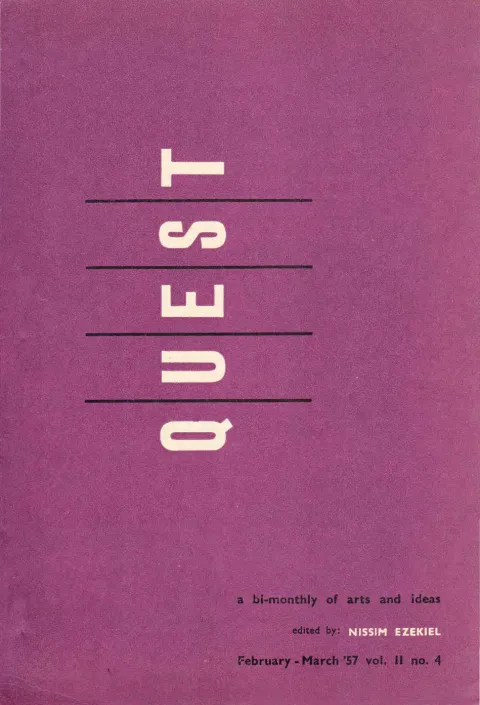
QUEST
Summary
Quest Vol. II No. 4 (February-March 1957), edited by Nissim Ezekiel for the Indian Committee for Cultural Freedom, is a wide-ranging bi-monthly of politics, ideas and the arts. Its political core is an unsigned editorial and two long essays (M. A. Venkata Rao on the Gandhian ‘Ashram ideal’ as an Indian alternative to Marxist classlessness, and Shiv S. Kapur on ‘mysticism’ versus ‘drill’ as modes of Indian political leadership) alongside first-person and reportorial pieces: a Praja Socialist satyagrahi’s prison memoir from Portuguese Goa, an Israeli parliamentarian’s account of life under permanent military tension, a satirical Socratic dialogue on Indian parliamentary and language politics, and a report on university medium-of-instruction policy. A substantial back half is devoted to the arts: film, theatre and exhibition reviews (Satyajit Ray’s Aparajito, a Sheila Bhatia opera, two Bombay painting shows), a critical essay on Forster’s A Passage to India thirty years on, seven book reviews (Panikkar, Toynbee, Daya Krishna, William Carlos Williams, Lambert Mascarenhas and others), a heated multi-letter correspondence dispute over a prior report on a theatre conference, and a publisher’s letter on the Copyright Bill. Interspersed, and absent from the printed contents page, are an unsigned Congress for Cultural Freedom communique on Hungary, the standing ‘Contributors to this issue’ page, and four unnumbered plate leaves of photographs and paintings (an Assamese textile exhibition, a still from Aparajito, and reproductions of paintings by Shanti Dave) that visibly disrupt the issue’s own pagination partway through.
Essays
Revolt and Mysticism in India
By Shiv S. Kapur
Shiv S. Kapur argues that Indian civilisation has a historical pattern of absorbing revolutionary challenge without producing revolution: Greek, Persian, Islamic and finally British impacts were all assimilated or ‘subverted’ rather than allowed to overturn the social order. British rule, he argues, promoted not revolution but an essentially revivalist nationalism built around symbols (the charkha, khadi, satyagraha) rather than class conflict. With independence won, Kapur argues India now faces a genuine, overdue industrial revolution which its culture must reconcile with agrarian tradition, using Toynbee’s language of challenge, response and the ‘creative minority’.
The essay’s second half contrasts two modes of political leadership available to that creative minority: ‘drill’ (organised, disciplined, party-based) and ‘mysticism’ (charismatic, exemplified above all by Acharya Vinoba Bhave’s Bhoodan land-gift movement). Kapur finds Indian tradition strongly inclined to the latter, which he treats as both a genuine spiritual resource and a structural danger, since mystical leadership generates no institutional successors. He reads independent India’s ‘controlled revolution’ — Bhoodan alongside State Socialism — as an attempt to fuse the two modes through the figure of the Prime Minister.
- Indian civilisation has repeatedly absorbed foreign challenge (Greek, Persian, Islamic, British) without producing outright revolution.
- British rule produced revivalist nationalism (charkha, khadi, satyagraha) rather than a class revolution.
- Independence leaves Indian culture needing to reconcile a now-urgent industrial revolution with agrarian, feudal tradition.
- Applies Toynbee’s ‘challenge and response’ and ‘creative minority’ framework to India’s postcolonial situation.
- Distinguishes ‘drill’ (organised, party-based) from ‘mysticism’ (charismatic) as modes of leadership, arguing Indian tradition favours the latter.
- Reads Vinoba Bhave’s Bhoodan movement and Nehru’s blend of Bhoodan and State Socialism as the present ‘controlled revolution’.
We, Prisoners in Goa
By Shiru Limaye
Translated from the original Marathi by A. K. Bhagwat, this is Praja Socialist leader Shiru Limaye’s first-person memoir of imprisonment by the Portuguese authorities at Panjim and later Aguada Fort in Goa, after leading a 1955 satyagraha batch and receiving an eighteen-year sentence (‘equal to Rama’s period of exile’). Limaye describes an initial numbness giving way to a deliberate, disciplined cultivation of ‘positive interest’ in prison life, expressed through minutely observed relationships with the jail compound’s ducks, hens, chicks, crows and stray dogs.
The memoir also records small handicraft and hobby projects — knitting, drawing, a miniature bottle-garden, pressed-leaf curtains — as ways of imposing order and continuity on an indefinite sentence, and closes with an account of the prisoners’ shared daily routine, from scavenging duties to an evening hour of reading and mock ‘World Cabinet’ debate on stale newspapers.
- Limaye and fellow Goa satyagrahis received an eighteen-year sentence, likened to ‘Rama’s period of exile’.
- Describes the psychological transition from numb despair to a disciplined, deliberate ‘positive interest’ in prison life.
- Extended naturalist observations of ducks, hens, chicks, crows and dogs in the jail compound substitute for lost freedom and companionship.
- Describes hobbies taken up in confinement: knitting, drawing, a bottled miniature garden, pressed-leaf curtains.
- Closes with the prisoners’ full daily routine, including a shared evening ‘World War Cabinet’ mock-debate on world affairs from week-old newspapers.
The Ashram Ideal in Politics
By MA Venkata Rao
M. A. Venkata Rao argues that the Gandhian Ashram — at Sabarmati, Wardha, and (in Vinoba Bhave’s Bhoodan movement) beyond — constitutes India’s own, non-Marxist version of a classless society, its authority resting on the personal example, truth and non-violence of a teacher rather than on party or class power. He traces the institution back through the tapovana and gurukula traditions to Chanakya’s Taxila, and contrasts the moral ‘sanctions’ the Ashram generates for social reform with the Communist technique of training cadres and elites for organised revolution.
Venkata Rao devotes a long central section to refuting Marxist class-determinism (noting that Marx and Engels’s own theory contradicts their bourgeois origins), and argues Vinoba’s Bhoodan land-gift campaign is fundamentally different from Soviet or Chinese collectivisation because it works through voluntary, decentralised village community rather than coercive state farms. He closes by aligning the Ashram ideal with Western pluralist social theory (Harold Laski, Edward Shils) as a check against both class tyranny and the demagogic conformism Shils calls ‘MacCarthyism’.
- Frames the Gandhian Ashram (Sabarmati, Wardha, and Aurobindo’s Pondicherry) as India’s own version of a ‘classless society’, distinct from Marx’s.
- Grounds the Ashram’s authority in personal renunciation and truth rather than in party or class power.
- Traces the Ashram back to the tapovana/gurukula tradition and Chanakya’s Taxila-era statecraft.
- Argues Marxist class-determinism is self-refuting, since Marx and Engels’s own theorising transcended their bourgeois class origin.
- Contrasts Vinoba Bhave’s voluntary Bhoodan land-gift movement with Soviet/Chinese coercive agricultural collectivisation.
- Invokes Harold Laski’s pluralism and Edward Shils’s warning against ‘MacCarthyism’ to argue for decentralised, non-partisan moral authority.
Sidelights on Israel
By Eliezer Livneh
Former Israeli parliamentarian Eliezer Livneh offers an insider’s account of aspects of Israeli life he says ‘do not make news’: the psychological normalisation of permanent low-level military tension among native-born youth and new immigrants, and the distorting economic effect of heavy dependence on external philanthropy (diaspora donations, German reparations, US aid), which he estimates at roughly a quarter to a third of national income.
Livneh closes with a generational argument: within ‘three to five years’, he predicts, leadership will pass from a founding generation formed in the Diaspora to an Israel-born generation whose sense of ‘existential’ Jewish tradition runs directly back to the Bible, bypassing the intervening two thousand years of Exile, and who combine socialism with admiration for American technological and material achievement.
- Argues permanent low-level war readiness has produced a distinctive, desensitised psychological type among Israeli-born youth.
- Estimates some 25-30% of Israel’s national income as ‘unearned income’ from diaspora philanthropy, German reparations and US grants-in-aid.
- Describes the absorption of new immigrants (e.g. Yemenite Jews) as a leap across two thousand years of history, not merely across geography.
- Warns that dependence on outside philanthropy weakens competitive economic discipline and breeds a subsidy-seeking business culture.
- Predicts a leadership handover within three to five years to an Israel-born generation whose sense of Jewish tradition centres on the Bible rather than the Exile.
Plato’s Indian Republic
By V. V. John
Writing as a mock-Platonic dialogue narrated by ‘Socrates’ recounting a visit to India, V. V. John satirises Indian public life of the mid-1950s: the endless, unresolved language-policy debate (English versus Hindi versus regional languages), a parliamentary culture in which members compete to ‘catch the Prime Minister’s eye’ rather than genuinely debate, and the national habit of settling controversies through fasts and processions rather than argument.
The piece also examines the ambivalent postcolonial status of English — resented as a colonial inheritance yet indispensable for science and administration — and contrasts India’s earnest, credulous use of official Commissions with the British practice of using them cynically to let public anger subside. It ends with the visiting Socrates confessing bafflement at India’s scale and contradictions.
- Uses a satirical Socratic dialogue to lampoon Indian parliamentary speech-making, aimed at ‘catching the Prime Minister’s eye’ rather than debate.
- Mocks the unending national preoccupation with language policy as India’s equivalent of the English obsession with weather.
- Notes the postcolonial ambivalence toward English: resented yet retained as indispensable for science, technology and administration.
- Contrasts Indian earnestness about government Commissions with British cynicism in using them to defuse controversy.
- Portrays fasting and processions as characteristically Indian substitutes for reasoned argument.
A Passage To India
By Rhona Ghate
Rhona Ghate revisits E. M. Forster’s A Passage to India thirty years after publication, arguing that Forster’s genuine affection for India — formed during his stays at the court of Dewas Senior, recounted in The Hill of Devi — allows him to render Aziz and the other Indian characters with a truth unmatched by any other foreign novelist, even where the English characters (the Turtons, the Callendars) verge on caricature. She singles out the novel’s ‘Mosque’ section, built around Aziz, as more convincing than its ‘Temple’ section, built around Professor Godbole, which she finds theatrically vivid but ultimately unconvincing as an account of Hinduism.
Ghate’s central argument is that the novel’s real achievement lies in its patterning of recurring images (the wasp, the green bird, the overarching sky) that link character, plot and theme, and above all in the friendship of Aziz and Mrs. Moore, whose intuitive ‘secret understanding of the heart’ succeeds where Fielding’s rational, deliberate effort at cross-racial friendship ultimately fails.
- Credits Forster’s personal experience at Dewas Senior (The Hill of Devi) for the depth and accuracy of his Indian characters.
- Calls Aziz ‘the realest person in the book’, crediting Forster with conveying his Islamic religious sensibility convincingly.
- Judges the novel’s ‘Temple’ section (Professor Godbole, the Krishna festival) weaker and less convincing than its ‘Mosque’ section.
- Criticises the English characters (Mrs Turton, Mrs Callendar) as overdrawn compared to the more realistic Indian characters.
- Reads the unresolved Marabar Caves incident and the ‘overarching sky’ motif as central to the book’s meditation on whether human connection can bridge racial division.
- Argues Mrs Moore’s intuitive friendship with Aziz succeeds where Fielding’s rational effort at cross-racial friendship fails.
Medium of Instruction
By D. D. Karve
D. D. Karve, principal of Fergusson College, argues against adopting Hindi or any regional language as the medium of university instruction in India. He holds that no Indian language yet meets the three requirements he sets out — adequate teacher/student proficiency, sufficient textbooks and reference works, and usefulness in the careers graduates will pursue — and that English alone currently satisfies all three, ‘and this will be so for a long time to come’.
Karve rejects the specific proposal to use Hindi nationwide, noting it is neither more developed nor richer in technical literature than several other Indian languages, and warns that regional-medium universities could not recruit teachers or examiners from outside their own region, fragmenting standards and blocking academic and professional mobility across India. He concludes that objections to English are ‘mainly sentimental’ and proposes that all Indians receive compulsory instruction in both their regional language and English.
- Distinguishes primary/secondary education, where mother-tongue instruction is uncontroversial, from university education, where he argues English must remain the medium.
- Sets three requirements for a medium of instruction (proficiency, textbooks, career utility) that no Indian regional language yet satisfies.
- Rejects Hindi specifically, noting several other Indian languages have richer literary and technical traditions.
- Warns regional-medium universities could not recruit teachers/examiners from outside their region, lowering standards and blocking mobility.
- Argues resistance to English is ‘mainly sentimental’ and proposes compulsory bilingual education (regional language plus English).
The Asian Writers’ Conference
By V. Anant
V. Anant delivers a sharply critical report on a recent Asian Writers’ Conference, arguing that Asian intellectuals suffer from ‘a surfeit of soulful sentiment’ and a lack of ‘sustained doubt’, which led the Conference to accept the political concept of ‘Asia’ forged at Bandung uncritically as a literary category. He quotes the Conference’s own report on ‘Asian Cultural Traditions’ to show its internal contradictions, and cites a Ceylonese delegate’s paper proposing a mystical ‘United States of Asia’ as an example of the resulting shabbiness of thought.
Anant warns that this uncritical solidarity can deepen European intellectual isolation, breed an undisciplined ‘boisterous, demonstrative humanism’, encourage a ‘morality of numbers’, and hand political advantage to Communists skilled at exploiting sentiment. He frames the report as an attempt to ‘initiate’ the rigorous enquiry the Conference itself failed to conduct.
- Argues writers should ask ‘why should writers in Asia confer?’ rather than accept ‘Asia’ as a ready-made category derived from the Bandung Conference.
- Criticises the Conference’s official ‘Asian Cultural Traditions’ report for internal contradiction and lack of scrutiny.
- Quotes a delegate’s paper proposing a ‘United States of Asia’ under a ‘President-General’ and ‘Premier-General’ as an example of undisciplined thinking.
- Warns uncritical Asian solidarity risks deepening European isolation, breeding anti-logical humanism, and aiding Communist propaganda.
- Calls for ‘the discipline of sustained doubt’ as the necessary corrective.
Satyajit Roy’s Aparajito
By D. G. Nadkarni
D. G. Nadkarni reviews Satyajit Ray’s Aparajito, the sequel to Pather Panchali, arguing that while individual shots still show Ray’s visual gift, the film overall loses the ‘mysteriously symphonic quality’ of its predecessor, becoming an episodic, narrative-driven account of Apu’s adolescence in which incidents (his father’s death, his years in a rich household, his mother’s death) fail to acquire the ‘elemental significance’ the earlier film achieved.
Nadkarni singles out a handful of surviving visual set-pieces — the Ganges glimpsed through a bridge’s girders, an old ascetic’s forgotten eyeglasses — as evidence of Ray’s continuing gift, but judges the later Calcutta college sequences ‘grossly predominant’ narratively, at the cost of the observational detail that made Pather Panchali distinctive. His verdict is that Aparajito, though far from disgraceful, ‘does not haunt’ as its predecessor did.
- Contrasts Pather Panchali’s ‘symphonic’ unity with Aparajito’s episodic, narrative-driven structure.
- Argues the father’s and mother’s deaths in Aparajito lack the ‘elemental significance’ of the two deaths in Pather Panchali.
- Credits a few visual moments (the Ganges through the bridge’s girders, an old ascetic’s eyeglasses) with retaining Ray’s earlier virtuosity.
- Criticises the later Calcutta-college section for letting narrative overwhelm observational detail.
- Concludes Aparajito, unlike its predecessor, ‘does not haunt’ the viewer.
Two Exhibitions
By Nissim Ezekiel
Nissim Ezekiel reviews two Bombay exhibitions. He finds Rasik Raval’s paintings at the Jehangir Art Gallery decoratively accomplished and commercially successful (roughly Rs. 10,000 of work sold), praising the artist’s colour-led, archetypal imagery as ‘an inexhaustible source’ at an early age, but ultimately judges Raval ‘fundamentally decorative’ because his compositions diffuse outward rather than concentrating force.
He is far harsher on the Bombay Art Society’s first portrait exhibition, calling it ‘a regular chamber of horrors’ in which he found nothing to praise, singling out K. H. Ara’s self-portrait, Madhav Satwalekar’s ‘ornate’ portraits, Prof. Langhammer’s Family Portrait and Almelkar’s Pony Tail for particular censure.
- Praises Rasik Raval’s colour-led, archetypal imagery as an ‘inexhaustible source’ of invention at an early age.
- Judges Raval ultimately ‘fundamentally decorative’, his compositions lacking concentrated force.
- Calls the Bombay Art Society’s first portrait exhibition ‘a regular chamber of horrors’.
- Singles out K. H. Ara, Madhav Satwalekar, Prof. Langhammer and Almelkar for specific criticism.
Letter from Calcutta
By Kautuhali
Writing under the pseudonym Kautuhali, this Calcutta diary surveys the city’s winter 1956-57 cultural ‘season’: Arnold Toynbee’s Asiatic Society lecture on ‘Uniqueness and Recurrence in History’, quoted at length on his theory of roughly 800-year subconscious historical cycles; the Indian Science Congress session, inaugurated as usual by Nehru and presided over by Dr. B. C. Roy, whose addresses the writer finds respectively repetitive and unfocused; and Gordon Childe’s lecture recasting ancient Asians as early imperialists over Bronze Age Europe, which visibly delighted the Calcutta audience.
The piece closes with shorter notices: the film Bhowani Junction (shot in Pakistan after India refused permission, with a well-drawn Anglo-Indian theme but a melodramatic satyagraha scene), the death of Bengali novelist Manik Bandopadhaya, and the film adaptation of Tagore’s Kabuliwalla, praised chiefly for Chhabi Biswas’s performance.
- Highlights Arnold Toynbee’s Asiatic Society lecture on roughly 800-year ‘subconscious’ historical cycles as the season’s intellectual highlight.
- Criticises Nehru’s Science Congress inaugural address as ‘monotonously the same’ as in past years, and Dr B. C. Roy’s presidential address as unfocused.
- Reports Gordon Childe’s lecture arguing ancient Asians were themselves imperialists of Bronze Age Europe, which the Calcutta audience visibly relished.
- Reviews the film Bhowani Junction, noting its Anglo-Indian theme but criticising its melodramatic satyagraha scene as shot in Pakistan.
- Notes the death of novelist Manik Bandopadhaya and praises Chhabi Biswas’s performance in the film Kabuliwalla.
An Opera in Punjabi
By S. S. K.
S. S. K. reviews the Delhi Art Theatre’s production of Heer Ranjha, a Punjabi opera written and produced by Sheila Bhatia after her earlier Call of the Valley and Rukhe Khet, built around the tragic love story from Warris Shah’s classic Heer. The review praises Shanno Khurana’s musically accomplished Heer and, above all, Snehlata Sanyal’s performance as Malki, the mother whose ‘haunting restraint’ anchors the opera’s final act, while finding Nishi Nakra’s Ranjha comparatively weak.
S. S. K. judges the production caught indecisively between stylised and naturalistic staging — its musical pacing ‘lax and slow-swinging’ in the earlier acts — with a spare four-board set better suited to a fully stylised approach, but concludes that the final act, driven by Quaido’s murderous confrontation with Heer’s parents, achieves real dramatic power.
- Frames Heer Ranjha as a distillation of Punjab’s tragic conception of love, drawn from Warris Shah’s classic text.
- Praises Shanno Khurana (Heer) and especially Snehlata Sanyal (Malki) for sustained, restrained intensity.
- Finds Nishi Nakra’s Ranjha comparatively weak, undercutting the earlier, lighter scenes.
- Criticises the production’s indecision between stylised and naturalistic staging, and its sparse (‘four boards’) set.
- Judges the final act, built around Quaido’s confrontation, the production’s most dramatically powerful.
That Theatre Conference
By Adam Adil
Bombay reader Adam Adil writes to correct what he calls factual inaccuracies in Uma Anand’s earlier Quest report on a recent theatre conference, insisting it was in fact the ‘First World Theatre Conference’ of the International Theatre Institute, deliberately so named (rather than ‘International’) to allow non-member Asian countries to attend. He defends the Bharatiya Natya Sangh’s two conference documents as collective institutional ‘reports’ rather than individually authored ‘papers’, lists the actual inaugural speakers — including Governor M. C. Chagla, S. K. Patil, Prem Kirpal of UNESCO, Milan Bogdanovic of the ITI, Kamladevi and Andre Josset — as legitimate cultural figures, and accuses Quest of publishing ‘distorted’ and ‘yellow’ journalism.
- Insists the event was the ‘First World Theatre Conference’, deliberately renamed from ‘International’ to admit non-member Asian countries.
- Defends the two Bharatiya Natya Sangh texts as collective institutional reports rather than individually authored papers.
- Lists the actual inaugural speakers, including Governor M. C. Chagla, S. K. Patil, Prem Kirpal, Milan Bogdanovic, Kamladevi and Andre Josset.
- Accuses Uma Anand and Quest of a ‘low standard of journalism’ and of publishing ‘yellow’ writing.
That Theatre Conference (The unposted reply)
By N. E.
Printed as ‘The unposted reply’ and signed in full by Nissim Ezekiel, this is the editor’s own private letter to Adam Adil, which he decides to publish rather than send privately. Ezekiel defends Uma Anand’s original report as free of political motive, disputes Adil’s implication that office-holders in theatre organisations automatically qualify as ‘theatre personalities’ (naming Ebrahim Alkazi as a genuine example by contrast), and rejects Adil’s charge that Quest was being used as a ‘political forum’, which he says misreads a report that contains ‘no trace of politics’.
- Ezekiel decides to publish his private reply to Adam Adil rather than send it privately, ‘even though it is personal’.
- Defends Uma Anand’s report as containing ‘no trace of politics’, contrary to Adil’s characterisation.
- Disputes the idea that holding office in a theatre organisation makes one a ‘theatre personality’, citing Ebrahim Alkazi as a genuine contrast case.
- Turns Adil’s demand that Quest ‘examine the credit’ of its contributors back on Adil himself.
That Theatre Conference (reply)
By Uma Anand
Uma Anand rebuts Adam Adil point by point. She quotes the conference’s own literature and printed programme to show the two Bharatiya Natya Sangh texts were formally billed as ‘papers’ to be ‘taken as read’ for group discussion, not mere factual reports, and cites H. H. Wilson’s Theatre of the Hindus to dispute the papers’ claim that classical Sanskrit drama was a popular, people’s theatre. She further notes the two Sangh papers contradict each other over whether theatrical content changed under Moghul rule, and flags the factual error of citing the Ramayana, an epic poem, as an example of classical Indian drama, concluding the episode reflects poor scholarly standards at Theatre Centre, India.
- Cites the conference’s printed programme to show the two Sangh texts were explicitly billed as ‘papers… taken as read’ for discussion.
- Quotes H. H. Wilson’s Theatre of the Hindus to dispute the claim that classical Sanskrit drama was a popular, people’s theatre.
- Notes an internal contradiction between the two Sangh papers over whether theatrical content changed under Moghul patronage.
- Flags the error of citing the Ramayana, an epic poem, as an example of classical Indian drama.
- Concludes the episode reflects badly on Theatre Centre, India’s scholarly standards.
The Copyright Bill
By R. E. Hawkins
Bombay publisher R. E. Hawkins criticises the Select Committee’s decision to shorten protection of translation rights under the new Copyright Bill from the full term of copyright to just ten years after first publication. Quoting M. A. Venkata Rao’s comments in the January Freedom First, Hawkins argues the change will chiefly benefit publishers and state or charitable translation bureaux at the expense of authors, since it removes his own incentive, as a publisher, to risk publishing translations of works that would otherwise still be commercially attractive within the ten-year window.
- Explains the Select Committee narrowed translation-right protection to ten years after first publication, down from the full copyright term.
- Cites M. A. Venkata Rao’s Freedom First comment that the change will ‘favour the tribe of publishers at the cost of creative writers’.
- Argues from personal experience that the shortened term removes incentive to publish translations of commercially promising works.
- Warns state or charitable translation bureaux could exploit the shortened window once translation rights become valuable, at authors’ expense.
The State and the Citizen by K. M. Panikkar
By Hamdi Bey
Hamdi Bey delivers a hostile review of K. M. Panikkar’s The State and the Citizen, dismissing it as a padded collection of convocation addresses that restates official Congress-party positions without originality, and quotes Panikkar’s distinction between legitimate individual civil disobedience and illegitimate ‘organised’ disobedience only to argue the distinction collapses under scrutiny. The review’s central charge is that Panikkar ignores caste and Hindu personal law — the real obstacles to individual freedom in India — while claiming a specifically ‘Indian’ theory of the state and citizen.
- Calls Panikkar ‘our most prolific pamphleteer’ despite his closeness to official Congress-party opinion.
- Quotes and disputes Panikkar’s distinction between legitimate individual civil disobedience and illegitimate ‘organised’ disobedience.
- Argues Panikkar ignores caste and Hindu personal law as the concrete obstacles to individual freedom in India.
- Notes the irony of Panikkar describing the modern state as ‘Jenghiz Khan with distance control’ while denying citizens the right to organise against it.
- Mocks Panikkar’s closing claim that Indian political thought must be understood strictly ‘in terms of Indian thinking’.
Tents in the Clouds by Monica Jackson and Elizabeth Stark
By Aamir Ali
Aamir Ali warmly reviews Monica Jackson and Elizabeth Stark’s Tents in the Clouds, the account of the first all-women Himalayan expedition, to the then-unvisited Jugal Himalaya, praising its light humour against the genre’s usual ‘solemn’ tone and its argument that Himalayan climbing itself, not just the approach march, can be genuinely enjoyable. He regrets only that the book gives no indication of the expedition’s cost, of particular interest given his view that the era of large, nationally-sponsored expeditions is giving way to small, self-financed ones.
- Notes the expedition was the first all-women Himalayan expedition and the first (and possibly only) to visit the Jugal Himalaya.
- Praises the book’s humour, quoting the authors’ account of being treated as ‘pin-ups’ on return to Kathmandu.
- Highlights the authors’ claim that, unlike most expeditions, theirs found the climbing itself, not just the march, genuinely enjoyable.
- Situates the book against a ‘law of diminishing returns’ in the crowded genre of Himalayan expedition memoirs.
- Regrets the book gives no indication of the expedition’s cost.
An Historian’s Approach to Religion by Arnold Toynbee
By S. Ookerjee
S. Ookerjee reviews Arnold Toynbee’s An Historian’s Approach to Religion (based on his 1952-53 Gifford Lectures), summarising Toynbee’s argument that self-centredness is both a necessary condition and an error of human life, progressively overcome by the ‘higher religions’, and his hope for an eventual ‘oecumenical-welfare-world-state’ in which religion could be renewed, tempered by his warning against excessive curtailment of individual freedom. Ookerjee is critical of Toynbee’s dismissive treatment of Greek civilisation and philosophy, and questions whether Toynbee’s own eloquent closing chapters are addressed to reason or only to feeling.
- Summarises Toynbee’s two-part structure: the ‘Dawn of the Higher Religions’ and ‘Religion in a Westernizing World’.
- Explains Toynbee’s thesis that self-centredness is inescapable yet an error, progressively overcome by the higher religions.
- Criticises Toynbee’s dismissive treatment of Greek philosophy as lacking ‘intellectual clarity’ and ‘moral courage’.
- Notes Toynbee’s vision of a future ‘oecumenical-welfare-world-state’ in which religion could be renewed, alongside his warning against curtailing individual freedom.
- Questions whether Toynbee’s own argument is addressed to ‘the head’ (reason) or only ‘the heart’ (feeling).
The Nature of Philosophy by Daya Krishna
By G. N. Lawande
G. N. Lawande reviews Daya Krishna’s The Nature of Philosophy (a Delhi University doctoral thesis), accusing the author of misrepresenting the ‘Great Tradition’ of philosophers (Plato, Spinoza, Hegel) by collapsing their careful distinctions — for instance, the Reason/Understanding distinction shared by Kant and Hegel — into a single crude sense of the terms, and of superficial engagement with modern philosophers such as Whitehead, whom Krishna appears to have read only in part. Lawande nonetheless credits Krishna with ‘zest’ and with breaking from the fashionable Radhakrishnan-style philosophising that treats quoting the Upanishads as sufficient argument.
- Summarises Krishna’s claim that traditional philosophers wrongly believed philosophy could proceed ‘without presuppositions’.
- Argues Krishna conflates the technical sense of ‘Reason’ used by Kant and Hegel with a looser, everyday sense of the word.
- Notes Krishna appears to criticise Whitehead’s Process and Reality having read only its first thirty pages.
- Concludes Krishna’s own definition of philosophy, as clarifying confusions generated by philosophising itself, is circular.
- Credits Krishna with breaking from the fashionable ‘Radhakrishnan’ style of philosophising by quotation from the Upanishads.
In the American Grain by William Carlos Williams
By V. Y. Kantak
V. Y. Kantak admiringly reviews William Carlos Williams’s In the American Grain, praising the poet’s refusal of conventional historical narrative — which ‘follows governments and never men’ — in favour of vivid, sympathetic prose-collage portraits of figures from Eric the Red and Columbus through to Aaron Burr and Edgar Allan Poe. Kantak highlights Williams’s epic-toned account of the destruction of Tenochtitlan as the book’s stylistic high point, and his harsh but original judgement that the Puritan settlers were shaped by spiritual ‘emptiness’ rather than positive virtue, recommending the book as ‘a necessary corrective’ to standard popular histories of American civilisation.
- Frames Williams’s method as a poet’s revolt against conventional history, which ‘follows governments and never men’.
- Highlights the book’s epic-prose account of the destruction of the Aztec city of Tenochtitlan as its stylistic high point.
- Summarises Williams’s unconventional, sympathetic rereadings of Aaron Burr and Edgar Allan Poe as misunderstood American originals.
- Notes Williams’s harsh assessment of the Puritan settlers as shaped by spiritual ‘emptiness’ rather than positive virtue.
- Recommends the book as ‘a necessary corrective’ to standard popular histories of American civilisation.
Design edited by Patwant Singh
By L.F.
L. F. reviews the inaugural January 1957 issue of Design, Patwant Singh’s new review of architecture and applied and free arts, welcoming its ambition to connect good design to everyday Indian life — a subject the reviewer says India has ‘become a tradition to ignore completely’ — while finding the actual execution flatter than the idea behind it. The review urges the editors toward clearer, less resounding prose for lay readers and suggests future issues turn their ‘critical gaze’ toward specific Indian buildings such as the Asoka Hotel or the Mysore assembly building.
- Frames Design as addressing a neglected aspect of Indian public life: physical environment and aesthetics.
- Judges the inaugural issue’s execution disappointing relative to its promising concept, expecting it to mature.
- Urges the editors to avoid ‘a resounding sequence of words’ that convey little to lay readers.
- Suggests the journal analyse specific Indian buildings, naming the Asoka Hotel and the Mysore assembly building.
Sorrowing Lies My Land by Lambert Mascarenhas
By L.F.
L. F. gives a brief, dismissive review of Lambert Mascarenhas’s novel of Goa, Sorrowing Lies My Land, opening with Sir Philip Sidney’s Muse’s advice to ‘look into thy heart, and write’ to suggest Mascarenhas followed it too literally, producing a novel written ‘without any support from the head’. The reviewer can find little to praise beyond the cover illustration and the novel’s informal style, and closes by congratulating the author only ‘on having found a publisher’.
- Opens with the Sir Philip Sidney anecdote to frame the novel as written ‘without any support from the head’.
- Concedes only the cover illustration and the novel’s general informality as points in its favour.
- Questions publishers’ judgement in accepting manuscripts showing little literary promise.
Essay 24
An unsigned editorial — conventionally the editor’s own voice, though unattributed — argues that India’s ‘virtual absence of an organised and integrated all-India Opposition’ reflects a deep-rooted national habit of acquiescence in authority, which it says Dr Radhakrishnan’s plea for ‘co-existence of ideologies’ merely rationalises as tolerance. It accuses ruling Congress thinkers of holding positions on socialism and ‘neutralism’ that could not survive rigorous, objective criticism, and argues the true role of an Opposition is to serve as ‘disinterested critic of government policies’ rather than simply to seek power, concluding that even a small, ideologically coherent minority party could act as ‘a catalyst of ideas’.
- Argues the absence of an organised Opposition reflects ‘a deep-rooted acquiescence in the acts of authority’.
- Criticises Dr Radhakrishnan’s ‘plea for co-existence of ideologies’ as foreclosing fundamental criticism.
- Accuses ruling Congress thinkers of holding positions that could not survive objective, rational scrutiny.
- Frames the Opposition’s proper role as ‘disinterested critic of government policies’, not simply an aspirant to power.
- Concludes a well-organised, ideologically confident minority party could still serve as ‘a catalyst of ideas’ even without power.
Essay 25
An unlisted, unsigned Communique reports on the January 1957 Paris session of the International Executive Committee of the Congress for Cultural Freedom, condemning the Soviet Union for ‘continued aggression and naked imperialism’ in defying UN resolutions on Hungary, in explicit contrast to French and British compliance with UN decisions on Egypt. It pays tribute to Hungarian and Polish intellectuals’ ‘continuing struggle for the right to know and affirm the truth’, invokes the 1950 Berlin Manifesto’s claim that cultural freedom is ‘a precondition for the acquisition of other liberties’, and announces continued CCF support for intellectuals under totalitarian rule and in Latin America.
- Reports the CCF Executive Committee met in Paris on 12-13 January 1957, with Hungarian poet Paul Ignotus present as an honorary guest.
- Condemns the Soviet Union for defying UN resolutions and continuing ‘aggression and naked imperialism’ in Hungary, contrasting this with French/British withdrawal from Egypt.
- Invokes the 1950 Berlin Manifesto’s principle that cultural freedom is ‘a precondition for the acquisition of other liberties’.
- Salutes the Vienna-based CCF magazine FORUM for helping rehabilitate Hungarian refugee intellectuals.
- Announces continuing CCF engagement with intellectuals under totalitarian rule and moral support for intellectual freedom struggles in Latin America.
Essay 26
The issue’s standing, unlisted ‘Contributors to this issue’ page gives brief biographical notes on most of the issue’s article authors: Shiru Limaye’s status as an imprisoned Praja Socialist satyagrahi, Eliezer Livneh’s career as a Russian-born Israeli settler, Hagana member, editor and 1949-55 member of the Israeli Parliament, A. K. Bhagwat’s professorship and earlier Quest contribution on Lokamanya Tilak, and shorter notes on Shiv S. Kapur, M. A. Venkata Rao, V. V. John, Rhona Ghate, V. Anant and D. D. Karve, closing with a sketch credit to B. M. Kulkarni.
- Identifies Shiru Limaye as a Praja Socialist leader then serving a long prison term in Portuguese Goa after the 1955 satyagraha.
- Gives Eliezer Livneh’s biography as a Russian-born Israeli settler, Hagana member, editor, and 1949-55 member of the Israeli Parliament (Knesset).
- Notes A. K. Bhagwat’s earlier Quest contribution (with Prof. G. P. Pradhan) on Lokamanya Tilak in Vol. II No. 1.
- Gives brief professional notes for M. A. Venkata Rao, V. V. John, Rhona Ghate, V. Anant and D. D. Karve.
- Credits sketches in the issue to B. M. Kulkarni.
- Prints no biographical note for most of the issue’s other bylined contributors (masthead staff, reviewers, correspondents).
Essay 27
An unlisted, unnumbered full-page plate reproduces two photographs from an exhibition of Assamese textiles and handicrafts from the collection of Mrs. Nilima Barua, held at the Jehangir Art Gallery from 10 to 20 January 1957: one shows Mrs. Barua demonstrating weaving, the other a display of the textiles themselves. The plate is not mentioned on the printed contents page and is not discussed in the body of ‘Two Exhibitions’ (which covers different shows).
- Unlisted captioned photo-feature inserted as an unnumbered plate, not referenced in the printed contents page.
- Documents a January 1957 Jehangir Art Gallery exhibition of Assamese textiles and handicrafts from a private collector’s holdings.
- One photograph shows Mrs Nilima Barua demonstrating weaving; the other shows a display of the textiles.
Essay 28
An unlisted, unnumbered full-page plate reproduces a photographic still from Satyajit Ray’s Aparajito, explicitly captioned as illustrating the film review printed on page 47, with a courtesy credit to the manager of the Naaz cinema.
- Unlisted photographic still, not referenced on the printed contents page.
- Caption explicitly cross-references the printed Aparajito review at page 47.
- Credited ‘Courtesy, Manager, Naaz cinema’.
Essay 29
An unlisted plate spread of five reproduced paintings by the artist Shanti Dave, spanning three unnumbered leaves and captioned only ‘Paintings by SHANTI DAVE’. The paintings are not discussed in the body text of ‘Two Exhibitions’ or anywhere else in the issue, and are not referenced on the printed contents page.
- Purely pictorial plate spread of five paintings, captioned only with the artist’s name.
- Not tied to any exhibition reviewed in the issue’s text and absent from the printed contents page.
- One of the unnumbered plate leaves whose insertion causes the issue’s printed pagination to jump from page 50 to page 51.
Generated by the v1.5 extraction pipeline. Awaiting editorial review.
Metadata and summary are AI-extracted from the source PDF and reviewed for editorial accuracy. The original work is available via the Read PDF tab above (where present); paragraph-level citation inside the PDF is deferred to a future engagement.
People in this work
- MA Venkata Raoauthor
- V. V. Johnauthor
- Shiv S. Kapurauthor
- Shiru Limayeauthor
- Eliezer Livnehauthor
- Rhona Ghateauthor
- D. D. Karveauthor
- V. Anantauthor
- D. G. Nadkarniauthor
- Nissim Ezekielauthor
- Adam Adilauthor
- Uma Anandauthor
- R. E. Hawkinsauthor
- Nirad C. Chaudhuri
- Sudhin Datta
- Laeeq Futehally
- Sheela Singh
- A. K. Bhagwat
- Hamdi Bey
- Aamir Ali
- S. Ookerjee
- G N Lawande
- V. Y. Kantak
- B. M. Kulkarni
- Vinoba Bhave
- Mahatma Gandhi
- Karl Marx
- Mao Zedong
- Jawaharlal Nehru
- Rabindranath Tagore
- M. C. Chagla
- Immanuel Kant
- Hernando de Soto
- Sarvepalli Radhakrishnan