
periodical issue
Quest
A Quarterly of Inquiry, Criticism and Ideas
By M. M. Postan, Hephzibah Jesudasan, Ka Naa Subramanyam, Gabriel Gersh, Prof. M. Ruthnaswamy, Serge Doubrovsky, Neela D'Souza, Jack Cope, S. Padmanabh, A. G. Stock, Bishnu Dey, Chandra Dhar Sharma Guleri, Santosh Kumar Ghosh, V. Romanov, Stephen Hay, Sadhan Kumar Ghosh, Robert Conquest
Printed and published by MISS SHEELA SINGH for the Indian Committee for Cultural Freedom, Army and Navy Building, 148 Mahatma Gandhi Rd., Bombay 1, at Inland Printers, Victoria Mills Buildings, 55 Gamdevi Road, Bombay 7. · Bombay · 1961
118 pages
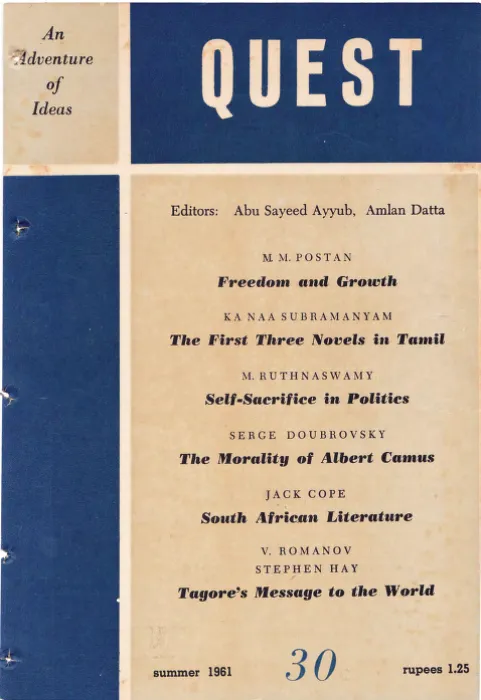
QUEST
Summary
Quest No. 30 (contents page dated JULY/SEPT. 1961, cover dated ‘summer 1961’) is a 112-page Bombay quarterly sponsored by the Indian Committee for Cultural Freedom, edited by Abu Sayeed Ayyub and Amlan Datta with Nirad C. Chaudhuri and Laxmanshastri Joshi as advisory editors, Nissim Ezekiel as Reviews Editor and Laeeq Futehally as his assistant. It describes itself on the contents page as ‘A Quarterly of Inquiry, Criticism and Ideas’ and on the cover as ‘An Adventure of Ideas’, and the issue lives up to both: twenty-one printed contents entries run from a Cambridge economic historian’s argument about growth and liberty, through two essays reclaiming Tamil literature from Sanskritic accounts of Indian culture, a demolition of H. G. Wells the prophet, an Acton-based attack on the ethic of self-sacrifice in Indian politics, and the issue’s longest piece, a post-mortem reading of Camus’s morality, to three poems, two translated short stories, a documentary quarrel with a Soviet report on a Tagore paper, a review-chronicle of a London publishing season, five book reviews and one long letter.
Its argumentative centre is the standing of the individual against collective claims, approached from several directions at once. Postan refuses the dichotomy of freedom versus growth and attacks doctrinaire laissez-faire as crudely Marxist in the same breath as he indicts Stalinist forced saving; Ruthnaswamy traces the sacrificial ethic from the Essenes to Congress ministers recruited from the class of thiagis and proposes dedication of the self to service in its place; Doubrovsky locates Camus’s break with Sartre and Marxism in the refusal to sacrifice the men of today for those of tomorrow; Neela D’Souza’s essay on homosexuality argues for the Wolfenden position on consenting adults in private and notes that Indian law treats homosexuality on a par with rape; Ashok N. Desai reads Chinese thought reform through Orwell’s Newspeak; and Robert Conquest’s letter answers a Quest reviewer with the claim that the present is real and the future hypothetical. Against that, Jesudasan and Cope are doing something different - reading literatures, Sangam Tamil and Afrikaans, as unflattering records of the societies that produced them. Beyond the printed contents the issue carries three unsigned SHORT NOTICES, an ‘OUR CONTRIBUTORS’ page with nine biographies, four boxed filler epigraphs, and an unusually heavy load of full-page advertising (roughly the first sixteen and last four PDF pages). It carries no editorial plate, photograph or art portfolio of any kind: every image in the issue belongs to an advertisement, which for Quest is itself a finding.
Essays
Freedom and Growth
By M. M. Postan
Postan attacks the premise that the underdeveloped world must choose between growth and freedom. He concedes at the outset that totalitarian states really do enjoy two growth advantages over liberal economies: compulsory capital formation, achieved by state-directed allocation of national income and the forcing down of popular consumption, and the power to direct factors of production to strategically chosen sectors. He is blunt that the first advantage is bought with atrocity, naming Stalin’s collectivisation and the famine that followed it and the crushing of worker revolts in East Germany and Hungary. Some other advertised facilities of dictatorship, notably the power of instantaneous decision, he dismisses as illusory or worse, arguing that the freedom to act without hesitation has cost Russia and China ruinous mistakes. The West, he says, has no economic reason to fear falling behind in the growth race, only military and reputational ones; the underdeveloped countries, held to a demographic timetable, cannot afford to lose it.
His answer is to dissolve the dilemma rather than accept either horn. Compulsory saving is not inescapable: what the private capital market cannot supply, Western capital-assistance schemes can, provided they come without political strings and without early and heavy repayment terms, which makes the choice between oppressive and humane growth a decision for the Western countries rather than for the poor ones. On planning, he insists on discriminating by level and by spirit. Direction at the level of the national budget of resources impairs nobody’s liberty; direction of inanimate resources carries only economic penalties; it is the lowest level, the detailed control of people’s employment and consumption, that requires authoritarian power, and even there he argues the Soviet case followed from communist ideology rather than from economic necessity, and may soften as consumption grows. Wartime Britain, he notes, planned more comprehensively than wartime Russia or Germany and yet bore less crushingly on individuals, because the planners were a body politic dedicated to freedom, subject to the rule of law, and inclined to treat regulation as a regrettable necessity. The essay closes by rejecting laissez-faire whole-hoggery as a mirror image of Marxism.
- Concedes two real totalitarian growth advantages - forced capital formation and the direction of productive factors - while treating the facility for instantaneous decision as illusory.
- Names Stalinist collectivisation, the ensuing famine, and the suppression of production-norm revolts in East Germany and Hungary as the price of forced saving.
- Argues Western capital-assistance schemes, if free of political strings and early repayment, remove the economic case for saving through hunger - so the moral choice lies with the West.
- Distinguishes three levels of state direction and insists the damage depends on purpose and political temper, not extent; wartime Britain planned harder than wartime Russia yet oppressed less.
- Attacks the ‘road to serfdom’ position as crudely Marxist for equating economic regulation with loss of personal liberty.
1) What Sangam Poetry Means to India
By Hephzibah Jesudasan
Jesudasan argues that ‘Indian culture’ is cheaply used to mean Varnasrama Dharma and ‘Indian literature’ to mean Sanskrit and Sanskritised literature, and that Sangam poetry - a body of work from roughly the second century A.D., independent of Sanskrit vocabulary, metre and ideals - is the standing refutation. She presents it as a secular literature divided into Aham (private life) and Puram (public life), worked against conventional landscapes, and as an unusually reliable historical record, because its four hundred and fifty odd poets range from kings to Kurava women and share an unfailing regard for fact. She is impatient with Tamil zealots who would push the Sangams back a hundred centuries and grace them with gods and saints, pointing out that the poets themselves never mention a Sangam or an Academy at Madura, and that the word Sangam is not even Tamil.
The centre of the essay is a reading of Sangam society against itself. The poetry shows an advanced, war-conscious, brilliantly cosmopolitan polity with vivid city life, honest trade, monogamy, widely honoured wifehood, women with freedom and status unthinkable later, and little religious pressure - the word ‘Hindu’ does not occur in the Sangam vocabulary. But it also shows the beginnings of what she calls the seeds of casteism in the Dravidian grouping of society by profession: poets call the Pulayas and Pariahs degraded, and a Pulaya cot-maker is shown economically oppressed. Her conclusion is deliberately uncomfortable for Tamil polemic - that regional and hereditary professional grouping produced unhealthy loyalties and exploitation before Brahminism watered those seeds, so that blaming religion alone is wrong. She is equally severe on the fondness for toddy and for the prostitute, which she reads as notes of decadence, and on the poets’ snobbery toward their patrons. On quality she rates the Sangam poets for quiet dignity, brevity and exact observation rather than for effusion, singling out Nakkirar’s Nedu-nal-vadai as one of the most finished little masterpieces in the world.
- Presents Sangam literature as secular, structurally independent of Sanskrit, and priceless as a historical record because its poets kept an unfailing regard for fact.
- Rejects the traditionalist chronology and the three-Sangam legend on the ground that the poets never mention a Sangam at all.
- Locates the seeds of caste in the Dravidian occupational grouping itself, with Brahminism as a later accelerant rather than the sole cause - printed in a magazine whose readers would expect the opposite.
- Reads toddy and prostitution in the poems as evidence of moral decadence and a grave lesson, and cites a queen’s pre-sati poem as an eye-opener to conservatives.
- Praises the poetry for restraint, compact imagery and observation ‘not less than Wordsworthian’, rating Nakkirar’s Nedu-nal-vadai against anything of its length in English.
2) The First Three Novels in the Tamil Language
By Ka Naa Subramanyam
Subramanyam traces the making of Tamil prose before turning to the first three Tamil novels. He credits the Jesuit Constantius Beschi, who followed Roberto di Nobili’s practice of preaching in prose, with the language’s first surviving prose work, the Tales of the Guru Who was a Simpleton, and calls him the father of modern Tamil prose because he used prose for a creative purpose independent of any poetic text. Ananda Rangam Pillai’s diary had no literary impact because it was not known until the end of the nineteenth century; the missionary and Education Society translations, including a Tamil Panchatantra from a Marathi version, he dismisses as pedantic exercises rather than creative work.
The novels themselves are Vedanayakam Pillai’s Prathapa Mudaliyar Charitram (1879), Rajam Iyer’s Kamalambal Charithram and Madhaviah’s Padmavathy, the last two from the middle and later nineties. He reads the first as episodic, preachy and extremely readable, inspired by both Beschi and the Muslim Ibrahim Shah Rowther’s Vikramaditya tales, modern in its ideals of womanhood and in its language reform but out of date in its statecraft, since its author preferred monarchy to a republic. He condemns as vandalism a publisher’s current attempt to purge Vedanayakam Pillai’s text of allegedly un-Tamil elements. Rajam Iyer, who died at twenty-six, he judges a keen and impartial observer whose novel he still rates the greatest yet produced in Tamil, though static and increasingly absorbed in Vedanta; Madhaviah he calls the novelist of social protest par excellence, better constructed and showing real development in his heroine, but with bad characters who are types rather than persons. All three, he notes, wrote to uplift the Tamil public, and all three differ radically in style - racy spoken rhythm, ornate and swift, and an attempted golden mean that lost both.
- Credits Beschi, not a Tamil, with the first creative Tamil prose work and calls him the father of modern Tamil prose.
- Separates genuinely creative prose from the missionary and Education Society translation exercises of the early nineteenth century.
- Rates Kamalambal Charithram the greatest Tamil novel yet written while conceding it is static and lacks the motivation of growth.
- Calls Madhaviah’s Padmavathy the Tamil novel of social protest par excellence and the better constructed of the two later books.
- Denounces a contemporary publisher for purging Vedanayakam Pillai’s prose of ‘alien and un-Tamil’ elements, and regrets that no effective protest has been raised.
H. G. Wells: The Prophet and the Artist
By Gabriel Gersh
Gersh opens with an anecdote of Wells puncturing Galsworthy’s arithmetic of animal suffering, then argues that Wells, so realistic in conversation, was himself sentimental in most of his social and economic belief. The essay is a sustained indictment of Wells the prophet: he could settle on nothing except the need for a world State, contradicted himself and anyone who agreed with him, oscillated between salvation by patient effort and salvation by magic, and produced a different vision of society and of the family in almost every book. He ran about the earth looking for leaders - Balfour, Rockefeller, George V, the Chiang Kai-sheks, both Roosevelts - and found all wanting, and died in despair in Mind at the End of Its Tether, whose forecast of imminent cosmic extinction Gersh finds simply incoherent: if the universe is about to disappear, nothing anyone does, including adopting the single transferable vote, can matter.
Gersh then grounds Wells’s convictions in his biography, arguing that his father’s failure as a Bromley shopkeeper and his mother’s incompetence as a housekeeper and cook were generalised into a false theory of society, and that the resemblance to Dickens’s life only sharpens the difference: Dickens’s work is pervaded by love of mankind, while Wells was almost destitute of love, loving only Ann Pornick without reserve and treating individuals as specimens. He assembles a catalogue of failed prophecies - the submarine that could only suffocate its crew, the ineffective aeroplane and the war-winning balloon, gas rendering the tank obsolete, cities of twenty to forty million people, a Radical victory in 1939 - and argues that the ones that came true were available to any sharp-witted man who talked to inventors. His verdict is that Wells was unimportant as politician, sociologist and seer and significant only as the artist he professed to despise: a potential great comic genius who chose instead to be a minor prophet. The sociological work is already dead; the novels, from The Island of Dr. Moreau to Tono-Bungay, will live.
- Reads Wells’s indecision as constitutional: a world State was the only thing he never changed his mind about.
- Finds the despair of Mind at the End of Its Tether logically incoherent, since inexorable cosmic doom makes proportional representation irrelevant.
- Derives Wells’s theory of society from his father’s bankruptcy and his mother’s cooking, and contrasts him with Dickens on the single axis of love.
- Catalogues the failed forecasts in Anticipations and The War That Will End War, including the dismissal of submarines and aeroplanes and the faith in balloons and gas.
- Concludes that Wells threw away the gift of genius, and that his novels, not his prophecies, will survive.
Self-Sacrifice in Politics
By M. Ruthnaswamy
Ruthnaswamy asks what truth there is in Acton’s warning that renovating society on the principle of self-sacrifice - the aspiration of the Essenes, the early Christians, the Fathers and Canonists and Friars, Erasmus, More and Fenelon - had become ‘the most dangerous enemy lurking in our path’. He begins by explaining why the idea is native to India: sacrifice, first of things and then of the self, was practised from Dravidian times as a way of acquiring power, and the social and political authority of the Brahmin rested on self-denial, so that among high and low it was deep-seated that men who led lives of self-denial must have power and influence. He then works through Acton’s list, qualifying it as he goes - the Essenes disappeared because they could not live like men in a world of men; monastic life sacrificed the individual to the community; Canon Law made sacrifice of self to the Church its informing principle; More recommended total submission in the Utopia but vindicated the rights of human personality on the scaffold; Fenelon’s fault was relying on the consciences of kings and citizens instead of on the division and limitation of power in representative assemblies, independent judiciaries and local self-government.
The second half brings the argument to India. Ruthnaswamy is careful to say that Gandhi’s Satyagraha is a far cry from the French Revolution and from the Nazi, Fascist and Communist nightmare, but insists the principle is the same, and that Gandhi’s own humility, compassion and sense of humour were what kept the doctrine from being applied au pied de la lettre. Even in his lifetime, he says, the military discipline imposed on Congressmen, the treatment of nonconformists like Subhas Chandra Bose and Neriman, khadi, prohibition, hartal, picketing, social boycott and the moral coercion of the fast unto death were already challenging individual liberty; after his death the Congress still heeds threats of starvation unto death, as with Potti Sriramalu, and still recruits ministers from the class of thiagis with little regard for intellect or character. He then lists the liberty-reducing consequences of the developmental state - controls, permits, licences and quotas, education becoming a state monopoly with nationalised textbooks, private enterprise allowed only 45 per cent of new industries, prohibition, population control by administrative order, cooperative farming and land ceilings - and says that while the logical result has not yet reached Mussolini’s maxim, India is on the road. His remedy is the opposite of the doctrine: dedication of the self to service rather than sacrifice of the self, and the intensification rather than the stemming of individualism, on the ground that it is self-reliant individuals who make institutions work, which is why cooperation succeeded in England, Germany and Denmark and relatively failed in India.
- Frames the whole essay on Acton’s lecture on the history of freedom in Christianity and on Acton’s record of vindicated predictions, including that power tends to corrupt.
- Explains the Indian purchase of the idea historically: sacrifice as a technique for acquiring power, and Brahmin authority resting on self-denial.
- Credits Gandhi’s personal temperament, not the doctrine, with restraining Satyagraha, while listing the coercions of khadi, prohibition, hartal, social boycott and the fast unto death.
- Reads planning, controls, licences, textbook nationalisation and the 45 per cent cap on private new industry as calls for sacrifice of the self in the name of economic progress.
- Proposes dedication to service rather than sacrifice of self, and argues the cooperative movement failed in India for want of self-reliant individuals dominated instead by community and caste spirit.
The Morality of Albert Camus
By Serge Doubrovsky
Doubrovsky’s long essay, written after Camus’s death, sets out to ask what moral principles Camus actually held. He clears the ground first by rejecting two labels: ‘existentialist’, which he calls a bugbear for imbeciles and merely an error of classification, and the more damaging picture of Camus the Just, the austere preacher, the school teacher of civics. His central claim is that Camus has no system: justice, happiness and revolt recur endlessly without ever being defined, and what the work yields is not rules for life but a human attitude, an existential tension, a passion for living. Camus, he says, is above all a poet who travesties his own intuitions whenever he presents them in the guise of reasoning.
The positive account is built on the sun. Where the sun is absent from Sartre’s universe and plays a negative role in La Nausee, and where for Valery it is a self-contained mode of spherical existence, for Camus it is the vital element itself and the perfect symbol of the link between the natural and the human - so the fundamental category of his ontology is participation. Doubrovsky contrasts the Camusian body, in which muscular indolence and physical harmony reign and physical love is unison, with the Sartrean body that philosophy has cut in half and cannot reassemble, and reads Meursault swimming with Marie, and Rieux and Tarrou swimming to the same rhythm in La Peste, as the same truth recovered on contact with the water. Death, on this reading, does not make life absurd but gives it its full meaning. He then eliminates heroism, which he calls a retreat into oneself and an attempt to be God while still being oneself, and hedonism, contrasting Camus’s poverty of natural imagery and singular world with Gide’s plural fruits of the earth and category of having. The final movement is the dispute with existentialism over being and doing: Sartre’s morality of historic action, oriented wholly to the future, opens the door to sacrificing the men of today for those of tomorrow, and every word of Camus’s morality is aimed at slamming that door and rehabilitating the inalienable value of the present. Camus, he concludes, never denied that violence might be a weapon but always refused to grant it be a policy - a simple distinction that for millions of human beings is a vital one - and his work is less a system of morality than a preface for all future morality.
- Refuses both the ‘existentialist’ label and the moralising-saint portrait, and argues Camus never subjects justice, happiness or revolt to a vertical analysis.
- Makes the sun the key to Camus’s ontology: participation, in explicit opposition to Sartrean nausea and to Valery’s self-contained sun.
- Reads swimming scenes in L’Etranger and La Peste as the recovery of vital communion, and death as what gives life its full meaning rather than what makes it absurd.
- Eliminates heroism and hedonism as ontological rather than moral errors - heroism closes the circle, Gide’s plural world belongs to the category of having.
- Locates the break with Sartre and Marxism in the refusal to sacrifice the present to the future, and in the distinction between violence as weapon and violence as policy.
One Among Many-the Homosexual
By Neela D’Souza
D’Souza opens with Kinsey’s proportion - one man in twenty-five - and extrapolates it to sixteen million homosexual men in India, four or five cities the size of Bombay, so that nearly all of us have one or more homosexuals among our acquaintances. She then surveys what was then known about causation without committing to any of it: the psychoanalytic claim that everyone passes through a homosexual phase, Donald West’s view that homosexual tendencies are part of the natural biological make-up and that preference for the opposite sex is acquired, Clifford Allen’s insistence that an abnormal childhood is the one sure fact, the pattern of dominant possessive mothers, and the situational factors of segregation in boarding schools, purdah societies and the South African mine compounds. She explicitly refuses the words ‘normal’ and ‘abnormal’ because of the approval and disapproval they carry, calling homosexuality a deviation from the usual, and she dismisses the seduction theory with an analogy: it is as valid as pleading that one fell into theft from having one’s school books stolen.
The historical section answers whether homosexuality is a symptom of modern decadence by showing it is as old as mankind, running from Sodom and Gomorrah through New Guinea and Australian initiation, the berdaches and alyhas of American Indian tribes, African initiation and Basuto ‘circumcision schools’, the contempt of the Trobriand Islanders, the loss of caste and whipping and mutilation prescribed in ancient India, Incan vengeance on whole families, the idealisation of the passion in classical Greece and its degeneration into a luxurious vice in Rome, and the twenty thousand people known to the London police in the 1890s. The rest of the essay is an argument for tolerance and for law reform, built on the persecution of Radclyffe Hall’s The Well of Loneliness and the destruction of Oscar Wilde, on the evidence that homosexuals are no more prone than heterosexuals to molest children, and above all on the Wolfenden Committee’s recommendation that homosexual behaviour between consenting adults in private be placed outside the sphere of the law. She notes the Committee’s support from the Archbishops of Canterbury and York, church groups, much of the press and the Oxford and Cambridge Unions, records that Indian law treats homosexuality on a par with rape, argues that talk of ‘cure’ wrongly assumes a disease and compares it to forcing left-handed children to write with the right hand, and closes on the treatment of the awkward minority group as the yardstick of a civilised society.
- Opens with Kinsey’s one-in-twenty-five figure and its extrapolation to sixteen million men in India, in order to make the subject unavoidable rather than exotic.
- Deliberately refuses the vocabulary of normal and abnormal, and rejects the seduction theory of causation with a theft analogy.
- Uses anthropology and history - Greece, Rome, New Guinea, the Basutos, ancient Indian penalties, Victorian London - to dismiss the claim that homosexuality is modern decadence.
- Argues for the Wolfenden recommendation on consenting adults in private, noting Indian law treats homosexuality on a par with rape while Italy and France do not punish it as such.
- Treats ‘cure’ as a category error, comparing it to making all left-handed people right-handed, and notes the homosexual may not want to be cured.
A Quick Look at South African Literature
By Jack Cope
Written fifty years after the Union of South Africa was established, Cope’s survey argues that the least expected outcome of 1910 has been the rise of an autonomous and often mature literature. He notes that creative South African writing has been almost entirely in Afrikaans and English, that at least eight other languages are spoken and written in the country, and that it is too early to speak of their literature in the larger sense - the African languages having hardly evolved beyond classroom and church, and most younger Indians having adopted English or Afrikaans. Afrikaans literature, he says, has followed the destiny of the Afrikaner nationality through defeat, subjection, liberation and triumph: despised and unrecognised as a language fifty years earlier, it found its strength in the Second Language Movement after the Boer War, and the 1905 publication of ‘Winternag’ by Eugene Marais marks the dawn of a new era. The early poets - Marais, Leipoldt, Jan Celliers, Totius - gave a defeated nationality the identity their conquerors denied them, and Cope is careful to add that except for the ironical fact that their skins were white, the Afrikaners’ position was not much better than that of other groups under the Pax Britannica.
The critical burden of the essay falls on realistic prose, which he says is hardly at its beginning even in 1960, and on why. His explanation is social: the transition from farm to city is only partly accomplished, the cities remain alien and dominated by British, Jewish and Indian commercial interests, Afrikaans suburbs are parochial, and the demand for books comes largely through schools and the politically aligned Press, so a critical social novel has little chance. The consequences he calls baffling - the educated turn to books in English, with library surveys showing up to ninety-five per cent of Afrikaans readers in typical country areas taking out English books, while a trade in salacious and semi-pornographic magazines flourishes; and a censorship Bill is before Parliament so drastic that any other system east or west of the Iron Curtain seems mild in comparison. He quotes the publisher J. Human that few Afrikaners read Afrikaans books because the quality does not satisfy them, and Alan Paton that Afrikaans fiction is an infant that never grew up, that the policy of the country’s rulers is killing the novel, and that fear of hostile social criticism may be as inhibitory as fear of hostile literary criticism. Poetry, by contrast, he finds technically advanced and still widely read and loved - he works through Uys Krige, the first important writer to reject the national myths, Van Wyk Louw with his profound and ignored pessimism, the academic Opperman, Elizabeth Eybers, Olga Kirsch (discouraged into silence and now living in Israel) and the coloured poets S. V. Petersen and P. J. Philander - quoting several poems in Afrikaans with his own English renderings.
- Treats Afrikaans literature as the literature of a defeated nationality that found in poetry the identity its conquerors denied it.
- Argues realistic prose has lagged because the Afrikaner move to the cities is incomplete and the book market runs through schools and a politically aligned press.
- Reports library evidence that up to ninety-five per cent of Afrikaans readers in country areas borrow English books, alongside a boom in semi-pornographic magazines.
- Warns that a censorship Bill before Parliament would be more drastic than any system east or west of the Iron Curtain.
- Finds the rejection of Afrikaner national myth mainly in poetry - Krige, Van Wyk Louw, Opperman - and in Jan Rabie’s ‘Ons die Afgod’, and quotes the verse bilingually.
Memory
By S. Padmanabh
A short free-verse lyric in two balanced stanzas, printed under the standing POETRY head. The first stanza inventories what the speaker has left behind - a face sculpted in sorrow, eyebrows lifted in puzzlement, a reproach suppressed in love, and a few sheets of paper whose letters have been made into stars by shed tears. The second inventories what has been brought along: a cover with faded petals, a photograph that ought to have been returned but could not be, and this emptiness. The poem’s whole effect rests on the symmetry of the two lists and on the flat, unexpanded last phrase, which turns an inventory of keepsakes into a statement about what remains.
- Two-stanza structure of parallel inventories: things left behind, things brought along.
- Relies on concrete residue - petals, a photograph, tear-blotted letters - rather than on statement.
- Closes on the bare phrase ‘and this emptiness’, the only abstraction in the poem.
- Occupies the whole of printed p.70, with the POETRY section head above it; that page carries no printed folio.
On the Roof
By A. G. Stock
A rhymed satirical monologue in couplets, spoken from a rooftop at sunset. The first movement sets the scene by degrading it: the sun sinks dust-slandered and unlamented, a donkey brays, neighbours’ radios raise false agonies and falser morals, pigeons repeat their own preposterous loves and quarrels with well-bred phrase and mincing feet, and heaven throbs with cuckoo-call. The middle movement turns inward, the speaker drinking tepid lemonade and asking what vagrant dance to the fiddle-notes of chance whirled her to this fantastic metamorphosis - the poem’s sharpest lines, in which a teaching career becomes the dispensing of a prophylactic vaccination known as higher education, daily and with pontific air, to students too well-trained to care for honest thought or depth of learning not expressed in rate of earning. The close is drier still: a gaunt sardonic crow lets slip its cynic comment, and the speaker, recalling that in ancient texts the soul is a bird, supposes hers will pass to that old crow and find the onward journey straight and clear compared with the one that brought her here.
- Rhymed couplets used for social satire rather than lyric; the rooftop is a vantage point on a degraded evening.
- Central conceit turns university teaching into an inoculation administered to students indifferent to unremunerative learning.
- Closes by handing the soul over to a sardonic crow, in a wry inversion of the ancient soul-as-bird topos.
- Complete on printed p.71 and signed ‘A. G. STOCK’.
Poetry without Split
By Bishnu Dey
A long poem in free verse, dedicated ‘(FOR PAUL ELUARD)’ and translated from the original Bengali by the poet himself. Its argument is a repudiation of the private lyric. Where poets in olden times held some Lady Muse in the seclusion of their hearts’ homes and in safe song, the housewalls are now breached and the wailing of all the homeless of the world blows in and out; private conversation with laughter is also a chorus, and even the sleep of poets is torn in the destitute night. The cloudpale beloveds of the Yakshas, the dear Malavikas, are today swords in the sharp light, with summer lightning in their arms and in their eyes the high waters that ripen the grain.
From there the poem opens into a catalogue of eyes on the public road - beggars’, the aged’s, young wives’, widows’, children’s looking into triad Time - and of crowds: from the Drought, the Flood, the riots, the Division of Bengal, ‘the trademark crowds of free India’, protesting students, the retrenched, strikers, crowds in protest against traffic in piety. A middle section turns directly on political manipulators, asking whether they think they can throttle the speaker’s voice, mocking the pious talks of agile politicians and the truths and untruths of the Pilates, and saying they are in search of hangmen all over the land. A further movement invokes an absent son who never gets lost and knows no defeat, whose return will rouse life back in the land of sleep. The last section states the poem’s title-figure directly: the Conscious and Unconscious will be bound in rhyme, the life-mind and body-mind have split and darken the world, dreams no longer obey censors, and the devotee leaves home to worship the Crisis - the split blooming in the blood into a thorny blue-rose while the rhythm of the moment dances into triad Time holding stormy peace in uplifted hands.
- Programmatic rejection of the sheltered private lyric in favour of a poetry that admits the wailing of the homeless.
- Classical Sanskrit love-figures - the Yakshas’ beloved, the Malavikas - are converted into swords and storm light.
- Catalogues the specific crowds of mid-century Bengal and India: drought, flood, riots, the Division of Bengal, retrenchment, strikes, student protest.
- Addresses political manipulators directly, with Pilate and the search for hangmen as its images of public bad faith.
- The title’s ‘split’ is the division of life-mind from body-mind, which the poem proposes to bind in rhyme; translated from Bengali by the author himself.
She Had Told Me
By Chandra Dhar Sharma Guleri
Guleri’s Hindi story, printed as ‘She had Told Me’ with the original title ‘Usne Kaha Tha’ footnoted, opens in the lanes of Amritsar with a comic disquisition on the elaborate courtesy of the city’s bamboo-cart drivers, whose politeness cuts more quietly than abuse. In that setting a boy of twelve buying curd and a girl of eight buying lentil cakes keep meeting at the shops, and he keeps asking whether she is engaged; she keeps saying ‘Tut!’ and running away, until the day she answers yes and shows him her new silk shawl, and he goes home leaving a trail of small destructions behind him.
The story then jumps twenty-five years to a First World War trench in France, where Jemadar Lehna Singh, Subedar Hazara Singh and the Subedar’s sick son Bodha Singh are enduring cold, mud and shelling. Lehna Singh gives Bodha his blankets, his sentry duties and a jersey he pretends came from Englishwomen’s knitting. When a man in the Lieutenant’s uniform appears with orders to attack a German trench a mile off, Lehna Singh catches the impostor out - the Sahib’s long hair has become a convict’s crop, he offers a Sikh a cigarette, his Urdu is fluent and bookish, and he takes the bait of invented details about blue bulls at Jogadhari and a Muslim bearer offering water in a temple. He sends Wazira Singh to recall the Subedar, kills the German before he can fire a booby-trap, and holds the trench with eight men against about a hundred Germans until the Subedar’s party takes them from behind. Sixty-three Germans are killed or wounded and fifteen Sikhs die; Lehna Singh, shot through the ribs, packs the wound with wet earth and conceals it so that the Subedar and Bodha will go in the ambulance. Dying in Wazira Singh’s lap, he remembers the third strand of the story: the Subedarni whose life he had once saved from a bolting tonga horse, who turned out to be the girl from Amritsar, and who asked him to bring her husband and her only son home. His message is that he has done what she told him. The last lines are a casualty list in a newspaper.
- Three-part structure - Amritsar comedy, trench narrative, deathbed recollection - with the childhood exchange ‘Are you engaged?’ / ‘Tut!’ recurring as the story’s refrain.
- The impostor is unmasked by cultural detail, not by evidence: cut hair, a cigarette offered to a Sikh, bookish Urdu and invented shikar memories.
- Lehna Singh’s heroism is entirely concealed - the jersey story is ‘moonshine’, the wound is packed with earth and hidden so that others are evacuated first.
- The promise that drives the plot is never spoken aloud to its beneficiary; the Subedar goes to the ambulance without learning what his wife had asked.
- Printed with a footnoted original title, ‘Usne Kaha Tha’, and the closing credit ‘(Translated from Hindi by N. N. Banerji)’.
The Musk Deer
By Santosh Kumar Ghosh
Ghosh’s Bengali story, printed as ‘The Musk Deer’ with the original title ‘Kastoorimriga’ footnoted, is built on a single withheld grief. Nirmala, a widow living as a dependent in her cousin’s ground-floor rooms, hears that Ajoy, the college teacher in the flat above, has collapsed. She climbs the stairs and stands at the threshold counting his eleven last breaths, and then must go back down and cook, because in the crowded room above it is Karabi’s day: the widow’s loud, shameless, obtrusive lament, the neighbours’ condolences, the students and the wreaths and the bier all belong to the wife. Nirmala’s tears can pass only as kitchen smoke.
The body of the story is her memory of how the attachment began - the first call upstairs, Ajoy noticing the borderless sari and the single pair of bangles, the daily cup of tea that became an invisible three o’clock urge, and the evening on the terrace after a humiliating family quarrel when he took her hand, wiped her face, and told her that women can stand on their own legs and that he would help. That promise he kept: she now teaches sewing at an institution, is no longer wholly dependent, and contributes to the household. But the story’s sting is the night she watched Ajoy take Karabi out and heard her Boudi remark how happily they gad about, and understood that Karabi’s happiness was demonstratably overflowing and needed no hiding, while hers could never be enriched by social consent. When Karabi returns from the ceremonial bath, stripped of ornaments and vermillion and hoarse past crying, Nirmala reflects that they are now in the same position, wearing the same clothes and eating the same food, except that Karabi has the consolation of crying aloud. Nirmala writes her farewell to Ajoy on the floor with a piece of burnt coal, and rubs it out with a wet cloth when a shadow moves in the passage.
- The whole story is organised around who has the socially recognised right to grieve; the wife’s public lament is contrasted with the widow’s forbidden tears.
- Nirmala’s counting of eleven final breaths, likened to counting swimmers surfacing, establishes the story’s benumbed, precise interior voice.
- The terrace scene reverses widowhood’s deadening of the senses through a single touch, and yields a practical promise of economic independence that is in fact kept.
- Writing is the story’s recurring gesture of secrecy - a finger in floor dust, a bare finger on a bed sheet, burnt coal on the floor, then a wet cloth.
- Printed with a footnoted original title, ‘Kastoorimriga’, and the closing credit ‘(Translated from Bengali by Kironmoy Raha)’.
Tagore’s Message to the World
By V. Romanov & Stephen Hay
A two-part exchange under the DISCUSSION head, introduced by an unsigned editorial note explaining that in Soviet Land, No. 18 (September 1960), V. Romanov commented critically on Stephen Hay’s paper on Tagore’s message to the world, published in the Special May issue of Quest, and that Quest reproduces Romanov’s comment with Hay’s reply. Romanov’s boxed paragraph, headed ‘SOVIET COLLEAGUES ARE RIGHT’, reports that at the 25th International Congress of Orientalists the American scholar Stephen Hay of Chicago read a paper reducing Tagore to a proponent of a deep and insurmountable distinction between the ideology of East and West, that his assertions were backed by quotations taken out of context, that Yevgeni Chelyshev, Vera Novikova and Nikolai Goldberg objected, that the Indian delegates supported the Soviet view, and that Hay was unable to refute their convincing arguments.
Hay’s reply is a point-by-point correction. He accepts that Tagore believed Eastern and Western civilisations fundamentally different in character but denies he presented the differences as insurmountable, citing the Visva-Bharati statement of purpose quoted on the first page of his own paper. He denies that anyone objected to quotations out of context, noting that neither Chelishev nor Goldberg reads Bengali and that Mme. Novikova, who knows Bengali well, took no part in the discussion. He records that Goldberg had missed the opening pages and criticised as Hay’s own opinion statements that were Rabindranath’s, and that the one genuinely controversial point was Chelishev’s complaint that the paper did not stress Tagore’s role in the independence struggle - to which Hay replied by quoting a 1908 Bengali letter in which Tagore refuses to let patriotism take precedence over humanity. He disputes that any Indian scholar took part in that particular discussion at all, and treats the closing sentence about being unable to refute as a polemical phrase rather than a description. He closes by absolving the Soviet Indologists of a careless reporter’s errors, rejecting the implication of the heading that any country’s scholars are more ‘right’ than another’s, thanking his Soviet colleagues for their hospitality and looking forward to the 26th Congress at New Delhi in 1963.
- A rare printed instance of a Soviet conference report and a Western scholar’s rebuttal placed side by side in an Indian journal.
- Hay’s method is documentary: he corrects the record by naming who spoke, who reads Bengali, and what his own paper’s first page actually said.
- The substantive disagreement concerns whether Tagore’s East/West distinction was insurmountable and whether his nationalist role was understated.
- Hay quotes a 1908 letter of Tagore’s refusing to buy glass at the price of diamonds or to let patriotism outrank humanity, sourced to Visva-Bharati Patrika.
- He explicitly exempts the Soviet Indologists from blame, attributing the errors to a careless reporter.
Talking About Books
By Sadhan Kumar Ghosh
Ghosh’s review-chronicle in the ‘Books in General’ section opens on the scarcity of good English, noting that academic V.I.P.s commit scandalous solecisms and get away with them, and that readers and pupils probably get the English they deserve. What follows is a rapid survey of a season’s books held together by that standard of prose. He prefers Tom Girtin, whom he calls the nearest thing to Thackeray the essayist, among the contributors to Pick of Punch, misses the astringency of the Muggeridge period and thinks the beatniks should be shown the door; in The Bedside Guardian 9 he is grateful for James Morris and Neville Cardus while complaining that each gets only one piece and that David Low is represented only by cartoons.
The longest section is on Julian Symons’s The Thirties, which he credits with bringing a decade to life where Lehmann failed, and with being aware of the pointlessness of constantly defending the bad against the worse. He follows Symons on Auden, Day Lewis and Spender breaking with the Twenties by setting out to be unpoetical and evolving a private conspiratorial language, on the little Reviews and Group Theatres and Surrealism and the Left Book Club, and on the heretics - Wyndham Lewis, Orwell and Robert Graves - concluding that the Thirties movement died silently because by the end of 1939 the great tide of left-wing feeling had receded beyond the bounds of vision. Shorter notices follow on David Low’s The Fearful Fifties, which he calls potted history delectably told, with its cameos of Makarios counting sea-shells, Eden and Suez, Notting Hill and the Hola camp deaths; on The Best of Henry Miller, whose honesty he likens to Rousseau’s while judging Orwell’s ‘Inside the Whale’ a better introduction than Durrell’s; on A. R. Burn’s The Lyric Age of Greece as a great humanist document; and on a cluster of books on tragedy, chiefly John Lawlor’s The Tragic Sense in Shakespeare, where Ghosh corrects the use made of a Kenneth Muir remark and reports his own 1959 conversation with M. R. Ridley and Kathleen Tillotson at Bedford College. He ends with John Bayley’s The Characters of Love on the antinomy of sex and love, Nicholas Bentley’s A Choice of Ornaments, Shakespeare Survey 13, Saturday Book 20 and Paul Einzig’s memoirs.
- Uses prose quality as the organising standard for a survey that ranges from Punch anthologies to Shakespearean tragedy criticism.
- Treats Julian Symons’s The Thirties as the first book to bring the decade to life, and endorses its account of the Auden group’s deliberate unpoeticality.
- Corrects other critics from personal knowledge, reporting that M. R. Ridley told him in 1959 he would recant the remark being quoted against Shakespearean Tragedy as a coherent idea.
- Repeatedly prefers Orwell as a critic - ‘Inside the Whale’ over Durrell’s introduction to Henry Miller, and Coming up for Air on the Left Book Club.
- Ends on Bayley’s claim that in modern literature Sex represents the Establishment and love is the outsider.
Thought Reform of the Chinese Intellectuals
By Ashok N. Desai
Desai reviews Theodore H. E. Chen’s study of indoctrination in China by way of Nineteen Eighty-Four, arguing that the appendix on Newspeak is the most ominous part of Orwell’s book because it shows a political vocabulary whose words necessarily imply desirable mental attitudes, making hostile ideas literally inexpressible. Chinese political language, he says, reminds one of Newspeak: phrases like ‘the Five-Anti Campaign’, slogans about repelling the ferocious attacks of the bourgeoisie and classifications like ‘intellectuals and semi-intellectuals’ produce a turgidity that slowly becomes too inflexible for fundamental heresies. He notes the historical irony that in the thirties and forties the consensus was that China’s size, ancient history, Confucian family traditions and respect for learning made communism impossible there, and that when events confounded that, the new opinion was that Chinese communism would be mild.
The review then follows Chen’s narrative: the 1942 Yenan ‘ideological remoulding campaign’ against unproletarian ideology, Mao’s speech subordinating literature and art to political warfare and his comparison of unreformed intellectuals unfavourably with peasants whose feet are smeared with animal excreta; the relatively mild self-remoulding and re-education of 1949-50; the hardening after 1951 under the Regulations for the Suppression of Counter-Revolutionary Activities, with public trials, mutual spying, and the denunciation of Hu Shih by his own son; and above all the machinery of confession, in which scholars declared their past inadequacies and coupled self-denunciation with admiration for Chairman Mao’s teachings - Hu Fang thanking the comrades who had hounded him for their constructive criticism. Desai reads the 1956 ‘hundred schools’ slogan and the February 1957 doctrine of non-antagonistic contradictions as a response to discontent that was impeding scientific progress, describes May 1957 as a month of resplendent blossoming, and then the rectification campaign in which the distinction between fragrant flowers and poisonous weeds was discovered and apostates confessed in ludicrous speeches of self-degradation. He faults Chen for not comparing the Chinese approach with its Soviet prototype, thinks the Chinese more thorough in depriving citizens of independent thought, and doubts Chen’s cautious optimism, suggesting instead that toleration slogans may be a device for exposing latent critics.
- Frames Chinese political language through Orwell’s Newspeak appendix, treating linguistic inflexibility as a mechanism of orthodoxy.
- Recovers the confounded 1930s consensus that China’s traditions made communism impossible, and the successor belief that it would be mild.
- Centres the analysis on confession and self-criticism as the technique for humiliating intellectuals, with the Hu Shih and Hu Fang cases as instances.
- Reads the Hundred Flowers interval as a concession forced by the damage terror was doing to scientific and technological progress.
- Faults the book for omitting the Soviet comparison and rejects its cautious optimism, suspecting toleration slogans of being traps.
Britain in India
By A. H. Somjee
Somjee begins by conceding the difficulty of his subject: British rule in India was more than a mere foreign rule, its impact on culture, politics, administration, education, the legal system and thinking so profound and varied that a generation which lived through its intensity lacks the necessary perspective to assess it. He therefore welcomes Masani’s alternative approach, which treats the contact between Britain and India in terms of the problems and dilemmas that Indian situations created for the British - dilemmas faced, he says Masani shows, sometimes with sincerity and courage and sometimes with callous neglect, in administering conquered territory, introducing social and educational reforms, conceding self-government by degrees, and finally transferring power to two nations.
He quotes Masani’s disarming preface - that the author is neither historian nor active politician but an eye-witness who for two decades interpreted the best mind in the Indian National Congress to successive representatives of the British Crown while striving to make rough places smooth - and traces the book from British sailors’ stories of India’s splendours to the Mountbatten Plan. The organising problem, he says, was always justification: first of British rule, on the ground that Britain alone could give India efficient and just administration, and then of withdrawal, on the ground that Indian political manhood had come of age. The one dilemma Somjee singles out as hardest was bringing the Congress and the League together before the transfer of power, and here he registers his single substantial disagreement: in considering Wavell’s role sympathetically, he believes Masani has overestimated the efforts of the soldier-statesman with ‘transparent sincerity’, while allowing that Wavell did try to help Britain in his own way. His verdict is that the book is a charming narrative full of rare insights, written with the respect and affection most Indians feel for British rule after independence, and without failing to criticise its faults.
- Opens by naming the reviewer’s own generation as disqualified by proximity from assessing British rule.
- Praises Masani’s device of organising the encounter around British dilemmas rather than Indian grievances.
- Identifies justification - of rule, then of withdrawal - as the continuous British problem across two centuries.
- Dissents on one point: that Masani overestimates Wavell’s efforts and his ‘transparent sincerity’.
- Notes the affectionate post-independence tone, and that Masani nevertheless criticises the Raj’s faults.
Letters to My Teacher
By Laeeq Futehally
A short, frankly hostile review of Dagobert D. Runes’s Letters to My Teacher, cast as short petulant letters to the author’s old school teacher. Futehally’s charge is that Runes has a few prejudices which he presents as his philosophy, and that the philosophy has the merit of being easy to understand: all that is bad should be changed, all that is wrong should be put right, and what the right is is so obvious that it needs no explanation. She concedes that quite a few of his statements are very true - so true that they are truisms - and then demolishes his one apparently deep argument, that instead of cramming pupils’ minds with a Greek vocabulary the teacher should have read the magnificent poetry and philosophy of ancient Greece with them, by observing that no one has yet thought of enjoying the poetry of Greece without first acquiring a Greek vocabulary. She notes that Runes has no faith in modern education or perhaps in any education, that he thinks the more successful students learn to be self-centred, success-greedy, prize-snatching and merit-hogging, and that he simultaneously credits a sixteen-year-old with reducing many of the theorems of Darwinism to weak-legged hypotheses. The review ends with an apology for its own frivolity that is also its final verdict.
- Identifies the book’s method as prejudice presented as philosophy, with truisms standing in for argument.
- Dismantles the Greek-vocabulary argument by pointing out it presupposes what it rejects.
- Notes the internal contradiction between contempt for all education and confidence in untutored adolescent wit.
- Closes with a self-deprecating apology that doubles as the harshest judgement in the review.
A Silence of Desire
By Laeeq Futehally
Futehally outlines the plot of Kamala Markandaya’s A Silence of Desire - a head clerk’s wife develops a growth in her womb and, without telling him, visits a swami said to cure such things without an operation; he suspects an affair, she becomes silent, the marriage opens a rift, and the unhappiness persists after he learns the truth until the swami leaves town and she has the operation - explicitly in order to expose the holes in it. Her objections are matters of plausibility. The reader is carefully assured the growth is not malignant, so a devoted wife concealing so innocuous a fact is unlikely; the wife’s explanation, that her husband has Westernized scientific notions and does not believe in faith healers, will not carry the weight put on it, since there is hardly any Indian so obsessively scientific that he would refuse his wife a swami-cure, and such a situation is barely conceivable even at the top level of the intelligentsia, still less at the matric-passed level. The mental calibre of a mild man who has risen by years of hard work to head clerk is not the calibre that makes a strong stand, and there is a tulsi plant in his own house before which his wife does puja daily. On the emotional plane too a non-malignant growth is an inadequate excuse for so much misery. Her closing judgement allows that outstanding talent, or a greater ability to create an Indian climate of thought and speech, might have carried the story, but finds that drama is not created by treating insignificant episodes in thrilling tones.
- Reviews by plot summary as demolition: the outline is given expressly to show where it will not bear weight.
- Grounds the implausibility in social observation - the tulsi plant, the head clerk’s temperament, the matric-passed milieu.
- Distinguishes competence from talent and denies that emphasis on the trivia of daily life can generate tension.
- Concedes that only genius could have made a good novel from such slight and unlikely happenings.
The Serpent and the Rope
By P. L. Stephen
Stephen opens with Somerset Maugham’s use of the Encyclopaedia Britannica on the true purpose of a novel - to amuse by a succession of scenes painted from nature and by a thread of emotional narrative - and places Raja Rao’s The Serpent and the Rope in the class where that purpose is most visible, with Conrad, Virginia Woolf and Dostoyevsky rather than Scott, Dumas and Tolstoy. He argues the book goes further, satisfying the demand for a truly Indian novel reflecting the flavour and wholeness of the traditional Indian way of life, where fact and fable, philosophy and the matter-of-fact blend into one, and further still because Raja Rao, born into an old Mysore Brahmin family and educated at Madras, Montpellier and the Sorbonne, blends the cultures of East and West, with Sanskrit, French and English literatures feeding a rare unhurrying style.
He states plainly that there is no well constructed plot to lure the reader from page to page - Rama meets Madeleine at a French university, they marry, their child dies, he returns to India for his father’s illness and goes in search of spiritual traditions, meets Savitri, finds on returning that Buddhism has taken hold of Madeleine, and resolves to seek a guru in Travancore - and then argues that as in all truly great books there is much more than the story. He praises the deep lore on every page, including a knowledge of Christianity and especially Catholicism that only years at Montpellier and the Sorbonne could yield, and the fact that it is carried by pleasant and lively conversation rather than exposition; he picks out the secondary characters, Savitri, Georges, Oncle Charles and Tante Zoubie, Father Zenobias and grandfather Kittanna, and quotes the almost mystical manner in which the author writes of them. Rama and Madeleine, he says, represent the East and the West, and it is the East that wins. He explains the title through Rama’s formula that the world is either unreal or real, the serpent or the rope, with poetry and sainthood lying between, and closes by invoking, with a vast difference, The Brothers Karamazov.
- Uses Maugham and the Britannica to place the book among plotless novels whose purpose is scenes and emotional thread.
- Presents the novel as the answer to the demand for a genuinely Indian novel blending fact, fable and philosophy.
- Concedes the absence of plot openly and rests the case on lore, conversation and character instead.
- Reads Rama and Madeleine as East and West, and declares that the East wins.
- Explains the title through the Vedantic serpent-and-rope formula, and ends by naming Dostoyevsky.
”Soviet Deportation of Nationalities”
By Robert Conquest
Conquest writes to answer Siddhartha Sen’s Quest review of his book The Soviet Deportation of Nationalities, and treats the disagreement as revealing an important division in the world about the standards to be adopted on moral and political issues. He accepts that he believes Soviet imperialism worse than Western imperialism and suggests it once or twice in the book, but insists the book’s main intention was to assemble facts not previously brought together, and that one can read it for the information while rejecting the conclusions. Where he parts company with Sen is on inference from those facts: having established, as he says Sen seems to concede, that the Soviet authorities treated subject races with an inhumanity both greater and more systematic than anything even alleged against Western imperialism in this century, he cannot follow an argument whereby the regime may behave badly but be good.
The letter’s core is an attack on what Conquest calls the thesis that an amoral humanism is possible. He argues that in any state built on the principle that massacre and torture are the logical road to peace and freedom, the terrorist rises to the top, and that Stalin and Rakosi, rulers of doubtful sanity creating a society in the image of their own delusions, are the natural end product of a fallacy. To the moral failure he adds a logical one: the present is real and the future hypothetical, theory is always fallible and its interpreters more so, and Stalinist practice equated particular tyrannies with the economic system itself. He then argues the deportations fail even by Sen’s own standards, since the Soviet state was neither nascent nor battling for survival - Khrushchev himself having said the action was not dictated by military considerations because the German defeat was already assured - and that Sen’s quotation from Maurice Dobb refers to the purges of the middle thirties, now officially called the period of mass repression and admitted to have been unnecessary and harmful. He closes with a series of questions about why the deported nations were disaffected at all, how their literatures came to be full of adulation of Stalin, how they voted 99 per cent for the government shortly before their revolts, and how their names were erased from new editions of Soviet books; suggests the rehabilitations of 1957-60 may partly reflect the pressure of opinion in non-Communist Asia; argues that it is the duty of all humanists to bring suppressed information to public consciousness, since if news of Sharpeville had been suppressed no one would be concerned about it; and denies ever having suggested that all Russians were a bestial race, since the Russians have no say in the matter and cannot be blamed for the actions of their rulers.
- Separates the book’s factual contribution from its conclusions, and invites readers to accept one while rejecting the other.
- Argues that amoral humanism is self-defeating because the state it builds selects for terrorists.
- Turns the temporal asymmetry into a principle: the present is real and the future hypothetical, so present suffering cannot be discounted against a hypothetical future.
- Uses Khrushchev’s own admission that the deportations were not militarily dictated to defeat the emergency justification.
- Grounds the case for publishing suppressed facts in the Sharpeville analogy, and expressly refuses any collective charge against Russians.
Essay 22
The first of three unsigned SHORT NOTICES printed at the foot of the BOOK-REVIEWS section and absent from the contents page. It notices John Correia Afonso’s The Soul of Modern India, an essay on spiritual and cultural values in India today which the notice says does not drive itself to a closely argued thesis about the exact place of religion in Indian life. Since eighty-five per cent of India’s population are Hindus, the author is described as concerning himself with Hinduism as practised and understood not by the spiritual elite but by that eighty-five per cent. The notice singles out as particularly forceful his analysis of the spiritual emptiness that has overtaken young people, quoting him that the strength of Hinduism has lain in the family and the caste and that its influence has waned with the declining power of those institutions, and that the young respect a spiritual outlook and religious ideas but regard religious practice as a thing of the past, left to retired gentlemen and the ladies of the house. It ends by calling his final verdict - that Indian youth’s great malaise is their lack of prayer - ironical and strange for the heirs to a country which prides itself on its spirituality.
- Unsigned and unlisted on the contents page; one of three short notices closing the reviews section on printed p.106.
- Notes the book declines a closely argued thesis and works instead with lived, majority Hinduism.
- Quotes the author on Hinduism’s strength having lain in family and caste, and on the young respecting religious ideas but not practice.
- The notice’s own verdict is that the diagnosis of a ‘lack of prayer’ is a strange one for a self-consciously spiritual country.
Essay 23
The second unsigned SHORT NOTICE, and the briefest item of editorial prose in the issue. It notices Gustav Regler’s The Owl of Minerva, an autobiography translated from the German, and characterises its author as a man who in spite of himself seemed to get mixed up in all the political activities of his time: he became a communist when communism was attracting the most idealistic young writers, fought in Spain, fought against the Nazis, and would have fought in the Second World War for the French except that the French army refused to accept him. The notice’s entire judgement is a single sentence about the translation.
- Unsigned and unlisted on the contents page.
- Summarises Regler’s career as involuntary political involvement rather than commitment.
- Declines to judge the book itself, attributing its shortcomings to the translation.
Essay 24
The third unsigned SHORT NOTICE, on Hiranmay Banerjee’s How Thou Singest, My Master, sub-titled ‘A Study of Tagore’s Poetry’. The notice is almost entirely biographical: Banerjee joined the Indian Civil Service in 1929 and is at present Development Commissioner in West Bengal; his great interest has always been philosophy; Tagore’s philosophy as well as his poetry has been a subject of study for him, and he has lectured and written about it for many years. The slender volume collects his thoughts on the different aspects of Tagore’s poetry, and the notice closes by observing that the present centennial year is a highly suitable occasion to publish it - one of several places in the issue where the 1961 Tagore centenary surfaces.
- Unsigned and unlisted on the contents page.
- The notice describes the author’s career and standing rather than assessing the book’s argument.
- Ties the book to the Tagore birth centenary of 1961, which recurs across the issue’s editorial matter and advertising.
- Prints ‘centenniel’ for ‘centennial’ - a source typo confirmed against the page image.
Essay 25
An editorial page headed ‘OUR CONTRIBUTORS’, printed on p.109 and not listed on the contents page, carrying nine one-sentence biographical notes in the order Postan, Ka Naa Subramanyam, Hephzibah Jesudasan, Ruthnaswamy, Neela D’Souza, A. G. Stock, S. Padmanabh, Bishnu De and Gabriel Gersh. The notes are the issue’s only source of biographical information about its writers: Postan teaches at Cambridge and is a recognised authority on economic history; Subramanyam and Bishnu De are declared to need no introduction to readers of Quest; Jesudasan lectures in English literature at a women’s college in South India and has appeared in Quest before; Ruthnaswamy was Vice-Chancellor of Annamalai University; D’Souza has a Master’s degree in journalism from Syracuse University and free-lances in her spare time; Stock has taught English at several Indian universities; Padmanabh teaches pathology at the Medical College, Baroda, and is working for his M.D.; and Gersh free-lances for journals in the United States, England, India and other countries. Twelve of the issue’s twenty-one bylined items are therefore unaccounted for - the two story writers and their two translators, both Discussion contributors, Sadhan Kumar Ghosh, all five reviewers and the correspondent get no note, and the page spells the poet’s name ‘BISHNU DE’ where the contents page and the poem itself print ‘Bishnu Dey’ / ‘BISHNU DEY’.
- Nine of the issue’s contributors are given one-sentence notes; the translators, reviewers, discussion contributors and correspondent are given none.
- Order of the notes does not follow the contents page: Subramanyam precedes Jesudasan, and Gersh is placed last though his article appears fourth.
- The only institutional affiliations recorded anywhere in the issue appear here - Cambridge, Annamalai, Syracuse, the Medical College Baroda.
- Records a name variant that matters for merging the run: ‘BISHNU DE’ here against ‘Bishnu Dey’ on the contents page and ‘BISHNU DEY’ under the poem.
- No nationality is stated for any contributor; the notes give only institutions and publication markets.
Essay 26
An unattributed boxed filler at the foot of printed p.28, closing Jesudasan’s article, quoting Pico della Mirandola on man as a little world in which may be discerned a body mingled of earthly elements, ethereal breath, the vegetable life of plants, the senses of the lower animals, reason, the intelligence of the angels, and a likeness to God. Quest sets these fillers in ruled boxes to fill the foot of a page where an article ends short, with no editorial comment and no source beyond the name. The choice is of a piece with the issue’s recurring interest in the standing of the human individual.
- A boxed, unattributed filler quotation, not listed on the contents page and given no source beyond the author’s name.
- Placed at the foot of p.28 where Jesudasan’s article ends part-way down the page.
- Its Renaissance account of man as a graded microcosm sits alongside the issue’s several defences of individual personality.
Essay 27
A second boxed filler, at the foot of printed p.44 where Ruthnaswamy’s article ends, quoting William James on unhappiness as not only painful but mean and ugly, asking what can be more base and unworthy than the pining, puling, mumping mood no matter by what outward ills it may have been engendered, and arguing that the mood fastens and perpetuates the trouble that occasioned it and increases the total evil of the situation, so that at all costs we ought to reduce its sway. Its placement immediately after an essay attacking the ethic of self-sacrifice is the nearest thing in the issue to editorial comment by juxtaposition.
- A boxed, unattributed filler quotation, not listed on the contents page.
- Falls directly beneath the close of ‘Self-Sacrifice in Politics’, whose argument it obliquely reinforces.
- Argues that the unhappy mood is itself a moral failing that compounds the harm that produced it.
Essay 28
A third boxed filler, at the foot of printed p.82 where Guleri’s story ends, quoting Dr Johnson that in our progress through life we are forced to abate much of our demands, and to take friends such as we find them and not as we would make them. Coming immediately after a story in which a man dies keeping a promise to a woman he met once as a child, the juxtaposition again reads as deliberate.
- A boxed, unattributed filler quotation, not listed on the contents page.
- Printed below the closing casualty list of ‘She had Told Me’ and its translator credit.
- Attributed only as ‘Dr. JOHNSON’, with no work named.
Essay 29
The fourth and last boxed filler, at the foot of printed p.93 where Stephen Hay’s reply ends, quoting T. S. Eliot that the essential advantage for a poet is not to have a beautiful world with which to deal but to be able to see beneath both beauty and ugliness. It closes the DISCUSSION section and, coming at the end of an exchange about how to read Tagore, glances at the issue’s running argument about what poets are for - an argument also carried by Bishnu Dey’s poem and by A. G. Stock’s.
- A boxed, unattributed filler quotation, not listed on the contents page.
- Closes the DISCUSSION section at the foot of p.93, after Hay’s reply on Tagore.
- Attributed only as ‘T. S. ELIOT’, with no work named.
Generated by the v1.5 extraction pipeline. Awaiting editorial review.
Metadata and summary are AI-extracted from the source PDF and reviewed for editorial accuracy. The original work is available via the Read PDF tab above (where present); paragraph-level citation inside the PDF is deferred to a future engagement.
People in this work
- M. M. Postanauthor
- Hephzibah Jesudasanauthor
- Ka Naa Subramanyamauthor
- Gabriel Gershauthor
- Prof. M. Ruthnaswamyauthor
- Serge Doubrovskyauthor
- Neela D'Souzaauthor
- Jack Copeauthor
- S. Padmanabhauthor
- A. G. Stockauthor
- Bishnu Deyauthor
- Chandra Dhar Sharma Guleriauthor
- Santosh Kumar Ghoshauthor
- V. Romanovauthor
- Stephen Hayauthor
- Sadhan Kumar Ghoshauthor
- Robert Conquestauthor
- Abu Sayeed Ayyub
- Prof. Amlan Datta
- Nirad C. Chaudhuri
- Laxmanshastri Joshi
- Nissim Ezekiel
- Laeeq Futehally
- Sheela Singh
- N. N. Banerji
- Kironmoy Raha
- Ashok Desai
- A. H. Somjee
- P. L. Stephen
- Mahatma Gandhi
- Rabindranath Tagore
- Jawaharlal Nehru
- Mao Zedong
- Karl Marx