
periodical issue
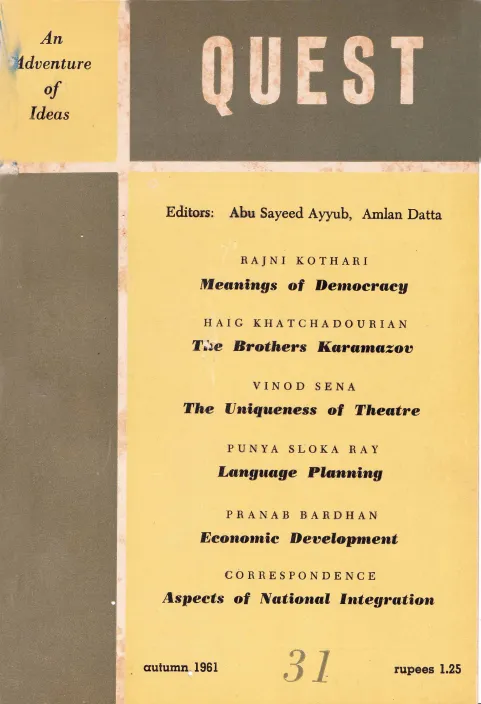
Quest
A Quarterly of Inquiry, Criticism and Ideas
By Haig Khatchadourian, Pranab Bardhan, Vinod Sena, Punya Sloka Ray, Omprakash Sharma, Jack Cope, Rajni Kothari, G. Burce Bunao, F. R. Stanley, Amaresh Datta, Ka Naa Subramanyam, Amarlal Hingorani, Sadhan Kumar Ghosh, P. Lal, A. H. Somjee, Mithoo Coorlawala, S. Natarajan, A. M. Ghose, Lina Mayadas, Iqbal Lukmani, Swami Agehananda Bharati, Satish C. Saberwal, Chetan Karnani, Subrata Banerjee
Printed and published by MISS SHEELA SINGH for the Indian Committee for Cultural Freedom, Army and Navy Building, 148 Mahatma Gandhi Rd., Bombay 1, at Inland Printers, Victoria Mills Buildings, 55 Gamdevi Road, Bombay 7. · Bombay · 1961
116 pages
Quest
Summary
Quest No. 31 is a general number of the Bombay quarterly ‘of Inquiry, Criticism and Ideas’ sponsored by the Indian Committee for Cultural Freedom, edited by Abu Sayeed Ayyub and Amlan Datta with Nirad C. Chaudhuri and Laxmanshastri Joshi as advisory editors; its contents page is dated OCT./DEC. 1961 while the cover reads ‘autumn 1961’. Its argumentative centre is Rajni Kothari’s sixteen-page ‘Meanings of Democracy’, a systematic attempt to break the Indian deadlock between parliamentary and ‘direct’ democracy by proposing a third term, ‘infra-democracy’ — an activated network of autonomous self-governing associations standing between the individual and the State — and to locate the failure of Indian democracy in the absence of that network rather than in the constitutional form. Kothari’s essay is flanked by two others on the political sociology of ideas: Pranab Bardhan asks whether intellectuals can lead economic development while remaining intellectuals, and answers ambivalently, and A. H. Somjee’s review of Selig Harrison’s ‘India: The Most Dangerous Decades’ supplies the empirical counterpart, on linguistic regionalism, caste organisation and the regionalisation of political parties on the eve of the 1962 elections. The literary half of the issue is substantial and unusually international: Haig Khatchadourian on isolation in The Brothers Karamazov, Vinod Sena’s theory of what the stage can do that the cinema cannot, Punya Sloka Ray’s comparative treatment of language planning (closing with seven concrete proposals for India, including a diacriticless Roman script for all Indian languages), Omprakash Sharma on the failures of Indian biography, and the second and concluding instalment of Jack Cope’s survey of South African writing in English. Four haiku by the Filipino poet G. Burce Bunao, poems by F. R. Stanley and Amaresh Datta, a Tamil story by Ka Naa Subramanyam and a posthumously printed Sindhi story by Amarlal Hingorani (both in translation) fill the middle; Sadhan Kumar Ghosh’s roving books column, seven signed reviews, three unlisted ‘shorter notices’, two blocks of contributor biographies and a three-letter correspondence section on integrating Indian society close it.
The issue’s Cold-War liberal orientation is explicit rather than argued: the sponsorship line, a house advertisement for Encounter, Bardhan’s account of intellectual leadership under Stalinism (‘Boris Pasternak’s is a tragic figure’), and Kothari’s closing refusal to treat ‘People’s Democracy’ as democracy at all. Two internal features are worth a cataloguer’s note. First, the issue reviews a book by one of its own editors — S. Natarajan on Amlan Datta’s ‘Essays on Economic Development’ — without printing any note of the relationship. Second, the correspondence section is an argument with Quest itself: Swami Agehananda Bharati replies to a Quest 29 article by Father De Meulder, and Chetan Karnani writes directly to ‘Dear Abu Sayeed Ayyub’ to reject the editor’s own proposal that science be made compulsory for graduates. The issue carries no plates, photographs or art feature of any kind — unusually for Quest, all of its non-textual pages are commercial advertisements.
Essays
The Theme of Isolation in The Brothers Karamazov
By Haig Khatchadourian
Khatchadourian reads The Brothers Karamazov through a single organising theme, isolation, deferring its twin (communion) to a later essay. His argument is that in Dostoevsky the moral order is God’s handiwork, so that sin is not merely social transgression but a severing of the bonds that tie a person to God, to other people and to nature; the penalty is not prison or Siberia but emotional and spiritual isolation. Crucially, the severance is emotional and spiritual but not ontological — the sinner remains God-created, which is precisely what makes redemption possible. He then grades the novel’s characters by the ratio of intellect to passion in their crimes: Mitya’s rebellion is impulsive and therefore mildly isolating, Smerdyakov’s is instrumental, and Ivan’s — wholly intellectual, with faith wholly absent — is the most isolating of all, because heightened self-consciousness turns the intellect into a two-edged knife. Cross-reading Crime And Punishment throughout, he argues that Raskolnikov’s calculated crime isolates him more drastically than Mitya’s, and that Svidrigailov’s failure to be redeemed by love ends in suicide. A second movement identifies hell, in Father Zossima’s definition, with the inability to love, and hence with isolation itself; a third extends isolation from human society to nature, contrasting Alyosha’s communion with the natural world against Raskolnikov and Svidrigailov, for whom the Neva’s grey water reflects only their own isolation and suggests suicide. He closes with the counter-intuitive judgement that isolation is actually less dominant in The Brothers Karamazov than in Crime And Punishment, because in the later novel the theme is said rather than embodied.
- Treats isolation and communion as the two governing themes of Dostoevsky’s major novels, and analyses only the first here.
- Sin severs the emotional and spiritual bond to God and men but not the ontological one — which is why redemption remains possible.
- Ranks characters by how far intellect rather than passion drives the crime: Ivan’s intellectual crime isolates more than Mitya’s impulsive one.
- Identifies Zossima’s ‘hell’ — the suffering of being unable to love — with spiritual isolation itself.
- Extends the theme to nature: only Alyosha (and Zossima) are at one with the created world.
- Concludes, against expectation, that the theme is more vividly embodied in Crime And Punishment than in The Brothers Karamazov.
Economic Development and the Intellectual
By Pranab Bardhan
Bardhan argues that development economics has neglected the sociology of leadership, and asks specifically what role the intellectual plays. Historically, he notes, industrialisation happened largely without intellectuals: the Schumpeterian entrepreneur was not one, and the great European intellectual centres had little to do with the progress of industry. The striking exception is the Bolshevik avant-garde — Lenin, Trotsky, Bukharin, Gorky and others — and, in his present, the Chinese Communist leadership. In the newly independent countries, where indigenous entrepreneurship is scarce, the task falls on intellectuals by default: they must supply personnel, diffuse growth-oriented values, formulate an ideology of advance (as Saint-Simonians did for France and nationalism did for Germany and Japan), and construct a collective self-image for the nation. He then turns the argument against itself. The historical record, he suggests, hints at something anti-intellectual in industrial advance: America’s distrust of ‘eggheads’ accompanied its industrial rise, intellectually mature France lagged, and within India the most ‘cultured’ regions — Bengal above all — have not been the most materially successful. A genuine intellectual, he continues, may find materialist ideologies empty, the ‘economic man’ a false conception, and mass idolatry of history repellent; the intellectual is constitutionally an outsider, prone to what Mannheim called ‘Schizothymia’. The same anti-intellectual bias, he adds, operates in Communist countries, where Stalin’s purges cleared out the very intellectualism that had vitalised the movement. The essay ends by affirming the necessity of intellectual leadership while questioning the eighteenth-century idea of ‘progress’ that underwrites it.
- Development cannot be understood through growth models alone; the structure of social and economic leadership is a determinant of it.
- Industrialisation in the West and Japan proceeded largely without intellectual leadership; Communist Russia and China are the conspicuous exceptions.
- In underdeveloped countries the scarcity of entrepreneurship devolves the leadership task onto intellectuals, who must supply both personnel and an ideology.
- Counter-argument: the historical record suggests something anti-intellectual in industrial advance — America’s populist distrust of ‘eggheads’, France’s lag, Bengal’s intellectual richness alongside material weakness.
- A true intellectual may reject the materialist ideology he is asked to propagate, and the intellectual’s temperamental outsiderhood limits his capacity for mass leadership.
- Communist industrialisation is also anti-intellectual once the doctrine hardens; ‘Boris Pasternak’s is a tragic figure’.
- Closes by questioning not the need for intellectual leadership but the philosophical foundations of the idea of progress it serves.
The Uniqueness of Theatre
By Vinod Sena
Sena begins from a practical Indian question — why bother reviving a professional theatre when the cinema has plainly won? — and refuses the two usual answers (national prestige, and the stage as a nursery for film actors), insisting that drama must be justified in itself. He surveys Eric Bentley, who locates theatre’s power in a live current running between actor and audience that celluloid cannot carry, and John Gassner, who locates it in ‘duality’, the spectator’s shuttling between reality and theatre. Sena synthesises the two: because a stage performance is always visibly an improvised imitation rather than a photographic record, the audience is simultaneously immersed and critically detached, and because its response feeds back to the actor it is a participant rather than a spectator. From this he derives a series of consequences. The theatre audience is more critically alive than the cinema audience, which makes greater demands on language and plot — and explains, he argues, why film dialogue reads so poorly on paper and why intricate plots work on stage but not on screen. Denied the screen’s visual resources, the stage must generate emotion from human action alone, which both protects it from the sentimentality of Indian films and the spectacle of Hollywood, and secures its survival as literature. Its highest gift is that it lets us enter experience from within while mastering it from without: a means to self-mastery, and the ground of tragedy. He concedes that not all drama realises these potentials, but holds that a living national theatre is the point where a people’s varied lives are gathered into one, and that no other art can substitute for its absence.
- Rejects prestige and film-training arguments for a national theatre: drama must justify itself in itself.
- Synthesises Bentley’s live actor-audience ‘current’ with Gassner’s ‘duality’ of reality and theatre.
- Cinema creates an illusion of literal transcription; theatre offers an imitation that is aware of its own illusoriness.
- Because theatre audiences stay critically awake, drama can sustain complexity of plot and language that film cannot — and so survives as literature.
- The stage’s poverty of visual resources is a discipline that saves it from the sentimentality of Indian cinema and the spectacle of Hollywood.
- Theatre unites empathy with detachment, making it ‘a means to self-mastery’ and the natural home of tragedy.
- Cites Brecht’s ‘epic theatre’ as a one-sided exaggeration of a genuine double-sided truth about drama.
Language Planning
By Punya Sloka Ray
Ray defines language planning minimally — ‘an active recommendation towards a preferred solution to an existing problem concerning linguistic usage’ — and then works comparatively through who plans, when planning succeeds, what it is for, and how it is done. Planning may begin with a single writer (Pramatha Chaudhury’s shift of Bengali literary dialect), a church (Luther’s choice of the Meissen chancellory dialect), or a state (Richelieu’s Academie, Ataturk’s Turkish Linguistic Society, which cut Arabic and Persian loanwords in newspaper Turkish from about 75 per cent to 35-40 per cent). State backing guarantees nothing: Norway’s long-ruling Socialists failed to displace Riksmaal, and the Papuan governor’s campaign against Neo-Melanesian succeeded only in replacing it with Motu. Planning works only when it rides existing channels of social communication and an increasing informal social mobilisation, in Karl Deutsch’s sense. He then classifies the situations calling for planning under four headings — script, dialect, source of borrowing, and language — illustrating each across Chinese, Turkish, Malay, Serbo-Croat, Japanese, Arabic diglossia, Bengali, Finnish, Swiss and Philippine cases, and counting India as having 6 common languages of varying reach, or on a different view 14 in 11 scripts. The means of planning are two: create a model literature in prose, and promote it over rivals; commissioned writing risks filled state library shelves that nobody reads, and need-creation without model-creation is futile. He closes with seven concrete proposals for India: a single, diacriticless Roman script for all Indian languages; one internationally comparable university; a translation programme preferring literal translation to ‘original’ expositions; technical terms decided by the translators actually working on texts rather than by classicists; pump-priming subsidies to commercial publishers rather than whole-hog state publishing; a central clearing house for technical information on expository writing; and systematic circulation between the languages of what each is deciding.
- Defines language planning as an active recommendation of a preferred solution to a problem of linguistic usage, from one writer’s spelling choice to a parliament’s choice of national language.
- Planning may be private, ecclesiastical or state-led; state backing is no guarantee of success (Norway’s Landsmaal, Papua’s campaign against Neo-Melanesian).
- Success depends on riding existing channels of social communication and increasing informal social mobilisation (Karl Deutsch).
- Classifies the problems as script, dialect, source of borrowing and language, with comparative cases from Turkey, China, Japan, Yugoslavia, Arabic diglossia, Finland, Switzerland and the Philippines.
- Counts India as having six common languages in differing degrees, or fourteen in eleven scripts on a slightly different view.
- Warns that changing the medium of instruction or administration will not by itself produce a literature — ‘a piece of falsehood’.
- Warns that Sanskrit-derived coinages are diverging between Indian languages while English technical terms converge them.
- Makes seven concrete proposals for India, opening with a single diacriticless Roman script and one world-class university.
Crisis in Indian Biography
By Omprakash Sharma
A short, acid essay on why India, ‘the land of heroes and hero-worshippers’, has produced no biographers of the stature of Strachey or Guedalla. Sharma’s diagnosis is that Indian biographers fall into one of two errors. The first is hagiography: they build an artificial halo, turning the life into ‘something akin to a matrimonial advertisement where all the good qualities are listed and magnified’. He recruits Leslie Stephen against a speaker at the occasion who had urged a worshipful attitude, and then catches Stephen contradicting himself on Spedding’s apologetics for Bacon; he quotes a modern life of Johnson to the effect that Johnson is treasured partly because he could resemble ‘an intoxicated hippopotamus’. The second error is the opposite: a cold, humourless accumulation of fact that reads like an epitaph, ‘a blue-book in which all the evidence bearing upon the subject can be piled like a huge prehistoric cairn over the remains of the deceased’. A third besetting sin is the absence of style and perspective: Frank Moraes’s Life of Nehru can be read cover to cover without a smile, while D. F. Karaka’s less reliable and less reverent account is more engaging but ‘stinks too much of Karaka’s gall and a pound of Nehru’s flesh’. He also complains of length, invoking Callimachus’s ‘A big book is a big evil’, and notes that for readable accounts of Indian lives one has had to look to foreigners — Hallam Tennyson on Bhave, Michael Brecher on Nehru, and Orwell to supplement Aiyar on Subhas Bose.
- Argues Indian biography has converted the absence of good biographers into a positive evil, producing Tendulkar, Aiyar and Frank Moraes.
- Error one: the hagiographic halo, ‘smothering your effigy with the conventional flowers’.
- Error two: the cold factual compilation that reads like a tombstone inscription.
- Error three: absence of style — contrasts Moraes’s unreadable Life of Nehru with D. F. Karaka’s engaging but vindictive account.
- Notes that the readable lives of Indian subjects have mostly been written by foreigners.
- Attacks bulk as well: invokes Callimachus’s ‘A big book is a big evil’ against library shelves of unread biographies.
Literature in South Africa
By Jack Cope
The concluding instalment of Cope’s survey traces South African writing in English from Thomas Pringle, friend of Coleridge and ally of Wilberforce, and argues that the ‘missionary’ descent from Pringle is ‘a thin and watery tradition’ whose writers fail from a lack of identity: they stand outside the violent life of the country and absolve themselves of guilt by abhorrence. The recurring undertone of the literature is therefore the sense of being outside, exiled or excluded, and the recurring question ‘What is a South African?’. Against that weakness he sets a strength: English in South Africa becomes a lingua franca available to writers of every race and group rather than the property of one nation’s prejudices. He then moves chronologically — Olive Schreiner, in whom art triumphed over special pleading (a contradiction he sees repeated in Alan Paton); Kipling, Haggard and Buchan; Pauline Smith’s The Little Karroo; the short-lived magazine Voorslag and its quarrelling founders Roy Campbell and William Plomer; Campbell’s ‘Adamastor’ and his later slide into ‘Flowering Rifle’, an adulation of fascism, which Cope thinks his larger achievement redeems; Thomas Mofolo’s Sesotho ‘Chaka’; Deneys Reitz’s Commando. The post-1945 period, he argues, produced something like a school, with two flaws: nearly all South African writers publish in Britain or America and slant their work for a foreign market, and the outside world’s appetite for somebody else’s sins rewards the thickest colours. He surveys Paton, Herman Bosman, Herbert Dhlomo, Phyllis Altman, Harry Bloom, Laurens van der Post, Sarah Gertrude Millin, Doris Lessing, Nadine Gordimer, Dan Jacobson, Peter Abrahams, Alfred Hutchinson and Ezekiel Mphahlele, and names a dozen poets who never find an audience. He closes on the price of writing there — Paton leading the Liberal Party, Bloom in gaol as a political prisoner in May 1960, Lessing ordered out, Hutchinson arraigned for high treason and fled to Ghana, Abrahams unable to return because he is married to a white woman, ‘a crime in South Africa’ — and predicts that the literature which lasts will be the kind that goes beyond the passions of the moment.
- Traces the tradition to Thomas Pringle and finds the ‘missionary’ descent from him sincere but rootless, failing from lack of identity with its society.
- Names the recurring theme of South African writing as exclusion and the unanswered question ‘What is a South African?’.
- Argues English in South Africa works as a lingua franca open to writers of every race, which is why the literature has impressed the outside world.
- Judges Campbell’s ‘Flowering Rifle’ his artistic and moral nadir but holds his achievement as a whole to be his vindication.
- Identifies two flaws in the post-war ‘school’: publication abroad slants the work for foreign markets, and foreign appetite for South Africa’s sins rewards distortion.
- Praises Nadine Gordimer’s ‘exquisite incisiveness’ while faulting her novels as episodic, and holds that Doris Lessing’s finest work is in her stories.
- Closes with a roll-call of writers in gaol, in exile, on trial or barred from return, including Abrahams, barred because of his marriage to a white woman.
Meanings of Democracy
By Rajni Kothari
The issue’s longest and most systematic essay. Kothari opens by complaining that the Indian debate over ‘parliamentary’ versus ‘direct’ democracy is vague, formalistic and conducted by slogan, and proposes two minimum criteria for judging any democratic system: it must maximise the scope for individual freedom, and it must impart a genuine (not coercive) unity and stability. By that test, ‘organic democracy’, ‘people’s democracy’ and ‘guided democracy’ alike fail, since all three foster unity by suppressing differences. He identifies rebelliousness and ‘direct action’ as the index of a system in which both freedom and stability are lacking. His central claim is that the real problem of Indian politics is neither constitutional form nor a state-sponsored versus privately launched ‘cultural renaissance’ but the absence of an ‘infra-structure’ of voluntary, self-governing institutions between the individual and the State. Caste, region, language and religion, not having been permeated by new values, are effectively manipulating the formal constitutional structure to serve quite different ends; humanists who wait for democracy to acquire ‘cultural roots’ in splendid isolation from activists are, he says, a symptom of the apoliticisation of the Indian intellectual. He reformulates direct democracy as ‘self-government through participation in the decision-making process’, distinguishes participation grounded in individual self-consciousness from participation grounded in a collective ego, and distinguishes a consensus imposed by conditioning from one reached by free discussion under known procedures. He then rejects several associations of the older idea: small size and autarky are not essential (and local autonomy can cramp individual freedom where a dominant faction controls it), unanimity is dangerous (he attacks the Congress Panchayat Committee’s recommendation of greater powers for ‘unanimously elected’ panchayats), and representative institutions cannot be dispensed with. Because both older names are compromised, he proposes the deliberately unemotive term ‘infra-democracy’. Against the parliamentary democrats he argues that their position rests on Classical Rationalism and a Platonic dichotomy between reason and passion, that parliamentary systems concentrate power in a small Establishment which a coup need only capture, and that where free institutions survive in Britain, Sweden, Switzerland and the United States they do so because of a self-governing tradition that antedates and persists in spite of parliamentary centralisation. On India specifically: politicisation of all social change has made the State the arbiter of society; centralised planning accentuates the concentration of power; the one saving grace is a large middle class steeped in democratic values, which a rapidly developing economy neglects, producing the frustrated exclamation ‘let’s have a dictator for a few years’. On national unity he insists that unity is being confused with uniformity, citing Pakistan’s greater cultural homogeneity and weaker institutions against Switzerland’s three national cultures and stable order. He closes by excluding ‘People’s Democracy’ from the discussion altogether as ‘at the same time a People’s Dictatorship’.
- Sets two minimum criteria for any democracy: maximum scope for individual freedom, and a genuine rather than coercive unity.
- Diagnoses ‘direct action’ and rebelliousness as the symptom of a system lacking both freedom and stability.
- Locates the real Indian problem in the missing ‘infra-structure’ of autonomous self-governing associations between individual and State, not in the constitutional form.
- Argues traditional institutions — caste, region, language, religion — are manipulating the formal structure precisely because liberals have refused to lead them.
- Redefines direct democracy as ‘self-government through participation in the decision-making process’ and distinguishes genuine participation and consensus from their totalitarian counterfeits.
- Rejects small size, local autonomy and unanimity as essential to the ideal, and specifically attacks the Congress recommendation of devolved powers to ‘unanimously elected’ panchayats.
- Coins ‘infra-democracy’ as a deliberately unemotive name for the system he proposes.
- Argues that parliamentary democracy rests on Classical Rationalism and concentrates power in an Establishment that a coup need only capture.
- Holds that where parliamentary democracies have preserved freedom, a self-governing tradition older than the legislature is doing the work.
- On India: politicisation plus centralised planning without a broad distribution of power risks ‘politicisation without democratisation’; the frustrated middle class is the first casualty.
- Insists unity must not be confused with uniformity, citing Pakistan against Switzerland.
- Excludes ‘People’s Democracy’ from the argument as a contradiction in terms.
Night Scene
By G. Burce Bunao
A three-line poem in haiku form, the first of the four Bunao contributes under the group head ‘FOUR POEMS’. Two waiting white geese are displaced by a black cat strutting blackly on the eaves — a nocturnal image built entirely on the substitution of one animal for another and of black for white, with the addressee (‘you’) never appearing.
- Haiku form: three lines, no punctuation beyond an ellipsis, no finite explanation.
- Built on a colour reversal, white geese against the blackness of cat and night.
- Addresses an absent ‘you’ who never arrives.
- The ‘Our Contributors’ note describes Bunao as combining ‘Filipine imagination with Japanese form’.
Two on the Seawall
By G. Burce Bunao
The second of Bunao’s four haiku. Two shadows below a seawall draw the lights of passing ships towards them, and the night grows tall — an inversion in which the shadow attracts the light rather than being cast by it.
- Second of four haiku on printed p.65 under one shared byline.
- Inverts the usual relation of light and shadow.
- Closes on a spatial rather than temporal figure for time passing: ‘night grows tall’.
Lovetease
By G. Burce Bunao
The third of Bunao’s four haiku, and the only one in a spoken register: the speaker has called a lover’s legs ‘spindles’, and then retracts it mid-poem with a conspiratorial question. The retraction is the poem.
- Third of four haiku on printed p.65.
- The only one of the four in direct speech, with quotation marks and two em dashes.
- Its subject is a teasing insult withdrawn in the act of being reported.
Floating Feeling
By G. Burce Bunao
The last of Bunao’s four haiku: touch is attributed to the eye and a smile to the finger, and the crossed senses together lift the speaker skyward. The poem works entirely by the transfer of one sense’s property to another organ.
- Fourth and last of the four haiku on printed p.65.
- Built on synaesthetic transfer — a touching eye, a smiling finger.
- The only one of the four that ends in elevation rather than reversal or retraction.
Family Album
By F. R. Stanley
A twenty-four-line meditation on a photograph. The people in the group portrait are invulnerable because they are already fixed: outside the frame leaves fall and children lose their innocence and the clock on the mantelpiece measures out lives, but inside it the evening light is imprisoned in their faces and they are ‘stylised for ever’. The speaker reads their careful smiles as masks bravely worn in the knowledge that what survives the tithe paid to time is theirs to keep, and closes by shutting the book and returning to ‘the narrow journey, the vicious chore’, coveting the immortality of the photographed and jealous of ‘the old, forgotten dead’. The poem quotes Hamlet — ‘The readiness is all’ — at its turn.
- The photograph’s occupants are invulnerable precisely because they are no longer living in time.
- The mantelpiece clock supplies the poem’s governing contrast between arrested and passing time.
- Reads the sitters’ smiles as deliberately assumed masks, worn ‘for posterity’.
- Turns on a quotation from Hamlet, ‘The readiness is all’.
- Ends in envy rather than consolation: the living speaker covets the immortality of the dead.
Strength
By Amaresh Datta
A short poem in two movements on the asymmetry of a quarrel. The man grows ‘disastrous in anger’ because a woman has betrayed his hope; his hand goes mad, his eyes narrow like beaks, his lips twist to an inchoate curse, and a spiral impulse shakes his frame and dies ‘Dumb and dangerous in every limb’. The woman, by contrast, sits smiling and reposed, her dark eyes darkened by understanding, because she knows his anger ‘As the earth knows the fury of storm’. The poem’s second half is a prediction of what she will do — take his hands, let their madness wane, kiss the curse from his lips, tame his dark impulse, and let him sleep ‘serene like a helpless child’. The strength named in the title is hers, and it is rendered in frankly physical imagery.
- Two-part structure: the man’s futile violent gesture, then the woman’s composure and her foreknowledge of its outcome.
- The male anger is rendered as animal and inarticulate — eyes ‘narrowed like beaks’, an ‘inchoate curse’.
- The woman’s knowledge is figured geologically: she knows his anger as the earth knows a storm.
- The title’s ‘strength’ belongs to the woman, and is expressed through erotic and maternal imagery rather than resistance.
- Closes with the man reduced to a sleeping child.
A Martyr
By Ka Naa Subramanyam
A Tamil story, translated by T. K. Doraiswamy and printed with its original title ‘Maha Thyagem’ in a footnote. Rajamani, thirty-five and repeatedly ruined, tells his sixty-four-year-old father Krishnaswamy Sastrigal that it would be better if the old man lived apart from him — a suggestion whose real motive, the narrator notes drily, is complicated by the fact that Rajamani would then lose the share of his father’s Rs. 28 pension he depends on. The old man refuses: ‘For good or bad, my place is with you.’ The story then unfolds in retrospect: the father’s own father ruined the family by going after women, the father spent twenty years repaying those debts, his mother taught him endurance, his wife died and his daughter was returned by her husband on a false charge of loose morals and died soon after; his son’s promise dissolved through two lost jobs and a wife dead of typhoid two years into a good marriage. Both men, unknown to each other, arrive at the same thought: the other’s death might improve his lot. Rajamani realises mid-bath that his father may have had the same thought, rushes dripping to the central hall, and finds the old man laid out on his sheet from south to north with a smile on his face. The closing question is Rajamani’s: his father had first his mother and then his son to play the martyr for — ‘But who is left for me?’
- Opens on a son proposing that his elderly father live elsewhere, while depending on the father’s pension.
- The father’s refusal, ‘For good or bad, my place is with you’, is the story’s moral centre.
- Three generations of family ruin are compressed into retrospect: a womanising grandfather, a returned and dead daughter, two lost jobs and a dead wife.
- The plot turns on the symmetry of an unspoken thought held by both men.
- The father’s death is presented as a deliberate, willed act of self-removal — the ‘great sacrifice’ of the Tamil title.
- Ends unresolved, with the son asking who is left for him to be a martyr for.
Brother Abdur Rahman
By Amarlal Hingorani
A Sindhi story, translated by Hashmat Ramani and printed after its author’s death. Abdur Rahman is a mystic of Sukkur, taken by some for a madman and by others for a holy dervish, who conducts his whole moral life aloud in the third person, addressing himself as ‘Brother Abdur Rahman’ and reporting his own conclusions to whoever asked the question. He is a Persian poet who knows Hafiz by heart, steeped in Sachal the Intoxicated, and reads Urdu letters for the neighbours. The plot turns on a frame-up: a poor man is charged with stealing a rich Seth’s gold watch after the Seth’s family honour was supposedly slighted, and Abdur Rahman — talking to himself so loudly that the whole company hears — half-discloses the Seth’s own reason for keeping his thirty-five-year-old sister unmarried, which destroys the Seth’s reputation and saves the accused from further molestation. In court, Abdur Rahman’s self-addressed answers to the clerk’s questions of name, religion and age escalate into a confrontation: asked his religion he recites Sachal’s ‘I am neither a Hindu, / Nor am I a Muslim; / I am what I am!’ and is entered as a Muslim by order; the magistrate loses his temper, calls him a ‘jat’, defines a jat as one who does not know English, and is asked in return how many of his own forefathers knew it. Threatened with contempt and ordered to write his defence, Abdur Rahman writes a dignified page telling the magistrate that he has abused several witnesses that day, that he is the servant and not the sovereign master of those he judges, and that it is he who should show cause why he should not be dismissed.
- The protagonist’s habit of addressing himself aloud as ‘Brother Abdur Rahman’ is both the story’s comic device and its moral mechanism — conscience made audible.
- He is placed outside religious categories: seen in mosques and Hindu shrines alike, and answering the court’s religion question with Sachal’s verse.
- He exposes the rich Seth’s motive by ‘talking to himself’ in public, saving a framed man without directly accusing anyone.
- The courtroom sequence satirises colonial-era judicial deference: borrowed shoes worn as respect, a scarf adopted from Hindu witnesses, and a magistrate whose only test of literacy is English.
- The magistrate’s slur ‘jat’ — used to mean an illiterate — is reported so as to indict the magistrate, not the witness.
- Ends with the witness turning the contempt proceeding around: the court’s dignity was lowered by the judge.
- Printed posthumously; the ‘Our Contributors’ note records that Hingorani ‘died some time back’.
Talking About Books
By Sadhan Kumar Ghosh
A five-page roving books column with no unifying thesis beyond a set of firm and combative preferences. Ghosh works through Walter de la Mare’s anthology Come Hither; Rayner Heppenstall’s The Fourfold Tradition, whose Francophilia and ‘healthy contempt for doctoral dissertations’ he enjoys while dismissing Kingsley Amis as ‘that fifth-rate writer’; the International Literary Annual No. 3, which he thinks has gone donnish, with a poor piece on India redeemed only by its observation that Sahitya Akademi awards have gone to ‘about fifty very second-rate persons’; Lionel Stevenson’s The English Novel, praised as meeting a long-felt want but faulted for its treatment of the Theophrastian character-writers and for excluding Frank Swinnerton and V. S. Pritchett; Raymond Aron’s Introduction to the Philosophy of History, called ‘one of the major books of this century’; The Basic Writings of Bertrand Russell, the occasion for a sustained defence of Russell as one of the best prose writers of the century and of his nuclear campaign against the Spectator’s attempts to subtract from his reputation; James Reeves’s A Short History of English Poetry; Sir Richard Rees’s George Orwell, which he attacks for exaggerating Orwell’s old-fashioned side and for repeating the fallacy that Orwell was at once rebel and imperialist — Orwell for Ghosh is ‘the greatest of the English Radicals’; Barbara Ward’s India and the West, which he accuses of eloquence about the Plans and silence about ‘the squeezing out of the Middle-class, the creation of unnecessary hierarchies, the sufferings of the Plan’s victims, the growing corruption in the ruling Party’; a digression in praise of Bowra, F. L. Lucas and Wilson Knight and of the neglected John Cowper Powys, whose Wolf Solent he reads at length for its Hardy-like nostalgia; J. B. Leishman on Shakespeare’s sonnets; M. C. Bradbrook on Elizabethan conventions, whom he thinks rides her idea too hard; John Masefield’s Collected Poems; and Yeats’s Essays and Introductions with Elizabeth Coxhead’s Lady Gregory.
- A miscellany column, roughly sixteen books, organised by the columnist’s enthusiasms rather than by subject.
- Sustained defence of Bertrand Russell, both as philosopher and as one of the century’s best prose writers.
- Sustained defence of George Orwell against his biographers, placing him in a line of English Radicals from Hazlitt and Cobbett to Dickens and Blunt.
- Political sharpness inside the literary column: Barbara Ward is charged with ignoring the Indian middle class squeezed out by planning and ‘the growing corruption in the ruling Party’.
- A sceptical note on Indian literary institutions: the Sahitya Akademi awards said to have gone to ‘about fifty very second-rate persons’.
- Campaigns for neglected writers — Frank Swinnerton, Compton Mackenzie, John Cowper Powys — against the fashionable ones.
- Running heads abbreviate the byline to ‘S. K. Ghosh’.
Walking the Indian Streets
By P. Lal
A hostile review of Ved Mehta’s Walking the Indian Streets, printed under the review title ‘Bumming Along’. Lal’s case is not that the book is badly written — he concedes the prose is beautiful — but that it is a sustained confidence trick played on the reader. He opens by counting the ‘bummy’ quotations, all five from a single page, and the ‘kins’ suffixes (Domkins, Vedkins, mekins) that Mehta and Dom Moraes carried from Oxford to Delhi, and reproduces a day’s doings — Khushwant Singh’s ‘lecherous eyes’, beer with Narayana Menon, a V.I.P. limousine sent by All India Radio for a somnolent interviewer — as a fair sample of the book. The heart of the review is a documentary comparison: Lal sets Mehta’s Walking against Moraes’s Gone Away page by page on the same three episodes (the Calcutta brothel visit, the arrival of Buddhadeva Bose with a ‘cousin’ who is a son-in-law in Moraes’s telling, and the first meeting with Nirad Chaudhuri) and shows the two accounts to be irreconcilable in almost every particular. Since Mehta himself admits to ‘embellishing and embroidering little incidents’, Lal argues, no quotation in the book can be trusted — including the quoted words of Krishna Menon, the President of India and the Prime Minister. He adds that neither author appears to realise that a Bengali gentleman asleep on a sheet on his own veranda is behaving normally, and that their fun at Chaudhuri’s expense is therefore pathetic. The review ends in the book’s own idiom: ‘Lifekins is too shortkins for this kind of foolikins.’
- Concedes Mehta writes beautifully, and attacks the book instead for unreliability presented as reportage.
- Documents the ‘bummy’ and ‘-kins’ Oxford idiom as evidence of the book’s tone before turning to its content.
- Sets Mehta’s Walking against Moraes’s Gone Away on three shared episodes and finds the accounts irreconcilable.
- Argues that Mehta’s own admission of embroidery discredits his quotations of Krishna Menon, the President and the Prime Minister.
- Defends Nirad Chaudhuri against both authors: sleeping on a sheet at home ‘in no way suggests lack of taste’.
- Closes by parodying the book’s own suffix habit.
India: The Most Dangerous Decades
By A. H. Somjee
Somjee reviews Selig S. Harrison’s India: The Most Dangerous Decades sympathetically and at length, treating it as an elaboration of Harrison’s earlier paper on Indian nationalism and as the most useful available perspective on why democratic procedure in India has released forces that threaten the state with disintegration. He organises the review around Harrison’s three factors. On linguistic diversity, Harrison’s claim is that India never achieved the fundamental ‘unity’ of which thinkers and politicians speak, and that democratic institutions gave Indians an opportunity to express their regional diversity in a manner that has alarmed everyone; what is new is not regional assertion but regions ‘face to face in a single state’. The decline of the inter-regional elite — first the Sanskrit-using Brahmin custodians of cultural unity, then the English-educated cosmopolitans — leaves a regional-language elite that is more effective with regional masses and in conflict with the national leadership. On caste, Harrison’s argument is that Hinduism is socially and politically as much a force for disintegration as for integration, that neither education nor urban migration has weakened caste (which is better organised economically in cities than is usually believed), and that pre-organised caste groups are assets no party refrains from exploiting. On parties, Somjee follows Harrison’s case that the CPI has exploited regional sentiment and social cleavage rather than class — Andhra’s Reddi-Kamma rivalry, Kerala’s Ezhavas against Nayars and Christians, Bengal’s regional rather than social leverage — and has lost its national character in the process, while the Congress is in the process of losing its. Somjee’s one substantial criticism is that Harrison has been ‘unduly charitable to the Congress’ about its own exploitation of inter-group antagonism and of minority religious anxieties. He closes on the open question of what will hold the country together once leaders of Gandhi’s and Nehru’s stature no longer appear.
- Frames the book as explaining why democratic procedure itself released India’s divisive forces rather than strengthening its democracy.
- Harrison’s first factor, linguistic diversity: India’s historic ‘unity’ is a gross oversimplification, and regions now confront each other inside a single state.
- The inter-regional elite (Sanskrit-based, then English-educated) is being displaced by a regional-language elite in conflict with the national leadership.
- Second factor, caste: politically expressed, caste organisation is a disintegrating force, and urban migration has organised it economically rather than dissolved it.
- Third factor, the regionalisation of parties: the CPI grew by exploiting regional sentiment and social cleavage, not class, and lost its national character.
- Somjee’s own criticism: Harrison is too charitable to the Congress about its exploitation of social antagonism and minority religious anxieties.
- Ends on the succession question — what holds India together after Gandhi and Nehru.
Sidelights on Rajaji
By Mithoo Coorlawala
Coorlawala reviews Sidelights on Rajaji, a collection of twenty-two short articles written for Swarajya between 1956 and 1960 by its late editor Khasa Subba Rau. She approaches a tribute volume with declared trepidation and finds it refreshingly free of ‘the atmosphere of incense and oracle’ that makes such books unreadable, crediting Subba Rau’s journalistic penetration and intellectual integrity. The picture that emerges is of Rajaji as a ‘man of indefatigable compassion’ whose deep religious faith is joined to an implacably honest mind, and as the true Gandhian who, having survived the Congress’s loss of ideals, has not hesitated to challenge a monolithic one-party government; as founder and leader of Swatantra, which the reviewer hopes may become India’s second party, he might yet force the Congress to a reappraisal through honest organised opposition. The review’s substance is a series of long quotations. Max Lerner is quoted on ‘one of India’s tragedies’ — that Rajaji seems doomed to eat his heart in bitterness in a modest Madras house until death — and Rajaji’s reply is quoted against him: he does not mind dying before Nehru relinquishes power, since where duty calls there is no question of bitterness, and ‘If the movement ( Swatantra) is one that the nation needed, it will not die with me’. A further block quotation carries Rajaji’s charge that India’s ‘Socialist pattern’ arrived without debate, in gross violation of Gandhi’s philosophy of individual responsibility, and his question whether socialism has ‘been adopted as parrots learn to speak’. Coorlawala offers the quotations ‘without comment’ and commends the volume to the politically conscious Indian on the eve of the elections.
- The book is twenty-two Swarajya articles by its late editor Khasa Subba Rau, collected as a tribute to Rajaji.
- Praised for avoiding the propagandist’s traps and the ‘incense and oracle’ of devotional writing.
- Presents Rajaji as the true Gandhian challenging a monolithic one-party government, and Swatantra as a possible second party for India.
- Quotes Max Lerner on Rajaji’s wasted ability, and Rajaji’s refusal of bitterness in reply.
- Quotes Rajaji’s core charge: the Socialist pattern was adopted without public debate and against Gandhi’s doctrine of trusteeship.
- The reviewer declines to comment on the quotations, offering them as Burke’s ‘clamourous midnight fire-bell’.
Essays on Economic Development
By S. Natarajan
A short, warm but faintly exasperated review of the second edition of Amlan Datta’s Essays on Economic Development — a book by one of Quest’s own two editors, a relationship the issue nowhere notes. Natarajan’s praise is for Datta’s placing of economic development in the context of democratic progress and for his avoidance of the technicalities that trap economists; his complaint is that the essays, first published in journals, raise fascinating lines of thought and then drop them. Three examples: Datta suggests the population rise of the last two hundred years is not normal and the trend might change, without saying why; he is sceptical of family-planning propaganda that reaches the educated and not the rural masses, on the ground that it risks ‘a qualitative deterioration of the human stock’ — a claim Natarajan pushes back on, noting the dilemma seems insoluble short of enforced sterilisation and that the assumed superiority of non-rural stock is itself questionable; and he makes but nearly loses the point that a backward country need not duplicate the cultural climate of advanced economies. The review’s substantive core is Datta on innovation: classical theories of capitalist development neglected it, preoccupation with physical output can hinder development, and India has shown less energy in recasting its educational system than in building ‘isolated physical symbols of progress’. Natarajan buttresses this with the Draft Third Plan’s own figures — university and college enrolment rising from 634,000 to 900,000 in five years while science students rise only from 209,000 to 270,000, and an expected surplus of 6,200 engineering graduates alongside a shortage of 4,000 diploma holders — and with the Japanese and Soviet precedent of drawing more on foreign skill than foreign capital.
- Reviews a book by Quest’s own co-editor, with no note of the relationship printed anywhere in the issue.
- Praises Datta for setting development in the frame of democratic progress and avoiding economists’ technicalities.
- Chief complaint: promising lines of thought are raised and not pursued.
- Pushes back on Datta’s worry about family planning causing ‘a qualitative deterioration of the human stock’, questioning the assumed superiority of non-rural stock.
- Endorses Datta on innovation: an innovation-oriented theory implies a poor country may forgo foreign loans but never foreign knowledge and technology.
- Cites the Draft Third Plan’s own numbers on university enrolment versus science enrolment, and the engineering graduate surplus against the diploma-holder shortage.
Reason and Morals
By A. M. Ghose
Ghose reviews John Wilson’s Reason and Morals as a successful attempt to show that the revolution in philosophy matters outside the universities. He lays out Wilson’s framing: until the late nineteenth century moral philosophers were expected to make moral recommendations aimed at changing how men live, and modern philosophers deny themselves that entitlement in their professional capacity, with the movement’s stress falling on logic, epistemology and philosophy of science rather than ethics. The first-order/second-order distinction is explained via the two-storey building in which ordinary people conduct their business on the ground floor while philosophers observe from the first. Ghose then summarises Wilson’s three demonstrations of the practical value of second-order work — dissolving the free-will/causation worry by showing that ‘cause’ does not imply ‘compulsion’; explaining the criteria that distinguish a virtue from a talent and a vice from a misfortune, which helps with hard cases like ‘the Inquisitor who commits the most wicked deeds of cruelty from the highest motives’; and analysing the first-order moralising of past philosophers. He devotes most space to Wilson’s second chapter and its pair of coinages: ‘Moralism’ for intuitionist, deontological, motive-centred ethics and ‘Factualism’ for utilitarian, teleological, consequence-centred ethics, neither of which can be ranked above the other since ‘each, in a quite different way, is plainly essential’. He notes Wilson’s claim that treating men as ‘like machines’ asserts only that they work by cause and effect and are therefore amenable to scientific study. The verdict: not everyone will accept the findings, but few write so clearly, and the book could serve as a text for Philosophy Honours students.
- Frames the book as an attempt to make analytic moral philosophy matter to communities and individuals, as science and psychology do.
- Explains the first-order/second-order distinction through Wilson’s two-storey building image.
- Three practical uses of moral philosophy: dissolving puzzles, explaining moral discourse, and critiquing past philosophers.
- Key distinction of the book: ‘Moralism’ (intuitionist, motive-centred) against ‘Factualism’ (utilitarian, consequence-centred), with neither rankable above the other.
- ‘Men are like machines’ is read as the modest claim that human beings work by cause and effect and are open to scientific study.
- Recommends the book as a possible Philosophy Honours text; praises its short but useful bibliography.
Towards Universal Man
By Lina Mayadas
Mayadas reviews Towards Universal Man, a collection of Tagore’s essays in English translation, and argues that though the last of them was written more than twenty years earlier they are ‘curiously pertinent’. Her case is that while the civilised world was destroying itself in the name of nationalism and Indian energies were turned inward on independence, Tagore saw past the two notions that have caused the most trouble — nationalism and formal religion — to the concept of universal man; but that he was an internationalist only in the most positive sense, holding that loyalty to humanity is an expansion of spirit that begins with love of one’s own country and is no excuse for shedding responsibility close to home. The bulk of the review sets out Tagore’s diagnosis of Indian faults, which Mayadas thinks India should reconsider after independence rather than before: an extraordinary apathy in both action and intellect, rooted in schools and universities where facts are accumulated to pass examinations and get jobs instead of developing discipline of thought and imagination. She cites Tagore’s own line that ‘we do not talk, think or act like adults and we try to cover up the poverty of our minds with over-statement, ostentation and swagger’, his answer in the rural university at Shantiniketan, and his anecdote of a flooded road near his house that its neighbours accepted as fate for sixty years rather than repair. The resulting weakness for prestige, she says, makes Indians decry the possibility that the world has anything but material benefits to offer. Her conclusion follows Tagore’s: the shock of outside forces and the West’s comparative joie de vivre can lift India out of spiritual inertia, provided the borrowing is discriminating.
- Argues that essays written more than twenty years earlier remain pertinent in the aftermath of political freedom.
- Reads Tagore as seeing past nationalism and formal religion to universal man, without abandoning love of one’s own country.
- Centres Tagore’s diagnosis of Indian apathy in action and intellect, and locates its root in examination-driven education.
- Cites the flooded road accepted as fate for sixty years as Tagore’s emblem of passivity before any call to action.
- Reads Shantiniketan as Tagore’s practical answer: education related to life and language to thought.
- Concludes that receiving from the West without renouncing oneself is a sign of strength, not weakness.
Chronicles of Kedaram
By Iqbal Lukmani
Lukmani reviews K. Nagarajan’s Chronicles of Kedaram, opening from John Wain’s recent Encounter argument that Indian writers must choose between English — which in India is a language of politics, commerce and administration rather than literature, and which as a lingua franca ‘lacks the fineness of nuance that makes literature possible’ — and an Indian language for their own people. Her case is that Nagarajan does not fence with the difficulty but accepts its inevitability and turns it to advantage: knowing that the Indian writing in English cannot risk the twentieth-century manner, and that the interested outsider turns to him for evidence about the country, Nagarajan submits to being judged on authenticity and discharges the obligation with distinction. The novel gives a vivid picture of Hindu life to the outsider and, for a generation too young to have shared the freedom struggle, a study of the conflicts created by imposing modern civilisation on minds essentially Vedic. Its narrator, Gokarna Sastri, is offered as a specimen of the orthodox mind awaiting the British departure and the restoration of ancient purity, and appalled instead to find the Congress proposing to throw Hindu temples open to Harijans — a long quotation reproduces his anguish, including his inability to name any objection ‘except that it was not done, it had not been done before’. A second quotation shows him contemplating twin daughters chiefly as two sets of bridegroom-price at future prices. Lukmani credits Nagarajan with consistently drawn characters, a story free of melodrama, a district town with a definite character of its own, a sense of humour, and a Wodehousian solution to Wain’s objection: the deliberate use of the lingua franca — translated Indian-language phrases, stilted legal and commercial expressions — to produce a ‘background humour’ and to portray the Indian mind more precisely.
- Starts from John Wain’s claim in Encounter that Indian English lacks the nuance literature requires.
- Argues Nagarajan converts the constraint into a method rather than evading it.
- Values the novel both as evidence for the foreign reader and as a record of Vedic minds under modern civilisation for Indian readers too young for the freedom struggle.
- Quotes the orthodox narrator’s horror at temple entry for Harijans, whose only stated objection is that it had not been done before.
- Praises characterisation free of ‘types’, absence of melodrama and a district town with its own character.
- Reads Nagarajan’s deliberate use of stilted Indian English as a Wodehousian source of ‘background humour’.
- Note on the printed page: full-page advertisements on pp.91 and 93 squeeze the review into narrow columns.
Education Among Adivasis
By Swami Agehananda
A letter replying to Father De Meulder’s article in Quest 29, printed first in the correspondence section under the section sub-title ‘Integrating Indian Society’. The writer accepts De Meulder’s anthropological content and grants that any endeavour to eliminate caste value-notions is laudable, agreeing that varna and jati have never been part of the cultural make-up of Indian tribals. His objection is to the method: the Christian missions’ care for the adivasis is fundamentally a Christian care, with proselytisation in the fore or at the back of the missionary’s mind, and he cites a famous missionary anthropologist’s written admission that ‘winning souls for Christ’ is the basic impetus of all charitable and educational work among the less privileged. Faced with a choice between secularising his work — which he defines as a change of heart, not merely a secular frame — and abandoning it, the missionary would abandon it, and his backers would withdraw support. Since the adivasis are a tabula rasa ideologically, he argues, a person whose final point of reference is ‘winning souls for X’ cannot be entrusted with their secular education. His proposal, which he concedes is speculative and hampered by a shortage of teachers, is to educate a cadre of adivasis from all over India in a purely humanistic fashion, free of nationalistic, religious and clannish bias. He then draws an asymmetry between religions: a Buddhist qua Buddhist need not convert and a Hindu qua Hindu cannot, whereas the Christian or Muslim educator suffers a ‘pathetical complex’; and he recruits Jaimini’s Mimamsa doctrine — that religious texts teach religious things only, and that the trees, cows, men and drugs of scripture are not those of botany, agriculture and pharmaceutics — to show that a Hindu can teach modern subjects without doctrinal qualms. He judges the Shukla-Niyogi reports not to have been inspired by secular or humanistic reasoning either, and concludes that a missionary who genuinely changes his basic reference is no longer a missionary ‘just only an educator’.
- Replies to Father De Meulder in Quest 29, accepting his ethnography and rejecting his method.
- Core objection: missionary care for adivasis is inseparable from the aim of conversion, on missionaries’ own written admission.
- ‘Secularizing’ is defined as a change of heart rather than a secular frame, and judged impossible for a missionary or his funders.
- Proposes educating an all-India cadre of adivasis in a purely humanistic fashion, free of nationalist, religious and clannish bias.
- Draws an asymmetry: a Buddhist need not convert and a Hindu cannot, so neither is beset by the Christian or Muslim educator’s complex.
- Uses Jaimini’s Mimamsa separation of religious from empirical subject-matter to argue a Hindu can teach science without doctrinal conflict.
- Withholds endorsement from the Shukla-Niyogi reports, judging them not really inspired by secular reasoning.
- Signed in full ‘SWAMI AGEHANANDA BHARATI’, a longer form than the contents-page byline.
Biological Effects of Race Mixture
By Satish C. Saberwal
A short letter, printed under the heading ‘CASTES AND BIOLOGY’ rather than the contents-page title, arguing from mid-century physical anthropology that caste endogamy is biologically unwise. Saberwal quotes Simpson and Yinger’s Racial and Cultural Minorities (1958) at length on the descendants of the Bounty mutineers and Tahitian women, who are said to equal or exceed either parent stock in ‘physical exuberance’ after five generations of interbreeding, on the mixed population of Hawaii, and on Maori-white mixture in New Zealand; and then their general conclusion that ‘Race mixture tends to produce offspring which exceed their parental groups in vitality, stature, and fertility.’ Against that he sets India’s traditionally endogamous castes, sanctioned socially against marriage outside, which have produced anthropometrically distinct groups whose members have not generally crossed — citing D. N. Majumdar’s data for castes in Uttar Pradesh. His hypothesis is that Indian castes, and the religious and language groups that also tend to be endogamous, represent relatively distinct gene-pools; he offers it as well worth examination by physical anthropologists, and says that if it finds empirical support it would follow that marriage across caste, religious and language boundaries would have desirable consequences ‘in purely biological terms’. He closes by explicitly separating that from the social question, which ‘will bear discussion’. The letter is a period document: it argues for inter-caste marriage using the vocabulary of ‘stock’ and hybrid vigour, and the causal claims it borrows from 1950s race biology are not ones a present-day geneticist would endorse.
- Argues from hybrid-vigour claims in 1950s physical anthropology that caste endogamy is biologically unwise.
- Quotes Simpson and Yinger on the Bounty descendants, Hawaii and Maori-white mixture in New Zealand.
- Treats Indian castes, and endogamous religious and language groups, as relatively distinct gene-pools, citing D. N. Majumdar’s anthropometric data for Uttar Pradesh.
- Frames the claim as a hypothesis for physical anthropologists rather than an established result.
- Explicitly separates the biological argument from the social desirability of the practice.
- Printed under its own heading ‘CASTES AND BIOLOGY’, which differs from the contents-page title.
Science and Humanities
By Chetan Karnani
A letter addressed directly to the editor — ‘Dear Abu Sayeed Ayyub’ — rejecting Ayyub’s proposal in Quest No. 29 that science be made compulsory for Indian graduates. Karnani’s first objection is that the proposal reveals a wrong bias: beyond the elementary stage a subject is only as difficult as the level of complexity one wants to reach in it, so science is not intrinsically harder than the humanities; and each student has a specific aptitude whose personality can blossom only if he chooses his own subjects. His counter-proposal, which he says shares Ayyub’s ideal but is ‘less totalitarian’, is that the one compulsory subject should be mathematics, on the grounds that mind maintains its own levels, that a high intellectual level reached young can be maintained and sharpened later, that one can master science at home but no one can master mathematics without external guidance, and that group or field theory, factor analysis, vector analysis and probability theory are preconditions for higher physics, economics, psychology and sociology alike; Russell may have condemned mathematics as ‘a weird tautology’ in an afterthought, but neither he nor Whitehead could have commanded their sweep of integrated learning without rigorous early training in it. His second objection is that Ayyub’s ‘cultured man’ cares only for intellect and refinement of taste and gives only a passing reference to character, and he quotes Eliot’s Notes towards the Definition of Culture on good manners without education tending to automatism and learning without manners being pedantry. The letter’s conclusion is that the basic problem is not knowing all the sciences and humanities — ‘He may know them all and still be ignorant’ — but the integrative faculty of mind; learning without hierarchic differentiation or synthetic integration yields only information, which disillusions rather than enlightens.
- Addressed by name to the editor, rejecting his own Quest 29 proposal that science be compulsory for graduates.
- Denies that science subjects are intrinsically harder than the humanities beyond the elementary stage.
- Counter-proposal: make mathematics the one compulsory subject, since science can be self-taught and mathematics cannot.
- Invokes Russell and Whitehead as products of rigorous early mathematical training, despite Russell’s own later dismissal of mathematics as ‘a weird tautology’.
- Faults Ayyub’s ideal of the cultured man for treating character as an afterthought, quoting Eliot against him.
- Concludes that the integrative faculty, not the coverage of subjects, is what makes learning into wisdom.
Essay 27
The first of three unlisted ‘SHORTER NOTICES’ at the end of the book section: a review of Asif Currimbhoy’s two plays, The Tourist Mecca and The Clock. Banerjee opens with a general observation that since Independence, alongside the urge to banish English, there has been an unusual growth in ‘Indo-Anglian Literature’, which he reads as a sign of coming of age beyond narrow nationalism, and notes that such writers suffer at the hands of critics because they use a foreign language — chauvinists failing to realise that for these writers the language may not be foreign at all. On The Tourist Mecca he credits Currimbhoy with boldness of theme (tourism’s sordid by-product, the gigolo, with an unfulfilled romance woven in) and with a completely modern construction that uses tourists visiting Agra as a chorus; he faults it for an atmosphere more European than Indian, for tourists too faintly sketched to become types, and for a sudden unexplained conclusion, and rejects the publisher’s blurb claim that it is ‘expressive of our times and the lives we live’ in India. The Clock he finds more experimental — a one-act, virtually one-man play in which the other characters stay in darkness and are heard but not seen, a technique that heightens the theme of the essential loneliness of man — but wonders why an English setting is used when the situation is truer of India today.
- Unlisted shorter notice; does not appear on the contents page.
- Opens on the post-Independence growth of Indo-Anglian writing and defends it against chauvinist critics.
- Praises the boldness of both plays’ themes and the Greek-chorus use of tourists in The Tourist Mecca.
- Faults The Tourist Mecca for a European rather than Indian atmosphere and a sudden conclusion, and rejects the publisher’s blurb.
- Reads The Clock’s device of unseen characters as heightening its theme of loneliness.
- Questions the English setting of The Clock as less apt than an Indian one.
Essay 28
An unsigned shorter notice of H. B. Charlton’s Shakespearian Tragedy, on its appearance as a paper-back. The notice records that the study was first published in 1948 and went into two more editions, that it consists of the Clark lectures delivered at Trinity College in 1946-47, and that it is a sustained defence of the Bradley approach to Shakespeare against its modern detractors — a point of view explained ‘with nimble sarcasm’ in the introduction. It then describes the structure: one chapter examining Titus Andronicus, Richard III and Richard II, another on Romeo and Juliet, King John and Julius Caesar, and a chapter each for the major tragedies, with a ‘Conclusion’ offering observations on the essentials of the Shakespearean vision. The verdict is one sentence: ‘The writing is clear and vigorous throughout.’
- Unlisted shorter notice; carries no byline at all, unlike the notices on either side of it.
- Notes the book’s origin as the 1946-47 Clark lectures at Trinity College and its 1948 first publication.
- Identifies its thesis as a sustained defence of A. C. Bradley’s approach against modern detractors.
- Sets out the chapter structure, including a chapter each for the major tragedies.
- Verdict confined to a single sentence on the quality of the writing.
Essay 29
The last of the three unlisted shorter notices, and the only one signed with initials — ‘N.E.’ — on Robert H. Thouless’s The Psychology of Religion in paper-back. The notice records that the author is Reader in Educational Psychology at Cambridge, that the book was first published in 1923 and reprinted in 1924, 1928, 1936, 1950 and 1956 (a tribute to its popularity), and that it is intended for those who wish to study the psychological problems of religion without any prior knowledge of psychological terminology. It notes that the substance was originally delivered as vacation lectures to ordination candidates, and that the ethos of the argument is therefore Christian, as are most of its references and examples. A special seventeen-page preface to the paper-back edition is noted, in which the author reaffirms his view that ‘a religious interpretation of the world and of the nature of our own being is basically right.’
- Unlisted shorter notice, signed only ‘N.E.’; the initials are not expanded anywhere in the issue and are deliberately left unresolved.
- Records the book’s long reprint history from 1923 through 1956 as evidence of its popularity.
- Notes its intended audience: readers without prior knowledge of psychological terminology.
- Flags the Christian ethos and examples, traceable to its origin as vacation lectures to ordination candidates.
- Quotes the author’s reaffirmation, in a new seventeen-page preface, that a religious interpretation of the world is basically right.
Essay 30
An unlisted editorial block, ‘OUR REVIEWERS’, printed at the foot of printed p.94 immediately after the shorter notices, giving one-sentence biographical notes for the eight signed reviewers in the issue. A. H. Somjee is Head of the Department of Politics at Baroda University and is currently delivering a series of lectures at the London School of Economics; Mrs. Mithoo Coorlawala was formerly principal of a boys’ school in Hyderabad and is at present secretary of the Cambridge Society, Bombay; P. Lal is Professor of English at St. Xavier’s College, Calcutta, and founder and chief organiser of Writers’ Workshop and editor of its bi-monthly miscellany of creative writing; Iqbal Lukmani is a poet and free-lance writer of Bombay; S. Natarajan was formerly editor of the Free Press Journal, Bombay, and is now a free-lance political commentator; Subrata Banerjee reviews books for Seminar and other Indian periodicals; Lina Mayadas holds an American degree in English literature and writes and reviews for magazines including Design and The Sunday Standard; and A. M. Ghose is Professor of Philosophy, Rajasthan University. The block is the only printed evidence of Subrata Banerjee’s identity, since his shorter notice is not listed on the contents page, and it settles the spelling of A. M. Ghose’s name against the PDF text layer’s ‘A.M. CHOSE’.
- Unlisted apparatus: appears nowhere on the contents page.
- Supplies one-sentence institutional biographies for all eight signed reviewers in the issue.
- Gives Mithoo Coorlawala the honorific ‘MRS.’ not used in her signature or on the contents page.
- The only printed identification of Subrata Banerjee, whose notice is itself unlisted.
- Confirms the spelling ‘A. M. GHOSE’ against the text layer’s OCR garble ‘A.M. CHOSE’.
- Covers the signed reviews only; the unsigned shorter notice and the ‘N.E.’ initials go unexplained.
Essay 31
An unlisted full-page editorial block, ‘OUR CONTRIBUTORS’, on printed p.98, giving biographical notes for the issue’s article, poetry and fiction contributors. Haig Khatchadourian teaches philosophy at the American University, Beirut; Pranab Bardhan teaches economics at Calcutta University; Omprakash Sharma teaches English at Government College, Ajmer; Vinod Sena, Punya Sloka Ray and Rajni Kothari ‘have appeared before in the pages of QUEST’; Jack Cope, novelist and short story writer, concludes in this issue his account of South African literature — the only printed evidence that his survey is a two-part serial; G. Burce Bunao is editor of Comment and ‘experiments in these poems to combine Filipine imagination with Japanese form’, the only nationality evidence for any contributor in this block; F. R. Stanley of Madras Christian College and Amaresh Datta of Gauhati University are ‘already known to regular readers of QUEST’; Amarlal Hingorani, lawyer and short story writer, ‘died some time back’, and his story is ‘highly esteemed in Sindhi literature’; and Ka Naa Subramanyam, ‘eminent Tamil writer, needs no introduction to readers of QUEST’. The block is notably incomplete: neither translator, none of the three correspondents, and not Sadhan Kumar Ghosh, whose five-page books column is the issue’s longest signed piece after Kothari’s essay, receives a note here or in ‘Our Reviewers’.
- Unlisted apparatus on printed p.98; not on the contents page.
- Gives institutional affiliations for four contributors and defers to earlier issues for four more.
- The only source establishing Jack Cope’s survey as the concluding half of a two-part serial.
- Records that Amarlal Hingorani was already dead when his story was printed.
- Describes Bunao’s poems as combining ‘Filipine imagination with Japanese form’ — ‘Filipine’ is as printed.
- Omits both translators, all three correspondents and the books columnist Sadhan Kumar Ghosh, who has no printed biography anywhere in the issue.
Generated by the v1.5 extraction pipeline. Awaiting editorial review.
Metadata and summary are AI-extracted from the source PDF and reviewed for editorial accuracy. The original work is available via the Read PDF tab above (where present); paragraph-level citation inside the PDF is deferred to a future engagement.
People in this work
- Haig Khatchadourianauthor
- Pranab Bardhanauthor
- Vinod Senaauthor
- Punya Sloka Rayauthor
- Omprakash Sharmaauthor
- Jack Copeauthor
- Rajni Kothariauthor
- G. Burce Bunaoauthor
- F. R. Stanleyauthor
- Amaresh Dattaauthor
- Ka Naa Subramanyamauthor
- Amarlal Hingoraniauthor
- Sadhan Kumar Ghoshauthor
- P. Lalauthor
- A. H. Somjeeauthor
- Mithoo Coorlawalaauthor
- S. Natarajanauthor
- A. M. Ghoseauthor
- Lina Mayadasauthor
- Iqbal Lukmaniauthor
- Swami Agehananda Bharatiauthor
- Satish C. Saberwalauthor
- Chetan Karnaniauthor
- Subrata Banerjeeauthor
- Abu Sayeed Ayyub
- Prof. Amlan Datta
- Nirad C. Chaudhuri
- Laxmanshastri Joshi
- Nissim Ezekiel
- Laeeq Futehally
- Sheela Singh
- T. K. Doraiswamy
- Hashmat Ramani
- Mao Zedong
- Abraham Lincoln
- Jawaharlal Nehru
- Jayaprakash Narayan
- John Stuart Mill
- Alexis de Tocqueville
- M. N. Roy
- Immanuel Kant
- Mahatma Gandhi
- V. K. Krishna Menon
- C. Rajagopalachari
- Khasa Subba Rau
- Rabindranath Tagore
- B. R. Ambedkar