
periodical issue
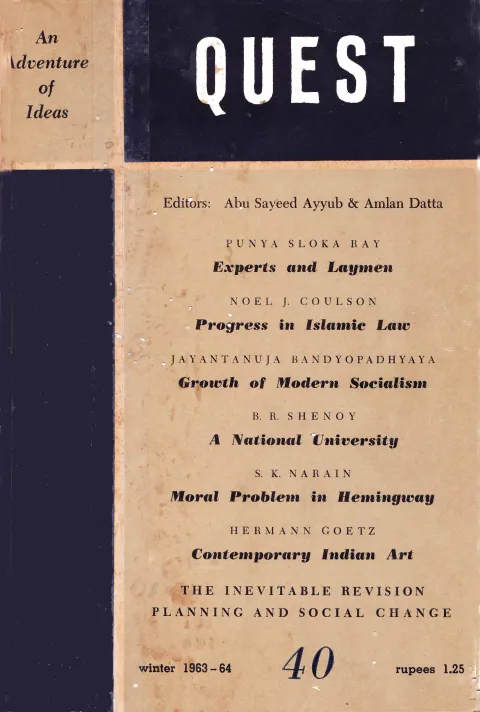
Quest
A Quarterly of Inquiry, Criticism and Ideas
By B. R. Shenoy, Rabindranath Tagore, Punya Sloka Ray, Noel James Coulson, Jayantanuja Bandyopadhyaya, A. P. Barnabas, S. K. Narain, Basudha Chakravarty, Tibor Meray, Sudhansu Bimal Mookherji, HERMANN GoETZ, Keki N. Daruwala, G. Burce Bunao, Sudhir Sonalkar, BoNoMALI GosWAMI, H. R. Pasricha, Satish C. Saberwal, K. K. Sinha
Printed and published by MISS SHEELA SINGH for the Indian Committee for Cultural Freedom, Army and Navy Building, 148 Mahatma Gandhi Rd., Bombay 1. at Inland Printers, Victoria Mills Buildings, 55 Gamdevi Road, Bombay 7. (colophon, printed p.121); contents page prints 'QUEST is sponsored by the Indian Committee for Cultural Freedom' · Bombay · 1964
124 pages
QUEST
Summary
Quest No. 40 (JAN./MAR. 1964 on the contents page, ‘winter 1963-64’ on the cover) is the Bombay quarterly of the Indian Committee for Cultural Freedom, edited by Abu Sayeed Ayyub and Amlan Datta with Nirad C. Chaudhuri and Laxmanshastri Joshi as advisory editors, Nissim Ezekiel as Reviews Editor and Mrs Laeeq Futehally as his assistant. Its argumentative centre is the capacity of institutions to absorb change: Punya Sloka Ray on how laymen can check specialists they cannot understand, Noel J. Coulson on how an allegedly immutable shari’a was reformed into a prohibition of polygamy, Jayantanuja Bandyopadhyaya’s long definition of a modern socialism that keeps Marx’s prognosis and rejects his remedy, B. R. Shenoy’s case for a national university built on faculty control rather than administrative authority, and A. P. Barnabas’s comparative sociology of planning in Turkey, China, Russia and India. A second cluster is written under the shadow of the 1962 war and the Sino-Soviet split: Basudha Chakravarty arguing that the emergency showed Indian nationhood has not outgrown Hindu nationalism, Tibor Meray demanding a revision of the Soviet verdict on Hungary, and Sudhansu Bimal Mookherji treating Chinese expansion in South-East Asia as a continuity from the Ming period. The arts section carries Hermann Goetz’s survey of Indian art since the Mughal twilight (translated from Indo-Asia by David McCutchion) and the issue’s one editorial plate, two leaves of Tagore letters in facsimile; then four poems, a Khasi Hills short story, nine signed book reviews, and four correspondence letters in two paired exchanges.
Three things an editor should know. First, the issue is dense with undisclosed relationships: S. P. Aiyar reviews A New Look at Communism, a book edited by Quest’s own Reviews Editor Nissim Ezekiel with A. B. Shah, published by Quest’s own sponsor, and Shah reviews Barbara Ward two pages later; the reviewers’ block identifies Shah as Secretary of the Committee while Aiyar’s review calls him its Executive Secretary. Second, the contents page is incomplete and inconsistent: it omits a three-book Shorter Reviews column signed by the Assistant Reviews Editor (pp.108-110) and the ‘Our Reviewers’ block, and it disagrees with the cover on the issue’s date and on six article titles, prints ‘The Growth or Modern Socialism’ for ‘of’, ‘Herman’ for ‘Hermann’ Goetz, ‘Futurables… Conjucture’ for ‘Futuribles… Conjecture’, and ‘Bonamali’ where the story and the contributors page print ‘Bonomali’. Third, two pieces carry language a modern reader will notice: Mookherji calls the Chinese residents of South-East Asia ‘Peking’s potential fifth-column’ and attributes smuggling, gambling dens and spurious manufacture to them as a group, and Goetz writes throughout of ‘babu’ Gothic and of Indian patrons who understand only the crudest naturalism. Both are the authors’ own views, not reported in order to be criticised.
Essays
How to Live with Ignorance
By Punya Sloka Ray
Punya Sloka Ray begins from the premise that specialisation has made everyone frightfully ignorant, and that the growth of knowledge makes us collectively more knowledgeable and severally less so. Since specialists, consultants and authorities may err, lie, be biassed, lazy or incompetent, and since each of them is also one of us, he argues that no test of authority - self-proclamation, public recognition, or consent - will serve. He proposes a three-pronged strategy: learn faster than ever; build an art by which the ignorant may rule the knowledgeable, a system of checks and balances over the specialists; and learn to deal with situations in which neither knowledge nor ignorance can be given the upper hand.
The long middle section is a catalogue of possible checks on expertise, each with its own failure mode: separating fundamentals from details, results from methods, methods from results, demanding a general logic, asking for concrete hints, setting specialists to police specialists, judging by crude material results, preferring specialists with agreeable non-specialist qualities, peer evaluation, majority opinion among equally ranked experts, and exploiting overlaps in specialisation. None is a panacea. He then turns the argument on intellectuals themselves, who assume that what is good for them - adult, male, born intelligent, trained in evaluating information - is good for everybody, and compares the ‘knower-sayer barons’ to early nineteenth-century industrialists defending the right to offer anybody any goods or employment. The closing section identifies the third prong as philosophy proper: philosophy exists only where neither the technical neutrality of the specialist nor the inarticulate practicality of the layman is allowed to prevail.
- Knowledge growth makes us jointly more and severally less knowledgeable, so each person becomes more ignorant as the stock of knowledge grows.
- No single technique checks expert authority; different techniques must be used jointly and successively.
- Ray’s paradox of research: the most knowledgeable is the one who becomes less knowledgeable fastest, because knowing the limits of a theory is where the next discovery starts.
- Intellectuals are as prone as anyone to universalise their own interests; he cites liberal defence of unsolicited obscene mail as insensitivity to those unlike themselves.
- Philosophy is neither objective nor subjective; it arises in the transition between certain knowledge, trusted authority and personal judgement.
The Concept of Progress and Islamic Law
By Noel J. Coulson
Noel J. Coulson traces the clash between an allegedly immutable religious law and the demands of modern Muslim society, using the Tunisian prohibition of polygamy in 1957 as his test case. He first sets out the classical concept: law as the command of Allah, precedent to and not produced by society, discovered rather than made. He then gives a historical account that cuts against that self-understanding - the early schools of Kufa and Medina built different systems of positive law out of local custom and human reason, differing even on whether an adult woman could contract her own marriage; the appeal to Prophetic hadith by a doctrinaire opposition group forced the ‘Establishment’ to re-express its own doctrines as hadith; al-Shafi’i synthesised revelation and analogical reasoning; the Hanbalis rejected juristic speculation altogether, which is why their law alone allowed a wife a remedy if her husband broke a stipulation against a second marriage. The doctrine of ijma then closed ‘the door of ijtihad’.
Against that background he reads twentieth-century reform as two successive strategies. The first stayed inside taqlid, using the ruler’s acknowledged power to select among school doctrines (the Ottoman Law of Family Rights, 1917) and to limit his courts’ jurisdiction (the Egyptian legitimacy law of 1929, which used a procedural device to bar claims resting on a gestation period of more than a year without formally denying the mediaeval rule). The second abandoned the pretence of taqlid and claimed the right of fresh ijtihad: Syria in 1953 made financial capacity a condition of polygamy, and Tunisia in 1957 turned the Qur’anic requirement of impartial treatment into an irrebuttable presumption that no husband can satisfy, prohibiting polygamy outright. Coulson compares Morocco (1958), Iraq (1960) and Pakistan’s Muslim Family Laws Ordinance (1961), notes that modernism ‘often wears an air of opportunism’, and concludes that its firmest foundation is the historical evidence that shari’a law itself grew out of local social conditions.
- The traditional Islamic concept of law - divine, comprehensive, immutable - is the obstacle to progress the paper sets out to analyse.
- Modern scholarship shows shari’a law was historically the implementation of Qur’anic precepts inside existing local custom, not a timeless code.
- First-phase reform worked through siyasa: selecting among the four schools’ doctrines and restricting court jurisdiction, without formally contradicting classical law.
- Second-phase reform claimed ijtihad outright; Tunisia’s 1957 law uses an irrebuttable presumption to abolish polygamy while remaining formally Qur’anic.
- Coulson expects growing diversity rather than uniformity in Islamic legal practice, and a re-orientation of the authority of reported Prophetic precedent.
The Growth or Modern Socialism
By Jayantanuja Bandyopadhyaya
Jayantanuja Bandyopadhyaya writes a long three-part survey. Part I is historical. Pre-Marxian and non-Marxist socialists - Saint-Simon, Fourier, Owen, Louis Blanc, Proudhon, Lassalle - all sought workers’ ownership or control as a remedy for the inequity free enterprise produced; crucially, he insists this socialism was not opposed to individualism but an extension of it, since the state was to secure economic equity for the sake of the individual. Marx changed everything: dialectical materialism made socialism ‘scientific’, internationalism became programmatic, religion was condemned, the labour theory of value supported a political sociology of class struggle, violence was sanctioned, and the remedy became the elimination of a class. But Marx left no blueprint for construction, which the author calls Marxism’s chief weakness, since almost anyone seizing power unconstitutionally in the workers’ name can claim to be Marxist. The Russian Revolution then miscarried: an undemocratic party dictatorship ‘unrestrained by law and based on force’, forcible collectivisation, famine, forced labour, regressive taxation and the New Class described by Djilas.
Part II defines modern socialism as owing Marx its prognosis of capitalism while rejecting his remedy on four counts: violence, dictatorship in any form, the prophecy that socialism requires mature capitalism, and the neglect of programme. It then sets out a political philosophy - pluralist sovereignty after Laski, devolution of power upward from primary units, and a twelve-point specification of democratic institutions including elections insulated from money, bureaucracy under popular control, an independent judiciary, cheap and expeditious justice, protection of minorities, an education system free of governmental control, and secularism - and an economics of socialisation (auto-management, sharply distinguished from nationalisation, which he calls ‘statization’), decentralisation, and equality within a range he puts at no more than 1:10, citing Israel’s 1:3.5. Part III attacks the thesis, associated with Asoka Mehta, that a backward economy has ‘compulsions’ requiring socialists to suspend their movement and cooperate with a non-socialist ruling party. He answers that economic growth was never socialism’s objective, that the Keynesian savings argument fails once Duesenberry’s demonstration effect is taken into account, and that the claim that workers are too ignorant to manage industry contradicts the belief that they are fit to elect a government.
- Pre-Marxian socialism is presented as an extension of individualism, not its opposite - the state intervening for the individual’s sake, not above him.
- Marxism’s strength is its prognosis of capitalism; its weakness is the absence of any blueprint for constructing socialism.
- The Soviet Union is treated as having lost both political freedom and economic equity, and so as anti-Marxist as well as anti-socialist.
- Modern socialism is defined institutionally: plural sovereignty, devolution from below, a twelve-point democratic specification, and socialisation as auto-management rather than state ownership.
- Equality is to be bounded rather than absolute, with an income ratio of at most 1:10, and paid for by progressive direct taxation.
- Against the ‘compulsions of a backward economy’, he holds that socialism demands growth with equity at every stage: when a country is poor, an equitable distribution of poverty.
A National University for India
By B. R. Shenoy
B. R. Shenoy argues for founding a model national university for India, and derives the case from what he regards as the virtual failure of the existing 54 universities. His diagnosis is that they cannot attract or keep able people, for three reasons: university salaries have fallen further behind comparable employment (a young man in a bank may pass the professor’s salary in six or eight years and double it in a dozen), the administrative set-up treats teachers as employees of the Vice-Chancellor’s office, and regionalism - driven by regional media of instruction - both repels teachers from outside the region and pushes others out of the profession. He quotes Masefield on the beauty of a university and Laski’s dictum that the university teacher is the university, and insists that the real malady is not weak administration but ‘the fatal separation of power and accountability’: administrators hold authority in academic matters while faculties carry the responsibility for delivering the goods, so decisions of expert selection committees can be overturned by interested majorities in Executive Councils.
His remedy inside existing universities is that all academic decisions - appointments, promotions, disbursement of academic funds, courses, examinations and grading - rest with the faculty concerned, the administrators reduced to routine and general matters; he cites Eric Ashby that a university is a society, not a public service, and that you cannot issue directives for scholarship or devise assembly lines for research. Since reform of existing universities will be slow, he proposes a national university: possibly with two independently managed wings, one affiliating colleges that teach in English across the language regions and one for teaching and research; English as the medium of instruction with Hindi compulsory at the Intermediate level; an Executive Council renamed a Board of Trustees headed by a President whose primary function is to attract endowments; complete autonomy from government and political organisations; recruitment from overseas where Indians of the requisite competence are unavailable, and posts left vacant or downgraded rather than filled indifferently. He warns specifically against building an administrative machine first or leaving the task to a non-academic ‘organizer’ who may unwittingly build an empire for himself.
- Shenoy’s case for a national university rests on a diagnosis of failure in the existing 54 universities, not on an expansion argument.
- Three causes of the flight of talent: the widening salary contrast, bureaucratic administration modelled on the government secretariat, and regionalism.
- The structural fault he names is the separation of power from accountability - authority with administrators, responsibility with faculties.
- His remedy is faculty control of all academic decisions, with administrators confined to general and routine matters and a Board of Trustees raising funds.
- The proposed national university is to be English-medium, wholly autonomous of government and parties, and to grow slowly from one or two faculties rather than from buildings and councils.
National Planning and Social Change
By A. P. Barnabas
A. P. Barnabas offers an ex-post-facto sociology of national planning, drawing observations from Turkey, China, Russia and India. He asks what pre-existing conditions led to planning, how societies were changed by it, and what has been done to stabilise those changes. His answer to the first is a three-stage sequence: disorganisation of society, the emergence of new ideas, and a crisis. Disorganisation was gradual and structural - in India beginning with a central agency’s revenue collection dislocating rural society some 150 years before Independence - and everywhere followed the unplanned transition from village to national economy, which broke ‘mechanical’ solidarity without supplying ‘organic’ solidarity, left status and role in confusion, and was aggravated by the unconcern of elites and by unintegrated technical innovations. New ideas (westernisation in Turkey, nationalism in India, communism in China and Russia) gathered followings, and the clash with the existing power structure - violent in Russia and China, hardly violent in Turkey, largely non-violent in India - was resolved in favour of the new ideas everywhere.
He then notes that planning began only after long preparation and well after the seizure of power (China 1949/1953; India 1947/1952; Russia 1918/1928), that it required a strong centralised bureaucracy which these societies willingly accepted, and that the plans were everywhere economic in nature with industrialisation as the main emphasis. The social changes he identifies are consequential rather than intended: a shift from ascribed to achieved status with greater social mobility (the hereditary village headman replaced by the elected Pradhan or Sarpanch), a rise in the status of women (the veil in Turkey, property and divorce rights in India), a direct attack on religion in the communist cases and indirect effects in India, the declaration of secular republics, and the displacement of religion and family by legislation as the major means of social control. Stabilisation has been attempted by rewriting history and legends, changing the content rather than the structure of education, new organisations for young and old, legislation, and large capital projects. He notes finally that techniques differed - Chinese planning almost entirely bureaucratic, Indian planning centralised for national schemes but with non-official bodies bringing bureaucracy closer to the people - and dismisses the Chinese communes as unthinkable in a country that believes in the dignity and freedom of the individual.
- A comparative, deliberately ex-post-facto method: no general theory of social change being available, four planning countries are compared after the fact.
- Planning is traced to a sequence of social disorganisation, new ideas and crisis, rather than to economic doctrine.
- The break-up of the self-sufficient village economy left societies without norms - ‘mechanical’ solidarity broken with no ‘organic’ solidarity to replace it.
- Planning everywhere required and received a strong centralised bureaucracy, accepted because societies had neither strength nor will to resist.
- Social change under planning was incidental to economic aims: achieved status, mobility, the raised status of women, secularisation, and legislation as the chief instrument of social control.
Moral Implications in Hemingway’s Work
By S. K. Narain
S. K. Narain sets out to rebut the charge that Hemingway lacks a moral sense. He begins from Hemingway’s own aesthetic creed - the Nobel statement that each book should be a new beginning, and the obligation to put down what the writer sees and feels in the best and simplest way - and argues that the accusations against him (social irresponsibility in the political 1930s, obsession with bull-fighters, gunmen, prostitutes and hard drinkers, an art of ‘surfaces and anecdotes’, naturalistic determinism) stem from critics’ failure to consider that aesthetic, the formative circumstances, and above all the development of his work across three decades. Narain divides that work into a negative phase and an affirmative one. In the early phase - the stories of In Our Time, The Sun Also Rises, A Farewell to Arms, Death in the Afternoon, The Green Hills of Africa - Hemingway records the post-war ‘lost generation’, writing by suggestion and implication, using nature symbols (rain as disaster) rather than editorial comment; Narain reads Henry’s desertion as both protest and an assertion of the moral value of life, and insists that an implicit condemnation of war’s senselessness runs through both novels.
The turn comes in the 1930s. To Have and Have Not returns to the American scene and the Depression, and carries Harry Morgan’s dying line about a man alone having no chance. For Whom the Bell Tolls, written out of the Spanish commitment, keeps an artistic balance: the idealism of the International Brigade and the cruelty on both sides, Pillar’s account of Pablo’s massacre making the reader share her horror, characters actuated by mixed motives rather than stereotypes of vice and virtue. The Old Man and the Sea is his most affirmative work, a parable of fighting the good fight in which literal and symbolic levels fuse completely, and Santiago’s defeat is a moral victory. Narain ends by quoting the President of the Swedish Academy on the heroic pathos in Hemingway’s awareness of life, and concludes that Hemingway works by implication rather than explication and elicits from the discerning reader a response that is essentially moral.
- The charge of nihilism is answered developmentally: the early work’s despair gives way to the later work’s affirmations, so charges valid of the one do not hold of the whole.
- Hemingway’s method is read as moral suggestion - evocative natural symbols, editorial comment scrupulously excluded.
- To Have and Have Not is treated as the transitional book, anticipating the ethic that man cannot stand alone.
- For Whom the Bell Tolls is praised precisely for refusing to gloss over the excesses of the side Hemingway supported.
- The Hemingway code is summarised, via Carlos Baker, as courage, honesty and the determination to live head high in the face of adversity.
The Image of a Nation
By Basudha Chakravarty
Basudha Chakravarty examines what the 1962 national emergency revealed about Indian nationhood. He accepts that the emergency produced national self-awareness - even the Dravida Munnetra Kazhagam abandoned Dravidastan on discovering it was impossible without the security and integrity of India - and argues that what had looked like disintegration was in fact ‘a frightful fight for integration’ by states, classes and communities each claiming a worthy place in an emergent India. He then probes the content of that nationalism through M. N. Roy’s idea of a philosophical revolution: freeing the popular mind not only from unconcern with worldly affairs but from authoritarianism and fatalism. He doubts the ascetic self-image is more than ‘spiritual salesmanship’, quotes Gandhi on wanting to identify himself with everything that lives, and cites Puranic verse on Bharata as the Indian’s eternal home while insisting the religious overtone of that integrating factor sets limits to its operation.
The central argument is that nationalism is compatible with reactionary philosophies (it thrived under Nazism and Fascism) and that communism in power appears as ultra-nationalist, stopping short of the philosophical revolution that would challenge its own authority. Quoting Lewis Mumford on nationality as the bond of common purpose and on the man who uproots nationality killing personality, he holds that nations remain units of the world community. Turning back to India, he argues that the emotional appeal of the unity aroused by the Chinese invasion rests largely on the Hindu religious background - the temple bell, the Gita, a tradition of religiosity set against ‘the atheistic character of the aggressor’ - which he links to the accession of strength to Rightist parties with a religio-communal emphasis and to the stultification of the communists by transgressing nationalism. His conclusion is that religious minorities, particularly Muslims, remain negatively integrated, tolerated on the fringe of a family danger; he traces this to a history in which Kabir’s syncretism failed to reach ritualistic religion, Azad’s secular orientation was branded a surrender to Gandhian eclecticism, and even Gandhi could not neutralise Jinnah before obscurantists in his own community struck him down. Secular nationalism, he argues, must transcend Hindu nationalism and also neutralise the residual communal nationalism of minorities, while the absence of normal relations with Pakistan keeps reacting on internal integration.
- The emergency is read as evidence of integration-in-conflict rather than of disintegration; the fear of break-up proved unreal.
- M. N. Roy’s ‘philosophical revolution’ is used as the measure of how far Indian nationalism has emancipated the popular mind from authoritarianism and fatalism.
- Nationalism is shown to be philosophically promiscuous: compatible with Nazism, Fascism and, in power, with communism, which he calls ultra-nationalist.
- The unity aroused by the Chinese invasion is argued to rest on a Hindu religious background, which strengthens religio-communal parties and leaves minorities negatively integrated.
- The deficiency of nationhood is traced historically through the failure of medieval religious synthesis, Azad’s isolation, and the killing of Gandhi by obscurantists of his own community.
- Secular nationalism must transcend Hindu nationalism and neutralise minority communal nationalism; relations with Pakistan react directly on internal integration.
The Inevitable Revision
By M. Tibor Meray
Tibor Meray writes on the seventh anniversary of the Hungarian revolution, prompted by the Chinese declaration of 5 September, which said that at the critical moment when Hungarian counter-revolutionaries had occupied Budapest the Soviet leaders ‘momentarily entertained the idea of capitulating and abandoning socialist Hungary to counter-revolution’, and that it was Chinese opposition and ‘correct suggestions’ which produced the harsh measures. Meray argues that the interest of the document lies less in confirming that the Russians might have let Hungary go - Khrushchev had alluded to Soviet indecision in a 1959 speech at the Ganz-MAVAG works - than in dating the decision. He reconstructs the Soviet hesitation: Mikoyan and Souslov, not the Molotov group, opposed intervention; they fired Gero, inspired the declaration of 30 October admitting the violation of equality between socialist states, assured Imre Nagy of their confidence, guaranteed that no more troops would cross the frontier and accepted a multi-party system, asking only that Hungary’s socialist gains be safeguarded and that it not become an anti-Soviet base.
He lists five contributing factors for the reversal - fear of the empire’s disintegration, pressure from Molotov’s Stalinists, the army’s refusal to withdraw ‘defeated’ from a country of ten million, the Suez affair dividing Western attention, and the American presidential election - and concludes that the Chinese position could have tipped the balance. Since Peking’s own communique of 1 November had endorsed the Polish and Hungarian demands and accused the Russians of great-power chauvinism, and was transmitted by Tass on 2 November, the advice to intervene can only have been given on the Friday before the tragic Sunday: ‘a disquieting detail, which shows that the Hungarian revolution had every chance of triumphing’. Meray then turns the Chinese claim against the current Soviet line with a series of questions: if the men who demanded the suppression and Nagy’s execution have since been declared adventurers and madmen, were they good counsellors then? If the Yugoslavs who sheltered Nagy are now true Communists, were they not right five years ago? And since Khrushchev has praised workers’ councils at Rakovica and conceded Yugoslavia’s right to stay outside the blocs, how can Nagy’s advocacy of the liquidation of power blocs remain a crime? The revision, he concludes, may be painful and postponable but is inevitable, and must be made not by the people of Hungary but by those who suppressed them.
- The Chinese declaration of 5 September 1963 is read as a Communist-source confirmation that Moscow considered abandoning Hungary.
- Mikoyan and Souslov, not the Stalinist Molotov group, are identified as the opponents of intervention, and their promises to Imre Nagy as probably sincere.
- Five converging factors, not one, produced the reversal; Chinese advice could only have been decisive on 2 November, forty-eight hours before the attack.
- Meray uses the Soviet leadership’s own later positions - on workers’ councils, on Yugoslavia, on non-bloc status - to dismantle the charges against Nagy one by one.
- The conclusion is that the policy of rapprochement with the West will keep colliding with the unrevised verdict on 1956.
China and South-East Asia
By Sudhansu Bimal Mookherji
Sudhansu Bimal Mookherji argues that a strong and united China has always been a curse to South-East Asia, and supports the claim with a long historical section: the seven Ming expeditions of 1405-1433, the pirate Limahang’s attempt on Manila, Kublai Khan’s invasions of Burma, Cambodia and Champa, and above all the repeated Chinese conquests of Annam. He dwells on the campaigns of sinicisation - the Trung Tac sisters’ revolt of 39 A.D., the liberation war of 939, the reconquest of 1407 with its forced labour, bonfires of Annamese books, Chinese as the school medium, the prohibition of betel-chewing and the requirement to carry identity cards - and concludes that Annamese civilisation is essentially Chinese in expression, while no Chinese government has reconciled itself to the loss of Annam.
He then weighs present factors. Favouring China: its prestige as Asia’s only great power, raised further by ‘the poor performance of India against the Chinese invader in the fall of 1962’, which he says demoralised several South-East Asian states and shifted the policies of Burma, Cambodia, Indonesia and Ceylon; the region’s political fragmentation, lacking Arab religious cohesion or Latin American cultural solidarity; economic factors, since the West now needs the region’s primary products less while an industrialising China needs them badly; the unsuitability of free enterprise to local tradition, which communists have exploited through anti-landlord and anti-moneylender sentiment; and, at greatest length, the 5.5 per cent of the population who are of Chinese origin, whom he calls ‘Peking’s potential fifth-column’, describing their solidarity, remittances, schools and newspapers, Peking’s ‘return to China movement’ and subsidies to pro-communist teachers, in terms that also attribute smuggling, gambling dens and the manufacture of spurious goods to them. Against China: suspicion bred by that same history, the adolescent sensitiveness of South-East Asian nationalism, anti-Chinese animosity as the underpinning of non-communist nationalism (the Java riots, Ceylon’s quit notice), the opposition of Islam and Buddhism to Chinese Marxism, and Thai and Philippine SEATO membership. His closing point is addressed to the Free World: the region’s malignant poverty is China’s best opportunity and must be removed.
- The article’s thesis is historical continuity: Chinese expansionism in South-East Asia is presented as a constant from the Ming period to Peking.
- Annam is the central case, treated as a ‘second Korea’ whose civilisation was reshaped by nine centuries of Chinese rule and campaigns of sinicisation.
- India’s defeat in 1962 is treated as a fact of regional politics that raised Chinese prestige and moved Burma, Cambodia, Indonesia and Ceylon.
- The overseas Chinese are the article’s ‘trump card in China’s hands’ and are described as a potential fifth column - language that generalises about an entire minority population.
- The counterweights identified are regional suspicion and nationalism, Islam and Buddhism, and SEATO membership; the prescribed remedy is the removal of poverty.
Problems of Contemporary Indian Art
By Herman Goetz
Hermann Goetz, translated from Indo-Asia, surveys Indian art from the late Mughal twilight to 1963 as a succession of revolutions and reactions. He begins by denying that Indian art was ever rigidly fixed: the mediaeval canon lasted about a thousand years, arose with feudalism and collapsed with it, and India has known more fundamentally different styles than Europe. The princely courts of the British period drew on a traditional art no longer understood, degenerating into empty imitation, while classicism and ‘babu’ Gothic arrived with the English; he dismisses the Victoria Memorial as having ‘a christmas cake effect’. Ravivarman is treated as the pivotal failure - an industrious self-taught painter whose mythological cycles reached every Indian home as oleographs and whose gods remain ‘well-fed bourgeois dressed up for the theatre’. The Bengal School’s national orientation was itself inspired from Europe and, Goetz argues, remained more dependent on English taste than its painters suspected: Abanindranath on Turner and the Pre-Raphaelites, Goganendranath on cubism, Rabindranath developing an expressionism reminiscent of Redon, Munch and Ensor; Ajanta gave the school its form, and mass-produced national painting its harmonious linear rhythm and its hysterical sentimentality.
The second half treats the present. As classicism degenerated, attention turned to Pallava, Chola and Khajuraho models and then, with independence, to the living present and to genuine folk art - Jamini Roy’s Kali-temple models producing pictures of ‘enchanting naivety’ before his later work turned artificial - and Goetz catalogues dozens of contemporary painters by region and manner, from K. Sreenivasulu in Madras to Almelkar, da Fonseca and Satawalekar in Bombay. Western movements were acceptable because they were revolutionary: Impressionism suited an Indian sense of the world as dream-like illusion, Expressionism the Rajput technique, Surrealism the tantric symbolism he sees revived in Husain. He is caustic about the new rich, who talk about the spirituality of national art but understand only the crudest naturalism, and about a romanticism of peasant life that refuses to see the hardness of rural existence; the younger generation he finds uprooted and pessimistic. Amrita Sher-Gil is his highest valuation - unrecognised in her lifetime, now the treasure of the National Gallery of Modern Art in New Delhi, which he notes was built up by himself in 1953-55. Sculpture has developed less; arts and crafts have been rescued economically but not aesthetically, sinking into tourist souvenirs; architecture has turned functional, with Le Corbusier and Maxwell Fry, Konigsberger and the American embassy as good examples, though most new building still falls back into the sins of ‘babu’ Gothic.
- Indian art is presented as historically plural and change-driven, against the view that it was fixed by canon.
- The Bengal School’s nationalism is read as itself European in inspiration and covertly dependent on English taste.
- Ravivarman is the article’s central case of popular success as artistic failure - millions of oleographs, gods like costumed bourgeois.
- Western modernism was adopted in India for its revolutionary character rather than as colonial influence, and was matched to indigenous techniques.
- Amrita Sher-Gil is ranked as one of the greatest painters of modern India; the author discloses that he built the collection in which her work hangs.
- Craft revival is judged an economic stopgap and a tourist industry of steadily sinking quality, because form and motif live only while anchored in a community’s life.
Facsimile of Two Letters
By Rabindranath Tagore
Two full-page facsimiles of letters in Rabindranath Tagore’s hand, printed without commentary beyond their captions. The first, headed Santiniketan and dated Nov. 10, 1918, is addressed ‘My dear Rudra’ - Sushil Kumar Rudra, Principal of St. Stephen’s College, Delhi - and is a comic complaint about fame as a form of conscription: Tagore protests that his correspondent has seen him work but not his immense capacity for doing nothing, that a spell of laziness is upon him, and that his reputation is playing tricks with him, since the Congress must have him for its President and the All India Musical Conference too, while institutions innumerable, from students’ debating societies to organisations for industrial regeneration, all think they must have a living poet to do their public advertisement ‘till he is dead’. He would like to ask them to quote a single line from his voluminous poems that justifies their choice, and affects to be hurt that Rudra has not asked him to preside at St. Stephen’s committee meetings, where expert auditor’s help is specially needed.
The second letter, undated and addressed to an unnamed English gentleman, survives only in a copy made by Rev. C. F. Andrews and is a reproof of missionary proselytism. Tagore tells his correspondent to stop trying to preach his doctrine and to give himself in love; the western mind is too obsessed with conquest and possession, and the inveterate habit of proselytising is another form of it. Christ never preached himself or any doctrine but the love of God; the object of a Christian should be to be like Christ, never to be like a coolie recruiting coolies to his master’s garden. Preaching one’s doctrine is no sacrifice at all but an indulgence in a luxury more dangerous than all the luxuries of material living, because it breeds the illusion that one is doing one’s duty and is wiser and better than one’s fellow beings; real preaching lies in being perfect, through meekness, love and self-dedication. Pride of race, of sect, or of personal superiority makes doing good to others useless, since the gift will be rejected or, if accepted, will not morally benefit - instances of which, he writes, can be seen in India every day. The letter ends that God is love, and that when a man tries to usurp God’s place and assume the role of a giver of gifts rather than a mere purveyor of God’s love, then all is vanity.
- The issue’s only editorial plate: two leaves of manuscript facsimile, listed in the contents as ‘Facsimile of Two Letters’.
- The 1918 letter to Principal Rudra is a joke against his own celebrity - institutions wanting ‘a living poet to do their public advertisement till he is dead’.
- The second letter is a sustained rejection of missionary proselytism as a form of the western habit of conquest and possession.
- Its core distinction is between preaching a doctrine and being perfect: real preaching is meekness, love and self-dedication.
- Provenance is printed with the plates: the second letter is a copy made by Rev. C. F. Andrews, and both were supplied by Mrs. Sudhir Rudra, daughter-in-law of Principal Rudra.
The Dream Gull
By Keki N. Daruwala
A twenty-eight-line poem in which the speaker’s dreams are figured as a white sea gull lost in cloud - ghost-gull, frantic-winged, honking for help over a dead sea and empty sky, hooded and groping, ‘a blind instinct on wings’. Beneath the tideless sea there is no ‘aequorial paradise’ slumbering in unconsciousness; there is only flat white sea and pale sky. The middle movement asks whether a day will come, beyond the mating time and the mating call, when a flight of nesting gulls will rise ‘revenant’ on the shrill laughter of a mad moon, across forgotten trails, a flying mist tremulous with wing-beats and yearning. The close chooses violence over numbness: the speaker would much rather be torn wing from shredded wing in the cross-mesh of sidereal winds and blinded by a windful of stardust than continue ‘this dull, hooded trek from nothingness to nothingness’.
- The gull is an emblem of dreams without object - flight without destination over a dead sea.
- The poem’s negation is specific: no ‘aequorial paradise’ under the water, no consolation in unconsciousness.
- Its one hope is collective and posthumous - nesting gulls rising ‘revenant’ beyond the mating season.
- The final preference for being torn apart by sidereal winds over a hooded trek from nothingness to nothingness is the poem’s argument.
Spring Sap
By Keki N. Daruwala
A short lyric of fourteen lines addressed to a lover, built on the return of life to a winter-scorched body: reawakening figured as ‘Christ-blood in spring sap’ ramifying in twigs. Memories come bird-like across ‘the prickly blue void of nostalgia’, spearing through the senses. The second movement asks to bathe wounds in the beloved’s river, to faint into the dreams of her sad eyes, and to hear ‘the mute song of the night bird in your breasts’ - reawakening into pain in the forest of her limbs and in the wet rain of her kisses. The poem’s logic is that revival and wounding are the same event.
- The governing conceit fuses resurrection and sap: ‘Christ-blood in spring sap’.
- Memory is sensory and involuntary, arriving bird-like and spearing through the senses.
- The reawakening is explicitly into pain, not relief, which distinguishes the poem from conventional spring lyric.
- The second of Daruwala’s two contributions to the issue, printed immediately after The Dream-Gull.
Church Ruins
By Burce Bunao
A sonnet on a bombed or ruined church. The voices of the last choir no longer hold an audible dimension and the loft has ‘long discarded its persistence’; if a song of dedication shows itself in the gold of some unsteady dusk thrown on an old and lonely saint, the speaker asks that it belong to ‘us the witnesses of war’, since the throng that perished sang their own. The concrete tongues of the ruin speak loudly of how each held a cross into the fire that scorched the flesh, and the hymn lingering around the sacred stones ‘is not a weak persuasion’. The closing couplet turns to the living: let us seek lost pews and sire a faith for an age that totters on a fear.
- A war sonnet whose subject is inheritance: who owns the dedication still audible in a ruin.
- The ruin itself speaks - ‘concrete tongues’ testifying to those who held a cross into the fire.
- The final couplet converts elegy into a demand that the survivors father a new faith.
- The poet is identified on the contributors page as one of the editors of COMMENT (Manila).
In the Wake
By Sudhir Sonalkar
A poem of numbed aftermath. It opens on ‘the spit of it’ - dead tobacco taste curled bitterly in the mouth - against which a lump of sugar forms in the mind, its sweetness licked steadily by tired thoughts while others lie stacked or scattered, ‘familiar ever’. Sunk in his chair the speaker watches dry wisps of air leave by the window, and with this ash-like dryness covering everything he is shocked to find he can see blue crystal in her eyes and to feel, as on coconut days by the sea, a rush among the leaves and a brittle glow on the waves. She does not and cannot offer stale cakes and loaves of bread, which he knows too well, but instead hands ‘hangleless’ to draw near in a lost moment. With his head swimming like a flute song he returns, running barefoot, face washed with blue breezes, and his full heart with a laugh finds that he does not care.
- The poem works by contrast of tastes and textures: dead tobacco against a mental lump of sugar, ash-dryness against sea breeze.
- Its turn is involuntary - the speaker is ‘shocked to find’ he can still see and feel.
- The refusal of ‘stale cakes and loaves of bread’ rejects consolation in favour of an unexplained closeness.
- The printed word ‘hangleless’ stands in the text as set; it is not an OCR artefact of the scan.
- The contributors page notes this is the poet’s maiden publication, just after his B.Sc. examination.
Bing and the Chicken
By Bonamali Goswami
A jeep from Shillong kills a chicken on a village road in a remote corner of the Khasi Hills, and the villagers surround the driver. A burly youth demands fifty rupees; an old man with a gun, Bing, emerges from the forest and presides over the transaction with elaborate courtesy, explaining the local tariff - fifty for a chicken, a hundred for a goat, two hundred for a calf - and, when the driver asks what a man would cost, answering after long thought that a man would have been twenty rupees. The driver pays, remarking that he almost wishes he had killed a man and saved thirty rupees, and asks the way to Ka Marylibon’s house. Bing, suddenly frightened, begs him to treat it all as a joke and to eat and drink with them; the jeep drives off.
That night the driver - Shingji, a wholesale dealer in vegetables and oranges and Ka Marylibon’s business partner - is her honoured guest. Bing, drunk, is thrown out of the house by his wife for having insulted her guest, and Shingji is left ashamed of having told her. Bing comes to his door to propitiate him, talks of his six children, of his government shikari licence and of his luck, since no elephant has ever gone mad for him to shoot, and insists on taking Shingji out before dawn to shoot mountain deer so as to compensate him and be let home. He kills a pair, husband and wife, and gives them to Shingji with delight. On the drive back, in the morning sun, Bing sees a limping yearling deer and screams to stop; Shingji, moved by the animal’s beauty, grips the gun and refuses. Bing cries out like a beaten child that this is his first and last chance, jumps from the moving jeep, and goes under the rear wheel. Shingji lays the gun on the corpse’s chest, drags one of the dead deer to lie beside him, reflects that the villagers will know what it was all about, and recites the tariff to himself - fifty rupees for a chicken, a hundred for a sheep, twenty for a man. He tucks two folded ten-rupee notes into the dead man’s pocket: ‘You’ve earned something at last.’
- The story’s structure is a tariff turned back on the village: the price list recited in the first scene becomes the payment made in the last.
- Bing is built as a comic authority in scene one and dismantled in scenes two and three into a dependent, unlucky old man who has never earned a coin.
- The refusal to let Bing shoot the yearling is the story’s moral centre, and the cause of his death.
- Twenty rupees for a man is a joke in the first scene and a settlement in the last; the story leaves the irony unglossed.
- The recited tariff differs between the two scenes - a goat at a hundred rupees on p.88, a sheep at a hundred on p.94 - an inconsistency printed as it stands.
Futurables. Studies in Conjucture
By S. Natarajan
S. Natarajan reviews the first volume of Futuribles, seven essays in political conjecture edited by Bertrand de Jouvenal. He opens on the respectability that forecasting has acquired by taking on the colour of science, and notes that the growing interest of economists in ‘projections’ shows astrologers and soothsayers giving place to graph-plotters; in politics the equivalent is the gloomy speculation on ‘After Nehru, Who?’. He remarks that the contributors speak with greater certainty the further they move from their own countries. Max Beloff’s Britain to 1970 is so tentatively advanced that only fanatics will be drawn into controversy; the reviewer uses the occasion to argue that a multi-racial Commonwealth of politically equal units would serve Britain better than a merger with Europe, since nations familiar with British institutions are easier to deal with on a footing of equality.
The regional studies draw sharper objections. Edmund Leach’s claim that post-independence Burma remained loyal to the British administrative model, and that the military junta’s powers are virtually identical to a British Governor’s in an emergency, ignores that the Governor was accountable to Parliament while the junta ‘is naked autocracy’; Natarajan nevertheless passes on Leach’s warning that a weak China policy and failed relations with Burma have made India negligible in forecasts of Asia’s political future. Leicester Webb is charged with two basic errors on Pakistan: believing that a comprehensive settlement with India is the central objective of Ayub’s government, when the central objective of all Pakistan governments is to obstruct India’s regional leadership, and expecting Ayub to restore democratic government. He finds Rene Servoisie on Africa the most studied contribution, and de Jouvenal and Ellul exceedingly gloomy - de Jouvenal doubting that a wise man from a new state searching for institutions that guarantee against arbitrary power would find any here, a problem the Communist never faces because he can always call the defects transitory. Natarajan’s own answer is the creation of communities of free men as a Commonwealth ideal, and his verdict on Ellul’s man without bearings is that the projection, like a sharebroker’s trend chart, assumes too much and too little.
- Forecasting’s new respectability is the review’s opening target: projections as the modern form of soothsaying.
- The volume’s contributors are said to write with more certainty the further they are from home.
- Natarajan’s sharpest correction is constitutional: accountability, not the extent of powers, distinguishes a British Governor from a military junta.
- He rejects the premise that Pakistan seeks a settlement with India, and doubts Ayub could restore democracy however sincerely he wished.
- He argues for a multi-racial Commonwealth over British entry into Europe, and dismisses Ellul’s projection of a meaningless Western future.
Hindu Culture, Economic Development and Economic Planning in India
By Aamir Ali
Aamir Ali reviews William K. Kapp’s Hindu Culture, Economic Development and Economic Planning in India, and treats it as an overdue application of a question social scientists have begun to press: why some countries become rich and others stay poor when capital and manpower are not enough. He gives the standard contrasts - Switzerland without resources against resource-rich Brazil, Denmark against Indonesia - and reasons from Max Weber that if the Protestant ethic mattered, other ethics must have other influences; it is surprising, he says, how little attention has gone to Hindu culture and values. Kapp’s analysis, made with his wife Lore L. Kapp, is judged a convincingly competent summary of a vast and difficult area: Hinduism has not been opposed to material objectives, but these have always been subordinate to liberation and release, so it is the saint and not the practical man who holds the place of honour.
The reviewer adds his own gloss on the Indian habit of claiming superior interest in spiritual values - manifestly untrue if it means Indians dislike money, probably true if it means contemplation is emphasised at the cost of hard work. He quotes Kapp on cyclical time and cosmological causation standing in the way of the conviction that man makes his own history, notes Gandhi’s reinterpretation of disinterested action as service including bodily labour and that his successors have not pushed it far, and cites the dependency complex bred by the extended family and by patriarchal authority. Against this he insists that every society must keep adapting, industrialised ones included, and observes the counter-evidence: India has large modern enterprises, no scarcity of villagers willing to work in them, entrepreneurs fully committed to industry - and yet the total picture is one of frustration rather than fulfilment. He closes on Kapp’s formulation that Hindu culture is caught between the forces of tradition and of modernisation, with the critical question being which will prove stronger, and hopes the work will be followed up.
- The review frames Kapp’s book as the first serious application of a Weberian question to Hindu culture and Indian economic performance.
- Kapp’s core claim, endorsed here, is that material objectives have always been subordinate to liberation and release, honouring the saint over the practical man.
- Cyclical time and cosmic causation are identified as obstacles to the conviction that men make their own history.
- Gandhi’s reinterpretation of non-attachment as service is noted, along with his successors’ failure to extend it.
- The reviewer records counter-evidence - willing industrial workers, committed entrepreneurs - and still finds the total picture one of frustration.
A New Look at Communism
By S. P. Aiyar
S. P. Aiyar reviews A New Look at Communism, a 68-page brochure published by the Indian Committee for Cultural Freedom and edited by A. B. Shah and Nissim Ezekiel, and says at once that though an edited work it is largely the product of one man, Professor A. B. Shah, now Executive Secretary of the Committee, who convened a Madras seminar in April 1963 and a second Bombay session in August-September whose papers make up the volume. Some papers, he notes, have an unfinished look. Of the seven, three are by foreigners - Brzezinski and Scalapino reprinted from Foreign Affairs, on which he declines to comment since students of international affairs will have read them, and Janet Chapman of the Rand Corporation on the place of the consumer in Soviet planning, which he thinks touches a central strand: people in developing countries believe communism has at least given the masses a better economic deal, and a careful study of Soviet economic history dispels that belief, leaving the question whether the human price is not too high.
The four Indian papers he treats as the important ones. Shah’s own examines four myths - scientific socialism, the revolution, social justice, proletarian internationalism - with great confidence and first-hand knowledge of Marxist literature. Philip Spratt explains communism’s appeal to Asian intellectuals by general rebelliousness, envy and hostility to the West, and the Hindu mind’s preference for a ‘complete’ philosophy, Marxism standing to social development as Vedanta to the cosmos; Aiyar finds it an interesting hypothesis needing further exploration. R. Srinivasan’s ‘vacuum hypothesis’ - communism filling the space left by the breakdown of traditional religion - he notes has been put forward by others too. Aloo Dastur’s account of the Communist Party in India centres on its extra-territorial loyalty and on ineffective handling of communists, and speaks of infiltration of the public services and defence establishments as an ‘open secret’; here Aiyar wishes the writer had elaborated and documented. His verdict is that the brochure is not addressed to the expert, that it usefully clarifies some issues, and that the ‘new look’ was possible only because most intellectuals in the country had not really looked at the problem at all.
- The reviewer immediately identifies the volume as effectively one man’s work - A. B. Shah’s - although printed as an edited collection.
- Chapman’s paper is singled out for testing the belief that communism at least delivers a better economic deal, and for raising the human price.
- Spratt’s explanation of communism’s appeal via the Hindu preference for a complete philosophy is found interesting but underdeveloped.
- Dastur’s claim of communist infiltration of the services and defence establishment is called an open secret and criticised for lack of documentation.
- The closing judgement is double-edged: the book clarifies, but its ‘new look’ was possible only because Indian intellectuals had not looked before.
The Evolution of India and Pakistan 1858-1947
By A. G. Noorani
A. G. Noorani reviews the fourth volume of a documentary series, Select Documents on the evolution of India and Pakistan 1858-1947, edited by G. H. Philips with H. L. Singh and B. N. Pandey. He explains the design - the first three volumes covering Early India, the era of Muslim rule and India under the East India Company, this one the Raj proper - and judges the object as competently executed as it is happily conceived, with extensive use of British and Indian state papers and the private papers of statesmen and soldiers. The editor’s chosen method, ‘significant nuclear themes through which the processes of history may best be illustrated and understood’, yields three parts: representative institutions to 1917, the culmination in 1947, and defence, economic, social and administrative problems.
Noorani’s test is whether a documentary collection reflects the mood and spirit of the times as well as the trends, and he finds the volume amply fulfils it, from the statutes and the Queen’s Proclamation - with Victoria’s request that Lord Derby write it himself, ‘bearing in mind that it is a female Sovereign who speaks to more than 100,000,000 of Eastern people’ - down to the proposal of 6 June 1947 that paved the way to partition, and including Gandhi on satyagraha, Gokhale on swadeshi and Iqbal’s 1930 League address mooting the Pakistan idea. He lists his own wished-for additions: Gokhale’s Political Testament of 1915, the 1916 Memorandum of the nineteen elected members of the Indian Legislative Council, and the terms Azad offered Khaliquzzaman for a U.P. coalition ministry after the 1937 elections, which marked the parting of ways between Congress and the League. Against these minor faults he sets documents seldom found even in standard works, such as the Muslim address to Lord Minto, and praises the editors for showing what was stirring in Indian society rather than concentrating on British activity or on politics at the expense of social and economic problems.
- The review judges the volume by whether documents convey the mood and spirit of a period, not only its trends.
- It praises the editors for interaction - Indian development alongside British policy-making, society alongside politics.
- Three named omissions are offered, the most weighty being Azad’s coalition terms to Khaliquzzaman after the 1937 elections.
- Documents rarely printed elsewhere, such as the Muslim address to Lord Minto, are counted the volume’s compensating strength.
- The verdict is superlative: no other book gives as judicious a selection or as balanced a picture of Indian history.
The Plan under Pressure
By A. B. Shah
A. B. Shah reviews Barbara Ward’s The Plan under Pressure, two lectures delivered in Bombay in December 1962 at the invitation of the Council for Economic Education, and treats them as significant both because she has long been an unofficial spokesman for India’s development plans and because she spoke soon after the Chinese invasion. He calls the lectures perhaps the first systematic analysis of Indian planning outside the Planning Commission, and points out that they gain importance because the core of Fourth Plan thinking will be done during 1964. Starting from her observation that ‘the Chinese have the power to come and go as they choose’ - still true a year later, he notes - she asks how the breathing space given by the unilateral cease-fire may be used to build military and economic strength, listing the weaknesses the plan already had: low growth, neglect of agriculture, transport bottlenecks and unending red tape, now to be aggravated by some Rs. 450 crores more of defence spending a year.
Shah endorses her suggestions as important if not all novel, especially given what he calls the ideological bias of the Planning Commission and its tendency to function as one more department of the administration: greater emphasis on agriculture, a more rational system for allocating foreign exchange, and recognition of the value of a sensible pricing system for capital in deciding investment priorities. He agrees that non-alignment is not an issue with the West in fixing the quantum of aid, and that what stands in the way of adequate aid is the continuing India-Pakistan deadlock over Kashmir, an understanding on which is indispensable for effective defence against China; the alternative is a huge avoidable strain on the economy and - the point he says delicacy kept her from making - the postponement of any recovery of territory already seized. Where she avoids guessing whether such an understanding will come soon, he as an Indian does not, and confesses that until the present leadership in either country is succeeded by a more sober and far-sighted one, the chances are bleak.
- The review treats the lectures as the first systematic outside analysis of Indian planning, timed for Fourth Plan deliberations.
- It endorses agriculture, rational foreign-exchange allocation and a sensible price for capital as priorities against the Commission’s ideological bias.
- Non-alignment is dismissed as an obstacle to Western aid; the Kashmir deadlock is named as the real one.
- Shah supplies the conclusion he says Barbara Ward was too delicate to draw: without an India-Pakistan understanding, recovery of seized territory is postponed.
- His own forecast is bleak and personal, resting on the quality of leadership in both countries.
Inventing the Future
By Iqbal Lukmani
Iqbal Lukmani reviews Dennis Gabor’s Inventing the Future, and begins with praise: Gabor is one of those rare individuals gifted with an understanding of almost the whole gamut of human knowledge, and every chapter is turned out in resplendent scholarship. The book reads, he says, like a report from a committee of senior scientists, economists and sociologists meeting in a spirit of ‘Come now, and let us reason together’, and its sanity and undeviating commonsense - a reverberating moral intelligence that refuses catastrophe and shies away from pessimism - is at once its greatest strength and its greatest limitation. The first part takes stock of the technological, economic, social and political condition of civilisation in 1963; little of it is new, but the data are lucidly presented by an eminent physicist.
Gabor’s thesis is that civilisation faces three dangers: nuclear war, overpopulation, and the Age of Leisure arriving before we are psychologically prepared. On the first, the reviewer finds him convincing that both superpowers have reached a level of armament at which ‘Dead Man’s Revenge’ deters aggression, and that even a nuclear war would leave a situation for which man is psychologically prepared by centuries of rebuilding from debris. On population he credits Gabor with putting the problem in perspective for an underdeveloped country through analysis of raw-material depletion and the remoteness of cheap new energy or other planets; on leisure he quotes Keynes’s 1930 dread of the readjustment of habits and instincts, and the nervous breakdown already common among well-to-do women deprived of traditional occupations. Beyond diagnosis, though, the book is a disappointment: commonsense over-reaches itself. Happiness in the family unit, education for ‘maturity’ making the world the next unit of loyalty, true science for the top IQ bracket, ‘hardship courses’ for the young, population kept stationary by voluntary submission to eugenics - in short an enlightened welfare state on a world scale. Lukmani doubts any start can be made in the present state of national differences, suspects such solutions will be found automatically when the problems actually arrive, and ends with the reproach that an inventor should have attacked the problem with an inventor’s single-mindedness rather than in the method and style of a research worker.
- The review’s central judgement is that Gabor’s commonsense is simultaneously the book’s strength and its limitation.
- Gabor’s three dangers - nuclear war, overpopulation, premature Age of Leisure - are accepted as diagnosis, with the nuclear case found convincing.
- The value of the book is located in its restatement and its vivid picture of the world in which the problems will be faced.
- The prescriptions, including voluntary eugenics and a world-scale welfare state, are dismissed as unattainable amid national differences.
- The closing reproach turns the title against the author: an inventor should have invented, not researched.
Love Songs of Vidyapati
By A. H. Mortimer
A. H. Mortimer reviews W. G. Archer’s edition of Love Songs of Vidyapati in a deliberately staged three-readings structure, written from an avowedly western vantage. He opens on the untranslatability of poetic convention - a beautiful woman being, incomprehensibly to the western mind, a she-elephant - and says the honest western reader must read the book three times. At a first reading it is tempting to dismiss it as another addition to ‘Erotica Indica’, and he pictures the staid English pater familias hiding it from the youngsters. The second reading is for literary merit, beginning with the translator’s note and Archer’s introduction: Deben Bhattacharya’s observation that lyrics do not translate well, since rhyme, internal echoes and play on meaning cannot survive word-for-word rendering. Mortimer regrets that loss, illustrates the alternative by quoting a Hindi quatrain on the beloved’s eyes and a verse translation of it, and points out that the English reader needs to be told that the elixir of life is traditionally white, poison black and wine red, mapped onto the white, pupil and veins of the eye. His verdict is that Bhattacharya has done a very good job within the limits translation imposes, and that a verse rendering would have needed a mighty tome of footnotes.
The second reading also establishes that what seemed pornographic was acceptable and appreciated by courtier and commoner alike - Shakespeare, he notes, was Bowdlerised long after his time - and that imagination and simile are not confined to one language, which he shows by setting Vidyapati’s ‘Whom can you blame for his death / If you are the murderer?’ beside a Persian couplet. The third and most difficult reading looks for the metaphysical significance of the Radha-Krishna theme. Westerners tend to shrug off the association of carnal expression with metaphysical thought as a device for slipping doubtful literature past the censor, yet the Song of Solomon sits in a respectable book and Omar Khayyam is read Sufistically. Comparing Jayadeva’s absolute male superiority with Vidyapati’s Krishna, who is chidden for neglect and cries ‘I cannot do without you’, he reads a change in religious thought - from a God demanding slavish obedience to one capable of loving and of sadness - and moves to the latent Godhead in each individual, quoting Khayyam, St Paul and Kabir’s ‘No more of “Thou” and “I”, at one with Thee’. He closes by warning against foisting modern assumptions on the poet, and with an invitation: read the book yourself and see what you think.
- The review is built as three readings - moral suspicion, literary merit, metaphysical significance - and says so explicitly.
- Untranslatability is its technical theme: rhyme, echo and wordplay are lost, and conventions such as the she-elephant need annotation.
- The charge of indecency is historicised: what the courtier and commoner of Vidyapati’s time appreciated cannot be judged by later standards.
- Vidyapati’s chidden, needful Krishna is read as evidence of a shift from a God demanding obedience to one capable of love and sadness.
- The reviewer draws the carnal-devotional parallel through the Song of Solomon, Omar Khayyam, St Paul and Kabir rather than treating it as an Indian peculiarity.
Mr. Stone and The Knights Companion
By Jill Hugh-Jones
Jill Hugh-Jones reviews V. S. Naipaul’s Mr Stone and the Knights Companion, opening with the joke that England’s recent immigration laws would be quickly rendered obsolete if the novel were widely read in India. She calls it a most depressing book, though amusing and acute, and says her heart sinks at the thought of returning to an England peopled by ‘all the poor harmless sad lifeless Mr. Stones, getting off buses in bowler hats, rolling up their lives tidily like umbrellas’. She summarises: Stone’s only non-quantitative contact with life is a dream of flying effortlessly through the streets and his office at Excal; he marries a widow, Margaret, and finds two pairs of false teeth mocking him from the bathroom window ledge; old age still advances and comfortable solitude is gone; Margaret’s statutory Feminine Touch edges him into the position of Lord and Master while she and the housekeeper Miss Millington hang about like submissive parasites, and an encounter in a Cornish tea-shoppe with a man already retired and even more horribly looked after pushes him into a first and last burst of creative energy - the scheme for ‘helping the poor old people’.
The scheme is seized by Excal and set up under Stone and the PRO Whymper, whom she calls a nice study indeed and congratulates Naipaul for picking on a type so temptingly caricaturable: brash, slick, sexy in idiom, intending to ‘lick’ Stone’s idea into shape, turning the department into a ‘unit’. She quotes Whymper’s junior-executive rhapsody on the name ‘Luncheon Vouchers’ - lunch, crunch, much, mouth, rich, even belch - against which Stone can only offer ‘Veterans’. Her critical verdict is precise: the mixture of absurd and pathetic comes off very well in Whymper and in Margaret, but Mr Stone, a near automaton at the beginning and perfect for Naipaul’s detached, faintly horrific comic manner, is awkward in the part he must fill at the end, so the attempt to assert the tragic element more fully does not succeed. She insists this is still a good book and a great success, but warns that unless Naipaul writes his heart out he may, with his already slightly mannered elegance, swerve along the barren path Iris Murdoch and Muriel Spark are following - ‘which would be three novelists too many for a country whose literary glory used to reside in being, according to Dr. Johnson and Voltaire big and bad’.
- The review’s argument is technical: the comic establishment of Stone as automaton undercuts the tragic weight the ending needs.
- Whymper is singled out as the book’s success, with his junior-executive jargon quoted at length.
- The reviewer reads anti-female feeling in the treatment of Margaret and says it works with ‘signal success’.
- England itself is the object of her dismay - lifeless Mr Stones in bowler hats, black jokes at parties where one glass of wine is served like a liqueur.
- The closing warning is that mannered elegance risks putting Naipaul on the barren path of Iris Murdoch and Muriel Spark.
Folksongs of India
By Lina Mayadas
Lina Mayadas reviews Hem Barua’s Folksongs of India for the Indian Council for Cultural Relations, and turns the author’s own preface against the book. If folksongs are ‘a natural flowering of the rural landscape’, she argues, therein lies the futility of such collections: songs particular to a region, a tribe or a village have no more chance of surviving translation into a language foreign to them than buds picked from a variety of soils, cultures and climates have of blooming in a city warehouse. To place a folksong on a printed page accompanied not by music but by copious notes and comments is to deprive it of its life-breath. She illustrates with a Bhojpuri song whose repetitive refrain, depending on rhythm for a feeling of fellowship in community singing, reads monotonous and stilted out of context, and notes that direct metaphor flowing from the sounds of a language is painfully forced in translation - the lover as bumble bee, a girl’s hair as a tamarind tree - while exact paraphrase can be merely embarrassing.
Her wider point is about self-consciousness. However rich, robust, tender or philosophical the songs are, the modern reader’s attitude to them is self-conscious, as is the author’s with his painstaking commentary, and self-consciousness is the ruination of any spontaneous art. She accepts that urban life is making a rude inroad into folk-life and that for most people the spontaneity and participation of group singing are lost, and suggests that a tinge of guilt at growing away from a joyful tradition is what prompts such anthologies; but what is left in them is neither poetry nor song, only a mixture of elementary sociology and nature study, from which a careful reader may at best get an inkling of flora, fauna and local custom. She ends by widening the blame from the author to the institutions: the book is as depressing and unsound as the mentality that awards prizes to city artists painting with folk motifs, or factories ‘like Jamini Roy’s, specialising in tradition’, and the fault lies with the bodies that sponsor sterile and thoughtless transcribing of tradition into textbook.
- The review argues from the author’s own premise that folksong is a flowering of landscape to the futility of printed, translated collections.
- Translation is said to destroy what makes the songs work - rhythm, refrain, and metaphor rooted in the sounds of a language.
- Self-consciousness, in reader and compiler alike, is identified as the ruination of spontaneous art.
- What survives in such anthologies is called a mixture of elementary sociology and nature study rather than poetry or song.
- The blame is placed finally on sponsoring institutions, with a sideswipe at prize-giving for folk motifs and at ‘factories, like Jamini Roy’s, specialising in tradition’.
Prospects of Democracy in India
By H. R. Pasricha
H. R. Pasricha replies to P. S. Ray’s letter from Chicago in Quest 39, on his own earlier article about the prospects of democracy in India. He begins by saying he finds it difficult to take serious notice of the letter because most of it is irrelevant to his theme, which was to explain why democracy was finding it hard to prosper in India: nowhere had he discussed the adequacy of the price exacted by the ruling class for their gifted talent for political organisation, and introducing such an extraneous point is ‘a trick of distortion and misrepresentation’. The background of the ruling class had to be emphasised, he argues, because it determined their performance in authority; his article made clear that they are of the masses and so cannot be different, and that they are ‘frustrated failures who found refuge in politics’ who naturally dislike the idea of going into the wilderness again.
He then works over Ray’s statements for their logical consequences. If political leadership failed in other vocations because it had a one-track mind and only one talent, it would follow that all who fail in other vocations have a talent for political organisation, or should at least try politics to discover it; and Ray offers no proof that the Indian leadership has shown remarkable talent for political organisation. Further consequences: all political talent would reside in those who fail at a vocation, and those successful in other vocations would have poor political talent - in which case a successful linguist and philosopher ‘minus logic’ should not pontificate on democracy, and no successful lawyer should enter politics, ‘a manifestly ridiculous proposition, since successful lawyers take to politics like fish to water’. He observes that Ray’s own admission that a few are more fit to rule than the peasants should have led him to different conclusions, permits himself the remark that Ray has not emancipated himself from the shackles of the caste system, and defends the Weimar analogy: it does not need a Versailles Treaty or a financial collapse to see that both constitutions were erected on a substratum of absolutism and feudalism. Some people, he closes, can only learn from disasters, and certain minds cannot see the basic similarity of two triangles unless they are absolutely congruent.
- Pasricha’s defence is that Ray answered a question he never asked: his subject was why democracy struggles in India, not the price of political talent.
- His characterisation of the ruling class as frustrated failures who found refuge in politics is restated rather than softened.
- The reply proceeds mainly by reductio: Ray’s premise about one-track minds is pushed to absurd consequences about lawyers and about Ray himself.
- The Weimar comparison is defended on the ground that both constitutions rested on a substratum of absolutism and feudalism.
- The exchange is personal as well as argumentative, including a remark that Ray has not escaped the shackles of the caste system.
Prospects of Democracy in India
By Punya Sloka Ray
Punya Sloka Ray’s reply, printed under the standing head REPLY, restates Pasricha’s thesis - that the transition to democracy in India has been rushed at an unsafe speed - and notes that Pasricha presupposes without discussing that democracy is worth having and that a poor ruling class will end it, sensing the danger from the armed forces and the extreme right. Ray answers the prior question directly: democracy is worth having not because it is respectable but as a sheer necessity for survival and prosperity, since policy decisions need adequate information, information needs free inquiry and free speech, and independence was not won until the masses rose from their traditional apathy and will not be kept if they do not choose to help again. The miserable illiterate peasant who knew only how to keep his place would make neither the best worker nor the best customer; freedom, wealth, knowledge and power are changing from things that decrease if divided into things that multiply when shared.
Slowing democracy down could therefore be justified only if its speed were proved unsafe. Against Pasricha’s claim of a deteriorating ruling class he offers several possibilities: membership means different things to different people, unfitness comes in kinds, one unfit to talk to Premier Khrushchev may be fit to say who is, the unfit may know it and not press their power, and may be eased into symbolic positions. The right question is not the proportion of inferior men but how useful and economical the ruling class’s total performance is - and he compares the pre-independence government of fewer than a couple of thousand men of outstanding integrity and impartiality, which nonetheless placed another country’s interests ahead of India’s. He adds that a technique for minimising the harm done by not-so-good men is to give them restricted legitimate scope, the proverbial ‘join ‘em if you can’t lick ‘em’. He then denies that a single uncrossable barrier now divides rulers from ruled: the real barriers are caste, religion, language, region and vocation, so India’s internal cold wars are diffused into many overlapping ones - a healthy way to hold mutual distrust within safe limits, since abolishing conflict rather than civilising it is a weakness in much political thinking. Power is indeed being given faster than people learn to use it, as in the USA where children are handed lethal sports cars before votes, but the cure is not restricted franchise: that makes sense only as preparation for partition, can be enforced only by armed intervention, and an army that governs does not win wars. If it could be enforced through adult franchise, the people would be capable of an extraordinary act of self-denial - better spent learning to use power and risking being a traitor to ego, caste or family.
- Ray answers the question Pasricha presupposed: democracy is defended instrumentally, as the only way to get the information good policy requires.
- The test of a ruling class is its total performance, not the proportion of unfit men in it - with the competent but foreign-interested Raj as the comparison.
- Unfitness is disaggregated: kinds of unfitness, symbolic power, self-awareness, and legitimate restricted scope for the not-so-good.
- India’s conflicts are argued to be safer for being many and overlapping - caste, religion, language, region, vocation - rather than one great cold war.
- Restricted franchise is rejected as unenforceable without the army, and an army that governs is said not to win wars.
The Sino-Soviet Conflict
By Satish C. Saberwal
Satish C. Saberwal writes on the Sino-Soviet conflict, allowing that despite K. K. Sinha’s love for mixed metaphors his discussion in Quest 39 shows a far-ranging grasp of the problem, but questioning his reading of its implications for India’s armed strength. He quotes Sinha’s proposal that India should work out, with other south-east Asian countries, short- and long-term defence strategy not only for India but for South and East Asia as a whole, as an integral but semi-autonomous part of the worldwide Western defence system, with Soviet aid supplementary to it - interjecting the query whether south-east Asia is the same as South and East Asia. Sinha does not explain, he objects, why India’s defence problems would be easier merged into the defence of South and East Asia as a whole: Europeans have found NATO a convenient if rickety structure, but the same can hardly be said for those who erected CENTO and SEATO. Sinha might assert that these alliances languished for want of a leader of India’s stature, which could be debated; but does he have any evidence that Pakistan, Burma, Thailand, South Vietnam, Taiwan and Japan are eager for India’s cooperation, let alone leadership? On Sinha’s assurance that the Russians will cooperate with India to the extent India wishes, Saberwal declines to call it wishful thinking and instead assumes he has special sources of information, about the nature of which he would have liked to know a little more.
- A short, sceptical letter that concedes the grasp of the Sino-Soviet analysis and attacks only its defence conclusions.
- Its first objection is definitional: ‘south-east Asia’ and ‘South and East Asia’ are used interchangeably.
- Its central challenge is evidential: no evidence is offered that the named Asian states want Indian cooperation or leadership.
- CENTO and SEATO are used as counter-examples to the convenience of NATO for the Europeans.
- The closing move is ironic rather than dismissive - an assumption of special sources instead of an accusation of wishful thinking.
The Sino-Soviet Conflict
By K. K. Sinha
K. K. Sinha, replying under the standing head REPLY, grants that Saberwal’s questions are pertinent but says each would require some discussion, and touches briefly on his arguments. Japan, in his view, has an important role in any proper defence strategy for this part of Asia, so not merely South-East Asia but East or Far East Asia must be taken into account. The political situation has changed considerably since CENTO and SEATO were established, and it is noteworthy that none of the SEATO powers in Asia has been militarily attacked by Communist China while India, outstanding for its non-alignment policy, was the object of aggression - though nobody would disagree that the SEATO approach needs revision. India’s entry into a concerted regional arrangement would alter the situation further. If Thailand, South Viet-Nam, Japan, Taiwan, Burma, Ceylon or even Nepal show no overt inclination for Indian cooperation, he attributes this mainly to India’s persistence in not cultivating these ‘smaller’ neighbours - as he says Sm. Lakshmi Menon admitted after her tour - and to its dreamy insistence that no threat from China was implied; these self-inflicted scars will take time to heal through positive diplomacy before the reactions of those countries can be evaluated. He sets Pakistan aside as requiring separate treatment.
On Russia he offers a structural rather than an ideological argument: Russia would want a strong India against China because otherwise its eastern flank would need heavy guarding, and might even be interested in egging India on in the north to keep Chinese forces locked up there. While Russia would welcome a pro-Soviet India it could manipulate or greatly influence, it will still cooperate even if India’s foreign policy is not much influenced by Moscow, because its strategic considerations remain unaltered and it has no alternative: it cannot afford to be pro-China to balance the scales against India, since India as presently situated cannot threaten the Soviet Union while China already does and will for a long time to come. ‘Thus my statement is based on the internal logic of the situation and not on special information.’
- Sinha widens the defence region deliberately: Japan’s role requires East or Far East Asia, not only South-East Asia.
- He turns the SEATO record into an argument: SEATO members in Asia were not attacked by China, while non-aligned India was (the sentence straddles printed pp.113-114 and so is not used as a pull quote).
- The absence of regional enthusiasm for Indian cooperation is attributed to India’s own neglect of smaller neighbours, citing Lakshmi Menon’s admission after her tour.
- His case for Soviet cooperation is structural - Russia’s eastern flank and the absence of alternatives - not ideological.
- He answers Saberwal’s jibe directly: the prediction rests on the internal logic of the situation, not on special information.
Essay 30
The first of three short notices in the unlisted SHORTER REVIEWS column, which carries a standing note that lack of space prevents full-length reviews of all books received and is signed ‘BY LAEEQ FUTEHALLY’. Futehally reviews Norah Richards’s The Physician and the Flag, two plays that are in a sense parts of the same play. She notes that for something like forty years Mrs Richards has been a familiar name to anyone interested in the theatre, active as producer, actor, playwright and lecturer on drama, and avidly interested in others’ work even in retirement. The Physicians was written in 1918 but, due to some accident, published only last year, when it once more seemed to have regained a certain topicality: the Sick Man of the play drifts towards death in spite of the ministrations of the doctors gathered about his bedside - ‘the eminent Drs. Steam, Whistle, Whitehall, Delhi and Montagu Ford’ - leaving his affairs to his young and active son Bharata. The hopeful note is turned to bitterness in the sequel, The Flag, written thirty years later at the time of independence and partition, in which Bharata and his brother find that after years of effort they have achieved the kind of independence neither really wanted. Futehally observes that the characters are meant to symbolise institutions and do so very faithfully - so faithfully that after reading the play one could write an accurate political dissertation on the situation obtaining when the constitutional expert Mr Curtis visited Delhi in 1918 - and finds some satisfaction that the episode which stopped publication forty years ago did not prevent the play appearing in print at all.
- Unlisted item: the contents page carries no entry for the Shorter Reviews column at all.
- Allegory read as documentary: the doctors’ names (Whitehall, Delhi, Montagu Ford) map directly onto the 1918 constitutional situation.
- The pairing of a 1918 play with a 1948 sequel is treated as the source of the volume’s interest - hope turned to bitterness at partition.
- The reviewer’s judgement is historical rather than dramatic: the play would surely have aroused great interest at the time.
Essay 31
The second unlisted notice in Laeeq Futehally’s Shorter Reviews column takes John Ferguson’s Foundations of the Modern World, which attempts in exactly one hundred and eighty pages - and on most pages half the space is a picture - to describe all the civilizations, religions and movements that shaped the Europe of today. Even leaving out Asia apart from a small section on Islam, she notes, a formidable amount of material has to be squeezed into a minute space; the text is a little sketchy, as it has to be, but it is not superficial. Ferguson has achieved a careful balance, and if his tightly rationed words do not let him go deeply into any subject he makes up for it by touching only the real highlights. His views, she judges, are always sound standard rather than inspired unconventional: for him the watershed between the medieval and modern worlds is still the Renaissance rather than the Scientific Revolution stressed by Butterfield and other modern historians. The purpose of so swift a survey can only be to give young minds a few bearings on the currents that created the world around them, and the large print, thick paper and excellent production make it easy to read and handle, while the liberal use of beautiful and apt photographs livens the book without turning it into a luxury article. They will enable the intelligent child to absorb much sophisticated information without effort - and so, she ends, the child will become truly educated without departing from G. K. Chesterton’s solemn warning to all children not to believe in anything that can’t be told in coloured pictures.
- A survey judged by fitness for purpose: bearings for young minds rather than depth for scholars.
- The verdict on the author’s position is placed precisely: Renaissance rather than Scientific Revolution as the modern watershed, against Butterfield.
- Production values - large print, thick paper, apt photographs - are treated as part of the book’s argument for its readers.
- The notice ends on Chesterton’s warning about believing only what can be told in coloured pictures.
Essay 32
The third unlisted notice in the Shorter Reviews column reviews Kamala Markandaya’s Possession. Futehally summarises: possession here means the possession of one person by another, the kind that cannot be forgiven by the one and leaves no guilt in the other. Lady Caroline Bell, a young and beautiful English lady, discovers in a South Indian village a goatherd lad who has painted very good pictures in a cave, compensates his father with five thousand rupees, takes the boy to London and begins to live off him emotionally; the ‘inevitable’ things happen, he has other love affairs, a brief success in the art world, and finally fights his way back to his village, his cave and his Swamy, who has always been a force for good in his life. She grants that nothing in the story is intrinsically improbable, that Markandaya is a competent manipulator of English and familiar with the two worlds of Madras and London, and that a slight predilection for overwriting should not seriously detract from plausibility. In complaining that the book fails to grip or arouse even faint excitement, she says she is paying the author the compliment of being surprised that she has not yet become a writer who can catch and sustain a reader’s attention.
The failure, she argues, is not the obvious one of an unlikely plot but of contrived detail: that an unlettered village boy without guidance should take the art world of London and Boston by storm; that even someone as egoistic as Lady Caroline should refuse to let him be taught to read and write; and above all the improbable relationship between Caroline and Anasuya, the narrator, who have met formally, share neither warmth nor liking, think each other rude and a selfish cheat respectively, and yet keep seeking each other’s company as if they were the most intimate of friends - because otherwise the story could not be told at all. Quoting Anasuya on ‘Dear Jumbo’ coming like a buffer between Caroline and her, she concludes that such intense writing is wasted on a reader who has not stopped wondering why the two continue to meet, and that the dramatic self-consciousness of the writing widens rather than bridges the gap between reader and writer.
- The notice locates the novel’s failure in contrived detail rather than in an implausible plot.
- Its sharpest structural observation is that the narrator’s relationship with Lady Caroline exists only to make the story tellable.
- The criticism is framed as a compliment: surprise that a competent writer has not yet learned to hold a reader.
- The closing formulation - self-conscious writing widening the gap between reader and writer - is the column’s most quotable line.
Generated by the v1.5 extraction pipeline. Awaiting editorial review.
Metadata and summary are AI-extracted from the source PDF and reviewed for editorial accuracy. The original work is available via the Read PDF tab above (where present); paragraph-level citation inside the PDF is deferred to a future engagement.
People in this work
- B. R. Shenoyauthor
- Rabindranath Tagoreauthor
- Punya Sloka Rayauthor
- Noel James Coulsonauthor
- Jayantanuja Bandyopadhyayaauthor
- A. P. Barnabasauthor
- S. K. Narainauthor
- Basudha Chakravartyauthor
- Tibor Merayauthor
- Sudhansu Bimal Mookherjiauthor
- HERMANN GoETZauthor
- Keki N. Daruwalaauthor
- G. Burce Bunaoauthor
- Sudhir Sonalkarauthor
- BoNoMALI GosWAMIauthor
- H. R. Pasrichaauthor
- Satish C. Saberwalauthor
- K. K. Sinhaauthor
- David McCutchion
- S. Natarajan
- Aamir Ali
- S. P. Aiyar
- A. G. Noorani
- A. B. Shah
- Iqbal Lukmani
- A. H. Mortimer
- Jill Hugh-Jones
- Lina Mayadas
- Laeeq Futehally
- Abu Sayeed Ayyub
- Prof. Amlan Datta
- Nirad C. Chaudhuri
- Laxmanshastri Joshi
- Nissim Ezekiel
- Sheela Singh
- Karl Marx
- Milovan Djilas
- Jawaharlal Nehru
- M. N. Roy
- Mahatma Gandhi
- Jayaprakash Narayan
- Gopal Krishna Gokhale