
edited volume · festschrift
Freedom and Dissent
Essays in Honour of Minoo Masani on his eightieth birthday
Edited by R. Srinivasan
Democratic Research Service · Bombay · 1985
245 pages
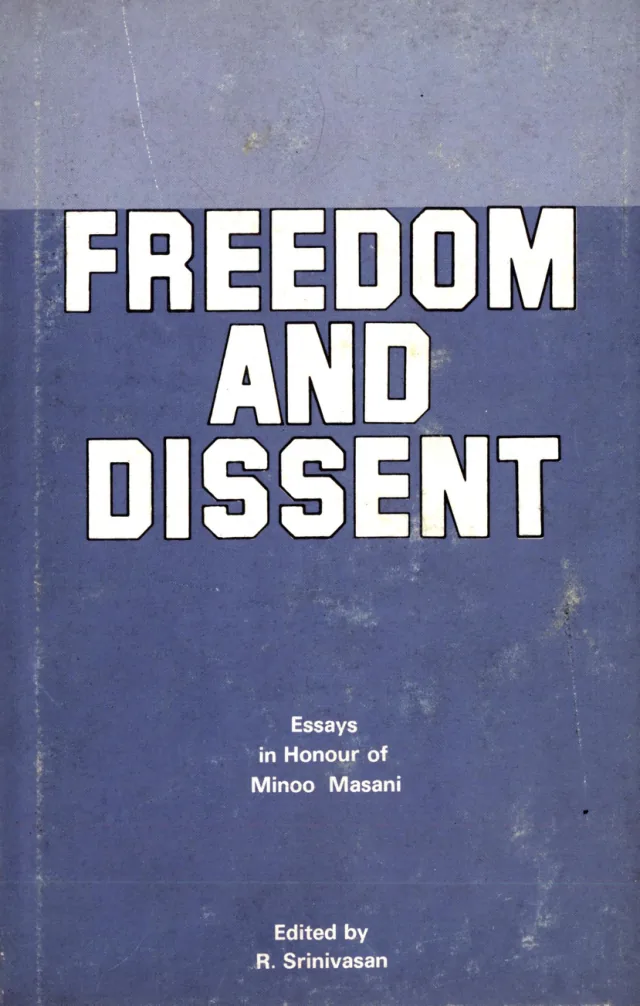
Freedom and Dissent
Summary
Freedom and Dissent (Bombay: Democratic Research Service, November 1985) is a festschrift for Minoo Masani’s eightieth birthday, edited by R. Srinivasan for a Felicitation Committee that included M. R. Pai, S. V. Raju and Anupam Mehta. Its eighteen essays do two jobs at once. Roughly the first third is tribute and testimony about Masani himself: J. R. D. Tata on his years in the Tata organisation, S. V. Raju on his Swatantra Party discipline and temperament, Ajit Jain on his record as a parliamentarian and Public Accounts Committee chairman, F. A. Mehta on his economics, and a reprinted 1979 interview with the Dutch liberal politician Frits Bolkestein in which Masani himself surveys Gandhi, Nehru, caste, party politics and Communism. The rest are issue essays on the causes he championed, and the editor’s introduction states the aim plainly: to present Masani as an heir and exponent of the Indian Liberal tradition and to remind a new generation of what an earlier one contributed to freedom and national development.
Across the volume the argumentative centre is the duty and the right to dissent in an open polity. S. P. Aiyar and R. Srinivasan trace Indian liberalism from Ram Mohun Roy, Ranade and Gokhale through its displacement by Gandhian mass politics; N. A. Palkhivala argues that governments persistently act unwisely and that citizens like Masani have a duty to dissent; Soli Sorabjee shows the Supreme Court as the guarantor of individual rights, including its Emergency-era failure; Padma Srinivasan and Adi Doctor attack the claims that opposition is a luxury and that populism serves the poor; Mehra Masani and Cushrow Irani defend an independent broadcasting and press system; R. M. Lala, C. D. Narasimhaiah, M. R. Pai and Nissim Ezekiel take up personal and civic ethics, university leadership, consumer rights and the autonomy of the arts; and P. T. Bauer and B. S. Yamey, in a reprint from Commentary, argue that foreign aid rewards the governments that impoverish their own people. The tone is that of a committed circle writing for a general public, with the Emergency, the decline of the Swatantra Party, state control of the economy and of broadcasting, and the 1985 liberalising turn under Rajiv Gandhi as the recurring reference points. This summary was written from the rendered pages 1 to 20 (cover, front matter, Introduction, contents, and the whole of Tata’s essay plus the first page of Raju’s) and from a full-text OCR survey of all 245 PDF pages; see summary_completeness for the split.
Metadata and summary are AI-extracted from the source PDF and reviewed for editorial accuracy. The original work is available via the Read PDF tab above (where present); paragraph-level citation inside the PDF is deferred to a future engagement.
People in this work
- R. Srinivasan
- J. R. D. Tata
- S. V. Raju
- F. A. Mehta
- M. R. Pai
- Achyut Patwardhan
- Adam Smith
- B. R. Shenoy
- Bal Gangadhar Tilak
- B. R. Ambedkar
- C. Rajagopalachari
- C. D. Deshmukh
- Gopal Krishna Gokhale
- Herbert Spencer
- Indira Gandhi
- Ishwar Chandra Vidyasagar
- Jawaharlal Nehru
- Jayaprakash Narayan
- John Stuart Mill
- K. M. Munshi
- Karl Marx
- Ludwig Erhard
- M. N. Roy
- Mahatma Gandhi
- Minoo Masani