
edited volume · memorial volume
LIBERALISM AND LESS DEVELOPED COUNTRIES
Essays in Memory of PROFESSOR BELLICOTH RAGHUNATH SHENOY
By Milton Friedman, Henry Hazlitt, Gottfried Haberler, Subramanian Swamy, David D. Friedman, Gautam Mathur, M. P. Bhatt, M. H. Gopal, G. C. Wiegand, Antony Fisher, C. Lawell Harriss, George C. Roche III, Mukund S. Trivedi, Leonard E. Read
GUJARAT UNIVERSITY AHMEDABAD-380 009 (Published by: B. M. Patel, Registrar, Gujarat University, Ahmedabad - 380 009) · Ahmedabad · 1982
257 pages
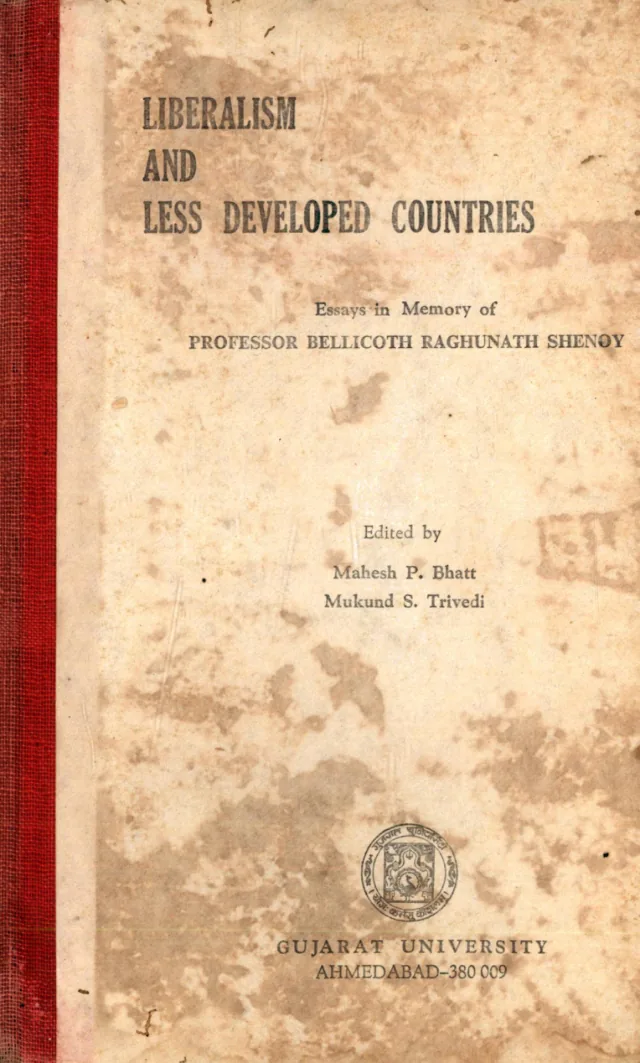
LIBERALISM AND LESS DEVELOPED COUNTRIES
Summary
Liberalism and Less Developed Countries (Gujarat University, Ahmedabad, 1982) is a memorial volume for the economist Bellicoth Raghunath Shenoy (1905-1978), edited by Mahesh P. Bhatt and Mukund S. Trivedi. It opens with a 14-page biographical sketch by the editors and then gathers fourteen essays: contributions from Milton Friedman, Henry Hazlitt, Gottfried Haberler, G. C. Wiegand, Antony Fisher, C. Lowell Harriss, George C. Roche III, Leonard E. Read and David D. Friedman, and from the Indian economists Subramanian Swamy, Gautam Mathur, M. H. Gopal and the two editors. The sketch, which the rendered pages show in full through page xii, presents Shenoy as an Austrian-trained monetary theorist, former Reserve Bank of India and IMF official, and first Director of Gujarat University’s School of Social Sciences who, from 1955, became the lone dissenter against deficit-financed Indian planning, exchange controls, PL 480 food imports and the transfer of resources out of agriculture, and who was largely ignored by his profession in his lifetime. The surveyed text of the whole volume (OCR, not the rendered images) shows that the essays divide into three groups: general statements of the liberal case against planning, inflation and protection (Friedman, Hazlitt, Haberler, Harriss, Wiegand), tributes that borrow Shenoy’s position (Fisher, Roche, Read, partly Wiegand), and technical pieces on Indian and theoretical economics (Swamy, D. Friedman, Mathur, Bhatt, Gopal, Trivedi).
The argumentative centre, read from the OCR survey, is the claim that market freedom, sound money and free trade serve poor countries better than central planning, deficit finance and controls. Friedman contrasts Meiji Japan with independent India to argue that ideas, not facts, govern policy; Hazlitt and Haberler treat inflation, protectionism and stagflation as products of government policy and market rigidity rather than of the liberal order; Gopal audits three decades of Indian budgets and recommends fewer objectives, an expenditure freeze and more room for the private sector; Swamy finds from 106 years of price data that agricultural prices lead the general price level in India. Other essays are further from the volume’s title: D. Friedman locates a stock-flow error in Adam Smith, Mathur attacks the kinked-demand price-rigidity hypothesis, Bhatt weighs the case for an expenditure tax, and Trivedi tests inflation variability in the Indian demand for money. Pull quotes below are taken only from the rendered pages (the editors’ biographical sketch), and per-essay summaries for the other essays rest on OCR text.
Metadata and summary are AI-extracted from the source PDF and reviewed for editorial accuracy. The original work is available via the Read PDF tab above (where present); paragraph-level citation inside the PDF is deferred to a future engagement.