
book · biography
Minoo Masani
By S. V. Raju
NATIONAL BOOK TRUST, INDIA (verso: Published by the Director, National Book Trust, India, A-5 Green Park, New Delhi - 110016) · New Delhi · 2007
124 pages
Part of National Biography
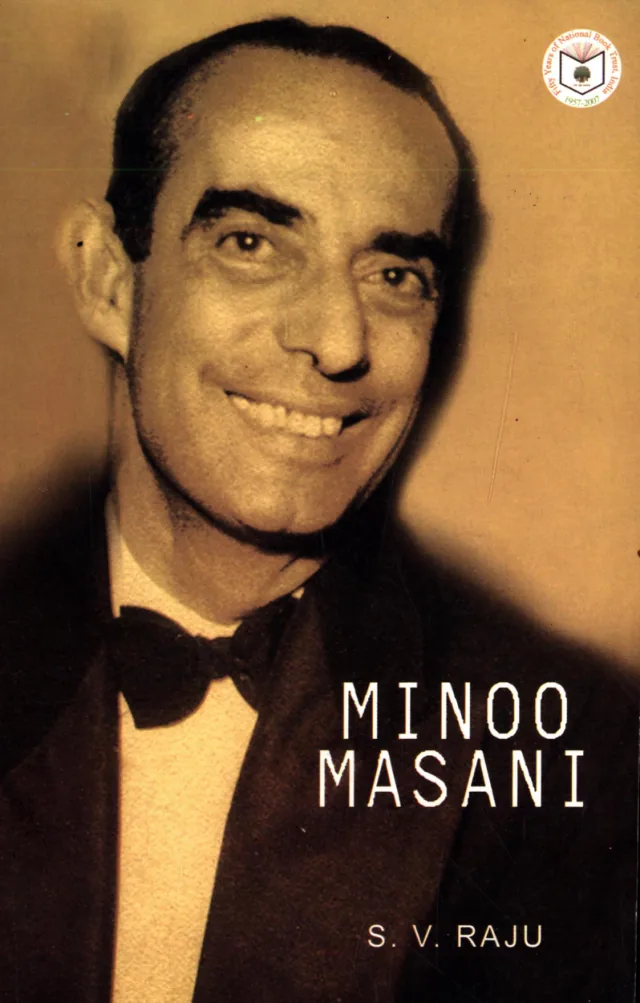
Minoo Masani
Summary
S. V. Raju’s short biography, issued in 2007 in the National Book Trust’s National Biography series, tells the life of Minoo Masani (1905-1998) as the story of a principled politician who moved from the Congress Socialist Party to the Swatantra Party and spent most of his public life in opposition. Raju worked with Masani for nearly four decades from December 1959, first in the Swatantra Party’s Central Office and then in the organisations Masani founded, and the book is openly an insider’s tribute that also admits Masani’s difficult, punctilious, ‘purist’ temperament. The Introduction sets Masani in the line of Naoroji and Gokhale, quotes R. Srinivasan on him as a vanishing species of liberal intellectual and J.R.D. Tata on a former Marxist who admitted he had been wrong, and lists the organisations he founded: the Democratic Research Service, the Indian Committee for Cultural Freedom, the Indian Liberal Group, the Leslie Sawhny Programme and the Project for Economic Education.
The first half follows Masani’s political education. Born into a Parsi family in Bombay, the son of the knighted Sir Rustom Masani, he studied at the London School of Economics, became a Labour-inclined socialist, visited the Soviet Union in 1927 and returned to the Bombay Bar. Drawn into Civil Disobedience by Yusuf Meherally, he was jailed in 1932-33, at Nasik met Jayaprakash Narayan, Lohia and Patwardhan, and helped found the Congress Socialist Party, whose Joint Secretary he became under JP. Chapter 4 traces his turn against Soviet communism through the 1935 and later Soviet visits, the Great Purges, the Comintern’s United Front tactic and the communists’ infiltration of the CSP, ending in his resignation in November 1939. Chapter 5 covers his ten-day 1934 walking tour with Gandhi and the exchange of letters about the CSP programme, and sets out what Masani took from Gandhi: ends and means are linked, the State should not be glorified, and power should be decentralised. Chapter 6 presents Socialism Reconsidered (1944), which questions four Marxist assumptions, and his 1947 A Plea for a Mixed Economy, with a small nationalised sector, a larger new public sector and the largest sector left to free enterprise.
The middle chapters cover his working life and his legislative career. He spent sixteen years with the Tatas from 1941, working on workers’ participation at TISCO and on the Declaration on the Social Responsibilities of Business of 1965, and set up his own management consultancy so that he need not live off politics. As a Congress member of the Indian Legislative Assembly and Constituent Assembly from 1945, he pressed for a uniform civil code, proportional representation instead of reserved seats, abolition of titles and planning on the States list, and he broke with Nehru over the Liaquat Ali budget, communism and the Cold War before leaving the Congress in 1952. Chapters 9 and 10 describe the Nagpur resolution on cooperative farming as the tipping point for the Swatantra Party, founded under Rajaji in 1959, with Masani as General Secretary and organiser: 25 Lok Sabha seats in 1962, 44 in 1967, the party’s Statement of Policy ‘To Prosperity Through Freedom’, the 1971 Grand Alliance dispute with Rajaji that led to Masani’s resignation, and the 1974 dissolution he opposed.
The last two chapters portray him as a model parliamentarian, who opened the Finance Bill debate for a decade, chaired the Public Accounts Committee in 1967-69, refused to oppose for opposition’s sake, and kept faith with his Rajkot constituents. They then follow his retirement from politics in 1971, his role as chronicler and adviser during JP’s Total Revolution, his stand against the Emergency through Freedom First (including the Bombay High Court case against pre-censorship), his refusal to join the Janata coordinating committees, and his resignation from the Minorities Commission in May 1978 when the government ignored it. The book ends with his later projects, his last children’s book We Indians (1989), his blindness and his death on 27 May 1998, and a list of his books and pamphlets. The narrative leans heavily on Masani’s own memoirs and quoted speeches and gives little independent critical evaluation of his judgements.
Notable passages
"This book is the story of a principled politician—an oxymoron in current political dialogue."
"Here was an example of one of India’s biggest tragedies—the inability to stand up to someone in authority."
"For Masani, means were important and, if in the process the organisation collapsed, so be it."
"Masani’s public life has been spent far more in the ranks of the Opposition than in the government."
"These two alone are enough to disqualify him as a ‘Neta’ and set him apart as an outstanding citizen of India."
Metadata and summary are AI-extracted from the source PDF and reviewed for editorial accuracy. The original work is available via the Read PDF tab above (where present); paragraph-level citation inside the PDF is deferred to a future engagement.