
periodical issue
Quest
a bi-monthly of arts and ideas
By R. E. Hawkins, R. Ramani, Kobita Sarkar, Pudumaippithan, Daya Krishna, Robert Flynn, A. B. Shah, Uma Anand, J. N. Chubb, S. Ookerjee, P. K. Saha
QUEST is sponsored by the Indian Committee for Cultural Freedom. ... published once every two months ... at Army & Navy Building, 148, Mahatma Gandhi Road, Bombay 1. · Bombay · 1956
76 pages
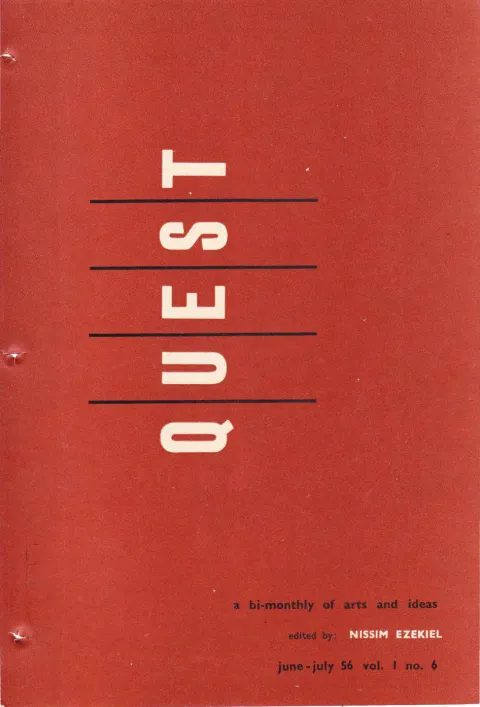
Quest
Summary
Quest Vol. I No. 6 (June-July 1956), edited by Nissim Ezekiel for the Indian Committee for Cultural Freedom, is a bi-monthly journal of ‘arts and ideas’ whose contents range far beyond politics: alongside two unsigned/lightly-signed pieces opening the issue on the pending Indian Copyright Bill, it carries political and social commentary (R. Ramani on Nehru’s Second Five-Year Plan and the rhetoric of racing Communist China; Daya Krishna on the erosion of civil liberties and a reprinted attack on loose talk of ‘Socialism’; Robert Flynn’s column on American politics, literature and theatre), a Tamil short story in translation, a literary profile of the visiting American novelist James T. Farrell, an anthology of Buddhist scripture marking the Buddha’s 2,500th anniversary, a report on an ICCF seminar on Maharashtra’s political and liberal heritage, reviews of Bombay theatre and folk-dance festivals, seven book reviews (Narayan, Spender, Duverger, a UNESCO Egypt pamphlet, Michener, Douglas Hyde, and the Rangoon Cultural Freedom in Asia proceedings), a three-letter correspondence dispute over the Indian Philosophical Congress, and a reader’s letter on social ostracism for anti-Communist views. The issue also carries several photographic plates — by N. V. Haldankar, a Pather Panchali/Farrell frontispiece, folk-dance photographs, and a preview of the ‘Family of Man’ exhibition featuring Laurence LeGuay, Lou Bernstein and Alfred Eisenstaedt — none of which appear on the printed contents page.
Essays
How Fast Should We Run?
By R. RAMANI
R. Ramani’s essay dissects Prime Minister Nehru’s public rhetoric of racing Communist China’s industrialisation, arguing that despite Nehru’s denials, his 1954 visit to China visibly reshaped the ambitions behind India’s Second Five-Year Plan. Ramani traces how the Planning Commission was effectively bypassed in favour of Prof. P. C. Mahalanobis’s Indian Statistical Institute and a Rs. 6,500-crore ‘Plan-frame’ modelled partly on Soviet precedent, over the private scepticism of Finance Minister C. D. Deshmukh and other ministers, who feared the targets were unrealistic. The essay catalogues the gap between the Plan’s promised outlay (eventually Rs. 4,800 crores) and the resources actually available, and argues that Nehru’s ‘devil at our heels’ framing of a race with China obscures both India’s real financial constraints and the human cost of Chinese and Soviet forced industrialisation.
- Nehru publicly denied that China’s industrialisation influenced India’s Second Plan, but his own 1954 remarks (e.g. ‘as if the devil were at our heels’) show otherwise.
- The Planning Commission was effectively superseded in late 1954 by Mahalanobis’s Indian Statistical Institute team, producing a Rs. 6,500-crore Plan-frame against the Commission’s own Rs. 5,500-crore ceiling.
- Finance Minister Deshmukh and other ministers privately doubted the plan’s feasibility but did not resist it openly; only T. T. Krishnamachari broke ranks publicly in April 1956.
- The final Plan (Rs. 4,800 crores) still left an admitted resource gap even after assuming Rs. 1,200 crores of deficit financing and Rs. 800 crores of foreign aid with no firm commitment.
- Argues Communist regimes’ claimed growth rates are unverifiable (China) or exaggerated (USSR, per Colin Clark), and that their apparent lead rests on forced under-consumption, citing Soviet wage and rouble-value data.
- Concludes democratic development, even if slower, is preferable: the real choice is between ‘increasing bread with freedom’ and ‘less bread with no freedom’.
Failure of the Indian Film
By KOBITA SARKAR
Kobita Sarkar surveys Indian cinema of the 1950s and finds it systematically evasive of the real social issues of the day. She argues Indian films borrow the surface techniques of Italian neo-realism and Hollywood social-problem pictures (citing Boomerang, Pinky, On the Waterfront as points of comparison) without their honesty, preferring melodrama, moralising or nostalgia to genuine engagement. She reviews specific films — Boot Polish, Awara, Biraj Bahu, the Bengali comedies Ardhangini and Ora Thakey Odharey, Sindoor, Do Bigha Zamin, Abbas’s Rahi, and Naukri — arguing each either recycles an outdated social problem, pulls its punches, or sentimentalises hardship rather than confronting it. She singles out the neglect of India’s biggest contemporary subjects — Partition-era migration, the dissolution of the joint family, industrial development, unemployment — as evidence the medium is failing its own potential as, in her words, ‘the greatest exponent of ideas for the common man’.
- Argues Indian cinema functions mainly as ‘an opiate’ rather than a genuine ‘conscience rouser’, hedging even its problem pictures.
- Credits Boot Polish (produced by Raj Kapoor) as one of the finest Indian films in the semi-documentary tradition, its songs a commercially necessary ‘sugar-coating’.
- Criticises Do Bigha Zamin and Abbas’s Rahi for tackling social problems (the zamindar system, colonial tea-plantation abuse) that were already outdated by the time of release.
- Praises the Bengali film Ora Thakey Odharey for handling Partition-refugee tensions between East and West Bengali families with humour rather than moralising.
- Calls for feature films to marry documentary subject matter (India’s industrial projects) with popular narrative form, as some French semi-documentaries had done.
- Concludes present-day failures of nerve will read as historical failures within a decade: ‘no amount of corrosive invective in 1966 will compensate us for the cinema having failed to appreciate our problems today.‘
An Experiment in Democracy?
By DAYA KRISHNA
Daya Krishna’s essay argues that India’s political and intellectual elite pay only lip service to civil liberties while tolerating, and sometimes practising, real intolerance of dissent. He opens with his own ‘experiment’: a short article questioning unqualified enthusiasm for Socialism, submitted to four leading English-language dailies (The Hindustan Times, Times of India, The Statesman, The Hindu) and rejected by all four without serious engagement. He generalises from this to a series of anecdotes — a Hindi writer warned against publishing criticism of the Soviet Union, an official of the Indian Council of World Affairs alarmed by a proposed study of authoritarian trends in India, a New Delhi road-naming reversed the moment it was known to have the Prime Minister’s personal approval, and a Free Enterprise pavilion at the Delhi Industries Fair censored after T. T. Krishnamachari’s objection — to argue that democratic liberties in India are eroding by small, unresisted increments. The essay reprints in full his rejected article, ‘Socialism … So What?’, which challenges the equation of ‘socialism’ with public-sector expansion, using Soviet consumption-shortfall statistics (from the economist Strumilin) to argue that thirty-eight years of Soviet socialism had left ordinary citizens without an adequate diet, and asks the Congress leadership to specify exactly what they mean when they prescribe ‘Socialism’ as India’s goal.
- Describes his own article on socialism being rejected, without serious reply, by all four of India’s leading English dailies.
- Argues that in a country where radio is government-controlled, a closed daily press effectively closes off democratic debate.
- Cites Rajaji’s allegations of threatened victimisation against doctors in the B.C.G. vaccination controversy and Jayaprakash Narayan’s statements on the Bihar disturbances as public evidence of the press’s failure to follow up on serious charges.
- Recounts T. T. Krishnamachari ordering the removal of Free Enterprise panels from a Nav Jivan pavilion at the Delhi Industries Fair after the Minister took offence.
- In the reprinted ‘Socialism … So What?’, uses Soviet consumption-shortfall data (Strumilin’s standards, Vestnik Statistiki 1954) to argue Soviet citizens still lacked basic bread, meat, milk, eggs, sugar, clothing and living space after 38 years of socialism.
- Poses four direct questions to the Prime Minister and Congress President about whether Socialism means the total elimination of the private sector and whether private enterprise is intrinsically evil.
A Letter from America
By ROBERT FLYNN
Robert Flynn’s regular column surveys American politics, literature and theatre in mid-1956. On politics, he explains the mechanics of the presidential primary system and assesses Adlai Stevenson’s vulnerable position against Estes Kefauver for the Democratic nomination, and the near-automatic renomination of President Eisenhower despite uncertainty over whether Richard Nixon will again be his running mate; he also surveys the slow progress of school desegregation following the Supreme Court’s Brown ruling, state by state. On literature, he reviews Robert Penn Warren’s new novel Band of Angels (comparing Warren unfavourably to Hawthorne and to Faulkner, Hemingway and Steinbeck at their best), Harry Truman’s two-volume Memoirs, and Will Herberg’s Protestant, Catholic, Jew on American religion. On theatre, he reports a shortage of Broadway venues, the rise of Off-Broadway, and the commercial dominance of lavish musicals such as the newly opened My Fair Lady, which he fears is crowding out serious drama.
- Explains how the U.S. presidential primary system tests popularity without binding convention delegates, using Stevenson’s 1956 loss to Kefauver in Minnesota as an example.
- Predicts Eisenhower’s renomination is ‘automatic’ barring incapacity, with Nixon’s place on the ticket the only open question.
- Surveys state-by-state progress on school desegregation after the 1954 Brown v. Board ruling: full integration in Washington D.C., substantial progress in five states, none in eight.
- Reviews Robert Penn Warren’s Band of Angels as a novel about freedom and slavery in the pre-Civil War South, judged competent but inferior to Hawthorne, Faulkner, Hemingway and Steinbeck.
- Notes a shortage of Broadway theatres (many converted to broadcast studios) offset by the growth of the Off-Broadway movement.
- Warns that expensive musical spectacles like My Fair Lady are crowding serious drama out of the commercial theatre.
James T. Farrell
By N.E.
This unsigned-but-initialled (‘N.E.’) literary profile, timed to a visit by James T. Farrell to India, surveys his career as both a public campaigner (against racial exclusion, political and social prejudice, and totalitarianism, culminating in his presidency of the American Committee for Cultural Freedom) and as a naturalist novelist. It argues Farrell’s best work is the Studs Lonigan trilogy and three volumes of short stories (Calico Shoes, Guillotine Party, Can All This Grandeur Perish), praising his flat, unliterary, deliberately unpretentious style as suited to depicting characters wholly shaped by heredity, environment and social circumstance, in contrast to Joyce’s more consciously ‘poetic’ method in Portrait of the Artist as a Young Man. The profile also surveys Farrell’s critical writing (A Note on Literary Criticism, The League of Frightened Philistines) directed against Marxist and other dogmatic approaches to literature.
- Traces Farrell’s public activism back to a student letter protesting the exclusion of coloured students from a college drama club.
- Identifies the Studs Lonigan trilogy and three story collections as Farrell’s best work, in the naturalist tradition of Emile Zola.
- Contrasts Farrell’s flat, ‘deliberately pedestrian’ style and refusal to moralise with James Joyce’s more lyrical, structured method in Portrait of the Artist as a Young Man.
- Surveys several of Farrell’s short stories (Looking ‘Em Over, Well, That’s That, Meet the Girls, The Benefits of American Life, Seventeen) as variations on American social frustration.
- Notes Farrell’s critical books attacking Marxist and other dogmatic criteria for judging literature.
Some Buddhist Ideas
This unsigned editorial feature marks the 2,500th anniversary of the Buddha’s birth with a short introductory note explaining that popular veneration of the Buddha often loses sight of the precise, metaphysical content of his teaching (illustrated with the Digha-nikaya’s account of what ‘ill and the stopping of ill’ actually means), followed by a substantial anthology of primary-text extracts: passages on the renunciant life from the Samgha material, the full ‘Great Refusal’ parable and the ‘Basic Exhortation’ (‘be a lamp unto yourself’) from the Buddha’s Farewell Address, and a long sequence of verses from the Dhammapada grouped under headings such as The Ethical Foundation, The Intellectual Problem, The Way of the Wise, Evil, The Self, Detachment, and Restraint.
- Frames the anniversary of the Buddha’s birth as an occasion to revisit primary texts rather than rely on popular, simplified conceptions of Buddhism.
- Distinguishes the popular, ethics-only conception of the Buddha’s teaching from its more precise metaphysical content (the ending of the cycle of rebirth).
- Reproduces the ‘Great Refusal’ parable in which the Buddha declines to answer metaphysical questions he judges unprofitable to the religious life.
- Reproduces the Buddha’s Farewell Address exhortation to ‘be a lamp unto yourself’ and rely on no external authority.
- Presents an extensive selection of Dhammapada verses on thought, self-mastery, evil, detachment and restraint, organised under thematic headings.
A Seminar in Poona
By A. B. SHAH
A. B. Shah reports on a two-day ICCF-sponsored seminar held in Poona (5-6 May) bringing together Maharashtrian intellectuals and politicians to discuss ‘The Pattern of Development in the New Maharashtra’ and ‘The Liberal Heritage in Maharashtra’. He frames the seminar against a longer argument about the historic estrangement of Indian intellectuals from public affairs (contrasting Tilak’s and Gandhi’s action-first political style with the traditional ‘Rishi’ detachment of intellectuals). The first day’s discussion, on casteism and the merger of Vidarbha and Marathwada into the new Maharashtra, is described as marked by a guilt-driven but analytically thin consensus that upper castes must simply concede ground. The second day’s discussion of Maharashtra’s Liberal heritage (Phule, Lokahitwadi, Gokhale) produces sharper disagreement: several speakers (Sudarshan Desai, G. P. Pradhan) dismiss Maharashtrian Liberalism as the ‘escapism of the respectable minority’, while M. R. Masani insists Liberalism is not dead, citing European Social Democratic parties and trade unions, and Prof. Kogekar closes by raising the unresolved question of how a Liberal, committed only to rational persuasion, should respond to an illiberal opponent.
- Frames the seminar as addressing the historic gulf between India’s intellectuals and its politicians, using Tilak and Gandhi as examples of action-first leadership that marginalised scholarly detachment.
- Reports the first day’s discussion of casteism and the integration of Vidarbha and Marathwada as dominated by upper-caste guilt rather than concrete proposals.
- Records sharp disagreement on the second day over whether Maharashtrian Liberalism (Phule, Lokahitwadi, Gokhale) left any living political heritage, with Sudarshan Desai and G. P. Pradhan calling it ‘escapism’.
- Records M. R. Masani’s intervention that Liberalism survives in Europe’s Social Democratic parties and trade unions.
- Closes on Prof. Kogekar’s unresolved question: how should a Liberal, committed to rational persuasion alone, respond to an agency that rejects liberal values?
- Warns that large-scale economic planning may threaten individual freedom by concentrating economic and political power, recommending decentralisation and separation of economic from political power as a safeguard.
The Golden City
By PUDUMAIPPITHAN
Pudumaippithan’s short story, translated from the Tamil by V. S. Maniam, describes the ‘Golden City’ — an ironically-named railside slum in Bombay (or a similarly overcrowded mill city) where a community of textile-mill workers lives in extreme poverty: no electricity, a single water tap fought over daily, children who play dangerously near railway tracks, and adults who drink to blunt hunger during slack season. The narrative settles on Ammalu, a young mill-worker married to a jutka (horse-carriage) driver, on the night her husband is badly injured after racing his cart while drunk. With no money in the house for the gruel he needs, Ammalu goes out for water after dark and, in the story’s stark final scene, allows a man to solicit her in the shadows in exchange for the coins she needs to buy her husband food.
- Frames the slum ironically as a ‘Golden City’ whose squalor can only be justified, if at all, by the philosophy of karma.
- Details material deprivation: no electric light, a single shared water tap, children fishing in sewage water, homes built like ‘bee-hives’.
- Centres on Ammalu, a young mill-worker, and the economic desperation (rent, opium for a brother-in-law, drink, a policeman’s mamul) that keeps the household permanently short of money.
- Ends with Ammalu resorting to transactional sex for the price of gruel after her husband is injured in a drunken jutka race, framed as an indictment of moralising about ‘chastity’ from outside such poverty.
Sahitya Sangh Festival
By K. G. P.
K. G. P. reviews the annual Marathi drama festival staged by the Mumbai Marathi Sahitya Sangh in its open-air theatre, describing it as ‘mixed fare’. Productions discussed include a revival of a J. M. Barrie translation by Prof. Anant Kanekar, Kolhatkar’s musical Vadhu-Pareeksha, Tipnis’s Shaha-Shivaji, Khadilkar’s Draupadi (starring the film actress Meenaxi and produced by Durgabai Khote), the comedy Chchapeel Samar, and C. Y. Marathe’s topical historical play Lokancha Raja, which the reviewer expects to be ‘the talk of the town’ despite finding Marathe’s construction and sense of dramatic climax weak.
- Describes the Sangh’s twelve-year history of festivals in its own open-air theatre, credited to the late Dr. A. N. Bhalerao’s leadership.
- Judges Khadilkar’s Draupadi, starring film actress Meenaxi and produced by Durgabai Khote, one of the festival’s main attractions, though some supporting performances were ‘amateurish by comparison’.
- Praises the comedy Chchapeel Samar’s lead performances but faults its pacing and weaker female casting.
- Highlights C. Y. Marathe’s Lokancha Raja as the play likely to be most talked-about, for its topical resonance with the Samyukta Maharashtra movement, despite weak plotting.
- Concludes by welcoming the Sangh’s plan to build a permanent theatre-cum-cultural-centre from festival proceeds.
Folk Dances of India
By UMA ANAND
Uma Anand reviews a folk-dance festival organised by the I.N.T. (Indian National Theatre) in Bombay, praising the initiative while lamenting how staging authentic folk dance under arc lights, with microphones and a monumental stupa backdrop, distorts its original communal character. She singles out the Tanjore stilt-dancers (professionalised but effective, especially their clown), the unspoilt Lambadi gypsy women from Hyderabad who brought their infants along and improvised a backstage creche, the disciplined Rajkot Sarvodaya dancers, the puppet Bommalattam of Kumbakonam, and the crowd-pleasing but self-consciously showy Bhangra of the Pepsu troupe, contrasted with quieter, more authentic performances like the Mahasus of Himachal and the Rallis of Udvada that an urban audience found harder to sit through.
- Argues authentic folk dance is inseparable from its natural communal setting (a village mela, a seasonal festival) and is inevitably distorted when staged for an urban audience.
- Praises the Lambadi gypsy dancers from Hyderabad as unspoilt, noting they brought their infants and improvised backstage childcare.
- Criticises the Pepsu troupe’s Bhangra performance as a crowd-pleasing but self-aware, costume-glamorised version of the dance, playing to the gallery.
- Notes the urban audience’s impatience with the genuinely repetitive, authentic Mahasu (Himachal) and Ralli (Udvada) dances in favour of the more theatrical Bhangra.
- Calls for folk dance to be documented on film and taught in schools rather than only staged as isolated theatrical spectacle.
Waiting for the Mahatma by R. K. Narayan
By G. V. VISWANATH
G. V. Viswanath reviews R. K. Narayan’s Waiting for the Mahatma, his seventh novel, judging it a departure from the Malgudi tradition into a Gandhi-era romance between the immature Sriram and the more purposeful Bharati. The review praises Narayan’s vivid minor ‘Malgudi’ characters and finds Bharati his best female creation, but judges the novel a disappointment overall: once Sriram is separated from Bharati and the Congress workers are jailed, the narrative becomes an episodic chronicle of Sriram’s adventures without cumulative suspense, and the Mahatma himself plays only a minor role, culminating in what the reviewer calls an ‘unnecessary over-dramatisation’ — the Mahatma’s assassination immediately after blessing the couple’s marriage.
- Places Waiting for the Mahatma as Narayan’s seventh novel and a departure from the Malgudi tradition in centring on romantic love (Sriram and Bharati).
- Praises Narayan’s vivid depiction of minor Malgudi characters and singles out Bharati as his best female character to date.
- Criticises the novel’s second half for becoming an episodic chronicle of Sriram’s adventures that loses narrative suspense.
- Judges the Mahatma’s role in the novel minor despite the title, and calls his assassination at the novel’s end ‘unnecessary over-dramatisation’.
The Making of a Poem by Stephen Spender
By N.E.
N.E.’s review of Stephen Spender’s essay collection The Making of a Poem finds its strength in Spender’s candid, unpretentious autobiographical voice — discussing his own difficulty concentrating while writing poetry, and giving a sympathetic account of the isolation of the American writer from any real literary community. The review is more critical of Spender’s treatment of the Georgian poets (finding his praise of de la Mare, W. H. Davies and James Stephens oddly generous) and especially of the volume’s most ambitious essay, ‘Inside the Cage’, which it judges obscure and logically loose, closing on Spender’s borrowed Henry Miller injunction to ‘live miraculously’ as ‘obscurantist and unhelpful’.
- Praises Spender’s candour about his own difficulty concentrating while composing poetry, contrasted with more habit-driven contemporaries (Schiller, de la Mare, Auden).
- Finds Spender’s essay on ‘The Situation of the American Writer’ his most successful, for its blend of objective perception and personal sympathy.
- Criticises Spender’s essay on the Georgian poets for over-generous praise of de la Mare, W. H. Davies and James Stephens.
- Judges the essay ‘Inside the Cage’ the collection’s weakest, citing specific passages as logically unclear.
- Closes by calling Spender’s borrowed conclusion (quoting Henry Miller on living, thinking and dying ‘miraculously’) ‘obscurantist and unhelpful’.
The Political Role of Women by Maurice Duverger
By KOBITA SARKAR
Kobita Sarkar reviews Maurice Duverger’s UNESCO-commissioned study The Political Role of Women, based on Norway, West Germany, Yugoslavia and France, which finds that although women vote in large absolute numbers, a higher proportion of women than men abstain, and that women who do enter politics are confined mostly to matters of ‘domestic interest and community welfare’ rather than finance or foreign affairs. The review notes the book gives no Indian data but suggests India has, despite less time since female suffrage than the countries studied, achieved comparatively more substantive recognition of women’s political rights, and concludes the deeper problem the survey identifies — women’s own internalised reluctance to engage with politics — is under-explored.
- Summarises Duverger’s method: comparative case studies of Norway, West Germany, Yugoslavia and France on women’s voting and office-holding.
- Notes that although women vote in larger absolute numbers than men in the countries studied, a higher percentage of women abstain from voting.
- Observes that women office-holders are concentrated in ‘domestic’ policy areas rather than finance or foreign affairs.
- Argues India, despite a shorter period of female suffrage than the countries studied, shows comparatively substantial political recognition of women.
- Criticises the book for identifying but not adequately analysing the ‘deep-seated’ conservative bias against women in politics.
Sirs El Layyan (Unesco)
By A. A. A. FYZEE
A. A. A. Fyzee reviews Sirs El Layyan, a UNESCO pamphlet describing a joint Egyptian government-UNESCO fundamental-education and community-development centre opened in 1952 in a village near Cairo, training teams to run ‘Social Centres’ with dispensaries, maternity clinics, adult education and playgrounds across the Arab world. The review situates the project against three larger Middle Eastern political problems (Israel, the Arab-French conflict in North Africa, and Soviet-Western competition for Arab favour) and against social problems shared with India (poverty, population growth, weak medical and technical infrastructure), praising the pamphlet’s enthusiastic ‘Arab style’ even where its claims would sound overstated if translated too literally into English idiom.
- Describes the Sirs El Layyan project: a joint Egyptian government-UNESCO training centre for fundamental-education and community-development workers, opened 1952 near Cairo.
- Frames Egypt’s social problems (poverty, population growth, weak medical/technical infrastructure) as closely paralleling India’s own.
- Notes the project trains international teams of 10-12 who both serve and learn from the local Egyptian (‘fellaheen’) community.
- Observes that some of the pamphlet’s claims ‘sound extravagant in English’ but would be normal and true within Arabic rhetorical convention.
- Frames the underlying stakes as whether Communism or Western-style development will win Arab allegiance amid the region’s economic strain.
The Floating World by James Michener
By N.J.N.
N.J.N. reviews James Michener’s The Floating World, a study of Japanese ukiyo-e woodblock prints, endorsing Michener’s placement of the prints within their original commercial, entertainment-driven context in Tokugawa-era Yedo rather than treating them as fine art in the Western sense. The review traces how the merchant class’s rising prosperity under two hundred and fifty years of enforced Tokugawa peace produced a flamboyant, censorship-defying popular culture (Kabuki, the Yoshiwara pleasure quarters, ukiyo-e) that quietly mocked the samurai and daimyo, and argues ukiyo-e finally died not from repression but because the world it depicted — Yedo’s ‘floating world’ of pleasure — dissolved with the arrival of Western influence, though it finds Michener’s own reproductions inadequate to the originals.
- Situates ukiyo-e as popular commercial entertainment art for Tokugawa-era Yedo’s merchant class, not a self-conscious fine art.
- Traces how Tokugawa sumptuary laws and censorship failed to suppress ukiyo-e, since the regime could control the daimyo but not the newly prosperous commoners.
- Notes the elaborate symbolic code of ukiyo-e (e.g. a carp against the current signifying courage) that a contemporary Yedo audience would read fluently.
- Argues ukiyo-e died together with the Tokugawa social order it depicted, as Western influence dissolved the ‘floating world’ of Yedo.
- Judges Michener’s own book reproductions inadequate to the quality of the original prints.
One Front Across the World by Douglas Hyde
By N. L. KHANOLKAR
N. L. Khanolkar’s sharply critical review of Douglas Hyde’s One Front Across the World rejects its central thesis — that the decisive contest of the age is between Communism and the Roman Catholic Church, with Asia’s masses turning to Catholicism as their own religions prove inadequate against Communism. The reviewer finds Hyde’s travel reportage from Africa, Pakistan, India, Japan and Korea marshalled selectively to fit a pre-formed dogma, objects to Hyde’s claim that Hinduism’s tolerance and Islam’s ‘externality’ leave them defenceless against Communism, and closes by asking pointedly what the author’s schema makes of the moral and religious ‘leaven’ stirred by Gandhi, Schweitzer and Vinoba Bhave, none of whom fit his Catholic-versus-Communist framework.
- Summarises Hyde’s thesis that the coming struggle for humanity is between Communist faith and Roman Catholic faith, not democracy versus totalitarianism as such.
- Criticises Hyde’s claim that Hinduism’s tolerance and Islam’s focus on ‘externalities’ leave Asian religions defenceless against Communism.
- Cites Hyde’s own figures on Catholic conversion (e.g. Uganda’s growth from five thousand to a quarter million Catholics) as evidence for his ‘leaven’ argument.
- Objects that Hyde’s schema has no room for moral and religious influence outside the Catholic Church, naming Gandhi, Schweitzer and Vinoba Bhave as counter-examples.
- Judges the book ‘naive, single-track thinking’ that treats all evidence as confirming a thesis decided in advance.
Cultural Freedom in Asia edited by Herbert Passin
By R. SIVARAMAN
R. Sivaraman reviews Cultural Freedom in Asia, Herbert Passin’s edited proceedings of a February 1955 Rangoon conference convened by the Congress for Cultural Freedom and the Society for the Extension of Democratic Ideals. He praises the volume’s intellectual range and its inclusion of the actual discussion transcripts alongside the papers, singling out a debate on ‘the Vitality of Religion in Asia’ in which Prof. Hajime Nakamura’s strong defence of religion’s continuing relevance is challenged by Laxman Shastri Joshi (arguing most Asian religions’ emphasis on moksha discourages worldly economic effort), A. K. Brohi, and Mochtar Lubis (arguing static religions are an ‘easy prey’ to Communism), with Jayaprakash Narayan proposing that existing religious formulas be reinterpreted to serve Asia’s material as well as spiritual needs.
- Describes the conference as convened by the Congress for Cultural Freedom and the Society for the Extension of Democratic Ideals at Rangoon, February 1955.
- Praises the book’s structure: opening addresses, concluding speeches, participant notes, eight pages of photographs, and verbatim discussion summaries alongside the papers.
- Highlights the delegates’ shared opposition to totalitarianism but sharp internal disagreement on other questions, especially religion’s relationship to economic modernisation.
- Records Laxman Shastri Joshi’s objection that religions oriented to moksha discourage the worldly aspiration needed for economic reconstruction.
- Records Jayaprakash Narayan’s proposal to relate existing religious precepts to people’s material as well as spiritual life, to close the gap between religious formula and practice.
The Indian Philosophical Congress
By J. N. CHUBB
J. N. Chubb’s letter continues a running dispute with S. Ookerjee over the conduct of the Indian Philosophical Congress and, in particular, Ookerjee’s criticism of the Congress president Dr. T. M. P. Mahadevan’s address as anti-Western and anti-rational. Chubb rebuts Ookerjee point by point — defending Mahadevan’s view that ultimate truth is ‘supra-rational’ as not equivalent to rejecting reason altogether, disputing Ookerjee’s characterisation of the Congress symposium as full of irrelevant contributions, and re-litigating an earlier acknowledged logical error by Ookerjee — while accusing Ookerjee of shifting his ground and of intellectual dishonesty.
- Defends Dr. Mahadevan’s Congress presidential address against Ookerjee’s charge that it dogmatically dismisses Western, reason-based philosophy.
- Argues that believing ultimate truth is ‘supra-rational’ is not the same as rejecting the use of reason, as Ookerjee’s argument implies.
- Disputes Ookerjee’s claim that non-philosophers (‘outsiders’) dominated a Congress symposium irrelevantly.
- Revisits an elementary logical error Ookerjee had earlier admitted making, arguing his later attempt to reframe it as ‘a profound truth’ is an after-the-fact face-saving move.
- Accuses Ookerjee of sweepingly and falsely implying that no Congress delegate besides himself has ever admitted a mistake in thirty years.
Essay 19
By S. OOKERJEE
S. Ookerjee’s reply to Chubb, headed ‘The Wood and the Trees’, defends his original criticism of the Indian Philosophical Congress and of Dr. Mahadevan’s presidential address, arguing Chubb’s abusive language (‘malice’, ‘mischief’, ‘intellectual dishonesty’) is disproportionate to the substance of his rebuttal. He restates his objection that Mahadevan’s address, in dismissing Western philosophical method as an ‘externalist attitude’ incapable of reaching Truth, effectively declares Western philosophy inferior without argument, and defends his earlier admitted logical slip as a minor, contextually explicable error that does not undermine his larger case that the Congress session was, on the whole, a disappointing affair. Quest’s editor appends a note that ‘this correspondence is now closed.’
- Rejects Chubb’s characterisation of his criticism as ‘malice’ and ‘devilry’, noting the imbalance between Chubb’s language and the substance of the reply.
- Restates that Mahadevan’s address, by dismissing ‘externalist’ reasoned argument in favour of intuition, implicitly claims Indian philosophy’s superiority to Western philosophy without supporting argument.
- Defends his own earlier admitted ‘elementary mistake in Logic’ as minor and contextually explicable, disputing that it undermines his broader case.
- Clarifies that his original claim was that the Congress was, ‘on the whole’, disappointing, not universally without merit.
- The exchange ends with an editorial note: ‘This correspondence is now closed.—EDITOR’.
A Question of Values
By P. K. SAHA
P. K. Saha’s letter from Calcutta describes being socially shunned by two old acquaintances after publishing a review critical of a book on New China by the Speaker of the West Bengal Legislative Assembly. Despite the book’s author himself favouring India’s democratic path, Saha’s review had argued New China’s economic achievements did not justify their human cost; on meeting him afterward, the two acquaintances refused to acknowledge him, telling him only that his ‘reactionary’ review disgusted them too much to continue the friendship. Saha reflects that this episode revealed, with unexpected immediacy, the Marxist indifference to the individual person that he had previously known only in the abstract.
- Describes reviewing a book on New China by the Speaker of the West Bengal Legislative Assembly, arguing China’s progress came at excessive human cost.
- Recounts being cut off by two Marxist acquaintances who refused to acknowledge him after the review’s publication, calling it ‘reactionary’.
- Reflects that the episode gave new, personal immediacy to an abstract awareness of Marxist indifference to individual human relations.
- Closes questioning why disagreement over ‘conditions in New China’ should require severing ‘all human relations’.
Essay 21
This unsigned editorial, part of Quest’s standing ‘editorial’ column, attacks the Copyright Bill then before a joint committee of the Indian Parliament. It argues the Bill is a needlessly radical revision that, contrary to its stated aim of protecting authors, actually weakens their position: it would put India in breach of international copyright norms by shortening the term of protection, introducing compulsory registration, and allowing state confiscation of rights. It singles out the Bill’s treatment of works produced under employment or in collaboration as particularly harmful to widows and dependants, and reports that the Indian Committee for Cultural Freedom, together with the P.E.N. All-India Centre and the Indian Institute for Educational and Cultural Co-operation, organised a public meeting in Bombay on 16 April 1956 to oppose it, drafting a memorandum for the Joint Select Committee of Parliament.
- Calls the 1956 Copyright Bill a ‘radical revision’ whose necessity is unexplained.
- Argues the Bill would put India in breach of obligations under the international copyright convention (shortened term, compulsory registration, confiscation powers).
- Highlights the harm to widows/dependants from calculating joint-work copyright from the death of the first co-author.
- Notes the absence of any authors’ society in India to defend writers’ interests.
- Reports the ICCF/PEN/IIECC public meeting of 16 April 1956 and a memorandum prepared for Parliament’s Joint Select Committee.
Essay 22
R. E. Hawkins’s signed article gives a detailed, comparative analysis of the 1956 Copyright Bill against the copyright law of other countries (the USA, Mexico, Guatemala, Switzerland, Russia, and the 1948 Brussels revision of the Berne Convention). He argues the Bill’s central proposal — cutting the post-mortem term of protection from 50 to 25 years — runs against the international trend of extending protection, and defends copyright itself against the common charge that it restricts the dissemination of ideas, arguing it protects only ‘a particular order of words’, not ideas as such. He is severest on the Bill’s proposed Copyright Office, which would require registration as a precondition of suing for infringement, and on Clause 31, which would let the Registrar issue compulsory licences to translate or reprint a work if the owner has refused permission — which he calls a form of expropriation of literary property, however well-compensated.
- Surveys comparative copyright terms across the USA, Mexico, Guatemala, Switzerland, Russia, and the 1948 Brussels Convention.
- Defends copyright as protection of ‘a particular order of words’, not a monopoly on ideas, using a Test Match reporting analogy.
- Criticises the proposal to let an author repurchase his own copyright 7-10 years after sale at the original price as likely to depress what authors are paid.
- Welcomes the extension of full-term protection to translations into Indian languages, using Premchand as an example.
- Attacks the proposed Copyright Registrar’s compulsory-licensing powers (Clause 31) as an unjustified ‘office for the expropriation of literary property’.
Essay 23
A full-page photographic plate, an Agfa Film advertising tie-in, reproducing a prize-winning photograph by the Bombay photographer N. V. Haldankar titled ‘By the Lamplight’: two women, lit by an oil lamp, absorbed in some close handwork on the floor. The image carries no article text beyond its caption and the Agfa Film credit line, and has no entry on the printed contents page.
- Full-page photographic plate captioned ‘By the Lamplight’, credited to N. V. Haldankar.
- Doubles as an advertisement for Agfa photographic film (‘FROM A PHOTOGRAPH TAKEN ON Agfa FILM’).
- The Contributors page (back matter) identifies Haldankar as a Bombay photographer and 1955 Agfa Grand National Photographic Contest prize-winner.
- No corresponding entry appears on the printed table of contents.
Essay 24
A full-page photo spread functioning as a frontispiece to the James T. Farrell profile that follows. It reproduces a still from Satyajit Ray’s Pather Panchali (captioned as bringing ‘a new note of poetic realism to the Indian cinema’ and noting its Cannes prize for ‘the most human document’, with a cross-reference to a review of the film in Quest Vol. 1, No. 4), credited ‘Photograph by kind courtesy of Satyajit Roy’, alongside a portrait photograph of James T. Farrell identifying him as ‘noted short story writer and novelist, President of the American Committee for Cultural Freedom now in India on a short visit.’
- Reproduces a still from Satyajit Ray’s Pather Panchali, credited to Ray, noting its Cannes ‘most human document’ prize and a prior Quest review in Vol. 1 No. 4.
- Carries a portrait photograph of James T. Farrell identifying him as President of the American Committee for Cultural Freedom, then visiting India.
- Functions as an uncredited-on-the-contents-page visual lead-in to the Farrell profile article (toc_index 10).
- No corresponding entry appears on the printed table of contents.
Essay 25
An uncredited photographic plate illustrating the preceding Folk Dances of India review: two photographs, captioned ‘Folk-Dancers from Madhya Pradesh’ (showing dancers with horned headdresses grouped around a drummer against a stupa-shaped backdrop) and ‘Folk-Dancers from Rajasthan’ (showing three dancers balancing stacked pots on their heads against the same backdrop).
- Two captioned photographs illustrating dance troupes described in the adjoining review: Madhya Pradesh (horned-headdress group dance) and Rajasthan (pot-balancing dance).
- No photographer credit is printed on the plate.
- No corresponding entry appears on the printed table of contents.
Essay 26
A photographic plate previewing ‘The Family of Man’, the touring photographic exhibition due to open for three weeks from 18 June at the Jehangir Art Gallery, Bombay. It reproduces a portrait credited to the Australian photographer Laurence LeGuay, a candid photograph of a couple credited to Lou Bernstein captioned with a verbatim quotation from the closing lines of James Joyce’s Ulysses (‘and yes I said yes I will Yes.’), the line ‘We two form a multitude’, and a double portrait credited to the Life photographer Alfred Eisenstaedt.
- Previews the Bombay opening (18 June, Jehangir Art Gallery) of ‘The Family of Man’, the internationally touring photographic exhibition.
- Reproduces work by three photographers associated with the exhibition: Laurence LeGuay, Lou Bernstein, and Alfred Eisenstaedt.
- Pairs the Bernstein photograph with the closing lines of James Joyce’s Ulysses, captioned ‘We two form a multitude’.
- No corresponding entry appears on the printed table of contents.
Essay 27
The back-matter ‘contributors to this issue’ page gives short biographical notes for six of the issue’s contributors: R. Ramani (a Delhi free-lance journalist), Kobita Sarkar (a Madras-based writer contributing widely to Indian and foreign periodicals), Pudumaippithan (identified as the pen name of the late S. Vriddachalam, credited as the writer who broke Tamil fiction away from escapist convention), Daya Krishna (a Delhi philosopher with a University of Delhi doctorate on The Nature of Philosophy and international publications), Robert Flynn (a research analyst with Human Relations Area Files Inc. at Yale), and N. V. Haldankar (a Bombay photographer and 1955 Agfa Grand National Photographic Contest prize-winner). The page closes with the standing editorial statements that contributions are invited and paid for, and that the Editor is ‘hospitable to a variety of beliefs provided they meet his requirements of style and thought.’
- Gives printed biographical notes for six contributors: Ramani, Sarkar, Pudumaippithan, Daya Krishna, Flynn, and Haldankar.
- Identifies Pudumaippithan as the pen name of the late S. Vriddachalam and credits him with breaking Tamil fiction away from escapist convention.
- Details Daya Krishna’s doctorate (University of Delhi, The Nature of Philosophy) and extensive international academic publication record.
- Notes that most of the issue’s other bylined contributors (reviewers, correspondents, the theatre/dance columnists) receive no biographical note here.
- Restates the magazine’s standing editorial policy of openness to ‘a variety of beliefs’ meeting its ‘requirements of style and thought’.
Generated by the v1.5 extraction pipeline. Awaiting editorial review.
Metadata and summary are AI-extracted from the source PDF and reviewed for editorial accuracy. The original work is available via the Read PDF tab above (where present); paragraph-level citation inside the PDF is deferred to a future engagement.
People in this work
- R. E. Hawkinsauthor
- R. Ramaniauthor
- Kobita Sarkarauthor
- Pudumaippithanauthor
- Daya Krishnaauthor
- Robert Flynnauthor
- A. B. Shahauthor
- Uma Anandauthor
- J. N. Chubbauthor
- S. Ookerjeeauthor
- P. K. Sahaauthor
- V. S. Maniam
- N. V. Haldankar
- Satyajit Roy
- LAURENCE LeGUAY
- Lou Bernstein
- Alfred Eisenstaedt
- G. V. Viswanath
- A. A. A. Fyzee
- N. L. Khanolkar
- R. Sivaraman
- Nissim Ezekiel
- Laeeq Futehally
- Indu P. Saraiya
- Jawaharlal Nehru
- C. D. Deshmukh
- T. T. Krishnamachari
- P. C. Mahalanobis
- C. Rajagopalachari
- Jayaprakash Narayan
- Sachin Sen
- Bal Gangadhar Tilak
- Mahatma Gandhi
- Jyotirao Phule
- Minoo Masani