
periodical issue
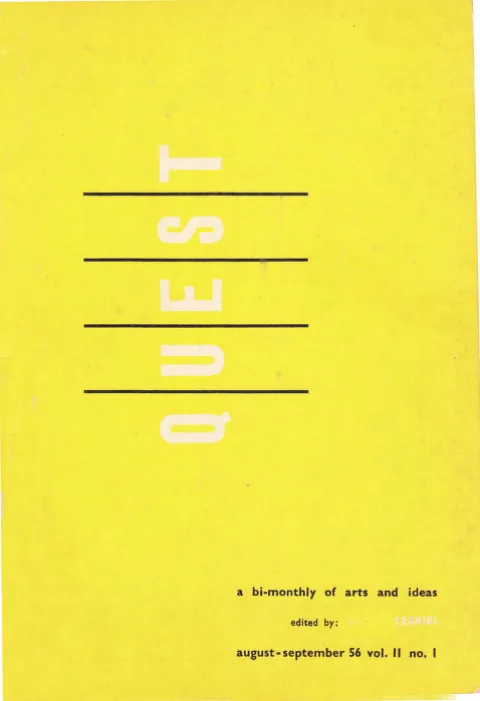
Quest
a bi-monthly of arts and ideas
By Nissim Ezekiel, Sunil Janah, Jean Stein, A. Subbiah, K. K. Sinha, Rita Rudra, Sadhan Kumar Ghosh, A. K. Bhagwat, G. P. Pradhan, R. Parthasarathy, Nirendranath Chakravarti, Monika Varma, Arun Kolatkar, Dom Moraes, Ashis Burman, Rene Tavernier, James T. Farrell, Marie Seton
QUEST is published once every two months in August, October, December, February, April and June, at Army & Navy Building, 148, Mahatma Gandhi Road, Bombay 1. · Bombay · 1956
78 pages
Quest
Summary
Quest Vol. II No. 1 (August-September 1956) opens with an unsigned editorial attacking India’s muted official reaction to Khrushchev’s denunciation of Stalin, and closes with correspondence defending and attacking Western reputations abroad — bracketing an issue whose centre of gravity is Cold War alignment, the health of Nehru-era Congress leadership, and the unfinished business of India’s own liberal and reformist traditions. K. K. Sinha’s ‘State of the Nation’ and A. Subbiah’s ‘A Question of Language’ both diagnose a Congress leadership drifting without Gandhi’s foresight, sliding toward the Soviet bloc over Kashmir, and improvising a ‘socialistic pattern’ without a coherent economic philosophy; Rita Rudra’s ‘The Nagas in Revolt’ turns the same self-critical lens on majority-Indian prejudice toward the Naga hills. G. P. Pradhan and A. K. Bhagwat’s long essay on Lokamanya Tilak, and R. P. Masani’s review of a Bhoodan bibliography centred on Vinoba Bhave and Jayaprakash Narayan, extend this into intellectual history. Alongside the politics, Quest lives up to its ‘arts and ideas’ masthead with Sunil Janah’s photographic testament on India’s tribal and rural poor, an abridged Paris Review-style interview with William Faulkner, a critical study of C. Day Lewis, five poems (including work by the 18-year-old Dom Moraes and by Arun Kolatkar), three theatre/cinema/arts columns, six book reviews, and two correspondence letters (James T. Farrell on anti-Americanism; Marie Seton defending her film criticism). Two substantial items carry no contents-page entry at all: an unsigned notice on international efforts to free Communist-bloc political prisoners, and ‘The Poznan Riots: Two Statements,’ reproducing an international writers’ solidarity declaration (Camus, Jaspers, Koestler, Silone, Spender among the signatories) alongside a parallel statement the sponsoring Indian Committee for Cultural Freedom was then circulating for Indian signatures. The issue’s single uncredited-on-the-contents-page art insert is a photographic portrait, ‘Chhara youth,’ by Chaturbhai P. Patel — a different hand from Janah’s — captioned only with an Agfa film credit.
Essays
A Photographer’s Testament
By Sunil Janah
Sunil Janah’s photo-essay and accompanying prose ‘testament’ argues that direct visual evidence — his ‘forty thousand photographs’ — reveals an Indian rural and tribal population that is unselfconscious about the body, hospitable, and quietly joyful despite poverty, in sharp contrast to the puritanical ‘Indian Mentality’ that urban reformers, officials and legislators project onto them. He traces the veiling of women and moral squeamishness to upper-caste and colonial-era overlays rather than to any native trait, and criticises welfare officials who ban tribal dances and clothe villagers into drab ‘respectability.’ The essay is illustrated by his own photographs of Bhil, Muria, Santhal and Saora subjects (rendered on the preceding, unnumbered pages) and closes on the idea that photography also records ‘the passing away of ways of life in a country so ready for changes.’
- Frames his ‘forty thousand photographs’ as visual evidence more trustworthy than words.
- Argues Indian prudishness about the body is a myth invented by ‘scribes and politicians,’ not a trait of ordinary people.
- Locates the veiling of women historically among upper castes of the Gangetic/Indus valleys under Islamic influence, not as a pan-Indian norm.
- Recounts easy hospitality, communal drinking and unselfconscious nudity among Bhils, Murias, Santhals, Kashmiri peasants and Assamese weavers.
- Criticises officials and welfare workers who ban tribal dances and impose ‘respectable’ dress, making communities ‘as dreary’ as the reformers themselves.
- Notes that his photographs also document a fast-vanishing way of life.
Faulkner Interviewed
By Jean Stein
An abridged transcript, syndicated via the Congress for Cultural Freedom, of a Paris-Review-style interview with William Faulkner conducted in New York in early 1956. Faulkner argues the artist’s individuality is unimportant next to the work itself (‘there is nothing new to be said’), that a first-rate writer needs no economic security (‘all he needs is a pencil, and some paper’), and that writing for the movies is an unavoidable compromise that cannot damage a genuinely good writer. He discusses his reading (the Old Testament, Dickens, Conrad, Cervantes, Melville, Shakespeare), names Dilsey from The Sound and the Fury among his favourite characters, and explains how, beginning with Sartoris, he discovered his ‘own little postage stamp of native soil’ and built the Yoknapatawpha saga by ‘sublimating the actual into apocryphal.’ He closes by describing the artist’s aim as arresting motion — life — so that it moves again for a stranger long after the artist’s death.
- The artist is ‘of no importance’; only what he creates matters, since all writers work with the same material.
- A first-rate writer needs nothing but ‘a pencil, and some paper’ — economic patronage corrupts, not liberates, the good writer.
- Moving-picture work is always compromise, but cannot injure a genuinely first-rate writer’s own fiction.
- The Sound and the Fury caused him ‘the most grief and anguish’ of anything he wrote, rewritten five times.
- Beginning with Sartoris he found his fictional ‘gold mine,’ moving characters through a self-created, non-linear sense of time (‘there is no such thing as was — only is’).
- The artist’s task is to ‘arrest motion’ so that, like a name scrawled in graffiti, the work outlives the man.
A Question of Language
By A. Subbiah
A. Subbiah argues against the constitutional plan to replace English with Hindi as India’s official language, contending that India’s multilingual political unity is a fragile British-era legacy that must now be sustained through democratic accommodation of linguistic nationality rather than suppressed. He favours reorganising states on linguistic lines, adopting the mother tongue as the medium of instruction with English as a compulsory second language, and retaining English — not Hindi — as the Union’s official language, on the model of linguistic parity in Switzerland, Belgium, Canada and (after initial resistance) Pakistan. He warns that installing Hindi would concentrate administrative power in Hindi-speaking hands and stoke a already-voiced fear of ‘Hindi Imperialism.’
- Quotes the anthropologist Kroeber: language is ‘the most important’ single factor producing the ‘consciousness of kind’ behind nationhood.
- Argues India’s political union is a British-era convenience that democratic accommodation, not compulsion, must now sustain.
- Cites Switzerland’s German-speaking 72% majority conceding linguistic parity to its 6% Italian-speaking minority as the model to emulate.
- Notes Ceylon’s retreat from linguistic parity is already producing minority secessionist demands, while Pakistan granted Bengali parity after electoral defeat.
- Warns that Hindi as sole official language would concentrate administrative jobs and power in Hindi-speaking hands.
- Reports a Madras conference including C. Rajagopalachari unanimously resolved that English, not Hindi, should remain the Union’s official language.
State of the Nation
By K. K. Sinha
K. K. Sinha argues that Nehru-era Congress leadership, unlike Gandhi’s, lacks the foresight to guide rather than merely react to events: India is sliding from declared non-alignment toward the Soviet bloc over the Kashmir dispute with Pakistan, and its economy is ‘steadily being transformed into a socialistic pattern’ by improvisation rather than any considered philosophy, abandoning the earlier ideal of a ‘Co-operative Commonwealth.’ He warns that continued drift could produce either a ‘Hindu revivalist’ dictatorship or Communist exploitation of the vacuum, and lays much of the blame on an intelligentsia and press too eager to flatter Nehru rather than think independently. He closes by quoting Minister T. T. Krishnamachari’s own admission to the Lok Sabha that India has ‘not yet evolved an economic philosophy of our own.’
- Contrasts Gandhi’s foresight-led Congress with Nehru’s reactive ‘mere drifting,’ driven by ‘world forces’ and ‘subconscious urges.’
- Argues the invitation to Soviet leaders and their backing of India on Kashmir marks a real, if unacknowledged, shift away from neutrality.
- Diagnoses the turn to socialism and public-sector expansion as improvised policy-making (‘We will see as the problem arises’), not a reasoned choice between the ‘Co-operative Commonwealth’ and Western-style socialism.
- Fears a future ‘strong-willed Hindu revivalist’ dictator, or Communist provincial secession, if ‘nothing new emerges’ in Indian political thought.
- Assigns the intelligentsia and the daily press joint responsibility with Nehru for the absence of independent, critical public debate.
- Closes with Krishnamachari’s own concession that India’s economic thinking is ‘ambivalent’ and lacks synthesis.
The Nagas in Revolt
By Rita Rudra
Rita Rudra, who visited the Naga Hills in 1953, argues that Naga hostility toward India stems from real Indian prejudice and neglect — not merely, as commonly assumed, foreign instigation. She contrasts Naga community-oriented, gender-freer tribal life (the ‘morung’ dormitory system, free choice in marriage) with caste-conscious Hindu India, and Naga hospitality with the contempt Nagas experience as ‘outcastes’ on the Assam plains. She notes that Naga admiration for India curdled once Naga territory was ‘grafted on to the Indian Union’ without consent after Independence, and that the worst wartime reputation among occupying troops was left not by the Japanese but by ‘our own men.’ She calls for self-critical re-education on the Indian side rather than scapegoating ‘foreign agents,’ as the surest path to winning Naga loyalty.
- Opens by quoting the Nagas’ own verdict: ‘Indians treat us like dogs.’
- Argues political union is not psychological integration; many Nagas were ‘barely aware of India even as a geographical entity.’
- Describes wartime Naga loyalty to the British curdling into estrangement after unconsulted incorporation into the Indian Union.
- Details the Naga ‘morung’ dormitory system and freedom in marriage choice, which visiting Indians often misread as impropriety.
- Attributes the worst wartime misconduct toward Naga women to ‘our own men,’ not the occupying Japanese army.
- Concludes Indian caste-based contempt and neglect, not external agents, best explain the revolt, and urges winning Naga ‘goodwill’ through genuine acceptance.
C. Day Lewis
By Sadhan Kumar Ghosh
Sadhan Kumar Ghosh traces C. Day Lewis’s poetic development from the near-Communist ‘New Signatures’ group of the 1930s (alongside Auden, Spender and MacNeice), through wartime reflective verse, to a mature, Yeats- and Hardy-influenced pastoral mode centred on ‘the abiding things of life.’ He argues that even Day Lewis’s most political book, The Magnetic Mountain, represents a personal, quasi-mystical utopia rather than a genuine surrender to Communism, and that Day Lewis’s lasting achievement lies in his eventual return to English tradition, childhood and nature rather than in the political ‘programmes’ of his Thirties poetry.
- Places Day Lewis among the Auden-generation ‘New Signatures’ poets, shaped by 1930s economic collapse and the fear of fascism.
- Cites W. B. Yeats’s 1936 observation that these poets called themselves Communists though their actual verse showed ‘no trace of the recognised Communist Philosophy.’
- Traces an influence trail from Whitman and Auden to, from Overtures to Death (1938) onward, Yeats, Hardy and Emily Brontë.
- Reads The Magnetic Mountain as closer to a personal ‘Shangri-la’ than a Communist manifesto, despite surface Marxist imagery.
- Notes the Spanish Civil War poem Nabara had the same emotional impact on the New Signatures poets as the First World War had on an earlier generation.
- Concludes Day Lewis will be remembered as ‘the poet of youth’ and of ‘returning illusions,’ not for political message.
Lokamanya Tilak
By A. K. Bhagwat & G. P. Pradhan
Writing on the centenary of Tilak’s birth, G. P. Pradhan and A. K. Bhagwat situate him within the Indian Renaissance begun by Ram Mohan Roy and the subsequent nationalist-revivalist current of Ramakrishna and Vivekananda. They examine Tilak’s metaphysics (siding with a mystic ‘Metaphysical’ stage against Comte’s Positivism, drawing on the Gita’s idea of ‘Lokasangraha’), his defence of caste and the four Varnas as social cement comparable to European trade guilds, and his often-fraught rivalry with the reformer Agarkar, who condemned caste inequality on liberal, rights-based grounds where Tilak defended it pragmatically. The essay closes on Tilak’s late, unresolved ambivalence about untouchability: a ringing declaration that he would not recognise a God who tolerated it, followed by his declining, at the last moment, to sign a reform memorandum he had all but agreed to.
- Quotes Aurobindo’s contemporary judgement that Tilak’s ‘principles of work’ had already become ‘the commonplaces and truisms of our political thoughts.’
- Contrasts Ram Mohan Roy’s universalist Vedanta-based Renaissance with the later nationalist, revivalist Vedanta of Vivekananda that shaped Tilak, Lajpat Rai and Bipin Chandra Pal.
- Explains Tilak’s ethics: rejecting Comte’s Positivism, defending disinterested ‘Lokasangraha’ (social good) drawn from the Bhagavadgita.
- Recounts Tilak’s justification of caste as pragmatic social integration, against Agarkar’s liberal, individual-rights-based condemnation of caste inequality.
- Notes Tilak’s use of religious revivalism (Ganpati and Shivaji festivals) for mass political mobilisation, judged ‘a good servant but a bad master’ once the masses were politically awakened.
- Closes on Tilak declaring ‘If a God were to tolerate untouchability, I would not recognize him as a God at all,’ yet declining at the last moment to sign Vithal Ramji Shinde’s anti-untouchability memorandum.
Lover’s Night Thought
By R. Parthasarathy
A short lyric comparing a suffering lover, prostrate on the bed, to Christ on the cross, but distinguishing self-inflicted romantic anguish (‘he suffered for others, but you for yourself’) from redemptive suffering, and closing on the thought that divine mercy exceeds love’s cruelty.
- Frames romantic suffering as self-centred against the model of Christ’s suffering for others.
- Turns on a single theological contrast between the Lord’s mercy and Love’s lack of it.
Waves
By Nirendranath Chakravarti
A Bengali lyric, translated by Srinarayan Ray, picturing a barren, miserly place that neither light, waves nor love ever reach, its fields choked with weeds where corn should grow, closing on the refrain that ‘this is no place for me.’
- Builds a repeated refrain of absence — no light, no waves, no gold — to figure spiritual aridity.
- Uses a choked cornfield as an image of thwarted abundance.
Step of Unwisdom
By Monika Varma
A lyric meditation on turning forty, imagined as standing on ‘the fortieth step of unwisdom’ while ‘surrogate years’ crowd around the speaker amid pastoral imagery of birds, trees and light.
- Turning forty is figured as an ‘isle of unwisdom.’
- Natural imagery (birdcall, dogs, horses, drifting leaves) marks the passage of years.
Dual
By Arun Kolatkar
A short poem picturing a man and woman as caged animals watched by ‘amused witnesses’ (a leopard, camel, deer), their intimacy stripped and bruised under artificial light, ending on the possibility that they might harden into cactus-like defensiveness against the world.
- Uses menagerie imagery (leopard, camel, deer) for onlookers to a couple’s exposed intimacy.
- Closes on a cactus metaphor for emotional self-protection.
Song
By Dom Moraes
A fable-like lyric in which a wizard’s flute stills dancers, archers and animals in a valley beneath a ‘gross sun,’ before the scene turns wintry and a fall of snow brings peace and silences the flute.
- Enchantment imagery: a flute’s music holding a valley’s creatures motionless.
- The poem moves from a squatting summer sun to a hushed winter close.
Tagore in the Bengali Cinema
By Ashis Burman
Ashis Burman surveys Bengali and Hindi film adaptations of Rabindranath Tagore’s work since 1932 (Natir Puja, Chira Kumar Sabha, Noukadubi, Chokher Bali, Zalzala and a recent Devaki Bose remake of Chira Kumar Sabha), arguing that nearly all fail because Indian directors merely transplant stage conventions onto film — long dialogue, song, static staging — rather than developing a distinct visual ‘filmform’ able to carry Tagore’s subtlety.
- Praises the amateur-cast 1932 Natir Puja for purity of intent despite technical amateurishness.
- Calls Paul Zils’s Hindi Zalzala ‘the most vulgarized and atrocious’ Tagore film adaptation.
- Diagnoses Indian cinema’s core problem as an absence of ‘filmform’ — reliance on dialogue and song over visual storytelling.
- Finds even the technically improved recent Devaki Bose remake of Chira Kumar Sabha still fails to achieve genuine cinematic quality.
Letter from Paris
By Rene Tavernier
Rene Tavernier’s Paris dispatch finds the current boulevard theatre season (Anouilh, Ayme, Roussin) competent but uninspired, praises the Corneille tercentenary revivals and an open-air Cromwell, and singles out Beckett’s Waiting for Godot for its ‘unquestionable verbal power.’ He contrasts the Soviet ballet’s technical brilliance but ‘reactionary’ choreography with Jean Babilee’s avant-garde troupe, and highlights three original French documentaries of the year — The World of Silence, The Picasso Mystery and especially Resnais’s Night and Fog on the concentration camps, unjustly barred from Cannes.
- Judges the boulevard season ‘cleverly contrived, but no better… than those of the late Henri Bernstein.’
- Reads Corneille, via the tercentenary revivals, as an unexpected forerunner of existentialism.
- Calls Soviet ballet’s choreography ‘the most reactionary in the world’ despite its dancers’ technical virtuosity.
- Names Resnais’s Night and Fog the most striking of the year’s documentaries, barred from Cannes for ‘diplomatic reasons.‘
Strindberg’s The Father
By Nissim Ezekiel
Nissim Ezekiel reviews Theatre Unit’s Bombay production of Strindberg’s The Father, directed by Ebrahim Alkazi: the direction is dramatically strong but the abstract-modernist sets fail; Nergis Cowasji’s Laura is singled out as her career-best performance for physical stillness and command, and Bomi Kapadia’s Captain for his rare ability to weep onstage without losing audience sympathy. Ezekiel situates the play’s paternity-doubt plot within Strindberg’s larger, carefully constructed study of a marital power struggle the wife wins, warning against literalist misreadings of the play as mere melodrama.
- Alkazi’s sets are ‘amateurish cut-outs’ the audience learns to ignore; his sparing use of music is praised.
- The play’s real subject, per Ezekiel, is a marital power struggle the wife wins by knowing ‘the precise weaknesses of her enemy.’
- Nergis Cowasji’s Laura is called better than her earlier work in Arms and the Man or Oedipus.
- Bomi Kapadia is praised for making the Captain’s onstage weeping and eventual breakdown believable without exaggeration.
- Warns against reducing Strindberg’s play, as one local critic did, to mere melodrama about a lamp-throwing husband.
The Torment of Secrecy by E. Shils
By K. K. S.
K.K.S. praises sociologist Edward Shils’s study of McCarthyism for avoiding both simple condemnation and simple defence, tracing hyper-patriotism, xenophobia, isolationism, fundamentalism and populism in American political culture, and for proposing a ‘pluralistic’ model of overlapping, balanced group loyalties (family, profession, party, church, nation) as an antidote to political extremism of right and left alike.
- Notes Shils spent a year in India studying Indian intellectual attitudes, lending him comparative standing.
- Identifies America’s constituency- rather than party-oriented politics, plus a populist press culture, as drivers of Congressional ‘investigation’ excess.
- Presents Shils’s definition of pluralism as balanced, simultaneous loyalty to many groups, with none allowed to dominate.
The Letters of D. H. Lawrence
By R. Choksi
R. Choksi reviews the Aldous Huxley-edited Letters of D. H. Lawrence (1910-1930), finding Lawrence a compelling, difficult, self-consumed personality whose letters express a temperament ‘in revolt’ against fixed society, money, homes and even love — more valuable as testimony to ‘an unusual being’ than as polished letter-writing, since they lack the ‘gift of communication’ the reviewer expects of the genre’s best examples.
- Quotes Lawrence’s credo that blood and flesh are wiser than intellect.
- Finds sympathy fluctuating: moved by the WWI-era letters, but finding Lawrence ‘futile and peevish’ in his bitter, self-concerned moods.
- Judges the collection valuable mainly for illuminating Lawrence’s novels and poems, not as letter-writing in its own right.
English Thought 1860-1900 by L. E. Elliot-Binns
By G. C. Chatterji
G. C. Chatterji gives a mixed review of L. E. Elliot-Binns’s study of Victorian theology, welcoming its thesis that theology is shaped by, and shapes, the wider currents of science, historical criticism and politics, but criticising its opening treatment of theological ‘development’ as scrappy, and regretting that the book stops at 1900, before Christianity’s severest twentieth-century trials. He closes by contrasting Christian theodicy — God incarnate sharing human suffering — with the Hindu idea that suffering and evil are mere ‘Lila,’ finding Elliot-Binns’s optimism about religious revival unconvincing.
- Approves the book’s central claim that theology and the general current of thought mutually influence each other.
- Faults the treatment of theological ‘development’ as dodging the real question of whether religious truth is fixed or evolving.
- Lists Froude, Matthew Arnold, Leslie Stephen, John Morley and Henry Sidgwick as Victorian doubters who nonetheless kept outward conformity.
- Regrets the 1900 cutoff, given two World Wars and the Cold War as arguably graver tests of Christian faith.
- Contrasts Christian and Hindu (‘Lila’) responses to the problem of suffering and evil.
Phoenix Fled by Attia Hosain
By Foy Nissen
Foy Nissen reviews Attia Hosain’s short-story collection Phoenix Fled, set among North Indian life, framing the challenge for Indian novelists writing in English as one of ‘translation from one discrete tradition into the idiom of another.’ Using a comparative-quotation method (a stilted passage from Kamala Markandaya’s Nectar in a Sieve against a vivid, vernacular-translated village woman’s speech recorded by Verrier Elwin, and an E. M. Forster comic dialogue), he argues good ‘Indian English’ comes from close attention to idiom rather than literary cliche, and praises Hosain’s stories — especially ‘The First Party,’ ‘After the Storm’ and the long ‘Street of the Moon’ — for psychological authenticity and disciplined symbolic control.
- Frames Indian fiction in English as a problem of ‘translation’ between discrete cultural and linguistic traditions.
- Contrasts a cliche-ridden passage from Markandaya’s Nectar in a Sieve with an idiomatically vivid village woman’s speech (via Verrier Elwin) to diagnose good and bad ‘Indian English.’
- Singles out ‘After the Storm,’ a Partition story about a character named Bibi, for its controlled use of symbol.
- Concludes Hosain’s writing sits ‘on the English side of literary tradition as instruments to the validity of her Indian subject-matter.‘
Vinoba and Bhoodan by J. S. Sharma
By R. P. Masani
R. P. Masani warmly reviews Jagdish Saran Sharma’s descriptive bibliography of the Bhoodan land-gift movement, praising its organisation into biographical studies and 562 annotated agrarian, cultural, economic, political and social entries. He frames Vinoba Bhave as a fourth twentieth-century ‘revolutionary’ alongside Lenin, Sun Yat-sen and Gandhi, distinguished by spiritualising rather than merely politicising his cause, notes Jayaprakash Narayan’s prominence in the literature as Vinoba’s chief practical lieutenant, and records the movement’s stated goal of fifty million donated acres by 1957.
- Describes Bhoodan/Sampattidan as extending Gandhi’s trusteeship ideal to the voluntary dedication of one’s talents and spiritual resources, not only land.
- Notes seven eminent Britons publicly appealed for funds to support the movement.
- Reports the bibliography finds few critics doubt Bhoodan’s philosophy or feasibility, though fragmentation of land is raised as an objection.
- Frames Jayaprakash Narayan as Vinoba’s leading practical collaborator in the movement’s literature.
Poetry London edited by Tambimuttu
By N. E.
N.E. welcomes the launch of Poetry London-New York, Tambimuttu’s revived transatlantic poetry magazine, noting its first issue’s roster (Auden, Barker, Campbell, Cummings, Empson, Graves, Spender) and three translated Indian poems (Amrita Pritam from Punjabi; Buddhadeva Bose and Jibanananda Das from Bengali), and endorsing the editor’s stated policy of maintaining a ‘balanced view’ against literary factionalism.
- Cites Tambimuttu’s own account of the old Poetry London surviving rival factions: ‘Objective Reporting,’ ‘The New Apocalypse,’ ‘The New Romanticism.’
- Notes three Indian-language poems (Punjabi and Bengali, in translation) placed at the end of the poetry section.
- Predicts the magazine ‘is going to play an important role in the literary history of the next decade or two.‘
Anti-Americanism
By James T. Farrell
James T. Farrell, writing from Sydney, argues anti-Americanism is real and predates Soviet propaganda, rooted partly in an old charge (traced to the American Revolution) that Americans are cultural ‘barbarians,’ partly in a double standard whereby American civil-liberties failures get worldwide publicity while American progress does not, and partly in an intellectual elite’s inherited aristocratic ‘disdain of material things and of work’ relabelled as anti-materialism. He warns that deepening foreign hostility, on top of declining domestic enthusiasm for foreign aid, could revive American isolationism.
- Distinguishes legitimate criticism of U.S. foreign policy, which ‘many Americans would not object’ to, from blanket anti-Americanism.
- Traces the charge that Americans are cultural barbarians back to English reaction against the newly independent colonies.
- Notes declining influence of Senator Joseph McCarthy, yet senses ‘foreign friends’ are disappointed by this decline.
- Warns that Congress has already begun cutting the foreign aid bill as American public opinion hardens.
- Closes wondering what to tell ‘the American man in the street’ about foreign resentment on his return home.
The Film Seminar
By Marie Seton
Marie Seton rebuts S. P. Sethna’s charge that her interviews at a Bombay Film Seminar were ‘shifty,’ defending her comparative remarks on Raj Kapoor’s Shree 420 versus Awara, her use of British Film Institute-style social/political film analysis, and her prediction — made before the film won at Cannes — that Satyajit Ray’s Pather Panchali would receive international recognition, contrasted with the Hollywood-influenced Jhanak Jhanak Payal Baaje, passed over at Venice.
- Cites British Film Institute practice of contextualising a film’s social and political background as precedent for her own critical method.
- Defends her use of Pabst’s Kameradschaft and the Japanese Children of Hiroshima as pedagogical ‘message’ films, while denying she claimed any ‘message’ for Norman McLaren’s abstract Fiddle-di-dee.
- Argues great films are typically national, not ‘cosmopolitan,’ in character — instancing Pather Panchali’s Cannes award for a film ‘truly reflective of Bengali life.’
- States she had ‘publicly predicted and privately insisted’ Pather Panchali would win an award even before seeing it screened in Bombay.
Essay 24
[Not in printed TOC — unsigned lead editorial.] Condemns the muted Indian official reaction to Khrushchev’s revelations about Stalin’s crimes, arguing Indians who are ‘roused to fury’ by isolated UK colour-bar incidents have taken ‘thirty years of mass murder’ in the USSR ‘comfortably in our stride.’ It singles out Vice-President Radhakrishnan’s post-Soviet-tour praise for ‘freedom of discussion within the party’ and his attack on Christianity as morally incoherent given his silence on Communist ‘liquidation’ as state policy, arguing India’s proclaimed neutralism is quietly eroding its own ‘feeling for democracy as a way of life.’
- Contrasts Indian outrage at an isolated UK colour-bar case with acceptance of decades of Soviet mass murder.
- Names Nehru, Radhakrishnan and Krishna Menon as having ‘provided the cue’ for excusing Soviet ‘de-Stalinisation’ rhetoric.
- Calls token near-unanimous Communist ‘elections’ a ‘tribute vice pays to virtue.’
- Attacks Radhakrishnan’s criticism of Christianity as inconsistent with his silence on Communist state violence.
- Notes Radhakrishnan approvingly quoted Tilak on the moral cost of political violence, calling this hard to square with his tolerance of Soviet dictatorship.
Essay 25
[Not in printed TOC — unsigned news notice.] Reports on an international Labour Committee (headed by S. M. Levitas in New York) campaigning for the release of trade unionists and democratic socialists imprisoned in Communist states, describing appeals sent to Bulganin and Khrushchev and to Soviet Communist Party authorities, a list cross-checked against one compiled by Hugh Gaitskell with European socialist parties, and Willy Brandt’s claim that East Germany alone held over 10,000 untried political prisoners. Quest offers to help any Indian solidarity project along similar lines.
- Names the ‘Labour Committee to Release Trade Unionists and Democratic Socialists,’ active in over twenty countries.
- Notes appeals mailed to sixty top Soviet officials and lists of imprisoned or murdered leaders sent to Bulganin and Khrushchev.
- Cites partial Soviet amnesties as evidence the Communist leadership feels ‘embarrassed’ by the campaign’s revelations.
Essay 26
[Not in printed TOC — unlisted photographic plate.] A single, uncaptioned-beyond-its-credit portrait, ‘Chhara youth,’ by Chaturbhai P. Patel: a smiling young man in an elaborately wound, decorated turban and heavy beaded necklaces, captioned only with the photographer’s name and ‘(Photograph on Agfa film).’ It is the only plate in the issue not by Sunil Janah, and carries no accompanying text — the art insert this issue carries with no contents-page entry, evidently tied to Agfa’s photographic-film promotion (an Agfa advertisement appears later in the same issue).
- The issue’s sole photographic plate not credited to Sunil Janah.
- Functions partly as a photographic showcase for Agfa film stock rather than as editorial content proper.
- Carries no printed folio at all — part of the unnumbered plate insert between printed pages 8 and 9.
Essay 27
[Not in printed TOC — unsigned feature reproducing two statements.] Reproduces an international writers’ solidarity declaration on the June 1956 Poznan workers’ uprising in Poland, signed by Albert Camus, Karl Jaspers, Arthur Koestler, Ignazio Silone, Stephen Spender and others, demanding public trials and an international inquiry, alongside a parallel statement the Indian Committee for Cultural Freedom was then circulating among Indian writers, thinkers and public men for eventual release to the press, demanding an end to reprisals against the Poznan workers.
- International signatories include Camus, Jaspers, Koestler, Silone, Spender, Manes Sperber and Alexandre Weissberg-Cybulski.
- Demands public trials, an end to further executions, and an international inquiry into conditions of Polish workers.
- The parallel Indian statement, circulated by the Indian Committee for Cultural Freedom, was still gathering signatures at time of publication.
Essay 28
[Not in printed TOC — standing back-matter feature.] The issue’s ‘Contributors to this issue’ page, giving short biographical notes on this number’s writers, poets and photographer — their home cities, occupations, and prior appearances in Quest — the primary source drawn on for this issue’s contributor biographies.
- Gives home city and occupation for most contributors (e.g. A. Subbiah, Vice President of the Academy of Tamil Culture, Madras; K. K. Sinha, editor of the Journal of Power and River Valley Development).
- Records prior Quest appearances for several contributors (Sadhan Kumar Ghosh, Dom Moraes, Arun Kolatkar).
- Gives no note for several bylined contributors elsewhere in the issue (e.g. the editor, the advisory editors, and most of the book reviewers).
Generated by the v1.5 extraction pipeline. Awaiting editorial review.
Metadata and summary are AI-extracted from the source PDF and reviewed for editorial accuracy. The original work is available via the Read PDF tab above (where present); paragraph-level citation inside the PDF is deferred to a future engagement.
People in this work
- Nissim Ezekielauthor
- Sunil Janahauthor
- Jean Steinauthor
- A. Subbiahauthor
- K. K. Sinhaauthor
- Rita Rudraauthor
- Sadhan Kumar Ghoshauthor
- A. K. Bhagwatauthor
- G. P. Pradhanauthor
- R. Parthasarathyauthor
- Nirendranath Chakravartiauthor
- Monika Varmaauthor
- Arun Kolatkarauthor
- Dom Moraesauthor
- Ashis Burmanauthor
- Rene Tavernierauthor
- James T. Farrellauthor
- Marie Setonauthor
- Nirad C. Chaudhuri
- Sudhin Datta
- D. G. Nadkarni
- Laeeq Futehally
- Indu P. Saraiya
- Srinarayan Ray
- R. Choksi
- G. C. Chatterji
- Foy Nissen
- R. P. Masani
- Chaturbhai P. Patel
- Jawaharlal Nehru
- C. Rajagopalachari
- Mahatma Gandhi
- V. K. Krishna Menon
- T. T. Krishnamachari
- Karl Marx
- Bal Gangadhar Tilak
- Herbert Spencer
- John Stuart Mill
- Rabindranath Tagore
- Jayaprakash Narayan
- Vinoba Bhave
- Sarvepalli Radhakrishnan