
periodical issue
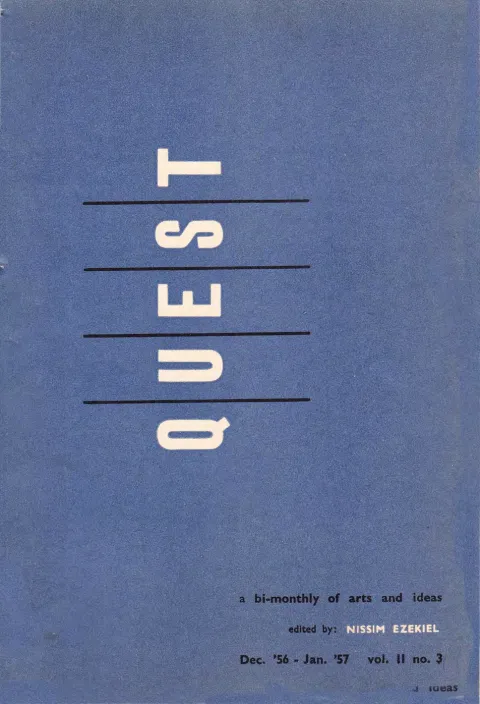
Quest
a bi-monthly of arts and ideas
By A Ranganathan, Jayaprakash Narayan, Salvador de Madariaga, K. K. Sinha, S. Natarajan, S. R. Tikekar, Devendra Prasad Singh, T. Andhyarujina, A. Wilber Stevens, Asha Bhende, Rene Tavernier, Aamir Ali, Uma Anand, James T. Farrell, D. N. Deshpande, A. L. Khatib, Denis de Rougemont, Stephen Spender, Nicolas Nabokov
QUEST is sponsored by the Indian Committee for Cultural Freedom. Edited, printed and published by Nissim Ezekiel for the Indian Committee for Cultural Freedom, Army and Navy Building, 148, Mahatma Gandhi Road, Bombay 1, at the Kanada Press, Fort Chambers, 109, Parsi Bazar Street, Fort, Bombay 1. · Bombay · 1956
82 pages
QUEST
Summary
Quest Vol. II No. 3 (December 1956-January 1957), edited by Nissim Ezekiel for the Indian Committee for Cultural Freedom, appeared in the middle of the Suez and Hungarian crises, and a large share of its front matter and articles are shaped by that moment: an unlisted dossier on the newly formed Indian Committee for Solidarity with Hungary (Jayaprakash Narayan’s press statement, the Committee’s own announcement, and messages from the Congress for Cultural Freedom and from Hungarian writers themselves) sits alongside S. Natarajan’s report on the Asian Socialist Conference and K. K. Sinha’s historical reassessment of Indian Leftism. Other articles range across Devendra Prasad Singh’s survey of Chinese pressure on India’s neighbours, S. R. Tikekar’s indictment of All India Radio, T. Andhyarujina’s philosophical defence of a narrowly-bounded Satyagraha under democracy, an unsigned Geneva-sourced argument for cultural exchange with the USSR, and A. Ranganathan’s warning against the Second Plan’s collectivist drift. A substantial back section carries theatre and travel writing (Rene Tavernier on the Baalbek Festival, Aamir Ali on Cairo, Uma Anand’s critical report on Bombay’s International Theatre Conference, Asha Bhende on open-air theatres), a Calcutta gossip-and-culture column, four correspondence letters (including James T. Farrell’s reply on anti-Americanism), and four book reviews (Amlan Datta on Bertram Wolfe’s Six Keys to the Soviet System, Kobita Sarkar on Charles Seltman’s Women in Antiquity, Laeeq Futehally on Osamu Dazai’s The Setting Sun, and P. C. Chatterji on W. Elton’s Aesthetics and Language). Two unlisted visual plates — stylised paintings by the young Bombay artist Rasik Raval, and photographs of the Baalbek Festival’s Julius Caesar and The Infernal Machine — are tipped into the pagination without a contents entry.
Essays
Indian Leftism
By K. K. SINHA
K. K. Sinha traces Indian ‘Leftism’ from its early-twentieth-century roots in Bengali terrorism and constitutional agitation, through Gandhi’s mass-participation methods, the Congress Socialist Party, wartime splits between Radicals, Communists and the Forward Bloc, to the post-1947 fragmentation of Socialists, Communists, PSP and Radicals. Sinha argues that by 1956 the Congress government itself has absorbed Leftism’s programme — nationalisation of insurance, state trading, the Second Five Year Plan’s socialistic pattern — so that the historic distinction between ‘Leftism’ and the ruling party has collapsed to ‘minor details’. He concludes that inherited habits of anti-government agitation now survive only as a reflexive, potentially anti-democratic cult of disobedience, divorced from any real programmatic content, and calls on Leftists to shed this obsolete posture before it curdles into a threat to democracy itself.
- Reviews the historical lineage of Indian Leftism: Bengal terrorism and Swadeshi agitation, Gandhian mass politics, the Congress Socialist Party, and wartime splits among Radicals, Communists and the Forward Bloc.
- Argues that post-independence Congress policy (Second Five Year Plan, nationalisation of insurance, state trading) has itself become more ‘socialistic’ than most self-described Leftists anticipated, eroding the Left/Right distinction.
- Identifies Leftism’s residual creed as anti-imperialism, socialism and pro-Soviet sympathy, and notes growing unease among some Leftists about Soviet as well as Western imperialism.
- Warns that Leftism’s real danger going forward is not ideological but methodological: a habitual culture of hartals, agitation and ‘revolution’-talk that could be exploited by anti-democratic forces.
- Concludes that historical Indian Leftism has lost its raison d’etre and must consciously discard its old reflexes to make way for a ‘new and more relevant contest of ideas’.
The Second Asian Socialist Conference
By S. NATARAJAN
S. Natarajan reports impressionistically on the 2nd Congress of the Asian Socialist Conference, held in Bombay in the first week of November 1956, against the backdrop of the Suez and Hungarian crises. He finds the Conference organisationally weak and prone to ‘seeing the wood for the trees’, passing resolutions on Poland-Hungary, Egypt and West Asia without confronting the deeper crisis of U.N. authority. He singles out Moshe Sharett’s surprise denunciation of French and British action in Egypt, and contrasts the varying discipline of national delegations, praising Burma’s U Ba Swe. The most substantial passage is Natarajan’s account of Jayaprakash Narayan’s seminar address calling for a new orientation for Socialist parties, and JP’s subsequent leadership of the Bombay-based Indian Committee for Solidarity with Hungary, which Natarajan credits with pushing Nehru toward a firmer public stand on Hungary.
- The 2nd Asian Socialist Conference met in Bombay in November 1956 during the simultaneous Suez and Hungarian crises.
- Natarajan criticises the Conference’s organisation and its tendency to pass safe resolutions rather than confront the erosion of U.N. authority by the Great Powers.
- Highlights Israeli delegate Moshe Sharett’s unexpected criticism of French and British intervention in Egypt.
- Profiles Jayaprakash Narayan’s seminar address urging a ‘new orientation’ for Socialist parties beyond conventional profit-motive critique.
- Credits JP Narayan’s Bombay-based Committee for Solidarity with Hungary with shifting Nehru’s public position toward unambiguous condemnation of the Soviet action.
Cultural Relations with Russia
An unsigned piece (credited only to ‘EDITOR’, reproducing a statement from the European Cultural Centre, Geneva) argues that despite Molotov’s blanket 1955 Geneva rejection of Western cultural-exchange proposals, the free world should keep pressing for cultural contact with the USSR, both because Soviet intellectuals genuinely desire it and because a free society loses nothing by offering completely open exchange. A long essayistic middle section (unattributed, evidently translated from French, given references to ‘Racine’ and continental idiom) argues that Russia’s Soviet interlude is a temporary aberration from a longer European identity stretching back to 988 AD, and that Russia can only fulfil its potential by ‘becoming European again’. The piece then sets out concrete, modest proposals — writers’ round tables, scientific teams, touring exhibitions — deliberately scaled down from the 17 Western proposals Moscow had rejected, and closes with a page-by-page table of the 1955 Western proposals and Soviet replies.
- Rebuts the common view that Molotov’s 1955 ‘Niets’ closed the door on East-West cultural exchange, noting several proposals were accepted in principle.
- Contends that Soviet intellectuals (citing Sholokhov and Ehrenburg) genuinely want contact with the West, distinct from the state’s propaganda purposes.
- Argues at length that Russia’s totalitarian present is a temporary deviation from a centuries-old European identity, and that only a ‘European’ Russia has a real future.
- Proposes modest, concrete cultural exchanges — a writers’ Round Table, joint scientific seminars, touring exhibitions — scaled back from the rejected 1955 Western package.
- Closes with a tabulated point-by-point record of the 17 Western cultural-exchange proposals of October 1955 and the Soviet replies of November 1955.
Failure of Broadcasting in India
By S. R. TIKEKAR
S. R. Tikekar delivers a sustained indictment of All India Radio, arguing that after more than 25 years of departmental management the state has proved ‘a most unsuitable agency’ for broadcasting. He documents low set ownership, a top-heavy central administration, absence of any AIR administration report since 1939, untrained staff, chronic transfers, and a mishandled film-music ban that only increased film-songs’ popularity via rival broadcasters. Tikekar criticises AIR’s disregard for authors’ and performers’ copyright compared with the BBC, and its use of Ministry discretionary-grant appointments to keep artistes compliant. He also flags an engineering-staff shortage (84 vacant posts per the 1954 Estimates Committee report) and argues transmitters should be relocated away from vulnerable coastal cities. His remedy is decentralisation — more regional autonomy for stations — and a long-overdue independent enquiry commission, of the kind granted to film and the press but never to broadcasting.
- Argues state management has left AIR static and unimaginative despite 26 stations and Rs. 40 million annual budget, with only about a million domestic licences in use.
- Criticises the Ministry’s refusal to hold any enquiry into broadcasting, unlike the film industry and the press, and notes no AIR administration report has been published since 1939.
- Describes AIR’s mishandled ‘ban’ on film-music as counter-productive, driving listeners to rival outside broadcasters.
- Faults AIR for exploiting rather than fairly compensating authors, composers and performers, unlike the BBC’s fee structure.
- Documents a serious shortage of trained engineering staff (84 vacant posts per the 1954 Lok Sabha Estimates Committee report) and calls for decentralised, regionally autonomous station management plus an independent enquiry commission.
China and Panchshila
By DEVENDRA PRASAD SINGH
Devendra Prasad Singh argues that China pays only lip service to Panchshila’s principle of non-interference, citing a survey of Chinese subversion and border pressure across Burma, Malaya, Singapore, Laos, Cambodia, Nepal and India. He details the disputed Sino-Burmese Iselin Line, Chinese troop incursions into Burma’s Wa and Kachin states, a surging ethnic-Chinese population and Communist-linked business takeover in Burma, Peking-directed student unrest in Singapore’s Chinese schools, Communist gains in Laos and Cambodia, and Chinese aid to Nepal read locally as opening the door to political penetration. He also notes a disputed McMahon Line incident in India and a Chinese five-coloured map claiming Burmese and Indian border territory. Singh concludes that the poverty and fragile democratic institutions of post-colonial Asia make it fertile ground for China’s ‘over-painted’ economic propaganda, and calls for continued Western support (minus lingering imperial postures) alongside Asian democracies’ own economic progress to blunt Chinese expansion.
- Argues China observes Panchshila only where it costs nothing, while steadily undermining the sovereignty of Burma, Malaya, Singapore, Laos, Cambodia, Nepal and India.
- Details Chinese Communist troop incursions into Burma’s Wa and Kachin states along the disputed Iselin Line, and a fivefold rise in Burma’s Chinese population since 1948.
- Describes Peking-directed unrest among Chinese Secondary School students in Singapore and creeping Communist influence in Laos and Cambodia.
- Warns that Chinese aid and a new treaty with Nepal risk opening the country to political penetration, alongside unresolved incidents on the Nepal-Tibet and India-China (McMahon Line) borders.
- Concludes Asian poverty and weak democratic traditions make the region susceptible to China’s propagandised economic image, and calls for Western support without residual imperial postures.
Satyagraha and Democracy
By T. ANDHYARUJINA
T. Andhyarujina examines whether Satyagraha remains compatible with a free, democratic India, tracing its theory of conditional obedience through Socrates, Thoreau, J. S. Mill, Blackstone, Duguit and Ernest Barker before returning to Gandhi’s own formulation of Satyagraha as truth-force and self-suffering rather than coercion. He argues Satyagraha’s post-independence ‘metamorphosis into a cult of disobedience and resistance’ now threatens the rule of law that India inherited from Britain, since in a functioning democracy the ballot — not civil disobedience — is the legitimate remedy for grievance. Quoting the Congress President’s own reappraisal restricting Satyagraha to matters touching the state’s very foundations, Andhyarujina concludes that in a democracy Satyagraha can only be a theory of the outer limits of political obligation, ‘the medicine and not the daily food of the government’, reserved for rare, extreme cases rather than routine political tactics.
- Surveys Western theories of justified disobedience (Socrates, Thoreau, J. S. Mill, Blackstone, Duguit, Ernest Barker) as context for evaluating Satyagraha’s place in a democracy.
- Distinguishes Satyagraha from these theories by its exclusive emphasis on non-violence, truth and self-suffering rather than inflicting suffering on an opponent.
- Argues Satyagraha’s post-independence overuse as a ‘cult of disobedience’ undermines the rule of law inherited from British administration.
- Cites the Congress President’s own restriction of Satyagraha to matters touching the ‘very foundations of the State or its Constitution’, with the ballot box as the normal democratic remedy.
- Concludes that in a democracy Satyagraha is properly a theory of the limits of political obligation, to be used only in rare, extreme circumstances.
Presence
By A. WILBER STEVENS
A short, imagistic free-verse poem by the American poet A. Wilber Stevens (editor of the literary periodical Interim, and a Fulbright professor in Burma who attended the Bombay International Theatre Conference). ‘Presence’ strings together disjointed, dream-like images of faces, snow, fire and dread to evoke an anxious, quasi-religious meditation on identity and mortality, closing on the line ‘God’s ice is my only road.’
- A single-page free-verse poem, not an essay or article.
- Uses recurring, disjointed imagery of ‘the face’, fire, snow and dread across sixteen lines.
- Closes on a stark religious image (‘God’s ice is my only road’) after invoking Christ and ‘nameless saints’.
- Contributed by A. Wilber Stevens, an American Fulbright professor and magazine editor visiting India for the International Theatre Conference.
Open Air Theatres
By ASHA BHENDE
Asha Bhende assesses Bombay’s experience with open-air theatres for Marathi drama, focusing on the Mumbai Marathi Sahitya Sangh’s ground, the only one then in regular use. She finds open-air staging harmful to singers’ voices, unable to sustain the intimacy modern plays require, and beset by avoidable defects: no dimmer, stray street light, noisy surroundings, garish proscenium lettering and advertisement boards, and poor backstage facilities. Given limited funds, she argues Bombay would be better served by a few small, well-equipped closed theatres than by more open-air venues, which have ‘proved their complete unsuitability for their primary purpose: the development of drama.’
- The Mumbai Marathi Sahitya Sangh’s ground was, at the time of writing, Bombay’s only regularly used open-air theatre for Marathi plays.
- Open-air staging is said to damage singers’ voices and to dissipate the concentrated atmosphere modern (non-historical) plays require.
- Lists avoidable technical defects: absence of a lighting dimmer, uncontrollable ambient light, noisy surroundings, and intrusive signage around the proscenium.
- Recommends a few small, well-equipped closed theatres over further open-air venues given limited funds.
- A footnote (by the editor) updates the piece with two further open-air theatres since built, at Elphinstone Technical School and Victoria Gardens.
East And West At Baalbek
By RENE TAVERNIER
Rene Tavernier, QUEST’s Paris correspondent, offers a lyrical travelogue-cum-review of the 1956 Baalbek International Festival in Lebanon, evoking the ruined Temple of Jupiter and its literary associations (Barres, Lamartine, Loti) before turning to the Festival programme: Leon Barzin and Wilhelm Kempff in the music week, Robert Atkins’s oddly moonlit Hamlet, and above all Jean Marchat’s troupe performing Shakespeare’s Julius Caesar, Cocteau’s The Infernal Machine and Racine’s rarely staged Mithridates before 15,000 spectators. Two photographic plates of the Julius Caesar and Infernal Machine productions accompany the piece. Tavernier closes by framing the Festival, held as the Suez crisis peaked, as a deliberate assertion of Lebanon’s precarious East-West balance and of French cultural presence in the Arab world.
- Describes the ruined Temple of Jupiter at Baalbek and its literary associations with Barres, Lamartine and Pierre Loti.
- Reviews the 1956 Baalbek Festival programme: a music week (Leon Barzin, Wilhelm Kempff), an English theatre week (Robert Atkins’s Hamlet), and Jean Marchat’s French troupe performing Julius Caesar, Cocteau’s Infernal Machine and Racine’s Mithridates.
- Notes the productions drew 15,000 spectators from across the Middle East and beyond.
- Frames the Festival, staged as the Suez crisis peaked, as an assertion of Lebanon’s fragile balance between Arab and Western/European identity.
- Two photographic plates (unnumbered) reproduce scenes from Julius Caesar and The Infernal Machine.
Cairo Interlude
By AAMIR ALI
Aamir Ali, on the staff of the ILO in Geneva, offers a light, anecdotal tour of the Cairo Museum’s lesser-visited manuscript room, treating ancient papyri as a kind of Sunday newspaper: a 3rd-century BC complaint by a bathing-woman scalded by an attendant, a 6th/7th-century letter breaking off an engagement over a suitor’s misconduct, a magic love-incantation on a lead tablet, a testy bureaucratic exchange between a Tura quarry officer and Vizier’s headquarters over clothing deliveries (which Ali cheekily updates with a ‘Five Year Plan’ aside), a Ptolemaic tax receipt, and a comic papyrus strip of anthropomorphic cats and mice. Ali’s droll point is that ancient Egyptian gossip, bureaucracy, romance and humour read as thoroughly modern.
- A tour of the Cairo Museum’s manuscript room, treating ancient papyri as gossip, correspondence and record rather than treasure.
- Recounts a 3rd-century BC complaint by a bathhouse patron scalded by an attendant, and a 6th/7th-century letter breaking off an engagement.
- Describes a magical love-incantation tablet and a Ptolemaic-era tax receipt as evidence that bureaucracy and superstition are not modern inventions.
- Wryly updates an ancient quarry-officer’s supply complaint with a jab at the ‘work norms of the 50 Year Plan’.
- Closes on a XIXth-Dynasty comic strip of talking cats and mice, joking that Walt Disney was merely four thousand years late.
A Letter From Calcutta
By KAUTUHALI
Writing under the pen-name ‘Kautuhali’, this Calcutta column mixes gossip and cultural reportage: a satirical exchange with J. B. S. Haldane defending Calcutta’s street cattle against traffic complaints; a sharp comment on the communal violence provoked by a single paragraph in K. M. Munshi’s Bharatiya Vidya Bhavan publication Religious Leaders, read as politically convenient to Muslim League, RSS and CPI alike ahead of elections; a report of Dr. Nihar Ranjan Roy’s Ramakrishna Mission Institute lecture on the Upanishadic concept of Shilpa (art) as harmony with Prakriti, contrasted with later Buddhist/Jain notions of formlessness; a comparative review of Satyajit Ray’s Aparajita against Pather Panchali; and coverage of the All-India Bengali Literary Conference at Agra, quoting at length Sri Kumar Bannerjea’s address on the disillusioned, Western-inflected ‘new style’ of young Bengali poets.
- Opens with a satirical exchange with biologist J. B. S. Haldane, who defends Calcutta’s street cattle as slowing dangerous traffic.
- Criticises K. M. Munshi’s Bharatiya Vidya Bhavan book Religious Leaders for a single paragraph that provoked Muslim violence in North India, seen as politically useful to the Muslim League, RSS/Hindu Mahasabha and CPI alike before elections.
- Reports Dr. Nihar Ranjan Roy’s lecture distinguishing the Upanishadic concept of art (Shilpa, harmony with Prakriti) from later, formlessness-oriented Buddhist and Jain aesthetics.
- Reviews Satyajit Ray’s Aparajita as technically strong but less affecting as ‘a human document’ than Pather Panchali.
- Quotes at length Sri Kumar Bannerjea’s address to the All-India Bengali Literary Conference at Agra on young Bengali poets’ post-war disillusionment and debt to English poetry.
The International Theatre Conference
By UMA ANAND
Uma Anand delivers a sharply critical report on the October-November 1956 International Theatre Conference in Bombay, organised by the Bharatiya Natya Sangh (Theatre Centre) after three years’ notice yet marred by last-minute confusion, absent Bombay theatre personnel, and discussions that largely ignored the two prepared papers on ‘Theatre for Youth’ and ‘Theatre for the People’. She is skeptical of proposals to import foreign ‘technician-producers’ to villages, arguing India’s own talent and living rural performance traditions (melas, tamashas) are better placed to revitalise the theatre, and that it is the cities, not the villages, that most need re-vitalising. The entertainment programme, staged in a converted open-air school ground, embarrassingly illustrated the very poverty of Indian theatre infrastructure it aimed to disguise, redeemed chiefly by the Little Ballet Troupe’s Panchatantra.
- Reports poor organisation of the October 1956 Bombay International Theatre Conference despite three years of advance planning by the Bharatiya Natya Sangh.
- Criticises reliance on official/civic dignitaries for inaugural speeches and discussions that ignored the two prepared conference papers.
- Disputes Dr. Mulk Raj Anand’s and others’ calls to import foreign technicians to village theatres, arguing India’s own talent and living folk traditions (melas, tamashas) are better suited, and that Indian cities, not villages, most need theatrical revival.
- Notes the conference’s showcase entertainment, held in a converted open-air school theatre, itself demonstrated India’s poor theatre infrastructure.
- Singles out the Little Ballet Troupe’s Panchatantra as the one genuinely successful item, worth an international tour.
Anti-Americanism
By JAMES T. FARRELL
American novelist James T. Farrell replies at length to D. D. Karve’s earlier letter on anti-Americanism, conceding that American wealth provokes understandable envy and that Americans sometimes carelessly call other countries ‘backward’, but insisting American prosperity rests on hard work as much as historical advantage. He challenges Karve’s charge that America uncritically backs ‘Totalitarian, Imperialistic and Racist’ regimes (Spain, Portugal, South Africa), arguing that moral double standards run both ways — citing colonial peoples’ silence on Soviet-annexed Latvia, Estonia and Lithuania while demanding Goa’s return. Farrell distinguishes a democratic government’s specific policies from ‘the entire life of a people’, and closes by affirming that, whatever their disagreements, 168,000,000 Americans think and speak freely, unlike populations under ‘a secret police’.
- Responds to D. D. Karve’s letter, acknowledging that American wealth provokes real envy and that loose talk of other nations as ‘backward’ causes genuine hurt.
- Argues American prosperity reflects hard work and struggle (citing labour unions) as much as historical advantage, rejecting simple resentment as a fair response.
- Rebuts the charge that the U.S. uniquely supports Totalitarian/Imperialist/Racist regimes, pointing to double standards in colonial critics’ silence on Soviet-annexed Latvia, Estonia and Lithuania.
- Distinguishes between criticising specific U.S. government policies and condemning ‘the entire life of a people’.
- Closes affirming that free, if disunited, American public opinion is itself a value distinct from any secret-police-enforced unanimity.
Rewriting of Indian History
By D. N. DESHPANDE
D. N. Deshpande, writing from Bombay, rebuts an earlier correspondent (Satindra Singh, Vol. II No. 2) who had claimed India lacks serious historians and historical scholarship. Deshpande cites the Bharatiya Vidya Bhavan’s four-volume History and Culture of the Indian People (to 1000 AD) and Prof. Nilakanta Sastri’s three-volume History of India as substantial, scholarly rebuttals, and accuses Singh of generalising about ‘Indian historians’ from only two booklets and a book by ‘historian-politicians’ rather than engaging serious scholarship.
- Rebuts a prior QUEST correspondent’s claim that India has no serious historians or historical scholarship.
- Cites the Bharatiya Vidya Bhavan’s four-volume History and Culture of the Indian People and Nilakanta Sastri’s three-volume History of India as counter-evidence.
- Accuses the original critic of judging all Indian historiography from just two booklets and one book by ‘historian-politicians’.
- Concedes there is always room for improvement but insists ‘what has so far been achieved is substantial and scholarly’.
Recent Trends in Indian Economy
By A Ranganathan
A. Ranganathan, writing from Madras, warns that India’s Second Five Year Plan is sliding toward Left-Wing collectivism, quoting John Strachey’s Encounter essay on ‘The Indian Alternative’, C. D. Deshmukh’s admission that insurance nationalisation was partly ‘ideological’, and Professor Dantwala’s concern that cooperative-sector land policy edges toward the Chinese model of collective farming despite the ‘Land to the Tiller’ slogan. He also flags deficit financing of roughly Rs. 1,200 crores against a Rs. 4,800 crore outlay as an inflationary driver that hurts the poorest most, and argues the only alternatives are to scale back the Plan’s ambitions or nationalise banking outright — either of which, he insists, must not come at the cost of individual freedom.
- Warns the Second Five Year Plan is drifting toward Left-Wing collectivism, citing John Strachey’s Encounter essay ‘The Indian Alternative’.
- Cites C. D. Deshmukh’s admission that insurance nationalisation was partly driven by ‘ideological reasons’ rather than pure economic advantage.
- Quotes Professor Dantwala questioning whether cooperative land-management policy is converging with the Chinese collective-farming model despite the ‘Land to the Tiller’ slogan.
- Flags roughly Rs. 1,200 crores of deficit financing against a Rs. 4,800 crore outlay as an inflationary burden falling hardest on the poor.
- Argues India must choose between scaling back the Plan or nationalising banking outright, but must not sacrifice individual freedom to either path.
An Indo-Pakistani Literary Miscellany
By A. L. KHATIB
A. L. Khatib, writing from Dacca, announces a planned Indo-Pakistani literary miscellany of poems, sketches, stories and essays in English (including translations from Indian and Pakistani languages), intended to promote goodwill between the two countries through their shared literary harvest. He notes interest from the London publisher George Allen & Unwin and invites contributions, addressed first to him in Ratnagiri District, Bombay, and later to the Press Club, Dacca.
- Announces a proposed Indo-Pakistani literary miscellany of English-language poems, stories, sketches and essays, including translations.
- Frames the project as a way for creative writers to transcend prejudice and build goodwill between India and Pakistan.
- Notes publisher interest from George Allen & Unwin, London, and that all accepted material will be paid for.
- Invites submissions, giving two successive addresses (Ratnagiri District, Bombay, then the Press Club, Dacca, Pakistan).
Six Keys to the Soviet System by Bertram D. Wolfe
By AMLAN DATTA
Amlan Datta reviews Bertram D. Wolfe’s Six Keys to the Soviet System, praising Wolfe’s earlier predictive record (Khrushchev’s rise, the Communist victory in China) and using the review chiefly to relate the book to the live controversy following Khrushchev’s 1956 secret speech. Datta rejects both the ‘great man’ explanation (blaming Stalin alone) and the ‘capitalist encirclement’ explanation for Soviet totalitarianism, siding with Wolfe’s structural account: dictatorship removes the institutional checks that in a democracy prevent concentrated power, and an ideology that equates morality with partisanship then licenses rewriting both future and past. He notes Wolfe’s evidence that Soviet artistic freedom has historically expanded precisely when the state felt secure (civil war years, 1939-45) and contracted once danger passed, and closes wondering whether spreading education and easing material hardship might eventually generate ideas at variance with Soviet orthodoxy.
- Praises Bertram D. Wolfe’s predictive track record (Khrushchev’s rise in 1953, the Communist victory in China in 1946) as grounds for taking his analysis seriously.
- Surveys the post-Khrushchev-speech controversy over how to explain Stalinism: personal villainy (Khrushchev’s line), capitalist encirclement, or the inner logic of the totalitarian system itself (Wolfe’s thesis, which Datta endorses).
- Cites Wolfe’s observation that Soviet artistic freedom expanded during the Civil War and 1939-45 crises and contracted once the state felt secure, as evidence against a simple ‘external threat’ explanation.
- Notes that even loyal Communists like Togliatti found Khrushchev’s ‘cult of personality’ explanation for Stalinism unsatisfactory.
- Speculates that rising education and living standards, combined with expanded cultural exchange, may eventually generate ideas within the USSR at variance with official orthodoxy.
Women in Antiquity by Charles Seltman
By KOBITA SARKAR
Kobita Sarkar reviews Charles Seltman’s Women in Antiquity, noting the book’s title over-promises (it covers only pre-Christian eastern-Mediterranean civilisations) but praising Seltman’s humour and use of graphic-arts evidence to trace shifting ideals of femininity from Paleolithic times through Egypt, Crete, Sparta, Athens (contrasting Plato’s abstraction with Aristophanes’ realism), the Hellenistic ‘New Woman’, and Rome, before Pauline Christianity’s ‘religiously induced horror’ of Woman as sin. Sarkar draws an explicit, appreciative comparison to Ajanta’s unselfconscious nudity despite Manu’s misogynistic legal strictures on Indian women, and closes wishing Seltman had argued his theories more fully rather than stating them with ‘swift, snappy generalisations’.
- Notes the book’s title overreaches: its actual scope is limited to pre-Christian eastern-Mediterranean civilisations, omitting the rest of the ancient world.
- Traces Seltman’s account of shifting status for women from Paleolithic times through Egypt, Crete, Sparta and Athens, including the Plato/Aristophanes contrast.
- Highlights Seltman’s treatment of the Hellenistic ‘New Woman’ and the later decline in status under Pauline Christianity.
- Draws a comparison between Greek figurative art and the Ajanta frescoes’ unselfconscious depiction of the body, contrasted with Manu’s restrictive legal treatment of Indian women.
- Criticises Seltman for asserting rather than fully arguing his theories, calling for more rigorous marshalling of evidence.
The Setting Sun by Osamu Dazai
By LAEEQ FUTEHALLY
Laeeq Futehally reviews Donald Keene’s translation of Osamu Dazai’s The Setting Sun, situating the novel’s portrait of a declining aristocratic family within a thousand-year-old Japanese aesthetic sensibility (invoking Lady Murasaki) that could not survive the war’s poverty and squalor, even where it had endured military defeat. She traces the fates of Naoji (whose suicide-testament defends his own death), his mother (the ‘last Lady in Japan’, who quietly dies), and Kazuko, the sister who alone retains the will to resist. Futehally praises Dazai’s sparseness and restraint, Keene’s translation and introduction, while noting the book — clearly closely autobiographical, given Dazai’s own similar life and death — was never really written for a foreign audience and may not fully register with readers unfamiliar with Japan.
- Frames Dazai’s novel within a thousand-year continuity of Japanese aristocratic aestheticism (invoking Lady Murasaki) undone not by war or defeat but by post-war poverty and squalor.
- Summarises the fates of the three central figures: Naoji, who dies by suicide as ‘atonement’; his mother, the fading aristocratic order; and Kazuko, who alone resists.
- Notes Dazai coined the phrase ‘Shayozoku’ (‘people of the Setting Sun’) to describe Japan’s declining aristocracy, a phrase that entered the language.
- Praises Dazai’s restraint and Donald Keene’s translation and introduction as excellent.
- Observes the novel is closely autobiographical — Dazai’s own life and death mirrored his hero’s — and was not written with a foreign readership in mind.
Aesthetics and Language edited by W. Elton
By P. C. CHATTERJI
P. C. Chatterji reviews Aesthetics and Language, edited by W. Elton, a companion volume to Logic and Language collecting ten philosophical essays united by scepticism toward grand unified theories of art (from Clive Bell to Susanne Langer) rather than by shared doctrine. He highlights W. B. Gallie’s case for the sceptic’s role in defending the uniqueness of art objects against general theory, Beryl Lake’s critique of Croce and Clive Bell as making merely verbal, irrefutable (and so pointless) claims, Bouwsma’s playful essay on whether music can literally be ‘sad’, Ryle’s taxonomy of uses of ‘feel’, and Margaret Macdonald’s and Margaret Knight’s essays on evaluative criteria in art criticism. Chatterji’s one editorial criticism is that Stuart Hampshire’s foundational essay ‘Logic and Appreciation’ is placed at the end of the book rather than the beginning, but otherwise judges it ‘about the best of similar collections dealing with recent trends in philosophy.’
- Aesthetics and Language, edited by W. Elton, collects ten previously published philosophical essays sharing a sceptical approach to grand unified aesthetic theory rather than a common doctrine.
- Highlights sustained critical engagement (three essays) with Croce’s Expressionism, including Beryl Lake’s argument that Croce’s and Clive Bell’s definitions of art are merely verbal and hence irrefutable but pointless.
- Describes Bouwsma’s essay on whether ‘the music was sad’ is a meaningful statement, and Ryle’s taxonomy of different senses of ‘to feel’.
- Notes Margaret Macdonald’s and Margaret Knight’s essays arguing there is no single evaluative criterion applicable to all art forms.
- Chatterji’s sole editorial criticism: Stuart Hampshire’s foundational essay ‘Logic and Appreciation’ should have opened, not closed, the collection.
Essay 21
By Jayaprakash Narayan
An unlisted front-matter item: a summary of a press statement by Jayaprakash Narayan, as Chairman of the newly formed Indian Committee for Solidarity with Hungary, attacking Nehru’s slow and equivocal response to the Soviet suppression of the Hungarian uprising. JP contrasts Nehru’s ‘immediate and firm’ reaction to the Suez crisis with a two-week silence on Hungary, criticises Krishna Menon’s remark that the Hungarian question was ‘a domestic affair’, and details India’s abstention on the first UN resolution on Hungary before Nehru’s later, tougher Unesco and Calcutta AICC statements. JP frames this as evidence of a double standard applied to Western versus Communist imperialism and calls for India to abandon it.
- JP Narayan criticises Nehru’s two-week delay in responding to the Soviet crushing of the Hungarian uprising, contrasted with his immediate reaction to Suez.
- Singles out Krishna Menon’s statement that the Hungarian question was ‘a domestic affair of the Hungarian people’ as astounding.
- Notes India’s surprising abstention on the UN’s first Hungary resolution, later attributed by Menon to deliberate policy rather than communication failure.
- Frames Western and Communist imperialism as equally real threats and calls for India to renounce a ‘double-standard’ applied to Egypt versus Hungary.
Essay 22
An unlisted front-matter announcement (dated 16 November 1956) of the formation of the Indian Committee for Solidarity with Hungary, chaired by Jayaprakash Narayan with R. V. Murthy and S. A. Sabavala as Honorary Secretaries. It lists roughly three dozen founding members spanning trade-union, Praja Socialist, business and public life — including Sir Homi Mody, Asoka Mehta, M. R. Masani, Jaipal Singh, Minoo Masani (as ‘M. R. Masani’, Author), A. D. Gorwala and B. P. Wadia — and invites the public to join with no membership fee.
- Announces the Indian Committee for Solidarity with Hungary, formed 16 November 1956 to publicise the Soviet suppression of the Hungarian uprising.
- Jayaprakash Narayan chairs the Committee; R. V. Murthy and S. A. Sabavala serve as Honorary Secretaries.
- Founding members span trade unions (Hind Mazdoor Sabha, various Mazdoor Sabhas), the Praja Socialist Party, industry (Sir Homi Mody) and public figures such as M. R. Masani and A. D. Gorwala.
- Membership is open to the public with no fee.
Essay 23
An unlisted front-matter item reproducing two documents: a message from the Congress for Cultural Freedom saluting Hungary’s ‘insurgent intellectuals’ and affirming the ideals it had proclaimed against totalitarianism in Berlin in 1950, together with the text of its 28 October 1956 cable to Nehru (signed by Salvador de Madariaga, Denis de Rougemont, Stephen Spender and Nicolas Nabokov) urging him to use his ‘moral authority as the companion and disciple of Gandhi’ to help stop the massacre and secure a Soviet withdrawal; and, in a boxed insert, the last radio message broadcast by Hungarian writers from Radio Budapest just before the Russian army overran the country on 4 November 1956, a desperate all-capitals appeal for international help.
- The Congress for Cultural Freedom’s message honours Hungary’s ‘insurgent intellectuals’ and situates their revolt within the ideals it proclaimed against totalitarianism at Berlin in 1950.
- Reproduces the Congress’s 28 October 1956 cable to Nehru, signed by Salvador de Madariaga, Denis de Rougemont, Stephen Spender and Nicolas Nabokov, invoking his standing as ‘the companion and disciple of Gandhi’.
- A separate boxed insert reproduces, in full capitals, the last message broadcast by the Federation of Hungarian Writers from Radio Budapest before the Soviet army overran the country on 4 November 1956.
Essay 24
An unlisted front-matter announcement: the Congress for Cultural Freedom, Paris, announces a short-story competition for Indian writers, offering a prize of approximately Rs. 1,350 (split Rs. 1,000 to the author, Rs. 350 to the translator) for the best English translation of a short story from any Indian language, to be conducted for the Congress by QUEST. Judges are named as Nirad C. Chaudhuri, Sudhin Datta, R. K. Narayan and Nissim Ezekiel; entries (3,000-7,000 words, previously unpublished in English) were due by 31 January 1957, with the verdict to be announced in QUEST’s April 1957 issue and the winning entry published in QUEST.
- The Congress for Cultural Freedom, Paris, sponsors a short-story competition for Indian writers, conducted for it by QUEST.
- Prize of approximately Rs. 1,350, split Rs. 1,000 to the author and Rs. 350 to the translator, for the best English translation of a story from any Indian language.
- Judges: Nirad C. Chaudhuri, Sudhin Datta, R. K. Narayan and Nissim Ezekiel.
- Entries (3,000-7,000 words, unpublished in English) due 31 January 1957; verdict to appear in QUEST’s April 1957 issue, with the winning story published in QUEST.
Essay 25
An unlisted, unnumbered two-page plate reproducing four stylised, flat-colour paintings by the young Bombay painter Rasik Raval — a woman and man with a cow being milked, wading cranes, a village courtyard scene with men and a laden donkey, and two horses against a black ground — captioned only ‘Paintings by Rasik Raval’. The issue’s Contributors page notes Raval had already held several one-man shows, with a further exhibition of recent work opening that month at Bombay’s Jehangir Art Gallery.
- A two-page unnumbered plate of four paintings by Rasik Raval, carrying no contents-page entry.
- Subjects are rural/village genre scenes rendered in a flat, stylised, black-and-white silhouette manner: a cow being milked, wading cranes, a village courtyard, and two horses.
- The Contributors page identifies Raval as a young Bombay painter with several prior one-man shows, and notes a further exhibition opening that month at the Jehangir Art Gallery.
Essay 26
Two unlisted, unnumbered full-page photographic plates illustrating Rene Tavernier’s ‘East And West At Baalbek’ review, each captioned ‘(See page 47)’. The first reproduces two scenes from the Baalbek Festival’s Julius Caesar, showing Jean Marchat as Caesar amid slain conspirators on the temple steps; the second shows two scenes from Jean Cocteau’s The Infernal Machine performed on the same Roman ruins.
- Two unnumbered photographic plates inserted into the issue’s pagination, carrying no separate contents-page entry.
- Both illustrate Rene Tavernier’s article on the 1956 Baalbek International Festival and are explicitly cross-referenced to it (‘See page 47’).
- First plate: two scenes from Julius Caesar with Jean Marchat as Caesar, staged on the ruined temple steps at Baalbek.
- Second plate: two scenes from Jean Cocteau’s The Infernal Machine, performed on the same site.
Essay 27
The issue’s ‘Contributors to this issue’ page gives short biographical notes for nine of its bylined contributors — K. K. Sinha, Devendra Prasad Singh, S. R. Tikekar, T. Andhyarujina, Rasik Raval, Rene Tavernier, Asha Bhende, Aamir Ali and A. Wilber Stevens — alongside a standing editorial note that views expressed are contributors’ own and not necessarily those of the Indian Committee for Cultural Freedom, and that the Editor ‘does not consciously exclude any point of view’ provided submissions meet his standards of style and thought. The facing column carries publisher’s notices for three Congress for Cultural Freedom-linked publications: Science and Freedom (Hamburg Conference, 1955), Cultural Freedom in Asia (Rangoon Conference, 1955) and The Soviet Economy (Milan Conference, 1955, with contributors including Raymond Aron, Bertrand de Jouvenel and Bertram D. Wolfe).
- Prints biographical notes for nine bylined contributors to this issue; eleven other bylined contributors (including the Editor and Advisory Editors) receive no note.
- States the Editor’s standing policy: contributors’ views are their own, not the Indian Committee for Cultural Freedom’s, and he ‘does not consciously exclude any point of view’ meeting his standards of style and thought.
- Facing-column notices advertise three Congress for Cultural Freedom conference-linked publications: Science and Freedom, Cultural Freedom in Asia, and The Soviet Economy.
Generated by the v1.5 extraction pipeline. Awaiting editorial review.
Metadata and summary are AI-extracted from the source PDF and reviewed for editorial accuracy. The original work is available via the Read PDF tab above (where present); paragraph-level citation inside the PDF is deferred to a future engagement.
People in this work
- A Ranganathanauthor
- Jayaprakash Narayanauthor
- Salvador de Madariagaauthor
- K. K. Sinhaauthor
- S. Natarajanauthor
- S. R. Tikekarauthor
- Devendra Prasad Singhauthor
- T. Andhyarujinaauthor
- A. Wilber Stevensauthor
- Asha Bhendeauthor
- Rene Tavernierauthor
- Aamir Aliauthor
- Uma Anandauthor
- James T. Farrellauthor
- D. N. Deshpandeauthor
- A. L. Khatibauthor
- Denis de Rougemontauthor
- Stephen Spenderauthor
- Nicolas Nabokovauthor
- Prof. Amlan Datta
- Kobita Sarkar
- Laeeq Futehally
- P. C. Chatterji
- Nissim Ezekiel
- Nirad C. Chaudhuri
- Sudhin Datta
- D. G. Nadkarni
- Indu P. Saraiya
- Rasik Raval
- Mahatma Gandhi
- Karl Marx
- Jawaharlal Nehru
- John Stuart Mill
- K. M. Munshi
- Rabindranath Tagore
- C. D. Deshmukh