
periodical issue
Quest
a bi-monthly of arts and ideas
By M. K. Haldar, A. M. Ghose, Dietmar Rothermund, R. Ramani, D. R. Gadgil, S. Natarajan, Subramanya Bharathi, Akkamahadevi, Rene Tavernier, Laeeq Futehally
Edited, printed and published by Nissim Ezekiel for the Indian Committee for Cultural Freedom, Army and Navy Building, 148, Mahatma Gandhi Road, Bombay 1, at the Kanada Press, Podar Chambers, 109, Parsi Bazar Street, Fort, Bombay 1. · Bombay · 1957
72 pages
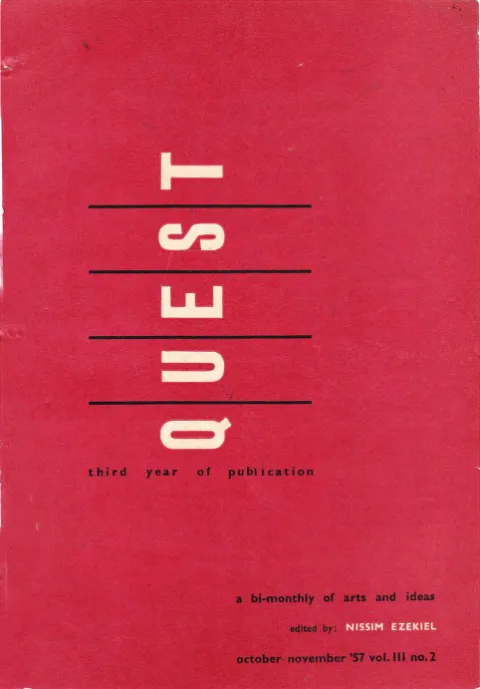
QUEST
Summary
This is the October-November 1957 issue of QUEST (Vol. III, No. 2), the Bombay bi-monthly of arts and ideas edited by Nissim Ezekiel for the Indian Committee for Cultural Freedom. The issue opens with a cluster of political-historical essays keyed to the centenary of 1857 (M. K. Haldar questioning the state’s celebration of the uprising as ‘national’), the sociology of science in India (A. M. Ghose), West Germany’s postwar recovery and its bearing on India (Dietmar Rothermund), a decade-long survey of Indo-Soviet cultural diplomacy (R. Ramani), a discussion article on linguistic-regional ‘emotional integration’ (D. R. Gadgil), and S. Natarajan’s regular column of political notes on Hungary, Kashmir, the Second Five-Year Plan and Congress-Communist tensions in Kerala. Two poems in English translation - a Subramanya Bharathi Tamil verse against English-medium schooling, and an Akkamahadevi Kannada vachana translated by A. K. Ramanujan - sit alongside a substantial arts section: Rene Tavernier’s survey of the 1957 Paris theatre season (illustrated by unnumbered photographic plates), two shorter theatre/exhibition notices, and six book reviews covering the 1857 uprising, a Sahitya Akademi literary anthology, communist writers under totalitarian rule, Lord Acton on liberty, and pamphlets on contemporary Christian social thought and Cold War international politics. Editorially the issue is united by a classical-liberal, anti-totalitarian scepticism: contributors repeatedly puncture official nationalism, Soviet propaganda and communist apologetics while defending individual liberty, a free press and the autonomy of writers and artists.
Essays
What Shall We Celebrate?
By M. K. Haldar
M. K. Haldar’s lead essay asks what, exactly, the 1957 state-sponsored centenary celebrations of the 1857 uprising were meant to commemorate. Drawing on R. C. Majumdar’s and Surendra Nath Sen’s rival scholarship, he shows that historians dispute whether 1857 had any coherent national or patriotic character at all, citing evidence of feudal loyalty, communal atrocities on both sides, and the mutual jealousy of the rebel leaders. He argues that the government’s simultaneous celebration of the Buddha’s 2,500th birthday and the Mutiny centenary was self-contradictory, since one glorified non-violence and the other a war record short on any usable moral lesson. The essay reads the state’s enthusiasm for retrospective national holidays as a symptom of authoritarian nationalism - a manufactured ‘self-sacrifice’ that both Congress and the Communist Party (via E. M. S. Namboodiripad and Hiren Mukherjee’s homage to Subhas Bose) are shown competing to claim. It closes by invoking Tagore’s warning against confusing uniformity with unity.
- Questions the historical basis for treating 1857 as a ‘national’ or ‘patriotic’ revolt, citing Majumdar’s and Sen’s divergent scholarly findings.
- Cites primary sources (letters of Tatia Topee, Nana Sahib’s Istiharnamah) showing mixed motives among the rebel leadership.
- Argues it is incoherent to celebrate the Buddha’s non-violence and the Mutiny’s violence as national holidays in the same year.
- Frames state-sponsored historical commemoration as an instrument for manufacturing authoritarian nationalist sentiment.
- Accuses both Congress and the Communist Party of opportunistically claiming the mantle of nationalism.
- Closes on Tagore’s distinction between imposed uniformity and true unity.
Science in Modern India
By A. M. Ghose
A. M. Ghose argues that modern science was ‘grafted’ onto India from Europe in the 19th century with no continuity from ancient Indian learning, and that Indian intellectual life has never fully absorbed the scientific attitude as a result. He distinguishes pure science from technology and traces India’s pervasive ‘anti-intellectualism’ - the privileging of intuition over analysis - to the Upanishadic distinction between para and apara vidya, finding it echoed uncritically by modern figures like Tagore, Sri Aurobindo and Radhakrishnan. Unlike Western intuitionists, he argues, Indian anti-intellectualists have rarely had any scientific training themselves. The essay closes with concrete institutional evidence of neglect (only 43 of 1,369 IIT Kharagpur students in postgraduate research) and calls for integrating scientific and humanistic education from the primary level.
- Argues ancient Indian ‘science’ is discontinuous with, not a precursor to, modern science.
- Distinguishes the pure scientist’s method from the technologist’s application.
- Traces Indian anti-intellectualism to the Upanishadic privileging of intuition (para vidya) over analytic knowledge.
- Cites Tagore, Sri Aurobindo and Radhakrishnan as modern exponents of this anti-scientific intuitionism.
- Notes only 43 of 1,369 students at IIT Kharagpur were in postgraduate research.
- Calls for integrating science and the humanities in education from the primary level upward.
The Rebirth of Germany
By Dietmar Rothermund
Dietmar Rothermund surveys West Germany’s postwar recovery - the ‘German Miracle’ - as a case study relevant to India’s own development. He argues the total collapse of 1945 (‘point zero’) cleared away the compromises that had crippled Weimar democracy, allowing a new political culture to form around shared wartime suffering across Catholic and Protestant lines. The essay profiles the three major parties - Adenauer’s Christian Democratic Union with Ludwig Erhard’s ‘social market economy’, the Social Democrats hobbled by their own rigid party machine, and the small but pivotal Free Democrats - and identifies German reunification as the central unresolved dilemma facing all of them. Rothermund closes by proposing that a Cold War ‘Neutral Belt’ across Central Europe could let Soviet satellite states gain the same kind of self-confidence Germany has regained, and argues Germany’s rebuilt academic and technical strength positions it as a natural partner for India in training, capital and investment.
- Frames West Germany’s total 1945 collapse (‘point zero’) as the paradoxical precondition for a fresh democratic start.
- Credits shared wartime persecution of Catholics and Protestants with founding the cross-confessional Christian Democratic Union.
- Profiles Adenauer’s CDU, Erhard’s ‘social market economy’, the Social Democrats’ party-machine rigidity, and the pivotal Free Democrats.
- Identifies reunification with the Protestant-majority East as the CDU’s core strategic dilemma.
- Proposes a Cold War ‘Neutral Belt’ across Central Europe as a path to self-confidence for Soviet satellite states, paralleling Germany’s own recovery.
- Argues India and Germany have growing complementary interests in academic exchange, technical training and capital investment.
Indo-Soviet Cultural Relations
By R. Ramani
R. Ramani traces a decade of Indo-Soviet cultural relations from 1947 to 1957. He documents how Soviet commentary before 1953 dismissed Indian independence as a ‘sham’ and Nehru as an imperialist stooge, citing a notorious 1951 Great Soviet Encyclopaedia entry branding Gandhi a reactionary tool of the propertied classes, which provoked outrage among Gandhians once it was reproduced by the Delhi weekly Thought. Stalin’s death and the Korean armistice in 1953 mark the turning point: Moscow began courting Nehru, and a wave of government-sponsored delegations flowed both ways - dancers, teachers, parliamentarians, film artists - generally returning with uncritical praise for Soviet achievements, though one suppressed official report on Soviet living standards found substantial income inequality. Ramani shows the 1956 Hungarian intervention chastening pro-Soviet sentiment even as Soviet backing for India on Kashmir sustained goodwill, and closes by noting the more indirect but significant influence of Soviet-trained economists (via P. C. Mahalanobis) on India’s Second Five-Year Plan.
- Shows Soviet propaganda before 1953 treating Indian independence as a ‘sham’ and Nehru as a British stooge.
- Documents a 1951 Great Soviet Encyclopaedia entry denouncing Gandhi, which caused public outrage once reproduced in India.
- Marks 1953 (Stalin’s death, Korean armistice) as the pivot to Soviet courtship of Nehru and mutual cultural delegations.
- Notes a suppressed Indian government report finding substantial income inequality in the USSR despite official propaganda of equality.
- Traces how the 1956 Hungary intervention dampened, but did not reverse, pro-Soviet sentiment in India.
- Identifies the indirect influence of Soviet-linked economists, via P. C. Mahalanobis, on India’s Second Five-Year Plan.
Emotional Integration of India
By D. R. Gadgil
D. R. Gadgil, writing as a discussion piece rather than a finished argument, proposes that India’s ‘emotional integration’ can only be built on the linguistic region as the basic unit of society, since Hindu caste groupings themselves function within regional, not all-India, boundaries. He argues a single homogenous Indian society on the French or English model is neither achievable nor desirable, and that integration is really a two-stage process: consolidating each linguistic region internally (chiefly by dismantling caste barriers, including for scheduled tribes and non-Hindu minorities) and then building solidarity across regions through shared language policy and reduced economic disparity. Gadgil is sharply critical of Nehru’s ‘subconscious’ North Indian, feudal frame of reference and of what he calls the ‘Nehru Cult’ - the idea that minorities are safe only as long as Nehru personally holds power - and of Delhi and Bombay elites who conflate ‘integration’ with their own consolidation of influence. He finds grounds for optimism in the 1957 Maharashtra election results, where caste-defying outcomes occurred, and in the decentralising, village-level work of Vinoba Bhave.
- Argues the linguistic region, not an undifferentiated ‘India’, is the workable unit for building social cohesion.
- Frames integration as a two-stage process: consolidating regional societies (chiefly by weakening caste) and then linking regions together.
- Criticizes Nehru’s handling of Hyderabad and Kashmir as rooted in an unexamined North-Indian, feudal frame of reference.
- Coins the phrase ‘Nehru Cult’ for the idea that Indian minorities are safe only because of one man’s power.
- Cites 1957 Maharashtra election upsets (a Parsi, an immigrant trader, and a Mahar defeating locally dominant-caste candidates) as evidence caste can be transcended.
- Holds up Vinoba Bhave’s village-level work as a living, decentralised model of Indian integration.
Temporal Power
By S. Natarajan
S. Natarajan’s ‘Temporal Power’ column surveys India’s foreign and economic policy through August-September 1957. He is sharply critical of the government’s muted response to the Soviet crushing of Hungary, contrasted with its vocal statements on Malayan independence, Kashmir and Goa, and quotes Nehru’s own equivocal Rajya Sabha remarks hoping Eastern Europe’s ‘liberalising forces’ would be left alone. He notes Krishna Menon rebuking the Indian press for insufficient nationalist vigour while praising the more compliant Pakistani press, and records two Congress ministers (T. T. Krishnamachari, S. K. Patil) openly voicing distrust of the Communist government in Kerala. On the economy, Natarajan details the Second Five-Year Plan’s foreign-exchange crisis, criticizes wage tribunals for linking pay to ‘capacity to pay’ rather than market conditions, and argues for ‘devesting’ rather than further nationalisation, closing with a warning that Cold War-driven foreign aid meant to ‘save’ a country from Communism is ‘very little short of a bribe’.
- Criticizes the Nehru government for downplaying Soviet intervention in Hungary while speaking forcefully on Kashmir and Goa.
- Records Krishna Menon rebuking the Indian press for insufficient nationalist vigour while praising Pakistan’s press.
- Notes Congress ministers T. T. Krishnamachari and S. K. Patil publicly distrusting the Communist government in Kerala.
- Details the Second Five-Year Plan’s foreign-exchange crisis and the shift from ‘the whole Plan’ to ‘the core of the Plan’.
- Criticizes wage tribunals for linking pay awards to industry’s ‘capacity to pay’ rather than market conditions.
- Argues that anti-Communist foreign aid is ‘very little short of a bribe’ and calls for reducing, not expanding, state ownership.
English Education
By Subramanya Bharathi
This is a free English verse-translation by ‘Andal’ of a poem from Subramanya Bharathi’s verse autobiography, preserving what the translator’s note calls the poet’s ‘exaggerated, chauvinistic sense of grievance’ at being sent to an English-medium school in Nellai. The poem catalogues classical Tamil, Sanskrit and historical figures and achievements (Kamban, Kalidasa, Bhaskara, Panini, Shankara, Valluvar, the Chera, Pandya and Chola kings, Asoka, Shivaji) that English schooling never taught, and accuses English education of instilling servility, false economics, doubt and endless argumentation in place of India’s own civilisational memory. It ends with the poet’s declaration that he escaped total spiritual destruction only by grace and ‘to serve the Motherland.’
- A free verse-translation of a Subramanya Bharathi poem from his autobiography in verse, rendered by ‘Andal’.
- Uses vivid similes (‘a bundle of grass before the cub of a lion’) to convey the violence of English-medium schooling to a Tamil boy.
- Lists classical Tamil and Indian figures (Kamban, Kalidasa, Bhaskara, Panini, Shankara, Valluvar, Asoka, Shivaji) whose achievements English schooling ignored.
- Accuses English education of producing servility, false economics, doubt, and endless argumentation.
- Ends with the poet’s declaration that he escaped total spiritual destruction ‘to serve the Motherland.‘
Liaison with the Lord
By Akkamahadevi
A. K. Ramanujan’s single-page translation of a Kannada vachana by the twelfth-century woman-mystic Akkamahadevi allegorizes worldly illusion and karma through domestic imagery - Illusion as a mother-in-law, the world as a decrepit husband, the three gunas as ‘fiery cousins’ keeping a ‘tiger-vigil’. Against these bonds the poem sets a secret devotion to ‘my Lord Chennamallikarjuna’, with the speaker declaring she will let her divine lover ‘cuckold’ her unwilled past. A brief translator’s note glosses the ‘three cousins’ as the three gunas and ‘Karma’ as ‘the unwilled past’.
- A single-page translation of a twelfth-century Kannada vachana by the woman-mystic Akkamahadevi.
- Allegorizes illusion, the material world and the three gunas as unwanted in-laws and cousins.
- Declares erotic-devotional loyalty to the god Chennamallikarjuna over worldly bonds.
- Ramanujan’s translator’s note glosses the ‘three cousins’ as the three gunas and ‘Karma’ as the unwilled past.
The Theatre in France 1957
By Rene Tavernier
Rene Tavernier surveys the 1957 Paris theatrical season, centred on the founding of the Theatre of the Nations, which brought sixteen troupes performing in nine languages to almost a hundred performances before roughly a hundred thousand spectators. He singles out Laurence Olivier’s Titus Andronicus (with Vivien Leigh), Vittorio Gassman’s Orestes, Jean-Louis Barrault’s Partage de Midi, Helene Weigel’s Galileo, and an O’Neill marathon as the season’s highlights, while judging the accompanying musical and dance programme disappointing. The essay also surveys the summer’s provincial drama festivals - Avignon, Angers, Lyons, Carcassonne, Sarlat, Bellac - as evidence of a broader decentralisation of French theatrical life. Three unnumbered photographic plates of the Olivier/Leigh, Gassman/Zareschi and Vilar/Le Marchand productions, each captioned ‘see page 49’, are tipped into the issue immediately before this article and are not listed on the contents page.
- Centres on the 1957 founding of the Theatre of the Nations in Paris: 16 troupes, 9 languages, ~100 performances, ~100,000 spectators.
- Highlights Olivier/Leigh’s Titus Andronicus, Gassman’s Orestes, Barrault’s Partage de Midi, Weigel’s Galileo and an O’Neill marathon.
- Judges the season’s musical and dance offerings disappointing compared to its drama.
- Surveys summer provincial festivals (Avignon, Angers, Lyons, Carcassonne, Sarlat, Bellac) as evidence of theatrical decentralisation.
- Notes the season’s photographic record is carried on unfolioed plates rather than in the article proper.
Instead of a Review
By S. T.
A short satirical dispatch by ‘S. T.’ on the Ambar Charkha Exhibition, organised by the Bombay suburban District Village Industries Association to promote Ambar Khadi spinning. The writer finds little to the exhibition beyond a few charkhas worked by ‘dowdy types’ and walls covered with skewed, ungrammatical placards quoting Pandit Nehru and touting cost savings, and dismisses the whole display as ‘dreary and arid, not worth the trouble of comment.’
- A brief, dismissive report on the Ambar Charkha Exhibition for khadi promotion in Bombay.
- Describes ungrammatical, misspelt placards quoting Nehru and touting Ambar Khadi’s cost advantages.
- Judges the exhibition ‘dreary and arid, not worth the trouble of comment.‘
Shishon-ki-Khilone
By Laeeq Futehally
Laeeq Futehally reviews a Hindi-language stage adaptation of Tennessee Williams’ The Glass Menagerie, titled Shishon-ki-Khilone and translated by Rifat Shamin. She praises Shaukat Azmi’s performance as the mother for carrying the production, but finds the two young leads under-resourced for the play’s demanding emotional register, and questions whether the American family’s dynamics - an unmarried 27-year-old daughter, a mother boasting of past conquests - convincingly transplant to an Indian setting. She measures the production against what she considers more successful earlier Hindi adaptations of European drama, Gogol’s Inspector and Anouilh’s Antigone, and finds it wanting.
- Reviews Shishon-ki-Khilone, a Hindi adaptation of Tennessee Williams’ The Glass Menagerie translated by Rifat Shamin.
- Praises Shaukat Azmi’s performance as the mother as the production’s main strength.
- Finds the two young leads (Meera and Raj) insufficiently experienced for the play’s difficult emotional demands.
- Questions whether the play’s American family dynamics sit convincingly in an adapted Indian setting.
- Compares the production unfavourably to earlier Hindi stagings of Gogol’s Inspector and Anouilh’s Antigone.
The Red Fort by James Leasor
By Ashoka Nanavaty
Ashoka Nanavaty reviews James Leasor’s The Red Fort, a narrowly-focused, well-researched account of the British siege and capture of Delhi during the 1857 uprising. He praises Leasor’s decision to avoid grand theses about the uprising’s national or mutinous character in favour of a factual, on-the-ground narrative, though he defends General Wilson against what he sees as the book’s unfairly critical treatment, attributing the British campaign’s difficulties instead to poor staff work and coordination rather than Wilson’s caution. Nanavaty notes that, being written from British sources, the book has almost nothing to say about Indian participants, since ‘none of them lived to write their memoirs.’
- Reviews James Leasor’s The Red Fort as a factual, non-partisan account of the siege and capture of Delhi in 1857.
- Praises Leasor’s avoidance of grand theses about whether 1857 was mutiny or war of independence.
- Defends General Wilson against what the reviewer considers the book’s overly critical treatment.
- Attributes British difficulties in the campaign to poor staff work and lack of coordination, not individual timidity.
- Notes the book is necessarily silent on Indian participants, since none left memoirs.
Contemporary Indian Literature
By R. Choksi
R. Choksi reviews the Sahitya Akademi’s Contemporary Indian Literature, an anthology of fifteen essays surveying the modern literatures of India’s major languages, with a foreword by Radhakrishnan. He singles out the essays on Oriya (Mayadhar Mansinha), Sanskrit (V. Raghavan), Indian writing in English (K. R. Srinivasa Iyengar), Hindi (S. H. Vatsyayan), Marathi (M. V. Rajadhyaksha) and Kannada (V. K. Gokak) for particular praise, while noting the volume’s uneven editorial quality, occasional ‘woolly’ prose, and small indexing errors, and recommends that any future edition have a proper editorial board and a glossary for Western readers.
- Reviews the Sahitya Akademi’s Contemporary Indian Literature, covering fifteen languages plus English, with a Radhakrishnan foreword.
- Praises the essays on Oriya, Sanskrit, Indian English writing, Hindi, Marathi and Kannada literature as standouts.
- Criticizes the absence of an editorial board, leading to uneven prose quality across the fifteen essays.
- Notes minor factual and indexing errors (e.g. on Cochin and Jaipur’s ruling houses).
- Recommends a future edition add a glossary of terms for Western readers.
March of a Conspiracy by Gopal Mittal
By A. H. Somjee
A. H. Somjee reviews Gopal Mittal’s The March of a Conspiracy, described as the first serious Indian study of the conflict between communist regimes and their writers. Somjee traces Mittal’s case studies - Wang Shih-Wei in Maoist China, Frantisek Halas in Czechoslovakia, and Ilya Ehrenburg and Vladimir Dudintsev in the Soviet Union - and the recurring pattern of writers who welcomed communism before running into conflict with the party once they began evaluating its record honestly. He disagrees with Mittal’s claim that Ehrenburg’s The Thaw was a ‘prearranged performance’ by the regime, arguing instead for reading it as a genuine, if belated, act of self-confession, and notes the regime’s own anxiety about Soviet youth (‘stilyagi’) drifting toward Western culture. He closes by criticising Mittal’s cursory and alarmist treatment of India’s own Progressive Writers’ Association.
- Reviews Gopal Mittal’s The March of a Conspiracy on the conflict between communist regimes and their writers.
- Traces case studies of Wang Shih-Wei (China), Frantisek Halas (Czechoslovakia), and Ehrenburg and Dudintsev (USSR).
- Disputes Mittal’s claim that Ehrenburg’s The Thaw was a ‘prearranged performance’, reading it instead as genuine self-confession.
- Notes the regime’s anxiety over Soviet youth (‘stilyagi’) drawn to Western culture as a symptom of cultural exhaustion.
- Criticizes Mittal’s cursory and alarmist treatment of India’s own Progressive Writers’ Association.
Essays on Freedom and Power by Lord Acton
By A. B. Shah
A. B. Shah reviews a collection of nine essays by Lord Acton on freedom and power, spanning ancient, Christian, American Revolutionary and Vatican Council history. He explains Acton’s definition of liberty as protection of individual conscience against authority and majority opinion, and traces Acton’s view that Christianity first gave civil power a limit external to itself. Shah dwells on the seeming paradox of Acton’s opposition to abolitionism, resolving it by noting Acton’s liberalism was religious and Catholic rather than rationalist and individualist, and contrasts Acton’s scathing criticism of the Vatican Council’s push for papal infallibility with his refusal to leave the Church. The review closes admiring Acton’s uncompromising insistence on a single moral standard in judging history, even at the cost of his own political isolation.
- Reviews nine Acton essays spanning ancient, Christian, American and French Revolutionary history plus the Vatican Council.
- Explains Acton’s definition of liberty as protection of individual duty against authority, majorities and custom.
- Traces Acton’s argument that Christianity first gave civil power an external, limiting authority.
- Resolves the paradox of Acton’s opposition to abolitionism via his specifically Catholic, non-rationalist liberalism.
- Highlights Acton’s severe criticism of the Vatican Council’s push for papal infallibility despite his own Catholic loyalty.
- Frames Acton’s insistence on one moral standard for judging history as the source of his political isolation.
The Bulletin of the Christian Institute for the Study of Society
By Pratap Chatterjee
Pratap Chatterjee briefly reviews a Bangalore Christian institute’s Bulletin, situating it within a broader tradition of Christian political scholarship associated with Maritain and Niebuhr. He argues religion is bound by intellectual honesty to comment on politics rather than staying separate from it, but regrets that this particular issue’s main contribution comes from a foreigner rather than an Indian Christian voice, given the Bulletin’s role as one of the few outlets for Indian Christian social thought.
- Reviews the Bulletin of the Christian Institute for the Study of Society, Bangalore.
- Situates the journal within the Maritain-Niebuhr tradition of Christian political scholarship.
- Argues religion is intellectually obliged to engage with its political environment rather than staying separate.
- Regrets that the issue’s main contribution is by a foreign, not Indian, writer.
Current International Problems by D. N. Pritt and Danial Latifi
By Ashok Desai
Ashok Desai reviews Current International Problems, a pamphlet of articles by D. N. Pritt and Danial Latifi on the Middle East, Hungary and nuclear weapons. He accuses both authors of dividing the world into ‘the faithful and the heretics’ and of glossing over the illegality of the Soviet intervention in Hungary through strained legal arguments citing the Warsaw Pact and the U.N. Charter. He also notes Latifi quoting the poet Iqbal to cast Western critics as ‘worshippers of darkness’, and finds it curious that C. Rajagopalachari contributed a foreword to a pamphlet whose views on nuclear weapons he does not share.
- Reviews Current International Problems, a pamphlet by D. N. Pritt and Danial Latifi on the Middle East, Hungary and nuclear weapons.
- Accuses the authors of a Manichean ‘faithful versus heretics’ framing of international politics.
- Criticizes the authors’ legal apologia for the Soviet intervention in Hungary.
- Notes Latifi’s use of a quotation from Iqbal to frame critics of Soviet policy as ‘worshippers of darkness’.
- Finds it curious that C. Rajagopalachari wrote the foreword given his differing views on nuclear weapons.
The Pen in Exile by Paul Tabori
By L. F.
‘L. F.’ reviews The Pen in Exile, a P.E.N. anthology of poems, essays, articles and stories by European writers living in exile, translated into English from languages including Hungarian, Polish, Austrian German, Latvian, Estonian and Chinese. The review frames the exiled writer’s tragedy as the loss of language itself - and with it ‘his art, his vocation, and his livelihood’ - noting that most contributors write of fleeing their own governments rather than a foreign invader, driven by the sense that bearing witness to the world is now their only remaining duty to their countrymen. It closes by quoting the Estonian poet Maria Under’s lament for her occupied homeland.
- Reviews The Pen in Exile, a P.E.N. anthology of writing by European exiled writers translated into English.
- Frames exile from language as the loss of ‘his art, his vocation, and his livelihood’ for the affected writer.
- Notes contributors from Hungary, Poland, Austria, Latvia, Estonia, Germany, Albania and China.
- Observes most contributors fled their own governments rather than a foreign invader.
- Closes on a quoted lament by the Estonian poet Maria Under.
Essay 19
Two unnumbered photographic plates are tipped into the issue between printed pages 48 and 49, carrying no entry on the printed contents page. They show three professional stage photographs from the first season of the Theatre of the Nations in Paris: Laurence Olivier and Vivien Leigh in Shakespeare’s Titus Andronicus at the Sarah Bernhardt Theatre; Elena Zareschi and Vittorio Gassman in Alfieri’s Orestes; and Jean Vilar, Lucienne Le Marchand and Simone Bouchateau in Pirandello’s Henry IV at the 1957 Avignon Festival. Each caption directs the reader to ‘see page 49’, explicitly tying the plates to Rene Tavernier’s following article, ‘The Theatre in France 1957’ - an example of QUEST running substantive visual material with no separate contents-page listing.
- Two unfolioed photographic plates (three photographs) are tipped in immediately before the printed p.49 theatre article.
- Depict Olivier/Leigh in Titus Andronicus, Zareschi/Gassman in Orestes, and Vilar/Le Marchand/Bouchateau in Henry IV.
- Each caption cross-references ‘page 49’, tying the plates to Rene Tavernier’s ‘The Theatre in France 1957’.
- Carry no printed folio and are not listed on the contents page, causing the issue’s printed-folio-to-PDF-page offset to shift from -2 to -4 from this point onward.
Generated by the v1.5 extraction pipeline. Awaiting editorial review.
Metadata and summary are AI-extracted from the source PDF and reviewed for editorial accuracy. The original work is available via the Read PDF tab above (where present); paragraph-level citation inside the PDF is deferred to a future engagement.
People in this work
- M. K. Haldarauthor
- A. M. Ghoseauthor
- Dietmar Rothermundauthor
- R. Ramaniauthor
- D. R. Gadgilauthor
- S. Natarajanauthor
- Subramanya Bharathiauthor
- Akkamahadeviauthor
- Rene Tavernierauthor
- Laeeq Futehallyauthor
- Andal
- A. K. Ramanujan
- Ashoka Nanavaty
- R. Choksi
- A. H. Somjee
- A. B. Shah
- Pratap Chatterjee
- Ashok Desai
- Nissim Ezekiel
- Nirad C. Chaudhuri
- Sudhin Datta
- D. G. Nadkarni
- Sheela Singh
- Mahatma Gandhi
- Rabindranath Tagore
- Ludwig Erhard
- Jawaharlal Nehru
- Jayaprakash Narayan
- Bal Gangadhar Tilak
- Chhatrapati Shivaji
- Abraham Lincoln
- C. Rajagopalachari