
periodical issue
Quest
a bi-monthly of arts and ideas
By V. V. John, A. H. Somjee, V. P. Raman, Paul Tabori, Ramaswamy R. Iyer, S. Natarajan, T. R. Ramanathan, A. K. Ramanujan, Andal
Edited, printed and published by NISSIM EZEKIEL for the Indian Committee for Cultural Freedom, Army and Navy Building, 148, Mahatma Gandhi Road, Bombay 1, at the Kamala Press [OCR: 'Kmwda Press'], Podar Chambers, 109, Parsi Bazaar Street, Fort, Bombay 1. · Bombay · 1957
72 pages
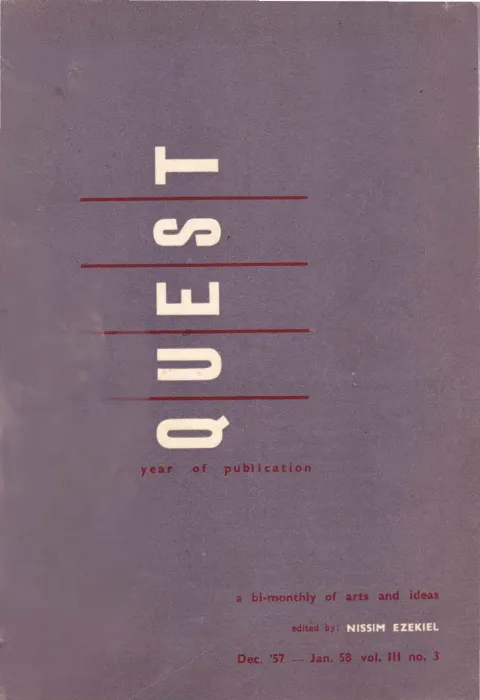
QUEST
Summary
Quest Vol. III No. 3 (Dec. 1957 - Jan. 1958), a bi-monthly of arts and ideas sponsored by the Indian Committee for Cultural Freedom and edited by Nissim Ezekiel, is dominated by the fallout of 1956-57: the Hungarian Revolution and Sputnik. A. H. Somjee’s ‘Four Communisms’ maps the ideological fracturing of Chinese, Yugoslav, Polish and Soviet communism; Paul Tabori’s Bombay speech ‘On Being Neutral’ and the review of ‘Hungary in Revolt’ both return to the Hungarian uprising as proof that Communist claims to freedom and racial equality are hollow; and S. Natarajan’s ‘Temporal Power’ column opens with the Sputnik launches’ shock to Western confidence in parliamentary democracy’s technical superiority. Alongside this Cold War preoccupation, V. P. Raman’s ‘Politics in Madras’ and Ramaswamy R. Iyer’s ‘Contemporary Tamil Literature’ address specifically South Indian concerns — Dravidian regionalism and electoral realignment in one case, the parochialism and decline of modern Tamil letters since Kalki in the other — while V. V. John’s ‘India’s Lost Generation’ surveys the alienation of Indian college youth. The issue rounds out with a short story (T. R. Ramanathan’s ‘Indian Summer’), two poems (A. K. Ramanujan, ‘Andal’), five signed book reviews and three shorter notices, plus a small unlisted second Ramanujan poem and an unlisted vignette-column on Indian consular bureaucracy abroad.
Essays
Four Communisms
By A. H. Somjee
Argues that global communism, often treated by power politics as a single force, has split into distinct national ideological variants that each abrogate the Marxist-Leninist principle of the dictatorship of the proletariat. Examines Chinese communism (Mao’s non-proletarian, peasant-based revolution, and his ‘hundred flowers’ thesis distinguishing ‘antagonistic’ from ‘non-antagonistic’ contradictions to justify a four-class ruling coalition), Yugoslav communism (Tito’s 1948 break with Stalin, and Milovan Djilas’s evolution from advocating ‘socialist democracy’ within the party to a full repudiation of Marxism-Leninism, culminating in his imprisonment), and Polish communism (Gomulka’s post-1956 decollectivization and workers’ councils, hemmed in by continued Soviet troops and a Stalinist party faction). A final section on Soviet communism itself argues that Marxist-Leninist ideology is losing practical relevance to an increasingly technically trained Soviet population, and that Soviet ‘indoctrination’ succeeds mainly negatively — by running down the West rather than by justifying Soviet rule.
- Communism’s apparent unity is illusory: Chinese, Yugoslav and Polish communism each break from Marxist-Leninist orthodoxy in different ways, though all abrogate the dictatorship-of-the-proletariat principle.
- Mao gave the Chinese revolution a peasant, non-proletarian base and later theorised ‘antagonistic’ vs ‘non-antagonistic’ contradictions to justify a four-class ruling coalition rather than sole proletarian rule.
- Djilas moved from proposing ‘socialist democracy’ within the Yugoslav party to a wholesale rejection of the dictatorship of the proletariat, and was expelled from the Central Committee and later imprisoned.
- Poland’s post-1956 liberalisation (decollectivized farms, workers’ councils, a revalued zloty) is constrained by continuing Soviet troop presence and an internal Stalinist faction.
- The essay judges Soviet indoctrination ‘mainly a negative success,’ more effective at discrediting the West than at justifying Soviet rulers, especially after the shocks of de-Stalinization and the Polish and Hungarian uprisings.
Politics in Madras
By V. P. Raman
A self-consciously partisan account of Madras politics since the 1952 general election. Traces C. Rajagopalachari’s 1952-54 tenure as Chief Minister, in which he broke the momentum of the Communist-led United Democratic Front through anti-Communist religious propaganda, Tanjore agrarian legislation, and a smooth concession of Andhra statehood — before his caste-inflected education scheme (‘Vamashrama Dharma’) triggered his own political downfall. Follows Kamaraj’s subsequent rise to Chief Minister via tactical alliances, notably with E. V. Ramaswami (‘Periyar’) and his Dravida Kazhagam, deployed against the newer, secessionist Dravida Munnetra Kazhagam (DMK) in the 1957 election. Closes by arguing that the DMK’s Dravidian-nationalist appeal reflects genuine grievances — Delhi-centred planning, the Hindi language push, historic North-South disunity — that only a change of outlook in the North, not concessions from Madras alone, can resolve.
- C. Rajagopalachari broke Communist momentum in 1952 through anti-Communist religious propaganda, Tanjore agrarian reform, and ceding Andhra’s separation from Madras State.
- Rajaji’s caste-linked education scheme, equated with imposing ‘Vamashrama Dharma’, triggered the backlash that ended his tenure as Chief Minister.
- Kamaraj’s rise depended on opportunistic alliances, notably with E. V. Ramaswami (‘Periyar’) and the Dravida Kazhagam, deployed against the rising Dravida Munnetra Kazhagam (DMK).
- In the 1957 election Congress won 151 of 205 seats on only 44.1% of the vote, while the DMK’s 15 seats came from 14.2% — evidence of a much larger latent DMK constituency than its seat count suggests.
- Frames the Congress-DMK contest as a deeper struggle between all-India centripetal nationalism and Dravidian centrifugal regionalism, arguing the remedy must come from the North, not the South.
On Being Neutral
By Paul Tabori
The text of a speech Paul Tabori delivered in Bombay, arguing that intellectual neutrality toward Communism is impossible. Opens with the idea that ‘even truth has to carry an identity card’ in an age of ideological suspicion, and establishes his own credentials through his family’s suffering under both Nazi and Communist persecution. He marshals the testimony of roughly two hundred thousand Hungarian 1956 refugees — including eight people personally known to him — to refute Western press claims that the Hungarian Revolution was a fascist, landlord-financed plot. Tabori insists there is no such thing as ‘comparative freedom,’ only freedom or its absence, and rebuts Soviet claims to racial tolerance by citing the Volga German resettlement, Baltic deportations, and the murder of Soviet Jewish writers such as Isaac Babel. He closes by insisting anyone who values truth, art or free thought cannot remain neutral between the two totalitarian extremes.
- Argues moral/intellectual neutrality toward Communism is as impossible as neutrality toward cholera or a shark’s bite.
- Establishes his authority to speak by citing his own family’s persecution under both Nazism (his father murdered, twenty-two relatives killed) and Communism (relatives imprisoned in Communist camps).
- Uses the testimony of roughly 200,000 Hungarian refugees, including eight relatives and acquaintances, to refute claims that the 1956 Revolution was fascist- or America-financed.
- Rejects the idea of ‘comparative freedom,’ arguing freedom is binary, like being alive or dead.
- Cites the Volga German resettlement, Baltic deportations, and the killing of Jewish writers like Isaac Babel to rebut Soviet claims of racial egalitarianism.
India’s Lost Generation
By V. V. John
Contrasts the ‘angry or bored’ youth of Britain’s Welfare State (echoing Bertrand Russell’s 1929 essay on the cynicism of Western youth versus the earnestness of Indian and Chinese youth) with what the author sees as an equally directionless, if differently caused, ‘lost generation’ among Indian college students. Surveys a history of Indian student unrest — strikes over cinema rates, bus fares, examination difficulty, hostel walls — as free-floating indiscipline disconnected from any national cause, unlike the genuinely purposive unrest of the freedom movement, and draws a parallel to Wavell’s account of Egyptian ‘school strikes’ being deliberately used as a political weapon. Argues Indian higher education has stopped producing political leadership, since capable graduates avoid politics — now dominated by former ‘political sufferers’ seeking reward — while the Congress Party itself has degenerated into factionalism ‘held together’ only by fear of Nehru’s displeasure, even as youth remain fascinated by the ‘Chou-Khrushchev-Nehru camaraderie.’
- Contrasts Britain’s post-war ‘angry/bored’ youth (via Bertrand Russell’s 1929 essay) with India’s own directionless student generation.
- Surveys Indian student unrest (Bihar exam boycotts, Rajasthan tuition-fee riots, a fatal Bihar bus-fare dispute) as disconnected indiscipline rather than political engagement, unlike freedom-movement-era unrest.
- Draws a parallel to Wavell’s biography of Allenby, in which Egyptian leaders deliberately used ‘school strikes’ as a political weapon.
- Argues capable Indian graduates now avoid politics, which is dominated instead by failed lawyers and time-serving former ‘political sufferers’ seeking ministerial reward.
- Criticises the Congress Party as riven by factionalism, held together ‘only [by] the love of power and the fear of Nehru’s displeasure.‘
Contemporary Tamil Literature
By Ramaswamy R. Iyer
A polemical rejoinder to Ka. Naa. Subramanyam’s earlier Quest survey of the Tamil novel, arguing Tamil literature has been in steady decline since its early-twentieth-century renaissance (Bharati, the novel Kamalambal Charitram) reached its high point with Kalki (R. Krishnamurthi), whom the author names the only major modern Tamil writer — valuable, he argues, more for his stature as ‘a man of letters’ and the clarity of his prose than for the intrinsic worth of his historical novels. Surveys writers of unfulfilled promise (‘S.V.V.’, ‘Devan’, ‘Pudumaippittan’), attributes today’s shallow magazine-fiction to writing ‘by adolescents… for adolescents,’ and blames Tamil letters’ near-total isolation from world literature — citing translators’ odd choices (A Tale of Two Cities over Bleak House; Ibsen’s A Doll’s House over Ghosts) and the neglect of Proust, Joyce, Eliot and Henry James — for its parochialism. Diagnoses ‘jingoism, parochialism, complacency’ as the root causes of a false belief in a Tamil literary ‘golden age,’ singles out the unrecognised Tamil translation of R. K. Narayan’s Swami and Friends as a genuine modern classic ignored only because Narayan writes in English, and closes urging established writers to practise rigorous, unsparing criticism to slowly cultivate a genuinely discriminating readership.
- Argues that Tamil literary discourse, including Subramanyam’s own survey, fails to distinguish literature from mere magazine-fiction, mistaking popularity for merit.
- Names Kalki (R. Krishnamurthi) the only major modern Tamil writer, important chiefly as a stylist and public man of letters rather than for his historical novels’ intrinsic worth.
- Diagnoses ‘jingoism, parochialism, complacency’ — fed by grievances like ‘the exploitation of the South by the North’ and fear of ‘Hindi imperialism’ — as the causes of Tamil literature’s stagnation.
- Blames the near-absence of translated world literature (Proust, Joyce, Eliot, Henry James unknown to Tamil readers) for the tradition’s insularity.
- Praises the Tamil translation of R. K. Narayan’s Swami and Friends as an unrecognised classic, ignored purely because Narayan writes in English.
- Closes by urging established writers to practise rigorous, unsparing criticism to slowly build a genuinely discriminating Tamil readership.
Temporal Power
By S. Natarajan
A column of topical notes opening with the Sputnik launches’ shock to Western, especially British, confidence in the assumed link between parliamentary democracy and technical supremacy, and surveying varied Indian reactions from scientific curiosity to Nehru’s wistful regret at not living to see interplanetary travel. Moves through Finance Minister T. T. Krishnamachari’s US investment drive and his undiplomatic remarks about Russia and China to the American press; criticises V. K. Krishna Menon’s ‘wild accusations’ against Britain at the UN over Kashmir; examines the Kerala Education Bill dispute, arguing enforcement of existing law, not fresh legislation, is what Kerala’s already heavily regulated private-school system needs; and, prompted by the Times of India’s non-renewal of Frank Moraes’s editorship, reflects at length on the structurally weakening position of newspaper editors squeezed between unionised staff and proprietor-managements. Closes on the Bangkok Asian women’s seminar (arguing men, not fewer household duties, are the real obstacle to women’s public participation) and the stalled Hindi-versus-English language transition.
- Frames the Sputnik launches as a Cold War shock to Western assumptions linking parliamentary democracy with technical supremacy, quoting the Economist’s alarm about ‘the dog in the sky.’
- Criticises Finance Minister T. T. Krishnamachari’s undiplomatic remarks about Russia and China made to the American press during his investment-seeking US visit.
- Criticises V. K. Krishna Menon’s intemperate UN speech on Kashmir as damaging to India’s cause despite his later apology.
- Argues the Kerala Education Bill controversy needs enforcement of existing law and better ‘character’ among school managements more than fresh legislation.
- Uses the non-renewal of Frank Moraes’s Times of India editorship to argue editorial independence is being squeezed between unionised staff and business-minded managements, predicting editors will increasingly have to align with their own staff to survive.
- Argues the Bangkok Asian women’s seminar wrongly frames home and public life as opposed, when the real obstacle is that ‘men have nothing to do with’ household duties.
Indian Summer
By T. R. Ramanathan
A short story set in a Mysore ‘halli’ (hamlet), following Pattabhi, a rootless wanderer who rents a cottage from the village patel and forms an uneasy intimacy with Appanna, a young tenant farmer, and later with Appanna’s teenage sister-in-law Kummi. Pattabhi’s restless, self-conscious loneliness — he muses on freedom, bondage and ‘the perfect woman’ — is set against Appanna’s unreflective rootedness in caste, soil and marriage. After Appanna leaves to join the army, Pattabhi leases the vacated brinjal plot; a dispute over dividing the harvest proceeds between Pattabhi and Kummi’s group of young cousins ends in humiliation for Pattabhi, and he wakes the next morning to find the harvested baskets stolen by Kummi’s family overnight. The story closes with the monsoon’s arrival dissolving Pattabhi’s brief communion with village life: ‘the spell of summer was broken.’
- Pattabhi, an itinerant outsider, rents a cottage in a Mysore village and befriends Appanna, a young tenant farmer, and later Appanna’s sister-in-law Kummi.
- The story sets Pattabhi’s rootless, self-conscious individualism against Appanna’s unquestioning acceptance of caste, poverty and marriage as simply how life is.
- A dispute over dividing brinjal-harvest earnings between Pattabhi and Kummi’s cousins ends with the group abandoning him mid-negotiation.
- Pattabhi discovers the harvested baskets stolen by Kummi’s family overnight but deliberately chooses not to accuse her.
- The narrative ends with the monsoon’s onset dissolving Pattabhi’s fragile sense of belonging to the village.
The Body as the Translator
By A. K. Ramanujan
A short lyric poem personifying bodily desire as a ‘translator’ that renders idealised, spiritual language of love into a cruder physical idiom: gland and gonad translate ‘sacramental innocence’ into ‘their own heretic language’ of caress and bloodbeat, overwhelming ‘the Platonic mouth’s surmise’ with the body’s ‘crunching certitude.’ It ends with an image of dormant desire (‘deadwood hands’) awakening at the approach of intimacy.
- Poem stages a conflict between the idealised, spiritual language of romantic love and the body’s own ‘heretic’ physical idiom.
- Ends on an image of dormant desire (‘deadwood hands’) stirring awake toward ‘another’s startled roots of secrecy.‘
Arjuna’s Penance at Mahabalipuram
By ‘Andal’
A poem reflecting on the Pallava-era rock relief ‘Arjuna’s Penance’ at Mahabalipuram, dwelling on the sculpture’s playful, seemingly irrelevant animal vignettes — a curious baby elephant, delousing monkeys, a ‘hypocritic cat’ — alongside its epic scene, and asking whether the sculptor’s own private ‘loves and likes,’ not only the commissioning king’s instructions, shaped what the carving elevates or mocks.
- Meditates on the Mahabalipuram ‘Arjuna’s Penance’ relief’s incidental animal genre-scenes as evidence of the sculptor’s own artistic will operating alongside royal commission.
- Questions whether kings and ministers are ‘the only wise ones’ in shaping the meaning of classical Indian art.
Parliament in India by W. H. Morris-Jones
By Ashok Desai
A largely admiring review of W. H. Morris-Jones’s Parliament in India, praising its ‘deep and sympathetic insight’ into Indian politics and its detailed treatment of parliamentary procedure, privilege and committees. Highlights the book’s argument that Congress’s sheer numerical and organisational dominance is itself a structural weakness for parliamentary democracy, since it leaves no credible, unified opposition; cites the book’s use of Dr. Ambedkar’s warning about political ‘hero-worship’ (Bhakti) as a danger to Indian democracy; and closes on the book’s own guardedly optimistic verdict that India’s parliamentary story so far is ‘unmistakably a story of success,’ if a less exciting one than crisis and failure.
- Praises Morris-Jones’s detailed institutional treatment of Parliament — bill procedure, the Council of States, control over public corporations.
- Flags the book’s argument that Congress’s numerical dominance, not any single defect, weakens Parliament by leaving no credible alternative opposition.
- Cites the book’s quotation of Dr. Ambedkar’s warning that ‘Bhakti, or… Hero-worship, plays a part in politics unequal in magnitude’ compared with other democracies.
- Notes the book’s closing comparison of Nehru’s Delhi to Pericles’s Athens as ‘the School of Asia.‘
An Introduction to Philosophical Analysis by P. C. Chatterji
By S. Ookerjee
A sharply critical review of P. C. Chatterji’s An Introduction to Philosophical Analysis, arguing the title misleads readers into expecting the specific ‘Philosophical Analysis’ school when the book actually surveys traditional problems from Plato to Wittgenstein. Praises Chatterji’s clear, straightforward prose but faults his method as a series of disconnected, inconclusive summaries — rushing ‘from Descartes… to Kant… to Russell and Wittgenstein’ without depth — that would leave student readers bewildered rather than illuminated, citing apparently self-contradictory passages on realism and idealism as evidence.
- Argues the book’s title misrepresents its content: it surveys historical philosophy broadly rather than the specific ‘Philosophical Analysis’ movement it claims to name.
- Praises Chatterji’s prose clarity but criticises his method of skating rapidly through many philosophers without developing any argument in depth.
- Finds the book internally inconsistent on realism versus idealism, quoting passages that seem to reject and then endorse realism within a few pages.
- Concludes student readers will come away in ‘bewilderment’ rather than with any working understanding of the problems covered.
The Nature of Conflict (Unesco)
By Mahesh Desai
Reviews a UNESCO-sponsored essay collection on the sociology and psychology of conflict, summarising contributions by Jessie Bernard (sceptical of both social-psychological and sociological approaches), Pear (deprecating the cultural over-valuation of war as more ‘interesting’ than peace), Raymond Aron (pessimistic that societies can be weaned off organised violence), and Robert Angell (a hopeful but question-begging vision of an ‘inclusive social system’). Concludes that the sociology of conflict is ‘at the crossroads,’ able to describe conflict but unable to prescribe its elimination without abandoning Max Weber’s demand for value-free social science.
- Surveys UNESCO’s ‘Tension Projects’ research programme and its four essays on the sociology and psychology of conflict.
- Raymond Aron’s contribution is judged the most pessimistic, doubting any imminent ‘conversion’ of societies away from organised violence.
- Robert Angell’s more hopeful vision of an ‘inclusive social system’ is judged naive and question-begging by comparison.
- Concludes sociology of conflict cannot advance further without abandoning Weberian value-neutrality, risking becoming ‘the art of manipulating our associative urges.‘
The Pink and the Brown by Hugh Atkinson
By Foy Nissen
A critical review of Hugh Atkinson’s debut novel about a European in post-independence Bombay, faulting its strained, self-conscious prose style and its failure to dramatize the interracial romance the blurb promises between narrator Peter Boyd and Sohini, an Indian woman whose death by stray bullet the reviewer judges an unearned shortcut resolution. Praises isolated passages of genuine observation about Bombay’s European community but concludes the novel’s structural detachment leaves both narrator and politics ‘at a remove from reality,’ amounting to a ‘propagandized’ assemblage of freedom-struggle-and-Gandhism material aimed at foreign readers.
- Criticises Atkinson’s prose for reaching after ‘verbal mirror-flashes’ and strained imagery rather than earning its effects.
- Notes the promised central romance between Peter Boyd and Sohini never becomes a real ‘activating cross-current,’ with Sohini’s death used as a shortcut resolution.
- Praises the novel’s sharper observations of Bombay’s European community as evidence of what Atkinson can do when writing what he actually knows.
- Concludes the novel is ‘propagandized’ freedom-struggle-and-Gandhism material assembled from ‘a convenient social void.‘
Uttararamacaritam by V. M. Inamdar
By R. N. Gadre
An admiring review of V. M. Inamdar’s critical study of Bhavabhuti’s Sanskrit drama Uttararamacaritam, endorsing Inamdar’s argument — against Belvalkar, Dasgupta, De and Karmarkar — that the play’s central theme is neither simple reconciliation nor idealised love but Rama’s tragic subordination of personal love to public duty. Praises Inamdar’s close textual defence of the much-criticised third act and his statistical rebuttal (Sita addresses Rama as ‘aryaputra’ thirty-eight times against only twice as ‘man,’ undercutting readings of resentment in her speech) of critics who find fault with Sita’s characterisation.
- Endorses Inamdar’s thesis that Bhavabhuti’s central theme is Rama’s tragic sacrifice of personal love to public duty, against rival readings centred on reconciliation or idealised love.
- Notes Inamdar’s textual-statistical defence against critics who read resentment into Sita’s forms of address toward Rama.
- Praises the book’s defence of the play’s much-criticised third act and its treatment of the ‘play within a play’ (garbhanataka) device.
- Calls the book ‘a laudable attempt to give Bhavabhuti his long overdue credit as a successful dramatist and poet.‘
Towards A Socialist Co-operative Commonwealth by U. N. Dhebar
By A.H.D.
A short review of Congress President U. N. Dhebar’s pamphlet Towards A Socialist Co-operative Commonwealth, welcoming its attempt to give Congress’s vague ‘socialism’ a concrete grounding in Sarvodaya and cooperation as an alternative to both laissez-faire and Communist development models, while faulting the ruling party for advocating socialism ‘without making clear… the presuppositions and the goals’ of its own version, and suspecting the Congress approach amounts to improvisation rather than principle.
- Welcomes Dhebar’s pamphlet as a rare attempt by the ruling party to define what ‘Congress Socialism’ actually means.
- Criticises the vagueness of Indian political ‘socialism’ more broadly, calling it ‘a vacuous term’ as used by some politicians.
- Suspects the Congress approach to socialism is closer to ad hoc improvisation (‘jumping hurdles… with eyes closed’) than to principled planning.
Plutonia by V. A. Obruchev
By Pratap Chatterjee
A dismissive review of V. A. Obruchev’s Soviet science-fiction novel Plutonia, aimed at teenagers, criticising its propagandistic insistence on Russian priority in inventions such as the telephone, but crediting its underlying aim of interesting young readers in paleontology. Predicts most teenage readers will abandon the ‘predictable… pedestrianly phrased’ book before finishing, and draws an explicit cautionary moral about state-sponsored publishing, then being debated in India.
- Criticises Plutonia’s ideological insistence on crediting Russians for inventions like the telephone.
- Credits the novel’s underlying educational aim of popularising paleontology among teenage readers.
- Predicts most young readers will abandon the book due to its ‘predictable… pedestrianly phrased’ prose.
- Draws an explicit cautionary parallel to contemporary Indian proposals for state-sponsored publishing.
Hungary in Revolt by Ajit Pyne and Bijay Bhattacharayya
By A.H.D.
Reviews Hungary in Revolt, an anthology of mostly Marxist commentary on the 1956 uprising, noting contributors (including Sartre and Edvard Kardelj) broadly agree the revolt was spontaneous and popular and Soviet intervention ‘imperial and ruthless.’ Observes that even a dissenting Marxist like Kardelj stops short of questioning dialectical materialism itself, instead blaming ‘Gero-Rakosi-Stalinism’ for Hungary’s degeneration — which the reviewer calls ‘joining an inverted cult of personality’ rather than a genuine reckoning.
- Notes the anthology’s largely Marxist contributors agree the Hungarian revolt was popular and spontaneous, and Soviet intervention was ‘imperial and ruthless.’
- Highlights Edvard Kardelj’s essay as an incisive Marxist analysis that nonetheless stops short of questioning Marxist dialectics itself.
- Argues even sympathetic Marxist critics who blame ‘Gero-Rakosi-Stalinism’ for Hungary’s failure are ‘joining an inverted cult of personality’ rather than confronting the system’s own flaws.
Essay 18
An unlisted second poem by A. K. Ramanujan, printed directly beneath ‘The Body as the Translator’ on the same page and sharing its byline but absent from the printed contents page. Presented as ‘after Allama Prabhu, a medieval mystic of Karnatak,’ it meditates on cosmic corruption — when even ‘the salt of the earth… take[s] the taints of the world,’ there is no adequate image left for corruption itself.
- Not listed on the printed contents page; appears directly under ‘The Body as the Translator’ under the same A. K. Ramanujan byline.
- Framed as an adaptation/translation ‘after Allama Prabhu,’ a medieval Kannada vachana poet.
- Argues that once even ‘the salt of the earth’ is corrupted, there is no image adequate to represent corruption.
Essay 19
An unlisted feature, ‘Our Legations: Two Recent Comments,’ reprinting two press vignettes about Indian officialdom’s handling of visas and public relations abroad. A. Hariharan (Bharat Jyoti, Bombay) attacks the poor calibre of Indian public-relations staff in New York and Washington; Daniel Bell (The New Leader, U.S.A.) recounts being asked by an Indian consular official in Paris to promise not to write in exchange for a visa, closing with an Indian friend’s unwittingly telling remark that ‘India… is becoming a great power.’
- Not listed on the printed contents page; a standalone one-page feature reprinting two outside press comments.
- A. Hariharan’s excerpt criticises the intellectual calibre of Indian public-relations staff posted in the United States.
- Daniel Bell’s excerpt recounts an Indian consular official in Paris offering him a visa only if he promised not to write, ending on an ironic note about India ‘becoming a great power.‘
Essay 20
An unlisted editorial announcement that Vyankatesh Madgulkar’s Marathi novel Bangarwadi, two chapters of which had previously appeared in Quest (Vol. II, Nos. 5 and 6), would shortly be published in full by Asia Publishing House, Bombay, in S. D. Deshmukh’s English translation, its eventual English title still undecided.
- Not listed on the printed contents page; a short editorial notice inserted within the ‘Four Communisms’ article’s footnote/advertisement block.
- Announces the forthcoming Asia Publishing House edition of Vyankatesh Madgulkar’s Bangarwadi, translated from Marathi by S. D. Deshmukh.
Generated by the v1.5 extraction pipeline. Awaiting editorial review.
Metadata and summary are AI-extracted from the source PDF and reviewed for editorial accuracy. The original work is available via the Read PDF tab above (where present); paragraph-level citation inside the PDF is deferred to a future engagement.
People in this work
- V. V. Johnauthor
- A. H. Somjeeauthor
- V. P. Ramanauthor
- Paul Taboriauthor
- Ramaswamy R. Iyerauthor
- S. Natarajanauthor
- T. R. Ramanathanauthor
- A. K. Ramanujanauthor
- Andalauthor
- Ashok Desai
- S. Ookerjee
- Mahesh Desai
- Foy Nissen
- R. N. Gadre
- Pratap Chatterjee
- Nissim Ezekiel
- Nirad C. Chaudhuri
- Sudhin Datta
- D. G. Nadkarni
- Laeeq Futehally
- Sheela Singh
- Mao Zedong
- Karl Marx
- C. Rajagopalachari
- Abraham Lincoln
- Mahatma Gandhi
- Jawaharlal Nehru
- Rabindranath Tagore
- B. R. Ambedkar