
periodical issue
Quest
a bi-monthly of arts and ideas
By Minoo Masani, A Ranganathan, Tibor Meray, Ranjani Rao, Prof. C. L. Gheevala, G. Sukumaran Nair, M. K. Haldar, M. S. Kalyanasundaram, S. Natarajan, A. K. Ramanujan, Uma Vasudev, Nissim Ezekiel, Ka Naa Subramanyam, Andal, T. K. Doraiswamy, R. R. Crossette-Thambiah, Chetan Karnani
Edited, printed and published by Nissim Ezekiel for the Indian Committee for Cultural Freedom, Ismail and Lady Building, 118, Mahatma Gandhi Road, Bombay 1, at the Kailas Press, ... Prospect Chambers Street, Fort, Bombay 1. · Bombay · 1958
70 pages
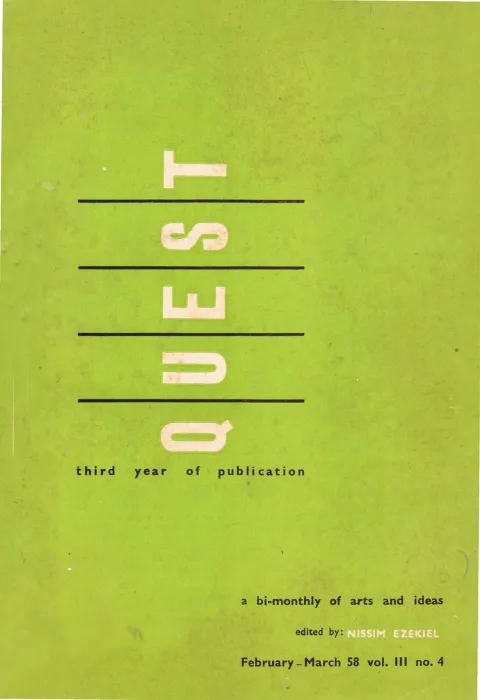
QUEST
Summary
Quest Vol. III No. 4 (Feb.-March 1958) is a bi-monthly journal of arts and ideas published in Bombay under the sponsorship of the Indian Committee for Cultural Freedom. This is Nissim Ezekiel’s final issue as editor: a front-matter ‘Announcement’ thanks him for launching and building the magazine over three years and hands charge to Abu Sayeed Ayyub and Amlan Datta as Joint Editors, moving the editorial office to Calcutta and converting Quest from a bi-monthly into a quarterly that will lean more toward ‘inquiry, criticism and constructive thought’ than arts and ideas. The issue’s contents range widely: M. R. Masani’s San Francisco speech on Western aid to Asia and the case for free enterprise; a Budapest newspaper’s justification of the imprisonment of Hungarian writers after 1956, rebutted point by point by the exiled writer Tibor Meray; A. Ranganathan’s long critical study of Ananda Coomaraswamy’s evolving, ultimately universalist theory of Indian cultural nationalism; a three-way symposium (Gheevala, Sukumaran Nair, Haldar) contesting Professor Gadgil’s thesis that linguistic regions are the only workable basis for India’s ‘emotional integration’; two personal columns of political and literary reportage (a Tamil writer’s wry account of the All-India Writers’ Conference in Calcutta, and S. Natarajan’s regular political notes on nationalisation, the Congress ‘ginger group’, and Sheikh Abdullah’s release); poetry by Ranjani Rao and A. K. Ramanujan; theatre and arts criticism (a survey of Delhi’s transformation under Punjabi refugee settlement and its classical-music scene, and a review of Theatre Unit’s Bombay production of Shaw’s Saint Joan, illustrated by an uncredited-in-TOC production photograph and a plate of modern Indian ceramics); a five-letter correspondence exchange on the state of the Tamil novel and on the constitutional non-recognition of Sindhi; and a substantial Books section reviewing Wittfogel’s Oriental Despotism, R. P. Masani on the Bhoodan movement, W. G. Archer on Krishna iconography, Sibnarayan Ray’s essays, Djilas’s The New Class, Dudintsev’s Not by Bread Alone, lectures by Auden and C. Day Lewis on poetics, Vaiyapuri Pillai’s posthumous history of Tamil literature, and three shorter reviews (on the Hungarian Revolution, BBC broadcasts on Gandhi, and a memoir of student life in Weimar Berlin). A short news item records the Committee’s Fourth Conference in Patna in December 1957, chaired by Rukmini Devi Arundale, with Jayaprakash Narayan, M. R. Masani and others debating ‘The Democratic Alternative’ and tribal integration, and confirms the decision to hand Quest to Ayyub and Datta.
Essays
The Great Challenge
By M. R. MASANI
The text of M. R. Masani’s address to the International Industrial Development Conference in San Francisco (sponsored by Time-Life International and the Stanford Research Institute), arguing that Western aid and investment in Asia and Africa is both a moral and a strategic necessity. Masani surveys the widening per-capita income gulf between the West and the underdeveloped world, warns against exporting a particular economic philosophy along with aid (‘the wrong kind of string’), and defends free enterprise’s record in India — citing the Forum of Free Enterprise, industrial production indices, and private-sector investment exceeding Second Five Year Plan targets — while distinguishing India’s entrepreneurial tradition from Iran’s. He closes by urging American businessmen toward equity investment over rigid government-to-government aid, framed as self-interest, national security against Soviet ‘economic and scientific manoeuvre’, and altruism combined.
- Frames the Cold War-era development gap as a ‘wide gulf’ in per-capita income between the US ($2,000), Western Europe (
$1,000) and underdeveloped regions ($100 a year). - Distinguishes ‘the right kind of string’ (sound supervision of aid) from ‘the wrong kind’ (dictating a recipient country’s economic philosophy), invoking a country’s sovereign right to choose its own economic structure.
- Cites Burmese PM U Nu’s June 1957 Rangoon speech renouncing overreach in state economic planning as an encouraging sign of realism spreading in Asia.
- Defends free enterprise’s record in India: industrial output rose from index 100 (1951) to 156 (May 1957), private investment of $1.7bn exceeded Second Plan targets, and the Forum of Free Enterprise has done ‘a great deal of educative work’.
- Argues equity capital is the most fruitful form of Western investment because it carries ‘no strings; no political strings’ and builds direct human contact between societies.
- Gives three reasons for large-scale Western investment in Asia: self-interest (industrialised countries buy more), national security (countering Soviet economic/propaganda gains such as Sputnik), and altruism.
- Closes with a call to Americans to share not just capital but the ‘values of being frontier-minded and not fate-bound’.
A Hungarian Dialogue
A paired exchange on the imprisonment of Hungarian writers after the 1956 revolution. The Budapest paper Magyarorszag argues that reports of persecuted writers are Western propaganda, that Hungarian literary output has never been higher, and that Tibor Dery and others were tried not for their writing but for inciting revolt and violence. Tibor Meray, an exiled Hungarian writer living in Paris, replies point by point: Dery received nine years, the playwright Gyula Hay six, the poet Zoltan Zelk three, and Tibor Tardos eighteen months, on the very day Magyarorszag’s article appeared. Meray argues the prosecutions plainly targeted literary and political expression, that ‘confessions’ and pro-government declarations from still-free writers were extracted by holding out clemency for imprisoned colleagues, and that the whole affair exposes the fragility of a regime that must jail ‘a few unfortunate scribblers’ to claim it has extinguished counter-revolution.
- Magyarorszag claims 201 literary works were published in Hungary in the first half of 1957 as proof writers are not being silenced.
- Meray documents the actual sentences: Dery (9 years), Gyula Hay (6), Zoltan Zelk (3), Tibor Tardos (18 months), handed down the same day the Budapest paper’s justification ran.
- Meray rebuts the claim that Dery was tried only for inciting revolt, not literary work, by showing the incriminating quotations were ‘clearly falsified’ extracts from Dery’s own self-tormented reflections.
- Argues the government’s own admission — that jailing writers was ‘the only way to put out the fires of counter-revolution’ — is itself a confession of the regime’s fragility.
Happy Acres
By RANJANI RAO
A short lyric poem of romantic and pantheistic communion, describing love as a form of merger with the natural and cosmic order — ‘happy acres’ shared between two people amid growing things, stars, oceans and storms.
- Imagery of youth, growth and cosmic union carries the poem’s central conceit of love as belonging to a wider natural order.
- Structured as a sequence of short quatrains building to a final declaration of ‘sacred communion’.
Coomaraswamy and Indian Nationalism
By A Ranganathan
A. Ranganathan traces the evolution of Ananda Coomaraswamy’s thinking on Indian nationalism, from his early ‘swadeshi’-era cultural nationalism — launched against the ‘Anglicisation of the East’ while editor of the Ceylon National Review and president of the Ceylon Social Reform Society — through his defence of Indian art against Ruskin’s and Vincent Smith’s dismissive Victorian criticism, to the cosmopolitan, near-mystical universalism of his mature Boston years. Ranganathan credits Coomaraswamy with giving swadeshi a ‘religious artistic ideal’ content that influenced Tagore, while criticising his idealisation of caste, his provincial hostility to Western education (misapplied, Ranganathan argues, given the immaturity of Indian-language education at the time), and his harsh characterisation of Nehru’s ‘queer mixture of East and West’ confession as ‘terrible soul-sickness’ compared with Gandhi’s supposed freedom. The essay closes by praising Coomaraswamy’s late scientific-mystical synthesis in Time and Eternity and his ideal of a ‘chosen people of the future’ defined not by nation or race but by a shared aristocracy of spirit.
- Coomaraswamy began as a swadeshi cultural nationalist, campaigning against ‘Anglicisation’ and reviving Ceylonese/Indian dress, education and art criticism.
- He defended Indian sculpture and art against Ruskin’s and Vincent Smith’s Victorian criticism that it was ‘monstrous’ and lacked naturalism, eventually causing Vincent Smith to revise his views.
- Ranganathan credits him with spiritualising Mazzinian nationalism into a ‘religious artistic ideal’, an idea echoed in Tagore’s Nationalism lectures in Japan and his concept of Vishwabharati.
- Criticises Coomaraswamy’s idealisation of the caste system and his ‘provincial’ attitude to Western political and educational thought, including his harsh reading of Nehru’s self-described inner rootlessness compared to Gandhi.
- Notes the irony that Coomaraswamy was ignored by Indian institutions (denied a Banaras Hindu University professorship) until he won recognition abroad (Linnean/Geological Societies, Boston Museum of Fine Arts).
- Concludes that Coomaraswamy’s mature philosophy (Time and Eternity) envisioned a future ‘chosen people’ — an ‘aristocracy of the earth’ transcending nation and race — as the fulfilment, not the negation, of his nationalism.
Emotional Integration of India
By C. L. GHEEVALA and others
Three writers respond to Professor Gadgil’s thesis (from an earlier issue) that linguistic regions are the only workable basis for India’s ‘emotional integration’. C. L. Gheevala rejects the claim that castes are regionally rather than pan-India in character, argues that emphasising linguistic regionalism will entrench, not dissolve, minority exclusion within each region, and insists that India’s cultural unity is ‘a way of life’ expressed through, not divided by, its many languages. G. Sukumaran Nair takes a more conciliatory line, arguing intellectual integration through Indian languages (not a premature national Hindi) must precede emotional integration, and dismisses talk of a Southern ‘Nehru cult’ as overstated. M. K. Haldar is the most skeptical of all, arguing the very idea of ‘emotional integration’ is occult and undefinable, that authoritarianism is inseparable from large nation-states, and that forced emotional uniformity of the kind achieved ‘elsewhere’ (implicitly the Soviet bloc, as pictured by Orwell) is a greater danger than diversity itself.
- Gheevala disputes Gadgil’s claim there are ‘no all-India castes’, pointing to Brahmins as a pan-regional caste group with consistent characteristics.
- Gheevala warns that reorganising India purely along linguistic-regional lines would ‘perpetuate numerous pockets of linguistic minorities’ with no path to emotional integration within each region.
- Sukumaran Nair argues cultural integration is ‘baffling’ without a common language, but that imposing Hindi ‘for a century more’ would be premature and regional languages will necessarily foster regional cultures in the meantime.
- Sukumaran Nair rejects the idea of a Southern grievance against a ‘Nehru cult’ as ‘a fiction of imagination’.
- Haldar argues ‘emotional integration’ as a concept is scientifically empty (‘necessarily occult’) and that the real danger is a Soviet/Orwellian style of engineered emotional uniformity, not linguistic or cultural diversity.
- All three implicitly agree diversity should be respected but differ sharply on whether linguistic-regional reorganisation helps or harms genuine integration.
In the Conference Hall
By M. S. KALYANASUNDARAM
M. S. Kalyanasundaram’s wry personal account of attending the All-India Writers’ Conference in Calcutta as a delegate, poking fun at conference rituals — badge-wearing, autograph-hunting, the tyranny of the chairman’s clock, and the general excess of speeches over substance. He describes Mahadevi Varma’s poetic opening address, S. Radhakrishnan’s closing appeal for writers to portray India’s social ills honestly, Rajagopalachari’s absent but familiar message on Hindi, and a farcical debate over whether English should become India’s ‘fifteenth language’ (Mulk Raj Anand and Buddhadeva Bose for; several Tamil delegates against, ‘necessarily, in English’). The piece closes with anecdotes of officialese absurdities generated by the compulsory use of Hindi in government memos.
- Frames the conference satirically as a spectacle of vanity, autograph-hunting and repetitive speechmaking, redeemed by genuine ‘personal contacts between birds of a similar feather’.
- Records Mahadevi Varma’s inaugural address deftly avoiding the ‘Hindi controversy’ with poetic generalities, and S. Radhakrishnan’s closing call for writers to expose ‘corruption in high places’ and division without descending into factionalism themselves.
- Notes Rajagopalachari’s absence but characteristic message repeating his known views on Hindi, and Humayun Kabir’s announcement that the conference would pass no resolutions since ‘writers do not believe in resolutions’.
- Recounts the argument over treating English as India’s ‘fifteenth language’ (Mulk Raj Anand, supported by Buddhadeva Bose) opposed by several delegates — ironically, in English.
- Closes with a comic anecdote of a Bengali official’s sabotage of a Hindi-only memo policy by drafting jaw-breaking Sanskritised Hindi that even a native Hindi-speaking superior could not parse.
Temporal Power
By S. NATARAJAN
S. Natarajan’s regular political notes column surveys the nationalised life-insurance sector’s troubles as a caution against Congress’s continuing preference for further nationalisation; a Congress ‘ginger group’ of dissident MPs organising outside formal opposition channels; the reference of the Kerala Education Bill to the Supreme Court and the wider constitutional questions it raises about Centre-State relations; Indonesia’s nationalisation of Dutch firms amid the West Irian dispute and its claim to territorial waters; unrest across the Arab world amid Cold War manoeuvring; the release of Sheikh Abdullah after four years’ detention and his subsequent reaffirmation of support for an independent Kashmir; and C. D. Deshmukh’s ambiguous public remarks on socialism versus bureaucracy.
- Argues nationalised life insurance has ‘manifested on a vaster scale’ the very defects it was meant to cure, undermining the belief that nationalisation removes ‘the human factor’ from economic error.
- Frames the Congress ‘ginger group’ of dissident backbenchers as a healthy, if overdue, step toward genuine internal opposition given India’s lack of an alternative ruling party.
- Analyses the Kerala Education Bill’s reference to the Supreme Court as raising unresolved constitutional questions about how far States’ opinions can be solicited without pre-empting judicial process.
- Covers Indonesia’s nationalisation of Dutch commercial assets and its claim over territorial waters around its 3,000 islands, noting India’s calculated sympathy despite Nehru’s silence on parallel questions about Goa.
- Reports Sheikh Abdullah’s release after four years’ detention and his immediate re-assertion of support for Kashmiri independence on the grounds of India’s ‘Hindu character’, arguing detention ‘never effects a change of political views’.
- Questions C. D. Deshmukh’s apparently contradictory remarks about India both retreating from and doubling down on ‘the socialistic pattern of society’.
A Poem on Logic
By A. K. RAMANUJAN
A. K. Ramanujan’s poem stages an internal confrontation between a narrator’s inherited Hindu-home morality and an embodied, seductive figure of ‘logic’ or desire encountered on a night road; the narrator’s rehearsed moral lecture collapses into surrender (‘behind the laws of my land’).
- Structured as a dramatic monologue: the narrator first lectures a personified female figure (‘that thought’) on propriety and marriage, then is overcome by desire.
- Ends with the narrator transgressing the very moral ‘commandments’ and social ‘laws’ he began by invoking.
A Letter from Delhi
By UMA VASUDEV
Uma Vasudev’s essay describes Delhi’s transformation from a ‘silent, time-worn’ Mughal-legacy city of soft-spoken, purdah-observing gentility into a bustling commercial centre, crediting — and partly blaming — the post-Partition influx of enterprising, unsentimental Punjabi refugees for the change. She then turns to Delhi’s classical-music scene, contrasting the contemplative, love-suffused style of sarod player Ali Akbar Khan with the flashier brilliance of sitarist Ravi Shankar, and worries that Shankar’s post-tour habit of compressing ragas for foreign audiences risks eroding the ‘timeless aspiration’ at the heart of Indian classical music.
- Contrasts pre-Partition Delhi’s introverted, tradition-bound, Mughal-inflected culture with the energetic, competitive commercial culture brought by Punjabi refugees after 1947.
- Credits Punjabi refugees with dramatically expanding Delhi’s transport, retail and restaurant economy within a decade, while criticising the resulting ‘vulgarisation’ of Delhi’s food culture and ‘clever salesmanship’.
- Notes the loosening of purdah norms among Delhi women as an indirect social effect of Punjabi settlement.
- Profiles Ali Akbar Khan and Ravi Shankar as disciples of Ustad Allauddin Khan of Maihar, contrasting Ali Akbar’s ‘love and compassion’ with Ravi Shankar’s ‘intellectual purity’ and ‘flash, wit and brilliance’.
- Expresses concern that Ravi Shankar’s post-European/American-tour tendency to shorten and simplify ragas for foreign audiences could set a damaging precedent of ‘twentieth century’ standardisation in Indian classical music.
Theatre Unit’s Saint Joan
By NISSIM EZEKIEL
Nissim Ezekiel reviews Theatre Unit’s Bombay production of Shaw’s Saint Joan, arguing the play succeeds as spectacle but fails in the interpretive detail that its lucid form demands. He praises Malcolm Macrae’s bluster as Robert de Baudricourt but finds his collapse under-astonished, criticises doubling of actors across roles as breaking the audience’s suspension of disbelief, and singles out Pheroza Cooper’s Joan as accomplished but miscast in spirit — a ‘nineteenth century Romantic heroine’ rather than a French peasant girl — whose intensity tips into monotony. He credits producer Mr. Shenoy with a strong ‘total effect’ but faults poor audibility across much of the cast.
- Argues the play’s dramatic interest lies less in plot than in the interpretation of Joan’s character, which the production only partly achieves.
- Praises the production’s overall ‘total effect’ — sets, costumes, lighting, stage movement — as evidence of genuinely good, not merely lucky, direction.
- Criticises actor-doubling (Minoo Chhoi as both Steward and Inquisitor) as breaking believability, and widespread inaudible line delivery, especially among the English cast members.
- Judges Pheroza Cooper’s Joan a polished, expressive failure of interpretation: a Romantic heroine rather than a French peasant, whose intensity produces monotony rather than a dramatic arc.
- Assesses Bomi Kapadia’s Richard de Beauchamp as ‘seedy instead of sinister’ due to a muffled, narrowly villainous reading.
Tamil Literature
By KA NAA SUBRAMANYAM
Ka Naa Subramanyam replies to an earlier Quest critic (Mr. Iyer) on the state of the Tamil novel, defending his own historical (not qualitative) approach to establishing the tradition’s landmarks — from Rajam Iyer through Kalki, Vaduvoor Duraiswamy Iyengar and Vai Mu Kothainayaki Ammal — and arguing Kalki’s popularity reflected shrewd accommodation rather than serious artistry, unlike Duraiswamy Iyengar’s or S.V.V.’s more genuine engagement with their subjects. He closes lamenting the post-1945 decline of serious literary forums in Tamil.
- Insists his earlier article was deliberately historical, not evaluative: ‘every writer who has contributed to the stream is to be considered a classic’ until literary landmarks are properly established.
- Argues Kalki ‘bowed before every wind that blew’ and offered only ‘polite platitudes’, unlike Vaduvoor Duraiswamy Iyengar, whom he rates more highly as a writer who ‘came to grips with his subjects’.
- Defends S.V.V. and ‘Devan’ against the charge of mere popular entertainment, while conceding their limitations.
- Attributes the decline of serious Tamil literary criticism since 1945 to the rise of mass-circulation magazines crowding out ‘little reviews’ and forums for serious writing.
Tamil Literature
By ‘ANDAL’
Writing under the pen-name ‘Andal’, Mrs. S. Rajee of Madras disputes Mr. Iyer’s claim that Kalki was the only ‘major’ Tamil writer, arguing ‘major’ is a matter of time and taste rather than immediate popularity, and naming Vai Mu Kothainayaki Ammal, Rajam Iyer, and several lesser-known contemporaries as equally deserving of serious attention. She questions the value of measuring Tamil literature against Eliot, Joyce or Proust, and argues that recognising genuinely significant writers ‘when they are contemporary’ is always difficult, citing Edmund Gosse’s blindness to James Joyce as a cautionary example.
- Challenges the equation of commercial success with literary ‘majorness’, comparing the case to Dickens, Thackeray and George Eliot’s shifting contemporary reputations.
- Ranks Vai Mu Kothainayaki Ammal, whom she compares to Gertrude Stein, above Kalki in her personal estimation.
- Argues Tamil literature need not imitate Eliot, Joyce, Proust or Lawrence to be ‘contemporary’, since ‘no awaiting of the coming of a major writer’ guarantees recognition.
- Cites Edmund Gosse’s perceptiveness about Sarojini Naidu but blindness to James Joyce as an illustration of how hard genuine contemporary judgement is.
- Requests that Quest give Tamil literature the same balanced coverage it gave Marathi in an earlier Special Number.
Tamil Literature
By T. K. DORAISWAMY
T. K. Doraiswamy lists Ka Naa Subramanyam, N. Chidambarasubramaniam, T. Janakiraman, ‘Krithika’ and others as serious contemporary Tamil novelists, and short-story writers publishing in ‘little’ literary magazines (Manikkodi, Kalamohini, Chandrodayam) rather than the mass-circulation press, arguing serious Tamil writing does exist but is obscured by the dominance of popular magazines. He closes by drawing a comparison to Nirad C. Chaudhuri, arguing Indo-Anglian writing is compromised by an urge to ‘explain… India to the West’ in ways regional-language writing avoids.
- Names a specific roster of serious contemporary Tamil prose writers and critics publishing in literary ‘little magazines’ distinct from mass-circulation titles like Ananda Vikatan and Kalki.
- Defines a ‘serious writer’ as one whose work ‘commands our respect by virtue of the peculiar vision of life it unfolds’, illustrated via Mr. K.N.S.’s novels.
- Argues, via Joyce and ‘dear dirty Dublin’, that even parochial or compromised local conditions can produce major literature.
- Contends Indo-Anglian writers, though rooted in Indian culture, are handicapped by ‘an urge to explain in a superficial manner India to the West’, making regional-language fiction often artistically superior.
Tamil Literature
By R. R. CROSSETTE-THAMBIAH
Writing from Colombo, the former Solicitor-General of Ceylon R. R. Crossette-Thambiah frames the Tamil situation in Ceylon as a matter of ‘life and death’, blaming the currency Max Muller gave to the term ‘Aryan’ for fuelling Sinhalese majoritarian claims against the Tamil-speaking third of the island’s population. He argues Ceylon Tamils have a distinct, ancient, thousand-year territorial and cultural identity, criticises the ‘traitor within’ phenomenon of Tamils aligning with those in power, and closes with an argument for civilisational separateness as the true path to peaceful coexistence, predicting a future Tamil ‘Jefferson’ to codify a distinct Dravidian political philosophy.
- Argues Max Muller’s coinage of ‘Aryan’ as a linguistic term was distorted into a racial one, fuelling both European racism and Sinhalese-Tamil communal politics in Ceylon.
- Describes Ceylon Tamils as a distinct, historically rooted community comprising a third of the population, with their own culture, language and unadulterated (non-Sanskritised) Tamil.
- Criticises the phenomenon of Tamils who hedge between communities for personal advantage, in both Ceylon and Tamil Nadu (citing wavering support during the freedom movement).
- Rejects universalist slogans (‘Parity’, ‘Equality’, ‘Neutralism’, ‘Co-existence’) as dangerously vague, arguing instead for each ‘unit of civilisation’ to develop within ‘its own geographical soil’.
- Predicts a future Tamil political philosopher-legislator (‘a Jefferson’) who will articulate a distinct Dravidian civilisational path.
Recognition of Sindhi
By CHETAN KARNANI
Chetan Karnani protests the eight-year failure to include Sindhi in the Eighth Schedule of the Indian Constitution, arguing Sindhi’s Sanskrit-derived vocabulary and Prakrit-close historical form (per philologists Grierson and Suniti Kumar Chatterjee) make it linguistically eligible by the same standard applied to its sister languages. He rejects the arguments that Sindhis are too few or too geographically scattered (a scattering caused, he notes, by Partition and government resettlement policy, not choice), lists the practical exclusions this non-recognition causes (Sangeet Natak Akademi, Lalit Kala Akademi, National Book Trust, and mislabelling by the U.P. Board as a ‘foreign language’), and reports on the All-India Sindhi Language Convention held in Delhi in December 1957.
- Argues nearly four in five Sindhi words descend from Sanskrit, making the language’s exclusion from the Eighth Schedule inconsistent with the inclusion of its ‘sister languages’.
- Notes Sindhi speakers (20 lakhs) are comparable in number to Kashmiri speakers (27 lakhs), who are recognised, undercutting the ‘too few speakers’ objection.
- Points out Sindhis, unlike Punjabis and Bengalis, retained no portion of their home province after Partition, and were deliberately dispersed by government resettlement policy — undermining the ‘not a compact region’ objection, especially since Urdu and Sanskrit are also not regionally compact yet are recognised.
- Lists concrete institutional harms of non-recognition: exclusion from the Sangeet Natak Akademi, Lalit Kala Akademi, National Book Trust and Vividh Bharati programming, and being classed a ‘foreign language’ by the Intermediate U.P. Board.
- Reports the All-India Sindhi Language Convention held in Delhi in December 1957 to press for a constitutional amendment.
Oriental Despotism
By A. H. SOMJEE
A. H. Somjee reviews Karl A. Wittfogel’s Oriental Despotism, summarising its thesis that ‘hydraulic’ Asiatic societies dependent on state-run irrigation inevitably produce total bureaucratic control and no liberal-democratic tradition — a diagnosis Wittfogel extends to contemporary India. Somjee criticises the thesis as resting on a caricatured, ahistorical notion of a uniformly liberty-conducive ‘Western Society’ (Germany’s twentieth-century record being the obvious counterexample), on unrefuted Marxian economic determinism, and on unreliable empirical claims, citing an example where Wittfogel’s cited absentee-landlordism figure for 1950 India is roughly double the actual figure given by I. S. Gulati.
- Summarises Wittfogel’s core claim that ‘Asiatic Society’ produces the harshest, most total form of political power because agricultural production depends on state-run irrigation (‘hydraulic society’).
- Argues Wittfogel treats ‘Western Society’ as inherently freedom-conducive despite Germany’s ‘political barbarism… unprecedented in the history of mankind’.
- Charges the book with unrefuted Marxian economic determinism and ‘naive historicism’ despite claiming to critique Marx.
- Flags a specific empirical error: Wittfogel’s claim that 80% of Indian land was owned by absentee landlords in 1950 versus the actual 30-40% given in I. S. Gulati’s Capital Taxation.
- Concludes the book is a product of ‘great learning and scholarship’ undermined by ‘sociological cold war’ against the author’s ideological opponents.
The Five Gifts
By LAEEQ FUTEHALLy
Laeeq Futehally reviews R. P. Masani’s The Five Gifts, on Vinoba Bhave’s Bhoodan (land-gift) movement, acknowledging the movement’s real achievement — four and a half million acres donated in six years — while pressing hard on its practical shortfall: only 8% of collected land had actually been redistributed to the landless, with no data on how many recipients had the seeds, tools and bullocks needed to work it. She quotes Nehru’s own defence of Bhoodan as a change in ‘atmosphere’ rather than a literal solution, and leaves open whether the movement’s real value lies in changed spirit rather than measurable land reform.
- Accepts as fact, against sceptics, that landlords have willingly given away millions of acres to Vinoba Bhave without coercion.
- Highlights the central practical failure: only 8% of collected land had been redistributed to the landless by the time of writing, per Sir Rustom Masani’s own account.
- Notes the movement’s distribution conditions (land must be worked within 3 years) but the book gives no data on how many recipients have actually begun cultivation.
- Quotes Nehru’s own more modest defence of Bhoodan’s value as changing the political ‘atmosphere’ rather than solving landlessness directly.
- Frames the reviewer’s own ambivalence: sympathetic to India’s tradition of saintly leadership, but unconvinced Bhoodan has delivered materially for the landless.
The Loves of Krishna
By MAHESH DESAI
Mahesh Desai reviews W. G. Archer’s The Loves of Krishna, praising an Englishman’s unusually sensitive account of why the erotic, playful young Krishna of Brindaban — rather than the martial or philosophical Krishna of the Mahabharata and Gita — became the dominant object of devotion and art in India. Desai reads this as evidence of Indian thought’s deep, unembarrassed ‘awareness of the undeniability of concrete experience’ and the idea that ‘Life is love’, while gently faulting the book for treating its paintings too briefly relative to its excellent textual scholarship.
- Poses the puzzle the book addresses: why devotional art and literature overwhelmingly favour the young lover-Krishna of Brindaban over the martial/philosophical Krishna of the Gita.
- Frames Krishna’s uninhibited loves as expressing a broader Indian aesthetic and religious principle: ‘There can be no continuity without love. Life is love.’
- Draws a comparative religious point via the Shiva-Parvati myth, where separation from love produces cosmic destruction (Tandava).
- Praises Archer’s erudition (source material ‘from the Upanishads to the Hindi poetry of the seventeenth century’) and sensitivity, calling the book ‘a summing up of the Indian way of life’.
- Criticises the book’s brevity on the paintings themselves and the quality of its photographic reproductions.
Explorations
By FoY NrssEN
Foy Nissen reviews Sibnarayan Ray’s Explorations, a collection of seven essays in literary and philosophical criticism (on Montaigne, Hamlet, Baudelaire, the ‘crisis in modern literature’, Popper’s Open Society, Pannekoek’s critique of Leninism, and Sartre’s existentialism). Nissen finds the essays competent but unoriginal ‘rambles through well-known suburbs’, useful to a student needing orientation but rarely yielding a striking independent insight, and wonders whether Ray’s fixation on Baudelaire-Pound-Eliot-Auden blinds him to other, ‘less arid’ strands of modern poetry such as Wallace Stevens.
- Summarises the collection’s seven essays spanning Montaigne, Hamlet, Baudelaire, modern literary ‘crisis’, Popper, Pannekoek on Lenin, and Sartre.
- Judges the essays informative but derivative, offering little beyond a ‘concise appraisal’ of ground already well covered by others.
- Singles out the Montaigne and Hamlet essays as particularly inconclusive (‘what does this mean?’).
- Suggests Ray’s exclusive focus on the Baudelaire-Pound-Eliot-Auden lineage of despair leaves him unable to account for a ‘less arid but no less disciplined’ poet like Wallace Stevens.
The New Class
By S. N.
A review (signed ‘S.N.’) of Milovan Djilas’s The New Class, arguing its significance has been under-appreciated by anti-communist readers eager only for ammunition. The reviewer traces Djilas’s trajectory from leading Yugoslav Communist theoretician to dissident advocate of ‘democratic socialism’, and endorses his central thesis that Communist elites constitute a ‘new class’ that seized power to establish its own monopoly over both ownership and political power — a pattern the reviewer argues applies to any system, communist or not, built on unaccountable nationalised industry.
- Frames Djilas’s importance as coming precisely from his insider trajectory: ‘as Communism grew out of the dissatisfaction of sensitive individuals… Djilas’ revolt against Communism is motivated by his very absorption in the Communist system’.
- Summarises Djilas’s core claim that the Communist ‘new class’ is unique in seizing political power before, not after, establishing a new economic order, using power to ‘establish its own’ economic order rather than complete one.
- Extends Djilas’s critique beyond the USSR: ‘the picture… applies not only to the Communist State but to all administrations which pin their faith on nationalised industry’.
- Highlights the chapter on ‘National Communism’ as the most fascinating, addressing whether nation-specific communism is decline or evolution.
- Judges the book’s weakest section to be its treatment of underdeveloped countries’ relations with Western democracies.
Not By Bread Alone
By NISSIM EZEKIEL
Nissim Ezekiel reviews V. Dudintsev’s Not by Bread Alone, sharply rebuking Western publishers and critics for praising the novel primarily because it is unflattering to the Soviet Union rather than for its literary merit, arguing this is exactly the propagandist standard the West condemns in Communist critics. He judges the novel itself mediocre — journalistic, predictable, lacking climactic force — while crediting its genuine significance as a document that broke, without fully escaping, the constraints of Soviet ‘social realism’ and official ideology.
- Attacks Western publishers and critics for praising the novel’s politics rather than its craft: ‘Are they not extravagantly praising Not By Bread Alone as a novel because it gives an unfavourable picture of the Soviet Union?’
- Argues the same critics would condemn Communist reviewers for judging Western novels by identical political criteria.
- Assesses the novel on literary grounds as flat and predictable: ‘it never rises to passionate denunciation… its characters, once established, behave predictably’.
- Notes Dudintsev’s own Epilogue speaks ‘with two voices’ — a genuine artistic voice and a coerced, propagandistic one — reflecting the pressure he was under to write a more ‘positive’ follow-up novel.
- Concludes the novel’s real, non-literary significance is that it broke from imposed ‘social realism’, criticising Soviet bureaucracy without daring to touch its ‘totalitarian and ideological roots’.
Making, Knowing and Judging
By IQBAL LUKMANI
Iqbal Lukmani reviews W. H. Auden’s Oxford inaugural lecture Making, Knowing and Judging, praising Auden’s account of the poet-critic’s advantages over ‘The Prig’ and ‘The Critic’s Critic’ — categories of bad critic Auden anatomises — because the practising poet’s ego is already satisfied by writing, freeing his criticism from either false modesty or competitive over-elaboration.
- Values poet-critics’ writing on poetic theory as an antidote to critics who would otherwise ‘swamp’ literary criticism and make new poetry impossible.
- Summarises Auden’s typology of ‘The Prig’ (for whom no actual poem is good enough) and ‘The Critic’s Critic’ (whose analysis outshines, and discourages reading of, the work itself).
- Highlights Auden’s account of a poet’s internal interrogation of a new poem: ‘What kind of guy inhabits this poem? What is his notion of the good life…?’
The Poet’s Way of Knowledge
By IQBAL LUKMANI
In the same combined review, Iqbal Lukmani covers C. Day Lewis’s Henry Sidgwick Memorial Lecture The Poet’s Way of Knowledge, which argues poetry is ‘another way of gaining and imparting knowledge’ with roots common to science, tracing back to when ‘poetry and science were one, and its name was Magic’. Lukmani praises the lecture’s prose as a model of directness and finds its conclusions especially illuminating for understanding the shared imagery of the Auden-Spender-Lewis-MacNeice generation.
- Summarises Day Lewis’s thesis that poetry and science share a common ancestor and operate ‘with equal validity at different levels of awareness’.
- Praises the lecture as ‘an excellent example of what prose should be — direct, lucid, polished’.
- Notes the lecture’s special relevance to understanding the shared poetic approach of the Auden-Spender-Lewis-MacNeice group.
History of Tamil Language and Literature
‘Andal’ reviews the late Prof. S. Vaiyapuri Pillai’s posthumous History of the Tamil Language and Literature, calling it a landmark that finally brings authenticated, evidence-based chronology to a previously ‘chaotic’ field, sometimes at the cost of the older, more romantic and ‘uniqueness’-asserting dating traditionalists preferred. The review summarises Pillai’s dating of the Tamil script to the third century B.C., the Sangam anthologies to around the fourth century A.D., Tirukkural to the early seventh century, and the twin epics Manimekhalai and Silappadhikaram to the ninth century, alongside his account of Sanskrit, Jain, Buddhist and Roman-trade influences on early Tamil culture.
- Credits Pillai with the ‘first clear authenticated and chronological history of Tamil literature’, based on rigorous internal and external evidence rather than traditional dating.
- Notes some traditionalist Tamil scholars resisted Pillai’s later dating of the classics because it undercut claims of Tamil’s antiquity and uniqueness.
- Summarises Pillai’s chronology: script to the 3rd century B.C.; Sangam anthologies collected c. 4th century A.D.; Tolkappiyam (first complete grammar) mid-5th century; Tirukkural early 7th century; devotional Saivite/Vaishnavite literature 7th-9th centuries; Manimekhalai and Silappadhikaram in the 9th century; Jivaka Chinthamani in the 10th.
- Highlights Pillai’s account of external influences — Sanskrit literary ideas, Jain and Buddhist religious currents, and early Roman trade — on the development of Tamil literature.
- Recommends the book as meeting ‘a longfelt need for a critical and historical introduction to the ancient Tamil classics’.
The Hungarian Revolution
By S. N.
A shorter review (signed ‘S.N.’) of Melvin J. Lasky’s edited collection The Hungarian Revolution, praising Hugh Seton-Watson’s introductory commentary for arguing that the West, despite its professed opposition to Soviet imperialism, ‘did nothing to help a people struggling for freedom’, and that the 1956 revolt proved internal discontent alone can shake a totalitarian regime — even though Soviet ruthlessness ultimately prevailed due to Western reluctance to risk wider conflict.
- Frames the book’s central argument, via Seton-Watson, that the West’s inaction during the Hungarian rising exposed the limits of its professed anti-Soviet commitments.
- Credits the revolt with proving that ‘internal discontent can destroy a totalitarian regime’, even where external intervention fails to follow through.
- Notes the volume’s timeliness given contemporary efforts on ‘both sides of the iron curtain’ to minimise the revolt and its suppression.
Talking of Gandhiji
By UMA ANAND
Uma Anand reviews Talking of Gandhiji, F. Watson and M. Brown’s book adapting their four-part BBC Third Programme ‘sound portrait’ of Gandhi (built from fifteen miles of recorded tape). She praises its unusually candid inclusion of Gandhi’s opponents’ criticisms alongside admiring testimony, arguing this even-handedness lends the portrait unusual authenticity, and pointedly contrasts it with what she sees as India’s own state broadcasting’s tendency to present only ‘one (one’s own) side of the picture’.
- Describes the BBC project’s scale and method: four broadcasts covering ‘A Portrait’, ‘The Conquest of India’, ‘Gandhiji in England’ and ‘The Last Phase’, built from fifteen miles of recorded interviews.
- Highlights specific vivid details revealed — the fight against untouchability, the uproar over a sick calf’s killing at the Ashram, Lancashire mill-workers’ reaction to Gandhi’s post-boycott visit.
- Argues the programme’s willingness to include ‘unbiased and open reportage of critical, even outspoken disagreement’ from Gandhi’s opponents paradoxically deepens, rather than undermines, the reverence it conveys.
- Uses the review to criticise India’s own Department of Information and Broadcasting for one-sidedness, calling the resulting coverage ‘a distorted view’.
Welcome Each Rebuff
By L. F.
A shorter review (signed ‘L.F.’) of Mahdi Ali Mirza’s memoir Welcome Each Rebuff, an unpretentious, admittedly minor but very readable account of the author’s student years among Indian expatriates in 1920s Berlin — including Zakir Husain, Abid Husain and Mohammed Mujeeb, with visits from a young Jawaharlal Nehru — praised for its high-spirited, self-deprecating comic tone despite offering no new historical insight.
- Describes the memoir as personal, fragmentary and dated, yet ‘so interesting that it is difficult to put down’.
- Notes the author chose Weimar-era Berlin over the more conventional English university path taken by other wealthy young Indians of his generation.
- Lists the notable Indian student circle in Berlin the book describes, including Zakir Husain, Abid Husain and Mohammed Mujeeb, with visits from a young Jawaharlal Nehru.
- Praises the memoir’s comic self-deprecation (poverty, an illegal motorcycle trip, an ill-suited stint as a taxi driver) as its chief pleasure, while conceding it offers little new information.
Essay 28
A front-matter notice from the Indian Committee for Cultural Freedom announcing that Nissim Ezekiel is relinquishing the editorship of Quest with this issue, thanking him for his ‘devoted work and care’ in building the magazine over three years, and handing charge to Abu Sayeed Ayyub and Amlan Datta as Joint Editors. It announces Quest’s conversion into a quarterly beginning 1 April, a relocation of the editorial office to Calcutta (5 Pearl Road) while the managerial office remains in Bombay under Sheela Singh, a reduced annual subscription (Rs. 5) alongside a raised single-copy price (Rs. 1.25), and a declared shift in editorial emphasis toward ‘inquiry, criticism and constructive thought’ and away from ‘arts and ideas’.
- Formally ends Nissim Ezekiel’s three-year editorship of Quest, with the Committee’s explicit thanks for his role in launching and sustaining the magazine.
- Names Abu Sayeed Ayyub (writer/critic from Bengal, formerly Professor of Philosophy at Shantiniketan) and Amlan Datta (economist, lecturer at Calcutta University) as incoming Joint Editors.
- Announces conversion from bi-monthly to quarterly publication starting 1 April, with the editorial office moving to Calcutta while the Bombay managerial office continues under Sheela Singh.
- Signals an editorial pivot away from ‘arts and ideas’ toward ‘inquiry, criticism and constructive thought’.
- Adjusts pricing: annual subscription cut to Rs. 5, single-copy price raised to Rs. 1.25.
Essay 29
An uncaptioned-in-the-TOC full-page production photograph from Theatre Unit’s Saint Joan, showing Pheroza Cooper, Denis Fernandes (as Poulengey) and Malcolm Macrae (as Robert de Baudricourt), credited to photographer Gurmeet Singh and cross-referenced to the review on page 42. The plate is tipped in without a printed folio number, one of the two unnumbered inserts that shift the issue’s printed-to-PDF page offset partway through.
- Illustrates the Theatre Unit Saint Joan production reviewed by Nissim Ezekiel elsewhere in the issue (toc_index 10).
- Names the photographer (Gurmeet Singh) and the three pictured cast members and their roles.
- Printed without a folio number, unlike the surrounding text pages.
Essay 30
A full-page photographic plate, ‘Modern Indian Ceramics’, showing tiles by Badri Narayan and M. R. Hathor(?) and a pitcher by Laxman J. Gaonkar, all photographed by Jean Herman, with the pottery noted as made at Vitrum Studio, Bombay. The plate carries no article text and no printed folio number, and has no corresponding TOC entry.
- Documents contemporary studio ceramics by named Indian artists (Badri Narayan, M. R. Hathor(?), Laxman J. Gaonkar) produced at Vitrum Studio, Bombay.
- Photography credited to Jean Herman.
- Entirely visual; unlisted in the printed contents page and unnumbered in the printed folio sequence.
Essay 31
A news report on the Fourth Conference of the Indian Committee for Cultural Freedom, held in Patna on 14-15 December 1957 under the presidentship of Rukmini Devi Arundale, covering two seminar topics — ‘The Democratic Alternative’ (with Jayaprakash Narayan, M. R. Masani, Prof. V. K. N. Menon and others, based on a paper by Devaki Sreenivasan) and tribal integration into Indian society — alongside an art and photography exhibition. The report also formally records the General Meeting’s decisions: adopting the annual report and accounts, approving Quest’s conversion into a quarterly under incoming Joint Editors Abu Sayeed Ayyub and Amlan Datta, thanking Ezekiel for his service, setting up five new study groups, and electing the Executive Committee.
- Records the Fourth ICCF Conference (Patna, 14-15 Dec. 1957) under Rukmini Devi Arundale, addressing ‘The Democratic Alternative’ and tribal integration.
- Names participants in the democratic-alternative discussion: Jayaprakash Narayan, M. R. Masani, Prof. V. K. N. Menon, M. P. Mishra, Prof. Rajkrishna and Prof. Amlan Datta, based on a ninety-page thesis by Devaki Sreenivasan.
- Reports an accompanying art/photography exhibition featuring painters Gopal Ghosh, K. K. Hebbar, Ara, Badri Narayan, Almelkar and Shiavax Chavda, and photographers Homi Patel and Sunil Janah.
- Formally confirms the decision (also announced in the front-matter notice) to hand editorial responsibility for Quest to Abu Sayeed Ayyub and Amlan Datta and to relocate the editorial office to Calcutta.
- Lists five new ICCF study groups (on repressive laws, Gramdan, import restrictions on books/artistic material, State patronage and writers’ freedom, and developments in Communist-run Kerala) and the newly elected Executive Committee.
Generated by the v1.5 extraction pipeline. Awaiting editorial review.
Metadata and summary are AI-extracted from the source PDF and reviewed for editorial accuracy. The original work is available via the Read PDF tab above (where present); paragraph-level citation inside the PDF is deferred to a future engagement.
People in this work
- Minoo Masaniauthor
- A Ranganathanauthor
- Tibor Merayauthor
- Ranjani Raoauthor
- Prof. C. L. Gheevalaauthor
- G. Sukumaran Nairauthor
- M. K. Haldarauthor
- M. S. Kalyanasundaramauthor
- S. Natarajanauthor
- A. K. Ramanujanauthor
- Uma Vasudevauthor
- Nissim Ezekielauthor
- Ka Naa Subramanyamauthor
- Andalauthor
- T. K. Doraiswamyauthor
- R. R. Crossette-Thambiahauthor
- Chetan Karnaniauthor
- Nirad C. Chaudhuri
- Sudhin Datta
- D. G. Nadkarni
- Laeeq Futehally
- Sheela Singh
- J. B. H. Wadia
- V. B. Karnik
- A. H. Somjee
- Mahesh Desai
- Foy Nissen
- Iqbal Lukmani
- Uma Anand
- Jawaharlal Nehru
- Mahatma Gandhi
- Rabindranath Tagore
- C. Rajagopalachari
- C. D. Deshmukh
- Jayaprakash Narayan