
periodical issue
Quest
A Quarterly of Inquiry, Criticism, and Ideas
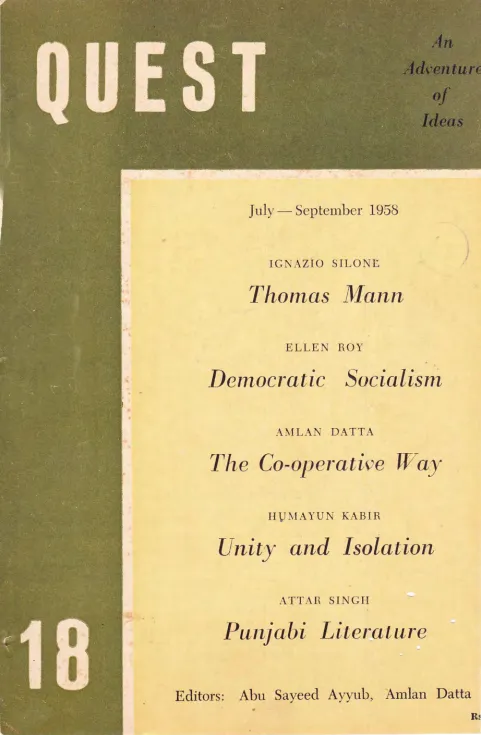
By Ignazio Silone, Ellen Roy, Prof. Amlan Datta, Humayun Kabir, Attar Singh, Pratima Bowes, R. L. Nigam, Annada Sankar Ray, Bishnu Dey, C. L. Proudfoot, Buddhadeva Bose, S. Balu Rao, Andal, Ashis Barman, H. H. Price, Saroj Kumar Das
Business Manager: Miss Sheela Singh; business address printed on subscription form: QUEST, 148 Mahatma Gandhi Road, Bombay 1 · Bombay · 1958
102 pages
QUEST
Summary
Quest No. 18 (July-September 1958) is a substantially longer issue (102 pp.) than the run before it, appearing after the magazine’s shift from a bi-monthly under Nissim Ezekiel to a quarterly under Abu Sayeed Ayyub and Amlan Datta, with an Advisory Board of Nirad C. Chaudhuri, Sudin Datta and Laxmanshastri Joshi. Its centre of gravity is political and ethical argument rather than fiction: Ignazio Silone interrogates Thomas Mann’s credentials as a political thinker; Ellen Roy sets out the Radical Humanist case for a ‘democratic socialism’ purged of Statism; Amlan Datta argues for a co-operative middle path through India’s industrial transition; Humayun Kabir’s inaugural seminar address defends India’s federal ‘unity in diversity’ against linguistic and communal fragmentation; and an Oxford-Calcutta correspondence between H. H. Price and Kabir debates whether the modern State’s command of propaganda and education has made ‘society as an organism’ a genuine danger to human freedom. Around this spine sit essays on ethics (Pratima Bowes on free will, blame and punishment), literature (Attar Singh’s survey of post-Partition Punjabi writing, R. L. Nigam on the writer’s freedom, Ashis Barman on Satyajit Ray’s Pather Panchali and Aparajita), five poems (two translated or adapted from Bengali), Annada Sankar Ray’s autobiographical ‘Two Binus’ on the tension between livelihood and vocation, three book reviews, one reader’s letter praising Quest’s stand on cultural freedom, and a Contributors page giving short biographical notes on most of the issue’s authors. No unlisted illustrations, drawings, or photographic plates were found anywhere in the issue; the only non-editorial pages are commercial advertisements and subscription forms.
Essays
Thomas Mann as Political Thinker
By Ignazio Silone
Silone argues that Thomas Mann, for all his moral stature, should not be over-rated as a political thinker. Re-reading Mann’s 1914-1920 writings and his later essays, Silone finds a recurring pattern: eloquent, historically-freighted prose that never rises to genuine political analysis. Mann’s early nationalism (justifying the invasion of Belgium, scorning democracy as ‘uncouth, plebeian and stupid’) gave way after 1918 to a conversion to democracy credited to Whitman rather than to any political thinker, and even his mature formulations (quoted at length from 1939) amount to a vague, quasi-anthropological endorsement rather than a considered theory. Silone extends the same scepticism to Mann’s late entanglement with Communist regimes: naive, self-flattering statements to the Eastern press are contrasted with Mann’s own sincere disclaimers of Communism, and Silone reads the contradiction as evidence of a mind that was morally unassailable but politically unserious, still driven, underneath, by the artist’s private need to escape into instability, eroticism and music.
- Silone distinguishes ‘affirmation of moral and spiritual values’ from real political and historical understanding, and finds Mann’s political essays fail the latter test.
- Mann’s 1914-1920 nationalist writings (on Frederick the Great, on the war as an assault of Western democracy on the ‘Germanic spirit’) are read as historically unreal, not merely wrong.
- Mann’s post-1918 conversion to democracy is traced to Whitman’s influence rather than to any coherent political philosophy.
- Mann’s later statements praising ‘the cultural flowering’ of Eastern Bloc regimes are presented as naive rather than sincerely Communist.
- Silone situates his own critique within a broader claim: the 19th-century figure of the poet-prophet no longer fits mass civilization’s altered relationship between politics and literature.
Our Conception of Democratic Socialism
By Ellen Roy
Ellen Roy argues that both Capitalism and Socialism, as historically practised, have converged on the same disfiguring trend: ‘giganticism’ — ever-larger production units under either corporate or State ownership, producing centralisation, regimentation and a citizenry reduced to interchangeable cogs. Neither system, she contends, has delivered the free unfolding of human individuality that was the original promise of both Democracy and Socialism. Her proposed ‘democratic Socialism’ rejects Statism and collectivisation as necessary features of Socialism, redefining social ownership instead as a function of co-operative, small-scale, voluntary economic organisation coincident with society itself rather than sitting above it. For India specifically, she argues against importing the Western template of Socialism as ‘the ideology of the working class’ (since India has no comparable industrial proletariat), and instead calls for a patient, education-led, example-driven spread of democratic and co-operative habits beginning in villages and towns, rather than a revolutionary seizure of State power.
- Both Capitalism and Socialism have converged toward ‘giganticism’: bigger production units, centralisation, and standardisation, regardless of whether ownership is private or State.
- Soviet-style State ownership is described as concentrating power even more completely than capitalist ownership, leaving workers with less real freedom than under Capitalism.
- Democratic Socialism, as Roy defines it, requires rejecting Statism and re-grounding ‘social ownership’ in small co-operative units run by those who actually perform the labour.
- India’s population is not a industrial working class, so Socialism cannot be imported as ‘the ideology of the working class’; new institutional forms suited to Indian conditions are needed.
- Change is expected to come through education, example, and active social work within existing institutions — not through a revolutionary seizure of State power (‘The Day’).
The Co-operative Way
By Amlan Datta
Amlan Datta addresses the classic dilemma of a democratic country attempting rapid industrialisation: how to raise the domestic savings-and-investment rate from roughly 5% to 15% of national income without the coercive suppression of trade unions and peasants that other industrialisers (Britain, Japan, the USSR) relied on. Because India already has universal suffrage, free trade unions and a free peasantry, Datta rules out both Soviet-style coercion and unregulated free-enterprise laissez-faire, and instead proposes a ‘co-operative approach’ in an expanded sense: close, continuous consultation between government, trade unions, co-operatives and opposition parties on the terms of shared austerity, so that self-restraint and discipline are accepted rather than imposed. He pairs this with a strong argument for redistributive taxation (endorsing a Kaldor-style expenditure tax over income tax) on the grounds that ordinary people cannot be asked to accept austerity while a wealthy section lives ostentatiously, and closes by distinguishing his ‘co-operative socialism’ — which starts from the free individual — from totalitarian socialisms that subordinate the individual to a glorified national or class totality.
- India’s political revolution (universal suffrage, free trade unions) preceded its industrial revolution, unlike Britain, Japan or the USSR — ruling out the coercive methods those countries used to force up savings rates.
- The ‘co-operative approach’ calls for policy to emerge from close, ongoing consultation between government and independent organisations (trade unions, co-operatives, opposition parties), not mere central direction.
- Trade unions are asked to take on a dual role: defending members’ interests, but also actively raising productivity and instilling discipline as part of a shared national effort.
- A steeply graduated expenditure tax (citing Prof. Kaldor) is endorsed as the fair way to demand austerity, since inequality undermines the willingness of ordinary people to accept sacrifice.
- Datta’s ‘co-operative socialism’ is explicitly distinguished from totalitarian socialisms (national or class-based) by starting from the free individual rather than from any collective totality.
National Unity Vs. Group Isolation
By Humayun Kabir
In this inaugural seminar address, Humayun Kabir argues that India’s diversity of language, religion and region is not itself the threat to national unity that it is often taken to be; the danger lies instead in the absence of an intellectual (as opposed to merely emotional) basis for reconciling that diversity. He traces India’s historic capacity for ‘unity in diversity’ to a federalist logic embedded in Hindu social organisation, and contrasts the durable Aryan philosophical synthesis with the merely practical, emotionally-grounded Hindu-Muslim accommodation of the medieval period, which he argues collapsed for lack of an equivalent philosophical integration. Turning to the present, Kabir treats linguistic and communal loyalties chiefly as expressions of a deeper anxiety about fair access to public employment and representation, arguable to be dispelled only when equality before the law becomes a lived reality rather than a formal 1950 constitutional guarantee; he closes by insisting that loyalty to smaller groups (religious, linguistic, professional, political) does not inherently conflict with national loyalty, since every person belongs simultaneously to many overlapping groups.
- No state is fully homogeneous; India’s problem is not diversity itself but the absence of an intellectual (not just emotional) basis for reconciling its groups.
- Kabir credits a federalist principle within the Hindu social system, and the caste system specifically, with historically enabling ‘unity in diversity’.
- The medieval Hindu-Muslim accommodation is judged to have failed to endure because it rested on practical and emotional grounds rather than genuine philosophical/intellectual synthesis.
- Linguistic and communal rivalry today is attributed largely to competition for public employment and political representation, not to religion or language as such.
- Group loyalty (linguistic, religious, professional, political) is argued not to be inherently in conflict with loyalty to the nation, since individuals hold multiple group memberships simultaneously.
New Trends in Punjabi Literature
By Attar Singh
Attar Singh surveys Punjabi literature since Partition (1947), which he treats as a genuine break in continuity. The initial post-Partition writing, he argues, was dominated by an often-clumsy social/political consciousness — a reaction to the trauma of Partition violence and refugee suffering, exemplified by writers such as Kartar Singh Duggal, Sant Singh Sekhon and Amrita Pritam — which subordinated literary form to ideological or propagandistic content and, in his judgement, damaged the formal quality of much Punjabi poetry and fiction of the period. He then traces a more recent ‘normalising’ trend of deeper intellectual inquiry and finer craftsmanship, praising Haribhajan Singh, Takhat Singh, Kartar Singh Duggal, Kulwant Singh Virk and others for combining psychological complexity with improved technique, while noting that the Punjabi novel in particular still lags behind poetry and the short story in adequately handling this new complexity of theme.
- Partition (1947) is treated as a genuine historical break-point for Punjabi literature, producing writing dominated at first by grief, blame (chiefly directed at British imperial policy) and a vague call for social revolution.
- This early social-consciousness trend, while understandable, is criticised for tending toward crude political propaganda and neglect of literary form.
- A liberalising counter-trend also emerged, with authors like Nanak Singh and Narinderpal Singh asserting individual dignity over sectarian viewpoints.
- A more recent trend favours deeper psychological complexity and finer craftsmanship, led by writers such as Haribhajan Singh and Takhat Singh.
- The Punjabi novel is judged to still lag behind poetry and the short story in adequately handling the new complexity of theme that Independence and Partition made possible.
The Ethical Basis of Blame and Punishment
By Pratima Bowes
Pratima Bowes examines whether blame and punishment can be morally justified only if the agent was genuinely free to have acted otherwise. Rejecting both hard determinism (that character, fixed by genetics and environment, determines every choice) and an unqualified free-will doctrine (that every person is equally free in every situation), she argues for a middle position: an individual’s ‘Will Power’ — the capacity to break from established habit and choose against one’s dominant tendency — is real but variable, present in some people in some situations and absent in others, and never fully predictable from knowledge of a person’s constitution and environment. On this basis she rejects purely reformatory and deterrent theories of punishment, which treat offenders merely as instruments to be manipulated for future social benefit, as failing to respect their dignity as potential moral agents; blame and punishment, she concludes, are justified only by responsibility and desert, assessed case by case rather than by blanket rule.
- Blame and punishment presuppose responsibility, and responsibility presupposes that the agent could have chosen otherwise — yet not every person is free in every situation.
- ‘Will Power’ is defined as the capacity to act against established habit or dominant tendency, real but variable and not reducible to a fixed, predictable quantity.
- Because character and constitution only set ‘initial conditions’, not fixed outcomes, predictions of how a person will choose in a crucial moral situation can never be fully reliable.
- Reformatory theories (treating punishment purely as behaviour modification) and deterrent theories (treating an offender as an example to others) are both criticised for denying the offender’s dignity as a potential free agent.
- The only sound justification for blame or punishment is responsibility and desert, judged on the individual peculiarities of each case rather than by uniform rule.
Freedom and Responsibility of Writers
By R. L. Nigam
R. L. Nigam argues that a writer’s freedom must be treated as inviolable rather than something to be traded off against ‘social responsibility’. Responsibility, he contends, is only possible where there is freedom; demands that writers curb their freedom in the name of social usefulness therefore threaten to destroy the very condition of genuine responsibility. He rejects the idea that literature should be assigned functions properly belonging to statesmen or reformers (such as ‘promoting peace’), insisting that a writer’s sole proper function is to write from his own vision, in his own way — quoting Mallarme’s dictum that literature ‘is not written with ideas but with words’ and Comfort’s definition of responsibility as refusing to subordinate the ‘basic conception of humanness’ to any extraneous cause. The essay closes by grounding literary freedom in a broader claim that freedom itself is fundamentally a biological property of individual organisms, so that a genuinely free society can only be built from genuinely free individuals.
- Freedom is presented as either ‘inviolable and inviolate, or there is no freedom’ — responsibility is only possible because of freedom, never a justification for curbing it.
- Nigam rejects assigning writers extraneous social functions (like ‘promoting peace between nations’), arguing this properly belongs to statesmen, not writers.
- Literature is not a vehicle for pre-formed ideas: ‘a writer is not simply a purveyor of ideas’ — form and words are inseparable from what is actually said.
- Quotes Alex Comfort’s definition of responsibility as refusal to subordinate the ‘basic conception of humanness’ to any extraneous object (victory, nation, party, etc).
- Freedom is argued to be, in the last analysis, a biological property of individual organisms, making a free society strictly dependent on free individuals.
The Two Binus: A Dilemma
By Annada Shankar Ray
This autobiographical extract (translated from the Bengali by Lila Hay) follows ‘Binu’ — a lightly-fictionalised authorial persona — through the lifelong conflict between two sides of his character: a heroic, struggle-driven self shaped by Jean-Christophe, and a playful, Vaishnava- and Rabindranath-influenced self for whom life is a lila, a game. The piece traces how Binu’s need to write for a single beloved reader turned him from journalist into creative writer, and dramatises his recurring shame at the idea of writing for money — ‘the ethics of the caterpillar differ from the ethics of the butterfly’ — alongside his rejection of teaching, law, the army and the Indian Civil Service as alternative livelihoods, each ruled out on grounds of temperament or (in the ICS case) the political taint of government service during the Non-cooperation era. It closes on an unresolved dilemma between the competing claims of ‘livelihood’ and ‘life’, with Binu unable to decide whether making writing itself his livelihood would destroy the very impulse that made it worth doing.
- Binu’s character is split between a heroic, Jean-Christophe-inspired self and a playful, Vaishnava/Rabindranath-influenced self who treats life as lila (a game).
- Binu’s transformation from journalist (‘the caterpillar’) to creative writer (‘the butterfly’) is triggered by love for one particular reader, not by career ambition.
- He feels deep shame at the thought of writing for money, though he acknowledges the practical necessity of earning a livelihood.
- He rejects teaching, law, the army, and even the Indian Civil Service (the last specifically because taking a government job felt like betrayal during the Non-cooperation movement) as alternative livelihoods.
- The piece ends unresolved: Binu cannot decide whether ‘to write or to live’, fearing that making writing his sole livelihood would corrupt the writing itself.
I, A Stranger
By Bishnu Dey
A short free-verse poem (translated by the author from his own Bengali) in the voice of an alienated stranger wandering a hostile ‘human jungle’, unable to share the language or customs of those around him, and left permanently unsettled — ‘my Trishanku heart ever hanging in mid-air’.
- Speaker figures himself as a barbarous, alien traveller unable to follow the language of those around him.
- Fear and instability recur as the poem’s dominant emotional register.
- The closing image draws on the mythological figure of Trishanku, suspended between heaven and earth.
Drought
By C. L. Proudfoot
A short poem contrasting the suffering of drought-stricken villagers — old men, children, cattle ‘like withered bovine ghosts’ — with the empty rhetoric of political speeches in the city halls that promise relief but deliver nothing.
- Depicts drought-stricken rural India: dry wells, patient waiting, gaunt cattle, anxious old men.
- Contrasts this suffering with hollow political speeches in the city that promise action.
- Ends by equating political promises with the emptiness of the villagers’ hunger.
Why?
By Buddhadeva Bose
A short reflective poem (adapted by the author from his own Bengali) questioning why the poet is driven to write despite having no answer to the great public questions of the day — war, justice, freedom — concluding that the poet’s compulsion to create is instinctive and largely unexamined, ‘without cause or name’.
- The poem explicitly disclaims any connection between poetry and the ‘fate of nations’ or daily headlines.
- The poet questions his own motive for writing without arriving at a clear answer.
- Closes by describing poetic creation as an instinctive, largely unexamined compulsion.
Listen
By S. Balu Rao
A brief, bleak poem of bodily and spiritual desolation, imagining flesh burning to ash and dreams marching out of a ‘tottering globe’, with the speaker coughing out sorrow alone on ‘the broken pavements of my heart’ and finding no one to blame.
- Uses imagery of bodily destruction (flesh, bone, ash) to figure spiritual desolation.
- The speaker is entirely isolated, addressing no one.
- Ends on an admission of blamelessness/confusion rather than resolution.
Kanya-Kumari
By “Andal”
A long poem addressed to the stone image of the goddess at Kanyakumari (Cape Comorin), figuring her as an indifferent, girlish deity untouched by the desires of the sailors and marriage-seeking maidens who worship her, waiting — the poem repeats — for a fulfilment she herself may not be able to name, at the meeting point of three seas.
- Personifies the Kanyakumari deity as a stone-hearted, indifferent girl-figure at land’s end where three seas meet.
- References Marco Polo’s account and Indian legend of a nose-ring/jewel that once saved sailors from shipwreck.
- Draws a parallel to Shakuntala, who lost her ring in the waters, suggesting the goddess awaits recognition by a living Lord.
- The refrain ‘She waits. She waits. She waits.’ structures the poem’s meditation on unresolved, undirected longing.
Problems of Identification and the Art of Satyajit Ray
By Ashis Barman
Ashis Barman analyses why Satyajit Ray’s Pather Panchali achieved an overwhelming and universal impact on Indian audiences and critics alike, while its sequel Aparajita received a comparatively cool reception despite comparable or even superior craftsmanship. He locates Pather Panchali’s success in the universality of its tragedy — a family’s struggle for bare existence and eventual disintegration — combined with a vivid, emotionally-charged pictorial lyricism that let unsophisticated audiences respond without needing to consciously analyse film form. Aparajita, by contrast, dramatises a specifically Western, post-Renaissance idea of individual selfhood (Apu’s drive to become an autonomous ‘man’ against his mother Sarbajaya’s older, joint-family values) that Barman argues has no urgent, lived resonance in a still-feudal, joint-family-oriented Indian society, and its more schematic Calcutta sequences further weakened audience identification — so that even the film’s top prize at the Venice Film Festival could not translate into comparable popular or even full critical acclaim in India.
- Pather Panchali’s universal impact is attributed to its accessible, existential tragedy (a family’s disintegration) rather than to sophisticated appreciation of film form as such.
- Aparajita’s comparatively cool reception is attributed to its central tragedy being rooted in a specifically Western, post-Renaissance conception of individualism not yet a live social issue in India.
- Barman judges several Aparajita sequences (young Apu and his mother; the Banaras period) as more technically accomplished than anything in Pather Panchali.
- The Calcutta phase of Apu’s life in Aparajita is singled out as the film’s weakest, most schematic passage.
- Notes that Aparajita won the top prize at the Venice Film Festival despite its muted reception among Indian audiences and critics.
Declaration
By C. L. Nahal
C. L. Nahal reviews Declaration, a collection of manifesto-essays by eight young British writers associated with the ‘Angry Young Men’ label (Doris Lessing, Colin Wilson, John Osborne, John Wain, Kenneth Tynan, Bill Hopkins, Lindsay Anderson, Stuart Holroyd). He finds their shared diagnosis — an age of disillusionment, lost faith in God/Religion/the State, and the need for a ‘new religion’ led by the creative artist — sound as far as it goes, and credits John Wain’s tightrope-walker metaphor for postwar Western civilisation as a genuinely arresting formulation. But Nahal judges the volume as a whole to be immaturely self-important, thin on constructive proposals, and guilty of exactly the self-promotional ‘labelling’ habit (Wilson’s ‘Outsider’, catchy essay titles) that its authors claim to resent; he closes by urging these ‘able, sharp-witted’ writers to return to producing actual literary work rather than further manifestos.
- Declaration collects manifesto-essays by eight young British writers grouped as ‘Angry Young Men’, diagnosing a postwar loss of faith in God, Religion and the State.
- Nahal credits John Wain’s ‘tightrope walker’ image of postwar Western civilisation as genuinely striking.
- He criticises the volume’s ‘immaturish, unbridled confidence’ and its scarcity of constructive suggestions.
- He notes the contributors’ own use of self-promotional labels (Wilson’s ‘Outsider’, catchy essay titles) despite objecting to being labelled ‘Angry Young Men’.
- Concludes the contributors’ creative output (excepting Doris Lessing) is thin, and urges them back toward literary work rather than manifestos.
Face to Face
By L. Chatterjee
L. Chatterjee reviews Face to Face, Ved Mehta’s autobiography of growing up blind in a Punjabi family through Partition and eventually studying in America and at Balliol, Oxford. She praises the book’s sane, unsentimental, humour-inflected tone, singling out Mehta’s account of his family (his Western-trained doctor father and traditional mother, his sisters, his eccentric music teacher), his description of living through Partition-era Lahore without recrimination, and his hard-won education first at Indian institutions for the blind and then, after long frustration, in Arkansas and California. She reads the book as both a personal narrative and an indictment of India’s inadequate institutions for the handicapped, closing that it offers a welcome, normal and hopeful counter-example to much of the ‘cant and cowardice’ in contemporary writing about India.
- Face to Face is Ved Mehta’s autobiography of growing up blind in a Punjabi family, spanning India, Partition-era Pakistan, and eventual education in America and at Balliol, Oxford.
- Chatterjee praises the book’s sane, unsentimental, unassuming tone and its family portraiture (father a Western-trained doctor, mother traditional and village-rooted).
- The book’s account of surviving Partition in Lahore is noted as free of ‘hysterics and hasty recriminations’.
- Mehta’s education is traced through inadequate Indian institutions for the blind to the Arkansas School and then Pomona College in California.
- Chatterjee frames the book as an implicit indictment of India’s institutions for the handicapped, and a welcome antidote to much contemporary writing about India.
The Rise of the Novel
By David McChutchion
David McCutchion reviews Ian Watt’s The Rise of the Novel, praising it as a model of disciplined literary-historical scholarship that relates Defoe, Richardson and Fielding to the social and economic conditions — rising middle-class individualism, a new reading public, the decline of aristocratic patronage — that produced the 18th-century novel’s ‘realism’. He finds Watt’s treatment of Defoe and Richardson exemplary (the chapters on Moll Flanders and Pamela/Clarissa are singled out as the book’s finest), but argues the sociological method breaks down with Fielding, an ironic writer working in the Augustan tradition of Swift and Pope who does not fit Watt’s individualism-driven explanatory frame; McCutchion judges Watt’s resulting under-estimation of Fielding as the book’s chief weakness, while still recommending it warmly overall.
- The Rise of the Novel argues that 18th-century ‘realism’ — particularity of description and fidelity to the minutiae of experience — arose from the rise of middle-class individualism and a new reading public.
- McCutchion singles out Watt’s chapters on Moll Flanders and Pamela/Clarissa as the book’s finest, most successful applications of its sociological method.
- Defoe is read as reflecting ‘economic man’ (Robinson Crusoe), Richardson as reflecting the newly-privatised, Protestant inner life (the letter, the closet).
- Watt’s method is judged to break down with Fielding, an ironic Augustan writer whose work does not fit the individualism-driven explanatory frame, leading Watt to over-emphasise Fielding’s ‘epic theory’ of the novel.
- McCutchion nonetheless recommends the book warmly for its ‘sober evidence-weighing’ and unobtrusive but wide scholarship.
The State and the Individual
By H. H. Price
In extracts from a letter to Humayun Kabir, Oxford philosopher H. H. Price argues that the modern State’s command of education, mass media and propaganda gives it a power to shape what citizens think — and to make them think it willingly — that no earlier tyranny possessed; because periodic elections and even the removal of economic inequality cannot safeguard against a State that controls public opinion itself, Price regards the idealistic notion that ‘society is an organism’ as having become dangerous rather than comforting now that societies actually do approximate that model. He further argues that modern industrial life represses not only emotional but ‘spiritual’ needs, and predicts that the 21st century in the West will see an ‘Age of Faith’ succeed the current ‘Age of Technology’, with the Eastern world perhaps following the reverse trajectory. In his reply, Kabir points to the 1956 Hungarian and Polish uprisings — led by teenagers raised entirely under State propaganda — as proof that ‘a spark of individuality’ can survive even the most totalising indoctrination, and asks Price’s permission to publish their exchange.
- Price argues the modern State’s control of education, broadcasting and information gives it unprecedented power to shape what citizens think, and to make them think it willingly.
- Periodic elections and reduced economic inequality are both judged inadequate safeguards if the State already controls public opinion and even public ‘wishes’.
- Price regards the idealistic theory that ‘society is an organism’ as newly dangerous, now that real societies increasingly resemble that model.
- He predicts a future ‘Age of Faith’ will succeed the current Western ‘Age of Technology’, possibly with the West and East on reversed trajectories.
- Kabir’s reply cites the 1956 Hungarian and Polish uprisings, led by young people raised entirely under State propaganda, as evidence that individuality cannot be permanently suppressed.
Essay 19
By Saroj Kumar Das
In this letter to the editor, Saroj Kumar Das (of Bihar University) endorses Quest’s April-June 1958 editorial on cultural freedom, agreeing that Indian culture’s basic religiosity has coexisted with unusual tolerance, while its ‘medievalist-authoritarian trend’ leaves it susceptible to totalitarian influence. He extends this into a critique of a rising ‘authoritarian tradition or Revivalism’ in Indian philosophical studies, invokes Whitehead’s account of reverence and the Rig-Vedic and Atharva-Vedic concepts of madhu (‘elixir’) and uchchishta (‘surplus/overplus’) — linking the latter to Rabindranath Tagore’s idea of ‘the Creative artist in Man’ — and closes by pledging himself, in Whitehead’s phrase, to ‘the guidance of the individual towards a comprehension of the art of life’, enlisting as a fellow-traveller on Quest’s ‘Adventure of Ideas’.
- Das agrees with Quest’s prior editorial that Indian culture combines basic religiosity with unusual tolerance, while its ‘medievalist-authoritarian trend’ makes it vulnerable to totalitarian influence.
- He identifies a contemporary ‘authoritarian tradition or Revivalism’ in Indian philosophical studies as a related danger.
- He draws on A. N. Whitehead’s account of reverence in education, and on the Rig-Veda’s madhu and the Atharva-Veda’s uchchishta (‘Surplus’/‘Overplus’) as Indian philosophical resources.
- He links the Atharva-Vedic ‘Surplus’ concept to Dr. (Rabindranath) Tagore’s idea of ‘the Creative artist in Man’.
- The letter closes by explicitly endorsing Quest’s own self-description as an ‘Adventure of Ideas’.
Contributors
The Contributors page gives short biographical notes on most of the issue’s bylined authors — their institutional affiliations, other publications, and (for several) their role in earlier Quest issues — functioning as the issue’s own biographical register of its writers, from Ignazio Silone’s career as a novelist and editor in Rome to student- and career-level notes on younger contributors such as Attar Singh, Ashis Barman and C. L. Nahal.
- Provides biographical notes for 18 of the issue’s bylined contributors (all except the two editors, the Discussion exchange’s second voice, and the Correspondence letter-writer).
- Several notes explicitly cross-reference earlier Quest issues (Humayun Kabir, Bishnu Dey ‘introduced in our previous issue’).
- Notes combine institutional affiliation, other publications, and occasional personal color (e.g. Major C. L. Proudfoot’s self-description as ‘Anglo-Indian’).
Essay 21
A short, unsigned corrigendum notes two misprints in Bishnu Dey’s essay ‘A Note on Michael Madhusudan Datta’, published in the previous issue (Quest 17, April-June 1958) as a draft toward a piece intended for the Bepin Pal Centenary Volume: ‘Antonie de Baa’ should have read ‘Antoine de Baif’, and a garbled phrase on page 16 should have read ‘Or think of R(…)’.
- Corrects two misprints in Bishnu Dey’s essay on Michael Madhusudan Datta from the previous issue (Quest 17, April-June 1958).
- Identifies that essay as a draft toward a piece intended for the Bepin Pal Centenary Volume (to be published November 1958).
Generated by the v1.5 extraction pipeline. Awaiting editorial review.
Metadata and summary are AI-extracted from the source PDF and reviewed for editorial accuracy. The original work is available via the Read PDF tab above (where present); paragraph-level citation inside the PDF is deferred to a future engagement.
People in this work
- Ignazio Siloneauthor
- Ellen Royauthor
- Prof. Amlan Dattaauthor
- Humayun Kabirauthor
- Attar Singhauthor
- Pratima Bowesauthor
- R. L. Nigamauthor
- Annada Sankar Rayauthor
- Bishnu Deyauthor
- C. L. Proudfootauthor
- Buddhadeva Boseauthor
- S. Balu Raoauthor
- Andalauthor
- Ashis Barmanauthor
- H. H. Priceauthor
- Saroj Kumar Dasauthor
- C. L. Nahal
- L. Chatterjee
- David McCutchion
- Abu Sayeed Ayyub
- Nirad C. Chaudhuri
- Sudin Datta
- Laxmanshastri Joshi
- Sheela Singh
- Karl Marx
- Maharana Pratap
- Mahatma Gandhi
- Rabindranath Tagore