
periodical issue
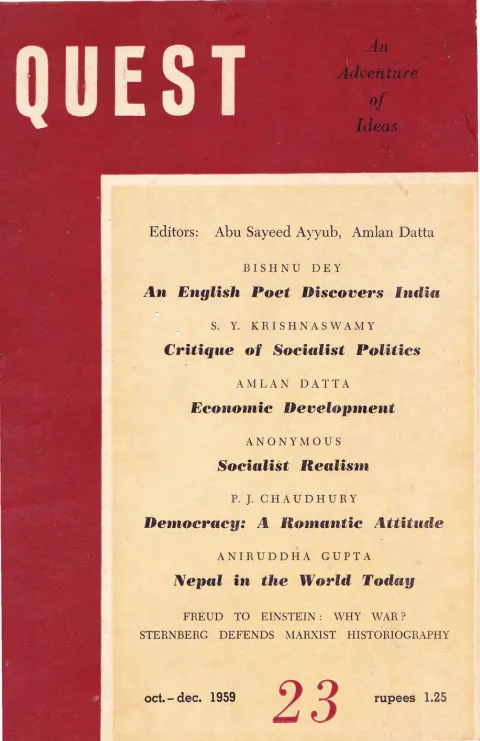
Quest
A Quarterly of Inquiry, Criticism and Ideas
By C. Rajagopalachari, Sigmund Freud, Bishnu Dey, S. Y. Krishnaswamy, Prof. Amlan Datta, P. J. Chaudhury, Aniruddha Gupta, G. V. Viswanath, C. L. Nahal, Fritz Sternberg, R. Das
QUEST is sponsored by the Indian Committee for Cultural Freedom. Printed and published by Miss Sheela Singh for the Indian Committee for Cultural Freedom, Army and Navy Building, 148 Mahatma Gandhi Rd., Bombay 1, at Inland Printers, Victoria Mills Buildings, 55 Gamdevi Road, Bombay 7. · Bombay · 1959
118 pages
Quest
Summary
Quest No. 23 (Oct.-Dec. 1959), edited by Abu Sayeed Ayyub and Amlan Datta for the Indian Committee for Cultural Freedom, is a Cold-War-era little magazine of ideas that mixes reprinted classic argument, live polemic, fiction, and book reviewing. Its spine is a 1932 exchange revived from the previous issue: Sigmund Freud’s reply-letter to Einstein on the origins of war. Around it cluster a set of contemporary Indian arguments — S. Y. Krishnaswamy’s programmatic defence of the newly founded Swatantra Party against Nehruvian planning and socialism; Amlan Datta’s Geneva conference speech on the economics of underdevelopment; P. J. Chaudhury’s essay reading the Cold War contest of democracy and communism through a romantic/classical philosophical lens; and a dense, anonymous, first-person insider dissection of Soviet ‘Socialist Realism’, printed with an editorial disclaimer about its unverifiable authorship. Fritz Sternberg’s lengthy rebuttal to Herbert Luthy’s review of his own book, and a two-part exchange between C. Rajagopalachari and ‘R. Das’ on the theory of Karma (continued into a reader’s letter signed ‘Sanjaya’), give the issue its argumentative, quarrel-driven texture. Literary content includes Bishnu Dey’s essay on English poets (especially Alun Lewis) who wrote of colonial India, a short story by C. L. Nahal, and eight book reviews covering subjects from Indian university education and American philosophy to Djilas’s Montenegrin memoir and Silone’s Italian village novel. Aniruddha Gupta’s essay on Nepal’s triangulated diplomacy among India, China and the two Cold War blocs rounds out the political content. The issue carries no separate art plates or illustrations; its only visual material is commercial advertising.
Essays
Why War?
By Sigmund Freud
A reprint of Sigmund Freud’s 1932 reply to Albert Einstein in their League-of-Nations-sponsored exchange on preventing war (Einstein’s original letter had appeared in the previous issue, Quest 22). Freud reframes Einstein’s ‘might and right’ in terms of ‘violence’, tracing how brute force is gradually supplanted by communal violence codified as law, and how larger political unions (culminating, tentatively, in the League of Nations) attempt to extend this process internationally without yet possessing enforceable executive power. He then turns to psychoanalytic theory, arguing that an innate ‘death instinct’ or aggressive drive, inseparably fused with the erotic instinct, makes the total suppression of human aggression impossible; war can at best be diverted by cultivating bonds of sentiment (love, identification) and by intellectual elites able to resist mass susceptibility to war-fever. He closes on cautious hope that the psychic changes wrought by civilization — and a well-founded dread of future weapons — are themselves working against war.
- Substitutes ‘violence’ for Einstein’s ‘might’ as the operative term; law is defined as the might of an organized community, still fundamentally violence.
- Traces the historical shift from individual to communal violence, and argues the League of Nations satisfies only the judicial, not the enforcement, half of what a supra-national authority needs.
- Introduces the erotic/destructive (‘death’) instinct pairing as the psychoanalytic root of aggression, arguing the two are always alloyed.
- Argues total suppression of aggression is impossible; the achievable goal is redirection via bonds of sentiment/identification.
- Proposes that culture’s twin effects — strengthened intellect and introverted aggression — make modern pacifism a near-‘constitutional intolerance’ of war, giving grounds for cautious optimism.
An English Poet Discovers India
By Bishnu Dey
Bishnu Dey’s essay memorializes English poets — above all Alun Lewis, killed in the Arakan campaign in 1944 — who served in India during the Second World War and whose verse registered the shock of colonial poverty and the moral burden of empire. Quoting extensively from Lewis, Vernon Watkins, John Turner, George Taylor, Reg Levy, Ralph Brooke, Douglas Gray and others, Dey traces a common movement from bewildered pity at Indian suffering toward guilt over ‘a long war of exploitation’. He reads Lewis’s late poems (from Ha! Ha! Among the Trumpets) as the fullest artistic resolution of this encounter, crediting Robert Graves’s introduction for confirming Lewis’s stature independent of Dey’s own ‘Indian loyalties’. The essay closes by quoting Lewis’s ‘Midnight in India’ in full and contrasting Lewis’s patient, empathetic engagement with India against more superficial tourist impressions (Karl Shapiro is mentioned as a later, hurried counter-example).
- Frames a cohort of British soldier-poets in wartime India (Alun Lewis, Sidney Keyes, Clive Branson, John Turner, George Taylor and others) as producing a distinct, guilt-inflected colonial poetry.
- Alun Lewis is presented as the most significant of these figures, his development cut short by his death in Arakan in 1944.
- Dey stresses that this Englishman’s discovery of India’s poverty and his own status as ‘an outsider, an intruder’ produced poetry of unusual honesty rather than false consolation.
- Robert Graves’s endorsement of Lewis is invoked as external confirmation against the suspicion that Dey’s admiration is mere ‘Indian loyalty’.
- Contrasts Lewis’s slow, humble engagement with India against hurried modern tourist-poets like Karl Shapiro.
A Critique of Socialist Politics
By S. Y. Krishnaswamy
Printed with an editorial preface disclaiming Quest’s endorsement, S. Y. Krishnaswamy’s essay (headed on the page itself ‘The Swatantra Party: A Restatement of Political Ideals’, though the contents page bills it ‘A Critique of Socialist Politics’) surveys the historical stages of Western socialist thought — minimum-wage collective action, Fabian nationalisation, Keynesian planning, and the postwar Welfare State — before arguing that each has proven unworkable or is being questioned even in its Western homelands. He then argues India, fifty years behind and imitating a discredited Fabian model, should instead build on the newly formed Swatantra Party’s programme: support for the small self-sufficient farmer against cooperative/collective farming, opposition to land ceilings, controlled but private-led industry, reduced taxation to spur saving and investment, and reliance on traditional trusteeship and private charity rather than state welfare. He closes by rejecting the labels ‘Rightist’ as inherently damning and blaming Congress-led planning for inflation, corruption and an over-centralised state.
- Surveys four historical stages of Western socialism (minimum wage/collective bargaining, Fabian nationalisation, Keynesian planning, Welfare State) and argues each has run into contradictions even in the West.
- Frames the Sanskrit ‘Swatantra’ as meaning ‘responsible to oneself’ rather than merely ‘freedom from’ compulsion.
- Argues India’s poverty makes state-directed planning self-defeating: taxation/expropriation shrinks the very capital needed for growth, fuelling inflation.
- Lays out the Swatantra Party’s agricultural policy: oppose land ceilings and cooperative farming; support the independent small farmer with credit, seed, and land-transfer facilitation instead.
- Criticises Indian state enterprises (Life Insurance Corporation, State Trading Corporation) as inefficient and politically captured.
- Argues traditional trusteeship/private charity, not state welfare, has historically sustained India’s poor, and that heavy taxation is drying up this source.
A Note on Economic Development
By Amlan Datta
The text of a speech Amlan Datta delivered to the World Economic Conference of Free Trade Unions in Geneva (March 1959). He lays out three structural facts about underdeveloped economies: the vast and widening income gap between rich and poor nations, and the way global economic instability hurts the poor disproportionately (terms of trade worsen for them in recessions). He argues that, unlike 19th-century Western industrialisers, today’s developing countries have comparatively strong trade unions, making the historical strategy of holding wage growth below productivity growth politically untenable unless paired with visible shared sacrifice: progressive taxes (India’s expenditure and wealth taxes are cited), public education about the reasons for austerity, and real consultative machinery for unions. He closes arguing that closing the North-South gap is not merely charity but essential to preserving both democracy and ‘certain basic values of civilisation’, citing the modest 1.5% of advanced-country income that meeting the projected aid need would require.
- Cites 30x per-capita income gap (US vs. India) and a widening two-thirds/one-third world income split favouring the wealthy sixth of humanity.
- Argues that in a downturn the terms of trade worsen for poor countries precisely when they can least bear it, unlike for rich countries.
- Contrasts today’s developing countries (strong trade unions) with 19th-century Western industrialisers (weak or illegal unions), making wage-restraint policy require union buy-in rather than coercion.
- Recommends three concrete mechanisms: proportionally heavier taxation of the rich, public education about the transition’s necessity, and consultative bodies bringing unions into policy-making.
- Rejects blame-shifting rhetoric (‘the poor are poor because they are lazy’) and reframes aid to the developing world as necessary to keep development compatible with democracy.
Democracy: A Romantic Attitude
By P. J. Chaudhury
P. J. Chaudhury (Pravas Jivan Chaudhury) argues that the Cold War contest between democracy and communism is a political expression of a deeper cultural opposition between ‘romantic’ and ‘classic’ temperaments. He surveys physics (post-Heisenberg indeterminacy), philosophy (pragmatism, phenomenology, existentialism), literature (Joyce, Woolf, Proust; neo-romantic poetry that prizes evocation over intelligibility) and religion (a modern turn from dogma toward raw mystical experience) and finds each discipline has, in his reading, tilted from classical order toward romantic acceptance of mystery, contingency, and individual freedom. Since democracy, unlike communism’s classical faith in a rationally planned social order, exalts the individual as mysterious and irreducible, he concludes democracy is ‘instrumentally’ favoured to prevail in the present cultural moment — while conceding the verdict is only provisional, since human knowledge remains an ‘open system’.
- Defines classic and romantic as ideal types: classic seeks order, intelligibility and communicable form; romantic accepts mystery, individuality and the ineffable.
- Surveys physics, philosophy, literature and religion and argues each now shows a dominant romantic tendency (quantum indeterminacy, existentialism, stream-of-consciousness fiction, anti-dogmatic religion).
- Maps democracy onto the romantic pole (individual as primary, mysterious, an end in itself) and communism onto the classic pole (society as primary, rationally planned, uniform).
- Concludes the era’s cultural verdict favours democracy over communism, but insists this is a contingent, temporary judgment, not an absolute proof.
Nepal in the World Today
By Jawaharlal Nehru
Aniruddha Gupta analyses Nepal’s foreign policy as caught between deep cultural and political dependence on India and a genuine popular fear of Indian ‘expansionism’. He surveys sources of Nepalese resentment (Indian check-posts, the 1950 trade treaty, remodelling of the Nepalese army, minor diplomatic incidents) that opposition parties exploit, and sets this against the deepening India-China tension after 1959, which has pushed Nepal’s monarchy to lean on India for security even as it costs the government domestic popularity. He traces Nepal’s countervailing ‘world consciousness’ strategy — UN membership, new missions in the US, USSR, Japan and elsewhere, aid from all major Cold War powers — as an attempt to escape overdependence on either giant neighbour, concluding that Nepal may eventually achieve a Swiss-style neutrality if given time.
- Nepal is culturally and administratively closely tied to India (Hindu law, Sanskrit-derived language, Indian-educated leadership) yet politically wary of Indian influence.
- Lists specific grievances driving anti-Indian sentiment: border check-posts, the 1950 trade treaty, army remodelling, and incidents involving Indian embassy staff.
- The Nehru-Koirala joint communique (June 1959) on Tibet was attacked by Nepal’s opposition United Front and Communist Party as compromising Nepalese neutrality.
- Nepal has cultivated relations with China, the US, and USSR simultaneously to reduce dependence on any one power, while remaining wary of Chinese-backed subversion.
- Concludes Nepal’s best long-term strategy is a ‘policy of intelligent non-commitment’ modelled on Swiss neutrality.
The Novels of Somerset Maugham
By G. V. Viswanath
G. V. Viswanath argues that Somerset Maugham’s enormous popular success and his critics’ persistent refusal to take him seriously are two sides of the same coin: his ‘slick’ technique and cynical, reductive view of human nature (illustrated via Cakes and Ale, The Moon and Sixpence, Rain, Of Human Bondage and The Razor’s Edge) offer readers an easy, low-cost sense of having ‘seen through’ life, but this same simplification prevents his fiction from reaching the depth of contemporaries like Henry James, Conrad, Joyce or Lawrence. Viswanath extends the critique to Maugham’s own stated theory of prose style (from The Summing Up), arguing Maugham’s preference for ‘rococo’ clarity over poetic depth is really a post-hoc justification of his own limits — limits he nonetheless used skilfully to produce lucid, widely readable prose.
- Maugham is immensely popular with general readers but has attracted almost no serious critical attention, a gap the essay treats as itself significant.
- Argues his cynical ‘realism’ functions as reassurance/armour: if humanity is assumed base, one cannot be disappointed by it.
- Surveys his major novels (Cakes and Ale, The Moon and Sixpence, Of Human Bondage, The Razor’s Edge) as variations on this simplifying view of human nature.
- Disputes Maugham’s own theorised distinction between ‘rococo’ prose and ‘baroque’ poetry as self-serving rather than a genuine account of style.
- Concludes Maugham’s popularity rests precisely on the limitations that keep him out of the first rank of his era’s novelists.
Socialist Pealism
By Anonymous
Printed anonymously with an editorial note explaining that the author’s identity cannot be verified or disclosed for the writer’s safety, this long essay — taken (abridged) from a French translation supplied by Soviet Survey — dissects Socialist Realism from inside Soviet literary culture. It defines the doctrine via the 1934 Union of Soviet Writers statute, argues it structurally guarantees every work an ideologically ‘happy ending’ oriented toward the Communist ‘End’, and traces its ‘positive hero’ type from Gorki onward. The essay narrates a shift from the romantic exuberance of the immediate post-Revolutionary period to a rigid, cliche-bound ‘classicism’ by the 1930s, argues the death of Stalin removed the system’s quasi-religious center without a viable replacement (Lenin being ‘too realistic’ a figure to sustain the same cult), and closes by hoping for a ‘phantasmagorical’ art of the grotesque and absurd (invoking Hoffmann, Dostoevsky, Goya, Chagall, and Mayakovsky) as literature’s only escape from the exhausted realism/classicism impasse.
- Defines Socialist Realism via its 1934 statute: truthful depiction of reality ‘in its revolutionary development’, serving ideological education toward communism.
- Argues every work of Socialist Realism is guaranteed a happy ending relative to the Communist ‘End’, contrasting Western titles of despair with Soviet titles of triumph.
- Traces the ‘positive hero’ archetype from Gorki’s early plays through to its saturation of 1930s-50s Soviet fiction, replacing the 19th-century ‘useless man’ (Onegin, Pechorin, Rudin) as protagonist.
- Narrates a shift from ‘revolutionary romanticism’ in the 1920s to rigid ‘classicism’ by the 1930s-50s, illustrated with parodic quotation from a mediocre 1949 novel.
- Blames the death of Stalin for depriving Soviet culture of its quasi-religious icon, since Lenin was ‘too much like an ordinary man’ to fill the same role.
- Concludes hoping for a future ‘phantasmagorical’ art of the grotesque as an escape from exhausted realism and classicism alike.
Mother
By C. L. Nahal
C. L. Nahal’s short story is narrated by a reserved academic, ‘Prehlad’, reunited after a decade with his boisterous, cynical old schoolfriend Janak for a hitch-hiking holiday to Rishikesh. Janak’s crude, mocking attitude toward the sacred town and his lascivious fixation on a pregnant fellow-guest, the young wife of an aristocratic Kashmiri ‘zamindar’, culminate when the two men secretly watch the couple through a door. What they witness — the husband addressing his wife tenderly as ‘Mother’ while she plans names and futures for their unborn child — is a scene of unexpected purity that silences Janak’s cynicism. When the wife dies suddenly in premature labour, the narrator is left permanently shaken: the woman’s death, following that glimpsed tenderness, becomes a private crisis of faith rather than of desire.
- Sets up temperamental contrast between the bookish narrator and his crude, philandering old friend Janak, reunited for a hitch-hiking trip to the pilgrimage town of Rishikesh.
- Janak’s voyeuristic anticipation (‘It would be fun sleeping with her these days’) is undercut by what the two men actually witness: tender, chaste intimacy between the pregnant woman and her husband, who calls her ‘Mother’.
- The overheard scene includes the couple’s hopeful planning for their unborn son’s future (engineer, then doctor) and mutual prayer.
- The wife dies of complications in premature labour that same night, an abrupt reversal that devastates both men.
- The narrator reports the episode ‘made me a disbeliever’, closing doors in his mind that remain closed ‘till today’ — an ambiguous, unresolved note rather than a moral lesson.
The Future of World History
By Fritz Sternberg
Fritz Sternberg’s lengthy rejoinder to Herbert Luthy’s review (in an earlier Quest issue) of his book Capitalism and Socialism on Trial. Sternberg defends his central thesis that Marx’s own analysis, being confined to European capitalism, must be extended by later Marxists to cover capitalism’s global expansion (including imperialism and American continental expansion), arguing this expansion decisively softened labour-market pressures and economic crises in the metropolitan centres — contra Luthy’s charge that this is an ad hoc ‘Marxist’ excuse invented after the fact. He defends his claim that Anglo-German industrial imbalance was the primary cause of the First World War (citing Lenin’s ‘uneven development’ thesis without endorsing German policy), and rebuts Luthy’s claims about pre-war British prosperity with data on stagnant pig-iron output and real wages. A concluding section argues Marxist method, while inadequate as mechanically transplanted, remains the best available tool for analysing newly independent Asian societies, and firmly denies that the Soviet Union’s state ownership of production makes it a ‘socialist’ state in Marx’s own sense of the term.
- Argues Marx’s completed analysis (much of ‘Capital’ and ‘Theories of Surplus Value’ appeared only posthumously) was explicitly confined to European capitalism, not a universal theory automatically covering the USA or Asia.
- Defends the thesis that capitalist/imperialist outward expansion (to India, colonies, and the American continent) materially eased labour-market pressure and postponed crises in the metropolitan core — rebutting Luthy’s charge that this is invented Marxist apologetics.
- Reasserts that the Anglo-German industrial imbalance, not merely ‘general prosperity’, was the decisive cause of the First World War, citing Lenin’s law of uneven development and Engels’s prescient 1891 warning of a 15-20 million-man war.
- Argues post-independence Asian societies need a fresh (not mechanically transplanted) Marxist analysis of their own developmental trajectory.
- Firmly denies the Soviet claim to be a ‘socialist state’, arguing state ownership of production alone does not satisfy Marx’s own definition of socialism, and that Capitalism/Socialism are not the only two possible social-economic organisms.
Karmavada
By C. Rajagopalachari
C. Rajagopalachari responds, at the editor’s invitation, to Dr. Rashbehari Das’s earlier Quest article questioning the theory of Karma. He argues Das has not adequately engaged Kant’s concept of happiness, defends the idea of the soul as existing apart from the body as a precondition for morality and for transmigration, and argues the law of Karma rests on causality plus rebirth independent of the separate question of divine justice. He also argues that repentance is itself an act with Karmic effects, so ‘Divine Grace’ following repentance is fully compatible with the law of Karma, and that Karma properly understood need not diminish compassion for others’ suffering.
- Responds point-by-point to Dr. Das’s prior published objections to the theory of Karma.
- Argues happiness is an inherent quality of virtue and that Das has mischaracterised Kant’s position on happiness and morality.
- Defends the soul’s existence apart from the body as necessary for both morality and the theory of transmigration.
- Argues repentance is itself a karmic act, so subsequent Divine Grace is not negated by, but operates through, the law of Karma.
- Rejects the claim that belief in Karma need make one hard-hearted toward others’ self-caused suffering.
Essay 12
By R. Das
R. Das replies to Rajagopalachari’s comments (the contents page lists no separate title for this entry; the piece itself is headed ‘The Theory of Karma and its Difficulties — 2. Reply’, and a later reader’s letter refers to it as ‘A Critique of Karmavada’). Written with self-deprecating deference to Rajagopalachari’s seniority, Das disputes the claimed equivalence of cause and effect, argues (via Kant’s Groundwork) that happiness is not analytically part of virtue, questions whether the self can be said to exist ‘apart from’ the body, and denies that the law of causality — which governs only the phenomenal, spatio-temporal world — can license belief that a moral (spiritual) act produces material happiness. He maintains his original objection that the doctrine of Karma tends, psychologically, to weaken sympathy for those seen as suffering through their own past misdeeds.
- Frames his reply with explicit deference to Rajagopalachari’s age and standing, professing reluctance to ‘controvert’ him.
- Disputes that cause and effect are equivalent in the relevant sense, using the example of a spark and an explosion.
- Cites Kant’s Groundwork of the Metaphysic of Morals to argue happiness is not analytically contained in the concept of virtue.
- Argues the law of causality applies only within the phenomenal, spatio-temporal world and cannot license the claim that a spiritual act (a moral choice) produces material happiness.
- Reaffirms that treating suffering as justified by past-life misdeeds risks weakening natural human sympathy for the sufferer.
General Education and Indian Universities
By A. B. Shah
A. B. Shah reviews G. D. Parikh’s General Education and Indian Universities, praising Parikh’s chapter defining ‘General Education’ as timely and important for reconciling India’s push for rapid technological development with the risk of authoritarian misuse of that same technology, given India never underwent a liberating cultural ‘renaissance’ comparable to pre-industrial Europe’s. Shah endorses Parikh’s rejection of the liberal/technical and liberal/illiberal education antitheses, but suggests the first practical step must be reorienting India’s own teachers before curricular reform can succeed. He raises two minor factual objections (on ancient Indian female education and on Macaulay) but concludes the book deserves comparison to the Harvard Committee’s Report on General Education in a Free Society.
- Frames General Education as urgently needed to prevent modern technology’s power from being turned to authoritarian ends in a society lacking a prior cultural ‘renaissance’.
- Endorses Parikh’s rejection of the liberal/technical and liberal/illiberal dichotomies in curriculum design.
- Argues India’s more pressing first step is teacher reorientation, since curricular reform cannot succeed without teachers who understand General Education’s purpose.
- Raises two specific factual quibbles: Parikh’s claim about the ‘catholicity’ of ancient Indian female education, and his criticism of Macaulay for not integrating Western and indigenous learning traditions.
- Concludes the book is a serious achievement worthy of comparison to the Harvard Report on General Education in a Free Society.
American Philosophers at Work
By A. M. Ghose
A. M. Ghose reviews Sidney Hook’s edited volume American Philosophers at Work, first sketching why American philosophy was historically overshadowed by German scholarship until William James, C. S. Peirce and later European emigres (Carnap, Cassirer, Reichenbach and others) established a distinct, anti-metaphysical, analytically-minded American tradition. He surveys the volume’s three sections (Logic and Scientific Method; Metaphysics and Theory of Knowledge; Ethics and Social Philosophy), highlighting essays by Carnap, Quine, Goodman, Nagel, Kaplan, Northrop and Weiss as particular strengths, while noting the conspicuous absence of thinkers working on Cassirer, Husserl or Kierkegaard. He concludes the volume is a reliable, lucid guide to the contemporary American philosophic scene, if not quite the ‘encyclopaedia’ its blurb claims.
- Explains American philosophy’s historical obscurity as a function of 19th-century German academic prestige, reversed only by James, Peirce, and later European emigre scholars.
- Surveys the volume’s three sections and singles out essays by Carnap, Quine, Goodman, Nagel, Kaplan, Morris and Northrop as strongest.
- Notes stylistic contrast between technical essays for specialists and more accessible essays on ‘matters of public interest’ aimed at educated laymen.
- Criticises the collection’s gap: no essays engaging Cassirer, Husserl, or Kierkegaard despite their influence on American thought.
- Concludes the book is a reliable guide to, though not a full encyclopaedia of, the contemporary American philosophic scene.
In Search of Identity
By Sachin K. Roy
Sachin K. Roy reviews In Search of Identity by John W. Bennett, Herbert Passin and Robert K. McKnight, a study of Japanese students who studied in America (the amerika-ryugakusei) and their adjustment to, and ambivalence about, American culture before and after the Second World War. Roy summarises Japan’s modernisation history since the Meiji Restoration, the class stratification between Imperial-University and other graduates, and the authors’ findings that Japanese students grew both attracted to and critical of American values (efficiency without depth, McCarthyism, and postwar rearmament policy). He raises methodological objections — a small, non-representative sample (45 of over 1,200 students), exclusion of Japanese educated in Europe — but concludes the book is a valuable, if narrowly titled, study best described as ‘The Experience of Japanese Students in America’.
- Frames the book as addressing whether parliamentary democracy can succeed in Asia via the lens of Western-educated Japanese elites.
- Sketches Japan’s isolation, forced opening by Commodore Perry, and rapid Meiji-era modernisation as background to the students’ identity crisis.
- Notes returning students were often frustrated and marginalised unless they had attended Japan’s Imperial University, sometimes radicalising them.
- Summarises findings that Japanese students both admired American power/efficiency and criticised its lack of ‘depth and repose’, its racial discrimination and McCarthyism.
- Criticises the study’s small, unrepresentative sample (45 of 1,294 students in 1953-54) and its exclusion of Japanese students educated in Europe.
Land without Justice
By David McCutchion
David McCutchion reviews Land without Justice, Milovan Djilas’s memoir of his Montenegrin childhood, reading it as a portrait gallery of a violent, blood-feud-bound tribal society transitioning slowly toward modern civilisation. He highlights Djilas’s unsentimental but compassionate treatment of brutal figures alongside gentler ones (his grandmother, aunt, uncle, the eccentric teachers of his schooldays), and connects the fierce independence of Montenegrin clan culture to Tito’s later Partisans. McCutchion judges the book stylistically episodic — a series of vivid portraits rather than a sustained narrative — but finds it achieves coherence through Djilas’s own consistent, humane presence and his ‘passionate desire for justice and happiness’.
- Frames the book as a portrait of Djilas’s native Montenegro — a ‘land without recourse’ — through the people of his childhood and youth.
- Describes the brutal blood-feud culture (his aunt’s memory of retrieving her murdered father’s head; his uncle who beat his family) as normalised violence Djilas neither excuses nor fully condemns.
- Notes Djilas’s ambivalent, ‘sneaking sympathy’ even for violent figures like the police thug Bosko Boskovic.
- Connects the fierce, outlaw independence of Montenegrin clan culture to the later emergence of Tito’s Partisans.
- Judges the book structurally episodic (a portrait gallery rather than sustained narrative) but coherent through Djilas’s own humane, consistent narrating presence.
Prehistoric background of Indian Culture
By H. D. Sankalia
H. D. Sankalia reviews Col. D. H. Gordon’s The Prehistoric Background of Indian Culture, welcoming a book-form synthesis of thirty years of the author’s specialist writing on Indian archaeology aimed at scholars without journal access. Sankalia praises the chapter on rock shelters as the best treatment of the subject by any scholar, Indian or foreign, but criticises the omission of India’s earliest Stone Age cultures (Sohanian and Handaxe) and warns readers to accept the newer, lower Carbon-14 dates for sites like Nevasa and Navdatoli despite lingering doubts about radiocarbon accuracy amid nuclear testing, since they point toward an Iranian-linked migration possibly identifiable with the Aryans.
- Frames Indian archaeology as a broader, more evidence-based corrective to purely textual (Rig Vedic) accounts of Indian culture’s origins.
- Praises the book’s chapter on rock-shelter paintings and engravings as the best available treatment of the subject.
- Criticises the omission of a description of India’s earliest Stone Age (Sohanian and Handaxe) cultures.
- Endorses new Carbon-14 dates for Nevasa, Navdatoli and Kotdiji as fairly accurate despite fears about nuclear-testing interference with radiocarbon dating.
- Notes these dates suggest an Iranian-connected population movement plausibly linked to the Aryans, meaning the book will need revision as archaeological work continues.
Sotto Voce
By “Chitragupta”
Writing under the pseudonym ‘Chitragupta’, a Madras journalist reviews Sotto Voce, a collection of the pseudonymous ‘Vighneswara’ (N. Raghunathan)‘s witty newspaper columns from the ‘Swatantra’ and ‘Swarajya’ weeklies, covering the years around Indian independence. The reviewer admires Vighneswara’s allusive, stylistically brilliant prose (comparing it to Lamb, Milton, Sir Thomas Browne and R.L.S.) but is sharply critical of the substance of his views, calling him more prejudiced than wise: Vighneswara is shown mourning the decline of caste-bound village institutions, opposing the legal abolition of untouchability and temple-entry for Harijans (which he reportedly calls ‘a form of sadism’ and ‘morbid’), and opposing Hindu Law reforms permitting divorce and monogamy. The review concludes he is best appreciated as a stylist rather than mistaken, as some readers do, for a serious moralist.
- Identifies ‘Vighneswara’ as the pen-name of a now-retired Hindu leader-writer, active 1946 onward in the Swatantra and Swarajya weeklies.
- Praises Vighneswara’s prose style as allusive and scholarly, comparable to Lamb, Milton, and Sir Thomas Browne.
- Sharply criticises his social views: he is reported opposing the abolition of untouchability and Harijan temple-entry, and Hindu Law reform permitting monogamy and divorce.
- Argues readers mistake his ‘barbed wit’ for ‘mellowed wisdom’, elevating a satirist to unwarranted status as a serious moral authority.
- Judges his best writing to be his more personal, nostalgic vignettes rather than his social polemics.
Oedipus and Job in W. African Religion
By Vatsala Rao
Vatsala Rao reviews Meyer Fortes’s Oedipus and Job in West African Religion, praising its clear demonstration of parallels between the Oedipus and Job stories and Tallensi (Tale) ancestor-worship, but questioning Fortes’s heavy reliance on ‘social structure’ as sole explanation. Rao argues the psychoanalytic Oedipal dynamic — repressed resentment of sons toward ageing fathers — better explains why Tale ancestors are invested with such power for good or ill than Fortes’s account of Tale fathers as simultaneously kind and despotic. She notes the book’s own account of ancestor-worship as a device letting people accept responsibility for outcomes while feeling free of blame, wondering aloud whether an institution rooted in hatred could really serve such a therapeutic function.
- Praises Fortes’s demonstration of resemblance between Oedipus, Job, and Tallensi ancestor-worship as well-supported and clearly written.
- Objects that Fortes over-relies on ‘social structure’ to explain ancestor-worship’s psychological power.
- Notes an apparent contradiction in Fortes’s own account of Tale fathers as both kind-hearted and ‘task-masters and minor despots’.
- Argues the psychoanalytic Oedipal dynamic (repressed son’s resentment) better explains the ancestors’ perceived power than social-structural analysis alone.
- Questions whether ancestor-worship, if rooted in repressed hatred, can really provide the ‘mental hygiene’ benefit Fortes claims for it.
The Secret of Luca
By Kobita Sarkar
Kobita Sarkar reviews Ignazio Silone’s The Secret of Luca, a village novel with detective-story tension: two men return the same day to their native village — Luca Sabatini, freed after an unjust prison term, and Andrea Cipriani, a successful local political leader — and receive opposite receptions. Andrea investigates the forty-year-old mystery of Luca’s silence rather than accept the villagers’ adulation, encountering hostility as he does so. Sarkar praises Silone’s vivid, authentic depiction of village life and ethics (drawing on his own Abruzzi origins) and Luca’s serene refusal to defend himself, judging the book compassionate and absorbing, if less intellectually complex than other neo-Realist Italian fiction given its peasant, non-intellectual characters.
- Sets up the novel’s central contrast: Luca Sabatini, unjustly imprisoned and now shunned, versus Andrea Cipriani, a celebrated returning political leader who instead pursues Luca’s story.
- Notes the novel’s detective-story structure, with Andrea’s investigation meeting hostility from villagers and bureaucrats alike.
- Praises Silone’s authentic depiction of Italian village ethics, attributed to his own origins in a village in the Abruzzi mountains.
- Frames the novel as part of the Italian neo-Realist school but less intellectually complex, since its central characters are peasants rather than intellectuals.
- Concludes the novel’s emphasis on compassion over ideology or plot mechanics makes it an absorbing, sympathetic read.
Essay 21
A reader’s letter signed ‘Sanjaya’, printed under the ‘Correspondence’ heading (which the contents page lists only as a bare section title, without any item or page number — this letter is therefore not on the printed contents page at all). Responding to the Rajagopalachari/Das exchange on Karma (‘the one for its refreshing directness and frankness of approach, the other for the way it circles round and round and never reaches the point’), Sanjaya argues that religion in practice functions to keep people passive and hopeful of reward only ‘in the other world’, citing the Inquisition’s persecution of Bruno and Galileo and religion’s historical complicity in caste-based degradation. The letter concludes that a secular state is not less moral than a religious one for excluding religious considerations from policy, and is in fact more consistent with human dignity.
- Explicitly reacts to both Rajagopalachari’s ‘The Province of Religion’ and R. Das’s ‘A Critique of Karmavada’ from earlier in this same issue.
- Argues religion in practice discourages worldly discontent by displacing hope onto a life beyond, regardless of its stated ideals.
- Cites the Inquisition’s treatment of Bruno and Galileo, and religion’s historical role in sustaining caste-based ‘untouchability’, as evidence of this practical effect.
- Concludes a secular state’s exclusion of religious considerations from policy is not a moral deficiency but an improvement over religious governance.
- Is a substantive, unlisted item: the contents page’s ‘Correspondence’ section heading carries no title, byline, or page number for it.
Generated by the v1.5 extraction pipeline. Awaiting editorial review.
Metadata and summary are AI-extracted from the source PDF and reviewed for editorial accuracy. The original work is available via the Read PDF tab above (where present); paragraph-level citation inside the PDF is deferred to a future engagement.
People in this work
- C. Rajagopalachariauthor
- Sigmund Freudauthor
- Bishnu Deyauthor
- S. Y. Krishnaswamyauthor
- Prof. Amlan Dattaauthor
- P. J. Chaudhuryauthor
- Aniruddha Guptaauthor
- G. V. Viswanathauthor
- C. L. Nahalauthor
- Fritz Sternbergauthor
- R. Dasauthor
- Abu Sayeed Ayyub
- Nirad C. Chaudhuri
- Sudhin Datta
- Laxmanshastri Joshi
- A. B. Shah
- Sheela Singh
- A. M. Ghose
- Sachin K. Roy
- David McCutchion
- H. D. Sankalia
- Chitragupta
- Vatsala Rao
- Kobita Sarkar
- Immanuel Kant
- Jawaharlal Nehru
- Karl Marx
- Milovan Djilas