
periodical issue
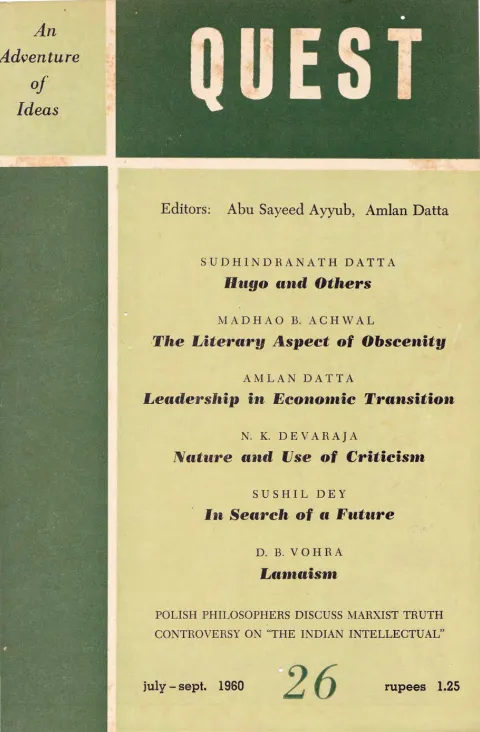
Quest
A Quarterly of Inquiry, Criticism and Ideas
By Sudhin Datta, Madhao B. Achwal, N. K. Devaraja, Sushil Dey, D. B. Vohra, Kirti N. Chaudhuri, L. Kolakowski, Adam Schaff, R. de Loyola Furtado, Amaresh Datta, Keshev Malik, Lila Ray, Jeremy Nelson, Jai Nimbkar, Vinod Sena, Gangadhar Gadgil, Sadhan Kumar Ghosh, Ellen Roy, Rhona Ghate
Printed and published by Miss Sheela Singh for the Indian Committee for Cultural Freedom, Army and Navy Building, 148-Mahatma Gandhi Rd., Bombay 1, at Inland Printers, Victoria Mills Buildings, 55 Gamdevi Road, Bombay 7. · Bombay · 1960
118 pages
QUEST
Summary
Quest No. 26 (July-September 1960) is a wide-ranging quarterly issue combining literary criticism, political-economic argument, poetry, fiction, historiography, an in-depth rebuttal of Edward Shils’ sociological study of the Indian intellectual, reportage on a seminar on literary obscenity, an extended translated Polish philosophical polemic on Marx’s theory of truth, a substantial book-reviews section, and correspondence. Its editorial marks two years under Abu Sayeed Ayyub and Amlan Datta and restates the magazine’s identity as a ‘journal of ideas’ (its motto drawn from Whitehead’s Adventures of Ideas) rather than a magazine of creative arts, while defending the continued inclusion of poetry and short fiction. The issue’s centre of gravity is the debate, across several pieces, about India’s cultural and intellectual condition after independence — from Sudhindranath Datta’s essay on Victor Hugo and Madhao Achwal’s theory of literary obscenity, to Amlan Datta’s argument against a rigid capitalism/socialism dichotomy of property, to Vinod Sena’s long counter-statement to Edward Shils on the ‘dilemmas of the Indian intellectual,’ which argues that British colonial education created a lasting cultural dualism that only a revival of indigenous tradition (as in Vivekananda, Tagore and Gandhi) can resolve. Two Warsaw-based Marxist philosophers, Leszek Kolakowski and Adam Schaff, contribute a translated exchange on the epistemology of the young versus the mature Marx. The issue closes with reportage on a Bombay seminar on obscenity in literature, a discursive books column, six book reviews (on Indian modern art, Tagore translations, a Tamil novel, African nationalism, an American poet, and a Churchill pictorial biography), and two letters continuing earlier debates on the Swatantra Party and on Shils’ essay.
Essays
Editorial
An unsigned editorial (voiced collectively by editors Abu Sayeed Ayyub and Amlan Datta) marking two years since they took over Quest, restating and amplifying the policy statement first laid down in Quest 17 (April-June 1958). It defends the magazine’s ‘heavier fare’ against complaints that Quest is too heavy or insufficiently bright, and diagnoses India’s ‘tragic lack of realisation of the value of cultural freedom’ as arising from three causes: a long tradition of authoritarianism that has ‘prepared the soil’ for totalitarianism, a poverty so severe that freedom of culture seems an ‘expendable quantity,’ and the deeper claim that India has ‘ceased to possess a living culture’ in the realm of ideas even while its ancient heritage remains alive. It sets out Quest’s self-appointed role in ‘cultural revitalisation,’ argues that English — though not a plausible medium for Indian creative literature — is nonetheless the necessary common language of Indian thought pending the maturing of the regional languages, and a postscript explains why the magazine nonetheless retains poetry and short fiction sections.
- Marks two years since Ayyub and Datta’s editorship began, citing Quest 17 (April-June 1958) as the founding policy statement.
- Restates Quest’s identity as ‘a quarterly journal of enquiry, criticism and constructive thought’ rather than ‘a bimonthly of arts and ideas.’
- Diagnoses India’s lack of cultural freedom to three causes: authoritarian tradition, poverty-driven indifference, and a ‘dead’ contemporary culture of ideas.
- Argues English cannot be a natural creative medium for Indians but remains indispensable as the common language of Indian thought.
- Reveals the magazine’s motto is drawn from Whitehead’s Adventures of Ideas.
- Postscript defends retaining poetry and short-story sections despite scepticism about creative writing in English or in translation.
Hugo and Others
By Sudhindranath Datta
Marking the seventy-fifth anniversary of Victor Hugo’s death, Sudhindranath Datta mounts a defence of Hugo’s ‘absolute greatness’ against a modern reader’s instinctive coolness toward him. He catalogues Hugo’s personal moral inconsistencies (romantic promiscuity, bourgeois possessiveness toward his wife, political opportunism) at length, then argues that a great writer’s very faults ‘rescue him from oblivion’ by first provoking and then converting critical hostility. The essay ranges comparatively across Racine, Tagore, Baudelaire, Mallarme, Rimbaud (via J. M. Cohen’s Poetry of this Age), Lorca, Yeats and Tennyson, using Hugo’s visual imagination, vast vocabulary and formal daring as the true grounds of his stature, and closes by proposing three possible objective standards of criticism — endurance, intention, and the gap between aim and achievement — any one of which, Datta argues, secures Hugo’s place among the immortals.
- Marks Hugo’s seventy-fifth death anniversary and recalls the scale of his 1885 funeral.
- Catalogues Hugo’s personal ‘inconsistency between words and deeds’ at length before arguing this does not diminish his poetic achievement.
- Compares Hugo’s visually organised imagination explicitly to Tagore’s, finding Hugo achieves a pictorial unity Tagore’s Bengali seldom attains.
- Uses J. M. Cohen’s Poetry of this Age to discuss Lorca’s and Yeats’s compression of imagery against Hugo’s more expansive method.
- Contrasts Hugo’s Le Cimetiere d’Eylau with Tennyson’s Charge of the Light Brigade as poetry versus propaganda on the same patriotic theme.
- Concludes that time’s test, sincerity of intention, or the distance between aim and achievement would each independently establish Hugo’s greatness.
The Literary Aspect of Obscenity
By Madhao B. Achwal
Madhao B. Achwal argues that obscenity is fundamentally an extra-literary, sociological category rather than an aesthetic one: literature can only be judged artistic, inartistic, or non-artistic, never moral or immoral, because its content is ‘a-moral.’ A literary work succeeds when its elements are organised into a ‘dynamic equilibrium’ that creates the illusion of life; obscenity results not from the choice of sexual subject matter but from bad art — content used purely for ‘sense-stimulating’ effect rather than integrated into an aesthetic whole. He tests the theory against Lady Chatterley’s Lover (saved from obscenity by its ‘predominant mood’ of protest), Madame Bovary, James Jones’ From Here to Eternity, and Moravia’s Time of Indifference, and closes by arguing that positive cultivation of aesthetic consciousness, not negative legal suppression, is the only real remedy for obscenity.
- Defines obscenity as a ‘social fact’ rather than an ‘aesthetic fact,’ making it an extra-literary category.
- Argues a literary work is one whose internal tensions reach a perceptible ‘dynamic equilibrium.’
- Uses Lady Chatterley’s Lover, From Here to Eternity, Madame Bovary and Time of Indifference as test cases distinguishing artistically ‘inevitable’ content from gratuitous sense-stimulation.
- Coins the memorable formula distinguishing the artistically justified nude from ‘the nude with socks.’
- Concludes that society’s laws on obscenity have so far been ‘entirely negative’ and recommends cultivating positive aesthetic consciousness instead.
Economic Transition and the Concept of Property
By Amlan Datta
Amlan Datta challenges the Marxist habit of treating ‘capitalism’ and ‘socialism’ as an absolute dichotomy of proprietorship versus expropriation, arguing that in practice property is always ‘a bundle of finely adjusted rights’ shared among individuals, groups and the state, so that ‘absolute proprietary rights exist only as a legal fiction.’ He surveys Yugoslav market-socialist ‘revisionism’ and Gandhian trusteeship as alternatives to the rigid dichotomy, then turns to a comparative study of economic leadership in transition: Japan’s Meiji-era samurai-led modernisation, which drew on traditional prestige to win the peasantry’s consent with a minimum of social dislocation, is contrasted with the Bolsheviks’ post-1917 leadership, alien to the peasantry and reliant on terror to force collectivisation. Datta concludes that transitions succeed with least waste when a society’s economic, political and intellectual leaderships remain distinct yet mutually reinforcing, and warns that any ‘absolutist’ concept of property — recognising only unlimited private or state ownership — tends to concentrate power dangerously.
- Argues Marxist and non-Marxist historians’ stage-theories of economic development do not actually correspond neatly to each other.
- Property in practice is ‘a bundle of finely adjusted rights’ among multiple parties, not an absolute; ‘absolute proprietary rights exist only as a legal fiction.’
- Cites Yugoslav market-socialism and Gandhian trusteeship as evidence that the capitalism/socialism dichotomy is dissolving in practice.
- Contrasts Japan’s Meiji Restoration (traditional leadership evolving with peasant consent) with the Bolshevik Revolution (alien leadership relying on terror against the peasantry) as a study in the costs of transition.
- Warns that a society’s economic, political and intellectual leaderships should remain distinct, since concentrating all three in one hand — as an absolutist concept of property encourages — is dangerous.
The Nature and Use of Criticism
By N. K. Devaraja
N. K. Devaraja offers a philosophical account of literary criticism as the combination of ‘analysis’ (disclosing the qualities that make a work’s ‘enjoyed experience’ valuable) and ‘interpretation’ (placing the work within its cultural-historical milieu). He argues that no evaluative judgement of a poem can be made in isolation: a critic’s competence rests entirely on comparison with other works previously read and enjoyed, so that ultimate critical standards are, in the end, the accumulated ‘overall feelings’ left by acknowledged masterpieces rather than any single theory (vividness, organic unity, realism, and so on) claimed as the exclusive cause of artistic greatness. He closes by distinguishing criticism, as a philosophical activity concerned with particular works, from aesthetics, which concerns itself with the general forms of art.
- Defines the critic’s task as making the enjoyment of a work ‘an articulate and conscious process.’
- Distinguishes analysis (isolating constituent qualities) from interpretation (situating the work historically and culturally).
- Argues evaluative judgement is inherently comparative, requiring a critic’s prior experience of other works.
- Suggests language differentiates the poetry of different ages more than it differentiates contemporary poets from one another.
- Concludes criticism is philosophical in character, distinguished from aesthetics by its focus on particular works rather than general forms.
In Search of a Future
By Sushil Dey
Writing from long personal observation as an FAO official meeting young Indians studying abroad, Sushil Dey reports that today’s overseas students are markedly abler than earlier generations but also more disillusioned, torn between idealistic hopes of serving their country and a dawning conviction that they will find neither reward nor scope for their skills at home; he illustrates the resulting national ‘wastage of skill’ with the case of a brilliant nuclear researcher who returned to India only to be starved of facilities and pay. Dey then broadens the argument to national planning itself, using an account of a village’s own bottom-up planning process (for irrigation, roads, a school, a clinic) to argue that development plans imposed only ‘arithmetically’ from a central planning elite, without genuine village-level participation, are the deeper cause of the country’s pervasive disorientation. He concludes that the young generation’s real peril is not material want but the absence of ‘a large and liberating cause,’ calling for political education in the classical sense.
- Reports, from decades of contact with Indian students abroad, that today’s overseas students are more capable but also more disillusioned than earlier generations.
- Illustrates the country’s ‘wastage of skill’ with the case of a nuclear-physics researcher who returned to India to poor facilities and pay.
- Distinguishes external brain-drain from the larger, internal wastage caused by unsuitable placement and discouraging work conditions.
- Uses a first-hand account of bottom-up village planning (irrigation, roads, school, clinic) as a model that national planning fails to emulate.
- Concludes the young generation’s crisis is the absence of ‘a large and liberating cause,’ not material privation, and calls for political education.
Lamaism
By D. B. Vohra
D. B. Vohra surveys the history of Tibetan Lamaism from its 8th-century founding by the Indian missionary Padma Sambhava, whose Tantric Buddhism fused with the animist Bon-po religion of Tibet, through the Guhya-samaja Tantra’s doctrine of Nirvana attainable in one lifetime via the union of male and female (Prajna) principles, to the successive reform movements of Atisa (11th century) and Tsang-Khapa (from 1390), whose strict, celibate ‘Yellow Cap’ Gelugpa sect eventually triumphed over the older ‘Red Caps’ with Mongol military backing. He traces the Mongol-conferred title of Dalai Lama (from 1578) and the resulting doctrine of Lamas as recognised reincarnations, quotes the French missionaries Hue and Gabet’s 1842 observation of Lamaism’s ritual resemblance to Catholicism, and closes by describing the everyday popular practice of the mantra ‘Om Mani Padme Hum’ via prayer wheels and prayer flags.
- Opens with Kublai Khan’s 13th-century Xanadu assembly of religious ‘savants,’ won by the Tibetan Lama Phags-pa.
- Traces Lamaism’s founding to the 8th-century Indian missionary Padma Sambhava and its fusion with Tibet’s animist Bon-po religion.
- Explains the Guhya-samaja Tantra’s doctrine of Nirvana attainable in one lifetime through union of the male and female (Prajna) principles.
- Describes the reform movements of Atisa and Tsang-Khapa, producing the ‘Red Cap’ and ‘Yellow Cap’ (Gelugpa) sects and, with Mongol backing, the Dalai Lama lineage from 1578.
- Quotes the 1842 French missionaries Hue and Gabet on Lamaism’s ritual resemblance to Catholicism, while noting the direction of influence is ‘a moot point.‘
Historical Rethinking
By Kirti N. Chaudhuri
Kirti N. Chaudhuri surveys the mid-twentieth-century shift in historical method away from constitutional/political explanation toward economic and institutional analysis, opening with F. M. Cornford’s argument that Thucydides’ narrative was itself shaped by the model of Greek tragedy, and tracing the influence of Ranke’s ‘objective’ method, Machiavelli’s cyclical statecraft, and Karl Wittfogel’s The Oriental Despotism. He gives an extended account of the Whig historiographical tradition of English constitutional progress (Hallam) and its overturning by Trevor-Roper and others, focusing especially on the Tawney/Laurence Stone versus Trevor-Roper controversy over whether the ‘Gentry’ rose or declined economically before the English Civil War — a controversy Chaudhuri suggests has ‘peculiar relevance’ to India’s post-independence professional middle class displacing the princely order. He closes with Charles Boxer’s and J. C. van Leur’s revisionist historiography of European contact with Asia, which replaced assumptions of European moral or military superiority with an account of largely equal trading relations disrupted only later by industrial-era power.
- Opens with F. M. Cornford’s thesis that Thucydides’ history was shaped by the pattern of Greek tragedy.
- Traces the shift from Rankean political history to economic determinism, citing Karl Wittfogel’s The Oriental Despotism on ‘Oriental society.’
- Surveys the Whig historiographical tradition (Hallam) of English constitutional progress and its mid-century overturning (Trevor-Roper, G. R. Elton).
- Details the Tawney/Laurence Stone vs Trevor-Roper controversy over the rise or decline of the English ‘Gentry’ before the Civil War, drawing a tentative parallel to India’s post-independence middle class.
- Closes with Charles Boxer’s and J. C. van Leur’s revisionist accounts of European-Asian trade contact, arguing against attributing early European dominance to moral or military superiority.
The Party and the Truth
By Kolakowski and Schaff
Translated extracts from a 1959 Polish philosophical controversy. Leszek Kolakowski (Professor of Philosophy, University of Warsaw) argues that the young Marx’s 1844 Manuscripts contain an ‘embryonic’ epistemology in which practical human activity does not merely verify but actually constitutes reality and truth — a reading Kolakowski likens to Spinoza and distinguishes from both the ‘classical’ correspondence theory of truth later associated with Engels and Lenin, and from Jamesian Pragmatism. Adam Schaff (also a Professor of Philosophy at Warsaw and a member of the Central Committee of the Polish Communist Party) rebuts this at length as a ‘crazy construction’: he argues Marx’s thought was continuously materialist from the Theses on Feuerbach onward, that Marx never departed from Engels’ account of dialectical materialism, and that Kolakowski’s reading illegitimately opposes an immature ‘young Marx’ to the mature Marx and to Engels/Lenin, effectively turning Marx into ‘a pure subjective idealist.’
- Kolakowski argues the young Marx’s 1844 Manuscripts imply that human practical activity does not just verify but actually constitutes reality, resembling Spinoza’s philosophy in this respect.
- Kolakowski distinguishes this reading from both the classical correspondence theory of truth (associated with Engels and Lenin) and from Jamesian Pragmatism.
- Schaff rejects the young Marx/mature Marx distinction as historically false, citing the Theses on Feuerbach and Marx’s continuing endorsement of Engels’ philosophical writing.
- Schaff frames the dispute as a test of materialism versus idealism, charging that Kolakowski’s argument effectively makes Marx ‘a pure subjective idealist.’
- Both authors are identified as Professors of Philosophy at the University of Warsaw; Schaff is additionally identified as a member of the Central Committee of the Polish Communist Party.
Lines for Stanley Kevelson
By R. de Loyola Furtado
A three-part philosophical poem addressed to ‘Stanley Kevelson,’ opening with an epigraph from Simonides on Orpheus, that turns on the temptation and danger of holding ‘a positive mind’ — mocking hair-splitting indecision in part I, questioning whether the intellect should ‘dissect’ the ‘siren-song of mystery’ in part II, and closing in part III on the unresolved, almost comic tension between scepticism (‘Nothing’) and conviction.
- Epigraph quotes Simonides on Orpheus charming birds and fish.
- Part I mocks the habit of endless hedging (‘splitting your hairs / About either/or’).
- Part II asks whether ‘the probing intellect’ should be allowed to ‘ravish’ the ‘siren-song of mystery.’
- Part III ends on the comic, unresolved tension between doubt and conviction, ‘seeking penetration / Not obliteration.‘
These Girls
By Amaresh Datta
A poem imagining young women as transient natural forces — ‘broken waters,’ ‘pleasant and meaningless songs of birds’ — who either die into motherhood or, refusing to vanish, persist at the world’s margins; it ends with a cosmic image of renewal after the world’s end, in which they ‘rise first as flowers for the bees.’
- Compares young women successively to breaking waves, birdsong, and hunting ‘green eyes of the prey.’
- States they ‘die, for the girls are born to die / Into mothers’ or else persist, refusing to vanish from men’s dreams.
- Closes on an apocalyptic-then-renewing image: after the world lies ‘buried under another world of rocks and seas,’ they rise again ‘as flowers for the bees.‘
Nothing Secures Him
By Keshev Malik
A poem of interior restlessness: an unnamed ‘he’ is never secured by reassurance, launching repeatedly on ‘similar schemes’ and retreating into ‘confusions.’ He commands his inner ‘music’ either to ‘emerge full-bodied’ now or never, fearing it will die unborn, and the poem ends with this tension slowly dissolving, ‘glacier-wise,’ into ‘waves of milk.’
- Describes a figure who is never reassured and repeatedly retreats from his own aspirations in ‘confusions.’
- Central imperative: ‘show your face now or never… Or lie still upon the cold heart pyre,’ addressed to his own creative impulse.
- Ends with the tension resolving slowly into stillness, likened to a glacier meeting warm seas.
The Birth of a Butterfly
By Lila Ray
A short poem tracing a butterfly’s emergence from the chrysalis — ‘like a headache’ the shell splits — through its vulnerable, wet-winged clinging, to the wings drying and stiffening, and finally its ‘frilled flight’ out of ‘perilous seclusion’ into sunlight.
- Opens with the chrysalis splitting compared to a headache.
- Describes the newborn butterfly as ‘small and soft and sodden,’ fighting the ‘downward drag’ of wet wings.
- Ends with the wings drying, stiffening, and the butterfly’s first flight into sunlight.
The Angel of Vengeance
By Jeremy Nelson
A short story intercutting the death of an unnamed, poor young man (‘vomited blood and pus over his hands and died’) with the story of Joe Guggenheim, a wealthy, whisky-loving philanthropist whose charitable barbecues for the poor mask years of recurring nightmares of blood, judgment and a faceless ‘presence.’ At a barbecue party Joe, drunk and staring into the coals, finally breaks down entirely, runs among the dancers with a poker shouting ‘I am the angel of vengeance!’, wounds a guest, and is beaten into submission and committed to an asylum — while, unnoticed, the same poor young man dies the same night ‘unmourned except by an angel.’
- Opens and closes with the framing death of an unnamed poor young man, mourned only by ‘an angel.’
- Satirises Mrs. Guggenheim’s charity circuit, The Women’s Charitable League, and its patronising rhetoric about ‘the poor.’
- Traces Joe Guggenheim’s escalating private nightmares of blood alongside his public reputation as ‘Guggenheim the jolly fellow.’
- Climaxes at a barbecue where Joe, in a psychotic episode, declares himself ‘the angel of vengeance’ and attacks the guests with a poker before being subdued and committed.
- The story’s irony rests on the contrast between the rich man’s melodramatic public breakdown and the poor man’s silent, unmourned death.
Metamorphosis
By Jai Nimbkar
A man visits a once-celebrated, now fat and crippled classical singer, Tarabai Kharkar, whom he had loved and proposed to as a young man in her family’s garden (she refused, mocking herself as ‘a cripple’). Meeting her again after her concert, he finds his romantic memory deflated by her worldly self-possession, her laughter at his old proposal, and his own diminished sense of himself as merely ‘a clerk in the post office.’ Leaving, he realises the ‘change’ in her is only superficial: she was always this confident and successful in her own terms, while he is the one who has ‘blundered into the world.’
- The narrator visits Tarabai Kharkar, a famous singer he had proposed to years earlier, who had refused him, joking about her own disability.
- The reunion deflates his nostalgic image of her as fragile and ethereal; she is now fat, crippled, and worldly-confident.
- He feels shame at his own comparatively unglamorous life as ‘a clerk in the post office.’
- The story ends with his realisation that she has not really changed — she always regarded the world as ‘her oyster’ — while he was the one who misjudged reality.
The Indian Intellectual: Reply to Shils
By Vinod Sena
Vinod Sena mounts a sustained rebuttal of sociologist Edward Shils’ Quest essay ‘The Culture of the Indian Intellectual,’ which had argued that the Indian intellectual’s sense of alienation is a ‘romantic distortion’ since he remains, at bottom, thoroughly Indian in upbringing and sensibility. Sena argues Shils’ interview-based method cannot grasp a ‘living’ culture, and that Shils fails to see how uniquely damaging British rule was: unlike earlier conquerors (Chingez Khan, Timur, even Aurangzeb), the British neither destroyed native tradition outright nor settled and intermingled with it, but instead, as merchants-turned-rulers convinced of their own civilisational superiority, imposed an English-medium education that created a lasting ‘fatal dualism’ between everything ‘English’ and everything ‘Indian’ in the intellectual’s mind. Sena traces this dualism through language, culture and politics — including the earlier appeal and subsequent disillusionment with Communism after Hungary, Tibet and Chinese ‘encroachments’ — and closes by proposing that a revival and reinterpretation of India’s own spiritual and philosophical traditions, as achieved by Vivekananda, Tagore and Gandhi, offers the only real route out of the intellectual’s paralysis, rather than substituting one borrowed model (Western liberal-democratic or Soviet) for another.
- Credits Edward Shils with a valuable pioneering study of the Indian intellectual but disputes his interview-based method as unable to grasp a ‘living’ culture.
- Argues British colonial education uniquely created a ‘fatal dualism’ between ‘Indian’ and ‘English’ identity, unlike the effect of earlier conquerors.
- Cites Nehru’s description of himself as ‘a queer mixture of East and West, out of place everywhere, at home no where’ as evidence against Shils’ thesis.
- Traces the Indian intellectual’s earlier sympathy for Communism (as anti-British defiance) and subsequent disillusionment after Hungary, Tibet, and Chinese incursions.
- Proposes that Vivekananda, Tagore and Gandhi modelled the way out of cultural dualism by reviving, rather than abandoning, indigenous tradition.
Seminar on Obscenity in Literature
By Gangadhar Gadgil
Gangadhar Gadgil reports on a two-day seminar on ‘Obscenity in Literature,’ jointly organised by the Indian Committee for Cultural Freedom and the P.E.N. All-India Centre on 6-7 February. Smt. Bhagwat opened by arguing that Victorian prudery is foreign to Indian tradition and that the obscene has always had a legitimate place in Indian culture; Prof. A. R. Wadia took a cautious middle position; lawyer C. C. Shah surveyed comparative obscenity law (the US most liberal, Japan most conservative, Indian courts influenced by both British and American precedent); Gujarati writer Jyotindra Dave discussed the Sanskrit principle of auchitya (propriety) as a still-relevant guide; and Madhao Achwal previewed the extra-literary theory of obscenity published as his own essay elsewhere in this same issue. No consensus definition of obscenity emerged, though most participants agreed pure pornography could be identified and discouraged.
- Two-day seminar (6-7 February) jointly organised by the I.C.C.F. and the P.E.N. All India Centre.
- Smt. Bhagwat argued the ‘obscene’ is not foreign to Indian tradition and is not inherently socially harmful, distinguishing it from the ‘pornographic.’
- Lawyer C. C. Shah compared obscenity law across the US, Britain, Japan and India.
- Jyotindra Dave presented the Sanskrit concept of auchitya (propriety) as the traditional guiding principle for writers.
- Madhao Achwal previewed his own essay’s argument that obscenity is an extra-literary category.
- No universally acceptable definition of obscenity emerged, though pure pornography was agreed to be identifiable and worth discouraging.
Talking About Books
By Sadhan Kumar Ghosh
Sadhan Kumar Ghosh’s discursive books column ranges over J. B. Priestley’s Literature and the Western Man (praised for treating comparative literature ‘as a liberation of the human mind’), L. C. Knights’s return, in Some Shakespearean Themes, to character-centred criticism after a phase of myth-and-theme analysis, the state of English theatre’s avoidance of political subjects (with Doris Lessing and Alfred Noyes as exceptions), Marc Slonim’s essay on Pasternak’s Dr. Zhivago and Nabokov’s Lolita, and closes with personal, anecdotal recollections — including conversations with Frank Swinnerton and Lord David Cecil — occasioned by new books on and by Walter de la Mare and Gilbert Murray.
- Praises Priestley’s Literature and the Western Man as more than literary history: ‘comparative literature … seen here as a liberation of the human mind.’
- Surveys new Shakespeare criticism (L. C. Knights) returning to character-study after a period of myth-and-theme-centred analysis.
- Notes English theatre’s general avoidance of political themes, citing Doris Lessing’s Mr Dollinger and Alfred Noyes’s Roger Casement as exceptions.
- Comments on Dr. Zhivago’s significance as affirming ‘the priority of life over dogma’ rather than being a sensational anti-Soviet tract.
- Closes with personal reminiscences (Frank Swinnerton, Lord David Cecil) occasioned by Walter de la Mare’s Collected Poems and Gilbert Murray’s unfinished autobiography.
Indian and Modern Art
By Foy Nissen
Foy Nissen reviews W. G. Archer’s Indian and Modern Art, which traces Indian painting’s recovery of a genuine ‘Indianness’ after nineteenth-century British academic dominance: E. B. Havell, the English principal of the Calcutta School of Art, is credited (despite his own limitations) with redirecting Indian art education back toward native tradition, though this first produced only the derivative ‘languid dream’ of the Bengal School and Gogonendranath Tagore’s ‘frigidly indifferent’ cubist experiments. Archer identifies Rabindranath Tagore, Jamini Roy, Amrita Sher-Gil and George Keyt as the artists who finally achieved a genuinely modern and Indian idiom; the reviewer agrees with this overall arc but finds Archer’s psychological reading of Rabindranath Tagore’s paintings specifically overdone.
- Opens by quoting Goldsworthy Lowes Dickinson’s 1930s essay as an example of sympathetic yet ultimately unseeing British criticism of Indian art.
- Credits E. B. Havell, English principal of the Calcutta School of Art, as the pivotal, if flawed, figure who redirected Indian art education toward native tradition.
- Describes the Bengal School’s Mughal- and Ajanta-derived pastiche, and Gogonendranath Tagore’s cubist experiments, as dead ends.
- Presents Rabindranath Tagore, Jamini Roy, Amrita Sher-Gil and George Keyt as the artists who achieved a genuinely modern ‘Indianness.’
- Criticises Archer for overdoing the psychological approach specifically in his chapter on Rabindranath Tagore.
The Runaway and Other Stories
By Lola Chatterji
A joint centenary review of two Tagore translation volumes — Viswa-Bharati’s collection The Runaway and Other Stories (nine stories by various translators) and K. R. Kripalani’s Sahitya Akademi translation of the novel Chokher Bali as Binodini. Lola Chatterji argues many of the older story translations, though produced by Tagore’s own friends and followers, have dated badly into ‘a sort of Celtic twilight’ that loses the precision of the Bengali original, while praising Kripalani’s Binodini as a comparatively successful, appropriately literal rendering of a novel that is ‘both a faithful description and a telling criticism of upper-class Hindu society.’ She calls for a fresh generation of translators to render Tagore in a modern idiom.
- Reviews two Tagore-centenary translation volumes: a Viswa-Bharati story collection and Kripalani’s novel translation Binodini.
- Argues the older story translations by Tagore’s friends and followers have dated into ‘a sort of Celtic twilight’ that loses the original’s precision.
- Praises Binodini (from the novel Chokher Bali, 1902) as a faithful and telling critique of upper-class Hindu society, well served by Kripalani’s largely literal translation.
- Calls for younger writers to be commissioned for fresh Tagore translations ‘in a modern idiom.‘
Asuraganam
By T. K. Doraiswamy
T. K. Doraiswamy reviews Ka. Naa. Subramanyam’s Tamil novel Asuraganam, describing its ambitious portrayal of an eighteen-year-old hero’s dread of sexuality — embodied in his fiancee’s mother, a ‘middle-aged Delilah’ — and his eventual, imaginatively achieved acceptance of ordinary life through marriage. The reviewer judges the novel’s climactic transformation artistically unconvincing (unlike, by comparison, Gide’s Lafcadio’s Adventures), but nonetheless calls it the most significant recent Tamil novel for its treatment of Freud, myth, and the creative process.
- Reviews Ka. Naa. Subramanyam’s Tamil novel Asuraganam, running to 119 pages.
- The hero, Raman, dreads sexual experience, embodied by his fiancee’s mother, a ‘middle-aged Delilah’ (called Surpanagai).
- The reviewer finds the climactic psychological transformation unconvincing compared to Gide’s Lafcadio’s Adventures.
- Despite this flaw, calls it ‘the most significant Tamil novel of the century’ for its treatment of Freud, myth (the Ramayana’s Rama/Lakshmana/Surpanagai motif) and the creative process.
Africa seen by American Negroes
By A. H. Somjee
A. H. Somjee reviews Africa Seen by American Negroes, an anthology of scholarly papers edited by John A. Davis, opening with a survey of dismissive pre-revolutionary French writing on Africans (Montesquieu, Voltaire) contrasted with Negro art’s later, incalculable influence on European painters such as Picasso and Braque. The review summarises the volume’s account of African societies’ pre-colonial civilisations, the disruptive effect of the slave trade and colonisation, and the volume’s internal disagreement — illustrated by sociologist E. Franklin Frazier’s sceptical view — over how much material or moral assistance American Negroes are actually positioned to give a newly independent Africa.
- Opens with historical French writers’ (Montesquieu, Voltaire) dismissive views of Africans, contrasted with Negro art’s later influence on Picasso and Braque’s cubism.
- Surveys the volume’s account of African societies’ pre-colonial civilisations, disrupted by the slave trade and then colonisation.
- Notes disagreement within the volume over what assistance American Negroes can give Africa, citing sociologist E. Franklin Frazier’s sceptical position.
- Criticises the book for focusing almost entirely on West Africa despite its general title.
Poems and Epigrams
By P. Lal
P. Lal defends Emily Polk’s Poems and Epigrams against its cool reception by Indian reviewers, praising its verbal playfulness — portmanteau coinages, internal rhyme, onomatopoeia — and its ‘curious American flavour,’ comparing Polk’s epigrammatic wit and lyric compression favourably to Emily Dickinson.
- Notes that Indian reviewers have largely ignored or dismissed Poems and Epigrams despite its considerable craft.
- Praises the book’s physical production (State Award-winning printing) alongside its verbal inventiveness.
- Compares Polk’s ‘curious American flavour’ to the reader’s more familiar British poetic diet (Byron, Milton, Shelley).
- Closes by comparing Polk’s lyric and epigrammatic gifts favourably to Emily Dickinson’s.
Churchill: The Walk With Destiny
By P. L. Stephen
P. L. Stephen reviews Tiny (titled on its cover ‘Churchill: The Walk With Destiny’), a lavishly produced pictorial biography compiled by H. Tatlock Miller and Loudon Sainthill tracing Winston Churchill’s life from infancy through his best-known wartime speeches via photographs, portraits (including one by Karsh of Ottawa) and facsimile letters, judging the volume ‘worth even more than a score of biographies.’
- Reviews the pictorial volume Tiny, compiled by H. Tatlock Miller and Loudon Sainthill, subtitled from Churchill’s own 1940 phrase about ‘walking with destiny.’
- Describes photographs and reproductions spanning Churchill’s infancy, schooling, military career, journalism and parliamentary life.
- Notes the volume reproduces key passages from Churchill’s historic wartime speeches alongside connected images.
- Judges the book ‘worth even more than a score of biographies.‘
The Swatantra Party
By Ellen Roy
A letter from Ellen Roy declining to prolong a published debate with a ‘Mr. Mody’ that followed her earlier piece, ‘A Closer Look at the Swatantra Party.’ Writing from a Radical Humanist standpoint, she restates that ‘self-respecting people might prefer rights conferred by legislation to charity arbitrarily bestowed on them by self-righteous trustees,’ disputes Mody’s characterisation of cartel and monopoly power as ‘purely economic,’ and argues that only an ‘enlightened and self-reliant citizenry’ — not the Swatantra Party’s doctrines of Dharma and Trusteeship — can meaningfully check Congress’s excesses.
- Declines to continue a debate with ‘Mr. Mody’ following her earlier article ‘A Closer Look at the Swatantra Party.’
- Restates that citizens might prefer legislated rights to trustee-bestowed charity.
- Disputes Mody’s claim that cartel and monopoly power has been ‘purely economic,’ citing American liberals’ alarm about corporate political power.
- Argues only an enlightened, self-reliant citizenry — not Swatantra’s Dharma/Trusteeship doctrines — can check Congress’s errors.
The Indian Intellectual
By Rhona Ghate
A letter from Rhona Ghate responding to Edward Shils’ article on the Indian intellectual, disputing his emphasis on British cultural influence and caste as chief causes of intellectual ‘malaise’ in India, and proposing instead that the real problem is simply that too few people in India have intellectual interests at all — a situation she half-jokingly blames on the climate — compounded by the fact that Indian society’s successful classes neither have, nor respect, intellectual interests.
- Responds to Edward Shils’ article, questioning his emphasis on British cultural influence as a ‘sinister’ cause of intellectuals’ malaise.
- Disputes Shils’ claim that caste conflict with ‘forward-looking tendencies’ is a major source of distress.
- Argues the real issue is simply that few Indians have intellectual interests, jokingly blaming the climate.
- Notes that successful Indians (politicians, businessmen, even university teachers) generally lack, and do not respect, intellectual interests.
Generated by the v1.5 extraction pipeline. Awaiting editorial review.
Metadata and summary are AI-extracted from the source PDF and reviewed for editorial accuracy. The original work is available via the Read PDF tab above (where present); paragraph-level citation inside the PDF is deferred to a future engagement.
People in this work
- Sudhin Dattaauthor
- Madhao B. Achwalauthor
- N. K. Devarajaauthor
- Sushil Deyauthor
- D. B. Vohraauthor
- Kirti N. Chaudhuriauthor
- L. Kolakowskiauthor
- Adam Schaffauthor
- R. de Loyola Furtadoauthor
- Amaresh Dattaauthor
- Keshev Malikauthor
- Lila Rayauthor
- Jeremy Nelsonauthor
- Jai Nimbkarauthor
- Vinod Senaauthor
- Gangadhar Gadgilauthor
- Sadhan Kumar Ghoshauthor
- Ellen Royauthor
- Rhona Ghateauthor
- Abu Sayeed Ayyub
- Prof. Amlan Datta
- Nirad C. Chaudhuri
- Laxmanshastri Joshi
- Indira Talyarkhan
- Foy Nissen
- Lola Chatterji
- T. K. Doraiswamy
- A. H. Somjee
- P. Lal
- P. L. Stephen
- Rabindranath Tagore
- Karl Marx
- Adam Smith
- John Stuart Mill
- Jawaharlal Nehru
- Mahatma Gandhi
- Jayaprakash Narayan