
periodical issue
Quest
A Quarterly of Inquiry, Criticism and Ideas
By Manes Sperber, Nirmal Kumar Bose, Michael Polanyi, Abu Sayeed Ayyub, Herbert Tingsten, E. de Meulder, Sigurdur A. Magnusson, Amaresh Datta, Jeremy Nelson, Raja Proctor, Gopi Gauba, David McCutchion, P. Lal, D. K. Bedekar, Sadhan Kumar Ghosh, Vinod Sena, Thomas Schreiber, K. Raghavendra Rao
Printed and published by Miss SHEELA SINGH for the Indian Committee for Cultural Freedom, Army and Navy Building, 148 Mahatma Gandhi Rd., Bombay 1, at Inland Printers, Victoria Mills Buildings, 55 Gamdevi Road, Bombay 7. · Bombay · 1961
124 pages
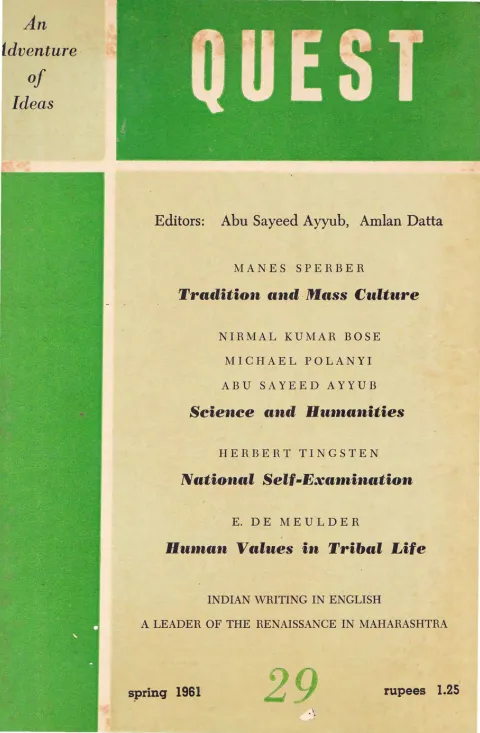
QUEST
Summary
Quest No. 29 (cover ‘spring 1961’, contents page ‘APRIL/JUNE 1961’) is largely a single-subject number without saying so on its cover: five of its six articles, plus its reportage section, come out of a three-day seminar on ‘The Place of Science and Humanities in Higher Education’ held in Bombay on 26-28 December 1960 under the joint auspices of Quest and the University of Bombay. Michael Polanyi, who presided, opens with ‘The Study of Man’, an attack on what he calls scientific obscurantism — the Laplacean ideal of a complete atomic topography of the universe, which he argues would ‘impose complete ignorance on us’ — and a case for personal, skill-based knowing as the bridge between the exact sciences and the study of man. Nirmal Kumar Bose’s inaugural address answers the same question from svadharma: leave scientist and artist each free to push his own path to its extreme. Co-editor Abu Sayeed Ayyub, in the issue’s longest piece, takes the opposite view from Polanyi, insisting the dichotomy between scientific and humanistic knowledge is ‘inescapable, and must be frankly recognised’, and ends with a deliberately ‘absurd’ proposal that arts courses be abolished and all university education be science education with a compulsory humanities pass paper. David McCutchion’s seminar report then shows the argument as it actually ran, with Sibnarayan Ray, A. B. Shah, Hans Simons, N. K. Devaraja and others defending the scientific method against Polanyi’s pessimism about it.
Around that core the issue sets Manes Sperber’s Congress for Cultural Freedom paper on tradition and ‘mass-man’; Herbert Tingsten’s comparative survey showing that Swedish, German and French writers on national character all reach identically flattering conclusions about their own peoples; and E. De Meulder’s Jesuit case for ‘re-tribalizing’ India rather than detribalizing its adivasis — printed with an unusual editorial disclaimer inviting readers to react. There are three poems, two short stories (Raja Proctor’s Ceylonese fishing-village tale and Gopi Gauba’s marital two-hander), D. K. Bedekar’s review article recovering Gopal Hari Deshmukh as a pioneer of the Maharashtra renaissance, Sadhan Kumar Ghosh’s books column, twelve book reviews, and three letters — two of them continuing Quest 28’s quarrel over Indians writing in English, with P. Lal answering Jyotirmoy Datta at length in the Discussion section. The recurring argumentative centre is authority and who gets to certify knowledge: Polanyi against positivism, Ayyub against I. A. Richards, Bedekar’s Deshmukh against the Sanskrit pandits, De Meulder against the census officer and the anthropologist, and Lal against the claim that a language must be one’s mother tongue to be one’s own. The issue carries no artistic plates or photographs at all: every non-text page is a paid advertisement.
Essays
Tradition and Mass Culture
By Manes Sperber
Sperber traces tradition through three stages of the human experience of time. In an illiterate, magical society memory belongs to old men, time does not appear to move, and tradition is invisible because it is simply the perpetual present; with written records comes historical consciousness, and each generation discovers it is not only heir to traditions but their creator; with the Renaissance and secularisation comes what he calls time-space, in which the present is lived as a moving threshold of the future. Mass culture, he argues, is what happens when human beings are cast out of time-space and forced back into one-dimensional time.
He then sketches ‘mass-man’ (MM) in five numbered traits: he feels deprived unless he owns each new commodity at once; he is attracted only by the newest, so that his 1960 dream is a 1961 television set; he measures his own happiness quantitatively against other people’s means and so is permanently dissatisfied; unlike the parvenu he does not want to inherit the past but to monopolise the future; and he wants to own exactly what everyone else owns while being utterly unlike everyone else. Sperber’s conclusion is unexpectedly hopeful and is aimed at the critics rather than the phenomenon: the reproaches directed at mass culture are aimed at the wrong target, which should be the age itself, and the phrase may prove to describe a transitional bridge rather than a condition.
- Tradition becomes visible as tradition only when its authority is shaken or when social and moral continuity is threatened; a ruling caste proclaims the sanctity of the tradition it says it was chosen to protect.
- Three successive regimes of time — motionless time in magical societies, forward-moving time with written records, and ‘time-space’ after the Renaissance — set up the argument.
- Marxists of fifty years ago saw the masses as a creative historical factor; Sperber says the great conglomerations are now only a ‘masse de manoeuvre’, an organisation-object acting like a military unit.
- ‘Mass-man’ is defined by his position in the rank of consumers rather than by his role as producer, and is psychologically conditioned accordingly.
- The critique is redirected: mass culture is the symptom, the age is the target, and the individual ‘in the deepest recesses of his being remains unchanged’.
Science and Humanities
By Nirmal Kumar Bose
Bose’s inaugural address to the Bombay seminar starts from the Vedic view that all forms of knowledge, including Ayur-veda and Dhanur-veda, lead towards the realization of Brahman, and contrasts that with the modern cleavage between the sciences and the humanities. He characterises the difference in method — the scientist plodding from hypothesis to hypothesis towards generalization, the artist reaching the heart of things by a condensed, intuitive route he cannot widen into a road — but argues that on closer inspection the gulf narrows considerably.
His substantive claim is that the two mechanistic remedies on offer both fail: giving scientists a patchy acquaintance with the classics, and giving artists a ballast of scientific knowledge, produce second-hand knowledge that stays ‘separate and unusable in one’s intellectual storehouse’ and fails when a crisis threatens life. Against this he offers a specifically Indian proposal drawn from the Hindu tradition and from Gandhi: since all views of truth are partial, each man should live by his own light and persist in his own dharma rather than imitate another’s, and where opposition in action becomes necessary it should be informed by non-violence — taking suffering on oneself rather than inflicting it. Add to this the Vedic injunction charaiveti, move onwards, never resting satisfied with one’s partial view, and the bridge between scientist and humanist becomes a bridge between spirits rather than a curricular device. He ends with the image of rivers that need not take each other’s course but must each flow on to the same ocean.
- Opens from the Indian past, where secular knowledge such as medicine and warfare counted among the highest forms of knowledge because all knowledge led to Brahman.
- Rejects both curricular remedies — classics for scientists, science for artists — as second-hand knowledge that never integrates into a life.
- Grounds mutual respect in the doctrine that all human views of truth are partial, so conflict in the sphere of thinking is unnecessary.
- Invokes Gandhi twice: that every man should live according to his own light, and the anecdote of Gandhi answering the claim that a community must live with the single question ‘Why?’
- Proposes that both scientist and humanist keep questioning — the scientist adding wonder and humility, the humanist refusing to treat his world-view as finally settled.
Essay 3
By Michael Polanyi
Polanyi’s presidential address — printed as ‘The Study of Man’, though the contents page files it under the group heading ‘Science and Humanities’ — argues that science has replaced religious dogma as the greatest single source of popular fallacies, not because science is bad but because its professed ideals are nonsensical. The Laplacean ideal of representing all knowledge as an exact topography of atoms in motion would, he says, answer none of the questions anyone actually wants answered: a list of atomic positions on 1 May 1961 tells you nothing about whether your primroses will blossom. He gathers examples of the resulting absurdities — three authorities at a 1954 symposium denying that consciousness exists; anthropologists describing witch-killing as a cultural achievement and head-hunting as functional; positivism discrediting all ethical statements as unverifiable — and links the corrosion to Spengler’s and Simone de Beauvoir’s moral inversions, arguing that scepticism drives moral sentiments underground where they return as a creed of salvation by violence.
His positive proposal is personal knowledge. No map can read itself; even the exact sciences depend on a skill of identifying numbers with observed events at both ends of a computation, and Newton’s laws can never foretell an actual instrument reading. From the hammer whose handle he is subsidiarily aware of while focally attending to the nail, through the blind man’s stick and the scientific textbook used as a tool rather than scrutinised as an object, he builds an account of knowing by indwelling, in which tools and theories become part of the body. Geometrical crystallography supplies a case of an exact science that supplies a framework of appraisal rather than predictions. If personal participation is the universal principle of knowing, he concludes, then evaluating human actions morally is a legitimate extension of scientific knowledge, and a code of laws is no longer unscientific merely because it predicts nothing.
- The charge is specific: not that science is harmful but that ‘the ideals of science are nonsensical’, and that the Laplacean ideal would leave us knowing nothing we care about.
- Collects contemporary denials of consciousness and value-free anthropology as the concrete costs of scientific detachment, with the aphorism that the stability of evil is the worst of evil.
- Argues every exact science relies on an art — the trained delicacy of eye, ear and touch that connects prediction to experience; ‘No map can read itself.’
- Introduces the distinction between focal and subsidiary awareness (hammer, probe, blind man’s stick, textbook, one’s own body) to produce ‘knowledge by indwelling’.
- Concludes that personal knowing sets up impersonal standards of excellence, so that appraising good from evil carries the same authority as distinguishing order from disorder.
Essay 4
By Abu Sayeed Ayyub
Ayyub takes C. P. Snow’s Two Cultures as his starting point but argues that India’s problem is different in timing and in kind: the scientific attitude here is still embryonic and confined to a tiny minority, so the seminar anticipates a divide that will arrive within a decade rather than reacting to one already arrived. Section I argues, against I. A. Richards, that art is a form of knowledge. Richards’s ‘Neutralisation of Nature’ defines knowledge and truth so as to make them the scientist’s monopoly, leaving poetry a set of pseudo-statements to be retained without belief; Ayyub replies that poetry cut free from belief becomes a merely decorative pattern of words, and that even Clive Bell, the purest formalist, cannot avoid asking what significant form is significant of. He recruits Maritain and Tagore for a ‘poetical knowledge’ that is knowledge through emotion.
Section II then reverses course and dialectically negates that argument. Having established that art is also knowledge, Ayyub insists the two ways of apprehending the world — humanistic and scientific — differ sharply in method: the humanist attends to individuals and wholes and seeks meaning and value with the knower involved, the scientist seeks generalities and parts and laws with the knower eliminated. Against Polanyi, who was in the room, he argues that personal participation does not bridge the gulf, because the scientist’s passion is to discover a reality uncoloured by his passions while the artist dyes his world with his; recognition of scientific truth carries a compulsive, pragmatic force that no other truth has. He sides with the Jaina doctrine of anekantavada — the multiplicity and basic divergence of standpoints — and declares the dichotomy inescapable. Sections III and IV move to education, where his worry is not communication between the two cultures but the existence of half-cultures on both sides, and he offers what he himself calls an absurd suggestion: abolish arts courses, make all university education science education with one compulsory humanities pass paper in literature, philosophy and history, restrict admission to those with aptitude, and campaign incessantly for the indispensability of the liberal humanities.
- Reframes Snow’s problem for India, where the two cultures are not yet both present and the divide is anticipated rather than diagnosed.
- Attacks the bifurcation of language into emotive expression and referential statement; art lays claim to universality, which involves a claim to truth.
- Argues that pure mathematics and music are not self-complete: mathematics is ‘hypothetical or potential physics’, and a symphony is a potential mould of emotional structure.
- Dissents explicitly from Polanyi, the seminar’s president: personal participation is real in both spheres but differs so much in degree as to amount to a difference in kind.
- Invokes the Jaina anekantavada to argue that wholeness of culture means embracing both standpoints, not reducing either to the other — ‘Man is the great amphibium’.
- Proposes a deliberately provocative reform — abolish arts degrees, universalise science degrees with a compulsory humanities paper — and offers to withdraw it as soon as something less absurd appears.
National Self-Examination
By Herbert Tingsten
Tingsten sets out to test a single, narrow question: what do nations say about themselves? He first distinguishes the older doctrine, in which a national character determines historical events, from the modern scientific consensus, in which differences between nations are superficial habits produced by history rather than basic dispositions — so that character does not determine history but the reverse, and a nation can change character. He warns that national psychology is a subject that stimulates intellectual sloppiness, and that popular notions constantly reverse themselves: the English were thought capricious and immoderate in the seventeenth century and the opposite later; the French were revolutionaries and decadents in the nineteenth century and conventional petty bourgeois afterwards.
He then works through Swedish, German and French self-characterisation, with briefer notes on Austrian, English, Spanish and pan-Slavonic material. From an 1803 children’s encyclopaedia through Heidenstam’s 1896 essay and Gustav Sundberg’s best-selling ‘The Swedish National Character’ (1911), the Swedes emerge as uniquely contradictory, nobly self-ironic, envious among themselves and submissive to foreigners. Schulze-Maizier, Bismarck, Treitschke, Wilhelm Wundt, Thomas Mann and National Socialist propaganda produce almost word-for-word the same picture of the Germans: brilliantly gifted, individualistic, quarrelsome, weak in national feeling, born cosmopolitans with an excessive respect for the foreign. French writers from Montegut and Renan to Maurras, Fouillée and Paul Gaultier say the same of the French. Tingsten’s conclusion is that the pattern is not borrowed — most of the writers were ignorant of each other — but structural: national self-analysis is an extension of personal self-examination, in which self-praise is coated with a varnish of self-criticism and one’s own weaknesses turn out on inspection to carry a mark of nobility. The political sting is in the last paragraph: this attitude motivates nationalism, because one boasts of not being a boaster, and so finally goes into battle with a good conscience.
- Distinguishes the older determinist doctrine of national character from the modern view that national differences are historical habits, so that ‘Character, thus, does not determine history but vice versa.’
- Documents that popular characterisations of the English and the French have reversed completely over two or three centuries.
- Shows Swedish, German and French self-portraits converging on an identical template: contradictory and gifted, individualistic, internally divided, weak in national feeling, over-admiring of the foreign.
- Rules out literary borrowing as the explanation — the writers were largely unaware of each other’s national-psychology literature and write with a joy of discovery.
- Reads national self-analysis as collective self-examination, and warns that its self-flattering humility is precisely what licenses nationalist aggression with a clear conscience.
Human Values in Tribal Life
By E. De Meulder
De Meulder, a Jesuit social worker in Bihar, argues in three parts that tribal policy fails because of a wrong vision of man. Part I opens from Ashoka’s rock-edict on the Pratyantavasino and Harekrishna Mahatab’s use of it, and insists tribals are men par excellence: the Mundas, Santhals and Hos call themselves Horo, Hor and Hos, all meaning men, and the worst insult to an adivasi is to call him a Banjati or jungli. He argues that Harijans are mostly old tribals absorbed into the caste system, quotes Verrier Elwin and Grigson on that absorption, and reproduces Jagjivan Ram at length on untouchability as an attack on the liberty of the individual which requires attacking the theory of karma and re-birth.
Part II names three allies of the tribal people — Free India, the Christian revival, and the tribals’ own self-reliance — and four opponents: the census officer, half-baked anthropologists, propagandists of an out-moded caste system, and rural capitalism and communism. He accuses the 1951 Census of suppressing sixty to seventy lakhs of tribals and of recording all but a fraction as Hindus, quoting a Census Superintendent’s admission that classification ‘has depended upon the whim of the enumerator’; argues that caste is hierarchical and vertical while tribal division is horizontal, so the word caste should never be applied to tribals; traces social Darwinism from Spencer and Nietzsche through the slave trade and reproduces the UNESCO ‘Race and Modern Science’ statement at length against it; and holds that capitalism and communism have both robbed peasant proprietors, citing the Permanent Settlement of Bengal. Part III concludes with his central inversion: do not detribalize the tribes in order to integrate them, but re-tribalize the whole Indian nation into a family of tribes with equal rights. He then makes a sharply partisan attack on Madhya Pradesh government policy under ‘the Shukla-Nyogi Regime’ for fighting Christian missions with government money, and argues that any school practising segregation — for adibasis only or for Harijans only — is anti-national.
- The organising claim is that wrong visions of man produce educational and social failure — instanced by Nazi Germany, Stalinist Russia and apartheid South Africa before India.
- Argues the census has statistically liquidated whole tribes by absorbing them into Hinduism and the caste system, and that the notion of caste is alien to the notion of tribe.
- Reproduces the UNESCO statement on race at length to rebut social Darwinism and its political uses.
- Proposes the inversion ‘do not detribalize the tribes… but rather re-tribalize the whole of the Indian nation’ as the way to build a democratic India.
- Argues against segregated schooling for adibasis and Harijans on national grounds, and notes that Verrier Elwin has changed his earlier view on segregating tribals.
- Printed with an editorial disclaimer — ‘This is a Christian missionary’s view of tribal problems in India. The editors of QUEST would expect readers to express their reactions.‘
A Poem
By Sigurdur A. Magnusson
A six-line poem, printed under the POETRY rubric with a bare question mark where a title would go — the contents page lists it simply as ‘A Poem’. It figures Time as the force that pulled the speaker from his mother’s womb and holds him tight in its palm, and locates behind Time not an answer but a question, imaged as a curved serpent with an apple. The Edenic emblem turns the poem’s metaphysical question about origin and captivity into a question about knowledge and temptation.
- Printed with ’?’ in place of a title; the contents page supplies the neutral description ‘A Poem’.
- Six lines, unpunctuated except for a colon and a closing full stop, with ‘behind Time’ repeated as a structural hinge.
- Closes on the Genesis emblem of serpent and apple, turning the question behind Time into a question about knowledge.
This City
By Amaresh Datta
A four-stanza free-verse poem in which the city is the subject and the speaker its exhausted counterpart. Three of the stanzas open by naming the city differently — plebian, tired, howling — and record what it has known: the ecstasy of rains in its dry bones, songs of the sun, the coming impact of silence at night. Against each of these the speaker sets his own incapacity: what revives the city is fierce or deafening to him, because he is as dry as the city’s soul and as old and preserved as its body. The poem closes by separating them for good, the city hearing the mysteries of the wind and the stars while the speaker seeks ‘Death of memory in the pursuit of joy’.
- Built on a repeated contrast between what the city can still feel and what the speaker no longer can.
- The city’s revival is registered physically — rains in dry bones, a mason’s steel-frame dream melting into drizzle, trees growing tense in their rhythm of life.
- Ends by dividing city from speaker: the city will hear the wind and stars, the speaker will seek the death of memory.
For All Who Suffer
By Jeremy Nelson
A devotional narrative poem in eight quatrains of loose iambic tetrameter, mostly rhymed or half-rhymed. The speaker recounts walking with God the Father before sleep and speaking to him as a trusting child; God smiles, touches his chin, takes his hand and leads him towards a hill bearing a sign few would care to look at. The journey crosses towns, lakes, ancient peaks of snow and ‘the shell of time’ until anguish fills the skies, and God says that pain is part of paradise and that he is ‘both the wound and blade’. What the speaker is shown on the darkened hill is an angry mob calling for the crucifixion of the Son of God. The poem ends by reversing the expected consolation: the dreamer watches God weep and seek for men on whom to lean.
- A dream-vision framed by sleep at both ends — ‘Last night before the hour of sleep’ and ‘Last night within the time of sleep’.
- The theology is explicitly one of shared suffering rather than rescue from it.
- Ends with the inversion of the consoling God into one who weeps and needs men to lean on.
”Where Waters Meet”
By Raja Proctor
A frame story set on a Ceylonese lagoon. The narrator, an Information Office man from Colombo who fishes alone and drinks from a hip-flask, is warned off by fisherboys — ‘No watersmit for you!’ — and driven by a monsoon squall into a village church, where he finds two unopened half-pint bottles of Ceylon arrack at the feet of a statue of St. Anthony. An English priest, twenty years in the country, explains them.
The inner story concerns Parris, a powerful fisherman called ‘The Bear’, his wife Rua (‘The Dove’) and their son Robo, whose left foot is amputated after an accident between two out-rigger canoes. Parris begins to drink; the boy, taught by the priest, becomes preoccupied with death, suffering, fate and faith. On the morning after his mother threatens to leave, the boy intercepts his father on the way to fishing and spends the day manoeuvring him away from drink — buying provisions on credit, faking pain from his lame leg outside the tavern, and finally goading him into fishing the dangerous Waters Meet by calling him a coward and a drunkard, so that both his hands stay on the oar. A squall takes the boat; Parris, having just understood what his son has been doing, drowns holding the boat’s head to the sea, and the boy is found clinging to an unopened half-pint, insisting to the village that his father did not drink. The bottles on the altar are Parris’s vow, made before St. Anthony, to come back for them the day another drop of arrack wets his throat. The story closes by turning back on the narrator, who swigs from his own flask and asks himself, ‘Can’t Waters Meet happen to me?’
- A frame narrative whose object — two unopened arrack bottles on a Catholic altar — is explained only at the end as a dead man’s vow.
- The child’s campaign against his father’s drinking is conducted entirely by indirection: provisions on credit, faked pain, and a deliberate insult.
- The fishermen’s chorus misreads the death completely as a drunkard’s folly, which is what forces the boy’s protest.
- The closing pages implicate the narrator, whose own solitary drinking makes him the priest’s next case rather than merely the story’s listener.
The Scar
By Gopi Gauba
A two-character story told almost entirely in alternating interior monologue. A painter, who left his father and a hosiery business for art, learns that his dead childhood friend Bholu has left money to his wife rather than to him, and the question ‘Why to you?’ takes possession of him. The story stages the interrogation twice over: what each says aloud, clipped and wounding, and what each thinks and longs to say, which is almost entirely tenderness. He insists he is not a villain, not jealous, trying to be just and reasonable; she, innocent, discovers that the fact of being asked at all is the injury — ‘What good is my word, what good is our love if there is no belief, no trust.’
Pressed for details, she finally tells him that Bholu had asked her to marry him before he did, and that one day Bholu told her to leave this poverty and run away with him so that her husband could return to his father. She had kept it secret for years because telling would have killed something in a husband who trusted his friend implicitly. He retreats to the other room; she, alone, arrives at the understanding that the bequest was a confession from a man torn between loyalty to a friend and desire for that friend’s wife — ‘how utterly callously successful sometimes the dead can be.’ She gropes her way to him and finds he has been weeping too, and the story ends on her line naming what has happened to them: ‘Our first scar… a heavy price for growing up.’
- Technique carries the story: spoken dialogue and unspoken monologue run in parallel and contradict each other throughout.
- The wound is epistemic rather than sexual — being disbelieved, not being unfaithful, is what she cannot survive.
- The withheld secret is reframed at the end as protection of the husband’s faith in his friend rather than concealment.
- The dead friend’s bequest is read as a posthumous confession, making him the story’s absent third character.
- Resolution is partial and named as such: a scar, and the price of growing up, not a restoration.
Seminar on Science and Humanities
By David McCutchion
McCutchion reports the three-day seminar whose papers fill the front of the issue, and his interest is in the gap between Polanyi and his audience. Polanyi’s presidential attack on scientific optimism ran contrary to the general disposition of the room and forced an initially philosophical orientation on the seminar, ‘some under protest, loud or muttered’. The majority — from Radical Humanists to physicists, economists and technicians — regarded the scientific method as indispensable in India precisely because opposition to science is associated with die-hard traditionalism and obscurantist politics. Sibnarayan Ray led the defence of rationalism, arguing that personal error in judgement is exactly why science matters and that an emphasis on personal knowledge risks impeding communication and encouraging ‘isolated self-sufficient microcosms’; Polanyi replied that a misguided ideal of exactness was distorting all teaching, poured scorn on the belief that science can predict, and accused Ray of conventionalism in ethics. A. B. Shah, N. K. Devaraja, Gangadhar Gadgil, A. K. Saran, A. N. Kothari and Hans Simons variously extended or resisted the argument, with Saran defending svadharma and Devaraja insisting scientists cannot be objective because all facts are modified by their instruments.
The afternoon and subsequent sessions turned practical: compulsory integrated courses in the theories and methodology of science, pilot schemes in individual colleges, orientation courses for teachers in the long holidays, internal assessment replacing rigid external examinations, restricted admissions, and — from Simons — the demand that general education teach less content and more method, since at present it is ‘merely the conveying of accepted bodies of knowledge for acceptance’. Polanyi, chairing the close, argued that a university is too narrow for the most vital ideas of the time and risks killing literature by teaching it, and that student societies and debates are the life-blood of a university. McCutchion’s own conclusion is dissenting: he thinks the seminarists’ optimism led them past the harder facts — the exam-obsessed Indian student who asks only whether it will get him a job, the weight of oral tradition and memorisation, the tacit taboo on aptitude, and the likelihood that students offered cultural alternatives would choose ‘the alternative of Hindi film and rock and roll’.
- Records that Polanyi’s critique of science failed to persuade an audience that saw science as its defence against obscurantist politics.
- Preserves the sharpest exchange of the seminar, with Polanyi leaning across the table to demand of Ray where Freud sought the roots of the super-ego.
- Notes Polanyi’s remark that Bose’s svadharma address made him feel more at home in Bombay than in Oxford.
- Summarises the practical consensus: pilot colleges, teacher training, methodology before content, internal assessment, restricted entry.
- Ends with the reporter dissenting from the participants on grounds of student motivation, oral tradition, aptitude and elite formation.
Indian Writing in English
By P. Lal
Lal replies to Jyotirmoy Datta’s Quest 28 attack on Indians writing creatively in English, opening with regret at its tone — ‘Facts elevate, opinions only corrupt’ — and dividing his answer into a clearing of six preliminary confusions and then Datta’s four substantive reasons. Against the chaffinch-and-nightingale image he objects that it imputes social climbing; against Datta’s ‘I admit no possibility of choice’ he produces T. S. Eliot in Paris Review confessing that he once considered giving up English for French; against ‘No language is more developed than another for writing good poems’ he suggests, humbly, that a language shows maturity in the emotional spectrum it can communicate without blurring nuance, while conceding that this is a belief and Datta is entitled to his own; and against the charge that Indian writers in English are ‘bastilled by 360 million people’ he notes that The Criterion under Eliot never collected more than 800 subscribers and Auden’s Poems took three years to sell a thousand.
He then takes Datta’s four reasons in turn: that the writer aims at an ‘all-India’ audience and flavour; that he is contemptuous of the Indian languages as insufficiently developed; that he writes for money, with the figure of $2,500 for a novel against Rs 25 from Desh; and that he writes from utilitarian rather than inner compulsion, to be tested by marooning him on a desert island. Lal denies the first two — English happens to be a pan-Indian elite language, which brings responsibilities, but ‘we write because we cannot write as well in any other language’ — accepts the third with equanimity, noting the Sahitya Akademi ignores English and that if English lost its position they would take Rs 25 in their stride, and answers the fourth by claiming that all creative writers in English who matter would plump for English. The plea throughout is for good faith: leave us alone to cultivate this little garden, and stress honest purpose over the hows and whys of the choice.
- Method is to separate tone from substance and answer Datta’s preliminary imputations before his four stated reasons.
- Uses Eliot’s own account of nearly switching to French to break the claim that a writer cannot choose his language.
- Concedes the money point rather than denying it, while noting the Sahitya Akademi awards ignore English.
- Reverses Datta’s chosen-language formula: ‘We have chosen it; or… it has chosen us.’
- Names Zofia Ilinska, Koestler and Nabokov as precedents for writing well in an adopted language.
- Closes by asking for sympathy and encouragement or else to be left alone, and for good faith over motive-hunting.
G. H. Deshmukh and His Ideas
By D. K. Bedekar
Bedekar reviews N. R. Inamdar’s edition of the essays Gopal Hari Deshmukh (1823-92, pen-name ‘Lok-hitavadi’) wrote in 1848-50, and argues their value is as a datum-line. Deshmukh belongs to the first generation of the modern Maharashtra intelligentsia, which came on the scene almost half a century after Bengal’s, so that the ideas it confronted had already taken root elsewhere; because the decades after 1857 brought rapid, abrupt and violent change to Maharashtrian thought, a clear reference point in the preceding period is what makes those changes legible. He notes that the essays were written when Deshmukh was twenty-five, and that their direct and forceful diction contrasts with the heavy, ornate, Sanskrit- and English-loaded Marathi prose of the later university-trained generation — a deterioration he attributes partly to Marathi ceasing after 1863 to be part of the Bombay University curriculum.
The substantive analysis identifies three concepts. First, education: 116 of 375 pages are devoted to it, and Deshmukh’s attack on the Brahmin priests is directed not at caste privilege but at their body of culture and learning, which he declares narrow, outdated and inferior to modern learning — Bedekar aligns this with Karl Mannheim’s account of learning ceasing to be the property of a caste and becoming an open ‘intellectual process’. Second, self-determination, a word Deshmukh did not have but whose principle underlies his advocacy of widow remarriage on the ground that a widow has a right to seek her own happiness, his economic self-reliance, and his political essays, which project an Indian parliament, an Indian majority demanding equal rights, and finally Swaraj, with the British reverting to the position of traders. Third, a non-aggregative concept of society, in which individuals’ ideas are moulded by the total social environment — Deshmukh argues that Hindu belief in Fate is itself the product of lawless rule, and that under a rule of equal opportunity no one would speak of Fate’s vagaries. Bedekar closes by noting that Deshmukh’s integrated framework, linking individual and community dynamically, was not fully grasped by his successors.
- Frames the essays as a ‘datum-line’ for measuring later Maharashtrian social thought rather than as an intrinsic achievement.
- Argues the Maharashtra intelligentsia arrived half a century after Bengal’s, into a field where ideas had already matured.
- Reads Deshmukh’s anti-Brahmin polemic as aimed at a body of learning, not at caste privilege — a distinction his western-educated successors missed.
- Uses Mannheim on the laicization of learning to gloss Deshmukh’s ‘intellectual process’, while correcting Mannheim’s sequence for Indian conditions in a footnote.
- Quotes Deshmukh’s 1848 forecast of an Indian parliament, an Indian majority, and Swaraj, with the British reduced to traders.
- Notes Deshmukh’s sociological point that belief in Fate is an effect of lawless rule rather than a cause of passivity.
Talking About Books
By Sadhan Kumar Ghosh
Ghosh’s books column surveys a dozen recent British titles in a densely allusive, first-person manner that mixes reviewing with reported conversation — he cites Sir C. M. Bowra’s comparison of ‘My English Journey’ to Henry James, and recounts lunching with Ivor Brown at the Garrick and dining with Sir Compton Mackenzie in Edinburgh. He begins with three books on London: Henry James’s ‘The English Hours’, a ‘Great Lover of England’ precise about Piccadilly’s uproar and Green Park’s grassy expanse; Fredric Willis’s nostalgic ‘A Book of London Yesterdays’, whose leading motif is ‘Do you remember? Can I forget?’ and whose wisdom is to recall that prices were low but so were incomes; and Ivor Brown’s ‘London’, for whom the city’s magic is a winter magic.
He then works through ‘The New Book of Snobs’ (with Tom Girtin on the wine snob and Philip Hope-Wallace on the theatre snob), Nicholas Bentley’s autobiography ‘A Version of the Truth’, Peter Green’s ‘Essays in Antiquity’ — brilliant but insufficiently mellow, and wrong, Ghosh thinks, about the state of classics teaching in England — Ifor Evans’s ‘The Language of Shakespeare’s Plays’, Una Ellis-Fermor’s ‘Jacobean Drama’, John Speirs’s ‘Chaucer, the Maker’, S. N. Behrman’s ‘Conversation with Max’, Edith Sitwell’s Swinburne selection (she is ‘than whom few persons could be more unworthy’, though the book is a good buy), and finally Lionel Fielden’s ‘Natural Bent’, which he thinks may be the best autobiography of recent years and much better than Cider with Rosie. The Fielden pages are the column’s most substantial: Ghosh admires his humour, his outspokenness about both the British Raj and the Congress leaders, and the loneliness in the book, while judging his professed indifference to love an overstatement and ‘a pastiche from T. E. Lawrence’.
- A miscellany of about a dozen British titles, organised loosely by subject: London books, snobbery, autobiography, the classics, Shakespeare and Jacobean drama, Chaucer, Beerbohm, Swinburne, Fielden.
- The manner is conversational and name-dropping, with reported remarks from Bowra, Richard Livingstone, Ivor Brown and Compton Mackenzie used as evidence.
- Sharpest judgment is on Edith Sitwell as editor of Swinburne, dismissed as slapdash and naive while the volume itself is recommended.
- Fielden’s ‘Natural Bent’ gets the fullest treatment and highest praise, with reservations about his account of his own sexuality and detachment from love.
- Notes Fielden’s even-handed outspokenness — ‘The Congress leaders liked that. They did not like him so much when he was just as outspoken about their shortcomings.‘
Creatures and Emblems; Poems
By M.E.
A single review, under the sub-rubric ‘Poetry’, of Kathleen Nott’s ‘Creatures and Emblems’ and Dom Moraes’s ‘Poems’, taken as evidence that ‘there is still a hope for poetry’. Nott, already a novelist and author of the critical book ‘The Emperor’s Clothes’, is credited with a wider range and a surer, more mature style in this third collection — ‘equally good at describing love or lemmings’ — with her Taormina landscape and the poem ‘What a piece of work’ quoted at length; the note throughout is sombre and melancholy but absorbing. Moraes, in his second book, is praised for skill, charm, simplicity, directness and melodiousness, with ‘A letter’, ‘Voices’, ‘French Lesson’ and ‘From Tibet’ quoted; the reviewer concedes another critic’s point that Moraes returns too often to words like ‘stone’ and ‘bird’, but denies the poems are repetitive. The verdict is that Moraes ‘seems to have incorporated the best of East and West and successfully presented each to each’, and that both poets, extremely different, are genuine and good writers.
- Reviews two books together as a joint sign of health in contemporary poetry.
- Quotes generously — four passages from Nott, four from Moraes — rather than arguing at length.
- Concedes a rival reviewer’s criticism of Moraes’s repeated vocabulary while rejecting the charge of repetitiveness.
- Frames Moraes’s achievement in East-West terms, a recurring preoccupation of this issue.
Lake Surface and Rippled Shadows
By Eric Kanga
Kanga reviews two collections by Keshev Malik, calling him ‘India’s Angry Young Man’ and placing his range between a Beatnik approach reminiscent of Kerouac or Gregory and the earthiness of Lawrence. The verdict is divided. The poems neither scan nor rhyme and largely disregard technical discipline, yet count as a definite contribution towards a new intellectual frontier; but as a collection they lack purpose, and the reviewer cannot tell what the intellectual rebel is rebelling against — the industrial system, society or himself — and asks the poet ‘Quo Vadis or Whither Goest Thou?’ In the title poem the initial impact is good but the poet’s guilt obsession mars the lake surface and spoils the symphonic mood of the first verse; ‘Portrait’ starts strongly and finishes meekly. Kanga judges Malik best in the short poems ‘The Stranger’ and ‘The Blind’, which carry one thought each and so cannot lose impact to meaningless meanderings, and finds the ‘Earth and the Spaces’ dialogue unique in conception but inconclusive. ‘Rippled Shadow’ he rates the more purposeful collection — spontaneous, exhilarating in parts, modern, and understandable in day-to-day terms — with ‘The Nomad’, ‘The Etruscan Grave’ (Keats in a modern context), ‘Noahs Ark’ and ‘Portraits’ singled out, the last as a revelation of the Lonely Western Man.
- Places Malik in an Anglo-American rebel lineage — Kerouac, Gregory Corso, D. H. Lawrence — rather than an Indian one.
- Separates formal judgment (the poems do not scan or rhyme and lack discipline) from intellectual judgment (a contribution to a new frontier).
- The recurring complaint is inconclusiveness: strong openings that finish meekly and dialogues that end on inconclusive notes.
- Prefers the short single-thought poems, and rates ‘Rippled Shadow’ the more purposeful of the two collections.
Child of the Revolution
By Nissim Ezekiel
Ezekiel reviews Wolfgang Leonhard’s ‘Child of the Revolution’ and spends most of the review on its political use rather than its literary qualities. He opens impatiently — ‘How long, 0 Lord, how long?’ — treating the book as one more ex-communist personal story, then reframes the impatience as a question Indians cannot afford to treat academically: either a vast force insisting on total subordination and driven towards world domination exists, in which case neutralism and co-existence are nonsense, or it does not, in which case India should indeed steer its own cautious way between the blocs.
What he finds genuinely new is the Comintern School, where Leonhard was trained as a Kremlin agent while Hitler’s troops occupied large parts of Russia, and where indoctrination went so far that students’ names were changed and their previous lives treated as non-existent, even among themselves. Following Edward Crankshaw’s introduction, he identifies the book’s two distinctive features: that Leonhard defected not because his God had failed but because he thought He had been betrayed — ‘Leonhard thought he was a better theologian than Stalin, but he believed in Stalin’s God’ — and that it shows the Soviet Union from the point of view of the communist elite. He ends by pressing unfashionable questions on ‘neutralist, co-existing India’: Khrushchev’s Russia is not Stalin’s, but have communist aims and methods changed fundamentally, and is the Friendship University the updated Comintern School? He admits these questions stopped him enjoying the book’s considerable merit as human drama.
- Treats the book primarily as a test of Indian non-alignment rather than as autobiography.
- Singles out the Comintern School — trained cadres stripped of their names and pasts even from one another — as the book’s most striking material.
- Adopts Crankshaw’s distinction: Leonhard left because he believed Stalin’s God had been betrayed, not because it had failed.
- Presses the contemporary question of whether the Friendship University is the Comintern School updated.
- Concedes that the political reading crowded out appreciation of the book’s outstanding human drama.
The Natural Bent
By S.M.
A mixed notice of Lionel Fielden’s autobiography, opening on the principle that a life history which evokes admiration, dislike and a sense of pity for its author is out of the common rut. The reviewer accepts a critic’s verdict of ‘a maddeningly perverse eccentric’, finds Fielden intermittently extremely dislikable — arrogant in power and whiningly morose in defeat — and traces the strange mosaic of a career running from Gallipoli to the League of Nations, from a near-gigolo existence in the South of France to the B.B.C. and a thwarted spell as the first Director of All India Radio. The Indian phase makes the most amusing reading, and Fielden’s own summary of how to be treated by India is quoted at length. Against that the reviewer suspects too much pretence and an inferiority complex, and doubts whether Fielden genuinely enjoyed his lonely fence-sitting at Wardha with the Mahatma. The balance is finally favourable: spears have been against him — a philistine fox-hunting father, ill health, the unfulfilled urge to be an artist of talent, and the loneliness arising from his self-confessed homosexuality — and he emerges a man of brilliance and intellectual integrity, an attractive misfit from whom a measure of admiration cannot be withheld. The last word is a publisher’s reader’s, that perversity cannot found a book, and the reviewer’s reply that Fielden has done it anyway, ‘with zest and a liberal salting of masochism’.
- Opens with a general criterion — admiration, dislike and pity together mark an uncommon life — and applies it throughout.
- Quotes Fielden’s own four-way formula for how India responded to rods of iron, genuine love, judicial impartiality and broad-minded pretence.
- Diagnoses an inferiority complex behind the defensiveness, quoting ‘behind the wheel of the Rolls I felt I could spit on humanity.’
- Concludes in Fielden’s favour despite the dislike: a man of brilliance and intellectual integrity, ‘an attractive misfit’.
- Reviews the same book that Sadhan Kumar Ghosh praises far more warmly earlier in this issue — an unremarked internal disagreement.
May this House be safe from Tigers
By Indira Talyarkhan
A warm, almost entirely appreciative notice of Alexander King’s second volume of reminiscences, described as an uproariously funny autobiography calculated to lighten sorrow and dispel cares. Talyarkhan notes King’s years as an editor of ‘Life’ and the American best-seller success of ‘Mine Enemy Grows Older’, and identifies the book’s characteristic mixture as exhilarating Brooklyn wit joined to an almost Proustian nostalgia for the Austria of his birth, with vignettes of the Vienna Volksgarten and sympathetic English renderings of the Austrian poet Peter Altenberg.
Most of the review is given over to retelling the book’s set pieces: the Zen-Buddhist friend whose parting benediction supplies the title and whose defence of it is that no tigers have in fact bothered anyone in three years; King’s own birth at barely three pounds, wrapped in cotton wool, placed in a frying pan in a moderate oven and basted with olive oil every twenty minutes; and his playing midwife to a veiled Arab woman among the ruins of Carthage, whose husband later came brandishing a knife because King had cut the umbilical cord with it instead of biting it through, and who was placated only by a friend’s explanation that King was a vegetarian. She notes that even hackneyed material — a prostitute with a heart of gold, a brothel gyrating to the William Tell overture — is redeemed by abrasive humour, and lists the gallery of eccentrics King collected, from the creator of the Kewpie doll to a sculptor whose masterpiece was a weeping male turnip. The verdict: ‘a riot from start to finish’.
- Identifies the book’s register as Brooklyn wit crossed with Proustian nostalgia for pre-war Vienna.
- Quotes the title’s origin story at length as a sample of what readers should expect from the start.
- Retells rather than analyses, on the principle that the anecdotes are the book.
- Notes King’s salacious humour rescues conventional material, and that the book is illustrated with his own cartoons and profiles.
The Revolt of the Mind
By R. V. Leyden
Leyden reviews Aczel and Meray’s account of intellectual resistance in Hungary, and begins with an unusual manoeuvre: a review of two reviews from Quest 28. He anticipates John Smithard’s objection that such books are pointless — too expensive for the man in the street, unbelievable to the confirmed communist, and already known to the right-thinking intellectual — and attacks Siddhartha Sen’s more cynical position on deported Soviet minorities, that if historical necessity demands it you can wipe out nations. If the individual does not count, Leyden asks, why abolish the H-Bomb or do anything for human progress at all. His advice to the smug, the cynical and the bible-faithful is not to bother reading on.
On the book itself he holds the subject to be of supreme importance: the Hungarian Revolution was the first large-scale insurrection against a communist regime and was initiated not by reactionaries but by the regime’s own faithful supporters. He traces the pattern of the writers’ disillusionment — initial enthusiasm at liberation from fascism, submission to Party discipline, ‘Social Realism’ revealed as the embellishment of current slogans, then the Rajk trial and the returning prisoners’ testimony that Rakosi’s jails were worse than Horthy’s, and finally the sudden Kremlin-driven reversals that honest intellectuals could not accept, ‘that yesterday’s crime was today’s merit or vice versa’. He quotes the official criticism of Tibor Dery’s prize-winning novel that ‘the fact that the book is good only aggravates the situation’, and Dery’s declaration at the Petofi Circle’s nine-hour public debate that criticising individuals rather than the system achieves nothing but the exchange of evil for a lesser evil. His complaint is about execution rather than subject: the book treats a great epic as a good story, in a chatty narrative adopting the tricks of illustrated-paper journalism, too long and spun out by the authors’ own confessed ‘involved, longwinded Party manner’. And yet a book to read, ‘to do honour to the brave’.
- Opens by rebutting two Quest 28 reviewers rather than the book, making the piece partly an internal argument within the magazine.
- The historical claim: the Hungarian Revolution mattered because it was begun by the regime’s own believers, not by anti-socialist forces.
- Sets out the standard sequence of intellectual enslavement, comparing Milosz on Poland and Kantorowicz on East Germany.
- Quotes the Party critic on Tibor Dery’s novel — literary quality itself as the aggravating danger.
- Separates the subject’s importance from the book’s failure of manner: chatty, journalistic, too long, unworthy of its theme.
The Lotus and the Robot
By ‘Sanjoy’
A sceptical review of Koestler’s ‘The Lotus and the Robot’ that begins by establishing the author’s credentials — science student in Vienna, foreign correspondent and science editor in pre-Hitler Germany, political novelist of ‘Darkness at Noon’, then back to science with ‘The Sleepwalkers’, followed by two years’ travel in India and Japan for this book — and states his question: is the East spiritually more secure than the West, and can the West benefit from it?
The reviewer summarises the Indian half as visits to four contemporary ‘saints’ — Vinoba Bhave as karma yogi, Krishna Menon Atmananda as jnana yogi, the Sankaracharya of Kanchi as jnana yogi inclining to bhakti, and ‘the kittenish Anandamayee Ma’ relying on shakti — noting carefully that all classifications and adjectives are Koestler’s own, followed by a look at Hatha Yoga in which hard physical discipline and complicated contortions ‘fail to return the spiritual penny’, and a mildly indignant interview with Nehru. The Japanese half covers Japanese reactions to stock situations and ‘the “hoax” of Zen’. Koestler is quoted concluding that both India and Japan seem spiritually sicker and more estranged from a living faith than the West, that looking to Asia for mystic enlightenment is as anachronistic as thinking of America as the Wild West, and that he returns ‘impoverished rather than enriched’, thanking a Western God for letting him be a European. The reviewer declines to adjudicate — faith is too personal a matter — but grants that Koestler’s views are as personally honest as he can make them and his credentials valid, predicts a tremendous impact on any Asian reader, and closes by suggesting Koestler’s next task might be to examine Judaism, Christianity and perhaps Islam, since ‘to one Asian, at any rate, he seems to be an angry old man in search of God.’
- Opens with an unusually long biographical preamble to establish Koestler’s right to ask the question.
- Scrupulously attributes the classification of the four ‘saints’ and the adjectives applied to them to Koestler rather than to the reviewer.
- Quotes Koestler’s negative verdict directly rather than paraphrasing it, on the ground that quotation is the most effective way to convey it.
- Declines to judge the substance because faith is personal, while questioning Koestler’s prose effects and predicting a strong Asian reaction.
- Turns the book back on its author with the closing suggestion that he examine his own religious traditions next.
Indian Trade Unions - A Survey
By Mahesh Desai
Desai reviews V. B. Karnik’s survey of Indian trade unionism from inside the movement, and the review is more an indictment of the movement than of the book. He begins with a general proposition about power: a trade union movement’s respect depends on its will and ability to act once it has dissented, so that ‘It is dangerous, therefore, for the trade union movement to be respectable before being strong.’ Applied to an Indian movement now forty years old, this yields a bleak balance sheet — real wages lower than twenty years earlier, the workers’ share of social security costs big in size but shrunk in proportion, fewer than one worker in ten with a house, and the demands of unions treated once again ‘as the prayers of the poor’ because the power and resources of owners, public and private, have grown so much faster. The ironic low point is that the movement is now asked to show cause why an industrial worker should get more than an under-employed landless labourer, and still hopes to benefit from that irrelevant dialogue.
On the book, Desai grants Karnik unusual competence — long and intimate involvement, politics of the less passionate variety, neat scholarship, careful search of facts, pleasant and intelligent presentation, every phase examined with an eye for detail against the national scene. But he registers ‘no small disappointment’ that what could have been an essay in introspection has remained a chronicle of dates and events seen through a participant’s coloured glasses, the colour occasionally a shade too much. His reading of the book’s moral is that if the movement must consort with politics it should decide to be powerful itself rather than remain on probation before those in power. The closing sentence is a reproof of tone: for a book in hard cover Karnik could have eschewed the sneering jargon of a pamphleteer in his references to the Communists.
- Frames trade unionism in terms of power and the credible threat of dissent rather than wages and welfare.
- Assembles a concrete indictment: real wages below the level of twenty years earlier, housing for under one worker in ten, proportionally shrinking gains.
- Names the rhetorical trap by which the industrial worker is set against the landless labourer instead of against the owners.
- Judges the book a competent chronicle where an introspective analysis was needed, and says the movement’s members all have much to answer for.
- Ends on a criticism of Karnik’s tone towards the Communists as unworthy of a hardcover book.
A Burnt-Out Case
By S.M.
A short, disappointed notice of Graham Greene’s Congo novel. The reviewer concedes it would be difficult for so masterly a craftsman to write even a mediocre novel, and that the background is brilliantly evoked — ‘the moist, esurient menace of the forest, the prevalence of death-dealing insects, the torpor and ubiquitous emptiness of the green solitudes’ — with the assured skill of a Hudson or a Conrad. The objection is that Greene appears to have gone to a remote riverine outpost and then felt compelled to weave a story around the setting. Querry, the burnt-out Belgian architect and renegade Catholic who takes himself to a leproserie, never comes to life: the symbolic analogy between mutilation and cure, mind against body, scarcely carries conviction when the subject is so wraith-like, and the structure would be immensely strengthened by fuller account of his past. By contrast the subsidiary characters are vital and memorable — the agnostic Doctor Colin, Parkinson the gutter-press journalist, and Rycker, ‘a quite horrible amalgam of lechery and religiosity’. The reviewer finds the melodramatic climax easy to foresee, notes that Querry’s death is perhaps the only moment when the man really exists, and ends on a technical complaint: a plethora of similes, sometimes a dozen to a page, some apt and striking and others too self-consciously wrought — ‘Mr. Greene should cure himself of this tendency to simile-itis.’
- Praises the Congo setting and the minor characters while judging the protagonist unrealised.
- Diagnoses the book as a story imposed on a place rather than a story that required it.
- Argues the mutilation-and-cure symbolism fails because Querry is too insubstantial to carry it.
- Closes on a stylistic complaint about simile density, coining ‘simile-itis’.
Scenes from Married Life
By B.A.
A cheerful plot-led notice of William Cooper’s novel. Joe Lunn at forty is a civil servant interviewing scientists by day, writing or correcting proofs of his latest novel, and otherwise occupied with occasional dalliance with a girl called Sybil and daily lunches with Robert, his more successful writer friend. Content as a confirmed bachelor until Robert decides to marry and then decides Joe should marry too, Joe asks how one goes about it and is told ‘By an act of will’ — ‘Like all the best revolutionary concepts, so simple, so obvious.’ He meets Elspeth, a charming young school-teacher, and recognises her not as a face that would launch a thousand ships but as one that would launch just his ship; Robert approves her as ‘Someone odd enough to interest you, and equable enough to make you a good wife’. Marriage solves loneliness, and the troubles that follow — a book that does not sell, another that falls foul of the Home Office for obscenity through an old friend’s wayward malice, and the threat of losing his job with Elspeth pregnant — are shared rather than borne alone. The reviewer stresses that this is above all a happy book, ending on a note of almost bubbling gaiety with Joe’s magnificent discovery, quoted in the novel’s own capitals: ‘MARRIED LIFE IS WONDERFUL.’
- Told almost entirely as plot summary, with the novel’s own dialogue carrying the characterisation.
- The comedy turns on marriage undertaken as a deliberate act of will at a friend’s instruction.
- Adversity — unsold book, obscenity proceedings, threatened job, pregnancy — is used to demonstrate the marriage rather than to threaten it.
- Ends by quoting the novel’s closing declaration in full capitals.
Pomp and Circumstance
By B.A.
A light notice of Noel Coward’s West Indian novel, retailed largely through its comic apparatus. Government House in the British possession of Samola looks from any aspect like a gargantuan mauve blancmange, and nobody knows why it has always been painted mauve; news of a three-day visit by the Queen and Prince Philip sends the painters up the scaffolding to paint it mauve again. The island throws itself into preparations including a Water Pageant in which the Ladies Church Choir, moored on a raft, will sing an oratorio accompanied by a regimental band — with the monsoon already overdue, the reviewer notes, the pageant promised to live up to its name. Into this arrives Eloise, the lovely and amoral Duchess of Fowey, ostensibly the guest of the narrator Grizel Craigie, a planter’s wife, but actually to meet her lover Bunny Colville, who within hours of their reunion goes down with chicken pox, his face as mauve with calamine as Government House, and refuses to be seen. The reviewer’s verdict is comparative and pointed: the novel’s agreeably lush surroundings form a pleasing contrast to ‘the recent oppressive spate of books dealing with life in backstreet bedsitters’, whose unloving melancholics slump beside unwashed women clutching empty gin bottles; Coward’s island layabouts have no moral scruples either but enjoy life with unquestioning verve, and never fall into the trap of entangling the spiritual with the physical.
- The mauve Government House and the doomed Water Pageant are used as the review’s structural jokes.
- Plot is summarised only as far as the lover’s chicken pox, whose calamine matches the building.
- The judgment is comparative: Coward as relief from the kitchen-sink novel of the late 1950s.
- Notes without disapproval that Coward’s characters are as amoral as the bedsitter novels’ but far more cheerful.
Don’t Tell Alfred
By Faubion Bowers
A severe review of Nancy Mitford’s novel by a reviewer who admires her earlier work. He calls her celebrated and extremely facile — doubting whether those two attributes are entirely complementary — and the author of ‘one of the finest light masterpieces of biography to appear in our times’, her Madame de Pompadour; but returning to social comedy she has produced a boring novel, and if anyone except Mitford had written it he would call it not only boring but pretentious. His hypothesis is that she keeps a discard file of ideas beside her desk and has cleaned it out for this book, which reads as if she had not wanted to write it any more than this reader wanted to read it.
The plot — Lady Wincham, whose husband Alfred is suddenly and mysteriously appointed British ambassador in Paris, beset by a Zen-converted son with an English wife and a Chinese baby, and a social secretary irresistible to French dignitaries and incapable in any known language — he dismisses as a thin story with ivy of embassy vignettes and commentaries growing over it, neither profound nor light but ‘in-between-half humor, half pompousness’. The review’s substantive complaint is social: he has long thought that the English believe they are evolving up the ladder of intelligence by laughing generously at themselves, and while the inability to ridicule one’s own countrymen produces depressing heaviness, Mitford’s forced funniness is a world ‘not of humor but of snobbism and narcissism’ in which everyone is titled, posted high, rich or old tie, and beneath the invitation to laugh runs an undercurrent of complacent contentment in one’s station in life that he finds sad. He concedes she has a large audience and that some may enjoy reading how the upper half lives, but says he cannot imagine anyone finishing the book, and admits he gave up on page 175 though the jacket blurb told him the conclusion is riotous.
- Separates admiration for Mitford’s Madame de Pompadour from a flat rejection of this novel.
- Argues the book’s humour is a vehicle for snobbism and narcissism rather than for self-criticism.
- Generalises about the English habit of mistaking self-ridicule for intelligence, while allowing that its absence produces heaviness.
- Ends with an unusual reviewer’s confession — abandonment at page 175, against the jacket blurb’s promise.
The Indian Intellectual
By Vinod Sena
Sena’s letter defends his Quest 28 ‘Counter-Statement’ on the Indian intellectual against a critic writing as ‘Sanjaya’, opening with the wish that his critic had read what he wrote before criticising it and pointing to specific sections and footnotes to establish that he is no blind votary of the past, has no basic antipathy to British culture, and finds no special charm in poverty and misery. He restates his relation to Edward Shils: he never regretted Shils being a foreigner, since only an outsider could have observed ‘us’ with such accurate objectivity, and never challenged the validity of his account; his objection was to Shils’s explanations, offered after too short a stay and therefore lacking the inwardness that observation alone cannot supply. Against them he had proposed three further factors — an inevitable Industrial Revolution, the aggravation caused not by British culture per se but by the unfavourable conditions in which India fell under its shadow, and the absence of any readily available ideology consonant with Indian attitudes and suited to modern technological needs.
What has really troubled ‘Sanjaya’, he argues, is not the argument but the words ‘spiritual’ and ‘tradition’, which for the Angry Young Men of the generation have become archetypes firing independently of context. He insists he is as aware as anyone of the need for change — ‘to stop would be (for us) instant disaster’ — but that sound psychological development rests on an initial, not uncritical, acceptance of one’s personality followed by steady transformation, and that tradition is not static: foreign elements may be grafted on and transform it out of recognition, but the base must be of native stock, and a tradition that ceases to shed dead foliage degenerates into ‘the choking weed of mere convention’. On ethnocentricity he reaffirms that egoistic tendency is natural in peoples as in individuals and makes purposive collective living possible. What he regrets about British rule is not what was learnt but the unnaturalness of imperial conditions, which led Indians to learn ‘often to the prejudice of what was ours: languages, arts and sciences’ — synthesis being possible only when traditions meet on a footing of equality. The cure is to wean ourselves from an irrational attitude to the West before we can truly learn from it.
- Procedural first move: cites his own sections and footnotes to rebut three positions attributed to him.
- Distinguishes accepting Shils’s observations from accepting his explanations, and grounds the difference in ‘intimacy’ as against observation.
- Offers three causes of the Indian intellectual’s malaise: industrialisation, the conditions of colonial cultural contact, and the absence of a usable ideology.
- Defends ‘tradition’ as dynamic and grafted-upon, with a base of native stock, against the charge of static nostalgia.
- Defends ethnocentricity as natural and enabling, while condemning the asymmetry of imperial cultural contact.
- Concludes that a rational attitude to the West is the precondition of learning from it, not its opposite.
The Nagy Affair
By Thomas Schreiber
Schreiber writes to deplore the brief review of ‘The Truth About the Nagy Affair’ that appeared in Quest 28, and his method is to turn the reviewer’s own credentials against him. He notes that Quest introduced John Smithard as ‘a very talented amateur actor and producer (who is) keenly interested in the arts’, and professes ignorance of why such a person was moved to pronounce on a book devoted not to the arts but to an important political problem. Against Smithard’s verdict that there is no reason whatever for this expensive, difficult and out-of-date propaganda, he quotes the editorial committee’s own statement of purpose — to help throw light on certain points in an important chapter of contemporary history — which he says hardly indicates propaganda rather than a serious document based on irrefutable facts that will aid future historians.
On ‘out-of-date’ he notes that the original French edition appeared four months after the Budapest verdict, ‘a fact which constitutes a veritable tour de force’, and argues more generally that publication date is secondary: new information and documents on the Dreyfus Affair and on the causes of the First World War are still appearing, so the events of 1956 can never be out of date. He then sharpens the sarcasm, suggesting that for Smithard such publications are perhaps useless and the money better spent on amateur theatricals, and that the next thing to expect is a demand that all institutions documenting contemporary history be closed down since their publications too are costly and their public limited. He closes by informing Quest’s ‘collaborateur’ that the book, in French, English, German, Spanish and Hungarian editions, aroused great interest in Europe and the United States, not only in the press but above all in circles of the political left and among historians of considerable note — and adds, with a final turn of the knife, that it is gratifying to find a talented amateur actor suddenly interested in political literature even if his first attempts are not a great success.
- Attacks the choice of reviewer as much as the review, using Quest’s own contributor blurb as evidence of misassignment.
- Answers the ‘propaganda’ charge by quoting the book’s editorial committee on its documentary purpose.
- Answers the ‘out-of-date’ charge with the speed of the French edition and with the Dreyfus Affair and First World War as precedents for continuing publication.
- Escalates to reductio — that Smithard’s logic would close every institution documenting contemporary history.
- Cites the book’s reception in five languages and among left-wing circles and historians as evidence of its value.
Indo-Anglian Writers
By K. Raghavendra Rao
Rao writes as a self-described small-scale Indo-Anglian writer, in general agreement with Jyotirmoy Datta’s position but deploring the manner of his case, and adds an emotional diagnosis of the whole controversy: behind the elaborate theoretical poses on both sides lies a very human conflict of frustrations and jealousies, since he knows Indian-language writers with odd ambitions to write in English and Indo-Anglians frustrated at not being able to write in their mother tongues. ‘The point I want to make is that sour grapes are not all on one side.’ On money he agrees that a true writer is moved by higher motives, but notes that many non-Indo-Anglians are content with Rs 25 only because they know they can get little more, so the mercenary motive should not be saddled specially on the Indian writer in English; Datta’s sneering at the ‘IEW’ has the unfortunate effect of straining already strained relations.
He then raises two analytic doubts. Relating creative writing to a living language is right but risks oversimplification: unless carefully qualified it degenerates into an argument for mass literature. And Datta’s line on Goethe — ‘No one was a better European because no one was a truer German’ — puzzles him, since it could mean either that Goethe was the most German among European writers or the most European among German writers, and in neither case can his Europeanness simply be assimilated to his Germanness. Defending P. Lal’s position without presuming to defend Lal himself, he argues that the only contact currently available between India’s regional languages is English, and asks whether Datta has not heard of the narrow prejudices and destructive contempt between writers from different regions. He signs off with an exasperated blessing on both houses: to hell with all quarrels, let the Indo-Anglian and the non-Indo-Anglian each go his own cursed way, and let them create first, leaving the wrangles to pseudo-pundits and nosey journalists.
- Sides broadly with Datta on principle while objecting to his tone and its practical effect on relations between the two camps.
- Introduces the controversy’s emotional economy as its real content: frustration and jealousy running in both directions.
- Notes that contentment with Rs 25 among non-Indo-Anglians is a consequence of the market, not of purity of motive.
- Warns that tying creative writing to a living language, unqualified, becomes an argument for mass literature.
- Defends the practical claim that English is at present the only medium of contact between India’s regional literatures.
- Ends by dismissing the quarrel entirely in favour of creation.
Essay 31
An unlisted filler quotation set in a box at the foot of printed p.25, closing Nirmal Kumar Bose’s article and attributed to Jacques Maritain. It states that the older the speaker grows, the more he is convinced that freedom cannot escape the dangers that menace it, and cannot be definitively won by mankind, except by a constant effort to subordinate everything to justice and brotherly love. It appears nowhere in the contents page and carries no source reference, but it is the only piece of editorial matter in the issue that states a positive political value directly, and it sits deliberately against Bose’s svadharma argument on the same page.
- Unlisted filler matter with a named attribution, occupying the foot of printed p.25.
- No source, date or translator is given for the quotation.
- The only place in the issue where freedom is made conditional on justice and brotherly love in so many words.
- Maritain is cited again, this time with a book and page reference, in Ayyub’s article on printed p.39.
Essay 32
The statutory annual declaration of ownership required of Indian newspapers, printed unlisted at the foot of printed p.75 under the heading ‘STATEMENT ABOUT OWNERSHIP AND OTHER PARTICULARS ABOUT NEWSPAPER “QUEST” / FORM IV (See Rule 8)’. It is the single most valuable piece of archival metadata in the issue, and it confirms independently of the masthead: place of publication Bombay; periodicity quarterly; printer and publisher both Miss Sheela Singh, nationality Indian, of 65 Nepean Sea Road, Bombay; editors Abu Sayeed Ayyub and Amlan Datta, nationality Indian, of 5 Pearl Road, Calcutta 17; and, as the individuals who own the newspaper, the Indian Committee for Cultural Freedom of 148 Mahatma Gandhi Road, Bombay. It is signed ‘SHEELA SINGH / Signature of Publisher’ and dated 1st March 1961 — which dates the issue’s production to the beginning of March 1961, consistent with the cover’s ‘spring 1961’ and against the contents page’s ‘APRIL/JUNE 1961’.
- Confirms ‘Quarterly’ as the printed cadence, independently of the contents-page self-description.
- Separates the two addresses the magazine works from: editorial at 5 Pearl Road, Calcutta 17, business and ownership at 148 Mahatma Gandhi Road, Bombay.
- Supplies the only explicit printed statements of nationality in the issue for Sheela Singh and for both editors — all ‘Indian’.
- Names the Indian Committee for Cultural Freedom as owner, matching the contents-page line that Quest ‘is sponsored by’ it.
- Dated 1st March 1961, which fixes production to early March and helps explain the cover/contents date discrepancy.
Essay 33
An unlisted editorial block headed ‘OUR REVIEWERS’, printed on p.113 immediately below the end of the last book review and above a full-page Encounter advertisement. It supplies short identifying notes for five of the issue’s twelve book reviewers: S. M. as a former editor of the Illustrated Weekly and well-known author and critic; M. E. as a lecturer in English and the principal of a college interested in contemporary literature; Faubion Bowers as a noted American critic and journalist contributing to the New Yorker, The Saturday Review and Harpers; Eric Kanga as a business man who writes poetry and articles in his spare time; and R. V. Leyden as well known in artistic and literary circles as a connoisseur and critic. Its significance for the archive is as much in its omissions as its contents: the two sets of initials it glosses are never expanded, and Nissim Ezekiel, Indira Talyarkhan, Mahesh Desai, ‘Sanjoy’ and the reviewer signing ‘B. A.’ are not covered at all.
- Covers five of the twelve book reviewers, and is the only printed identification of the initials ‘S. M.’ and ‘M. E.’ in the issue.
- Glosses the initials without expanding them, so the archive has no printed basis for full names.
- Supplies the issue’s only printed nationality evidence for Faubion Bowers, as ‘Noted American critic and journalist’.
- Leaves seven reviewers, including Nissim Ezekiel and the Reviews Editor Indira Talyarkhan, without any note.
Essay 34
An unlisted editorial block headed ‘OUR CONTRIBUTORS’, filling printed p.117 — an otherwise unfoliated page between the last letter and the back-matter advertisements. It supplies ten notes covering eleven of the issue’s contributors: Manes Sperber as an ex-Marxist philosopher sociologist on the Executive Committee of the Congress for Cultural Freedom; Nirmal Kumar Bose as an eminent anthropologist and one of India’s leading Gandhian intellectuals; Michael Polanyi, who ‘needs no introduction to readers of this journal’; Herbert Tingsten as an eminent Swedish writer; E. De Meulder as a social worker in Bihar; Raja Proctor as from Ceylon, twenty years in the navy, published on three continents; Sigurdur Magnusson as one of the younger generation of Icelandic poets who recently visited India after years in Greece; Gopi Gauba as a free-lance writer; D. K. Bedekar as a student of philosophy, former Marxist and communist and well-known Marathi writer; and Jeremy Nelson, from Australia, together with Amaresh Datta, as already known to regular readers. It is the issue’s principal source of nationality and vocation evidence, and it pointedly omits the two editors, the reportage writer McCutchion, the discussion writer P. Lal and the books columnist Sadhan Kumar Ghosh.
- Ten notes covering eleven contributors, with Nelson and Amaresh Datta sharing a single closing sentence.
- Establishes non-Indian nationality in printed words for Tingsten (Swedish), Proctor (Ceylon), Magnusson (Icelandic) and Nelson (Australia).
- Gives Sperber and Bedekar the same political trajectory in the same phrasing — both are introduced as former Marxists.
- Omits Ayyub, Amlan Datta, McCutchion, P. Lal and Sadhan Kumar Ghosh, four of whom carry substantial pieces in the issue.
- Prints ‘SIGURDUR MAGNUSSON’ without the middle initial used on the contents page and under the poem.
Generated by the v1.5 extraction pipeline. Awaiting editorial review.
Metadata and summary are AI-extracted from the source PDF and reviewed for editorial accuracy. The original work is available via the Read PDF tab above (where present); paragraph-level citation inside the PDF is deferred to a future engagement.
People in this work
- Manes Sperberauthor
- Nirmal Kumar Boseauthor
- Michael Polanyiauthor
- Abu Sayeed Ayyubauthor
- Herbert Tingstenauthor
- E. de Meulderauthor
- Sigurdur A. Magnussonauthor
- Amaresh Dattaauthor
- Jeremy Nelsonauthor
- Raja Proctorauthor
- Gopi Gaubaauthor
- David McCutchionauthor
- P. Lalauthor
- D. K. Bedekarauthor
- Sadhan Kumar Ghoshauthor
- Vinod Senaauthor
- Thomas Schreiberauthor
- K. Raghavendra Raoauthor
- Eric Kanga
- Nissim Ezekiel
- Indira Talyarkhan
- R. V. Leyden
- Sanjoy
- Mahesh Desai
- B.a
- Faubion Bowers
- Prof. Amlan Datta
- Nirad C. Chaudhuri
- Laxmanshastri Joshi
- Sheela Singh
- Constantine Fitzgibbon
- Karl Marx
- Mahatma Gandhi
- Immanuel Kant
- Rabindranath Tagore
- Alexis de Tocqueville
- Salvador de Madariaga
- Herbert Spencer
- Jawaharlal Nehru
- Vinoba Bhave