
periodical issue
Quest
A Quarterly of Inquiry, Criticism and Ideas
By Naresh Guha, Subhash Chandra Mehta, Sudhansu Bimal Mookherji, A. K. Saran, Sibnarayan Ray, Abu Sayeed Ayyub, Marie Seton, Allen Ginsberg, Kewlian Sio, Satish C. Saberwal, Kusum Chandra, Punya Sloka Ray, N. K. Devaraja
Printed and published by MISS SHEELA SINGH for the Indian Committee for Cultural Freedom, Army and Navy Building, 148 Mahatma Gandhi Rd., Bombay 1, at Inland Printers, Victoria Mills Buildings, 55 Gamdevi Road, Bombay 7. · Bombay · 1963
128 pages
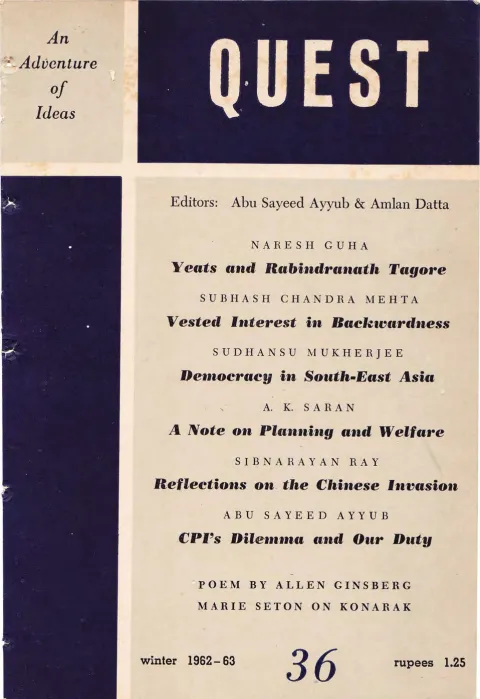
QUEST
Summary
Quest No. 36 (cover-dated ‘winter 1962-63’, contents-dated JAN./MAR. 1963) is the first number of the Bombay quarterly to appear after the Chinese attack of October 1962, and the war reorganises the issue around it. A two-part section headed CURRENT POLITICS / ‘Reflections on the Chinese Invasion’ carries Sibnarayan Ray on the collapse of pan-Asianism and of the belief that communist states cannot wage war, and co-editor Abu Sayeed Ayyub on the logical trap the invasion has sprung on the Communist Party of India; an unlisted dossier at the back reprints the Indian Committee for Cultural Freedom’s ‘Appeal to the Intellectuals of the World’ with signed responses from France, the United Kingdom and Japan. Around that political core the issue keeps its usual range: Naresh Guha on the Yeats-Tagore relationship, Subhash Chandra Mehta on why caste has outlived its constitutional abolition, Sudhansu Bimal Mookherji on the failure of parliamentary democracy across South-East Asia, A. K. Saran on the incompatibility of planning with a democratic conception of welfare, Marie Seton on the erotic sculpture of Konarak, Allen Ginsberg’s long ether poem ‘Aether’ written in Lima in 1960, a short story by Kewlian Sio, and a DISCUSSION pair on group integration and the three-language formula.
Essays
Yeats and Rabindranath Tagore
By Naresh Guha
Guha reconstructs the arc of W. B. Yeats’s relation to Rabindranath Tagore from the first meeting at William Rothenstein’s house on 30 June 1912 to Yeats’s later coldness, and argues that the standard explanations miss the point. Yeats’s initial rapture, Guha shows, was not the enthusiasm of a promoter of an exotic but the recognition of an ally: he thought he had found in Tagore a poet rooted in a living popular tradition, one whose lyrics united sensuous image and spiritual apprehension, and so realised the ‘Unity of Being’ Yeats had inherited as an ideal from his father and could not find in a post-Renaissance European tradition disabled by what Eliot called the dissociation of sensibility.
The cooling, Guha insists, was intellectual rather than personal. He dismisses the gossip about how much of the English Gitanjali Yeats had rewritten as irrelevant on both sides - Tagore’s stature never depended on his English - and locates the real break in Tagore’s Sadhana lectures of 1913, in his devotion to Upanisadic abstraction, in his flat contrast of a nature-subduing West with a nature-embracing ancient India, and in the mocking treatment of theosophical ghosts in The Hungry Stones. Yeats, whose interest in Yoga and Tantra had just been fed by Woodroffe’s texts and the Harvard Patanjali, came to think abstraction the root of India’s downfall and wanted tragedy and conflict where Tagore dissolved the clash of opposites into reconciliation. Guha traces this disagreement into the poems, reading ‘The Hero, the Girl, and the Fool’ and ‘For Anne Gregory’ as replies to the heroine of Tagore’s Chitra, who repudiates her own borrowed beauty.
- Dates the first Yeats-Tagore meeting to 30 June 1912 at William Rothenstein’s home, and the India Society reception to 10 July 1912.
- Argues Yeats admired Tagore because he read him as a ‘popular poet’ of a living tradition, confirming Yeats’s own ideal of the Unity of Being.
- Treats the controversy over Yeats’s share in the Gitanjali translations as a false issue on which both detractors and defenders argued badly.
- Locates the rupture in Tagore’s Upanisadic abstraction (Sadhana, 1913), his East/West generalisations, and his scepticism about ghosts and the body.
- Reads two Yeats poems as direct rejoinders to the self-repudiating heroine of Tagore’s Chitra.
- Notes that the printed article head is ‘Yeats and Rabindranath: A Study in Tradition and Modern Poetry’, not the contents-page title.
Persistence of the Caste System
By Subhash Chandra Mehta
Mehta asks whether caste is dying and answers that it is not. He begins by conceding that the 1950 Constitution formally destroyed caste’s legal basis - Article 15, the ban on untouchability, the right to practise any lawful calling - and that urbanism, industrial organisation, transport, new occupations and the spread of education all cut against commensality rules and hereditary work. But he argues that the same modernisation has strengthened caste as a corporate body: adult franchise turned every numerous caste into a political unit; the weakness of organised peasant and worker interests left no rival loyalties; cheap paper and caste newspapers gave fluid local custom a permanent written form; and panchayati decentralisation carried caste consciousness into the village council. Marriage advertisements placed by foreign-trained professionals are his standing proof that education reorganises the surface of life and leaves its ‘more intimate core’ untouched.
The second half is a polemic against caste-based preference. Drawing heavily on M. N. Srinivas - for Sanskritization and Westernization, and for the argument that backwardness should be measured by a father’s income, education and rural or urban residence rather than by birth - Mehta describes a competition among castes to be listed as Backward, with the Lingayats of Mysore campaigning their way onto the list, and a state where ‘everybody belongs to the Backward Class except the Brahmins’. He distinguishes the humanitarian case for the Scheduled Castes and Tribes from what he sees as the political manufacture of Backward Class status, argues that reservation in promotions demoralises services and lowers standards, and closes on Radhakrishnan’s line that caste has ceased to be a social evil only to become a political and administrative one.
- Grants that the Constitution abolished caste in law and that industrialism, transport and new occupations erode its restrictive side.
- Argues adult franchise, caste associations (sabhas), caste newspapers and democratic decentralisation have converted caste into an effective political corporation.
- Cites the 1951 Census figure that of 5.13 crores of scheduled castes only 64 lakhs were in traditionally ‘untouchable’ occupations.
- Uses Srinivas’s Sanskritization/Westernization scheme and his income-education-residence test of individual backwardness.
- Attacks the scramble for Backward Class listing, with Mysore and the Lingayats as his central example, and rejects reservation in promotions.
- Transcribes, in order to attack them, Tilak-era and orthodox defences of caste hierarchy, and quotes Ambedkar’s description of Hinduism as a gospel proclaiming ‘the worship of the superman-the Brahmin’.
Democracy in South-East Asia
By Sudhansu Bimal Mookherji
Mookherji surveys the collapse of parliamentary democracy across South-East Asia and asks what conditions were missing. He dates the region’s entry into world politics from Japan’s entry into the Second World War, notes that all its states except Thailand became independent within a few years of 1945, and observes that by Ne Win’s coup of 2 March 1962 parliamentary democracy survived only in Malaya and the Philippines. Communist insurgency - the Hukbalahaps, the P.K.I., the Red Flag and White Flag Communists, the Malayan rebellion, the Viet Cong - is one part of his explanation, though he thinks the communists ‘missed the bus’ thanks to nationalist prestige and their own reputation for extra-territorial loyalty.
His substantive argument is about preconditions. Democracy is rule by majority and therefore requires a ‘doctrine of obedience’ that minority groups based on military power or local independence have refused. It requires popular participation at every administrative level, which the region’s authoritarian history never provided, leaving democracy ‘a head without a body’. It requires ideas generated outside politics, and the region has no established agency of free political thinking: he walks through the founding dates of Rangoon, Chulalongkorn, Hanoi and the Singapore colleges to show that no South-East Asian university is older than about forty years, and adds that colonial educational policy wanted clerks rather than thinkers - quoting Vivekananda on students taught that their fathers were fools. It requires trained personnel, a disciplined opposition, mass and higher and technical education, and a politically conscious middle class independent of official patronage, which has only begun to form. Quoting K. M. Panikkar, he concludes that these are ‘text book democracies’ with ‘an air of unreality’, and that where democratic institutions are merely formal the army becomes a rival centre of power.
- Treats South-East Asia as one region with sharply divergent linguistic, religious and political patterns but convergent post-colonial problems.
- Dates the region’s democratic debacle to Ne Win’s coup of 2 March 1962, after which only Malaya and the Philippines retained parliamentary forms.
- Argues democracy must ‘grow from below, not be imposed from above’, so there is no universal pattern of democratic forms.
- Identifies five missing preconditions: obedience to majority decisions, participation at all administrative levels, ideas generated outside politics, qualified personnel, and a disciplined opposition.
- Uses university founding dates (Rangoon 1920, Chulalongkorn 1917, Hanoi 1907, Raffles College 1928) as evidence that no tradition of free political thinking has had time to grow.
- Notes as a first-hand observation that in spring 1949 ‘more than 90% of Burma had slipped out of the hands of the Nu Government at Rangoon’.
- Names the Muslim League, Jana Sangh, Akali Dal and D.M.K. as ‘reactionary communal parties’ that nonetheless won seats in India in February 1962 - the author’s own characterisation.
A Note on Planning and Welfare
By A. K. Saran
Saran separates planning from welfare and then sets them against each other. Historically, he argues, the two became associated because liberal societies that began from the premise of minimal state interference needed a justification for interventions that had become frequent and unavoidable, and welfare supplied it; logically, however, welfare has been achieved without planning and planning can serve other ends. Taking welfare to mean equality, freedom and justice - ‘a projection, in the field of economy and society, of the political ideals of liberal democracy’ - and to include non-material goods, he then argues that a planned order must presuppose a set of goals the individual has to accept as given, so that planning requires a holistic concept of welfare while democracy requires an individualistic one. The two concepts do not harmonise.
The longer argument concerns technology. Both Marxists and non-Marxists hold that increasing technological power can be turned to universal welfare - the Marxists on condition of a communist order, the non-Marxists by further technical development, psycho-social science, education for altruism and fear of nuclear war. Saran replies that technological advance is a system of means whose accepted purpose is leisure; that leisure without a supra-human purpose is either boredom or is spent on war and persecution; and that technological power over nature is by the same token power over men, so that ‘the moment of its highest success is also the moment of the loss of man’s human status’. He denies assuming a fixed or evil human nature, claiming only that the new man will still be man and will have to use his leisure. Faced with the objection that in a fully planned future the very concepts of welfare and exploitation may become obsolete - Alfred Weber’s pure power relationship - he concedes he has no answer, and asks whether such a society could still be called a society of man.
- Separates the historical association of planning and welfare from any logical implication between them.
- Defines social welfare in terms of equality, freedom and justice, and as including non-material ‘imponderables’.
- Argues planning presupposes given goals and therefore a holistic welfare concept, incompatible with the democratic individualistic one.
- Defines exploitation, in the Marxian tradition, as the concrete expression of alienation and as loss of self-determination.
- Contends that leisure without a supra-human purpose issues in boredom, war or persecution, so that the only safeguard against exploitative technology is an accepted supra-human purpose.
- Finds it ‘surprising’ that so many thinkers trust future social science, whose ambition is precisely to control human conduct as fully as natural science controls nature.
- Concedes he has no answer to the objection that in a fully planned society exploitation may become a meaningless idea.
Anguished Awakening
By Sibnarayan Ray
Ray welcomes one consequence of the Chinese attack: the destruction of two myths that had governed Asian intellectual life. The first is pan-Asianism, formulated in Okakura’s ‘Asia is one’ of 1903 - a myth built on the real fact of European exploitation but refusing to see that the cultural distances among India, China and the Islamic Middle East are as great as any between them and Western Europe, and that the Asian choice of the twentieth century is not Asian but universal. The second is the Leninist belief that wars belong to capitalism and communism means peace, a thesis made plausible by the Soviet Union’s early preoccupation with internal struggles and propped up afterwards by Khrushchev’s co-existence theory. Indian neutralism under Nehru, he writes, was never quite neutral, and against every evidence the government held that Mao’s China could not be aggressive because it was both Asian and communist; Korea was glossed over and Tibet condoned.
The second section argues that the deepest cause of Chinese hostility is India’s commitment to democracy, which presents Asia with an alternative model that a totalitarian regime cannot tolerate; the invasion has been prepared for nearly a decade, and its objects are to humiliate India, keep her permanently vulnerable, wreck the Third Five Year Plan and create conditions for a communist coup. The third turns to what India must now do: appeal to the United Nations and then directly to any nation that will help; go more than half way to win Pakistan, if necessary conceding an internationally supervised plebiscite in Kashmir once Chinese forces have withdrawn; resist the wartime drift to regimentation and militant chauvinism; refuse the CPI the benefit of the doubt despite its pro-government resolution; and build consumers’ cooperatives and citizens’ vigilance committees against hoarding and black-marketeering. The piece is dated 9 November 1962, with the front still giving way.
- Names two myths destroyed by the invasion: Okakura’s ‘Asia is one’ (1903) and the Leninist identification of war with capitalism.
- Holds Krishna Menon primarily to blame but insists the political intelligentsia, including ‘many liberal intellectuals’, share responsibility.
- Argues India’s democratic choice, not territory, is what Red China is attacking, and lists four Chinese objectives including subversion of the Third Five Year Plan.
- Proposes conceding a plebiscite in Kashmir under international supervision, conditional on prior Chinese withdrawal from Indian territory.
- Warns that war breeds chauvinism and that militant nationalists may displace liberals and democratic socialists in the country’s leadership.
- Notes India has three times held free and fair elections on universal adult suffrage and that ‘the independence and integrity of the Indian judiciary is above reproach’.
- Datelined ‘November 9, 1962’, while ‘one post after another has fallen to the Chinese invaders’.
The Silver Lining
By Abu Sayeed Ayyub
Ayyub takes the Communist Party of India’s National Council resolution of 1 November 1962, which condemned Chinese aggression and backed Nehru’s appeal for unity, and turns it into a dilemma. A party member had called the resolution proof that the CPI ‘had come of age’ because it had judged a grave issue on its own reading of the situation; Ayyub congratulates the coming of age while noting the admission it contains, that for years the party had let people thousands of miles away in Moscow, Peking or London decide for it. His logical point is sharper: the resolution, taken with the axiom that no socialist state can commit aggression, forces the CPI to choose between holding that the Chinese party has ceased to be communist and holding that communism is as compatible with military aggression as capitalism or fascism - and the Dange majority, he shows from the New Age of 11 November and Hiren Mukherjee’s Lok Sabha speech, has been asserting all three incompatible propositions at once while the pro-Peking minority stays silent.
He dissents from Nehru’s claim that the issue is expansionism rather than communism: China does not want a governor-general in Delhi but the acceptance of Chinese communism and tutelage across south and south-east Asia, and NEFA and Ladakh are a foothold, not a prize. Turning to the CPI’s talk of a ‘madness’ seizing the Chinese leaders, he recalls Khrushchev’s 1956 account of Stalin and asks, with heavy irony, whether absolute power in a communist party produces mental derangement rather than mere corruption. He then attacks neutrality as distinct from military non-alignment: India spoke out for Egypt and would speak for Cuba but faltered over Hungary and condoned Tibet, and now finds Indonesia, Burma, Ghana and Ceylon silent. He contrasts the United Kingdom’s and the United States’ immediate help with the Soviet Union’s calling Indians friends and the Chinese brothers, notes Nehru’s 1954 envy of Mao’s Long March, and argues that the Chinese have supplied both at once. The piece is dated 15 November 1962 and adds in a footnote that Nehru ‘symbolises for us the democratic spirit and secular temper of life’.
- Builds a formal dilemma from the CPI resolution: either the Chinese party has stopped being communist, or communism is compatible with aggression.
- Shows the Dange group asserting three mutually inconsistent propositions and quotes New Age of 11 November 1962 against it.
- Rejects Nehru’s Lok Sabha framing of the war as expansionism rather than communism versus democracy.
- Reads the CPI’s talk of Chinese ‘madness’ against Khrushchev’s 1956 account of Stalin, and suggests absolute power in a party produces derangement rather than mere corruption.
- Distinguishes military non-alignment, which he endorses, from political and ethical neutrality, which he calls immoral in a clear case of aggression.
- Contrasts British and American speed in answering India’s appeal with Soviet support for Chinese territorial claims, citing a proscribed Soviet atlas in a footnote.
- Written by one of the issue’s two named editors, and advertised on the cover under a different title, ‘CPI’s Dilemma and Our Duty’.
- Printed p.51 carries a typesetting error in the sentence before the pull quote: ‘the cause of the Communist govern- ment fo China’ for ‘of China’.
Konarak
By Marie Seton
Seton’s essay on the thirteenth-century Sun Temple is an argument about the difference between the erotic and the pornographic. She begins from her own ‘ingrained aversion to the pornographic’, which she defines by lewdness, suggestiveness and decadence, and reports that the Konarak sculptures struck her as the furthest thing from it - unlike Khajuraho, which she knows only from photographs and finds poised between passion and decadence. Long digressions on Lady Chatterley’s Lover, which she first read at eighteen as a ‘naughty’ book and later judged the only novel true to sexual experience, and on Lolita, which she calls the most morbid book she has read because both characters abhor their own sexuality, set up her central contrast: Western erotic art, including the Greek and Roman, is dominated by conquest, rape and the dirty joke, while Hindu myth - the Krishna Lila, the character of Ravana, Sita - turns on mutual passion and consent. ‘Hardly anyone enjoys themselves’ in Western pornographic art; at Konarak it is the mutuality of enjoyment that makes the impact.
The second and third sections read the building. The figures of Surya on his horses stand at the apex; the Natmandir is ‘a pillared delight’; the Jagamohan records the evolution of human love from its most bestial aspect to its most sublime, with the scale of the figures increasing and the emotion refining as the motif of union rises towards the parapet. She notes, and refuses to be embarrassed by, the small inconspicuous plaque at the base depicting bestiality, and observes that not one scene in the whole temple suggests rape. She speculates, while admitting there is not a shred of evidence, that Narasimha Deva built the temple not in triumph over the Muslim invaders he had defeated but in honour of life against the horrors of war, recalling Asoka in the same land of Kalinga. The essay closes on the transformation worked by dawn and sunset, when shadows bring the figures alive and the free-standing women appear to step forward from the wall, and on an unphotographed frieze under a tree that she says she will remember for the rest of her life.
- Defines pornography by lewdness, suggestiveness and decadence, and argues Konarak is its opposite because nothing there is done against anyone’s will.
- Contrasts the conquest and rape motifs of Western and classical erotic art with the mutuality and consent she finds in Hindu myth.
- Uses Lady Chatterley’s Lover and Lolita as test cases, praising the first and calling the second the most morbid book she has read.
- Reads the Jagamohan’s rising motif as a progression from bestial to spiritualised love under the jurisdiction of the Sun God.
- Records the small basal plaque depicting bestiality and argues that its inconspicuousness is exactly what keeps the temple from being pornographic.
- Speculates that Narasimha Deva (1238-1264) may have built the temple in honour of life rather than in triumph over defeated invaders.
- Accompanied by an unlisted two-page plate of Satyajit Ray’s sketches of Konarak sculpture, tipped in between printed pp.56 and 57; Seton’s contributor note records that she had just completed a book on Ray.
Aether
By Allen Ginsberg
‘Aether’ is a twelve-page poem written under ether in Lima and datelined ‘Hotel, Commercio / Lima, Peru / May 28, 1960’. An unsigned editorial headnote on printed p.61 explains that Ginsberg is then in India ‘experimenting on the hallucination-inducing properties of certain indigenous drugs’ but that this poem was written under a different stimulant and in different circumstances, that it has been ‘somewhat condensed and reset for QUEST’, and that Ginsberg has spent longer in Calcutta than in any city but his native New York and San Francisco because he finds much in common with the Bengali poets of the ‘Hungry Generation’; the note reads the Beat interest in drugs as the belief that if poetry fails to deliver a supersensory revelation, narcotics may.
The poem itself is a timed log of consciousness dissolving and returning, marked by clock hours (‘11.15 p.m. May 27’, ‘May 28 - 7:30pm’, ‘9 PM’) and punctuated by recurring external noises - trolleycars, church bells at midnight, and a pistol shot outside the window that becomes the poem’s proof that experience repeats. Its recurrent claim is that this consciousness is one accident among ‘Ether-possible worlds’, that every insight has been had before and lost, and that the universe is ‘an OLD mistake’. Ginsberg salutes Kerouac, Gregory Corso, Peter Orlovsky and Philip Whalen by name, addresses the ‘GREAT CREATOR’ in capitals asking permission to publish his name, and attacks the concept of a single God as arbitrary madness, rejecting the Hebrew Adonoi Echad along with Christ and Buddha. Peruvian and Andean material runs through it - Nasca, Paracas, Chancay, the millipede on the staircase at Macchu Picchu, the Mochica potter, the Plaza de Armas and the Gran Hotel Bolivar - and the poem ends in the street at midnight, the poet turning thirty-four, alone among friends in a Chinese restaurant.
- Written in Lima under ether on 27-28 May 1960 and datelined from the Hotel Commercio; condensed and reset for this issue of Quest.
- Prefaced by an unsigned editorial headnote linking the Beat poets and the Calcutta ‘Hungry Generation’ as sharing a craving for an experience art can hardly give.
- Structured as a timed log of repeated dissolutions of consciousness, keyed to clock chimes and a recurring pistol shot outside the window.
- Argues that consciousness is an accident of one among many ‘Ether-possible worlds’ and that all knowledge is recollected rather than new.
- Rejects monotheism explicitly - ‘What is One but Formation of mind?’ - and names Kerouac, Whalen, Gregory and Peter within the text.
- Saturated with Peruvian material: Nasca, Paracas, Chancay, Macchu Picchu, the Mochica potter, the Plaza de Armas.
Laurie Lewis
By Kewlian Sio
A first-person story set in wartime Calcutta, narrated in retrospect by a man recalling the summer holidays in which he turned thirteen. He and his cousin, teaching themselves to ride a hired bicycle in a back lane, are jeered at and then coolly taught by Laurie Lewis, an Anglo-Burmese boy who has fled Rangoon with his brother Edgar ahead of the Japanese and is living with an aunt, Mrs Robinson. Laurie is a natural teacher, patronising in an elusive way, and a compulsive fabulist: he produces a Burmese ruby that is a magic ring, a monk with shining eyes and long nails, a glowing warning that saved a whole party from a Japanese scout in a tree, and finally a bamboo movie projector from Rangoon that costs twenty rupees and takes two-rupee colour reels of Superman and Captain Marvel. Between the stories he plays a ‘Burmese tune’ on the piano using only the black keys, cadges gum and Hershey’s chocolate off two GIs in a cinema lounge, and keeps the chocolate for his mother.
The narrator, whose birthday present is a magic lantern, hands over two rupees as an advance on the projector; Leong, the third boy, is pressed for an advance too and his widowed mother gives five rupees ‘just to end it all’. The suspicion the narrator has been suppressing surfaces at night as rage - ‘He’s a stupid liar! And a cheat!’ - and when he goes to the Lewises’ rooms he finds patchy walls, a few sticks of furniture, a sleeping brother, and a mother who does not know the time because the servant-boy stole her alarm clock and who wishes for a small one. Laurie comes once more, sweating, to ask for a hundred rupees for school fees, is refused, drinks a glass of water, says ‘That was a grand day’ of the birthday, and goes down the stairs muttering. The Lewises leave for Delhi; the narrator forgets them; the story ends with him awake as an adult, seeing the boy on the stairs again.
- Set in wartime Calcutta among schoolboys, with refugee arrivals, GIs on Chowringhee and Betty Grable musicals as the texture of the period.
- Laurie Lewis is Anglo-Burmese, a refugee from Rangoon, and his tall stories escalate from a magic ring to a twenty-rupee bamboo movie projector.
- The confidence trick is small - two rupees from the narrator, five from Leong’s mother, a failed request for a hundred - and is never named as such in the story.
- The visit to the Lewises’ rooms supplies the explanation the narrator’s anger had refused: poverty, a stolen alarm clock, a mother who cannot tell the time.
- The retrospective frame turns a boyhood grievance into adult recognition, with the closing image of the boy going down the stairs.
Overintegration and Underintegration in Indian Society
By Satish C. Saberwal
Saberwal offers a conceptual vocabulary for the debate on ‘national integration’ that earlier Quest contributors had joined: overintegration, underintegration, group separation and group overlap. An overintegrated unit commands strong, emotionally laden allegiance and, in return for meeting its members’ multiple needs, claims unquestioning loyalty; overintegration, he suggests, is like overlearning, necessary for reliable performance but capable of exceeding the optimum for a group’s goals. His examples are pointedly mixed - a family, an orchestra, an army platoon, but also the pre-revolutionary Bolsheviks, the Nazi party of the twenties and the R.S.S. of the mid-forties - and he observes drily that whether one likes a group’s overintegration depends partly on whether one is inside it.
From his own residence in a village of about 750 people in a dozen castes less than twenty miles from Delhi between April 1958 and August 1959, he describes caste overintegration: residential segregation of sweepers, leather-workers and potters; hookah groups drawn from single castes or near-neighbours in the hierarchy; and Jats sitting together in a chartered bus by ‘a deeply ingrained unconscious tendency’. He grants the literature on factions cutting across caste lines but holds that castes close ranks when whole-caste interests are at stake, and suggests that the new political salience of caste reflects a ruralisation of Indian politics. In the city, caste integration weakens while the family persists, held together by intra-caste marriage; he warns that abolishing arranged marriage before alternative courtship mechanisms exist ‘would be an act of folly’, and calls for research on the several thousand intercaste couples already married. His constructive proposal is that overlapping membership in many small groups - adult education, civic bodies, music, religion - both meets the urban need for belongingness and multiplies the ‘go-betweens’ or brokers who can resolve conflicts, so that national integration can be redefined as the problem of increasing group overlap.
- Introduces four terms: overintegration, underintegration, group separation and group overlap, refusing a precise definition of ‘integration’ itself.
- Compares overintegration to overlearning and posits an optimal integrational level that shifts when a group’s goals change.
- Grounds the caste argument in fieldwork in a village of c.750 people in a dozen castes near Delhi, April 1958 to August 1959.
- Argues against dismantling arranged marriage before substitute courtship mechanisms exist, and calls for research on intercaste couples.
- Claims coinciding group boundaries scarcify brokers, so conflict resolution depends on overlapping memberships.
- Notes that the increasing political salience of caste indicates a ‘ruralization of Indian politics’.
- The article’s printed head is ‘Integration, Separation, and Overlapping of Groups in Indian Society’, not the contents-page title.
The Three Language Formula
By Kusum Chandra
Chandra argues that the language debate is over and what is needed is an implementation timetable. She notes that the Constituent Assembly’s 1965 deadline for the changeover from English to Hindi has effectively lapsed, that English is now to continue indefinitely as an ‘associate’ official language, and that with no time limit things will proceed at a leisurely pace; Hindi, once a symbol of national unity, has been reduced to one of fourteen contending forces. The three-language formula she takes to be the right solution - mother tongue, Hindi and English for non-Hindi speakers; Hindi, another modern Indian language and English for Hindi speakers - applied by mother tongue rather than by region of residence, so that a Bengali in U.P. studies Hindi, English and Bengali and nothing more.
She then sets out a schedule. Hindi speakers must not be allowed to satisfy the second-language requirement with Urdu, since no linguistic barrier separates Hindi from Urdu and the purpose is first-hand contact between language groups. Teaching of a second Indian language must begin at the primary, not the secondary, stage, since children plainly acquire two languages at once. State governments should finalise teacher numbers and language combinations by the first quarter of 1964, distributing a couple of regional languages to each primary school; national training institutes should open by mid-1964; the first trained teachers take up work in June-July 1967 with the first class, and that cohort completes primary school by 1972 and begins English then; by about 1984 the generation will be entering public administration, and that is the moment for a complete switchover, declared in advance and made in one step rather than in instalments, since a language that can carry part of official business can carry all of it. On script she rejects Roman (unusable without diacritics, cumbersome with them) and Vinoba Bhave’s proposal of Kannada, arguing that Devanagari, used by about 180 million against Kannada’s twelve, can be modified to serve all Indian languages; for the present all groups keep their own scripts while Hindi speakers learn other Indian languages in Devanagari, and voluntary adoption is expected to follow.
- Treats the language question as settled in argument and unsettled only in administration: ‘now is the time to act’.
- Insists the three-language formula be applied by mother tongue, not by state of residence, correcting what she says is U.P.’s reading.
- Would bar Hindi speakers from offering Urdu as their second Indian language, while predicting many will still study it ‘for love’.
- Sets a dated schedule: teacher requirements by early 1964, training institutes by mid-1964, teaching from June-July 1967, complete switchover in 1984-85.
- Rejects a changeover in instalments on the argument that a language able to carry part of official business can carry all of it.
- Argues for Devanagari as a common script over Roman and over Vinoba Bhave’s Kannada proposal, citing 180 million users against twelve million.
Beyond Existentialism
By A. M. Ghose
Ghose reviews Hilda Graef’s translation of Fritz-Joachim von Rintelen’s Philosophie der Endlichkeit (1951) as Beyond Existentialism, and opens with a complaint about access: Husserl is almost unknown in India except to philosophers trained in Germany, Hartmann is known only through his Ethics, Heidegger’s Being and Time appeared in English only this year, and existentialism reached India mainly through French literature, so that Kierkegaard is the only existential thinker widely available. Rintelen is therefore doubly welcome as a clear and eminent thinker offering a balanced assessment of Heidegger, Rilke and Jaspers.
The review presents Rintelen’s account of existentialism as the aftermath of two world wars - when possessions vanish in an instant and relatives are killed daily, only one’s own existence is left - and his objection to it: that rejecting the rule of the intellect sacrifices truths along with falsehoods, that contemporaries concentrate almost exclusively on the depraved and discordant, and that this whole attitude ‘corresponds to the German liking for whatever is burdensome and tragic’. Against Nietzsche’s ‘Optimism is cowardice’ Rintelen sets Leibniz’s ‘We increase the evil if we pay attention to it’, and argues that despair can be conquered only by an indestructible trust in meaning and value. Ghose closes on Rintelen’s treatment of joy as having, like Angst, its own metaphysical ground - not a mood but a project, a deliverance from burden, always a sign of the affirmation of life.
- Frames the book’s value by the poverty of Indian access to twentieth-century German philosophy in English translation.
- Presents existentialism, following Rintelen, as an analysis of the basic mood engendered by the two world wars.
- Reports Rintelen’s charge that existentialism sacrifices truth along with falsehood by rejecting ‘the rule of the intellect’.
- Sets Nietzsche’s ‘Optimism is cowardice’ against Leibniz’s ‘We increase the evil if we pay attention to it’.
- Ends on joy as a metaphysically grounded project rather than a mood.
- Carries no headline of its own; the section head ‘BOOKS’ stands above it.
British Statesmen in India
By Romila Thapar
Headlined ‘History as Before’, Thapar’s review treats V. B. Kulkarni’s study of fifteen of the thirty-three Governors-General and Viceroys as one more instance of a genre Indian historical studies should have outgrown. The scheme of dividing the period by terms of office is the one followed by innumerable general histories; within that framework, she writes, the book is ‘barely competent’, and the reader cannot tell one statesman from another because the author’s adjectives, though rarely repeated, all mean the same thing. What is missing is any attempt to link administrative ideas to the lives that produced them, or to the intellectual trends in Britain across the two centuries under survey.
Her specific criticisms are historiographical. The Indian background is described almost entirely in political terms even though the author accepts that the British came as traders, so the economic conditions and the means by which trading interests became political control are neglected; Clive is not plausibly given a free hand without an underlying motive. Warren Hastings’ conduct over Nanda Kumar and the Begums of Oudh is explained away as personal idiosyncrasy when following the scent would have produced a better chapter, and Hastings’ responsibility for the first modern study of India’s ancient past is dismissed in a paragraph. The omission of Cornwallis in favour of Lord Hastings is a strange choice given the permanent settlement’s effect on Bengali agrarian, social and cultural life and the emergence of the zamindar. On sati she argues that the received view that widow-burning was practised by all ranks of Hindu society is repeated ad infinitum and is wrong: the cult was commoner among the feudal aristocracy and zamindars, which raises the question whether official hesitation to ban it reflected fear of Hindu orthodoxy or fear of antagonising an established upper class. The last chapters bring the account to 1947 in the same vein, and here she finds a strong authorial prejudice of suspecting Muslim intentions; a quoted passage about Muslims being ‘excellent performers’ who have found a secure place in Congress ranks, she says, reduces the book to political ranting.
- Rejects the viceroy-by-viceroy scheme as a genre that has left Indian history overweighted with the biographies of rulers.
- Faults the book for describing pre-colonial India politically while conceding the British came as traders, and so omitting the economics.
- Objects to explaining Warren Hastings’ conduct as personal idiosyncrasy and to the single paragraph on his Orientalist patronage.
- Calls the omission of Cornwallis strange given the permanent settlement’s effect on Bengali agrarian and cultural life.
- Argues, against the standard view, that sati was not practised by all ranks and was commoner among the aristocracy and zamindars - which reframes the politics of its prohibition.
- Identifies and attacks the author’s blanket suspicion of Muslim intentions in the independence movement.
The Anatomy of Soviet Man
By S. Natarajan
Headlined ‘The Human Element’, Natarajan’s review places Klaus Mehnert’s The Anatomy of Soviet Man as a continuation of the record begun by George Paloczi-Horvath’s Khrushchev: The Road to Power, which had shown how the party established ascendancy over all political thinking and why leaders who wanted an end to the purges feared to rouse forces they could not control, settling for ‘collective leadership’. Mehnert’s thesis, put briefly, is that every contact with the outside world makes Soviet Man more acutely conscious of the shortcomings of his regime without making him proportionately more attracted to Western democracy: Soviet Man is more man than Soviet.
Natarajan is warm about the reporting and cool about the prescription. Mehnert’s plea that the West must behave so as to convince Soviet man of its admiration for Russian achievements, and his proposal of a joint American-Soviet moon expedition to win Russian confidence, betray ‘a complete misreading of the world situation’ and read as an over-anxious bid for an imaginative conclusion the book does not need. What Natarajan values is the factual density: the breakdown of Soviet ‘classes’ with numbers; the housing and living struggle; the puritanism of the Government-Party pressing on an uninhibited people; the changing attitude to foreigners and the distinction drawn between ‘real foreigners’ and visitors from the satellites; the instructive Russian response to Nehru’s visit; and the incentive system, in which achieving the target doubles a manager’s salary and 120 per cent trebles it, with the predictable result that he skimps on material and spares and quality suffers - a warning, Natarajan notes, to others tempted down the same path. He dissents from Mehnert’s claim that Soviet policy is greatly influenced by public opinion, since unlike Paloczi-Horvath he makes no allowance for party intrigues that exploit it.
- Reads Mehnert as continuing Paloczi-Horvath’s account of how the party subordinated all political thinking.
- States the book’s thesis as: contact with the outside world sharpens Soviet discontent without producing attraction to Western democracy.
- Praises the factual density - class numbers, housing, the treatment of foreigners, the reception of Nehru’s visit.
- Reports the incentive scheme (100 per cent doubles salary, 120 per cent trebles it) and its predictable effect on quality as a warning to others.
- Rejects Mehnert’s joint moon-expedition proposal as over-anxious and as misreading the world situation.
- Faults him for crediting Soviet public opinion with influence while ignoring the party intrigues that exploit it.
Tilak and Gokhale
By P. Kodanda Rao
Headlined ‘Reform and Revolution’, Kodanda Rao calls Stanley Wolpert’s Tilak and Gokhale perhaps the best comparison of the two men’s contributions to the making of modern India, and reads it as vindicating Gokhale. He begins with the symmetries - both Chitpavan Brahmins, both Bombay University graduates, both sacrificing for the Deccan Education Society, both teachers before public life, both based in Poona, both dead before their labours bore fruit - and then sets out the divergence. Gokhale’s response to university education was the progressive humanitarianism and liberalism of Burke, Mill, Ram Mohan Roy and Ranade; he traced India’s subjection to a caste-ridden and priest-ridden society and welcomed British rule temporarily as an instrument of reform. Tilak looked back, championed Hindu orthodoxy, resented social reform, and held British rule a predatory incubus removable only by terrorism.
The review is severe on Tilak. Rao rehearses, from the book, his opposition to women’s education on religious grounds and his claim that even the three R’s were unhealthy for women; his defence of child marriage and opposition to the Age of Consent Bill; his demand that an educated girl who refused to join a much older husband be tried under the Dharma Shastra and compelled to go to him or to jail; and his insistence, after the death of the eleven-year-old Phulmani Bai, that intercourse on the night of first menstruation was a custom 2,500 years old with which reformers had no business to interfere. He rejects the defence that Tilak was only a journalist reflecting popular opinion - Tilak’s stature required him to lead it - and endorses Wolpert’s conclusion that Tilak approved of Rand’s assassination, tried to protect the Chapekars, and provided ethical justification for political assassination while avowing loyalty to British rule. On one point he corrects Wolpert: Gandhi was not denied admission to the Servants of India Society because Sastri would not serve under him, but because Gandhi had given notice that he would work to bring the Society’s policies into line with his own, and according to Sastri Gokhale never nominated a successor at all.
- Reads Wolpert as the best comparison of Tilak and Gokhale, with Gokhale emerging ‘as the nobler of the two heroes’.
- Traces Gokhale’s liberalism to Burke, Mill, Ram Mohan Roy and Ranade, and his temporary welcome of British rule as an instrument of social reform.
- Transcribes, in order to condemn, Tilak’s arguments against women’s education and against the Age of Consent Bill, including his defence of intercourse at first menstruation after the death of Phulmani Bai.
- Rejects the ‘he was only a journalist’ defence of Tilak’s stand on social reform.
- Endorses Wolpert’s judgement that Tilak was not innocent in the 1897 assassination of Capt. Rand.
- Corrects Wolpert on V. S. Srinivasa Sastri and the Servants of India Society, arguing Gandhi’s exclusion was a matter of policy, not precedence.
Revolt on the Campus
By N. L. Khanolkar
Headlined ‘Can Conservatives Revolt?’, Khanolkar’s review of M. Stanton Evans’s Revolt on the Campus is a bemused and finally sceptical report on the American conservative student movement. He quotes the movement’s manifesto in full - a God-created universe, free will and reason, individual men as their own agents, liberty indivisible, the United States Constitution as the best arrangement yet devised, socialism and welfarism as unwelcome intrusions in a market economy, and victory over rather than coexistence with international communism - and records Evans’s care to establish that the rebellion belongs not to the ‘rich young fogey’ but to a student from a family on about $5,000 a year who holds a job and often has scholarship aid, that the new conservative has had enough of liberal relativism and conformism, and that the movement is conscious conservatism rather than a swing of the pendulum.
Khanolkar’s objection is that the labels have been categorically exchanged. Chapter after chapter documents intelligent groups closing ranks against campus liberalism, with a string of new organisations - ISI, YR, YAF, YRNF, SCANR - and campaigns for the loyalty oath, for the House Committee on un-American Activities, and for Barry Goldwater; and he cannot see how a rugged individualist reconciles Goldwater buttons with an aversion to flag-waving, or whether the liberty-loving conservative is escaping groupism or plunging for the safety of the herd. He asks what ‘un-American’ means, recalls Lincoln’s civil war to test the spirit of a nation conceived in liberty, Edmund Wilson’s Patriotic Gore on the ‘rainbow slogans’ of American foreign policy, Little Rock, and Faulkner’s statement that he would fight for Mississippi against the United States ‘even if it meant going out into the street and shooting Negroes’. He finds the writing committed and humourless, and two items of the credo depressing: YAF’s declared appetite for power, and the demand that the United States destroy rather than coexist with communism, which if not impracticable would be cataclysmic. He ends by granting that the revolt is a fight for ideas rather than against examination papers, and that a Goldwater balloon is preferable to setting fire to a bus.
- Quotes the American campus-conservative manifesto verbatim, including the demand for victory over rather than coexistence with communism.
- Records Evans’s sociological claims about the movement’s ordinary, job-holding, scholarship-aided membership.
- Argues the movement has exchanged labels rather than changed the terms, and questions whether its individualists are escaping or seeking the herd.
- Invokes Lincoln, Edmund Wilson’s Patriotic Gore, Little Rock and Faulkner to ask what ‘un-American’ can mean; transcribes Faulkner’s statement about shooting Negroes as printed, quoting it in order to indict the movement’s patriotism.
- Finds the destroy-communism plank cataclysmic if practicable, and YAF’s ‘appetite for power’ depressing.
- Concedes at the end that a campus fight over ideas is preferable to a riot over fees.
Shadow and Sunlight
By A. H. Mortimer
Headlined ‘Music from the Hills’, Mortimer reviews Karan Singh’s Shadow and Sunlight, an anthology of Dogra and Pahari songs. He opens on the problem of translation: love is a universal norm and ‘I love you’ means the same in any language, but how and why one loves differs from language to language, and the conventions of poetry differ more sharply still. He credits the translator with knowing the difficulty, with avoiding literal word-for-word rendering, and with taking limited liberties to convey the spirit, and judges that he has succeeded very well in bringing out the richness of simile and breadth of imagination of the hill composers - illustrating with the description of Durga worshipped as the Sacred Flame at Jawalamukhi, whose red garment, saffron mark and five-hued shimmering shawl he reads as an exact description of a flame.
He notes that most of the songs concern the sorrow of the absent beloved but that humour, crude and subtle, keeps breaking in: ‘0 Soldier, Come Home to Me’, in which the hardships of military life are thrown back at the soldier as an inducement to take his discharge, and ‘The Bogus Contractor’, which he can hear delivered in a strident voice among interested neighbours. What the songs show above all is the cheerfulness of mountain dwellers in the face of difficulty. His reservation is that once one has read the originals a sense of frustration remains - not at the translator’s shortcomings but at the impossibility of carrying the piquancy and compression of Dogra-Pahari into English or Hindi - and he suggests that printing the originals in Roman script would have given the English reader some idea of the rhythm. He queries one detail of the Hindi version, where the partridge of the original becomes the Brahmini Duck, and praises the provision of Hindi tonic sol-fa notation while admitting he cannot follow it.
- Frames the review as a problem in the translation of poetry rather than of prose.
- Credits Karan Singh with avoiding literal translation and taking limited, acknowledged liberties.
- Reads the Jawalamukhi description of Durga as a precise physical description of flame.
- Finds humour as well as separation-sorrow in the songs, citing ‘0 Soldier, Come Home to Me’ and ‘The Bogus Contractor’.
- Proposes printing the originals in Roman script so the English reader can hear the rhythm.
- Queries the Hindi version’s substitution of the Brahmini Duck for the partridge of the original.
Combat of Shadows
By Iqbal Lukmani
Headlined ‘India as it Was’, Lukmani’s review praises Manohar Malgonkar’s Combat of Shadows as a novel with the attributes of good story telling at a time when story telling has become the preserve of crime and science fiction. The pleasure, the reviewer says, is that while reading one is aware of nothing but the progress of the story, and only afterwards realises how little ‘story’ there was: what remains is the imprint of a time, a place and a people - the Assam tea district of 1939, with its Resident Directors, tea-and-tennis afternoons, rigid protocol, dressing for dinner, and a world where black is charcoal-black and white chalk-white and the British Empire is still a mighty thing.
The central achievement, for Lukmani, is the portrait of the English public-school boy turned planter who weighs every action by whether it lets the Empire down, and whose colour complex blinds him into committing hell-worthy actions in the sincere belief that he is doing his duty - so well done that the reader often finds himself sympathising with him. The novel is read as a study of race prejudice and of the two shadows, desire and aversion, that victimise characters too small to overcome the colour wall; sex is acknowledged as a force that elevates and destroys without ever being used for shock. Lukmani also makes a claim about idiom: Malgonkar writes English with no Indianisms at all, which makes comparison with John Masters inevitable and proves that, given the language, it takes an Indian to capture the subtler nuances of India with authenticity - his Eurasians, union leaders and conforming and non-conforming Britishers all speaking their own language rather than the author’s. The review closes by noting how familiar the Resident Director’s complaint about planters not being classified as essential sounds in a country that may now have to draft its young men: ‘It is sauce for the gander.’
- Praises the novel as old-fashioned good story telling whose plot dissolves and leaves a time, a place and a people.
- Identifies the portrait of the duty-bound, colour-prejudiced planter as the book’s central achievement.
- Reads the title’s ‘combat of shadows’ as desire and aversion working on characters too small to cross the colour wall.
- Claims Malgonkar writes English ‘with absolutely no Indianisms at all’, making the John Masters comparison inevitable.
- Draws a wartime parallel between the 1939 planters’ exemption complaint and India’s own position in late 1962.
The Backward Society
By Ashok Desai
Headlined ‘Progress and Poverty’, Desai’s review of Raymond Frost’s The Backward Society opens with a historical frame: the predicament of the backward society is recent, since our forefathers were content in the sages’ revelation that their lot was ordained and that landlords and locusts were acts of God, while the liberal concept of history taught by Macaulay, Bentham and Wells promised that history was impelling states towards a liberal, prosperous society. That assurance now lies shattered; for two-thirds of the world the problem is the next meal rather than the second telephone, and while the average American’s monthly income of Rs. 1,000 is rising by Rs. 15 a month the average Indian’s Rs. 30 is rising by 50 naye paise.
Frost - ‘Oxford, the Guardian and the City’, now with the World Bank - argues that a large number of poor, backward, unstable nations endangers world peace, making the backward society an international problem; Desai notes in parenthesis that Frost concluded before India’s neighbours did that Red China is the exception to the rule that backward countries are no military menace, and may have a valid economic interest in aggression. The book’s substantive argument, presented with lucidity for a lay reader, is that capital movement is the last international equaliser now that war and migration cannot be matters of policy; that the backward society’s problem is unlike depression in an advanced economy because what is lacking is not demand but the means of production; and that between bureaucracy and the market, bureaucracy should supply the objectives of policy and a corrective while the market exploits the opportunity for growth, with even government investment oriented to quick returns and to exports rather than to politically satisfying public works. Desai credits Frost with raising the right issues rather than with solving them, and lists the compulsions no model captures - ideology and leadership, investment private enterprise will not undertake, and the military desirability of self-sufficiency in strategic fields. ‘It is these imponderables that are the despair of planners’ - no wonder some have gone back to the sages and become leading lights of the Sadhu Samaj.
- Opens by contrasting fatalism with the liberal theory of history taught by Macaulay, Bentham and Wells, and declares that assurance shattered.
- Gives the income comparison: Rs. 1,000 a month in America rising Rs. 15, against Rs. 30 in India rising 50 naye paise.
- Reports Frost’s claim that capital movement is the last international equaliser once war and migration cease to be instruments of policy.
- Notes Frost’s early identification of Red China as the exception to the rule that backward countries are no military menace.
- Summarises the bureaucracy/market division of labour, with investment oriented to quick returns and exports rather than public works.
- Credits the book with posing the right questions while listing the ideological, distributive and strategic compulsions no model can absorb.
- Insists on the word ‘backward’: ‘Let us not call a spade an agricultural implement, and a backward society an underdeveloped country.‘
English, Sanskrit and the Regional Languages
By P. S. Ray
Punya Sloka Ray writes in response to N. K. Devaraja’s suggestion in the July 1962 Quest that no Sanskrit-trained pandit should be allowed to teach or examine, and argues the problem is larger than the pandit. India has, he says, a three-headed intellectual elite - some genuinely literate only in Sanskrit, some only in a regional language, some only in English, with fewer overlaps than are needed - and the regional-language specialists, ‘the spiritual descendants of the kathak’, are a worse problem than the pandits, because their claim to teach and examine both fails to hook on to the drive of modern science and disrupts national unity. He is careful to say that many traditional and regional-language scholars are of the highest competence, but that their competence is of a kind impossible to link to the flow of objective knowledge, and foresees much anguish before the two old orders accept supersession with grace.
The second half is about the technical weakness of Indian education. Over the course of civilisation the tests of merit in physical competition have grown easier and those in the competition of knowledge harder: it is no longer necessary to learn swordsmanship but no longer possible not to learn algebra. What appals him is the tenacity with which Indian education avoids contact with up-to-date and hardening standards, placing authority in the Vedas, the medieval mystics, nineteenth-century Europe or the undergraduate lore of Oxbridge - ‘as distant, as static and as undemanding as possible’ - and he wonders whether Indian universities are not designed to stem the flow of science into Indian minds. Against this he sets Wilhelm von Humboldt’s founding assumption that one who does not investigate cannot teach, and the Oxbridge fellowship system as the one British feature India did not adopt. His three conditions for reform are that the authority of modernity must not be kept from the masses by the bottleneck of the universities, must not be usurped by dogmas justifying the dominance of any class ‘even of the class of the so-called intellectuals’, and must protect the restricted but legitimate rights of the other two sources of standards, since modernity is dominant but not self-sufficient. He ends by saluting the courage of a professor of Indology and Indian Philosophy for having written as he did, and dates the letter 8 October 1962.
- Written against Devaraja’s proposal, in the July 1962 Quest, to bar Sanskrit-trained pandits from teaching and examining.
- Recasts the problem as the mutual isolation of a ‘three-headed intellectual elite’ literate in Sanskrit, a regional language or English.
- Holds regional-language specialists to be a worse obstacle than pandits, both educationally and for national unity.
- Argues that tests of merit in knowledge have hardened as tests in physical competition have eased - swordsmanship versus algebra.
- Invokes Humboldt’s principle that ‘one who does not investigate, cannot teach’ and the unadopted Oxbridge fellowship.
- Distinguishes dominance from sufficiency: modernity must be paramount without displacing Sanskrit or the regional languages.
- Dated ‘October 8, 1962’ and signed in full ‘PUNYA SLOKA RAY’; the contents page abbreviates him to ‘P. S. Ray’.
English, Sanskrit and the Regional Languages
By A. S. Ayyub
Ayyub replies to Ray in the correspondence columns of his own journal, addressing him as ‘My dear Punya’, promising publication in the next issue with a rejoinder from Devaraja, and then joining issue himself. Ray, he says, has completely ignored the role of the regional languages as the natural media of expression for creative writers: surely he does not expect Indian poets, novelists and critics to be writing in English within a few decades, and if not, how can he say that the regional languages cannot win India but can still ruin her? Ayyub concedes the distinction between sciences and humanities and turns it against Ray - scientific work can be done in English, but monumental works of philosophy or history will not be written by Indians in English, because a philosophy that is creative as well as discursive, the kind represented by Plato, Schopenhauer, Bradley, Bergson, Whitehead and Sartre, requires complete mastery of every shade of the language it is written in.
His second argument is a diagnosis of Bengali literature, offered with the caveat that it is the only one he can speak of confidently. Indian creative writing has reached a fairly high level but lacks toughness or solidity: not vacuous but thin, and when not sentimental in the bad sense its sentiments are weak and nebulous. The cause, he argues, is that the languages themselves lack power, having been developed almost exclusively along imaginative channels with hardly any literature of ideas, and no language can develop its sinews as a medium of artistic expression alone. Indian thinkers have expressed themselves almost exclusively in English and so have failed to give creative writers the linguistic support they need - doubly deplorable, since their own failure was partly caused by having to struggle in a foreign language. A literature of ideas must therefore grow in the Indian languages if the creative literatures are not to starve, and the day when the regional languages are superseded would be a sad one that must not be allowed to come.
- The editor answering a correspondent in his own pages, and announcing a rejoinder from Devaraja in the next issue.
- Accepts English for science while denying that Indians will produce major philosophy or history in it.
- Argues creative-discursive philosophy - Plato to Sartre - demands complete command of the writer’s own language.
- Diagnoses Indian, and specifically Bengali, creative writing as thin rather than vacuous, its sentiments weak and nebulous.
- Traces that thinness to the absence of a literature of ideas in the Indian languages, itself caused by thinkers writing only in English.
- Closes against Ray’s phrase: the supersession of the regional languages ‘will never come; we must not let it come.‘
English, Sanskrit and the Regional Languages
By P. S. Ray
A short postscript from Ray, printed after Ayyub’s reply and addressed ‘Dear Ayyubda’, asking that it be added to his letter. He hopes not to be mistaken for a lover of English as such: he wrote with scientific and historical discussion in mind, not aesthetic literature or speculative metaphysics, and the operative word is ‘knowledge’. His point was that an unprecedented expansion, and acceleration of expansion, is happening in every field of human knowledge - not only in engineering technology but in the social and human sciences and even in Indology - and that leadership in this movement lies in the English-speaking countries not because they speak English but because they have been the most willing of all peoples to read, translate and give others a hearing; French or German would be almost as good, and Russian for certain limited fields.
He is convinced no future Indian thought, literary or metaphysical, will flower without the closest contact with that movement, while insisting that the language in which new Indian thought seeks expression is a separate question outside his topic. He is not asking anyone to write in English instead of an Indian language, but to do more of their reading in English, in the most modern developments of all kinds of knowledge. What appals him is the complacency presupposed in refusing to read at all, or to read more than a minimum number of books, or any books in English, or books published after 1930 - attitudes he compares to blinking at the sun. The postscript closes on an image drawn from the weeks just past: like the soldiers who went to fight the Chinese with brave hearts, summer uniforms and Enfield rifles, India’s MAs and PhDs can only find reality unexpectedly overpowering.
- Clarifies that the argument concerns knowledge - scientific and historical discussion - not imaginative literature or metaphysics.
- Attributes English-language leadership to willingness to read, translate and give others a hearing rather than to the language itself.
- Explicitly separates the question of what Indians should read from the question of what language they should write in.
- Names the target as complacency: refusing to read, or to read anything in English, or anything published after 1930.
- Closes with a simile drawn from the October-November 1962 fighting, linking academic unpreparedness to military unpreparedness.
- Signed simply ‘PUNYA’; printed as a separate item after the editor’s reply, so the single contents line covers four letters in all.
English, Sanskrit and the Regional Languages
By N. K. Devaraja
Devaraja answers Ray, welcoming the comments as a chance to elucidate points made in ‘an all too brief article on a vast subject’. He shares Ray’s regret about the traditional pandit but defends his extreme proposal: the pandit educated on purely traditional lines plays an essentially anti-democratic and anti-progressive part, lacks the sense of philosophic wonder, is insensitive to the complexity of problems and cannot stimulate new thinking; if he still seems useful it is only because of the vitality of the thought enshrined in Sanskrit, whose literal knowledge he transmits and whose vitality he himself largely misses. His constructive version is that the traditional pandit should not be allowed young pupils of his own but should be attached to modern institutions of learning and research, while graduate and post-graduate students are offered special inducements to take diplomas and degrees in ancient texts and gradually replace him as teachers of those texts.
On the regional languages he disagrees flatly. They are, he says, precisely the media where the interaction and amalgamation of India’s different traditions is taking place. He describes the process concretely: U.P. graduates and MAs in Hindi staff the schools and colleges, and if they keep up with current Hindi literature through magazines they are bound to be affected by modern thought; writers in a modern Indian language may know the Sanskrit tradition well but are not tradition-bound like the pandit, and the more intelligent among them are eager to display acquaintance with the latest Western thought - a tendency no less prevalent among those who write in English. There is no sharp line between regional-language teachers and other teachers, who share the same urban culture, the same party propaganda and the same dailies and weeklies; and with the regional language installed as the medium of instruction at B.A. level in several state universities, students at Lucknow, Allahabad or Banaras Hindu University express themselves more easily in it than in English. Hence it is unrealistic to say the regional language ‘cannot win India any more’: any far-reaching change in the Indian mind can be effected only through it. He adds a ranking - Dayanand, Tilak, Gandhi and Tagore have influenced Indians more than Vivekananda, Aurobindo and Radhakrishnan - and concludes that professors who wrote exclusively in English on British writers failed twice over, winning no recognition in England and contributing nothing to their own literatures.
- Defends the anti-pandit proposal on the ground that traditional training produces neither philosophic wonder nor the capacity to stimulate new thinking.
- Softens it into a scheme: attach pandits to modern institutions, induce graduates to take degrees in ancient texts, and let them replace the pandits as teachers.
- Reverses Ray’s diagnosis: the regional languages are where India’s traditions actually interact and amalgamate.
- Describes the mechanism through U.P. Hindi teachers, magazines and the shared urban culture of all teachers.
- Notes that students at Lucknow, Allahabad and Banaras Hindu University now express themselves more easily in the regional language than in English.
- Ranks influence: Dayanand, Tilak, Gandhi and Tagore above Vivekananda, Aurobindo and Radhakrishnan, on the ground that the first group wrote in the regional languages too.
- Judges that critics writing exclusively in English on British writers ‘have been failures in a double sense’.
Essay 24
An unlisted two-page plate, tipped in unnumbered between printed pp.56 and 57 inside Marie Seton’s Konarak essay, reproducing four brush-and-charcoal drawings of Konarak sculpture over the vertical caption ‘Sketches of Konarak Sculpture by SATYAJIT RAY’. The plates are printed sideways on the leaf, two drawings to a page, each a rapid linear study of an entwined couple or a reclining figure taken from the temple reliefs; one carries what appears to be a signature and date at the upper right. The plate carries no contents entry, no byline in the list of contributors, and no editorial note connecting it to the essay it interrupts, although Seton’s contributor note on printed p.112 records that she ‘has just completed a book on Satyajit Ray’.
This is the first editorial plate the Quest run has shown since the 1961 numbers, which carried no editorial visual material at all, and it is the cause of the folio discontinuity in this issue: the two unnumbered pages shift the printed-to-PDF offset from -2 to -4 at PDF page 61.
- Four drawings across two unnumbered pages, captioned ‘Sketches of Konarak Sculpture by SATYAJIT RAY’.
- Tipped in mid-essay between printed pp.56 and 57 and printed sideways on the leaf.
- Unlisted: no contents entry, no contributor note, and no cross-reference in Seton’s text.
- The only editorial (non-advertising) visual material in the issue; every other image is an advertisement.
- Its two unnumbered pages are what shift the folio offset from -2 to -4 at PDF page 61.
Essay 25
The first of six unlisted short notices signed ‘BY NISSIM EZEKIEL’ under the standing head SHORTER REVIEWS, introduced by an editorial note that lack of space prevents full-length reviews of everything received. Ezekiel welcomes the first number of The Journal of University Education (Vol. I No. 1, September 1962), edited by Dr. Amrik Singh and published three times a year from the Faculty of Arts, University of Delhi, and hopes it will be actively supported by everyone involved in university affairs. He gives pride of place to Romila Thapar’s article on ‘The Study of Indology’, a survey of the historical background of the subject leading to proposals for bringing it ‘into line with the requirements of twentieth-century India’; notes Girja Kumar of the Indian Council of World Affairs library on university libraries, documentation, out-of-print acquisition and specialisation; Dr. B. G. Rao on the expansion of medical education; Prof. Bhabatosh Datta on problems of economic research; and D. D. Karve’s argued plea for junior colleges. Production, he says, is dignified and appropriate.
- Unlisted; the section is printed as ‘SHORTER RIVIEWS’ - a typographical error for REVIEWS, verified on the rendered page - and appears nowhere on the printed contents page.
- Reviews the first issue of a new thrice-yearly Delhi University journal edited by Dr. Amrik Singh.
- Singles out Romila Thapar on ‘The Study of Indology’ - the same reviewer who supplies a full-length review earlier in this issue.
- Lists the other contributors on libraries, medical education, economic research and junior colleges.
- Recommends that every college library subscribe.
Essay 26
Ezekiel calls Adil Jussawalla’s Land’s End (Writers Workshop, Calcutta, 46 pp., Rs. 6) probably the best collection of poems in English by an Indian since Dom Moraes published A Beginning. He sketches the biography - the author is 22, left for England in 1957 to study architecture, abandoned it to write a play, wrote another, went up to Oxford to read English, began to paint, produced several short stories, spent most of 1962 in India and is now back in Oxford - and notes that the poems were written in England or elsewhere in Europe and express a distinctly Westernised sensibility, which gives strength to his handling of the language without making him ape fashionable Western attitudes: a sensitive, personal voice asserts itself virtually independent of any national matrix of feeling. Quoting from ‘A Bomb-site’ for its unsentimental compassion and from another poem for a youthful idealism that sounds a surprisingly mature note, he observes that some poems are mere notes, short and casual-looking, yet none feels truncated or short of breath; each presents a wholly convincing image and a phrase or two of lucid power. Both the thirst for private worlds and the urge to connect with the public world are seriously explored, and a second collection that carried the achievement forward would establish Jussawalla securely.
- Ranks Land’s End as the best Indian collection in English since Dom Moraes’s A Beginning.
- Reports Jussawalla’s age (22) and his route through architecture, playwriting, Oxford English, painting and short stories.
- Reads the Westernised sensibility as a source of linguistic strength rather than of imitation.
- Defends the short, note-like poems as complete rather than truncated.
- Quotes ‘Violence is a culture found on playgrounds. / Cities fall to let their children breathe.’ as characteristic.
Essay 27
Ezekiel notices Shiv K. Kumar’s Bergson and the Stream of Consciousness Novel (Blackie and Son, London and Glasgow, 174 pp., 18s. 6d.). He establishes the author’s standing - Head of the English Department at Osmania University, a Cambridge doctorate, critical papers in The Modern Language Review, English Studies, Modern Fiction Studies and The Journal of Aesthetics and Art Criticism, a British Council invitation in 1961 to collect material for a book on contemporary criticism - and counts him among the very few Indian writers on English literary themes whose voice is authentic and authoritative, on two grounds: his mastery of English is never in question, and his ideas are not derivative.
Kumar’s claim, which Ezekiel thinks correct, is to offer the first comprehensive interpretation of the stream-of-consciousness novel in Bergsonian terms - not an influence but a ‘parallelism’ between the novelists’ techniques and the Bergsonian concept of flux. The study is heavily documented yet the main line stays clear; the chapter on Bergson’s theory of the novel prepares the reader and already illuminates the ‘radical dislocation of normal prose syntax’ in Joyce and others; psychological concepts are used freely but the focus stays literary, so that the treatment of Dorothy Richardson acknowledges her historical importance while insisting on her weakness as literature, since technique is only a means. Ezekiel, who declares himself unsympathetic to Virginia Woolf, finds that chapter the most helpful in the book, and judges the chapter on Joyce repetitious because Kumar keeps within the narrow limits of his thesis - a less modest ambition would have been in order, though the self-imposed limitation gives the book its impressive unity.
- Establishes Kumar’s credentials as Head of English at Osmania, a Cambridge doctorate, and a publisher in four international journals.
- Accepts Kumar’s claim to the first comprehensive Bergsonian reading of the stream-of-consciousness novel.
- Notes the argument is one of ‘parallelism’ rather than influence, keyed to the Bergsonian concept of flux.
- Praises the Virginia Woolf chapter as most helpful to unsympathetic readers - the reviewer counting himself one.
- Finds the Joyce chapter repetitious because the thesis is kept deliberately narrow.
Essay 28
Ezekiel notices History and Hope - Tradition, Scepticism, Fanaticism in Modern Society, the papers of the Berlin Conference of 1960, edited by K. A. Jelenski with a postscript by Michael Polanyi (Routledge and Kegan Paul, 208 pp., 25s.). The volume collects the ‘Progress of Ideas’ seminar held when the Congress for Cultural Freedom marked its tenth anniversary with a conference of more than two hundred scholars, writers and intellectuals. Part I, ‘Beyond the Ideological Passions?’ - cautiously interrogative - carries papers by Polanyi, Richard Lowenthal and Sidney Hook; Part 2, ‘Prospects for a New Civility’, papers by Herbert Luthy, Albert Hourani, Kathleen Bliss, Joseph Pieper and Jeanne Hirsch.
Polanyi’s thesis, that beyond the nihilism of existing totalitarianisms there are glimpses of ideological sanity indicated in the ‘revisionism’ of Eastern Europe, dominates Part I; Lowenthal and Hook disagree in different ways, Hook defending ‘the principle of radicalism’ and pleading for a return to the ideals of the Enlightenment against Polanyi’s caution - ‘Over-cautious drivers can be just as much of a road hazard as speed demons.’ Ezekiel picks out Luthy on nationalism as ‘at once impractical and indispensable’ and quotes at length Hourani’s summary of why most modern communities followed the French Revolution rather than English reform: not a preference for Rousseau over Locke on intellectual grounds but because French experience was more relevant to their problems. Polanyi’s postscript asks whether the West can build a bridge to communist ideas and authority, on the argument that communist ideas are powerful because ‘deeply rooted in ideas which we share’, so that recognising the common ancestry makes contact with the internal difficulties of the Soviet mind possible. Ezekiel regrets that the two Indian participants, Jayaprakash Narayan and Raja Rao, are so thinly represented - Raja Rao by a single question, ‘Can one really be free when one still has a body?’, to which Jeanne Hirsch replied by asking how one can be free when one hasn’t got a body, which is virtually the only dialogue between Orient and West in the volume.
- Reports the 1960 Berlin conference marking the tenth anniversary of the Congress for Cultural Freedom - the international parent of Quest’s own sponsor.
- Sets out the two-part structure and names all the contributors to each part.
- Summarises Polanyi’s thesis about East European revisionism and Hook’s Enlightenment-radical dissent from it.
- Quotes Hourani’s explanation of why most communities followed the French rather than the English model.
- Registers a complaint that the two Indian participants, Jayaprakash Narayan and Raja Rao, are barely represented.
- Refers throughout to Michael Polanyi, who is not the Karl Polanyi of the authority file.
Essay 29
Ezekiel notices Eustace Mullins’s This Difficult Individual, Ezra Pound (Fleet Publishing Corporation, New York, 388 pp., $5) and opens with a striking factual error: he states that Ezra Pound’s death ‘early this year’ went almost unnoticed even in the literary circles of the world’s cosmopolitan capitals, and calls that perhaps fortunate, since Pound’s enemies were too many and his friends had forsaken him, and only the less amiable sides of his character and the controversial episodes had impressed themselves on the public mind. Pound was in fact alive when this issue appeared and did not die until 1972.
On the book itself, Ezekiel reports that Mullins recounts Pound’s constructive literary career from its beginnings, giving an entertaining survey of the avant-garde milieu in Europe before and after the first world war; that he then surveys the debate started by the Bollingen Prize; and that his intimate portrait includes extracts from the ‘treasonable’ broadcasts along with generous quotation from letters and conversations. The case for Pound, he says, could hardly be better argued, though Mullins identifies himself a little too closely with Pound’s point of view on a host of subjects, and one is aware that the case against can also be cogently made. Ezekiel’s own verdict is that Pound ‘was more sinned against than sinning’, that he paid a price far in excess of the difficulty, and that posthumous reparation is due in the form of clearing away the more pernicious charges - for which Mullins’s case-book is an invaluable source of reference.
- Contains a plain factual error: the notice states that Ezra Pound died ‘early this year’, though Pound lived until 1972.
- Also misstates the legal outcome, saying Pound ‘was finally acquitted of all the charges against him’.
- Reports the book’s survey of the pre- and post-1918 avant-garde and of the Bollingen Prize controversy.
- Notes that Mullins prints extracts from Pound’s wartime broadcasts alongside letters and conversations.
- Judges Mullins too closely identified with his subject while endorsing the verdict that Pound was ‘more sinned against than sinning’.
Essay 30
The last of Ezekiel’s notices takes G. P. Bhattacharya’s M. N. Roy and Radical Humanism (A. B. Wadia Publication, Casa da Vinci, Worli Sea Face, Bombay 18, Rs. 3). Ezekiel observes that there are not many books on M. N. Roy and that this is the only one available at present, apart from a brochure of statements compiled and edited by Prof. Sibnarayan Ray - the author, in this same issue, of the lead piece on the Chinese invasion. Bhattacharya devotes an introductory chapter to Roy’s biography and is thereafter concerned almost exclusively with the philosophy Roy developed in his last years; a partial list at the end covers sixty-five books and thirty-nine pamphlets.
The account, Ezekiel finds, is straightforward, quoting liberally and in a spirit of acceptance rather than critical analysis, but lucid and impossible to take exception to. In relating Roy’s ideas to contemporary social philosophies Bhattacharya emphasises current ideologies including Gandhism, and in a book this short no wider reference could be expected. The chapter on ‘Radical Humanist Methodology’ attempts to break new ground, since Roy not only visualised a new social order but suggested means to realise it, and here Bhattacharya develops Roy’s conception of education as the only ultimate way to a superior democratic life - the real battle for democracy being fought not against dictators or governments but against ignorance, selfishness, intolerance and arrogance among the people. Ezekiel hopes the book will stimulate greater interest in India in Roy’s life and work.
- Notes this is the only available book on M. N. Roy apart from a compilation edited by Sibnarayan Ray, a contributor to the same issue.
- Records Roy’s output as sixty-five books and thirty-nine pamphlets, from the book’s partial list.
- Finds the account accepting rather than critical, but lucid and unexceptionable.
- Highlights the chapter on ‘Radical Humanist Methodology’ and Roy’s conception of education as the route to democracy.
- Quotes Bhattacharya on democracy’s real enemy being popular ignorance rather than any dictator or government.
Essay 31
The first of five unlisted notices signed ‘BY LAEEQ FUTEHALLY’. She reviews Krishna Kripalani’s Rabindranath Tagore, a biography (Oxford University Press, 397 pp., 35s.), noting that because the full-length life was not ready in time for the Tagore centenary a limited edition of an abridged version was hastily printed in 1961, and that the real biography now appears - the fuller text and handsome appearance making it a much more rewarding book, worthy to be taken as the standard life of the poet. Kripalani has kept a fine balance between Tagore’s domestic background and his public achievements, and his own position as Tagore’s assistant who worked at Santiniketan and became a member of the family must have helped him give a well-rounded picture of the life of his guru. She quotes the book’s claim that Tagore gave his people in one lifetime what normally takes centuries to evolve - a language capable of expressing the finest modulations of thought and feeling, and a literature worthy to be taught by any university in the world - and closes on the consequence: if, as Robert Frost says, poetry is what gets lost in translation, then Tagore is condemned to be known either at second hand even by his own countrymen, or through works he himself did not consider central to his being.
- Distinguishes the 1961 abridged centenary edition from the full biography now published.
- Credits Kripalani with balancing Tagore’s domestic life against his public achievements.
- Notes the biographer’s position as Tagore’s assistant at Santiniketan and a member of his family.
- Ends on the translation problem: Tagore is known either at second hand or through works he did not think central.
- Complements the issue’s lead article, Naresh Guha’s study of Yeats and Tagore.
Essay 32
A hostile notice of Kewal Motwani’s Integration, a programme of education (Ganesh and Co., Madras, 114 pp., Rs. 2), written as a mock quest. Futehally begins by saying the title is so compelling that any Indian who turned away without reading it would expect to be plagued by conscience for the rest of his life, and that in this spirit of duty one turns page after page expecting some striking fact or comment about how to become a close-knit nation. The introductory chapter is a 1960 University Extension Lecture entirely concerned with the virtues of the Manu Dharma Shastra; the second is the author’s 1960 presidential address to the Indian Sociological Conference, much of it taken up with gratitude for the honour done him; the sub-title of the third and last chapter seems to promise the subject but turns out to be deceptive, offering unexceptionable sentiments of which she quotes a sample about India failing ‘in her sacred mission of guarding the ramparts of her spiritual being’. The book ends with a carefully worked out reading list for a course in Sociology which has nothing to do with integration, and in which, naturally, the author’s own works are prominent. So there is nothing, after all, about what the title promised - and who can blame the author for getting caught up in a far more absorbing subject, himself, and to a lesser extent in Manu, a wholehearted return to whose laws he earnestly believes would take care of nearly all India’s troubles.
- Written as a satirical account of reading a book whose title promises a programme for national integration.
- Shows the three chapters to be a lecture on the Manu Dharma Shastra, a presidential address largely of thanks, and a set of unexceptionable sentiments.
- Notes the closing reading list in Sociology is unrelated to integration and features the author’s own works.
- Characterises the author’s real subjects as himself and Manu.
- Quotes the author’s own prose about ‘the ramparts of her spiritual being’ as a sample of the book’s level.
Essay 33
Futehally notices Krishnakanta’s Will by Bankim Chandra Chatterjee, translated by J. C. Ghosh (New Directions, 172 pp., $1.65), and says it is not really necessary to formulate a literary opinion of either the novel or the translation: the main interest rests on the fact that it is one of the earliest novels written in India. It is also, she adds, a very typical representative of the early Indian novel - the wooden characters and their seemingly motiveless actions, the rigid line between good and bad, the heroine dying triumphantly of T.B. after accepting the remorse of her erring husband - and ‘something we have not yet succeeded in shaking off’. The translation has been jointly sponsored by UNESCO and the Government of India as part of the UNESCO Collection of Representative Works; Ghosh has rendered the book into an English that is plain and simple but free of awkwardness, which compared to some recent locally published translations of similar works is itself an achievement, and the production is neat and pleasant, greatly enhancing its value.
- Treats the book’s interest as historical rather than literary: one of the earliest Indian novels.
- Lists the conventions of the early Indian novel - wooden characters, motiveless action, a rigid moral line, the consumptive heroine - and says they persist.
- Notes the UNESCO and Government of India joint sponsorship under the Collection of Representative Works.
- Praises the translation as plain, simple and unawkward by comparison with recent local translations.
- Commends the physical production of the volume.
Essay 34
Futehally notices What Interests You Most in the World Today, edited by Julie Medlock (Wilco Publishing House, 186 pp., Rs. 2), a book based on a project to get ‘the best thinking of the best minds of our time focused on world affairs’. About two years earlier Medlock organised a series of articles for The Hindu, choosing writers she considered the best minds of the time and asking each for a short article on whatever interested them most, with no limitation on the choice. It is not easy, Futehally observes, for a ‘best mind’ to put his most profound thoughts and deepest beliefs into a short newspaper article, but Medlock has collected an impressive number that combine profundity with ease and lightness of expression: Bertrand Russell manages a long-term historical view of Communism in a few paragraphs, and Horace Alexander’s article on citizens and villagers probes a problem of modern life that is seldom even acknowledged to exist. Each article is preceded by a short editorial piece giving ‘personal glimpses’ of the writer, which is particularly useful for writers whose lives most Indians do not know. Her one complaint is that the cover design is so poor it gives a totally false impression of the contents.
- Describes the book’s origin as a commissioned series in The Hindu about two years earlier.
- Notes the difficulty of compressing a thinker’s deepest beliefs into a short newspaper article.
- Singles out Bertrand Russell on Communism and Horace Alexander on citizens and villagers.
- Praises the editorial ‘personal glimpses’ prefacing each piece as useful for Indian readers.
- Objects only to the cover design, which she says misrepresents the contents.
Essay 35
The last unlisted notice takes the first number of Minerva, A Review of Science, Learning and Policy, edited by Edward Shils (Vol. I, No. 1, Autumn 1962, 5s., published by C.S.F. Publications Ltd., London, with an agency in Bombay). Futehally notes that Shils is already well known to most Quest readers, and reports from his carefully considered introduction that Minerva will concern itself primarily with the area of intellectual life where research and politics meet - and sometimes clash - and that it hopes to testify to its belief in the reality of the international intellectual community by drawing scholars, scientists and administrators from the Communist countries into its circle of contributors.
The first issue opens with Sir Eric Ashby’s lecture at the University of the Witwatersrand, the university that has put up a bronze plaque announcing that all men and women without regard to race and colour are welcome to join in the acquisition and advancement of knowledge. Of special interest to Indian readers, she says, will be Amar Kumar Singh’s paper on Indian students, The Impact of Foreign Study. She calls the editor’s decision to summarise and publish the reports of various countries’ Special Commissions, where these bear on intellectual life, an imaginative departure, and names two in this issue: the Report of the Scientific Commission in Pakistan and the Report to the President of the United States on Government Contracting for Research and Development.
- Reviews the first issue of Edward Shils’s new journal Minerva, Autumn 1962.
- Reports its declared field as the meeting point of research and politics, and its intention to recruit contributors from the Communist countries.
- Notes Sir Eric Ashby’s Witwatersrand lecture and the university’s bronze plaque on admission without regard to race and colour.
- Flags Amar Kumar Singh’s ‘The Impact of Foreign Study’ as of particular Indian interest.
- Praises the plan to summarise national Special Commission reports bearing on intellectual life.
Essay 36
An unlisted documentary dossier at the back of the issue, printed without any contents entry. The ‘Appeal to the Intellectuals of the World’ is an unsigned collective statement - issued from the Indian Committee for Cultural Freedom’s circle - declaring that India faces the gravest situation since independence, engaged in a bitter struggle with ‘a cynical invader who has taken advantage of India’s friendship and trust only to prepare to turn its expansionist designs against her.’ It asks the intellectuals of the world to grasp the historic significance of the struggle: the fight is not for a strategic strip of land, nor for imaginary historical rights, but against a calculated move to destroy the freedom of Asia, since in attacking India Red China aims a blow at democracy in Asia, in seeking to defeat India by methods customary to communist imperialism it seeks to dominate the people of Asia, and in seeking to humiliate India it seeks to destroy the prospect of peace and prosperity there. The addressees are asked to exercise ‘the authority of your knowledge and understanding’ to broadcast the significance of India’s fight and declare solidarity with it.
The signatories are printed with their designations: Rajendra Prasad (former President of the Republic of India); Jayaprakash Narayan (founder of the Praja Socialist Party, a leader of the Bhoodan movement, Honorary President of the Congress for Cultural Freedom); Dr. V. K. R. V. Rao (Director, Institute of Economic Growth); Professor Kali Prasad (former Vice-Chancellor, Lucknow University); Dr. B. Kuppuswamy (psychologist and Joint Director of the India International Centre); Dr. Raghuvira (Director of the International Academy of Indian Culture); Mr. Asoka Mehta (leader of the Praja Socialist Party); Mr. Eric Da Costa (economist and former editor of The Eastern Economist); ‘and others’.
- Unlisted: the dossier occupies printed pp.113-114 with no contents entry.
- Frames the Chinese attack as an assault on democracy in Asia rather than a border dispute.
- Asks foreign intellectuals specifically to use the authority of their knowledge to broadcast and declare solidarity.
- Signatories include a former President of India and the Honorary President of the Congress for Cultural Freedom.
- The phrase ‘a cynical invader who has taken advantage of India’s friendship and trust’ is quoted back in the British response on the next page, confirming it is the appeal that circulated abroad.
Essay 37
Printed immediately below the appeal on the same page and headed ‘Response from France’, this unlisted statement records that the Chinese aggression has provoked profound anxiety among Western intellectuals because of the great respect they have for the pacific and democratic character of India, and notes that English intellectuals such as the novelist E. M. Forster, and Italians such as the novelist Carlo Cassola, the poet Libero de Libero, the editor of Il Mondo Mario Pannunzio, Roberto Rossellini, Ignazio Silone and Professor Levi della Vida have publicly expressed sympathy for India. The French signatories hope that the Chinese will fail in their bid at territorial expansion and that their aggression will cease so that India may again take up her task of peaceful construction.
The list of signatories is long and academically weighted: Jean Cocteau, Francois Mauriac and Andre Maurois of the Academie Francaise (Mauriac identified as a Nobel Prize winner), Raymond Aron and L. Renou as professors at the Sorbonne, Armand Salacrou of the Academie Goncourt, and then Marcel Arland, Roger Giron, Jacques Nantet, Claude Aveline, Alfred Kem, Jean Paulhan, Janine Bouissounouse, Bernard Lecache, Armand Pierhal, Camille Bourniquel, Prof. Jean Lecerf, David Rousset, Adrian Dansette, Simone Martin-Chauffier, Ilene Tavernier, Louis Martin Chauffier, Pierre Emmanuel and Louis de Villefosse.
- Unlisted; shares printed p.113 with the appeal it answers.
- Grounds Western anxiety in respect for ‘the pacific and democratic character of India’.
- Names English and Italian intellectuals - Forster, Cassola, de Libero, Pannunzio, Rossellini, Silone, Levi della Vida - who had already expressed sympathy.
- Carries some twenty-eight French signatories, three of them from the Academie Francaise and two from the Sorbonne.
- Asks only that the aggression cease so India may resume ‘her task of peaceful construction’.
Essay 38
An unlisted statement headed ‘Response from the United Kingdom’, occupying the top of printed p.114. It argues that China’s attack on India - a peaceful democracy, a member of the Commonwealth, a country struggling to make a better life for millions through freedom and independence - is a challenge to everyone; that a long-recognised frontier was crossed without warning or even a breaking off of diplomatic relations; that thousands of lives have been lost; and that the attack was mounted from Tibet, ‘whose conquest by the Chinese was an unconscionable act of imperialism’. It observes pointedly that the Indians are fighting their own battle and have asked neither their fellow democracies nor their fellow Commonwealth members for soldiers or for free arms, and quotes the Indian appeal’s own phrase about ‘a cynical invader’.
Its practical suggestions are that individuals contribute to the United India Defence Fund or another fund, that governments be urged to supply arms on lend-lease and to increase aid for India’s Plans now that Indian resources must go to the war, and that additional heart and courage be given to Indian friends whose spirit in the crisis is sound and steadfast, since on India’s survival depends the hope of a better life for one fifth of the human race. The signatories are Lord Altrincham, Professor Max Beloff, Sir Olaf Caroe, Rumer Godden, E. M. Forster, Laurie Lee, Professor J. E. Meade, A. L. P. Norrington, D. Dodds Parker, Barbara Ward and Guy Wint.
- Unlisted; printed at the head of p.114 above the Japanese response.
- Calls the conquest of Tibet, from which the attack was mounted, ‘an unconscionable act of imperialism’.
- Stresses that India has asked for neither soldiers nor free arms - only for understanding and solidarity.
- Recommends the United India Defence Fund, arms on lend-lease and increased aid for the Plans.
- Signatories include Max Beloff, E. M. Forster, Barbara Ward, J. E. Meade, Rumer Godden, Laurie Lee and Guy Wint.
Essay 39
The last item of the unlisted dossier, headed ‘Response from Japan’ and printed in the lower half of p.114. It is the shortest of the three responses: the appeal presented by eminent Indian scholars on the current Sino-Indian frontier dispute has aroused keen attention and sympathy; the signatories regret that Communist China’s ‘present unwarranted invasion of the Indian boundaries’ ignores the principle of peaceful settlement of international conflicts and constitutes a serious menace to the freedom and democracy not only of India but of all Asian people; they express deep sympathy with the Indian people fighting this menace and hope for a peaceful settlement; and they state that the intellectuals of Japan, who base their actions on a democratic constitution in the same way as the intellectuals of India, look forward to strengthening solidarity now and in the future.
The signatories are Dr. Kenzo Takayanagi (Chairman of the Constitution Investigation Commission), Dr. Takeyasu Kimura (Professor at Tokyo University), Prof. Kentaro Hayashi (Tokyo University), Mr. Hataji Iijima (President of the Asahi Broadcasting Corporation), Prof. Daishiro Hidaka (Vice-President, International Christian University), Prof. Kensho Honda (Head of the Literature Department, Hosei University), Prof. Masahisa Matsushita (President, Rikkyo University) and Mr. Toshio Takahashi (Director, Shinbashi Art Theatre), ‘and twenty-eight other signatories’. A closing line records that similar responses have been received from Germany, Italy, Brazil, Argentina and many other countries.
- Unlisted; the third and shortest of the responses printed after the appeal.
- Frames the invasion as a breach of the principle of peaceful settlement of international conflicts.
- Grounds the solidarity in a shared democratic constitution rather than in Asian identity - the reverse of the pan-Asianism Sibnarayan Ray attacks earlier in the issue.
- Signed by eight named academics and broadcasters ‘and twenty-eight other signatories’.
- A closing line records similar responses from Germany, Italy, Brazil, Argentina ‘and many other countries’.
Generated by the v1.5 extraction pipeline. Awaiting editorial review.
Metadata and summary are AI-extracted from the source PDF and reviewed for editorial accuracy. The original work is available via the Read PDF tab above (where present); paragraph-level citation inside the PDF is deferred to a future engagement.
People in this work
- Naresh Guhaauthor
- Subhash Chandra Mehtaauthor
- Sudhansu Bimal Mookherjiauthor
- A. K. Saranauthor
- Sibnarayan Rayauthor
- Abu Sayeed Ayyubauthor
- Marie Setonauthor
- Allen Ginsbergauthor
- Kewlian Sioauthor
- Satish C. Saberwalauthor
- Kusum Chandraauthor
- Punya Sloka Rayauthor
- N. K. Devarajaauthor
- A. M. Ghose
- Romila Thapar's
- S. Natarajan
- P Kodanda Rao
- N. L. Khanolkar
- A. H. Mortimer
- Iqbal Lukmani
- Ashok Desai
- Satyajit Ray
- Nissim Ezekiel
- Laeeq Futehally
- Sheela Singh
- Prof. Amlan Datta
- Nirad C. Chaudhuri
- Laxmanshastri Joshi
- Rabindranath Tagore
- B. R. Ambedkar
- Jayaprakash Narayan
- Mahatma Gandhi
- Jawaharlal Nehru
- Karl Marx
- Nikita Khrushchev
- Vinoba Bhave
- Warren Hastings
- Bal Gangadhar Tilak
- Gopal Krishna Gokhale
- John Stuart Mill
- Raja Ram Mohan Roy
- Mahadev Govind Ranade
- V. S. Srinivasa Sastri
- Abraham Lincoln
- Thomas Babington Macaulay
- M. N. Roy
- Rajendra Prasad