
periodical issue
Quest
A Quarterly of Inquiry, Criticism and Ideas
By R. Bhaskaran, K. A. Jelenski, A. H. Somjee, H. R. Pasricha, Leslie Bodi, Mihir Sinha, Punya Sloka Ray, S. B. Sinha, William Phillips, Asfaw Damte, Charles Patterson, Martin S. Dworkin, Chetan Karnani, Christopher Mayhew, Henry L. Roberts, Zbigniew Brzezinski, Wolfgang Leonhard, Victor Erlich, Mbella Sonne Dipoko, Lawrence Bantleman's, Amaresh Datta, G. C. S. Marar, Indira Mahanty, Krishan Kumar, S. P. Aiyar, A. M. Ghose, G. P. Pradhan
Printed and published by MISS SHEELA SINGH for the Indian Committee for Cultural Freedom, Army and Navy Building, 148 Mahatma Gandhi Rd., Bombay 1, at Inland Printers, Victoria Mills Buildings, 55 Gamdevi Road, Bombay 7. · Bombay · 1963
122 pages
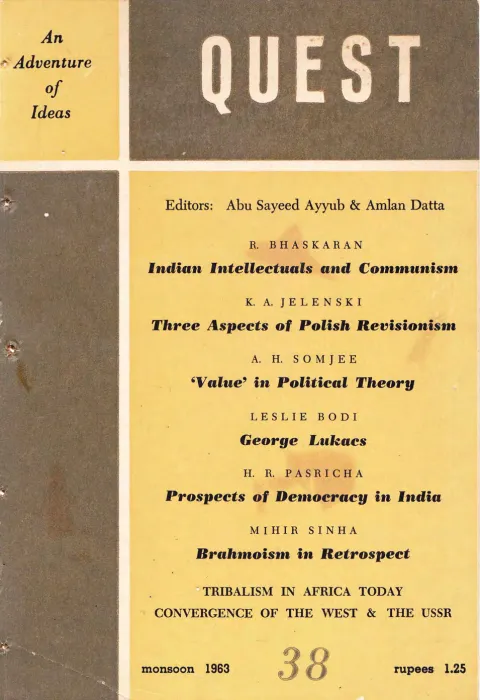
QUEST
Summary
Quest No. 38 (July/Sept. 1963; ‘monsoon 1963’ on the cover), edited by Abu Sayeed Ayyub and Amlan Datta for the Indian Committee for Cultural Freedom, is the Bombay quarterly’s post-1962 reckoning with communism. Its argumentative centre is the question of what the Chinese invasion has done to Indian non-alignment and to the Indian intellectual’s habitual sympathy for the Left: R. Bhaskaran’s lead article predicts a split of the ‘so long happily united’ intelligentsia into Right and Left and proposes a ‘new Sanatanism’ as the anti-communist’s idiom, while K. A. Jelenski anatomises three layers of Polish revisionism, Leslie Bodi traces Lukacs’s career as a case of philosophy captured by party dogma, and a five-hander symposium asks whether the Western and Soviet systems are converging. Around that spine the issue sets H. R. Pasricha’s bleak, culturally deterministic verdict on Indian democracy, Mihir Sinha’s revisionist history of the Brahmo Samaj, Punya Sloka Ray’s audit of Indian linguistics, S. B. Sinha’s survey of crime in the welfare state, William Phillips’s New York letter on the middlebrow absorption of the avant-garde, a transcribed London discussion on African tribalism and Pan-Africanism chaired by Ernest Gellner, film and Hindustani-music criticism, six poems, Krishan Kumar’s short story on widowhood and hypocrisy, ten signed book reviews, three unlisted shorter reviews and three correspondence letters, two of which are quarrels with Quest’s own editors.
Essays
The Indian Intellectual & Communism
By R. Bhaskaran
Bhaskaran argues that the Indian intellectual is a recent, wholly Western import — a product of literacy and the printing press with no counterpart in ancient or mediaeval India — and that his instinctive ‘progressivism’ is an inherited fashion rather than a considered position. Because the revolutionary intelligentsia tradition comes from Tsarist Russia by way of Britain, and because the Indian variety combines a Western liberal concern for personal freedom with an old Indian aversion to violent action, the good Indian intellectual has become an ideal fellow-traveller ‘up to a point’, admiring Russian and Chinese achievement while declining communism in toto; Nehru is offered as the type of this eclectic ‘majority’ intellectual.
The Chinese invasion of 1962, Bhaskaran contends, has destroyed the third position. Neutralism’s profits have run out, so the intelligentsia must now divide into Right and Left, which he welcomes as clarifying. He then sets out the handicaps of the avowed anti-communist — who will be called a capitalist stooge and a traitor, and who faces the entrenched beneficiaries of what Bhaskaran calls India’s ‘pseudo-socialism’ — and his one advantage, the surviving moral vocabulary of Indian tradition. From that he proposes four principles: refusal of a perpetually rising standard of living as the goal of life, refusal of state monopoly over the definition of human values, assertion of every man’s uniqueness as a natural right, and denial of the goodness of equality. The result he names ‘a new Sanatanism’.
- Defines the intellectual negatively: we can be sure who is not one but cannot agree who is.
- Treats Indian intellectualism as a colonial derivative with no native tradition behind it, and predicts more than a generation before a non-Western Indian intelligentsia appears.
- Reads the pro-communist reflex as an intellectual fashion sustained by 15 years of government propaganda and a climate favouring the planned socialistic state.
- Argues that 1962 forced Indians into the contemporary world and destroyed the neutralist third position.
- Proposes four anti-communist principles, including an explicit ‘denial of the possibility or the goodness of the principle of equality’.
Three Aspects of Polish Revisionism
By K. A. Jelenski
Jelenski distinguishes three layers of revisionism at work in Poland. The first is the ‘pragmatic revisionism of the rulers’: Gomulka’s ‘Polish road to socialism’, for which he was purged as a national deviationist in 1948 and which quietly disappeared as a slogan once Moscow conceded the realities behind it — private agriculture on 87 per cent of the cultivated area, a modus vivendi with the Church, and Khrushchev’s oblique approval at the 22nd congress. The second is the ‘heretic’ or philosophic revisionism of the young Marxists of the weekly Po Prostu, whose editors began as fanatical Stalinists, coined the term ‘New Class’ before Djilas’s book, rejected Marxist dogmas by testing them against historical experience, and were suppressed in 1957; its deepest expression is Leszek Kolakowski’s insistence that historical necessity can never discharge a moral duty. The third is the ‘orthodox revisionism’ of Schaff, Lange and their generation, who modernise Marxist method while reserving to the Party the right to decide what counts as creative and what as liquidatory revision.
Jelenski’s conclusion is that orthodox revisionism matters chiefly as a conduit — it launders the heretics’ questions into forms Moscow can accept, and it is only through such men that Poland can influence Soviet thinking. But the genuinely new problems are always posed by the philosophic revisionists, and the same 22nd congress that opened the sciences has tightened the screws on literature: a novel withdrawn, the literary prizes abolished, Kolakowski’s plays pulled after five days, and the liberal ‘Crooked Circle’ club closed after a debate in which Schaff argued that Poland enjoyed more intellectual freedom than the United States.
- Separates pragmatic (Gomulka), orthodox (Schaff, Lange) and philosophic (Kolakowski, Beylin, Strzelecki) revisionism.
- Reads Gomulka’s 1949 confession about his attitude to the USSR as evidence that the CPSU, not Gomulka, has since moved.
- Portrays Po Prostu as internationally minded and eclectic — Mayakovsky, jazz, Steinbeck, existentialist psychoanalysis — and credits its writers with inventing ‘New Class’.
- Identifies the essential difference between orthodox and philosophic revisionism as the question of who decides the limits: the Party, or not.
- Notes that scientific liberalisation after the 22nd congress coincided with renewed literary censorship, ending with the closure of the ‘Crooked Circle’.
The Problem of Value in Recent Political Theory
By A. H. Somjee
Somjee sets out to show that the long controversy over ‘the relevance of science to values’ in political theory has been barren, and to restate the problem. He traces the framework from Simmel and Rickert through Max Weber — who equated the value problem with means and ends and remained ambivalent, granting science a free hand over means and a hesitant one over ends — and then through those who worked inside Weber’s frame: Charles Beard and George Sabine, who concluded that no social inquiry can be morally neutral, and David Easton, who took it as given that every moral frame of reference conditions empirical research. Against these he sets Dewey and Catlin, who tried to dissolve or redefine value, and Kaufmann and Brecht, who tried to give value-terms an objective base through agreed axiological rules or an intersubjective common denominator. All of them, he argues, remained prisoners of the positivism/anti-positivism quarrel.
His own proposal is to abandon the epistemological question for an operational one: under what conditions do values actually enter an inquiry? He introduces the term ‘value-situation’ and argues that such situations are not produced by the subject-matter, nor by the analyst’s professed or unprofessed values, nor by the values of his social milieu, but by the interaction of three groups of factors — the dominating motive of the inquiry (of which he distinguishes six), the psychologico-intellectual quality of the assertion guiding it, and the testifiability of warranted assertions. A hunch has no value-source; a fully intellectualised hypothesis exposed to public testing has none either; it is the middle range, where assertions rest on a moral frame and cannot be publicly communicated or refuted, that generates value-situations. The consequence he draws is that value-free situations are possible even in the study of political phenomena.
- Argues the science-and-values controversy has obscured rather than clarified the problem of value in political theory.
- Reads Weber as the bridge and the source of the later rift, his treatment ‘ambivalent’ between scientific method and the will as the source of final axioms.
- Groups Dewey and Catlin as trying to do without value, Kaufmann and Brecht as trying to objectify it.
- Substitutes the operational concept of the ‘value-situation’ for the epistemological question.
- Concludes that value-free situations are possible in political study, since only some assertions carry value-quality.
- Closes with a 20-item reference list on printed p.30 citing Myrdal, Weber, Beard, Easton, Dewey, Catlin, Kaufmann, Brecht and Popper.
Prospects of Democracy in India
By H. R. Pasricha
Pasricha argues that democracy, being Greco-Roman in concept and pragmatic in outlook, was transplanted into Asian and African soil without the stages that produced it in the West, and that in India the genius of the people refuses it. His explanation is frankly culturalist and, in places, openly contemptuous: Indian abstract thought has produced a personality ‘steeped in self, vain and egotistical’; preoccupation with the eternal makes present suffering a purifier rather than a problem; feudal conceptions of serfdom survive, which he illustrates with anecdotes from his own medical practice; and he asserts that a hot climate has degraded labour and that Indian minds are handicapped in empirical science. He quotes Lord Birkenhead approvingly: ‘You cannot distil Western wine into Eastern bottles’.
The constitutional half of the argument compares the Indian Republic with Weimar (printed throughout as ‘Weimer’), which he calls the most liberal constitution of its kind and which died of proportional representation and presidential decree. India’s equivalent ‘built-in device of self-destruction’ is adult franchise: conferred on an illiterate electorate and worked by a government holding vast economic power, it becomes a weapon for perpetuating one-party rule, so that India may already be under a dictatorship of the proletariat run by men determined to rise into the capitalist class. He closes on the political class — men without vocation or profession, hostile to the better-equipped, unable to resist ‘filthy lucre’ — and concludes that neither people nor leadership will exert itself for democracy, leaving its fate ‘anybody’s guess’. A closing note adds that uncontrolled population growth widens ‘the sector of hungry unemployables who gravitate easily to communism’.
- Treats democracy as a Greco-Roman inheritance whose absence of pragmatic culture in India is decisive.
- Explains Indian backwardness in science and the low status of labour by inherited thought-patterns and climate — assertions made in the author’s own voice.
- Draws a sustained parallel between the Weimar and Indian Republics, including the combination of cabinet government with a strong president.
- Identifies adult franchise as the Indian constitution’s self-destructive device and suggests one-party dictatorship may already exist.
- Indicts the political leadership as unqualified, self-abasing before leaders of ‘revolting personality’, and corrupt.
- Appears in the issue alongside a contributors note identifying Pasricha as ‘a leading member of the Swatantra Party’ — relevant to the Aiyar correspondence in the same issue about writers with party preferences.
George Lukacs
By Leslie Bodi
Bodi, lecturing to Australian philosophers, presents Lukacs as the case-history of a great modern thinker inside a closed ideological system. He tracks the early work — Die Seele und die Formen, the Hungarian history of modern drama, and The Theory of the Novel, read as a sophisticated ‘Paradise Lost’ in which the novel expresses man’s transcendental homelessness — then the turn to Marxism, the Commissarship in the 1919 Hungarian Soviet Republic, and History and Class Consciousness, which fused Hegel’s self-alienation of spirit with Marx’s alienation of labour and became ‘the profession of faith of an aesthetic Humanist turned Marxist’. That book also ended his standing as an official Party spokesman: ‘Lukacsism’ became a term of abuse, and the Blum Theses were denounced as rightist deviation.
The centre of the essay is a close reading of The Historical Novel, whose account of Scott’s ‘middle-of-the-road hero’ Bodi calls brilliant while noting a second, speculative explanation of the same device offered in the same paragraph, and whose comparison of drama and epic he rates Lukacs’s method at its best. The second half of the book, by contrast, shows Party dogma interfering: bourgeois ‘decadence’ after 1848, progressive form in Rolland and Mann. Bodi diagnoses the ‘eery abstraction’ Thomas Mann felt in Lukacs as the consequence of working with absolute categories that cannot be discussed — Lenin’s theory of reflection, the ambivalent ‘typical’ — and credits him with the theory of the ‘fundamental bias’ of great art, by which the reactionary Scott may write better historical novels than a progressive contemporary. The narrative closes with the 1956 rehabilitation, the ministry under Imre Nagy, deportation to Rumania, and Lukacs at 77, having finished his Aesthetics and begun his Ethics.
- Presents Lukacs’s whole career as a contradiction between the highest standards of European aesthetics and the closed system of Party doctrine.
- Notes that only two of his major works then existed in English, evidence of slow Anglo-Saxon reception.
- Reads The Historical Novel as strongest on genre theory and weakest where post-1848 ‘decadence’ is being demonstrated.
- Explains the ‘fundamental bias’ theory via Engels on Balzac, and its corollary that Scott may outwrite progressive novelists.
- Retells the parable of the rabbit on the Himalayas and the elephant as Lukacs’s answer to the dogma of automatic Soviet literary superiority.
- Closes with an anonymous New Statesman verdict on his survival; the essay carries a headnote (‘Based on a lecture given in June 1962 to the Melbourne University Philosophical Society’) and a bibliography.
Brahmoism in Retrospect
By Mihir Sinha
Mihir Sinha offers a deliberately anti-hagiographic social history of the Brahmo Samaj. His opening move is to invert the usual account: Ram Mohan Roy did not found a movement so much as the movement gave him his historical importance, since significant social movements ‘are never dependent on the fortuitous presence of a leader’. A footnote insists that Ram Mohan was a social thinker rather than a religious leader like Chaitanya, and warns the historian against hero-worship. The Atmiya Sabha and Brahmo Sabha are then read as the ideological arm of a new commercial aristocracy, created by trade with foreign interests and pushed by British policy and the Sale Law into land, competing for the leadership of Calcutta’s rising middle class against Radhakanto Deb’s Dharma Sabha on one side and Derozio’s Academic Association radicals on the other.
The decline is traced through personalities and organisations: Debendranath Tagore, an introvert absorbed in spiritual speculation, abolished the Tatwabodhini Sabha in 1859 and built a superstructure of ritual, then joined Radhakanto Deb in the British Indian Association — for Sinha, the end of the original movement. Keshab Chandra Sen’s career from firebrand missionary to the man-god cult and alignment with the Ramakrishna revival produced the split into Adi and Bharatbarshiya Samajes (1866) and then the Sadharan Brahmo Samaj (1878). Sinha’s verdict is that the movement’s real failure was not its inability to reform Hinduism but ‘its subsequent success as a sect of reformed Hindus’: having supplied the national movement with an educational and cultural basis, the Samaj has been relegated to one sect among many, its present members living off an older generation’s pioneering.
- Reverses the conventional causal story: the movement made Ram Mohan Roy historically important, not the other way round.
- Reads Brahmoism as the ideological self-fashioning of a new trade-derived Calcutta aristocracy rather than as a religious awakening.
- Places the Brahmo Sabha between Dharma Sabha conservatism and Derozian radicalism as three answers to the same historical pressure.
- Identifies Debendranath Tagore’s ritualism and his alliance with Radhakanto Deb as the point of no return.
- Treats the successive schisms of 1866 and 1878 as completing a full circle, with intellectual leadership lost each time.
Linguistics in India
By Punya Sloka Ray
Ray calls his article ‘a one-man report on the state of the scientific study of languages in India’ and answers the sceptic’s question — why study linguistics at all — with four arguments: literature departments are built for aesthetic appreciation, not for teaching practical command of a language to engineers, colonels and officials; small distortions of information now cost votes or military disasters, and modern campaigning requires real communication with local people; language learning is not a common-sense skill picked up by gesture; and modern linguistics has become a full discipline, as demanding as a physical science.
He then paints the situation harshly. Fewer than two dozen Indian scholars would be considered competent by modern standards, most of them without inner drive; the one-professor-per-department rule lets a single ageing eminence dam a field for a lifetime; the government anthropology department is interested in folk-dances and ruined temples and has about one competent linguist in its entire cadre, with nothing in its files more recent than Grierson’s survey. He offers shock illustrations: officials who take a year to learn simple greetings, Russians in Calcutta speaking Bengali like natives, Chinese intelligence networks in border areas, an MA whose paper is returned from abroad as unintelligible. Equipment, he notes, is ‘ridiculously inexpensive’ — a tape recorder, tapes, and perhaps Rs. 500 a year of books. The Deccan College at Poona is the only training place worth naming, and it lacks staff in Tibeto-Burman languages, general syntax, suprasegmental phonology and monolingual field methodology while fighting students who claim degrees as a political right. He ends with six ranked priorities — structural descriptions of the leading spoken languages, contrastive presentations against English and Hindi, bilingual dictionaries for learners, a central pool of new technical terms, descriptions of strategically important tribal languages, and area manuals — while conceding some scope to pure science.
- Frames linguistics as a strategic and administrative necessity as much as a scholarly one, citing votes and military disaster.
- Puts the number of competent Indian linguists at under two dozen and blames the single-professor department structure for stagnation.
- Indicts the government anthropology department for antiquarian interests and for relying on Grierson’s survey.
- Argues the material cost of competent linguistic work is trivial; the real costs are field trips and office-keeping.
- Names Deccan College, Poona as the only real training centre and itemises its gaps, including a war with students claiming degrees as a political right.
- Sets out six priorities headed by structural descriptions of prestige spoken dialects, with tribal languages of sensitive border areas included.
Crime in a Welfare State
By S. B. Sinha
S. B. Sinha, a retired prisons superintendent and former Indian Medical Service officer, asks how far crime can be averted by education and improved living conditions in a welfare state. His premise is that nobody is born a criminal — ‘the chromosomes do not transmit criminality’ — so that the parents, the childhood environment and education form the triad that makes or mars character, and a welfare state owes the working individual a decent home and economic security as well as schooling. He classifies crimes against persons and property and describes the older pattern of ‘emotional’ crime arising from caste, village and zamindar-ryot feuds and from deviation from sexual morality, including a case reported by a Chief Judge of the Oudh High Court in which a farmer killed his nine-year-old daughter over an unmade breakfast.
The bulk of the article is an indictment of post-independence India. Crime has risen through Partition’s uprooting, linguistic-reorganisation agitations, unemployment following the population explosion, migration to cities and partial prohibition; separatist demands for Vidarbha, Sikhistan, Nagaland and Dravidland are named as continuing sources of violence. The administration was weakened by the departure of senior British officers and by ministers who interfered, practised nepotism and ‘shifarrish’, and abandoned the Mahatma’s advice to live in huts; Sinha judges 1957-62 worse than 1952-57 because of Congress group rivalries. Partial prohibition and anti-prostitution laws, he argues, have spread the evils they attacked; the beggars, bootleggers, prostitutes and wandering sadhus are the recruiting ground of professional crime; and roughly 10 per cent of the jail population is diseased, idiot, imbecile or mentally underdeveloped, whose incarceration he calls inhuman. The failure he names last is the absence of any comprehensive crime policy at all.
- Rejects innate criminality and locates crime in family, environment and education, making housing and economic security welfare-state duties.
- Distinguishes older ‘emotional’ crime from the new white-collar and gentleman crime produced by educated unemployment, with a catalogue of modi operandi.
- Gives the number of unemployed as nearly 10 million and links unemployment directly to crime.
- Blames partial prohibition and anti-prostitution measures for creating rackets and driving the evils underground.
- Argues that about 10 per cent of the prison population is mentally disabled or diseased and should be treated, not jailed.
- Attributes administrative decline both to the loss of experienced British officers and to ministerial interference and corruption.
Letter from New York
By William Phillips
Phillips reports a becalmed New York. After the Cuban crisis and during the newspaper strike, little seems to be happening: there is a stalemate at home and abroad, extremes of action or thought are left to lunatics who are not even interesting, and the war scare has turned into its opposite, taken as final proof that war is out of the question. He reads Republican attacks on Kennedy for softness on Russia as a domestic necessity rather than a foreign policy, notes that toughness is always the posture of the party out of power, and observes that the lesson about Latin America — that only a democratic socialism which wipes out backwardness and corruption can stop the Russian brand of communism — is being learned purely abstractly, with no formula for building such movements against both conservative and communist opposition.
The cultural half of the letter is an argument about the apparent collapse of the line between serious and popular audiences. The New Yorker has run Hannah Arendt on Eichmann, Harold Rosenberg as art critic and James Baldwin on the Negro question; Nugget and Playboy have found a formula mixing sex and culture; Esquire prints Macdonald and Mailer; even the women’s magazines and the Saturday Evening Post have gone in for intellectual fashions. Phillips counts himself among the traditionalists who view this with alarm, because its effect is to promote the chic and the slick, to turn ideas into sensations and writers into celebrities, with money rather than the arts driving the change; the Baldwin piece is his test case, its excitement ‘took care of’ readers’ guilt. Recent fiction is mostly slick — Roth accomplished but feeding on himself, Updike’s early books ‘outstanding examples of undergraduate prose’, Baldwin’s Another Country crude in style and conventional in its sexual permutations — and Albee’s Who’s Afraid of Virginia Woolf ‘converts the living room into an unused bedroom’.
- Diagnoses a non-political mood in which brinkmanship has become a defensive weapon for keeping the stalemate.
- Reads party positions on Cuba and Russia as functions of being in or out of power rather than of foreign policy.
- Identifies the breakdown of serious/popular distinctions as more apparent than real, and driven by money.
- Uses the reception of Baldwin’s New Yorker essay to argue that the excitement of reading substituted for responsibility.
- Judges current American fiction and theatre as technically proficient and safe, mixing sex, social consciousness and an experimental look.
- Printed with the line ‘(Exclusive to Quest)’ at its close.
Tribalism and Modern Political Developments in Africa
By Masika, Asfaw Damte and Charles Patterson
This is a transcribed discussion, printed under CURRENT POLITICS, between Masika (a Ugandan research student in London), Asfaw Damte (an Ethiopian economist at Cambridge) and Charles Patterson (an American research fellow from Berkeley), chaired by Ernest Gellner, who is named only in the bracketed headnote. Gellner opens by distinguishing three senses of ‘tribe’ — the small kin-based village unit that performs state functions in pre-industrial societies; the cultural-linguistic group, which may number millions; and the loose use of the word for any traditional African political organisation, including large states and empires. Damte accepts the second; Masika observes that the first is what anthropologists call a clan.
The argument then turns on Pan-Africanism. Patterson suggests it is a ‘tribal mystique’ writ large, an extension of common culture to a continental scale. Damte rejects any tribal or racial basis — all who live in Africa and consider themselves African, ‘whether red or white’, are raw material for a Pan-African state — and grounds the case in size: small, poor, backward states cannot survive beside the United States, the Soviet Union and the European Common Market. Gellner presses the practical difficulties: perpetuating small cultures obstructs a mobile modern economy, as India’s linguistic diversity shows; who holds the membership card in a Pan-African union, the individual, the inherited colonial state or the tribe; and is tribal membership a legitimate ground for redrawing State Y’s boundaries? Masika replies that Africans will not encourage what cannot survive modern conditions, illustrates the language problem with Swahili’s acceptance in Kenya, Tanganyika and Zanzibar but not Uganda, and says the state is seen as the colonial power’s immediate successor while Pan-Africanism ‘will be our own creation’. Gellner’s retort is that Pan-Africanism is popular precisely because it does not yet exist.
- Three distinct senses of ‘tribe’ are separated before any political argument is allowed to proceed.
- Damte argues the case for continental union from the economics of scale, not from race or culture.
- Gellner raises the membership question — individual, inherited state, or tribe — as the practical test of tribal political legitimacy.
- India’s linguistic diversity is used as the comparative case for the costs of cultural pluralism in a modern economy.
- Masika reports that Swahili’s spread is acceptable partly because ‘the Swahili are a dying race’, adoption of another living tribe’s language implying inferiority.
- The Monrovia/Casablanca split is noted as a setback already suffered by Pan-Africanism.
Atomic Operas
By M. S. Dworkin
Dworkin argues that the dramatisation of atomic holocaust has become an established genre with its connoisseurs, and that this is more dangerous than indifference: once dooms become a genre, prophecy is put up for sale, and the shock administered in a theatre carries its own catharsis, providing conventional substitutes for thought and action. His test cases are two films. The Day the Earth Caught Fire, written by Wolf Mankowitz with Val Guest, earns full marks for pro-survivalism, and its insistence on realism — shot in the Daily Express office with Arthur Christiansen playing himself — is meant to sharpen the fantasy of an earth knocked out of orbit by simultaneous Russian and American tests. But the newspaper milieu, Dworkin argues, lends a Sunday-supplement tinge to the science and associates two kinds of sensationalism through their shared familiarity; its imagery of a parched Thames and empty streets repeats an already established pictograph, after On the Beach and The World, the Flesh and the Devil.
Panic In Year Zero, directed by Ray Milland from a screenplay by Jay Simms and John Morton, is read as a colder and more corrosive fantasy: the vacationing family that sees the cloud over Los Angeles and retreats to a cave enacts the ‘What would you do if…’ daydream, with the mother standing four-square for culture against the suspicions, fortifications and violences the father demonstrates to be necessary, and with father and son finally blasting the punks who have raped ‘the family virgin’ — the hallowed movie conjunction of sex and violence with tasty rectitude. Dworkin’s closing point is that it makes a difference whether audiences are being led to envision or to enjoy the worst they can imagine, and that so much terror sold to so little effect may be mirroring a perpetual destiny.
- Treats the atomic film as a genre whose consumers know what they are buying, advertising having called them carefully.
- Argues the more enjoyable the film, the less likely it is to disturb complacency.
- Reads the Daily Express setting of The Day the Earth Caught Fire as compromising its science with newspaper sensationalism.
- Finds Panic In Year Zero’s family-survival scenario the more disturbing because it prescribes behaviour, including violence, as necessary.
- Ends by asking whether such films show more of our future than appears on the screen.
Amir Khan
By Chetan Karani
Karnani praises Amir Khan as one of the few contemporary Hindustani vocalists able to create a ‘time-Svar continuum’, recalling a 1958 Akashvani Sangeet Sammelan at which he contemplated the notes of Abhogi for half an hour and still seemed to be starting. He reads this as the avoidance of deliberate effect, quoting T. S. Eliot’s dictum that art is an escape from personality rather than an expression of it, and argues that Amir Khan’s most daring innovation is discarding the sarangi altogether — proof of his vocal resources, and evidence that for contemplation of notes the sarangi is an obstacle rather than an aid.
The article is built on a contrast with Bade Ghulam Ali Khan. Where Ghulam Ali begins with intricate patterns that amaze, Amir Khan builds his edifice note by note, which Karnani describes through I. A. Richards on nervous equipoise and through Gestalt psychology: each higher note forms an entirely new whole in relation to the earlier ones. Amir Khan takes at least half an hour over depth ragas like Marva, Todi, Purya Dhanashri and Darbari, and Karnani singles out the Madhyam of his hour-long recorded Miyan Ki Malhar; Ghulam Ali’s favourites are pentatonic modes with a flitting grace that let him range over three octaves. He proposes reducing all the gharanas — Agra, Gwalior, Kairana, Jaipur, Delhi — to two schools, a contemplative one led by Amir Khan (whom he places as the highest consummation of Kairana, though he hails from Indore) and an active one led by Ghulam Ali, while insisting that Amir Khan’s Drut singing is equally masterly, ‘a breathless leap into verticality’.
- Argues for a two-school classification of Hindustani vocal music — contemplative versus active — cutting across the gharanas.
- Treats the abandonment of the sarangi as the central aesthetic decision of Amir Khan’s style.
- Imports Western critical apparatus (Eliot, I. A. Richards, Gestalt psychology) into Hindustani music criticism.
- Distinguishes the Vilambit and Drut halves of a recital as requiring opposite qualities.
- Concludes that Amir Khan’s contribution is undervalued because few vocalists have grasped that music should soothe and elevate, not only please and surprise.
Convergence of the West and the Soviet Union
By Christopher Mayhew and others
Mayhew’s is the opening statement of the DISCUSSION symposium and the only affirmative one. He takes the principal differences between the systems to be the Soviet Union’s lack of political, personal and cultural freedom, its lower living standards, greater social equality and higher level of planning, and examines each in turn. Politically he expects little Western movement towards Soviet methods, though he notes the growing power of the executive over the legislature and the erosion of party differences, which could be read as a drift towards single-party democracy; on the Soviet side he records a marked decrease in the power of the secret police and of the Head of State, more freedom of speech for private citizens, and small gains in the autonomy of courts and local institutions — advances he expects to continue without spectacular formal change, power remaining overwhelmingly with the Party.
On personal and cultural freedom he predicts continued Soviet liberalisation, resting on rising living standards, the state’s dependence on its intelligentsia, public commitment to cultural contacts, and the unstoppable spread of Western popular music and consumer goods. On economic planning he calls the avoidance of a major capitalist slump for two decades the outstanding feature of East-West convergence — a Western advance towards Soviet standards — while Soviet failures in agriculture and retailing compel decentralisation and personal incentives, with rent and interest entering Soviet industrial accounting. On social equality he expects Western movement towards equality and further American advances against racial discrimination, while rising Soviet living standards and incentives produce greater differentiation. The process, he concludes, will be hastened by both sides conceiving competition in measurable economic terms rather than in terms of ‘freedom’ and ‘socialism’.
- Argues convergence is already visible in every field examined and will continue, with the Soviet system contributing most of the movement politically.
- Reads Western executive dominance and bipartisanship as a mirror-image drift towards single-party politics.
- Calls two decades without a capitalist slump the outstanding instance of Western movement towards Soviet standards.
- Predicts Khrushchev’s successor will not inherit his full personal power, absent a strong ‘Chinese’ faction.
- Expects the two systems to converge faster as both redefine competition in measurable economic achievement.
Convergence of the West and the Soviet Union
By HENRY L. ROBERTS
Roberts approaches the question historically and sceptically. He argues that pre-revolutionary contrasts between Russia and Western Europe have been drawn too sharply — the relationship is better described as gradations of a spectrum across the continent than as a polarity — while conceding that the subjective sense of antithesis mattered, since moderate differences of degree are easily taken for differences in kind. In the two decades before 1914 that picture was becoming irrelevant, especially culturally: Russia’s Silver Age was allied to Western developments, but the similarity came from a common irruption into the disquieting landscape of the twentieth century, so that the convergence was ‘not through resolution but through advance into the unknown’.
The war and revolution then restored the old antithesis in Communist and Imperialist dress, and Roberts identifies a specific impetus to divergence in the act of breaking away: like a child leaving its parents or a colony its mother country, the struggle for separate identity is an intimate internecine conflict in which features of the old order carry over and threaten ‘backsliding’ or Restoration. That fear dominated the first Soviet generation, but is losing force with the passage of time — with the paradoxical result that securely established distance may reduce divergence, as he felt in postwar Soviet scholars who were more remote yet less combative. Against this he sets the fact that the two societies are now constantly thrown together, producing a host of ‘partial convergences’, some inimical, some positive, which excite visiting scientists and artists. He doubts these can produce political convergence, and cites Khrushchev’s rebuff to a French correspondent who suggested science might unify the world. Any general convergence, he speculates, would come as another common break-through into the uncharted, politics ‘in a new key’ with unsettling dissonances.
- Recasts the Russia-West antithesis as a spectrum, while insisting subjective perceptions of polarity had real effects.
- Reads the pre-1914 cultural convergence as a shared plunge into modernity rather than a meeting of two societies.
- Identifies disaffiliation — the struggle for separate identity — as an independent source of hostility, now fading with the generations.
- Distinguishes numerous partial convergences from political convergence and doubts the former produce the latter.
- Suggests too much human history has gone into the political divergences for explicit reconciliation.
Convergence of the West and the Soviet Union
By ZBIGNIEW BRZEZINSKI
Brzezinski answers ‘Not really.’ He concedes universal traits inherent in the industrial order and in mass culture and leisure, so that in that sense convergence has happened, is happening and will happen, China included: every factory built in an isolated Chinese town reduces the cultural, economic and social distance between Chikurting and Chicago. But he dismisses these as superficial considerations, and points to the profound chasm that separated Essen under the Nazis from Detroit despite similar economic and technology levels. What differentiates political and social systems, he argues, is internal political organisation, the fundamental purposes of the system and the methods used to obtain them — and those are shaped by the methods used to build the society in the first place. The forced, brutal industrialisation of the Soviet Union, repeated in China, leaves its mark on the subsequent social order, creating vested interests and institutions that differ profoundly from a system that developed gradually and pluralistically. The Soviet image of the future, he concludes, points to a welfare totalitarianism combining elite leadership with mass voluntarism and little political pluralism — profoundly different from the welfare democracy towards which the West is evolving.
- Accepts industrial-society similarities but denies they touch what differentiates political systems.
- Uses Nazi Essen versus Detroit as the decisive counter-example to technological convergence arguments.
- Argues the methods of building a society persist in its institutions and values.
- Names the Soviet destination ‘welfare totalitarianism’ against the West’s ‘welfare democracy’.
Convergence of the West and the Soviet Union
By WOLFGANG LEONHARD
Leonhard makes the answer depend on the word ‘gradual’. Absent startling changes — such as the potential crisis of leadership mentioned earlier in the symposium — he expects any mutual convergence to evolve slowly and to occur mainly in the social and economic sphere: the growing influence of the state in Western economies matched by a decrease in state control over the Soviet economy, with detailed state planning replaced by a broader framework and Common Market features introduced. The rising importance of the managerial class in both forms of society, and the increasing similarity of managers’ training and outlook, he offers as evidence that such a process is under way. Politically he is pessimistic: the party machine will probably exercise absolute control over all spheres of Soviet life for a long time to come, and there is virtually no prospect of departure from the ideological tenets that justify the party’s supremacy.
- Conditions the whole answer on what ‘gradual’ is taken to mean.
- Locates convergence in the economic and social sphere only, moving in both directions.
- Treats the growth of a managerial class with common training as the best evidence of convergence.
- Rules out political rapprochement while the party’s ideological justification holds.
Convergence of the West and the Soviet Union
By VICTOR ERLICH
Erlich also answers no. Following Alex Inkeles, he lists features the US and USSR already share, which are either inherent traits of large-scale industrial societies or corollaries of the Cold War: expanding bureaucracies, vast productive plants geared largely to military purposes, mass culture and mass education, heavy emphasis on science and technology, and — though here he thinks differences outweigh similarities — the average citizen’s growing inability to participate meaningfully in decisions based on classified information and expert data. Actual convergence of the two systems he judges highly improbable, since it would presuppose either a Western drift towards the garrison state or a far-reaching democratisation of the Soviet system, or a considerable measure of both. He sees no sign of the latter and does not envisage the former: despite the dangers in the much-touted eminence of the ‘military-industrial complex’ in the United States, the Western system remains fundamentally pluralistic and so qualitatively different from a somewhat modified Soviet totalitarianism.
- Grants a substantial list of shared features, attributing them to industrial scale or to the Cold War rather than to convergence.
- Names the citizen’s exclusion from expert, classified decision-making as a shared trend where differences still dominate.
- Sets two conditions for real convergence — a Western garrison state or Soviet democratisation — and finds neither in prospect.
- Acknowledges the American military-industrial complex while insisting on Western pluralism as the qualitative difference.
Transient Might
By Mbella Sonne Dipoko
A short poem in three movements that likens states and nations to dead leaves and the earth to a hungry monster that swallows them. Trees, ‘like fecund women’, keep replacing the numbers even as individuals yellow and die; in an autumn park the speaker sees ‘the world’s parts’ as nations of dead leaves tossed about by time, the maddening wind, so that ‘So little we weigh.’ The closing stanza turns inward: closing his eyes in a time of fear, the speaker sees himself as a single leaf already struck by yellow fever, in death’s prelude, and drops.
- Sustains one figure — nations as dead leaves — across all three stanzas.
- Makes time, not politics, the governing force: ‘the wind of time That governs us.’
- Moves from collective to personal mortality in the final stanza.
It Is For You
By Mbella Sonne Dipoko
An invitation poem. The speaker promises to take the addressee ‘beyond today’ to his mangrove swamps, where his people live on mangrove trees in huts like lighthouses; there they would keep mudskippers as pets that never need feeding, garage a canoe among the lanky roots and ride a sea fringed with surf-like flowers. Clothing reduces to loin cloths, the sun bronzes her breasts ‘Like cocoa pods hanging from your naked chest’, and the evenings bring a chorus sung by winds and the lights of merchant ships like torch-bearers in a distant field, the waves clapping as they paddle home to the mother-in-law waiting on the mangrove trees. The poem closes with a mermaid kiss among the tropic mangrove trees.
- Builds an entire domestic future out of mangrove-swamp imagery, substituting canoe for car and roots for garage.
- Frames the erotic invitation as an invitation into a people and their ways, not merely a landscape.
- Closes by domesticating the exotic — the journey ends at the mother-in-law’s.
On Seeing Clouds
By Lawrence Bantleman
Printed over the poem as ‘ON SEEING CLOUDS AND WITH THE CLOUD IN MIND’, this is a single long sentence-sequence in which the weather of the sky becomes the ageing of a personal god. Skies move from the early blue of ‘his cooed-over summer eyes’ to grey and curling black forelocks that also waved in youth; young clouds brushed to and fro across the blue beach of his eyes make mackerel and sunset red, and hold holy fish and blood still to watch the sun-blood spill across his godhead at the kill. The second movement insists on a darkness beyond comparison — not fog or night, and rather gentian than soot — a multiplying dark that tolerates no flame and sits upon the spark without the usual bickering of flint and woody fire. The god’s last fistful of wisdom, knowledge, intellect, know-how and ‘supermarket truth’ returns only as small change; he asks, no longer praying, that the darkness break, but no crack comes, and the soul, tramped underfoot and dry with lying, lies down to wait for truth and for ‘the early blue of ribbon-coloured skyway Tying the nimbus of a youthful god In youth.’
- Maps a whole theology onto cloud-watching: the god ages as the sky darkens.
- Sets ‘supermarket truth’ and ‘know-how’ against the older vocabulary of wisdom and intellect.
- Ends suspended — waiting rather than resolving, with youth held out as the unreached blue.
The Descent
By Amaresh Datta
A five-stanza poem tracing a descent from ambition to torpor. The subject had coveted ‘the purple power’ and the centrality of the sun, its majestic poise islanded by ripples of colour and light; failing, he sought instead the sun’s promise of ripeness and the rock’s geologic maturity in a world of ‘liquid girls’ and rivers of time and tide. Now he ponders justice and fate between one frustration and another, moving from trance to trance, ‘Drunk with the opiate of living’, with no heart left for the sun or its symbol of hope. In a cold corner he weaves strange patterns between damp walls and lets ‘his anaemic grin rise and fall’ when chance blows some faint shadow of longing. The last stanza names the acquired skill: the smooth gliding down the curve of rolling stone, moments of defeat and daring forgotten, the man now ‘Time’s ally Happy and sheltered in his revolving orb.’
- Organises the poem around solar imagery withdrawn stage by stage.
- Makes accommodation, not catastrophe, the form of the fall: the descent is comfortable.
- Ends on the irony of being Time’s ally and sheltered by it.
Recapture
By G. C. S. Marar
A sonnet of uncanny landscape. The way leads down a dark half-wooded heath where moss-grey boulders hump above the mould and cold, disquieting drops spray from unseen streams in gulfs beneath; there is no wind and no sound in the puzzling shrub or alien-featured tree, and no view ahead until a monstrous mound stands straight in the speaker’s path. Its steep rank-grassed sides loom half to the sky, cluttered by a crumpling flight of lava stairs scaling the ‘fear-topped height’ in steps too vast for any human tread. The closing couplet supplies the recognition the title promises: the speaker shrieks and knows ‘what primal star and Year Had sucked me back from man’s dream-transient sphere!’
- Uses a strict sonnet form for a weird-fiction subject — a non-human architecture encountered on a walk.
- Withholds explanation until the final couplet, where recapture rather than discovery is revealed.
- Marks the inhuman by scale: steps ‘too vast for any human tread’.
Reflection
By Indira Mahanty
A ten-line poem printed at the foot of the page on which the issue’s short story ends. It opens in reported speech — ‘Yes, she said, the trees look ridiculously nubile’ — and then directs attention to a twinkling stream ‘Now laced with cracks, like the chasms in your heart Where once the roses were’. The middle turn asks whether the palimpsest sighed when it knew things unseen, and the close denies consolation: despair was ‘sticks and stones, Killing, crushing, nothingness’, others may see what the speaker cannot, and ‘The beacon, to me, Was always a mirage.’
- Sets a companion’s easy pastoral observation against the speaker’s cracked interior landscape.
- Uses the palimpsest as the figure for knowledge written over and half-erased.
- Ends by refusing the guiding light the poem has been moving towards.
Lala Dharam Das
By Krishan Kumar
A story about orthodoxy and its uses. Lala Dharam Das is educated and widely travelled — Europe, America — and grew more orthodox with every trip; the women of his family are famous in the town for never going out unescorted or in a car without opaque curtains, and the pundits hold them up as models, satisfied that no girl of the house has been sent to school. When his wife raises the case of her widowed cousin Shakuntala, Lalaji refuses violently — ‘Is my home a widow’s home that every widow in town should come here?’ — and relents only when told she will work in the kitchen, need no payment, and can chaperone the daughters.
Shakuntala proves an asset and is unfailingly modest, but she is perpetually depressed and especially cringing towards Lalaji, who makes no effort to put her at ease. The balance breaks when Ratan Das, Lalaji’s foreign-educated younger brother and his opposite in everything, returns and is revolted by a society ‘which neither killed widows nor allowed them to live decently but insisted on keeping them as living corpses’. The two begin meeting early in the morning; Ratan presses her to wear something other than white, and after long deliberation she chooses a sari with a very slight creamy tinge. Lalaji is ‘furious’ at being confronted with a woman ‘indecently clad’, the brothers shout, Ratan threatens to marry her, and Ratan is ordered abroad the next day. That night, having resolved to demand partition of the family property and marry Shakuntala, Ratan climbs the stairs to explain — and in a flash of lightning catches ‘a momentary glimpse of the ascetic and saintly face of Lala Dharam Das’ leaving her room and stealing back to his own.
- Uses travel and education as no guarantee of liberality: Lalaji becomes more orthodox the more he sees.
- Shows widow-keeping as domestic economy — unpaid kitchen labour and chaperonage — dressed as charity.
- Makes the crisis turn on a barely tinted sari, the smallest possible breach of widow’s white.
- Ends with a single-sentence reversal that exposes the enforcer of purity as its violator.
- Reformer and reactionary are both drawn as types whose convictions come from abroad or from custom, not from Shakuntala’s own wishes.
The Spinoza of Market Street
By Jill Hugh-Jones
Hugh-Jones reviews Isaac Bashevis Singer’s The Spinoza of Market Street and other stories, noting that the remarkable style survives translation by different hands — an archaic simplicity with the earthiness of peasants and provincials — so that ‘short stories’ misleads: reading them, you check the calendar to see what century it is. Beside the demons and spells stand Hitler and Zionism, the folklore of Polish Jewry recounted with a rabbinical scholar’s irony, and, she notes, an almost forgotten talent for straightforward realistic description, illustrated by the passage introducing Black Dobbe. The title piece she finds charming: a dyspeptic scholar who carries a basket and Spinoza’s Ethics to market and is rejuvenated by marriage, ending ‘Divine Spinoza, forgive me. I have become a fool.’
The review then follows Singer’s grotesque strain — ‘Caricature’, where the wife who is converted to her husband’s intellectuality grows to resemble him; the demon-narrated ‘A Tale of Two Liars’, with its Screwtape-like devil and liars hung by their tongues; and the sombre ‘Destruction of Kreshev’, where a secret disciple of the False Messiah persuades his wife that good is evil and drives her to Mendel the coachman and then to suicide. Hugh-Jones reads the last as a study in sexual perversion as much as heresy, praises Singer’s power to evoke the sexual fantasies of innocent women in colourful physical images without psychological description, and traces the logic to its end in ‘Shiddah and Kuziba’, where two demons trade horror-stories about Man: ‘Man is the mistake of God.’ The Jewish antithesis of good and evil, God and Devil, mind and matter, she concludes, gives the work its body and tension.
- Argues Singer’s style survives multiple translators and displaces the reader in time rather than in place.
- Identifies a realist talent under the folklore, quoting the description of Black Dobbe.
- Reads the devil-narrated stories as moralities in the mediaeval manner, with a modern sexual reading available.
- Notes Singer’s recurring proposition that much learning, especially rabbinical, makes a man mad.
- Locates the work’s tension in a specifically Jewish set of antitheses.
The Terribly Wild Flowers
By Iqbal Lukmani
Under the headline ‘Fantastic Sense?’, Lukmani reviews Gerald Kersh’s The Terribly Wild Flowers with a general thesis: today’s science-fiction writers are the returned astral skeletons of the soothsayers and minor prophets who once enslaved men’s minds with a blend of fact and fantasy, and their professional success still depends on the gift of the gab plus enough psychology and science to exploit the current scene. He divides the breed into those whose real heroes are Machines and the smaller faction who treat scientific possibility merely as an environment in which human oddness can be displayed. Kersh belongs to the second but has avoided politics, which Lukmani thinks will lengthen the life of his work.
Only the title story is strictly science fiction, and he retells it as a model for aspirants: Dr. Agnus Huish, interested in the fifteen thousand million neurons of the brain, reasons that plants adapt better than men and that grass eats the pig and eats man in the end, so intelligence should be cultivated in flesh-eating plants; the Venus Fly Trap learns to lure the gardener with perfume and snap at him, and the world is lucky that a timely fire destroys the wild flowers and Huish is committed. What distinguishes Kersh, Lukmani argues, is that character dominates plot and provokes a rethinking of accepted strangenesses — the gardener’s ‘green thumb’ as a possible glandular agreement between animal and vegetable. Kersh’s people tend to come a cropper, leaving a taste ‘as of green mould on old pennies’, and despite his ‘whole second-hand jewellery shopful of semi-precious similes’ he has one disqualifying failing for a prophet: a sense of humour, of the worst kind, which laughs at Man.
- Places science-fiction writers in a lineage of soothsayers who obscure the frontiers of knowledge with imaginative language.
- Splits the genre into machine-centred and character-centred factions, putting Kersh in the latter.
- Retells the title story as an exemplary SF construction while noting that Kersh’s characters dominate its plot.
- Finds the book’s distinction in its provocation to rethink familiar oddities rather than in its science.
- Ends on the joke that humour would have ruined Kersh’s prospects as a prophet 2000 years ago.
Flight of White Crows
By Foy Nissen
Under ‘Seeing Through India’, Nissen finds John Berry’s Flight of White Crows an advance in poise and clarity on his earlier novel Krishna Fluting, its sureness carrying ‘the relish of sympathy for an alien environment which has helped one to grow up, together and apart’. He describes a style that dilates the imagination with reference to the transcendental world of Indian philosophy while remaining wryly critical in particular observation, likening the combination to a floating bubble carrying an iridescent spectrum of lyrical unreality — ‘rather like the ethos of the world of Sudhin Ghose’ — around a recognisably camouflaged Bengali provincial university and an easily discernible Himalayan hill-station. Reality keeps pricking the bubble with cruel Western insights, illustrated by a long quotation from ‘The Lover of Bharatpur’ describing a Vice-Chancellor’s annual dinner for foreign scholars, its chairs ‘that martyred the flesh’ squared off in geometrical opposition.
Nissen notes that the book’s formal separation into story, tale and paradox breaks down in practice, since the elements intertwine in every unit: ‘The Golden Hair’ reads as a twilight fable whose point is the metamorphosis of cultural disenchantment. He judges the title story — a hill-station cameo of foreign wives married to Indians, who fear other Western women will expose their contradictions and warn that ‘If you have no serious defects, India will create them’ — as legerdemain that does not quite come off, and puts the formal parodies in the same less satisfactory category. His conclusion is nonetheless grateful: a writer of Berry’s temperament and calibre, capable of twisting Indian exoticism by its tail, found his way to India, and the resulting entertainment at everybody’s expense is India’s gain too.
- Reads the book as the work of an insider-outsider whose sympathy and criticism operate simultaneously.
- Compares Berry’s lyrical unreality to Sudhin Ghose’s fictional world.
- Quotes the Vice-Chancellor’s dinner at length as the specimen of Berry’s satirical realism.
- Finds the title story and the formal parodies the weakest parts of an otherwise successful book.
- Welcomes satire of Indian ‘exoticism’ as a gain for Indian readers.
‘Clemency’ Canning
By Romila Thapar
Under ‘The First Viceroy’, Thapar accepts that Canning’s six years, 1856 to 1862, were a watershed — the strangulation of many traditional institutions and the emergence of the foundations of modern India — but faults Michael Maclagan’s biography for not deviating from the standard account of 1857 as a sepoy revolt precipitated by greased cartridges. To soft-pedal the conflict of old and new forces, she argues, leaves the study with an uncertain historical grip: under the cartridge stories lay a concerted but unsuccessful attempt by the Indian feudal order to assert itself, which is why the capture of Delhi and the Red Fort was the Mutiny’s highlight and why Bahadur Shah was removed to Rangoon; the later shift of leadership from the feudal nobility to the new professional classes confirms the disintegration.
She then summarises the post-Mutiny changes the book records: the end of the Governor-Generalship and of Company rule, Canning as first Viceroy under the 1858 Act, a Council with a Financial Member introducing the idea of an Indian economy, the army reorganised so that no Indian regiment could take over a town’s essential services, province-wise segregation with emphasis on Punjabi and Gurkha recruitment, new railway lines linking cantonments and strategic towns, and encouragement of the three universities founded during the Mutiny period as centres of the new professional classes. Maclagan’s purpose being a straight biography rather than historical analysis, Thapar allows that the book succeeds on its own terms, with generous use of previously unpublished private correspondence, while wishing for more of the man behind the official. She raises the interesting question of Canning’s motives in refusing blood for blood — sophisticated political gesture or simple-hearted belief that the sepoys had been misled — and ends on Granville’s letter about the ‘real swells’: ‘Perhaps he was not cut out to be a real swell.’
- Endorses the watershed thesis about Canning’s administration while rejecting the book’s account of 1857.
- Argues the Mutiny was the Indian feudal order’s failed self-assertion, evidenced by the centrality of Delhi and the Red Fort.
- Lists the post-Mutiny institutional reconstruction — Viceroyalty, Council, army, railways, universities — as Canning’s real legacy.
- Questions the motives behind the ‘Clemency’ policy rather than accepting the nickname’s satire.
- Concedes the book’s success as biography, praising the unpublished private correspondence.
Fabian Socialism and English Politics
By S. Natarajan
Under ‘Slowly To The Left’, Natarajan reviews A. M. McBriar’s study of the Fabians and objects that most reviewers have quoted its conclusion about a small group wielding influence beyond its size while charitably passing over McBriar’s qualification that the influence was exercised ‘mostly in minor but important ways’. He follows the book’s account of individuals — a comprehensive study of Shaw, Annie Besant’s role in the early years, credit to Hubert Bland, the Webbs prominent as ever — and singles out an interesting contrast drawn from the original records: the men who formed the Marxist Social Democratic Federation were older, with private incomes and ‘that revolutionary zeal which overcomes fear of dismissal from employment’, while the Fabians were civil servants, struggling journalists, teachers and moderately successful professional men, who gradually evolved into a group reflecting English constitutionalism and Radicalism and bridged the way from laissez faire to a consciously organised society.
Natarajan’s own emphasis falls on two things. First, the Fabians’ claim to distinction from other socialist groups emerges as ‘the agreement to disagree which seems to be a peculiarly English characteristic’, naturally linked to the objective of permeating community leaders. Second, he finds an element of unfairness in McBriar’s caution, which withholds from the Society any credit for originality: the mass of material testifies to an evolutionary rather than revolutionary approach, and going through the pages it is strange how much of their own society the Fabians accepted — the Monarchy, Imperialism short of jingo-imperialism, the spread of Western commercial civilisation, even a distrust of democracy that McBriar attributes to Shaw’s early failure as a novelist. Having chosen practical questions over theory, the Society let political extravagance fade out, supplying a doctrine by which a churchwarden or a trade unionist could call himself a Socialist; in E. R. Pease’s words, they ‘opened England up to ideas which ordinarily she would not have considered.’
- Points out that reviewers quote the Fabians’ influence while ignoring McBriar’s limiting qualification.
- Highlights the social contrast between the SDF’s private-income Marxists and the Fabians’ salaried professionals.
- Identifies the agreement to disagree as the Fabians’ distinguishing trait and the natural companion of permeation.
- Calls McBriar’s refusal of originality to the Society unfair given the evidence of its evolutionary method.
- Notes how much of Victorian England — Monarchy, Imperialism, commercial civilisation — the Fabians simply accepted.
- The bibliographic head misprints the book’s dates as 1884-1981.
Paths to Economic Growth
By Mahesh Desai
Under ‘The Heritage of Poverty’, Desai reviews Paths to Economic Growth, the proceedings of a January 1961 Poona seminar of economists from Africa, Asia, Europe and America, edited by Amlan Datta — who is one of the two editors of the issue in which this review appears, a connection nowhere disclosed in print. Desai’s opening is a general thesis about administered economies: the politician-administrator prefers the least unpleasant choice to the necessary one, and mostly makes no choice at all, preferring the pleasure of repeating the goal to the pain of going through the process; if economists encourage this by their utterances, political schizophrenia passes for economic eclecticism. That, he argues, is the danger in opening with a question as large as whether there is an alternative to the capitalist and communist paths — especially when no alternative path emerges in the answers, let alone the several the title promises.
He faults the discussion at both ends: it opens with Bertrand de Jouvenal’s startling claim in the Draft Programme that economic growth is the end and political and ethical change merely means, and closes with D. R. Gadgil’s presidential exhortation about understanding the process and treating considerately those who pay its price. Between them the seminar was ‘singularly unproductive of new ideas’ on food, transport, industrial location, population, land reform and wages, and failed to follow up the significant contributions of Dandekar on land distribution, Onitri on Nigeria and Shonfield on the motivations of urbanisation. Desai’s own position is that rapid growth within a democratic framework requires recasting the structure of power and privilege, which cannot be done without sweeping away traditional ideas and institutions; economists, unlike politicians, should not fall back on national genius and national heritage, since ‘the discernible and dispensable heritage is poverty’. He grants the participants are enlightened humanists anxious that developing countries should not lose the values of civilised life, but insists their humanism is not enough until their economics demonstrates the economic importance of those values — which the ‘Poona palaver’ has not done.
- Opens with a general critique of choice-avoidance in administered economies, and warns economists against supplying its alibi.
- Argues the seminar’s framing question produced no alternative path at all.
- Singles out de Jouvenal’s means-and-ends claim and Gadgil’s closing exhortation as the discussion’s poles.
- Demands that developing countries recast structures of power and privilege rather than invoke national genius or heritage.
- Notes Jayaprakash Narayan’s remark that the discussions had become disconnected from the seminar’s main topic.
- Concludes that the economists’ humanism must become economics before it can claim to mark a new path.
Philosophical Sketches
By A. M. Ghose
Under ‘A Positive Aesthetic’, Ghose reviews Susanne K. Langer’s Philosophical Sketches, important both for its contents and because the essays are, in her words, previews or incidental products of a larger undertaking still in progress. He opens with a complaint about criticism: art and literary criticism tends to degenerate into cliche because even good critics are insufficiently acquainted with the speculative implications of the views they hold, and the separation of criticism from philosophy holds only in the ‘more pedestrian range of critical aesthetics’. Langer, a student of Cassirer and Whitehead, he presents as an original thinker of considerable eminence whose ability to get to fundamentals is extraordinary, and who follows Whitehead in urging that logic be supplemented by aesthetic intuition: art is ‘the practice of creating perceptible forms expressive of human feeling’ and the spearhead of human development, with art education the education of feeling and bad art a corruption of it that dictators and demagogues exploit.
The review’s centre is the chapter ‘The Problems of Feeling’, where Langer argues against the behaviouristic explanation of mind; Ghose quotes her at length on the consensus of social scientists that feeling, consciousness and subjective experience lie outside factual description, and on her judgment that this opinion is erroneous. He finds her treatment of Russell, Ryle and Morris on ‘mind’ brief but illuminating, notes her insistence that feeling is not an ontologically distinct entity but ‘anything that may be felt’, and picks out the essays on the origins of speech and on a new definition of ‘symbol’, where any device by which we make an abstraction is a symbolic element and symbols — words especially — let human beings think about what is neither present nor expected. He closes by looking forward to the larger work and remarking on the author’s indomitable optimism, ‘a rare thing these days among the philosophers of the west’.
- Treats the book as a preview of a larger system still in progress.
- Blames critical cliche on critics’ ignorance of the speculative implications of their own positions.
- Centres the review on Langer’s rejection of behaviourism and her widest sense of ‘feeling’.
- Draws out her account of symbol as the device of abstraction that distinguishes human from animal sign-reading.
- Ends on her optimism as unusual among contemporary Western philosophers.
Public Administration for a Welfare State
By Subhash Chandra Mehta
Under ‘Governmental Expertise’, Mehta reviews the book form of Paul H. Appleby’s four Delhi lectures of December 1960, noting Appleby’s earlier reports to the Government of India in 1953 and 1956. He summarises Appleby’s pragmatic approach: the only way to make the burdens of leadership manageable is to enhance capacity and use the knowledge and judgment of all citizens, so that action through democratic government is a valid form of self-help since government has no means except those the people produce; trial and error is better than shifting direction to a miracle man; and present leaders must use their capacities to fulfil mass aspiration or the mass will end the regime, give followership to another, or substitute disorder for order. Appleby rejects the notion that the welfare state makes citizens dependent on authority, answering that no dependence is more alarming than that which results from the absence of authority, and insists that the lowest employee of a worthy organisation matters as much as the top administrator, while organisational structures must be adapted — he wants more and better staff aides for Ministers.
Mehta records agreement and one disagreement. He accepts Appleby on political parties as the means of providing top leadership by election, and quotes his line that government betterment comes not from throwing out politicians but from substituting high-grade ones for inferior. But where Appleby holds that the more democratic a government the more political it is, and treats the civil servant’s involvement in politics as inevitable — which Mehta attributes to his American background — Mehta takes the stricter British view: the civil servant must remain non-political in outlook and attitude, leaving it to his political chief to modify conclusions reached on the merits for reasons of political expediency. The review closes by setting out the three principles behind generalist administration and reproducing Appleby’s list of twelve essential characteristics of a good administrator, along with his own caution that no single individual will have them all.
- Places the book in the sequence of Appleby’s four Indian visits and two official reports.
- Summarises his defence of the welfare state against the charge of creating dependence.
- Records the reviewer’s explicit dissent on civil-service neutrality, attributing Appleby’s view to American practice.
- Sets out the three principles supporting generalist administrators over specialists.
- Reproduces the twelve enumerated characteristics of a good administrator.
Mao Tse-Tung
By A. G. Noorani
Under ‘Chairman Mao’, Noorani opens with the question his review will answer: how far has an individual’s megalomania contributed to China’s present bellicosity? Granting that China has long been expansionist and that communist ideology turns a state imperialistic given opportunity and ability, he insists it is left to the man at the helm to express these traits in his own style, so a study of Mao’s life matters. He credits George Paloczi-Horvath with a good account of the early years — the turbulent boyhood, the discord with his father, student leadership, entry into the Party — and with the finding that the founders of Chinese Communism in 1921 were converted less by communist theory than by communist practice. He follows the conflict with Stalin from the mid-twenties peasant revolts that Borodin sought to stifle, through Mao’s exclusion from leadership, the Long March, the Party’s recognition of him in 1935 without Moscow’s, the United Front and the Sian incident, quoting the biographer’s judgment that Mao was no peasant deviationist but a man attacked for unorthodox means to the most orthodox communist ends, and Mao’s own 1938 dictum that ‘the whole world can be remoulded only with the gun’.
The criticisms are specific. Noorani finds it difficult to accept that Stalin would not have minded the Korean war spreading to the Chinese mainland, calls the claim that Mao wanted the Hungarian revolt to succeed and would have welcomed a Russo-American war over Hungary equally fanciful, and disputes the assertion that Red China never joined the Soviet bloc. On later events the book is ‘altogether disappointing’: published in 1962, it has no reference to the conflict with India, and its analysis of the Sino-Soviet dispute is superficial. Yet it answers the opening question convincingly by locating the content of Mao’s obsession in Marxism-Leninism carried to its logical extreme, differing from Khrushchev not in the direction of the obsession but in its degree — whence Noorani’s closing generalisation about dedication and tyranny.
- Frames the biography as a test of how far one man’s megalomania explains Chinese bellicosity.
- Highlights the book’s claim that Chinese communism’s founders were converted by practice rather than theory.
- Reads Mao’s heterodoxy as tactical rather than doctrinal, quoting the 1938 ‘power of the gun’ passage.
- Rejects three specific interpretations as fanciful and notes the absence of any reference to the 1962 India conflict.
- Endorses the book’s final explanation — Marxism-Leninism carried to its extreme — and generalises about dedication and tyranny.
Studies in Indian Music
By Uma Vasudev
Under ‘Hide-bound Music’, Vasudev observes that R. G. Sthalekar’s stylised modern jacket belies the traditionally sentimental writing inside, and that the late T. V. Subba Rao’s approach matches it: Tyagaraja is ‘the hero of heroes, fit object of adoration and festive celebration, the idol of the nation’, and among the essentials of good music is sampradaya, faithfulness to tradition. In the chapter ‘Seven Lamps of Sangita’ the first condition of good music is that it please the ear — but the good ear turns out to be one accustomed to ‘the right type of traditional music’, and Vasudev notes he says traditional, not even classical. She allows his scholarship is indisputable while finding his vision limited by the reiteration of expected theories: that notation cannot capture the subtleties of Indian music, that only intimate practical knowledge, hard practice on the vina and a highly sensitive ear qualify a man to pronounce, that the gurushishyaparampara should be extolled, and that Indian music is above the Western system because it contains harmony in a generalised sense.
She describes the book’s contents — an exhaustive chapter on Tyagaraja as composer and saint, embellished accounts of individual compositions, the ragas of the pre-Tyagaraja Saramrita, the evolution of the 22 srutis, biographical sketches of Shyama Shastri, Muthuswami Dikshitar and three modern musicians — and notes with distaste Subba Rao’s apparent gullibility about the blinding flash of light said to have risen from Tyagaraja’s head, which he is certain is an authentic incident. His most constructive suggestion, she grants, is exhaustive recording of classic compositions by leading musicians as reference works for posterity; his overvaluation of the vina as a model for the human voice she rejects, since the vina’s distinction is usually thought to lie in its approximation to the voice. Her main quarrel is broader: no book on Indian music deals with the basic problems of creativity. ‘Our music is stagnating. Why?’ A lawyer, founder of the Music Academy of Madras, journal editor, principal and practising musician, Subba Rao had the background and opportunity for a more probing study and instead plumped for technical argument.
- Sets the book’s modern jacket against its sentimental and traditionalist contents.
- Fastens on ‘sampradaya’ and on the circular definition of the good ear as trained to traditional music.
- Criticises the credulous treatment of miraculous incidents in Tyagaraja’s life as authentic history.
- Accepts the proposal for exhaustive recording of classic compositions as the book’s best suggestion.
- Rejects the idealisation of the vina as a model for the human voice.
- Demands a criticism that asks why Indian music is stagnating and what inspires the Indian musician.
Government and Opposition
By S. P. Aiyar
Aiyar’s letter, printed first under CORRESPONDENCE, is a protest against Quest’s handling of his own article, ‘Government and Opposition in a National Emergency’, in the April number. He recalls the editors’ letter of 2 January 1963 proposing what they called minor deletions — specifically his comment on the Congress acceptance of donations from Tatas and an extract from the Lok Sabha Debates of 10 December 1962 — and says that although he did not concur, he left the matter to their judgment. What was done went well beyond the agreement: the concluding sentence was chopped off in the middle, apparently because its last part complimented the Swatantra Party, and the article was introduced with the loaded remark that it ‘is evidently written from the point of view of the Swatantra Party’.
He quotes his own pages 56-57 to show that the Opposition’s role was treated objectively and that the Swatantra Party was given special attention only because, alone among Indian parties, it had considered that role theoretically. The comment, he writes, does justice neither to the editor nor to the contributor; even if the article had been written from a party point of view it should be for readers to judge, and the editor should not take on the responsibility of thinking for them. His grievance is professional as well as personal: intellectuals dislike being bracketed with a political party unless they agree with it, and the treatment is the more unpleasant because he belongs to the academic profession, ‘in which intellectual integrity would be more valuable than socialism or laissez faire’.
- Documents the editorial correspondence of January 1963 and the specific deletions proposed.
- Alleges that a concluding sentence was cut because it complimented the Swatantra Party.
- Objects to the editorial headnote as loaded, and to editors thinking for readers.
- Insists the article treated the Opposition’s role objectively, quoting his own text as proof.
- States that he differs from the Swatantra Party on a number of issues.
- Appears in the same issue as H. R. Pasricha’s article, whose contributors note identifies the author as a leading member of that party.
Philosophy in Indian Universities
By A. M. Ghose
Ghose’s letter responds to Punya Sloka Ray’s article ‘The Teaching of Philosophy in India’ in Quest 34, which he calls admirably frank and perspicacious, and adds observations of his own. First, the traditions of higher learning are relatively new in India: by higher learning he does not mean the pandits and maulvis but a liberal outlook free of both subtilised mysticism and gross utilitarianism, caring more for intellectual adventure and unhurried research than scholastic hair-splitting — almost wholly a gift of European education, since for all the imposing speculative systems, knowledge here was rarely valued as power and was subservient to esoteric experience or immediate need. The second handicap is poverty: not merely poor libraries and laboratories, but the fact that a nation steeped in poverty for centuries scarcely produces men who can stand apart and reflect, and reflection is the mother of higher learning.
He then turns the criticism on the whole academic class. Academic philosophers are seldom interested in problems that agitate minds in other fields, but neither is anyone else: what colleagues in other disciplines are passionately interested in is ‘career, recognition, committees and conferences’. Academic life is inane because the problems that ought to worry the eggheads go undetected, and since nature abhors a vacuum, demagogues look after those problems instead. If professional philosophy in India is sick, it is because academic life neither offers nor accepts challenges; education is a neglected portfolio in an atmosphere where men with little education get concession tickets to celebrity. What is desperately necessary, he concludes, is to orient courses and syllabi to the actual problems of Indian life — professors should know what their compeers in Europe and America think, but in the course of their own investigations and not as a precondition. He endorses Ray’s suggestions on syllabus revision, notes that northern universities keep syllabi framed decades ago and that attempts at revision have been foiled by ‘the enthusiasts of regional languages’ and by students arriving with little English, and welcomes any move to bring senior and junior teachers together.
- Distinguishes ‘higher learning’ as a European inheritance from India’s older pandit and maulvi traditions.
- Argues centuries of poverty, not just poor facilities, prevent the detachment that reflection requires.
- Extends the indictment from philosophers to the whole academic class, whose real interests are career and conferences.
- Claims demagogues take over the problems academics leave undetected.
- Wants syllabi oriented to actual Indian problems, with foreign scholarship a result of inquiry rather than its precondition.
- Names regional-language enthusiasm and students’ lack of English as the practical obstacles to syllabus revision.
Essay 37
First of three unlisted notices in the SHORTER REVIEWS column, which is headed by a standing note that lack of space prevents full-length reviews of all books received, and signed ‘By LAEEQ FUTEHALLY’ — the issue’s Assistant Reviews Editor. Reviewing Margaret J. O’Donnell’s Anthology of Commonwealth Verse, she begins with the anthology’s political geography: Scotland and Wales count as separate countries and New Zealand as independent of Australia, while all the countries of Africa are lumped together although South Africa, which produced the only poets of any stature, is technically no longer in the Commonwealth. The British Isles section needs no comment, its poets being household names, with a few pieces by Tennyson, Wordsworth and Browning included possibly to indicate the standards the earliest colonial poets worked from.
Outside the British Isles she divides the writers into those who took their language with them, like the Canadians and Australians, and the Africans and Indians who wrote in an alien tongue acquired through political necessity — ‘a disadvantage which has never been fully overcome’. Both groups began by imitating the English Romantics, and ‘Our cultural capital is still in London’, as one African critic put it, though by the turn of the century the idiom had generally become local. Canada broke free earliest, and she quotes Ralf Gustafson’s defence of Canadian self-respect and Masefield on Duncan Campbell Scott, picking Scott’s ‘Prairie Wind’ as the section’s most attractive poem. The Australian and New Zealand pages expose a gap between balladry, born of the unlettered man’s need to sing and strongest in Banjo Paterson’s ‘Song of the Artesian Water’, and the thin efforts of intellectuals writing in the proper Eng. Lit. tradition. African poets interest her because they reflect the aspirations of a people who lost their past and have just acquired political consciousness, though simplicity can become excessive. The Indian section is representative rather than selective, from Tagore, Mrs. Naidu and Aurobindo Ghosh to Dom Moraes and P. Lal, with Nissim Ezekiel — Quest’s own Reviews Editor — the only Indian given two poems.
- Opens by picking apart the anthology’s treatment of national categories, especially Africa and South Africa.
- Divides colonial writing into transplanted-language and acquired-language traditions, calling the second a lasting disadvantage.
- Traces the movement from Romantic imitation to a local idiom, quoting ‘Our cultural capital is still in London’.
- Prefers Australian balladry to the intellectual verse written in the Eng. Lit. tradition.
- Notes that Nissim Ezekiel, this issue’s own Reviews Editor, is the only Indian represented by two poems.
- Ends on a wry argument for retaining English: it gets obscure Indian versifiers published beside Eliot and Dylan Thomas.
Essay 38
The second unlisted shorter review, again by Laeeq Futehally, notices Aaron Judah’s Clown of Bombay. She finds it written in a fast smart-alecky language likely to induce nausea in most readers, and reasons that since the hero-narrator is a Bombay boy of part-Indian Jewish parents the argot must be that of the school-age Anglo-Indian; its authenticity seems vouched for by the fact that the author certainly knows his Bombay — so well that, unlike most Indian writers, he does not labour to describe it. The story concerns the guilt of an unpleasant boy who let a classmate be killed in an accident he could have prevented, and whose troubles are rooted in a nasty family: a father working sixteen hours a day for money, a mother who is a society social worker with no time for her own household. Futehally allows that the author may have intended sympathy for his protagonist, says this never becomes clear, and concludes that if so he does not succeed — ‘Neither does he succeed in writing a book worth reading.’
- Objects first to the narrative voice, then concedes its likely authenticity as Anglo-Indian schoolboy argot.
- Credits the author with knowing Bombay well enough not to describe it for effect.
- Reads the guilt plot as rooted in a family of absent, money-driven parents.
- Dismisses the book outright in a two-clause closing verdict.
Essay 39
The third unlisted shorter review, by Laeeq Futehally, notices the University Paperbacks reprint of Woodworth and Marquis’s Psychology. She judges the publishers’ claim that it is one of the most successful introductions to psychology ever published probably well founded: written by R. S. Woodworth and first published in 1922, it has gone through almost annual editions, and even in a rapidly developing subject the author kept pace, the twentieth edition of 1949 — of which this paperback is a reprint — having been wholly revised and reorganised by Professor Marquis, so that the present work is genuinely a joint one. She notes the textbook apparatus with amusement: a chapter-by-chapter bibliography, end-of-chapter summaries and lists of questions ‘alarmingly reminiscent of examinations’ exert a gentle pressure on the reader to study the book for profit rather than read it cursorily for pleasure.
- Accepts the publishers’ claim about the book’s standing, citing its edition history since 1922.
- Explains how Marquis’s 1949 revision makes the book a joint work.
- Notes the pedagogical apparatus as a deliberate deterrent to casual reading.
Essay 40
An unlisted reply printed immediately after S. P. Aiyar’s letter and signed ‘The Editors of QUEST’. It concedes the factual charge: the last clause of his concluding sentence was deleted accidentally, since dropping an independent clause that leaves the remainder meaningful is liable to escape the proof-reader’s notice, and the editors apologise for the error. On the substantive charge they hold their ground while retreating: to say an article is written from a party’s point of view is neither to assert that the writer belongs to the party nor to deny that he differs with it on issues the article does not cover — but they regret being misled by the general tenor of his article into assuming closer agreement with the Swatantra Party than is in fact the case, and are glad to give him the chance to tell readers that he differs from that party on a number of issues.
The reply closes by restating the purpose of the disputed headnote: in the newly introduced political section it would be neither possible nor desirable to exclude articles by writers with definite political preferences, so readers with only one issue before them should not hastily conclude that Quest shares the preference expressed in it. The caution may be unnecessary for regular subscribers, the editors add, ‘but the number of our stall purchasers is not small.’
- Admits the deletion of the final clause as a proof-reading accident and apologises.
- Defends the distinction between writing from a party’s point of view and belonging to that party.
- Concedes it misjudged the degree of Aiyar’s agreement with the Swatantra Party.
- Explains the headnote as a policy of the new political section, aimed at casual stall purchasers rather than subscribers.
- Documents editorial practice in a run where a co-editor’s book is reviewed in the same issue without comparable disclosure.
Essay 41
An unlisted third correspondence letter, signed G. P. Pradhan and printed on p.106 with no entry on the contents page. It objects to P. Kodanda Rao’s full-length review, in Quest’s January issue, of Stanley Wolpert’s Tilak and Gokhale, and specifically to Kodanda Rao’s remark that ‘While Gokhale sought political progress through constitutional agitation in the open, Tilak sought it through revolution including political assassination.’ Anyone who studies Tilak’s career without bias, Pradhan argues, would have to acknowledge him as the apostle of civil revolt: it was mainly through Tilak’s efforts that the message of Swaraj reached the people, he strove to create a mass sanction for the freedom struggle, and his methods were qualitatively different from those of revolutionaries like Aurobindo Ghosh. Tilak objected strongly to terrorist actions, tried during the first world war to dissuade revolutionaries from sporadic actions, and was too mature a statesman to believe in political assassination.
Pradhan is equally amused by the attribution of ‘constitutional agitation’ to Gokhale, who believed in constitutional protests and not in agitation, the latter implying direct action in some form: most Indian liberal leaders were allergic to the very word agitation, and Kodanda Rao would not have used the expression before independence. He concludes that the time has come to take a detached view of both men’s principles and policies: Wolpert’s book he calls an amateurish effort full of hasty generalisations and oversimplifications, forgivable in a foreigner with an inadequate grasp of a phase of Indian political life, but it pains him that an elder statesman like Kodanda Rao cannot get over his earlier prejudices and preconceived notions.
- Contests a specific sentence in a review Quest printed in its January number.
- Defends Tilak as the apostle of civil revolt who opposed terrorism and dissuaded revolutionaries from sporadic action.
- Draws a fine distinction between Gokhale’s constitutional protest and constitutional agitation, noting liberal aversion to the word.
- Judges Wolpert’s book amateurish while directing the sharper criticism at the reviewer.
- Calls for a detached evaluation of Tilak and Gokhale together.
Essay 42
A two-sentence unlisted editorial riposte in italics, signed ‘Reviews Editor’, printed directly beneath G. P. Pradhan’s letter on p.106. It answers neither of Pradhan’s historical points, offering instead a general observation on the vocabulary of literary quarrel: the views one disagrees with are called prejudices and preconceived notions, and the generalisations one dislikes are called hasty — both of which are the exact terms Pradhan had just used against P. Kodanda Rao and Stanley Wolpert. The masthead identifies the Reviews Editor as Nissim Ezekiel, though his name is not printed with the riposte.
- Replies to a correspondent by turning his own two terms of abuse back on him.
- Declines to engage the substance of the Tilak-Gokhale dispute.
- Signed by office rather than by name, though the masthead names Nissim Ezekiel as Reviews Editor.
Generated by the v1.5 extraction pipeline. Awaiting editorial review.
Metadata and summary are AI-extracted from the source PDF and reviewed for editorial accuracy. The original work is available via the Read PDF tab above (where present); paragraph-level citation inside the PDF is deferred to a future engagement.
People in this work
- R. Bhaskaranauthor
- K. A. Jelenskiauthor
- A. H. Somjeeauthor
- H. R. Pasrichaauthor
- Leslie Bodiauthor
- Mihir Sinhaauthor
- Punya Sloka Rayauthor
- S. B. Sinhaauthor
- William Phillipsauthor
- Asfaw Damteauthor
- Charles Pattersonauthor
- Martin S. Dworkinauthor
- Chetan Karnaniauthor
- Christopher Mayhewauthor
- Henry L. Robertsauthor
- Zbigniew Brzezinskiauthor
- Wolfgang Leonhardauthor
- Victor Erlichauthor
- Mbella Sonne Dipokoauthor
- Lawrence Bantleman'sauthor
- Amaresh Dattaauthor
- G. C. S. Mararauthor
- Indira Mahantyauthor
- Krishan Kumarauthor
- S. P. Aiyarauthor
- A. M. Ghoseauthor
- G. P. Pradhanauthor
- Abu Sayeed Ayyub
- Prof. Amlan Datta
- Nirad C. Chaudhuri
- Laxmanshastri Joshi
- Nissim Ezekiel
- Laeeq Futehally
- Sheela Singh
- Ernest Gellner
- Jill Hugh-Jones
- Iqbal Lukmani
- Foy Nissen
- Romila Thapar's
- S. Natarajan
- Mahesh Desai
- Subhash Chandra Mehta
- A. G. Noorani
- Uma Vasudev
- The Editors of QUEST
- Reviews Editor
- Jawaharlal Nehru
- Nikita Khrushchev
- Mao Zedong
- Karl Marx
- Immanuel Kant
- Adam Smith
- Raja Ram Mohan Roy
- Dwarkanath Tagore
- Ishwar Chandra Vidyasagar
- Henry Louis Vivian Derozio
- Vinoba Bhave
- Mahatma Gandhi
- Mahadev Govind Ranade
- George Bernard Shaw
- Jayaprakash Narayan
- Rabindranath Tagore
- Bal Gangadhar Tilak
- Gopal Krishna Gokhale
- P Kodanda Rao