
periodical issue
Quest
A Quarterly of Inquiry, Criticism and Ideas
By Clifford Geertz, R. Das, David McCutchion, D. G. Nadkarni, M. Gopalakrishna Adiga, Kastur Chand Lalwani, K. K. Sinha, Theodore Draper, R. Parthasarathy, Dorothy Sinha, S. Padmanabh, Ka Naa Subramanyam, M. M. M. Mahroof, Punya Sloka Ray
Printed and published by MISS SHEELA SINGH for the Indian Committee for Cultural Freedom, Army and Navy Building, 148 Mahatma Gandhi Rd., Bombay 1, at Inland Printers, Victoria Mills Buildings, 55 Gawdevi Road, Bombay 7. · Bombay · 1963
120 pages
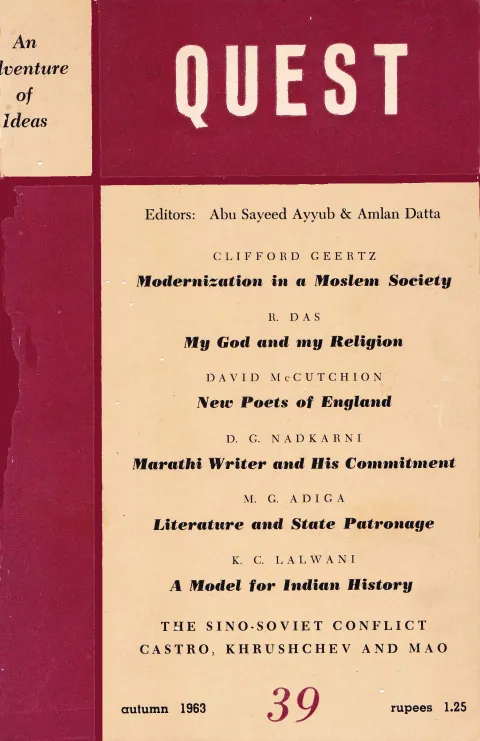
QUEST
Summary
Quest No. 39 (cover: ‘autumn 1963’; contents page: ‘OCT./DEC. 1963’) is the Bombay quarterly of the Indian Committee for Cultural Freedom, edited by Abu Sayeed Ayyub and Amlan Datta with Nirad C. Chaudhuri and Laxmanshastri Joshi as advisory editors, Nissim Ezekiel on the reviews desk and Mrs. Laeeq Futehally as his assistant. The issue has two argumentative centres. The first is the writer’s relation to authority: D. G. Nadkarni’s paper, read at an ICCF seminar on ‘The Writer and His Commitment’, tests the Sartrean idea of engagement against two decades of Marathi fiction, poetry and drama and finds Marathi writers turned inward and away from the 1942 movement and Partition; M. Gopalakrishna Adiga, writing from Kannada, mounts a frontal attack on the Sahitya Akademi and the Mysore state prizes as a machinery of patronage that corrupts the second-rank writer and asks the state simply to leave writers alone; David McCutchion diagnoses a parallel timidity in contemporary English verse. The second centre is the Sino-Soviet split, given two consecutive and uncoordinated treatments — K. K. Sinha’s structural account of the Communist movement’s passage from a ‘solar’ empire centred on Moscow to a polycentric ‘Commonwealth of Communist States’, and Theodore Draper’s close reading of Castro’s April-to-September 1963 manoeuvring between Khrushchev and Mao. Around these sit Clifford Geertz’s lead essay on the Indonesian pesantren and madrasah as the real site of Islamic modernisation, Rashbehari Das’s personal credo of an agnostic’s religion, K. C. Lalwani’s proposal that Indian history be modelled as continuous decline rather than growth, four poems, two short stories (one translated from the Tamil), nine signed book reviews, three unlisted shorter notices by Laeeq Futehally, and a single letter from Punya Sloka Ray at the University of Chicago attacking an earlier Quest article by H. R. Pasricha.
As an artefact the issue is unusually revealing about the ICCF network that produced it. Two of its papers are traced in print to seminars convened by the Committee or by its international parent, the Congress for Cultural Freedom; the Committee advertises its own conference volume inside the issue; and Aamir Ali reviews the first title in a Hutchinson series ‘issued by Hutchinson in association with the Congress for Cultural Freedom’ without any note that the reviewing journal shares that sponsor. It also carries a plain printing failure: a paragraph of Draper’s article is set twice, in two slightly different wordings, at printed pp.69-70 and again at p.71. There is no editorial plate or illustrated leaf anywhere in QT039 — every image in its 120 PDF pages is commercial advertising.
Essays
Modernisation in a Moslem Society: The Indonesian Case
By Clifford Geertz
Geertz opens by dismantling his own assigned title. Each of the three terms — ‘modernization’, ‘a society’, ‘Moslem’ — begs a conceptual question, and the third is the worst, because Orientalist scholarship has grown so aware of Islam’s local variety that the object of study threatens to dissolve. His answer is the anthropologist’s: abandon the large canvas for a concrete case whose features, suitably adjusted, generalise. The case is the Indonesian religious school. He argues that because Islam arrived late into an already established Hindu-Buddhist civilisation, and because the tradition is literary and legalistic while lacking priesthood, sermon and strong liturgy, the school rather than the mosque became the structural core of Indonesian Islam. He then traces the sequence: the pesantren, descended not from the madrasa but from Javanese monasteries, with its kijaji and chanting santris and heterodox mystical primbon; its gradual orthodoxisation as the Hadj and Arab immigration improved communications; the twentieth-century reformist madrasah, which introduced graded curricula, secular subjects, examinations, lay teachers, day-schooling and the education of girls; and the orthodox counter-reform of Nahdatul Ulama in 1926, which absorbed the reformers’ pedagogy into the pesantren tradition and so, Geertz says, made the reform’s lasting impact felt through its opponents rather than through its own success.
The policy conclusion is deliberately paradoxical and is addressed to secular modernising elites. A strong parochial school system is not the enemy of a secularising elite but its ally, because it is the one institution through which an established religious tradition can come to terms with the modern world instead of rigidifying. Geertz invokes Snouck Hurgronje’s 1906 warning that Indonesian Islam was changing invisibly, and Soedjatmoko’s observation that traditional religious commitments have proved a larger obstacle to modernisation than the modernisers expected. Western scholars, expecting Luthers and Calvins and getting cautious pedagogues, have underrated what the madrasah revolution actually did.
- Argues that ‘modernization’, ‘society’ and ‘Islam’ are all unstable abstractions and that the way past the difficulty is a concrete case, not a better definition.
- Identifies the religious school — not the mosque or prayer house, whose importance he calls ‘almost purely ritualistic’ — as the social-structural core of Indonesian Islam.
- Traces the institutional sequence pesantren → madrasah → sekolah Islam, and gives 1954 figures of roughly 12,000 madrasahs with about a million and a half pupils against some 53,000 pesantren with nearly two million.
- Holds that reformism’s real importance lies in its transformative effect on the orthodoxy that defeated it, chiefly through the Nahdatul Ulama counter-reform of 1926.
- Concludes that a vigorous religious school system is an ally, not an enemy, of a secularist modernising elite, and warns against ‘mindless imitation’ of Western external forms.
My God and my Religion
By R. Das
Rashbehari Das, writing as ‘R. Das’, sets out his position on God and religion in the form of a personal statement prompted by two occasions: a student’s assumption that an unbeliever cannot enjoy the Gitanjali, and a letter telling him that a festschrift was being prepared for his old friend D. M. Datta, who had once predicted that Das would end his days at Vrindaban. He first accumulates the negations his students have heard from him: that prayer for changes in the physical world is fruitless, otherwise no mother would lose a child; that selective divine mercy deserves no enthusiasm; that a God who made such defective vessels as ourselves would be the worst sinner of all. He refuses either to affirm or deny God’s existence, on the ground that no questioner has ever given him a clear and intelligible idea of what is being asserted. On religion as history shows it, he is harsher still: a divisive force, responsible for the homelessness of many after Partition, whose disappearance he has sometimes thought would be a merciful riddance.
He then turns the argument round. Religion in his own sense — the apprehension of a spiritual ideal held in the highest regard and pursued in thought and conduct — is an essential attribute of man, and by that definition he has one. The ideal must be spiritual, concerned with the non-bodily self; it must command reverence; and it involves thinking, feeling and willing together. He identifies his ideal with knowledge or truth, love or kindness, and innocent joy, and calls that ideal his God: not a loving and knowing God but love and knowledge themselves, real in the way a law of nature is real, tested by its effectiveness in determining judgment and conduct. He expects no post-mortem benefit and hopes to ‘die out completely’. He closes by conceding the questions he cannot answer — how the ideal relates to a world of cruelty and fraud, whether the values form a unity — and by admitting that he is largely an ignorant man groping his way.
- Written as a reply to the widespread assumption among his students that he is ‘a confirmed atheist - a position which I have never affirmed or denied’.
- Refuses to answer whether he believes in God until the questioner can supply a clear and intelligible idea of God that does not collapse into absurdity.
- Indicts organised religion as inherently divisive, citing Hindu-Moslem feuds and the homelessness they caused, and transcribes the derogatory vocabulary (‘Melechchhas, Kafirs, Heathens’) in order to condemn it.
- Redefines religion as the reverent pursuit of a spiritual ideal, and on that definition claims one of his own; even money-making could be a religion, but ‘such a low kind’ as hardly to deserve the name.
- Identifies God with the highest ideal conceivable — love, knowledge, innocent joy — and defends its reality by its effectiveness (arthakriyakaritra) rather than by proof of existence.
- Draws on the Upanishads, the Bible and the Buddha while declining to accept any religious group’s creed, and describes himself as both agnostic and sceptic on professional grounds as a philosopher.
New Poets of England
By David McCutchion
McCutchion’s survey argues that English poetry around 1960 is inhibited by self-consciousness: spontaneous emotion is checked by second thoughts, the human heart is not to be trusted, and the poet avoids the passionate and sublime for fear of striking an attitude. He illustrates the resulting manner — cautious, precise, wry, detached — from Elizabeth Jennings, Dannie Abse, Norman MacCaig, Hilary Corke, Anthony Cronin, Carla Lanyon, Peter Redgrove and Alan Brownjohn, and traces the technical discipline back to Eliot’s ‘intolerable struggle with words and meanings’, I. A. Richards’s Practical Criticism and Leavis’s insistence on concreteness. Two causes are offered for the inhibition: the poets are nearly all graduates and teachers of English literature, so saturated in the past that they can hardly write a spontaneous line and end by writing poems about writing poems; and they are victims of post-war disenchantment, with Auschwitz and the H-bomb having made the issues too huge and communism discredited, so that the response to Great Causes is ‘Count me out!’
He connects the new verse to the fiction of Kingsley Amis, John Wain and William Cooper, whose shrewd, unromantic, class-mobile heroes share the poets’ hatred of affectation, and credits universal National Service with widening sympathies. He then reads Thom Gunn’s toughness as a Cambridge undergraduate’s mask, Ted Hughes’s predatory animals as an attempt to assimilate the facts rather than exult in them, and Enright and Larkin as ironists of man in society, Enright always on the side of the insulted and the injured, Larkin using racy slang as a shield in a world with little tenderness. The verdict is that this is a restricted world — the housing estate and the living room rather than the cosmos — preferring tenderness to passion, enquiry to revelation, charity to faith, rooted in the concrete and presided over by Robert Graves.
- Diagnoses self-consciousness as the governing condition of contemporary English verse and traces its technical pedigree through Eliot, I. A. Richards and Leavis.
- Attributes the inhibition partly to the poets’ academic saturation — ‘Nearly all the contemporary English poets are graduates of English literature’ — and partly to post-war disenchantment.
- Reads Thom Gunn’s leather-jacketed toughness and Larkin’s slang as defensive masks rather than convictions.
- Notes that ‘the most impressive English poetry of the twentieth century has been written by Americans, Irishmen, and at least one Scotsman’, and finds in Hugh MacDiarmid a communist’s unselfconscious directness few Englishmen could manage.
- Characterises the resulting poetry as domestic and empirical, exchanging the grand vision for the little insight.
The Marathi Writer and his Commitment
By D. G. Nadkarni
Nadkarni’s paper, read at the ICCF’s July 1963 Bombay seminar on ‘The Writer and His Commitment’, applies that theme to two decades of Marathi writing. He works through Sartre’s engagement and liberte to Iris Murdoch’s objection that Sartre cannot demonstrate that good art will of its own nature favour a particular kind of society, and takes from her the position that good art by itself performs a social function. He then argues that the Western reference points do not transfer: the two world wars did not touch Indian intellectuals as they touched European ones, and the Spanish Civil War, where commitment first appeared in its modern sense, has no Indian equivalent — though the pre-Independence situation was comparable in its implications.
The bulk of the essay is a literary history. Against the earlier prolixity of Phadke and Khandekar, whose enthusiasms he traces through Cronin, Vicki Baum, Hilton, Maugham, Toller and Zweig, he sets the ‘new writing’ of the late forties: the four short-story pioneers Gangadhar Gadgil, Aravind Gokhale, Vyankatesh Madgulkar and P. B. Bhave, preceded by Rege, Anil and N. G. Deshpande in poetry and R. B. Joshi, Prabhakar Padhye and S. M. Mate in fiction. He then follows the next generation (G. A. Kulkarni, Uddhav Shelke, Madhu Mangesh Karnik, Vidyadhar Pundalik, Kamal Desai, S. D. Panvalkar, E. V. Joshi), the novel (Pendse’s Garambicha Bapu and Rathachakra, Muktibodh, Dandekar, Ranjit Desai, Dalvi, Khanolkar) and the drama (Tendulkar, Kanetkar, P. L. Deshpande, Sathe). His central finding is that the traumatic public events of two decades — the 1942 movement, the 1946 riots, Independence, Gandhi’s assassination, the 1955 linguistic agitation, the Chinese invasion — are not significantly reflected in the Marathi short story and only partly in the novel. He proposes both an excuse and an indictment: the short story is formally unsuited to large social movements, and Marathi writers’ experience of life is ‘academic, and woefully restricted’. Ending on Allen Tate, he distinguishes the writer committed to himself from the writer committed to an ideology outside himself, notes that Tate faulted Ezra Pound not for broadcasting for the Fascists but for an activity alien to the writer’s mission, and dismisses Marathi’s supposed Beats as ‘non-conformists twice removed’.
- Frames commitment through Sartre’s engagement and Iris Murdoch’s critique, and adopts Murdoch’s position that good art performs a social function by itself.
- Argues the European reference points (the two wars, the Spanish Civil War) do not transfer to India because Indian intellectuals were not drafted and killed.
- Reconstructs the ‘new writing’ movement of the late forties in detail, insisting a literary movement ‘cannot be launched with a manifesto, although such a document may rightfully follow’.
- Finds that the 1942 movement, Partition-era riots, Gandhi’s assassination, the 1955 linguistic agitation and the Chinese invasion are almost absent from the Marathi short story.
- Blames both the form (the short story cannot carry vast social movements; the novel can) and the writers’ restricted, academic experience of life.
- Closes with Allen Tate to separate commitment to oneself from commitment to an external ideology, and dismisses the Marathi ‘Beats’.
Literature and State Patronage in India
By M. Gopalakrishna Adiga
Adiga’s essay is a sustained attack on state literary patronage in independent India, argued from two premises: that literature’s essential character is fidelity to experience, which requires freedom from external authority, and that literary creation is an end in itself needing no extra-literary vindication. He begins historically — the courtier-poet was the rule, Pampa glorified his patron Arikesari, only a Naranappa or a Harihara refused to dedicate work to a mortal — and argues that because Indian poets’ attitude was social rather than individual, freedom never became a problem for them. It has become one now, because of the reach of the modern state.
His case against the Sahitya Akademi is that India has failed to establish critical standards, which leaves the field to the writer-politician and to advisory committees that are ‘essentially a mutual benefit society’, in which every member is himself a candidate for the honour. He notes that the Akademi award is worth about 5,000 rupees, not negligible in a poor country, and describes old writers ‘already dead as writers’ producing new work designed for it. He thinks the state should wind up the Akademi or confine it to translating science and philosophy. The Mysore state prizes he finds cruder still: 500 rupees, special prizes for women writers, entries solicited from writers as if for a school prize, and awards distributed so that no major caste can complain. The real danger, he insists, is not the fraudulent writer who wins but the genuine one who is tempted to compromise, and the middling writers who form the majority and whose corruption corrupts the whole atmosphere. His positive programme is for the state to withdraw to education — good education being the only way to breed a discriminating audience — and for writers to build their own co-operatives, benefit funds and publishing ventures so that the young and the heterodox can be published without patronage.
- Grounds the argument in two stated criteria: literature must be true to experience, which presupposes freedom from external authority, and literary creation is self-justifying.
- Traces Indian literary patronage from Pampa’s glorification of Arikesari onward, and explains the absence of a freedom problem by the social rather than individual conception of poetry.
- Indicts the Sahitya Akademi’s advisory committees as mutual benefit societies whose members are themselves candidates for the award.
- Attacks the Mysore government’s practice of soliciting entries and distributing prizes by caste parity, producing ‘a new class of hack writers, the prize-writers’.
- Identifies the real harm as the corruption of middling and genuine writers rather than the elevation of frauds.
- Proposes state withdrawal to education plus writers’ co-operatives, benefit funds and co-operative publishing as the alternative.
A Model for Indian History
By K. C. Lalwani
Lalwani argues that ‘the history of India’ is a modern notion, barely two centuries old, and that for the classical or medieval Indian, India was a continent of contending states rather than a country. Historical scholarship, having inherited from European scholars a chronological framework, has since confined itself to an ‘ant industry’ of adding material to that framework without ever glimpsing the historical process. Chronology cannot give history life or meaning. At the other extreme, national pride now threatens distortion: he cites the ‘manufactured’ letter of the Rani of Jhansi and the Azimullah diary written by a modern hand to sustain the politician’s thesis about 1857, and argues that in these circumstances Ranke’s aim of showing merely ‘how things actually were’ is a safer inspiration for the Indian historian than Danilevsky, Spengler or Toynbee — though rather than leave false models standing he will propose a true one.
His model rests on India being neither one culture nor one country but an arena where Aryan, Islamic and finally European world-transforming forces successively burst in. He dates the usable record to about 3000 B.C. and the Indus valley, reads the Dravidian migration south as preceding the Aryan arrival, and holds that only the last stage of Vedic literature can have been composed in the Indus valley — dismissing as fantastic the claim that the Indus civilisation was Aryan, on the evidence of its script. The Aryans, exhausted by a long trek, met little resistance; a reaction against ritualism had already begun before the Buddha; and Hinduism, distinct from Vedic religion, spent its childhood before the Christian era, its noonday under the Guptas and disintegrated after the sixth century A.D. Buddhism matters less as a rival to Hinduism than as the point at which reason enters and the first great historical dynasties appear from outside the Aryan settlements, with Magadha politically subordinating the Aryan domain. The conclusion is that a model of Indian history must be one of decline from the very dawn of history, its only distinctive feature being a tenacious continuity that has been a liability rather than an asset.
- Argues that ‘India’ as a single political and historical object is a notion acquired only in the last two centuries, and that earlier Indians could not have shared it.
- Charges Indian historical scholarship with an ‘ant industry’ of adding material to a European chronological framework without producing any theory.
- Documents present-day distortion by nationalist historiography, including a ‘manufactured’ Rani of Jhansi letter and an Azimullah diary ‘written by a modern hand’.
- Prefers Ranke’s objectivity to Danilevsky, Spengler and Toynbee for Indian conditions, while still offering a speculative model.
- Rejects the claim that the Indus valley civilisation was Aryan, arguing from the difference of script, and dates the Dravidian migration south as prior to the Aryan arrival.
- Concludes that Indian history is a story of decline from its beginning, and that its exceptional continuity ‘instead of being an asset, has in reality been a liability’.
Some Aspects of the Sino-Soviet Conflict
By K. K. Sinha
Sinha reads the open Sino-Soviet confrontation of 1963 as the crisis of a system rather than a quarrel over doctrine. He begins with what he calls the subjective factor: the temperamental dislike between Khrushchev and Mao Tse-tung, and behind it an unresolved question of succession to Stalin’s leadership of a world movement, which he argues cuts across state considerations because Mao is ideologically senior while Khrushchev holds the office. Beneath that he places the conflict between Russian and Chinese (Han) chauvinism, and concludes that the formally ideological dispute is driven by motivations that are historical, cultural and personal, and that ‘Marxism is too narrow and rigid to adequately interpret these “unexpected” contradictions’.
His structural argument is that the movement functioned from 1917 like a solar system with Moscow at the centre, a centralisation institutionalised by Lenin’s Third International and completed under Stalin, and that Stalin’s death made such an authoritarian structure unstable. China’s interventions in Eastern Europe in 1956 — objecting to the ‘unpersoning’ of Stalin and pressing Moscow to crush the Hungarian revolution — showed that rays could come from elsewhere, and in ten years the Communist empire became ‘a sort of a “Commonwealth of Communist States”’ with a weaker centre, a new factor of Communist public opinion, and the emergence of Communist nation-states pursuing national interest against proletarian internationalism. He then reads the dispute over world strategy: the Russians, having built an economy at great sacrifice and having learned from the Cuban missile crisis, want competition rather than war, while the Chinese refuse a road that would in fact suit them, a decision Sinha explains by hypothesising that Mao is ‘a megalomaniac’. He predicts an inevitable break preceded by a prolonged ‘civil war’ among Communists, with possible violence in Albania, Sinkiang or Outer Mongolia, and with demoralisation among the still-idealist rank and file. For India he prescribes a clear stated position, a short- and long-term defence strategy worked out with South-East Asian countries as a semi-autonomous part of the Western defence system, with Soviet aid supplementary to it — arguing that the choice before India is not between the West and Russia but a question of perspective. The article is dated 6 August 1963.
- Treats the split as driven by succession, personality and Russian versus Han chauvinism rather than by doctrine, and says Marxism cannot interpret its own contradictions.
- Charts the movement’s passage from Moscow-centred ‘solar system’ to polycentric ‘Commonwealth of Communist States’ in the decade after Stalin.
- Credits Peking with persuading Moscow to crush the Hungarian revolution and with defending the Stalin mystique as necessary to the movement’s cohesion.
- Identifies ‘the Communist public opinion’ and the emergence of Communist nation-states pursuing national interest as the decisive new factors.
- Predicts an inevitable formal break preceded by a non-violent ‘civil war’, with Albania, Sinkiang or Outer Mongolia as possible flashpoints.
- Advises India to state its position clearly and to build a South and East Asian defence strategy as part of the Western system, with Soviet aid supplementary.
Castro, Khrushchev and Mao
By Theodore Draper
Draper reconstructs Castro’s course between January and September 1963 and argues that he has been unable to stay out of the Sino-Soviet conflict and unwilling to plunge into it. In January Castro was at his most extreme — holding up the Cuban revolution as the model for Latin America, denouncing fellow-Communists for ‘conformism’ with imperialism and ‘fear of revolutions’, and taunting them with the claim that only the subjective conditions for revolution were lacking — which read as an echo of Mao’s line and encouraged admirers like Huberman and Sweezy to repudiate Khrushchev outright. But he never took sides openly, offering himself instead as honest broker while his economy depended wholly on Moscow. The turn came with Prestes’s visit to Havana in February, the Cuban Communist organ’s publication of his insistence that revolution is not synonymous with violence, and Castro’s protracted visit to the Soviet Union from 27 April, producing the 23 May joint statement and the 4 June television report.
Draper reads that report as a settlement heavily in Moscow’s favour: twenty minutes of extraordinary personal eulogy of Khrushchev, gratuitous advice to the Chinese to abstain from public polemics, the adoption of ‘Communist’ as the official designation, the acceleration of PURS as a party machine on the Russian model, a new discipline of productivity and norms, and above all the integration of Cuba into an ‘international division of labor’ that assigns it agriculture and fishing and revives sugar — essentially the old doctrine of complementary economies in a socialist version. The vaguer May formula on peaceful and non-peaceful roads he reads as a compromise leaving the large South American parties alone while giving Castro a Caribbean sphere, consistent with continuing pro-Castro terrorism in Venezuela. He notes Castro’s furtiveness — the Cuban press concealing the Soviet-Chinese split at the World Congress of Women, his endorsement of the test ban treaty on 26 July which the Chinese pointedly did not denounce — and closes on Kennedy’s Cuban impasse: ‘Hope’, however, is not a policy.
- Argues Castro has been unable to abstain from the Sino-Soviet quarrel and unwilling to enter it, saying Khrushchev is right without saying Mao is wrong.
- Reads the May 1963 Moscow visit as a victory for Soviet policy, sealed by an unprecedented personal eulogy of Khrushchev in the 4 June speech.
- Identifies the decisive mechanism as economic: an ‘international division of labor’ returning Cuba to agriculture, fishing and sugar, reviving in socialist form the very doctrine of complementary economies Cuban Communists had denounced as imperialist.
- Warns explicitly against reading Castro’s rhetoric as alignment — violent talk does not make him a Maoist, nor peaceful gestures a Khrushchevite.
- Faults the Kennedy administration for a contradictory Cuban policy that subsidised exiles while becoming persuaded an invasion would create worse problems.
The Leader
By R. Parthasarathy
A short free-verse poem on the choreography of a leader’s arrival. The streets overflow, traffic halts before the limousine appears, the town holds its breath, a policeman drops his baton and a crowd strains at the leash; overhead a crow flies in absolute freedom while a people wait from airport to city, waving paper flags and chanting slogans. The penultimate lines deliver the poem’s irony in an aside to the reader — he had changed the face of the country, ‘(you laugh), yes, / with speeches and brave promises / and eternal vigilance and all that’ — and the closing couplet deflates the whole spectacle: when he appeared, waving a hand, he seemed tired and yawned.
- Builds the public spectacle of a leader’s motorcade in flat reportorial detail, then punctures it in the last two lines.
- Sets the crow’s ‘absolute freedom’ above a waiting, flag-waving people as the poem’s central contrast.
- Uses a direct parenthetical address to the reader, ‘(you laugh)’, to signal shared scepticism about the rhetoric of national achievement.
False Teeth
By R. Parthasarathy
A poem about an Indian poet’s abandonment of English verse, written in the third person about a figure who has had his teeth in the English language for years — false teeth. His earliest poems rhymed, but rhyme is now more fashionable in toothpaste advertisements; established poets told him love poems had had their day and that it was decadent to love; he thought highly of love until he was badly let down on the floor of a hotel, shared the loss of a thousand-year-old dream with a dumb waiter, and flung his metaphor Woman out of the window on a summer afternoon. He had not found the rubies in lips or the Niagara in her hair, and his travelling heart blew up like a tyre. The poem closes on the flat statement that it is easier to leave words alone than to like them, and that at twenty-five he retired from the field without having written a poem.
- Makes the borrowed language itself the subject: the English the Indian poet writes in is a prosthesis, ‘false teeth’.
- Turns the exhausted stock of love poetry into concrete comic-bathetic incident — the hotel floor, the dumb waiter, the metaphor thrown out of a window.
- Ends in renunciation at twenty-five, ‘without having written a poem’, an anticipation of the linguistic self-doubt Parthasarathy would later make his main theme.
Underdog in the Rain
By Dorothy Sinha
A five-stanza rhyming poem in short lines, spoken for a man walking home in the rain because the bus would not hold one more passenger. He is cold to the core, his shorts and shirt soaking and spattered with tyre dirt and still to be worn again; hungry, bent with care and prematurely grey, he nevertheless keeps absolute despair at bay. What sustains him is the break around the bend and the last sweepstake, surely misery’s end. The closing stanza holds the poem’s tone: he cannot bid goodbye to one little hope, or give the lie to his optimistic horoscope.
- A poem of urban poverty told through physical detail — the full bus, the wet clothes that must be worn again, the tyre dirt.
- Sets the sweepstake and the horoscope against destitution as the only available instruments of hope.
- Formally the most conventional item in the issue’s poetry section, using regular short-line rhyme where the two Parthasarathy poems use free verse.
Release
By S. Padmanabh
A three-stanza free-verse poem built on a caged bird and an emerald pool. The speaker, thinking by the pool of the red-feathered bird in his cage, asks when he shall break ‘this concrete and girder cage’, set the bird free, rest by the pool and think no more of the bird in the cage — so that the cage is at once the bird’s and the city’s. The middle stanza states the discipline required: power drawn from storms, thoughts from seeping rocks, a climb by the thorn-covered way, a leap over the wedge of doubt, and the breaking of the bones of the fist that has clenched so long. In the last stanza the pool’s emerald has turned deep-blue at nightfall, the speaker hears wings fluttering cramped by the girder cage, and resolves that he shall soon break the bones and watch red wings in the sky.
- Uses a single sustained image — caged red-feathered bird, girder cage, emerald pool — for a release that is simultaneously personal and urban.
- The central stanza makes the release strenuous rather than lyrical: storms, seeping rocks, a thorn-covered way, the breaking of one’s own clenched fist.
- Marks time by the pool’s colour shifting from emerald to deep-blue as night falls.
- S. Padmanabh is the only bylined poet or prose contributor in the issue with no biography in the ‘OUR CONTRIBUTORS’ block.
Reconciliation
By Ka Naa Subramanyam
A story told by the seventy-year-old secretary of a declining small-town club whose seven remaining members meet every Saturday to drink excellent coffee and talk. Nearly half its length is given to introducing them: Ramanujam the merchant prince and president, of intriguingly obscure antecedents, who arrived twenty-five years ago with less than a rupee; Raghavan the Civic Conscience; Ganapathi the much-educated mirasdar who abandoned a top government job for the soil; Srinivasan the retired leader of the Bar; Satyan the Professor of Philosophy who is also a philosopher; Mani the postmaster and vedantin who stopped a bullet in Mesopotamia; and the narrator himself, who writes for the periodical press of two continents and three languages. A new member arrives, the district’s new Surgeon, and the narrator notices that Ramanujam is displeased at his name and that the two men suppress a start of recognition when introduced.
The Surgeon steers the evening’s conversation to love and then offers a tale of two lovers no whit inferior to Laila and Majnu. He and Ramanujam then tell it in alternating turns, each pausing for the other: a boy and girl, distant relatives and neighbours, one family rich and headed by a Gazetted Officer, the other poor and headed by a municipal peon; the girl’s mother forbids the friendship; the girl becomes secretive and is beaten; the family is transferred, her letters intercepted and his never delivered; the peon swallows his pride to ask for her hand and is laughed at; a second, secret transfer removes her altogether and the boy loses his senses. Both narrators break down as they approach the end. On the morning of her arranged wedding the boy sat up crying ‘She calls! She calls!’, ran out and drowned in the disused well before the Mariamman temple; she was fished out of another such well at noon, dressed as a bride, with a smile of contentment on her lips. Ramanujam says only: ‘Our children are dead but we are alive to tell the tale.’ The Surgeon proposes that the two of them, the parents of the lovers, be reconciled; Ramanujam takes his hand. The story is credited as translated from the Tamil by Mr. S. Rajee.
- The alternating-narration device is the story’s structure and its revelation: the two tellers turn out to be the fathers of the dead lovers, which the reader infers before it is stated.
- Caste and rank are given concretely as a Gazetted Officer’s family against a municipal peon’s, and the mother rather than the father drives the persecution.
- The narrator’s long introduction of seven club members establishes a leisured provincial world of talk against which the violence of the inner tale lands.
- Both deaths occur in disused wells before Mariamman temples, in two different towns, at the hour fixed for the wedding.
- Printed with a translation credit that the contents page omits: ‘(Translated from the Tamil by Mr. S. Rajee)’.
One Night and After
By M. M. M. Mahroof
A story of one early morning in a tenement, told almost entirely through the physical texture of poverty. Jamis wakes on a mat slick with sweat, is woken again by his wife’s timid two-fingered touch, and finds the tooth-powder gone — it is crushed charcoal from the base of the clay stove, and she must grind it while he waits. The two-year-old daughter cries because she has wet the clean sheet there is no time to wash; a bed-bug is found on her back and killed and sniffed, which never fails to give the mother satisfaction; the child has a small scar or mole on her cheek with a hair growing on it, and Jamis reflects that it was bad enough for his child to be a girl and worse for her to have a disfigurement.
Outside, some thirty neighbours stand in the passage-way with pails and improvised tins waiting for the single lavatory, and two quarrels break out over precedence and over whose husband works. Jamis draws his head back: the shouting happens every day, unchanging like a ritual, though the purposes are mundane. There is no firewood, so his wife boils water with newspapers and the room fills with smoke; he shaves in luke-warm water and tells her not to make tea because she too must leave, to break up tea leaves sitting on the floor all day. The baby is tethered by a string from one foot to the arm of their only big chair, and the door is closed but not locked so that neighbours can let themselves in to soothe her. At the factory the watcher tells him there is no work today because the goods have not arrived. Jamis is not much troubled by the lost day’s pay; what defeats him is that he had meant to use the factory lavatory, and must now go back and take his place in the queue.
- Builds an entire narrative from household logistics — charcoal tooth-powder, newspaper fuel, a shared lavatory, a tethered infant — with no explicit commentary.
- Records the wife’s refusal to pronounce her husband’s name after sixteen years of marriage, which Jamis calls ‘a convention, without sense or content’.
- Includes the narrator’s unsoftened transcription of the father’s view that a daughter is a misfortune and a blemished daughter worse.
- Notes that the couple’s neighbours function as childcare because the door is left unlocked.
- Ends on anticlimax: the lost day’s wage matters less to Jamis than having to rejoin the lavatory queue.
The Right Honourable V. S. Srinivasa Sastri
By S. Natarajan
Natarajan reviews P. Kodanda Rao’s 464-page biography of V. S. Srinivasa Sastri and treats it as the natural completion of one of the century’s great associations, noting that Sastri imposed a longer and severer probation on Kodanda Rao than members of the Servants of India Society ordinarily passed through. The book’s value, he says, lies in the author’s technique of letting Sastri speak for himself, and the life makes an interesting focal point for British-Indian relations in the first half of the century. Sastri emerges as a Commonwealth statesman whose faith in the Commonwealth and in India’s role within it was unaffected by anything done at Delhi or London or by the Gandhian Congress, and whose withdrawal from Indian politics came not from loss of faith but from a judgement that public dissent could then only do harm.
Natarajan draws out the affinity between Sastri and Gandhi: Kodanda Rao’s claim that Gokhale intended Gandhi to succeed him but expressed no preference, so that Sastri was elected while Gandhi withdrew his application; Gandhi’s support for Sastri’s South African agency; and Sastri’s refusal to brook criticism of Gandhi even from close associates. He is nevertheless critical: Sastri’s contribution lay mainly in the Commonwealth countries, and in India he allowed events to crowd him out, overestimating Gandhi’s influence, misjudging his politics and giving up the fight for the Congress before battle was joined; even among the Liberals and within the Servants of India Society he did not assert himself. The exception was the Round Table Conference, where he ‘rose to his full height’. The liveliest chapters, Natarajan adds, are those on Africa, Malaya and the Commonwealth conferences, where Kodanda Rao writes his own experience into the account.
- Praises Kodanda Rao’s method of letting Sastri speak for himself and the resulting value for the study of British-Indian relations.
- Presents Sastri’s Commonwealth faith as unshakeable, and his retreat from Indian politics as tactical rather than disillusioned.
- Reports the Society’s succession question: Gokhale is said to have intended Gandhi but expressed no preference, Sastri was elected and Gandhi withdrew his application for membership.
- Judges Sastri to have been crowded out in India — ineffective even among the Liberals and inside his own Society — while rising to his height at the Round Table Conference.
- Is the only one of the issue’s nine reviews printed without a headline of its own.
Marxism, Gandhism, Stalinism
By A. H. Somjee
Under the headline ‘Behind The Times’, Somjee reviews C. G. Shah’s collection of thirty years’ essays and lectures. He notes that Shah, now in his late sixties, embraced communism in the twenties and reacted strongly against the Stalinist apparatus of terror, Soviet interference in Eastern Europe and particularly Hungary, and the Chinese annexation of Tibet, but that none of this shook his faith in Marxism as the explanation of the world and the only key to justice. The section on Marxism, Somjee finds, merely reproduces basic tenets in simple language without probing their philosophical implications; he quotes Shah on history and the masses selecting the ideology that reflects ‘the objective truth i.e. the historical necessity’ and objects that even an orthodox Marxist might have explained how masses make history and what objective truth and historical necessity mean.
On Stalinism and parliamentary reformism he is blunter: a piece of poor journalism, which attributes the apparatus of terror to bureaucracy, low Russian cultural level and encirclement, but never to the type of political system itself. Somjee’s own counter-claim is that liberalisation in the Soviet Union is due to Russians’ growing appreciation of free life outside the camp, and that even Khrushchev still issues idiotic pronouncements on poetry and painting. He records Shah’s rejection of parliamentary democracy as a bourgeois safety-valve, and traces the one genuine change in Shah’s views — from calling Gandhism ‘the last flash’ of a declining religio-mystical culture to discovering an element of humanism in Gandhi after the assassination and calling him ‘the highest expression of nationalism’ — while faulting him for never casting off his Marxist blinkers to see Gandhi’s encounter with the West and the urge to seek purely Indian roots.
- Presents Shah as a lifelong Marxist whose break with Stalinism, Hungary and Tibet left his faith in the theory untouched.
- Faults the book for reproducing Marxist tenets without philosophical scrutiny and for quoting authority instead of arguing.
- Argues Shah never connects Stalinist terror to the type of political system, only to bureaucracy, cultural level and encirclement.
- Records Shah’s total rejection of parliamentary democracy as ‘the most formidable safety-valve devised by the bourgeoisie’.
- Traces Shah’s shifting estimate of Gandhi across thirty years and faults him for never revising the framework that produced it.
British Relations with Sind 1799-1843
By Hamid A. Ali
Under the headline ‘Imperial Grab’, Hamid A. Ali reviews Robert A. Huttenback’s study of British relations with Sind between 1799 and 1843. He opens with Sind’s earlier prominence — pre-historic civilisation, richest satrapy of the Achaemenian empire, scene of Alexander’s exploits, gateway for Islam into India — and calls the book a carefully documented guide through the diplomacy and intrigue that led to ‘the devouring of the “dumba” (fat-tailed sheep) by the wolf’, a story no self-respecting Britisher could contemplate with pride. He explains the Talpur regime’s fragility: displacing the Kalhoras in 1783, administering Sind as a family estate under a patriarchal and irresponsible system, with three centres, joint rule by several individuals at two of them, and semi-independent tribal chieftains; and externally, Kabul’s suzerainty, Talpur designs on Cutch, the Jodhpur ruler’s support for a Kalhora pretender, and Sikh interest in northern Sind.
His account of British policy is that it was consistent only in pursuing trade and cheap wealth: England opposed territorial expansion, Calcutta intrigued and vacillated, and men on the spot did as they chose and presented their superiors with the fait accompli. Napier conquered Sind almost before Calcutta had decided and against London’s wishes, and was first condoned then justified. Ali compares the book with Lambrick’s Sir Charles Napier and Sind, judging Lambrick better on life and conditions in Sind and Huttenback more academic and archival, corrects the book’s statement that the Kalhoras were Baluchis, and lists misprints and misspelt place-names on the map. Of the Britons involved he allows only Outram and Metcalfe any decency, describes Napier as an unscrupulous megalomaniac who led Ellenborough by the nose, and quotes him without illusion on the morality of the conquest. His main regret is that the Sindhi actors get no clear picture and that Sindhi historians, notably Mirza Kalich Beg, are under-used.
- Sets the annexation in the longer history of Sind as satrapy, Alexandrine battleground and gateway for Islam into India.
- Explains the Talpur collapse structurally: a family estate with three centres, joint rulers, semi-independent chiefs, and four external claimants.
- Characterises British policy as consistent only in pursuit of trade and cheap wealth, with men on the spot acting and presenting Calcutta with the fait accompli.
- Names Napier ‘an unscrupulous megalomaniac’ who led Ellenborough by the nose, and allows only Outram and Metcalfe any decency.
- Corrects the book’s claim that the Kalhoras were Baluchis, citing Lambrick’s ‘a Levitical family with many disciples among the Baluchis’, and faults it for neglecting Sindhi historians.
A Modern Approach to Islam
By A. G. Noorani
Under the headline ‘The Other Community’, Noorani reviews A. A. A. Fyzee’s four essays on the reinterpretation of Islam. He accepts the first half of Fyzee’s case readily: in Islam law and religion flow in a single channel, social conditions have varied, reform of the law is needed, and Fyzee’s five-stage questionnaire — what was society like before Islam, what rule did the Prophet lay down, what resulted, how is it interpreted today across the Muslim world, and can the rules be moulded for healthy reform — is sensible and necessary. What he resists is the conclusion. Seeing the growth of modern state law outside the ambit of the Sharia, Fyzee proposes that the Sharia itself may be discarded and that the separation of civil from religious law can no longer be delayed; he then extends the same method to doctrine, opening the Gate of Interpretation for himself, damning the Ulemas and giving every Muslim, indeed every man, the right to fashion his own faith.
Noorani’s objection is that this would end Islam as a social force. He cites Wilfred Cantwell Smith on the paramount position of the community, argues that Islam deals with man in society and that there is room for dissent but not complete departure, and notes that the Supreme Court of India has upheld a community’s right to excommunicate a member who does not subscribe to its fundamentals. He suspects Fyzee fears that Islam’s collective identity would conflict with the trend towards secularity, and prefers K. M. Pannikkar’s plea in The Foundation of New India for mutual acceptance between an organised Muslim minority and a dominant Hindu majority. But he refuses to leave the substantive question there: does Islam in fact close the Gate of Interpretation? Against Fyzee he sets Iqbal, who held the claim of Muslim liberals to reinterpret foundational legal principles perfectly justified, blamed stagnation on the intense conservatism of Indian Muslims, and called the closing of the door of Ijtihad ‘pure fiction’. Noorani ends by noting Fyzee’s own concession that some Quranic verses must be interpreted before they can be applied, and by observing that one is not sure whether Fyzee is angry with the creed or with its current practice.
- Endorses Fyzee’s five-stage method for reforming Muslim law as ‘very sensible and very necessary’ while rejecting the conclusion drawn from it.
- Argues that discarding the Sharia and individualising faith would end Islam as a social force and destroy the Millet on which its cohesion rests.
- Cites the Supreme Court of India’s upholding of a community’s right to excommunicate as evidence that the collective claim is legally recognised.
- Turns Iqbal against Fyzee: the Gate of Interpretation was never bolted, and ‘the closing of the door of Ijtihad is pure fiction’.
- Prefers K. M. Pannikkar’s formula of mutual acceptance between an organised minority and a dominant majority to Fyzee’s individualism.
India as a Secular State
By S. P. Aiyar
Under the headline ‘How Much Religion?’, Aiyar reviews Donald Eugene Smith’s India as a Secular State. He frames the book’s theme as the silent revolutionary transformation that a secular democratic constitution symbolises in a society whose structure and operating ideals have been authoritarian and whose life has been regulated in minute detail by religion — so that both secularism and democracy are ‘somewhat foreign’ to the Indian political tradition. He follows Smith’s historical introduction on British policy: early East India Company patronage of Hindu and Muslim religious institutions, the missionary agitation that accused the Company of being ‘dry nurse to Vishnu’ and ‘church warden of Jaganath’, the 1833 despatch that changed policy, the negative neutrality that followed, and the caution the Mutiny and later the Age of Consent Bill controversy imposed on officials. He accepts Smith’s account of neutrality as a direct antecedent of the secular state, reinforced by egalitarian law, secular education and bureaucratic tradition, but he dissents sharply on one of Smith’s two other elements: the long tradition of religious tolerance. That attractive view, he writes, rests on a very selective reading, and the opposite thesis can be substantiated from schisms in the early Jaina church and the actions of fanatical Hindu rulers.
On the working of the secular state he follows Smith through protective discrimination and caste, citing Keshava Iyengar v. State of Mysore (1956), where seven of ten public appointments went to backward-class nominees and only three on qualification, and quoting C. H. Alexandrowicz’s comment that the decision marks extensive state intervention in defiance of caste tradition and may not be compatible with the tenets of a secular state. He endorses Smith’s finding that the electoral system has given caste associations a new lease of life and that the Congress has been as guilty as any other party of playing caste politics. He judges the book an important contribution to an untilled field, praises its imaginative use of government documents, newspapers and Supreme Court decisions — noting a footnote revealing that Sanjiva Reddy reproduced sentences from Radhakrishnan’s foreword in a Congress presidential address without acknowledgement — and complains only that portions are needlessly amplified and the historical introduction over-long.
- Frames both secularism and democracy as ‘somewhat foreign’ to an Indian political tradition that was authoritarian in structure and minutely regulated by religion.
- Traces British policy from Company patronage of temples through the missionary agitation and the 1833 despatch to a negative neutrality hardened by 1857.
- Dissents from Smith’s reliance on a long Hindu tradition of religious tolerance, calling it a very selective interpretation and citing early Jaina schisms and fanatical Hindu rulers against it.
- Uses Keshava Iyengar v. State of Mysore (1956) and Alexandrowicz’s commentary to expose the tension between protective discrimination and the secular state’s non-discrimination.
- Accepts Smith’s judgement that the electoral system revived caste associations and that Congress exploited caste as freely as its rivals.
Dr. Ambedkar, Life and Mission
By Sima Mallik
Under the headline ‘The Great Outsider’, Sima Mallik reviews Dhananjay Keer’s 522-page biography of Ambedkar and attacks it for hero-worship. She begins on the general problem — an eminent man loses his identity in a cocoon of legend and becomes an institution, commemorated in fat volumes punctuated with eulogies — and says the biographer’s job is to extricate the man from the legends. Keer instead takes the conventional stand of the ‘full length authoritative biography’ the dust-jacket advertises. She gives him full credit for research and industry, and grants that the book is the last word on the incidents of Ambedkar’s life, but says what eluded him was the conflict in Ambedkar’s personality: the man who might have been a different person, a different institution even, had the times been different.
Her specific charges are that the clash with Gandhi is given in sweeping statements extolling Ambedkar’s singleness of purpose and bickering at the Mahatma’s ‘stagecraft and statecraft’, without Keer ever asking why a man of such sincerity was not drawn to the greater cause of the nation, why his sympathies stayed within a narrow circle, or why he remained an outsider when the nationalist movement absorbed every thinking Indian. Her own answer is that the hurt and mortification Ambedkar suffered as an untouchable had twisted something in him for ever, and that Gandhi’s desire to preserve the unity of Hinduism and of India is at least one plausible reading of his position on untouchability — an interpretation that does not occur to Keer. She finds Keer failing to convey Ambedkar’s intellectual stature, notes the paradox of a man who revolted against Varnashram yet set himself up as the Modern Manu to codify new rigid rules, questions Keer’s silence on the conflict between the Sikhism Ambedkar abandoned over reserved seats and the Buddhism he embraced from conviction, and detects an intellectual aristocracy in his impersonal love of the masses, contrasting it with Gandhi’s human and personal approach and with what Nehru gained by sacrificing philosophy for politics. Her verdict is that the unblemished hero of a long panegyric could have been a true tragic hero.
- Credits Keer’s research and completeness while rejecting the hero-worshipping frame the dust-jacket advertises.
- Locates the book’s failure in its silence about Ambedkar’s inner conflicts and about why he remained outside the nationalist movement.
- Offers her own reading — that the mortifications of untouchability ‘had twisted something in him for ever’ — and suggests Gandhi’s concern for the unity of Hinduism and India as a plausible counter-reading Keer never considers.
- Identifies the paradox of a man who revolted against Varnashram yet ‘set himself up as the Modern Manu to codify and formulate a new set of rigid rules’.
- Distinguishes Ambedkar’s abandoned Sikhism, given up over reserved seats and joint electorates, from his conversion to Buddhism, which she reads as genuine conviction.
- Concludes that a true tragic hero has been lost to ‘a flawless and implausible paragon of perfection’.
The Doldrummers, The Dumb Dancer & Om
By Stewart Melluish
Under the headline “Playwright’s Predicament”, Melluish reviews three plays by Asif Currimbhoy and begins by warning against overvaluing a rarity: an Indian playwright writing in English is so rare that it is easy to attribute too much importance and merit to the few there are. Neither Currimbhoy’s earlier published plays nor any of these three, he says, could be described as distinguished, but the collection does reveal a playwright who has thought about his craft, has a lively imagination, at times writes promisingly, and should go on making plays. His predicament, which Melluish grants is real, is that there is virtually no western theatre in India and no audience for the sort of play a playwright ought to want to write.
On the individual plays he is severe about The Doldrummers, whose banning by the Maharashtra government’s Board of Censors is made much of on ‘the quite deplorable exterior of this book’ — a case, he thinks, that reveals the immaturity of censorship precisely because the play deals in commonplace ideas in a far from provocative way. To work as a demonstration against modern Indian urban society, which may or may not have been the intention, it would need to be a play about Indians; Rita and Liza and their friends Tony and Joe may exist at the seedy end of Juhu but are found in a hundred other cities, and their story is old and not very interesting. He allows the play pathos in Rita’s progress and a discernible sense of theatre. The middle play he finds the most interesting of the three, a piece with gusto and bloodshed about an asylum superintendent who tries to cure a Kathakali trainee, mishandled by his guru into cutting out his own tongue, by making him enact Duryodhana’s slaughter as Bhima, and who ends by carving open a rival lover for real blood and warm guts. Om he finds tentative and experimental, a symbolisation of four thousand years of Hindu spiritual development whose elaborate footnotes disarm the critic and which ‘must, I think, be seen to be believed’.
- Opens by warning against inflating the merit of a rarity — an Indian playwright writing in English.
- Argues the censorship of The Doldrummers exposes the immaturity of censorship precisely because the play is unprovocative.
- Faults the play for aping western beat drama and for characters who could be from a hundred other cities rather than from India.
- Finds the middle play, about shock therapy through the enactment of Duryodhana’s slaughter, the most interesting of the three.
- Identifies the structural predicament: no western theatre in India and no audience for the play a playwright ought to want to write.
Twilight in Djakarta
By Aamir Ali
Under the headline ‘Type Cast’, Aamir Ali reviews Mochtar Lubis’s Twilight in Djakarta, the first volume in Hutchinson’s new series ‘New Voices in Translation’ issued in association with the Congress for Cultural Freedom, and notes at the outset that the author has been detained in prison without trial since 1961, so that publishing the book is itself an effort for cultural freedom. That effort is strengthened, he argues, by the novel’s substance: a portrait of Djakarta’s political and social life — corruption in public life, self-seeking politicians, greed for money, disregard for any standards of public or private morality. He lists the cast as types: Husin Lunbara the party boss, Raden Kaslan the financier who supports the party and is supported by it, Surpono the playboy, Dahlia who uses her beauty to supplement an honest husband’s meagre income, Achmad the communist who knows with certainty where he is going, Pranoto the earnest but ineffective liberal. Lubis has woven their lives into a total picture of a rot so deep that it is hard to know where it can be fought — a picture accurate, Ali adds, not only of Indonesia but of a host of other newly independent countries.
The rest of the review is a comparison and a complaint about translation. The title must remind Indian readers of Ahmed Ali’s Twilight in Delhi, and the difference between the twilight of a gracious age and the twilight of the brave hopes of a fight for independence measures the change of twenty years. Indian novelists in English have developed devices for rendering dialogue — Jhabvala’s middle-class Indian-English, Mulk Raj Anand’s virile renderings of Hindustani expressions, Narayan’s quaint flavourings, footnoted or glossed Hindustani words — which work because the Hindustani is familiar. Claire Holt faces the same problem in a more acute form with a strange idiom and few precedents; Ali quotes her own admission about the impossibility of rendering the Djakarta dialect’s local flavour, judges the attempt laboured and ineffective, sometimes almost incomprehensible and sometimes like Americanese, and ends with a plea for a glossary instead of footnotes, which he finds disturbing in a novel.
- Notes that Lubis has been imprisoned without trial since 1961 and that publication is therefore itself an act of cultural freedom.
- Reads the novel’s typed characters — party boss, financier, playboy, communist, ineffective liberal — as an accurate portrait not only of Indonesia but of newly independent countries generally.
- Measures twenty years of change by the distance between Ahmed Ali’s Twilight in Delhi and this book’s title.
- Surveys the devices Indian novelists in English use for dialogue (Jhabvala, Mulk Raj Anand, Narayan) and finds the translator’s equivalent attempt laboured and ineffective.
- Records without comment on Quest’s own position that the series is ‘issued by Hutchinson in association with the Congress for Cultural Freedom’ — the international parent of Quest’s own sponsor.
Cry, The Peacock
By Nayana Daftary
Under the headline ‘Cry Anyway’, Nayana Daftary reviews Anita Desai’s first novel and finds its theme well-worn: Fate, its mystery and the brooding terror it creates in those conscious of it. She summarises the plot — Maya, young, sensitive and desperate to love and be loved, married to Gautama, an older ‘gaunt, sarcastically silent intellectual’ with no time for her; the gulf widening after the death of Maya’s dog recalls a childhood prophecy that one partner would die of unnatural causes within a few years of the marriage; Maya longing to unfold before her husband and draw him into her world of sounds, senses, movements, odours, colours and tunes; the two worlds never meeting; Gautama treating her as a fanciful child and persuading her that her world of the senses is fatal while his is real, from which it follows that she must be the one to perish; the summer heat thickening with her hysteria until a climactic dust storm goads her to her final decision.
Her judgement is mostly severe. The narrative mixes realism and fantasy through interior monologue, snatches of dialogue and flights of description, but is greatly weakened by self-conscious affectations of phrase that betray a painful amateurishness: she quotes the shuttlecock oranges that shoot bird-like and break egg-like, and lists ‘the luscious water’ oozing from a bath tap, a curtain falling in tragic folds, the sun hanging pendant from topmost branches. Most of the characters remain shadowy bundles of qualities and puppets with little volition — Pom ‘plump, pink, pretty’, a Sikh friend ‘a prosperous, buoyant, witless fool’, an indulgent silver-haired father, a Gautama generally wooden and unconvincing. What she does credit is the portrayal of Maya herself, the vulnerable creature brutally brought to the horror of being hypersensitive, sometimes endearing, and the one thing that sustains an improbable story and affords it a measure of life.
- Treats the novel’s theme of Fate and prophecy as well-worn and its plot as improbable.
- Quotes the novel’s own prose at length to substantiate the charge of ‘self-conscious affectations of phrase which betray a painful amateurishness’.
- Finds most characters ‘shadowy bundles of qualities, puppets with little volition of their own’, Gautama included.
- Credits the portrayal of Maya as the one genuine achievement, sustaining the book by itself.
- The last of the nine signed reviews; the unlisted Shorter Reviews column begins on the same printed page, 101.
Prospects of Democracy in India
By Punya Sloka Ray
The issue’s single letter, written from the University of Chicago on 5 September 1963, protests against an earlier Quest article by H. R. Pasricha. Ray calls the article very distressing and says Quest should invite political discussion on principles rather than print statements such as the claim that a large majority of the political leadership consists of men incapable of earning a decent livelihood in the open market. His counter-argument is professional: some individuals have talent only for political organisation and will not shine elsewhere, just as some physicians make mediocre political beings; amateurs are not good enough in medicine or in politics; and if professionals are to give good service they must be paid decently, with prerequisites arranged where the formally allowed salaries are ridiculously inadequate. He doubts the ruling class has been taking more than it fairly deserves for the services.
Statements at such a low level, he continues, obscure the real dilemma, which is that the Indian elite is as unenlightened as the masses. He grants that in the eagerness for relief from poverty India has come close to killing the goose that lays the eggs by neglecting the minority who alone have the talent, background and opportunity to compete internationally, and he formulates the resulting temptation in deliberately harsh terms — the illiterate peasant may be allowed to choose the rulers but not to rule, not to dress up in the costumes of generals, professors, engineers, administrators or corporation directors and play at life — adding that India has come uncomfortably close to that. But he then turns the point against Pasricha’s implied remedy: the elite businessmen, generals and professors are not really much more fit to rule, too many derive their station from biological accidents of lineage, caste or seniority rather than individual competence, and too few are better fitted than ‘the pretentious peasants’ to run corporations, armies or universities — so restriction of the franchise would merely worsen the situation. He closes by rejecting the analogy with the Weimar Republic: India has no bitter memory of a Versailles treaty or a ruinous financial collapse, though it might acquire one if the Pakistanis or the Chinese succeeded in imposing a similarly humiliating peace.
- Objects on principle to the level of argument Quest had printed, not merely to its conclusion.
- Defends politics as a profession requiring competence and decent pay, and doubts the ruling class takes more than it deserves.
- Restates the elitist case against mass participation in its harshest form and then rejects it, because the Indian elite is no more competent and derives its station from lineage, caste and seniority.
- Concludes that restricting the franchise would make matters worse, not better.
- Rejects the Weimar analogy for want of a Versailles or a financial collapse — while noting India might yet acquire one from Pakistan or China.
Essay 25
UNLISTED. The first of three notices in the ‘SHORTER REVIEWS’ column that runs from printed p.101 to p.103 under the standing rubric ‘Lack of space prevents us giving full-length reviews to all the books we receive. Those we think are likely to have some interest for our readers are briefly noticed in these columns.’ and the byline ‘BY LAEEQ FUTEHALLY’. Neither the column nor any of its notices appears on the contents page. This notice deals with Jai Ratan’s selection and translation of Contemporary Hindi Short Stories, and Futehally uses it to make a general claim first: that contemporary Indian writing, in English or in the Indian languages, has not yet produced anything to which world standards can be applied, and that the reason no volume of translations has appeared despite the enthusiasm of foreign publishers is simply that the writing did not meet their minimum requirements. This volume, drawn from post-1947 stories of a certain length, underlines that position rather than refuting it: not one of the stories would be likely to find a place in an English or American magazine, even a non-literary one, because the old habits of easy sentimentality and paper-doll characterisation persist beneath a superficially modern form of ‘atmosphere’ and ‘mood’.
Her second charge is against the translation. As with a quarrel, she writes, it takes two to make a good translation, and Jai Ratan has done the work single-handed and is not displeased with his own effort. He lacks the command of English needed to make the reader forget the medium, which she takes to be the real aim of the translator, and attention is continuously distracted by the awkwardness of the rendering. She is careful to say she is not complaining of ordinary Indian English but of wrong phrases no literate person has any business to use, and gives three: ‘Please reach them home’ for ‘please see them home’, ‘curiosity for him’ for ‘curiosity about him’, ‘thin like stricks’ for ‘thin as sticks’. The conclusion is that whatever chance the original writer had of creating conviction seems deliberately destroyed by the translator in every line.
- Opens with a sweeping claim that contemporary Indian writing has not yet met world standards, and explains the absence of translation volumes by the quality of the originals rather than by publishers’ indifference.
- Finds the modern ‘atmosphere’ and ‘mood’ forms a surface over persistent sentimentality and paper-doll characterisation.
- Argues translation needs two people and faults Jai Ratan for working single-handed and being satisfied with the result.
- Cites three specific solecisms as evidence, while explicitly exempting ‘ordinary Indian English’ from the complaint.
- Not listed on the contents page, and its author — the issue’s Assistant Reviews Editor — has no biography in the ‘Our Reviewers’ block.
Essay 26
UNLISTED. The second notice in Laeeq Futehally’s ‘SHORTER REVIEWS’ column, on Sybil Marshall’s An Experiment in Education, and much the warmest piece of criticism in the issue. Futehally admits that one seldom expects to sit up half the night unable to put down a book about the work of a primary school teacher. Marshall’s school consisted of 28 children between four and eleven, all of whose subjects she was supposed to teach although her own interest lay in art. The first lessons were not promising — Futehally quotes Marshall’s ‘Day after day they would produce microscopic tanks, armoured cars, ships or aeroplanes, of most primitive design, all stranded in a desert of white paper.’ — yet a few years later the same children were producing paintings exhibited in the United States, prize-winning in London, and since used as lecture slides in training colleges.
Futehally attributes the results not to Marshall’s own artistry, which she does not claim, but to a reckless imagination and a personality that could create feverish enthusiasm in her pupils, so that children and teacher could hardly wait for school to open. She describes the method: basing a term’s activity on a single work of art, so that one term geography, history, composition and art were all studied in the context of The Canterbury Tales, and the last and most audacious theme was Beethoven’s Ninth Symphony, whose movements the children learnt to analyse and used as leit motifs for work on the aspects of nature the symphony describes. The notice closes by drawing the Indian moral: the material circumstances of Marshall’s job — the same lack of equipment and resources, the same conservative distrust from the community at the outset — were not unlike those of a village school teacher in India, and on facing and overcoming these handicaps she has practical advice that ought to put new heart and courage into Indian school teachers.
- An unusually enthusiastic notice: Futehally reports being unable to put down a book about a one-room primary school.
- Credits the results to imagination and personality rather than to artistic skill, which Marshall does not claim.
- Describes the method of building a whole term’s curriculum on one work of art — The Canterbury Tales, and then Beethoven’s Ninth Symphony.
- Draws an explicit parallel with the Indian village school teacher’s lack of equipment and the community’s initial distrust, and recommends the book on that ground.
Essay 27
UNLISTED. The third and last notice in Laeeq Futehally’s ‘SHORTER REVIEWS’ column, on Anne Guthrie’s short life of Vijaya Lakshmi Pandit, and the most dismissive. Futehally begins with the competitive problem: the domestic and family life of the Nehrus has been described several times and at different levels by members of the family themselves, so any new book over the same ground competes with works that can at least claim authenticity. A superficial second-hand account would be worth reading, even for a non-Indian public, only if it could claim literary merit or shrewd analysis, and this book has neither.
Her charge is that the author’s special gift is to make the banal sound even more banal, and she quotes two passages to prove it — the temple bells that ‘tinkled in a pleasing fashion’ when the wind blew, and the delight of seeing the Nehru daughter always in and out, on the verandah or in the library. There was, she observes, enough incident in her subject’s life to make this kind of acute detailing unnecessary in a short book of 172 pages. On the public career the author again catches the trees and misses the wood, admiring her subject for the wrong reasons: the garlanding at San Francisco to the delight of the photographers, the Queen Mother presenting a degree while the hall hushed at two women ‘each a Queen in her own right’. Futehally’s conclusion is that her subject’s real greatness is insulted and made smaller by the innumerable references to graciousness, small figure, pastel sari and grey hair, that the obvious public for the book is the woman’s magazine reader, and that it should have been serialised in one, ‘preferably in a country where people do not know too much about India.’
- Frames the book as competing hopelessly with the Nehru family’s own accounts, which at least claim authenticity.
- Charges the author with making the banal more banal, and quotes two passages as evidence.
- Argues that the detailing is unnecessary in a 172-page book about a life with plenty of incident.
- Holds that praise for graciousness, small figure, pastel sari and grey hair insults the subject’s real greatness.
- Prints the subject’s surname inconsistently as both ‘Mrs. Pandit’ and ‘Mrs. Pundit’ within the same notice.
Generated by the v1.5 extraction pipeline. Awaiting editorial review.
Metadata and summary are AI-extracted from the source PDF and reviewed for editorial accuracy. The original work is available via the Read PDF tab above (where present); paragraph-level citation inside the PDF is deferred to a future engagement.
People in this work
- Clifford Geertzauthor
- R. Dasauthor
- David McCutchionauthor
- D. G. Nadkarniauthor
- M. Gopalakrishna Adigaauthor
- Kastur Chand Lalwaniauthor
- K. K. Sinhaauthor
- Theodore Draperauthor
- R. Parthasarathyauthor
- Dorothy Sinhaauthor
- S. Padmanabhauthor
- Ka Naa Subramanyamauthor
- M. M. M. Mahroofauthor
- Punya Sloka Rayauthor
- Abu Sayeed Ayyub
- Prof. Amlan Datta
- Nirad C. Chaudhuri
- Laxmanshastri Joshi
- Nissim Ezekiel
- Laeeq Futehally
- Sheela Singh
- S. Rajee
- S. Natarajan
- A. H. Somjee
- Hamid A. Ali
- A. G. Noorani
- S. P. Aiyar
- Sima Mallik
- Stewart Melluish
- Aamir Ali
- Nayana Daftary
- Bal Gangadhar Tilak
- Mao Zedong
- Karl Marx
- Jawaharlal Nehru
- Nikita Khrushchev
- Mahatma Gandhi
- Gopal Krishna Gokhale
- V. S. Srinivasa Sastri
- P Kodanda Rao
- B. R. Ambedkar
- Voltaire