
periodical issue
Quest
A Quarterly of Inquiry, Criticism and Ideas
By Jawaharlal Nehru, Raj Krishna, D. C. Mathur, M. M. Bhalla, Joseph Jordens, A. S. Nadkarni, Sudhir Chandra, R. Srinivasan, T. K. Oommen, Abu Sayeed Ayyub, Ashin Das Gupta, Ryuichi Tamura, Kamala Das, Leslie de Noronha, L. N. P. Wickramasinghe, M. C. Gabriel, Punya Sloka Ray, Kastur Chand Lalwani
Printed and published by MISS SHEELA SINGH for the Indian Committee for Cultural Freedom, Army and Navy Building, 148 Mahatma Gandhi Rd., Bombay 1. at Inland Printers, Victoria Mills Buildings, 55 Gamdevi Road, Bombay 7. · Bombay · 1964
116 pages
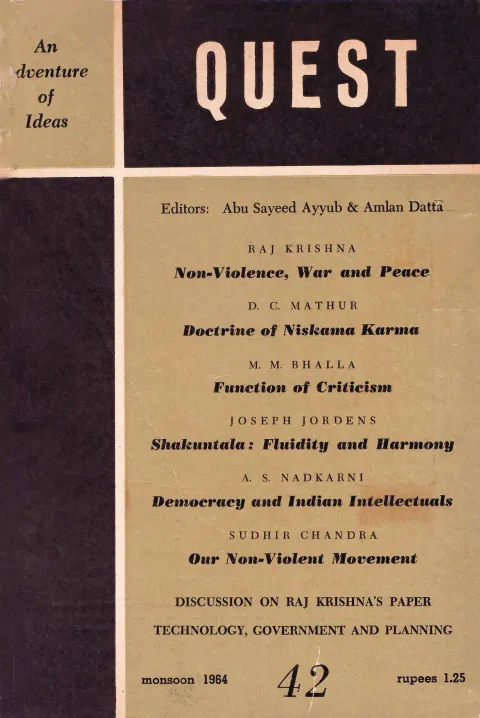
QUEST
Summary
Quest 42 (No. 42, JULY/SEPT. 1964; ‘monsoon 1964’ on the cover) is the Bombay quarterly’s Nehru-memorial number and its non-violence number at once. Jawaharlal Nehru had died on 27 May 1964; the issue opens with an unlisted tipped-in memorial portrait bearing his autograph in facsimile, follows it with two unlisted pages of extracts from his own prose, and drops a further Nehru quotation as a filler at the end of M. M. Bhalla’s article. The argumentative centre, however, is a sustained assault on the Gandhian inheritance conducted from inside the journal. Raj Krishna’s lead article - a revised G. V. Mavalanker Memorial lecture - argues that non-violence is one value among many, that Gandhi himself licensed violence under stated conditions, and that a ‘righteous cold war’ with an arms race and a balance-of-power policy can be the least evil course; co-editor Abu Sayeed Ayyub then answers him at length in an open letter in the DISCUSSION section, conceding most of the case while insisting that violence can be justified only negatively and that ‘cold war psychosis’ must be condemned. Sudhir Chandra attacks the same inheritance historically, arguing that the Indian National Movement’s non-violence was borrowed from Britain and the West rather than indigenous, and D. C. Mathur reinterprets the Gita’s niskama-karma to restore goal-commitment to moral action. Around this core the issue sets A. S. Nadkarni and R. Srinivasan on the intellectual’s and the technologist’s place in planned development, T. K. Oommen’s thesis that India suffers from over-integration at the intra-group level rather than under-integration, M. M. Bhalla on the function of criticism, Joseph Jordens on the Shakuntala as poetic drama, Ashin Das Gupta’s defence of Percival Spear against a reviewer in Quest’s own previous number, five poems (Kamala Das taking the 1964 Annual Quest Poetry Award), a long short story by M. C. Gabriel, seven signed book reviews and two letters answering an essay in Quest 41.
The issue’s institutional entanglements are dense and nowhere disclosed. The lead article is answered by a serving co-editor; the Assistant Reviews Editor signs one of the reviews; another review takes the measure of A. B. Shah’s ‘Scientific Method’ while, twelve pages later, the journal’s own sponsor advertises a Shah-edited volume containing a contribution by the other co-editor; and Raj Krishna’s footnote 10 cites the Congress for Cultural Freedom’s Forum Service for the Russell-Hook exchange without noting that the CCF is the parent body of Quest’s own sponsor, the Indian Committee for Cultural Freedom.
Essays
Non-Violence, War and Peace
By Raj Krishna
Raj Krishna sets out a general formulation of moral choice - several values are always in play, every course of action realises some at the expense of others, and the moral problem is to find the course with the best net balance - and then applies it to non-violence. His conclusion is that a commitment to non-violence can only be conditional, not because of expediency but because we are simultaneously committed to other values. He reads Gandhi’s own writings to derive three conditions under which Gandhi himself sanctioned violence: when non-violence would sacrifice other values of great worth (the honour of women, the freedom of a nation, the survival of democracy); when the victims of injustice are not prepared for genuine satyagraha; and when the oppressor is not ‘convertible’. On the third he is harshest: conversion works only where oppressor and victim share a moral vocabulary, which is why Gandhian resistance defeated British imperialism and could not have saved Hitler’s or Stalin’s victims. From there he rehabilitates dharmayuddha, the righteous war, and extends it to the ‘righteous cold war’, arguing that the Western arms race has kept such peace as there has been since 1945, that non-alignment has been ‘palpably immoral’ where it condemned both sides indiscriminately, and that India has itself been conducting cold wars with Pakistan and China while denouncing everyone else’s. He allows one untested alternative - a massive, simultaneous, genuinely even-handed international satyagraha for disarmament - but holds that pacifists who campaign only where campaigning is free have no right to campaign at all.
- Recasts non-violence as one value among many, so that commitment to it is necessarily conditional on commitments to other values - not on grounds of expediency.
- Derives three conditions legitimising violence from Gandhi’s own published positions: sacrifice of other great values, unpreparedness of the satyagrahis, and the non-convertibility of the oppressor.
- Argues conversion through satyagraha succeeds only where the parties share a moral vocabulary, which explains the Indian success against Britain and the futility of satyagraha against Hitler, Stalin, Jinnah or the Japanese.
- Revives dharmayuddha and extends it to a ‘righteous cold war’, crediting Western balance-of-power and nuclear brinkmanship with preserving post-1945 peace and calling indiscriminate non-alignment immoral.
- Concedes one untested possibility - a simultaneous, equally intensive international satyagraha for disarmament in every armed camp - and argues that unequal campaigns make satyagrahis functionally saboteurs of the defensive side.
- Sums up the anti-Gandhian polemic in the aphorism ‘Moral monism is unIndian’, locating pluralism in the Indian tradition rather than in modernity.
Doctrine of Niskama Karma
By D. C. Mathur
D. C. Mathur reads the Bhagavad Gita as a philosophy of moral action and finds the received doctrine of niskama-karma unfit for ‘changing and revolutionary times’. He accepts the Gita’s warning against pride in one’s own agency, since every significant moral act is a cooperative enterprise, but argues that subordinating moral action to the metaphysical end of moksa destroys the autonomy of moral judgement: if perfect equipoise secures liberation whichever side one takes, the distinction between right and wrong actions in specific situations is voided, and any status-quo or obscurantist course can be justified. His second objection is that the Gita’s deontology derives the content of duty from svadharma and svabhava, a static code that cannot guide the genuinely problematic situations in which moral advice is actually needed - Arjuna’s own, for one. Mathur proposes instead that non-attachment be read narrowly: one should be firmly committed to a goal reached by rational appraisal of consequences, while remaining detached about the goal’s effects on one’s personal fortunes. He supports the reinterpretation by pointing out that Krishna, as tradition depicts him, was a master strategist and a superb politician - goal-oriented rather than self-oriented - so the reading is closer to Krishna’s practice than to his preaching. The unresolved tension between goal-directed social action and ultimate concern for the serene Atman, he argues, has marked Indian culture ever since and accounts in part for its relatively static character.
- Grants the Gita’s critique of karttrtvabhimana - pride in one’s own agency - because moral action is always socially cooperative.
- Objects that referring every moral act to moksa lifts concrete situations ‘into the haze of metaphysical doctrines’ and renders right/wrong distinctions nugatory.
- Objects further that a deontology drawing duty from svadharma and svabhava is a static code useless in the crisis situations the Gita purports to address.
- Proposes reading non-attachment as detachment from personal consequences only, retaining firm commitment to a rationally appraised goal.
- Argues the reinterpretation matches Krishna’s own depicted practice as strategist and politician even if not the text’s preaching.
- Diagnoses the unreconciled tension between goal-orientation and concern for the Atman as a source of Indian social stasis - either lip-service and withdrawal, or opportunistic pursuit of selfish goals.
Function of Criticism
By M. M. Bhalla
M. M. Bhalla opens by admitting he cannot define literary criticism, and demonstrates the point by setting Eliot, Donald A. Stauffer, Leavis, John Crowe Ransom and the rasa theorists of Anandavardhana and Abhinava Gupta against one another. Criticism, he argues, ‘lacks a philosophy, a consistent science, a common and agreed idea about what it is’. The rival schools - sociological, Marxist, psychological, Empsonian, affective - each abstract one attribute from what Coleridge called ‘substantial knowledge’, the intuition of things that arises ‘when we possess ourselves as one with the whole’. Against them Bhalla asserts that human experience is objective and subjective in one inseparable process, so that literature images the structure of meaning of a whole way of life and literary studies are a concern with culture itself. He then assigns the critic three roles - self-disciplined individual, educator concerned with the health and tone of society, and judge awakening conscience - and develops the second at length with Coleridge on unity and method, Arnold on despotism and government by clubs and newspapers, and Leavis on ‘a discontinuity of consciousness’. Modern mass civilisation, advertisement and industrial machinery have broken traditional wisdom and turned education into ‘a colossal machine for the manufacture of Philistines’; critical discipline is his proposed training against it, and he ends by claiming for literary criticism the status the classics once held in university education.
- Refuses a definition of literary criticism and shows the disagreement by quoting Eliot, Stauffer, Leavis, Ransom and the rasa theorists against each other.
- Rejects the sociological, Marxist, psychological and Empsonian schools as abstractions of a single attribute from an integral human process.
- Draws on Coleridge’s distinction between introspection (subject held aloof from object) and reflection (their coincidence) to ground the critic’s self-discipline.
- Diagnoses mass civilisation - advertisement, newspapers, wireless, industrial machinery - as having destroyed traditional wisdom and made education a producer of Philistines.
- Claims criticism has a valuational dimension that sets standards and can be a force in education, and should hold the place the classics once did in universities.
Shakuntala: Rhythm, Fluidity, Harmony
By Joseph Jordens
Joseph Jordens asks why analysing the Shakuntala by plot, character and theme always ends in frustration, and answers that the method is wrong for the object. Analytical plot-study makes the curse the pivot and then cannot interpret it without a ridiculous disproportion between sin and punishment; analytical character-study finds Dushmanta and Shakuntala so perfect that they ‘totally lack personality’. Jordens proposes instead that the play is poetic drama in Traversi’s sense, to be approached from its dramatic and poetic unity. Each act, he argues, is a self-enclosed visual unit - a tableau vivant comparable to the Ajanta wall paintings, with action carried off stage and reported in the act’s introduction - and its essential unity lies in its particular emotional tonality of the single rasa of love: idyllic in Act I, idealising in II, consuming in III, bitter-sweet in IV, harsh in V, remorseful in VI, mature in VII. He shows the tonality permeating the descriptions of both persons and nature, quoting the flower imagery of Act I against the fire and fever imagery of Act III. The acts then repeat one another like the movements of a piece of music, and Act VII symbolically closes the circle begun in Act I. He closes by connecting this to two Hindu attitudes: rhythm as the essence of life, which makes the play pathetic but never tragic and suggests a mandala rather than a directed graph as its emblem; and the ‘fluidity’ of Indian aesthetics, in which drama flows into dance and music, the conceptual recedes, and art passes over into a nature mysticism that is ‘profoundly aesthetical, and unobtrusively religious’.
- Argues the classical analysis of plot, character and theme is the wrong instrument for the Shakuntala and produces only fringe qualities - ‘a perfect body without a soul’.
- Reclassifies the play as poetic drama in D. Traversi’s sense, borrowed from his account of Shakespeare’s last plays, and insists it be approached from its poetic unity.
- Reads each act as a self-enclosed tableau vivant, comparable to the Ajanta murals, unified by one emotional tonality of the rasa of love.
- Demonstrates that the tonality governs the description of nature as much as of persons, contrasting Act I’s flower imagery with Act III’s fire and fever.
- Dissolves the curse as pivot: rhythm, not the curse, is the cause, and the curse is merely an occasion by which suffering enters love.
- Connects the reading to Hindu conceptions of cosmic rhythm and of the fluidity between art forms and between art and religion.
Economic Development, Democracy and the Indian Intellectuals
By A. S. Nadkarni
A. S. Nadkarni asks what the intellectual can do about the tensions that economic development creates for Indian democracy. He defines the intellectual by the manner in which he forms judgements, and excludes political leaders and businessmen as ‘divided personalities’ whose one-track pursuit of power or profit destroys the minimum detachment required; in Indian conditions, he argues, ‘intellectual’ and ‘educated’ are effectively co-terminous. He then sets out the tensions: prolonged frustration of elementary needs weakens the sense of social responsibility until people ‘behave desperately even over relatively minor issues’; development simultaneously creates new opportunities and demands sacrifices, so there is ‘effort all round to seize opportunities and evade sacrifices’; and it accentuates conflicts between caste groups, between linguistic regions, and between rural and urban India. He adds a further dimension: the rich industrial interests are by definition urban, so their influence on policy produces an urban-oriented strategy that starves the villages, and since the very rich come from only certain linguistic regions, class conflict takes linguistic form - which makes egalitarian policy doubly stabilising. Ranking intellectuals by their access to the public, he puts journalists first and educators second, but concedes that none can match the politicians’ face-to-face reach in a largely illiterate society. The intellectual’s role therefore lies not in reaching the people directly but in influencing the behaviour of politicians: expounding the impartial academic position, supplying a basis for inter-party agreement on a minimum programme, and demonstrating democratic conduct in the conduct of their own corporate affairs.
- Defines the intellectual by detachment in forming judgements and excludes party activists and businessmen as divided personalities.
- Treats ‘intellectual’ and ‘educated’ as co-terminous in Indian conditions, given mass illiteracy, while denying that identification for the literate West.
- Identifies a lag between desires and awareness of social responsibility as the central threat to democracy under development.
- Locates the stresses in caste competition, linguistic chauvinism and the widening rural-urban gap, and adds the urban bias of rich industrial interests.
- Argues egalitarian economic policy reinforces democracy twice over - directly, and by blunting linguistic chauvinism.
- Concludes the intellectual’s leverage is on politicians rather than on the people, and requires that intellectuals run their own corporate bodies democratically.
Non-Violence in the Indian National Movement
By Sudhir Chandra
Sudhir Chandra dismisses three standing explanations for the non-violent character of the Indian National Movement - the failure of 1857, a cowardly or peace-loving national character, and an immemorial Indian tradition of non-violence - and replaces them with the character of the ruling nation. On the second he is blunt: Indians have never been conspicuous for adherence to peace or order, and the ‘barbaric frenzy’ of 1947 and the present ‘pathological inclination for riots, disorders and disturbances’ prove it. On the third he argues that Indian thought’s tradition of non-violence never stipulated projecting non-violence into politics, that the scriptures licensed force and made it the Kshatriya’s duty, that even Ashoka used force at Takshashila, and that Christianity and the West had an equally ancient tradition, first broadcast by Isaiah. The real causes he finds in British rule itself: a government based on the semblance of constitutional machinery, a policy of piecemeal reform that channelled grievance into lawful agitation, and an educational policy that exposed India to Western currents and supplied both a new concept of liberty and the technique of constitutional agitation - a technique whose adoption he illustrates from Dadabhai Naoroji’s 1906 Calcutta presidential address and from Burke’s hold on the period. Gandhi, he argues, drew his ideas of non-co-operation and satyagraha from Tolstoy and the Sermon on the Mount rather than from Hinduism, and it was Tilak, not Gandhi, who first declared the principle of passive resistance at the Benares Congress of 1905. Non-violence in similar movements across British colonies makes the Indian case no novelty, and he closes by conceding that national prejudice makes an impartial Indian account of the movement unlikely for many decades.
- Rejects 1857, national character and indigenous tradition as explanations, arguing the character of the ruling nation was as decisive as that of the subject people.
- Insists the Indian scriptural tradition of non-violence never extended to politics and that the West had an equally ancient tradition, first stated by Isaiah.
- Credits British constitutional machinery, piecemeal reform and educational policy with channelling Indian grievance into lawful, non-violent agitation.
- Argues Gandhi’s satyagraha derived largely from Tolstoy and the Sermon on the Mount, and that Tilak, not Gandhi, introduced passive resistance at Benares in 1905.
- Points out that non-violence was common to independence movements across British colonies, so it is no Indian peculiarity, and corrects Tara Chand on the point.
- Concludes that national prejudice will delay an impartial Indian history of the movement ‘many decades yet’.
Technology, Government and Planning
By R. Srinivasan
R. Srinivasan argues that planning is inevitable not because of ‘the compulsions of a backward economy’ but because of what the application of technology does to society, and that Indian social scientists who ignore technology will be as unprepared as English public men were by the Industrial Revolution. His evidence is a survey of resource exhaustion and ecological backlash: the Fertile Crescent and Libya turned to desert, Lebanon’s cedars reduced to a few thousand, English tin gone and coal seams thinning, the Mississippi stripping 750 million tons of soil a year, American per-capita consumption on the Paley Commission’s figures, and a jet fighter’s copper requirement rising from 125 lb in 1944 to 513 lb in 1954. He adds Darwin on clover and cats, China’s Operation Sparrow, and the DDT chain that passed through cattle into milk and into infants, to argue that only the state can map resources or formulate conservation policy - no private enterprise could have produced the Paley Commission’s five volumes. Automation compounds the case: the United States has created an Office of Manpower, Automation and Training and provided $435 million to retrain 400,000 workers, which he sets against an Indian government ‘sworn to planning’ that offers nothing to goldsmiths thrown out of work by its own policy. But he is equally sharp about planning’s dangers, invoking C. P. Snow’s Science and Government on Churchill and Lindemann, the Atomic Energy Commission’s Project Chariot, and India’s own crores spent on khadi and prohibition; and he charges that most Indian intellectuals have been ‘bribed into silence’ by appointment to the Planning Commission’s hundred and one agencies.
- Grounds the inevitability of planning in the social consequences of technology rather than in economic backwardness, and warns social scientists that Keynes and Marshall offer no ready-made solutions.
- Marshals resource-depletion and ecological data - soil erosion, exhausted ores, the Paley Commission’s consumption figures, DDT in milk, Operation Sparrow - to argue only the state can plan conservation.
- Contrasts the American response to automation (Office of Manpower, Automation and Training; $435 million for retraining 400,000 workers) with Indian inaction over displaced goldsmiths.
- Argues computers and automation make government scientifically fitted to comprehend social problems for the first time.
- Sets against this the dangers of ‘closed politics’ at the top of government, illustrated by C. P. Snow on Churchill and Lindemann and by Project Chariot, and by India’s khadi and prohibition spending.
- Accuses Indian intellectuals of being disarmed by co-option into the Planning Commission’s agencies, and warns that if academics betray their responsibilities ‘we will be on the high road to serfdom’.
The Over-Integrated Society
By T. K. Oommen
T. K. Oommen argues that India’s integration problem has been misdiagnosed. Reviewing the claim that the Indian village is a ‘community’, he holds that the three supports of that claim - relative isolation, the Hindu Yajmani system and caste and kinship - have all been weakened by industrialisation, urbanisation, monetisation and the free transfer of property, so that the sense of belonging has migrated from the village to the caste or jati. The village is therefore ‘a vertical entity made up of several horizontal layers each of which is caste’, and the individual is claimed by a set of ever-widening circles - caste, village, region, linguistic area, religion - arranged by their decreasing power to elicit loyalty. He then argues, against the usual alarm, that competitive bargaining by such groups for benefits from the state may actually build a democratic culture and could weaken the groups’ own basis once their aims are met, provided the basis of group formation shifts from particularistic criteria to universalistic, merit-oriented ones. The group releasing most of the present tension, he suggests on historical rather than statistical grounds, is the urban middle class, whose aspirations outrun the possibilities of fulfilment - and whose numbers and whose problem will both grow. His own contribution is the closing thesis: since the Indian urbanite has not been uprooted at all and does not hunger to belong, the problem is over-integration at the intra-group level, and over-integrated in-group loyalties produce under-integrated inter-group relations. What India needs, he proposes, is to develop an indifference on the part of the individual to the group - to ‘manufacture the balanced man who is attached to but independent of the group’.
- Denies that the Indian village is a community, tracing the collapse of its three supports - isolation, the Yajmani system, caste and kinship - under industrialisation and monetisation.
- Arranges caste, village, region, linguistic area and religion as ever-widening circles competing for the individual’s loyalty in decreasing order of power.
- Argues competitive group bargaining for state benefits is not necessarily alarming and may foster a democratic culture, if the basis of group formation shifts from particularistic to universalistic criteria.
- Identifies the urban middle class, with aspirations outrunning fulfilment, as the group most active on the social tension front - and notes the near-absence of data for the claim.
- Warns that economic growth is itself politically destabilising because it raises organised demands, so ‘economics cannot solve our riddles’.
- Advances the title thesis: the problem is over-integration at the intra-group level, and the remedy is an individual indifference to the group.
Non-Violence and Cold War
By Abu Sayeed Ayyub
Abu Sayeed Ayyub answers Raj Krishna in an open letter that begins ‘Dear Dr. Raj Krishna’ and ends ‘For the rest I am with you’. His method is to concede the conclusion while rebuilding the opponents’ case. He sorts Raj Krishna’s opponents into three classes - absolute pacifists, condemners of the cold war between the blocs, and advocates of nuclear disarmament - and objects that more than half the paper is spent on the first, the least significant, and that there is no logical connection between Gandhian non-violence and condemnation of the cold war: ‘the principle of universal non-violence is rather a dead horse to flog’. He then disputes Raj Krishna’s history of value pluralism, citing the Vedic singer’s ‘Kasmai devaya havisha vidhema’, the four purusharthas, the Gita’s jnana-karma-bhakti, the Ramayana, the Mahabharata and Greek tragedy, and asks who the alleged ‘moral monists’ are, given that Raj Krishna himself exempts Gandhi and declares moral monism un-Indian. His substantive amendment is that violence can be justified only negatively - by the demonstrable balance of evil it prevents, never by the good it may promote - since the positive form licenses wars of liberation, a Western preventive war, and the Communist case for liquidating the capitalists; and he charges that Raj Krishna nowhere discusses the possibility of a disastrous short-lived nuclear imbalance emerging from the arms race. Finally he defends one kind of condemnation of the cold war: not of military preparedness, which he grants, but of ‘cold war psychology’ or ‘psychosis’, the mental declaration of war that blackens the enemy and is ‘so obvious a prelude to hot war’. Coexistence with thugs is one thing; coexistence between two systems accepted as enduring historical entities is another, and only the latter can avoid a nuclear holocaust. He asks Indians to be as critical of their own vices as of the other side’s, notes that ‘the right side of the iron curtain’ produced Hitler, Mussolini and McCarthy, argues China may best be checked by Soviet-American collaboration, and concludes that intellectual freedom is not the only value - the Communist East may claim some superiority on racial and economic equality - and that the cold war’s mental climate is incompatible with the intellectual’s own ideals.
- Concedes broad agreement with Raj Krishna while arguing that his opponents’ case ‘could have been presented a shade better’.
- Denies any logical connection between belief in non-violence and condemnation of the cold war or the arms race, making universal non-violence ‘a dead horse to flog’.
- Traces value pluralism to the Vedic singer, the purusharthas, the Gita, the Ramayana, the Mahabharata and Greek tragedy, against the suggestion that it is a modern discovery.
- Insists violence be justified only by the balance of evil it prevents, never by the good it may promote - otherwise wars of liberation and Communist liquidation of capitalists follow.
- Faults Raj Krishna for not discussing the risk of a short-lived but disastrous nuclear imbalance emerging from the arms race itself.
- Distinguishes military preparedness from ‘cold war psychosis’ and defends condemnation of the latter as the one sensible form the condemnation of the cold war can take.
- Argues intellectual freedom is not the only value, and that the Communist East may claim some superiority on racial and economic equality.
Trivial Attitudes
By Ashin Das Gupta
Ashin Das Gupta defends Percival Spear’s ‘India, A Modern History’ against D. P. Singhal’s review of it in Quest Spring 1964, which had accused Spear of motivated writing, political pamphleteering and a concealed colonialism. Das Gupta’s method is to refute each charge from Spear’s own text: that Spear denied Hinduism its assimilative character is answered by Spear’s own definition of Hinduism as a body of customs and ideas with pervasive absorptive power; that he denied Indian history its continuity is answered by showing the offending sentence about ‘a broken country in the world of time’ was Spear reporting A. L. Basham’s view and then dissenting from it; that he slighted pre-British India is answered by counting a hundred and eighty of four hundred and fifty pages devoted to it; that he ignored ancient Indian achievement is answered with Spear’s own pages on Arabic numerals, the zero and the Vedanta’s influence from Fichte to Schopenhauer; and that he thinks too much of the English is answered with Spear on Clive’s departure, ‘open and unashamed plunder’, and Cornwallis’s failure to enlist Indians. Where Spear handles caste heavily, Das Gupta argues, it is because he believes Indian history is discovered in hamlets and temples rather than royal courts - ‘In this Spear practices what Rabindranath preached’. But he concedes Singhal’s case in part for the twentieth century, where Spear becomes ‘more as a participant than as a historian’, is silent about the excitement of non-co-operation, and treats Irwin, C. R. Das and Motilal Nehru as the heroes. On Pakistan he finds Spear evasive - inclined as a historian to accept the two-nation theory, unwilling as a liberal aesthete to state it - and offers his own scheme of three nationalisms, Hindu, Muslim and Indian, in place of two. He ends with two imagined histories of the subcontinent written in 2064, one bleak and one hopeful, and the remark that a people’s failure often expresses itself in trivial attitudes.
- Refutes D. P. Singhal’s charges against Percival Spear point by point from quotations in Spear’s own book, including the misattribution of A. L. Basham’s view to Spear.
- Notes Spear devoted about 180 of 450-odd pages to pre-British India, which Singhal turned into a grievance.
- Explains Spear’s insistence on caste as following from his belief that Indian history is found in hamlets and temples rather than courts - ‘In this Spear practices what Rabindranath preached’.
- Concedes that Spear’s twentieth-century chapters fail, the writer appearing ‘more as a participant than as a historian’ after his own arrival in Delhi in 1924.
- Finds Spear contradictory on Pakistan, leaning as historian towards the two-nation theory while his liberal self slurs over the details.
- Proposes three nationalisms - Hindu, Muslim and Indian - instead of two, and credits Muslim separatism to a belated Muslim middle class plus a ‘motivated tenderness’ from the British.
- Cites Satish Chandra and Brij Kishore on the late-Mughal agrarian crisis to argue communal tension should be reread against economic conflict.
Invisible Tree
By Ryuichi Tamura
A short lyric in free verse, translated from the Japanese by Rikutaro Fukuda. The speaker reads animal tracks in snow - squirrel prints down an old elm, a fox’s line through the valley north of his village, a bird’s claw-marks and feather-flicks - and measures each against his own inner life, finding his hunger less straight, his mind less sure in rhythm, his terror incapable of such pattern. A sudden sunset on the summit of Asama marks the turn: something not known has built a forest, pushed open the mouth of the valley and split the cold air. Back in his hut, lighting the stove, the speaker thinks the invisible tree, invisible bird, invisible small things living, and closes on ‘rhythm invisible’.
- Builds by comparison: each animal track is set against a corresponding human faculty that falls short of it.
- Turns on an unexplained agency - ‘Something not known has built a forest’ - rather than on the speaker’s own action.
- Ends by inverting its adjective into a final noun-phrase, ‘rhythm invisible’, after a list of invisible living things.
- Printed with the translator credited only under the poem; the contents page names no translator.
Summer in Calcutta
By Kamala Das
A single-sentence-driven lyric in short lines, in which drinking becomes the April sun squeezed like an orange in the glass. The speaker drinks fire, is drunk on the gold of suns, and asks what noble venom fills her mind with unhurried laughter while her worries doze. Bubbles ring the glass like a bride’s nervous smile and meet her lips; she asks the addressee to forgive ‘This moment’s lull in / Wanting you, the blur / In memory’, and measures how brief the term of her devotion and how brief his reign, before returning to the drink at the close. The poem is one of the two for which Kamala Das was named the 1964 Annual Quest Poetry Award recipient in an editors’ note printed directly beneath it.
- Sustains a single conceit - the drink as the April sun squeezed like an orange - from first line to last.
- Sets intoxication against erotic attachment, making the lull in wanting the poem’s confessed subject.
- Runs in very short lines with heavy enjambment across syntactic units, so the sentences break mid-phrase.
- Printed immediately above the editors’ announcement of her Quest Poetry Award.
The Sirens
By Kamala Das
A longer narrative lyric across two pages. The night, ‘dark-cloaked like a procuress’, brings the speaker a willing lover who speaks love in a tender language she does not know; she asks Aniruddha, her dream-lover, to hide the night’s deceit from him, knowing he does not love her. Morning comes with the crows, and at the door a pockmarked face, a friendly smile and a rolleiflex - a man proposing a drive or a look at the lakes. She has washed and dressed in six yards of printed voile and wonders whether her night of love still shows; he says she looks pale, and she answers inwardly that it is ‘the lipstick’s anaemia’. Air-raid sirens are being tested as they talk, and she weaves their sound into his mirthless laughter. He is lavish with words, guesses she loves a handsome man, and she thinks: not young, not handsome, just a filthy snob. Near the lake a pregnant girl bares her breasts and washes them sullenly; crows bicker over lizard-meat on an old cannon-stand; he asks her to lie against the rusty nineteen-thirty-four guns for a photograph. She agrees, shuts her eyes, and finds inside her eyelids no night, no love, no peace, only the white sun burning - closing on the couplet ‘Ah, why does love come to me like pain, / again and again and again.’
- Moves from a night of unloving love through a banal daytime encounter to a flat refusal of consolation.
- Uses modern props - a rolleiflex, tested sirens, 1934 guns, printed voile - against the dream-lover Aniruddha of the opening.
- Places the speaker’s private cruelty (‘just a filthy snob’) in unspoken counterpoint to the man’s talk.
- Ends on a repeating triple cadence that gives the poem its only closure.
No Heart to Give
By Leslie de Noronha
A poem of refusals built in four movements, each pairing two long lines of negation with an indented two-line taunt addressed to a ‘fool’. The speaker has no heart to give a country, sheds no glory for a flag, stains no battlefield and flies no bomber; has no passion to give a woman, no scalps of undone maids, no memories of triumphant passion; has no scars of brawls or drunken orgies and no virile laughter to pattern an unborn babe. Against each refusal the taunt turns on the addressee - hold the world in your fist, lick your livid wounds; seek refuge in the daylight; sob into your salted wounds, for your night will never end. The close abandons the pattern for a single run of denials - no kingdom under the sea, no coral-red-acquamarine-turquoise-kingfisher-blue, no promised land, no silent beauty, no myth of rainbow ends - save ‘in the wild, wild bramble minds / Of sanity’, which closes the poem on a deliberate reversal of the expected word.
- Structured as three matched movements of refusal plus taunt, then a fourth that breaks the pattern.
- Refuses in turn the claims of nation, of sexual conquest and of masculine bravado.
- Runs a single hyphenated compound colour - ‘coral-red-acquamarine-turquoise-kingfisher-blue’ - as the poem’s one moment of excess.
- Ends by locating the denied myths in the ‘bramble minds / Of sanity’ rather than of madness.
Note Elegiac
By L. N. P. Wickramasinghe
A five-line poem set in lower case as ‘note elegiac’ and printed as a filler under the close of Sudhir Chandra’s article on non-violence in the Indian National Movement. It records a dawn attack in a single unpunctuated sentence: they attacked in the mist, the others’ watch saw them, and the still unwarmed blood of morning was shed in the firing and the cries of men - and in the grass that was, inside the camp’s perimeter, fresh and wet and silent. The whole poem withholds any statement of who attacked or why, and its last line transfers the qualities of the killed to the grass.
- Five lines, lower-case title, no terminal punctuation until the final full stop, and no named combatants.
- Turns on the phrase ‘the still unwarmed blood of morning’, which fuses the hour with the wound.
- Displaces the elegy’s grief onto the camp’s grass, ‘fresh and wet and silent’, in the closing line.
- Printed at p. 48, out of sequence with the rest of the POETRY block, immediately below an article arguing that India’s non-violence was borrowed from Britain.
Bit by Bit
By M. C. Gabriel
M. C. Gabriel’s story is a ten-page comedy of literary fraud. Gurumurthy Subramaniam, who spends his evenings in innocent non-committal chatter with Raghavan and Krishnan at the South Indian Cafe, accidentally produces the rhyme ‘You’ve got to walk a mile, to find a smile’, takes it for a revelation of his inner depths, and decides he has been called by the Muse. The Epic he plans will not come; he concludes the obstacle is his name, settles on ‘Gurtys’ (pronounced Ger-tis, like Keats), and the nickname sticks when Krishnan adopts it out of spite. Into the group drifts Vasudevan - ‘Vasu’ - a voluble literary critic who reviews for the Sentinel and whom nobody admits having brought. Gurtys attaches himself to him, claims to read poetry ‘By the mile’, buys Eliot, Auden, Donne, Keats and Yeats, signs them with a flourish, cannot read a line of them, and builds a reputation out of blurbs, dust-jackets and Vasu’s talk. He dreams of chewing his own books like sandwiches. He borrows Vasu’s favourite poet and declares Yeats the greatest modern poet to Vasu’s face; he pronounces judgement on the sixteen-year-old Raman’s notebook while refusing to read it, and turns vicious when Vasu picks the notebook up and praises a poem Gurtys has not seen. Vasu’s diagnosis, reported to Gurtys by Krishnan, supplies the title: ‘He’s just a case of conscience dying bit by bit. That’s all.’ Reconciliation fails when Gurtys, asked about his poem on the lights, confuses it with Raman’s ‘The Camera Eye’; Vasu looks at him with consternation, then contempt, then tired pity, pats his shoulder and leaves for good. The story ends with Gurtys at the newspaper office learning that Vasu has gone without an address, and with a dream in which Vasu tears the books from his shelves and carries them out while Raman grins.
- Satirises literary pretension through a protagonist whose entire equipment is one accidental rhyme and a shelf of unread books.
- Makes the change of name - Gurumurthy Subramaniam to ‘Gurtys’, modelled on Keats - the first and funniest of his frauds.
- Builds its comedy from talk: the cafe group’s malice, Raghavan’s pointless punctuations, Krishnan’s relish in carrying remarks between people.
- Supplies the title from Vasu’s verdict on Gurtys - ‘a case of conscience dying bit by bit’.
- Turns on the boy Raman, whose directness (‘But I must write’) is the one thing Gurtys cannot answer, and whose poem he finally mistakes for his own.
- Ends with a dream of dispossession rather than an exposure, leaving the fraud intact and unpunished.
Studies in the Social Thought of M. G. Ranade
By S. Natarajan
S. Natarajan reviews P. J. Jagirdar’s ‘Studies in the Social Thought of M. G. Ranade’ (Asia Publishing House). He opens with his own account of Ranade’s place: Ranade took the progressive religious movement Ram Mohan Roy began in Bengal and gave it an all-India character, which mattered because the Bengal initiative threatened to harden into a sect - though the Prarthana Samaj, unlike the Brahmo Samaj, failed to stem conversion to Christianity in Western India. Jagirdar’s thesis, he reports, is that Ranade was essentially a Western-tradition thinker, and Natarajan accepts it with one qualification: the idea of progress may be Western in origin but gradualism, ‘change for the better by slow absorption’, is peculiarly Indian. He quotes at length Ranade’s letter to the Indian Social Reformer defending K. T. Telang, and takes it as the key to a social philosophy that held the reform movement together for forty years - approving reinterpretation of the shastras, appeal to reason, and State or caste penalties, but rejecting secession from Hindu society. Ranade’s confidence in the British administration as a liberal secular State made him tolerant of reactionary agitators and apprehensive of zealous reformers, patient with Tilak and hesitant about Malabari; Natarajan suggests his higher regard for the state than for society had a less personal explanation than Jagirdar’s, namely the reformers’ experience of caste’s dominating influence. He judges the book a complementary study without which the understanding of Ranade would be incomplete, and credits Jagirdar with facing Ranade’s theory of Providence boldly instead of apologising for it.
- Places Ranade as the man who gave Ram Mohan Roy’s Bengal movement an all-India character and kept it from hardening into a sect.
- Accepts Jagirdar’s thesis that Ranade was a Western-tradition thinker but insists gradualism, ‘change for the better by slow absorption’, is peculiarly Indian.
- Quotes Ranade’s letter on Telang at length as the key to a philosophy that held the reform movement together for over forty years.
- Explains Ranade’s tolerance of Hindu conservatives and apprehension about impatient reformers by his faith in British liberal secularism.
- Offers a less personal account than Jagirdar’s of Ranade’s higher regard for the state: the reformers had been impressed by the dominating influence of caste.
- Endorses the book’s conclusion that a synthesis of East and West ‘could only have been attempted in an India under British rule’, contrary to extreme nationalist views.
Scientific Method
By Lewis Simmons
Lewis Simmons reviews A. B. Shah’s ‘Scientific Method’ (Allied Publishers) under the display title ‘How to Think’. He grants the subject’s importance in India, quoting M. P. Rege’s Foreword on having accepted Western technology without assimilating the essential values of that civilisation, and grants the author’s qualifications as an experienced teacher of mathematics who brings a trained mind to problems outside his specialism. But he announces frankly that because Shah writes ‘as a humanist whose thinking is centred only on man’, and will consider religion only in terms of its usefulness to man, ‘the reviewer finds himself in frequent disagreement with him’. The four middle chapters explaining scientific method - the natural-history stage, then the deductively formulated theory, hypothesis, search for unobserved consequences and experimental test - he judges the most valuable in the book, though he doubts their mathematician’s precision and terseness will be easily followed by the educated layman for whom Shah professes to write. The quarrel is with the later chapters, where Shah seeks to have scientific method take over the functions of religion. Simmons argues the rejection of the concept of God rests on the assumption that all knowledge of Him comes through mysticism and philosophical speculation, and ignores the Christian claim of revelation in datable historical events; he objects that Shah does not explain how Socrates, Christ, Charvak and the Buddha propounded ethics Shah approves of on religious premises he disapproves of; and he holds the concluding chapters to be ‘simply an attempt to throw away the religious basis of traditional ethics without producing complete moral chaos’.
- Declares the reviewer’s own position openly: Shah’s humanism, which considers religion only as useful to man, puts him in frequent disagreement.
- Judges the four chapters explaining scientific method the most valuable in the book, while doubting the educated layman can follow their terseness.
- Argues Shah’s rejection of God ignores the claim of revelation in datable historical events, a claim Judaism and Islam would make in modified form.
- Points out the unexplained gap between the ethical teaching Shah approves of and the religious premises from which Socrates, Christ, Charvak and the Buddha derived it.
- Finds Shah’s ‘scientifically based’ ethics hard to distinguish from expediency and likely to produce the chaos it seeks to avoid.
- Uses the state of world tension to discredit the confidence that scientific patterns of thought will preserve human values.
The Damned
By P. T. Chacko
P. T. Chacko reviews Frantz Fanon’s ‘The Damned’ with a Foreword by J. P. Sartre, under the display title ‘The Third World’. The review is openly hostile. Chacko allows Fanon’s right to think in continental terms despite being from Algeria, and reports his vision of a Third World fashioned by values wholly different from Europe’s, Europe having lost its capacity to lead. But he turns Heidegger’s ‘Alles Verstehen ist befindliches’ against him: Fanon’s understanding is conditioned by his situation as an Algerian witness to French atrocities, and so he cannot escape thinking in inimical terms about Europeans while also failing to absorb the best of Western civilisation - ‘Marxism and the cult of violence-that is all that he has been able to learn from his long contact with the Europeans’. He objects that Fanon presents decolonisation as necessarily violent while never once mentioning India or its freedom struggle in the whole book, and reads that silence as the necessary consequence of following Sorel and Marx. He finds Fanon’s advocacy of violence as a ‘cleansing force for individuals’ fantastic, his borrowings from Freud unassimilated, his grand generalisations unsubstantiated and applicable mostly to Algeria alone, and Sartre’s claim that no one since Marx has so well described the great laws of history undiscoverable in the text. He also rejects the claim that Europe is literally the creation of the Third World, asking whether Christianity, science and philosophy are to be credited to Africans. What he does allow is the value of Fanon’s observations on the colonial situation - that nationalist parties lose touch with the people after independence, that party headquarters should sit in the countryside, that intellectuals should not lose touch and youth should go to the fields rather than the stadiums, that soldiers need political education to forestall coups - and the chapter on the mental disorders produced by French torture, whose parallel he finds ‘only in Angola’. He ends by suggesting such books may be a way of venting pent-up passion, and that this does not stop philosophers of Sartre’s persuasion ‘from writing furious Forewards to such thunderous tomes’.
- Turns Heidegger’s dictum on the situatedness of understanding against Fanon, to explain rather than excuse his hostility to Europe.
- Charges that a book on decolonisation never once mentions India or its non-violent freedom struggle, and attributes the silence to Sorel and Marx.
- Rejects violence as a ‘cleansing force’, the unassimilated Freudian borrowings, and the unsubstantiated ‘laws of history’ Sartre claims to find.
- Denies that Europe is the creation of the Third World, citing Christianity, science and philosophy as Europe’s own contributions.
- Concedes real value in Fanon’s analysis of post-independence nationalist parties, of capital-city centralisation, and of the intellectual’s distance from the people.
- Accepts as almost unbelievable but documented the chapter on mental disorders caused by French army and police torture in Algeria.
- Closes by reducing the book to a venting of pent-up passion and mocking Sartre’s Foreword.
The Greater Darkness
By Chetan Karnani
Chetan Karnani reviews David Rubin’s first novel ‘The Greater Darkness’ under the display title ‘A Raga of Life’. The novel, set in an imaginary U.P. town called Gauhar that resembles Allahabad, brings three cultural planes together in K. M. Rau’s mansion: Rau’s England-educated granddaughter Kiran returns to India, and an American sociologist, Bill Ames, arrives with his wife Carol as Rau’s tenants. Neither Kiran nor Ames lasts more than an academic term; the couple’s opposite reactions to India lead to divorce and to Carol’s death in communal riots. Karnani finds the characters more impressive than the story, and reads their varying responses - Rau’s sceptical wit, Dr. Muskett’s clinical stare, Leslie’s ‘Nobody belongs anywhere until he makes his place’ - as an existential approach shared across nationalities. He is most interested in Rubin’s handling of Indian music: the novel opens and closes with the seasonal modes malhar and vasant and runs its chapters through ragas round the clock, each chapter answering to a raga’s dominant mood, which he calls a tribute to the author’s intimate knowledge. He records two lapses - no treatise prescribes that chandrakauns be played on moonlit nights, and Bhatnagar is a lecturer in history on p. 126 and in English on p. 180 - and complains that many descriptions will strike Indian readers as over-obvious, ‘almost the author’s diary woven into his novel’, tolerable only as an American novelist’s perceptions; the novel would have had greater impact had the author ‘ceased to be a tourist guide at many places’. His verdict is nevertheless warm for a first novel.
- Describes the novel’s three-plane cultural confluence - Indian, British, American - meeting in K. M. Rau’s Allahabad-like mansion.
- Prefers the characters to the plot, reading their divergent responses to India as a shared existential outlook across nationalities.
- Treats the raga structure as the novel’s real achievement, each chapter corresponding to the dominant mood of a named raga.
- Catches two errors: the chandrakauns/moonlit-night claim, and Bhatnagar’s shifting department between pp. 126 and 180.
- Objects to descriptions that read as the author’s diary and to the novelist acting as tourist guide.
- Concludes generously for a first novel, crediting Rubin with penetrating Indian culture as far as an outsider can.
The Teaching of English Literature Overseas
By Krishna Essauloff
Krishna Essauloff reviews ‘The Teaching of English Literature Overseas’, John Press’s record of a British Council conference held at King’s College Cambridge on 16-18 July 1962, under the display title ‘Language or Literature’. She opens by wondering whether records of conferences make interesting reading, and grants that those concerned with making syllabuses will find them useful. The delegates, she reports, unanimously answered yes to the question whether the study of English literature is necessary where English is chiefly a means to another end - no language can be learnt except through its literature - though I. A. Richards would widen ‘literature’ to include all good writing and Professor Pattison and many schoolteachers would put Nevil Shute in the syllabus ahead of nineteenth-century writers. Essauloff is unconvinced by the grander claims made for English literature. She finds John Holloway’s description of it as a broad, flexible and liberal discipline ‘not clearly excelled by any other’ hard to swallow, and doubts that maturity of understanding comes from literature rather than life or that a sense of history is better got from literature than from history; broadness and flexibility, she adds, are not necessarily virtues for young minds. She endorses Professor Gokak’s warning that students of English literature in emerging countries risk a colonialism of the intellectual and aesthetic life, noting that many Indians have become ‘transmogrified Englishmen’ and that the Indian student of English literature ‘does tend to become denationalised, an alien in his own country’. She backs Pattison’s functional emphasis, suggesting students be thought of as future writers and critics, and observes that the last thing anyone who wants to write is advised to do is study English literature. Finally she doubts that films, broadcasts and records can replace the teacher, and singles out one commission recommendation as important: that literature’s relation to history, sociology, philosophy, politics and science be explored through joint courses.
- Reports the conference’s unanimous answer that literature is essential because no language can be learnt except through its literature.
- Records the dissent about which literature - I. A. Richards widening it to all good writing, Pattison and schoolteachers preferring Nevil Shute to the nineteenth century.
- Rejects Holloway’s claims for English literature as a uniquely broad and liberal discipline, and doubts that literature teaches history or maturity better than history or life.
- Endorses Gokak’s warning about intellectual and aesthetic colonialism, and the making of ‘transmogrified Englishmen’ in India.
- Argues for a functional emphasis that treats students as future writers and critics.
- Doubts that audiovisual aids can replace the teacher, and finds the space John Press gives them dangerous.
- Singles out the recommendation for joint courses linking literature to history, sociology, philosophy, politics and science.
Corruption in Developing Countries
By A. G. Noorani
A short notice by A. G. Noorani of Ronald Wraith and Adgar Simpkins’s ‘Corruption in Developing Countries’, printed under the display title ‘Comparative Malpractices’ and contained entirely on printed p. 96. Noorani quotes the book’s opening image - ‘Throughout the fabric of public life in newly independent states runs the scarlet thread of bribery and corruption’ - and then complains that the title misleads: the book deals not with those states or a representative selection of them but with corruption in Nigeria and in eighteenth- and nineteenth-century Britain, Nigeria being simply the country outside Britain where the authors have lived longest. He treats the crucial question as whether any threads in that pattern are meaningful for Britain’s former African and Asian dependencies, credits the authors with fine documentation, and notes their own admission that the British story reveals no short cuts to integrity any more than to democracy. The meaningful threads, he concludes, are very few but useful, and he quotes the authors’ cures - the passage of time, steady economic progress shifting loyalties from family, clan and tribe to the nation-state, the spread of education, the evolution of public opinion, the growth of commerce and of a professional class, the diffusion of power, wealth and status - inserting his own parenthetical doubt whether steady economic progress is possible without first eradicating corruption. The book disappoints, he says, only because it arouses expectations it fails to fulfil; corruption is certain to live long among the developing countries, and need not hurt their pride, since Gibbon called it the most infallible symptom of constitutional liberty.
- Faults the book’s title as misleading: it covers Nigeria and eighteenth- and nineteenth-century Britain, not developing countries generally.
- Notes the authors’ own admission that Britain’s story reveals no short cuts to integrity any more than to democracy.
- Lists the authors’ prescribed cures and interposes the doubt whether steady economic progress is possible before corruption is eradicated.
- Concludes the book disappoints only by arousing expectations it fails to fulfil, while containing a good deal of useful material.
- Ends with Gibbon’s paradox that corruption is the most infallible symptom of constitutional liberty.
The Indian Immigrants in Britain
By Laeeq Futehally
Laeeq Futehally reviews Rashmi Desai’s ‘The Indian Immigrants in Britain’, issued under the auspices of the Institute of Race Relations, London, under the display title ‘A Home from Home’. She reduces the book’s finding to one sentence: the immigrant Indian’s highest social ambition is to overcome the strangeness of an alien environment and reconstruct as nearly as possible the huddle of a typical Punjabi or Gujarati village - a central fact Desai has expanded with case histories, tables, statistics ‘and other scholarly impedimenta’ into a hundred and fifty pages. She distinguishes the immigrant from the Indian student or professional: an unskilled or semi-skilled labourer who went to England solely to earn and remit, mostly from Gujarat or the Punjab where pressure on the land is heaviest, and almost all between 1950 and 1960, after which a passport became almost impossible to get ‘either real or forged’. Against the natural supposition that part of the motive was escape from family and group pressure, she reports the opposite: the immigrant’s most strenuous activity went into maintaining village-kin links and building an identical replica of what he had left, joint family household included, with no hankering for better physical conditions or greater mental freedom. Refusing to spend money where it is earned has made Indian immigrants unpopular in many parts of the world, and the incapacity to accept the host country’s norms she attributes to the tenacity with which Indians are taught to cling to their values, dress being the only concession and that only by the men. The book’s most unexpected fact, she says, is that many immigrants still cannot speak English after ten years - which demolishes the Indian belief in an inborn gift for languages, since her acquaintances in pre-war China and Japan owed their fluency to Japanese grammar’s similarity to Indian forms rather than to any talent. Desai passes no judgments and makes no predictions, but she draws her own: a future in any foreign country requires the willingness to lose one’s identity gracefully and merge with the host society, a process that has not even begun to be thought about in Britain.
- Compresses the book’s finding to one sentence: the immigrant reconstructs the Punjabi or Gujarati village rather than escaping it.
- Distinguishes the labouring immigrant of 1950-60 from the Indian student or professional settler, and notes the passport difficulty ‘either real or forged’.
- Reports the counter-intuitive absence of any wish for better physical conditions or greater mental freedom.
- Attributes the refusal to spend money locally and the incapacity to accept host norms to the tenacity with which Indians cling to their values.
- Uses the finding that many immigrants cannot speak English after ten years to demolish the Indian self-flattery about a gift for languages.
- Goes beyond Desai’s own reticence to argue that a future abroad requires losing one’s identity gracefully and merging with the host society.
- Written by the journal’s own Assistant Reviews Editor, without disclosure.
Cultural Unity of India
By Punya Sloka Ray
A letter from Punya Sloka Ray, writing from The University of Chicago on 17 June 1964, responding to Asaf A. Fyzee’s essay on the cultural unity of India in Quest 41. Ray refuses the starting point: cultural unity has been an early Indian aspiration, as Bharatvarsha, Jambudvipa and Hind attest, but no cultural unity anywhere is provable in the scientific or legal sense - Europe’s and Britain’s are no less unprovable. What demonstrably exists is the legal reality of the Indian republic since 1947, and he asks whether India needs any cultural unity beyond that legal one. The grain of truth in the demand, he concedes, is that legality must be backed by a community of persuasion, which he defines as ‘the conscious, personal and mutual allegiance of a dominant number of opinion moulders’ - a community that excludes those not actually participating in the culture and includes many outside the legal community. India already has such a unity, he argues, consisting of those who value the government of India for the opportunities for intellectual, spiritual and social freedom it has sought to create, inseparable from love for four dead men: Gandhi, Patel, Azad and Nehru. Much of the older Hindu, Islamic and other tradition is incompatible with this new culture but need not be persecuted. He then addresses the Indian Muslims directly: the mass of them remain convinced their interests are unsafe in a state whose ultimate authority is not Muslim, and for every Hindu working to alienate them there are one to three Muslims who already feel alienated; this excessive fear is the root of the trouble, and it is due to ignorance. Too few Muslims know the best of the Hindu tradition well enough to appeal to it, where Gandhi could quote the Bible or John Stuart Mill against the British. Educated Indian Muslims must therefore write, speak and teach without depending on the government for their livelihoods, and Hindu opinion moulders must lose their hysterical fear of crypto-Pakistanis and grasp that a purely Hindu state would count for less in the world than a secular India. He closes on President Ayub Khan’s possible change of heart: if Pakistan becomes a safe neighbour, ‘a Pathan from Sandhurst will share with a Brahmin from Cambridge that ultimate honor which was denied to Gandhi and Azad’.
- Denies that any cultural unity - India’s, Europe’s or Britain’s - is amenable to scientific or legal proof, and takes the legal reality of the republic as the demonstrable fact.
- Defines a cultural community as the conscious, personal and mutual allegiance of a dominant number of opinion moulders, not as a potentiality shared by all citizens.
- Locates India’s existing cultural unity in allegiance to the freedoms the state has sought to create, and in love for Gandhi, Patel, Azad and Nehru.
- Names Muslim fear, rooted in ignorance rather than proximity, as the root of communal trouble, and assigns educated Indian Muslims the duty of teaching and writing independently of government employment.
- Assigns Hindu opinion moulders the corresponding duty of abandoning their fear of ‘crypto-Pakistanis’ and recognising a secular India’s greater weight in world affairs.
- Uses deliberately harsh formulations - ‘institutionalized lunatics are Indian citizens’, ‘potentiality excludes none but the clinically proved idiot’ - to press the distinction between legal and cultural membership.
- Ends on Ayub Khan’s possible change of heart and the honour denied to Gandhi and Azad.
Essay 25
By K. C. Lalwani
An untitled letter opening ‘Dear Sir,’ and signed K. C. Lalwani, also responding to Prof. Fyzee’s essay in Quest 41 but from the opposite direction to Punya Sloka Ray’s. Lalwani agrees with Fyzee’s basic point and says it has been anticipated by dispassionate writers outside ‘the narrow official circle of post-independence pseudo-nationalistic historians’, setting Fyzee’s judgement that the cultural unity of India is a ‘sheer self-deception’ alongside a long quotation from the preface to R. C. Majumdar’s History of the Freedom Movement in India, which he cites as Dr. H. C. Majumdar. He then presses one qualification: Fyzee had allowed that if ‘Indian’ culture means Hindu culture the claims of unity are ‘perfectly true’, and Lalwani denies even that. Hindu India, he argues, was itself diverse and only later rigid, because fresh hordes of newcomers were added to the ‘Indic’ society at the end of almost every epoch, leaving loyalty to a few common deities but a wide variety of cultures expressed in language, dress, food habits and even modes of worship. Classical Sanskrit, itself the product of a first-rate linguistic reform, failed to supply the necessary unity, and the north Indian languages, though of common descent, exhibit ‘an unbridgeable divergence’ for practical purposes including the adoption of a lingua franca in place of English. Hinduism became a common religion of divergent groups without reconstituting them into a uniform people as in the U.K. or the U.S.A., and popular Hinduism is itself a compromise with local archaisms; art, architecture, painting, music and calligraphy diverge as widely. ‘Hence the cultural unity is a grand fiction.’ Islam complicated matters further, adding Turko-Afghans, Mongols and local converts; the fault for the failure to fuse he assigns partly to the ‘barbarians’ who imported it, as distinguished from the classical Arabs, but mainly to ‘a degenerate Hinduism which had taken shelter beneath a thick crust and was unable and unwilling to absorb the new currents’.
- Agrees with Fyzee that the cultural unity of India is a self-deception, and aligns him against ‘post-independence pseudo-nationalistic historians’.
- Refuses even Fyzee’s concession that the claim holds for Hindu culture alone, arguing Hindu India was itself plural from the start.
- Explains the plurality by successive waves of newcomers absorbed into ‘Indic’ society at the end of each epoch.
- Argues classical Sanskrit failed to unify, and that the north Indian languages diverge unbridgeably despite common descent - bearing on the lingua franca question.
- Holds that Hinduism supplied a common religion without producing a uniform people as in the U.K. or U.S.A.
- Blames the failure of Hindu-Muslim fusion partly on the ‘barbarians’ who brought Islam but mainly on ‘a degenerate Hinduism’ unwilling to absorb new currents.
- Cites R. C. Majumdar’s preface at length while misnaming him ‘Dr. H. C. Majumdar’.
Essay 26
By Jawaharlal Nehru
An unlisted memorial plate on an unnumbered leaf tipped in between printed pp. 8 and 9 - the one piece of editorial visual material in the issue, and the cause of the folio offset shifting from -2 to -4. The leaf is blank on its first side (PDF 11, showing only the portrait’s frame as show-through) and carries on its second (PDF 12) a full-page half-tone portrait of Jawaharlal Nehru in white cap and achkan against a dark ground, with his signature reproduced in facsimile across the lower part of the image in both Latin script and Devanagari. Beneath the portrait is a two-line quotation in italic and then, in capitals, ‘JAWAHARLAL NEHRU’ with his dates ‘(14th Nov. 1889 - 27th May 1964)’. Nothing on the leaf credits a photographer, and the contents page does not mention it. It sets up the two unlisted pages of Nehru extracts that follow immediately.
- The issue’s only editorial plate - every other image in QT042 is advertising, established by rendering every low-text page.
- An unnumbered tipped-in leaf, blank on the recto side and bearing the portrait on the verso, which is what shifts the folio offset from -2 to -4.
- Reproduces Nehru’s autograph in facsimile in both Latin and Devanagari script.
- Carries the memorial dates 14 November 1889 to 27 May 1964 and a two-line quotation, but no photographer credit and no contents entry.
Essay 27
By Jawaharlal Nehru
An unlisted two-page anthology of Nehru’s own prose, printed on printed pp. 9-10 immediately after the memorial plate, headed ‘Glimpses of Jawaharlal Nehru’ and consisting of extracts run together with asterisk dividers and credited at the foot of each sequence to their source. The first and longest extract, credited to ‘Autobiography (Allied Publishers)’, is Nehru on religion: India is supposed to be a religious country above everything else, and Hindu and Moslem and Sikh ‘take pride in their faiths and testify to their truth by breaking heads’; organised religion has filled him with horror as standing for blind belief, dogma and bigotry, yet he knew well that something in it supplied a deep inner craving; he prefers the open sea with all its storms to the safe anchorage Roman Catholicism, Islam and popular Hinduism offer, is not greatly interested in the after life, and finds the traditional Chinese outlook - ethical and yet tinged with religious scepticism - appealing. The remaining extracts, credited to ‘The Discovery of India (Meridian Books Limited)’, move through the burden of inheritance quoted against Nietzsche, a passage of private remorse about Kamala’s wish to play her own part in the national struggle and his blindness to it, a long recollection of Iqbal’s late turn towards socialism and his remark ‘What is there in common between Jinnah and you? He is a politician, you are a patriot’, and a closing meditation on balancing body and spirit, quoting Tagore, Lao Tzu and Aristotle. The editors supply no commentary of their own - the selection is the whole editorial act.
- An unlisted memorial feature made entirely of Nehru’s own words, with no editorial commentary - the selection is the argument.
- Leads with the most anti-clerical passage available, on organised religion as blind belief, dogma and bigotry.
- Includes an unusually personal extract on Kamala Nehru’s wish not to be ‘a hanger-on and a shadow of her husband’, and his blindness to it.
- Carries the Iqbal recollection, including Iqbal’s distinction between Jinnah the politician and Nehru the patriot.
- Closes with the Discovery of India passage braiding Tagore, Lao Tzu and Aristotle on the practice of immortality.
- Credits both source volumes and their publishers - Allied Publishers and Meridian Books Limited - at the foot of each extract.
Essay 28
By Jawaharlal Nehru
An unlisted untitled quotation filler, printed inside a double rule at the foot of printed p. 30 below the close of M. M. Bhalla’s article and signed in capitals ‘JAWAHARLAL NEHRU’. It is the third element of the issue’s Nehru memorial thread. The passage records his isolation on returning to India - he felt lonely and homeless, and India, to whom he had given his love and for whom he had laboured, seemed a strange and bewildering land; he could not enter into the spirit and ways of thinking of his countrymen, felt an invisible barrier even with his closest associates and shrank back into his shell, while the old world of past ideologies enveloped them and the new world was yet far distant. It closes with three lines of verse, set as a quotation within the quotation and unattributed on the page, beginning ‘Wandering between two worlds, one dead’. No source volume is credited, unlike the extracts on pp. 9-10.
- An untitled filler in a ruled box, signed by Nehru and carrying no source credit, unlike the pp. 9-10 extracts.
- Records estrangement from his own countrymen rather than public achievement - a deliberate choice of register for a memorial.
- Closes with three lines of verse quoted without attribution on the page (‘Wandering between two worlds, one dead’).
- Placed under a literary-critical article about the function of criticism, with no editorial link between the two.
Essay 29
An unlisted editorial note, set below a rule at the foot of printed p. 74 immediately under Kamala Das’s ‘Summer in Calcutta’ and signed ‘-EDITORS’. It announces that Kamala Das is the recipient for 1964 of the Annual Quest Poetry Award, explains that the judges are appointed annually by the various P.E.N. centres in Asia and that the Indian representative for the year was Khushwant Singh, and states that her two poems and the preceding poem by ‘the Japanese poet Ryuichi Tamura’ will be included in the first Asian PEN Anthology of English Poetry, to be edited by F. Sionel Jose of Manila and published that autumn. It is the only editorial voice in the issue apart from the selection of the Nehru material, and the only printed source of biographical information for either poet - neither appears in ‘OUR CONTRIBUTORS’ or ‘OUR REVIEWERS’.
- Announces the 1964 Annual Quest Poetry Award to Kamala Das, and describes the award’s judging arrangement through the Asian P.E.N. centres.
- Names Khushwant Singh as the Indian representative on the panel for the year.
- Records that the three poems on pp. 73-76 will appear in the first Asian PEN Anthology of English Poetry, edited by F. Sionel Jose of Manila.
- Is the only printed note on either Kamala Das or Ryuichi Tamura, both of whom are absent from the issue’s two contributor-note blocks.
- Signed ‘-EDITORS’ and unlisted on the contents page.
Essay 30
An unlisted block of six biographical notes headed ‘OUR REVIEWERS’ and printed on printed p. 98 below the close of Laeeq Futehally’s review. The notes are one sentence each: S. Natarajan a veteran journalist working for the Council of Economic Development; Lewis Simmons a lecturer at Wilson College, Bombay; P. T. Chacko interested in sociology and politics and living in Kerala; Chetan Karnani a lecturer in English in Jaipur; Krishna Essauloff teaching English literature at Miranda House, Delhi; and A. G. Noorani ‘at present attending an International Seminar at Harvard’. Seven reviews are printed in the issue and only six reviewers are noted here: the omission is Laeeq Futehally, who is the journal’s own Assistant Reviews Editor and whose review ends on this very page. The block is set over heavy show-through from a facing advertisement, which the fulltext layer interleaves with the notes but which rendering separates cleanly.
- Six one-sentence notes covering the reviewers, unlisted on the contents page.
- Covers six of the issue’s seven reviewers; the missing one is the Assistant Reviews Editor, Laeeq Futehally.
- Two notes give affiliation only outside India’s institutions - Noorani at a Harvard seminar - which is employment or education rather than evidence of origin.
- Printed over strong show-through from a facing full-page advertisement; the fulltext layer interleaves the two, rendering separates them.
Essay 31
An unlisted block of nine biographical notes headed ‘OUR CONTRIBUTORS’ and printed on printed p. 102, four pages after the ‘OUR REVIEWERS’ block. It covers the eight article writers and Ashin Das Gupta of the DISCUSSION section: Raj Krishna at the Institute of Economic Growth, University of Delhi; D. C. Mathur, Columbia doctorate and Reader in Philosophy at Rajasthan, with a forthcoming book on Dewey’s aesthetics; M. M. Bhalla at St. Stephen’s College and the University of Delhi, who adds in his own voice that ‘when the stars are favourable I write or produce plays’; Joseph Jordens, Louvain doctorate on theism in the Bhagvad Gita, lecturing in Indian Studies at Melbourne; A. S. Nadkarni, Professor of Economics at Ferguson College, Poona; Sudhir Chandra, research scholar at the National Archives; R. Srinivasan, lecturing on political theory and South-East Asian politics at the University of Bombay; T. K. Oommen, research scholar in Sociology at Rajasthan; and Ashin Das Gupta, Professor of History at Presidency College, Calcutta, with a Cambridge dissertation on Malabar in Asian trade awaiting publication. Abu Sayeed Ayyub, the other DISCUSSION contributor, is absent - he is the journal’s own co-editor - as are all five poets and poets’ translator, the short-story writer and both correspondents.
- Nine one-sentence notes, unlisted on the contents page, covering the eight article writers plus Ashin Das Gupta.
- Omits the co-editor Abu Sayeed Ayyub, who signs the other DISCUSSION piece, and omits all poets, the translator, the short-story writer and both correspondents.
- Bhalla’s note breaks into his own first-person voice, the only such moment in either notes block.
- Prints exactly one person per note in this issue - no contributor has two printed biographies, unlike QT033 and QT037.
- All affiliations are institutional; none of the nine notes states where a contributor is from.
Generated by the v1.5 extraction pipeline. Awaiting editorial review.
Metadata and summary are AI-extracted from the source PDF and reviewed for editorial accuracy. The original work is available via the Read PDF tab above (where present); paragraph-level citation inside the PDF is deferred to a future engagement.
People in this work
- Jawaharlal Nehruauthor
- Raj Krishnaauthor
- D. C. Mathurauthor
- M. M. Bhallaauthor
- Joseph Jordensauthor
- A. S. Nadkarniauthor
- Sudhir Chandraauthor
- R. Srinivasanauthor
- T. K. Oommenauthor
- Abu Sayeed Ayyubauthor
- Ashin Das Guptaauthor
- Ryuichi Tamuraauthor
- Kamala Dasauthor
- Leslie de Noronhaauthor
- L. N. P. Wickramasingheauthor
- M. C. Gabrielauthor
- Punya Sloka Rayauthor
- Kastur Chand Lalwaniauthor
- Rikutaro Fukuda
- S. Natarajan
- Lewis Simmons
- P. T. Chacko
- Chetan Karnani
- Krishna Essauloff
- A. G. Noorani
- Laeeq Futehally
- Prof. Amlan Datta
- Nirad C. Chaudhuri
- Laxmanshastri Joshi
- Nissim Ezekiel
- Sheela Singh
- Mahatma Gandhi
- Bal Gangadhar Tilak
- Dadabhai Naoroji
- Nikita Khrushchev
- Mahadev Govind Ranade
- Raja Ram Mohan Roy
- Karl Marx
- John Stuart Mill
- Vallabhbhai Patel
- Rabindranath Tagore