
periodical issue
Quest
a bi-monthly of arts and ideas
By D. G. Nadkarni, Vyankatesh Madgulkar, P. S. Rege, B. S. Mardhekar, N. G. Deshpande, Sharatchandra Muktibodh, Sadanand Rege, Vasant Bapat, Vinda Karandikar, B. B. Borkar, Mangesh Padgaonkar, Kusumavati Deshpande, W. L. Kulkarni, Durga Bhagwat, Prabhakar Padhye, P. B. Bhave, D. B. Mokashi, R. B. Joshi, Anant Kanekar, M. V. Rajadhyaksha, Gangadhar Gadgil, D. K. Bedekar
Edited, printed and published by Nissim Ezekiel for the Indian Committee for Cultural Freedom, Army and Navy Building, 148, Mahatma Gandhi Road, Bombay 1. · Bombay · 1957
94 pages
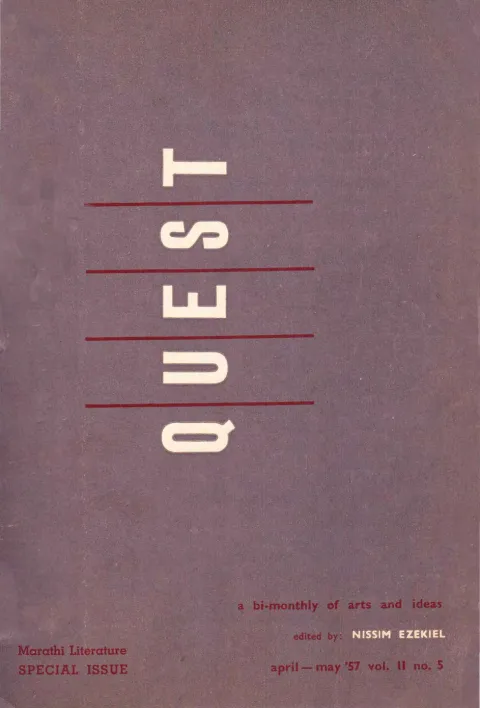
Quest
Summary
This Marathi Literature Special Issue of Quest (Vol. II No. 5, April-May 1957) assembles a wide cross-section of contemporary Marathi writing in English translation: a guest editorial by D. G. Nadkarni surveying the postwar ‘new writing’ movement in Marathi poetry, fiction and criticism; a chapter from Vyankatesh Madgulkar’s novel Bangarwadi; fourteen poems by leading Marathi poets of the day (Anil, Kusumagraj, P. S. Rege, B. S. Mardhekar, Indira, N. G. Deshpande, Sanjeevani, Sharatchandra Muktibodh, Padma, Sadanand Rege, Vasant Bapat, Vinda Karandikar, B. B. Borkar and Mangesh Padgaonkar); four survey essays on Marathi poetry, the short story, folklore and journalism; three short stories; a travel-sketch of rural Berar; a light essay; a pen-portrait of the veteran playwright Mama Warerkar; and three essays of literary criticism, including B. S. Mardhekar’s own extract on aesthetic ‘identification’ and D. K. Bedekar’s ‘declaration of faith’ on the writer’s freedom.
Essays
A time for transition
By D. G. Nadkarni
D. G. Nadkarni’s guest editorial argues that modern (‘new’) Marathi writing is closing out one cycle of renewal and awaiting the next. He traces the movement’s origin not to any manifesto but to a shared postwar realisation, chiefly among poets and short-story writers, of the ‘inexcusable immaturity’ of interwar Marathi literature. He credits Mardhekar and Rege with reshaping metre and diction, Gadgil with widening the short story’s range of experience, and Madgulkar with bringing rural vigour and sincerity to fiction, while noting that drama and the light essay lagged and that serious, un-dogmatic criticism only flourished after Mardhekar’s recent death freed it from his controversial authority. He closes on a note of anxious diagnosis: Diwali ‘bumper issues’ are diluting the achievement of the pioneers, only Gadgil and Madgulkar keep experimenting, and criticism has not yet examined the resulting ‘literary erosion’ — so that this special issue itself, he says, documents ‘a period that is actually closing.’
- New Marathi writing arose from a shared postwar sensibility, not a manifesto, unlike comparable movements in the West.
- Mardhekar and Rege are credited with making metre ‘consistent with content’; Gadgil and Madgulkar are credited with renewing the short story.
- Drama and the light essay lagged behind poetry and the short story in this renewal.
- Serious, non-dogmatic criticism grew only after Mardhekar’s recent death freed it from his contested authority.
- Diwali ‘bumper issues’ are blamed for diluting the pioneers’ achievement through overproduction.
- Poets such as Muktibodh and Sareeta Padki are said to be moving successfully into the novel and drama.
- The editorial explicitly frames this special issue as documenting a literary period that is ‘actually closing.‘
Under the yoke
By Vyankatesh Madgulkar
This chapter from Vyankatesh Madgulkar’s novel Bangarwadi is narrated by a village schoolmaster who has become, by default, the settlement’s scribe, adviser, judge and general fixer — illustrating a rural governance improvised around panchayats and, in rare disputes, a shepherd deity’s oracle. The chapter’s centre is Sheku, a poor farmer who cannot borrow a bullock anywhere in the village at sowing time. When he returns from a fruitless search, his formidable wife declares she will provide the missing draught animal herself: at dawn she yokes herself bodily alongside their one remaining bullock and, straining beside the animal for a full day, helps complete the sowing of their two-acre plot. The village reacts with a mixture of admiration, astonishment and mockery, and the chapter ends with a quiet, unsentimental image of Sheku that night kneading his exhausted wife’s aching back.
- The schoolmaster’s role has expanded far beyond teaching to include scribe, adviser, judge and de facto revenue official for the village.
- Disputes are normally settled by a ten-person panchayat, with appeal in rare cases to a shepherd deity’s oracle, invoked only via an expensive communal feast.
- Sheku cannot borrow a bullock from any other farmer, all of whom need theirs for their own sowing.
- His wife resolves the impasse by yoking herself to the plough alongside their single bullock.
- The couple completes a full day’s sowing of two acres through this arrangement.
- The village’s mixed reaction (admiration, astonishment, ‘scornful amusement’) and the closing image of mutual physical exhaustion avoid sentimentalising the episode.
The Trail
By Anil
A short lyric built entirely on the repeated refrain ‘I love the winding trail,’ each stanza adding a fresh cluster of natural and topographical images — cobra coils, sticky mud, teak and bamboo groves, mountain tops — to characterise a path whose appeal lies precisely in its unpredictability.
- Structured as five near-identical quatrains around one refrain.
- Draws its imagery entirely from a forest/riverside landscape.
- Translated by the poet himself.
Footprints
By Kusumagraj
A brief, skeptical address to the stars, asking whether they — as ‘travellers of the eternal universe’ — have ever actually seen the feet of the God the speaker keeps telling himself does not exist.
- Four-line poem framed as a direct question to the stars.
- Balances a stated disbelief in God against an open, unresolved question.
They Asked Me
By P. S. Rege
In three parallel stanzas the speaker reports being asked whether his experience was ‘significant,’ ‘real,’ and morally useful; each time he answers ‘I did not know,’ offering instead only concrete sensory or erotic particulars — lived and died moments, two eyes, hushed wind, a hidden mole — in place of any abstract justification.
- Built on a repeated question-and-answer structure (‘They asked me… I said, I did not know’).
- Refuses abstract justification of experience in favour of sensory particulars.
- Translated by the poet himself.
A Poem
By B. S. Mardhekar
A short meditative poem on memory, doubt and a possibly absent ‘he’ (a Traveller/God figure), built on images of an unravelling lake, a rudderless bark sailing ‘without finding a shore,’ and fish staring at ‘endless riddles reflected’ — ending with the stars themselves urging the speaker to question whether the Traveller exists.
- Uses aquatic and voyage imagery (lake, bark, sea) to figure existential doubt.
- The stars appear as a chorus urging further questioning, echoing the theme of ‘Footprints.’
- Translated by Arun Kolatkar.
‘Listen to Me’
By Indira
A dramatic monologue in which half-personified things in a stormy house — the door, an easy chair, falling rain — each murmur ‘Listen to me,’ reconstructing a night of longing, a lightning-lit near-encounter and an unbearable, remembered tension, while the speaker struggles to shut the voices out.
- Built as a chorus of personified household objects each repeating ‘Listen to me.’
- Storm and lightning imagery frames a remembered romantic tension.
- Translated by Arun Kolatkar.
Perhaps
By N. G. Deshpande
The speaker catalogues all the beautiful things a wandering, indifferent beloved will notice — blooming champak flowers, a rainbow, a cuckoo’s call — while never remembering him, until perhaps only a sighing breeze, at the very end, carries his memory to her.
- Structured as a repeated refrain (‘But she will not remember…’) across six stanzas of natural imagery.
- Ends on a single small hope (the sighing breeze) after five stanzas of certain forgetting.
- Translated by D. G. Nadkarni.
The Knot
By Sanjeevani
A compressed, incantatory poem invoking night, worry, a ‘dark bank’ and a lover’s ‘honied voice,’ asking that the speaker’s fading memories be permanently ‘knotted’ with the beloved’s mark.
- Four-line-stanza poem built on a series of ritualistic ‘should be’ invocations.
- Ends on an image of memory being physically knotted to the beloved.
- Translated by D. G. Nadkarni.
Now and Then
By Sharatchandra Muktibodh
The speaker, driven by a ‘hungry, feverish speed’ of youth he cannot explain or calm, asks an addressee living a smooth, untroubled life to remember him only occasionally, admitting his love is inadequate to quiet his own restlessness.
- Self-diagnosing restlessness and ‘speed’ as an affliction of youth.
- Contrasts the addressee’s calm, line-free face with the speaker’s inner turmoil.
- Translated by D. G. Nadkarni.
Ship
By Sadanand Rege
On a seashore, the speaker carves ‘marble birds’ of loneliness and dream from bronze-brown longing, addressing an unfaithful beloved described as a ‘witch’ sailing an insolent ‘ship of quicksilver’ that every element of the landscape — clouds, rocks, the sky itself — seems to confirm will finally ‘set… in the sun.’
- Extended sea/ship imagery structures the whole poem.
- The beloved is figured as a witch commanding a ‘ship of quicksilver.’
- Translated by Arun Kolatkar.
The Path
By Padma
A brief poem of longing in which mascara-dark horizon light, silent entwined trees, and a parched, wriggling path glimpsed through tear-stained eyes stand in for an unnamed, unresolved yearning for home.
- Very short (four quatrains); horizon and path imagery dominate.
- Explicitly denies the speaker any ‘longing for home’ while describing exactly that.
- Translated by D. G. Nadkarni.
Then Go At Once
By Vasant Bapat
The speaker urges a departing lover to leave at once and, on returning, to forget every marker of urban modernity — watches, careful creases, hurried speech — and instead come back slowly, like a natural force such as a sea-wave or the polar night.
- Built as a catalogue of things to ‘forget,’ contrasting urban haste with natural slowness.
- Ends by asking the lover to return ‘tremulous, eager… with gentle pace.’
- Translated by R. P. Sirkar.
To You It Was A Native Art
By Vinda Karandikar
An accusatory love poem addressing a partner whose native gift is swaying and discarding hearts effortlessly; the speaker catalogues this cruel ‘art’ point by point before ending on his own resulting emptiness.
- Structured as a list of the addressee’s manipulative social/emotional skills, framed ironically as ‘native art.’
- Ends by inverting the praise into a statement of personal loss.
- Translated by R. P. Sirkar.
Towards the Horizon
By B. B. Borkar
A landscape poem describing a wet, quivering plain and a lone, umbrella-shaped tree, which the speaker suddenly sees bearing a crucified Christ while his mother grazes sheep nearby — an image that turns the poem’s opening pastoral description into a meditation on compassion through suffering.
- Opens as pure landscape description before introducing a startling Christian image.
- Ends on the phrase ‘the wide horizon of compassion.’
- Translated by D. G. Nadkarni.
Sinking Deep in Your Eyes Profound
By Mangesh Padgaonkar
A meditation on a moment of self-discovery found in a beloved’s gaze: the speaker’s sense of self is renewed, then lost again ‘like a deep winter’s mystic dawn’ sinking the sea in mist, in an experience deeper than the mind can otherwise sound.
- Repeats its opening image (‘Sinking deep in your eyes profound’) as a closing refrain, framing the whole poem.
- Compares the experience of self-discovery to a winter dawn’s mist swallowing the sea.
- Translated by R. P. Sirkar.
Some thoughts on present-day Marathi poetry
By Kusumavati Deshpande
Kusumavati Deshpande’s impressionistic survey of contemporary Marathi poetry resists systematic classification, instead ‘pecking at the poems at random’ to show how genuinely individual voices — above all Indira Sant’s — can renew ‘the same old words’ without gimmickry. She praises Padgaonkar’s affirmative ‘hymn to Earthliness’ against ascetic world-denial, finds in Karandikar an intellectual, sometimes ‘haranguing’ vigour tempered by faith in humanity, and traces a shared intellectual and socially conscious lineage running from Anil and Mardhekar through Muktibodh. She closes by noting a distinct, less urbanised ‘Vidarbha’ school of younger poets (Shevalkar, M. M. Deshpande, Kaje, Keche, Baba Mohod) whose imagery of black soil, dust and river-banks marks them off from their more cosmopolitan contemporaries.
- Argues good poetry is different ‘because it is true to individual feeling,’ not different for its own sake.
- Uses Indira Sant’s poetry at length to demonstrate this individuality of voice.
- Reads Padgaonkar’s nature poetry as a deliberate affirmation of ‘Earthliness’ against ascetic Vedantic world-denial.
- Finds Karandikar’s intellectual, sometimes ‘haranguing’ poems tempered by an underlying faith in humanity.
- Traces a lineage from Anil, Mardhekar, Borkar and Kusumagraj down to Muktibodh and the younger generation.
- Identifies a separate, less-urbanised ‘Vidarbha’ school of poets with a distinct regional sensibility.
Evolution of the new short story in Marathi
By W. L. Kulkarni
W. L. Kulkarni traces the ‘revolutionary development’ of the Marathi short story from around 1942, when wartime and postwar upheaval broke down the older short story’s dependence on ‘a craftily constructed plot and a denouement.’ He credits a ‘quartet’ — Gangadhar Gadgil, Vyankatesh Madgulkar, Arwind Gokhale and P. B. Bhave — with driving this change, profiling each in turn: Gadgil’s protean, psychologically dense and symbol-rich stories; Madgulkar’s unsentimental, soil-rooted Mandesh sketches; Gokhale’s empathetic but technique-reliant narratives; and Bhave’s unrestrained, risk-taking intensity. He notes an older generation (Phadke, Khandekar, Sardesai, Y. G. Joshi) still writing in the traditional mode alongside the quartet, and a newer generation publishing chiefly in the magazine Satyakatha, who have benefited from the purified, more discriminating readership the pioneers created even as some remain awkwardly self-conscious about writing something ‘new.’
- Dates the short story’s transformation to around 1942, driven by wartime and postwar social change.
- Names Gadgil, Madgulkar, Gokhale and Bhave as the ‘quartet’ responsible for the revolutionary development.
- Describes Gadgil’s stories as changing form and language with ‘the fleeting colours of water’ depending on the experience conveyed.
- Credits Madgulkar with rural sketches of the Mandesh region free of his predecessors’ sentimentality.
- Criticises Gokhale for over-relying on narrative technique rather than fusing theme and expression.
- Notes Bhave’s stories are powerful but sometimes sacrifice ‘artistic restraint’ to unchecked emotional force.
- Identifies Satyakatha as the main outlet nurturing a newer generation of writers (Mirasdar, Shankar Patil, Ranjit Desai).
Love in Marathi folk-lore
By Durga Bhagwat
Durga Bhagwat investigates a puzzle: despite India’s rich general tradition of love-poetry and love-tales, Marathi folk-lore is unusually poor in the love theme, its Holi songs swinging between solemn ritual and pure obscenity with ‘no intermediate stage of pure love-songs.’ Surveying grindmill (Ovi) songs, harvest and spring festivities, Sohar songs, Lavani, and the songs of aboriginal and Koli communities, she finds love submerged beneath either family sentiment or coarse licence almost everywhere, with rare exceptions among the Son-Kolis’ ‘Chakva’ duets and a few Agri marriage-songs. She proposes that the devotional ‘saint movement,’ beginning with Jnaneshvara in the thirteenth century, redirected erotic feeling into idealised or divine romance, converting what may once have been secular love-tales into myths of Krishna-Radha or Vithoba-Rukmini. The essay closes with two extended myths she collected in the field — the tragic transformation of the girl Tulsi into a plant after her jealous rival’s trick, and the permanent, ritually sanctified separation of the shepherd-god Vithoba from Queen Padubai — arguing that ‘the peculiar adoration of permanent loneliness’ is a distinctively Maharashtrian folk ideal.
- Marathi folk-lore is markedly poorer in genuine love-songs than the folklore of other Indian provinces.
- Maharashtrian Holi songs oscillate between solemn ritual and outright obscenity with no intermediate love-song register.
- Grindmill (Ovi) songs are dominated by family affection (mother-son, sister-brother) rather than conjugal love.
- Bhagwat credits the ‘saint movement’ from Jnaneshvara onward with sublimating erotic feeling into devotional or divine romance.
- The Son-Koli ‘Chakva’ duets and a handful of Agri marriage-songs are identified as rare genuine exceptions.
- Two extended myths — Tulsi’s transformation into a plant, and Vithoba’s eternal separation from Padubai/Rukmini — exemplify a distinctly Maharashtrian ideal of sanctified permanent loneliness rather than union.
Marathi journalism
By Prabhakar Padhye
Prabhakar Padhye argues that the post-independence commercialisation of the Marathi press — as financially motivated buyers acquired papers sold by departing British owners — raised circulation and efficiency but was ‘a curse rather than a blessing’ for Marathi literature. He traces a distinguished nineteenth-century lineage of editor-writers (Bal Gangadharshastri Jambhekar, Lokahitawadi, Vishnushastri Pandit, Vishnushastri Chiplunkar and his Nibandhamala, followed by Agarkar, Tilak, Kelkar and Khadilkar) whose weekly and monthly journalism doubled as literary and political leadership, and a twentieth-century line of literary monthlies (Ratnakar, Yeshwant, Pragati, Pratibha, Sameekshak, Abhiruchi) that discovered major writers such as N. S. Phadke, Anant Kanekar and Khandekar. He contrasts this with the present: only Satyakatha still cultivates genuinely new writers, the daily press cannot sustain independent literary columnists, and well-paying commercial monthlies produce merely ‘saleable,’ not good, writing — distinguished from ‘cheap pornographic journals only by the fact that they strove to be decent.’
- Post-independence, financially motivated buyers acquired departing British-owned papers for commercial and political power rather than journalistic mission.
- Mass-circulation techniques (crossword competitions, magazine supplements) are blamed for undermining the weekly and monthly literary press.
- A historic line of editor-writers (Jambhekar, Lokahitawadi, Chiplunkar, Tilak, Agarkar) fused journalism with literary and political leadership.
- Literary monthlies such as Ratnakar and Pratibha are credited with launching major Marathi writers.
- Satyakatha is named as the only current journal still discovering genuinely new writers.
- The daily press’s format and pace are said to prevent it from sustaining independent literary criticism.
The house of cards
By P. B. Bhave
On the day he is due to leave town, the narrator indulges his small nephew Betu’s request to build a five-storey house of playing cards, even as it collapses again and again to the children’s delighted uproar and his own fraying temper. Amid the day’s small, undischarged obligations to Betu — a promised shoulder-ride, a coveted cigarette case, a house of cards left unfinished — the narrator departs guiltily. On the train he is charmed by a stranger’s toddler, Tagya, and hears the boy’s father tell of a friend whose baby died from one moment’s parental inattention; the anecdote fuses with his own guilt about Betu until, at a stop, he impulsively boards what he takes for the wrong train back before catching himself. He returns home to Betu still holding the pack of cards, resolved at last to finish the house.
- A single afternoon’s frustration with a literal house of cards becomes a meditation on the fragility of small promises made to children.
- The narrator’s genuine impatience and rough handling of Betu are shown without sentimentalising him.
- A digressive train encounter with a stranger’s child, Tagya, mirrors and intensifies the narrator’s guilt about leaving Betu.
- An inset anecdote about a father’s momentary inattention causing his baby’s death raises the story’s emotional stakes around small carelessnesses.
- The story ends on return and repair, with the narrator coming back specifically ‘to build a house for Betu.‘
The squirrel
By Shantaram
Unwell in some undefinable way, a man takes an evening walk and encounters a squirrel who speaks to him, teasingly needling him about having abandoned poetry for a ‘bread and butter job.’ Their flirtatious, philosophical exchange ranges over time, change, and whether art necessarily transforms its subject beyond recognition — until the squirrel demands he write a poem about her and vanishes. He runs home and manages one line before his wife, unaware of the squirrel entirely, also asks him to write a poem ‘on her’; faced with both demands he can satisfy neither, and the story ends on his unresolved, unnamed inner pain.
- The talking squirrel functions as a muse-figure taunting the narrator’s abandoned poetic vocation.
- Their dialogue turns on whether art ‘transforms’ its subject so completely that the subject becomes unrecognisable.
- The narrator’s creative paralysis is doubled: he can finish a poem for neither the squirrel nor his wife.
- The story closes on ‘a pain that has to be borne but cannot be revealed,’ left explicitly unresolved.
‘Do write a story on me!’
By D. B. Mokashi
A self-important teenage ‘author’ writes a sentimental story at his young neighbour Ragini’s tearful request, only for her to reject it indignantly once her mother turns out to be loving rather than the ‘wicked’ figure he had invented. Years later, now grown and in a forbidden cross-caste romance, Ragini again begs him to fictionalise her suffering, this time to indict her disapproving parents and society; the thinly veiled story he publishes causes a local scandal, and her furious father accuses the narrator of doing ‘irreparable damage’ before sending Ragini away. In a final ironic movement, years afterward, Ragini — now married with a child — visits and repeatedly asks ‘Nana, can you write a story like this?’, a question the narrator eventually realises was never addressed to him at all, but only, absent-mindedly, to her baby.
- The narrator is twice enlisted by Ragini, at different ages, to turn her real suffering into published fiction, with unintended consequences both times.
- Ragini’s father’s rebuke functions as a critique of fiction’s power to expose and wound real people under a thin disguise.
- The narrator’s own vanity — he is more pleased by Ragini’s praise than concerned for her welfare — undercuts any claim to pure sympathy.
- The closing scene deflates the story’s premise entirely: Ragini’s repeated question was never really meant for the narrator.
Off the road in Berar
By R. B. Joshi
R. B. Joshi’s travel-sketch follows a March journey off the Akola-Akot highway into rural Berar, dwelling on the region’s parched, personified ‘resting’ earth and its leafless neem and babul trees. In a near-empty village school — attendance collapsed once the free shirts and caps handed out to attract pupils wore out — and at an untended, cattle-fouled temple, Joshi records a district still largely untouched by a century and a half of vaccination against smallpox despite regular visits by a vaccinator. At the larger destination village, his host apologises for the plain food (the soil is too saline for vegetables) and describes villagers keeping night watch over hand-dug seepage pits against water theft, ‘for water is not “identifiable property”.’ Joshi closes wondering whether Berar’s visible dullness is a seasonal ebb, like the fallow land itself, or something more permanent, openly doubting the local saying that the region’s soil always ‘reaps gold.’
- The essay personifies the parched Berar landscape as an exhausted earth ‘resting between whiles.’
- Village school attendance is explained by economics — free clothing withdrawn, children needed for farm and grazing labour — rather than by simple indifference to education.
- A once-endowed temple stands neglected because its ‘Inam’ income can no longer support its upkeep or priestly service.
- Persistent smallpox despite a century and a half of Jenner’s vaccine and regular vaccinator visits stands as an emblem of uneven modernisation.
- Villagers keep armed night watch over scarce hand-dug water pits, since stolen water offers no legal recourse.
- Joshi ends by explicitly questioning, rather than affirming, the popular saying that Berar’s soil always ‘reaps gold.‘
The bigger cypher!
By Anant Kanekar
Anant Kanekar’s light essay builds a mock-mathematical argument for the futility of ‘progress’ from two anecdotes: a small Bombay iron trader who grew rich in the wartime boom, worked himself to death from tuberculosis, and left his family only the modest house he already owned before his ‘success’; and an Australian record-breaking aviator whom a meditating Tibetan Lama answers with a single repeated ‘Well?’ after each boast, until she dies chasing a still-higher altitude record. Kanekar extends the logic playfully: a stone feels neither pleasure nor pain, primitive man feels less of both, civilised man feels more of both — so that scaling up a life’s income, expenditure, pleasure and pain together changes nothing about its net balance, which remains, in his schoolboy arithmetic conceit, ‘a bigger cypher.’
- Uses two illustrative anecdotes — a businessman ruined by success, a record-chasing aviator — to frame its argument.
- Proposes that scaling up both a life’s pleasures and pains (like both sides of an arithmetic equation) leaves the net balance unchanged.
- Resolves a childhood confusion between ‘five minus five’ and ‘five thousand minus five thousand,’ both zero, into the essay’s title conceit.
- Keeps a wry, anecdotal, conversational tone appropriate to the ‘light essay’ genre label on the contents page.
Tribute to Mama Warerkar
By M. V. Rajadhyaksha
M. V. Rajadhyaksha’s tribute reckons the 70-year-old playwright and novelist Mama Warerkar’s 141 books — 45 plays, 29 novels, 30 translations of Sharatchandra Chatterji, five story collections, memoirs and more — against critics who dismiss him as prolific but shallow. He defends Warerkar’s social conscience, citing his dramatisation of mill-labour unrest in Sonyacha Kalas against the backdrop of the real Meerut Conspiracy, his unusually unidealised women characters, and his sympathetic, non-caricatured treatment of other provinces and of Muslims in works like Sanyashacha Sansar and Apoorva Bengal. Above all he praises Warerkar’s deliberate use of plain, ‘living’ spoken Marathi against the Sanskritised, elite literary register descended from Vishnushastri Chiplunkar, contrasting him favourably with contemporaries such as Khadilkar, Kolhatkar, Atre and Rangnekar. An editorial postscript, dated four years after the essay was first written, notes that Warerkar remains active, has since joined the Sahitya Akademi, and been nominated to the Rajya Sabha.
- Defends Warerkar’s sheer productivity (141 books over 45 years) against critics who treat quantity as proof of shallowness.
- Credits his plays with giving dramatic weight to real social conflicts, including mill-labour unrest and the Meerut Conspiracy, that mainstream theatre otherwise ignored.
- Praises his women characters as unusually unsentimental and unidealised for the period.
- Frames his plain, spoken ‘living Marathi’ as a deliberate rebuke to the Sanskritised elite literary register traced back to Vishnushastri Chiplunkar.
- Singles out his sympathetic, non-stereotyped treatment of other provinces and of Muslims as his ‘most notable progressive feature.’
- An editorial postscript records that Warerkar has since become a Sahitya Akademi member and a Rajya Sabha nominee.
Modern Marathi criticism
By Gangadhar Gadgil
Gangadhar Gadgil surveys the competing schools of Marathi literary criticism: the classical Sanskrit Rasa theory and its unresolved problems (the pleasure taken in tragedy, the disputed number of Rasas, even a mock-serious proposed ‘Prakshobha Rasa’ for revolutionary feeling); the long ‘social/moral’ tradition running from the saint-poets through Gandhian and Marxist critics; humanitarian critics such as M. V. Rajadhyaksha and Kusumavati Deshpande; and the ‘aesthetes’ who hold art to be its own end. He gives sustained, even-handed attention to D. K. Bedekar’s systematic Marxist theory of literature — which reads new Marathi writing’s obscurity and ‘isolationist individualism’ as a symptom of its writers’ middle-class consciousness — and to the rebuttals it has drawn. The essay’s centre of gravity is a long, admiring exposition of B. S. Mardhekar’s rigorous aesthetic theory (the distinction between artistic medium and material, between ‘forms of literature’ and ‘forms in literature,’ and the existence of a ‘specific aesthetic emotion’), which Gadgil calls the most complete theory Marathi criticism has produced. He closes arguing that Marathi criticism’s heavy borrowing from Western thought is not a weakness but an ‘inevitable stage’ of intellectual growth requiring more, not less, of such ‘wholesome borrowing.’
- The ancient Rasa theory remains foundational to Marathi theoretical criticism but faces unresolved problems, including the number of Rasas and the pleasure taken in tragedy.
- D. K. Bedekar’s Marxist criticism reads new Marathi writing’s obscurity and individualism as a product of its writers’ middle-class origins.
- Bedekar’s critics counter that Marxist historical prediction has not been borne out and that his form/content distinction is oversimplified.
- The ‘aesthete’ school (Phadke, Jog, Kulkarni, and above all Mardhekar) holds that art creates beauty or pattern as an end in itself.
- Mardhekar’s aesthetic theory — distinguishing medium from material and positing a ‘specific aesthetic emotion’ — is presented as the most rigorous achievement in Marathi criticism.
- Gadgil frames Marathi criticism’s extensive borrowing from Western thought as a healthy, necessary stage of intellectual growth rather than a defect.
Identification
By B. S. Mardhekar
Presented as the continuation of a longer serialised aesthetic essay (‘In the second part of this essay, I have developed the view…’), B. S. Mardhekar argues that sincerity to one’s original experience is necessary but not sufficient for good literature: the writer must also ‘identify’ with the object of that experience, an active, dynamic mental state distinct from ordinary contemplation, with cognitive (sensuous and intellectual) and emotional dimensions. He carefully distinguishes the writer’s own identification from the reader’s, and argues that a writer’s power lies not in registering sensation with a painter’s precision but in the range of thought a single sensation can provoke — ‘one thought in many sensations and many thoughts in one sensation.’ The essay builds toward Mardhekar’s larger, promised concept of ‘large-souledness’ in literature, and closes with the legend of the poet Valmiki’s grief spontaneously becoming verse, and a metaphor comparing creative inspiration to a rock split open, by a sudden thunderbolt or by slow dripping water, to release ‘the sacred stream of words.’
- Argues that sincerity alone is not enough for literature; ‘identification’ with the object of one’s original experience is a second, necessary condition.
- Defines identification as dynamic and active, with distinct sensuous, intellectual and emotional components.
- Explicitly separates the writer’s identification (in creating) from the reader’s (in appreciating), criticising critics who conflate the two.
- Holds that a writer’s power lies in the range of thought a sensation provokes, not in registering the sensation itself as precisely as a painter might.
- The discussion is explicitly building toward a larger concept, ‘large-souledness in literature,’ promised for further treatment.
- Closes with the legend of Valmiki’s grief becoming spontaneous verse, and a rock/thunderbolt metaphor for creative inspiration.
Freedom and the writer
By D. K. Bedekar
D. K. Bedekar sets out ‘a declaration of faith’: the writer, like every human being, must be free both as a rational individual (freedom from arbitrary restraint) and as a person with a developed, concrete personality (freedom of expressive power). He grounds the first in rationality itself, noting by contrast that bees form ‘a wonderful collective existence’ but, lacking rationality, cannot be said to desire freedom at all; he grounds the second in the psychological process by which personality is formed through social maturation, arguing that artistic creativity is therefore inherently a ‘social communication,’ never purely private. He acknowledges this second, positive freedom is necessarily bounded by the artist’s own cultural heritage — an Indian artist who tried to express himself only ‘in the Chinese or the European ways’ would be untrue to his own personality — and concludes that the two freedoms are not opposed but aspects of one indivisible Freedom, though political circumstance (combating totalitarianism, or countering ‘a false a-social adoration of the individual’) may require emphasising one aspect over the other.
- Distinguishes freedom-from-restraint (as a rational individual) from freedom-of-expression (as a developed ‘person’).
- Uses the bee-hive as a foil: a smoothly functioning collective, but with no freedom, because bees are not rational beings.
- Frames personality and artistic power as products of social maturation, making artistic self-expression inherently a social communication.
- Argues an artist’s cultural heritage both empowers and limits creative freedom of expression.
- Concludes the two kinds of freedom are ultimately ‘one Freedom,’ though which aspect to emphasise depends on the political situation.
Essay 30
An unsigned editorial (immediately preceding, and running into, Nadkarni’s Guest Editorial) reflects on the paradox that Indians know Western literature better than the literatures of their own other regions, available only through uneven English translation. It surveys two existing cross-translation efforts — the Sahitya Akademi’s Hindi-translated multilingual poetry anthology, and the informal ‘Aantar Bharati’ movement — and argues, provocatively, that only translation into English, not Hindi, can give Indian literature a rigorous critical standard ‘difficult to corrupt,’ comparing the ambition to Arthur Waley’s and Ezra Pound’s translation work (with the caveat that they translated into their own mother tongue). It explicitly frames this special issue’s selection of Marathi literature in English translation as a modest, practical instance of that larger project.
- States the founding paradox of the special issue: Indians are typically unacquainted with each other’s regional literatures.
- Names two existing efforts at cross-lingual literary exchange in India: the Sahitya Akademi’s anthology and the ‘Aantar Bharati’ movement.
- Argues, controversially, that only English translation (not Hindi) can supply Indian literature with a rigorous, ‘uncorrupted’ critical standard.
- Explicitly frames this issue’s Marathi selection as a practical experiment in that translation project.
Essay 31
A full-page photograph, captioned ‘When Two Authors Meet,’ shows Jawaharlal Nehru clasping hands backstage with the veteran Marathi playwright Mama Warerkar at the performance of a Sanskrit play in Delhi. The caption explicitly cross-references the issue’s own tribute to Warerkar (toc_index 26), using the photograph to underline his national stature.
- An uncredited photographic plate with no contents-page entry of its own.
- Pictures Jawaharlal Nehru and Mama Warerkar together backstage at a Sanskrit-play performance.
- Its caption directly cross-references Rajadhyaksha’s pen-portrait of Warerkar printed later in the same issue.
Essay 32
A recurring, unsigned ‘Some of our contributors’ feature runs in at least three separate instalments through the issue — a photo-portrait spread after the poems (unnumbered), a page of plain-text notices on printed p.24, and a further four-page photo-portrait block later in the issue (unnumbered) — together giving brief biographical notices, some illustrated with studio portraits credited to the photographer Somnath Samel, for nearly every poet, story-writer, essayist, critic and translator represented in the issue. A few notices add topical news, such as Gangadhar Gadgil’s Rockefeller Foundation travelling fellowship and Anant Kanekar’s election to the presidency of the Marathi Sahitya Sammelan.
- Functions as the issue’s ‘Contributors’ page, but is split across at least three separate points in the layout rather than gathered in one place.
- Combines one-line descriptions of literary reputation with occasional topical news about individual contributors.
- Portrait photographs across the instalments are credited to a single photographer, Somnath Samel.
- Serves as the primary printed biographical source used for this catalogue’s separate contributor-notes deliverable.
Essay 33
Two full-page documentary photographs are run as an uncaptioned-to-contents photo-essay between the poetry survey and the short-story survey: ‘A schooling in the kitchen’ (credited ‘Photo: R. A. Bacha’), showing a mother cooking while two children look on, one asleep on a mat; and ‘“Little Learned”’ (credited ‘Photograph on Agfa film’), showing a boy reading before an ornately carved stone screen. Read together they form a loose diptych contrasting informal domestic ‘kitchen’ learning with a solitary act of study.
- Two unrelated-seeming photographs are paired to suggest a thematic contrast between informal domestic learning and solitary literacy.
- Neither image is linked by any printed byline to a contents-page entry.
- The second image’s credit line (‘Photograph on Agfa film’) reads partly like camera-stock publicity, though no separate Agfa advertisement copy appears on the page itself.
Generated by the v1.5 extraction pipeline. Awaiting editorial review.
Metadata and summary are AI-extracted from the source PDF and reviewed for editorial accuracy. The original work is available via the Read PDF tab above (where present); paragraph-level citation inside the PDF is deferred to a future engagement.
People in this work
- D. G. Nadkarniauthor
- Vyankatesh Madgulkarauthor
- P. S. Regeauthor
- B. S. Mardhekarauthor
- N. G. Deshpandeauthor
- Sharatchandra Muktibodhauthor
- Sadanand Regeauthor
- Vasant Bapatauthor
- Vinda Karandikarauthor
- B. B. Borkarauthor
- Mangesh Padgaonkarauthor
- Kusumavati Deshpandeauthor
- W. L. Kulkarniauthor
- Durga Bhagwatauthor
- Prabhakar Padhyeauthor
- P. B. Bhaveauthor
- D. B. Mokashiauthor
- R. B. Joshiauthor
- Anant Kanekarauthor
- M. V. Rajadhyakshaauthor
- Gangadhar Gadgilauthor
- D. K. Bedekarauthor
- Nissim Ezekiel
- Nirad C. Chaudhuri
- Sudhin Datta
- Laeeq Futehally
- Sheela Singh
- S. D. Deshmukh
- Arun Kolatkar
- R. P. Sirkar
- Mangesh Padki
- Ravindra Pinge
- M. P. Rege
- Bal Gangadhar Tilak
- Jyotirao Phule
- Karl Marx
- Mahatma Gandhi
- Jawaharlal Nehru