
periodical issue
Quest
A Quarterly of Inquiry, Criticism and Ideas
By C. Rajagopalachari, Leon Emery, Sibnarayan Ray, Michael Polanyi, Tulsi Narayan Singh, Neville Braybrooke, Prof. Amlan Datta, Jeremy Nelson, Purnendubikash Bhattacharya, K. Raghavendra Rao, A. M. Ghose, Indrani Rahman, Jagannath Banerjee, Joseph Roggendorf, Satindranath Chakravarti, Abu Sayeed Ayyub, Eugene Kamenka, A. H. Somjee, Dietmur Rothermund
Printed and published by Miss Sheela Singh for the Indian Committee for Cultural Freedom, Army and Navy Building, 148, Mahatma Gandhi Road, Bombay 1, at the Kanada Press, Podar Chambers, 109, Parsi Bazar Street, Fort, Bombay 1. · Bombay · 1958
112 pages
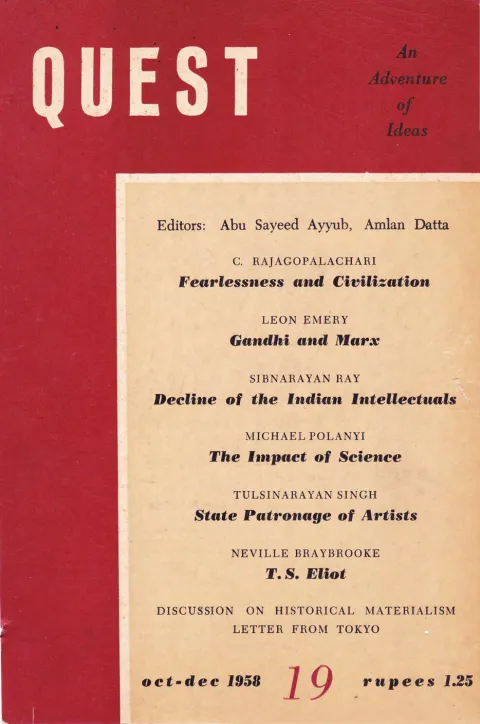
QUEST
Summary
Quest No. 19 (Oct-Dec 1958) is the first issue examined here under the magazine’s post-transition masthead: quarterly cadence, dual editorship of Abu Sayeed Ayyub and Amlan Datta, and an Advisory Board of Nirad C. Chaudhuri, Sudhin Datta and Laxmanshastri Joshi, still sponsored by the Indian Committee for Cultural Freedom. The issue opens with C. Rajagopalachari’s plea for unilateral disarmament and closes with a long correspondence section, and in between runs a heavily Cold-War-inflected argument about how India should relate to Gandhism, Marxism and the West: Leon Emery reads Gandhian village socialism against Nehru’s compromises with both Marx and Gandhi; Sibnarayan Ray diagnoses a decline of independent Indian intellectuals from Ram Mohan Roy’s renaissance through Gandhi’s ‘cult of the masses’; and a two-round philosophical slugging match between Satindranath Chakravarti and Ayyub over historical materialism, and between Eugene Kamenka and A. H. Somjee over Karl Wittfogel’s Oriental Despotism, carries the anti-Marxist argument furthest. Around this spine sit essays on the state’s proper relation to art and literature, a birthday tribute to T. S. Eliot, five poems, two Arts pieces (on Orissi dance and on the khyal singer Fyaz Khan, illustrated by two uncredited-in-the-contents photographic plates of Orissi dance), a report on the near-total secularization of religion in postwar Japan, five book reviews, and correspondence continuing both the English-versus-Hindi language debate and the historical-materialism dispute. A one-page ‘Contributors’ section identifies most of the bylined writers.
Essays
Unilateral Action: An Appeal to India and Pakistan
By C. Rajagopalachari
Rajagopalachari asks what it means for a people, or the world, to be ‘civilized,’ and answers that civilization is the condition of being free from fear of one’s neighbours — a fearlessness that makes weapons and safeguards unnecessary. He extends this to international affairs: nations are still mutually savage, and only a people willing to renounce the demand for guarantees and live without thought of security can lead the world toward true civilization. He closes by urging India and Pakistan specifically to seize their quarrel as an opportunity to demonstrate this fearlessness through unilateral disarmament, rather than treat it as mere misfortune.
- Defines civilization as a state of mutual fearlessness rather than material comfort or technological advance.
- Argues that carrying weapons for self-defence is itself proof a community is not yet civilized.
- Applies the argument for unilateral disarmament to relations between nations, not just individuals.
- Quotes and translates a passage from the Isha Upanishad on non-covetousness and steady work as the model of civilized living.
- Proposes India and Pakistan’s dispute as a historic opportunity to lead the world by example.
Gandhi and Marx
By Leon Emery
Reviewing a French study titled Gandhi and Marx, Leon Emery surveys Gandhi’s village-based, religiously grounded socialism — carried on after his death by Vinoba Bhave’s land-gift movement — and argues it belongs to the tradition of European utopian socialism (Fourier, Proudhon, Kropotkin), but with a spiritual foundation that gives it unusual staying power. He then stages the Marxist objection: that Gandhian villages survive only under state protection and could never scale to running a modern nation of four hundred million people. Nehru, he argues, stands uneasily between Gandhi and Marx, encouraging Vinoba’s land reform while also building steel plants and dams — and Emery closes by drawing an explicit parallel to Christian socialism in the West, which he says risks being absorbed by the Marxism it claims to oppose.
- Classifies Gandhi’s social doctrine as a religiously-grounded variant of 19th-century utopian socialism.
- Credits Vinoba Bhave’s itinerant land-gift campaign as the practical continuation of Gandhi’s programme after independence.
- States the Marxist counter-argument that village socialism cannot govern a modern industrial state.
- Places Nehru ‘between Marx and Gandhi’ as the ambiguous figure reconciling both legacies.
- Draws a parallel between the temptations facing Gandhian socialism in India and Christian socialism’s flirtation with Marxism in the West.
Decline of the Indian Intellectuals
By Sibnarayan Ray
Sibnarayan Ray argues that despite the appearance of an intellectual boom — more schools, more books, more graduates — genuine independent-minded intellectuals are vanishing from Indian public life. He traces a 19th-century ‘Indian renaissance’ beginning with Ram Mohan Roy’s 1815 reform movement in Bengal through the Asiatic Society’s scholarship, arguing it produced a generation combining critical scholarship with reformist energy, climaxing (and also cut short) around Rabindranath Tagore’s generation. He then blames the subsequent decline on the psychological ambivalence of a Western-educated elite alienated from both its rulers and the masses, on Bankim Chandra Chatterji’s religious-nationalist ‘cult of the nation-mother goddess,’ and above all on Gandhi’s charismatic mobilization of the ‘masses’ against the individual reasoning of intellectuals, a pressure since compounded by Communism, communalism, and the expanding welfare state’s absorption of cultural life.
- Distinguishes true ‘intellectuals’ (independent, critical thinkers) from the merely educated professional class, whose numbers actually are growing.
- Locates the birth of the modern Indian intellectual in the Asiatic Society (1784) and Ram Mohan Roy’s Bengal renaissance (from 1815).
- Blames Bankim Chandra Chatterji, Tilak and Aurobindo Ghosh for propagating a religious-collectivist reaction against liberal individualism.
- Argues Gandhi’s charismatic mass politics broke the intellectuals’ last resistance by pitting the ‘voice of the people’ against individual reason.
- Notes Tagore’s attempt, especially via Santiniketan/Vishwabharati (1919), to resist this collectivist drift before two world wars overwhelmed it.
The Impact of Science
By Michael Polanyi
In this BBC-broadcast text, Michael Polanyi asks why the early-20th-century faith that science would rationally guide human affairs instead produced totalitarian tyranny. He argues the 18th-century materialist view of man as governed by pleasure and pain was originally benign, fuelling humanitarian reform (Bentham’s utilitarianism), but under Marx it curdled into a doctrine that morality is merely class ideology, and under Nietzsche into a cult of ruthless self-assertion — both feeding a ‘fanaticism’ whose enormous moral passions, no longer answerable to conscience, became embodied instead in the machinery of party, police and army. He ends by reading the post-Stalin thaw and the Hungarian uprising as the original humanitarian impulse finally leaking back out from under that armour.
- Contrasts J. B. Bury’s 1913 optimism that science had permanently secured reason against religious authority with the ensuing century of scientifically-justified tyranny.
- Argues science’s method, suited to inanimate matter, distorts human affairs when applied without qualification.
- Traces the 18th-century materialist view of man through Bentham’s benign utilitarian reformism to Marx’s ‘all morality is class morality’ and Nietzsche’s nihilism.
- Identifies ‘fanaticism’ — moral passion detached from reasoned argument — as the mechanism converting reformist materialism into totalitarian violence.
- Reads the 1956 Hungarian uprising as evidence that the original humanitarian impulse inside Communism survives and can still ‘re-emerge’.
Literary Prospects in Free India
By Tulsi Narayan Singh
Tulsi Narayan Singh weighs whether state patronage of literature and art in independent India threatens artistic freedom. He argues the danger lies only in patronage that demands subservience to the ruling party, using Elizabethan England (state patronage flourishing amid genuine national unity) versus the Stuart era and modern totalitarian states (patronage as an instrument of control) as contrasting precedents, and noting that in ancient India the State and society were kept as ‘two distinct entities.’ He concludes that autonomous national Akademies, staffed by people of integrity, are the best safeguard, and that writers themselves must also resist both reactionary traditionalism and uncritical imitation of imported literary fashions.
- Frames the central question as whether state literary awards create genuine incentive or covert political dependency.
- Uses Elizabethan patronage (healthy, because tied to real national unity) versus Stuart-era conflict (Milton) as a historical contrast.
- Cites ancient Indian precedent in which the State supported culture without controlling it.
- Warns that in totalitarian states, apparent unity between state and society is ‘more apparent than real’ and enforced by a ‘steam-roller’ of administrative control.
- Recommends autonomous national Akademies of persons of ‘irreproachable integrity’ as a check on state pressure, alongside artists’ own vigilance against both stale tradition and imported fashion.
T. S. Eliot: Reflections on his 70th Birthday
By Neville Braybrooke
Marking Eliot’s 70th birthday, Neville Braybrooke recalls how his own generation received Eliot in the 1930s as ‘decidedly modern’ rather than merely contemporary, contrasted with Yeats and the more politically engaged Auden circle. He traces Eliot’s growing popular reach from the ‘hole-in-the-corner’ verse drama of Murder in the Cathedral to the West End successes The Cocktail Party and The Confidential Clerk, arguing Eliot achieved mass appeal without sacrificing artistic seriousness, fusing colloquial and poetic registers and smuggling a genuinely religious ‘variation on Divine Comedy’ into commercial theatre. He closes by noting the coincidence that Eliot’s birthday falls on the feast day of two early Christian martyrs.
- Contrasts the 1930s reception of Eliot as ‘modern’ against Yeats as merely ‘contemporary’.
- Traces Eliot’s dramatic career from elite verse-drama to popular West End success without loss of artistic seriousness.
- Argues Eliot’s late plays smuggle serious religious content (a ‘variation on Divine Comedy’) into secular commercial theatre.
- Cites Eliot’s own aphorism equating English bishops, horses and dogs as parts of English culture/religion.
- Notes the coincidental alignment of Eliot’s 70th birthday with the feast of early Christian martyrs Cyprian and Justina.
Hymn to the River
By Jyotirmoy Datta
A two-part poem, translated by the poet from his own Bengali, addressing a river as a woman transposed into it after death, tracing her mythic journey from a hidden lake to the sea and asking the ‘ancient, beloved mother’ river to keep an ‘innocent daughter’ safe in her depths.
- Personifies a river as a woman who has died and been ‘transposed’ into the water rather than simply dying.
- Second section narrates the river’s mythic descent from a hidden lake through a ‘city of reeds’ to a still, milk-white ancient water.
- Closes with an invocation to the river as ‘ancient, beloved mother’ to guard an ‘innocent daughter’.
- Author’s note identifies the poem as part of a longer sequence, self-translated from Bengali.
The Golden Fox
By Jeremy Nelson
A short lyric in which the speaker is seized by desire on seeing a golden fox in his garden and resolves to abandon friends and follow it through winter nights, closing with a rebuke to those who lack the daring to do the same and so ‘know not love nor love’s despairing’.
- Uses the golden fox as a figure for consuming, transgressive desire.
- The speaker chooses pursuit of the fox over loyalty to friends.
- Ends by contrasting the timid, who ‘leap from eagle’s cliffs’ but dare not follow foxes, with the risk of real love.
O Heart I Have Seen
By Jeremy Nelson
A meditation on sorrow and lost youth, moving from a heart marked by sorrow and confusion between ‘truth and lie’, through the fall of the ‘Tower of Babel’ and man’s isolation, to childhood memories of purity, and finally to an old, ‘lame’ speaker still compelled by daring to chase ‘the mountains of the sun’ even as beauty betrays him.
- Opens with sorrow as a fixed condition of the heart that forecloses moral certainty.
- Uses the fall of the Tower of Babel as a figure for human isolation.
- Contrasts childhood purity (the morning star, the crowing cock) with aged, lamed present daring.
- Ends on the paradox that beauty itself ‘strips my mind’ and is experienced as a kind of evil.
The Bat
By Purnendubikas Bhattacharya
Self-translated from the poet’s Bengali, this poem treats the bat as an outcast belonging to no tribe — neither bird nor beast — whose defiant nocturnal flight over Delhi (naming the Qutub) becomes an image of solitary, self-willed existence that nonetheless watches over a sleeping world.
- Presents the bat as excluded from both bird and animal ‘society’, a permanent outsider.
- Gives the bat a voice of open defiance: ‘Here is my challenge. Accept, if you can.’
- Sets the poem’s night-flight explicitly over Delhi landmarks (the Qutub, the Great Bear constellation).
- Ends with the bat as solitary guardian, awake while ‘birds and beasts’ sleep.
The First Year
By K. Raghavendra Rao
A birthday poem for a one-year-old girl, Tun, addressing her as a being who crossed countries and dark depths to be born into her parents’ house, and wishing that her first year ‘join all our years’ and that misfortune ‘perish like moths’ over the light of her life.
- Written for the first birthday of Tun, daughter of Anima and Parameswara Sarma.
- Figures conception and birth as a journey across countries and a ‘nine-month seize’ of the mother’s body.
- Wishes the child’s first year to ‘multiply into an archipelago of spices and pirates.’
- Closes with a wish that sins and sorrows perish like moths over the child’s ‘singing light’.
The Necessity of English in India
By A. M. Ghose
A. M. Ghose argues that a genuine synthesis of Indian and Western culture is impossible because Indian traditions are already ‘lost or weak or already sufficiently diluted’, so that English — not Hindi — should keep its central place in Indian education. He contends India’s political, economic and philosophical life is already thoroughly westernized, that reviving ancient ideals can only be a brief, rootless ‘flashy success,’ and that abandoning English is premature since no Indian language currently produces the volume of original creative and scientific work needed to replace it; he also disputes that a common language (Hindi) would meaningfully secure national ‘emotional integration’.
- Argues genuine cultural synthesis requires two equally dynamic traditions, and India’s indigenous tendencies are too weakened for that.
- Claims Indian democratic, secular, and scientific life is already ‘westernized… in spirit as well as in form.’
- Rejects Hindi as a substitute for English on the grounds that no Indian language yet produces enough original scholarly/creative work.
- Disputes that a single national language would achieve ‘emotional integration’, attributing disunity instead to religious fanaticism and communalism.
- Frames Indian independence as the start of new experiments in thought rather than a return to a pre-colonial ‘soul’.
”Orissi”, the Ancient Classical Dance of Orissa
By Indrani Rahman
Indrani Rahman traces Orissi from its earliest textual and inscriptional evidence (the 2nd-century-BC Hatigumpha inscription, temple Devadasis called Maharis) through the Jagannath temple’s rise as a religious-cultural centre and Jayadeva’s Gitagovindam, to the 15th-century introduction of male Gotipua dancers, the decline of the Maharis’ status, and the dance’s near-eclipse under colonial rule. She then describes Orissi’s technical distinctiveness — its tribhanga postures, unique heel-based footwork, its accompanying Orissi musical style and repertoire structure (Batu, Nartana, Pallavi, and so on) — and argues, against sceptics, that Orissi’s conformity to the Natya Sastra earns it recognition alongside Bharata Natyam, Kathakali, Kathak and Manipuri as a fifth classical Indian dance form.
- Dates Orissi’s temple-dance lineage to at least the 2nd century BC via the Hatigumpha inscription.
- Describes the historical shift from temple Maharis (Devadasis) to boy Gotipua dancers from the 15th century onward, and the Maharis’ subsequent social decline.
- Details Orissi’s distinctive technical vocabulary: tribhanga postures, heel-based backward footwork, and its own musical accompaniment style.
- Outlines the traditional structure of a full Orissi performance set (namaskara, Batu, Nartana, Pallavi, Parija, Natangi).
- Argues explicitly for Orissi’s recognition as a fifth classical Indian dance form alongside Bharata Natyam, Kathakali, Kathak and Manipuri.
Fyaz the Romantic
By Jagannath Banerjee
Jagannath Banerjee profiles the khyal singer Ustad Fyaz Khan as a ‘romantic revolt’ within the Gwalior gharana tradition, who absorbed the Rangile khyal style of his father-in-law Ustad Mehboob Khan (Daras Piya) on top of the Alap-Dhrupad-Dhamar grounding he received from his maternal grandfather. Banerjee argues Fyaz Khan’s romanticism was expressed mainly through dramatic form, colour and virtuosic ornamentation (bol tan, halak tan) rather than through sustained raga development, making his appeal ‘extrinsic’ — based on form more than on raga-message — in contrast to an artist like Ustad Abdul Karim Khan; he concludes this formal, unilateral romanticism is nonetheless Fyaz Khan’s distinctive greatness, one his imitators merely mimic rather than emulate.
- Situates Fyaz Khan within the Gwalior gharana but as a stylistic innovator via the Agra-associated Rangile school.
- Credits his father-in-law Ustad Mehboob Khan (‘Daras Piya’) as the decisive influence on his romantic khyal style.
- Argues his romanticism is ‘extrinsic’ — built on dramatic form, colour and ornamentation rather than deep raga development.
- Contrasts him with Ustad Abdul Karim Khan, who prioritized lyrical raga development over formal display.
- Concludes his greatness, though ‘unilateral’ and confined to formal values, is inimitable and not matched by his emulators.
The Place of Religion in Modern Japan
By Joseph Roggendorf
Joseph Roggendorf, a German Jesuit scholar resident in Japan for twenty years, argues that Europeans badly overestimate the hold of traditional religion on modern Japanese life: surveys show the large majority of city-dwellers, students and even Buddhist seminarians professing no religious interest or conviction. Unlike Europe, he argues, this indifference cuts across all social strata and reflects a longstanding Japanese unconcern with reconciling religion with reason, producing an easy relativism (‘several gods make for more tolerance than one’) and a striking tolerance for treating the sacred lightly. He traces the roots of this secularity deep into Japanese history — syncretistic, non-dogmatic religious traditions, Tokugawa-era Confucian pragmatism, and the coolly secular rationalism of the Meiji modernizers — rather than treating it as a simple side-effect of Western contact, while noting that a real, if private and undemonstrative, religious depth persists in many individual Japanese.
- Cites survey data (61.3% of city-dwellers, only 15.8% of college students professing religious interest) to show the depth of Japanese religious indifference.
- Argues Japan’s secularism is distinctively uniform across social classes, unlike Europe’s more class-stratified religiosity.
- Describes a Japanese relativism about religious truth (‘It wouldn’t do for me… but my friend X would believe it’) that makes assertions of absolute religious truth read as intolerance.
- Traces the roots of this secularity to pre-modern syncretism, Tokugawa Confucian pragmatism, and Meiji-era rationalist state-builders, not simply to Western influence.
- Warns that Japan’s WWII militarism was itself ‘an experiment in ruthless progressivism’ rather than a revival of dormant Shinto myth.
In Defence of Historical Materialism
By Satindranath Chakravarti
Chakravarti defends Marxist historical materialism against Abu Sayeed Ayyub’s earlier Quest article, insisting historical materialism cannot be separated from dialectical materialism and rejecting Ayyub’s claim that it amounts to a rigid ‘economic conception of history.’ Using John Strachey’s image of the economic structure as ‘the skeleton of the body social,’ he argues that economic conditions ultimately determine, without simply reducing, the play of ideas, religion and culture, and that this method has proved its worth in explaining major historical turning points from the Reformation to the rise of nationalism — concluding that Ayyub’s professed inability to predict history reflects an anti-materialist refusal to recognize history as a scientific discipline.
- Insists historical materialism is inseparable from dialectical materialism, against Ayyub’s attempt to rank the former above the latter.
- Uses John Strachey’s anatomical metaphor of the economic ‘skeleton’ underlying the ‘flesh’ of social and cultural life.
- Cites archaeology, ethnology and economics as fields where the method has proven fruitful (Reformation, rise of nation-states, industrial revolution).
- Denies that historical materialism excludes human volition, ideas or passions, presenting a causal chain from economic conditions to class struggle to action.
- Accuses Ayyub of anti-materialist ‘irresponsibility’ for treating history as a ‘play of the contingent and the unforeseen.‘
Historical Materialism: Further Examination (Reply to Prof. S. N. Chakravarti)
By Abu Sayeed Ayyub
Ayyub replies that Chakravarti has misrepresented his position, attacking straw-man 19th-century materialist doctrines Ayyub never held, and restates his real objection: not that economics matters to history, but that Marxists illegitimately claim it is the sole ‘ultimate’ or ‘primary’ determinant, a metaphysical rather than empirical claim with no real analogue in natural science. He argues the ‘skeleton of the body social’ metaphor is anatomically confused, that Historical Materialism is not even philosophically a form of materialism (since the ‘economic structure’ is itself a human, partly mental construct), and that Marxist-Leninist practice has in fact created a new ruling class of ‘planners’ who indefinitely postpone the promised transition from the ‘kingdom of necessity’ to the ‘kingdom of freedom.’
- Argues Chakravarti’s rebuttal attacks positions (‘several distinct histories’, ‘ideas explained by their own genealogy’) that Ayyub never held.
- Distinguishes non-ultimate/proximate causation (scientifically meaningful) from claims of a single ‘ultimate’ or ‘primary’ determinant (metaphysical, not empirical).
- Argues the ‘economic structure’ cannot be the ‘material’ base of a properly materialist theory, since it is itself a human construct blending material and mental elements.
- Criticizes the Strachey ‘skeleton’ and Marxian ‘building’ metaphors as factually misleading analogies for a truly reciprocal, co-developing social system.
- Warns that Leninist-Stalinist practice has installed a permanent ‘class of planners’ who alone ‘ascend the kingdom of freedom’ while postponing it for everyone else.
Oriental Despotism and Dr. Somjee
By Eugene Kamenka
Kamenka defends Karl Wittfogel’s Oriental Despotism — which explains the persistence of despotism across Asian ‘hydraulic societies’ via state control of large-scale irrigation — against A. H. Somjee’s earlier Quest review, which Kamenka says gives readers no real sense of Wittfogel’s actual thesis and levels several factually mistaken criticisms (misreading Wittfogel’s sourcing on Indian landownership, and wrongly treating ‘hydraulic society’ as merely a derogatory synonym for ‘Asiatic’). While defending Wittfogel’s general framework, Kamenka also raises his own doubts, questioning whether the theory — developed mainly from Chinese history — can really be extended to India’s more complex history of guilds, sub-political religious movements, and landownership, and urges Indian specialists to test and refine rather than defensively reject the theory.
- Opens with the historical anecdote of the historian Ssu-ma Ch’ien’s castration by imperial order as an example of Chinese despotism’s routine cruelty.
- Defends Wittfogel’s use of ‘hydraulic society’ (state control of irrigation and flood control) as a general, not exclusively Asian or derogatory, category.
- Corrects Somjee’s claim that Wittfogel’s absentee-landlordism statistic was baseless, showing it was sourced from an Indian government publication.
- Questions whether Wittfogel’s China-derived model actually fits India’s distinct history of guilds, landowners and religious movements.
- Urges Indian scholars to engage critically with Wittfogel’s thesis rather than dismiss it as anti-Asian prejudice.
Oriental Despotism and Prof. Kamenka
By A. H. Somjee
Somjee responds that he never called Wittfogel a ‘malignant Westerner’ and that Kamenka has misread his position as mere touchiness rather than substantive disagreement. He disputes Kamenka’s premise that Europe maintained ‘individual rights, political liberty and institutional autonomy’ continuously for three thousand years, arguing the relevant European institutions (church, guilds, nation-state) are themselves comparatively recent, and defends his preference for Gulati’s lower estimate of Indian absentee landlordism using Planning Commission census data. His central charge is that Wittfogel’s thesis is a ‘naive historicism’ — an attempt to found historical prophecy about Asia’s future on a single-factor (irrigation/despotism) law, when modern philosophy of science (he cites Popper) counsels far greater humility about generalizing from limited cases.
- Denies calling Wittfogel a ‘malignant Westerner’, correcting what he calls a misattribution by Kamenka.
- Argues the European ‘anti-totalitarian’ institutions Kamenka cites are themselves only a few centuries old, not three millennia old.
- Defends his preferred (lower) estimate of Indian absentee landlordism using Planning Commission Five-Year Plan data.
- Accuses Wittfogel of ‘naive historicism’ — turning a study of Asia’s hydraulic past into an unfounded prophecy about its future.
- Invokes Karl Popper’s caution against over-generalizing scientific laws beyond the specific cases actually studied.
Man’s Western Quest (review)
By M. K. Haldar
M. K. Haldar reviews Denis de Rougemont’s Man’s Western Quest, which contrasts an ‘Eastern Way’ of life-negation (exemplified by India) with a ‘Western Quest’ rooted in Greek paideia, Roman law and Christian agape, and which diagnoses passion, revolution and nation as three characteristically Western ‘diseases’ arising from a misinterpretation of Christian faith. Haldar is broadly sympathetic but pushes back on Rougemont’s factual claims (disputing that Ramakrishna was a disciple of Ram Mohan Roy) and worries that if these Western ‘diseases’ spread to Asia without the compensating Christian and civic ‘defensive reflexes’ present in the West, growing Asian nationalism could produce a dangerous East-West clash just as the West begins to recognize its own follies.
- Summarizes Rougemont’s contrast between an Eastern ‘Way’ of world-negation and a Western ‘Quest’ rooted in Greek, Roman and Christian elements.
- Presents passion, revolution and nation as three Western ‘diseases’ that Rougemont says are inseparable from the West’s vitality.
- Corrects Rougemont’s factual error conflating Ramakrishna with a disciple of Ram Mohan Roy.
- Warns that Western diseases could break out with ‘extraordinary virulence’ in the East, lacking the West’s compensating institutions.
- Notes Rougemont’s hope for a mutually respectful dialogue between the Eastern Way and Western Quest, complicated by residual national pride on both sides.
Niki (review)
By G. P. Pradhan
G. P. Pradhan reviews Tibor Dery’s novel Niki, the story of a Hungarian engineer couple’s bond with a fox-terrier bitch, set against the Communist purges: the husband, a ‘conforming communist,’ is dismissed, arrested and disappears for over a year while the dog becomes his wife’s sole comfort, and Dery renders the era’s atmosphere of enforced hypocrisy through understated, ironic prose rather than direct political commentary. Pradhan calls the novel a touching, artistically economical human tragedy ‘in the context of a canine situation,’ with only minor complaints about occasional authorial intrusion.
- Summarizes the plot: an ageing Hungarian couple’s growing attachment to a fox-terrier, Niki, amid the husband’s political persecution.
- Highlights Dery’s indirect, understated technique for conveying the terror and hypocrisy of the Stalinist purge era.
- Notes the husband’s disappearance for over a year and the dog’s role as the wife’s emotional anchor.
- Praises the novel’s ‘perfect economy of expression’ and freedom from sentimentality.
- Minor criticism: occasional intrusive authorial asides break the narrative’s otherwise tight control.
Is the Liberal West in Decline? (review)
By A. B. Shah
A. B. Shah reviews Hans Kohn’s Is the Liberal West in Decline?, endorsing Kohn’s rejection of Spenglerian ‘decline of the West’ narratives: Kohn argues Fascism, Nazism and Communism arose precisely in countries (Germany, Russia, Italy, Spain) that never fully absorbed the liberal values of the Renaissance, so their crimes are a rejection of, not evidence against, Western liberal culture. Shah also follows Kohn in tracing Asian nationalism’s authoritarian tinge to its having transferred the ideal of individual liberty onto the collective nation, but adds his own qualification: that Western imperialism’s own failure to win colonial peoples’ trust and respect — not merely an inherited authoritarian culture — also feeds anti-Western, and so authoritarian-leaning, Asian nationalism.
- Endorses Kohn’s rejection of Spengler/Toynbee-style narratives of inevitable Western civilizational decline.
- Follows Kohn’s distinction between a ‘liberal Western’ Europe (Britain, France, the Netherlands) and a ‘non-liberal’ Eastern/Southern Europe from which Fascism and Communism actually emerged.
- Traces Asian nationalism’s authoritarian character to the ideal of liberty being transferred from the individual to the ‘organic’ nation.
- Notes Tilak and Gandhi appealed to the British in the language of shared liberal values, but to their own followers in an older ‘authoritarian culture’ of Hinduism.
- Adds his own qualification to Kohn: Western imperialism’s failure to earn colonial trust is a further, independent driver of anti-Western Asian authoritarianism.
Language, Thought and Reality (review)
By Punya Sloka Ray
Punya Sloka Ray reviews a posthumous collection of Benjamin Lee Whorf’s linguistic writings, explaining Whorf’s ‘Metalinguistic’ thesis that a language’s grammar imposes obligatory categories (such as English’s actor/action sentence structure) on speakers regardless of their personal philosophy, and that studying such categories — as in Whorf’s celebrated analysis of the Hopi language’s radically different treatment of time and event — can reveal an entire implicit logic and metaphysic. The review praises Whorf’s descriptive genius while noting two limits: he never extended his method from vocabulary/grammar to full syntax, and his central claim linking ways of speaking, thinking and behaving remains, in Ray’s judgment, ‘not a fact but a programme’ rather than an established finding.
- Explains Whorf’s central thesis that a language’s grammar obligates speakers to certain conceptual categories independent of personal belief.
- Uses the English ‘actor/action’ sentence structure (e.g. ‘the sunset was lovely’) as an accessible illustration.
- Highlights Whorf’s study of Hopi as demonstrating a radically different, non-spatial treatment of time and event.
- Notes Whorf, a fire-insurance executive, pursued linguistics only in his leisure and died at 44.
- Concludes that Whorf’s linking of language, thought and behaviour remains an open research programme, not a demonstrated fact.
Drama of the Group (review)
By M. G. Bhate
M. G. Bhate reviews P. J. Norrish’s study of ‘unanimism’ in the plays of Jules Romains — the idea of a collective group-mind superior to individual souls — tracing it from Romains’s realistic depiction of mass psychology (as in Knock) to his more troubling later plays (Le Dictateur) that present unanimist collective life as an ideal justified even by dictatorship. Bhate praises Norrish’s documentation of the concept’s sociological roots (Durkheim) but explicitly condemns the political drift of Romains’s later work, arguing that unity must never be confused with uniformity and that a healthy society protects individual freedom of choice rather than dissolving it into a mystique of collective life.
- Explains ‘unanimism’ as Romains’s concept of a collective ‘being’ with a mind and soul distinct from, and superior to, individuals.
- Cites Knock as a realistic dramatization of a town’s mass psychology being shaped into a collective consciousness by an indoctrinating doctor.
- Notes Romains’s later play Le Dictateur presents unanimist society as an ideal achieved through strong, even dictatorial, leadership, with echoes of Mussolini.
- Credits sociologist Durkheim as the intellectual source of the unanimist concept that Romains dramatized.
- Concludes with an explicit political judgment: unity must not be confused with uniformity, and individual freedom of choice must be preserved.
The Necessity of English (correspondence, letter 1)
By A. S. Ayyub
In an open letter, Ayyub praises Ghose’s ‘Necessity of English’ article but presses him on two points: whether his opposition to replacing English with Hindi extends to all Indian languages in all cultural roles (not just administration), noting that creative writing has in fact become the province of Indian-language writers since Michael Madhusudan Datta’s failed 19th-century experiment in English verse; and whether Ghose’s rejection of East-West cultural synthesis as impossible between an ‘aged’ and a ‘young’ tradition can really survive the counter-examples of Rome-and-Christianity, Iran, and figures like Ram Mohan Roy, Tagore and Gandhi.
- Praises Ghose’s article while identifying two specific points he wants reconsidered.
- Notes Michael Madhusudan Datta’s failed mid-19th-century attempt to make English the medium of Indian creative writing, arguing Indian languages have since become the natural vehicle for it.
- Questions whether Ghose’s argument, though framed around English-versus-Hindi, actually implies English should displace all Indian languages in all cultural roles.
- Cites Rome/Christianity and Iran/Islam as historical precedents of successful synthesis between unequal cultural traditions.
- Invokes Ram Mohan Roy, Tagore and Gandhi as counter-examples to the claim that no genuine East-West synthesis is possible.
The Necessity of English (correspondence, letter 2 / reply)
By A. M. Ghose
Ghose replies that Indian cultural life — dress, architecture, thought, and eventually creative literature — is being ‘rapidly and steadily occidentalized’, so English’s dominance in self-expression may be inevitable even if he cannot specify its future form, while still expecting most creative writing to remain in Indian languages. He rejects the historical parallels Ayyub offers (Rome/Christianity, Iran/Islam) as disanalogous to India’s situation, and denies that Ram Mohan Roy, Tagore or Gandhi achieved a genuine two-way cultural ‘synthesis’ rather than a one-sided Indian absorption of Western ideas, arguing that revivalism itself is doomed because India’s cultural ‘layers’ cannot be cleanly separated out from one another.
- Argues Indian cultural life generally — not only administration — is being steadily ‘occidentalized’, extending his thesis beyond the language question narrowly construed.
- Rejects Ayyub’s Rome/Iran analogies as disanalogous, since India’s exchange with the West has been one-directional rather than reciprocal.
- Denies that Ram Mohan Roy, Tagore or Gandhi achieved genuine cultural synthesis rather than partial Western absorption by a small educated elite.
- Argues revivalism is inherently self-defeating because historical cultural ‘layers’ in India cannot be cleanly isolated and restored.
- Reaffirms his position that Nehru, like Tagore and Gandhi, is essentially as Indian as any revivalist figure, resisting Ayyub’s suggestion that he singled out Nehru as uniquely ‘westernized’.
Historical Materialism (correspondence)
By Dietmur Rothermund
Dietmur Rothermund argues that analytical critiques of Marxism’s specific economic and historical claims miss the real source of its power: Marxism functions as a ‘chiliastic religion’ promising, through crisis and the dissolution of historical determinism, a coming ‘golden age of freedom’ and the self-redemption of the alienated individual. He contends this messianic, quasi-religious appeal — not the rigor of its economic theory — explains why Communism has displaced Liberalism in the 20th century, since it offers a far more thoroughgoing philosophy of human emancipation than Liberalism has provided.
- Argues that debating Marxism’s specific ‘scientific’ constructs misses its real, quasi-religious source of appeal.
- Describes Marxism as a ‘chiliastic religion’ combining economic theory, historicism and philosophy into a narrative of crisis and coming redemption.
- Frames Marxist class-consciousness as an individual ‘self-redemption’ narrative, with Man (God being ‘eliminated’) as sole beneficiary of historical progress.
- Claims this messianic appeal, not its theoretical rigor, is what made Marx famous and durably influential.
- Concludes Communism has ‘usurped the tasks of Liberalism’ by offering a more thoroughgoing philosophy of human emancipation.
Essay 28
Two unnumbered full-page photographic plates, printed with no table-of-contents entry, are tipped into the Arts section between the printed pages 56 and 57: one shows Indrani Rahman in the Orissi pose ‘Darpana Bhangi’ from the dance ‘Nartana’, the other shows Guru Debaprasad Das of Cuttack demonstrating several Orissi poses (‘Vasana’, ‘Dhvaja’, ‘Taranga’). A caption credits the photographs to Dr. Charles Fabri, described as having done the most to get Orissi recognised as an important Indian classical dance form.
- Two full-page photographic plates illustrate Indrani Rahman’s ‘Orissi’ essay but carry no table-of-contents entry of their own.
- The plates are unnumbered in print, sitting between printed pages 56 and 57 and shifting the issue’s printed-folio-to-PDF-page offset from -2 to -4 for the remainder of the issue.
- One plate depicts Indrani Rahman in the pose ‘Darpana Bhangi’ from the dance sequence ‘Nartana’.
- The other depicts Guru Debaprasad Das of Cuttack in the poses ‘Vasana’, ‘Dhvaja’ and ‘Taranga’.
- A caption explicitly credits the photographs to Dr. Charles Fabri, crediting him with having done the most to secure Orissi’s recognition as a classical dance form.
Essay 29
A one-page ‘Contributors’ section (printed page 99, unlisted in the table of contents) gives brief biographical and vocational notes on twenty-one of the issue’s bylined writers, from elder statesman C. Rajagopalachari to the issue’s youngest poets and reviewers, typically naming a person’s institutional post, nationality/origin where relevant, and notable prior publications.
- Standard Quest back-matter page, not listed in the printed table of contents, giving short biographical notes for most (though not all) bylined contributors.
- Covers 21 of the issue’s contributors; notably omits A. M. Ghose, Abu Sayeed Ayyub and Amlan Datta (the editors) and correspondent Dietmur Rothermund.
- Notes include institutional affiliations (e.g. Sibnarayan Ray’s Radical Humanist movement leadership, Michael Polanyi’s F.R.S. and Manchester chair), nationality evidence (e.g. Leon Emery’s University of Lyon post, Eugene Kamenka’s Sydney University degree), and forthcoming or recent publications.
- Confirms A. B. Shah’s appointment as ‘Reviews Editor, Quest from the current issue.’
Generated by the v1.5 extraction pipeline. Awaiting editorial review.
Metadata and summary are AI-extracted from the source PDF and reviewed for editorial accuracy. The original work is available via the Read PDF tab above (where present); paragraph-level citation inside the PDF is deferred to a future engagement.
People in this work
- C. Rajagopalachariauthor
- Leon Emeryauthor
- Sibnarayan Rayauthor
- Michael Polanyiauthor
- Tulsi Narayan Singhauthor
- Neville Braybrookeauthor
- Prof. Amlan Dattaauthor
- Jeremy Nelsonauthor
- Purnendubikash Bhattacharyaauthor
- K. Raghavendra Raoauthor
- A. M. Ghoseauthor
- Indrani Rahmanauthor
- Jagannath Banerjeeauthor
- Joseph Roggendorfauthor
- Satindranath Chakravartiauthor
- Abu Sayeed Ayyubauthor
- Eugene Kamenkaauthor
- A. H. Somjeeauthor
- Dietmur Rothermundauthor
- M. K. Haldar
- G. P. Pradhan
- A. B. Shah
- Punya Sloka Ray
- M. G. Bhate
- Nirad C. Chaudhuri
- Sudhin Datta
- Laxmanshastri Joshi
- Sheela Singh
- Charles Fabri
- Mahatma Gandhi
- Karl Marx
- Jawaharlal Nehru
- Bal Gangadhar Tilak