
periodical issue
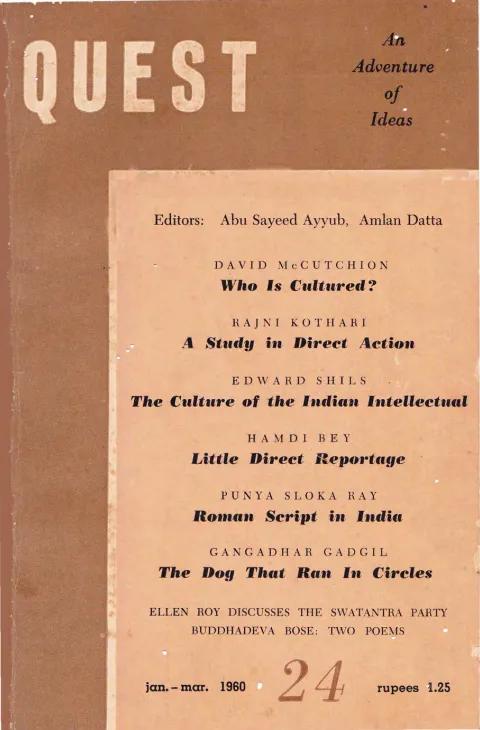
Quest
A Quarterly of Inquiry, Criticism and Ideas
By David McCutchion, Rajni Kothari, Edward Shils, Hamdi Bey, Punya Sloka Ray, Krishna Nandan Sinha, Buddhadeva Bose, Dorothy Norman, Pradip Sen, Feroze F. Moos, Gangadhar Gadgil, Martin S. Dworkin, Ellen Roy, Sadhan Kumar Ghosh
Printed and published by Miss Sheela Singh for the Indian Committee for Cultural Freedom, Army and Navy Building, 148 Mahatma Gandhi Rd., Bombay 1, at Inland Printers, Victoria Mills Buildings, 55 Gamdevi Road, Bombay 7. · Bombay · 1960
118 pages
Quest
Summary
Quest No. 24 (Jan.-Mar. 1960) is a wide-ranging ‘quarterly of inquiry, criticism and ideas’ sponsored by the Indian Committee for Cultural Freedom, mixing political and sociological argument with literary criticism, poetry, fiction and film criticism. David McCutchion opens with a long essay arguing that culture cannot be manufactured or imposed and defending a distinction between organic ‘community’ culture and imposed ‘commercial’ culture; Rajni Kothari offers a structural theory of ‘direct action’ as an inevitable by-product of parliamentary democracy’s failure to let the politically-conscious middle class participate in power, tested against the 1957-59 Communist government crisis in Kerala; Edward Shils, reporting on several hundred interviews, argues that the ‘rootless’ Indian intellectual is in fact still deeply embedded in family, caste and religious tradition, and that caste rather than English education is the true source of any alienation from ‘the people’. Hamdi Bey diagnoses the Indian press’s chronic lack of first-hand reportage; Punya Sloka Ray proposes a concrete scheme for romanising Indian scripts; Krishna Nandan Sinha traces the movement from impersonal ‘voices’ to a unified authorial ‘voice’ across Eliot’s Four Quartets. Five poems (Buddhadeva Bose, Dorothy Norman, Pradip Sen, Feroze F. Moos), a short story by Gangadhar Gadgil, a film-criticism column by Martin S. Dworkin on the UN documentary ‘Power Among Men’, and Ellen Roy’s sharply critical dissection of the newly formed Swatantra Party as a vehicle for landlord and industrialist interests dressed in the language of Gandhian ‘trusteeship’ and ‘Dharma’ round out the issue, followed by Sadhan Kumar Ghosh’s book-chat column and five signed book reviews.
Essays
Who Is Cultured?
By David McCutchion
McCutchion argues that ‘culture’ has collapsed into two incompatible senses: an anthropological sense in which culture is simply the organically-evolved forms through which a community lives (which he calls ‘community culture’), and a debased, imposed ‘commercial culture’ manufactured by films, radio and illustrated magazines to standardise and pacify a mass audience. He traces how this confusion lets culture be turned into a matter of social prestige, Cold War propaganda (British Council grants, Rockefeller-funded translations, U.S.I.S. centres) and empty connoisseurship, and argues that genuine appreciation of any art requires participation in the tradition and stage of development that produced it — hence a culture cannot simply be handed down to ‘the masses’ via museums, digests or pocket-book editions, nor can one culture be adequately understood purely from outside. The essay closes with a Q&A section in which the editors (‘Quest’) put seven objections to McCutchion (that culture can teach even the unprepared, that taste is a matter of personal right, that school-imposed literature still benefits pupils later, that a ‘cultured’ minority should be allowed lowbrow relaxation, that the very idea of ‘the people’ is loose, that popular vitality can reassert itself, and that nostalgia for a lost unity of art and life is illusory), each of which he answers in turn.
- Distinguishes organically-evolved ‘community culture’ from imposed, standardising ‘commercial culture’, arguing the two seek opposite ends (understanding vs. immediate pleasing).
- Argues culture cannot be ‘made a programme’: cultural display for a Distinguished Guest, or for propaganda purposes, is inherently self-defeating.
- Culture has become politicised: examples include Brussels exhibition rivalry, the persecution of Pasternak, U.S.I.S. centres, British Council grants and Rockefeller-funded distribution of Faulkner.
- Appreciation of any art requires prior participation in the culture and developmental stage that produced it; ‘passive acquisition of culture is meaningless’.
- Modern society shows three attitudes to community culture: mass indifference/hostility, socially-pretentious aspiration to be ‘cultured’, and a genuinely responsive discriminating minority.
- Closing Q&A section directly rebuts seven reader objections put by the Quest editors, sharpening and qualifying the main argument.
Direct Action: A Pattern of Political Behaviour
By Rajni Kothari
Kothari sets out to give ‘direct action’ — the extra-constitutional group techniques used against Indian governments since independence — a rigorous theory rather than dismissing or endorsing it on principle. He first argues that parliamentary government’s philosophical basis (an assumed ‘natural harmony’ between individuals and society) and its institutional basis (periodic elections and a theory of representation) both fail to secure genuine popular participation, so that power concentrates in a small leadership and bureaucracy while ordinary citizens become spectators. From this he derives a general definition of direct action as an extra-constitutional, group-based technique aimed at political change against the government of the day, and distinguishes ‘democratic’ direct action (which strengthens the democratic content of existing forms) from action that degenerates into authoritarianism. He then applies the theory at length to the Communist government’s rise and fall in Kerala (1957-59), arguing that the pivotal actor was not the peasantry but the politically dispossessed middle class, whom the Communists alienated through humiliation of small vested interests, the Education Bill dispute with school managements, interference with the rule of law, and party-based patronage in administration. He concludes with a general causal hypothesis: direct action follows from a politically-conscious middle class being split into rulers and ruled, with parochial identities (language, religion, caste) providing only the ‘colour’, not the cause, of any given agitation.
- Parliamentary democracy’s assumption of ‘natural harmony’ between individual and society, and its reduction of democracy to periodic elections and party-based representation, together frustrate real popular participation.
- Direct action is defined as an extra-constitutional, group-based political technique aimed at changing policy, the constitutional machinery, or the government, and directed against the government in power.
- Distinguishes desirable, democracy-strengthening direct action from action that is unprincipled, violence-driven and liable to produce dictatorship.
- Case study: the Communist Party’s 1957 Kerala victory rested on Ezhava/scheduled-caste and split-Nair/Christian support plus a divided, politically ‘uncommitted’ middle class — and its subsequent humiliation of that same middle class (ferry-boat fares, the Education Bill, party interference with justice and administration) produced the direct-action crisis that led to Governor’s Rule.
- General hypothesis: direct action is caused by the split of the politically-conscious middle class into rulers and ruled, not by parochialism or ‘vested interests’ as Nehru and the Communists respectively claimed — these merely supply the ‘colour’ of a given agitation.
- Cites Gandhi’s own campaigns, British wartime opposition to appeasement, the Suez reaction, and American academic resistance to McCarthyism as parallel, more ‘mature’ instances of democratic direct action.
The Culture of the Indian Intellectual
By Edward Shils
Based on extensive interviews (nearly five hundred), Shils challenges the common charge — made by foreigners and Indian intellectuals alike — that the Indian intellectual is ‘rootless’, ‘uprooted’ or torn between two worlds. He shows that Indian intellectuals overwhelmingly grew up in Indian households with strong maternal religious observance, married within caste by parental arrangement even when personally ‘liberated’, retain an intense religious sensibility (including ‘oceanic’ mystical experience and widespread ambivalent belief in astrology) far exceeding their Western counterparts, and remain emotionally at home in the third and fourth asramas (renunciation) as an ideal even when they do not literally withdraw from the world. Where alienation from ‘the people’ is genuinely felt, Shils locates its real source not in English education or Western culture — most intellectuals still speak, and value, their mother tongue — but in the caste system itself, which structurally ‘cuts human beings off’ from each other and dulls empathy for those outside one’s own circle; this, rather than English, is what produces the Indian press’s poverty of human-interest reportage and the underdevelopment of the novel and biography as genres. He closes the (unfinished) essay by tracing linguistic nationalism (Marathi, Bengali and Tamil resistance to Hindi) and a post-independence ‘return to the people’ through renewed interest in Indian dance, art and architecture, citing painters such as Husain, Jamini Roy and Jehangir Sabavala.
- Nearly all interviewed Indian intellectuals were raised in traditionally Indian, religiously observant households and married within caste by parental arrangement, even the personally ‘liberated’ ones.
- Religious sensibility — including ‘oceanic’ mystical feeling and ambivalent belief in astrology — is markedly stronger among Indian intellectuals than among their Western counterparts, even the self-declared ‘secularized’.
- The ideal of the third and fourth asramas (renunciation, withdrawal from worldly life) remains a powerful lodestar, exemplified by Jayaprakash Narayan’s turn to Bhoodan, Aurobindo Ghose’s ashram, and M. N. Roy’s post-political ‘camp’ movement.
- Argues the real cause of any alienation from ‘the people’ is the caste system — which structurally blocks empathy across caste lines — not English education, which does not stop intellectuals speaking or valuing their mother tongue.
- Reads the Bombay/Calcutta/Madras language disputes (Marathi, Bengali, Tamil vs. Hindi) as expressions of intellectuals’ anxiety about contact with ‘the people’, with English’s retention as official/higher-education language serving both that anxiety and a countervailing need to stay in contact with the West.
- Notes a post-independence ‘return to the people’ in renewed attention to Indian dance (Kathakali, Bharatanatyam), temple visiting, and painting that engages village/folk subject matter (Husain, Jamini Roy, Jehangir Sabavala).
Little Direct Reportage
By Hamdi Bey
Bey, a veteran Calcutta journalist, argues that the central defect of the Indian press is its want of direct, first-hand observation. He traces this to physical/financial causes (328 huge, poorly-connected districts; no paper can afford a correspondent in each; total national advertising revenue of only Rs. 9 crores spread across 3,992 journals), historical causes (papers founded by the British community originally prioritised European news and official sources, a habit inherited by Indian papers), and, more speculatively, an Indian epistemological habit of according ‘shabda pramana’ — the authority of the spoken or written word — priority over direct observation, so that reporters routinely defer to official or bureaucratic versions of events rather than trusting their own eyes. He documents how district correspondents, underpaid and part-time, depend on politically interested or bureaucratically defensive sources, and how the single national newsagency (Press Trust of India) is itself financially dependent on government subscriptions. He credits some post-independence improvement — adversarial press conferences replacing wholly ‘dictated’ interviews — but concludes the Indian press remains, after 24 years in the trade, still without adequate direct reportage.
- India’s 328 districts (many over 7,000 sq. miles) and poor transport make it financially impossible for papers to maintain a correspondent in every district.
- Total national newspaper advertising revenue (~Rs. 9 crores) is spread thinly across 3,992 journals, including 330 dailies, none of which can afford true nationwide direct coverage.
- The single newsagency, Press Trust of India, draws significant revenue from Central and State government subscriptions, compromising its independence from official sources.
- Historical legacy: British-founded Indian papers prioritised European/official news, entrenching a habit of deference to bureaucratic and political sources over direct observation.
- Argues an Indian epistemological preference for ‘shabda pramana’ (authority of the spoken/written word) over inference/observation reinforces reliance on official statements even where direct reportage would be possible.
- Notes concrete improvement since independence: adversarial press conferences have begun replacing wholly dictated ‘authorized’ interviews (the author himself was ejected from a 1941 press conference for ‘daring to cross-examine’).
Adoption of the Roman Script in India
By Punya Sloka Ray
Ray argues that if India ever standardises its scripts, it should adopt the Roman alphabet rather than Devanagari, on three grounds: the Roman script’s independent vowel signs and absence of compound letters make it more ‘scientific’ and typewriter/telegraph-compatible; it is the only genuinely international script (already used or being adopted by Turkey, Indonesia, the Philippines, several Communist-bloc states and, prospectively, China); and, unlike Devanagari (tied to Hindi and Marathi), it belongs to no single Indian language and so could unify the country without privileging any one linguistic group. He rejects the existing century-old Sanskrit transliteration convention as clumsy and proposes a new scheme built from four devices — newly invented letters, diacritical marks, digraphs, and repurposed ‘superfluous’ Roman letters (q, f, w, x) — to represent Indian vowels, retroflex consonants and nasals, with different adjustments needed for Hindi, Bengali, Oriya, Tamil, Marathi and Urdu. He closes with sample transcriptions of passages in Sanskrit, Hindi, Old Literary Bengali, current Bengali and Oriya to demonstrate the scheme.
- Roman script’s independent vowel signs, position-invariant letterforms and lack of compound letters make it more ‘scientific’ and machine-compatible than Indian scripts.
- Cites Turkey, Indonesia, the Philippines and several Communist-bloc countries as having already romanised, and notes China was then ‘on the eve’ of adopting Roman script.
- Rejects Devanagari as a unifying national script because it is tied to Hindi and Marathi and would read as Hindi expansionism to speakers of other Indian languages.
- Proposes representing Indian sounds via new letters, diacritics, digraphs (e.g. borrowing ‘ng’), and repurposed superfluous Roman letters (q, f, w, x) for retroflexion, nasalisation, etc.
- Provides worked sample transcriptions in Sanskrit, Hindi, Old Literary Bengali, current standard Bengali and Oriya to illustrate the proposed system.
T. S. Eliot’s Four Quartets
By Krishna Nandan Sinha
Sinha reads Eliot’s Four Quartets as a progressive resolution of the ‘voice’/‘voices’ distinction Eliot himself drew in The Three Voices of Poetry. Where The Waste Land was ‘an anthology of the highest points of drama’ assembled from many impersonal voices, Burnt Norton opens as a world of impersonal ‘echoes’ (the thrush, the rose-garden) evoking a transcendental vision the protagonist cannot sustain (‘human kind/Cannot bear very much reality’). East Coker, by contrast, is dominated by the poet’s own confident personal voice, interrupted by historical voices (the rustics, Sir Thomas Elyot, St. John of the Cross) rooted in the poet’s ancestral village. The Dry Salvages plunges into the impersonal, oceanic ‘voices’ of the sea and of Krishna, culminating in visions of agony and ecstasy beyond ordinary human bearing. Finally, in Little Gidding, full communication is achieved: the poet converses with a ‘familiar compound ghost’ compounded of Dante, Milton, Swift and others, and the essay reads the closing fusion of ‘the fire and the rose’ as the point where the many voices and the single voice become one.
- Frames the analysis using Eliot’s own distinction (in The Three Voices of Poetry) between the poet’s private voice, his public voice, and a dramatic character’s voice.
- Burnt Norton is dominated by impersonal ‘echoes’ evoking an unsustainable transcendental vision (‘Go, go, go, said the bird: human kind/Cannot bear very much reality’).
- East Coker shows the poet’s own confident voice interrupted by historical voices tied to his ancestral village and lineage (Sir Thomas Elyot, St John of the Cross, Mary Queen of Scots).
- The Dry Salvages is dominated by the impersonal, massive ‘voices’ of the sea and of Krishna’s exhortation to ‘fare forward’.
- Little Gidding achieves full communication through the dialogue with the ‘familiar compound ghost’ and the voice of Juliana of Norwich, resolving in the final image of fire and rose becoming one.
The Advent
By Buddhadeva Bose
A short lyric in which an angel arrives not in the expected apocalyptic splendour but as a small, weary bird carrying ‘the whole great weight of Spring’; on a desolate, rubble-strewn coast a single fallen feather is enough to transform the speaker’s death into ‘an isle of loveliness’, even though the angel itself finds no final rest and the speaker is left with only an unresolved, grave-rending anguish of desire, which the poem names as blessedness.
- The angel appears as a humble, weary bird rather than the expected splendid apocalyptic figure.
- Set on a ‘derelict coast’ amid rock, weed and dead fish; renewal is figured as a single fallen feather.
- The poem rejects a sentimental reading (reunion of parted lovers) as ‘an idle thought of those who never have loved’.
- Ends by naming unresolved, restless anguish of desire itself as ‘blessedness’.
One Who Died in an Accident
By Buddhadeva Bose
A memorial poem (adapted by Bose from his own Bengali) picturing a sudden, dignified death without lingering decline: the dead man ‘just strode across’ rather than fading like a guttering lamp, and his abrupt departure is likened to an emperor dismissing an entire banquet — lights, dancing girls, trophies of war — with a flicker of an eyelid, ‘without a word of ruth or pity’ for those left behind.
- Contrasts a sudden, ‘proud’ death with a slow, humiliating decline (‘the slow/Spluttering lamp at dawn’).
- Central simile: the dead man’s abrupt departure is likened to an emperor casually dismissing an entire banquet.
- Emphasises the absence of self-pity or courtly lament in the death being memorialised.
- Printed with the note ‘Adapted by the author from his Bengali’, signalling Bose’s own self-translation.
For You and You
By Dorothy Norman
A two-part love poem. Part one surrenders wholly to romantic/erotic union (‘Oh love: The final choice is not in me’), imagining the beloved’s features and the couple’s embrace as cosmically total (‘the universe fulfilled reborn’). Part two (‘For You and You - 2’) turns to the wound beneath that surrender — a ‘separateness adrift’, a sense of betrayal ‘from in and not from out’ — before returning, in the final lines, to trust and immediacy: ‘no time save now: your lips in utter trust’.
- Part one figures romantic surrender as involuntary and total, merging personal experience with cosmic imagery.
- Part two (‘For You and You - 2’) introduces a counter-movement of inward wound and ‘separateness adrift’ beneath the professed union.
- The two parts together move from ecstatic totality to a more guarded, present-tense trust.
The Disinherited
By Pradip Sen
A poem of resentment spoken by the historically dispossessed (‘We who were meek once’), who claim the earth by right yet remain rooted only in ‘the sodden soil’; it accuses those with means of making ‘charity an evil thing’ that must be given ‘secretly’ rather than as of right, and ends by repeating its opening question as a declaration that the meek ‘can no longer be mute’.
- Opens and closes on the refrain ‘Have we not inherited the earth?’, framing dispossession as an unmet claim rather than a settled fact.
- Critiques charity as demeaning when it substitutes for justice, forcing the giver to act ‘secretly’ and ‘without a degree of caution’.
- Ends on a note of refusal to remain silent any longer.
When I Have Got the Sack
By Feroze F. Moos
The speaker imagines himself, after being dismissed from work (‘hounded out of livelihood’), returning aged and unrecognisable to the place and people he once knew, finding that former acquaintances no longer know his ‘wrinkled face’ or cracked voice; the poem ends by extending this estrangement to the speaker’s relation to himself and, ultimately, to death and the tomb.
- Imagines job loss as the trigger for an aged, unrecognisable return to a former home and community.
- Estrangement escalates from social non-recognition to self-estrangement and finally estrangement even from the tomb.
- Understated, meditative tone rather than overt protest.
The Dog That Ran In Circles
By Gangadhar Gadgil
A narrator, blocked while trying to write a story, becomes absorbed watching a starving, injured stray dog that a Bombay street crowd first tries clumsily to help and then simply watches as it staggers, seemingly possessed, in erratic circles through busy traffic for over ten minutes before finally being killed by a double-decker bus. The crowd’s shifting moods — amused condescension, vicarious terror, false sympathy, indifference — mirror the narrator’s own detached, aesthetic fascination with the dog’s eyes, which he reads (perhaps fancifully) as almost saintly; the story ends on the ironic recognition that the narrator has, without realising it, finally gotten the ‘story’ he had been straining for.
- Stream-of-consciousness frame: a blocked writer’s search for ‘a story’ is answered, unbeknownst to him, by the very spectacle he is coldly observing.
- Detailed crowd psychology: amusement, false concern, vicarious terror and eventual indifference as the dog repeatedly escapes death in traffic.
- The dog’s ‘queer moist’ eyes are read by the narrator as expressing something like saintly compassion, detached from ordinary canine fear or hunger.
- Ends with the dog’s death under a bus and the crowd’s rapid loss of interest, framing spectatorship itself as a kind of moral failure the narrator shares.
Last Words and Last Chances
By Martin S. Dworkin
Dworkin contrasts the evasive, superstition-dressed-as-morality of science-fiction and horror films with the United Nations Film Board’s first feature-length documentary, ‘Power Among Men’ (1959), which he treats as a sincere but structurally difficult experiment in reaching a genuine theatrical audience with propaganda for UN internationalism. He summarises its four episodes — postwar reconstruction in Sant’Ambrogio, Italy; agricultural modernisation in Fermathe, Haiti; industrial development and inter-communal friction in Kitimat, British Columbia; and the promise/peril of nuclear energy at the Kjeller reactor in Norway — and praises its craft (Thorold Dickinson and J. C. Sheers’s writing/production, Virgil Thomson’s score, narration voiced in multiple languages including by Laurence Olivier’s contemporaries Laurence Harvey and Marlon Brando). His central reservation is that the film’s admirable universal humanism tips into an abstraction of ‘Man’ that depreciates actual, particular men and women.
- Opens by diagnosing science-fiction/horror cinema’s moralising about technological hubris as an evasive, quasi-religious ritual rather than genuine engagement with real dangers.
- ‘Power Among Men’ (UN Film Board, dir. multiple; written/produced by Thorold Dickinson and J. C. Sheers) is the Board’s first feature-length (90-minute) production, aimed at ordinary paying theatrical audiences rather than institutional/educational screenings.
- Summarises all four episodes: Sant’Ambrogio (Italy, postwar reconstruction via UNRRA), Fermathe (Haiti, agricultural technical assistance), Kitimat (British Columbia, industrial development and inter-communal tension), and Kjeller (Norway, nuclear energy’s promise and peril).
- Notes the score (Virgil Thomson, New York Philharmonic) and multilingual narration (including Laurence Harvey and Marlon Brando) built around a recurring Hamlet-derived commentary (‘What a piece of work is man!’).
- Central critique: the film’s collectivist, universalist humanism risks elevating an abstract ‘Man’ at the expense of actual, particular individuals.
A Closer Look at the Swatantra Party
By Ellen Roy
Ellen Roy argues that the newly formed Swatantra Party (founded by C. Rajagopalachari and M. R. Masani, June 1959) is, despite its ‘liberal’ vocabulary, a fundamentally conservative and reactionary party representing big landowners and industrialists behind the language of Gandhian ‘trusteeship’ and ‘Dharma’. She traces its origin to opposition to the Congress’s Nagpur resolution on land ceilings and cooperative farming, and argues that, unlike the Congress’s faltering but genuine attempt at a ‘philosophical revolution’ (a mixed economy balancing public and private sectors), Swatantra offers only nostalgia for a largely non-existent self-sufficient peasant-proprietor class. Quoting extensively from C. Rajagopalachari, M. R. Masani, N. G. Ranga, K. M. Munshi and the party’s own economic interpreter S. Y. Krishnaswamy, she exposes contradictions in the party’s stance — simultaneously opposing ‘compulsion’ while endorsing land-ceiling-style state action against smaller vested interests, and claiming both to conserve Gandhian values and to unleash an uncrippled profit motive. Her conclusion is that trusteeship is the very opposite of individual freedom, since it makes the majority permanent wards of self-appointed trustees, and that the party’s slogans of freedom, social justice and equality are calculated to mislead ‘unwary Liberals, Democrats and Humanists’.
- The Swatantra Party (C. Rajagopalachari and M. R. Masani) originated as opposition to the Congress’s Nagpur resolution on land ceilings and the drive towards cooperative/collective farming.
- Contrasts the Congress’s tentative, sometimes contradictory attempt at a mixed-economy ‘philosophical revolution’ with Swatantra’s reactionary appeal to a largely non-existent self-employed, self-supporting peasant-proprietor class.
- Extensively quotes and cross-examines C. Rajagopalachari’s, N. G. Ranga’s and K. M. Munshi’s public statements to expose internal contradictions on cooperative farming, Gandhian socialism, and taxation.
- Argues ‘trusteeship’ is antithetical to individual freedom because it makes the majority permanent wards of self-appointed wealthy trustees, rather than rights-bearing citizens.
- Concludes the party’s appeal to ‘freedom’, ‘social justice’ and ‘equality of opportunity’ is calculated to mislead ‘unwary Liberals, Democrats and Humanists’ while its actual programme serves industrialists and big landlords.
Talking About Books
By Sadhan Kumar Ghosh
Ghosh’s book-chat column surveys recent English-language publications: E. M. Butler’s memoir ‘Paper Boats’ and K. Codrington’s Anglo-Indian childhood memoir ‘Cricket in the Grass’; a cluster of new Shakespeare criticism (John Vyvyan’s ‘The Shakespearean Ethic’, John Garrett’s edited essay collection ‘More Talking of Shakespeare’); contemporary poetry (Robert Graves’s Collected Poems 1959, Edmund Blunden’s Poems of Many Years); Henry Charles Duffin’s study of Browning (‘Amphibian’); Norman Lewis’s travel book ‘The Changing Sky’; and G. S. Fraser’s ‘Vision and Rhetoric’, which Ghosh discusses at length for its argument that the modern movement in poetry (Hulme, the Imagists, Pound, Eliot) continues rather than breaks from Romanticism.
- Discusses E. M. Butler’s ‘Paper Boats’ and K. Codrington’s ‘Cricket in the Grass’ as instances of a current vogue for autobiographical nostalgia.
- Surveys new Shakespeare criticism (Vyvyan, Garrett’s edited collection) siding with the ‘interpreters’ against purely textual critics.
- Assesses Robert Graves and Edmund Blunden as the only two contemporary poets conveying ‘a sense of timelessness in a time-haunted age’, and reviews Duffin’s study of the ‘amphibious’ (passion-and-thought) character of Browning’s poetry.
- Covers Norman Lewis’s travel book ‘The Changing Sky’, including Lewis’s opinion that Goa would not vote to join India in a plebiscite.
- Extended discussion of G. S. Fraser’s ‘Vision and Rhetoric’ and its case (following Herbert Read, John Bayley and Frank Kermode) that modern poetry (Pound, Eliot, Yeats) continues rather than breaks from the Romantic tradition.
Back to Life
By M. D. Hatkangalekar
Hatkangalekar reviews ‘Back to Life: Poems From Behind The Iron Curtain’ (ed. Robert Conquest), an anthology of poems by Russian and East European writers who survived the Stalin-era ‘quarter of a century’ of literary suppression and began to publish more openly after the post-1955 political ‘thaw’ — a thaw the reviewer notes was itself undercut by the storm over Pasternak’s Doctor Zhivago. He stresses that the editor himself does not claim the poems as great literature but as ‘documents of courage and love of truth’, offering only ‘fitful glimpses’ of life under totalitarian suppression rather than full documentation.
- Anthology collects poems from Russia and Eastern European satellite states written under, or just after, Stalin-era literary suppression.
- Notes editor Robert Conquest’s own disclaimer that the poems are valued as ‘documents of courage and love of truth’ rather than as literature per se.
- Cites Isaac Babel’s 1934 remark to Soviet writers that they had been deprived of only ‘the right to write badly’.
- Frames the post-1955 political ‘thaw’ as incomplete, undercut by the official backlash against Pasternak’s Doctor Zhivago.
Charvaka
By S. H. Dixit
Dixit reviews S. N. Athavale’s Marathi-language study ‘Charvaka: History and Philosophy’, praising it as the most exhaustive single-author treatment of Charvaka/Lokayata materialist philosophy yet compiled, and comparing its epistemology (which trusts only sense-perception-grounded inference) favourably to Hume’s empiricism. He credits Athavale’s account of Charvaka’s social radicalism (rejection of caste and Vedic authority, an ethic of maximising happiness through honest labour) but faults the book, and Charvaka philosophy itself, for lacking any way to ground ethical distinctions (good/bad, right/wrong) once consciousness is reduced to a mechanical product of unconscious matter.
- Reviews S. N. Athavale’s ‘Charvaka: History and Philosophy’ (Marathi), calling it the most exhaustive single-author compilation of references to Charvaka/Lokayata materialism yet produced.
- Explains Charvaka epistemology: sense perception is the sole valid source of knowledge; inference is accepted only when grounded in sense experience, closely paralleling Hume.
- Notes Charvaka social radicalism: rejection of caste distinctions and Vedic authority (exposed as serving ‘the shrewd, the wicked and the voluptuous’), and an ethic of pursuing maximum happiness through honest labour.
- Critiques both Athavale and the Charvaka system for failing to ground the distinction between good and bad once consciousness is treated as mechanically determined by unconscious matter.
China’s Population
By D. A. Dabholkar
Dabholkar reviews S. Chandrasekhar’s ‘China’s Population’, the text of two 1959 Hong Kong lectures presenting China’s 1953 census (revealing a population near 600 million, against a prior estimate of 400 million) and vital statistics with little editorial comment. He credits the book’s objective, factual approach — including candour about the number of ‘enemies of the people’ officially eliminated (three to twenty million) — while noting the census’s methodological limits (a rushed de jure count) and the reviewer’s own concern that China’s officially-abandoned 1958 birth-control campaign, driven by ‘blind loyalty to Marx’, leaves an unchecked and consequential population growth unaddressed.
- China’s first comprehensive census (1953) found a population of roughly 600 million, far above the prior estimate of about 400 million.
- Reviewer credits the book’s objective, non-propagandistic tone even where it reports uncomfortable official admissions.
- Notes the official figures ‘have unfortunately the support of official statements’ that between three and twenty million ‘enemies of the people’ were eliminated.
- Criticises the People’s Government for abandoning its birth-control campaign in 1958 ‘out of blind loyalty to Marx’ despite the evident economic risks of unchecked population growth.
American-Asian Tensions
By A. H. Somjee
Somjee reviews ‘American-Asian Tensions’ (ed. Robert Strausz-Hupe and others, Foreign Policy Research Institute), a collection of essays examining America’s relations with India, Indonesia, Japan, the Philippines and Egypt in terms of genuinely incompatible foreign-policy objectives rather than removable misunderstandings. He summarises each country’s distinct tension with the U.S. — India’s neutrality and anti-colonialism versus America’s Cold War framing; Indonesia’s resentment of U.S. arms aid to the Dutch; Japan’s dependence-versus-independence dilemma; the Philippines’ unease at ‘let the Asians fight the Asians’; and Egypt’s narrowly tactical, non-ideological frictions over Israel and Suez — while criticising the editors for lapsing at points into policy advocacy addressed to American officials rather than sober analysis.
- Defines ‘tensions’ as rooted in genuinely incompatible foreign-policy objectives, not removable diplomatic misunderstandings.
- India: anti-colonial, neutralist outlook clashes with America’s ‘contest of power’ framing; quotes Nehru distinguishing the Asian ‘crisis’ (colonialism vs. anti-colonialism) from the American one (communism vs. anti-communism).
- Indonesia: anti-colonial and neutral like India, but resents U.S. arms aid to the Dutch and U.N. abstention on the Irian issue.
- Japan and the Philippines: caught between desired independence from, and continued military dependence on, the United States.
- Egypt: tactical rather than ideological friction, centred on Israel, Suez, Sudan and the Aswan Dam.
- Criticises the book’s concluding chapter for lapsing into policy prescriptions addressed to American diplomats and army personnel rather than remaining analytic.
The American Novel and its Tradition
By M. K. Naik
Naik reviews Richard Chase’s ‘The American Novel and its Tradition’, which argues the American novel has defined itself, from its earliest days, by a distinctive ‘romance’ element largely absent from (or minor within) the English novel tradition, tracing this through Fenimore Cooper, Hawthorne, Melville and Faulkner. Naik questions Chase’s central thesis, arguing the ‘romance element’ has arguably always been central to the mainstream English novel too (against F. R. Leavis’s narrower ‘Great Tradition’), and faults the book for relatively neglecting Hemingway and for offering no account of likely future developments in American fiction, while praising Chase’s lucid argument and his individual chapters on Melville and Faulkner.
- Chase’s thesis: the American novel’s ‘most original and characteristic form’ has worked out its identity by incorporating a ‘romance’ element that is ‘major’ in American fiction but ‘minor’ in the English novel.
- Naik disputes the English/American contrast, arguing the ‘romance element’ has arguably always distinguished the mainstream English novel from the French, contra F. R. Leavis’s narrower ‘Great Tradition’ (which excludes Scott, Dickens, Hardy and Meredith).
- Notes as a ‘surprising lacuna’ that Hemingway, despite exemplifying the ‘romance’ element well, receives only passing mention while Charles Brockden Brown gets a full chapter.
- Praises the book’s lucid, cogent argument and its chapters on Melville and Faulkner as its strongest sections despite reservations about the central thesis.
Generated by the v1.5 extraction pipeline. Awaiting editorial review.
Metadata and summary are AI-extracted from the source PDF and reviewed for editorial accuracy. The original work is available via the Read PDF tab above (where present); paragraph-level citation inside the PDF is deferred to a future engagement.
People in this work
- David McCutchionauthor
- Rajni Kothariauthor
- Edward Shilsauthor
- Hamdi Beyauthor
- Punya Sloka Rayauthor
- Krishna Nandan Sinhaauthor
- Buddhadeva Boseauthor
- Dorothy Normanauthor
- Pradip Senauthor
- Feroze F. Moosauthor
- Gangadhar Gadgilauthor
- Martin S. Dworkinauthor
- Ellen Royauthor
- Sadhan Kumar Ghoshauthor
- M. D. Hatkangalekar
- S. H. Dixit
- D. A. Dabholkar
- A. H. Somjee
- M. K. Naik
- Abu Sayeed Ayyub
- Prof. Amlan Datta
- Nirad C. Chaudhuri
- Sudhin Datta
- Laxmanshastri Joshi
- A. B. Shah
- Sheela Singh
- Rabindranath Tagore
- Jawaharlal Nehru
- Mahatma Gandhi
- M. N. Roy
- Jayaprakash Narayan
- C. Rajagopalachari
- M. C. Chagla
- Bal Gangadhar Tilak
- Herbert Spencer
- John Stuart Mill
- K. M. Munshi
- Adam Smith
- Minoo Masani