
periodical issue
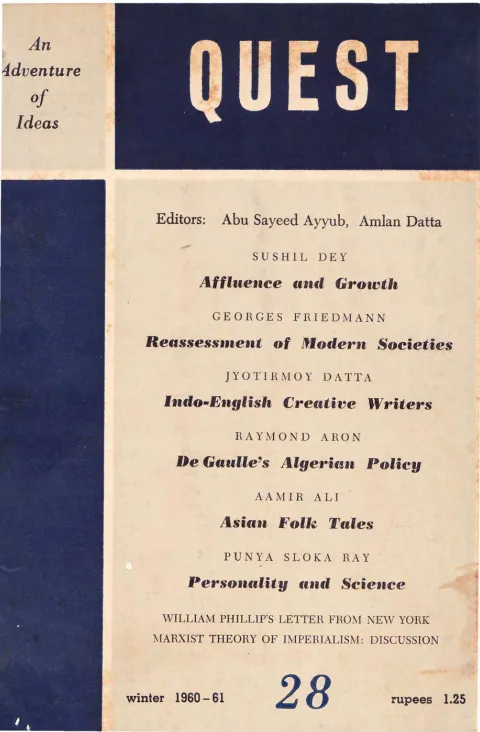
Quest
A Quarterly of Inquiry, Criticism and Ideas
By Sushil Dey, Georges Friedmann, Prof. Amlan Datta, Raymond Aron, V. A. Shahane, Aamir Ali, C. L. Miglani, D. L. Pham-xuan-Luong, William Phillips, Nissim Ezekiel, Pradip Sen, K. Raghavendra Rao, F. R. Stanley, Madhao B. Achwal, Anita Desai, Herbert Luthy, Punya Sloka Ray, Sadhan Kumar Ghosh, Nicolas Nabokov, K. Hazareesingh
Printed and published by Miss Sheela Singh for the Indian Committee for Cultural Freedom, Army and Navy Building, 148 Mahatma Gandhi Rd., Bombay 1, at Inland Printers, Victoria Mills Buildings, 55 Gamdevi Road, Bombay 7. · Bombay · 1961
128 pages
QUEST
Summary
Quest No. 28 (Jan/Mar 1961, cover-dated ‘winter 1960-61’) opens with three essays on the shape of post-war modernity — Sushil Dey on the moral costs of Galbraith-style ‘affluence’, Georges Friedmann’s Congress-for-Cultural-Freedom conference paper reassessing technical civilization as both consumer and producer, and Jyotirmoy Datta’s polemic (printed as ‘On Caged Chaffinches and Polyglot Parrots’) defending Indian-language writers against the claims of Indo-English literature. Raymond Aron then delivers a pointed retrospective, ‘Presumption’, judging de Gaulle’s Algerian policy two years on. V. A. Shahane profiles the controversial Marathi poet B. S. Mardhekar; Aamir Ali surveys shared motifs across Asian folk tales; C. L. Miglani and D. L. Pham-xuan-Luong contribute shorter pieces on essential-services strikes and the Vietnamese Tet festival respectively; and William Phillips files a ‘Letter from New York’ on the Kennedy-era mood in American politics and letters. A poetry section (two Nissim Ezekiel sonnets, and single poems by Pradip Sen, K. Raghavendra Rao and F. R. Stanley), an essay on Indian architecture’s search for a post-Independence idiom by Madhao Achwal, Anita Desai’s ghost-narrated short story ‘Ghost House’, Herbert Luthy’s long open-letter rebuttal of a Marxist theory of imperialism, and Punya Sloka Ray’s review-article on Michael Polanyi’s ‘Personal Knowledge’ round out the front half. The back half is entirely criticism and correspondence: Sadhan Kumar Ghosh’s books column, a substantial, contentious review by P. Lal of Dom Moraes’s ‘Gone Away’, further reviews of art, theatre, poetry, language, politics, Soviet nationality policy and current fiction, an ‘Our Reviewers’/‘Our Contributors’ pair of biographical notes, and a correspondence section carrying a rebuttal of Edward Shils on the Indian intellectual, a correction from Nicolas Nabokov, and an unlisted letter from a Mauritian correspondent. Throughout, the magazine’s Cold-War liberal, anti-Communist and anti-doctrinaire orientation (it is sponsored by the Indian Committee for Cultural Freedom) is explicit, most sharply in Luthy’s dismantling of ‘Marxist’ imperialism theory and in the reviews of books on Hungary and the Soviet deportations.
Essays
Affluence and Growth
By Sushil Dey
Dey argues that the ‘affluent society’ identified by Galbraith afflicts capitalist and socialist economies alike, since both have converged on the same goal of maximizing output through modern technological apparatus, leaving individuals as interchangeable cogs rather than originators of production. He surveys the psychological costs of undirected material growth (advertising-driven consumerism, teenage ‘beatnik’ revolt) and argues economic planning must be subordinated to a moral purpose of fostering human growth, not mere output. He proposes that newly developing countries, precisely because their technology has not yet outrun ordinary people’s comprehension, have a chance to build democratic, rural-centred development that avoids the affluent world’s mistake, and that such a course would also benefit the rich countries by reorienting demand away from ‘frills and gadgets’.
- Capitalism and socialism have converged on the same goal of maximizing productive output, making their old ideological opposition mostly historical.
- Modern production strips ordinary workers of initiative, concentrating judgment in a ‘small managerial elite’.
- Galbraith’s ‘affluence’ produces psychological and cultural damage (consumerism, loss of thrift, teenage revolt) even as it solves distribution.
- The liberal case for redirecting resources toward public goods (education, health, culture) requires large-scale central control, which is itself in tension with liberal premises.
- Newly developing countries can choose a rural, democratically-paced development model that keeps pace with people’s own capacity to understand and direct it.
- A healthier ‘affluence’, geared to capacity-building rather than consumption, would change the character of demand from the developing world (books and ballet rather than colour television).
The Reassessment of Modern Societies
By Georges Friedmann
Friedmann’s conference paper (delivered at the Congress for Cultural Freedom’s Berlin general conference, June 1960) argues that 19th- and 20th-century social theory — Saint-Simon, Comte, Durkheim, Marx, Lenin among others — no longer suffices to interpret the ‘technical civilization’ now emerging worldwide. He distinguishes a society’s ‘technical environment’ from its ‘technical civilization’ and assesses modern society from the standpoint of consumer and producer: material consumption has improved broadly, even for the poorest, but the mass media are double-edged, capable of educating or of manipulating; industrial work has been physically eased but drained of personal meaning through repetitive specialization, even as automation creates new problems of enforced, empty leisure (the ‘double job’ phenomenon). He closes by calling for the social sciences to keep pace with the exact sciences in restoring an ethical equilibrium to technical civilization.
- Classical social theory (Marx, Comte, Durkheim, etc.) cannot fully explain contemporary technical/industrial society.
- A ‘technical environment’ (machines, transport, mass media) is now near-universal, reaching even ‘underdeveloped countries’ and provoking rural-to-urban migration into slums.
- Material consumption has improved across social classes, but cultural consumption via mass media is ‘equivocal’ — capable of enlightenment or of manipulation and even totalitarian control.
- Industrial specialization has reduced physical drudgery but intensified nervous fatigue and destroyed workers’ sense of personal achievement — the ‘New Sisyphus’.
- Reduced working hours have not produced the hoped-for flowering of leisure culture; instead workers often take a ‘double job’.
- Friedmann calls for the social sciences to progress alongside, and morally temper, the exact sciences.
Indian Creative Writers and English
By Jyotirmoy Datta
Under the printed heading ‘On Caged Chaffinches and Polyglot Parrots’, Datta mounts a personal, often satirical defence of writing in one’s own Indian language against the claims of Indo-English writers. He argues language is not chosen but ‘dictates’ itself to the writer, that no language is too ‘underdeveloped’ for great poetry, that the Indo-English writer’s claim to a uniquely all-India, cosmopolitan voice is unfounded (comparing it to a mistaken belief that English is today what Sanskrit was in its living heyday), and that the real, unstated motive for many is financial reward from Western publishers. He singles out P. Lal’s Writers Workshop manifesto for particular rebuttal, while praising Madhusudan Datta and Rabindranath Tagore as writers whose greatness came through, not despite, their own language.
- Datta rejects the idea that writers ‘choose’ a language; for him the language of composition is involuntary, ‘dictated’ rather than selected.
- He disputes the claim that English is the only language that can express an all-India, pan-regional reality, comparing it unfavourably to Sanskrit’s actual living literary history.
- He specifically challenges P. Lal’s claim (quoted from Writers Workshop No. 2) that ‘only in English can real Indian poetry be written’.
- He argues no language is inherently ‘underdeveloped’ for poetry; early masters (Homer, Dante, Pushkin) achieved greatness in languages at their infancy.
- He names money — high payments from Western publishers and magazines — as the unstated but ‘overwhelming’ reason many Indians write in English.
- He holds up Madhusudan Datta and Rabindranath Tagore as writers whose universality came from, not despite, writing in Bengali.
De Gaulle’s Algerian Policy
By Raymond Aron
Printed under the title ‘Presumption’, Aron revisits forecasts he made in June 1958 about de Gaulle’s likely Algerian policy and judges them against two years of events. He concludes de Gaulle has pursued a hybrid of unconditional-surrender demands and a promised ‘Algerian Algeria’, refusing to negotiate with the F.L.N. as a legitimate interlocutor while simultaneously conceding its core claim (Algerian self-determination) — a contradiction Aron calls illogical and traces to Gaullist pride rather than strategy. He compares the trajectory to French policy in Vietnam (Bao-Daism), argues secret negotiation remains possible even if public negotiation is politically closed to de Gaulle, and extends the critique to de Gaulle’s wider foreign policy failures (the tripartite-directorate memorandum, NATO integration, the ‘Europe of fatherlands’) as instances of the same gap between grandiose ambition and diminishing French capacity.
- Aron checks his own 1958 forecasts about three possible French policies (continued pacification, negotiation with the F.L.N., or an intermediate compromise) against two years of subsequent events.
- De Gaulle’s actual policy is a hybrid: demanding F.L.N. surrender while working toward an ‘Algerian Algeria’ — logically inconsistent, in Aron’s view.
- Aron attributes the impasse to Gaullist pride (‘France is a great lady who grants favours, but does not permit them to be wrested from her’) rather than to strategic necessity.
- He draws an explicit parallel with French policy toward Vietnam and Bao Dai, warning of a similar hollow transfer of nominal independence.
- The essay broadens into a wider indictment of de Gaulle’s foreign policy overreach — the tripartite-directorate memorandum, the Atlantic Alliance, and NATO integration — as symptoms of the same disproportion between ambition and resources.
- Aron ends on the phrase that gives the piece its title: the ‘presumption’ of 1958 is now plainly visible in 1960’s outcomes.
B. S. Mardhekar: Modern Marathi Poet
By V. A. Shahane
Shahane profiles B. S. Mardhekar (1909-1956) as the pivotal, controversial figure of modern Marathi poetry, tracing Marathi verse from its devotional origins through the individualist and nationalist reform movements of Keshav-sut, Ravi Kiran Mandal and Kusumagraj to Mardhekar’s post-war ‘widening’ of individual consciousness into social awareness, comparable in Shahane’s account to T. S. Eliot’s impact on English poetry. He recounts Mardhekar’s Bombay obscenity prosecution over his poetry (successfully defended on I. A. Richards’s ‘context theorem of meaning’), quotes extensively from Mardhekar’s poems illustrating his deliberately unornamented, semantically inventive diction and parody of devotional convention, and credits him as a pioneer of stream-of-consciousness technique in the Marathi novel.
- Mardhekar is presented as simultaneously an ‘event’ and a ‘problem’ in modern Marathi literature, provoking both worship and condemnation.
- Shahane traces a lineage from devotional Marathi saint-poets through Keshav-sut’s individualism to the post-1945 disillusionment Mardhekar shares with T. S. Eliot’s ‘The Wasteland’.
- Mardhekar was prosecuted by the Government of Bombay for obscenity over ‘A Few Poems’ (1947) and ‘A Few More Poems’ (1950), and won using I. A. Richards’s context theory of meaning.
- His diction is described as deliberately unornamented and semantically inventive, coining words like ‘chakrapani’ to describe an industrial mill-worker rather than Krishna.
- He pioneered the stream-of-consciousness technique in the Marathi novel with ‘Night Turned into Day’.
- Shahane predicts Mardhekar a permanent, if minority, place in Marathi literary history.
Notes on Some Asian Folk Tales
By Aamir Ali
Aamir Ali surveys recurring motifs across Asian folk tales — from Bengal, Kashmir, Cambodia, Japan, the Philippines and Western India — noting shared elements (rakshasas whose life resides in some hidden object; a heroine reborn through successive forms after death; the tortoise-and-hare race retold with a snail or buffalo) alongside genuine regional variation, and traces how such stories seem to travel and adapt between countries while keeping a common narrative grammar rooted in the Ramayana, Mahabharata and Jataka tales.
- Notable published collections of Asian folk tales (Bengal, Kashmir, Ceylon, Japan, Thailand) are largely out of print and hard to find.
- Common motifs recur across the region: demons (rakshasas/Yakas) whose ‘life’ is hidden in an external object that must be destroyed to kill them.
- A recurring ‘reincarnation’ convention has a wronged heroine reborn successively as animal, plant and finally human again (illustrated via a Cambodian and a Western Indian tale).
- The hare-and-tortoise race motif recurs with local substitutions (a snail challenging a hare in Cambodia; a buffalo in the Philippines).
- Ali attributes the shared grammar of these tales partly to the common heritage of the Ramayana, Mahabharata and Jataka tales across the region.
- Some tales show clear signs of travelling between countries and acquiring local variation en route (e.g. a rakshasi-becomes-queen story found in both Kashmir and Cambodia).
Strike in Essential Services
By C. L. Miglani
Miglani argues that India’s lack of a clear, consistent government policy on strikes in essential public services risks serious economic and administrative damage, contrasting India’s ad hoc use of special ordinances with the more decisive legal bans on such strikes in the United States (Taft-Hartley Act), Japan and Indonesia. He contends that a government employee’s responsibility to the public overrides any claimed ‘equal right’ to strike, warns that the expanding public sector risks blurring ‘essential services’ into an ever-widening category that could edge socialism toward outright state control, and calls for clearer thinking rather than mere suppression.
- India has no settled, coherent definition of ‘essential services’ where strikes can be banned by ordinance, unlike the U.S., Japan or (post-1957) Indonesia.
- Miglani argues a public-utility employee’s responsibility to the community overrides any ‘equal right’ to strike using the strongest bargaining tactics.
- He surveys the Essential Services Maintenance Act (1957) and subsequent presidential ordinances widening the banned-strike list.
- He warns that an open-ended ‘any other service’ clause could let government label almost any public-sector industry ‘essential’, narrowing the gap between socialism and outright state control.
- Recent strikes (State Bank employees, Bhilai Steel, Central Government employees) are cited as evidence of the stakes.
- He calls for ‘clearer thinking and attempts at resolution rather than suppression of differences’.
The Meaning of Tet
By D. L. Pham-xuan-Luong
Framed as an open letter to editor Abu Sayeed Ayyub, the Saigon-based Pham-xuan-Luong explains the meaning and rites of Tet, the Vietnamese lunar New Year, tracing its Chinese-antiquity origins, its role as a Confucian family-reunion and ancestor-cult occasion, and its symbolic function of wiping away the old year’s grievances — contrasting the Lunar Calendar’s extended New Year holiday, evolved from an agricultural society without a weekly Sabbath, against the West’s single-day, Sunday-anchored calendar.
- Tet’s origin is traced to Chinese antiquity, though its rites have since become distinctively Vietnamese.
- Confucius’s Five Classical Books are cited as treating Tet’s observance as a compulsory periodic celebration for the King.
- Tet functions as a family-reunion and ancestor-cult occasion binding ‘the living with the dead’.
- The New Year is meant to wipe out the old year’s ‘hatred and rancours’ entirely.
- The extended, month-long character of the Lunar New Year holiday is explained as compensation for an agricultural society that historically had no weekly day of rest.
- The piece closes framing itself explicitly as a bridge of ‘mutual understanding between our two cultures’, per both the author’s covering note and the editors’ reply.
Letter from New York
By William Phillips
Writing just after Kennedy’s election victory, Phillips reads the vote as the merger of long-separate political and intellectual discontents against post-war conservatism and philistinism, surveys a ‘new radicalism’ in American letters that is more attitude than program (the Beat movement, Paul Goodman, Harold Rosenberg, Norman Mailer, Robert Lowell), and closes by noting the sudden cultural permissiveness around sex in American fiction and film, which he attributes less to any change in sexual behaviour than to a broader historical dislocation following the era’s scientific and political shocks.
- Phillips reads Kennedy’s election as symbolizing the convergence of separately-brewing political and intellectual discontent in America.
- He distinguishes the new mood from 1930s-style political radicalism: it is ‘literary’ — more attitude and stance than program.
- The Beat movement is assessed as more a social than literary phenomenon, its lasting effect confined to a few genuinely talented poets (Ginsberg, Corso, Kerouac).
- New books by Paul Goodman, Harold Rosenberg, Norman Mailer and Robert Lowell are singled out as striking a genuinely new note after a decade of ‘gentility, respectability and smugness’.
- He notes the sudden prominence of explicit sex in American fiction and film, attributing it to historical dislocation rather than any real increase in sexual activity itself.
- He credits Kenneth Galbraith’s review of Paul Goodman’s ‘Growing Up Absurd’ as recognizing Goodman’s originality against the grain of most social criticism.
Perspective
By Nissim Ezekiel
A sonnet-sequence meditation on the tension between visionary calling and self-doubt, moving from saints whose inner voices were dismissed by ‘priests and lawyers’ as diabolical, through the dancer’s and pilgrim’s discipline, to a closing injunction to persist despite illusion and leave ultimate judgement to darkness or God.
- The poem opens by likening the poet’s/mystic’s inner call to the discredited ‘voices’ of saints, dismissed by institutional authority.
- It moves through images of dance, pilgrimage and quest as figures for creative or spiritual vocation.
- It closes with an injunction to accept one’s fate (‘turn the sod / With deeper thrust’) and leave final judgement to forces beyond human control.
Poet, Lover, Birdwatcher
By Nissim Ezekiel
A short poem comparing the discipline of the birdwatcher’s patience to that of the poet and the lover, arguing all three succeed not by force of will but by attentive waiting for the right, unforced moment.
- The poem draws an extended analogy between birdwatching, courtship and poetic composition as arts of patient waiting rather than active pursuit.
- It closes on images of transformation and revelation (‘The deaf can hear, the blind recover sight’) achieved through such patience.
Men At Work
By Pradip Sen
A short free-verse poem set among labouring men under a punishing sun, contrasting the indifferent natural world (‘the sun, that unthinking / Searing flame’) with the men’s own embodied suffering and their refusal of easy consolation (‘This is no time to sing / Or praise the goodness of the Earth’).
- The poem juxtaposes an indifferent, ‘unthinking’ sun against the physical suffering of manual labourers.
- The labourers themselves reject any romanticised ‘praise’ of the earth, insisting instead on the felt reality of sweat and fear of death.
The Vultures
By K. Raghavendra Rao
A poem (dedicated ‘for friend Lal’) imagining vultures as both natural scavengers and figures for the corrupting, treasonous forces of contemporary political life, who ‘trade in small fears’ and profit from decay while performing their grim office with ‘winged modesty’.
- Vultures are figured simultaneously as literal scavenger birds and as a metaphor for political betrayal and moral scavenging.
- The poem’s tone moves between disgust and a kind of admiration for the vultures’ unashamed, uncomplaining discharge of their function.
A Valediction
By F. R. Stanley
A meditative poem on parting, arguing that the ‘true valediction’ is not the sentimental gesture of a single farewell but the deeper, ongoing knowledge that living in time is itself a continuous separation from every moment once loved.
- The poem redefines ‘valediction’ away from a single dramatic farewell scene toward an ongoing philosophical condition of loss inherent in time itself.
- It closes by comparing the aftermath of parting to either ‘a life just ended, or a life just begun’.
Indian Tradition and Contemporary Architecture
By Madhao B. Achwal
Achwal diagnoses contemporary Indian architecture as caught between two failed responses — an official, government-favoured pastiche of ‘Glorious Tradition’ motifs (Moghul domes, Ajanta arches, Gopurams) grafted onto modern buildings, and a younger generation’s reactive rejection of any symbolic/traditional content in favour of bare craftsmanship — and argues both mistake surface architectural forms for the deeper cultural forces that produced them. He traces the pastiche tendency to the psychological insecurity of a newly independent state needing to loudly assert both national identity and international standing, and calls for architects to be freed from both nostalgic and anti-traditionalist dogma to pursue their own honest creative expression.
- Contemporary Indian architecture shows two dominant, opposed trends: official pastiche-‘Indian’ revivalism, and a younger reactive modernism that denies symbolic/traditional content altogether.
- Achwal frames architecture as fundamentally a symbolic language of communication, not merely a functional-technical exercise.
- He traces the post-Independence hunger for monumental ‘Indian’ architecture to psychological insecurity — a newly sovereign state needing to loudly assert both nationality and internationalism at once.
- He rejects the equation of architectural ‘honesty’ with exposed structure/materials, arguing artistic integrity is about fidelity to one’s own aesthetic concept, not literal transparency.
- He compares the situation to revolutionary Russia’s abandonment of constructivism for Tsarist-style monumentalism, and to Nazi Germany’s parallel classicism.
- He calls for the ‘Authority’ (state patrons) to leave architects alone to experiment and create rather than judging buildings by conformity to an official idea of tradition.
Ghost House
By Anita Desai
Narrated collectively by the ghosts inhabiting an old two-hundred-year-old family house in ‘Chanderanagore’ (Chandernagore), the story recounts the family’s fear of the monsoon storms the ghosts actually love, the accident of young Khokon (left an ‘idiot’ after glimpsing a ghost while kite-flying), the drunken young heir who is terrified by a phantom carriage, the lonely old grandfather Thakur-babu’s grief over a spectral dancing-girl, and the sweeper woman’s superstitious dread — the ghosts closing by insisting they mean the family no harm and simply wish to ‘entertain’ and comfort their ‘dear haunted friends’.
- The story is narrated in the first-person plural by a band of household ghosts who love the monsoon season the frightened human family dreads.
- A central incident: the boy Khokon is left permanently traumatised (‘idiot-faced’) after apparently glimpsing one of the ghosts while flying a kite.
- The ghosts stage a phantom-carriage apparition to frighten the family’s dissolute young heir returning drunk from a former tavern.
- The aged Thakur-babu is haunted by grief for a spectral dancing-girl from the house’s more glamorous past, tied to memories of a colonial-era English tutor.
- The ghosts insist, in a plaintive final register, that they mean the family no harm and only wish to comfort their ‘poor haunted’ human companions.
Marx’s Theory of Imperialism
By Herbert Luthy
Printed as an open letter (‘Imperialism, or Marx’s Posthumous Martyrdoms’) addressed to ‘my dear Sternberg’ (Fritz Sternberg, author of ‘The Conflict of the Century’), Luthy mounts a sustained rebuttal of the Marxist theory that imperialism is a late, necessary phase of capitalist crisis-avoidance. He argues historically that imperialism and world-spanning trade preceded industrial capitalism by centuries (citing the ‘India stuffs’ cotton trade and the East India Company), that classical liberal economists including Marx himself largely ignored colonial empire as a pre-capitalist survival, that the causes of both the First World War and the 1929 crisis cannot be reduced to capitalist economic contradictions, and that genuine post-war scholarship on development economics (Furnivall, Colin Clark, Rostow, Kuznets) has left ‘Marxist science’ decades behind. He closes conceding Marx’s genius while insisting his followers’ scholastic dogma has ossified rather than extended his thought.
- Luthy rebuts the Leninist/Sternberg thesis that ‘imperialism’ is capitalism’s necessary late-stage escape from its own contradictions, arguing colonial expansion long preceded industrial capitalism.
- He cites the pre-industrial global cotton and slave trade, and Britain’s East India Company, as evidence imperialism was ‘planetary before becoming national’.
- He argues classical liberal economists, Marx included, largely treated colonial empire and national rivalry as pre-capitalist survivals irrelevant to their economic models.
- He rejects Sternberg’s account of the causes of the First World War as Anglo-German capitalist rivalry, and of the 1929 Depression as a confirmation of the ‘law of the aggravation of capitalist crisis’.
- He credits modern development economics (Furnivall, Colin Clark, Rostow, Kuznetz, Perroux) with real advances that Marxist theory, wedded to ‘opponents’ confessions’ as evidence, has failed to match.
- He closes acknowledging Marx’s genius while arguing Marxist orthodoxy has calcified into an unfalsifiable scholasticism — and pointedly notes that ‘Nehru the statesman’ has himself moved well beyond his own earlier revolutionary simplifications.
Personality and Science
By Punya Sloka Ray
Ray reviews Michael Polanyi’s ‘Personal Knowledge’ (1958) as a major, if flawed, statement of the ‘integralist’ pole in a perennial split within scientific thought between mechanistic/objectivist and holistic/personalist approaches. He credits Polanyi with a genuinely important argument — that science is transmitted as an unformalisable craft-tradition through personal apprenticeship, not merely through written propositions — while criticising Polanyi’s reliance on loosely-verified secondary facts and, more seriously, his implicit suggestion that accepting science requires accepting the whole inherited tradition of ‘Europe’. Ray proposes instead that the needed alternative to Communism’s false claim to be ‘scientific yet totalitarian’ is not a single unified (European) tradition but a genuine plurality of independent, freely combinable traditions.
- Ray frames the review around a recurring split in every field of science between ‘objectivist’ (mechanistic, analytic) and ‘integralist’ (holistic, personalist) approaches.
- Polanyi, a physical chemist turned philosopher, is credited with mounting the most comprehensive integralist challenge to positivism in years.
- Polanyi’s central and valuable claim: science propagates as a craft-tradition of personal, apprenticed knowledge, not as a set of formulated propositions learnable from books alone.
- Ray criticises Polanyi’s use of loosely-verified secondary facts, and more substantively his apparent equation of accepting science with accepting the whole of ‘Europe’ as an integrated tradition.
- Ray warns this has a ‘rather cruel implication’ for India, which wants science and democracy from Europe without importing ‘all of Europe’.
- He proposes a plurality of independent traditions, rather than either pure objectivism or an unformalised European Catholicism, as the real alternative to Communism’s false scientific/totalitarian synthesis.
Talking About Books
By Sadhan Kumar Ghosh
Ghosh’s regular books column ranges across several recent British literary autobiographies and reference works: Peter Quennell’s ‘The Sign of the Fish’, Cecil Day Lewis’s ‘The Buried Day’, Sylvia Beach’s ‘Shakespeare and Company’, Leonard Woolf’s ‘Sowing’, F. L. Lucas’s essay collection ‘The Greatest Problem’, the ‘Companion to Shakespeare Studies’, and Graham Hough’s ‘Image and Experience’ — weaving in personal reminiscences of meeting several of the authors and figures discussed (Harold Nicolson, E. M. Forster) and repeatedly returning to the theme of nostalgia, literary reputation, and the passing of a more ‘civilised’ Bloomsbury-and-Cambridge literary world.
- Ghosh surveys recent literary autobiographies, favouring Peter Quennell’s ‘The Sign of the Fish’ and Cecil Day Lewis’s ‘The Buried Day’ as genuinely sensitive to loss and nostalgia.
- He discusses Sylvia Beach’s ‘Shakespeare and Company’ as testament to her courage in publishing Joyce’s ‘Ulysses’ and declining ‘Lady Chatterley’s Lover’.
- Leonard Woolf’s ‘Sowing’ prompts reflection on the Cambridge Apostles and the Bloomsbury group’s mixed legacy, including a defence of Desmond MacCarthy against Woolf’s ‘supercilious’ treatment.
- F. L. Lucas’s essays are praised especially for their autobiographical, reminiscent register and his essay on A. E. Housman.
- A ‘Companion to Shakespeare Studies’ is reviewed chapter by chapter, with T. S. Eliot’s and Prof. Isaacs’s contributions singled out as the book’s weak points.
- Graham Hough’s ‘Image and Experience’ is credited as ‘a very important book’ arguing modern poetry has overvalued image at the expense of shared discourse between poet and reader.
Gone Away
By P. Lal
Under the heading ‘Gone Astray’, P. Lal delivers a sharply critical, investigative review of Dom Moraes’s travel memoir ‘Gone Away’, accusing Moraes of fabricating or distorting quoted conversations with numerous named Indian public figures. Lal says he wrote to many of the people quoted in the book and reports their replies: Professor Buddhadeva Bose flatly denies remarks attributed to him about Tagore; Pandit Nehru’s office gives an evasive, uncertain response about a quoted remark on Parliament; Dr. Narayana Menon and Nirad C. Chaudhuri both distance themselves from statements or framing attributed to them; only Mulk Raj Anand confirms Moraes reported him ‘substantially’ correctly. Lal concludes the book’s real offence is not its scandalous content but Moraes’s self-aggrandizing ‘puja-ing himself’, citing other Indian reviewers (Sham Lal, A. M. Abraham) who reached similarly damning verdicts.
- Lal frames his review as an investigative exercise: he wrote to many of the real people Moraes quotes in the book to check the accuracy of the conversations reported.
- Professor Buddhadeva Bose flatly denies (in writing, quoted by Lal) ever making the remarks attributed to him about Tagore’s novel output.
- Pandit Nehru’s office replies evasively when asked to confirm a quoted remark that ‘Parliament can wait for a few minutes’.
- Dr. Narayana Menon and Nirad C. Chaudhuri are both reported as unhappy with statements or characterisations Moraes attributes to them.
- Only Dr. Mulk Raj Anand, of those Lal contacted, confirms that Moraes reported him ‘substantially’ and ‘correctly’ (with one factual correction).
- Lal concludes the book’s central flaw is not scandal but Moraes’s self-promotion, quoting other Indian critics (Sham Lal, A. M. Abraham) who reached similarly negative verdicts.
The Erotic Sculpture of India
By Nissim Ezekiel
Ezekiel reviews Max-Pol Fouchet’s ‘The Erotic Sculpture of India’, praising its scholarship, sensitive photography and evocative prose on the temple sites (Sanchi, Mamallapuram, Ajanta, Elephanta, Konarak, Khajuraho) it surveys, while gently criticising Fouchet’s occasional sentimentality and rhetorical overreach (e.g. his claim that ‘the Hindu artist mirrors Truth’) and noting that a long quotation from Krishnamurti on sexuality in Hindu civilization fails to resolve the doubts the book itself raises.
- Ezekiel places the book within a broader, sometimes exploitative Western fascination with Indian mysticism and eroticism (‘Kama Kalpa’), while judging Fouchet’s effort as a serious, well-produced exception.
- The book surveys temple sites across India but Ezekiel notes many of the illustrations are ‘familiar images… not specifically erotic’.
- He challenges Fouchet’s rhetorical claims (e.g. ‘The Hindu artist mirrors Truth’) as overreach rather than analysis.
- He finds the closing appeal to Krishnamurti’s authority on Hindu attitudes to sexuality unconvincing as a resolution to the book’s own questions.
The Karnatak Theatre
By T. R. Rajasekharaiah
Rajasekharaiah reviews Dr. H. K. Ranganath’s ‘The Karnatak Theatre’ as a diligent, pioneering English-language survey of Karnataka’s folk, court and professional theatre traditions — praising its account of Yakshagana and its detailed history of the professional stage’s rise and fall — while criticising the book’s uneven organisation, lack of deeper analytical synthesis, and inconsistent proofreading, and suggesting a glossary of Kannada terms for non-Kannada readers.
- The book is credited as the first English-language history of its kind, covering folk (Yakshagana), court and professional Karnataka theatre traditions.
- Ranganath’s extensive bibliography and detailed account of professional-stage actors, managers and playwrights (Varadachar, Peer, Basavappa Sastry) are praised.
- The rise of the amateur stage is presented as displacing the professional stage, driven by cinema competition and demand for more socially engaged themes.
- Rajasekharaiah criticises the book’s organisation as a ‘bird’s eye-view’ lacking deeper analytical synthesis of theatre’s relation to social life.
- He also notes lapses in proof-reading and recommends a glossary of Kannada technical terms for non-Kannada readers in any revised edition.
Homage to Clio
By Barry Barker
Barker reviews W. H. Auden’s ‘Homage to Clio’, judging the title poem and the collection’s other historically-themed pieces as superlative — praising Auden’s fusion of poetic and ‘donnish’ registers on the theme of history’s inscrutable silence — while finding much of the rest of the collection, including a ‘Dichtung und Wahrheit’ interlude billed as an ‘Unwritten Poem’, slight or merely clever wordplay (an anagram poem on ‘A NUBILE TRAM’/‘TAMBURLAINE’).
- The title poem ‘Homage to Clio’ is singled out as ‘a superlative poem’ fusing poetic perception with donnish wit on the theme of man’s relationship to history.
- Barker praises Auden’s technique of using an ordinary observation (birds lack a sense of history) to open into a meditation on human historical consciousness.
- Much of the rest of the collection is judged slighter — ‘inconsequential stuff’ including an anagram-based squib on ‘TAMBURLAINE’.
- An interlude titled ‘Dichtung und Wahrheit’, described in the book as an ‘Unwritten Poem’, is dismissed in a single line: ‘It is just as well.‘
Studies in Words
By V. M. Goatly
Goatly reviews C. S. Lewis’s ‘Studies in Words’ as a scholarly but accessible study of the semantic history of eight English words (‘Nature’, ‘Sad’, ‘Wit’, ‘Free’, ‘Sense’, ‘Simple’, ‘Conscious’, ‘Conscience’), illustrating with the example of ‘nature’/‘kind’/‘physical’ how words carry a ‘dangerous sense’ — their present dominant meaning — that can mislead readers of older literature, and recommending the book to any serious reader of English, not only students.
- Lewis’s book traces the semantic history of eight core English words to show how meanings shift like branches growing from a common root.
- The ‘nature’/‘kind’/‘physical’ case study shows ‘kind’ originally meant ‘hereditary’ or ‘proper’, not ‘compassionate’, with implications for reading Shakespeare correctly.
- Lewis’s concept of a word’s ‘dangerous sense’ — its currently dominant meaning, likely NOT the one intended by an older writer — is presented as the book’s key interpretive tool.
- Goatly recommends the book beyond its intended student audience for its clarity and scholarly assurance.
Problems of Maharashtra
By A. H. Somjee
Somjee reviews ‘Problems of Maharashtra’, the published proceedings of a 1960 Bombay seminar (introduced by Gangadhar Gadgil, held for the Indian Committee for Cultural Freedom shortly after the state’s bifurcation), praising its unusually high calibre of participants and papers across economic, educational and political working groups — covering industrial imbalance favouring Greater Bombay, the case for Marathi as university medium of instruction, and caste-based insecurity among Harijans and neo-Buddhists — and concluding the seminar did real service in engaging Maharashtra’s intellectuals with public affairs.
- The volume collects papers and speeches from a high-calibre 1960 Bombay seminar (roughly eighty participants) held shortly after Maharashtra’s creation from the bifurcated Bombay State.
- Y. B. Chavan and C. D. Deshmukh both used the seminar to appeal to intellectuals to engage more actively with public affairs and government.
- Economic discussion centred on correcting Maharashtra’s industrial concentration in Greater Bombay through fairer public-sector investment across the state.
- S. R. Dongerkery’s paper argued Marathi should eventually become the medium of university instruction outside cosmopolitan Bombay.
- Social discussion focused on caste, with participants arguing Harijans and neo-Buddhists needed economic security to reduce reactionary, communal politics.
- Somjee judges the seminar a genuine success in engaging Maharashtra’s intellectual class with the new state’s problems, despite the generally poor reputation of Indian policy seminars.
The Truth About the Nagy Affair
By John Smithard
Smithard reviews ‘The Truth About the Nagy Affair’ (published by the Congress for Cultural Freedom, with a preface by Albert Camus) as succeeding entirely in proving the 1956 Hungarian show-trial of Imre Nagy a farce, but questions the book’s value as propaganda: it is too expensive and unappealing to reach the ordinary Western reader it would need to persuade, arrives too late (with 1960 attention shifted to the Congo), and exemplifies what he sees as the West’s persistent, principled ineptitude at propaganda compared to its opponents.
- The book, prefaced by Albert Camus, is judged to succeed completely in demonstrating the 1956 Nagy trial was a rigged farce.
- Smithard questions its practical value: at 35 shillings it will not reach the ‘man-in-the-street’ audience that would need persuading.
- He argues the book arrives too late, since 1960 public attention has moved on to the Congo crisis.
- He generalises to a claim that Western propaganda is inherently weaker than its opponents’ because Western liberal values themselves make sustained propaganda ‘repugnant’.
The Soviet Deportation of Nationalities
By Siddhartha Sen
Siddhartha Sen reviews R. Conquest’s ‘The Soviet Deportation of Nationalities’, agreeing with its documentary account of the wartime deportation and 1957 partial rehabilitation of seven Soviet minority nations, but faulting Conquest for offering no explanation of WHY the deportations happened beyond implying innate Russian brutality, contrasting this with economic historian Maurice Dobb’s more contextual account of the wartime pressures the Soviet state faced.
- Conquest’s book documents the wartime deportation of seven Soviet minority nations (Volga Germans, Karachai, Kalmyks, Chechens and Ingushi, Balkars, Crimean Turks) and the partial 1957 rehabilitation of five of them.
- Sen credits the book’s factual documentation and chronological appendix as its main positive achievement.
- He criticises Conquest for offering no real analysis of the deportations’ causes beyond an implicit charge of Soviet/Russian innate brutality.
- He contrasts this with economist Maurice Dobb’s more contextual explanation of the ‘urgency aroused by the sudden recrudescence of the war-danger’ facing the young Soviet state.
- Sen concludes the book’s real failure is interpretive, not factual: ‘he has never tried to analyse the exact reason for these drastic actions’.
Where the Lion Trod
By ‘Sanjoy’
‘Sanjoy’ reviews two books together: Gordon Shepherd’s ‘Where the Lion Trod’, a breezy four-month-tour travelogue on post-independence India that the reviewer finds pleasant but superficial, and Isaac Deutscher’s ‘The Great Contest’ (four Canadian lectures on Soviet policy since Stalin’s death), judged good history whose 1959 predictions about peaceful co-existence already look dated against 1960’s developments (Sino-Soviet strains, missile competition, and the U.S. election).
- Shepherd’s travelogue is treated as one more in a familiar genre of ‘bright, chatty, semi-friendly books’ about post-independence India, whose limited authority (a four-month tour) the author himself admits.
- ‘Sanjoy’ questions who still reads such books, suggesting only nostalgic former colonials remain the audience.
- Deutscher’s ‘The Great Contest’ is judged more serious, being an expert’s survey of Soviet policy change since Stalin.
- Deutscher’s own 1959 warning that competitive co-existence could turn to ‘co-operative emulation’ or to ‘mutual extermination’ is quoted at length.
- The review concludes changes since 1959 (within the Communist bloc, missile competition, the US election) have already made Deutscher’s book ‘good history but poor prophecy’.
Studies in the Problems of Peace
By K. Mukerji
Mukerji reviews ‘Studies in the Problems of Peace’ by A. C. Bouquet and K. Satchidananda Murty, finding Bouquet’s historical-survey section too broad and reliant on a facile East-West organisational dichotomy (with a lengthy, arguably padded excerpt from Mo Ti), but praising Murty’s contribution as a brilliant, well-argued ‘phenomenology of peace’ — while noting Murty sometimes over-argues his thesis that Indian civilisation’s historical formlessness stems from a deeply ingrained idea-primacy rather than material or institutional causes.
- The book’s three parts split unevenly between Bouquet’s historical survey, Murty’s ‘phenomenology of peace’, and a joint, less useful epilogue.
- Bouquet’s claim that Western culture stresses organisation while Eastern culture shows ‘relative formlessness’ is judged ‘too Toynbeesque in its sweep’ to be analytically useful.
- Mukerji questions whether U.N.-style organisational formalism has actually outperformed less formal frameworks like Panch Sheela in binding member states to shared principles.
- Murty’s section is praised as one of the best and most cogently argued pieces the reviewer has read in years, willing to critically examine Indian traditions rather than simply defend them.
- Mukerji nonetheless flags Murty’s tendency to ‘over-argue’ — for instance attributing the absence of a lasting Indian ‘Pax Mauryana’ purely to a culturally ingrained belief in mutually exclusive royal interests.
To Kill A Mockingbird
By B.A.
B.A. (Barbara Astington) reviews Harper Lee’s ‘To Kill A Mockingbird’ warmly, describing its portrait of 1930s small-town Alabama seen through the eyes of eight-year-old Scout, whose lawyer father Atticus Finch’s defence of a wrongly-accused Black man turns kindly neighbours into hostile strangers, and praising the book’s blend of humour, drama and its child’s-eye clarity about the ‘unbelievable’ fact of injustice.
- The novel is praised as avoiding the two clichéd openings the reviewer expects of ‘Deep South’ fiction (genteel belle or lynching).
- Scout, an unconventional eight-year-old, and her brother Jem are the children of Atticus Finch, who defends a Black man wrongly accused of rape.
- The trial’s guilty verdict against an innocent man shocks the children even as adults around them seem inured to it: ‘To a child, injustice is still unbelievable.’
- The subplot of the reclusive neighbour Boo Radley, whom the children try to lure out, is noted as a source of both comedy and eventual significance.
- The review calls the book one ‘of timeless and haunting charm’.
When the Kissing had to Stop
By Indira Talyarkhan
Talyarkhan reviews Constantine Fitzgibbon’s near-future political satire ‘When The Kissing Had To Stop’, in which a morally and politically ‘demoralized’ Britain elects a woolly-idealist Left-Wing government that is gradually manoeuvred into Soviet takeover, and explicitly frames the book’s warning as more urgent for India, given its ‘far more favourable’ conditions (in her view) for a similarly naive, incremental slide toward Communist influence.
- The novel imagines a near-future Britain so demoralized by soft living that it falls to a Soviet-manipulated takeover following an anti-nuclear, anti-American-bases political shift.
- Leonard Braithwaite’s anti-nuclear-bomb movement sweeps a Left-Wing government to power, and his opportunist Foreign Secretary Rupert Page-Gorman gradually admits Soviet ‘technicians’ who are really military tacticians.
- The reviewer finds the situations more credible than the characters, especially the ‘overdrawn villain’ Page-Gorman.
- Talyarkhan draws an explicit contemporary moral: unlike Britain’s ‘firmly entrenched love of individual freedom’, she argues conditions in India (with an expanding Socialist bent to central government) are ‘far more favourable’ for a similar drift, and urges Indian readers to heed the book’s warning.
The Indian Intellectual
By ‘Sanjaya’
Writing under the pseudonym ‘Sanjaya’, a correspondent rebuts an unnamed earlier Quest piece by Vinod Sena on Professor Edward Shils’s assessment of the Indian intellectual, arguing point by point that reverence for ‘tradition’, resistance to Western cultural influence, and claims to a special Indian ‘spirituality’ are all defects rather than virtues, crediting British-introduced education and Western cultural contact with real, if unacknowledged, benefits to Indian intellectual life, and defending Shils’s outsider perspective as broadly correct despite some loss of local detail.
- The letter responds to Vinod Sena’s critique of Professor Edward Shils’s outsider assessment of the Indian intellectual.
- ‘Sanjaya’ argues reverence for undefined ‘tradition’ — bound up with ‘social conformity, poverty and oligarchy’ — has impeded rather than served Indian intellectual life.
- He disputes the claim that the British were culturally imperialistic, crediting British scholarship with helping reveal India’s own past to Indians and opening higher education beyond a hereditary elite.
- He rejects the claim that Western cultural contact has made Indians ‘less spiritual’, pointing to caste and untouchability as products of an earlier, more ‘spiritual’ era.
- He defends Shils’s right to assess Indian intellectual life ‘from the outside’ as a legitimate vantage point, notwithstanding some loss of local nuance.
Mistake in Reporting
By Nicolas Nabokov
Composer and writer Nicolas Nabokov corrects a misquotation, repeated by both Quest’s own contributor B. G. Verghese and Time magazine, of a remark Mary McCarthy made at a Congress for Cultural Freedom seminar on Western affluence and culture, supplying the exact wording from the Berlin recording and noting the editors’ regret for the error.
- Nabokov corrects a quotation, previously printed in Quest (attributed to B. G. Verghese’s reportage) and separately in Time magazine, of a remark by Mary McCarthy at a Congress for Cultural Freedom seminar.
- He supplies what he says is the exact wording from the Berlin recording, describing ‘the lonely intellectual’ consuming television and tabloids rather than reading or writing seriously.
- The actual phrase — comparing this kind of writing to ‘the mirror on the ceiling of a whorehouse’ — described the debased writing itself, not Western literature broadly, as the earlier misquotation implied.
- The editors append a one-line apology: ‘We deeply regret the mistake.‘
Essay 34
An unsigned editorial notice, printed immediately after Sushil Dey’s ‘Affluence and Growth’ and not listed in the contents page, announces the sudden, violent death of Ellen Roy at her home in Dehra Dun, calls the murder’s motive still unexplained (possibly political), and pays tribute to her as M. N. Roy’s close collaborator in the Radical Humanist movement, editor of The Radical Humanist after his death, Secretary of the Indian Renaissance Institute, and an occasional Quest contributor in her own right.
- The notice reports Ellen Roy’s violent death at her Dehra Dun residence, with the motive (possibly political) still unclear.
- She is identified as the close collaborator and widow of M. N. Roy, active with him in building the Radical Humanist movement.
- After her husband’s death she edited the weekly Radical Humanist and was preparing his unpublished writings for publication.
- She served as Secretary of the Indian Renaissance Institute and had herself contributed to Quest from time to time.
Essay 35
An unlisted letter from K. Hazareesingh, a civil servant in Port Louis, Mauritius and editor of the (irregularly published) Indian Cultural Review, praises the autumn 1960 issue of Quest as the first Indian literary production since Tagore’s death that has struck him as genuinely compelling, recalls his own prior contact with Tagore (who once sent him an English translation of ‘Krishnakali’) and with contributors to the old Modern Review, comments on the P. Lal Indo-English-writing correspondence with a quotation from Malraux about Conrad, and announces he is subscribing to Quest himself and asking public libraries in Mauritius to do the same.
- Hazareesingh, writing from Mauritius, calls the recent (autumn 1960) issue of Quest the first Indian literary production since Tagore’s death to genuinely move him.
- He identifies himself as editor of the Indian Cultural Review, whose publication has been irregular given his Civil Service duties, and recalls contributions from Ramananda Chattopadhyay and Indira Chaudhurani twenty years earlier.
- He recalls personally receiving from Tagore the original English translation of ‘Krishnakali’ for his own Review in its early years.
- Commenting on the P. Lal correspondence about Indo-English writing (toc_index 20/3), he doubts any enduring work can be produced in a ‘foreign tongue’, quoting Malraux on Conrad having ‘reached the summit of his art in his own language’.
- He announces he is placing a personal and institutional (public library) subscription to Quest from Mauritius.
Generated by the v1.5 extraction pipeline. Awaiting editorial review.
Metadata and summary are AI-extracted from the source PDF and reviewed for editorial accuracy. The original work is available via the Read PDF tab above (where present); paragraph-level citation inside the PDF is deferred to a future engagement.
People in this work
- Sushil Deyauthor
- Georges Friedmannauthor
- Prof. Amlan Dattaauthor
- Raymond Aronauthor
- V. A. Shahaneauthor
- Aamir Aliauthor
- C. L. Miglaniauthor
- D. L. Pham-xuan-Luongauthor
- William Phillipsauthor
- Nissim Ezekielauthor
- Pradip Senauthor
- K. Raghavendra Raoauthor
- F. R. Stanleyauthor
- Madhao B. Achwalauthor
- Anita Desaiauthor
- Herbert Luthyauthor
- Punya Sloka Rayauthor
- Sadhan Kumar Ghoshauthor
- Nicolas Nabokovauthor
- K. Hazareesinghauthor
- P. Lal
- T. R. Rajasekharaiah
- Barry Barker
- V. M. Goatly
- A. H. Somjee
- John Smithard
- Siddhartha Sen
- Sanjoy
- K. Mukerji
- B.a
- Indira Talyarkhan
- Abu Sayeed Ayyub
- Nirad C. Chaudhuri
- Laxmanshastri Joshi
- Sheela Singh
- John Kenneth Galbraith
- Karl Marx
- Rabindranath Tagore
- Adam Smith
- Jawaharlal Nehru
- Mahatma Gandhi
- C. D. Deshmukh
- M. N. Roy