
periodical issue
Quest
A Quarterly of Inquiry, Criticism and Ideas
By Salvador de Madariaga, George E. Gordon Catlin, Ram Joshi, David McCutchion, Ashin Das Gupta, Harold A. Gould, Pranab Bardhan, F. R. Stanley, Jagannath Prasad Das, Martin S. Dworkin, P. Lal, Haig Khatchadourian, Murli Das Melwani, Sadhan Kumar Ghosh, D. M. Bassa, Prof. Amlan Datta
Printed and published by MISS SHEELA SINGH for the Indian Committee for Cultural Freedom, Army and Navy Building, 148 Mahatma Gandhi Rd., Bombay 1, at Inland Printers, Victoria Mills Buildings, 55 Gamdevi Road, Bombay 7. · Bombay · 1962
110 pages
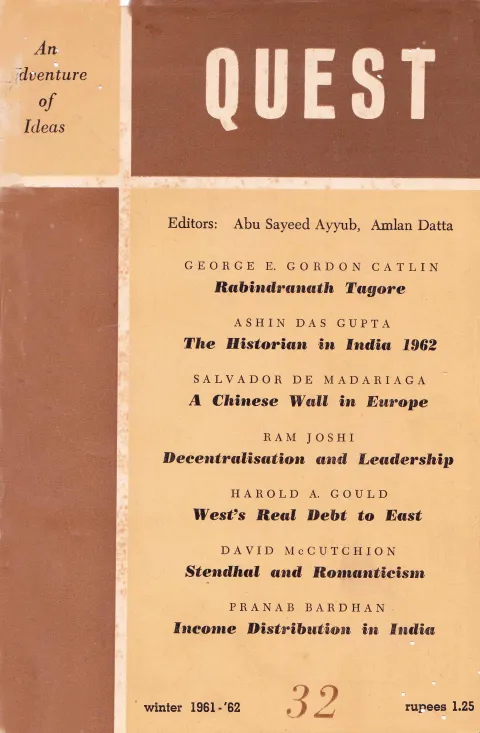
QUEST
Summary
Quest No. 32 (contents page: JAN./MAR. 1962; front cover: ‘winter 1961-‘62’) is the Bombay quarterly of the Indian Committee for Cultural Freedom, edited by Abu Sayeed Ayyub and Amlan Datta with Nirad C. Chaudhuri and Laxmanshastri Joshi as advisory editors, Nissim Ezekiel as Reviews Editor, Laeeq Futehally as assistant, and Sheela Singh as Business Manager. The contents page bills the magazine ‘A Quarterly of Inquiry, Criticism and Ideas’; the cover calls it ‘An Adventure of Ideas’. The issue’s argumentative centre is the relation between cultural autonomy and political power. G. E. G. Catlin reads Rabindranath Tagore (in his centenary season) as the anti-nationalist prophet of cultural freedom; Ashin Das Gupta tells Indian historians that communal and regional history-writing is immoral in 1962 and that ‘propaganda for the good cause has become a necessity’; Ram Joshi weighs Maharashtra’s district-council scheme against the Balvantraya Mehta Committee’s block model and against caste-bound village society; Harold A. Gould argues that colonialism arrested an indigenous Indian modernisation already under way, so that Western aid is restitution rather than charity; Pranab Bardhan marshals tax, wage and expenditure data to show that a decade of planning has widened inequality. Around this sit two ‘Angles on the German Problem’ — Salvador de Madariaga on the Berlin Wall as Khrushchev’s closed shop-window, Martin S. Dworkin on the postwar Anglo-American film habit of separating decent Germans from dirty politics — plus David McCutchion on Stendhal, F. R. Stanley on Kabir, Jagannath Prasad Das on the scientific pretensions of psychoanalysis, three poems, a short story set in Shillong, a six-page books column, nine signed book reviews, six unsigned shorter notices, and two letters.
The issue is emphatically a Congress for Cultural Freedom product: the Berlin Wall, Soviet propaganda on Gagarin, the Eichmann trial, the Nazi past and the Soviet re-assessment of Gandhi are all handled from a liberal anti-totalitarian position, while the domestic pieces are sceptical of Indian planning and of what Bardhan calls ‘that monument of platitudes and cliches, The Third Five Year Plan’. It also carries no artwork or photographic plate of any kind — every visual page in the issue is a commercial advertisement (Dunlop, Bengal Potteries, Mahindra, Mobil, Tata-Mercedes-Benz, Khatau, Wills’ Gold Flake, Tinopal, a Government of India tourist-books page, Jamshedpur/Tata, Peps, Caltex, IISCO, Mafatlal, Indian Oil, Small Savings, Kohinoor, Hindustan Motors, Encounter, Hindustan Lever), the sole exception being a small comedy-and-tragedy masks vignette beside the ‘BOOKS’ section head on printed p.77. That absence is a genuine finding for this number of the run.
Essays
Rabindranath Tagore
By G. E. G. Catlin
Catlin’s piece, abridged from an address printed in the Journal of the Royal Society of Arts, reads Tagore not as a poet who dabbled in politics but as a political thinker whose central category was the Nation — and whose central hostility was to it. Catlin traces four episodes of ‘moral indignation’: the 1900 patriotic Stories and Tales, the campaign against Curzon’s partition of Bengal, the 1919 renunciation of the knighthood after Jallianwala Bagh, and the 1940 refusal (against Eleanor Rathbone’s appeal) to bring India into the war on terms India had not been consulted about. Against Gandhi’s swaraj he sets Tagore’s fear of Bengali chauvinism and his descent from Rammohun Roy’s Brahmo reformism.
The argument’s core is Tagore’s definition of the Nation as ‘a machinery of commerce and politics’, a hydraulic press of impersonal power which Catlin links to Hobhouse’s ‘metaphysical idea of the State’ and to what ‘we call alienation’. Tagore’s quarrel with empire, Catlin insists, was cultural rather than economic: what outraged him was Macaulay’s educational strait-waistcoat, and he would not necessarily have preferred a Hindi culture imposed on Bengal. A second movement of the essay defends Tagore’s distrust of science and his Upanishadic metaphysics, glossed through Radhakrishnan and then — in a surprising turn — through Teilhard de Chardin’s Milieu Divin, whose theme Catlin finds ‘almost exactly the same pattern of thought’ as Tagore’s.
- Presents Tagore as political thinker and ‘Great Sentinel’, not as an occasional political poet; notes he attended a Congress annual meeting only once, to sing Bande Mataram.
- Four episodes of moral indignation anchor the reading: Stories and Tales (1900), the anti-partition campaign against Curzon, the 1919 resignation of the knighthood after Jallianwala Bagh, and the 1940 exchange with Eleanor Rathbone over the war.
- Tagore’s ‘Nation’ is a machinery of impersonal power; Catlin ties it to Hobhouse’s ‘Metaphysical Idea of the State’ and to modern ‘alienation’.
- The indictment of empire is cultural, not economic: Macaulay’s education system is the outrage, and Catlin adds pointedly that a Hindi culture imposed on Bengal would have fared no better.
- Closes by aligning Tagore’s metaphysics with Radhakrishnan’s Verstand/living-concrete distinction and with Teilhard de Chardin, arguing the verities Tagore expressed ‘are not those either of India or of the East alone’.
Democratic Decentralisation
By Ram Joshi
Joshi’s article (printed under the fuller title ‘Democratic Decentralisation and the Problem of Local Leadership’) sets out the political problem behind panchayati raj. Independent India’s ‘modernist elite’ inherited a tradition of leadership that was ‘symbolic’ rather than ‘creative’: habitual obedience to a superior personality, rights tied to caste function rather than to individuals. The result is a democracy of ‘soulless formalism’ in which governments announce large welfare schemes, find no popular co-operation, fall back on the bureaucracy, and thereby isolate themselves further. Decentralisation matters, Joshi argues, less as a constitutional ideal than as the only institutional device that can manufacture the local leadership the Plans need.
He then compares two models. The Balvantraya Mehta Committee recommended the block as the unit with an indirectly elected pyramid topped by the Zila Parishad; the Government of Maharashtra proposes the district, with directly elected District Councils, almost no ex-officio membership, and committees elected by proportional representation with a single transferable vote. Joshi prefers Maharashtra’s: a district constituency of some thirty-five thousand is winnable by hard work rather than by purse, and the committee principle forces opposition parties to share in making and executing decisions instead of merely opposing. He is candid about the dangers — caste rigidities are hardening, not loosening, and ‘village gangsterism’ is a real risk — and equally candid that there is almost no popular demand for decentralisation, rural people preferring the Collector as protection against ‘the predatory invasion on their power and purse by the local politicians’. Against the romantic appeal to ancient village republics he is blunt: self-sufficiency was a function of isolation, and the ancient village was ‘the arrested village’.
- Diagnoses Indian leadership as ‘symbolic’ not ‘creative’ (citing Schmidt), producing a democracy of ‘soulless formalism’ in which mass expectations expand government while popular co-operation does not follow.
- Contrasts the Mehta Committee’s block unit and indirectly elected Zila Parishad with Maharashtra’s directly elected District Councils, and prefers the latter as ‘distinctly more democratic’.
- Argues the committee principle plus proportional representation by single transferable vote will make opposition parties responsible partners rather than pure obstructors.
- Rejects the historical argument from ancient village republics: their sufficiency rested on isolation and fatalistic caste routine.
- Concedes the experiments respond to doctrine and to the fear of Plan failure rather than to any popular demand, and warns of casteism, parochialism and village gangsterism.
Stendhal and Romanticism
By David McCutchion
McCutchion’s essay — the longest in the issue, set in smaller type across eight pages — uses Stendhal to anatomise Romanticism. Following Irving Babbitt, he defines Romanticism as exalted idealism married to unrestrained egoism, deprived of moral discipline and therefore doomed to the mal du siecle. Stendhal is the exception who proves the type: divided between ‘logique’ (French analytical intellect) and ‘espagnolisme’ (sensibility nurtured on the Nouvelle Heloise), he is the first writer to accommodate himself to the failure of absolutes and ‘to realise that relativity is the price of freedom’.
Much of the essay is close reading. Julien Sorel combines Romantic energy with Romantic sensibility but is set loose in a real, harsh world, so that ‘every attempt to actualise an ideal betrays it’; Mathilde de la Mole is an overt satire of Romantic love; Lucien Leuwen is the satire of parliamentary democracy and of the bank that ‘is at the head of the state’. McCutchion reads Stendhal’s Restoration France as devitalised in every sphere — the lopped plane trees of Verrieres, the Besancon seminary that shuts out life, the Paris salon ‘dying of boredom with its own existence’ — and Julien’s energy as the locus of value in a conflict not of good and evil but of life and death. The last pages turn the argument on the present: Stendhal’s philosophy of ‘the happy few’ who accept the rules of the game to gain scope for their own gifts is, McCutchion suggests, one of ‘the chief forces of disintegration in European society today’, because in an affluent society everyone believes himself one of the happy few and the ‘chase for happiness’ becomes the aim of life. He closes with Kierkegaard’s aesthetic/ethical/religious stages, wondering whether societies run them in reverse.
- Defines Romanticism via Irving Babbitt as idealism plus egoism minus moral discipline, producing the ‘children of Werther’ and the mal du siecle.
- Stendhal is the divided exception: ‘logique’ against ‘espagnolisme’, a realist who knows when he is happy and who accepts relativity as the price of freedom.
- Reads Scarlet and Black as the Romantic predicament staged in a real world, with Mathilde de la Mole as explicit satire of Romantic love and Julien’s energy as the essay’s locus of value.
- Reads Lucien Leuwen as satire of parliamentary democracy and of finance capital: ‘the bank is the nobility of the bourgeois class’.
- Turns the analysis on 1962: the ethic of ‘the happy few’ has become mass aesthetic hedonism, ‘the betrayal of the clerks’ complete, with Durrell’s Alexandria Quartet and Swami Agehananda cited as symptoms.
The Historian in India, 1962
By Ashin Das Gupta
Das Gupta opens with Nelson at Trafalgar to say that in 1962 India needs more than the traditional duty, and then asks what the historian’s traditional duty is. Section I argues that it is impossible to discharge: a historian who searches his sources with the best techniques still gives only ‘some truths about the past’, consoles himself with a segment and thereby distorts by omission. Even the detached antiquarian distorts, ‘by robbing the past of its vitality’. The right conclusion is not despair but modesty: ‘all history is false, but some history is less false than others.’
Section II makes the political turn. Das Gupta thinks it probable that ‘in some years from now the Republic of India will break down in confusion’, and that historians have a vested interest in the integrity of their country. The danger is not a faulty reading of the past but a vicious mental climate, to which a particular kind of history contributes: communal history and history that exalts one region at the expense of others. His striking move is to concede the factual accuracy of such work — historians who bring up ‘stories of sustained Muslim atrocities against the Hindus’ are not necessarily lying — and to condemn it on moral rather than evidential grounds: ‘communal and regional preoccupations are immoral.’ Traditional tests (are the facts ascertained? does the thesis account for most known facts?) will catch the worst of it, but they are not enough; the real work is to build new preoccupations, telling the story of the common people ‘quietly underlining its totality and synthesis’. Section III answers three objections — that this denies historical objectivity, that it licenses private moralities, and that it is either dictatorial or futile — by distinguishing objective factual assertions from unavoidably non-objective generalisations, and by insisting that morality should shape the orientation of research, never the acceptance or rejection of a thesis.
- The historian’s traditional duty — the truth about the past — is unperformable; all history distorts, whether by omission, by predilection, or by antiquarian lack of imagination.
- ‘All history is false, but some history is less false than others’ — work with diligence and circumspection to approximate an unattainable totality.
- Predicts a possible breakdown of the Republic and identifies communal and regionalist history-writing as a contributor to the ‘vicious mental climate’ behind it.
- Concedes that communal historians may be factually accurate and condemns them morally instead; the antidote is not refutation but a new social and economic history of the common people.
- Distinguishes two levels of historical statement (objective specific facts; inescapably less objective abstractions) so that moral considerations guide the choice of subject, never the validation of a thesis.
West’s Real Debt to East
By Harold A. Gould
Gould’s article (headed ‘The West’s Real Debt to the East’) begins from a Dutch scholar’s account of Indonesia as a congeries of progress and stagnation, and from the justification of Dutch rule as better than ‘the former feudal conditions’. Gould inverts the argument. Down to the mid-eighteenth century the East-West encounter was a commercial draw, often more profitable to Asia; Mughal India, Ming China and the Southeast Asian entrepots were richer and more venerable than Europe. What upset the balance was the Industrial Revolution, which turned Europe from a buyer of Asian handicrafts into a hunter of raw materials and captive markets, and which sent European populations up six hundred per cent, supplying both the motive and the manpower for expansion. Asia’s simultaneous internal collapse — Aurangzeb’s defeat of Dara Shikoh, the Maratha catastrophe at Panipat, the Manchu decay in China — meant the great civilisations were subdued not even by states but by trading companies.
Colonialism, on Gould’s account, produced societies ‘modern’ in administration, transport and communication but ‘backward’ in production, with a Westernised elite alienated from peasants barred from the modern economy — hence the appearance of progress and non-progress together. Against Max Weber’s verdict that the ritual law of caste could not give birth to economic revolutions from within, Gould offers the Bhakti mystics — Ramanand, Kabir, Nanak, Garibdas, Chaitanya — quoting D. P. Mukerjee on their revolt against caste and ritual, and argues that British policy to ‘honour native custom’ froze that reform current by re-empowering the high-caste factions Bhakti had been challenging. Japan, spared a colonial master, is his one concrete counter-case. He is careful not to demonise European individuals — quoting Redfield on judging earlier stages of civilisation, and conceding that Parliament and even part of Gandhi’s outlook were Western gifts — but concludes that the East’s involuntary ‘aid programs’ financed the West’s industrialisation, and that repayment is a right rather than a charity.
- The 15th-18th century encounter was ‘a draw from the standpoint of power’, often more profitable to Asian than to Western societies.
- The Industrial Revolution, plus a 600 per cent European population rise, converted Asia into supplier of raw materials and receiver of finished goods, destroying its handicraft integration.
- Asia’s near-simultaneous political collapse (Aurangzeb over Dara Shikoh, Panipat, the Manchu Ch’ing decay) let mere trading companies dominate whole civilisations.
- Contests Max Weber directly: the Bhakti reform current was already dissolving caste rigidity, and British ‘honour native custom’ policy reversed it by confirming high-caste authority.
- Concludes that colonies were involuntary one-way ‘aid programmes’ to the West, so Western capital transfer today is restitution, not generosity; Japan is the counterfactual.
Income Distribution in India
By Pranab Bardhan
Bardhan’s article (printed as ‘Recent Trends in the Distribution of Income in India’, under a Lewis Carroll epigraph about dyeing one’s whiskers green and using a large fan so they cannot be seen) asks where a decade of planning has sent the national income. His frame is Kuznets’s long secular swing in inequality, and the observation that developing economies, unlike Victorian England, cannot postpone egalitarian claims; India’s professed answer was rapid growth plus equality, and it has delivered neither — a 3.5 per cent growth rate, half Turkey’s and a third of Iraq’s, and a Mahalanobis committee whose findings were still undisclosed more than a year on.
The body is an assembly of scattered evidence. The new direct taxes have made no dent: Wealth Tax receipts were 0.05 per cent of national income in 1960-61, Estate Duty, Gift, Expenditure and Wealth taxes together 0.08 per cent, while the share of direct taxes in total receipts fell from 32.6 to 29.5 per cent and the excise burden shifted towards ‘wage-goods’. In agriculture, roughly 10 per cent of the population took more than half the total agricultural income in 1953-54, and over 30 per cent of the decade’s income increase accrued to holdings of 30 acres and over — 3 per cent of rural people. Agricultural labour families’ total income fell 11 per cent in absolute terms between 1950-51 and 1956-57. Industrial labour’s share stayed flat while the profits index rose from 100 to 151.7; unemployment’s backlog grew from 5 to 9 million. Consumer expenditure data show the lowest 75 per cent static and the top 10 per cent gaining. Bardhan then dismantles the standard defences — that early inequality is historically inevitable, that egalitarianism blunts incentives, that inequality finances savings (savings rose only from 6.7 to 7.7 per cent of national income), and that redistribution is politically unfeasible — and ends by asking whether India is ‘having second thoughts on socialist ideals’.
- Growth of 3.5 per cent a year is half Turkey’s and a third of Iraq’s; the Mahalanobis committee on distribution had reported nothing after more than a year.
- The celebrated new direct taxes are negligible: Wealth Tax 0.05 per cent of national income in 1960-61, and Estate Duty plus Gift, Expenditure and Wealth taxes together 0.08 per cent — ‘The mountain has evidently produced a poor little mouse.’
- Agricultural gains are concentrated: about 10 per cent of the agricultural population took over half of agricultural income in 1953-54; over 30 per cent of the decade’s increase went to holdings of 30 acres and above, only 3 per cent of rural people.
- Agricultural labour families’ total income fell 11 per cent in absolute terms 1950-51 to 1956-57, while industrial real earnings crept to 102.6 against a productivity index of 132.7 and a profits index of 151.7.
- Rebuts the inevitability, incentive, savings-financing and political-infeasibility defences of inequality, quoting Kuznets against the analogy with historical Western Europe.
The True Disciple
By F. R. Stanley
Stanley’s essay (printed as ‘The True Disciple: An Essay on Kabir’, under an epigraph from a letter of Plotinus to Flaccus) begins at Maghar, where a Hindu shrine tended by a sadhu of the Kabir Panth and a Muslim shrine held by a family of weavers stand divided by a high wall — two monuments, he says, to the Oneness that Kabir preached. He retells the legend of Kabir’s discipleship to Ramananda, notes that the one authenticated biographical fact is his weaving, and reads the loom imagery of the 28th Ramaini of the Bijak as Kabir’s image of God. The argument is that Kabir’s rejection of Hindu and Muslim dogma alike — pilgrimage, fasting, sacred threads, circumcision, idolatry, asceticism — follows from a single conviction that the unity of God is manifested in a unity of love uniting all castes and creeds.
The second half places Kabir among the mystics. His God is neither abstraction nor impersonal infinite; the Bijak’s 6th and 7th Ramainis stage the difficulty of describing the indescribable, and the Adi-Granth supplies the settled claim that purity of heart is what permits the vision of God. Stanley sets Kabir’s period — the declining Delhi Sultanate, Timur’s invasion of 1398, Lodi bigotry — as the political background against which the Bhakti movement rose, and traces the line Ramanuja to Ramananda to Kabir. He notes the wordplay on manaka/pher that carries the rosary couplet, the Sufi ‘stations of the soul’ that structure Kabir’s spiritual pilgrimage, and the scale of Kabir’s afterlife: a following of a million or more, thousands of sakhis still current by word of mouth in northern India, and Kabir Panth sects of both Hindus and Muslims claiming him.
- Opens at the twin shrines of Maghar, Hindu and Muslim, divided by a wall — offered as monuments to the unity Kabir preached.
- Kabir’s weaving is ‘the only authentic piece of information’ about him; the loom supplies the Bijak’s central image of God as weaver.
- His rejection of both Hindu and Muslim ritual follows from one premise: the unity of God manifested as a unity of love across caste and creed.
- Places Kabir historically in the declining Delhi Sultanate after Timur’s 1398 invasion, and doctrinally in the Bhakti line from Ramanuja through Ramananda.
- Reads Kabir as a mystic in the Sufi ‘stations of the soul’ sense — dying to self, then awakening to God — whose posthumous following crossed both communities.
Psychoanalysis Re-examined
By Jagannath Prasad Das
Das asks whether psychoanalysis is a science and answers no, while insisting that a theory can be useful without producing rigorous laws. He begins with the sociology of the movement: Freud’s popularity rivals Marx’s, some contemporary novels can hardly be told from psychiatric case reports, and to the man in the street psychology just is psychoanalysis. But Freud’s habit of ascribing personal motives to theoretical disagreement — Jung’s ‘lofty ideas’, Adler’s will to power, Havelock Ellis’s presumed impotence — sealed the movement off from criticism. The set-up is self-confirming: no one who has not been analysed may contribute, and the years of analysis wash out the complexes and the critical attitude together.
Das then sets out the theory fairly — id, ego, superego; Eros and Thanatos; repression, rationalisation, sublimation and regression; the psychopathology of everyday life — before locating the fallacy: ‘regarding observation and explanation as inseparable’, so that the truth of Freud’s observations casts a halo over explanations with no experimental moorings. The heaviest charge is biological reductionism: Freud forgot that man is a social animal, and built the universality of the Oedipus complex on a sample of neurotic upper-middle-class Germans. Totem and Taboo is ‘a woeful performance’ by anthropological standards. Das surveys the neo-Freudian revolt (Kardiner, Fromm) to show that only the form of psychoanalysis survives in it, notes Freud’s late conversion to occultism and his defence of lay analysis as evidence of an unscientific temper, and concludes on therapy: prolonged, expensive, with cure rates not significantly different from no treatment, though the analyst remains ‘a great source of comfort and consolation’ in impersonal big cities — which, Das says, proves little about id, ego or superego.
- Distinguishes psychoanalysis’s cultural authority from its scientific standing, and allows that unverifiable theories can still contribute.
- Documents Freud’s practice of converting theoretical dissent into diagnosis (Jung, Adler, Havelock Ellis), and the closed-circle rule that only the analysed may contribute.
- Names the core fallacy: treating observation and explanation as inseparable, so true observations lend a halo to unmoored explanations.
- Attacks the biological reductionism — man as biological rather than social unit, the Oedipus complex universalised from neurotic upper-middle-class German patients, Totem and Taboo dismissed by anthropologists.
- Finds the neo-Freudians (Kardiner, Fromm) retaining only the form of psychoanalysis, and reports that American analytic associations claim no statistically acceptable evidence of curative power.
1) A Chinese Wall in Europe
By Salvador de Madariaga
Madariaga’s short piece opens with a reported incident: while the wall went up, an East German guard escaped west because his comrades, unwilling to be photographed ‘serving the servant of Moscow’, turned their backs on the cameramen. He reads it as the whole operation in reverse. Khrushchev, he argues, was cornered: on the eve of sending a settler to the Moon, his German colony was emptying itself westward at a rate of one a minute, with no bread in the Eastern Zone and no movement without police scrutiny. The zone was a double shame — proof that a free Germany could become a miracle of wealth and that a communist Germany could not compensate its subjects for their lack of freedom — and, worse, evidence that the Soviet Union could not remedy it, and so that the Soviet economy itself was ‘parlous’.
Madariaga then ventriloquises ‘the Red Tsar”s strategy in the first person: we cannot improve the Eastern Zone, but we can stop the leakage of the young and end the scandalous contrast between the two Berlins; the Powers have not reacted to broken arrangements before, so the risk is small; and in the meantime we will distract and frighten the West with carefully contradictory statements — imperious demands under nuclear threat while insisting it is they who threaten us, a peace treaty offered and its refusal made catastrophic — so that governments turn from the real problem to the formal ones of how to avoid nuclear war and how to negotiate. He concedes the Red Tsar got away with it: the Western press largely agreed that nothing in the record obliged the Powers to prevent Ulbricht from building a wall, and no one but a madman would risk nuclear war over it. The Iron Curtain ‘has now blinded the window’, and Madariaga calls it the most signal cold-war victory since Budapest-56.
- Opens with the guard who escaped because his comrades turned their backs on Western cameras, read as a symbol of the whole operation in reverse.
- Frames the Eastern Zone as the Soviet Union’s shop-window, whose poverty proved both that communism does not deliver and that Moscow could not fix it.
- Reconstructs Khrushchev’s strategy in his own imagined voice: seal the leakage, end the visible contrast, exploit Western non-reaction to earlier broken arrangements.
- Argues the contradictory nuclear rhetoric was designed to shift Western attention from the real problem to the formal questions of avoiding war and negotiating.
- Concludes that the wall was not a sufficient cause for anyone but a madman to risk nuclear war, and counts it the biggest cold-war victory since Budapest 1956.
2) Clean Germans and Dirty Politics
By Martin S. Dworkin
Dworkin’s essay is a study of a film convention and its politics. Six years after Nuremberg, The Desert Fox (1951) gave Rundstedt and Rommel a subtle sympathy as chivalric enemies; by 1958 Variety could headline ‘FILMS’ NEW NICE-NASTY NAZIS’. Dworkin’s thesis is that turning old enemies into allies on screen requires a renovation of memory, and that the device chosen was to separate Germans from politics: the soldiers are decent, the politicians are to blame, and the politicians happen to be Nazis. The pattern, he notes, marks almost all American and British films of the decade but very few French and even fewer Russian ones.
He then works through the corpus. The British specialise in triumphant ingenuity and the glorified German antagonist — Rommel, Canaris, Langsdorff, Von Werra in The One That Got Away. The Americans, under State Department hints about overseas audiences and commercial pressure, go further, making good Germans resemble Americans in appearance and mannerism, from John Wayne’s captain in The Sea Chase to Curt Jurgens’s U-boat commander in The Enemy Below, each supplied with a fanatic Nazi political officer ‘apparently carried by all German ships as standard equipment’. Loyalty is displaced onto Imperial Germany rather than onto any pre-Hitler democracy. The German girl gets the same treatment in Fraulein (1958), rehabilitated by kindly Americans against a tourist-poster Rhineland. The culmination is I Aim At the Stars (1960) on Wernher von Braun, where a single critical American character lends a false air of public debate to a film that moves ‘pointedly to exculpate’ its subject: the good German of the past as outside politics, the good scientist of the present as outside responsibility. Against this Dworkin sets the documentary counter-wave — Erwin Leiser’s Mein Kampf, The Valiant Years, the Eichmann trial coverage — whose propaganda, he argues, had also to be counterpropaganda ‘against recurrent inclinations of the victors themselves to separate the Germans from their politics’.
- Traces the ‘Nice-Nasty Nazi’ convention from The Desert Fox (1951) to Variety’s 1958 headline and the 1961 ‘NEW NAZI BEAST FILM CYCLE’.
- The device is to split soldiers from politicians: decent Germans despise ideology, guilt is assigned to Nazis-as-politicians, and the question of why the war was fought disappears.
- British films glorify the chivalric German antagonist; American films Americanise the good German’s appearance and manner and attach a standard-issue fanatic Nazi officer.
- Loyalty is displaced onto Imperial rather than Weimar Germany, raising ‘the ghosts of the gallant Count Von Luckners and Baron Richtofens’ of an earlier romanticised enmity.
- I Aim At the Stars is the culmination: it fabricates an open debate about von Braun that never happened, and argues ‘for a future of little meaning’ by keeping the good German outside politics and the good scientist outside responsibility.
The Poet
By P. Lal
A fourteen-line poem in two stanzas opening the issue’s poetry section. The first stanza sets the poet’s comic outward accidents — wild hair, a stammer at parties, slipping from a tram, an unmended sole, a ‘mock heroic Damn’ — against the faculty those accidents conceal: he notices the spider’s intestines, sees harlot and black marketeer claimed by the same web, and divines in a clicking grin ‘A moody world of artifice and fear’. The second stanza gives the priority (‘Above all, this’): watching a woman weave her hair in the sun, the poet sees her common eyes reach towards a lost country, and the poem ends on repentance yearning for hope and love and finding none.
- Structured as a contrast between the poet’s ludicrous social surface and his perceptual gift.
- The spider’s web image collapses moral distinctions — ‘windy harlot and black marketeer’ are claimed alike.
- The turn at ‘Above all, this:’ privileges an ordinary woman’s gaze over the poem’s earlier cleverness.
- Ends on an unresolved negation: repentance yearning ‘For hope, and love, and finds that there is none.‘
Rain on the Pond
By Haig Khatchadourian
A shaped, two-movement poem printed with musical tempo directions as part of its text. Under ‘(Allegro moderato)’ the lines lengthen from a single word (‘Endless’) outward as raindrops strike the pond and the ripples widen — ‘Expanding to circle-within-circle of little ripples / Like opening water-lilies or lotus flowers blooming’ — until the lines dissolve into ellipses and the simile turns explicitly temporal: ‘Like life’s ripples… traced… on… time’s waters…’ The second movement, ‘(Presto)’, restarts the same growth at speed, replacing beads with ‘Strings of rain-drops’ and closing on an Italian musical direction used as description: ‘Running staccato molto allegro vivace in demisemiquaver time…’. The typographic shape of the stanza, widening then tapering, does the work of the metaphor.
- Two movements marked ‘(Allegro moderato)’ and ‘(Presto)’, with the tempo directions printed as part of the poem.
- Line length grows word by word to mimic the widening of ripples, then tapers into ellipses.
- The water-lily and lotus similes turn the physical observation towards the conventional Indian image repertoire.
- Closes by borrowing musical vocabulary outright — ‘staccato molto allegro vivace in demisemiquaver time’ — as the description of rain.
Krishna’s Handmaiden
By Dadu
An eleven-line devotional lyric in the voice of a woman awaiting Krishna, bylined ‘Dadu’ on the contents page and credited beneath the poem as ‘An adaptation of Dadu’s “Fajar Meh Jub Elchi” by Sudhin Ghose’. A resplendent messenger brings a missive at morning and ascends again before she can answer — ‘then too late, alas!’ — leaving her speechless, trembling and fear-worn. The day racks her with ordeals of fire while she is burdened with love’s longing; peace comes only with the evening angelus of praise as ‘west the sunset’s saffron grace declared’. The close reverses the expected image of night: the sky’s dark scroll unrolls ‘black as death’ and is at once denied — ‘Not dark! No! Lit was it with letters of fire’ — summoning her to the tryst in bride’s attire.
- A bridal-mystical lyric: the soul as woman summoned by a messenger to a tryst with the divine beloved.
- Structured by the daily cycle — morning missive, day of fire, evening angelus, night of letters of fire.
- The final couplet reverses the funereal image of night into one of illumination.
- Printed as an adaptation rather than a translation, with the adapter (Sudhin Ghose) named only under the poem and not on the contents page.
The Doctor’s Fees
By Murli Das Melwani
A seven-page story set in and around Shillong. Deng, a twenty-year-old Khasi girl who sells firewood with her mother, finds her mother feverish with only four rupees, a little milk and one bundle of wood left in the shanty. She walks into town to fetch a doctor. Dr. Ved Prakash takes two rupees for consultation, refuses to visit for less than seven, writes a prescription without seeing the patient, and dismisses her: ‘Oh! don’t take up my time. I’m a busy man.’ Deng runs home, carries the last bundle of wood into town on a forehead strap through the Republic Day fireworks, is refused by household after household and by the Burra Bazaar wholesalers, escapes a man who lures her into his kitchen, and finally sells the wood for three rupees to a tailor. The doctor now demands a taxi.
The second half turns on the price of that taxi. The drivers at the stand jeer at her; Kalu, who holds ‘the contract of three hotels’ supplying ‘extra comforts’ to lodgers, offers her ten rupees for an hour’s work, minus three for himself. She refuses, goes to her estranged brother for money and is driven out by a drunk who hurls a glass at her; her sister-in-law has nothing. Remembering a wild pony flogged into accepting the halter, she goes back to Kalu. The rape is written in a single restrained paragraph of terror and a closed door. She brings the doctor, who examines her mother for fifteen minutes, writes a prescription, closes his palm over the soiled notes and hurries out. Her mother asks whether she paid the doctor, whether she paid for the taxi, and notes that there was only one bundle in the house. Deng nods. ‘They looked at each other, without words, without reproach.’ The story’s indictment is distributed — doctor, hotel, taxi contractor, brother — and its language records without softening the drivers’ obscene abuse of her.
- A single evening’s errand structures the whole story: the fee demanded, the wood sold, the taxi demanded, the body sold.
- Dr. Ved Prakash is characterised entirely through fee schedules and the repeated line ‘I’m a busy man’; he has time for a minister’s daughter.
- The taxi driver Kalu is presented as a procurer with hotel contracts, framing the exchange as an ordinary commercial service.
- Childhood memories of Independence-day fireworks and of getting lost in Burra Bazaar are cut into the walk, measuring the family’s fall.
- The ending withholds moral commentary: mother and daughter exchange three factual questions and look at each other ‘without words, without reproach’.
Talking About Books
By Sadhan Kumar Ghosh
Ghosh’s six-page ‘Books in General’ column is an omnibus survey of recent British publishing, written in the first person of a well-connected reader who drops conversations with Harold Nicolson, Kathleen Nott and Arnold Wesker into the argument. It opens on Byron: Doris Langley Moore’s The Late Lord Byron, built on the Lovelace Papers, against Virginia Woolf’s impatience with centenary gossip, and Andrew Rutherford’s critical study, which Ghosh faults for trying to appraise the poetry with as little reference to the man as possible — ‘Byron was not even a split personality; he was a multiple personality.’ Scott follows, with Donald Davie’s Heyday and John Buchan’s centenary study, and Ghosh endorses MacDiarmid’s thesis that Scottish culture is European where English culture is insular.
The rest ranges over Peter Quennell on the essay, Ronald Firbank’s revival, two travel books (Kathleen Nott on Sweden, William Sansom on the Mediterranean), two autobiographies (Derek Patmore and L. A. G. Strong), Philip Toynbee’s Underdogs, Yeats criticism (Ellmann, Jeffares, A. G. Stock), Batsford’s English topography, Nicolson on humour, Day Lewis’s lyric anthology, Compton Mackenzie on Greece, John Davidson, and Methuen’s Shakespeare list. Two threads recur: hostility to the Cambridge-Bloomsbury critical establishment (‘the reign of Cambridge… is over’; the TLS survey ‘tacitly, expressly and deliberately’ ignoring challenges to Leavis and Richards), and a claim for the modern revival of Shakespeare as a revolt against standardisation — ‘in ten years’ time Berlin and Bombay may be equally indistinguishable from Birmingham.’ The column also contains the issue’s sharpest personal complaint: that Toynbee, cataloguing chips on shoulders, never considered ‘the cases of Indians whose English is too good for India and whose skins too dark for England.’
- Byron and Scott lead the column; Ghosh insists the poetry cannot be read apart from the man and endorses MacDiarmid’s Scotland-as-European thesis.
- Sustained hostility to the Cambridge-Bloomsbury establishment and to the TLS’s silent exclusion of challenges to Leavis and Richards.
- A long appreciation of Ronald Firbank as dandy, impressionist and ‘pedlar of day-dreams’, via Connolly and Anthony Powell.
- Faults Philip Toynbee’s Underdogs for inept editing and for omitting ‘Indians whose English is too good for India and whose skins too dark for England’.
- Reads the Shakespeare revival as revolt against a standardising modern civilisation in which ‘Berlin and Bombay may be equally indistinguishable from Birmingham’.
Mr. Gandhi
By Iqbal Lukmani
A review of Ranjee Shahani’s Mr. Gandhi (Macmillan New York, pp. 211, $4.95). Lukmani’s opening conceit is that in the India of 1961 the title conjures a man likely to float a fertiliser factory: a generation used to wreaths at the samadhi and to politicians invoking the magic name in reverent tones knows only Mahatmaji, Mahatma Gandhi or at best Gandhiji, while ‘the plain Mister Gandhi’ has been obscured by the very ocean of writing about him. Lukmani says he asked his friends and was astonished that practically none under thirty had any idea what sort of man Gandhi was; ‘He was a saint’ was the sum of their knowledge.
Shahani’s method — ten years of interviews with relatives and co-workers, collecting ‘les petits faits vrais’ rather than relying on the printed mass — earns Lukmani’s approval, and he credits the book with being vivid, forthright and readable, and with bringing out the streak of fierce honesty even while narrating Gandhi’s amorous excesses (a father at sixteen) and his demand for complete obedience from his wife, who ‘taught him his first lesson in satyagraha’. The criticisms are structural: the early chapters over-dramatise, and the transition from ordinary lawyer to miracle-worker is too abrupt, so that the self-discipline by which Gandhi grew into his new position is skimped and a gap is left in the reader’s comprehension. Lukmani ends with Shahani on the lemon-juice cure (‘no one except a saint or a charlatan could so risk a precious existence’) and with Stafford Cripps on the well-timed prayer break, concluding that Gandhi ‘was a saint who was too political and a politician who was too saintly’.
- Frames the book’s value as recovering ‘the plain Mister Gandhi’ from beneath ritual invocation and an ocean of commentary.
- Reports that almost none of the reviewer’s friends under thirty knew what kind of man Gandhi was beyond ‘He was a saint’.
- Praises Shahani’s ten years of interviews with relatives and co-workers over reliance on the existing literature.
- Faults the book for over-dramatising Gandhi’s early life and for making the transition to ‘miracle-worker’ too abrupt, skipping the self-discipline that produced it.
- Notes without flinching the material on Gandhi’s sexual excesses and his demand for obedience from Kasturbai, which Lukmani reads as evidence of the book’s honesty.
Politics, Power and Parties
By S. Natarajan
A review of M. N. Roy’s posthumously collected Politics, Power and Parties (Renaissance Publishers, Calcutta, pp. 216, Rs. 7.50). Natarajan holds that the ten years since Roy spoke or wrote these pieces have only sharpened his points: India is more deeply involved in the system he denounced, and more acutely in need of ‘rescue operations’ — a need even the party in power now concedes, as the recent national-integration conferences show. He sets out Roy’s thesis that parliamentary democracy has failed to yield satisfactory results while dictatorships make matters worse, and that the remedy is decentralisation, education in responsibility, and an appeal to men and women ‘on the plane of reason and morality’. He follows Roy’s argument that ambiguity about the sanction of morality is the source of modern confusion, that religious faith in man’s moral essence implies man cannot be moral, and that the two Western revolts against it — the French Revolution’s transcendental moral order and Liberalism’s utilitarianism — were respectively metaphysical and a negation of morality; Roy grounds morality instead in human rationality.
Natarajan’s own criticism is precise. Roy’s practical proposal, support for independent candidates free of the party whip, rests on ‘a large and wholly unfounded’ assumption that an independent can win without demagogy; unable to outbid the party candidate in promises, he will lean harder on the electorate’s prejudices. Much more could be achieved, Natarajan agrees with Roy against Roy, by a hundred picked men holding attention by their integrity — a proposal he notes bears a striking similarity to what Allan Octavian Hume told Calcutta University graduates in 1883, which he quotes at length. The review closes by conceding Roy’s point that both parliamentary democracy and dictatorship have failed to deliver a fuller and freer life, and then turning it: under party democracy one can strive for better forms without bringing the machinery of government down on oneself, and that choice is absent under any dictatorship.
- Argues the decade since Roy wrote has confirmed rather than dated his indictment, with the national-integration conferences as evidence the ruling party now feels it too.
- Summarises Roy’s grounding of morality in human rationality against both religious faith in man’s moral essence and utilitarian Liberalism.
- Rejects Roy’s independent-candidate proposal as resting on an unfounded assumption: the independent, unable to outbid on promises, will rely more heavily on prejudice.
- Draws a long parallel between Roy’s ‘hundred picked men’ and A. O. Hume’s 1883 address to Calcutta graduates, quoted at length.
- Defends party democracy on a single liberal ground: it is ‘a workable system where the individual can choose to free himself and free others’.
Till We Reach the Stars
By Ashok Desai
A sustained piece of deadpan mockery directed at Khwaja Ahmad Abbas’s Till We Reach the Stars (Asia Publishing House, pp. 145, Rs. 8.50), a book on Yuri Gagarin. Desai opens on the speed of production — Gagarin orbited on 12 April 1961, and the book’s dateline reads ‘Moscow, July 7, 1961: Bombay, August 7, 1961’ — and pretends to wonder whether Abbas is accusing Bombay of being a month behind Moscow, before crediting ‘the kind blurb writer’ with clearing it up. He then reproduces, without comment, Abbas’s rendering of Gagarin’s report to Khrushchev (‘the order of the Government and the task given to me by the Communist Party has been implemented’) and the Cockney taxi-driver crying ‘Oh, Blimey!’, adding: ‘So does Shri Abbas in parts of the book.’
The rest picks at the book’s apparatus: epigraphs pairing Anaximander with Gagarin, a Svetasvatara Upanishad quotation about rolling up space that Desai had thought concerned meditation, a chapter on Tsiolkovsky he genuinely finds informative, and Gagarin described as a ‘blue-eyed phaeton’ and as everyone’s ideal son, brother, pal and beau. Desai concedes that Gagarin nonetheless emerges as pleasant, earnest and sensitive — ‘who won us over when he compared the colours seen from the space ship to the paintings of Nikolai Roerich’. The sharpest thrust is at Abbas’s revision of Carlyle to add ‘Hero as the Common Man’, which Desai notes runs exactly counter to Carlyle’s whole effort. He signs off by suggesting that one of the three photographs of Abbas with Gagarin might have been given over to Gina Lollobrigida instead, and that his own failure to grasp the book’s syntheses may be a want of ‘the Gagarin Summer’ in ‘the Kruschev Era’.
- Mocks the book’s speed of production and its reliance on a ‘kind blurb writer’ to explain its own dateline.
- Quotes Abbas’s uncritical reproduction of Gagarin’s formulaic report to Khrushchev, and the Cockney taxi-driver, without editorial comment.
- Questions the epigraph apparatus, especially a Svetasvatara Upanishad passage recruited to the space age.
- Notes that Abbas’s added Carlylean category, ‘Hero as the Common Man’, inverts Carlyle’s actual argument.
- Concedes that Gagarin himself emerges as pleasant, earnest and sensitive despite the effusion surrounding him.
Nehru: His Democracy in India
By S. R. Tikekar
A defence of Nehru against Atulananda Chakrabarti’s Nehru: His Democracy in India (Thackers, Calcutta, pp. 438). Tikekar describes the book’s three parts — a long derivation of state and democracy from the Sanskrit classics, a section on what Gandhi hoped for against what happened, and an X-raying of Nehru’s utterances and actions — and credits Chakrabarti with originality in naming Nehru’s foreign policy ‘non-violent non-resistance’, ‘doubly passive’, a mysticism of appeasement labelled the ‘Munich mentality’. He agrees that the book usefully distinguishes Gandhi’s passive resistance, meant for politics, from the Buddhist Panchsheel, meant for individuals, and that Nehru has used the two teachings in part ‘to suit his convenience’. But he calls the argument, though fully documented and original in expression, unconvincing.
His counter-case has three strands. Constitutional: Nehru holds office by popular vote, and Indians must learn to have faith in ‘my government right or wrong’; Chakrabarti writes as if aloof from India and from its elected Premier, and leadership, like spiritual belief, must be accepted whole. Developmental: industrialisation and the chain of research laboratories would not have happened without Nehru, and the non-aligned middle path is his contribution to lessening world tension — it would have been easiest to join a bloc, as Pakistan did. Biographical: Nehru was never trained for diplomacy or administration, was on no payroll until he became Prime Minister, and inherited a state with no Indian nation ready to replace the departing British, so blame is misplaced — ‘Anyone else in his position would have been responsible for a far greater number of mistakes.’ Tikekar notes that Nehru held the foreign portfolio for only fifteen years and had to build a foreign service from scratch, and closes by saying that Chakrabarti, calling this an honest endeavour, ‘only overstates his case’.
- Summarises Chakrabarti’s three-part structure and his coinages: ‘non-violent non-resistance’, ‘doubly passive’, the ‘Munich mentality’.
- Accepts the book’s distinction between Gandhian passive resistance as politics and Panchsheel as individual ethics, and the charge that Nehru mixes the two selectively.
- Argues from electoral legitimacy that the elected Prime Minister must be accepted whole, good points and shortcomings together.
- Credits Nehru with industrialisation, the research-institute network, and a non-aligned middle path that resisted the temptations Pakistan accepted.
- Pleads Nehru’s lack of administrative training and the absence of a ready Indian nation in 1947 as mitigation, and finds the book’s tone hyper-critical.
Sunlight on a broken column
By David McCutchion
McCutchion’s review of Attia Hosain’s Sunlight on a Broken Column (Chatto and Windus, pp. 318, 18sh.) opens with a general diagnosis: nostalgia is the favourite mode of the Indian novel in English since Independence, because writers drawn from classes educated under the old order are torn between the age-old pattern identified with home and mother and a modern independence identified with the university, and expiate the guilt of choosing ‘foreign’ ways either by idealising the past or by lip-service to ancient dharma. Rajan’s Dark Dancer rediscovers ancient wisdom; Raja Rao’s Serpent and the Rope combines Vedanta with fin-de-siecle weariness. The danger in all this, he says, is sentimentality, and the broken column in sunlight evokes grandeur while forgetting the cringing slaves and overbearing patriarchs. His counter-model is Satyajit Ray’s Jalsaghar, where the old Zamindar cannot be idealised because he remains imperious and extravagantly foolish even as the forces the film despises destroy him: ‘We must take his greatness with his violence, as Yeats said.’
The novel itself he judges a minor contribution to that literature. He credits charm and restraint, but finds no original significance in the well-tried themes, too little depth to develop character or situation, and vivid detail that evokes only the typical — the sharpest characterisations verging on caricature while hero and heroine are ‘the most anodyne’. Laila’s secret affair follows the pattern of magazine romance, item by item; Sita’s renunciation is stereotyped. Part Four, after fourteen years and partition, he calls ‘an orgy of nostalgia’ in which no touching detail of the abandoned house is overlooked. Against Thomas Mann’s handling of a similar return in Tonio Kroger, he concludes that Hosain lacks detachment and may not feel the need of it — ‘Her purpose is tears, no more’ — and that the Indian novel in English ‘must abandon all these tears idle tears and acquire a little more irony and intellect’.
- Diagnoses post-Independence Indo-Anglian fiction as a literature of nostalgia produced by writers guiltily torn between inherited and university cultures.
- Offers Satyajit Ray’s Jalsaghar as the model treatment, because its Zamindar is destroyed without being idealised.
- Credits Hosain with charm and restraint but finds the novel too slight for depth, its vivid detail evoking only the typical.
- Reads Laila’s romance as following the pattern of ‘countless “true-life” romances from the women’s magazines’, item by item.
- Concludes that the Indian novel in English needs ‘a little more irony and intellect’ rather than tears.
Too Long in the West
By Foy Nissen
A dismissive review of Balachandra Rajan’s Too Long in the West (Heinemann, 16s. net). Nissen opens by asking why the novel received serious attention from Western reviewers — were they deceived by its title, did they expect social satire, were colleagues on the Spectator and the New Statesman beguiled by the blurb and the author’s c.v. only to turn away cheated by its ‘unreality’? He notes that the corpus of Indo-Anglian fiction is still small enough for each new novel to be measured against its predecessors as a matter of course, and that the comparison is unrewarding here, while against current fiction in English as a whole the novel ‘does not breathe more freely’.
He concedes fluent writing and a bland wit in Rajan’s observation of the South Indian scene, and grants that the ingredients promise an expose of provincial IAS-oriented values. What is missing is the satirical detonation: the plot ‘fizzles out with improbability’. He summarises Mudalur, the no-man’s-land presided over by Sambasivan, who has attained pre-eminence in winning crossword-puzzle prizes; his wife Lakshmi’s earthy materialism as the voice of the outside world; the matrimonial advertisement for a ‘Vadama girl, educated yet domesticated’; the American-educated daughter Nalini; the pilgrimage of impossible suitors including the deus ex machina American friend Ernest; and the resolution by Nalini’s marriage to the village revolutionary and barber, Raman, after which Mudalur flourishes under their joint management, circulating its own printed currency, while the Community Development Officer resigns to live there. With this evaporation, Nissen writes, the reader is left pondering the tone of the author’s clever giggle, and he lets one of the failed suitors supply the epitaph.
- Opens by challenging the novel’s favourable Western reception as a possible effect of title, blurb and author’s c.v.
- Concedes fluency and bland wit but finds no satirical detonation: the plot fizzles out with improbability.
- Summarises the Mudalur fable — crossword prizes, matrimonial advertisement, foreign-returned daughter, marriage to the barber-revolutionary, a village printing its own currency.
- Judges the novel ‘perhaps the only example of directionless levitation’ in the development of Indo-Anglian fiction.
- Closes by quoting a failed suitor’s line about an unusual combination requiring discipline as the book’s own epitaph.
Momoirs of a Bengal Civilian
By Aamir Ali
A warm review of John Beames’s Memoirs of a Bengal Civilian (Chatto and Windus, pp. 311, 30s.), placed in the recent wave of memoirs and biographies of those who administered India for the Company and the Crown — Sleeman the suppressor of thugee, John Jacob of Jacobabad, Philip Woodruff’s two volumes. Aamir Ali’s framing claim is that with independence an established institution these accounts can now be read ‘without bringing the heat of nationalist fervour to bear on them’, and can be found extraordinarily interesting: history is most vividly reflected in individual lives, and these lives reveal a period of vast opportunity.
Beames’s value, he argues, is precisely that he was not an outstanding public figure but ‘an ordinary “clodhopping collector”’, and therefore typical, and that he writes directly and freshly. Ali sketches the life of an I.C.S. officer in ‘those spacious days’ when a D.M. was a little god and there was time for private scholarship — Beames produced a Comparative Grammar of the Modern Aryan Languages of India taken up by European philologists — and notes that overworked I.A.S. officers now cast longing glances back. He quotes at length two passages: Beames on the old Daroghas, who ruled as little kings, could command as many witnesses as they wanted, and practised ‘a little torture’ to extract money, yet were often splendid detectives who under a strong Magistrate did excellent work; and Beames on Sir Richard Temple’s 1874 official visit to Cuttack, with its arches, illuminations and ‘eyewash’, concluding that a Governor cannot really know a province the size of England in a hurried tour and that the net gain from such tours ‘is infinitesimal, if not absolutely nil’. It is this ability to see through eyewash and humbug, Ali concludes, that makes the book so useful a picture of an era gone for good.
- Places the book in a recent wave of I.C.S. memoirs and argues that independence now permits reading them without nationalist heat.
- Values Beames precisely for being obscure and therefore typical, and for the directness of his prose.
- Sketches the I.C.S. officer’s life of varied but unexacting work with time for private scholarship — Beames’s Comparative Grammar of the Modern Aryan Languages of India.
- Quotes Beames at length on the old Daroghas: manufactured witnesses, casual torture for money, concealed crime — yet often splendid detectives under a strong Magistrate.
- Quotes Beames on ‘eyewash’ during Sir Richard Temple’s official tour, and on the net gain of such vice-regal progresses being ‘infinitesimal, if not absolutely nil’.
God in Modern Philosophy
By A. M. Ghose
A careful, largely expository review of James Collins’s God in Modern Philosophy (Routledge & Kegan Paul, pp. 476, 40s.), which Ghose calls ‘a fine specimen of modern American scholarship’ written in an extremely lucid style. He lets Collins state his own purpose at length: to determine the main kinds of philosophical approach to God in the modern period, with emphasis on tendencies still shaping contemporary conceptions, on the premise that the philosopher today cannot make headway on the question without consulting his predecessors. Ghose reproduces Collins’s claim that positions on God are the hinge of modern philosophy’s continuity and critical interchange, and his two organising distinctions: the functional use of God in rationalism against its neutralisation by empiricism for the pre-Kantian period, and the polarising conflict between Hegelian and neutralistic absolutism since.
The review then walks the book’s chapters — Cusanus, Calvin and Bruno; Renaissance scepticism (Montaigne, Charron, Gassendi, Huet, Mersenne); God as a function in Descartes, Spinoza and Leibniz, where ‘God was made to serve the purposes of the system itself’; the British empiricists, whose great negative theme was that experience can dispense with God; the Enlightenment as a battlefield with Bayle, Wolff, Voltaire, Holbach, Diderot and Rousseau; two chapters on Kant’s ‘moral functionalism’ and Hegel; ‘The Emergence of Atheism’ with Feuerbach, Marx, Nietzsche and the American naturalists; Mill, James and Whitehead; and ‘The Heart’s Way of God’ with Pascal, Kierkegaard, Newman and the Existentialists. He notes Collins’s own standpoint, ‘realistic theism’, rooted in St Thomas, and the apparatus of 34 pages of notes and 16 of bibliography. Two complaints close the review, both from the periphery: British readers might have expected at least brief references to James Ward, C. C. J. Webb, A. E. Taylor, Balfour, Inge and von Hügel; and, more pointedly, ‘Non-Western views on God have not been taken into account.’
- Presents the book largely in Collins’s own words, as a history of philosophical paths to God rather than of religion, art or theology.
- Highlights Collins’s two organising oppositions: rationalist functional use of God against empiricist neutralisation, and Hegelian against neutralistic absolutism.
- Traces the chapter sequence from Cusanus to the Existentialists, quoting the verdict that in rationalist systems God ‘becomes a major cog, but still a cog’.
- Names Collins’s own position as ‘realistic theism’ with metaphysical roots in St Thomas.
- Registers two omissions — the British theistic philosophers of Ghose’s own training, and non-Western views of God, excluded altogether.
South Asian Affairs, Number One
By Jayantanuja Bandyopadhyaya
A review of South Asian Affairs, Number One (St Antony’s Papers, Number 8), edited by Raghavan Iyer (Chatto & Windus, pp. 155, 18s.), treating its five papers separately. Iyer’s own ‘Utilitarianism and All That’ occupies half the book and attacks the view that British political theory was sound and only its Indian practitioners perverted it: if we condemn Rousseau by Robespierre, Hegel by Hitler and Marx by Stalin, we may judge Bentham by Bentinck, Burke by Curzon and ‘the two Mills by those who invoked the notion of Oriental despotism’. Iyer then tests four doctrines used to justify British rule — Burke’s imperial trusteeship, Benthamite utilitarianism, Plato’s rule of the elite, and the Evangelical gospel — and argues that their application produced the Indian Renaissance and so the Raj’s own downfall, while warning that elements of them exist in traditional Indian political thought too, so that the doctrines of British imperialism should not be read as the direct cause of the doctrines of Indian nationalism. Bandyopadhyaya calls it brilliant and valuable, combining ‘a refreshingly Indian outlook with a somewhat un-Indian scholarship’, but complains of word-play and authority-dropping in almost every sentence: ‘If it is an imitation of Spengler, it is a poor one.’
Guy Wint on the 1958 Pakistan coup he finds remarkably lucid and objective, though sympathetic to the regime, and he balks at Wint’s view that the military government ‘has endeavoured to retain all the essential ingredients of a liberal society’. Kyril Tidmarsh’s paper on the Soviet re-assessment of Gandhi he judges a collection of quotations and little else, proving the known — Russian sympathy in the early twenties, hostility from about 1925, acceptability again from the end of 1955 — and methodologically flawed: unattributed quotations from the Communist International, 1929 evidence sourced to the 1922 volume, and silence on the ‘united front from below / above / proletarian national liberation’ strategy that governed Soviet attitudes to national leaders. The last two papers are ‘purely historical narratives of no particular merit’. He regrets the absence of an article on Nepal and closes on the physical book: ‘The production is good, but the small print strains the eye.’
- Treats the volume as ‘mixed fare’, with Iyer’s long essay on the doctrines justifying British rule as its substance.
- Reports Iyer’s argument that Burkean trusteeship, utilitarianism, Platonic elitism and Evangelicalism together produced the Indian Renaissance and so the Raj’s downfall.
- Faults Iyer’s style for word-play and constant appeals to authority: ‘If it is an imitation of Spengler, it is a poor one.’
- Rejects Guy Wint’s claim that Pakistan’s military regime retained the essential ingredients of a liberal society.
- Demolishes Tidmarsh’s method — unattributed Comintern quotations, 1929 evidence cited to a 1922 volume, and no account of Soviet united-front strategy: ‘No, better was expected of Oxford.‘
National Integration
By D. M. Bassa
A letter to the editors, printed under the fuller title ‘Aspects of National Integration’. Bassa argues that communal, linguistic and other group tensions have outlived the colonial rulers who were once blamed for them, and in accentuated form; the intellectuals bear a special responsibility for having failed even to debate the root causes. If the tensions are the cumulative result of personal frustration projected onto the social scene, then the palliatives are either to offer avenues for sublimating those frustrations or to remove from public life whatever makes them crystallise along group lines.
His worked example is the secular state. The ideal is propagated from platform, press and radio with such intensity that it has become an incantation, and Bassa suspects an unconscious device for assuaging the guilt of politicians who have not lived up to it — invoking Freud on the man who protests too much and Somerset Maugham’s missionary obsessed with the prostitute’s sin. Taking up M. R. Masani’s statement that a secular state is not against religion but favours all religions equally, he asks how one then justifies the use of ‘obviously religious symbols like the deepak and the Kum Kum on state occasions’ when sections of the nation have strong feelings about them, and extends the point to school textbooks: just as the sight of animal flesh is anathema to many Indians, the sight of idols and images is anathema to others, and pointing out that other communities’ symbols also appear in the same textbook does nothing to assuage outraged feelings. Employment grievances, he adds, matter less here than symbols, for ‘Man does not live by bread alone’. He closes by asking what the Indian intellectual has done to debate, if not fight, the introduction of religious symbols into the public life of a secular state — ‘Or are we as emotionally involved and confused as the politican?’
- Argues group tensions have worsened since independence and that intellectuals have failed even to debate their root causes.
- Treats the tensions as projected personal frustration, admitting only palliatives: sublimation, or removing the triggers that make frustration crystallise along group lines.
- Reads the incantatory repetition of ‘secular state’ as a guilt-assuaging device, citing Freud on protesting too much.
- Presses M. R. Masani’s equal-favour definition of secularism against the deepak and kum kum at state occasions, and against religious imagery in textbooks.
- Insists symbolic offence outweighs material grievance as a source of communal tension: ‘Man does not live by bread alone.‘
Essay 26
The first of six unlisted notices in a ‘SHORTER REVIEWS’ block that the printed contents page ignores entirely. This one, the only signed item in the block, reviews Nabagopal Das’s The Public Sector in India (Asia Publishing House, pp. 180, Rs. 11.25). Z.F. frames the public sector as the most debated subject in India and the index of the socialistic pattern of society, and sets out the criterion for judging it: growth for economic reasons would be good for the country, growth for political reasons an unfortunate development. Das’s credentials — former Indian Civil Service, now Director General of the Employers’ Federation of India — put him in a good position to weigh shortcomings against benefits.
The notice summarises the book’s first chapter on three successive conflicts (British industry against Indian business, then British industry in the U.K. against British industry in India, then Indian private enterprise against the State sector) and its survey of state enterprise in both democracies and totalitarian countries, noting the common developmental thread from dominating ministerial control towards maximum freedom for the man on the spot. The verdict is measured — no bright light on fundamentals, but a useful catalogue of events — with the sting in the observation that the most significant information is in the footnotes: that 43 per cent of Swedish government-company directors were drawn from business, against a sprinkling of non-officials in India, and that Galbraith’s frank appraisal of Indian state undertakings, commissioned by the Planning Commission and dated 29.4.59, was laid on the table of the Lok Sabha only on 22.12.60 because it was ‘not one of unadulterated praise’.
- Not listed on the contents page: the whole ‘SHORTER REVIEWS’ block on printed pp.91-93 is unindexed.
- Sets the test for the public sector: economic reasons for its growth good, political reasons unfortunate.
- Notes the author’s dual vantage as ex-I.C.S. and Director General of the Employers’ Federation of India.
- Traces the book’s three stages of conflict and its comparative survey of state enterprise in democracies and totalitarian states.
- The most cited finding is a footnote: Galbraith’s Planning Commission appraisal, dated 29.4.59, reached the Lok Sabha only on 22.12.60 because it was not unadulterated praise.
Essay 27
An unsigned shorter notice, absent from the contents page, of Sisirkumar Ghose’s The Later Poems of Tagore (Asia Publishing House, pp. 304, 12.50). The notice describes the book as a series of critical essays on the poems Tagore wrote in the last ten years of his life, by a lecturer in the department of English and Modern European languages at Visva-Bharati, and the product of a lifetime’s study. It notes that Ghose begins with Tagore’s prose poems, ‘an innovation which would not be accepted as an unqualified success by everyone’, then gives a chapter to each late volume, and in a concluding chapter sums up what the last poems — many written in sickness and suffering — reveal about Tagore’s work as a whole. Eighty pages of documented notes and a five-page select bibliography close the book.
- Unlisted on the contents page; one of six notices in the SHORTER REVIEWS block.
- Describes a volume-by-volume critical treatment of Tagore’s last decade of poems.
- Registers scepticism, attributed to readers generally, about the prose poems as an innovation.
- Notes the concluding chapter’s use of the late poems, written in sickness, to read Tagore’s work as a whole.
- Records the apparatus: eighty pages of notes and a five-page select bibliography.
Essay 28
An unsigned shorter notice, absent from the contents page, of Reflections Wise and Otherwise by Homi Mody (Asia Publishing House, pp. 132, Rs. 10). It describes the book as a collection of speeches and talks given by Sir Homi Mody at various times before different groups, most of them in a light vein and many in the after-dinner category. The notice dates the collection’s span by its endpoints: the first speech was at a dinner for Lord Irwin in 1927, and the last is Mody’s introduction of Lord Morrison when he came to Bombay the previous year to deliver the Dorab Tata Memorial lectures.
- Unlisted on the contents page; part of the SHORTER REVIEWS block.
- Identifies the book as collected speeches and talks rather than essays.
- Characterises the register as light and largely after-dinner.
- Dates the span from a 1927 dinner for Lord Irwin to an introduction of Lord Morrison at the Dorab Tata Memorial lectures in Bombay the previous year.
Essay 29
An unsigned shorter notice, absent from the contents page, of Our New Rulers by N. Raghunathan (B. G. Paul & Co., Madras, pp. 390, Rs. 5). It explains that Raghunathan wrote a weekly column called Sotto Voce for Swatantra under the pen name Vigneshwara, that an earlier collection under the same title had been reviewed in Quest No. 23 (Oct-Dec. 1959), and that this new book gathers the pieces published between February 1949 and August 1952 — the period in which the Indian Constitution was being framed. The notice’s only evaluative remark is a report of the preface, in which Raghunathan sets out a list of the sins the government committed between the hope-filled days of the new Constitution, when the articles were first written, and their reappearance in print now.
- Unlisted on the contents page; part of the SHORTER REVIEWS block.
- Identifies the author’s pen name (Vigneshwara) and his Swatantra column, Sotto Voce.
- Cross-refers to Quest’s own review of the earlier collection in No. 23, Oct-Dec. 1959 — a rare instance of the run citing itself.
- Dates the contents to February 1949-August 1952, the Constitution-framing period.
- Reports the preface’s catalogue of government sins committed since those ‘hope filled’ constitutional days.
Essay 30
An unsigned shorter notice, absent from the contents page, of Embers in Cathay by Stanley Ghosh (Doubleday & Co., pp. 231, $4.50). The notice identifies Ghosh as an Indian who has become a naturalised American, deeply interested in Asia and a specialist in Asian economic and political affairs, and describes the book as an exposition of the relationship between the Government of Communist China and the ‘minorities’ — the Mongols, Turkis, the Chinese Muslims and the Tibetans — who are mostly the peoples of what it calls China’s Dominions: Inner Mongolia, Sinkiang and Tibet. A short historical survey puts those Dominions’ connection with China proper in perspective. The notice closes by quoting Justice William Douglas’s introduction, that Free Asia has not yet felt the full impact of Communist Imperialism under Mao Tse Tung’s mailed fist, and that the book ‘carries warnings for the Soviet Union as well as for the nations of Southeast Asia’.
- Unlisted on the contents page; part of the SHORTER REVIEWS block.
- Identifies the author’s nationality change explicitly: an Indian naturalised as American.
- Describes the subject as Communist China’s handling of the Mongols, Turkis, Chinese Muslims and Tibetans.
- Uses the term ‘China’s Dominions’ for Inner Mongolia, Sinkiang and Tibet.
- Quotes Justice William Douglas’s introduction on ‘Communist Imperialism under Mao Tse Tung’s mailed fist’ — a cold-war framing typical of this issue.
Essay 31
An unsigned shorter notice, absent from the contents page, of The Evolution of Physics by Albert Einstein and Leopold Infeld (Cambridge University Press, pp. 297, 15s 6d). The notice records that the book was first published in 1938 and that, in collaborating with one of his own co-workers, Einstein was able to explain the processes of his own creative thinking in language a layman could follow. It stresses the authors’ own insistence that this is not a physics textbook but a history of the thought processes of man in the region of physical phenomena, ‘a sketch in broad outline of the attempts of the human mind to find a connection between the world of ideas and the world of phenomena’. Introducing the new edition, Infeld is reported as saying that despite tremendous developments in physics very little in the book needs changing, since it deals only with principal ideas that have remained essentially the same since 1938.
- Unlisted on the contents page; the last of six notices in the SHORTER REVIEWS block.
- Frames the book as Einstein explaining his own creative thinking to a lay reader.
- Insists, with the authors, that it is a history of thought rather than a textbook.
- Reports Infeld’s claim in the new edition that the principal ideas of physics are unchanged since 1938.
Essay 32
An unlisted editorial apparatus block headed ‘OUR REVIEWERS’, printed below a rule at the foot of printed p.93. It supplies one-sentence biographies for eight of the issue’s nine signed reviewers: David McCutchion (English literature, Vishwa Bharati University, Santiniketan), Foy Nissen (British Council, Bombay), S. Natarajan (former editor of the Free Press Journal and Bombay Chronicle, author of History of Social Reform and History of the Press, Secretary of the Council for Economic Education), A. M. Ghose (Philosophy, Maharaja’s College, Jaipur), Iqbal Lukmani (a Bombay businessman), Prof. J. Bandyopadhyaya (International Relations, Jadavpur University), Aamir Ali (the I.L.O., Geneva) and S. R. Tikekar (a free-lance journalist of Bombay). Ashok Desai, who signs the review of Khwaja Ahmad Abbas, is absent from the list, as is Sadhan Kumar Ghosh, who writes the Books in General column. The block is the only source in the issue for the shortened form ‘Prof. J. BANDYOPADHYAYA’ of Jayantanuja Bandyopadhyaya’s name.
- An unlisted apparatus block: the contents page does not index it.
- Covers eight of the nine signed reviewers, omitting Ashok Desai entirely.
- Places two contributors outside India institutionally: Nissen at the British Council and Aamir Ali at the I.L.O. in Geneva.
- Is the only place in the issue where Jayantanuja Bandyopadhyaya appears as ‘Prof. J. BANDYOPADHYAYA’.
- Carries the biography of David McCutchion, who also contributes a full article, so his note sits under Reviewers rather than Contributors.
Essay 33
A second Correspondence letter on printed p.94, which the contents page does not list (it indexes only the Bassa letter). Addressed to ‘The Reviews Editor, QUEST’ and signed by co-editor Amlan Datta, it answers a review by S. Natarajan that Datta thinks misread his position on population. He concedes the fault may be partly his own writing, states plainly that he is in favour of family planning in countries like India, and then quotes his own ‘offending article’ from Essays on Economic Development (pp. 38-9): that the existing stock of capital is insufficient to employ the available labour force, that population growth continuously adds to unproductively employed and unemployed labour, and that properly directed education for family planning should not only relieve pressure on limited resources but serve as ‘an instrument of cultural change in tradition-oriented countries, inculcating on the people a less fatalistic and more self-reliant outlook’. The letter is notable for showing one of the magazine’s two editors using its correspondence column to correct one of its own reviewers.
- Not indexed on the contents page, which lists only D. M. Bassa’s letter under CORRESPONDENCE.
- Written by a sitting co-editor of Quest to Quest’s own Reviews Editor, correcting the magazine’s own reviewer.
- States unambiguous support for family planning in countries like India.
- Quotes Datta’s Essays on Economic Development on capital insufficiency and the growing load of unproductively employed labour.
- Argues family-planning education is an instrument of cultural change toward a less fatalistic, more self-reliant outlook.
Essay 34
An unlisted apparatus page headed ‘OUR CONTRIBUTORS’, printed on p.95, carrying eight one- or two-sentence biographies in the order Catlin, Das Gupta, Joshi, Dworkin, Madariaga, Jagannath Prasad Das, Melwani, Gould — not the order of the contents page. Three notes locate their subjects outside India in printed words rather than by inference: Catlin ‘has been a distinguished friend of India for a considerable number of years’, Madariaga is a ‘Spanish writer in exile, philosopher, historian, poet’ who ‘is 75 this year’, and Gould ‘has been in this country for a number of years now’. Dworkin is placed at Teachers College, Columbia University. The remaining notes give institutional affiliations: Das Gupta (Cambridge doctorate, now history at Presidency College, Calcutta), Joshi (S.I.E.S. College, Bombay, with an active interest in politics), Jagannath Prasad Das (London doctorate, psychology at Utkal University) and Melwani (in business at Shillong, writing short story in his spare time). Three bylined article contributors are missing from the page: Pranab Bardhan, F. R. Stanley and the three poets.
- An unlisted apparatus page carrying eight contributor biographies, ordered independently of the contents page.
- Supplies printed nationality evidence for three contributors — Catlin as a friend of India, Madariaga as a Spanish writer in exile aged 75, Gould as resident in ‘this country’ for some years.
- Places Dworkin at Teachers College, Columbia University, and Das Gupta’s doctorate at Cambridge.
- Omits Pranab Bardhan, F. R. Stanley and all three poets, who are bylined but carry no biography anywhere in the issue.
- Runs separately from the ‘OUR REVIEWERS’ block two pages earlier, so a contributor who is also a reviewer (McCutchion) appears only in the latter.
Generated by the v1.5 extraction pipeline. Awaiting editorial review.
Metadata and summary are AI-extracted from the source PDF and reviewed for editorial accuracy. The original work is available via the Read PDF tab above (where present); paragraph-level citation inside the PDF is deferred to a future engagement.
People in this work
- Salvador de Madariagaauthor
- George E. Gordon Catlinauthor
- Ram Joshiauthor
- David McCutchionauthor
- Ashin Das Guptaauthor
- Harold A. Gouldauthor
- Pranab Bardhanauthor
- F. R. Stanleyauthor
- Jagannath Prasad Dasauthor
- Martin S. Dworkinauthor
- P. Lalauthor
- Haig Khatchadourianauthor
- Murli Das Melwaniauthor
- Sadhan Kumar Ghoshauthor
- D. M. Bassaauthor
- Prof. Amlan Dattaauthor
- Abu Sayeed Ayyub
- Nirad C. Chaudhuri
- Laxmanshastri Joshi
- Nissim Ezekiel
- Laeeq Futehally
- Sheela Singh
- Sudhin Ghose
- Iqbal Lukmani
- S. Natarajan
- Ashok Desai
- S. R. Tikekar
- Foy Nissen
- Aamir Ali
- A. M. Ghose
- Jayantanuja Bandyopadhyaya
- Mahatma Gandhi
- Dwarkanath Tagore
- Jawaharlal Nehru
- Thomas Babington Macaulay
- Raja Ram Mohan Roy
- Sarvepalli Radhakrishnan
- Karl Marx
- Nikita Khrushchev
- Winston Churchill
- M. N. Roy
- Vallabhbhai Patel
- Minoo Masani
- John Kenneth Galbraith
- Rabindranath Tagore
- Mao Zedong