
periodical issue
Quest
A Quarterly of Inquiry, Criticism and Ideas
By C. Rajagopalachari, Abu Sayeed Ayyub, M. K. Haldar, Punya Sloka Ray, Daya Krishna, N. K. Devaraja, S. C. Dubey, Ka Naa Subramanyam, Philip Altbach, David Rousset, Jorgen Schleimann, Prof. Amlan Datta, Shashi Kant, Ian MacMaster, Chairil Anwar, A. Madhavan, S. P. Bhagavatulu, Indrajit S. Masuda, Dorothy Sinha, G. C. S. Marar, D. P. Singhal
Printed and published by MISS SHEELA SINGH for the Indian Committee for Cultural Freedom, Army and Navy Building, 148 Mahatma Gandhi Rd., Bombay 1. at Inland Printers, Victoria Mills Buildings, 55 Camdevi Road, Bombay 7. · Bombay · 1964
124 pages
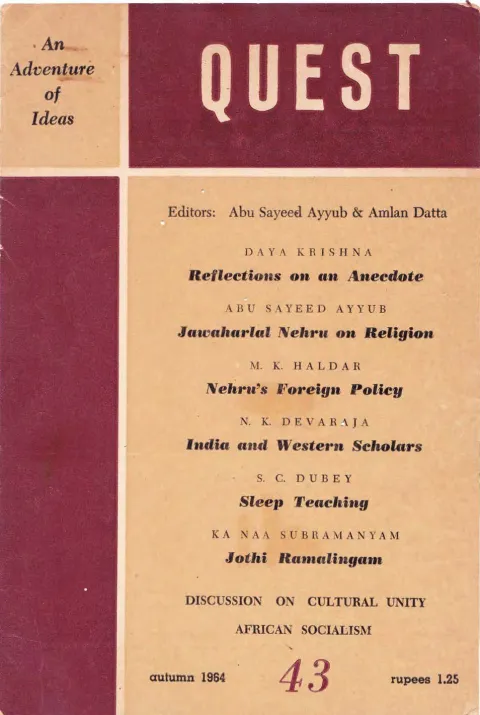
Quest
Summary
Quest No. 43 (OCT./DEC. 1964; ‘autumn 1964’ on the cover) is the first number the Bombay quarterly assembled after Jawaharlal Nehru’s death in May 1964, and its ARTICLES section is effectively a symposium on him: co-editor Abu Sayeed Ayyub opens with a long, unfinished essay on Nehru’s quarrel with organised religion, M. K. Haldar narrates the whole arc of Nehru’s foreign policy as a story of misplaced trust in Chinese Communism, and Punya Sloka Ray answers Haldar by arguing that no other prime minister of India, given the vital interests of Pakistan, China, the USSR and the USA, could have acted differently. Around that core the issue sets three pieces of intellectual history and philosophy - Daya Krishna using a legend about Samkara to argue that no realised soul can know empirical fact without the senses, N. K. Devaraja tracing India’s self-understanding through Western orientalists from Sir William Jones to Max Muller, and Ka Naa Subramanyam recovering the nineteenth-century Tamil poet-reformer Jothi Ramalingam - plus S. C. Dubey’s credulous survey of ‘sleep-teaching’, Philip Altbach on the collapse of the American student movement, David Rousset’s letter on the Brazilian coup, and Jorgen Schleimann’s report from the Dakar colloquium on African Socialism. A DISCUSSION section carries co-editor Amlan Datta answering Asaf A. Fyzee’s article in Quest’s own Spring 1964 number on whether religions can be reconciled, and Shashi Kant’s polemic against the imperialist, Muslim, Hindu, nationalist and Marxist schools of Indian historiography. Six poems, two short stories, nine book reviews and a four-letter correspondence section - three of the letters an exchange between C. Rajagopalachari and the editor - complete the number.
The issue’s argumentative centre is the relation between religion, reason and the modern state: Ayyub and Datta, the two editors, both argue in these pages that dogmatic religion cannot survive contact with a scientific temper, Daya Krishna attacks the epistemology that underwrites Indian claims to spiritual omniscience, Devaraja asks what East and West can still learn from one another, and Shashi Kant and Ray press the case for a hard-headed nationalism in history and in foreign policy. The register is uneven: alongside genuine philosophical work the number prints a wholly uncritical account of hypnopaedia, an anti-Muslim passage in the historiography article delivered in the author’s own voice, and a Cold War satire in which the Buddha calls Mao a butcher. Quest is sponsored by the Indian Committee for Cultural Freedom, and the issue nowhere discloses that the PEN volume it reviews was edited by its own Reviews Editor.
Essays
Jawaharlal Nehru on Religion
By Abu Sayeed Ayyub
Ayyub opens with A. N. Whitehead’s question whether religion must always remain a synonym for hatred, and argues that neither Nehru nor Whitehead should have equated religion as such with organised religion. He separates two meanings of the word - personal religion (inner development, the sense in which Nehru defined it approvingly in the Autobiography) and communal or organised religion - and then works through Nehru’s three standing objections to the latter: that organised religions become vested interests and reactionary forces; that the religious outlook is the enemy of clear thought because it rests on unalterable dogma; and that religion turns into an asocial quest for salvation indifferent to society. Along the way he reconstructs Nehru’s painful disagreements with Gandhi - over the suspension of Civil Disobedience, over Gandhi’s reading of the 1934 Bihar earthquake as punishment for untouchability, over trusteeship and the landlords - and concludes that the conflict was between a social engineer and a spiritual healer.
The essay is unusually frank about its own target: Ayyub says he has ‘the educated section of the religious community in mind’, and writes that dogmatic faith, lacking experience or reason, can only be propped up by the full-throated support of one’s group, so that it ‘breeds and feeds on communalism’. He is equally hard on both major Indian communities, calls Pakistan ‘a thinly disguised religio-fascist dictatorship’, and notes the fillip Indian fascism received from recent communal killings and Nehru’s death. It breaks off on printed p.20 with ‘(To be concluded)’, promising a treatment of personal religion in the next issue.
- Distinguishes personal religion from communal or organised religion and says Nehru’s indictment applies only to the second - a distinction Ayyub thinks Nehru himself blurred.
- Reconstructs Nehru’s three printed objections to organised religion (vested interest, dogma, asocial salvation-seeking) and comments on each in turn.
- Traces Nehru’s impatience with religion to his love for Gandhi, whose ‘inner voice’ reasoning Ayyub says agonised him more than his actions did.
- Argues that dogma cannot survive contact between communities without contempt: ‘the terms heathen, kafir and mleccha are terms of contempt’.
- Reads Iqbal’s Six Lectures as holding that after the inductive method reached the Arab scientists, religion ‘must find a new basis - in reason’.
- Ends unfinished, with personal religion deferred to the next number.
Nehru’s Foreign Policy
By M. K. Haldar
Haldar narrates India’s foreign policy from 1927 to the Chinese invasion as an episode in Nehru’s ideological biography: the pull between the Second and Third Internationals, the Brussels League Against Imperialism, the Congress resolution on the Spanish Civil War, the Lucknow session’s authorisation of a Congress foreign department, and then the long sequence of recognitions, conferences and pacts through which Nehru tried to make non-alignment do the work of security. The judgment is consistently critical. Haldar holds that Nehru saw the danger of Chinese Communism early - quoting his own 1959 Parliament speech that ‘a strong China is normally an expansionist China’ - yet went on playing ‘mother hen’ to Chou En-lai, refused Eisenhower’s offer of military aid, and let Hindi-Chini-Bhai-Bhai proceed anyway.
The article’s recurring device is to set Nehru’s private perception against his public policy, and it closes by asking whether the foreign aid India received came because of Nehru’s foreign policy or in spite of it. Two details are of archival interest: Haldar reports the birth of the Congress for Cultural Freedom in Berlin in June 1950 without noting that it is the parent body of Quest’s own sponsor, and he credits Rajagopalachari and M. N. Roy with having warned the nationalist leadership about the possibilities of the war.
- Treats non-alignment as the product of Nehru’s unresolved tension between nationalism and internationalism rather than of a settled doctrine.
- Marks the Indonesian settlement of 1949 as non-alignment’s ‘first significant success’ and Bandung 1955 as its zenith.
- Argues Tibet in 1950-51 ‘did open a big rent’ in the policy, quoting Nehru’s admission to the New York Times that Communist tactics were ‘closely allied to expansionism’.
- Holds that India, which ‘had the grandest opportunity of becoming the leader of the democratic South and South East Asian countries’, instead partially surrendered its interests to ‘the machinations of the totalitarians’.
- Notes without disclosure that the Congress for Cultural Freedom was founded in Berlin in June 1950.
Nation’s Foreign Policy
By Punya Sloka Ray
Ray answers the criticism of Nehru by reconstructing the geopolitics as a problem in the perception of vital interests - interests ‘for the defence of which a nation agrees to put up a relatively unlimited amount of resources’ - and then asks what any other prime minister could have done. He works through four neighbours in turn. Pakistan’s vital interest, he argues, was for a time the recovery of empire from a more compact base; China’s is likewise imperial recovery, which makes any foothold south of the Himalayas a standing invitation to interfere in Indian politics; the USSR acquired a vital interest in India only with the American base at Peshawar and the Sino-Soviet split; and few influential Americans believe the USA has one at all, the New York Times having advised India after the invasion to seek peace on Chinese terms.
Granted those realities, Ray says, entering the pacts would have cost India its only friend against Pakistan and put Indian troops in South Viet Nam, while alliance with the USSR would have invited American sanctions and given Indian Communists a larger say. He concedes Nehru’s failures of expression and his unlucky subordinates but insists none of them came from a failure to perceive the realities, and ends by hoping his successors will have equal insight. The piece is printed under the same title as Haldar’s (‘Nehru’s Foreign Policy’), though the contents page and running head call it ‘Nation’s Foreign Policy’. Its reasoning about boundary principles uses the racial vocabulary of its moment - the Chinese empire is described as having included ‘in established aspiration, though never in fact, all the peoples with yellow skin’ - which is the author reporting an imperial claim, while his rhetorical question ‘Are not even Bengalis largely Mongolian in racial origin?’ is his own.
- Defines vital interests behaviourally and insists debates about them are ‘exercises in psychological perception and psychological prediction, not to be fogged over by the pious verbiage through which they find expression’.
- Rejects the advice to trade the Aksai Chin for the Chumbi Valley, on the ground that race-and-tribute boundary principles ‘lead to a maze of overlaps’ while the watershed principle decides.
- Holds that Pakistan’s value in US strategy has only recently declined, through the thaw with the USSR, satellites, Iranian rearmament and ‘the demonstrated unreliability of Pakistan against China’.
- Names three new realities that might justify revising the policy: Kennedy’s decision to stand with India, the Sino-Soviet break, and a growing US-USSR understanding.
- Credits Nehru with keeping a line open to Peking and opening one to Rawalpindi even when ‘many persons were sure of his senility’.
Reflections on an Alleged Anecdote in Samkara’s Life
By Daya Krishna
Daya Krishna takes the well-known legend of Samkara’s debate with Mandana Misra - in which Mandana’s wife defeats him by taking the discussion to love and sex, whereupon Samkara asks for six months, enters the body of a dead king to acquire the experience, and returns to win - and treats it as a piece of evidence rather than a story. If one accepts the anecdote and also accepts Samkara as the perfect embodiment of Vedantic realisation, then four conclusions follow that are the exact opposites of what most Hindus hold axiomatically: the revealed texts do not contain all the knowledge a person needs; realisation of Brahman does not give all knowledge; yogic concentration cannot supply it; and sense-experience is the only route to certain kinds of knowledge.
He then generalises the problem past Samkara to Christ, Muhammad, Ramakrishna and Aurobindo, arguing that every tradition holds both that some individual was perfect and that certain incidents in his life are literally true, and that the two commitments conflict. Rather than escape by dialectics, which ‘makes nonsense of every assertion, the true as well as the false’, he proposes revising the concept of perfection: there are no perfect beings, only persons infinitely better than ourselves and better only in certain respects. A saint who pronounces on relativity, fiscal policy, birth control or the comparative merits of the Khajuraho Kiss and Rodin’s will be judged like anybody else. The running head over this article reads ‘Intuition and Fact’.
- Begins from the Indian presupposition that a master’s life is a living commentary on his thought, so that ‘the least little anecdote, therefore, is as important as any other’.
- Derives four anti-scriptural epistemological theses from the Samkara legend, each the negation of a belief he says is held axiomatically in the Hindu tradition.
- Reformulates the problem as three general questions about perfection, the veracity of anecdote, and what to do when the two conflict.
- Rejects dialectical reconciliation and proposes instead abandoning the notion of perfect beings.
- Concludes that ‘there is no other way to the truth of the senses except the senses themselves’, a claim he says would unsettle a belief ‘shared from the peasant to the President’.
India and Western Scholars
By N. K. Devaraja
Devaraja writes the history of India’s self-understanding in four numbered parts. The first traces the contact with Europe from Warren Hastings’s digest of Hindu laws and Wilkins’s and Jones’s translations, through Colebrooke, Wilson, Schlegel, Burnouf, Roth, Max Muller, Bohtlingk, Monier Williams and Fausboll, and sets against those appreciative orientalists the missionary attacks that put Hinduism on the defensive and produced Rammohun Roy. The second contrasts Roy’s and Dayananda’s apologetics with the serene confidence of Ramakrishna and Vivekananda, which he calls the second phase of Indian self-understanding. The third describes how, until independence, scholarly judgment on both sides was ‘conditioned by extra-academic prejudices and sentiments’, with A. B. Keith finding India’s borrowing from Greece ‘highly probable’ and the reverse ‘not conclusive’, and with Indian scholars answering by calling Western civilisation materialistic.
The fourth part turns prescriptive. The labours of scholars who set out to prove one hemisphere superior now look wasted; the real problem is how East and West can cooperate to discover better truths. Devaraja, writing from Banaras Hindu University, reports his amazement at Western students and scholars who arrive professing unabated faith in God when Western literature is so full of spiritual conflict, and argues that the possibility of ‘a religion without revelation and without God’ - thoroughly worked out by Buddhism and by several orthodox Hindu schools - is what the West might still learn. He is explicitly against the purists who would have modern Indians go on reinterpreting ancient philosophies. The essay is announced in the contributor notes as the concluding chapter of his forthcoming book The Mind and Spirit of India.
- Argues Europe’s impact was more revolutionary for Indian thought than any earlier immigration because the Europeans never settled and never conceded equality.
- Reads the praise of Western orientalists as producing ‘a more genuine assurance’ among the Indian intelligentsia than Roy’s or Dayananda’s own claims could.
- Documents the mutual bad faith of pre-independence scholarship on both sides, and calls the attitudes ‘though morally indefensible, … not psychologically unintelligible’.
- Holds that India can avert a crisis of religious disintegration ‘by reformulating its religious philosophy in terms acceptable to the modern critical consciousness’.
- Proposes a religious philosophy ‘both deeply humanistic and profoundly spiritual’, drawing on Mahayana Buddhism and on the Greek and Christian components of the Western tradition.
Sleep-Teaching
By S. C. Dubey
Dubey surveys ‘sleep-teaching’ or hypnopaedia as one of the latest developments in applied psychology, and the survey is almost entirely credulous. He describes Max Sherover’s record-player, clock and under-the-pillow speaker; Charles R. Elliot’s North Carolina trial in which a sleep-taught group learned fifteen three-letter words 83% faster than a control group; a Chilean opera singer who memorised a role in accentless Italian; Art Linkletter conversing in Mandarin after ten nights; the OSS teaching agents accents and customs; a 1951 Soviet law requiring doctors to pump suggestions into expectant mothers; a railroad despatcher who memorised the Union Pacific timetable in ten days. He then provides a psychological rationale from the subconscious, the reticular theory of consciousness and Penfield’s brain-stimulation experiments, validates the whole thing against Freud’s three chambers of the mind, and ends with practical procedures - motivation, reward, association, relaxation affirmations, the ‘reverie period’, the ‘transitional sleep period’ - and seven recommendations for getting through a learner’s psychological barrier.
The one critical note is a section headed ‘Fear of Misuse’, in which Dubey credits Aldous Huxley with having foreseen in Brave New World that the state would use hypnopaedia to condition citizens in the state religion, and says Huxley’s fears have proved true: dictatorial countries are doing ‘thorough brain-washing by this device’. But he does not stop there. He sets a ‘liberating’ against a ‘restrictive’ view of education for citizenship, concedes that sleep-teaching ‘extends better possibilities to dictators than democrats’, and then concludes that this is no reason for democrats not to use the method for their own goals.
- Presents a long chain of reported successes - language learning, memory feats, cure of speech defects, bad habits and nervous breakdowns - almost all sourced to popular books and magazines (David Curtis’s Learn While You Sleep, Reader’s Digest, Television Weekly, The Wall Street Journal).
- Grounds the technique in the claim that ‘our subconscious is receptive and alert all the twenty four hours’, citing the electro-encephalograph and Penfield’s finding that brain cells need ‘only one impression for retention’.
- Reads Freud’s unconscious as identical with the sleep-teaching literature’s ‘subconscious’ and takes Freud as validating the pumping of ideas directly into it.
- Credits the principle to antiquity: Egyptian ‘slumber temples’, Greek temple priests, and a Coleridge anecdote about a servant who spoke Latin, Greek and Hebrew in brain fever.
- Accepts Huxley’s warning that the technique suits state conditioning, and then argues democracies should use it anyway.
Jothi Ramalingam
By Ka Naa Subramanyam
Subramanyam recovers the nineteenth-century Tamil poet-reformer Jothi Ramalingam - also known as Ramalinga Swamigal or Adigal (1823-1874) - as the largest of the waves of new ideas that swept Tamilnad. He is careful about the sources: Tamils, he says, ‘along with the other Indians, lack the instinct for biography as well as for history’, so that reputations accrete out of proportion, and Ramalingam’s present standing among some Tamil publics ‘far outweighs the real impact of the man or his later influence’. But he insists the personality is large enough without the miracles. Ramalingam was unlettered, trained in neither the native traditions nor the new learning, yet made his influence felt as no pundit’s could; his songs anticipate a loosening of caste, an equality between men, and a humanist insistence on individual good against all institutions - religious, social, economic.
The article’s set piece is the collision with the Saivite pundit Arumugha Navalar, who had translated parts of the Bible and the catechism for Christian missionaries and then retold the puranas in Tamil prose, and who went to the British-instituted District Court at Cuddalore to restrain Ramalingam from calling his own poems the ‘sacred’ or ‘divine’ chant. The case ended when the poet walked into court and the whole court, petitioner included, rose as one man to do him honour - which decided it for the British sub-judge. Subramanyam closes on the disputed end: Ramalingam simply disappeared from the sight of men after founding the ‘true’ Chidambaram at Vadalur, and on his treasured last words. The article uses the period term ‘Harijan’ for the saint Nandan.
- Frames Ramalingam as a humanist reformer rather than only a devotional poet: ‘he led the movement in South India … towards a simplification of Hinduism, towards an equalisation of all men, towards the abolition of caste in its most oppressive forms’.
- Quotes two of his songs in translation, including ‘I have neither magic nor medicine; the roots of the ego in man are cruel … Caste and current creeds do torture me’.
- Sets him against Arumugha Navalar as a contrast of unlettered revolutionary against establishment pundit, and narrates the Cuddalore court case.
- Places him in a line ‘from Ram Mohun Roy to Mahatma Gandhi’ who were striving to give form to the tightening of Hinduism’s many fields into one fold.
- Reports the claim that he was killed as a rival to the old Chidambaram, and rejects it as credible only ‘by the too credulous’.
Student Movement in U.S.A.
By Philip Altbach
Altbach, writing as National Chairman of the Student Peace Union, reports that the American student movement of 1959-62 has collapsed and asks why. He inventories the losses on both wings: the Young Americans For Freedom, which had filled Madison Square Garden and claimed 20,000 members, no longer exists on most campuses, and the New Individualist Review has curtailed publication; on the left, New University Thought has not appeared in six months, Venture, New Freedom and Root and Branch have folded, the civil liberties movement that grew out of the San Francisco HUAC riots has disappeared, and the northern campus civil rights movement has all but gone even as southern students are being jailed in large numbers. Against that he sets the hopeful signs: the Student Peace Union’s survival and growth to over 200 chapters, the Northern Student Movement’s tutoring projects in depressed urban areas, the turn to ‘peace research’ at Harvard’s Tocsin and in SDS and SPU groups, and student involvement in southern voter registration with SNCC.
His diagnosis has four strands: American students have no tradition of student activity and no influence over the Establishment, so they conclude they ‘can’t do anything anyway’; the movement has no community base and is therefore isolated; fear of losing contact with the Kennedy administration produced a refusal to criticise it substantively, followed by a feeling of betrayal; and there is a crisis of leadership, since day-to-day organisational work falls to ‘pacifists, socialists, Christians, and the like’, of whom there is no oversupply. He ends undecided: the direction of the movement is an open question, ‘though most student leaders seem to be somewhat pessimistic about the prospects’.
- Argues the conservative student movement has been ‘decimated’ and the liberal organisations, with a stronger campus base, ‘severely weakened’.
- Names the 8,000-student Washington Action Project as the high-water mark and notes those students found themselves ‘lectured to like children by Congressmen’.
- Identifies isolation from any community base as the structural weakness, and community spade work and voter registration as the answer students are finding.
- Sees peace research as both a symptom of decline and a sign of long-range hope, since students are ‘no longer content to accept simplicistic answers to pressing problems’.
- Written before the Berkeley free speech movement: predicts that a conservative response ‘will again make such groups as the Young Americans for Freedom a viable force on the campus’.
Letter from Brazil
By David Rousset
Rousset’s letter argues that Brazil’s crisis of 1964 - Quadros’s withdrawal, Goulart’s fall, the Left’s defeat without a struggle, the seizure of power by the ‘Sorbonne’ faction of the officer corps and its March break with its right-wing allies - is driven not by politicians’ manoeuvres but by the level industrial production has reached. Industry is concentrated in the Rio-Sao Paulo-Belo Horizonte triangle with a genuinely skilled workforce; inflation and corruption, which once served as incentives to development and broadened the home market, have passed the point of no return and now tighten it. Since cost prices bar access to foreign markets, the only way to widen the domestic one is to turn peasants into consumers, and that operation means the end of the large landowning class. ‘The level now attained by the forces of industrial production confronts Brazil with social revolution.’
The political question is therefore who will control that revolution. Rousset answers: the triangle, not the North-East. The North-East is a powder keg whose uprising could destroy federal unity but could not lead; the revolution is industrial, not peasant. Yet the industrial bourgeoisie is tied to the landowners by family, property and mental outlook, and the skilled proletariat is part of privileged Brazil and acts as a social brake. The fastest radicalisation has been among the middle classes and above all the intelligentsia, which has moved so far ahead that it is cut off from its social roots - which is why, he says, the intellectual Left lapsed into political adventurism and paved the way for anarchy. Added to this is the vacuum of power: since 1961 Brazil has not been governed, only fought over.
- Treats the coup as the surface of a structural problem: converting peasants into consumers is ‘a social operation on a genuinely revolutionary scale’.
- Holds that a peasant uprising not immediately engulfed by an industrial-proletarian movement ‘could only sweep back into anarchy’.
- Explains the Brazilian bourgeoisie’s paralysis by its intimacy with landowning interests and its fear that agrarian revolution would require a much larger state role in property.
- Argues the skilled proletariat’s awareness of its own privilege makes it conservative, slowing radicalisation relative to the country as a whole.
- Names the ‘vacuum of power’ since the end of Kubitschek’s mandate as the political factor that accelerated institutional dissolution.
African Socialism
By Jorgen Schleimann
Schleimann reports from the Dakar Colloquium on Politics of Development and Different African Ways to Socialism, organised by the Senegalese government and the Congres Mediterraneen de la Culture, and what struck him first was the confessional character of the African interventions. Delegates from Senegal, Niger, the Congo, Tunisia, Tchad, Guinea, Mali, Nigeria and the Malagasy Republic all professed socialism as Africa’s road. He takes President Leopold Sedar Senghor’s definition - socialism as the rational organisation of society by the most modern methods, plus ‘the sense of community which is a return to Africanness’ - and defends it against the charge of vagueness by noting that the first speaker to endorse it was the Nigerian delegate S. O. Biobaku, vice-chancellor of the University of Ife, professing African Socialism on behalf of a federation usually labelled conservative.
His analytical point comes from Pierre Kanoute’s pre-conference essay: European socialism was a movement of protest against unbridled capitalism, historically tied to industrialisation and philosophically to West European individualist thinking, whereas ‘African Socialism is not a reaction against anybody or anything’ but an attempt to modernise a traditional collectivism built on collective ownership. The colloquium, he says, produced little discussion between Africans - their interventions were parallel statements of faith in planification - but those were still more relevant to the subject than the Yugoslav, Czech, Israeli and Scandinavian examples offered by non-African participants. His decisive conclusion is that African socialists are in search of modern techniques of development and ‘in no circumstances in search of an ideology’, which he offers as comfort to anyone who still pictures Africa choosing between capitalism and communism. A footnote records that the report was written before the July Summit Conference took place.
- Argues the world ‘had better get adjusted to the fact that Africa wants to be socialist’, and that this is a political and psychological fact for others to accept rather than debate.
- Uses the Senegal-Nigeria comparison to show that the revolutionary/reformist division in Africa reduces to ‘differences of temperament coupled with different road conditions’.
- Reports Mali’s Dr. Seydou Badian Kouyate insisting that the socialist option ‘can in no way be inconsistent with the religious faith’ and must recognise ‘spirituality as part of man’.
- Notes he heard the speeches in the Senegalese National Assembly ‘only one week later to become the stage of Premier Mamadou Dia’s abortive coup d’etat’.
- Concludes that African socialism is a search for development technique, not for ideology.
Cultural Unity and Unity of Religion
By Amlan Datta
Datta writes against Asaf A. Fyzee’s article in Quest’s own Spring 1964 number, which had approvingly quoted T. S. Eliot that religions cannot be reconciled and could only settle down in peaceful co-existence. Datta’s counter-tradition runs from Rammohan Roy: religions have features arising from ‘habits and training’ in a particular cultural milieu, in respect of which they differ greatly, and an ethical message of good neighbourliness, which they share. He documents Rammohan’s application of that distinction to the Ishopanishad, the Precepts of Jesus and the Persian Tuhfat-al-Muwahhidin, and notes that Thomas Jefferson independently made his own compilation of the precepts of Jesus, keeping only ‘those moral precepts only in which all religions agree’.
Datta then concedes a great deal to Fyzee: in India the idea of unity is ‘often a little too glibly accepted’, variations are inevitable and some differences are of deeper significance than prides and prejudices. But he argues that recognising differences and recognising unity do not contradict one another, and that indifference is not enough - ‘we cannot have genuine respect for them without discovering in all of them a common value’. His third section states the deeper cleavage honestly: it is arguable that the ethical core of all religions has nothing religious about it, and that the search for common precepts must end in abandoning religion, which is the road to scientific humanism. The alternative he sketches is religion’s claim to the unconditional - Christ’s forgiveness on the cross, the Vaishnava ahetuki priti - which erects a timeless arch over the conditional goods of justice and mutual aid. His closing sentence is that one who cannot find the common value in religion ‘had better give up religion than give up the search’.
- Sets a Rammohan-Jefferson thesis - separate a religion’s dogmas and forms from its common ethical message - against Fyzee’s Eliot-derived pluralism of peaceful co-existence.
- Answers the objection that precepts do not match practice by pointing out that Rammohan and Jefferson admitted as much.
- Corrects Fyzee’s use of de Riencourt on Alberuni, arguing Alberuni was more balanced than the quoted passage suggests and quoting his admission that depreciation of foreigners ‘is common to all nations towards each other’.
- Distinguishes indifference from respect: proximity now requires ‘a more positive principle of mutual respect’, failing which the best available is ‘a kind of cold co-existence, occasionally erupting into active animosity’.
- Leaves two roads open - scientific humanism, or a religion that marries justice to unconditional forgiveness - without forcing a choice.
Approach to History
By Shashi Kant
Shashi Kant argues that the history of India has been written by interested parties and reviews five of them. The imperialist school, he says, wrote to prove Indians born to be ruled: India always vulnerable to invasion, its climate emasculating, its resistance movements blacked out, its unity a British gift, Alexander’s attempted invasion magnified into a feat of valour, and ‘an aura of the superman’ created around the Europeans. He quotes C. H. Philips’s introduction to Historians of India, Pakistan and Ceylon at length, first for its own admission that European writers sought ‘to influence government policy by publishing works of a politically didactic character’, and then - for the passage promising western help in training Indian, Pakistani and Ceylonese colleagues - with the dismissal ‘Such noble sentiments are no longer in demand.’ Against the imperialist school he ranges the Muslim, the Hindu, the nationalist and the Marxist views, and finds all of them wanting.
The treatment of the ‘Muslim view’ is the article’s most striking passage and it is delivered in Shashi Kant’s own voice, not reported: the Muslim chronicles ‘were all written by fanatic and bigoted Mullahs and Maulvis’, are ‘permeated with the jehad outlook throughout’, and are ‘nauseating to read’; he doubts whether any history written by a Muslim shows ‘a frank condemnation of partition’. The Hindu view he calls communally inspired too, though ‘comparatively more broad-based and liberal’ because devoid of proselytising zeal; the nationalist view he faults for neutralising Muslim opposition by accepting the Muslim account of the medieval period and for presenting the liberation movement as largely the proceedings of the Congress; the Marxist view he dismisses in a sentence as judging everything by ‘dialectical materialism and certain odd standards which are hardly intelligible’. He ends prescriptively: history should be reconstructed to meet the national requirements of secularism, unity, independence, democracy and advancement, and should be ‘a story of growth and evolution’ rather than of decline.
- Opens with a definition - ‘History is purposive interpretation of the known facts’ - and holds that national interest, ideology and political calculation condition the historian’s judgement.
- Reads the imperialist historiography as a deliberate psychological operation to persuade Indians they were born to be ruled.
- Attacks the medieval Muslim chronicles in wholesale communal terms, in the author’s own voice, as the work of ‘fanatic and bigoted Mullahs and Maulvis’.
- Faults the Hindu school for making the Vedas the source of all culture, refusing to fix dates, and giving ‘historical footing and sanctity’ to archaic practices.
- Answers K. C. Lalwani’s ‘model for Indian history’ - which appeared in Quest, Autumn 1963 - and rejects its narrative of decline from the dawn of history.
Towards the East
By Ian MacMaster
A free-verse poem in two movements that opens the POETRY section. The first instructs the reader that after submission comes silence, and that breathing again is not to re-enter the world one periodically escapes ‘by ritual of the flesh / or countless counterfeits’ but to take hold of the physical world directly - the fertile soil, the unbiased sun, the clay, the landscape grasped with one’s being, the budding flower that is also oneself. It arrives at a quietist conclusion: there are no paths, no going forth and no return, ‘that thence is nowhere, / and here, where you stand / the universe also waits’. The short second movement turns outward and imperative, letting the wind carry the cries of suffering and the calendars measure ‘the centuries of grief’, while the addressee’s face of stone looks outwards, ‘ever turned towards the east’.
- Written by an English poet who, per the contributor note, had spent a few months in Calcutta earlier in 1964.
- Moves from an inward discipline of silence and submission to a stance of endurance facing east.
- Its closing image is of a stone face, not a person - the addressee is asked to become monument rather than witness.
- Printed on folio 77, the POETRY section opener, which carries no printed page number.
Dusk in the Harbour
By Chairil Anwar
A short poem in three stanzas, printed in English and sub-titled ‘(Dedicated to Sri Ajati)’. It is an emptied harbour at nightfall: nobody seeking love among the godowns, the old houses or the stores of ropes and masts; grounded ships and boats ‘Lie there abandoned hoping to be moored’. Rain precipitates the night, the rustle of kites’ wings comes faintly, the day’s soft sounds are hushed ‘swimming to meet the end of sight’, and land and sea lie sleeping while the waves dissolve. The refrain ‘Nothing moves’ is broken only by the speaker, strolling along the headland with his vanquished hopes, and by ‘The last sob smothered upon the beach’. Chairil Anwar, per the issue’s own contributor note, died in 1949 at twenty-seven and is regarded as the forerunner of modern Indonesian literature; no translator is credited anywhere in the issue, so this appears in Quest as an unattributed translation from Indonesian.
- An abandonment poem built on a refrain of stillness, with the speaker as the single moving thing in the scene.
- Printed with a dedication, ‘(Dedicated to Sri Ajati)’, which the contents page does not carry.
- The author had been dead fifteen years when this appeared; the poem is posthumous and in translation.
- No translator is named - an attribution gap an editor should record.
A Walk in Spring
By A. Madhavan
A poem of perception written by a serving Indian diplomat then posted at Berne. Vapours hover rinsed in a shower, the air is muslin, sunlight rains on horses’ capers, and overhead ‘a shiny crucifix’ - an aircraft - darts in and out of sight, followed by ‘a fearsome roar / Raving in sonic pursuit’. The speaker walks ‘in slow iambics / Not without a sense of surfaces’, flattening the scene into bas-relief and then, ‘by a trick of ether’, compressing the third dimension to tactile depth, so that the toy plane is dinky within reach and the formal mountain and winter-stark trees are ‘Granulated to the touch’. Notional antennae stroke roof tiles like the scales of a fish. It ends on a snail’s belly-print across the path: ‘Others have been here before.’
- A walking poem organised around the collapse of visual distance into touch.
- Its central conceit turns a jet into a crucifix and then into a dinky toy within reach.
- Metrically self-conscious: ‘I walk in slow iambics’.
- The last line converts a snail’s trail into a note on precedence.
Beyond the Corner of my Eye
By S. P. Bhagavatulu
A single-sentence poem of retrospect, built as a chain of ‘when’ clauses looking back from the giddiness of ‘the unkempt years / that went swirling down’. The remembered world is one in which the sun had a softer touch and the saner streets a soul, lamp-posts were miracles and each star a belief ‘being my own’; smoke hurt the eyes ‘touched red with rebellion’ while unintended tears wet a soiled shirt ‘and / not my bones’; nights sailed into days and the untutored speaker danced to rays ‘laced on a myriad eyes / of quiet glitters, benign / unbitter and not an adder / to be seen’. The clauses run out on feet ‘yet unformed and / moist not with sweat but / lissom morning grass or distant snow’, all of it ‘now swept beyond / the corner of my eye’. The author, per the contributor note, was a journalist on the editorial staff of the New Delhi weekly THOUGHT.
- One long syntactic period; the title supplies the only verb of the main clause.
- Its subject is the loss of a first-person world in which belief and perception were the same thing.
- Innocence is registered physically - tears on a shirt rather than in the bones, feet moist with grass rather than sweat.
Iconoclast
By Indrajit S. Masuda
A poem on idol-making and its undoing, written by a history postgraduate at St. Stephen’s College, Delhi. The first stanza builds upwards - icon upon icon in grim ascent, masks of totems probing the blue for unknown truths, ‘Building, forever building tall pillars’ of sustenance to grip and entwine and climb with ‘shivering roots of existence’. The second reduces those structures to pebbles littering a beach: ‘These bejeweled idols of the beach / These ideals that we build and shield.’ The third brings on a leviathan ocean crouched like a cat with feline patience, springing in foaming fury, ebbing ‘to torture and bait’, engulfing and renewing the wait until the wounded sands lie prostrate with the pebbles reduced and effaced. The last turns the contest into a permanent one - ‘The man in beach, the man in sea / Perpetually clash, melting ideals to mockery’ - and closes with man first as maker of pebbles, ideals and toys, and at last ‘Man the iconoclast’. The printed text carries three typographic errors that are preserved as set: ‘Wierd’, ‘bejeweled’ and ‘vomitting’.
- An allegory of idealism as pebble-building and of criticism as an appetite that both destroys and re-supplies its objects.
- The sea is figured as a patient cat and then as a shapeless monster ‘Eating idols of the beach / And vomitting more as bait’.
- Resolves into a single agent: the maker of idols is also the iconoclast.
- Three printed misspellings stand in the text as set - ‘Wierd’, ‘bejeweled’, ‘vomitting’.
Of Eyes
By Dorothy Sinha
A short, hard poem in four quatrains, printed out of its contents-page sequence on folio 92, below the closing lines of ‘The Commissar and the Buddha’. A figure called ‘Bag o’ Bones’ instructs the speaker on what to write: ‘Write, woman, write … Not of sunlight / Dappling a tree; / Nor of the red rose, / Nor the black bee; / Leave that to those / Who drink China tea.’ What she is to write of instead is eyes - ‘Staring in the dark, / Yellow-rimmed eyes’ - and the poem refuses the interrogative that would soften them: ‘No, no question mark / On the back-drop / Of an unconcerned today, / But, each a full stop: / What future have they?’ Dorothy Sinha is the one bylined literary contributor in this issue for whom no biography is printed in either note block.
- A poem about the ethics of subject matter: pastoral imagery is assigned to a leisured class ‘Who drink China tea’.
- The instruction comes from a personified figure of famine or emaciation, ‘Bag o’ Bones’.
- Its typographic conceit is grammatical - the eyes are full stops, not question marks - and its last line reopens the question anyway.
- Printed at p.92 rather than with the other poems at pp.77-81; the contents-page page number is correct.
- The author has no printed contributor note anywhere in the issue.
Story of a Mother
By G. C. S. Marar
A first-person story narrated by a bank clerk about his mother, and about his repeated failure to write her story. The household holds four people who barely speak: a father who reads the paper in the morning, sleeps in the afternoon and reads the Gita at night; an unemployed elder brother, Ramu, who comes home late to food kept in a tiffin-box; a mother who sobs ‘Oh Ram! Oh God!’ as a way of starting a conversation about him; and the narrator, who writes a story every three or four months and once got a ten-rupee money order that his mother carried round the whole neighbourhood. She keeps asking him to write her story - ‘When you can make up untrue stories, why not write a true one?’ - and he keeps laughing it off, telling her a story about her could never sell like Devdas, the novel she rereads and weeps over as if it were true.
The story turns on a Sunday quarrel in which the father tells Ramu he cannot feed him all his life, Ramu makes a bundle of two torn shirts and a pair of khaki trousers, and the mother for the first time stands up to her husband - ‘You cannot throw my children out of this house. I have as much right over this house as you have’ - and then falls and catches her son’s feet. Ramu stays that day and leaves the next, and does not come back. The mother stops speaking altogether. The narrator, years later and with three collections published and a ‘place’ in the literary world, cannot begin: ‘I know only too well that even if I were to try a thousand times I would never be able to write my Mother’s story.’ The story’s own byline reads ‘G. CHANDRASEKHARA MARAR’, though the contents page, running heads and contributor note all say ‘G. C. S. Marar’.
- Built on a single withheld act - the story the narrator is asked for and never writes - which the story itself both is and is not.
- Uses Devdas as the mother’s measure of what a true story is, and the narrator’s counter-argument that hers ‘can never sell’.
- The domestic economy is exact: five parathas and potato-salan thrown into the drain, a ten-rupee money order, a rupee’s worth of sweets, a permanent bank job set against a brother’s unemployment.
- Its emotional pivot is a withheld grief: ‘Closely scrutinizing her I could not trace any tear in her eyes-as if her two eyes had become wide deserts.’
- A photograph of Gandhiji on the calendar is the only object in the house the narrator looks at while his mother talks.
The Cormmissar and the Buddha
By S … Z …
A satirical dialogue, published over the pseudonym ‘S … Z …’, with a printed head-note setting the scene: Liu Shao-chi, chairman of the People’s Republic of China, has been given a lighted candle to offer at the Shwe Dagon Pagoda in Rangoon during his recent tour of Burma; left alone for a moment he hesitates, remembers his master’s command, places the candle, and hears the image speak. Liu’s mission, he explains, is to convert the Buddha to Communism, on the ground that the two doctrines are identical: both founders were denounced as atheists, the Four Noble Truths and the Eightfold Path are what Communism aims at, the Buddha renounced riches and a kingdom and organised a brotherhood ‘not much different from our idea of a commune’, and both preach eternal peace. The Buddha plays along, asks why then the new name, and is told the differences are slight and due to the gap of time - 2,500 years is not a small period, and ‘We have to be progressive’.
The satire works by letting Liu’s own vocabulary betray him. He calls love ‘a bourgeois word’ with no place in Communism, dismisses spirit as ‘a drug concocted by the capitalists to put common people to sleep’, mishears the Buddha’s mock-confusion of ‘dialectic’ with ‘diabetic’, and when asked what is done with a man who remains unconvinced answers ‘We just cut off their silly heads’, adding that ‘Capital punishment is also a sort of conviction.’ The Buddha offers to be converted on one condition - no murder under any circumstances - and Liu refuses: ‘Communism, like the god of ancient Rome, needs human sacrifice, hundreds of them, a blood bath.’ The Buddha replies that this is ‘not the way of the Buddha but the way of the butcher’, Liu protests at the word applied to his master, and the arrival of the hosts cuts the dialogue short.
- A Cold War dialogue dressed as a Buddhist encounter, staged at a real diplomatic occasion (Liu Shao-chi’s tour of Burma).
- Liu’s case for identity between Buddhism and Communism is built item by item from the Four Noble Truths and the Eightfold Path.
- The Buddha’s counter-position is metaphysical rather than political: circularity against progress, heart against head, spirit as ‘that extra something’.
- Turns on the question of killing: the Buddha will compromise on everything except ‘Thou shalt not kill’.
- Includes the Hundred Flowers line, which Liu explains away as ‘quoted out of context’ with a suppressed second half about withering and dying.
- The byline is a pseudonym and has been left unresolved.
‘English in India’
By N. G. Thakar
Thakar welcomes V. K. Gokak’s book as an important contribution from the Director of the Central Institute of English, then dissents from it fundamentally. Gokak, he says, shows restraint about the history of the question since 1947 and thereby does the cause a disservice: the lesson of the previous seventeen years is that indecision rather than wrong decisions caused the decline of Indian education, and by accepting the resulting insecurity and offering ‘hopeful but essentially makeshift remedies’ Gokak does less than justice to the realities and to his own ability. The reviewer’s target is the formula that English ‘will have to continue as the medium for higher studies’ for ‘a long time to come’, endorsed by the late Prime Minister, the Kunzru Commission, the Official Language Commission, the National Integration Conference and the Chief Ministers’ Conference of 1961: ‘This head shaking threatens to become an incurable palsy!’
His own proposal is a dated decision: within not more than eight years, say by 1972, all universities except perhaps a college or two each should have regional media in full operation, with individual undergraduates still permitted to answer in English and only the all-India technological and research institutions retaining it as chief medium. He pairs this with a second argument that once media are regionalised, English should be loosened from its position as the one inevitable second language - ‘not one colour - just the dark blue or grey - but a spectrum of European languages’, with France, West and East Germany, Russia and America induced to supply aid and personnel. His image of the educated Indian of 1984 is ‘ambilingual’ in Catford’s sense, wielding Hindi and a regional language ‘as a fencer wields a keen, supple, flashing blade’ while reading one European language professionally.
- Accepts the book’s authority and rejects its gradualism: the reviewer wants a hard deadline for regional media, not a transition of indefinite length.
- Diagnoses indecision, not wrong decisions, as the main cause of educational decline since 1947.
- Quotes Arnold’s ‘Wandering between two worlds / One dead, the other powerless to be born’ on the post-independence interval, and blames ‘a surfeit of politics’ for preventing the new world’s birth.
- Proposes plural European second languages in place of English’s monopoly, with foreign governments funding the programmes.
- Is printed without a review headline of its own - the only review in the issue so set.
Oriental Jones: A Biography of Sir William Jones
By A. H. Mortimer
Under the headline ‘Dedicated Genius’, Mortimer praises Garland Cannon’s biography for finding the only possible way to tell its story, and for linking the Ideal and the Idealist in the historical texture of the age. He then retells the life: an international reputation as orientalist, scholar and poet by twenty-three; a Royal Society fellowship and Johnson’s Club at twenty-six; the day’s excess of wine on the Welsh Circuit that bought him ‘perpetual temperance for the rest of my life’; the turn to law to relieve his mother of supporting him, and the love of the constitution that came with it; the clash between constitutional rights and Lord North’s administration of George III’s policies; the failed Oxford candidature, lost to inexperience and a refusal to descend to ‘electioneering skulduggery’; Tory suspicion of his sympathy with the American colonists and his friendship with Franklin; and, once the Whigs came in, the Bengal judgeship, the marriage to Anna Maria Shipley, and the ten years in Calcutta.
The achievements Mortimer counts are the translation of the Ordinances of Manu, the founding of the Asiatic Society of Bengal, the unfinished Digest of Indian Laws covering both Islamic and Hindu jurisprudence, and Jones’s standing as ‘the first modern linguist and world-populiser of the values of knowing foreign languages’ - he knew twenty-eight, ‘including Runic, if that can be called a language’. The review ends on Cannon’s own verdict that Jones was a hundred years ahead of his time, his example praised but not followed. A factual error stands in the printed text and is left as printed: the date of Jones’s death is given as 1974.
- Reads the biography as the history of an ideal as much as of a man, and credits Cannon with choosing the one workable way to tell it.
- Frames Jones’s Indian career as constitutional rather than merely scholarly: his object was to establish ‘that their constitutional rights were in no degree less than those of their foreign rulers’.
- Notes his question ‘Could the oriental people learn to love and trust the West?’ as the one his office was meant to answer.
- Contains a printed error - Jones’s death dated ‘in 1974’ rather than 1794 - preserved as set, together with the spelling ‘inflamation’.
- The subject also appears in this issue in N. K. Devaraja’s article (p.37) and, misspelt ‘Whitson’ aside, nowhere else.
The Wasted Hour
By Mahesh Desai
Under ‘Planning the Peace’, Desai reviews Brian Gardner’s account of 1945 as the year in which Britain won the war and lost the peace. He takes Churchill’s August 1945 words - ‘There is not an hour to be wasted; there is not a day to be lost’ - and answers that for Churchill and the victorious Great Britain the hour was already wasted and the game already lost: pre-war Britain had ceased to be great except in name, and the contest for influence was now between the United States and Soviet Russia. He follows Gardner’s narrative from the Ardennes offensive through Yalta, where the conference ‘yielded few concrete decisions and great issues remained untouched’, to Potsdam, where the comradeship of war was vitiated by distrust and the comrades were no longer the same men, and where the task of papering over the chasm was passed to the foreign ministers. The crucial change between the two conferences was American possession of the atom bomb, mentioned at Potsdam ‘quite casually’ and without effect on the deliberations, so that the world moved from the diplomacy of balance of power to nuclear brinkmanship without noticing.
Desai credits Gardner with a brilliant ensemble of events and with a chronicle in which the war matters less than the quarrels over Poland, Yugoslavia, Greece, Trieste, Austria and Germany. But he dissents from Gardner’s theses - that the United States failed to exploit its nuclear superiority against Stalin, and that Stalin by 1945 was no longer the ruler of Soviet Russia - and says one reads the book in vain to find how Russian influence could have been contained ‘except by turning Germany against Russia’. His own conclusion is that historians seldom allow for peoples wearied of war, and that the wasted hours ‘sum up the pointlessness of war as an instrument to settle the affairs of nations’.
- Reads 1945 as the year Britain’s traditional diplomacy became ‘pathetically irrelevant’.
- Holds that greater Anglo-American accord could not have prevented the Cold War, Soviet Russia being by then too big to be browbeaten or fooled.
- Rejects Gardner’s minor thesis that Stalin had ceased to rule and had to be wary of Molotov.
- Notes that the ethics of the bomb’s use ‘is not beyond debate’ while conceding it ended the Japanese war sooner than feared.
- Ends by turning the book’s title against its author.
Letters of Srinivasa Sastri
By P. Kodanda Rao
Under the headline ‘To my Brother’, Kodanda Rao reviews T. N. Jagadesan’s edition of Srinivasa Sastri’s letters as ‘at once English literature of high quality, snatches of autobiography and insights into the political history of India during the first half of the current century’. Most of the review is quotation. He establishes Sastri’s command of English through the story of embarrassing his British principal at the Madras Teachers’ Training College by correcting Nesfield’s grammar, and through Sir P. S. Sivaswami Aiyar’s judgment that ‘There are other orators, but he is our only letter-writer.’ He then reproduces the cameos: the note to Sivaswami Aiyar of June 1927, the descriptions of the Taj by moonlight and of the marvels of London written for his daughter, and the 1919 letter longing for home - ‘What if there be mosquitoes and all sorts of inconveniences: still, it is home.’
The review’s substance is the Gandhi correspondence, which Kodanda Rao presents as ‘a lustrous example, perhaps unequalled, of firm personal bonds of love and admiration co-existing with fundamental differences on public questions’: the two addressed each other as ‘Dear Brother’, and Gandhi latterly signed himself ‘Little Brother’. He quotes Gandhi from Yervada Prison (‘Your criticism soothes. Your silence makes me nervous’), Sastri’s refusal to bless the 1933 fast (‘Our values are different fundamentally. The difference is radical, no sophistication can abolish it’), Gandhi’s 1934 confession that ‘Though our hearts are one we seem to be living in different worlds of thought and action’, Sastri’s panegyric in reply, his 1940 rebuke on partial abandonment of non-violence, and his 1944 letters urging Gandhi to attend the World Conference on Peace even unofficially: ‘You are much more than the head of the Congress movement in India.’ The reviewer’s own contributor note records that he was Sastri’s secretary for many years.
- Presents the volume as literature, autobiography and political history at once, and reviews it largely by quotation.
- Documents the Gandhi-Sastri relationship as affection surviving radical disagreement, with the salutations as evidence.
- Quotes Sastri’s 1940 judgment that ‘Partial abandonment of non-violence is abandonment’, and his refusal of the 1933 fast.
- Reproduces Sastri’s 1944 appeal that Gandhi attend the peace conference because ‘you are a citizen of the world, eagerly looked for when mighty issues are settled’.
- The reviewer’s long service as Sastri’s secretary is stated in the issue’s OUR REVIEWERS block, not on the review itself.
Freedom and After
By V. R. Narayan
Under ‘Authentic Africa’, Narayan reviews Tom Mboya’s Freedom and After by way of the history it records. He traces Mboya’s rise from sanitary inspector for Nairobi, through the Local Government Union, to general secretary of the Kenya Federation of Labour, and argues that when the native political organisations were suppressed during the Mau Mau emergency the labour unions fused their economic and political functions and took on ‘a political role rarely demanded of trade unions and their leaders’. He supplies the economic background - a Kenyan economy oriented for fifty years to European prosperity, wages below subsistence with wide racial differentials, the 1923 declaration of African paramountcy contradicted by land and labour policy - and the demography of Mau Mau’s strength among dispossessed Kikuyu tenants. He notes candidly that Mboya’s ascendancy originated among the Luo who filled Nairobi’s jobs when more than 100,000 Kikuyu were expelled during the emergency, and credits him with an appeal that ‘was always national rather than tribal’.
The review then turns to Mboya’s own formulations, quoting him at length on isolating ‘negative tribalism’ from tribalism as custom and culture, on Asian minorities in Kenya (‘There is no intention to replace present privilege with African privileges, but a true Kenyan - irrespective of his race or creed - must be entitled to some degree of privilege in his mother country’), on Pan-Africanism (‘Africa is neither pro-west or pro-Russia; they are pro-African’), and on African Socialism as ‘those proven codes of conduct in the African societies which have over the ages conferred dignity on our people’. Narayan’s own conclusion is that Africa’s problems are not merely poverty, ignorance and disease but an intensive search for personality and destiny - a search he describes, in the colonial vocabulary of the period, as an emergence ‘from the primitive tribal way of life to an aggressive membership of modern society’.
- Treats trade unionism as the vehicle of Kenyan nationalism when party politics was suppressed.
- Sets out the structural grievances - racial wage differentials, land alienation to the white highlands, segregated and missionary-funded African schooling - that Mau Mau grew from.
- Notes Mboya’s ‘Students’ Airlift’ scheme, which drew support from the U.S. and Canada.
- Reads the Indian minority question sympathetically but firmly: they ‘have to decide within a given period, the question of nationality’, having served Kenya well but still looking culturally to the United Kingdom or India.
- Closes in the period’s colonial idiom about ‘the primitive tribal way of life’, a phrase in the reviewer’s own voice.
The Hour of Maximum Danger
By Stewart Melluish
Under ‘Traitors by Default’, Melluish recommends James Barlow’s novel despite finding its theme unappetising and its characters depressing. It is ‘an admonitory novel about the techniques of Russian espionage in modern Britain’, and its purpose is to show how simple spying can be in a flabby, morally decadent democratic society ‘where the individual’s cherished freedom all too readily becomes the freedom to behave as irresponsibly and as unethically as he finds personally convenient’. The book’s argument, as Melluish reads it, is that treason is popularly imagined as a colossal, overt crime - regicide, usurpation, rebellion - and that this conception is not only misleading but dangerous. Barlow’s professional spies are dedicated specialists, but the instruments they recruit are unspectacular amateurs: the girl on the switchboard, the factory hand, the disgruntled student, the self-satisfied cover-girl, all trapped by their own weak wills into ‘performing puny teacheries, hardly realising what has happened to them’.
Melluish praises the technical choice that makes this work: Barlow introduces and pursues each character’s decline independently, ‘like so many separate case-histories’, and draws each into the middle of the web from its own point on the circumference, avoiding ‘the usual quite unrealistic no man’s land of elusive puppets with briefcases, belted raincoats and sinister trilby hats’. He singles out the unpopular South African student who longs to be one of the chaps and the factory worker who pockets a part from an assembly line and is inevitably caught, and concludes that the characters never invoke much sympathy - ‘they are a lousy lot’ - but that curiosity never flags.
- Reads the novel as a warning that treason is committed by ordinary weak people, not by dramatic villains.
- Credits the case-history structure with making an espionage plot plausible.
- Turns the book’s moral against the society it describes: freedom degenerating into convenience.
- Admits the characters are unsympathetic and argues that this is not a defect.
- A Penguin paperback at five shillings, reviewed alongside hardbacks at thirty-six shillings and Rs. 31.
Indian Writers in Conference
By Kamala Bose
Under ‘Writers Meet’, Kamala Bose reviews the proceedings of the sixth P.E.N. All-India Writers’ Conference, held at Mysore in August 1962 at the University’s invitation and inaugurated by President Radhakrishnan. She describes the volume’s two parts - three of the four Mysore symposia (How Writers See Contemporary India, Ideas In Modern Poetry, East-West Dialogue) and reports on Humour In Indian Literature running through all the languages recognised by the Constitution - and judges that although the papers are of unequal standard and a few are not to the point at all, the book gives an excellent view of the current Indian literary scene. She picks out Gulabdas Broker’s depressing account of the middle-class writer who looks on Indian life with dismay, and his complaint about the volume of ‘goody-goody writing’ that reflects ‘a serene, a normal, a moral, a no-longer-existing world’; Gangadhar Gadgil’s variation on the same point; Mulk Raj Anand’s charge that for over five hundred years Western domination has thwarted the exchange of Asian and African works to the West; and Dharmvir Bharati’s argument that humour developed independently in Hindi only in modern times because prose, its natural medium, never achieved high position in medieval Hindi and because courts were too formal for untainted humour.
Of the section on poetry she writes that Nissim Ezekiel ‘provides an interesting and learned paper’ on how ideas animate or weaken poetry’s power, and notes his insistence that poetry cannot be ignored while the ideas are discussed. Nowhere in the review or around it does the issue disclose that Nissim Ezekiel edited the volume under review and is Quest’s own Reviews Editor, named as such on the contents page.
- Reviews a conference volume as a survey of the Indian literary scene rather than as a collection of arguments.
- Foregrounds two papers diagnosing the same condition - middle-class frustration in Indian writing and the ‘goody-goody’ writing printed alongside it.
- Reports Anand’s complaint that literary exchange runs one way, from Europe to Asia.
- Singles out the Hindi humour paper as the most interesting of the language reports, most of which ‘do little more than list writers and their works’.
- UNDISCLOSED RELATIONSHIP: the volume’s editor is this journal’s Reviews Editor, and his own paper is praised in the review, with no disclosure printed.
The Whitson Weddings
By Foy Nissen
Under ‘The Poetic Coin’, Nissen reviews Larkin’s second collection as a book that cannot be put down with a feeling of ease: the more one reads into each poem ‘the more disturbing are the nagging insights which reach out, like that in the poem taking Mr. Bleaney’s name, as reminders that “how we live measures our own nature”’. He quotes the three lines beginning ‘In this way I spent youth’ and warns that their tone, ‘an amalgam of the nostalgia of choice’, might delude a reader into simple literal-mindedness, ‘like bumping into the furniture of a house in the dark’. His positive claim is technical: for all their urbane, deft colloquialisms, the novelist’s eye and the dramatist’s ear, Larkin’s poems proclaim his to be one of the most carefully formed techniques of expression in English poetry today, and his achievement lies in ‘the sureness with which he touches off the poetry’ of the processes of self-clarification.
The review then argues that to produce poetry from the terrors of self-awareness is ‘to enjoy the privilege of a surprise ending’, with the punch-lines foreclosing on the almost humdrum stuffing of the poems, and declines to describe them further on the ground that to do so ‘would be to circulate bad coinage’. The title poem is called the best in the selection. Quest misspells that title, in both the contents page and the review heading, as ‘The Whitson Weddings’.
- Reads Larkin as a poet of self-clarification whose technique, not his subject matter, is the achievement.
- Warns against literal-mindedness about the nostalgic tone of the quoted lines.
- Uses a coinage metaphor throughout: describing the poems further would ‘circulate bad coinage’, and the reader should seek ‘the other side of the poetic coin, the patent demands of their writing’.
- Names ‘The Whitsun Weddings’ itself the best poem in the book - though the journal prints the title as ‘Whitson’ twice.
- A short review - a page and a fraction - for the collection that would come to define post-war English poetry.
Labour Movement in India
By V. B. Karnik
Under ‘Our Trade Unions’, Karnik calls G. K. Sharma’s book a valuable addition to a growing literature, and its greater part a history of the movement since the advent of industry, which - trade unions still constituting the main part of the movement - has become a history of their birth and growth. He credits Sharma with diligent and painstaking research that has brought new facts to light, but faults him for choosing a term of wider import and then not discussing the political, cooperative and welfare aspects of the labour movement: those attempts have not yielded substantial results, ‘but in a history of the labour movement they should have found some mention.’
The review’s real interest is in what the book does not settle. Scholars may want the history, Karnik writes, but men of affairs want to know the movement’s present condition and future role: will Indian trade unions help or hinder economic development, what will their relations with government be, and will they develop as responsible social organisations or function ‘merely as pressure groups interested only in securing the largest possible benefits for their members’. Sharma’s answer - that in an economy moving towards Socialism relations between the State and trade unions will be increasingly based on consultation and mutual reliance - he dismisses as too general to satisfy anybody, and insists that both the State and the unions must change their attitude to each other before the labour movement can become ‘a positive factor contributing to the growth of a free society’. Karnik’s own contributor note describes him as a veteran trade union leader. The contents page gives this review’s page as 105; it is in fact printed on 106.
- Distinguishes a history of trade unions from a history of the labour movement, and faults the book for conflating them.
- Poses the practical questions the book leaves open, about unions’ relation to development and to the State.
- Rejects the book’s answer as ‘too general an answer which will not satisfy anybody’.
- Makes the reciprocal change of attitude between State and unions the condition of a free society, not merely of industrial peace.
- The only review whose contents-page page number is wrong (105 for 106).
Non-Violence and the Gita
By C. Rajagopalachari
A letter to the editor, dated July 12, 1964 and opening ‘Dear Abu Sayeed Ayyub,’. Rajagopalachari asks Ayyub to convey to D. C. Mathur that he read his article in the July-September 1964 Quest with much interest, and that as far as he could gather from all his talks and contacts with Gandhiji, Gandhi’s understanding of non-attached action according to the Gita was what Mathur had interpreted it to be - the last sentence of Gita II.50, ‘Yogah karmastu kausalam’, strongly supporting the interpretation, which he glosses as ‘Indeed, the way of yoga which I preach is real skill in the work you undertake’. He then turns to Sudhir Chandra’s article, confirming from memory - ‘(as I was even then an active politician & “intellectual”)’ - that Tilak spoke about passive resistance at Banaras in 1905 and that Gokhale later deprecated all such talk as unsuitable for the country, and quoting with particular approval Sudhir Chandra’s paragraph on Gandhi having culled his cardinal principles from a number of religions, their rediscovery in Hinduism being ‘the sequel rather than the prelude to his quest’. He adds that he has taken the same stand himself, speaking on Gandhiji’s philosophy at Poona University.
A postscript, signed ‘C.R.’, calls Raj Krishna’s article ‘a brilliant contribution’ and reduces Ayyub’s criticism of it to a single point - that Raj Krishna ought always to assign a minus value to the alternative of violence - which Rajagopalachari believes Raj Krishna does implicitly: ‘He does permit loading the scales, so to say, against violence. But he would not go with it.’ No title is printed over the letter; ‘Non-Violence and the Gita’ is supplied by the contents page.
- A reader’s letter that functions as an authority claim: Rajagopalachari corroborates a scholar’s reading of Gandhi from personal contact.
- Supplies his own translation of Gita II.50 in support of non-attached action as skill in work.
- Gives first-hand testimony on Tilak at Banaras in 1905 and Gokhale’s later deprecation of passive resistance.
- Endorses the argument that Gandhi’s principles were not distinctively Hindu, quoting Sudhir Chandra at length.
- Postscript intervenes in an argument between the editor and another contributor about whether violence carries a minus value or destroys value.
Non-Violence and the Gita
By A. S. Ayyub
The editor’s reply, dated July 16, 1964 and opening ‘Shraddhaspadeshu,’. Ayyub says he is flattered by the letter and that as the editor of Quest he cannot but take pride in the knowledge that the journal can count among its painstaking readers ‘a man of your eminence and intellectual distinction’. He then registers a mild protest against Rajagopalachari’s reduction of his critique of Raj Krishna to one point, and restates all three: that Raj Krishna was not right to characterise his opponents as value-monists and claim merit for value-pluralism, a slip Ayyub attributes to failing to distinguish instrumental from final values; that he would prefer to describe violence not as ‘a minus quantity value’ but as ‘a destruction of value’, justified only when clearly seen as preventing the destruction of a greater value, since the plus-and-minus comparison ‘makes the moral issue more difficult of solution’; and that while agreeing on military preparedness he deprecated the mental state of cold war, both for its liability to push cold-warriors into a hot war and, more, for being ‘the wrong temperature-and-pressure condition’ for preserving the dispassionateness and scrupulousness of intellectual activity to which intellectuals and believers in intellectual freedom owe a special allegiance.
He closes by saying he is sending copies of the letter to Mathur, Sudhir Chandra and Raj Krishna, asking permission to print it, and requesting a contribution: ‘It is long since we have published anything from your esteemed pen.’
- An editor answering a correspondent in his own pages, and simultaneously continuing an argument with a contributor to an earlier number.
- Reformulates the moral accounting of violence: destruction of value, not negative value.
- Grounds his objection to the cold-war mentality in the conditions required for intellectual honesty rather than in pacifism.
- Ends by soliciting a contribution from the correspondent - the editorial function visible inside the correspondence column.
- Printed without a title; the contents page supplies ‘Non-Violence and the Gita’ and bylines him ‘A. S. Ayyub’.
Non-Violence and the Gita
By C. Rajagopalachari
A short second letter, dated 18th July, 1964 and opening ‘My dear Abu Sayeed Ayyub,’. Rajagopalachari thanks the editor for his forbearance and withdraws any pretension in his earlier remarks: ‘My remarks about your critique were only to help and could not possibly pretend to be anything like a full-dress examination.’ On the request for a contribution he pleads age - ‘I must ask you to realise my age and consequent limitations in energy’ - and says that if he felt like writing anything of suitable nature and quality he would send it without being asked. He grants permission to print the first letter: ‘You may, if you think it would be of any use, print my letter in Quest as you say.’ This is the letter that makes the preceding exchange publishable, and Quest prints all three.
- Grants the permission that licences the whole exchange’s appearance in print.
- Declines the invitation to contribute, on grounds of age and energy rather than of subject.
- Withdraws the earlier criticism’s pretension without withdrawing its substance.
- Rajagopalachari was 85 at the date of writing; he lived another eight years.
Tendentious Historiography
By S. P. Singhal
A letter opening ‘Dear Sir,’ from the Department of History, University of Queensland, dated 3rd Sept., 1964, and signed D. P. SINGHAL - the contents page mis-bylines it ‘S. P. Singhal’. Singhal replies to Professor Ashin Das Gupta’s comments, published in the July-September 1964 Quest, on his own review article in the April-June number criticising Percival Spear’s recent book on Indian history. While he says he understands Das Gupta’s zeal in defending ‘his erstwhile Cambridge associate, possibly old teacher’, he is surprised at his having missed the point. The essence of the criticism, he restates, was to expose a kind of history-writing that indulges in no complete falsehood and suppresses no vital fact, but ‘employs different standards of scrutiny in different cases, assembles half-truths dexterously, highlights certain facts while playing down others, does not let the story unfold itself but places events and facts in convenient historical contexts, and aims at conveying a desiredly distorted image’. Such disguised pre-dispositions, backed by competent scholarship, are ordinarily difficult to detect and easy to defend - and the fact that a trained historian has been taken in by Spear’s book ‘only underlines the risk which an unsuspecting non-specialist reader or a young under-graduate is exposed to’.
- Third round of a running controversy conducted across three consecutive Quest numbers (April-June, July-September, October-December 1964).
- Defines a species of tendentiousness that operates entirely within the facts, by selection and framing.
- Turns his opponent’s professional standing into evidence for his own thesis about how hard such writing is to detect.
- Notes the Cambridge connection between reviewer’s target and his critic - an interest disclosed by the correspondent, not by the journal.
- Signed D. P. Singhal; the contents page’s ‘S. P. Singhal’ is an error, verified by rendering p.108.
Essay 34
An unlisted editorial notice, boxed at the foot of printed p.30 below the end of Punya Sloka Ray’s article and signed ‘-EDITORS’. It announces that two short stories published in Quest - ‘Lawrie Lewis’ by Kewlian Sio (Jan.-March 1963) and ‘Bing and the Chicken’ by Bonomali Goswami (Jan.-March 1964) - were selected for reproduction by the well-known Short Story International of New York. It is the only item in the issue in which the editors speak in their own institutional voice about the journal’s standing, and it documents two back-number contributions whose titles and dates appear nowhere else in this number.
- Records two Quest short stories picked up by Short Story International, New York.
- Names and dates two earlier contributions: Kewlian Sio, Jan.-March 1963; Bonomali Goswami, Jan.-March 1964.
- Signed collectively ‘-EDITORS’; not in the contents page.
- Useful to the archive as a cross-reference to QT037/QT040-era numbers.
Essay 35
An unlisted, unsigned editorial note set in small type below David Rousset’s signature at the foot of printed p.64, announcing that in the next number Rousset will further analyse the Brazilian crisis from the withdrawal of Quadros up to the present break between the military and their Right-wing allies. It establishes that ‘Letter from Brazil’ is the first of two parts, and pairs with the ‘(To be concluded)’ at the end of Ayyub’s article on p.20 to show that this number carries two serials. The president’s name is printed ‘Guadros’ in the note, though the article itself spells it ‘Quadros’ throughout.
- Establishes ‘Letter from Brazil’ as the first of two instalments.
- Defines the promised scope of the sequel: from Quadros’s withdrawal to the military’s break with its right-wing allies.
- Unsigned, unlike the issue’s two other editorial notices.
- Prints ‘Guadros’ for ‘Quadros’ - a typographic error preserved as set.
Essay 36
An unlisted editorial apology, one sentence long, set below a rule at the foot of printed p.76 after the end of Shashi Kant’s ‘Approach to History’ and signed ‘-EDITORS’: ‘We regret the accidental delay in the publication of this discussion.’ It is the only place in the issue where the editors account for their own production, and it explains the otherwise puzzling fact that Shashi Kant’s article answers a piece K. C. Lalwani published in Quest, Autumn 1963, four numbers earlier.
- The editors’ apology for a delay in publishing the DISCUSSION section.
- Placed after Shashi Kant’s article rather than after Amlan Datta’s, though both belong to DISCUSSION.
- Explains the long gap between Lalwani’s Autumn 1963 piece and this answer to it.
- Signed ‘-EDITORS’; not in the contents page.
Essay 37
An unlisted apparatus block headed ‘OUR REVIEWERS’, printed on the lower half of p.106 below the end of the Karnik review. It gives one-sentence biographies for all nine reviewers in this number: N. G. Thakar (principal of the Bombay International School, formerly vice-principal of Scindia School), A. H. Mortimer (interested in Orientalism, student of North Indian languages), Mahesh Desai (active trade union worker), P. Kodanda Rao (secretary to Srinivasa Sastri for many years), V. R. Narayan (interested in literature and politics), Stewart Melluish (represents the Oxford University Press in Madras), Kamala Bose (Bombay journalist), Foy Nissen (works for the British Council in Bombay) and V. B. Karnik (veteran Trade Union leader). The block covers the reviewers exactly, with no standing note left set from a previous number and none omitted - worth recording, since Quest has elsewhere in this run printed a note for someone with no byline in the issue.
- Nine notes for nine reviewers - complete coverage of the BOOK-REVIEWS section, with no surplus or missing entries.
- Two of the nine work for foreign cultural or publishing institutions in India (Oxford University Press, the British Council).
- Two are trade unionists, which explains the assignment of the labour-movement and Gardner reviews.
- P. Kodanda Rao’s note is the only place the issue discloses his relationship to the subject of the book he reviews.
- Separate from, and printed three pages before, the ‘OUR CONTRIBUTORS’ block.
Essay 38
An unlisted apparatus block headed ‘OUR CONTRIBUTORS’, filling printed p.109 - the last numbered text page of the issue. It gives sixteen biographical notes, in the order the contributions appear: M. K. Haldar, Punya Sloka Ray, Daya Krishna, S. C. Dubey, N. K. Devaraja, Ka Naa Subramanyam, Philip Altbach, David Rousset, Jorgen Schleimann, Shashi Kant, Ian MacMaster, Chairil Anwar, A. Madhavan, S. P. Bhagavatulu, Indrajit S. Masuda and G. C. S. Marar. The notes are the issue’s only source of biographical evidence for most of its contributors, and three of them are the only statements of nationality in the whole number: Rousset ‘is a French writer and journalist’; MacMaster is ‘a young English poet’; Chairil Anwar ‘who died in 1949 at the age of 27 is regarded as “the forerunner of modern Indonesian literature and the most outstanding Indonesian poet”’.
The block also carries the issue’s one piece of forthcoming-book news - Devaraja’s article ‘will form the concluding chapter of his forthcoming book The Mind and Spirit of India’ - and Shashi Kant’s note that his Hindi historical study Kausambi is in the press. Two bylined literary contributors are absent from it: Dorothy Sinha, whose poem is printed at p.92, and the pseudonymous ‘S … Z …’. The two editors, the two advisory editors, the reviews desk, the business manager and the two correspondents also have no notes, which for masthead staff and correspondents is the norm in this run.
- Sixteen notes, in order of appearance, covering the articles, the reportage, the discussion, five of the six poems and one of the two short stories.
- Supplies the only nationality statements in the issue, for Rousset, MacMaster and Anwar.
- Names a forthcoming book (Devaraja’s The Mind and Spirit of India) and a book in the press (Shashi Kant’s Kausambi).
- Omits Dorothy Sinha and the pseudonymous ‘S … Z …’, the issue’s only unnoted bylined literary contributors.
- Confirms Chairil Anwar’s death in 1949, so that the poem on p.78 is posthumous and translated - with no translator credited.
Generated by the v1.5 extraction pipeline. Awaiting editorial review.
Metadata and summary are AI-extracted from the source PDF and reviewed for editorial accuracy. The original work is available via the Read PDF tab above (where present); paragraph-level citation inside the PDF is deferred to a future engagement.
People in this work
- C. Rajagopalachariauthor
- Abu Sayeed Ayyubauthor
- M. K. Haldarauthor
- Punya Sloka Rayauthor
- Daya Krishnaauthor
- N. K. Devarajaauthor
- S. C. Dubeyauthor
- Ka Naa Subramanyamauthor
- Philip Altbachauthor
- David Roussetauthor
- Jorgen Schleimannauthor
- Prof. Amlan Dattaauthor
- Shashi Kantauthor
- Ian MacMasterauthor
- Chairil Anwarauthor
- A. Madhavanauthor
- S. P. Bhagavatuluauthor
- Indrajit S. Masudaauthor
- Dorothy Sinhaauthor
- G. C. S. Mararauthor
- D. P. Singhalauthor
- Nirad C. Chaudhuri
- Laxmanshastri Joshi
- Nissim Ezekiel
- Laeeq Futehally
- Sheela Singh
- N. G. Thakar
- A. H. Mortimer
- Mahesh Desai
- P Kodanda Rao
- V. R. Narayan
- Stewart Melluish
- Kamala Bose
- Foy Nissen
- V. B. Karnik
- Jawaharlal Nehru
- Mahatma Gandhi
- Rabindranath Tagore
- M. N. Roy
- Mao Zedong
- V. K. Krishna Menon
- Immanuel Kant
- Karl Marx
- Raja Ram Mohan Roy
- Sarvepalli Radhakrishnan
- Aldous Huxley
- Friedrich Hayek
- Milton Friedman
- K. M. Munshi
- Winston Churchill
- V. S. Srinivasa Sastri
- Bal Gangadhar Tilak
- Gopal Krishna Gokhale