
periodical issue
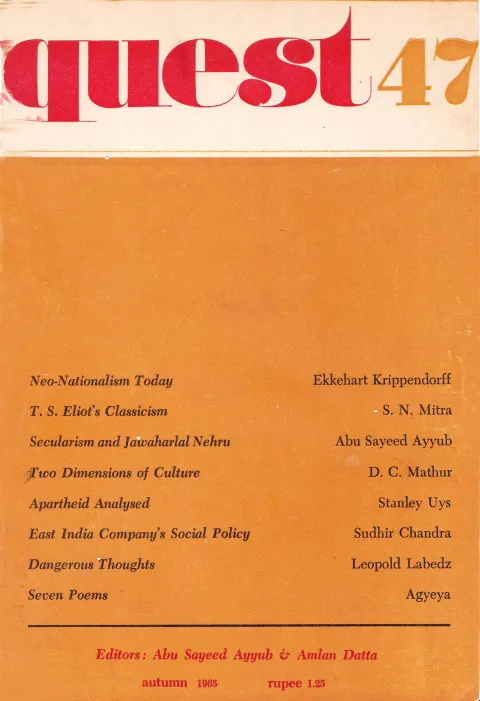
Quest
A Quarterly of Inquiry, Criticism and Ideas
By Ekkehart Krippendorff, S. N. Mitra, Abu Sayeed Ayyub, Sudhir Chandra, D. C. Mathur, Himanshu Vohra, Sujit Kumar Mukherjee, N. R. W. Pande, Stanley Uys, Raj Chatterjee, Leopold Labedz, Agyeya, Gauri Pant, Gladys Bhai, Leslie de Noronha, Punya Sloka Ray
Printed and published by Miss SHEELA SINGH for the Indian Committee for Cultural Freedom, Army and Navy Building, 148 Mahatma Gandhi Rd., Bombay 1. at Inland Printers, Victoria Mills Buildings, 55 Garndevi Road, Bombay 7. · Bombay · 1965
120 pages
QUEST
Summary
Quest No. 47 (Oct./Dec. 1965), the Bombay quarterly of the Indian Committee for Cultural Freedom edited by Abu Sayeed Ayyub and Amlan Datta, is a 120-page number whose argumentative centre is the durability of national, ethnic and religious identification against every twentieth-century scheme for dissolving it. Ekkehart Krippendorff’s lead article, translated from the German for Der Monat, argues that the Cold War’s bipolar frame has collapsed into a world of resurgent nationalisms which neither Western economic aid nor Communist social engineering has been able to overcome; Stanley Uys applies the same logic to South Africa, where a political superstructure built on segregation sits on an economy built on integration; Leopold Labedz reads a Yugoslav writer’s suppressed report from Moscow as evidence that de-Stalinisation has been ‘operetta style’; and Raj Chatterjee, writing in the year after Nehru’s death, argues from the same premise to the opposite politics, proposing a restricted franchise and ‘a controlled and regulated despotism of the bureaucrat’. Against these, co-editor Ayyub’s symposium paper on Nehru and secularism makes the issue’s most sustained liberal case: that Indian secularism must be rebuilt by separating religion from creed and community rather than by driving religion out of life, and that religious instruction of small children is ‘tantamount to a violation of the adult’s freedom of conscience’.
The issue’s other half is literary and historical. S. N. Mitra reconstructs what T. S. Eliot meant by calling himself a classicist; D. C. Mathur opposes to C. P. Snow’s ‘two cultures’ a different split, between the temporal-historical and the trans-temporal dimensions of every culture; Sudhir Chandra argues, against the Marxist consensus, that the East India Company’s government consciously chose a reforming social policy; Himanshu Vohra dissects the emptying-out of Indian socialism into a word everyone claims; Sujit Mukherjee compares Kim with A Passage to India; and N. R. W. Pande mounts an unfashionable defence of Sanskritic purism against English and Persian loanwords. There are seven Agyeya poems in English, a filler poem by Gauri Pant, two short stories - Gladys Bhai’s on nuclear dread in a hill station and Leslie de Noronha’s on an Englishman who believes he has found his illegitimate son pulling a rickshaw - eight book reviews, and a single letter from Punya Sloka Ray answering an essay on Hindu life by Nirad C. Chaudhuri, who is one of the issue’s own advisory editors. No editorial plate, photograph or drawing appears anywhere: every image in the number is advertising.
Essays
Neo-Nationalism & International Politics
By Ekkehart Krippendorff
Krippendorff divides the twenty post-war years at the mid-1950s. In the first decade the East-West conflict was defined as military, producing NATO, the Bundeswehr and what he calls ‘the Dulles craze for collecting alliances’; in the second it was redefined as a social and ideological competition for the developing world, but the redefinition never shook the underlying assumption of an irreconcilable antagonism between the two systems. He then argues that both definitions have failed, because cultural and national identifications have proved far more durable than either camp expected: the Alianza para Progreso has failed, the Sino-Soviet split is at bottom cultural and national rather than ideological, Romania and Yugoslavia have asserted national integrity against bloc discipline, and the GDR has produced a recognisably Prussian form of Communism.
The article’s second half catalogues re-awakening nationalism and racial tension across Europe, Africa, Asia and America - de Gaulle’s France, Cyprus, Canada, Czechoslovakia, Israel, the American colour bar, even the Jura question in Switzerland - and warns that Western encouragement of national feeling inside the Soviet bloc is ‘a boomerang’. Since the danger is now regional and nuclear proliferation is imminent, he calls for strict limitation of atomic weapons to the two existing Great Powers and for the conflict to be redefined in ethnic and cultural rather than military or socio-economic terms, working at its sources in domestic policy, social constitution and education.
- The Cold War is treated as over, and its ending read as a source of instability rather than of peace: ‘the risk of international chaos much more than by hope of world peace’.
- Both the military definition of the conflict (1945-55) and the social-ideological redefinition (1955-65) are judged to have failed because neither touched traditional value-judgments or behaviour patterns.
- The Sino-Soviet rift is explained primarily by cultural and historical divergence, not doctrine, and China’s increasing use of racial argument is called ‘spine-chilling’.
- Western ‘polycentrism’ policy - appealing to satellite nationalism to loosen the Soviet bloc - is called playing with fire, since the same fire burns in Western Europe, North Africa and Latin America.
- Concrete prescription: no proliferation to ‘brittle supra-national institutions such as the MLF’, an end to arms and military-training aid to young nations, and a new definition of conflict in ethnic-cultural terms.
Notes Towards the Definition of T. S. Eliot’s Classicism
By S. N. Mitra
Mitra takes Eliot’s 1928 declaration in the preface to For Lancelot Andrewes - ‘classicist in literature, royalist in politics and Anglo-Catholic in religion’ - and asks what the first term actually meant. He rejects the standard reading, shared by Max Eastman and John Bayley, that Eliot ‘located’ his classicism in the seventeenth and eighteenth centuries and meant by it simple anti-romanticism; and he rejects equally the ‘cleft Eliot’ thesis of Paul Elmer More, John Crowe Ransom and Yvor Winters, which resolved the apparent contradiction between the critic and the poet of The Waste Land by declaring Eliot inconsistent or opportunistic.
His own case is that Eliot’s critical vocabulary - impersonality, integrity, tradition, the classic - descends from Flaubert, Mallarme, Sainte-Beuve and Coleridge, that is, from the nineteenth century, and that his conception of poetry as organic integration is fundamentally different from the empirical aesthetic of Hobbes and Dryden. Reading two uncollected articles, ‘The Idea of a Literary Review’ (Criterion, 1926) and ‘Ulysses, Order and Myth’ (Dial, 1923), Mitra distinguishes a false classicism that measures living art by dead laws from a true classicism of organic order, and shows that Eliot’s praise of Ulysses follows from the latter. The later lecture What is a Classic? then redefines the classic quality as ‘maturity’, makes tradition its transmitting principle, and yields the conclusion that English literature contains no absolute classic - Pope being a ‘relative’ classic and the Elizabethans an ‘impure’ art - because classicism ‘provides no yard-stick for the measurement of individual greatness’.
- Eliot’s ‘classicism’ is argued to be a comprehensive ideal uniting organic integrity with order, not an anti-romantic slogan; Eliot himself relegated the classic/romantic antithesis to ‘literary politics’.
- The critical terms Eliot used - impersonality, integrity, the classic, tradition - are traced to Flaubert, Mallarme and Sainte-Beuve, making his aesthetic post-Coleridgean rather than neo-classical.
- The defence of the ‘three unities’ is shown to rest on Eliot’s reading of them as laws of nature discovered by Aristotle, not rules laid down, and so on dramatic concentration rather than formal correctness.
- ‘Classicism, royalism and Anglo-Catholicism’ is read, following John Hayward, as ‘the triple affirmation of a single belief-the belief in the value of tradition’.
- Conclusion: there is no absolute classic in English literature, and classicism measures artistic integrity rather than individual greatness.
- The article carries 41 numbered endnotes set over printed pp.26-27, unusually full apparatus for this run.
Secularism & Jawaharlal Nehru
By Abu Sayeed Ayyub
Ayyub’s paper - read at a symposium on Democracy, Socialism and Secularism at Vigyan Bhavan on the first anniversary of Nehru’s death, and printed by courtesy of the Ministry of Education - begins by noting that the Constitution guarantees religious liberty without separating Church and State, and defends that deviation on the ground that it lets the State legislate social reform, as in the Hindu Marriage Act, which he wants extended to the other communities. He then distinguishes three Indian senses of secularism: M. N. Roy’s materialist demand for ‘the freedom of the human spirit from the tyranny of all of them’; Radhakrishnan’s non-communalism; and Gandhi’s conviction that all religions are true. Nehru, he argues, belongs to neither extreme: quoting the Autobiography and The Discovery of India at length, Ayyub presents him as a man of deep religious emotion who condemned organised religion but defined religion as the inner development of the individual, and whose distinctive quality was a synthesis of scientific temper with ‘reverence for all that lies beyond’.
The second and third sections turn diagnostic and prescriptive. Constitutional secularism is called weak at the base because the masses remain steeped in casteism and communalism while the educated classes never had a scientific-philosophic movement comparable to Europe’s; the Bengal renaissance was swamped by a revivalism whose ‘high priest’ was Bankim Chandra Chatterjee and which Tilak carried into Bombay. Ayyub is unusually even-handed about blame - Hindu communalism is ‘soft-speaking and subtle’, ‘half-hidden from the eye like Wordsworth’s violet’, while Muslim communalism was aggressive and partitioned the country - and holds that the real obstacle is habitual loyalty to communalised forms of religion. His remedy is a new Indian secularism achieved by separating religion from creed and community: religious instruction should be withheld from children, whom he would protect from sectarian religion altogether, and departments of comparative religion should be established in all the central universities.
- India is held to be rightly not secular ‘in the western sense of complete separation between Church and State’, because the State must retain power to legislate social reform.
- Three rival Indian secularisms are distinguished - M. N. Roy’s materialism, Radhakrishnan’s non-communalism, Gandhi’s equal truth of all faiths - and Nehru placed between them.
- Nehru is read as religious in an important sense of the word, and as ‘rather out of tune with the 19th century movement called secularism’.
- Communalism, redescribed as ‘uncritical and habitual loyalty to communalised forms of religion’, is named the biggest obstacle to secularism; Hindu and Muslim varieties are both anatomised, with a footnote faulting most Muslims for not accepting ancient India as their own heritage.
- Programme: separate religion from creed and community; no recondite or exclusive doctrine taught at school or before; departments of comparative religion in every central university.
Evolution of East India Company’s Social Policy
By Sudhir Chandra
Chandra attacks the consensus - traced to Marx and endorsed even by K. M. Panikkar - that the East India Company’s government took no real interest in Indian social reform and that whatever good it did was accidental. His contention is that the administrators deliberated for several decades and then adopted a reformatory social policy ‘with full awareness of its implications’, and did not afterwards reverse it: ‘Never since Ashoka’s reign, had a Government in India evinced such an active interest in social reform.’
The causes he assigns are cumulative: the Company’s transformation from a plundering into an administering state; humanitarian protest at home, from Cowper’s verse and Burke’s ‘birds of prey and passage’ oration to Adam Smith’s strictures; the alliance of manufacturing interests with the humanitarians against the monopoly; the warning administered by Warren Hastings’s impeachment and by the loss of America; and the moral and intellectual revolution in England after Waterloo, in its Evangelical, Utilitarian and Liberal-humanitarian strands, which produced Bentinck’s appointment. The reforms are then read as a connected programme - the abolition of sati in 1829 against Rammohan Roy’s advice, the Caste Disabilities Removal Act of 1850, Widow Remarriage in 1856, the suppression of female infanticide and human sacrifice, pressure on the Rajput princes and the Khonds - culminating in the Macaulay-Bentinck educational reform, which Chandra treats as more social than administrative in motive, aimed at preparing Indians for self-government. He closes by arguing that after 1857-58 the Crown, not the Company, turned to non-intervention and to the appeasement of princes and landlords.
- Revisionist thesis: the Company’s reforming social policy was consciously chosen after decades of deliberation, not an accidental by-product of exploitation.
- Neutrality in religious and social affairs was never formally abandoned but was reinterpreted so as to license interference with practices ‘which revolted human reason and conscience’.
- Macaulay’s educational policy is credited with the deliberate intention of preparing Indians to demand European institutions - the day they did so being ‘the proudest day in English history’.
- The turn to non-intervention is dated to the Crown after 1857-58, when reform was judged unsafe and the intelligentsia came to look like a threat rather than a bulwark.
- The article is unusually well supplied with quotation - Cowper, Burke, Sir Josiah Child, Malcolm, Bentinck, Trevelyan, Elphinstone - and thin on citation.
The Two Dimensions of Culture
By D. C. Mathur
Mathur accepts that the Snow-Leavis controversy identified a real problem but argues that Snow misplaced it: the split he describes between scientific and literary cultures is horizontal, and he expects education to close it. Mathur’s counter-thesis is that every culture, East or West, past or present, carries an internal tension between a historical-temporal (‘horizontal’) dimension, in which cooperative rational intelligence accumulates achievements in time, and a trans-historical or transcendental (‘vertical’) dimension, in which the spirit reaches for a wholeness no finite achievement can supply.
He then traces the tension through four domains. In science, imagination and the ‘unification myth’ are shown to be as constitutive as observation - Newton’s gravitation, Einstein’s field theory, Freud’s and Jung’s unconscious are all named as romantic visions of total explanation. In art, the work is always less than the artist’s vision and the artist greater than his works; ‘Dionysian’ and ‘Apollonian’ elements are never perfectly harmonised. In philosophy and political theory, Plato’s Republic, Hegel’s Absolute Spirit and Marx’s classless society are read as trans-temporal romantic utopias, with Popper faulted for taking Plato ‘too seriously’ and missing his dramatic irony; behaviouralist political science after Lasswell, Easton and Weldon is faulted for a value-free positivism that conceals an unacknowledged commitment to the liberal-democratic ideal - itself, Mathur insists, a romantic one. In religion, the unresolved tension between institutionalised worship and non-institutional aspiration is blamed for contemporary apathy, and Tillich, Otto, Sartre and Camus are invoked. He ends without a remedy, hoping only for a synthesis of transcendent yearning with humane management of the world.
- Against C. P. Snow, the real cultural split is held to be vertical - temporal against trans-temporal - not horizontal between scientists and literary men.
- Imagination, defined as ‘an ideal harmony of rational intelligence, feeling and emotion’, is presented as the distinctive human capacity and as operative inside science itself.
- Karl Popper is charged with missing Plato’s dramatic irony in labelling him a Fascist and totalitarian; Plato’s utopia is one ‘could live by… but certainly not live in’.
- The claim that ‘the tremendous practical success of marxism has nothing whatever to do with its alleged scientific nature’ - Marx is read as a visionary, not a scientist.
- Behaviouralist political science is charged with an unacknowledged commitment to ‘The Open Society’, because ‘even the ideal of liberal democracy is essentially a romantic one’.
- The paper closes by posing the problem and explicitly declining to offer ‘no “panacea”… no tabloid solutions… and no super-tranquilizers’.
Socialism in India
By Himanshu Vohra
Vohra’s short article describes a double movement: Indian socialists, communists included, have abandoned socialist theory in its pure form and reduced their programmes to pragmatic items - state control of commanding heights, state trading in foodgrains, incentives to farmers, better implementation of government plans - while the formerly anti-socialist Congress has adopted socialism as its creed and made the word popular as no other party in the world has done. He notes an AICC session that debated bank nationalisation and then resolved instead, as a long-term measure, to nationalise rice-mills.
His explanation is the underdeveloped economy’s dilemma: high saving requires curtailed consumption, but existing inequality makes any cut in consumption anathema to socialists, who therefore neither take radical risks nor renounce the creed. Nehru is given an unusually large causal role - a utopian by temperament, influenced by both Marx and the Fabians, who mellowed in office yet could not break with his old ideas and so persuaded his party to adopt first ‘a socialistic pattern of society’ and then ‘socialism’ as its goal, with class interest replaced by the general interest of society and struggle against exploiters by a vague fight against poverty and ignorance. The result is ideological confusion in which opposition socialist parties are indistinguishable from the ruling party, the Hindu Mahasabha calls its goal ‘Hindu Socialism’, and ‘everybody fell over each other in this fashion to get into the omnibus of socialism’ - a contradiction, he ends, ‘hardly one which can lead to a higher synthesis’.
- Indian socialist parties, communists included, are described as shedding ideology ‘drop by drop’ while the Congress popularises the word.
- The underlying dilemma is stated as the conflict between the saving rate an underdeveloped economy needs and the existing inequality of consumption.
- Nehru is assigned an extraordinary individual causal role in converting the Congress to socialism, and his own dilemma is made the source of that socialism’s peculiar features.
- Consequence: opposition socialist parties lost their programmes to the ruling party and revivalist parties were forced to adopt qualified socialisms of their own.
- The projected merger of non-communist socialist parties is judged unlikely to produce any more radical stand than its constituents took separately.
India’s Entry in English Fiction
By Sujit Mukherjee
Mukherjee sets Kim beside A Passage to India and asks to be allowed to read them as novels rather than as interpretations of India. He first lists their similarities: each is its author’s last novel, neither was written in a hurry, both are built on search themes (the Lama’s River, Kim’s Red Bull, Mrs Moore’s and Adela’s ‘real India’, Fielding’s good will plus culture and intelligence), both use a non-Indian as viewing medium, both contain an unexplained mystery attached to a strange character, both fall into three movements with a climax that forces a taking of sides, and both are backlit by a religious symbology.
He then argues that the similarities are incidental and that the writers differ radically in manner and achievement. Kipling writes with the confidence of a man in no doubt about his material, crowding the canvas with passers-by and local colour and proceeding by ‘understanding’; Forster approaches Chandrapur from a great distance and proceeds by degrees of misunderstanding, of which the central incident is the greatest. Kipling’s characters are mostly old and look backward, are subservient to an exterior force and do not constitute a society; Forster’s are involved in mutual relationships that form the fabric through which he strains his comprehension. Mukherjee grants Kipling the more compelling narrative but finds it leaves no room for reflection, while A Passage has an organic wholeness that makes Kim’s brilliance look like surface brilliance - Kipling, ‘essentially a short-story writer, convinced himself at last in Kim that his talents were not suited to the novel form’.
- The two novels are compared as novels, not as fictional interpretations of India - the customary approach the article sets aside at the outset.
- Both are built on search themes; the difference lies in how the search is conducted and what the seekers find, Forster’s issues transcending the individuals who raise them.
- Kipling proceeds by understanding, Forster by misunderstanding; Forster’s verdicts on India refuse to be as definitive as Kipling’s.
- Kim is judged easier to read and Kipling’s narrative power more compelling, but A Passage the more deliberately planned and complete work.
- A footnote observes that horse-riding is ‘inescapably associated with British rule in India’ and that even Forster cannot avoid it - the novel ends on horseback.
In Defence of Linguistic Purism
By N. R. W. Pande
Pande answers the argument that foreign words are easier than Sanskrit ones in Indian languages. He tests ‘easier’ against three criteria - ease of pronunciation, brevity and meaningfulness - and claims Sanskrit wins on each, comparing prachar with propaganda, peeth with academy, natak with drama and laghu-lahari with short-wave. Where an English word is genuinely more current, he attributes the currency to British educational and political policy rather than to any property of the word, and argues that the state, ‘becoming omnipotent’, can give currency to any word it likes, citing pustak’s displacement of book after Tilak’s time. A twelve-language comparative table on printed p.57 is offered to show that samay, upayog and daya are current across India while time, istemal and rahem are confined to Western U.P. and the Punjab.
The second half is a theory of enrichment. Substituting a foreign word for a Sanskrit one adds nothing to the stock; English is hard to master precisely because its heterogeneous vocabulary gives no guidance from word to word (philately, litigation, horticulture), whereas 2,000 Sanskrit roots generate the rest with ‘nearly mathematical regularity’ - he compares abandoning Sanskrit for English and Persian to abandoning the decimal system for Roman numerals. Foreign grammar is said to do worse damage than foreign words by importing alien plural formation. On the aesthetic side, ‘One cannot darn velvet with jute threads’; on the scientific side, he denies that English terminology is international, citing Dr. Kothari to the effect that only signs like = and + are, and proposes that Sanskrit terminology could be adopted across East Pakistan, Ceylon, Burma and South-East Asia. He concedes three classes of non-Sanskrit words that must be kept - each language’s own native stock, proper nouns, and foreign words naturalised over centuries without the instrumentality of foreign rule. The article also contains a contested claim that Urdu ‘cannot be the mother-tongue of anyone’ and would disappear without state patronage.
- Three tests of simplicity - pronunciation, brevity, meaningfulness - are applied word by word and Sanskrit equivalents held to win on all three.
- Currency is dismissed as a criterion because the state can manufacture it: if the Railways use sthanak, station’s currency will ‘become a thing of the past’.
- Sanskrit’s derivational regularity from roots is contrasted with English’s unconnected vocabulary; borrowing is said to dry up a language’s power to coin new words.
- The claim that English scientific terminology is international is called ‘demonstrably false’, with Dr. Kothari cited that only signs like = and + are genuinely international.
- A strong and contestable claim about Urdu: that philologists regard it as a literary form of Hindi, that it ‘cannot be the mother-tongue of anyone’, and that without deliberate patronage its Persian vocabulary will disappear.
- Three classes of non-Sanskrit words are nevertheless conceded as necessary, including proper nouns, which he wants restored to Indian forms (Narottam Sinhahanu, Sibir, Rusi, Pari).
Theory and Practice of Apartheid
By Stanley Uys
Uys states apartheid’s theory in its own terms - economic integration leads to political and social integration, therefore whites must dispense with African labour or else be behaving immorally - and then shows that the whole white population has refused the sacrifice. He assembles the figures: urban non-whites rose from 3,326,000 of 5,397,000 in 1951 to 4,509,000 of 6,970,000 in 1960, non-whites now outnumber whites in every major urban centre including Pretoria, and they supply 86 per cent of agricultural, 80 per cent of mining and 70 per cent of manufacturing labour. The contradiction is structural: a segregationist political superstructure erected on an integrated economic base, so that enforcing economic apartheid would bankrupt the country while allowing integration to continue must eventually produce demands the government has itself defined as impossible to concede.
He then argues that the Nationalist government is not conservative but reactionary, quoting Palmerston’s 1859 definition of the second kind of revolutionist and Burke on a state without the means of change, and that apartheid can only be abandoned or accelerated because Verwoerd has closed every escape hatch. Apartheid is presented as specific to Afrikaner nationalism - the oldest nationalism on the continent, nurtured on resentment of British imperialism, avenged in 1948 - and as a doctrine no other white government would have needed; Uys marshals figures on Afrikaner economic weakness (1 per cent of gold mining, 3 per cent of coal, about 1 per cent of industrial production) to suggest that affluence might have made them more pragmatic. He shows Malan and Strydom both rejecting total territorial segregation, cites Smuts in 1942 on urbanisation (‘You might as well try to sweep the ocean back with a broom’), and dismisses the Bantustan solution: the Reserves are under 13 per cent of the surface area, the Tomlinson Commission wants 1,800,000 Africans taken off that land, and the government forbids private white capital or foreign aid from industrialising them. The article ends on the political consequence - if people are denied participation in Parliament they cannot resolve their conflicts through it: ‘Where must they resolve them then-in the streets?’
- Apartheid is refuted on its own premises: it accepts economic integration in practice while rejecting the political, social and residential consequences its own theory says must follow.
- The Nationalist government is classed as reactionary rather than conservative, via Palmerston’s 1859 definition and Burke’s maxim that a state without the means of change lacks the means of its conservation.
- Apartheid is treated as the race doctrine of the Afrikaner people specifically, inseparable from Afrikaner nationalism, so that if it goes the nationalism goes with it.
- Verwoerd’s predecessors Malan and Strydom are quoted rejecting total territorial segregation, making Verwoerd’s claim that apartheid is ‘traditional’ policy ‘quite incorrect’.
- The Bantustan remedy is dismissed on the Tomlinson Commission’s own arithmetic, with the government prohibiting the private and foreign capital the Reserves would need.
- The structural danger identified is the loss of parliamentary arbitration: conflict with no institutional outlet moves to the streets.
A Case for Centralisation
By Raj Chatterjee
Chatterjee opens with a balanced-seeming double portrait of Nehru - all the attributes of greatness on one side, an idealist and dreamer whose public utterances were ‘weak and fumbling’ and whose foreign policy ‘consisted, alternately, of begging and bragging’ on the other - and locates the debit in Nehru’s loyalty to the ‘office-seeking, power-hungry “freedom fighters”’ whose judgement overrode his own. Those men, he says, ignored two lessons of history: that India is not a nation in the strict sense and can retain only the semblance of nationhood while there is a strong unwavering hand at the centre; and that there can be no true democracy in a country with a literacy rate under 10 per cent and no alternative government to turn to.
He surveys eighteen years of independence as a landscape of provincial satraps, unchecked corruption, demoralised bureaucracy, ration queues, pavement sleepers and showpiece projects financed by borrowing, and faults prohibition and the language policy as impositions maintained out of constitutional obstinacy - Hindi, he writes, ‘can never be a common language for the country’. His remedy, offered as transitional, is a return to something like the pre-1935 set-up: Service governors advised by men of the same school, a controlled and regulated despotism of the bureaucrat accountable only upward, apprenticeship for future legislators in county-council-style local bodies, and a restricted franchise - matriculation in the towns, matriculation or Rs. 1,000 of agricultural revenue in the villages - with a second chamber of elder statesmen, princes, industrialists, educationists and retired officers part elected and part nominated. He anticipates the charge: ‘In making these suggestions I shall be called a reactionary by many of my compatriots.’
- An explicitly anti-democratic liberal-conservative argument published in a journal of cultural freedom in the year after Nehru’s death.
- India is described as not a nation in the strict sense, so that only a strong centre prevents separatist tendencies - the ‘Case for Centralisation’ of the contents-page title.
- The franchise is to be restricted by education or property, on the ground that democracy with sub-10-per-cent literacy is a farce.
- Bureaucratic rule is preferred to political rule, with about 150 surviving I.C.S. men and senior I.A.S. officers named as the available material.
- Prohibition and the imposition of Hindi are attacked as constitutional obstinacies that have cost revenue and lives respectively.
- The author forestalls the obvious objection by disclaiming politics: ‘labels and shibboleths are of small consequence when the happiness and prosperity of 400 million people are in the balance.‘
Dangerous Thoughts: A Yugoslav Looks at Russia
By Leopold Labedz
Labedz builds his article around the suppression of Mihajlo Mihajlov’s ‘Moscow Summer 1964’, which appeared in the Belgrade literary monthly Delo in January and February 1965 and was withdrawn from circulation on 10 February for insulting the honour of the Soviet Union. He sets the affair beside Milovan Djilas’s imprisonment over Conversations with Stalin, quoting Tito’s claim that he is ‘not an autocrat’ and could neither imprison nor release anyone, and then his complaint to state prosecutors that they wait for a signal from above; Mihajlov was arrested under an article punishing ‘whoever brings a foreign state into derision’. Labedz’s point is that the offence was not the facts - the death camps and the genocide were no longer in dispute after Khrushchev’s 1956 speech - but the approach to them and the fact that a Yugoslav brought them out on his own initiative.
The bulk of the article quotes Mihajlov’s report as evidence of ferment under the ritual phraseology: the perfunctory rehabilitation forms that tell families nothing; Tvardovsky’s introduction to the January 1965 Novy Mir; Lakshin’s defence of Solzhenitsyn and the saying ‘Tell me what you think of Ivan Denisovich, and I will tell you who you are’; Leonov’s judgement that people will write about the camps for eighty years; the concentration-camp folklore and prisoners’ songs; the immense unofficial popularity of Bulat Okudzhava, whose records are never made; Dudintsev’s poverty while Mezhdunarodnaya Kniga withholds his foreign royalties; the young readers of Bely, Kafka, Nabokov, Zamyatin and Remizov; and the way polemics with China became a weapon against Zhdanovism. Labedz closes on the 2nd Russian Writers’ Union Congress, where no liberal was given the platform, quotes Zamyatin’s 1921 prophecy that a literature made to tremble at heresy has ‘only one future: its past’, and ends: ‘If Tito agrees that he is, Mihajlov should be free.’
- The Mihajlov affair is read as confirming Djilas’s diagnosis that Soviet de-Stalinisation has been ‘operetta style’ and that conscience is ‘implacable and indestructible’.
- Labedz insists the scandal was not the facts reported but that a writer from a socialist country reported them on his own initiative: ‘I have dared to think with my own head see with my own eyes without permission.’
- Rehabilitation is shown as a bureaucratic form that names no date, place or manner of death, with ‘few families in the country without at least one member being in need of rehabilitation’.
- Unofficial culture - camp songs, Okudzhava’s tape-recorded chansonnettes, samizdat-adjacent enthusiasm for Kafka and Nabokov - is presented as the real measure of the thaw.
- The Sino-Soviet dispute is identified as a practical resource for Soviet liberals, since attacking Chinese positions obliged Izvestiya to defend Voznesensky, Yevtushenko and Akhmadulina.
- The article is sympathetic to Yugoslav writers but sceptical of ‘the quality of the new Yugoslav democracy’.
Seven Poems
By Agyeya
Seven short poems by Agyeya in English translation, printed under the POETRY head as ‘Seven Poems of Agyeya’ and credited at the foot of printed p.83 to Sachchidananda Vatsyayan and Leonard Nathan working from the Hindi original. The sequence is ‘Life and Shadow’, in which the speaker watches his own reflection pierced by colour-flashing fish; ‘Waiting’, a nocturne of the twelfth moon, a sunken lake and ‘Long kept-down desire’; ‘Hunter’, two parallel scenes in which an arrow loosed at a target kills no one while an idle twang on an empty bowstring strikes a heart miles away; ‘The River Is a Friend’, where the same declaration of love by the Jamuna is answered first with acceptance and then with renunciation; ‘The Revolving Rock XXV’, a long meditation in which the speaker sits on the seam where sea meets land and finds at nightfall that the sea should sing and the land be still; ‘June Night’, in which a gorged-python river worms into the cliff’s shadow and ‘There is no privacy anywhere, no silence’; and ‘A Farewell at the Airport’, where the machined eagle rises and merges into nothing while the snake is ‘left behind, here, writhing, snapping’.
The poems share a habit of holding two states in balance - shadow and body, acceptance and renunciation, aim and no aim, land and sea, departure and remaining - and they consistently end without resolving the balance. The translation is plain and unrhymed, with irregular indentation used to set off alternate voices in ‘Mirage’-like fashion.
- Seven titled poems in English translation, the group heading naming the poet; the poet is simultaneously credited as one of the two translators.
- Recurring structural device: a pair of opposed states presented without resolution - shadow and reflection, acceptance and renunciation, the sea’s song and the land’s stillness.
- ‘Hunter’ inverts intention and effect: the aimed arrow kills nothing, the aimless twang wounds someone miles away.
- ‘A Farewell at the Airport’ sets the aeroplane’s disappearance against the snake left writhing on the ground, and ends with everything going dark before the eyes.
- ‘June Night’ is the most concretely observed - oxen, nightjars, cicadas ‘rewind their clocks’ - and the most oppressive in mood.
Mirage
By Gauri Pant
A single short free-verse poem of thirteen lines printed as a filler on the lower half of printed p.68, below the close of Stanley Uys’s article on apartheid and well ahead of the POETRY section proper. The speaker drinks ‘strange waters of strange lands’ in the bowl of night and is lulled into strange fantasies; when the inner mirror blazes she becomes conscious and sees ‘ungloved hands of life rotting’. The middle turn balances the absence of anything to live for against the absence of anything to die for and resolves it in the flat line ‘I go on living.’ The close widens the frame: the revolving mind sees a thousand dawns and a thousand nights ‘Revolving on the tips / Of time’s finger.’
The poem is signed GAURI PANT beneath the text and is the shortest signed item in the issue.
- Thirteen lines of unrhymed free verse, printed as a page-filler rather than in the POETRY section, though the contents page lists it there.
- Structural device: alternating indentation, with the indented lines carrying the moments of consciousness and the flush lines the images of decay.
- The central balance - nothing to live for, nothing to die for - is resolved by inertia rather than by choice.
- The closing image of dawns and nights revolving on the tips of time’s finger supplies the title’s mirage.
The Lesser Evil
By Gladys Bhai
Eighty-year-old Miss Victoria Taylor, an Englishwoman who has stayed on in an Indian hill station, closes a Book Society novel about accidental nuclear war and finds herself unable to stop thinking about it. The story follows a single evening: her walk to the gate to look for her servant Moti Ram and the three dogs, her Tuesday dinner with Dr. Lal of the T.B. hospital, their conversation about whether the masses ought to be educated in civil defence, and her retirement to bed. The domestic detail carries the story’s real subject - she uses her priceless dinner service because she can no longer afford ordinary things, she pins her hopes on selling treasures to next season’s summer visitors, and she has written her house and everything in it to Moti Ram for loyalty and devotion, a bequest she will not hint at for fear of embarrassing him.
The last page turns the situation inside out. In the servants’ quarters Moti Ram explains to his widowed daughter Shanti that he has been haggling over her wedding anklets with the old merchant in the bazaar; only one anklet is left. Father and daughter discuss how the old woman ‘has spent so much money on feeding all those dogs’ and ‘starved herself to do it’, and Moti Ram gives up his hookah because it makes him cough. The title’s lesser evil is left unnamed - the reader is allowed to weigh the nuclear terror the two educated characters discuss over dinner against the quiet insolvency that is consuming both households.
- A two-household structure - the mistress’s drawing room and the servants’ quarters - with the second revealed only in the final page and reversing the first.
- The nuclear anxiety of 1965 is filtered through a Book Society novel and a doctor’s reassurance that a novelist who were an expert ‘wouldn’t be writing novels would he?’
- Miss Taylor’s refusal to ‘go back home’ is given an economic as well as sentimental motive: a dreary boarding house in England, and the dogs.
- The story’s irony is financial: she is secretly leaving the house to Moti Ram while he is secretly selling his daughter’s silver to keep them all fed.
- Bertrand Russell is quoted at the dinner table: ‘People would rather die than think- and they do.‘
The Rickshaw Man
By Leslie de Noronha
A retired British officer, now a Home Office clerk in a Brompton Road bedsitter, comes into a legacy and returns after some forty years to the Himalayan hill station where he spent the first half of his life. The narration is his own written account of what followed. Among the Gilbert and Sullivan memories, the church parades, the polo ground and the ‘Europeans Only’ sign at the club gate, he keeps seeing one rickshaw coolie with yellow hair and blue eyes, and comes to be obsessed by him - by a way of running, head thrust forward, jaw protruding, that he recognises as his own and his brothers’. The obsession drives him at last to the club, and to the memory he had avoided: in 1938, drunk and humiliated after Margaret’s engagement to the general’s A.D.C., he walked five miles down the valley, stripped at a pump, and raped a hill woman who ‘offered no resistance’; she turned out to work in the club gardens, and when the regiment left for Burma she was ‘pointedly pregnant’ and he settled the matter with a ten rupee note.
He returns to his hotel room, strips, trots at the mirror, and catches his own head shooting forward. The story then refuses him his recognition scene: he can imagine no way to say it, weighs taking the man to England or forgetting the whole affair, and leaves on the afternoon train with a week of his holiday unused. The last section switches to the rickshaw man, who is relieved the elderly white sahib has gone, is tired of his cronies’ teasing about his hair and eyes, and has understood the staring in the only terms his experience offers: a hotel room, a locked door, a ten rupee note, a little haggling, another note. The reader is left holding the two incompatible readings of the same weeks.
- A late-colonial story of returned memory whose final page transfers the point of view to the Indian character and destroys the narrator’s sentimental reading of events.
- The narrator’s tenderness and pride are shown resting on an act he has spent decades not remembering; the story’s design makes the reader supply the judgement.
- The 1938 section is set in smaller indented type as a framed memory, the club’s ‘Europeans Only’ security enumerated in a single cadenced sentence.
- The story records period racial language in the narrator’s own voice - the Anglo-Indian station-master and ‘the tar-brush brigade, we called them then’, and the other rickshaw men as ‘grubby, dark-skinned, puny little bastards’ - as well as the routine of sending for women ‘from the bazaar’.
- The final irony is economic as well as sexual: the same ten rupee note closes both encounters, a generation apart.
Design for Tomorrow
By Mahesh Desai
Desai reviews B. G. Verghese’s Design for Tomorrow, a journalist’s account of three months’ travel through farms, factories, mines, dams, power stations, research establishments, zila parishads, co-operatives, industrial estates, technical institutions and housing developments. He is generous about the reporting - the range is ‘truly breathtaking’, the writing ‘consistently aglow with authentic comment added to an intelligible set of facts’, the book plainly ‘a labour of love’ - and grants that hope of a better tomorrow is as necessary to development in an impoverished open society as savings or organisation.
His reservation is political. It is very difficult, he writes, to see in the isolated activities of the development programme any worthwhile evidence of the conscious dynamics of a nation committed to democracy and socialism. Economic growth in India is ‘an awful compulsion’ to which the people will not submit unless its egalitarian purposes are reflected in national behaviour; if growth moves away from those purposes, submission will cease to be willing and India will cease to be a democracy. The review therefore ends not on the projects but on the challenge: ‘Some may hope and many may grumble. But a lot more besides are wondering how we are going to live up to the challenge.’
- Praises the book as reportage while rejecting the optimism implicit in its title.
- Argues that hope is a factor of production in a poor open society - people will not save or organise for a tomorrow they do not expect.
- Central objection: individual projects supply no evidence of a nation consciously committed to democracy and socialism.
- Links the two: ‘One way or another our development endeavour cannot but be socialistic if we are to remain a democracy.‘
Political Behaviour in India
By S. Natarajan
Natarajan reviews V. M. Sirsikar’s study of voting in four of Poona’s six Lok Sabha constituencies in the 1962 general elections, and judges it ‘infinitely more valuable than its title suggests’ - pioneering research that confirms or demolishes the preconceived notions of political observers. Sirsikar’s broad conclusion is that parliamentary democracy is institutionally fairly firm but that the political education of voters is badly lacking; the review’s own emphasis falls on the voter’s misconception of his power, seeing the government not as removable but as a dispenser of small favours.
The review then relays the findings: a third of voters do not understand the issues, nearly a quarter do not know the candidates or which legislature they are standing for, 8.5 per cent vote for the symbol, and about 40 per cent vote as the head of the family directs, he in turn being influenced by a religious head, community leader or caste panchayat. Natarajan adds a factor Sirsikar omits - the employer’s influence on votes, crudest where unskilled labour is loosely organised but not unknown in organised industry at trade-union level - and notes that neither party nor candidate expenditure can be reconstructed. He reports the asymmetry by which voters lean to Congress on broad policy (foreign affairs, peaceful settlement, the socialist society) but accept opposition criticism on local questions and prices, and the high value they place on a candidate’s ‘social service’. On Sirsikar’s two questions about 1967 - how Congress will fare without Nehru, and how business houses will react to the anti-corruption drive given Congress’s need for funds - he hazards that the effect of both will be marginal.
- A rare early Indian voting-behaviour study, treated as pioneering and worth serious argument even where its conclusions are contestable.
- Headline finding relayed: institutional democracy is firm, voter political education is not.
- The voter’s model of government is patronage, not removability - ‘possession of office… is not nine points of the law but the whole law’.
- Structural advantage of Congress noted: it alone contests nearly all seats and so alone qualifies for office, while others bid for second place.
- The reviewer supplies a factor the book omits - employer pressure on votes - and predicts that both the loss of Nehru and the corruption drive will matter only marginally in 1967.
Gandhi, His Relevance for Our Times
By A Ranganathan
Ranganathan reviews a Bharatiya Vidya Bhavan symposium on Gandhi’s relevance, and finds it ‘a combination of commentary and sermon’ - the commentary ranging from Thoreau’s impact on Gandhi to means and ends in politics, the sermon suggesting that the Government of India’s actions should be conditioned by the Gandhian ethic. His main complaint is editorial: competently written essays assembled without unity or a stated basis of selection, with Sriman Narayan’s ‘Planning for the Future’ singled out as irrelevant to the symposium and too superficial for serious readers.
The substantive argument concerns whether Indian foreign policy may fairly be judged by a Gandhian yardstick. Ranganathan quotes Radhakrishnan’s Bikaner address of 1959 on having Gandhi’s name on our lips but not in our hearts, and then a run of Western judgements - Gene Sharp on India’s likely nuclear response to China, Paul Power endorsing Pyarelal’s verdict that Goa was a ‘travesty’ of Gandhian principles, Kenneth Boulding on India as a weak and petulant bully - observing that these are provoked by Indian foreign-policy statements ‘usually noted for their sanctimonious display of moral superiority’, but that applying the Gandhian scale to Indian foreign policy is ‘neither accurate nor fair’. His reason is that Gandhi invariably allowed Nehru to be the spokesman on foreign policy, and that Nehru’s affinities were with the Left Book Club of the thirties rather than with Gandhi: hence the epigram that ‘just as the battle of Waterloo was won on the playing fields of Eton, the battle of NEFA was lost in the lecture-halls of the London School of Economics’. He ends by welcoming Yamunacharya’s essay on Thoreau and Indian thought and by noting Byles’s argument that Martin Luther King did not consciously copy Gandhi’s methods.
- Faults the symposium for lack of unity and for not disclosing its basis of selection; criticism is directed at the editors as much as the contributors.
- Rejects the practice of judging Indian foreign policy by the Gandhian yardstick, while conceding that Indian moral rhetoric invites it.
- Explains the gap by Gandhi’s own delegation of foreign policy to Nehru, and Nehru’s formation in thirties Western left politics rather than Gandhian ethics.
- Relays the claim that Martin Luther King did not consciously copy Gandhi’s methods but recognised the likeness after his movement was launched.
- Treats Thoreau as ‘the patron saint of the Gandhian movement in India’ and welcomes Yamunacharya’s essay on him.
The Beginnings of Indian Philosophy
By Daya Krishna
Daya Krishna reviews a UNESCO-series volume of selections from the Rig Veda, Atharva Veda, Upanisads, Gita and Mahabharata translated mostly by their compiler, a Sterling Professor Emeritus of Sanskrit at Yale. He proposes two tests - the correctness of the new departures in translation, and the adequacy of the selection as an insight into the seeds of Indian philosophy - and finds the book fails both. The philological perspective so prominently announced on the cover is not sustained in the body of the work, whose emphasis ‘is philosophical rather than philological’; the philological innovations that do appear, chiefly the readings of Samkhya as everyday ‘reasoning, ratiocination’ and Yoga as putting something to active and purposeful use, are called minor variations rather than basic alterations, since the philosophical picture they yield is not substantially different from the received one.
The review’s real force is directed at the selection’s conception of Indian philosophy, which it finds even more restricted than the traditional one: Nyaya, Vaisesika and Mimamsa are excluded and do not even appear in the index, the grammarians and aestheticians are ignored, atheistic strands are underplayed, and Buddhist and Jain thought is set aside as heterodox. Against this, Daya Krishna presses a comparative argument - selections from the Bible would scarcely form part of a book of readings on the beginnings of Western philosophy, so why should the Gita in an Indian one - and calls this ‘the million-dollar question which neither Prof. Edgerton nor anybody else has asked himself’. His conclusion is that the volume obstructs rather than helps the only worthwhile task in the contemporary state of Indian philosophy, which is to free it from a frozen mould.
- Two explicit tests are set for a book of selections - translational novelty and adequacy as an account of philosophical beginnings - and both are judged unmet.
- The advertised philological perspective is said not to be sustained in the body of the work; the reinterpretations of Samkhya and Yoga are granted but called minor.
- The selection’s exclusions are the substance of the complaint: Nyaya, Vaisesika, Mimamsa, the grammarians, the aestheticians, and Buddhist and Jain thought.
- A comparative polemic: a twentieth-century book on the beginnings of Western philosophy would not print the Bible, and Indian philosophy is held to its own sixteenth-century perspective.
- The headnote misnames the author ‘Franklin Edgeston’ while the review itself calls him Prof. Edgerton throughout - a printed error preserved as set.
Is Metaphysics Possible?
By A. R. Sinari
Sinari reviews Pratima Bowes’s defence of metaphysics against logical positivism and linguistic analysis. He sets the scene by noting that phenomenology and existentialism have forced the anti-metaphysical schools into concessions, while the ruling temperament of Anglo-American philosophy remains essentially anti-metaphysical. Bowes’s position, as he presents it, is that there is a plurality of legitimate approaches of which the metaphysical is one, characterised by the search for a principle of creative capacity that can raise mere multiplicity to unity, and he agrees that the norm metaphysics points to is the ultimate reference by which the manifold of reality can be understood or judged.
His criticism is that her defence is sometimes unrestrained. She grants that analysis has made it impossible to philosophise ‘in an abstractly vague and woolly fashion’ but never says what that fashion is, so that one cannot tell which metaphysical works she would condemn; and she does not face the questions her own case raises - what rules of language a metaphysician giving expression to ‘a new dimension of awareness’ should abide by, how to test sense against nonsense in philosophical language, how to determine degrees of clarity or woolliness, and whether cashability in experience should be a universal norm. He would also have liked the question raised of what makes speculative metaphysics adopt statements that cannot be cashed in terms of experience, warning that if psychological motivation is admitted as explanation ‘clarity ceases to have any value’. He nonetheless commends the book as a powerful essay on the narrow working of the criterion of meaningfulness in Anglo-American philosophy.
- Places the book in a wave of recent defences of metaphysics enabled by phenomenology and existentialism.
- Accepts the pluralist framing - metaphysics as one legitimate approach, aimed at an ultimate form of unity.
- Principal objection: the book invokes vagueness and woolliness as faults without ever specifying them, leaving its own standard unusable.
- Presses four unanswered questions about the rules of metaphysical language, the test of sense and nonsense, degrees of clarity, and cashability.
- Warns that grounding metaphysical language in psychological motivation licenses ‘the most confounding fuzziness’.
The Miracle Ahead
By Martin S. Dworkin
Dworkin’s is the longest and most hostile review in the issue. He sets George Gallup’s book in a native American tradition of declamatory optimism - ‘the obverse, brighter face of the doomsday pietism hoarded by the earliest immigrants’ - and in a lineage of hortatory entertainment running through modernist sermons, the Lyceums and Chautauquas and newspaper supplements, likening the promised miracle to Russell Conwell’s ‘Acres of Diamonds’. Gallup’s thesis is that man has not realised the potential of his brain and that available technique and technology can secure limitless progress; his programme is to find and organise talented and public-spirited people into team efforts that would bypass conferences, committees, commissions and much of conventional politics, wielding a new methodology drawn from ‘the statistical analysis of mass experience’.
Dworkin’s objection is political rather than methodological. He reads the proposal as ‘another plan for the management of society by custodians and experts’, notes that Gallup’s safeguards - programmed professional dispassion, dedication to freedom of the common man - are less realistic than the strictures Plato put on his own deliberately imaginary philosopher-rulers, and insists that ‘the question of who is to plan the planners surely has some place in democratic planning’. The review’s sharpest point is that Gallup admires the Manhattan Project above all precursors precisely for the monumental secrecy that kept the development of atomic force from those ultimately responsible for it, and reads his call for ‘political invention’ as a proposal to place planning and execution beyond disclosure and political alternatives - which makes him, in Dworkin’s closing phrase, ‘a menacing rhetorician of Newspeak, or an inexcusably unwitting ironist’.
- Locates Gallup in an American tradition of popular meliorist exhortation rather than in social science.
- Concedes the criticism of American education but faults Gallup’s own uncritical appropriation of ‘change’, ‘progress’ and ‘happiness’ from popular discourse.
- Core objection: the plan is technocratic custodianship, and ‘the question of who is to plan the planners surely has some place in democratic planning’.
- Notes the double-edge of polling itself - informing the democratic process while capable of shaping rather than discovering public opinion.
- The decisive evidence is Gallup’s admiration for the Manhattan Project’s secrecy as a model of organisational achievement, not a wartime necessity.
Summer in Calcutta
By Gieve Patel
Patel reviews Kamala Das’s first book of verse and finds her a sensitive, self-willed and honest poet, sometimes high-strung, whose poems are ‘used as instruments for regaining balance, often clutched at in haste and rarely scrutinized later’. His critical principle is that where art and conflict are well poised the result is very good - he names ‘The Freaks’, ‘A Relationship’ and ‘The Sea Shore’ - because the poems spring from a genuine personal conflict that supplies a taut counter-tension to its resolution in art, and the lines then dictate their own length and structure.
He is exact about the failures. He objects to ‘stuffing’: cliches (‘The summer wind puffs and huffs’), repetitions that add no strength (‘dead, dead, dead’ where one would be more effective), and redundant beats filling rhythm gaps. He traces the eunuch image from ‘The Dance of the Eunuchs’ through ‘The Freaks’ to ‘In Love’, prefers the poems that arise from the need for love set against ‘mere’ physicality, praises the title poem’s self-containment and ‘The Flag’ for two lines about the stationary wheel while faulting the rest for obviously pathetic images, and dismisses most of the ‘Childhood’ poems as disproportionate or theatrical, ‘A Hot Noon in Malabar’ excepted. He closes by granting that Kamala Das has enough fine poems to command notice and setting her two tasks: to do away with lines wasted on stuffing, and to work her way towards a tougher vision, ‘even if it be one of despair’.
- An unusually technical review of a first book: the criterion is the poise between personal conflict and its resolution in art.
- Coins ‘stuffing’ for cliche, ineffective repetition and rhythm-filling redundancy, and quotes instances.
- Traces the eunuch figure across three poems as the book’s controlling image of flamboyant barrenness.
- Judges the ‘Childhood’ poems disproportionate, with ‘A Hot Noon in Malabar’ the exception.
- Ends with a demand rather than a verdict: strip the stuffing and move towards a tougher vision.
India and Regional Integration in Asia
By P. Kodanda Rao
Kodanda Rao reviews Sisir Gupta’s book on India and regional integration in Asia, written while the author was in America in 1961-63 for the Indian Council of World Affairs. He notes that Gupta declared a narrow scope - the official Indian attitude - but happily exceeded it, and that he quoted more foreign non-official sources than Indian, ‘perhaps because they were more readily at hand to him in America’. The review’s substance is a reading of Nehru’s foreign policy: his personality and interests gave him uncontested monopoly in the field, and his dominant ambition was ‘to seek a short-cut to international status’, winning a seat at the high table by moral exhortation, non-alignment, honest brokerage between the blocs and friendship to all. For Nehru the dividing line was not communism against anti-communism but haves against have-nots, colonialism and racialism, which cut across it.
The review then runs through the attempts at regional integration Gupta catalogues, from the Asian Relations Conference of 1947 through Baguio, Colombo, Bandung, Brioni and Belgrade to the Simla and New Delhi conferences, and explains their failure: the region could not be clearly defined, it had no common bonds of religion, race, history or political institutions, and immediate tensions made integration impossible between India and Pakistan, Pakistan and Afghanistan, Malaysia and Indonesia, Arabs and Jews, India and Ceylon, Burma and China. Their only common factor was economic poverty - ‘and, as one commentator put it, any number of zeros added together make only Zero!’ Pakistan’s Pan-Islamic counterpart efforts are noted and their abandonment recorded, with the Pakistani foreign minister’s 1956 formula ‘Pak-Islamism, and not Pan-Islamism’. The review ends flatly: Nehru’s enthusiasm peaked in 1947 and declined thereafter, and ‘India’s non-alignment is outmoded.’
- Notes and gently criticises the book’s dependence on foreign non-official sources over Indian ones.
- Reads Nehru’s non-alignment as a search for a short-cut to international status in the absence of military might.
- Attributes the failure of Asian regional integration to the absence of any definable region and of common religious, racial, historical or institutional bonds.
- Records Pakistan’s parallel and abandoned attempt at Islamic integration, with its own foreign minister repudiating Pan-Islamism.
- Closes with a flat verdict against the policy the book describes: ‘India’s non-alignment is outmoded.‘
Dichotomy in Hindu Life
By Punya Sloka Ray
A letter to the editors from New Delhi, dated 30 July 1965, answering an essay on Hindu life by Nirad C. Chaudhuri - who is named on this issue’s own masthead as an advisory editor, a relationship the printed text does not disclose. Ray calls the essay ‘an interesting failure’: interesting for a passionate nationalism disguised as self-criticism, a failure because the passion is guided by so uncertain a vision, and because its authorities on ‘Hindu’ psychology are Alberuni, the Abbe Dubois and other long-past foreigners while its informants are taxi drivers and petty lawyers. Research on British or French psychology conducted on such principles, he observes, would be equally unhelpful.
His substantive argument is that national character is a concept of limited value, that the most widespread traits need not be the most decisive, and that much depends on which leaders happen to hold power - neither Gandhi nor Nehru was a typical ‘Hindu’, and even Shastri is hardly one in his political decisions, since ‘a typical “Hindu” would have fought a war over Kutch’. He grants that the traits of Indian citizens today include many undesirable ones, since statistically India is among the most ignorant of nations, and urges urgent comparative study of their historical causes - the Hindu defeat by Muslim conquerors, he says, cannot be understood without knowing why Western Europe fell so easily to the Normans. He then turns the argument on the ruling class: the worst part of the British legacy is an emphasis on a ruling caste, reinforced by West Pakistan’s example, and yet Indian unity does not rest on any ethnic homogeneity of the rulers, because caste and sect prevent the rise of any single ‘Hindu’ aristocracy. Hence India is, in traditional British or Muslim terms, ‘a unity without a nucleus, a riddle not worth understanding’ - and Chaudhuri’s preference for ‘Hindu’ over ‘Indian’ is of no help.
- A letter answering an advisory editor of the same journal, with no editorial note disclosing the connection.
- Attacks the essay’s evidence base: medieval and colonial European observers plus taxi drivers and petty lawyers.
- Argues that national character is of limited analytic value and that leadership, not modal traits, is decisive.
- Insists that any study of undesirable Indian traits requires detailed comparison with other national characters and histories, offering the Norman conquest of Western Europe as the comparison for the Muslim conquest of India.
- Concludes that India’s unity has no ethnic nucleus in its ruling class, caste and sect preventing any single Hindu aristocracy from forming.
Essay 25
An unlisted standing block headed OUR REVIEWERS, printed at the foot of printed p.105 immediately below the last review, giving one- or two-line biographies of all eight reviewers in the order of their reviews. The notes identify Mahesh Desai as a trade unionist, S. Natarajan as a veteran journalist and writer, A. Ranganathan as a Madras journalist, Daya Krishna as the author of several philosophical works at present at the University of Rajasthan, Jaipur, A. R. Sinari as head of the Department of Philosophy at S.I.E.S. College, Bombay, with a book Reason in Existentialism due at the end of the year, Martin S. Dworkin as a journalist and critic teaching at Teachers’ College, Columbia University, Gieve Patel as a poet whose work has appeared in Quest and whose first book is expected shortly, and P. Kodanda Rao as a writer and lecturer formerly of the Servants of India Society.
The block matches the eight reviewers exactly, with no orphan notes for people not bylined in this issue and no reviewer left without a note. Nobody appears in both this block and the separate OUR CONTRIBUTORS block.
- Eight notes for eight reviewers, exactly matching the BOOKS section’s bylines with no orphans and no omissions.
- Positions are institutional and occupational; no nationality is stated for anyone in the block.
- Gieve Patel’s note discloses that his poems have appeared in Quest itself - the only self-reference in either notes block.
- The block is squeezed onto the same page as the end of the last review rather than given a page of its own.
Essay 26
An unlisted full-page block headed OUR CONTRIBUTORS on printed p.107, carrying fourteen biographical notes in the order of the contents page. They place Krippendorff at the Free University of West Berlin, Mitra as Reader in English at the University of North Bengal, Sudhir Chandra as a research scholar of Kurukshetra University working on the background of Indian nationalism 1858-1865, Mathur as Reader in Philosophy at the University of Rajasthan, Vohra as a Gujarati poet and short-story writer who also writes on financial topics in English, Sujit Kumar Mukherjee at Patna University with a University of Pennsylvania dissertation forthcoming, Pande as Principal Scientific Officer (Psychology) in the Ministry of Defence and author of two books in Marathi and English, Uys as a Cape Town journalist, Raj Chatterjee as a premature retiree from the Imperial Tobacco Co., Gauri Pant as a contributor of sketches and poems to Caravan, Gladys Bhai as ‘a busy housewife’ with fifteen published stories, Leslie de Noronha as a practising physician, journalist, short story writer and poet, and Labedz as Assistant Editor of Soviet Survey.
The block is notable for what it discloses and for what it omits. It identifies Agyeya as the pen-name of S. H. Vatsyayan, which is how a reader learns that the poet is also one of the two translators credited on printed p.83; and it gives no note at all to Abu Sayeed Ayyub, who contributes a substantial article, or to Punya Sloka Ray, whose letter closes the issue, both presumably because the first is the editor and the second a correspondent.
- Fourteen notes for fifteen bylined contributors of articles, verse and fiction; co-editor Ayyub and correspondent Punya Sloka Ray have none.
- The note on Agyeya supplies the identification with S. H. Vatsyayan that makes the translator credit legible.
- Sujit Mukherjee appears here under the fuller form ‘SUJIT KUMAR MUKHERJEE’, a name variant for the byline on printed p.51.
- Only Stanley Uys is placed outside India, as ‘a distinguished Cape Town journalist’; Krippendorff’s Berlin position and Labedz’s editorship are employment rather than origin.
- Gladys Bhai is the only contributor whose note gives a domestic rather than a professional identification.
Essay 27
The unlisted standing imprint, set in three lines of small type at the foot of the last advertisement leaf before the back cover (PDF p.119, a leaf carrying no printed folio). It is the only place in the issue that names the publishing body, the responsible person and the press: ‘Printed and published by Miss SHEELA SINGH for the Indian Committee for Cultural Freedom, Army and Navy Building, 148 Mahatma Gandhi Rd., Bombay 1. at Inland Printers, Victoria Mills Buildings, 55 Garndevi Road, Bombay 7.’
Read with the contents page, which lists Miss Sheela Singh as Business Manager, and with the back cover’s registration line ‘Registered with the Registrar of Newspapers for India Under No. R. N. 1909/57’, the imprint establishes the issue’s bibliographic identity: an ICCF periodical edited from 5 Pearl Road, Calcutta 17 and published and sold from 148 Mahatma Gandhi Road, Bombay 1.
- The only statement of publisher, responsible person and printer in the whole issue.
- The same person, Miss Sheela Singh, appears on the contents page as Business Manager and here as printer and publisher - a masthead credit and a machinery imprint in one name.
- Confirms the Indian Committee for Cultural Freedom as the issuing body, matching the ICCF’s own advertisement on printed p.109.
- Establishes the two-city arrangement: editorial at 5 Pearl Road, Calcutta 17; business and book reviews at 148 Mahatma Gandhi Road, Bombay 1.
- The printer’s street is set as ‘Garndevi Road’, almost certainly for Gamdevi Road.
Generated by the v1.5 extraction pipeline. Awaiting editorial review.
Metadata and summary are AI-extracted from the source PDF and reviewed for editorial accuracy. The original work is available via the Read PDF tab above (where present); paragraph-level citation inside the PDF is deferred to a future engagement.
People in this work
- Ekkehart Krippendorffauthor
- S. N. Mitraauthor
- Abu Sayeed Ayyubauthor
- Sudhir Chandraauthor
- D. C. Mathurauthor
- Himanshu Vohraauthor
- Sujit Kumar Mukherjeeauthor
- N. R. W. Pandeauthor
- Stanley Uysauthor
- Raj Chatterjeeauthor
- Leopold Labedzauthor
- Agyeyaauthor
- Gauri Pantauthor
- Gladys Bhaiauthor
- Leslie de Noronhaauthor
- Punya Sloka Rayauthor
- Leonard Nathan
- Mahesh Desai
- S. Natarajan
- A Ranganathan
- Daya Krishna
- A. R. Sinari
- Martin S. Dworkin
- Gieve Patel
- P Kodanda Rao
- Prof. Amlan Datta
- Nirad C. Chaudhuri
- Laxmanshastri Joshi
- Nissim Ezekiel
- Laeeq Futehally
- Sheela Singh
- Karl Marx
- Nikita Khrushchev
- M. N. Roy
- Jawaharlal Nehru
- Mahatma Gandhi
- Bal Gangadhar Tilak
- Rabindranath Tagore
- Adam Smith
- Warren Hastings
- Thomas Babington Macaulay
- Milovan Djilas
- Lal Bahadur Shastri