
periodical issue
Quest
A Quarterly of Inquiry, Criticism and Ideas
By Minoo Masani, Sushil Dey, C. N. Bhalerao, Amritananda Das, Punya Sloka Ray, Pradip Sinha, A. B. Shah, Sudhansu Bimal Mookherji, Rajni Kothari, David McCutchion, S. Rajen, Jette Kjaerboe, K. Raghavendra Rao, H. R. Pasricha
Printed and published by Miss SHEELA SINGH for the Indian Committee for Cultural Freedom, Army and Navy Building, 148 Mahatma Gandhi Rd., Bombay 1. at Inland Printers, Victoria Mills Buildings, 55 Gamdevi Road, Bombay 7. · Bombay · 1966
122 pages
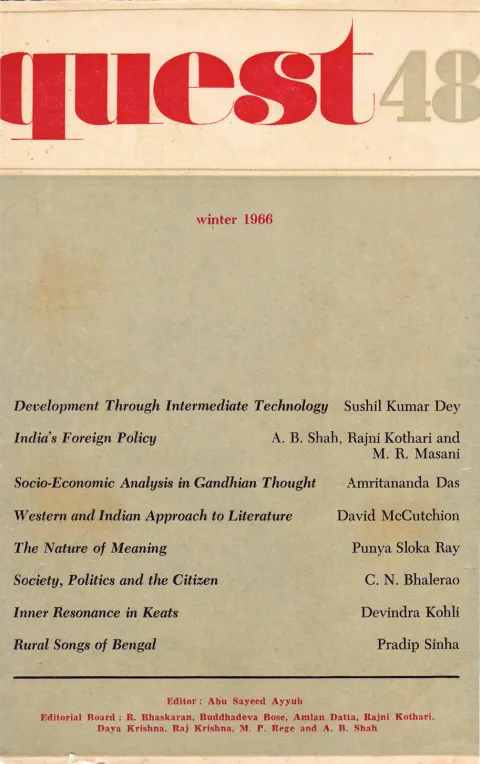
QUEST
Summary
Quest No. 48 (Jan./Mar. 1966; ‘winter 1966’ on the cover) is the first number of the Bombay quarterly to appear under Abu Sayeed Ayyub as sole editor, with Amlan Datta moved down to a newly constituted eight-man Editorial Board and the former advisory editors gone from the masthead. Its argumentative centre is a four-part symposium on Indian foreign policy occupying pp.49-75, written in the immediate aftermath of the September 1965 Indo-Pakistani war: A. B. Shah’s long indictment of non-alignment as ‘naive, narcissistic and self-righteous’, M. R. Masani’s Lok Sabha speech demanding a regional security pact with Japan and Australasia, Sudhansu Bimal Mookerjee’s post-mortem on the collapse of Indo-Indonesian friendship, and Rajni Kothari’s Discussion reply defending Nehru’s record and warning Shah that his ‘Democratic International’ is ‘a position almost reminiscent of John Foster Dulles’. Around this sit an FAO official’s case for intermediate technology, a political scientist’s account of one-party dominance and the politicisation of the Indian bureaucracy, a Jadavpur graduate student’s attempt to reconstruct Gandhi as an analyst of rural-urban dualism, a Chicago linguist’s argument that a theory of meaning should begin from arbitrariness rather than order, an essay on the Keats odes, a study of nineteenth-century Bengali rural song, a nine-page report on the Mysore seminar on Western and Sanskrit poetics, three poems, one Partition short story, and nine book reviews.
The issue is unusually candid in its politics and unusually silent about its own entanglements. Two of the four foreign-policy contributors (Shah and Kothari) sit on this issue’s Editorial Board and argue against each other across a fifteen-page spread without any editorial note disclosing the fact; Shah’s own closing paragraph records that his paper was the discussion document at a seminar convened by the Indian Committee for Cultural Freedom, the body that prints and publishes Quest, and by it and Wilson College; Ronald Segal’s The Crisis of India is cited in a footnote by Shah and separately reviewed twenty pages later; and a full-page in-house advertisement on p.114 sells ‘Ten Years of Quest’, an anthology edited by this issue’s editor Ayyub with his board member Datta. There is no editorial plate of any kind: every image in the issue, including a Tata Chemicals page that quotes Nehru on Indian continuity (p.5) and three Government of India national-integration pages (pp.42, 110, 116), is advertising, established by rendering every low-text page. There is no unlisted SHORTER REVIEWS column, no editors’ notice and no apology - the only unlisted editorial matter is the standing ‘OUR REVIEWERS’ and ‘OUR CONTRIBUTORS’ blocks on pp.110-111.
Essays
Development Through Intermediate Technology
By Sushil Kumar Dey
Sushil Kumar Dey, a former Bengal district magistrate then serving as an FAO director, takes E. F. Schumacher’s August 1965 Observer article on intermediate technology as a springboard and argues that its prescriptions are under-theorised. Schumacher’s rule of thumb - an equipment cost of £70-£100 per work-place, then empirical trial - is ‘an invitation to a blind and purely arbitrary start’; poor local groups live on too narrow a margin to gamble. Dey substitutes a policy criterion: the technological improvement adopted must be ‘the maximum compatible with net increase in minimal time’, a formula that steers between suicidal over-sophistication and hopeless crude works programmes.
His positive contribution is the concept of a second, parallel market. Because low-grade output cannot capture an existing market served by superior technology without subsidy or protection, intermediate technology must be applied simultaneously across a wide range of mutually exchanged goods and services, creating a ‘basement bazaar’ of surplus products made by surplus labour, additional to and not competing with normal market channels. Saving then occurs by ‘purchase substitution’, the domestic analogue of import substitution. He identifies three proper functions for external aid - propagating the approach, supplying prototype-designing expertise, and concessional supply of semi-processed materials, obsolete machinery and surplus food - and points to the UN/FAO World Food Program, then in its third year, as an experiment already running along these lines.
- Accepts Schumacher’s diagnosis but rejects his method: empirical trial without policy guidance is an arbitrary start that poor local groups cannot afford.
- Proposes a decision rule - the maximum technological improvement compatible with net increase in minimal time - as the planner’s conceptual framework.
- Argues intermediate technology cannot work piecemeal: improvements must be applied simultaneously across a range of mutually exchanged goods, creating an additional market rather than competing for the existing one.
- Coins the ‘basement bazaar’ image for that additional market and ‘purchase substitution’ for the saving mechanism inside it.
- Notes that surplus food in advanced countries is ‘ideally usable’ to activate dormant production capacity, and cites the UN/FAO World Food Program as a live precedent.
Society, Politics and the Citizen
By C. N. Bhalerao
C. N. Bhalerao asks why development programmes premised on popular enthusiasm produce so little of it, and answers that Indian politics has become almost wholly unaccountable to Indian society. The Congress party, he argues, is not a party but ‘a party system by itself’, containing both a governmental wing and an opposition, riven by factionalism from the Mandal committee to the AICC. Political communication with the electorate is ‘too general and amorphous’; leaders survive not by delivering programmes but through ‘local potentates, the key men’ who control ‘voting banks’, and recruitment favours power-winning over cadre-building, so the ablest go into administration, science and journalism instead.
The cleavage between party and society has widened while the party’s grip on society has tightened - what Bhalerao calls the politicisation of social processes. The Congress boss controls panchayats, cooperatives, municipalities, trusts, licences and quotas; on D. R. Gadgil’s account the politician, the industrialist and the civil servant now form the ruling class. Legislatures neglect what C. Wright Mills called ‘publicly relevant issues’; cabinets are constituted by caste and faction rather than competence; the bureaucracy is being politicised and subjected to caste and regional pressure, and corruption at the political level feeds corruption in administration. Bhalerao’s remedy is not institutional but civic: citizens must use their existing civic, professional and cultural associations to build a democratic infrastructure of decision-making, developing awareness, the habit of resistance to undemocratic forces, and ‘the public philosophy’.
- Characterises the Indian party system as one-party dominance in which the Congress is itself a party system, with ruling wing and opposition inside it.
- Locates the failure in political communication and recruitment: leaders depend on ‘key men’ and ‘voting banks’, not on programme delivery, so the electoral mechanism registers no verdict on outgoing governments.
- Argues the party-society cleavage coexists with increasing party control of society - the politicisation of panchayats, cooperatives, trusts, licences and quotas.
- Cites D. R. Gadgil for the triumvirate of politician, industrialist and civil servant as the ruling class, and the Committee on Prevention of Corruption for the spread of corruption.
- Prescribes citizen participation through voluntary associations plus the inculcation of ‘the public philosophy’, not constitutional change.
Implicit Socio-Economic Analysis in Gandhian Thought
By Amritananda Das
Amritananda Das sets out to extract from Gandhi a socio-economic analysis independent of Gandhian policy, on the argument that the ‘interpretative literature’ has never separated the two and that Gandhi’s own ‘strongly held ethical convictions and equally stubborn fads’ gave his recommendations a faddist colouring that repelled scholarly attention. The central Gandhian problem, he proposes, is rural-urban conflict and village decay in overpopulated colonial economies - central in the sense that involuntary-unemployment equilibrium is central to Keynes. Pre-Gandhian nationalist economics, neo-mercantilist and Listian, treated the Indian economy as a collective and so missed the socio-economic dualism being created; Gandhi was the first leader ‘village minded’ enough to see that village poverty came not from Malthusian fecundity but from the destruction of alternative occupations, and that Indian mills were as much a menace to the villager as Manchester.
Das then recasts the familiar Gandhian doctrines as rational responses to that diagnosis. ‘Village-mindedness’ is the organisation of the village sector’s defence against a city-industrial sector that is ‘parasitic’ rather than ‘generative’; khadi and the charkha follow from a zero shadow-price of village labour and a very high shadow-price of capital embodying modern technique; the rejection of machinery was a rejection of ‘embodied technics’, not of science. He finds echoes in Hoselitz on parasitic cities, Hans Singer on north-east Brazil, Rostow on rural development and Milton Singer’s suggestion that a Gandhian ethic might supply the worldly asceticism for socialism that the Protestant ethic supplied for capitalism. A long comparison with Marx follows: both see colonial exploitation destroying inoffensive village communities, but Marx judges the process progressive and binds himself to feudalism-capitalism-socialism, whereas for Gandhi the question is one of ethical choice between alternative paths, which makes the Gandhian framework ‘at once non-Marxian and more general’. The essay closes on international economy: predation is ecologically inefficient once the victims turn predator, and the degeneration of UNCTAD into a North-South confrontation shows the need for a symbiotic rather than parasite-host relation between industrial and agrarian economies. Das is explicit that none of this implies Gandhian policies are the best cure.
- Separates Gandhian analysis from Gandhian prescription, on the grounds that better solutions to the diagnosed problem may exist.
- Identifies rural-urban conflict and cumulative village decay as the ‘central’ Gandhian problem, analogous in status to Keynesian underemployment equilibrium.
- Reads khadi economics as shadow-price rationality (labour at zero, modern capital very high) rather than as nostalgia, and Gandhi’s machine-scepticism as a rejection of ‘embodied technics’ not of science.
- Contrasts Gandhi with Marx: both see colonialism dissolving village communities, but Marx calls it progressive while Gandhi makes it a matter of ethical choice between development paths.
- Extends the analysis to international economy, treating the collapse of UNCTAD into North-South confrontation as evidence for the predator-prey model.
The Nature of Meaning
By Punya Sloka Ray
Punya Sloka Ray, then Assistant Professor of Linguistics at Chicago, attacks the methodological embarrassment that made semantics disreputable. Bloomfield defined the meaning of a form as the situation and response, which ‘include every object and happening in their universe’, and concluded that the statement of meanings is therefore the weak point in language study. Ray’s reply is that Bloomfield confused the everything of postulation with the everything of discovery, and the merely very large with the infinite; on his definition the study of meaning is deprived ‘not only of respectability but of existence’, and yet linguists go on making dictionaries and stating grammatical meanings exactly like the amateurs. The professional must therefore ‘revoke the de jure abdication from reasons’ and give a defensible account of his de facto activities.
Ray then argues that the search for the nature of meaning is itself the mistake: meaning has ‘either no nature at all, or a multiplicity of partially and variably overlapping natures’. He sets out four operations any meaningful form must permit - repetition, limitation, substitution and extension - and derives from them the conditions of meaning: recurrence, contrast, synonymy and open-endedness, hence that ‘there is no meaning if it is not also marginally vague.’ The decisive move is methodological. Saussure’s principle of arbitrariness, which Bloomfield accepted, can be taken either way round: start from order and the fragmentation and overlaps of orderliness are embarrassing, tempting one into a grand pseudo-science ‘about as respectable as palmistry’; start from freedom and order needs no extra hypotheses, since arbitrariness may arbitrarily restrict itself. Starting from freedom costs fewer hypotheses and limits the conflict. The theory of meaning will therefore not be a stable uniform structure, nor a system ‘policing different natures, pushing back recalcitrant intruders into their appropriate intellectual ghettos’, but at most a way of lighting up one direction of enquiry among increasingly many.
- Diagnoses Bloomfield’s definition of meaning as self-defeating: it makes semantics not merely disreputable but impossible, while practising linguists carry on regardless.
- Denies that meaning has a single nature; it has overlapping, fragmentary natures, and few words in any language stay within one.
- Derives the conditions of meaningfulness from four operations - repeat, limit, substitute, extend - and concludes that marginal vagueness is a condition of meaning, not a defect.
- Argues that Saussurean arbitrariness should be the methodological starting point rather than order, because freedom generates order without extra hypotheses while order makes freedom purely negative.
- Accepts that the student of meaning must draw on many empirical sciences, and treats this burden as the common burden of general knowledge rather than a sign of the field’s immaturity.
Inner Resonance : A Note on the Odes of John Keats
By Deuindra Kohli
Devindra Kohli argues that the Keats odes are great because they fuse the naturalistic and the moral interpretations of poetry, against Arthur Symons’s claim that Keats ‘was not troubled about his soul’ and Matthew Arnold’s that his genius was not ripe for moral interpretation of experience. Taking four odes in turn, he traces a single vision: Psyche becomes the symbol of a soul beautified and baptized by suffering, and the ode becomes an ode to Keats’s own ‘inner resonance’, with ‘branch’d thoughts, new-grown with pleasant pain’ as the sensuous embodiment of the idea that new insight and great art originate in tragic suffering. The Nightingale ode is neither adolescent nor an escapist’s obsession with death but the rejection of escape: neither wine nor poetic fancy nor even death can eternalise the joyous moment, and the poem’s central irony is that sharing the bird’s joy requires an intense awareness of the tragic pressure that dissolves it.
On the Grecian Urn Kohli reads the closing ‘Cold Pastoral’ as the poem’s own ironic judgement on the urn’s silent perfection - life can mock back at it - so that the ode implicitly shares the Nightingale’s conclusion, just as Yeats’s ‘artifice of eternity’ marks Sailing to Byzantium. ‘To Autumn’ completes the sequence: Keats celebrates autumn and not spring, arresting the rhythms of the season in the rhythms of ordinary existence, and Kohli enlists Leavis’s account of the ‘tragic impersonality’ of the Moneta passage in The Fall of Hyperion as an equally appropriate criticism of the odes. The essay’s recurring emphasis is that Keats accepted pain and joy as facets of one coin, and that the ode was composed when his own prospects were dim.
- Sets out to refute Symons and Arnold by showing the odes are energized by moral insight, not merely felicity of expression.
- Reads ‘Ode to Psyche’ as Keats’s commitment to the tragic, with suffering necessary to the purification of the self.
- Argues ‘Ode to a Nightingale’ rejects escape rather than enacting it, making the rejection the point critics have missed.
- Treats ‘Cold Pastoral’ as the Grecian Urn’s self-undercutting, aligning the ode with the Nightingale’s conclusion and with Yeats’s ‘artifice of eternity’.
- Uses Leavis on the Moneta passage as the critical vocabulary for the impersonal strength Kohli finds in the odes.
Rural Songs in 19th Century Bengal
By Pradip Sinha
Pradip Sinha treats the later nineteenth century as a period when Bengali rural song still had vitality and when contemporary or near-contemporary collections make it recoverable. He begins from a characterisation of the Bengali mind as plaintive rather than virile - Bhatiali and Bhowaia reveal ‘a mind not strong enough to face a harsher environment’, to which Vaishnavism was the ideal answer, and even the martial Jari songs put the Quranic theme in ‘a strange soft garb’. Vaishnavism, in unorthodox devotional form, drew both religious communities, and Muslim exponents from the sixteenth century enriched Vaishnava literature, while the songs of Gajis and Pirs attracted Hindus; Islam, arriving at a developed stage of regional culture, had to make the greater adjustment, though the ritual-free teachings of the Quran also produced a body of song confined to the Islamic community and the nineteenth century saw puritanical sects such as the Ferazis and the Ta’aiyuni grow in East Bengal.
The core of the essay is the Baul, whose cult Sinha traces to a Tantric tradition mingled with Vaishnava and Sufi strains, and whose songs he quotes at length: Lalan Faqir ridiculing caste and circumcision alike, finding the infinite within the finite body, hunting the ‘unknown bird’ in the cage. He notes that Baul songs, unusually, carry their composers’ names, that such composers were ‘phenomenally large’ in number in the nineteenth century, and that the community declined rapidly after 1900. He then handles the Mymensingh ballads and their disputed authenticity, siding with the Czech Orientalist Dussan Zbavitel against a very early date; the Nath ballads of Rangpur recovered by Grierson; and the Radha-Krishna, Kathak, Agamani and Behula traditions, in which majestic figures are domesticated - Durga becomes a village daughter, Shiva a peasant or weaver, and the Ramayana is retold so that it moves a village bride to tears.
- Argues that nineteenth-century Bengali folk song is recoverable because contemporary collectors recorded it while it was still living, and that its dominant register is plaintive and feminine rather than heroic.
- Presents unorthodox Vaishnavism and the Baul cult as the meeting ground of Hindu and Muslim rural culture, with Lalan Faqir as the greatest and most representative Baul.
- Notes the diagnostic peculiarity of Baul song - it names its composers - and dates the community’s rapid decline to the opening of the twentieth century.
- Reviews the long dispute over the authenticity of the Mymensingh ballads, endorsing Zbavitel’s defence and the nineteenth-century dating over D. C. Sen’s very early one.
- Reads the Agamani, Kathak and Behula traditions as domesticating the Hindu pantheon: ‘Hindu mythology at the rural level has been in Bengal like her temple architecture - an extension of the cottage so peculiar in simplicity.‘
India’s Foreign Policy: Review and Perspective
By A. B. Shah
A. B. Shah’s article, dated 21 October 1965 with additions made in proof, reads the Indo-Pakistani cease-fire as breathing space for a wholesale reassessment. He treats autumn 1962 - the Russian retreat from Cuba, the Chinese invasion, the first public Sino-Soviet quarrel - as the real turning point, and argues that the foreign policies of both India and Pakistan have become irrelevant to their national interests. Non-alignment, he contends, yielded no differential gains: Pakistan received about Rs. 700 crore of American military assistance in 1954-64 against less than Rs. 40 crore for India, and nearly three times as much Western per capita economic aid, while US net aid to India stood at Rs. 1930.55 crore against Russia’s Rs. 152.63 crore, a ratio of 12.65:1. Worse, non-alignment prevented Indian statesmen from recognising the role geopolitics assigns to India; ‘one cannot be a saint and a statesman at the same time’.
Shah is at his most caustic about Indian self-regard and about Western commentators. He blames India’s ‘naive, narcissistic and self-righteous foreign policy’, its inability ‘to see the beam in her own eye while pointing to the mote in her friends’, and the peripatetic intellectuals and ‘progressive’ journalists - ‘the flotsam of the Leftist tide of the thirties’ - who wrote off Indian democracy after Nehru and thereby became ‘a minor causal factor in bringing nearer the very disaster which they were ostensibly concerned about’. He then states positive goals - democracy, secularism, economic growth, social justice - and derives a policy: sympathies unmistakably on the democratic side in any contest with dictatorship; initiative in South-East Asia, since only India can be its rallying point; a close understanding with the United States, if necessary at the risk of Soviet displeasure, because Russia cannot go all out for a non-communist country against a fellow-communist state; and, because China will be a full nuclear power in about ten years, a negotiated Kashmir settlement, whether by partition or by a Sikkim- or Nagaland-style special status. This rules out a plebiscite: ‘What is important from the standpoint of democracy is, not the exercise of the right of self-determination by a small border region but the creation of a stable and democratic administration in the interest of its inhabitants.’ The piece closes with an appendix of comparative military strengths as of 31 October 1964, a note that a section on defence and economic policy has been omitted for later treatment, and the disclosure that the paper was the discussion basis at an Indian Committee for Cultural Freedom seminar in New Delhi on 14 November 1965 and at Bombay with Wilson College on 6-7 December 1965.
- Dates the real shift in the world balance to autumn 1962, not to September 1965, and argues both Indian and Pakistani foreign policy have become irrelevant to their national interests.
- Marshals aid figures to deny that non-alignment bought India any differential advantage, and argues its two real costs were strategic blindness and a saintly posture incompatible with statesmanship.
- Attacks Indian self-righteousness and Western ‘progressive’ commentators in equal measure, holding that mutual pessimism about Indian democracy helped bring nearer the disaster it predicted.
- Prescribes Indian leadership of free Asia plus a close understanding with the United States even at the cost of Soviet displeasure, invoking ‘He should have a long spoon that sups with the Devil.’
- Rules out a Kashmir plebiscite and urges partition or a special status, subordinating self-determination for a border region to the defence and stability of a large democratic state.
- Carries an appendix of Indian, Chinese and Pakistani military strengths (31 Oct. 1964) sourced to Military Balance 1964-65 via D. E. Kennedy.
What is Wrong with our Foreign Policy
By M. R. Masani
M. R. Masani’s piece, footnoted as based on a Lok Sabha speech of 15 November 1965, opens from a Press Trust of India tally of the UN General Assembly debate: of 110 speakers, 63 were neutral, 19 hostile (11 of them Arab states), 3 made passing references, 25 ignored the issue, and ‘not one spoke up for us’. This, he insists, was not a failure of public relations or of diplomats: ‘You cannot sell a product if the product is no good.’ Indian foreign policy had three basic weaknesses - naivety, of which the Panch Sheela pact with China and the betrayal of Tibet were the notorious example; a narcissistic character, ‘watching ourselves in the mirror and admiring ourselves’; and self-righteousness, refusing to judge between right and wrong over Berlin, Hungary, Tibet and Vietnam, and then crossing the frontier itself.
His positive programme is a regional security arrangement inside the triangle of India, Japan and Australasia, and the abandonment of ‘this caste system of judging between non-aligned and aligned nations’. On Pakistan he wants a firm short-term posture plus a long-term door left open, and on Kashmir he holds that Pakistan has lost its locus standi but that India’s obligations to the Kashmiri people remain, so a policy of conciliation must distinguish the pro-Pakistani from the merely uncommitted. On the great powers he is careful: American help is needed for nuclear deterrence, food and capital, but the United States cannot take sides between two non-communist states, as Cyprus showed; the Soviet Union has played a constructive role and, though ‘Strongly opposed to Communism as I am’, Masani would welcome Kosygin’s mediation and hail him as a good friend. He then documents Soviet limitations - the lost veto, Kosygin’s letter objecting to India crossing the international border, a Problems of Socialism and Peace article on war hysteria - and ridicules the new illusion replacing ‘Hindi Chini Bhai Bhai’, including Ashok Mehta’s talk of dovetailing Indian planning to a Soviet system ‘which is itself in disarray’ and a minister’s claim that the USSR was ‘a hundred per cent true friend of India’. Third Plan figures close the case: 59 per cent of external assistance from the United States, 8.2 per cent from the Soviet Union.
- Uses the PTI count of the UN debate (110 speakers, none supporting India) to argue the failure was of policy, not of diplomacy or publicity.
- Names three defects - naivety, narcissism, self-righteousness - with Panch Sheela, Tibet and the Vietnam lectures as the exhibits.
- Calls for a regional security arrangement across the India-Japan-Australasia triangle and the end of the aligned/non-aligned distinction.
- Accepts the limits of both superpowers, welcoming Kosygin’s mediation while insisting there are no hundred-per-cent friends between nations.
- Attacks the emerging pro-Soviet illusion, naming Ashok Mehta, and closes on Third Plan aid shares of 59 per cent (US) against 8.2 per cent (USSR).
Indo-Indonesian Relations
By Sudhansu Bimal Mookerjee
Sudhansu Bimal Mookerjee, a historian who had headed the department at Gadja Mada University in Jogjakarta, reconstructs the decay of Indo-Indonesian friendship. He begins with the ancient tie - Tagore’s 1925 line about speech tangled in speech, a Javanese linguist’s estimate that seventy to eighty per cent of old Javanese vocabulary is Sanskrit or Sanskritic, Soekarno’s reading of Vivekananda - and with the Indian record of support: the ban on KLM flights after the first Dutch police action, and Nehru’s Afro-Asian-Australasian Conference of January 1949. He then dates the parting of the ways from Bandung 1955 and Belgrade 1961 through the anti-Indian incidents at the 1962 Asian Games to Indonesia’s hobnobbing with China and Pakistan.
His explanation is psychological as much as political. The relationship had been ‘wholly one-way traffic’, and ‘the memory of benefits received often generates a feeling of inferiority’ - aggravated when early Indian diplomats reminded Indonesians of it, so that the 1949 Delhi conference has been played down in official Indonesian histories. India and Indonesia also mean different things by non-alignment, India’s version not hesitating to judge; Indian progress since independence is a standing irritant to a country that attained nationhood at the same time and has fallen back; the rise of China has pushed Indonesia towards the Chinese orbit; Malaysia and konfrontassi are the newest quarrel; and the 30,000 Indians in Indonesia, better off than their neighbours and reluctant to assimilate, produce ‘an unpleasant emotional response everywhere in South-East Asia’. Remedies follow: tone up the Indian Information Service, which prints little but ministers’ speeches while educated Indonesians ask whether there are Muslims in India; give real material aid, lend teachers and doctors; endow professorships in Tagore and Gandhi; translate Indian works into Bahasa Indonesia; and print Indonesian textbooks in India against payment in rupiah. A footnote records that the article was written before the anti-communist coup attempt and the army’s reaction.
- Traces a millennium of cultural transmission and two decades of Indian diplomatic support before dating the rupture to Bandung 1955 and Belgrade 1961.
- Explains Indonesian resentment as the psychology of one-way indebtedness, aggravated by Indian diplomats’ reminders of it.
- Distinguishes Indian from Indonesian non-alignment: India’s does not hesitate to judge where justice lies, Indonesia’s means neutrality in all conflicts.
- Names India’s relative progress, the rise of China, konfrontassi against Malaysia, and the conduct of the 30,000-strong Indian community as compounding irritants.
- Proposes concrete cultural and material remedies - information service reform, scholarships, professorships, translations into Bahasa Indonesia, and joint textbook printing paid for in rupiah.
India’s Foreign Policy: Need for a Non-Doctrinaire Perspective
By Rajni Kothari
Rajni Kothari replies to Shah directly, and the reply is the sharpest piece in the issue. Both defenders and opponents of non-alignment suffer from ‘a frightful illusion: that it is possible to reduce the conduct of foreign relations to a neat formula’, and Shah’s tirade is ‘not only uncalled for, but misleading’. Kothari turns Shah’s own sentence about India as pace-setter or camp-follower against him: on Shah’s premises only camp-following was available until the industrial base was built, so it is significant that non-alignment mitigated India’s fate as Russia’s camp-follower - America’s being out of the question ‘under the Dulles dispensation’ - and let India build to the point where it can now think of itself as potentially a leading power. Nehru’s failure was the Chinese miscalculation, his ‘Himalayan blunder’; his achievement was a durable political base and institutional legitimacy, without which a major military build-up could not be contemplated inside a democratic polity.
On Shah’s use of democracy as a determining principle Kothari is scathing: to abstract outward from an article of faith to ‘a whole system of democratic power - something like a Democratic International’ confuses institutional commitments with foreign policy and assumes that wars led by democratic nations are necessarily just. ‘It is a position almost reminiscent of John Foster Dulles.’ He lists three pitfalls in Shah’s deduction towards American alliance - that the US is itself interested, that other factors can be ignored, that a self-respecting government can disavow its policies overnight - and proposes instead to neutralise the American political presence in the subcontinent while making economic development and collaboration the chief plank of Indo-American relations, buttressed by Soviet armaments and by ties with Japan, Australia and European powers. His closing perspective is that bipolarity is over, the period of international tutelage finished, and the superpowers becoming ‘cautious mediators of relations between states rather than initiators of policies themselves’; India’s 22-day war has opened new room for manoeuvre, and the task is coordination of diplomacy, military preparedness and economic mobilisation rather than ‘unnecessary intellectual exercises in geopolitics’.
- Charges both sides of the non-alignment debate with seeking a neat formula, and Shah in particular with offering no evidence beyond the admitted neglect of defence.
- Defends non-alignment instrumentally: it mitigated camp-follower status under the Dulles dispensation and bought the freedom of manoeuvre that made present strength possible.
- Separates Nehru’s ‘Himalayan blunder’ over China from his achievement of institutional legitimacy and an industrial infrastructure.
- Rejects a ‘Democratic International’ as confusing domestic arrangements with foreign policy and assuming democracies’ wars are just - ‘almost reminiscent of John Foster Dulles’.
- Proposes minimising political and military demands on the US while making economic collaboration the chief plank, with Soviet armaments and ties to Japan, Australia and Europe as buttresses.
- Argues bipolarity and international tutelage are finished, so only states showing their own strength will attract support.
Western and Indian Approach to Literature
By David McCutchion
David McCutchion reports at length on a seminar at Mysore University (1-7 June 1965) convened by Professor C. D. Narasimhaiah to test whether Sanskrit poetics can be accommodated with Western aesthetics. The first question was whether universal standards are possible at all. Mulk Raj Anand said yes, from universal humanness and universal evolution, and was pressed until ‘universal standards gave way to personal affirmation’; McCutchion’s own paper argued that critical appreciation is influenced but not bound by religion, country and tradition, that there is no criterion for elevating a particular taste to the universal, and that while we are morally engaged in aesthetic experience there are limits - he would not accept ‘a poem celebrating the Nazi gassing of the Jews however marvellously structured’. He was at once accused of holding incompatible positions, and Narayanachar later ‘created a sensation’ by characterising Leavis’s standpoint as Art for Art’s sake, to the discomfort of Narasimhaiah, an old student of Leavis.
The seminar’s drift, McCutchion observes, was from formalism towards moralism: Naresh Guha argued for poems as ‘autonomous, self-sufficient artefacts’ judged on ‘the noble complexity’ of their organisation, Amalendu Bose for the interdependence of criticism and literary history, and Narasimhaiah finally for the critic as ‘one who cares for the health of the mind’ whose concern is the transformation of individual and society - a commitment McCutchion finds paradoxical in a seminar on Sanskrit poetics, ‘for this is precisely where the Indian tradition failed’, being more preoccupied with analysis than judgement and treating the Vedas as revealed word rather than the foundation of a poetic tradition. He then surveys the real convergences (Kuntala’s indirectness beside Empson’s ambiguity; the dhvani theory beside organic and expressionist positions; Kantak on Western drama of action against Indian drama of being) and warns repeatedly that similarity in verbal description is not similarity in practice: the dhvani theory applied to English poetry ‘was revealed as a descriptive rather than a discriminatory method’, and Sanskrit poetics has no word for tragedy, confusing it with karuna-rasa. The seminar closed with recommendations for a syllabus combining both traditions, and McCutchion notes its strong English bias - Eliot, Richards and Leavis dominating - and that Krishnamoorthy was the only Sanskritist present, all the others being professors of English.
- Frames the seminar as the first serious test of whether Sanskrit poetics can be made relevant to modern literary interests rather than left to Sanskrit specialists.
- Records the collapse of the case for universal standards into personal affirmation, and McCutchion’s own limit case - a poem celebrating the gassing of the Jews.
- Traces a drift from formalist to moralist positions across the week, ending in Narasimhaiah’s claim that criticism is a way of life.
- Judges that theoretical accommodation is far easier than practical: applied to actual poems and plays, dhvani proves descriptive rather than discriminatory, and Sanskrit poetics has no word for tragedy.
- Notes the structural imbalance of the seminar - a strong English bias, and only one Sanskritist among professors of English.
Pieta
By S. Rajen
‘Pieta’ is a long free-verse dramatic monologue in the voice of the mother at the foot of the cross, running unbroken over three pages. It opens with death composing the speaker’s hands into ‘a long closed lip, / puckered with pain’ and moves through incomprehension - ‘All the world, people, love, / the spreading of light and day!’ - to the recognition that the loss is a second parturition: ‘I feel the pain of another birth! / An umbilical chord is being / cut inside me!’ The middle section turns on light and sight: the speaker cannot bear the glare she wants to dim, sees two other men ‘blind with pain’ and offers to fetch their mothers, and arrives at the admission that she had spent her life hiding behind her son and must now thank him for the open world.
The close reverses the roles of the Passion. The mother rests her head on the hard wood of the cross, understands ‘this death and love’, and asks to be given the bitter cup herself - ‘Now, with a son’s love, / offer me this cup! I wish to drink and / wear your thorns in silence!’ - ending on the paradox that she was never so close to him in life, and on the repeated pledge to join him ‘on your aching cross’. The recurring image binding the poem is the nail as a closed aching lip, echoing the mouth of the opening lines.
- A three-page free-verse monologue spoken by the mother at the crucifixion, printed under the POETRY section head as ‘PIETA’ without diacritic.
- Structured as a movement from incomprehension through the imagery of glare and blindness to acceptance and reversal.
- Treats bereavement as a second birth, with the umbilical cord cut inside the mourner.
- Reverses the Passion’s roles in the closing sections: the mother asks for the cup and the thorns.
- Unified by the image of the nails as closed, aching lips, which answers the poem’s opening figure of the mouth.
Two Poems
By Jette Kjaerboe
The contents line ‘Two Poems’ covers two short lyrics printed together on p.88 and signed jointly. ‘THE HUNTED’ builds a plain syllogism out of a father who shoots squirrels for eyesight, deer for meat and ‘sometimes … a lion / For his pride’, then addresses a ‘Hunter greater than my father’ whose fate is linked with all men’s, and asks whether the speaker’s own death will be that of a squirrel, a deer or a lion - closing on the deflation ‘And after all, / What difference does it make?’
‘WORDS’ is an ars poetica in the same flat idiom. The poet’s vocabulary is ‘Only a handful of words’, seashells arranged in patterns on sand: ‘The shells are the same / The pattern changes.’ The middle stanza wonders whether this is tedium or a child’s game the mother does not understand, and the last makes the whole enterprise conditional on communication - the poet would rather not have written at all if the shells brought no message from the sea.
- Two lyrics, ‘THE HUNTED’ and ‘WORDS’, printed on one page under a single contents line and one signature.
- ‘THE HUNTED’ turns a father’s three motives for killing into a question about the speaker’s own death, and then refuses the question.
- ‘WORDS’ treats the poet’s limited vocabulary as seashells whose pattern, not whose substance, changes.
- Both poems work by plain statement and short lines, with the epigrammatic deflation placed last.
- The Danish poet’s contributor note records that she was working with ‘The Swallows’ at Madras.
for my daughter
By K. Raghavendra Rao
A single-sentence poem in rhymed couplets, printed on p.19 below the notes to C. N. Bhalerao’s article and out of numerical sequence in the contents. The speaker watches a daughter fall asleep against him - ‘I watch a flower of sleep gently grow / in those most compelling, helpless eyes / and feel her body, a fruit beyond flies, / rest limp, yet warm against my arms’ - while ‘out there the insect night squirms’.
The second movement turns the image back on the speaker, who remembers himself as ‘now a fruit of fear’ but once no less gentle than his daughter, swinging ‘like a dawn wish in that garden / which no time no place no cause had begun’. The close is urban and diminished: every raining hour uncovers desert, every advancing minute closes off the city’s route, and all the speaker can do is clear up his own street and pray it may be peopled by his daughter’s sunny feet.
- A short rhymed lyric of a father holding a sleeping daughter, printed as filler at the foot of an unrelated political-science article.
- Sets the daughter’s gentleness against the speaker’s present condition as ‘a fruit of fear’.
- Moves from a timeless garden of childhood to a contracting city whose route is being ‘clinched’ minute by minute.
- Ends on the smallest available action - clearing up one’s own street - as the only form of hope.
- Its contents-page page number, 19, breaks the POETRY sequence but is correct.
The Castle
By H. R. Pasricha
H. R. Pasricha’s story is a first-person recollection, in six numbered sections, of a prosperous Punjabi joint family in a village near Sialkot, told through a boy’s eyes and ending with Partition. The ‘castle’ is the family house, named for the thickness of its walls and the portal a rider could enter without dismounting - ‘Paper currency had not yet made its appearance in India, and a man’s house was his bank.’ The early sections are domestic: grandfather placing his law-graduate sons, insisting ‘I do not like service’ because ‘it has never been done in our family’, appointing Gehna Mirasi as his son’s munshi, and a headmaster with an outsize turban explaining on a wall map that Germany had started a war because an Austrian duke had been murdered in Sarajevo. Martial law stops the trains; Indian cavalry arrive at the school and the boys salute the Union Jack twice a day; and Gandhi comes to town, ‘A thin lean figure wrapped in a sheet of homespun’, whom the narrator watches from the freezing ground outside the station.
The second half is a sequence of deaths - the grandmother of cancer, uncle Chand of heart failure, uncle Arjan in 1942 while the narrator is at Alamein - and then 1947. The village has changed: shopkeepers sit listlessly, the afternoon newspapers bring ‘riots and killings; stoppings of trains and wholesale slaughter of the helpless’. Gehna Mirasi, now bent and bowed, comes to warn his old patron obliquely: ‘But the people have changed, Shahji. They are wicked; they are no longer human.’ Grandfather refuses to leave - ‘Leave my ancestral property and home? Thank God, I am not that craven’ - and his Muslim friend Ilahi Baksh, who had hoped they would ‘become part of the earth so dear to us both’, promises protection but knows he has not many days to live. The last section is flat and short: the family left, the letters stopped, they have no news of the Castle, and grandfather never mentioned it again but took no interest in their new lives, having left his heart behind.
- A six-part Partition memoir-story tracing one Punjabi joint family from pre-1914 prosperity to displacement in 1947.
- Uses the house itself as the measure of a vanished order - three-foot walls, a rideable portal, a house that was its own bank.
- Registers the First World War, the 1919 martial law and Gandhi’s visit as a child’s fragmentary impressions rather than as history.
- Places the warning of coming violence in the mouth of the family’s Muslim dependant, Gehna Mirasi, and the promise of protection in that of grandfather’s Muslim friend Ilahi Baksh.
- Ends without catastrophe on the page: the loss is conveyed by silence, absence of news, and an old man’s refusal to speak of it.
Freedom Struggle in India ( 1858-1909)
By Sudhir Chandra
Sudhir Chandra opens the BOOKS section with a severe notice of M. M. Ahluwalia’s Freedom Struggle in India (1858-1909): ‘Diligence devoid of discernment is the chief characteristic of the present work’, and typical, he adds, of the theses annually approved for doctorates. The central fault is want of proportion: twenty-four pages on India passing under the Crown against under three on the impact of 1857, a passing allusion to Vasudev Balwant Phadke beside an insignificant hartal at Mathura, a sketchy and obsolete account of the pre-Congress associations, and the omission of the two National Conferences that presaged the Congress. He corrects one name in passing - the Bombay Association founder was Nowrojee Furdoonjee, not Nowrosjee Surdoonjee - and wonders whether this too is one of the countless misprints disfiguring the volume.
Chandra credits the book’s vivid handling of economic exploitation - the rejection of a country-wide Permanent Settlement, coercive revenue realisation, the peasant delivered to the mahajan, salt taxed at 500 to 2,500 per cent of value - but insists that history is not ‘a mere jumbling of available facts’. Where new interpretation is needed Ahluwalia does not attempt it, reproducing instead the views of Trevelyan, Fawcett, Bright, Digby, Naoroji, Dutt and Gokhale; he relies on secondary works and on parliamentary debates, commission reports and non-Indian writing rather than on Indian speeches, writing and press, which vitally affects his standpoint. Treating 1858-1909 as static, he gives no idea of the Indian awakening, and his treatment of communalism argues backwards from the counterpoise policy of the 1900s to assume it must have operated earlier - for a historian ‘a most dangerous approach’, when the documents show a government pleading religious neutrality against Muslim petitions and individual English officials, not policy, urging divide and rule. The closing question is institutional: where will academic standards go if such works earn doctorates and publication in a university series?
- Condemns the book for diligence without discernment and treats it as symptomatic of Indian doctoral production and of Delhi University’s Modern Historical Series.
- Documents the want of proportion with page counts and specific omissions, including the two pre-Congress National Conferences.
- Credits the economic chapters while insisting that assembling facts is not interpretation.
- Objects on method to reliance on secondary works and on non-Indian sources over Indian speeches, writing and press.
- Singles out the treatment of communalism as arguing backwards from hindsight, against documents showing a government professing religious neutrality.
The Crisis of India
By M. M. Sankhdher
Under the display title ‘A Way of Life?’ M. M. Sankhdher reviews Ronald Segal’s Penguin Special The Crisis of India as a book whose facts are unanswerable and whose argument is not. He concedes at the outset that Indians and Hindus are ‘always on the defensive’ about their way of life and that many readers will react adversely, and he does not object to Segal’s characterisation of Indian backwardness as a consequence of Hinduism so much as to ‘his highly impressionistic observations and gross generalizations’. He lists the sources Segal acknowledges - Carstairs, Cormack, Zinkin, Renou, Weiner, Forster, and the novels of Narayan, Anand and Jhabvala - and places the resulting line of thought ‘not very different from Katherine Mayo’s Mother India’, while allowing that Segal’s purpose is to rouse the conscience of mankind rather than to denigrate.
The substantive objection is to Segal’s juxtaposition of facts with values and with theory. Quoting Segal’s self-description - ‘I am an unregenerate materialist … and nothing can compensate for the massive damage done by Indian hunger. That is my limitation’ - Sankhdher takes that to be the limitation of the book. He grants that Segal writes incisively on Congress’s deafness to quiet petition and responsiveness to riot, but holds that the inferred moral, that democracy is a subterfuge postponing revolution as the Kuomintang did, rests on Selig Harrison’s ‘Dangerous Decades’ having ‘caught Segal in a trap’, and that the forces of unity gained strength in the emergency after the Chinese aggression. Segal’s longing for a ruthless government is ‘the most vulnerable position’: to seek a strong man for a country of India’s diversity is to search for the impossible, and Segal himself rules out military rule while no strong rule can be sustained without the army. The verdict is that Segal’s discovery of China as a development model ‘only underscores the values of a libertarian policy in India’.
- Accepts Segal’s facts about Indian poverty as unanswerable and refuses the defensive Indian reflex, while rejecting his generalisations.
- Traces the book’s descent from a short shelf of Western books on India and aligns its line of thought with Katherine Mayo’s Mother India.
- Turns Segal’s declared materialism into the diagnosis of the book’s limitation.
- Identifies the authoritarian longing as the most vulnerable position, since Segal himself excludes military rule and no strong rule survives without the army.
- Concludes that Segal’s admiration for the Chinese model is an argument for a libertarian policy in India.
Contrasting Conceptions of Unesco
By Frances Blank
Frances Blank’s notice of T. V. Sathyamurthy’s Contrasting Conceptions of Unesco, printed under the display title ‘Words, words …’, is the issue’s one piece of sustained comic demolition. ‘Three hundred and ten all-but-unreadable pages, including five appendices and a note to Appendix Five’, made worse by ‘the truly appalling gobbledygook used throughout the book’: words like ‘minimal’, ‘dichotomy’, ‘continuum’, ‘isolable’ and ‘holistic’ that exist in dictionaries, and coinages like ‘self-conception’ that do not. She quotes a sentence about forging ‘social tissues of an integrated world community’ and asks how one forges a tissue - ‘special tissue-forging machinery, perhaps? It would, of course, be in short supply - extremely short.’ Ideas that clearly matter are dimly discernible inside the verbiage, like animals in a State Forest Reserve one cannot get close enough to catch.
Under the joke there is a political complaint. The book reads like what it admits to being, an expanded American doctoral dissertation, and it says very little about ‘who does what to whom’ - Blank asks why one of the first Unesco special projects brought primary education to South America, and whether the reader is too naive to realise who paid the piper. She presses the same question on the book’s own terms: education is an instrument, and what comes rumbling along the highway it builds may be ‘a fully-loaded tank-carrier, or a pantechnicon bulging with baby grands’; peace may mean merely absence of war, which already requires changes of thinking no nation will consider for itself. The review closes by conceding real value - the future historian will find it a useful source-book on Unesco’s early years, and if it leaves the impression that everything is decided somewhere else, ‘that impression may well be correct’ - and then by simply throwing the author’s own closing question back at him: ‘Well: is there?’
- Attacks the book primarily on style, cataloguing its jargon and its coinages and treating the prose as an obstacle to the ideas inside it.
- Identifies the book as an expanded American doctoral dissertation and faults it for evading the politics of who decides.
- Raises the instrumental question about education and about the meaning of ‘peace’ that the book leaves unasked.
- Concedes lasting value as a source-book on Unesco’s early years, and takes seriously the impression that everything is decided elsewhere.
- Ends by quoting the author’s own three-part question and answering it with four words.
Indian Economic Policy and Development
By S. Sabnis
Under the display title ‘Politics of Scarcity’, S. Sabnis reviews P. T. Bauer’s Indian Economic Policy and Development - printed in the headnote as ‘P. T. Baur’ - as a study confined to the Indian economy of 1959-60 and openly shaped by its author’s political position. Sabnis reports Bauer’s account of the non-economic obstacles to material progress - population, social custom, religion, caste - but objects that Bauer’s claim that these ‘are very rarely mentioned in the literature on Indian planning’ is simply wrong, since even Indian economics textbooks are full of such references, and that his explanation for the alleged silence, the embarrassment of intellectuals who wish to speak for the masses, is ‘strange’: the social reform movement is over a hundred years old and intellectuals have always been at its forefront.
On the Second Five Year Plan Sabnis follows Bauer’s list of paradoxes - heavy industry against an urgent need for agricultural output, cottage industry against the need to husband scarce resources, private enterprise excluded from wide fields - and Bauer’s inference that some overriding objective takes precedence over economic advance, namely ‘the establishment of a socialist society’. But he denies this is a discovery: Congress had pledged itself to a socialistic pattern at Avadi long before the Plan, so planning was bound to serve that goal, and while the extent of state control is arguable ‘there can scarcely be any debate on the need for the deliberate organisation of resources to defeat the grip of stagnation’. Where Sabnis agrees strongly is on aid conditionality. Political involvement accompanying Western aid has made it ‘a constant source of friction and resentment’ and wasted much of it; here the Soviet Union and recently China have scored, their assistance being largely unconditional, and Sabnis invokes the Marshall Plan and Marshall’s Harvard speech against the practice. He also endorses Bauer’s objection to government entering wide fields while discharging basic functions badly, and notes with relief that Bauer rejects Milton Friedman’s proposal to end aid altogether after a terminal notice.
- Summarises Bauer’s argument that social and religious obstacles perpetuate poverty, then rebuts his claim that Indian planning literature ignores them.
- Accepts the catalogue of Second Plan paradoxes but denies that the socialist objective behind them is any kind of discovery, citing the Avadi pledge.
- Defends deliberate organisation of resources against stagnation while conceding that the extent of state control is a real question.
- Sides with Bauer on the damage done by political conditionality in Western aid, invoking the Marshall Plan’s unconditional character.
- Notes approvingly that Bauer refuses Milton Friedman’s proposal to terminate foreign economic aid outright.
Essays presented to Amy G. Stock
By D. ]. M.
The reviewer signing ‘D.J.M.’, under the display title ‘Stock Taking’, assesses the thirteen-essay festschrift for Professor Amy G. Stock edited by R. K. Kaul. The collection ‘has no binding principle except the common association of the contributors with Professor Stock - as students, colleagues, friends’, and about half of it is documentation: Yashdip Singh Bains on Middleton’s Blurt, Master Constable, Kashi Prasad on Margaret Cavendish’s Blazing World, Norman Jeffares on George Moore, K. N. Bakaya on Tennyson’s dramatic monologue, Syed Ali Ashraf on rural sentimentalism between the wars. ‘All this is very useful: the scholars have coughed away in libraries and archives, saving us the trouble.’ Geoffrey Bullough on Shakespeare’s classics is singled out as documentation that opens wider issues, since to the Elizabethans no line divided classical from romantic.
The reviewer’s complaint is that, as usual with a documentary approach, ideas get more attention than language and elucidation more than evaluation. M. M. Bhalla reads Shelley’s Alastor without discussing its language at all; Amalendu Bose treats Browning’s The Ring and the Book as if it were on a par with Shakespeare, a claim the reviewer refuses (‘the same could be said of a James Bond story - and I don’t believe Professor Bose shares the admiration of Kingsley Amis for Ian Fleming?’), finding Browning’s language ‘so brazen and hollow, so full of attitudes’ that from Bose’s description the poem might as well be a novel. The praise goes to William Empson on Yeats’s Byzantium poems - ‘uninhibitedly frank and personal’, reading Byzantium as a real tenth-century city and as a condensed ‘Science-Fiction Narrative’, a reading ‘well calculated to shock the neo-Christian commentators’. The reviewer dissents from Kaul’s claim that Narayan’s comic treatment of maladjusted individuals is essentially Indian, but finds his other suggestion interesting - that translating rural Indian into English itself makes the material comic by stripping its film of familiarity - and notes that the only contributor whose insight might be owed to Sanskrit poetics is V. Y. Kantak, who proposes that Shakespeare too conceived character as being, though Wilson Knight had anticipated even that.
- Identifies the volume’s only unifying principle as personal association with the honorand, and roughly half its contents as documentation.
- Credits the documentary essays as useful labour-saving scholarship while faulting the approach for privileging ideas over language and elucidation over evaluation.
- Rejects Amalendu Bose’s equation of Browning with Shakespeare outright, with a James Bond comparison.
- Makes William Empson’s frank, concrete reading of the Byzantium poems the outstanding contribution precisely because it risks crude misunderstanding.
- Notes that almost nothing in the volume is distinctively Indian, V. Y. Kantak on Shakespeare’s dramatic design being the one possible exception.
Psychological Counselling in India
By Zahida Noorani
Zahida Noorani, of the Nirmala Niketan social-service institute in Bombay, reviews Father J. M. Fuster’s Psychological Counselling in India under the display title ‘Help for the Young’. She begins with an organisational criticism: the four parts do not run in a logical sequence, since Part I on ‘Preparation’ deals with training, qualifications, ethics and the theory of mental disorder while the nature of psychological counselling itself is not discussed until late in Part II - a reader would want to know what the practice is before learning how to qualify for it. She quotes Fuster’s definition and notes that the book, though applicable to various settings, is written with the educational setting in mind, so all its illustrations come from colleges.
Noorani’s substantive argument is that the book serves a real preventive purpose - maladjustment in adult life is preventable if psychological services reach people in their early years, and school is where a child’s difficulties in social functioning show - while suffering from two limitations of scope. First, Fuster’s conditions of success require a client who is ‘co-operative, genuinely motivated to seek help, able to express feelings verbally, and able to remain in the counselling situation long enough to achieve success’, which leaves untouched the large number who deny their problems or attribute them to external conditions; it is precisely recognition of this that led social workers to reach out to the ‘hard to reach’, so educational settings will need trained social workers alongside counsellors. Second, she notes that although group dynamics is taught, group counselling is nowhere discussed, and sets out its specific value: being with others facing similar problems shows an individual he is not alone, help comes from other members and not only the counsellor, and the counsellor’s authority, minority-placed in a group, provokes less fear, hostility and resistance. She also faults Fuster for treating vocational counselling as a first step towards personal counselling, which underrates each field’s distinct contribution and the possibility of teamwork and referral.
- Faults the book’s sequence: training, ethics and theory precede any account of what psychological counselling actually is.
- Endorses its preventive case - school and college are where early maladjustment surfaces and where help works best.
- Argues Fuster’s essential conditions exclude the unmotivated and non-verbal clients who need help most, so trained social workers are needed as well as counsellors.
- Identifies the omission of group counselling as a real gap and sets out its distinctive therapeutic value.
- Objects to vocational counselling being treated as a stage towards personal counselling rather than a separate profession working by referral.
The Bhagavad Gita
By A. H . . Mortimer
A. H. Mortimer, of the British High Commission in Bombay, reviews P. Lal’s new Bhagavad Gita for the Writers Workshop under the display title ‘Simplified Epic’. He begins by dividing existing translations into two kinds - the ‘Epic’ manner best exemplified by Edwin Arnold’s The Song Celestial, where stately wording matters as much as accuracy and the result is very free, and the fully annotated version for the student of philosophy, of which Radhakrishnan’s is probably the best and which would fail in its purpose if it were anything but erudite and even pedantic. Lal’s belongs to neither, so the reviewer is ‘deprived of his good old standby, comparison’, and left only to judge whether Lal has met his own aim of eliminating unnecessary circumlocution and verbiage.
His verdict is that the paring down has for the most part been very effectively done, especially where several verses are telescoped into one or two sentences, with the first paragraph of chapter six as a brilliant example. But clarity is sometimes the victim of brevity. He quotes Lal’s Arjuna - ‘Dhritarashtra’s sons are our enemies. / Killing them would bring us lifelong misery.’ - and points out that the full stop makes Arjuna appear averse to killing enemies, when his plea was against killing relatives and friends; a rendering putting ‘our enemies are Dhritarashtra’s sons, / the killing of whom would bring us lifelong misery’ would be clearer. Two word choices also trouble him: ‘The untrue never is: / The True never isn’t’, where the contraction cheapens a profound lesson about the ultimate Divine Principle, and ‘My invisible presence straddles this universe’, where ‘pervades’ would have been happier. He ends with a parable of a host who decants old wine into a shiny new bottle for a guest who will not drink from a dusty one, granting that if Lal’s new garb makes old truths more acceptable to the modern reader he will have done humanity a service.
- Classifies Gita translations into ‘Epic’ and scholarly kinds and places Lal’s in neither, depriving the reviewer of comparison.
- Judges the compression largely successful, singling out the telescoping of verses in chapter six.
- Shows one place where punctuation makes brevity misleading about Arjuna’s actual objection, and offers an alternative rendering.
- Objects on register to the contraction “isn’t” for the Divine Principle and to ‘straddles’ for ‘pervades’.
- Closes with a decanting parable granting that a modern garb for old truths may itself be a service.
Studies in the Islamic Culture in the Indian Enviornment
By A. G. N.
The reviewer signing ‘A. G. N.’, described in OUR REVIEWERS only as ‘the well-known political Commentator’, takes Aziz Ahmad’s Studies in Islamic Culture in the Indian Environment under the display title ‘Problem Unsolved’. He opens by quoting Ahmad’s own framing - Islamic culture in India as a regional formulation of a universal culture and as a response to tensions arising from its persistence, fear of submergence and compromises in an overwhelmingly non-Muslim environment - and grants the first quarter of the book, on the Muslim world at large, a wealth of learning, praising in particular the discussion of Jamal al-din al-Afghani’s and Sir Syed’s differing approaches and a chapter on early Muslim studies of Hindu culture that credits Al-Biruni with introducing the Bhagavad Gita to the Muslim world and translating Patanjali and Samkhya into a Muslim language.
The quarrel is with the remaining three-quarters and with its thesis that Hindu-Muslim divisive forces ‘have proved much more dynamic than the cohesive one’. The reviewer holds the bias to be ‘all for stressing the separateness’ and becomes explicit about it in the modern period. On Ahmad’s account of 1936 - a new landed gentry with professional politicians resurrecting the Muslim League ‘to bring back Mr. Jinnah’ - the reviewer replies that Liaqat Ali Khan persuaded Jinnah to return and Jinnah resurrected the League using the landed gentry as tools, and calls Ahmad’s passage ‘ludicrous’. Against Ahmad’s claim that Jinnah did not lead but was led by the Muslim consensus, functioning as a lawyer articulating what his client wanted, the reviewer insists on the direct opposite: ‘If ever a leader led it was Jinnah’, who moved from holding that religion should not enter politics to the two-nation theory and then, having got Pakistan, ‘threw the two-nation theory out of the Constituent Assembly’s windows’. His closing argument is that a Pakistan founded on that theory has proved ‘no solution but an aggravation of a vexed problem’ - not least because the theory cannot account for the minorities left in both countries - and that the necessity of doing violence to facts is itself a ground for hope.
- Accepts the book’s framing and praises the section on the Muslim world at large, the al-Afghani/Sir Syed comparison and the chapter on Al-Biruni.
- Rejects the governing thesis that divisive forces have been more dynamic than cohesive ones as a bias throughout the modern chapters.
- Corrects Ahmad’s account of the 1936 revival of the Muslim League, reversing the roles of Liaqat Ali Khan, Jinnah and the landed gentry.
- Insists against Ahmad that Jinnah led rather than followed the Muslim consensus, and abandoned the two-nation theory once Pakistan existed.
- Argues the two-nation theory cannot account for the minorities remaining in both states, and takes the theorists’ need to violate facts as grounds for hope.
A Backward Place
By Foy Nissen
Foy Nissen reviews R. Prawer Jhabvala’s A Backward Place together with Anita Desai’s Voices in the City under the display title ‘Backward Cities’, finding the link between them ‘tenuous’ and residing only in their sense of place: both derive their titles from it, ‘but there the basis for comparison ends’. He frames both as products of the ‘English-medium humus now being laid in the Indian literary garden’ and of a widening gulf between the Western novel and its Indian offshoots: the vernacular novel remains ‘constricted by linguistic limitations and by cramped sensibilities’, so it is the Indo-Anglians who command an audience as authentic if hybrid interpreters of the contemporary scene. He offers a test for the difference - count the characters in a vernacular novel shown to exercise a critical awareness of their surroundings.
On Jhabvala he is warmest. She glides ‘across the icy surface of social satire with a fluent insouciance’; her observation of life in the capital is neither dogmatic nor intrusive, her title a euphemism that amounts to a write-off of Delhi’s citizens, the action accumulating around Bal, ‘an improvident dreamer’, and his ‘gamely struggling English wife Judy’. The novel grows richer as one half-persuades oneself the characters could be identified, and Nissen recommends, at the risk of precipitating a libel, the set-piece account of an amateur Hindi Doll’s House as remembered by the kindly Germans Dr. and Mrs. Hochstadt - forgotten lines, a Torvald who delivers everything with his right hand raised, a curtain that will not close, and ‘a large Sikh in striped underpants’ strolling on stage mid-scene to fix a refractory light. His complaint is that there is too little close ensemble observation of this calibre in the rest of the book, which ‘culminates with an unworthily bagatelle flavour’, and that the reader is left relying on the residual reassurance of her past successes.
- Treats the two novels as linked only by their sense of place, and reviews them within a general argument about the Indo-Anglian novel’s advantage over the vernacular.
- Proposes a diagnostic test: count the characters in a vernacular novel who exercise critical awareness of their surroundings.
- Praises Jhabvala’s satire of Delhi as fluent, unintrusive and increasingly rich as the characters seem identifiable.
- Singles out the amateur Doll’s House episode, quoted at length, as the calibre of observation the rest of the novel lacks.
- Finds the book’s ending ‘unworthily bagatelle’ and dependent on the reassurance of her earlier work.
Voices in. the City
By Foy Nissen
The second half of Foy Nissen’s combined review takes Anita Desai’s Voices in the City, which he says ‘plants a foot in both worlds’: an almost obsessive preoccupation with formalised relationships in the Indian social context is assailed by a westernised sensitivity to the influence of the genius loci. He describes the design as ‘ideogrammatic, a composite of four sections’, each dealing with a member of a family quartet whose individual development supplies the plot’s momentum, with Calcutta as the setting; the mother is least affected because she relates securely to a separate and clearly perceived existence in the foothills.
The city’s impress on the three younger, educated, sophisticated characters is ‘catastrophic in the context of its permanent and imaginatively constricted inhabitants’, among them the family’s own relatives, and Nissen credits Desai with a continuous interplay between the emotional disturbances of Nirode, Monisha and - through a diminished awareness - Amla and their reactions to the total environment. This he calls ‘a step in the right direction’ despite the novel’s inconclusive achievement. His criticism is stylistic: the language ‘frequently strives towards internal effects within a sentence, forfeiting a progressive expansion of meaning and clear articulation of development or action’, so it does not carry the reader clear of minute description and fails to sustain the attempt to render Nirode’s kaleidoscopic emotions; the parts of the ideogram ‘do not coalesce easily in the reader’s imagination’.
- Reads the novel as standing between two worlds, combining Indian preoccupation with formalised relationship and a Western sensitivity to place.
- Describes the four-part ‘ideogrammatic’ structure and the mother’s exemption from Calcutta’s pressure.
- Credits Desai with sustained interplay between emotional disturbance and total environment as a step in the right direction.
- Faults the prose for pursuing internal sentence effects at the cost of progressive meaning and clear articulation of action.
- Concludes that the parts of the ideogram do not coalesce in the reader’s imagination.
Essay 26
An unlisted standing block headed ‘OUR REVIEWERS’, printed at the foot of p.110 immediately after the last review and above a Government of India advertisement. It carries eight one-line biographical notes, in the order of the reviews: Sudhir Chandra (‘engaged in historical research at the National Archives, New Delhi’), M. M. Sankhdher (lecturer in Political Science, Hindu College, Delhi), Frances Blank (‘a student of economics’), Zahida Noorani (on the staff of Nirmala Niketan, a Social Service Teaching Institute in Bombay), S. Sabnis (lecturer in Economics, M. M. College, Bombay), A. H. Mortimer (‘with the British High Commission in Bombay’), A. G. N. (‘the well-known political Commentator’) and Foy Nissen (‘works for the British Council’).
The block is the issue’s only apparatus for identifying its reviewers, and it is incomplete: the reviewer of the Amy G. Stock festschrift, who signs ‘D.J.M.’ on p.103, has no entry, so nine reviews are covered by eight notes. Two of the eight notes place their subjects in British institutions in India, and one - for ‘A. G. N.’ - preserves a pseudonymous byline while asserting the writer’s standing, which is the nearest the issue comes to explaining who its anonymous political commentator is.
- Unlisted standing block of eight one-line reviewer biographies at the foot of p.110, not entered in the printed contents.
- Covers nine reviews with eight notes: the initials-only reviewer ‘D.J.M.’ is omitted.
- Identifies Frances Blank only as ‘a student of economics’, which is all the issue says about the author of its sharpest review.
- Retains the pseudonymous ‘A. G. N.’ while calling him ‘the well-known political Commentator’, declining to name him.
- Places two reviewers in British institutions in India - the British High Commission and the British Council.
Essay 27
An unlisted standing block headed ‘OUR CONTRIBUTORS’, filling the unnumbered p.111, with fourteen notes covering the fifteen prose and verse contributors. It is the issue’s main source of biographical fact and is markedly institutional: Sushil Kumar Dey organised what is believed to be India’s first cooperative farm in Nadia in 1940 while district magistrate and is ‘at present a director of the Food and Agricultural Organisation of the U.N.’; C. N. Bhalerao is Deputy Director of the Study Programme of the All India Panchayat Parishad with a thesis on Public Service Commissions forthcoming; Amritananda Das is a post-graduate student at Jadavpur; Punya Sloka Ray is Assistant Professor of Linguistics at Chicago, in India on a research project; Pradip Sinha is a senior U.G.C. research fellow at Calcutta; Sudhansu Bimal Mookherji has moved from Gadja Mada State University, Jogjakarta, to Surendranath College, Calcutta; Rajni Kothari is Director of the Centre for the Study of Developing Societies with a book on Politics in India forthcoming from Little Brown; David McCutchion teaches Comparative Literature at Jadavpur and is writing on the terra cotta temples of Bengal; H. R. Pasricha has retired from the Army Medical Service for orthopaedic practice in New Delhi.
Two features are worth an editor’s attention. The note for the issue’s two most prominent political contributors is a cross-reference rather than a biography - ‘A. B. SHAH & M. R. MASANI were introduced in recent issues of Quest’ - so neither man is described here at all, although both sit at the centre of the issue and Shah sits on its Editorial Board. And the note for Jette Kjaerboe is the only one in the issue that quotes its subject: her ‘deep interest in India’s economic development and its great culture’ brought her to India, she is working with ‘The Swallows’ at Madras, majored in Modern Languages and ‘has contributed so far to Danish magazines’ - the issue’s sole positive evidence of a non-Indian contributor. S. Rajen is dismissed in five words as ‘a free-lance writer’.
- Unlisted standing block of fourteen contributor notes on the unnumbered p.111, covering fifteen bylined contributors.
- Heavily institutional in emphasis - posts, degrees, forthcoming books - and the only source in the issue for most contributors’ affiliations.
- Handles A. B. Shah and M. R. Masani by cross-reference to earlier issues instead of a biography, leaving the issue’s two central political contributors undescribed.
- Supplies the issue’s only nationality evidence, for the Danish poet Jette Kjaerboe, by quoting her own words about coming to India.
- Spells the Indo-Indonesian contributor ‘SUDHANSU BIMAL MOOKHERJI’, against ‘Mookerjee’ on the contents page and byline and ‘S. B. Mookherji’ in the running heads.
Generated by the v1.5 extraction pipeline. Awaiting editorial review.
Metadata and summary are AI-extracted from the source PDF and reviewed for editorial accuracy. The original work is available via the Read PDF tab above (where present); paragraph-level citation inside the PDF is deferred to a future engagement.
People in this work
- Minoo Masaniauthor
- Sushil Deyauthor
- C. N. Bhaleraoauthor
- Amritananda Dasauthor
- Punya Sloka Rayauthor
- Pradip Sinhaauthor
- A. B. Shahauthor
- Sudhansu Bimal Mookherjiauthor
- Rajni Kothariauthor
- David McCutchionauthor
- S. Rajenauthor
- Jette Kjaerboeauthor
- K. Raghavendra Raoauthor
- H. R. Pasrichaauthor
- Sudhir Chandra
- M. M. Sankhdher
- Frances Blank
- S. Sabnis
- Zahida Noorani
- A. H. Mortimer
- Foy Nissen
- Abu Sayeed Ayyub
- R. Bhaskaran
- Buddhadeva Bose
- Prof. Amlan Datta
- Daya Krishna
- Raj Krishna
- M. P. Rege
- Nissim Ezekiel
- Laeeq Futehally
- Sheela Singh
- C. D. Deshmukh
- Mahatma Gandhi
- Karl Marx
- Jayaprakash Narayan
- Jawaharlal Nehru
- Vinoba Bhave
- Lal Bahadur Shastri
- Nikita Khrushchev
- M. C. Chagla
- Rabindranath Tagore
- Gopal Krishna Gokhale
- Milton Friedman
- Sarvepalli Radhakrishnan