
periodical issue
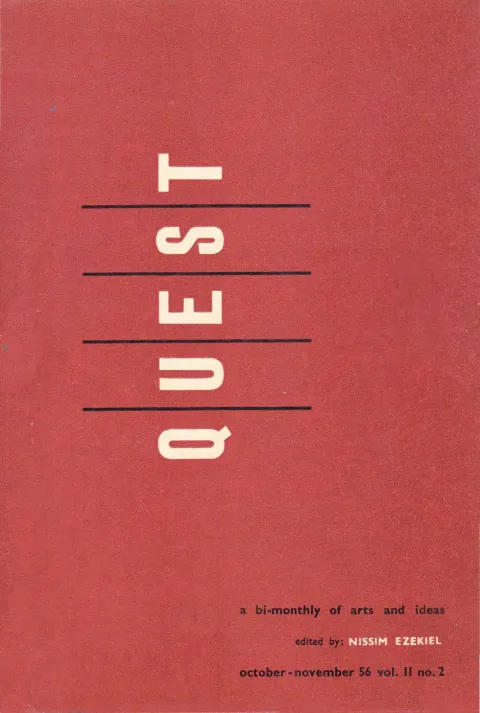
Quest
a bi-monthly of arts and ideas
By A Ranganathan, A. B. Shah, Harry Roskolenko, Sunil Mukherji, Walter Z. Laqueur, Satindra Singh, Ranjani Rao, Philip Spratt, Natwar Singh, Gangadhar Gadgil, A. M. Ghose, D. D. Karve
QUEST is published once every two months in August, October, December, February, April and June, at Army & Navy Building, 148, Mahatma Gandhi Road, Bombay 1. ... Edited, printed and published by Nissim Ezekiel for the Indian Committee for Cultural Freedom, Army and Navy Building, 148, Mahatma Gandhi Road, Bombay 1, at the Kanada Press, Podar Chambers, 109, Farsi Bazar Street, Fort, Bombay 1. · Bombay · 1956
72 pages
QUEST
Summary
This issue of Quest (Vol. II No. 2, October-November 1956), edited by Nissim Ezekiel for the Indian Committee for Cultural Freedom, opens with an unsigned editorial arguing that a liberal democracy is the only political order that can support the arts without dictating to them, explicitly contrasting this with a Soviet-style Ministry of Culture. The seven articles that follow range widely: A. B. Shah examines the dangers and limits of Gandhian satyagraha as a tool for a self-righteous majority or a fractious minority in independent India (using the Bombay-Maharashtra linguistic dispute as his test case); Sunil Mukherji and Walter Z. Laqueur (the latter reprinted from The New Leader as a ‘prophetic’ pre-nationalisation piece) analyse the Suez Canal crisis and the character of Nasserism; Satindra Singh surveys the politicised historiography of post-Independence India; Philip Spratt offers a Jungian/mythological reading of the Subhas Chandra Bose ‘return of the hero’ legend; A. Ranganathan traces Thoreau’s influence on Gandhi; and Natwar Singh contributes an admiring literary tribute to R. K. Narayan. A short story by Gangadhar Gadgil (translated from the Marathi by Padma S. Rao), three poems, eight book reviews and two correspondence letters (on the state of academic philosophy and on anti-Americanism) round out the issue, along with a ‘Contributors to this issue’ page and a Congress for Cultural Freedom short-story-competition announcement.
Beyond the printed table of contents, the issue also carries four unnumbered art/photography plates tipped in mid-issue (between printed pages 22 and 23): a Raza painting, a photograph by Dr. S. B. Cooper, and two pages of street photographs by Jean Herman — none of which is listed in the contents page. Read across the whole issue, a recurrent argumentative thread is a liberal, anti-totalitarian scepticism of both Communist and majoritarian-nationalist solutions — whether in Indian domestic politics (satyagraha, historiography, linguistic-state reorganisation), in the Suez crisis, or in Cold War alignment — paired with a strong interest in literary and artistic culture for its own sake.
Essays
Satyagraha and Democracy
By A. B. Shah
A. B. Shah examines satyagraha as an instrument of political change in independent India, arguing that its usual justification — that it awakens the moral conscience of an opponent — assumes an idealised Gandhian actor rarely found in practice. He traces the theory of satyagraha (its etymology, its reliance on ‘soulforce’ and quality over quantity of participants, Gandhiji’s willingness to work with ‘ordinary mortals’) before turning to its dangers: a mass civil-disobedience movement tends to slip into violence (citing the 1955-56 Goa demonstrations and the reaction to the States Reorganisation Commission report in Bombay), and it relies on emotion rather than reasoned agreement, which is corrosive of parliamentary norms. Using the Congress leadership’s decision to make Bombay a centrally administered area against the wishes of Maharashtra as his central illustration, he argues satyagraha is justified only as a last resort, when parliamentary methods are genuinely closed, and that even Gandhiji’s own movement did no more than ‘rouse and weld together’ Indians against a common foreign enemy — a very different, and much easier, task than a minority group or regional unit would face today.
- Democracy relies on persuasion by rational argument, but a determined majority can still curtail minority rights while formally observing the Constitution (the Madras caste-exclusion example, the Jeep-scandal exchange).
- The Bombay-Maharashtra dispute is used as the central case: linguistic and cultural claims were conceded ‘in theory but denied in practice’ when Bombay was made a centrally administered area.
- Satyagraha is defined via its Gandhian theory: insistence on truth, willing suffering, ‘soulforce’ over numbers, non-violence in word, action and (ideally) thought.
- In practice, mass satyagraha risks violence by irresponsible elements even under careful leadership, as recent Bombay experience showed.
- Satyagraha appeals to emotion rather than reason and is only legitimate as a last resort after parliamentary and rational avenues are exhausted.
- Even Gandhiji’s satyagraha achieved only a ‘popular awakening,’ not independence itself, which came from other historical forces; a minority group today has far less scope for a comparably unifying appeal.
- Conclusion: satyagraha, like virtue, must be treated as its own reward rather than a reliable political weapon.
Areas of Conscience
By Harry Roskolenko
A short lyric on guilt, cruelty to a drowned cat, and the equalising, self-transforming passage of time and pain from childhood to adulthood.
- Uses the memory of drowning a cat as a recurring image of youthful sin and later remorse.
- Builds a refrain structure (‘and so…’, ‘in all my ways’) across three stanzas moving from guilt to fear to self-knowledge.
Portrait in Purple
By Harry Roskolenko
A satirical character sketch in verse of careerist, morally compromised men — their ‘amoral kingdoms,’ hidden treasons and calculated ambitions — rendered in a mock-mathematical vocabulary of ‘arithmetic,’ ‘measure’ and ‘exactness.’
- Applies a conceit of arithmetic/mathematics to satirise the calculated, transactional morality of ambitious men.
- Each stanza intensifies the indictment, moving from social observation to explicit moral suicide and lechery.
The Suez Canal Crisis
By Sunil Mukherji
Sunil Mukherji reads the Suez Canal nationalisation as one symptom of a broader, difficult re-adjustment between newly sovereign Asian and African states and their former colonial rulers, complicated at every turn by the Cold War contest between the Soviet and Anglo-American blocs. He argues India’s own experience — friendly relations with the West curdling somewhat as the USSR courted New Delhi and the US, in response, armed Pakistan — typifies the dynamic. His central prescription is that national sovereignty itself, both Western and ‘newly independent,’ is an ‘anachronism’ in a shrunken, technologically interdependent world, and that the Suez Canal’s internationalisation could be the opening move toward abrogating sovereignty altogether. He closes by criticising Indian statesmen for indulging Soviet ‘crocodile tears’ about colonial victims while ignoring how the Cold War itself, not Western malice alone, blocks aid and development — pointedly asking whether India might instead ‘blaze a new trail’ by championing cooperative internationalism over national glory.
- Frames Suez, the Algerian war and Goa as three symptoms of the same post-colonial ‘birth pangs.’
- Argues the Cold War, not colonial legacy alone, is what makes decolonisation-era readjustment so combustible.
- India’s drift toward the Soviet bloc pushed the West toward Pakistan, souring Indo-Western relations.
- Calls national sovereignty (Western and Asian/African alike) an anachronism the Suez crisis could help dismantle via internationalisation of the Canal.
- Criticises Indian leaders for uncritically accepting Soviet professions of anti-colonial solidarity while ignoring the World Bank/Aswan Dam funding dispute that actually triggered Nasser’s move.
- Ends with a rhetorical challenge: can India ground its foreign policy in cooperative human welfare rather than national power politics?
Dilemma of the West in Egypt
By Walter Z. Laqueur
Reprinted from The New Leader (23 July 1956) with an editor’s note flagging it as remarkably prophetic (it predates the Canal’s nationalisation), Laqueur’s essay dissects Western ‘conservative’ and ‘liberal’ schools of thought on how to handle Nasser. He rejects the conservative call to prop up Iran, Turkey and Iraq against ‘Nasserism’ as resting on unstable partners, and is harsher still on the liberal position, which he accuses of refusing to distinguish constructive nationalisms (Burma, Ceylon) from an expansionist, Napoleon III/Mussolini-style Nasserism bent on regional ‘leadership’ rather than domestic development. He insists Western observers must take Egyptian and other Arab press and radio at face value rather than dismissing their anti-Western rhetoric as posturing, warning that a handful of hidden ‘wire-pullers’ could turn Nasser’s ‘left-wing fascist’ regime into a Communist one with little effort, and that only a realistic reading of what is actually being said in Cairo can produce a workable Western Middle East policy.
- Surveys the immediate regional backdrop: British withdrawal from Suez, Nasser’s 99.9% election, Sharett’s resignation, Soviet diplomatic overtures.
- Rejects the ‘conservative’ Western strategy of backing Iran/Turkey/Iraq as resting on weak, unstable regimes.
- Rejects the ‘liberal’ Western strategy of accommodating Nasserism, arguing it wrongly equates it with constructive nationalisms elsewhere in Asia.
- Warns that Egyptian state media should be read literally, not dismissed as bluster, citing an editorial boasting ‘every Egyptian is proud to be a Goebbels.’
- Argues the current Cairo regime is already functionally the ‘first stage’ of a people’s democracy, needing only a change of 10-20 personnel to become fully Communist.
- Calls for Western policy grounded in what is actually printed/broadcast in Egypt rather than filtered official translations.
Rewriting of Indian History
By Satindra Singh
Satindra Singh surveys the post-Independence enthusiasm for rewriting Indian history and finds it wanting on both sides of the old divide: foreign historians vilified India to justify colonial rule, while Indian historians (nationalist and Marxist alike, from Nehru’s Discovery of India to Dange’s and Namboodripad’s materialist histories) over-glorified or force-fitted the past to serve present political ends. He lists a set of unanswered puzzles — why India’s civilisation persisted where Egypt’s, Syria’s or Babylon’s did not, why it never industrialised despite an advanced commercial-urban civilisation, why conquerors other than the British were absorbed — and argues these can only be answered through patient, non-ideological empirical research (agrarian economy, land revenue records, trade and archaeology) rather than further politically motivated synthesis.
- New official and independent bodies (a government committee, the Bharatiya Itihasa Samiti, Communist pamphleteers) are all producing new ‘true’ histories of India, welcome in principle but suspect in execution.
- Foreign historians used historiography to justify colonial rule; Indian historians overcorrected into self-glorification.
- Politician-historians (Nehru’s Discovery of India, Dange’s and Namboodripad’s Marxist histories) distort the past to fit present political programmes.
- Lists open, unanswered historical puzzles about the persistence, technological stagnation and repeated conquest of Indian civilisation.
- Proposes empirical remedies: agrarian-economy and land-revenue research, trade and archaeological data, comparative work with Western scholarship on other civilisations.
The Lonely Hour
By Ranjani Rao
A brief lyric on grief, twilight and unending loneliness, tomorrow perpetually deferred.
- Uses storm and twilight imagery (‘dark hooves of bodiless air’, ‘razor-sleek sparrow-way’) to figure grief as an elemental, ongoing event.
- Closes on an image of loneliness that ‘may never end’ with tomorrow ‘always far away.‘
The Rebel
By Philip Spratt
Philip Spratt offers a mythological-psychological reading of the popular refusal to accept Subhas Chandra Bose’s 1945 death, arguing that the coloured prints of a youthful, defiant ‘Netaji’ returning against a rising sun re-enact an ancient Indian myth-pattern of the rebellious slain-and-resurrected god (Indra/Vritra, the Oedipal Prajapati story in the Brahmanas, Krishna, Rama), a pattern Spratt (drawing on A. M. Hocart and Ananda Coomaraswamy) argues had been largely suppressed or moralised out of later Hindu mythology in favour of images of filial, ascetic piety. He reviews Bose’s biography — his youth relative to Gandhi and Nehru, his austere and ‘brahmachari’ reputation, his repeated imprisonments and hunger strikes, his rebellion against ‘the Father of the Nation,’ his flight underground to Germany and Japan — as fitting this template unusually well, and argues Bose’s actual political and intellectual contribution was slight (independence was already implicit in the 1935 constitution and the Cripps offer) even as the emotional force of the myth was real. He closes with the generalisation that ‘the mere rebel is only too likely to turn authoritarian,’ finding Bose politically sterile but psychologically at the centre of ‘much of the world’s romance.’
- Popular belief that Netaji survived and would return functions as a modern instance of the ancient rebellious-slain-god myth pattern.
- Traces the myth through the Rigveda (Indra/Vritra), the Brahmanas’ Oedipal Prajapati story (via Coomaraswamy), and later, more moralised puranic and epic versions (Krishna, Rama, the Vali-Sugriva episode).
- Argues later Hindu tradition largely purged the image of the rebel, replacing it with elderly, ascetic national heroes — Bose is presented as the exception.
- Reviews Bose’s biography (youth, austerity, repeated jailing and hunger strikes, revolt against Gandhi, flight to Germany and Japan, the I.N.A.) as fitting the mythic template closely.
- Argues Bose’s substantive political contribution was minimal since independence was already implicit in the 1935 Act and the 1942 Cripps offer.
- Concludes that ‘the mere rebel’ without a constructive programme tends toward authoritarianism, and that the Bose legend has since faded into ‘the national unconscious.‘
Thoreau’s Impact on Gandhi
By A Ranganathan
A. Ranganathan traces the intellectual debt Gandhi owed to Thoreau, quoting President Sukarno’s claim that this ‘remote and lofty mind’ of nineteenth-century Concord helped shape the twentieth-century Afro-Asian awakening. He follows Thoreau’s own debt to Indian classics (the Gita, the image of Walden mingling with ‘the sacred water of the Ganges’), Gandhi’s 1907 encounter with Thoreau’s Civil Disobedience in South Africa, and the parallel between Thoreau’s tax resistance against slavery and Gandhi’s campaigns against ‘apartheid’ and later against British rule (Champaran, then national satyagraha). Ranganathan also places Tolstoy and Ruskin in this genealogy of influence, and traces a further diffusion outward from Gandhi to Nkrumah-era Gold Coast and Nigeria, Bourguiba’s Tunisia, and the Montgomery bus boycott, framing the whole as a ‘cross-fertilization of ideas’ underwriting a new East-West synthesis.
- Opens with Sukarno’s claim that Thoreau and Gandhi jointly helped form the contemporary Afro-Asian political awakening.
- Traces Thoreau’s own debt to Indian philosophy and Gandhi’s 1907 encounter with Civil Disobedience in South Africa.
- Draws a direct parallel between Thoreau’s resistance to the poll tax (over slavery) and Gandhi’s campaigns in South Africa and India.
- Situates Tolstoy and Ruskin alongside Thoreau as formative influences feeding into Gandhi’s synthesis.
- Traces the onward diffusion of Gandhian method to Nkrumah’s Gold Coast, Nigeria, Bourguiba’s Tunisia, and the Montgomery bus boycott.
- Frames the whole chain (Locke to the Glorious Revolution, Voltaire/Rousseau to the French Revolution, Marx/Lenin to the Russian Revolution, Thoreau/Gandhi to the Indian Revolution) as a general thesis that ‘revolutions are made in the minds of men.‘
Tribute to R. K. Narayan
By Natwar Singh
Natwar Singh’s tribute praises R. K. Narayan as unique among major Indian English writers for never having left India, crediting this for the ‘chastity and purity’ of his fiction. He surveys Narayan’s Malgudi novels from Swami and Friends (1935, praised in Graham Greene’s introduction to The Bachelor of Arts) through The English Teacher, The Dark Room, Mr. Sampath, The Financial Expert and the then-recent Waiting for the Mahatma, describing Narayan’s characters as gently comic, free of violence or moralising ‘isms,’ and his prose as simple, sincere and quietly sad. He singles out Bharati in Waiting for the Mahatma as Narayan’s finest female character to date, and closes by wondering whether Narayan, having apparently exhausted Malgudi’s material, will now venture into fiction with a wider emotional and geographic range.
- Frames Narayan as unique among Indian English writers for never leaving India, crediting this for his fiction’s authenticity.
- Quotes Graham Greene’s introduction to The Bachelor of Arts praising Narayan for first bringing Indian life alive to English readers.
- Surveys Narayan’s novels chronologically from Swami and Friends (1935) to Waiting for the Mahatma (the previous year), with a mixed verdict (praising The Bachelor of Arts and The English Teacher, more critical of The Financial Expert).
- Highlights Narayan’s freedom from ‘isms’, violence and moralising, and his consistently comic-but-melancholy tone.
- Praises Bharati (Waiting for the Mahatma) as Narayan’s best-drawn female character, contrasting her with his earlier ‘flat and passive’ women.
- Closes on whether Narayan’s apparent move beyond Malgudi in his latest novel signals a lasting change in range.
The Cage
By Gangadhar Gadgil (translated from the Marathi by Padma S. Rao)
A Marathi short story (translated by Padma S. Rao) about Ravindra Phatak, an impoverished, hot-tempered college lecturer crushed by his family’s needs — an ailing, asthmatic mother, a wife, two young daughters, a sister still at school — in a cramped two-room Bombay home. When a wealthy student’s father tries to buy a passing grade for his son, first via an ingratiating car ride and a planted cigarette case, and later via the Principal’s thinly veiled hint that a promotion depends on the boy’s marks, Phatak reacts with a proud, wounded refusal each time (hurling the cigarette case back, later throwing a bribery parcel at the same student), even though he immediately regrets the lost opportunity and cannot bring himself to voice his contempt for the Principal aloud. He remains a ‘sheep belonging to the middle class,’ powerless to escape his cage of poverty and obligation even as he preserves, in isolated bursts, his integrity.
- Establishes Phatak’s poverty and domestic burdens (asthmatic mother, wife, children, a school-going sister) in a cramped two-room flat.
- A wealthy student’s father attempts to bribe Phatak with a car ride, flattery and a planted cigarette case; Phatak angrily throws the case back and gets out of the car.
- The College Principal separately hints that a promotion depends on passing the same rich man’s son; Phatak, ashamed, capitulates verbally but cannot bring himself to act corruptly or to protest.
- The story ends with the student, having ‘bluffed’ his way through the exam anyway, delivering a gift parcel that Phatak again refuses, throwing it back at him.
- Phatak’s recurring self-description as ‘a slave to my job, a sheep belonging to the middle class’ frames the story’s title image of a man caged by economic necessity.
The Colour Curtain by Richard Wright
By Prabhakar Padhye
Prabhakar Padhye reviews Richard Wright’s The Colour Curtain, an account of the 1955 Bandung Conference, arguing that despite Wright’s reportorial gifts the book is disfigured by an ‘obsession’ with race that leads him (echoing a charge made against Wright by the Indonesian writer Mochtar Lubis) to read colour and anti-Western feeling into every attitude he encounters. Padhye argues Wright downplays Nehru’s own impatience with the racial and religious rhetoric at Bandung and glosses over the delegates’ silence on Chinese aggression against Burma and on Soviet ‘colonialism’ in Eastern Europe, concluding the book is ‘eminently readable though not equally rewarding.’
- Wright’s earlier work (Black Boy, his chapter in The God That Failed) is praised, setting up disappointment with The Colour Curtain.
- Cites the Indonesian writer Mochtar Lubis’s charge, made in Encounter, that Wright viewed Bandung through ‘coloured glasses.’
- Argues Wright underplays Nehru’s discomfort with racial/religious rhetoric at the conference and its ambivalence toward Communist colonialism.
- Notes Bandung produced little real economic or cultural cooperation and no protest against China’s Burma border violation.
- Final verdict: illuminating in parts (interviews, vignettes) but not an organically successful book.
Integration of States by V. P. Menon
By P. Kodanda Rao
P. Kodanda Rao reviews V. P. Menon’s account of the integration of the Princely States, crediting Sardar Patel’s trust in his lieutenant Menon and their combined ‘ruthless daring and incredible speed’ for achieving what he calls a near-impossible feat within two months of Independence. He recounts how the departing British granted the Princes technically full sovereignty rather than transferring paramountcy to Delhi, creating over 600 nominally independent states that Patel and Menon then absorbed via a policy of limited, then complete, accession. He singles out Kashmir as the one case where Patel and Menon were not given a free hand — the issue was moved to the Ministry of External Affairs under Nehru once the United Nations was invoked — and laments that Kashmir remains unresolved as a result.
- Credits Sardar Patel’s leadership style (delegating full trust to Menon) and Menon’s own energy for the integration’s success.
- Explains the British ‘gift’ of full, separate sovereignty to every Princely State on lapse of paramountcy as needlessly chaotic.
- Details the policy of limited-then-complete accession that absorbed most states, including holdouts like Travancore and Hyderabad.
- Presents Kashmir as the singular failure: the Maharaja delayed, Mountbatten’s advice is disputed, and the issue was later moved out of Patel/Menon’s Ministry of States to Nehru’s External Affairs Ministry once the UN was invoked.
- States as fact that Menon’s book was ‘screened by the present Government of India before publication.‘
The Time of the Assassins by Henry Miller
By Lola Chatterji
Lola Chatterji dismisses Henry Miller’s The Time of the Assassins, a study of Arthur Rimbaud published for his centenary, as a self-indulgent projection of Miller’s own biography onto Rimbaud’s, arguing Miller confuses appreciation of a poet’s work with excusing or romanticising his personal ‘faults’, and that the book’s ‘sonorous’ prose obscures rather than illuminates its subject. She insists a poet must be judged by ‘his handiwork’ alone and that Rimbaud’s poetry, not his vagabondage, is what has earned him lasting influence.
- Miller’s claimed qualification for the biography is a supposed personal resemblance to Rimbaud, which Chatterji finds overworked and unconvincing.
- Situates Rimbaud within the broader 1880s-90s European movement of nihilism/aestheticism (Verlaine, Baudelaire, the Yellow Book group) rather than as an isolated ‘lonely rebel.’
- Criticises Miller for treating the poet as an ‘unacknowledged ruler of the world’ exempt from ordinary standards of interpretation.
- Argues an artist’s biography is at most background, not an excuse for or explanation that supersedes judging the actual work.
- Concludes the book’s 163 pages are not worth Miller’s ‘sonorous’ but confused prose.
The Republic of Indonesia by Dorothy Woodman
By S. Natarajan
S. Natarajan praises Dorothy Woodman’s The Republic of Indonesia for its historical account of sustained Indonesian resistance to Dutch rule and the accelerated nationalism produced under Japanese occupation, and draws repeated parallels with India — language policy, the unitary versus federal question, and education, where Woodman shows the Republic building six universities from a base of fewer than 1,000 university-educated Indonesians. Natarajan’s main criticism is that Woodman fails to distinguish community-development models properly (comparing India unfavourably on this point) and gives too little space to Indonesia’s adoption of a secular national ideal.
- Woodman frames Indonesian nationalism as continuous resistance to Dutch rule, intensified rather than broken by Japanese occupation.
- Draws Indo-Indonesian parallels: language policy (Bahasa Indonesia versus English), and the ease of unitary administration compared to India’s federal structure.
- Highlights Woodman’s account of the post-Independence expansion of higher education from a tiny colonial-era base.
- Criticises Woodman for not properly distinguishing community-development approaches and for underplaying Indonesia’s secular national ideal.
- Notes Woodman’s attention to the prominent role of Indonesian women in the new republic.
What the United States Can do About India by E. Seligman
By A. H. Somjee
A. H. Somjee reviews Eustace Seligman’s What the United States Can Do About India, describing it as a well-intentioned but conceptually dated attempt to convince American readers that India, though non-aligned and often critical of Western policy, is fundamentally on the side of democracy against Communism and therefore deserves warmer US support. Somjee’s central objection is that Seligman tries to place India on an obsolete binary ideological map (democratic versus communist, with a hasty ‘Indian Socialism’ chapter bolted on) when India’s actual programme is best understood as pragmatic experimentalism rather than doctrine, and that simply telling Americans India is ‘with democracy’ risks a further disillusionment rather than genuine understanding.
- Seligman, a lawyer and former colleague of John Foster Dulles, spent six weeks interviewing Indian public figures for the book.
- His thesis: India, despite non-alignment and criticism of Western military alliances, is fundamentally committed to democracy over communism.
- Somjee argues Seligman never asks whether Indians see America itself as genuinely democratic, an omission shared by many Western commentators.
- Criticises the ‘Indian Socialism’ chapter as a hasty attempt to relocate India on an already obsolete East-West ideological map.
- Concludes India’s economic and political programme is experimental and independent rather than classifiable on Seligman’s binary map, and that oversimplifying this to US audiences risks backfiring.
The Legacy of the Lokamanya by Theodore L. Shay
By S. R. Tikekar
S. R. Tikekar welcomes Theodore L. Shay’s The Legacy of the Lokamanya as a fresh, sympathetic outsider’s reading of Bal Gangadhar Tilak’s political philosophy, arguing Shay’s very distance from India (and reliance on translated Marathi sources) gave him clarity that closer, partisan Indian commentators lacked. Tikekar summarises Shay’s central claim that Tilak’s thought was grounded in dharma (rendered as an untranslatable compound of duty, religion and moral rule) aimed at establishing ‘Dharmarajya,’ and highlights Shay’s comparative chapter on Tilak and Gandhi, and his speculative chapter on how Tilak might have drafted a more indigenously-grounded Indian Constitution than the actually adopted, largely Western-derived one.
- Praises Shay’s outsider status (a young American student working through translated Marathi material) as an asset rather than a limitation.
- Summarises Shay’s tripartite world political-philosophy schema (Western, Marxist-Soviet, Indian) and his claim Tilak’s ‘Indian’ philosophy could have global relevance.
- Explains the untranslatable centrality of ‘dharma’ (and ‘Swarajya’ as establishing ‘Dharmarajya’) to Shay’s reading of Tilak.
- Notes Tilak was not opposed to social reform itself, only to reform imposed by an alien government (differing from Agarkar, Bhandarkar, Ranade and Gokhale on method, not goal).
- Highlights Shay’s comparative Tilak-Gandhi chapter and his counterfactual chapter on how Tilak might have shaped the Indian Constitution differently.
Battles at the Bar by K. L. Gauba
By Laeeq Futehally
Laeeq Futehally gives K. L. Gauba’s memoir of famous Lahore and Bombay criminal trials, Battles at the Bar, a mostly negative review, arguing Gauba has genuinely interesting material (the Kishori case, the Colaba Trunk Murder, the Magna Carta case duel with Chief Judge Sir Douglas Young that led to three judges’ resignations) but buries it under a self-consciously literary, facetious and euphemism-heavy style (referring to clients only as ‘D-d-D’ or ‘V-v-V-’) that leaves the reader unable to judge whether the stories themselves were as dramatic as claimed.
- Opens with a joke about ‘ghost writing’ in America to suggest Gauba would have benefited from a collaborator to convey his material more plainly.
- Praises the underlying material (notorious Lahore/Bombay criminal cases, the Magna Carta case against Chief Judge Sir Douglas Young) as inherently dramatic.
- Criticises Gauba’s style as facetious, self-congratulatory and obscured by pseudonyms for influential clients.
- Concludes the reader can admire Gauba’s ‘fiery spirit’ but not fully follow or trust his account of events.
Unprofessional Essays by Middleton Murry
By Shiv K. Kumar
Shiv K. Kumar reviews J. Middleton Murry’s Unprofessional Essays, praising the veteran critic’s late-career shift from professional to informal criticism as lending ‘uncompromising integrity’ to his judgments. He surveys Murry’s spirited but not fully convincing defence of Fielding against F. R. Leavis, his antiquarian recovery of the obscure poet John Clare, a more skeptical treatment of Walt Whitman’s claims to a coherent ‘divine egoism,’ and singles out the essay on T. S. Eliot’s plays as the collection’s strongest, tracing structural weaknesses across Family Reunion and The Confidential Clerk to Eliot’s ‘inhuman detachment’ from romantic love as a subject.
- Frames the book against a wider split in contemporary criticism between ‘professional’ formalism (Leavis et al.) and Virginia Woolf-style ‘unprofessionalism.’
- Murry’s defence of Henry Fielding against Leavis’s attacks is judged spirited but not wholly persuasive.
- The Clare essay recovers an obscure Keats contemporary who found ‘refuge… in insanity,’ valued for its mystic nature poetry.
- Murry’s Whitman essay is more critical, agreeing with Richard Chase that Whitman’s reputation is ‘really not very high.’
- The Eliot essay is singled out as the collection’s best, diagnosing weaknesses in Eliot’s dramatic construction as rooted in emotional detachment from romantic love.
The Study of Philosophy in Our Universities
By A. M. Ghose
In a letter to the editor, A. M. Ghose (Head of the Department of Philosophy, Government College, Ajmer) argues that Indian university philosophy curricula have stagnated since Independence: syllabuses repeat elementary material at higher levels without depth, modern Western movements (Logical Positivism, Phenomenalism, Existentialism) are neglected, medieval European and Chinese and Islamic philosophy are omitted entirely, and Sanskrit/Pali competence among philosophy teachers is weak, leaving even canonical figures like Kant and Hegel taught only at second hand through English commentators. He calls for root-and-branch curriculum revision, greater emphasis on mathematics, physics and languages, and, if necessary, inviting scholars from abroad.
- Argues Indian university Philosophy syllabuses repeat the same elementary material at successive levels without real advancement.
- Notes uneven treatment of Indian versus Islamic philosophy across universities, and weak Sanskrit/Pali competence among teachers.
- Criticises the neglect of medieval European philosophy, Chinese philosophy, and modern movements like Logical Positivism and Existentialism.
- Argues even canonical Western figures (Kant, Hegel) are taught only through English secondary sources rather than the original languages.
- Calls for curriculum revision from the ground up, more mathematics/physics, more language study, and importing foreign scholars if needed.
Anti-Americanism
By D. D. Karve
D. D. Karve (Principal, Fergusson College, Poona), responding to an earlier letter on anti-Americanism, agrees with its general diagnosis but adds two factors he thinks were missed: the perceived hypocrisy of the US backing ‘Totalitarian, Imperialistic and Racist’ regimes such as Spain, Portugal and South Africa while posturing against Soviet imperialism, and simple resentment of the purchasing power of the dollar. He insists, from personal friendships with Americans, that this is not personal animus but a mismatch of moral priorities, closing with the observation that for Asians and Africans racial equality outranks anti-communism as an urgent cause.
- Responds to and largely endorses an earlier letter (by ‘Mr. Farrell’) on the roots of anti-Americanism.
- Adds that US support for Spain, Portugal, South Africa and France reads to Asians/Africans as inconsistent with its anti-Soviet, anti-imperial rhetoric.
- Notes a secondary, minor factor: resentment of the dollar’s high purchasing power abroad, especially in Europe.
- Stresses personal fondness for individual Americans he has known, framing the critique as one of policy and priorities, not people.
- Closes arguing that for Asians and Africans, racial equality is a more urgent cause than anti-communism.
Essay 22
The unsigned editorial (not listed in the printed contents page) argues that culture — ultimately ‘all-pervading’ and saturated with political and economic significance — is inevitably a subject of state concern, but that only a liberal democracy can encourage cultural life without dictating to it. It attacks the idea of an Indian Ministry of Culture on the grounds that no one advocating one has offered an original, non-Communist model for how it would function, and closes by arguing there is no need to study Nazi or Soviet cultural institutions merely for negative lessons when the American Works Progress Administration, the British Arts Council and UNESCO already offer positive models.
- Defines culture broadly (arts, customs, ethics) as inseparable from, and shaped by, economic and political life.
- Argues government involvement in culture is unavoidable in the modern state, so the real question is its form.
- Warns that any government cultural machinery risks becoming an instrument of political control, citing the Communist Ministry-of-Culture model as the extreme case.
- Specifically challenges proponents of an Indian Ministry of Culture to show a non-Communist model for how it would work.
- Points to the American WPA, British Arts Council and UNESCO as preferable models, closing with an ironic aphorism against studying Nazi/Fascist cultural institutions merely for ‘negative lessons.‘
Essay 23
A formal announcement (not listed in the printed contents page) that the Congress for Cultural Freedom, Paris, is sponsoring a short-story competition for Indian writers, conducted for the Congress by Quest: a prize of about Rs. 1,350 (100,000 French francs) for the best English translation of a short story from any Indian language, split Rs. 1,000 to the author and Rs. 350 to the translator, judged by Nirad C. Chaudhuri, Sudhin Datta, R. K. Narayan and Nissim Ezekiel, with entries due by 31 January 1957 and the winner to be published in Quest.
- Prize of approximately Rs. 1,350 (100,000 French francs), split Rs. 1,000 to the author and Rs. 350 to the translator.
- Open only to living Indian-national authors (translators need not be Indian); stories 3,000-7,000 words, not previously published in English.
- Judges: Nirad C. Chaudhuri, Sudhin Datta, R. K. Narayan and Nissim Ezekiel.
- Deadline 31 January 1957, verdict to be announced in the April 1957 issue, winning entry published in Quest.
Essay 24
An unnumbered, uncredited-in-the-contents art plate reproducing ‘Village’ by S. H. Raza, captioned as one of four paintings awarded the Prix de la Critique in Paris that year. It is tipped in mid-issue (between printed pages 22 and 23) with no accompanying essay text and no printed folio.
- A full-page reproduction of a painting titled ‘Village’ by S. H. Raza.
- Captioned as one of four paintings that won the Prix de la Critique in Paris that year.
- Falls on an unnumbered leaf with no printed folio, between printed pages 22 and 23, and has no entry in the printed table of contents.
Essay 25
An unnumbered, uncredited-in-the-contents photograph plate, ‘Meal-time’ by Dr. S. B. Cooper (captioned as shot on Agfa film), showing men buying food and drink from a vendor’s stand beside a train carriage. It immediately follows the Raza painting plate and likewise has no printed folio or table-of-contents entry.
- A full-page photograph titled ‘Meal-time’, credited to Dr. S. B. Cooper and captioned as taken on Agfa film.
- Depicts a group of men at a railway-platform food/drink stand beside a train carriage.
- Falls on an unnumbered leaf with no printed folio and no table-of-contents entry.
Essay 26
Two unnumbered, uncredited-in-the-contents pages of street photography by Jean Herman, six images in all: The Banana Vendor, Paper Wheels and Sugar Cane on the first page, and Kite Seller, Gram and Nuts and a large photograph captioned Pot-Pourri on the second. All are unbylined in the table of contents and fall on leaves without printed folios, immediately following the Raza and Cooper plates.
- Six photographs across two unnumbered pages, all credited ‘Photographs by Jean Herman.’
- First page: The Banana Vendor (a woman vendor seen through a wire mesh of hanging bananas), Paper Wheels, and Sugar Cane (a turbaned man at a cane-press).
- Second page: Kite Seller, Gram and Nuts (a vendor with pyramids of grain), and a larger untitled-by-subject photograph of two men at a hanging balance-scale captioned Pot-Pourri.
- No printed folio and no table-of-contents entry for any of the six images.
Essay 27
The back-matter ‘Contributors to this issue’ page (not listed in the printed table of contents) gives short biographical notes for eight of the issue’s authors: A. B. Shah, Sunil Mukherji, Walter Z. Laqueur, Satindra Singh, Philip Spratt, A. Ranganathan, Gangadhar Gadgil and Harry Roskolenko. No notes are printed for the remaining contributors (poets, reviewers, translator, correspondents, or the art-plate credits).
- Provides biographical notes for 8 of the issue’s roughly 20 non-masthead bylined contributors.
- Notably identifies Philip Spratt as a former British Communist Party envoy involved in the Meerut Conspiracy Case who later repudiated communism.
- Identifies A. B. Shah and Gangadhar Gadgil as academics (Fergusson College, Poona and Sydenham College, Bombay respectively).
- Gives nationality/occupation evidence for Walter Z. Laqueur (London correspondent of The New Leader, an authority on the Middle East) and Harry Roskolenko (American author, recent visitor to India).
Generated by the v1.5 extraction pipeline. Awaiting editorial review.
Metadata and summary are AI-extracted from the source PDF and reviewed for editorial accuracy. The original work is available via the Read PDF tab above (where present); paragraph-level citation inside the PDF is deferred to a future engagement.
People in this work
- A Ranganathanauthor
- A. B. Shahauthor
- Harry Roskolenkoauthor
- Sunil Mukherjiauthor
- Walter Z. Laqueurauthor
- Satindra Singhauthor
- Ranjani Raoauthor
- Philip Sprattauthor
- Natwar Singhauthor
- Gangadhar Gadgilauthor
- A. M. Ghoseauthor
- D. D. Karveauthor
- Padma S. Rao
- Prabhakar Padhye
- P Kodanda Rao
- Lola Chatterji
- S. Natarajan
- A. H. Somjee
- S. R. Tikekar
- Laeeq Futehally
- Shiv K. Kumar
- Nirad C. Chaudhuri
- Sudhin Datta
- D. G. Nadkarni
- Indu P. Saraiya
- S. H. Raza
- S. B. Cooper
- Jean Herman
- Mahatma Gandhi
- Jawaharlal Nehru
- Karl Marx
- M. N. Roy
- Bal Gangadhar Tilak
- John Locke
- Rabindranath Tagore
- Gopal Krishna Gokhale
- Immanuel Kant