
periodical issue
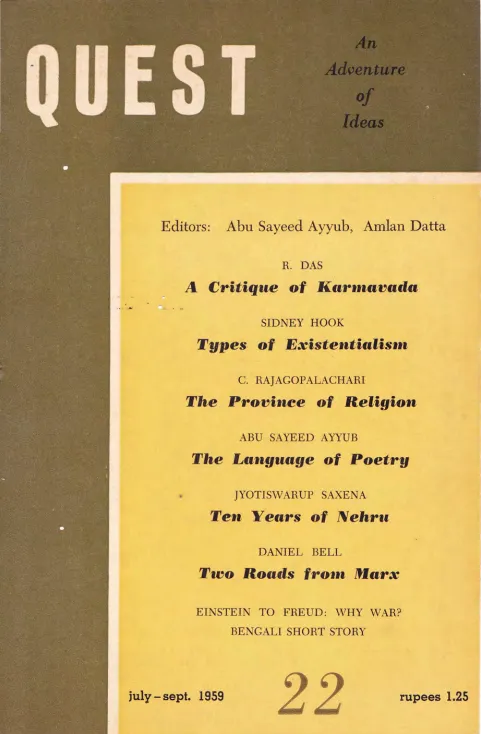
Quest
A Quarterly of Inquiry, Criticism and Ideas
By C. Rajagopalachari, A Ranganathan, Abu Sayeed Ayyub, Albert Einstein, R. Das, Sidney Hook, Gangadhar Gadgil, Prabhakar Padhye, Jyotiswarup Saxena, Daniel Bell, Emily Polk, Amaresh Datta, A. K. Ramanujan, Bertold Brecht, Kironmoy Raha, Ashapurna Gupta, Paresh C. Chatterjee, Punya Sloka Ray
Printed and published by Miss Sheela Singh for the Indian Committee for Cultural Freedom, Army and Navy Building, 148 Mahatma Gandhi Rd., Bombay 1, at Inland Printers, Victoria Mills Buildings, 55 Gamdevi Road, Bombay 7. · Bombay · 1959
116 pages
QUEST
Summary
Quest No. 22 (July-September 1959), edited by Abu Sayeed Ayyub and Amlan Datta, opens with the first half of the Einstein-Freud ‘Why War?’ correspondence (Freud’s reply promised next issue) and then runs a dense run of philosophy-of-religion and literary-theory pieces (R. Das on karma, Sidney Hook on Kierkegaard and Feuerbach, Rajagopalachari on faith and science, and three linked papers from a Quest-sponsored Calcutta seminar on ‘Belief and Literature’ by Gadgil, Padhye and Ayyub). The issue’s political centre of gravity is a sharply critical minority-report style essay on Nehru by Jyotiswarup Saxena, an economic-planning piece on food and population by A. Ranganathan, and Daniel Bell’s ‘Two Roads from Marx’ on alienation and workers’ control, delivered originally at a Congress for Cultural Freedom seminar in Vienna. A poetry section (Emily Polk, Amaresh Datta, A. K. Ramanujan, and two Bertolt Brecht poems reprinted from Encounter) is followed by Kironmoy Raha’s survey of India’s ‘minority theatre’ (Bohurupee, Alkazi), a translated Ashapurna Devi short story, a two-part discussion section on Marxism and on the English-Hindi language question, and eight book reviews closing the issue. QUEST is explicitly sponsored by the Indian Committee for Cultural Freedom, and its Cold-War, anti-totalitarian, pro-pluralist orientation surfaces repeatedly, from the Encounter advertisement to the recurring engagement with Marx and Marxism across at least three separate pieces.
Essays
Why War?
By Albert Einstein
Denis de Rougemont’s framing essay introduces the 1932 Einstein-Freud exchange on ‘Is there any way of delivering mankind from the menace of war?’, commissioned by the League of Nations’ International Institute of Intellectual Co-operation. This issue prints de Rougemont’s introduction plus Einstein’s opening letter, in which Einstein proposes a supranational legislative and judicial body that nations must obey, and interrogates why a small, mercenary, arms-interested minority can bend majorities that would otherwise oppose war. Freud’s reply is announced as forthcoming in the next issue.
- De Rougemont frames the exchange as prophetic, written in 1932 on the threshold of Hitler’s rise.
- Einstein’s proposed remedy is a supranational body to which states surrender a measure of sovereignty.
- Einstein asks how a small, self-interested clique commanding schools, press and church can drive majorities to war.
- De Rougemont notes the situation is now reversed: a ‘super-weapon’ exists while the moral/political authority to control it does not.
- Freud’s answering letter is explicitly deferred to Quest’s next issue.
A Critique of Karmavada
By R. Das
Printed under the running head ‘The Theory of Karma and its Difficulties’, R. Das (full name Rashbehari Das per the contributor note) lays out the doctrine of karma as commonly understood, grants it some prima facie plausibility (it answers the problem of evil and the demand that virtue be rewarded), and then dismantles its three underlying assumptions — that virtue and happiness are linked, that a disembodied moral quality can shape material conditions, and that spirit can migrate between bodies — concluding the theory is ultimately anti-rational, anti-moral and, on some views of religion, anti-religious.
- Das prefers ‘theory’ to ‘law’ of karma, doubting the evidential basis for its stronger claims.
- He grants karma some appeal: it seems to solve the problem of evil without indicting God.
- He rejects the assumed link between virtue and happiness, citing Kant against the theory’s own appeal to Kant.
- He argues no evidence supports spirit existing, or migrating, apart from the body.
- He concludes karma-belief breeds hard-heartedness toward sufferers and diverts attention from remediable social causes of suffering.
Two Types of Existentialism
By Sidney Hook
Sidney Hook contrasts two nineteenth/twentieth-century strands of existentialist religious thought: Kierkegaard’s theism, which grounds faith in an unknowable transcendent Absolute reached by an irrational ‘leap’, and Feuerbach’s humanism, which treats religion as a human projection (‘the secret of theology is anthropology’). Using Kierkegaard’s reading of the Abraham-Isaac story, Hook argues existential theism ultimately accepts the world as given (awaiting salvation through faith), while existential humanism insists on remaking the world through consciously held ethical ideals, and defends the latter against the charge that it is merely another idolatry of human nature.
- Kierkegaard’s God is ‘wholly other than man’, reached only by a leap of faith beyond reason.
- Feuerbach reduces theology to anthropology: religious beliefs are projections of human needs.
- Hook uses the Abraham-Isaac ‘teleological suspension of the ethical’ to contrast the two positions.
- Existential theism tends toward accepting the existing order; existential humanism toward its active transformation.
- Hook defends existential humanism against the charge that grounding ethics in human interest is itself a form of self-worship.
The Province of Religion
By C. Rajagopalachari
Prompted by Nehru’s Azad Memorial address, Rajagopalachari argues that Indian culture ultimately rests on self-control, that such self-control is more effectively secured through religion than through law or state coercion, and that governments therefore should support all religions rather than affect a ‘secular’ neutrality he regards as a misleading label. He also argues that determinism cannot abolish human responsibility, that religion should stay out of the domains properly belonging to science, and closes with a case for unilateral action — rooted in religious conviction — as the only real solvent of international suspicion and fear.
- Self-control, not external coercion, is Rajagopalachari’s account of Indian civilisational discipline.
- He rejects the term ‘secular’ for state impartiality, preferring that governments support all religions equally.
- Physical determinism does not, in his view, eliminate a residual, relative human duty and responsibility.
- Religion should confine itself to the ‘unknowable’ region beyond science’s proper domain.
- He closes with an argument for unilateral action, not balanced terror, as the true road to peace.
The Symbolism of Literature
By Gangadhar Gadgil
Gangadhar Gadgil argues that creative literature does not make truth-claims of the kind moral or political philosophy makes: a novel or poem symbolises an emotional experience rather than asserting or resolving anything, so a reader need not accept a work’s embedded moral or political ideas to value it as literature. He extends this into an account of why totalitarian regimes are perpetually suspicious of creative literature even as they need it: genuine literature’s spirit of free inquiry cannot be made to conform completely to an official system of belief.
- Literary meaning is inward and emotional, not a set of externally verifiable propositions.
- Readers routinely admire works whose embedded worldview they reject (Dostoevsky, ‘Mahabharat’, ‘1984’).
- Moral/political content in literature functions like ‘sparks that fly off a rotating wheel’ — incidental, not the point.
- Totalitarian systems face a dilemma: they need literature to reinforce belief but fear its inherent spirit of free inquiry.
- Paper was originally presented at Quest’s own Calcutta seminar on ‘Belief and Literature’, Feb 1959.
Belief and Literature
By Prabhakar Padhye
Prabhakar Padhye, responding to Arthur Koestler’s inaugural address at the same Calcutta seminar, argues that moral, social and psychological content in literature functions only as a ‘means’ to the creation of an aesthetically patterned emotional experience (‘aesthetic emotion’), not as the ‘end’ that confers greatness — disputing Koestler’s claim, via a Troilus and Cressida passage, that ideology is the hidden scaffolding of even the most timeless art.
- Four schools of literary evaluation are distinguished: aesthetic, moral, social, psychological.
- Padhye argues readers turn to literature for a distinctive ‘aesthetic emotion’, not moral or social instruction available more directly elsewhere.
- He disputes Koestler’s ‘scaffolding’ metaphor, preferring to call ideas the ‘material’ of the literary ‘mansion’.
- Art is valued because it increases awareness/consciousness (citing J. W. N. Sullivan) and gives the artist a threefold harmony with nature, others, and self.
- Paper was also presented at the Quest-sponsored ‘Belief and Literature’ seminar, Calcutta, Feb 1959.
The Language of Poetry
By Abu Sayeed Ayyub
In Part I (‘Autonomous and Opaque’) of a two-part essay, Abu Sayeed Ayyub attacks the modern critical fashion — associated with Mallarme, Sartre and the ‘new critics’ — of treating poetic language as wholly opaque, referring to nothing beyond its own sound and image, a ‘thing’ rather than a ‘sign’. Ayyub argues this sacrifices meaning for sonal/pictorial effect, that poetry’s ‘aesthetic surface’ is far poorer than music’s and cannot bear the weight symbolist theory places on it, and that this is corrupting both poetry and, via Joyce and Stein, prose. Part II is announced for the next issue.
- Sartre and Mallarme are cited as treating words in a poem as opaque ‘things’, not transparent signs pointing beyond themselves.
- Ayyub rejects the ‘organic theory’ fusing form and content as inadequate once form is elevated over meaning.
- He argues the poetic ‘aesthetic surface’ (sound, image) is inherently poorer than music’s and cannot sustain a pure-form theory of poetry.
- Jacques Maritain’s account of modern poetry abolishing its ‘intermediary signification’ is examined and rejected.
- The essay is explicitly Part I, with the conclusion promised in the following issue.
Ten Years of Nehru
By Jawaharlal Nehru
Under the fuller printed title ‘Ten Years of Nehru: A Minority Report’, Jyotiswarup Saxena delivers a bitter, deliberately partisan indictment of Jawaharlal Nehru’s decade as Prime Minister, arguing the once-mythic ‘intellectual’ Nehru of the independence era has been captured by the party machine and bureaucracy, has presided over the erosion of democratic institutions from panchayats to universities, and now administers rather than creates — his popularity resting on manufactured myth rather than substance. Saxena frames this explicitly as a partisan ‘minority report’ rather than a balanced assessment.
- Saxena distinguishes the youthful, mythic Nehru of the independence struggle from the Prime Minister of 1959.
- He argues nearly every Indian democratic institution, from panchayats to universities, has grown less democratic under Nehru despite his rhetoric.
- He calls the popular faith in Nehru ‘the greatest confidence-trick in our history’.
- He credits Nehru with secularism and planning as real achievements, while arguing his ‘socialism’ has become strategy rather than conviction.
- The essay explicitly self-identifies as a ‘minority report’ — a disenchanted, partisan assessment, not a consensus view.
- It closes by denying Nehru the status of culture-hero: ‘a politician can only administer, he cannot create’.
Food and Population
By A Ranganathan
A. Ranganathan surveys India’s food-and-population problem at the close of the First Five Year Plan, tracing the historical slide from occasional export surplus to chronic deficit (worsened by the loss of Burma, the 1943 Bengal Famine, and Partition), citing Census Commissioner projections of population reaching 450-520 million by 1981, and weighing remedies — migration, agricultural investment, industrialisation and voluntary family planning — while warning that deficit financing to fund heavy industry is generating dangerous inflation that itself threatens the food position.
- FAO import/export data across 1900-1940 shows India moved from occasional surplus to chronic food deficit after Burma’s separation.
- The 1943 Bengal Famine and Partition (loss of wheat/irrigated acreage) sharply worsened the structural food deficit.
- Census Commissioner projections cited: population reaching 410m (1961), 460m (1971), 520m (1981), with food capacity capping it near 450m around 1969.
- Ranganathan argues deficit financing (Rs. 957 crores injected in three years) is generating a dangerous, partly artificial inflation.
- He calls for voluntary, socially-educated family planning rather than legislative compulsion, plus a 10-million-ton food reserve.
Two Roads from Marx
By Daniel Bell
Presented as Part II of a paper from a 1958 Vienna Congress for Cultural Freedom seminar on Workers’ Participation in Management, Daniel Bell traces how Marx’s early concept of alienation-as-loss-of-self-in-work was narrowed by the mature Marx into the economic category of ‘exploitation’, so that abolishing private property came to be seen as sufficient to end alienation — a conflation Bell argues was mistaken, since dehumanised, monotonous work persists under both capitalism and Soviet-style socialism alike. Reviewing Guild Socialism and the ambiguous slogan of ‘workers’ control’, Bell argues real reform must focus concretely on equity and on the organisation of the work process itself, not on grand property-relations solutions.
- Bell distinguishes the young Marx’s ‘alienation’ (loss of control over work) from the mature Marx’s narrower ‘exploitation’ (loss of surplus value).
- He argues abolishing private property did not end alienation in the Soviet Union, where a heavy, police-backed exploitation of labour persists.
- Guild Socialism is examined as an instructive but overly rationalist blueprint for reconciling state and syndicalist control.
- ‘Workers’ control’ is shown to conflate two senses of ‘control’ — direction/management versus a defensive check on arbitrary power.
- Bell locates the real, tractable problem in the engineering ‘cult of efficiency’ underlying modern work organisation, in both capitalist and communist economies.
- He cites the Scanlon Plan and job-enlargement as concrete, incremental routes to meaningful work, rather than utopian property-relations fixes.
A Center
By Emily Polk
A short lyric of fractured identity, in which the speaker repeatedly asks ‘Who am I?’ amid images of an anonymous urban crossing.
- Speaker questions their own identity across three brief stanzas.
- Urban, anonymous imagery of streets and corners frames the search for self.
The Castles
By Emily Polk
A melancholy lyric imagining decaying Adriatic/Venetian castles by the sea, invoking their buried scandals and grandeur, and wishing them, and their history, unmade.
- Castles personified as aging, gossiped-about figures by the sea.
- The poem asks the wind/sea to recount old scandals, then wishes ‘that none of it has ever been’.
Our Hands
By Amaresh Datta
A love poem built around the image of joined hands as the site of an inarticulate, bodily language of intimacy that succeeds where words and eyes fail, closing with a vision of two hands, freed from anguish, able to ‘give shape to a god’.
- Hands are figured as a wordless ‘language of blood’ between lovers.
- The poem moves from images of pursuit and storm to calm, mutual stillness.
One Reads
By A. K. Ramanujan
A. K. Ramanujan’s poem contrasts the numbed, daily consumption of newspaper catastrophe — flood, fire, distant violence — with the sudden, unsettling perception of nearby suffering (a beggar ‘squatting on his shadow’), indicting the reader’s habituated, merely charitable response to both.
- Newspaper headlines of disaster (Ganges floods, burned villages) are absorbed ‘daily, and therefore calmly’.
- The poem shifts from distant, abstracted catastrophe to a close, uncomfortable image of urban poverty.
- Ends by indicting charity as a ‘counterfeit’ response to visible suffering.
Two Poems
By Bertold Brecht
Two short Brecht poems are printed with an editorial note explaining their provenance: ‘The Solution’, a satirical epigram on the East German government’s response to the 17 June 1953 uprising, whose Brecht authorship the note says is unconfirmed but plausible; and ‘Bad Morning’, read (per Martin Esslin, quoted from Encounter) as expressing Brecht’s guilt over his support for the East German regime.
- ‘The Solution’ proposes, ironically, that the government ‘dissolve the people’ and elect another, after officials blamed the people for losing the government’s confidence.
- An editorial note states Brecht’s authorship of ‘The Solution’ is unconfirmed but ‘genuine’ per Martin Esslin’s stylistic judgement in Encounter, June 1959.
- ‘Bad Morning’ is read as Brecht’s guilt-laden self-address after the 1953 uprising.
- Both poems are reprinted from Encounter with permission.
Minority Theatre in India
By Kironmoy Raha
Kironmoy Raha traces the near-total collapse of India’s classical dramatic tradition and its replacement, from the late nineteenth century, by an imitative, artificial Parsi/commercial theatre, arguing that a genuine ‘minority theatre’ movement — beginning with IPTA’s 1944 ‘Nabanna’ — has since produced serious, socially-grounded work, above all from Sombhu Mitra’s Bohurupee troupe in Calcutta and E. Alkazi’s Theatre Unit in Bombay, though it remains hampered by the absence of a first-rate native playwright and of any permanent stage of its own. Four uncaptioned photographs of Bohurupee and Alkazi productions are tipped in as plates alongside the article (see toc_index 28).
- India’s classical Sanskrit dramatic tradition (Sakuntala, Mrichchakatika) had already largely died out before British-era theatre arrived.
- The Parsi theatre, India’s first modern theatre, is described as an artificial ‘twice removed’ copy of a British theatre already at its own nadir.
- IPTA’s 1944 production of ‘Nabanna’ (on the Bengal famine) is credited with founding the modern ‘minority theatre’ movement’s naturalistic, socially-engaged idiom.
- Sombhu Mitra’s Bohurupee (Calcutta) and E. Alkazi’s Theatre Unit (Bombay) are singled out as the movement’s most accomplished exponents.
- Raha identifies two unresolved weaknesses: no major native playwright has yet emerged, and the movement lacks a permanent theatre building.
All For A Match
By Ashapurna Devi
Translated from Bengali by Lila Ray, Ashapurna Devi’s comic-then-poignant story follows Jayanti, who wakes to find the household out of matches after her husband burned the last box on incense the previous night; a petty argument over the missing matches escalates into a marriage-endangering quarrel and the loss of their maidservant, until Jayanti, tidying up in remorse, finds one surviving matchstick among the ashes — and, in a final ironic twist, nearly sets herself alight with kerosene meant for the reconciliation dinner she plans to cook.
- A missing box of matches, used up the previous night on incense during a happy homecoming, triggers the story’s crisis.
- The maidservant Sarada quits after a shouting match, which escalates into open marital cruelty between Jayanti and her husband Jahar.
- Jayanti later finds one surviving matchstick while cleaning, and resolves to cook a reconciliation dinner.
- The narrator intervenes directly in the closing lines to forestall disbelief that ‘a single match’ could cause such a conflagration.
Herbert Luthy and Marxism
By Paresh C. Chatterjee
Paresh C. Chatterjee rebuts Herbert Luthy’s earlier Quest review of Fritz Sternberg’s ‘Capitalism and Socialism on Trial’, defending Marx against the charge that his economic model was merely an unrealistic abstraction and that he failed to foresee imperialism and monopoly capitalism; Chatterjee argues Marx anticipated Say’s Law’s failure decades before Keynes, foresaw the concentration/centralisation of capital, and that Marxist theories of imperialism (as capital-export safety-valve and source of ‘super-profits’ pacifying metropolitan workers) remain broadly confirmed by economic history, even while conceding Marx’s economic theory is not infallible.
- Chatterjee credits Marx with rejecting Say’s Law of markets roughly seventy years before Keynes, quoting John Strachey to that effect.
- He argues Marx’s analysis of concentration and centralisation of capital anticipated later academic discussion of monopoly/oligopoly.
- He distinguishes Marxist imperialism (monopoly capital plus capital export) from mere colonialism, and defends its explanatory power using Jules Ferry and Joseph Chamberlain’s own 1880s statements.
- He argues ‘super-profits’ from imperialism both propped up the rate of profit at home and pacified metropolitan workers, echoing Engels and Lenin.
- The piece closes conceding Marx erred in particulars while insisting Marxism as method remains valid: ‘Marx might have been wrong here and there, but not Marxism.‘
The Place of English in India
By Punya Sloka Ray
Printed under the head ‘II. The Necessity of English in India’, Punya Sloka Ray responds to an earlier Quest discussion piece by ‘Shri Kant’ arguing English should be replaced by Hindi, contending that the English-speaking group is fairly representative of all Indian regions while the Hindi-speaking group is concentrated in one region, that the ‘gulf’ commonly blamed on English is really a pre-existing gentry/lower-class social gulf, and warning that a hasty, ungenerous transition to Hindi risks alienating half the nation and cutting India off from world knowledge.
- Ray disputes the analogy between English-speakers (1% of India, drawn from all regions) and Hindi-speakers (42%, concentrated in the north-central belt).
- He argues the English/non-English social gulf predates English education and is really a gentry/lower-class divide.
- He warns that replacing English risks both regional favouritism and cutting India off from imported knowledge.
- He is sceptical that Hindi enthusiasts have reckoned honestly with the sacrifices and self-discipline a fair transition would require.
Bodily Responses
By M. D. Hatkananglekar
M. D. Hatkananglekar reviews George Buchanan’s slim poetry collection ‘Bodily Responses’, sardonically dissecting its call for an ‘aphrodisian revolution’ restoring bodily/erotic feeling against a coldly cerebral modernity, and concluding that while the underlying diagnosis (modern man’s dried-up feeling) is sound, Buchanan’s prescriptive theorising in verse form is unpersuasive and occasionally self-parodying.
- The collection, illustrated in a Yellow-Nineties style with Titian’s Venus on its cover, argues for an ‘aphrodisian revolution’ reuniting head and body/heart.
- Hatkananglekar mocks the book’s explanatory footnotes as symptomatic of the very cerebral disconnection it decries.
- He questions whether an individual remedy (bodily/erotic reintegration) can meaningfully be scaled to a whole society.
- The review closes with a folk anecdote about a fisherman who catches, then rejects, a mermaid — used to needle Buchanan’s own theory.
Determinism and Freedom
By A. B. Shah
A. B. Shah reviews the proceedings of a 1957 NYU symposium on determinism edited by Sidney Hook, praising papers by Max Black, William Barrett and H. L. A. Hart (on legal responsibility) as clarifying confusions in the free-will debate, while criticising Brand Blanshard’s metaphysical defence of determinism and noting the self-undermining logic of ‘hard determinism’: if the determinist’s own attitudes are as pre-determined as the opponent’s, on what basis does he blame anyone?
- The symposium is organised in four sections: philosophical, scientific, legal/ethical determinism, and general discussion.
- Shah singles out H. L. A. Hart’s treatment of legal responsibility and excusing conditions as especially valuable.
- He argues ‘hard determinism’ is self-undermining: it cannot coherently ground blame if all attitudes, including the determinist’s own, are pre-determined.
- He criticises Brand Blanshard’s claim that necessity in an object of thought partially determines the movement of thought itself as unsupported metaphysics.
Mind and Matter
By A. B. Shah
In the same combined review, A. B. Shah turns to Erwin Schrodinger’s ‘Mind and Matter’ (his 1956 Tarner Lectures) and finds it a disappointment after the determinism symposium, criticising its idealist-leaning claim that the world is ‘a construct of our sensations, perceptions, memories’ as reminiscent of Eddington and Russell ‘at their worst’, and suggesting Schrodinger needs a critic of Susan Stebbing’s calibre.
- Schrodinger speculates other species could have organs of thought as superior to the human brain as ours is to a dog’s or snail’s.
- Shah finds Schrodinger’s idealist framing of the physical world as a ‘construct of our sensations’ philosophically weak.
- The review closes by comparing the needed corrective to Susan Stebbing’s earlier critique of Arthur Eddington.
The Rhythm of History
By Sadashiv Athavale
Sadashiv Athavale reviews Arthur Osborne’s ‘The Rhythm of History’, which claims to find recurring, divinely-guided ‘rhythms’ and parallels across world civilisations without asserting a full theory of progress; Athavale finds the thesis internally inconsistent (mighty beginnings, empires and bifurcations are inconsistently timed and explained) and ultimately no more than an unfalsifiable appeal to providence, closing with H. L. A. Fisher’s admission that he can discern no plot or rhythm in history at all.
- Osborne rejects both cyclic-progress and ‘fortuitous universe’ theories of history in favour of a providential ‘rhythm’.
- Athavale challenges Osborne’s dating scheme — why should the 6th-5th century BC beginnings count but not Christianity or Islam?
- He notes Osborne’s own account contradicts itself between claiming parallel world-historical rhythms and explaining East-West ‘bifurcation’ at the Renaissance.
- Athavale ultimately judges the ‘rhythm’ thesis a way of smuggling in a divine plan that explains everything and nothing.
Nehru and Democracy
By Jawaharlal Nehru
K. K. Sinha reviews Donald Eugene Smith’s ‘Nehru and Democracy’, questioning whether Nehru’s copious, mostly extemporaneous speeches amount to a systematic political philosophy, tracing Nehru’s psychological dependence first on his father and then on Gandhi as decisive for his recurring ideological swings, and concluding Nehru remains, for all essential purposes, a classical-Marxian socialist in outlook whose most durable achievement — secularism — is itself under strain from communalism, regionalism and casteism, with no clear definition of Indian identity yet on offer to survive him.
- Sinha doubts Nehru’s voluminous, largely unprepared speeches constitute a coherent political philosophy.
- He traces Nehru’s recurring ideological swings to an emotional dependence first on his father, then on Gandhi as a substitute father-figure.
- He credits Nehru’s greatest contribution as secularism, distinguishing his approach from Gandhi’s more religiously-inflected one.
- He judges Nehru’s underlying outlook ‘socialist in the classical Marxian sense’ despite his personal decency and rejection of Soviet-style realpolitik.
- The review closes questioning whether India, post-Nehru, has any settled definition of itself as a civil society.
India’s fight for Freedom
By M. V. Namjoshi
M. V. Namjoshi reviews Haridas and Uma Mukherjee’s ‘India’s Fight for Freedom or the Swadeshi Movement (1905-1960)’, welcoming its new archival data on the 1905-06 Bengal partition agitation and its fusion of regional and national goals, but faulting the book for not clearly distinguishing the narrower 1905-06 sense of ‘Swadeshi’ from its broader, longer-running economic-attitude sense.
- The book explains the emergence of a new 1905-06 national outlook (Swaraj, Swadeshi, national education, united Bengal) from the regional protest against Bengal’s partition.
- Namjoshi credits it with providing new data on the period, including the founding of the Muslim League and moderate/extremist polarisation.
- He criticises the authors for not distinguishing the 1905-06 agitation sense of ‘Swadeshi’ from its broader economic-programme sense (preference for Khaddar and Indian capital/labour).
East to West
By A. H. Somjee
A. H. Somjee reviews Arnold Toynbee’s travel memoir ‘East to West’, describing how Toynbee’s seventeen-month round-the-world tour — taken after thirty-three years at the Royal Institute of International Affairs — shifted between historian, sociologist and sentimental registers depending on the country, with India provoking his most emotional response and a wish to return without itinerary or deadline.
- The journey ran from Ecuador and Peru through New Zealand, Australia, and the Far/Middle East.
- Toynbee approaches each country in a different register: historian in the Andes, sociologist in Japan, sentimentalist in India.
- He deliberately avoids each country’s ‘standardized’ modern capital in favour of its historical civilisation.
- Somjee notes the impressions were written up immediately after travel, at the cost of occasional superficial generalisation.
Kingdom Come
By M. G. Desai
M. G. Desai reviews Laurence Clark’s comic novel ‘Kingdom Come’, a farcical send-up of the dying ‘Sahibocracy’ on the North-West Frontier during the 1942 Quit India movement, praising Clark’s gift for caricature while judging the publisher’s claim of a ‘brilliant satire on the times’ overstated for what is ultimately frothy, naive entertainment.
- The novel follows young Lieutenant Felix Tolley commanding a fictional frontier fortress during the 1942 Quit India agitation.
- Desai reads it as effective caricature of the declining British ‘Sahibocracy’ rather than serious satire in the vein of ‘A Passage to India’.
- He praises Clark’s comic gift while gently deflating the publisher’s blurb claiming ‘brilliant satire on the times’.
Essay 28
Two unpaginated photographic plates (four production stills in total) are tipped into the issue between the article text on printed pages 72-73 and 73-74, illustrating Kironmoy Raha’s ‘Minority Theatre in India’ but carrying no separate contents-page listing. They show two Bohurupee (Calcutta, directed by Sombhu Mitra) productions — a scene from Tagore’s ‘Rakta Karabi’ and a scene from ‘Putul Khela’ (a Bengali translation of Ibsen’s ‘A Doll’s House’) — and two E. Alkazi (Bombay) productions — a scene from Ibsen’s ‘Hedda Gabler’ and Alkazi’s stage setting for Strindberg’s ‘The Father’.
- Not listed on the printed contents page; identified only by discovering the plates have no printed folio between printed pages 72 and 77.
- Two photographs credit Bohurupee (Sombhu Mitra’s Calcutta troupe): Tagore’s ‘Rakta Karabi’ and ‘Putul Khela’ (Ibsen’s ‘A Doll’s House’ in Bengali translation).
- Two photographs credit E. Alkazi’s Bombay Theatre Unit: Ibsen’s ‘Hedda Gabler’ and Alkazi’s set design for Strindberg’s ‘The Father’.
- The plates carry only italic photo captions, no accompanying prose; they directly illustrate claims made in the adjoining Kironmoy Raha article about Bohurupee and Alkazi as the movement’s leading exponents.
Generated by the v1.5 extraction pipeline. Awaiting editorial review.
Metadata and summary are AI-extracted from the source PDF and reviewed for editorial accuracy. The original work is available via the Read PDF tab above (where present); paragraph-level citation inside the PDF is deferred to a future engagement.
People in this work
- C. Rajagopalachariauthor
- A Ranganathanauthor
- Abu Sayeed Ayyubauthor
- Albert Einsteinauthor
- R. Dasauthor
- Sidney Hookauthor
- Gangadhar Gadgilauthor
- Prabhakar Padhyeauthor
- Jyotiswarup Saxenaauthor
- Daniel Bellauthor
- Emily Polkauthor
- Amaresh Dattaauthor
- A. K. Ramanujanauthor
- Bertold Brechtauthor
- Kironmoy Rahaauthor
- Ashapurna Guptaauthor
- Paresh C. Chatterjeeauthor
- Punya Sloka Rayauthor
- Prof. Amlan Datta
- Nirad C. Chaudhuri
- Sudhin Datta
- Laxmanshastri Joshi
- A. B. Shah
- Sheela Singh
- Denis de Rougemont
- Lila Ray
- M. D. Hatkananglekar
- Sadashiv Athavale
- K. K. Sinha
- M. V. Namjoshi
- A. H. Somjee
- M. G. Desai
- Immanuel Kant
- Jawaharlal Nehru
- Mahatma Gandhi
- Karl Marx
- John Stuart Mill